Home Blog Page 6190

Article 370 fallout: Pakistan partially shuts down airspace between India and Pakistan for a month

0

As Pakistan tries to increase tensions over full integration of Jammu and Kashmir in India by abrogation of Article 370 by the Indian government, it has partially shut down its airspace for all airlines. The Pakistan airspace remained closed for several months after the Balakot strikes by India, and it was reopened only last month.

According to a NOTAM (notice to airman) issued by Pakistan on 6th August, three segments of air routes between India and Pakistan will remain closed till 5th September. All three segments are part of International routes connecting Lahore. They have cited ‘operations reasons’ as the reason for this closure. The restriction will be in place for 8 hours and 15 minutes a day, except Sundays. The NOTAM also states that alternative segment of the route is available above 30,000 feet for flights operating on the affected route, while flights
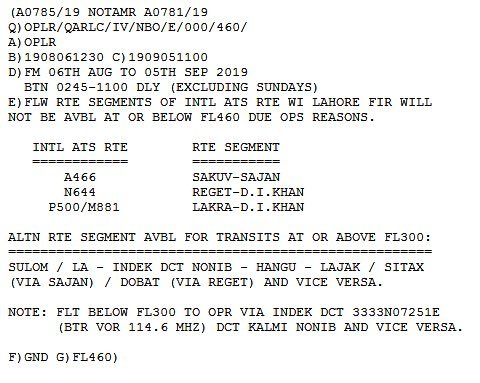
NOTAM issued by Pakistan

This airspace closure is much minor compared to the complete closure of airspace by Pakistan after Balakot strikes. During that time all international flights that usually fly over Pakistan had to take a different route avoiding Pakistan, resulting in a longer route which had increased cost of the airlines. Compared to that, the current order will increase the flying time by a few minutes for some flights that operate during the restricted time period.

With this decision, the flying time of around 50 flights will increase by about 10-15 minutes for Indian carriers. “The major route which we use for our long haul flights are still open and hence the impact is not much right now but we have got initial inputs that the remaining air routes will be shut. The impact will be huge as flying time for our ultra long haul flights using Pakistani airspace would increase by 2-3 hours,” said a senior Air India official.

Yesterday, a report in Times of Islamabad had reported that such a move was being anticipated after India abrogated all provisions of Article 370 and stripped Jammu and Kashmir off its special status. “Pakistan is anticipating February-like aerial aggression from the Indian side; thus, an airspace closure is deemed necessary”.

After the Balakot airstrikes where India had gone deep into Pakistan territory and flattened terror camps in Balakot with airstrikes, Pakistan had shut its airspace completely for weeks. Pakistan had in June asserted that it will open its Eastern airspace for flights to and from New Delhi only if India promises not to repeat a Balakot like operation inside Pakistan’s territory. Interestingly, while Pakistan wants India to promise that a Balakot like operation won’t be repeated, when the operation, codenamed ‘Operation Bandar’ had happened, Pakistan had lied that India had managed to hit just a few trees. It was only in July that Pakistan had re-opened its airspace for civilian flights again.

Yesterday Pakistan had downgraded diplomatic relations with India along with suspending trade relations, to which India responded today by reiterating that revocation of Article 370 is a completely internal matter of India.
Re-shaping Article 370: Has the Modi government upped its Constitutional game?

These last few days have been exciting, to say the least, but perhaps the words historic and momentous do better justice to them. The lightning speed with which the Presidential Orders of August 5, 2019, and August 6, 2019, have been promulgated thanks to the Centre’s doggedness and determination, has put an end to the 70-year old stalemate created by and surrounding Article 370 of the Indian Constitution.

Contrary to what was widely reported and continues to be reported by the mainstream media, Article 370 has not been “scrapped” or “repealed”. Instead, the Article has been employed to supersede the 1954 Presidential Order with the Order of August 5, 2019, and critically, to extend and apply the entire Indian Constitution to the State of Jammu and Kashmir.

The following results have been achieved cumulatively through the twin Presidential Orders:

  1. With the supersession of the 1954 Presidential Order, abominations such as Article 35A, which were introduced through the 1954 Order, have been done away with in one fell swoop;
  2. The Constitution of Jammu and Kashmir, 1956, which was a by-product of Article 370, has been replaced by and with the Indian Constitution;
  3. While Article 370 still remains in the Constitution, the new version cements the application of the Indian Constitution to the State notwithstanding anything contained in any provision of the Constitution or any other legal instrument, which includes the Instrument of Accession executed between the Princely State of Jammu and Kashmir and the Indian Union.

The sequence in which the Presidential Orders have been promulgated is of particular significance since the object of the Order of August 5th was to first achieve the replacement of the Jammu and Kashmir Constitution with the Indian Constitution, so as to avoid a Constitutional void.

Further, the Order also paved the way for invoking Article 370(3) by replacing the hitherto inoperable references to the “Constituent Assembly of the State” (which ceased to exist in 1956 once the J&K Constitution came into force), with the “Legislative Assembly of the State”. This way, it was made possible for the President to invoke the amended Article 370(3) through the second Presidential Order to overhaul the entire provision to cement the sovereignty of the Indian Constitution over the troubled State.

Given that the State is currently under the President’s Rule, it is being argued in some quarters that the constitutionality of both Presidential Orders is seriously circumspect since neither the Government of the State nor the Legislative Assembly has been taken on board before giving effect to the decision. While this appears to be an arguable position, it is important to note that the unamended Articles 370(1) & 370(3) began with non-obstante clauses, meaning thereby, that no other provision of the Constitution could have been used to fetter the application of any of the powers of either the Parliament or the President under Article 370. This means that such powers were available for exercise even during the subsistence of the President’s Rule under Article 356.

Therefore, constitutionally speaking, it could be argued that the Presidential Orders of August 5 & 6, 2019 cannot be impugned on the ground that they could not have been promulgated during the President’s Rule. If the framers of the Constitution had indeed intended to prevent such a circumstance, they could have easily clarified in Article 370 itself that the President could not exercise his powers under the Article when the State was under President’s Rule.

As for the legality of amending Article 367 through a Presidential Order under Article 370, the Government may have been inspired by the ruling of the Supreme Court in 1961 in Puranlal Lakhanpal v The President of India wherein it was held by a Constitution Bench that the power of the President under Article 370(1)(d) even extended to the insertion of an altogether new provision in the Indian Constitution in relation to the State of Jammu and Kashmir. This decision was rendered in the backdrop of a challenge to Article 35A on the ground that the President could not have inserted Article 35A through powers under Article 370 since it was in violation of the procedure for Constitutional amendment prescribed in Article 368.

Since the Supreme Court upheld the validity of Article 35A by enlarging the scope of powers of the President under Article 370(1)(d), one suspects the Government too can defend the amendment to Articles 367 and 370 by placing reliance on the very same judgment. In other words, if the opponents of the current Presidential Orders wish to challenge the constitutionality of the amendment to Articles 367 and 370 on grounds of violation of Article 368, they cannot do so without conceding that even Article 35A was introduced in 1954 in violation of Article 368.

Interestingly, the Home Minister Shri Amit Shah referred to Article 363 in his speech in the Parliament introducing the resolutions relating to Article 370. Those who have already approached the Supreme Court challenging the Presidential Orders and those who wish to join the queue should perhaps read Article 363. This is because the said Article effectively takes away the jurisdiction of the Supreme Court or any other Court in relation to a dispute which relates to a covenant or treaty or any other instrument entered into by the Ruler of a Princely State with the Indian Union.

In fact, a combined reading of Articles 363 & 143 would make it clear that any dispute which falls within the scope of Article 363, falls within the exclusive jurisdiction of the President, and the Supreme Court may at best perform an advisory role when such advice is sought by the President under Article 143.

While none of this precludes further challenges to the Presidential Orders before the Supreme Court, and it is anyone’s guess which way the Supremes will ultimately rule, this much is clear that a lot of thought has gone into the ideation and execution of Operation 370 in all respects, not just legal.

This is also proof of the fact that the BJP has now understood that it is possible to find solutions for “core issues” within the four corners of the Constitution. One sincerely hopes that the very same commitment, focus and execution are brought to bear on other core issues.

Incompetence or malice? Indiatimes twists Ranvir Shorey’s comments against Congress to target Modi Govt on abrogation of Article 370

With every passing day, it is becoming increasingly difficult to ascertain whether the mainstream media’s repeated mistakes are due to sheer malice or a consequence of their utter incompetence. The latest outlet to engage in a hilarious gaffe is Indiatimes.

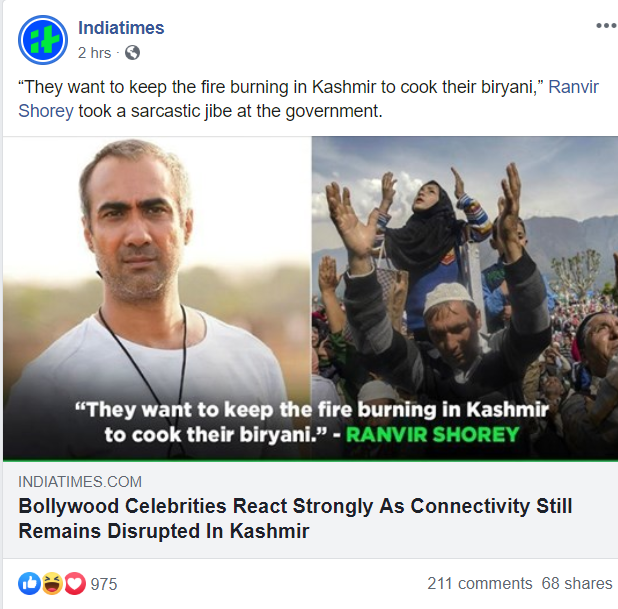
In an article posted recently, IndiaTimes claimed that actor Ranvir Shorey had taken a jibe against the government. Indiatimes was quoting a comment Shorey had made in a tweet.

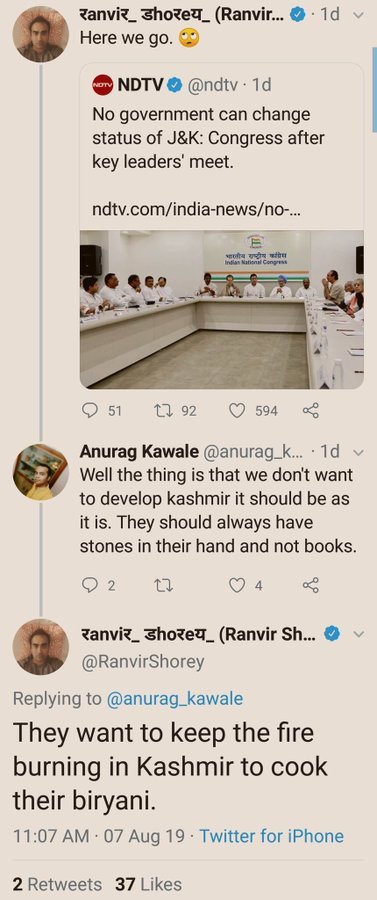
However, when one reads the entire conversation, it becomes evident that Shorey had not used the words for the government but for the Congress party. It is difficult to imagine exactly how does any reporter fails to report something as simple as even this inaccurately. It beggars belief.

In the screenshot, it is evident that Ranveer Shorey was responding to a comment that derided Congress’ statement that nobody can change the status of Jammu and Kashmir. Congress has taken an opposing stand to the Modi government abrogating Article 370. The person Ranveer Shorey responded to say that they (Congress) don’t want to see a developed Kashmir and want to ensure that Kashmiris have stones in their hands and not books.

To that, Shorey said that “they (Congress) wants to keep the fire burning in Kashmir to cook their Biryani.

IndiaTimes maliciously turned this comment by Shorey to say that he called the Modi government out.

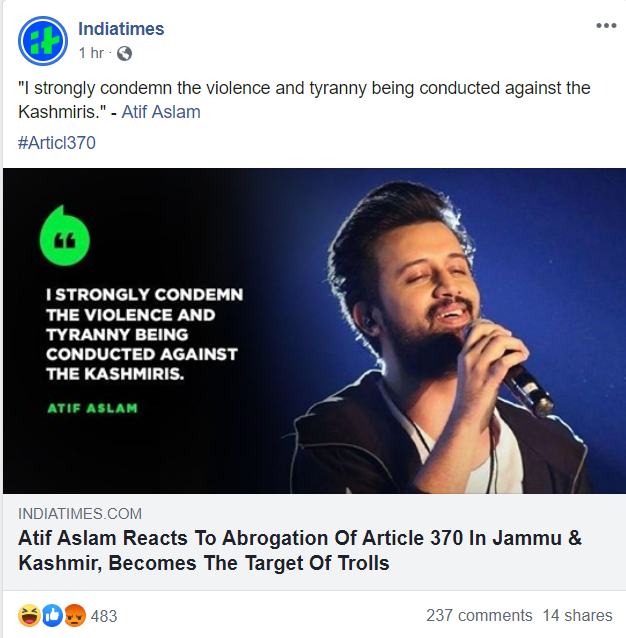
Interestingly, another report by Indiatimes does lead one to conclude that the mistakes may be motivated more by malice than mere incompetence. It reported that Pakistani singer Atif Aslam was attacked by ‘trolls’ on social media for his comments on Kashmir.

As is quite evident, Atif was criticized by patriotic Indians for his ridiculous comments on Kashmir. It’s quite natural that Indians would feel angered by the fact that Atif was meddling in the issue even as he earned lots of money from working in this country. It does show the motivations of Indiatimes that they label patriotic Indians ‘trolls’ for merely exercising their freedom of speech.

The media has been running a sustained fake news campaign against the government regarding the situation in Kashmir. ThePrint had claimed that the Indian government informed the US before abolishing Article 370, a dubious nonsensical claim that was denied by American authorities.

Molestation accused propagandist Vinod Dua had claimed that PM Modi had requested POTUS Donald Trump to mediate on the Kashmir issue, despite the fact that it has been denied categorically by the Indian administration. Intriguingly, such mistakes unfailingly occur in only one direction, never the other.

Congress’ Ghulam Nabi Azad goes to Srinagar to be part of ‘sadness’ in JK after abrogation of Article 370, sent back from airport to Delhi

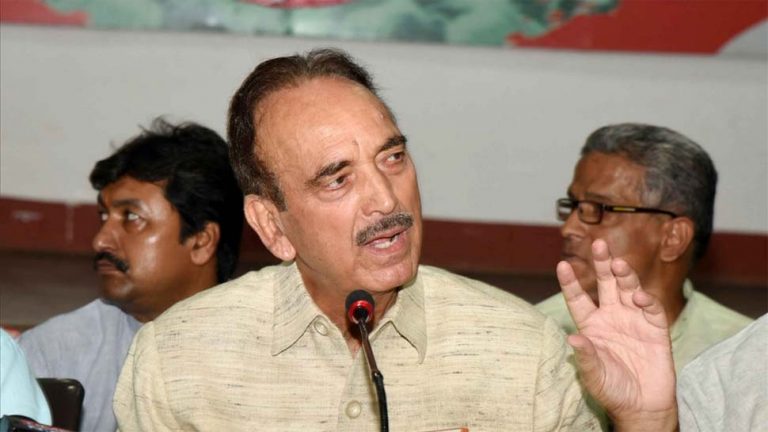
Congress leaders Ghulam Nabi Azad and Congress JK chief Ghulam Ahmed Mir who were earlier detained at the Srinagar airport are being sent back to New Delhi as the erstwhile state of Jammu and Kashmir slowly returns back to normalcy after the momentous decision taken by the government to abrogate Article 370 and bifurcate the state into two union territories.


The Rajya Sabha leader of opposition Ghulam Nabi Azad and Jammu and Kashmir Congress chief Ghulam Ahmed Mir were stopped just at the exit of the Srinagar airport. Azad and Mir were expected to meet the Congress cadres and leaders in the Valley who have been incommunicado since the imposition of Section 144 in the state along with the suspension of communication links.

Azad stated that he is going to the Kashmir to be a part of the ‘sadness’ that has crept over the state after the government took the “murderous decision” of bifurcating the state and repealing Article 370. He said that it is perhaps for the first time in the history of Independent India that all 22 districts in Jammu and Kashmir have been lockdown simultaneously.

Earlier today, Ghulam Nabi Azad had insinuated that the Kashmiris are a tradeable commodity as he stated that locals in Shopian who were seen yesterday dining out with National Security Advisor Ajit Doval were paid for the charade.

Congress is facing a divide within in its own ranks as there are two distinct factions over the issue of Jammu and Kashmir. While one has manifestly protested against the government’s decision regarding the state, the other too has come out and supported the central government for the true integration of the state with the union and the annulment of the partition relic. Jyotiraditya Scindia, Milind Deora, Deepender Hooda, Janardhan Dwivedi have welcomed the government’s decision. Congress’ chief whip Bhubaneswar Kalita resigned from Rajya Sabha because he was upset over Congress’ stand to oppose Centre’s move to dilute Article 370.  Rahul Gandhi, Sonia Gandhi and Priyanka avoided making an outright condemnation of the government move but they expressed their displeasure over the way the decision was implemented.

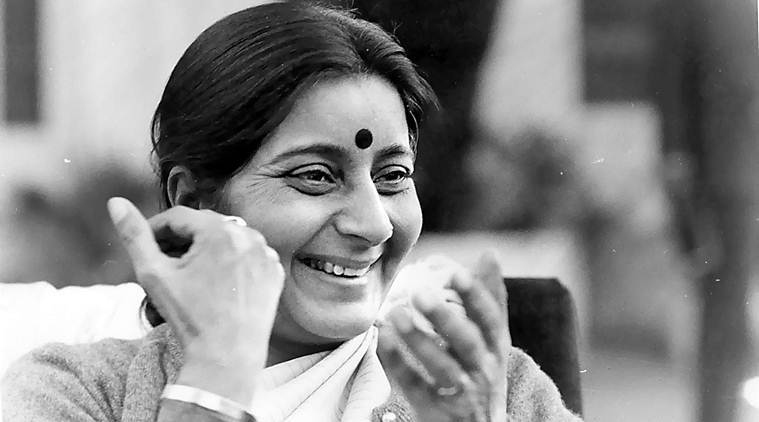
Travel well Sushma Swaraj, they don’t make leaders like you anymore

The only time I cried when a politician passed away was when Jayalalitha had died in December 2016. I was a bit surprised myself because I am someone who had mocked his cousin when he had dropped tears when Bala Saheb Thackeray had passed away. I cried again the other day. Sushma Swaraj’s death seemed like a personal loss.

My first memory of Sushma Swaraj is from the late ’90s when a new chapter in Indian politics was about to be written. This was the time when BJP was set to ascend to power for the first time and she being a great orator was one of the star campaigners of the party. I still remember watching Sushma Swaraj’s campaign trail in Delhi on news channels in 1998; her fiery speeches attacking the Congress, reaching out to the refugees in transit camps, the tongue in cheek statements drawing thunderous applause from the audience and being thronged by women as she campaigned through the bylanes of the capital. Taking a jibe towards the ‘Italian’ Sonia Gandhi, she once told NDTV that ” Ordinary women connect with me because I dress and speak as they do”; which was indeed the truth. Clad in a saree with a big bindi and sindoor; she was just like the millions of mothers and wives in the nation.

When she took over as the Leader of Opposition in 2009, it was almost certain that she would be the BJP’s prime ministerial candidate in 2014 Lok Sabha elections. We all saw a mellow and mature Sushma Swaraj compared to the feisty Swaraj of the 1990s. Though she never talked about it but it wouldn’t be wrong to say that she was preparing herself for the larger role. However, Narendra Modi led BJP’s victory in 2012 Gujarat polls altered the situation. The entire BJP cadre saw Narendra Modi as the BJP’s PM candidate and given his Sangh background he was also the RSS’s blue-eyed boy. Fighting all the internal tussles and differences, he was finally declared as the Prime Minister candidate.

Sushma Swaraj has had a remarkable career. She has many firsts to her credits as being the youngest ever Cabinet Minister in the history of India, first woman Chief Minister of the capital, first woman spokesperson of any political party and of course BJP’s first woman Leader of Opposition. She has won elections in Haryana, Delhi and Madhya Pradesh with remarkable margins. Though she lost the 1999 Bellary elections to Sonia Gandhi, nobody can deny the fact that she had put up a great fight and secured massive 3,58,000 votes in just 12 days of the campaign.

As a Union Minister in the NDA government, she handled various portfolios and brought radical and important changes in the ministries. She can be credited with establishing six All India Institute of Medical Sciences (AIIMS) across India; an initiative she took as the Health Minister aimed towards providing economical yet efficient health services to people. As the minister of I&B and Telecommunications declaring Films as an industry was a milestone step as it made the industry eligible to get loans and be financed by banks which were otherwise funded by the underworld. She freed the industry from the control of the underworld and ironically the same industry now takes out petitions against her party. She can also be credited for much of the ‘radio boom’ in the country as she encouraged community radio services which enabled colleges and universities to start their own FM stations.  In a span of over 3 years, she brought the radio and cable services to a large population in the country. Her popularity can be assessed by the fact that Multiple System Operator (MSO) wanted Sushma Swaraj back as I&B Minister when she was moved to another portfolio.

Her tenure as the External Affairs Minister when NDA returned to power has been nothing short of historic. Historic because she will go down as one of the most popular Foreign Ministers ever. She added a humane touch to the Ministry and was truly a people’s leader. While she was often ridiculed as a Visa Minister, Sushma Swaraj never bothered and kept on working earnestly which has earned her so much goodwill and respect. Often told that she is being shadowed by the Prime Minister; Sushma Swaraj on the floor of the house asked former PM Manmohan Singh as to how many times his foreign minister accompanied him on the foreign visits.

Though her party has produced many women netas it is Sushma Swaraj who is a feminist in true sense. It was due to her efforts that two-thirds of the seats in BJP were reserved for women. Smriti Irani who is often touted as the next ‘Sushma Swaraj’ acknowledges this and thanks Swaraj for pushing through the reservation. She has been quite vocal about women equality & security. I still remember her Lok Sabha speech on International Women’s Day where she talked about increasing crime against women and urged that irrespective of political ideologies, the political class should ensure that women are safe in the country. She is also one of the few BJP netas to have come out strongly against the moral policing by organizations like the Sri Ram Sene. She has stated that her daughter who studies in Britain often visits pubs and it is up to her to decide whether she wants to celebrate Valentine’s Day or not. However, it’s unfortunate that her critics still view her as a traditional (maybe orthodox) Bhartiya Nari who vowed to shave her head if Sonia Gandhi became India’s Prime Minister.

As the leader of the opposition, Swaraj has been brilliant in the Lok-Sabha. An articulate and forceful speaker, she managed to keep the ruling party on its toes and successfully brought the agenda of the opposition on the table. Some of the outstanding debates in the parliament saw speeches by Sushma Swaraj; especially on Lokpal Bill, Coalgate, Cash for Votes and the FDI. Whether it is the ‘sher-o-shayri’  with the PM or advising the young Manish Tiwari to learn ‘vinamrata; she has been one of the finest Lok Sabha speakers that the country has seen.

Personally, I have admired her since the time I started understanding politics. Being a woman in India is tough and it’s tougher when you are a woman trying to make it big in the male-dominated the world of politics. Her political journey has been nothing but phenomenal. The way Sushma Swaraj rose through the ranks, breaking several glass ceilings and made it to the top without any godfather is commendable. I have been particularly moved by her speeches in the Parliament because she was the voice of the ‘right’ in the country. I have been so consumed by her brilliant oratory that I have lost count as to how many times I have replayed her speeches on Youtube. Such was the euphoria that the first thing I did post coming from college (2011-2013) and office (2013-present) was to go to YouTube and listen to her speech of the day. Dinner and other chores could wait but not her speech.

Deep down, I wanted her to become the Prime Minister, but I came to terms as she did. I was hoping to see her as the next President. I was also hoping to meet her someday. I remember tweeting this to her often, but I, of course, one of the many fans and somehow, I never got the chance to meet. They don’t make leaders like you anymore. Good Bye!

Congress leader and son of Maharaja Hari Singh who signed Instrument of Accession, Dr Karan Singh, welcomes abrogation of Article 370

0

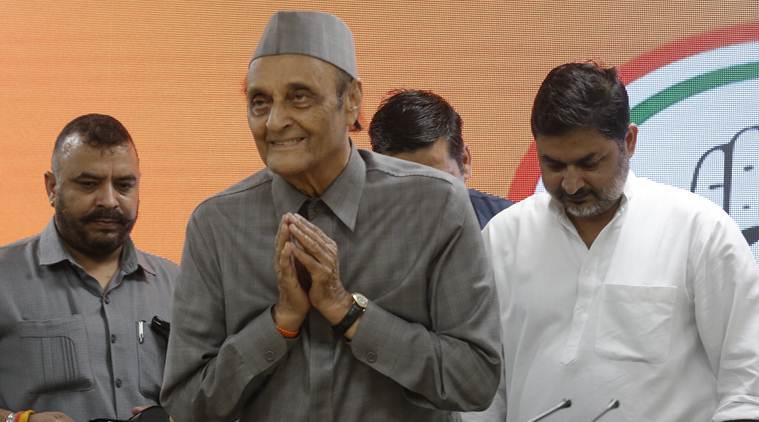
Senior Congress leader and son of Maharaja Hari Singh, the last king of erstwhile state of Jammu and Kashmir, who had signed the Instrument of Accession agreeing to accede to the Dominion of India, Dr Karan Singh has welcomed the abrogation of Article 370 and bifurcation of the state into union territories of Jammu & Kashmir and Ladakh.

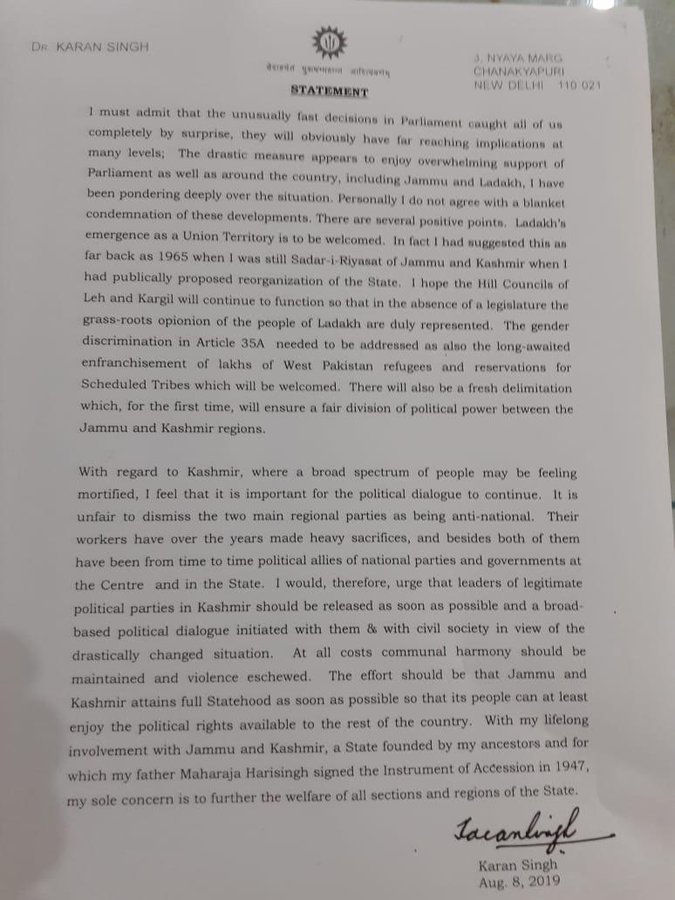
Statement issued by Dr Karan Singh, Congress leader and son of Maharaja Hari Singh (image: ANI)

In his statement, the last ‘Yuvraj’ of Jammu and Kashmir said that the drastic step taken by the Indian government appears to be enjoying an overwhelming support of the Parliament as well as around the country including region of Jammu and Ladakh.

He says that he has been pondering over the issue and does not think that blanket condemnation of the step is appropriate. He says that he had suggested recognition of Ladakh as a union territory back in 1965 itself when he was the Sadar-i-Riyasat of the state. He also mentioned that the discriminatory Article 35A had to be addressed and the fresh delimitation will ensure fair division of political power between Jammu and Kashmir regions.

With regard to Kashmir, he said that the political dialogue must continue and would be unfair to dismiss the two major regional parties as ‘anti-national’. He urged the politicians to hold a political dialogue and insisted that the communal harmony should be maintained. He added that his sole concern is to further the welfare of all sections and regions of the state.

Congress leader Karan Singh joins long list of prominent Congress leaders who have come out in support of Modi government’s decision to dilute Article 370 making Jammu and Kashmir a part of India without any riders attached. Earlier, Jyotiraditya Scindia, Deepinder Hooda, Janardan Dwivedi have come out in support of abrogation of Article 370. Congress’ chief whip Bhubaneswar Kalita even resigned from Rajya Sabha over Congress’ stand on Article 370.

Rajasthan: Dalit woman commits suicide in Bharatpur after allegedly tortured and threatened by police

A Dalit woman named Amita Devi (35) allegedly committed suicide by hanging herself to death on Tuesday due to torture by police. She took the extreme step in her house at Bhandor village in Sewar police station area of Bharatpur district in Rajasthan.

The family members of Amita have alleged that she was tortured and abused by the police who took her to the Sewar police station on Monday to inquire about her husband who had reportedly eloped with a young girl from the village 15 days ago.

Even after being released she was constantly being threatened by the police which made her take the drastic step, alleged the Dalit woman’s family members.

The Police were informed of the suicide and they promptly reached the spot.

According to sources the Dalit woman’s husband had eloped with a schoolgirl living in the same village 15 days ago. Acting on the complaint lodged by the young girl’s parents, the Sewar police picked up Amita Devi and her brother-in-law from their house and took them to the police station for investigation suspecting that she was aware of her husband’s whereabouts.

During interrogation, Amita was allegedly thrashed and humiliated by cops who told her that they would beat her up again if she didn’t give up her husband’s location.

Depressed after she returned home from the Sewer police station at around 11 pm on Monday night, Amita narrated her ordeal to her younger sister.

Humiliated by what transpired the 35-year-old locked herself in her room and was found hanging from the ceiling on Tuesday morning, the sister said.

The family demanded a probe against the Sewar police personnel in abetting the death, following which an inquiry has been started against the cops. The police have, however, denied the charges against them saying that Amita Devi was not tortured or threatened by them.

This is, however, not the first time Rajasthan police has been accused of this kind of mistreatment and brutality. A similar case where Rajasthan police had been charged for allegedly gang-raping and brutally beating up a Dalit woman in Sardarshahr Police station in Churu, Rajasthan had been reported on July 16, 2019.

A 35-year-old Dalit woman and her brother-in-law Nemichand were allegedly illegally detained by the then SHO and other police officers. The woman had alleged that she was raped, tortured and beaten up after her brother in law died in police custody. Subsequently, an FIR had been registered against the then SHO and five to seven other police officers.

Here is how the Narendra Modi doctrine has broken all psychological barriers and left Pakistan clueless

Among the “retaliatory measures” announced by Pakistan yesterday, and I kid you not, is a threat to observe Aug 15 as a Black Day.

Yes, you may burst out laughing.

What else has Pakistan got in its arsenal? For one, they are sending the Indian High Commissioner back home. Which can only be good news for him and his family? I hope he will be reassigned to a better, more livable country soon.

Anything else? Well, they are suspending all bilateral trade with India. That’s a big move for a country that is currently rationing roti, naan and possibly “timatar.” This will also mean that Pakistan will have to sell more donkeys to China in order to earn precious bits of foreign exchange.

Is it beneath us to revel in the misery of a neighbour? I couldn’t care less. We have tried to treat them well, be good neighbours, for 70 years. Enough. What is that colloquial Hindi saying about knowing the difference between those who respond to “laat” and those who respond to “baat“? Pakistan has richly qualified to be among the former.

So what else can Pakistan do? Stop some cultural exchange program with India? Review the Indus Water Treaty and decide to build a dam that will stop the river from flowing upwards?

Basically, Pakistan has been blindsided by what should be termed as the “Modi Doctrine.” Keep raising the stakes and calling the bluff of the other side.

For decades, we tried to keep our peace and avoid stepping on their toes. By acting crazy, Pakistan got away with everything. After every terrorist attack, we would call their diplomats, use some stern language and then send them home with a dossier.

Because we had so much to lose and they had nothing to lose, they could basically do whatever they wanted. This is the irony where the crazier party wins.

Modi’s solution was to call their bluff. We wouldn’t cross the LoC because we thought it would send the crazy Pakistanis over the edge. Even at the time of the Kargil War, we did not cross the LoC. But when Uri happened, India went right ahead with a surgical strike across the Line of Control. The response left the Pakistani establishment numb with surprise.

Then Balakot. After the Pulwama attack, the Pakistani establishment was expecting a second surgical strike. They had their Army ready to prevent Surgical Strike #2. They were waiting for it. As Modi later explained in one of his rallies, “Hum upar se chale gaye” — we went over their heads. We sent the Indian Air Force and bombed a terrorist camp not in PoK but in Pakistan proper.

Once again, India had raised the stakes. Called their bluff.

Now Kashmir and Article 370 are a purely internal matter of India, a fact that India’s principal opposition party may or may not understand. But as with many other things, India has come to expect a nuisance from Pakistan in our day to day lives, as with flies when we lay out the food on an outdoor picnic.

At one stroke on Monday, Aug 5, India moved to fully integrate Kashmir with the rest of our country. The Pakistanis, who thought they had built up some kind of pressure by meeting with the Americans, were left at a loss for words.

Each of these was just a psychological barrier: the LoC, the border, Article 370. And we have called the bluff of all elements, both domestic and foreign, who warned us of all sorts of consequences.

Did any country in the world speak in favour of Pakistan after Balakot? No. In fact, they got rebuked even by their Chinese benefactors.

Any significant violence in Kashmir after Article 370 was revoked? No! If Pakistan wants to jump up and down and make a fool of itself over India’s internal administrative affairs, it is not our problem. They say they are going to the UN Security Council. Fat chance they have there. The recent 15-1 thrashing to Pakistan at the International Court of Justice should tell them where they stand on the global stage. Has any other Muslim nation said anything against India’s move in Kashmir? No, but significant ones like UAE have welcomed it. The Chinese did make some feeble noises about Ladakh, but a stern rebuke from India sent them packing.

We are not a world power if we can’t do things unilaterally. The Modi doctrine is to act first and then ask the world to deal with it.

As far as Pakistan is concerned, when we keep raising the stakes, we take advantage of surprise away from terrorists.

What will Pakistan do now? Send more terrorists to India? But should another major terror attack happen, Pakistan no longer knows what to expect. How far will we go? Will the Indian Air Force strike Rawalpindi next time? Will we block the Indus river and finish agriculture in all of Pakistan? They don’t know.

We’ve had enough of them getting their way because they act crazy. They are not actually crazy. The Pakistani Army establishment wants to live just as much as we do. We know they don’t want to die in a nuclear conflagration. Now the onus is on them to think carefully before doing anything against us. Because there is no saying what we will do in response.

The finest part of the Modi doctrine is that it is permanent. No future government can now dilute this doctrine. Because public pressure simply would not allow it. After Pulwama, there was anger but also deep confidence among the masses. We knew India was going to punish them. The only question was when and how much. The sense of helplessness that was common in the old days was no longer around. No future Prime Minister can now deviate from this path, because people would hold them to Modi’s standards.

Hopefully, Pakistan gets it. Perhaps that’s why they are “retaliating” by observing Black Day on this or that occasion. Good to see that they are developing techniques for anger management.

In an act of bravery, Muslim woman tears up triple talaq paper in front of her husband, says ‘it won’t work anymore’

In an exemplary act of bravery, a Muslim woman belonging to Rampur of Uttar Pradesh tore the piece of talaq paper at a counselling centre in Moradabad, where the couple had gone for a ‘mediation’, while saying that “this (triple talaq) won’t work anymore”, reports Times of India.

Reportedly, the husband of the victim, who works as a labourer had given her ‘talaq’ on a piece of paper and threw her out of the house. The woman with all her courage has now stood against the oppression by tearing off that illegal divorce paper.

The victim woman had complained to Moradabad SP that her husband would often harass her for dowry. On July 1, the husband had written talaq thrice on a piece of paper and handed it over to her. The SP had then asked the couple to visit the Nari Utthan Kendra counsellor.

On Tuesday, Sandhya Rawat, the counsellor at Nari Utthan Kendra counsellor had asked the couple to appear before the centre for a counselling session. As counsellor listened to the couple, the woman tore the ‘talaq’ paper in front of her husband. The husband then agreed to take her back.

“The woman is 52-year-old while her husband is 55. During the counselling session, the woman showed courage and made it clear to her husband that she was not going to leave him, and there was no use of writing ‘talaq’ on a piece of paper. We shot the entire scene in our mobile phone when she was tearing the ‘talaq’ paper,” Rawat reportedly said to TOI.

“This video of tearing the paper with talaq written on it will certainly help. We’ll use it to convince other quarrelling couples,” said Rawat terming it as an emotional moment.

Reportedly, the woman was married to him for 26 years and belonged to a poor family. The husband is a labourer and the couple has three children. The eldest son is 19-year-old.

The victim had lodged a complaint around 11 years ago after being fed up of her husband for harassing her over dowry. The matter was resolved after families from both sides reached out and took prompt initiatives, said counsellor Ritu Narang said.

The effect of newly enacted Triple Talaq law is already being reflected in the society as a similar incident took place in  Saharanpur, Uttar Pradesh after a Muslim man named Mohammad Ali returned to his wife fearing arrest after the historic Triple Talaq bill became a law making the illegal divorce a punishable offence.

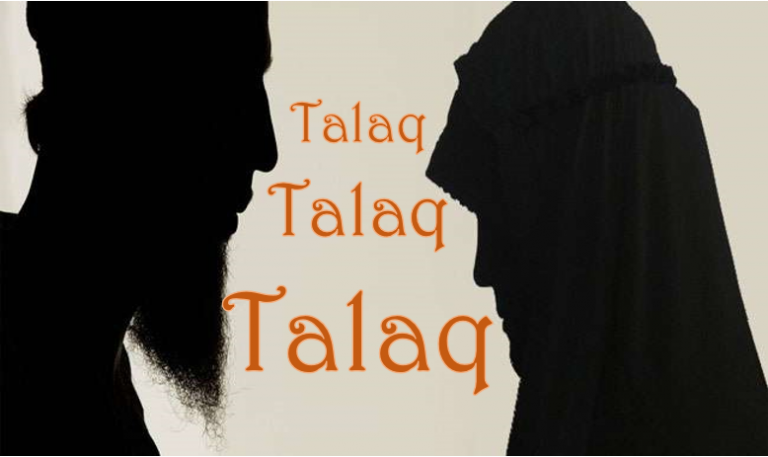
The historic triple talaq bill passed by Narendra Modi led NDA government makes a declaration of talaq-e-biddat in spoken, written or through SMS or WhatsApp or any other electronic chat illegal. Talaq-e-biddat refers to the pronouncement of talaq three times by a Muslim man in one sitting to his wife resulting in an instant and irrevocable divorce.

The triple talaq law also makes a declaration of talaq-e-biddat cognisable offence that gives a police officer powers to arrest the offender without requiring a warrant. A Muslim man pronouncing instant triple talaq attracts a jail term of three years under the triple talaq law. The accused under the triple talaq law is entitled to bail, which can be granted by a magistrate. But the bail can be granted only after the magistrate has heard the aggrieved woman.

Molestation accused ‘journalist’ Vinod Dua lies again, this time on Trump’s statement on Kashmir after abrogation of Article 370

Molestation accused purveyor of fake news ‘journalist’ Vinod Dua was caught spreading lies yet again. In a video uploaded last night on media house ‘HW News Network’, Dua asks a pointed question whether Jammu and Kashmir is indeed an internal matter of India.

At around 2 minutes into the video, Dua says that it is still not clear whether the Kashmir issue is an internal matter (something that India has always maintained) or whether it is a bilateral matter or whether it is an international matter. India has always maintained that PoK is a part of India and is under illegal occupation of Pakistan

He adds how Trump had also offered to mediate in the matter, “Donald Trump ne bhi shaamil hone ki peshkash ki hai. Ki Bharatiya Pradhan Mantri ne mujhse kaha tha ki main madhyasta karu (Donald Trump had also offered to get involved. That Indian Prime Minister [Narendra Modi] had told me that I should intervene).” Dua then plays the clip of Trump’s meeting with Pakistan PM Imran Khan held last month where he made that statement.

However, soon after India had made its stand very clear that the Kashmir issue continues to be a bilateral matter between India and Pakistan and India shall not accept third party intervention.

Not too surprisingly, Dua does not mention that the Ministry of External Affairs has already clarified India’s stand on Trump’s offer. He also plays Congress’ goof-up clip from the Lok Sabha where Congress’ leader of opposition Adhir Ranjan Choudhary also confused the state of Jammu and Kashmir for the region of Kashmir which is illegally occupied by Pakistan. He also adds how SP MP Akhilesh Yadav also brought up the matter and asked whether J&K is indeed an internal matter. He conveniently forgets to add that Akhilesh Yadav had also displayed his ignorance since through the decades and despite the change in governments, India has always maintained that PoK is a part of India.

He brings up a 2016 article by Karan Singh, son of Maharaja Hari Singh, erstwhile King of Jammu & Kashmir who signed the Instrument of Accession. Congress leader Karan Singh, too, had then said that stating that Jammu and Kashmir is not an international matter will dilute India’s position on it. Amusingly, in a statement released today, Karan Singh has actually welcomed the step.


In a very snide remark, he then takes on Home Minister Amit Shah and questions how does he plan to take back PoK and Aksai Chin (which is disputed region with China). “Hum jaan de denge, jaan de denge, lekin kaise lenge aur jaan kaise denge yeh mamla abhi baki hai,” he said. Interestingly, these are the very people who would go all guns blazing at any military solution to the illegal occupation of POK by Pakistan.

Dua reads out Pakistan’s and China’s criticism regarding the abrogation of Article 370. However, Vinod Dua doesn’t bother informing his viewers of the strong stand India has taken against the ‘concern’ shown by China. India, in categorical terms, told China that this is India’s internal matter and just as India doesn’t interfere in the internal matters of other countries, other countries should do the same. While taking China as a yardstick in his show, Dua, who seems to be ever so concerned about the Muslim population of the world, doesn’t once talk about the treatment met out of Uighur Muslims in China. Any journalist worth his salt would question China as to what right it has to pontificate to India when a rebellion brews in its backyard and Muslims are shoved in concentration camps across the country.

Further, he mentions how in the Pakistan Assembly Imran Khan mentioned dilution of Article 370 will lead to ethnic cleansing. “Imran Khan ne apni parliament mein kaha hai ki woh UN security council ko approach kar sakte hai. Unhe yeh darr hai ki India is initiating ethnic cleansing in Kashmir to wipe out the local population,” Dua reads out. He says that what Khan says does not surprise him but he wants clarity from our own government on this issue. The valley has been quiet with no reports of violence being reported against Kashmiri Muslims. In fact, reports have now emerged that migrant workers are being threatened by Kashmiri Muslims to leave the valley. While Dua’s heart bleeds for the Kashmiri Muslim population, not once does he stop to consider how this movie affects the Kashmiri Hindus who were raped, killed and driven out of the valley in the 1990s by Jihadis in the valley. What this decision means to the Hindu population in exile is that they will finally be able to go back home without the shadow of discriminatory laws hanging over their heads. In fact, Dua completely forgets what this move does for Ladakh as well. It is almost as if for this molestation accused journalist, Jammu and Kashmir do not exist beyond South Kashmir.

Any journalist worth his experience would be at this point questioning Pakistan about the atrocities it heaps in Balochistan on its own people. One has to wonder why Vinod Dua, while parroting Imran Khan’s lies on ‘ethnic cleansing’ of ‘Kashmiri Muslims’, wouldn’t raise the question about what right does Pakistan have to question any other country when the Pakistan Army and ISI have raped, killed, abducted and cleansed Balochistan of the Balochi people. In fact, the atrocities are such that Pakistan has even used F16s against their own population in Balochistan. But, of course, real, pertinent questions would only rain on Vinod Dua’s propaganda parade.

Then in the most bizarre manner, he turns his attention on memes which followed after the Article 370 was diluted. This was almost like fact-checking an Internet meme. Except, Dua, whose own daughter is a ‘comedian’ and often takes liberties with her ‘jokes’ under the cloak of ‘artistic freedom’ couldn’t even take a joke, however distasteful it might be.

Essentially, Dua lies and misleads his viewers by questioning whether Jammu and Kashmir is an internal matter or an international one despite multiple clarifications from the government and the ministry that it continues to be an internal matter, except for PoK which remains a bilateral matter.

The fact that Jammu and Kashmir is now a part of India without any riders and conditions has taken the ones who never wanted to bring a solution to the Kashmir issue by surprise. The same can be evident from propaganda spread by propagandists like Dua who chooses to mention only selective information which could have dangerous repercussions on national security.

Meanwhile, to answer your question, for the nth time, Jammu and Kashmir will always remain an internal matter for India. The portion illegally occupied by Pakistan is also part of Indian union territory of Jammu & Kashmir. Hope that clears the air for him.