Home Blog Page 81

‘Bhim Army’ chief Chandra Shekhar Ravan bats for separate electorate for Dalits: Read how Ambedkar himself had abandoned it and Indian Constitution explicitly prohibits it

On Friday (17th April), Chandra Shekhar Aazad, also known as Chandra Shekhar Aazad Ravan of the Bhim Army (Bharat Ekta Mission) and Azad Samaj Party (Kanshi Ram), incited a fresh controversy during his problematic speech in the Lok Sabha. He alleged that if the government genuinely aims to strengthen backward communities, women and Dalits, then it should implement separate electorates.

He maintained that reservations have not succeeded in empowering these groups and are merely a slogan. To achieve social justice, he argued, it is imperative to shift towards complete, courageous and direct remedies to the issues rather than relying on half-hearted slogans.

The Lok Sabha MP from Nagina referenced Bahujan leader Kanshi Ram and his book “Chamcha Yug” (Age of Stooges) to claim that representatives elected from reserved seats are compelled to operate within the system and tend to be more loyal to their party than to their community. “Therefore, a separate electorate is the only feasible solution,” he declared.

It is evident that his comments in the Parliament are not only unlawful but also contradict the essential tenets of the Indian Constitution and the “idea of India” as envisioned by the founders of the republic. More importantly, Article 325 categorically dismisses such recommendations built on religion, race, sex or other factors.

What is stated in Article 325 of the Constitution of India

“There shall be one general electoral roll for every territorial constituency for election to either House of Parliament or to the House or either House of the Legislature of a State and no person shall be ineligible for inclusion in any such roll or claim to be included in any special electoral roll for any such constituency on grounds only of religion, race, caste, sex or any of them,” Article 325 of the Indian Constitution clearly stipulates.

The 1948 Draft Constitution did not include Draft Article 289A, which was subsequently enacted as Article 325. On 16th June 1949, the Chairman of the Drafting Committee introduced this provision. It specified that each constituency would have a single electoral roll for polls in state legislatures and Parliament.

Furthermore, no person would be left off the list due to their sex, caste, race, or religion. According to the chairman, the intention was to strike out the possibility of a separate electorate. It was unanimously approved the same day without any debate.
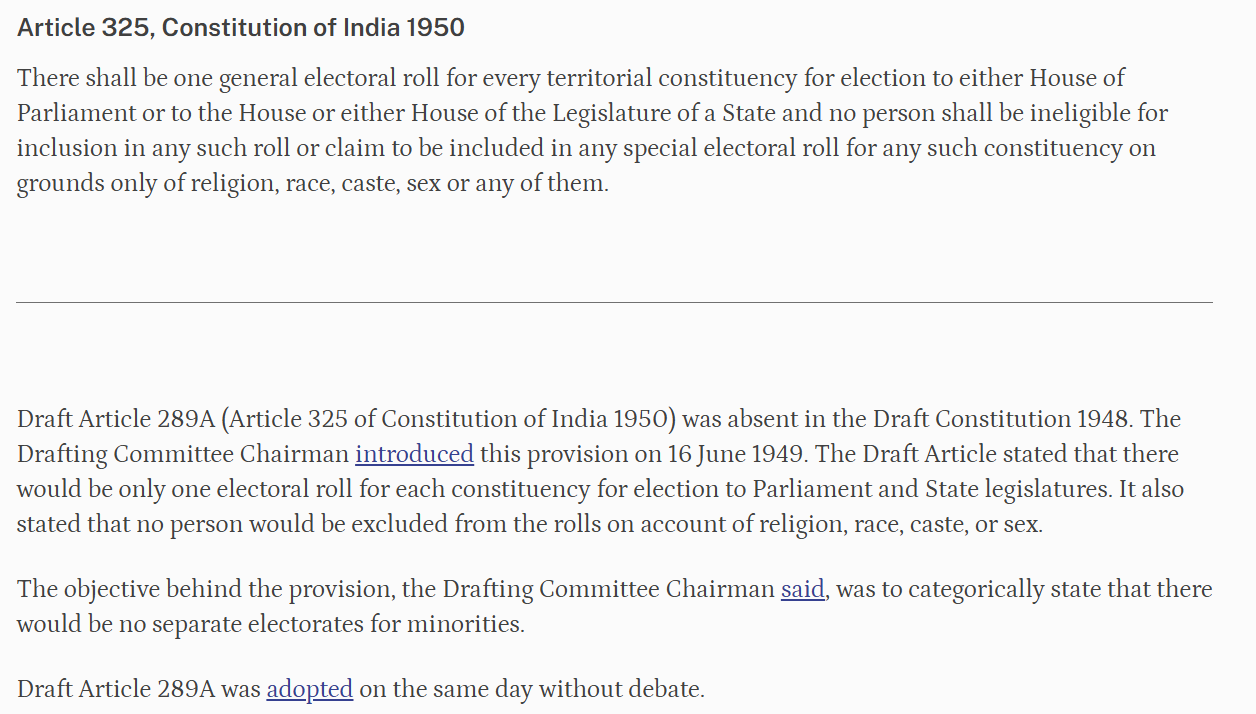
Image via constitutionofindia.net

The definitive support for one of the foundational principles of the Constitution, as articulated by Dr Bhimrao Ramji (BR) Ambedkar, reveals that the country invariably stood for fair and just electoral equality for every eligible citizen, without providing a conducive environment for the seeds of communalism and separate electorates sown by the British. The decision gained even greater significance against the backdrop of a violent partition proposed by the All-India Muslim League and endorsed by the colonisers.

Ambedkar specifically rejected separate electorate during the Constituent Assembly debates

The architects of modern India underlined that democracy must be centred around universal adult suffrage and the concept of “one person, one vote,” instead of communal divisions throughout the Constituent Assembly debates, which were held between December 1946 and January 1950.

Ambedkar, the brain behind the Constitution, exemplified the same during the discussions over the aforementioned 289A “with reference to amendment number 110 of List I (Fifth Week)” which was tabled in the presence of Dr Rajendra Prasad, who was the permanent President of the Constituent Assembly, on 16th June 1949.

The former highlighted that “the object of this is merely to give effect to the decision of the House that there shall hereafter be no separate electorates at all. As a matter of fact, this clause is unnecessary because by later amendments we shall be deleting the provisions contained in the Draft Constitution which make provision for representations of Muslims, Sikhs, Anglo-Indians and so on.”
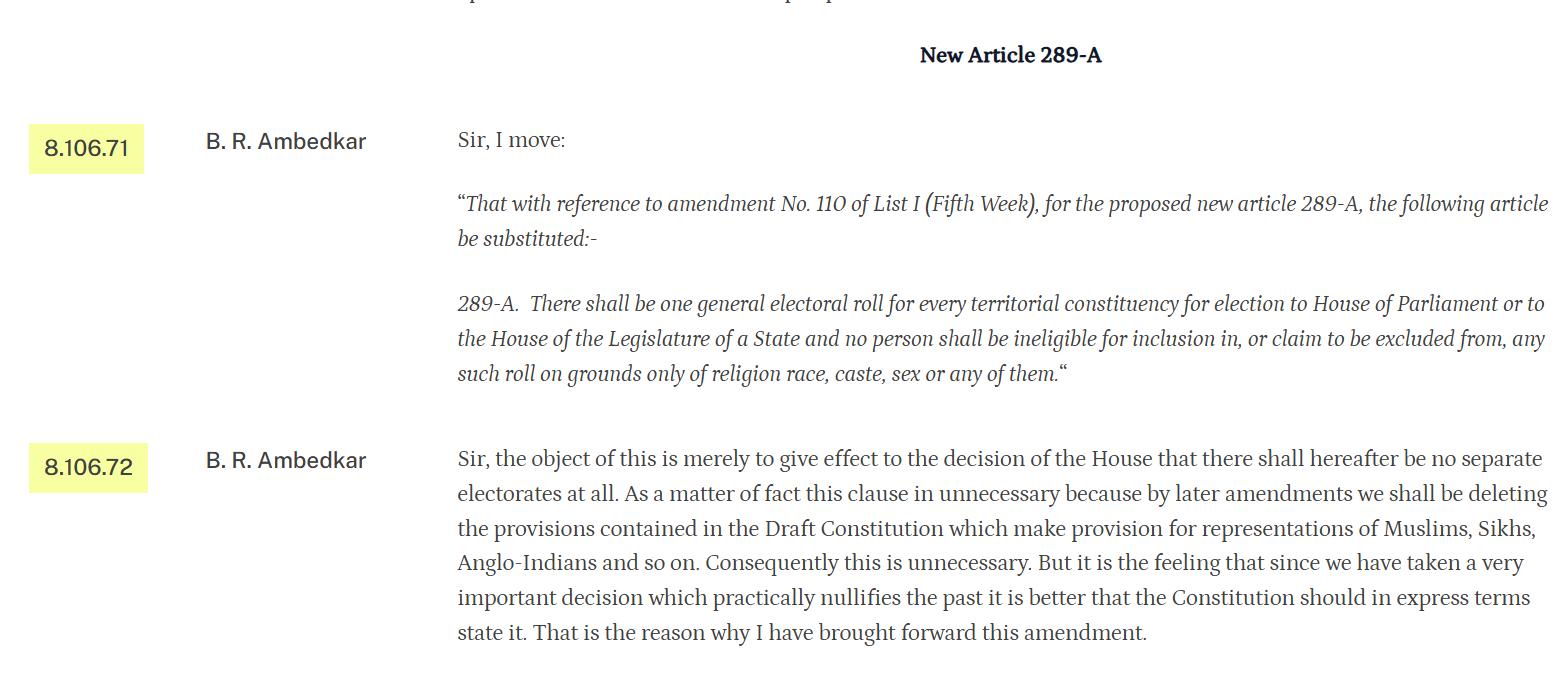
Image via Constituent Assembly Debates (Volume 8) (Source: constitutionofindia.net)

Ambedkar added, “Consequently, this is unnecessary. But it is the feeling that since we have taken a very important decision which practically nullifies the past, it is better that the Constitution should in express terms state it. That is the reason why I have brought forward this amendment.”

When asked if the objective was to pass the amendment, Ambedkar replied that he wanted to express the reasoning behind his submission, pointing out how firmly he believed in the cause of disallowing separate electorates.
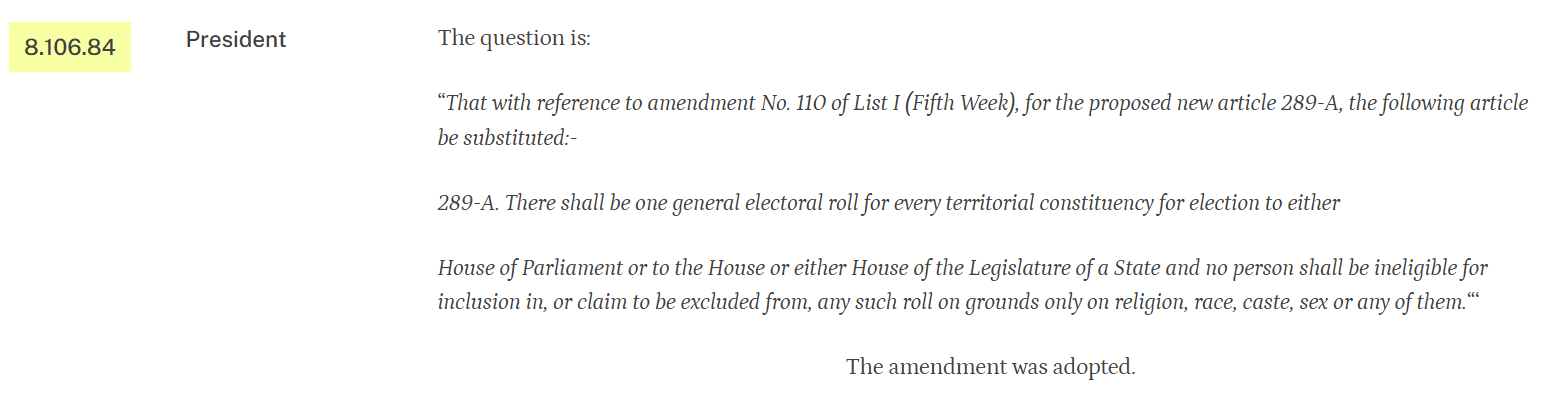
Image via Constituent Assembly Debates (Volume 8) (Source: constitutionofindia.net)

Afterwards, Article 325 was adopted to prevent separate electoral records defined by religion, race, or caste, to guarantee equal political rights for all nationals and to foster national unity and social integration through a common electoral procedure.

The roots of the separate electorate

The origins of the separate electorate can be traced back to British India, when the foreign regime acquiesced to the demands presented by the Islamists to facilitate their communal agenda. The British Parliament’s Indian Councils Act 1909, also referred to as the Morley-Minto Reforms, proposed the creation of distinct electorates for Muslims.

This formalised sectarian divisions in the political landscape by enabling the community to elect their representatives solely on religious grounds. The system, which endured for many decades, fostered religious rather than national identity, prompting the Muslim League to advocate for a separate state, ultimately leading to the bloody division of the nation in 1947 and the establishment of the Islamic Republic of Pakistan in 1956.

The Indian Council Act marked the first time that seats in legislative bodies were distributed according to identity. Thus, “Depressed Classes” (Scheduled Castes) also received some seats in 1919 before experiencing a rise in 1925. This matter later turned into a point of dispute between Mohandas Karamchand Gandhi and Ambedkar, who desired a special electorate for the Dalits before relinquishing the demand.

The disagreement between Gandhi and Ambedkar

The “Communal Award” of August 1932 attempted to provide Depressed Classes, Muslims, Sikhs, Indian Christians and others with separate electorates for the election of members of provincial legislative assemblies during the 1931 “Second Round Table Conference.”

Gandhi rejected the notion of a separate electorate for the Depressed Classes but not for other groups, perceiving it as a ploy by the British to split the Hindu population, perpetuate social divisions and reinforce their faltering grasp on power. The decision, in his opinion, suggested that Dalits were not part of the Hindu community as he began a fast till death while incarcerated in Yerwada Central Jail in Poona.

On the other hand, Ambedkar wanted a separate electorate for the Depressed Classes he spoke for during the “First Round Table Conference” in 1930. However, Gandhi and the Indian National Congress (INC) regarded it as a scheme to weaken and fracture Indian society.

He witnessed the British employing their notorious “Divide and Rule” policy to protect their interests and expand their power with the award. His rigorous fast put public pressure on Ambedkar to intervene and eventually the hunger strike concluded when the two sides reached an agreement.

The Poona Pact: The resolution of the conflict

The “Poona Pact” was inked between Dr Madan Mohan Malviya on behalf of Hindus from higher castes and Ambedkar in the name of the downtrodden sections on 24th September 1932. It increased the number of reserved seats within a framework of shared electorates, and the earlier clamour in relation to Depressed Classes was effectively abandoned.

Interestingly, Ambedkar campaigned for communal representation since his appearance before the Franchise (Southborough) Committee in 1918-1919. He had, however, raised serious doubts about the communal electorate’s suitability as an instrument of achieving representation, reported The Print.

Ambedkar promoted adult suffrage, which would determine voting rights based on age rather than income, prestige, or education, during his appearance before the “Simon Commission.” He mentioned that there should be a mixed electorate with allocated seats, otherwise the Depressed Classes should have representation similar to Muslims amid the cross-examination.

The Muslim League representatives, princely states and others opposed his request for universal adult suffrage. The British government was also hesitant to grant universal adult suffrage to the country. This could be attributed to the alteration of his stance and insistence on a separate electorate.

However, Ambedkar’s primary focus was on pushing for representation for the scheduled castes within the political structure of the country rather than on the concept of a separate electorate for them.

Conclusion

India has already borne the brunt of partition, which was instigated by the demand for a separate electorate for the Muslim community. This not only has its beginnings in radicalism and extremism masquerading as justice and representation.

However, it is also harmful to the social and cohesive fabric of the nation, which will be exploited by malicious and vested interests to exacerbate the fault lines and widen the divide in society. It will derail India, its developmental trajectory and undo the progress made over the years.

Separate electorates hold no relevance in contemporary India, nor will they in the future, nor did they in the past. The conspiracy intentionally devised by the invaders to dominate the country cannot be reinforced under the guise of “empowerment,” when in truth it just acts as a mechanism of division, undermining national unity and a major hindrance to the advancement of India and its people.

Of course, the problems or concerns encountered by the people should be highlighted and resolved, but this cannot be accomplished at the expense of the country, mangling its Constitution. Ravan needs to grasp the simple fact that his political aspirations cannot be allowed to forge ahead while risking the present and future of the nation.

Delhi HC’s surgical strike on Kejriwal’s recusal plea drama: Read how the AAP chief’s allegations were dismissed point-by-point by Justice Swarana Kanta Sharma

The recent judgement by Justice Swarana Kanta Sharma of the Delhi High Court, dismissing Arvind Kejriwal and his associates’ recusal applications, is more than just a legal victory for the Bench; it is a scathing exposé of a calculated political strategy designed to manage rather than receive justice. While the public has focused on the dismissal’s superficial headlines, a closer read of the 115-page judgment reveals a series of arguments that have largely gone unnoticed, arguments that paint the Kejriwal incident as a systematic attempt to undermine judicial integrity, making it a suitable case for contempt.

Catch 22: A win-win for the litigant

The Catch 22 scenario that the applicants painstakingly created is one of the Court’s most nuanced point that has not received much public attention. The recusal request, according to Justice Sharma, is a tactical move that benefits the litigant regardless of the verdict. If the judge recuses, the litigant effectively selects their Bench through intimidation, establishing a troubling precedent that any judge can be removed simply by casting aspersions. The litigant can use the judge’s reluctance to recuse as justification for pre judged bias in any subsequent unfavourable judgement, tainting the proceedings in the court of public opinion. The dignity of the judicial system is directly attacked by this ‘heads I win, tails you lose’ strategy.

The trial of the institution

The judgement marks a transition from a legal conflict between parties to the judge’s personal trial. In a moving statement, Justice Sharma said that a litigant was testing the institution’s resilience itself in this case and that her silence as a judge was being tested. It is an unprecedented insult to the constitutional oath to require a judge to go through what she called a Agni Pariksha (trial by fire) to demonstrate her fairness. Requiring a judge to defend her impartiality against wild, irrelevant, or imaginary allegations essentially puts the entire system on trial in a system where judicial integrity is a fundamental tenet. This reversal, in which the accused tries to judge a judge in the absence of relevant facts, is an obvious instance of selective targeting that transcends a valid legal justification.

Calculated contradictions

Kejriwal’s inherently inconsistent and contradictory stance on the judge’s family is a very telling argument that has gone unnoticed. Kejriwal asserted in his written arguments that recusal is not warranted just because a judge’s family members are appointed as government counsel. But he also claimed that there was a conflict of interest because the Solicitor General, who is representing the CBI, had authority over how much work is assigned to those relatives. The Court revealed this as a constructed story, observing that Kejriwal was taking contrary stands in his own affidavits to suit the situation. The applicants attempted to utilise the professional careers of a judge’s children as a tool for strategic character assassination by insinuating a nexus where none existed.

Selective memory: Conveniently ignoring past relief

The judgement throws light on the petitioners selective perception, which established a narrative of bias by spotlighting a single stay order while conveniently ignoring countless instances in which the same Court gave them interim relief. Justice Sharma noted that in other sensitive cases, the Court has upheld Kejriwal’s and his political party members rights. By focusing solely on a stay that the Court deemed appropriate because the trial court’s conclusions were prima facie erroneous, the applicants attempted to create a theatre of perception. This purposeful omission of the Court’s balanced history demonstrates that the apprehension was not reasonable but rather manufactured to interrupt a specific proceeding.

Why the incident is fit for contempt

Perhaps the most daring grounds for contempt listed in the judgment is the attempt to remove a judge on the basis of imagination and misbeliefs about a Union Home Minister’s television interview. The Court noted that the applicants provided no precise quote or description of the alleged statement. Relying on an external actor’s alleged political commentary to question a judge’s impartiality is a reckless disregard for the legal system. It shows a desire to transform the courts into a battleground for political narratives, with aspersions, insinuations, and doubts replacing proof. As Justice Sharma warned, a politician cannot be allowed to cross the boundary and pass judgment on the competence of a constitutional authority.

Finally, the decision states that justice is not achieved by bowing to pressure. The systematic attempt to coerce the Court into recusal using familial ties, political rumours, and selective judicial history is a mala fide attempt to dictate the composition of the bench. When a litigant attempts to make the justice delivery system vulnerable to unfounded allegations, they are targeting the credibility of the institution itself rather than merely a judge. Justice Sharma, by standing firm and refusing to take the easier path of recusal, safeguarded the judiciary from political manoeuvring. 

This occurrence, marked by strategic character assassination and an attempt to manage rather than receive justice, is a textbook example of why such conduct must be punished with the full force of the law to prevent the floodgates of mistrust to ever open.

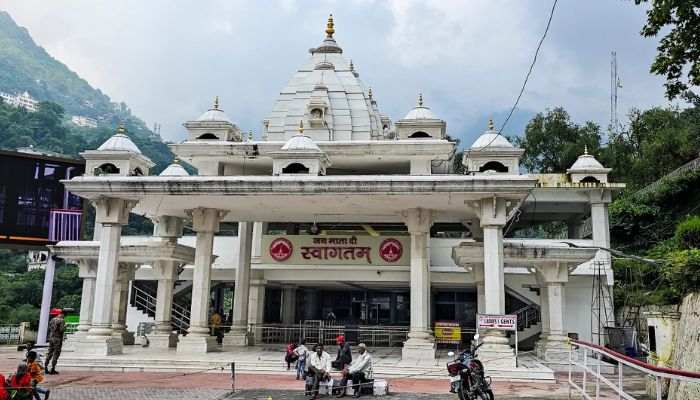
Vaishno Devi offering scam: Govt Mint exposes fake silver sold to devotees; Only 5% silver, rest cadmium and iron

A massive discrepancy has come to light in the silver offerings made by devotees at the Mata Vaishno Devi Shrine, raising serious concerns about the authenticity of items being sold in the temple’s vicinity. According to a report by The Economic Times, a large portion of what devotees believed to be silver has turned out to be mostly low-value and even toxic metals.

Shocking findings at the government mint

The issue surfaced when the Shri Mata Vaishno Devi Shrine Board sent around 20 tonnes of accumulated offerings to a government mint for melting and storage. Officials conducting the assay were surprised to find that the metal contained only about 5-6% actual silver.

Instead of pure silver, the remaining composition was largely cadmium and iron. While silver currently trades at around Rs 2,75,000 per kilogram, cadmium is worth only Rs 400-500 per kilogram, making the offerings far less valuable than expected.

Based on earlier estimates, the shrine board was hoping to recover silver worth nearly Rs 500-550 crore from these donations. However, with the low silver content now confirmed, the actual value may be closer to just Rs 30 crore.

In one specific instance, a batch of about 70 kg of offerings yielded only 3 kg of genuine silver. Mint officials had to spend nearly three months separating usable metal from the rest, highlighting how deep the problem runs.

Health risks and processing challenges

The presence of cadmium has made the situation more serious. This metal is not only cheap but also hazardous. It is banned in consumer goods under Bureau of Indian Standards (BIS) norms due to the harmful fumes it releases, which are known to be carcinogenic.

Mint officials initially refused to process the material because of these risks. Only after putting safety measures in place and arranging specialised equipment were they able to proceed. Even then, identifying higher silver content required advanced handheld devices costing around Rs 25 lakh.

Officials also pointed out that handling such contaminated material poses risks not just to workers but also to the environment, including air and water pollution.

No action taken so far

Despite repeated warnings, there has been no documented action from authorities. The mint has formally raised the issue several times over the past year, including writing to the office of Manoj Sinha and the shrine board.

In its communication, the mint clearly stated that such practices are unfair to devotees who purchase these items in good faith, unaware that they contain harmful and low-value metals. It also stressed the urgent need to stop the production and sale of such adulterated silver articles.

However, as of now, neither the Lieutenant Governor’s office nor the shrine board has publicly responded or taken visible steps to address the issue.

Possible source of fake silver

What makes the situation even more concerning is that no similar contamination has been reported at other major temples in India, such as Tirupati, Siddhivinayak, Guruvayur Devaswom, or Srikalahasti.

This has led to a strong suspicion that the problem may lie with local jewellers and vendors operating around the Vaishno Devi pilgrimage route. These shops are believed to be selling items that look like silver but are actually made from cheaper substitutes like cadmium.

Since cadmium closely resembles silver in appearance, it becomes difficult for ordinary buyers to tell the difference. This puts millions of devotees at risk of being misled every year.

Devotees unaware of reality

Every year, lakhs of pilgrims climb the Trikuta hills carrying coins, ornaments, and other items as offerings to the goddess. For most, this is an act of deep faith and devotion. However, the latest findings suggest that many of these offerings are not what they seem.

The discovery not only questions the quality of items being sold but also raises broader concerns about trust and regulation in religious marketplaces. With the mint repeatedly flagging the issue and highlighting both financial and health risks, the lack of action so far has only added to the urgency of the matter.

Chhattisgarh HC refuses to quash criminal case against Professor who forced Hindus students to offer Namaz: Read the background of the case and observations made by the court

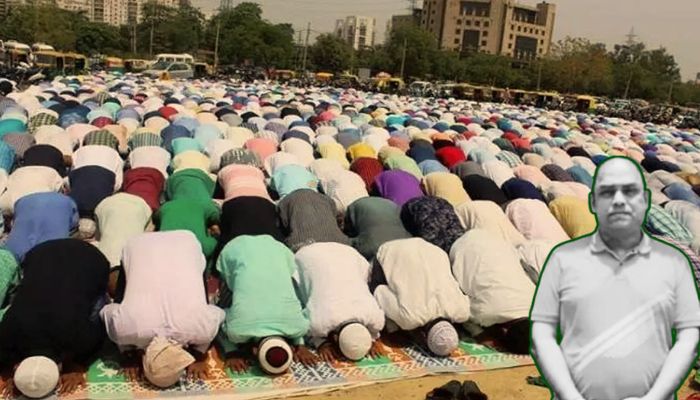
The Chhattisgarh High Court refused to quash a criminal case against Dilip Jha, a professor at Guru Ghasidas Central University in Bilaspur, for forcing Hindu students to offer namaz during an NSS camp in March 2025.

Dilip Jha sought quashing of the FIR against, State counsel argued against it, Chhattisgarh HC rejected the plea

In an order dated 16th April 2026, a division bench comprising Chief Justice Ramesh Sinha and Justice Ravindra Kumar Agrawal held that there was prima facie sufficient evidence in the charge sheet to warrant trial against Professor Dilip Jha.

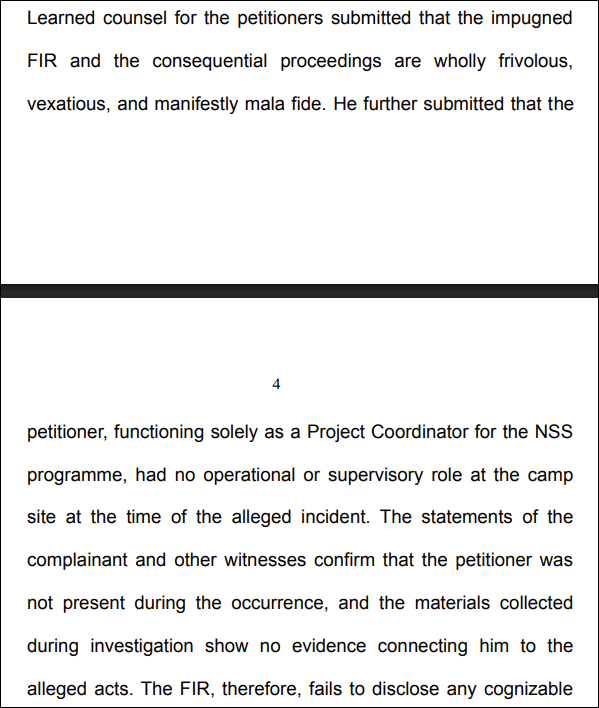
Jha’s counsel, Arjit Tiwari, argued that the entire case against his client should be quashed as the impugned FIR and the consequential proceedings are “wholly frivolous, vexatious, and manifestly mala fide.”

The court, however, rejected this argument, stating that there was no evidence to establish that legal proceedings against Professor Dilip Jha were initiated with mala fide intentions.

The petitioner’s counsel had also contended that the complainant and other witnesses had stated that he was not present when Hindu students were forced to offer namaz, and the materials collected during the investigation show no evidence connecting him to the acts. It was stated by the petitioner’s counsel that he was a Project Coordinator for the NSS programme, had no operational or supervisory role at the camp site at the time when Hindu students were forced to offer namaz.

“The FIR, therefore, fails to disclose any cognizable offence against the petitioner and amounts to an abuse of the criminal process. Continuation of proceedings would cause irreparable harm to the petitioner’s professional career, reputation, and personal liberty,” the petitioner argued.

“The present case falls squarely within these principles, as the petitioner has been selectively implicated despite the institutional nature of the NSS programme, and no evidence implicates him in any operational wrongdoing, as such, the impugned FIR as well as the order taking cognisance, so far as it relates to the petitioner, be quashed,” Jha’s counsel added.

Meanwhile, the State counsel contended that the petition seeking quashing of the FIR and proceedings against Professor Dilip Jha “is not maintainable at this stage, as the charge-sheet has already been filed following a detailed investigation.”

The State counsel submitted that the filing of the charge-sheet demonstrates that the probe agency has found sufficient material to proceed against the petitioner, and it is now for the court to examine the evidence and determine the petitioner’s liability.

“Interference at this stage would amount to pre-judging the merits of the case, which is impermissible, and could impede the statutory criminal process,” the State counsel said.

After hearing arguments of both sides, the court observed that the investigation in the matter is completed and that sufficient material has been gathered against the accused.

Rejecting the petitioner’s “mala fide intentions” argument, the court said that while it takes note of the submission that the proceedings against Dilip Jha are “frivolous or vexatious”, quashing of proceedings is justified “only n exceptional circumstances where the allegations on the face of the FIR do not disclose a cognizable offence or where the proceedings are manifestly mala fide.”

“In the present case, the charge-sheet indicates that the investigation revealed prima facie evidence warranting trial, and there is no conclusive proof at this stage that the proceedings were instituted with ulterior motives,” the court stated.

Regarding the petitioner’s contention that he was not present when Hindu students were forced to offer namaz during a NSS camp, the court said that Dilip Jha’s absence from the scene or the question of his administrative role can be addressed during the trial. The court opined that interfering at this stage would amount to pre-judging issues of fact and evidence.

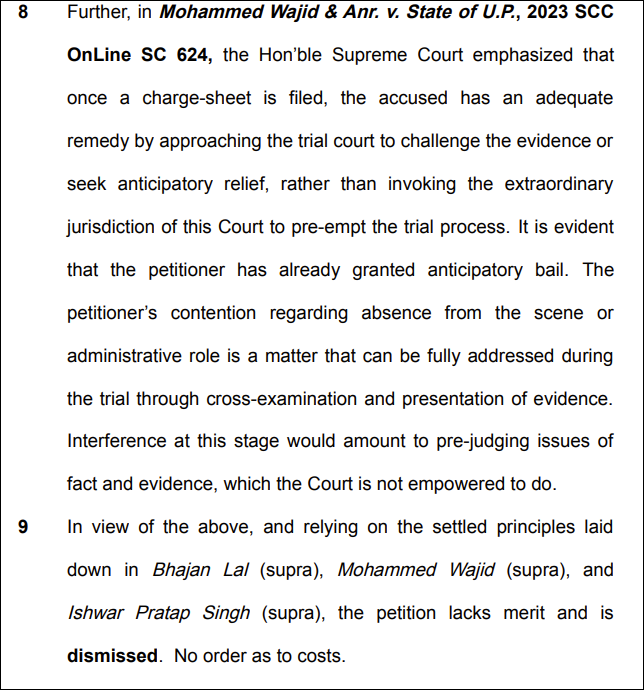
“It is evident that the petitioner has already been granted anticipatory bail. The petitioner’s contention regarding absence from the scene or administrative role is a matter that can be fully addressed during the trial through cross-examination and presentation of evidence. Interference at this stage would amount to pre-judging issues of fact and evidence, which the Court is not empowered to do,” the court said.

Dismissing the Jha’s plea, the court ruled, “In view of the above, and relying on the settled principles laid down in Bhajan Lal (supra), Mohammed Wajid (supra), and Ishwar Pratap Singh (supra), the petition lacks merit and is dismissed. No order as to costs.”

Background of the case

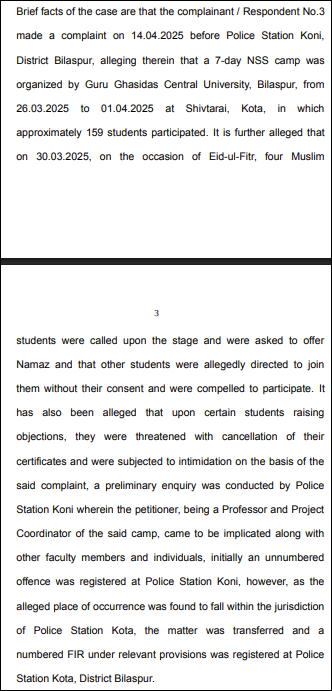
Back in March-April 2025, a massive row had erupted in Bilaspur’s Guru Ghasidas Central University after over 150 Hindu students narrated that they were coerced into offering namaz during an NSS (National Service Scheme) camp.

The students had filed a formal complaint at the Koni police station, accusing camp officials of religious coercion, manipulation, and threats of withholding participation certificates.

It was reported that the incident occurred during a week-long NSS camp (March 26–April 1) in Shivtarai forest. On 31st March, Eid-ul-Fitr, the coordinator reportedly invited four Muslim students to pray on stage, and then forced Hindu students to offer namaz without their consent. It was stated that this move was part of a larger effort to influence their beliefs under the guise of cultural exchange.

Despite objections, the students informed that they were threatened with disciplinary action if they refused. Phones were confiscated, preventing documentation of the incident.

Consequently, a complaint was filed against program officer Dr Basant Kumar, coordinator Dilip Jha, and others.

In May 2025, the Chhattisgarh High Court refused to quash 2 FIRs against 7 professors at Guru Ghasidas Central University. A petition seeking cancellation of the FIR was filed by Professor Dilip Jha, who was arrested in this case. However, he was later granted bail. The second petition was filed by six assistant professors. These people were named as accused in this case.

Back then, Chief Justice Ramesh Sinha and Justice Rakesh Mohan Pandey of the Chhattisgarh High Court dismissed the plea, stating that the veracity of the allegations in the FIR cannot be commented upon during the investigation. The court allowed the police to complete the investigation into the matter.

Now, on 16th April 2026, the Chhattisgarh High Court has once again rejected Jha’s desperate plea seeking quashing of the FIRs and proceedings against him.

Twitter DM scam: X users hacked via fake links from mutuals, what happened and how to stay safe – Read details

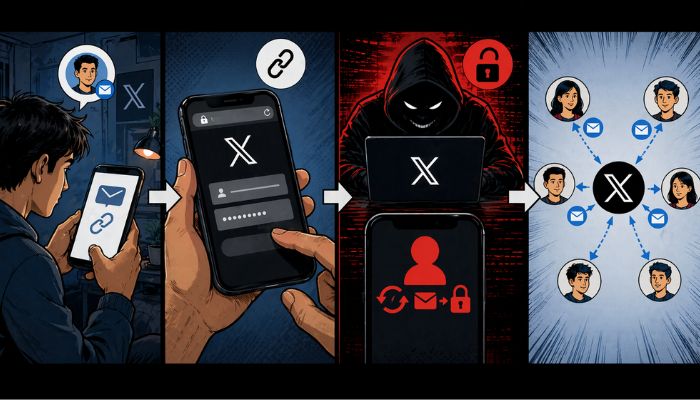
An X user received a direct message (DM) from a mutual seeking support in the form of a vote for an influencer programme or a competition. The user, who believed the message was from the mutual, clicked on the link in good faith. Within seconds, his account was hacked, his email ID was changed and his profile was now full of posts related to crypto. In the next few hours, his mutuals were getting similar DMs from his account.

This is not fiction but one of the most common scams happening on X, formerly known as Twitter, for years, and now it is once again affecting users. Several famous handles including Ramprasad_c, NAN_DINI_, and others fell prey to the hack.

X user Mohan Sinha, one of the friends of Nandini on X, shared a message from her yesterday stating that she received a DM from a follower seeking a vote for him on a website. Initially, she ignored it for a couple of days. However, the follower then followed up and said that he was just a few votes short.

While this could have been seen as a red flag, she clicked on the link. She was immediately logged out of X and the moment she entered her password, the account was gone.

Soon after, a suspicious X account coach_hannahrae was being promoted on her timeline with some crypto links. While those posts have been removed from her profile now, it is unclear if she has regained access to her account or not. Nandini is not alone. There are many such X users who received similar DMs, and they accidentally clicked on the link and lost their accounts within seconds.

In the comments under the post from Mohan, several X users said they recieved similar DMs and some also shared screenshots of the posts published after the hack.

What is happening

This is a phishing scam that is circulating on X. This is not a new scam and versions of this have been around for years, not only on X but on other platforms like Facebook, WhatsApp, and Instagram as well.

In such scams, users receive a DM from a mutual asking for some help. It could be anything including a vote, support, sharing a page or anything. In this case, the DM is about a vote for an influencer programme. The message appears authentic because it is from a known contact with whom either you have interacted or at least you both follow each other.

However, the account sending you the message is already compromised. Clicking on such a link starts a chain reaction that spreads to your contacts on social media because once your account is compromised, they will get a similar message from the scammer pretending to be you.

When someone clicks on the link in the DM, note that your account does not get hacked automatically. It takes you to a fake login page that looks like X. When users enter their username and password, the credentials are captured instantly. Within seconds, hackers, who have been waiting for someone to fall for the scam, get hold of your account, change the registered email ID and password and lock the original user out.

The compromised account is then used to run a similar scam and post content promoting cryptocurrency or some other scam. Because the account is credible for the followers, many of them click on the links in the post and may face financial losses.

How to be safe

Users should treat unsolicited DMs, especially those asking them to vote or click on a link, even if it is from a mutual, with caution. Never click on such links directly. Confirm with the sender through another platform or ask a question that only they can answer.

Make sure to check the URL before logging in. When you click on a link in the DM, you are not logged out from your X account. In most cases, you are taken to a page that looks exactly like the X login page. Close the page and open X’s official link. Only then enter your credentials.

Make sure to enable two factor authentication to add an extra layer of security. Use a unique and strong password for X that is not used on any other platform. Make sure to regularly review active sessions and logged in devices. Log out from any unknown sessions. If a mutual suddenly sends repetitive promotional messages, assume their account may be compromised.

How to regain access to X account

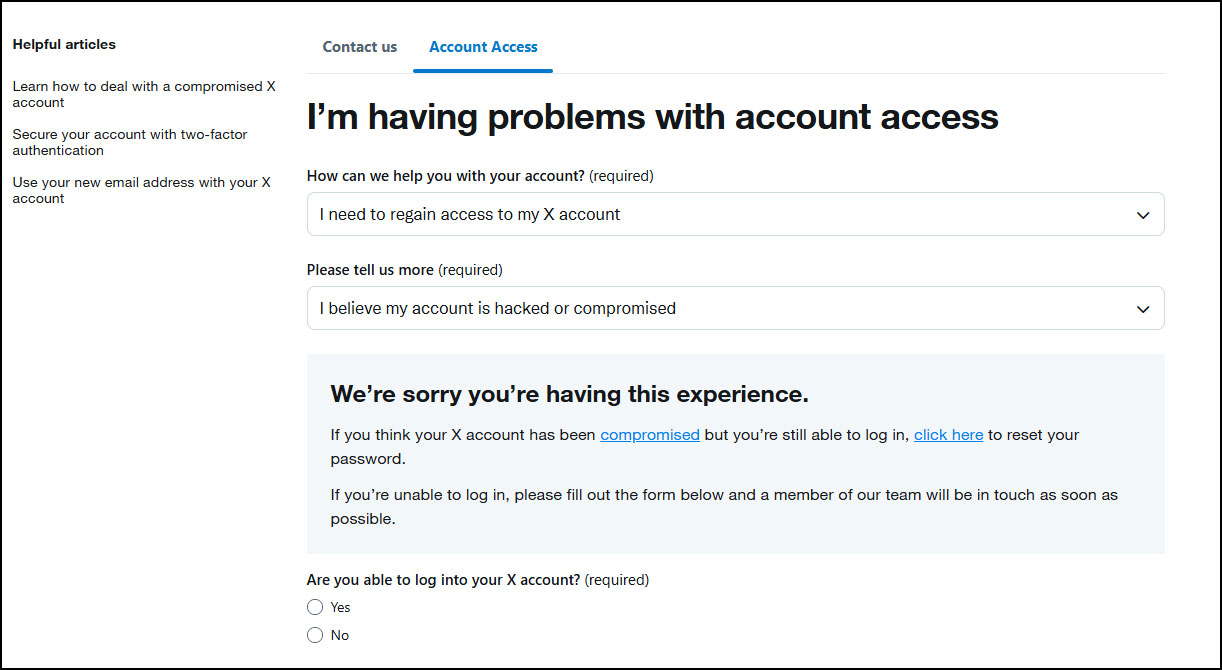
If you have already lost access to your account, act immediately. First of all, try resetting your password using the official X password recovery option. In case the hacker has changed your email ID, use the “I don’t have access to this email” option and submit the request through X support.

Source: X

Make sure to provide as much information as you can to verify ownership. It may include previous email IDs, usernames, or linked phone numbers. Check your email for any security alerts from X and use those links to reverse unauthorised changes if still possible.

Make sure that your email account is secure because hackers often target it alongside social media accounts. It may take some time, in some cases several days, to regain access to your account.

Meanwhile, take help of some mutuals with whom you are in contact on other platforms or on the phone. Request them to post a message on your behalf, tagging you and explaining the situation.

Once you regain access to your account, remove any suspicious posts or DMs sent from your profile. Inform your followers that your account was compromised and advise them not to click on any link sent from your account in the last few days.

For decades, Assam’s political narrative was about Assamese Vs Bengalis, then Himanta Biswa Sarma changed it and united all Hindus: Story from a Bengali Hindu’s perspective

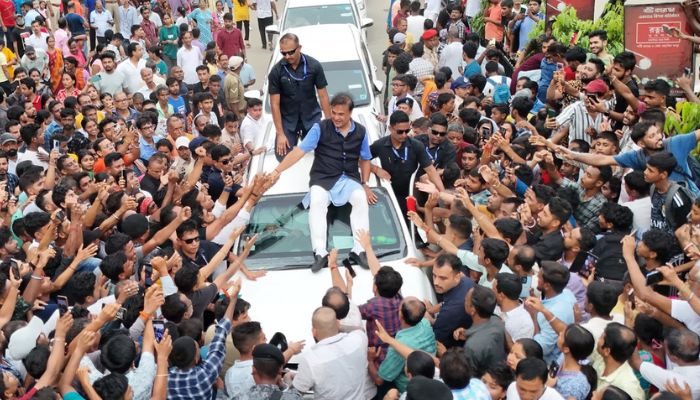
The day was 31st August 2025. Lakhs of Bengalis flocked to the Rangirkhari point in Assam’s Silchar city to catch a glimpse of Himanta Biswa Sarma. The overwhelming reception, warmth and adulation of the public that the Assamese-speaking Chief Minister received on that particular day remains unprecedented in the State’s history.

It was not just another political roadshow but a moment of reckoning: The long-standing ethnic divide between Assamese Hindus and Bengali Hindus had finally been breached.

Himanta Biswa Sarma had truly emerged as the ‘Mama‘(maternal uncle), not just for the youth of the Assamese-majority Brahmaputra Valley but the Bengali-dominated Barak Valley as well. A few decades ago, such a spectacle was politically impossible and unimaginable.

A sneak peek into the history

Three events in particular affected Bengali-Assamese relations over the last century, namely, the Partition of Bengal (1905), the Partition of India (1947) and the Bangladesh Liberation War (1971).

Although Bengalis and Assamese share vast similarities in terms of cuisine, language (written script) and culture, mass migration and changing demographics have become the bone of contention between the two ethnic groups.

The events of 1947 and 1971 saw a large displacement of Bengali Hindu refugees into Assam, mostly to avoid religious persecution at the hands of Muslim separatists (first in East Pakistan and later in Bangladesh).

Even after the Bangladesh Liberation War, Bengali Hindu refugees continued to migrate to Assam. This had led to friction with the indigenous Assamese community over land, resource-sharing and representation in politics.

Between the 1950s and the 1980s, the ethnic divide had spiralled out of control, leading to mass violence and language riots.

This was further worsened by vested political parties fanning communal disharmony and exploiting fault lines to divide the Hindu vote into distinct groups: Assamese and Bengali.

Himanta Biswa Sarma decimated politics to divide Assamese and Bengali Hindus

Interestingly, the vested groups appeased the Bengali Muslims from East Pakistan/Bangladesh, who illegally migrated to Assam for economic opportunities and worsened the demographic crisis (caused by them in the first place).

This served as a shrewd election strategy: First, divide Hindus into Assamese and Bengalis by making them fight over language and identity. Second, consolidate the ‘Miya’ (a term used by Bengali Muslims from East Pakistan/ Bangladesh to refer to themselves) vote bank as one bloc to keep winning elections.

As a result, the ethnic tension between Bengali Hindus and Assamese Hindus was kept boiling from time to time through provocative speeches, divisive policies and hateful political rhetoric. All of this changed after the BJP came to power in Assam in 2016, first under the Chief Ministership of Sarbananda Sonowal and then rather aggressively under Himanta Biswa Sarma.

Previously unheard and unseen in Assam politics, an objective approach was undertaken to draw a much-needed distinction between Bengali Hindu refugees (who migrated to the Indian State to flee persecution) and Bengali Muslim infiltrators (who came to Assam for economic opportunities). Through targeted messaging, awareness about the big difference between the two groups and their contribution to demographic change was made crystal clear.

How can someone who came to Assam to protect his religious identity be compared to someone who first created an Islamic nation and then migrated to the Indian State for opportunism? In the spirit of fairness, such a comparison is untenable. The Assamese Hindu community, which was once made to believe by vested political groups that their Bengali Hindu counterpart is somehow their enemy, has now called out the bluff.

Years of political propaganda, aimed at dividing and ruling over the masses, have been decimated under the leadership of Himanta Biswa Sarma. The State and its people are now convinced that there is only one enemy: The illegal immigrant who came to Assam after 24th March 1971 (the cut-off date of the Assam Accord) to reap economic benefits and change the culture of this beautiful Northeastern State.

Bengalis love ‘Mama’

Himanta Biswa Sarma has been vocal in differentiating between infiltrators and refugees. Hindu Bengalis, who lost their ancestral property and centuries of generational wealth to protect their ‘Dharma’, are finally getting their much-deserved recognition.

The Assam CM has repeatedly assured that no Hindu Bengali will be decried as a ‘foreigner’ or subjected to harassment. In September last year, he clarified, “There is no reason to suspect Hindu Bengalis as foreigners, as they have come before 1971. The CAA has no relevance in Assam.”

When the flawed draft of the National Register of Citizens (NRC) was published in Assam in 2019 and excluded about 12 lakh Hindu Bengalis, Himanta Biswa Sarma pointed out that the exercise was “fundamentally flawed” and called for a fresh NRC.

He has been unabashed about his Hindu identity and has meticulously worked to unite the community across linguistic and ethnic lines in Assam. He has been instrumental in mitigating differences and bringing Assamese Hindus and Bengali Hindus closer.

This explains why ‘Mama’ received a grand welcome in West Bengal ahead of the 2026 Vidhan Sabha election. His speeches were attended by thousands of Bengali voters. Never in the history of the Bengali-speaking State has an Assamese CM been given such a reception by the locals.

Interestingly, Himanta Biswa Sarma also spoke in Bengali to the delight of the locals. A few decades ago, vested groups would have created a political storm in Assam, but these powerless entities couldn’t move a needle this time.

It is due to the Assam CM’s relentless efforts that historical differences between Assamese Hindus and Bengali Hindus have healed, and the State has moved in the direction of permanent reconciliation.

A personal experience in identifying ‘opportunism’

I distinctly remember having a Twitter spat with a Muslim activist, masquerading as an Assamese nationalist, in early 2020. It was related to the rollout of the Citizenship Amendment Act in Assam.

During the course of the online debate, the activist tried to score brownie points by suggesting to his Assamese followers that I came from the ‘other side’ of the border and that they must be wary of me. (Fact: My family migrated to independent India from East Pakistan in 1947).

I was surprised to discover an indigenous Assamese Muslim nationalist for the first time. As such, I decided to look further into his account. When I scrolled through his Twitter timeline, I found that he had shared multiple articles decrying government action against illegal Rohingya infiltrators in Assam.

And that made one thing clear: The activist was advocating to keep illegal Rohingyas in Assam on one hand (for the virtue of Ummah) and berating a 2nd generation Bengali Hindu migrant on the other hand (by posing as an ‘Assamese nationalist’).

Isn’t this fascinating? A wolf in sheep’s clothing, championing his religious ideology while playing the ethnic card. But that was 6 years ago.

As history would have it, the political propaganda of such activists would be exposed in no time today. Because Himanta Biswa Sarma has left no scope of ambiguity in determining and making one thing clear – Who belongs in Assam and who doesn’t?

India receives its first 3D glass chip project in Odisha: Read about the decisive step for ‘Aatmanirbhar Bharat’ in the country’s semiconductor journey

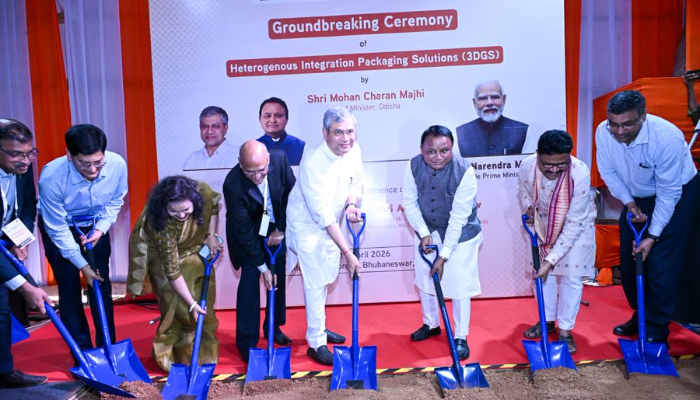
On 19th April (Sunday), the foundation for the nation’s first cutting-edge 3D chip packaging facility was laid at Bhubaneswar’s Infovalley in the presence of Minister of Electronics and Information Technology Ashwini Vaishnaw, along with Odisha Chief Minister Mohan Charan Majhi, as well as other dignitaries.

The occasion marked a turning point for India’s aspirations in the semiconductor industry and Odisha’s rise as a future-oriented technology attraction. It is an important leap towards expanding the “Aatmanirbhar Bharat” policy in high-end electronics production and strengthening the indigenous semiconductor ecosystem. Odisha will house one of the most innovative chip packing systems in the global market, owing to the start of this venture in the Khordha district.

3D Glass Solutions Inc (3DGS) of the United States is responsible for the operation through its fully incorporated Indian company, Heterogeneous Integration Packaging Solutions Private Limited (HIPSPL). It is a greenfield, vertically integrated ATMP (Assembly, Testing, Marking and Packaging) unit with embedded glass substrate and sophisticated packaging. It is scheduled to cost Rs 1,943.53 crore in total, including Rs 799 crore in approved central fiscal assistance and an additional Rs 399.5 crore in support from the state.

High-growth sectors, including data hubs, artificial intelligence, machine learning, 5G/6G (Generation) communications, automotive radar, defence electronics, aerospace applications and photonics, will be served by the installation. The aim is to reach full-scale volume manufacturing by August 2030, with commercial production predicted to commence by August 2028.

A grand achievement in future innovation

“A high-tech industry coming to Odisha is a matter of pride. This is an advanced technology. Normally, a silicone substrate is used in the manufacturing of chips, and now the technology of advanced 3D Glass substrate will be employed. We will also work to double the capacity after the completion of the first phase of the plant,” Vaishnaw expressed. According to him, Odisha, which has historically been recognised for its capabilities in minerals, metals and energy, is now slowly carving out a name for itself in sophisticated sectors like electronics, IT and semiconductors.

The union minister highlighted that this effort will greatly improve the country’s semiconductor value chain and referred to it as one of the most novel manufacturing undertakings of its kind. He added that three other bids pertaining to electronics and semiconductors are underway, and two semiconductor assignments have already been sanctioned for Odisha under the India Semiconductor Mission.

Majhi also described the event as a “historic milestone” for Odisha and India. He pointed out that Global tech giants such as Intel, Lockheed Martin and Applied Materials are linked to inventive packaging technologies, and their interest in the state is a reflection of its growing industrial power.

“The products manufactured in the state will support next-generation sectors such as Artificial Intelligence, high-performance computing, defence electronics, telecommunications and advanced digital systems. Odisha is ready to play a pivotal role in realising Prime Minister Narendra Modi’s vision of making India self-reliant in semiconductor and electronics manufacturing,” he announced.

The chief minister mentioned that the plant is planned to supply 70,000 glass panels, 50 million assembled units and about 13,000 upgraded 3DHI (Heterogeneous Integration) modules annually.

He conveyed that large-scale job prospects for engineering graduates, diploma holders and Industrial Training Institutes (ITI) students will be made possible by Odisha’s rising semiconductor ecosystem, which will contribute to its transformation from an economy dependent on resources towards one driven by technology.

According to IT Secretary S Krishnan, the government will be ensuring a “close eye” on the endeavour, which might put the nation “on the map” in terms of modern chip packing.

Majhi also described the event as a “historic milestone” for Odisha and India. He pointed out that Global tech giants such as Intel, Lockheed Martin and Applied Materials are linked to inventive packaging technologies and their interest in the state is a reflection of its growing industrial power.

“The products manufactured in the state will support next-generation sectors such as Artificial Intelligence, high-performance computing, defence electronics, telecommunications and advanced digital systems. Odisha is ready to play a pivotal role in realising Prime Minister Narendra Modi’s vision of making India self-reliant in semiconductor and electronics manufacturing,” he announced.

The chief minister mentioned that the plant is planned to supply 70,000 glass panels, 50 million assembled units and about 13,000 upgraded 3DHI (Heterogeneous Integration) modules annually.

He conveyed that large-scale job prospects for engineering graduates, diploma holders and Industrial Training Institutes (ITI) students will be made possible by Odisha’s rising semiconductor ecosystem, which will contribute to its transformation from an economy dependent on resources towards one driven by technology.

According to IT Secretary S Krishnan, the government will be ensuring a “close eye” on the endeavour, which might put the nation “on the map” in terms of modern chip packing.

What are 3D glass semiconductors

The brand-new site in Odisha will utilise glass-based substrates and 3D stacking technologies, in contrast to conventional semiconductor manufacturing, which mostly involves silicon wafers and planar (2D) packaging. These enable the vertical integration of several chip components, significantly boosting processing power within a single footprint. For sophisticated nodes, glass substrates offer superior thermal stability, reduced signal loss and better accuracy.

The future of computing itself is influenced by the potential of 3D glass chip technology. It is crucial to stack chips vertically and integrate various components (logic, memory, sensors) as devices such as smartphones and autonomous systems need more power in smaller spaces. Faster AI models, more effective data centres, and advanced defensive electronics could all be made accessible by this “heterogeneous integration.”

Gordon Moore, a co-founder of Intel, created Moore’s Law in 1965, which predicted that the number of transistors on a chip would nearly double every two years, resulting in exponential spikes in processing power while lowering prices. It was the semiconductor industry’s guiding idea for many years. This pace has slowed, though, as chips move closer to their physical and thermal constraints at advanced nodes. It has brought the industry into new solutions such as improved packaging, chiplets and 3D integration to maintain performance gains.

A remarkable evolution in the supply chain

The value of the project is determined by the technology layer it seeks to achieve rather than by the size or scope of the investment. Its emphasis on capacity, intellectual property, and ecosystem positioning suggests an arrangement away from assembly-led manufacturing and in favour of deeper involvement in the global semiconductor value chain.

The facility particularly focuses on the IP-intensive portion of semiconductor production, whereas conventional ATMP units work with imported substrates and standardised methods. Furthermore, the glass-ceramic packaging platform of 3DGS has above 100 patents from 31 active patent families worldwide. Materials engineering, manufacturing techniques, device architectures and system-level integration are covered by these patents. Notably, India’s presence in these regions has been restricted thus far.

Both locally produced glass substrates and organic substrates from outside sources will be primarily supported by the unit, as early commercial activities will take place while the local ecosystem flourishes. The intention is to eventually switch entirely to glass-based innovative packaging. Glass substrates serve stronger connectivity density, elevated dependability and better thermal control. These features are vital for defence-grade hardware, advanced computing systems and AI accelerators.

This could also result in an upstream alteration in sourcing as Indian system integrators, OEMs (Original Equipment Manufacturers) and government vendors might get advanced packaged components in the country and do not have to approach packaging clusters in Taiwan and South Korea. This builds up supply resiliency and gives industries like data centres, telecom infrastructure, aircraft and defence electronics a higher degree of authority over a key hardware stack layer.

India’s ambition for semiconductor growth

The India Semiconductor Mission, a state-backed campaign to create a full-stack semiconductor ecosystem from fabrication and packaging to design and display manufacturing, was introduced in 2021 with an investment of Rs 76,000 crore. 10 semiconductor projects excess of Rs 1.6 lakh crore, have been sanctioned in 6 states comprising fabrication facilities, OSAT (Outsourced Semiconductor Assembly and Test) units and design-linked incentives.

According to reports, the government is developing the subsequent edition of the blueprint and might accept a proposal that would amount to approximately $11 billion.

Nepal imposes customs duty on Indian goods priced above NRS 100, protests erupt across border regions: Here’s what happened

The ousted KP Sharma Oli-led communist government in Nepal used to attack India intermittently through rhetoric. The present Balen Shah-led government, however, has apparently leapt to rolling out policies antagonising India. This time, at the cost of making the Nepali populace suffer. Protests have erupted in many parts of Nepal after the government issued directives enforcing a tax on all items above Nepali Rupee 100 imported from India.

Nepal imposes Rs 100 customs duty on Indian goods

As per the new rules, a mandatory customs duty or Bhansar will be imposed on goods costing more than Rs 100, to curb the loss of national revenue for Nepal. The order to levy customs duty on Indian exports was originally issued by the Oli government around two years ago; however, it could not be implemented at that time.

The move came reportedly after complaints emerged that Nepalese citizens residing in the India-Nepal border areas frequently visited Indian markets for the purchase of household, food, clothing and other items.

There has been an increase in the presence and activities of Nepal’s Armed Police Force (APF) in border areas to enforce the draconian tax levy on Indian goods.

Confirming the imposition of NRS 100 custom duty on Indian exports, an official from Nepal’s Department of Customs told ANI, “It has always been the government’s policy to adopt a zero-tolerance approach to prevent illegal imports in customs areas. The Customs Act already had a provision requiring duties on goods worth more than 100 rupees. ‘We have become more proactive now.”

High-level team has been formed to monitor the imposition of customs duty on Indian exports

To ensure a strict implementation of the customs duty imposition, a joint monitoring team consisting of the Department of Customs, the Department of Revenue Investigation, District Administration Offices, Nepal Police, and the Armed Police Force have been formed. Inspections are being conducted by the APF on Nepali people coming back home from the weekly market in  Kakarbhitta, Bhadrapur, Pherniya, and Rupandehi. Nepali citizens have to stand in long queues to have their packages checked by the authorities for Indian goods.

From Jhapa in the east to Kanchanpur in the west, all main and secondary customs points are witnessing intensified crackdowns under the pretext of curbing tax evasion. Besides inspections, the Nepali authorities are also running ‘awareness’ programs to apprise citizens about the new customs duty on Indian goods priced above NRS 100. The move comes across as the Balen Shah government’s diktat to deter Nepali citizens from visiting India and purchasing Indian goods altogether.

In addition to levying customs duty on Indian exports, Nepal, under Prime Minister Balen Shah, has also banned the entry of private vehicles with Indian license plates without prior authorisation.

Earlier, motorbikes with Indian number plates entered Nepal without any harsh restrictions, with many people even using them within the country.

However, the Balen Shah government’s unilateral, stringent policy, in addition to the prohibition on Indian-registered vehicles, has caused massive distress in Nepal’s border districts of Madhesh. The lives of ordinary people have been significantly affected by the Balen Shah government’s unwarranted targeting of India under the pretext of preventing revenue leakage.

Nepali residents in border areas rise in protest  

Local Nepalis who boast of having roti-beti relations with India have expressed immense discontent and slammed the Balen Shah government for its ignorance of the ground realities in the Madhesh region. Many political parties and activists have also extended support to protesting Nepali citizens.

Umesh Yadav, a member of the Central Coordination Committee of the Janata Samajbadi Party (JSP), said the open border between Nepal and India cannot be controlled by those sitting in air-conditioned rooms, be it in Kathmandu or Delhi. “’The open border is a literal and practical truth here. It is completely wrong to impose policies arbitrarily without understanding the concerns of residents from Biratnagar to Nepalgunj,” Yadav said.

Similarly, Rastriya Swatantra Party and chairman of the Open Border Dialogue Group, Dr Rajiv Jha, said that India and Nepal not only share a geographical border but also maintain social, cultural, religious, and familial ties.

“Setting a limit of 100 rupees in today’s era of inflation is extremely low and impractical; the government must review this immediately,’ Dr Jha said. ‘There should be a clear distinction between simple gifts brought by a daughter visiting from her maternal home and goods for commercial purposes. Food items should be exempt from customs,” Jha said.

Binay Yadav, Chairman of the Rastriya Ekta Dal, went a step ahead and dubbed the Balen Shah government’s move to levy customs duty on Indian goods, “undeclared blockade”.

“This step is against the provisions of the 1950 Peace and Friendship Treaty. The government should immediately remove the customs limit for household items and instruct security personnel to behave in a citizen-friendly manner,” he said, adding that if the directive is not rolled back, a massive protest will erupt in the Indo-Nepal border region.

The Nepali government’s divorced-from-reality move is not only causing immense inconvenience to Nepali citizens but also stoking troubles for Indian traders in the border areas.

In the Banbasa area of Uttarakhand’s Champawat district, Nepali citizens rely on the local Indian market for their daily essentials. Imposing a duty on Indian goods priced above NRS 100 would not only affect trade here but also result in price hikes in Nepal. This will force Nepali traders to procure affordable goods from non-Indian sources.

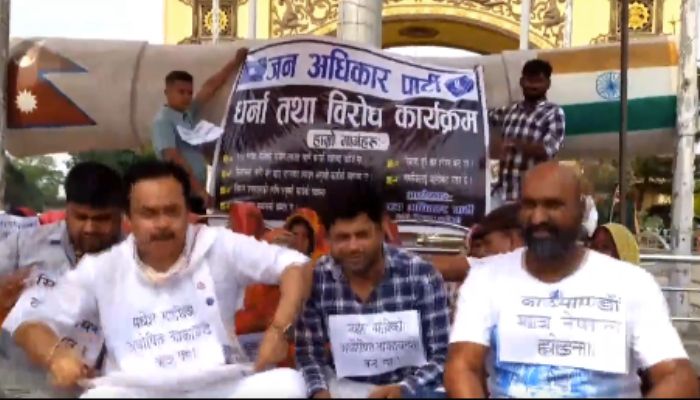
During a protest, a Nepali citizen told ANI, “Whatever the rituals are performed here (Nepal) from birth to death, we bring all the essentials from there (India), even the fertilisers which the Government of Nepal at times is not able to provide on time, we bring them from there. Now the situation has turned different; it is an unannounced blockade. The Jana Adhikar Party demand it to be withdrawn. Failure to control the plunder by the Government of Nepal is its incapacity.”

Another one said, “They’re not allowed to bring in items that cost above NRS 100 without paying tax; we want this provision to end. It has brought us to the protest. They should also respect the relation that exists- the relation of Roti-Beti between India and Nepal. We are demanding that the government give an exemption to the items that cost above NRS 100, which is for domestic use.”

Gujarat: Parvez Pathan trapped minor Hindu girl in Kheda, gang-raped her with Muslim friends for 3 years, blackmailed with obscene images and videos; 8 arrested, 1 absconding

On 17th April (Friday), a case involving the gang rape of a 17-year-old Hindu girl has come to light in the Kheda district, Gujarat. A complaint has been filed against 9 Muslim individuals at the Kheda Town Police Station, and 8 have been arrested. The police are actively working to capture the remaining suspect who is still at large.

The rapists have been identified as Parvez Anwar Khan, also known as Munawar Khan Pathan (the prime accused), Mahir Yakub Pathan, Faizan Zahir Khan Pathan, Taufiq alias Tausiq Hussain Khan Pathan, Sahil Liyaqat Khan alias Dawood Pathan, Ayan Liyaqat Khan Pathan, Moin Firoz Khan Pathan, Maruf alias Nurani Mubarak Pathan and Salman Arif Khan Pathan.

Hindu organisations have come forward and demanded strict action against the perpetrators. The police have indicated that the situation seems to involve a criminal conspiracy, and the investigation is currently focused on that aspect.

According to the information, the incident occurred in a village located in Kheda. The victim disclosed the entire ordeal to her mother and recounted her distressing experience, after which the latter registered a First Information Report (FIR). The police filed a case, commenced further actions and apprehended 8 offenders, presenting them before the court.

The minor told her mother that she had met Parvez Pathan, an inhabitant of the same village, three years ago. The two families maintained a close relationship and visited each other’s homes. Over time, he increasingly made deliberate attempts to trap her by any means necessary and somehow obtained her phone number. He persistently harassed her. During this time, he once summoned her late at night, threatening to tarnish her image if she did not comply.

The underage girl went alone to the village school that the duo attended, to meet him out of fear. Parvez reportedly raped her and also recorded photographs and videos. He repeated the heinous act nearly 10 to 12 times on different occasions. He shared obscene visuals within his circle of friends, which prompted the others to begin threatening and sexually violating her as well. He forced her to have sexual relations with all of his associates and issued death threats along with threats to damage her reputation if she denied.

“You are obligated to come whenever we call. If you do not, we will make sure these photos and videos go viral,” Parvez dictated. According to the complaint, she was horrified and cried. However, he verbally assaulted her and blackmailed, “You are to be kept exclusively for the enjoyment of our entire group. If you refuse to submit to sexual relations with any of them, your photos and videos will be made public.”

A couple of days following the incident, he threatened the victim again and remarked, “You will never marry or become engaged. You must consistently keep all your friends pleased,” during the gang rape. Afterwards, she was regularly put through similarly horrendous circumstances by them and likewise mocked, “You are not going to get engaged or married anywhere. You must maintain this relationship exactly as it is.”

Parvez and his gang exploited the girl for 3 years, subjecting her to continuous intimidation and torment. She eventually turned utterly despondent, cried profusely at home, and even wanted to end her life, which led her to reveal the entire episode to her mother when inquired.

The mother was initially hesitant to notify the cops due to concern of social backlash, but later decided otherwise and went to the police station after she was persuaded by the community. The accused have been booked under sections 64(2)(m), 65(1), 70(2), 351(2), 352, 61(2) and 3(5) of the Bharatiya Nyaya Sanhita (BNS) along with sections 3(a), 4, 5(G), 5(L) and 6 of the Protection of Children from Sexual Offences (POCSO) Act.

In an interview with OpIndia, VB Desai, the Officer in Charge of Kheda Town Police Station, unveiled that this occurrence was carried out as part of a coordinated criminal conspiracy. The police have nabbed 8 persons, and further measures against them are in progress. There are ongoing efforts to find the absconding accused.

From industrial powerhouse to debt trap: Read how West Bengal’s economy has seen a massive decline under the TMC government since 2011

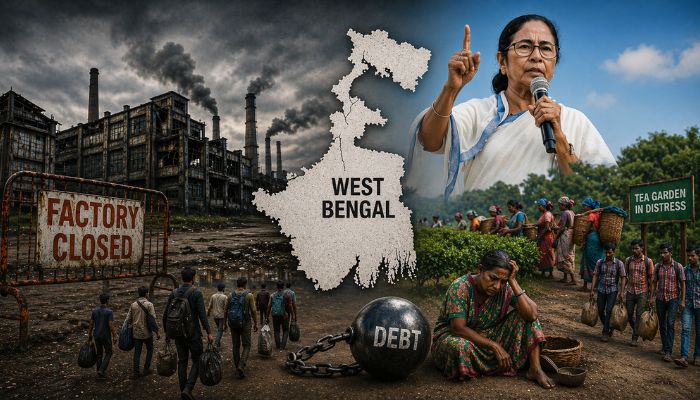
As West Bengal moves toward the 2026 Assembly elections, the atmosphere is thick with political tension. From the tea gardens of Darjeeling to the industrial belts of Hooghly and the coastal villages of the South, every corner of the state is bracing for a decisive moment. 

Beyond the slogans of “Ma, Mati, Manush” by TMC, a study shows how a state that once stood among India’s foremost economic powerhouses has gradually slid into a cycle of debt and decline. First under the decades-long rule of the Left Front and now under fifteen years of the All India Trinamool Congress (TMC) government led by Mamata Banerjee.

A structural decline since 2011

According to the financial report [pdf] published by Finskeptics, there was a sense of hope that the “new dawn” would finally break the chains of industrial inertia. However, the data shows that the structural weaknesses of the economy haven’t just remained; they’ve actually deepened. 

While the state government has been very successful at building a massive network of welfare schemes, which provide immediate relief to the poor, the “engine” of the economy is sputtering. We are seeing a model where the government is spending more and more on redistribution while the productive sectors, like heavy industry and IT, are struggling to keep up.

The consequences are visible in broader indicators: West Bengal’s share in national GDP has declined, per capita income remains below the national average, and thousands of companies have moved out of the state.

The investment climate has also suffered. Informal costs such as rent-seeking networks, combined with political interference in labour relations, have reduced investor confidence. Infrastructure gaps and factory closures have further weakened the industrial ecosystem.

The long fall of an Industrial giant

Historically, West Bengal was the nerve centre of Indian industry. Shortly after Independence, it contributed nearly 10% to the national GDP. It was the land of engineering giants, jute mills, and the undisputed commercial capital of the East. But over the last seven decades, a combination of bad luck and even worse policy has eroded that foundation. From the shocks of Partition to the “freight equalisation policy” that stripped Bengal of its competitive edge in minerals, and the later years of militant labour movements under the Left, the decline was steady.

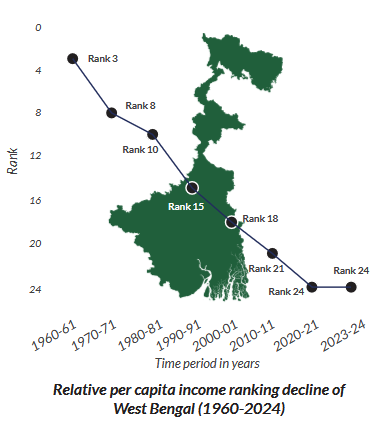
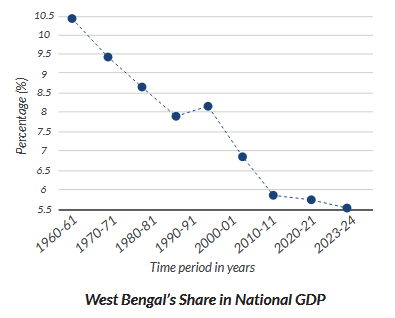
The “Bengal Curse” is a poignant way to describe this: in 1960, West Bengal was the 3rd richest state in India. By 2024, it had tumbled to the 24th spot. 

Graph via Finskeptics

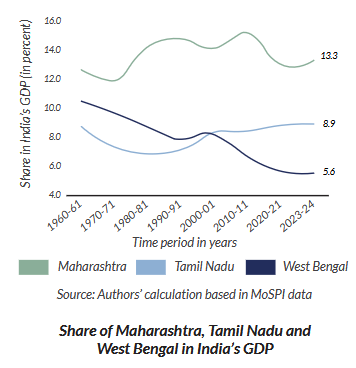
According to a major working paper by the Economic Advisory Council to the Prime Minister (EAC-PM), the state’s share of national GDP dropped from 10.5% in 1960–61 to just 5.6% in 2023–24. This is the sharpest drop recorded for any major state in the country. Even more heartbreaking is that the relative per capita income, which used to be 127.5% of the national average, has crashed to 83.7%. States like Odisha, which were once considered far behind Bengal, are now racing ahead while Bengal struggles to find its footing.

Graph via Finskeptics

This long-term decline, often described as the “Bengal Curse,” reflects cumulative policy failures across regimes. While the Left Front years entrenched deindustrialisation, the post-2011 period has not delivered the expected turnaround.

The current financial mess: Welfare at the cost of growth

Under the TMC government, the financial situation has become increasingly fragile. The state is currently trapped in a cycle of borrowing to pay for day-to-day expenses rather than building assets that could generate future income. The debt has skyrocketed, and because the state isn’t bringing in enough of its own tax revenue, it has become heavily dependent on the Centre. 

The state’s debt has surged to over ₹7.7 lakh crore, while fiscal deficits remain high. Welfare expenditure has expanded significantly, often around election cycles, but capital investment continues to lag.

While the government celebrates its “populist” image, the math behind it is worrying. Most of the money coming in is immediately swallowed up by interest payments on old loans, salaries, and pensions. This leaves very little room for building new roads, bridges, or power plants, the very things that attract businesses and create jobs.

Key indicators highlight the imbalance. Own tax revenue growth remains weak, the credit-deposit ratio is low, and foreign investment inflows are modest. Industrial closures and company relocations further indicate a weakening economic base. The MSME sector, though large in numbers, is dominated by micro enterprises with limited capacity for scale or job creation.

Fiscal and debt trends: The growing mountain of loss

The numbers regarding Bengal’s debt are staggering. When the TMC took office in 2011, the state’s debt was about ₹1.92 lakh crore. By the end of the 2025–26 fiscal year, that figure is projected to hit a massive ₹7.7 lakh crore. That is a fourfold increase in just 15 years. 

Every single citizen in West Bengal now carries a “debt burden” of roughly ₹70,653. While the government argues that this is manageable, the real danger is the interest. West Bengal spends about 20% to 28% of all the money it earns just on paying back interest. In comparison, most other big states only spend between 5% and 15%. This means Bengal is losing its “fiscal breathing room.”

Even more concerning is the “Revenue Deficit.” In simple terms, the state is borrowing money to pay for things like subsidies and administrative costs rather than building infrastructure. In FY 2024-25, the fiscal deficit reached 4.02% of the GSDP, which is well above the safe limit of 3% recommended by experts. 

Graph via Finskeptics

Between 2020 and 2025, the state accumulated a revenue deficit of ₹1.49 lakh crore. To sustain this, the government has been borrowing heavily, with loans making up 80% of its capital receipts. This is like a household taking out a high-interest credit card loan just to pay the grocery bill; it’s a short-term fix that leads to long-term disaster.

Industrial exodus: Why the factories are leaving

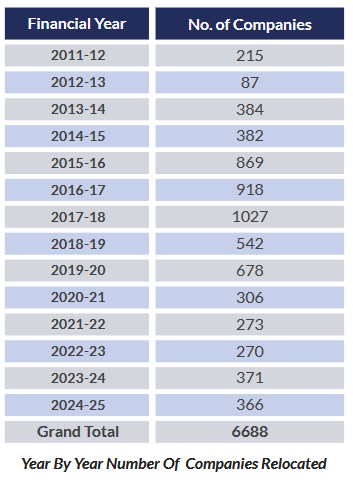
One of the most visible signs of economic stress in West Bengal is the steady exit of industries. Since 2011, over 6,600 companies, including 110 listed firms, have moved their registered offices out of West Bengal. This isn’t just a temporary dip; it’s a structural flight of capital. 

Table via Finskeptics

Businesses are leaving for states like Maharashtra, Gujarat, and Uttar Pradesh because they no longer feel confident in Bengal’s business environment. While the state holds grand “Bengal Global Business Summits” and announces massive investment figures, the reality on the ground is that only about 4% of those proposals ever actually happen.

A major reason for this is the “Syndicate System.” In Bengal, the term “syndicate” refers to politically backed groups that control everything from construction materials to labour supply. If a company wants to build a factory, they often have to deal with these informal networks that demand “cut money”, essentially a bribe or a parallel tax. 

This adds a huge hidden cost to doing business. On top of this, the old “Gherao” culture, where workers surround managers to demand changes, has made a comeback under new names, leading to 177 factory closures during the TMC’s tenure compared to 83 under the previous government. 

This environment has scared away big investors, leaving the state’s industrial output to shrink from 13.5% in the 70s to a measly 3.9% today.

Labour and sectoral distress: The Human cost of decline

The economic imbalance is not just visible in data; it is reflected in the lives of people. One of the clearest indicators is the rise in labour migration. Because there are no new factories and the old ones are closing, West Bengal has become one of India’s biggest exporters of labour. As of 2025, an estimated 22.4 lakh workers from Bengal are working in other states like Kerala, Karnataka, and Maharashtra. 

These are people who have left their families behind to do menial jobs elsewhere because they can’t find a living wage at home. This massive out-migration is a “silent referendum” on the state’s governance. If things were going well, why would over two million people flee their homes to work in distant lands?

The distress is particularly visible in the tea gardens of North Bengal. Once the pride of the state, the tea industry is now in a “humanitarian emergency.” Production in 2025 dropped by 50-60%, and 80% of the organised gardens are running at a loss. 

But the real tragedy is the workers. While a tea worker in Sikkim earns ₹500 a day, a worker in West Bengal gets only ₹250. This wage gap has led to horrific levels of malnutrition. 

Studies in the Alipurduar district show that over 36% of tea workers are clinically undernourished, and nearly 88% suffer from anaemia. In some abandoned gardens, people are literally dying of hunger-related complications. Instead of reviving the industry, the state has allowed land to be diverted for “tea tourism” and real estate, effectively liquidating the assets while the workers starve.

Macroeconomic underperformance: Falling behind the rest of India

At the macro level, West Bengal’s economic performance continues to lag behind comparable states. Its share of national GDP has fallen from 10.5% in 1960–61 to just 5.6% in 2023–24. Per capita income remains below the national average at around 83.7%. The nominal GSDP growth of the state in FY25 was just 9.91%, the lowest among all comparable major states. 

The Credit-Deposit (CD) ratio, which measures how much banks are lending locally, is stuck between 46% and 52%. This is 30 points below the national average! It means that the money people in Bengal save in banks is being sent by those banks to other states to fund projects there, because there aren’t enough viable projects to fund in Bengal.

The MSME (Micro, Small, and Medium Enterprises) sector, which the government often brags about, is also in trouble. While there are millions of registrations, 99.9% of them are “Micro” units, often just one person working from home.

These aren’t the kind of businesses that can scale up and provide thousands of jobs. In fact, over 2,200 MSMEs closed down between 2019 and 2024. The state’s ability to generate its own tax revenue is among the lowest in India, and its spending on infrastructure has dropped from 5.3% to a tiny 3%.

Conclusion

What emerges from all these numbers is a clear and worrying pattern. West Bengal is transforming from a state of production to a state of dependency. It is moving from industrial employment to a reliance on money sent home by migrants. Its share of the national pie is shrinking, its factories are closing, and its debt is piling up. 

West Bengal’s economic challenges today are not the result of a temporary slowdown; they reflect a deeper structural imbalance. The shift toward welfare-heavy spending without corresponding growth in production, investment, and industry has created a fragile economic model.

High debt, low capital investment, industrial flight, and rising migration are all interconnected symptoms of this imbalance.