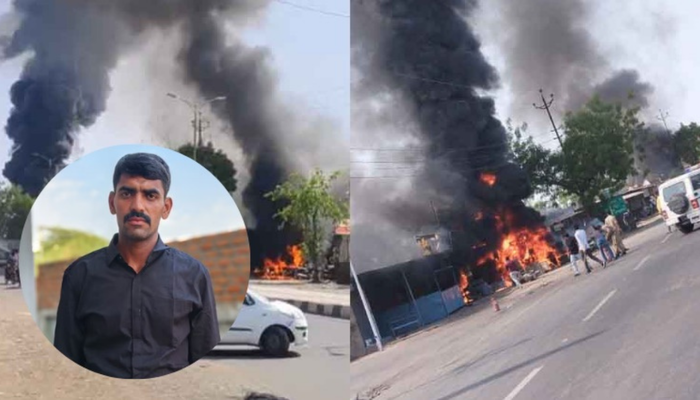
On April 18 (Saturday), two Muslim men brutally murdered a Hindu man, Dharmesh Bharwad, in Dhandhuka town of the Ahmedabad district of Gujarat. A minor dispute over a trivial issue relating to parking led to the victim being stabbed to death by the accused. After the attack, Dharmesh was rushed to the hospital in a critical condition, where he succumbed to his injuries. The incident sparked outrage among the local Hindu community, leading to widespread demonstrations and shops being vandalised. As the situation deteriorated, a police convoy, including Ahmedabad Rural SP and other senior officials, reached Dhandhuka and brought the situation under control.
Rahul Bharwad, the cousin of the deceased, Dharmesh, filed a complaint regarding the entire incident at the Dhandhuka Police Station, based on which the police have registered an FIR. A copy of the FIR is available with OpIndia. The accused have been identified as Rizwan Nizam Maniyar and Sameer Mohammed Amdani. They were arrested by the police and were sent into custody for interrogation.
On the fateful day, Dharmesh Gamara (Bharwad) asked his cousin, Rahul, to accompany him to the place of a relative and also bring his motorbike. Rahul agreed and met Dharmesh at Ranpur crossroad, where he took Rahul’s motorbike and left for the bank for some work. On reaching the bank, as Dharmesh was parking his bike, Sameer and Rizwan got into an argument with him over a parking space. Dharmesh ignored them and went inside the bank to finish the work. In the meantime, he called Rahul to the bank from where they left for the relative’s place on separate bikes.
The accused stood near the vehicle and began their assault.
When Dharmesh and Rahul reached Naseeb Society, they saw that two accused were already present there, blocking the road. They started abusing Dharmesh. When Dharmesh and Rahul attempted to reason with the accused, the attackers assaulted them and grabbed Dharmesh. “What were you talking about at the bank? Today, we are going to finish you off,” the accused said, threatening Dharmesh. In his complaint, Rahul stated that Sameer Mohammed held Dharmesh down while Rizwan stabbed him with a knife. Rahul attempted to intervene, but by then, the attack on Dharmesh had been stabbed.
The accused immediately fled the scene after the act. Dharmesh Bharwad was rushed to the hospital in a critical condition; however, his life could not be saved, and he was pronounced dead after briefly receiving treatment. According to the complaint filed by Rahul, while on the way to the hospital, Dharmesh had identified the accused as Rizwan and Sameer.
Based on the complaint, the police registered an FIR against the accused, Rizwan Nizam Maniyar and Sameer Mohammed Amdani, under Sections 103(1), 351(3), 352, and 54 of the BNS, and Section 135 of the Gujarat Police Act. Terming the incident a premeditated criminal conspiracy, the police have initiated an investigation into the case.
Speaking to OpIndia, Rahul said that the two accused attacked Dharmesh with a sharp-edged weapon, shouting, “We will not spare him today. Let’s kill him”. They fled the spot after stabbing Dharmesh. The complainant further recounted that he attempted to intervene and rushed to save his brother, but the accused restrained him, thereby preventing him from saving his brother.
Police to constitute a Special Investigation Team
Speaking about the incident, Ahmedabad Rural SP Om Prakash Jat said that he met the victim’s family, who expressed satisfaction over the police action. He further added, “The deceased’s family had demanded the appointment of a special public prosecutor and a comprehensive investigation. Therefore, we will constitute a Special Investigation Team (SIT) after consulting with our senior officials and the government.”
#WATCH | Ahmedabad, Gujarat: On violence in Dhandhuka, Ahmedabad Rural SP Om Prakash Jat says, "I met the victim family, and they are satisfied with the Police action. They had demanded a Special Public Prosecutor and a detailed investigation be done. So, after consulting our… pic.twitter.com/IbvYrGI1wc
Furthermore, the SP said that all shops were reopened and peace prevails in the area. The police had initiated a search of the locality during the night and had also started interrogating suspects. Providing a brief account of the incident, the police official explained that following an altercation over a motorcycle, two individuals named Rizwan and Sameer attacked Dharmesh, who later died. The police confirmed that a thorough investigation into the incident is underway, and further legal action has been initiated following the arrest of the accused.
#WATCH | Dhandhuka, Gujarat | Superintendent of Police (SP) for Ahmedabad Rural, Om Prakash Jat says, "In Dandhuka town, two people were involved in a bike accident. One of them was a youth from the Muslim community, and the other was from the Bharwad community. They had a fight,… pic.twitter.com/ecG6mX9aQe
Notably, in 2022, a Hindu man named Kishan Bharwad was murdered by Muslims in the same area merely for posting a picture of Lord Krishna. He was shot dead in broad daylight by Muslims in Sarjaher. Subsequently, several accused, including a cleric, were arrested in connection with this case. Hindus had not been able to forget the brutal murder of Kishan Bharwad, and outrage spread when another similar incident occurred in the area. However, peace currently prevails in the region.
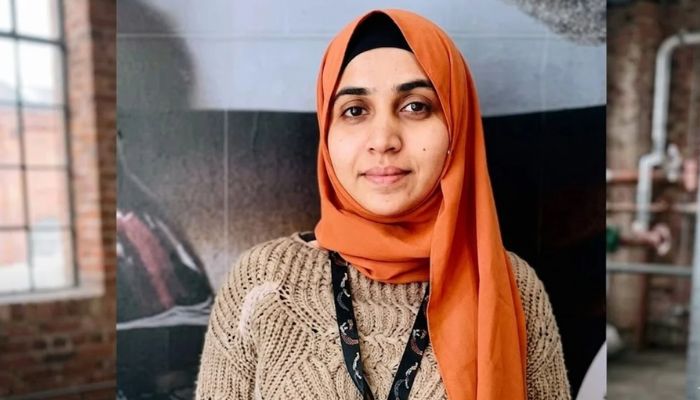
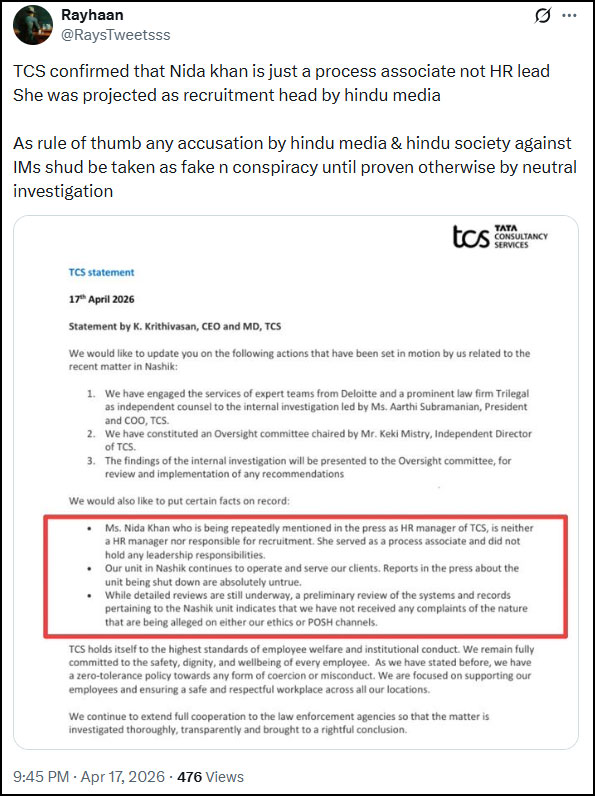
On 17th April, Tata Consultancy Services (TCS) issued an official statement regarding the ongoing conversion scandal controversy. In its statement, the company stated that while media reports have named Nida Khan as HR manager, she holds the post of a process associate. The company further clarified that she did not hold any leadership roles.
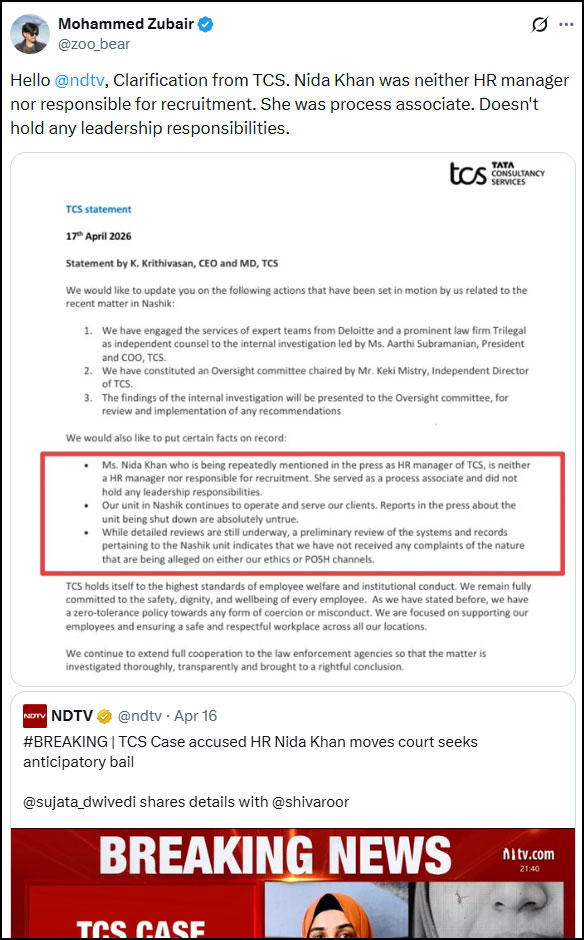
The statement read, “Ms. Nida Khan, who is being repeatedly mentioned in the press as an HR manager of TCS, is neither an HR manager nor responsible for recruitment. She served as a process associate and did not hold any leadership responsibilities.” The statement was also submitted to the National Stock Exchange and shared on social media platforms. Notably, Nida Khan has been suspended by the company pending internal investigation.
Several media houses and Left-liberals used this statement to whitewash the role of Nida Khan in the conversion scandal.
Propagandist and fake news peddler posing as a fact-checker, Mohammed Zubair of Alt News, ran a campaign after TCS’s clarification and targeted every news portal and media house that called Nida Khan an HR manager.
Source: X
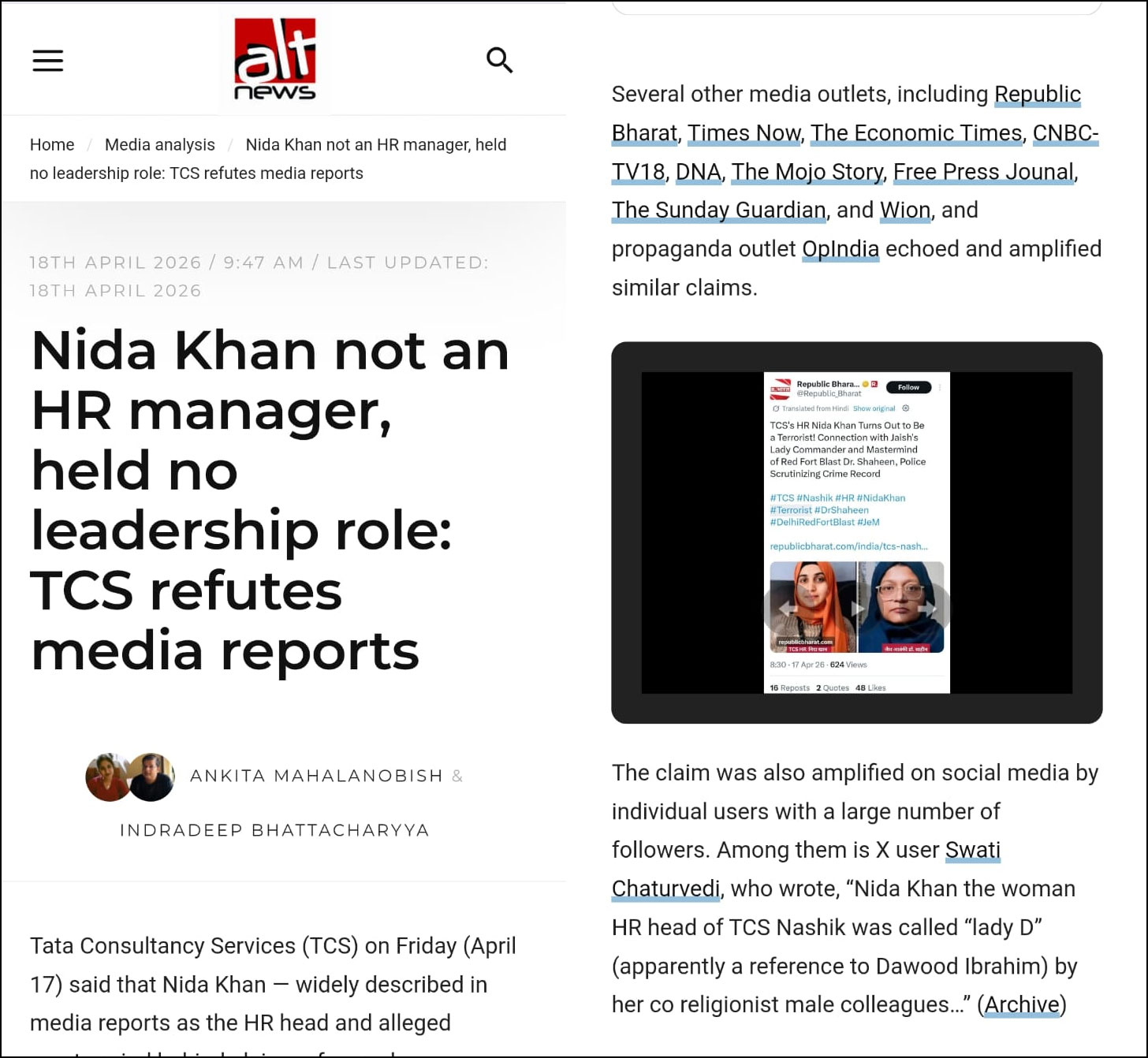
A detailed report was published on Alt News targeting media houses including OpIndia. However, the article did not describe the role of process associate in HR framework.
Source: Alt News
Several social media users ran similar campaigns targeting media houses for calling her HR manager, without going into details of the role of a process associate.
Source: X
What is a process associate in HR?
While TCS has clarified that Nida Khan was not an HR manager, the company completely skipped explaining the role of a process associate in the HR department. This job profile, which according to the company, Nida Khan held, requires a closer look, especially to understand what responsibilities employees in such positions entail within large corporate structures.
TCS Case: Was Nida Khan really a process associate and not HR? What's with 78 emails:
In BPO and ITES companies, process associates in the HR department do most of the ground-level work. They are the ones who keep everything running daily. While HR managers make plans and… pic.twitter.com/Re8Z2rMvIA
While process associate is not a leadership role, an employee in this post in the HR department is responsible for handling operational and backend HR functions. These roles form a crucial part of the human resources workflow by ensuring that systems, documentation, and employee processes function smoothly.
Handling employee documentation and onboarding processes
One of the main responsibilities of a process associate is to manage employee documentation. The process associate is responsible for verifying identity proofs, conducting background checks, and ensuring that all the needed paperwork is in place before the employee completes onboarding. The process associate also makes sure that documents such as non-disclosure agreements, company policies, and employment contracts are processed and recorded.
These functions are important for compliance and maintaining standards at the organisational level, especially in large companies where onboarding is handled at scale.
Maintaining and updating employee records
Furthermore, process associates are also responsible for updating and maintaining employee data in HR systems. This involves inputting accurate information, ensuring records are up to date, and managing databases that are used across various HR services.
The role requires attention to detail, as errors in employee data can impact payroll, compliance, and internal reporting systems.
Acting as the first point of contact for employees
This is the most crucial aspect of the process associate role, especially when seen in the context of the ongoing TCS conversion scandal controversy. In many organisations, process associates act as the first level of interaction for employees facing issues related to HR. They record complaints, respond to basic queries, and escalate matters to the appropriate departments such as senior HR personnel or committees like POSH when required.
Though they may not play a direct role or hold authority to resolve complex matters independently, their role is to act as a bridge between employees and the broader HR framework.
Supporting HR operations and compliance
Other than basic documentation and communication, process associates support HR operations in generating reports, handle transactional processes, and assist in compliance-related tasks.
Another key aspect of the role includes addressing employee queries related to compensation, policies, and HR procedures. While they may not make policy decisions, they help interpret and communicate existing frameworks to employees and ensure timely resolution of concerns by coordinating with relevant teams.
Role limited to execution, not decision making
As described above, the role of a process associate is mostly execution-driven. It involves processing, verifying, updating, and escalating, rather than making strategic decisions or leading teams. While what TCS claims in its statement is true, denying Nida Khan’s role in the HR framework just because she was a process associate would be completely wrong.
The investigation in the matter is underway and as Nida Khan is still absconding, the police are yet to question her about her role in the company and the controversy surrounding the FIRs that have named her.
India’s attempt to implement women’s reservation in the Parliament suffered a major setback after the Constitution (One Hundred and Sixth Amendment) Act, 2023, failed to get through the Parliament. India’s current representation of women in the Indian Parliament is roughly around 14% in the Lok Sabha and 17% in the Rajya Sabha, as compared to the global average, which stands at 26%. The low representation of women in politics and their involvement in decision-making at the national and lower levels has been and continues to be low worldwide.
While in principle, India has already taken a step forward in the direction of increasing women’s participation in the national decision-making with the passing of the Constitution (One Hundred and Sixth Amendment) Act, 2023, the law has been waiting for implementation for over two years.
The debate about bringing gender parity in politics and public life is not limited to any one country or region. The 17 Sustainable Development Goals (SDGs) under the 2030 Agenda for Sustainable Development include gender equality as one of the goals. It goes without saying that gender parity in politics and policymaking is pivotal for achieving gender equality at other levels nationally as well as globally.
Notably, India is not the only country to take legislative action to ensure that women are given adequate representation in the country’s biggest decision-making body. Several other countries have taken affirmative actions to ensure women’s representation in the national as well as local politics. Some of the countries have introduced fixed minimum quotas for women in their national legislative bodies, while others have fixed minimum quotas in the candidates’ lists of political parties.
Here is a list of some of the countries which have taken affirmative actions and fixed gender quotas, including reserved seats in their national or local legislative bodies and candidate quotas.
Nepal
In Nepal, 33% seats in its Parliament are reserved for women. It has a fixed gender quota of 33% for the Lower House and 2% for the Upper House. The gender quota for the sub-national level also stands at 33%.
Pakistan
In Pakistan, the gender quota was introduced in 1965, but after 2002, the minimum representation of women in its National Assembly was fixed at 17%.
Bangladesh
In Bangladesh, at least 14% of the seats in the Lower House of the Jatiye Sansad are to be filled by women candidates, while at the sub-national level, the minimum gender quota has been fixed at 33%.
Sri Lanka
Sri Lanka has fixed a gender quota target for the Sub-national level at 25%.
United Arab Emirates
The Middle Eastern country has a gender Quota target of 50% for the Lower House of its Federal National Council.
Indonesia
The gender quota in the Lower House of the People’s Consultative Assembly has been fixed at 30%. The minimum percentage of women at the sub-national level has also been set at 30%.
Greece
40% of the seats in the Lower House of the Hellenic Parliament have been reserved for women representatives. And the same percentage of seats has been fixed for women at the sub-national level.
Italy
In Italy, 40% of the seats in the Lower House of the Italian Parliament have been reserved for women, and the same percentage of the total seats have been fixed for women representatives in the Upper House. Besides, 40% reservation has been provided to women candidates at the sub-national level. The political parties in Italy have voluntarily adopted gender quotas.
Spain
Spain has reserved 40% of the seats in the Lower House and 50% of the seats in the Upper House of its national legislature for women. At the sub-national level, 40% of the seats have been reserved for women. Like Italy, political parties in Spain have also adopted voluntary quotas of 44% for women.
Norway
The Nordic country has fixed a gender quota of 40% for women at the sub-national level.
Notably, major Western and European countries like the US, Canada, France, Germany and Sweden do not have seats reserved for women representatives in their national legislative bodies. If one takes a look at the representation of women in top political positions and connected public offices globally, in 28 countries, 30 women serve as Heads of State and/or Government as of January 1, 2026. According to the data compiled by UN Women, women represent 22.4 per cent of Cabinet members heading Ministries, leading a policy area as of the same date.
According to an estimate, at the current rates of progress in granting women representation in political spheres, gender parity in national legislative bodies will not be achieved before 2063. While gender parity remains evasive across the world, including the first world and the third world countries alike, reservation of seats for women in national legislatures and local levels has contributed significantly towards the aspirational goal of achieving gender parity in politics globally.
Women’s representation in politics is not a mere cosmetic change in how the national decision-making bodies appear. It had deep and far-reaching implications for policies and governance outcomes. A balanced representation is likely to ensure more equitable and inclusive policy-making. It will encourage and empower women to claim their rightful places in public life and areas traditionally dominated by men because of societal norms and a tilted power structure.
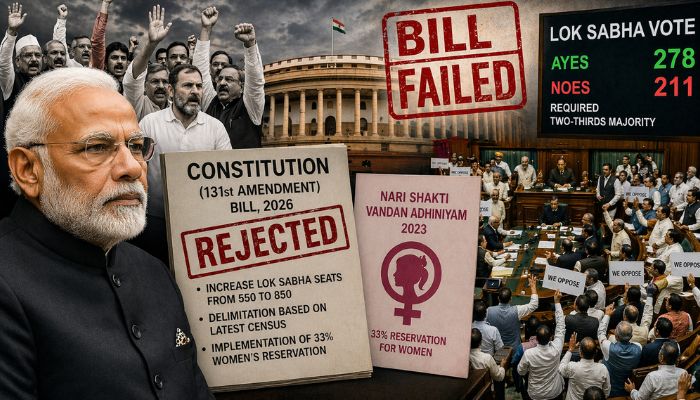
The Indian parliamentary landscape witnessed a major development on Friday, 17th April, as the central government’s plan to transform the nation’s electoral framework came to a halt. In a setback for the ruling National Democratic Alliance (NDA), the Constitution (131st Amendment) Bill, 2026, failed to pass in the Lok Sabha, falling short of the mandatory constitutional threshold.
The bill received 278 votes in favour (ayes) and 211 against (noes), with 489 members present and voting and no abstentions. A constitutional amendment under Article 368 of the Constitution requires the support of at least two-thirds of the members present and voting.
Lok Sabha Speaker Om Birla says, "The Constitution (131st Amendment) Amendment Bill did not pass as it did not achieve a 2/3 majority during voting in the House." https://t.co/ucLnUltYnjpic.twitter.com/xcBUJ3RhAv
The vote comes a day after the Union Government notified the Constitution (106th Amendment) Act, 2023, bringing into force the law providing for 33% reservation for women in the Lok Sabha and State Legislative Assemblies with effect from Thursday, 16th April.
Recognising that the structural foundation of their reform package had been rejected, Union Minister Kiren Rijiju moved to withdraw the accompanying Delimitation Bill, 2026, and the Union Territories Laws (Amendment) Bill, 2026. These bills were inextricably linked to the 131st Amendment; without the constitutional authority to alter the seat limits and the census criteria, the subsidiary bills became legally untenable.
This is a rare and significant blow to the government’s plans, effectively stalling the much-anticipated increase in Lok Sabha seats and, more importantly, putting the implementation of the Women’s Reservation Act into a state of deep uncertainty.
What is the 131st Amendment Bill?
The 131st Amendment Bill was essentially a plan to completely overhaul how India’s elections look. For decades, the number of seats in the Lok Sabha has been frozen based on the 1971 Census. This bill wanted to break that freeze. It proposed to increase the maximum number of seats in the Lok Sabha from 550 to a whopping 850.
Out of these, 815 seats would come from the states and 35 from the Union Territories. The idea was to move back to the principle that every state should have seats in proportion to its actual population, ensuring that every citizen’s vote carries roughly the same weight across the country.
Beyond just adding seats, the bill gave Parliament the power to decide when the next “delimitation” (the process of redrawing constituency boundaries) would happen and which census would be used. The accompanying Delimitation Bill made it clear that they intended to use the 2011 Census for this next round.
Most importantly for the average citizen, this bill was designed to remove the technical hurdles that were blocking the 33% reservation for women. It sought to decouple the start of the reservation from the “first census after 2023” requirement, so that the reservation law can be implemented without waiting for the results of 2026-27 census, aiming to get women into those seats much faster by linking it to the immediate delimitation exercise.
The Nari Shakti Vandan Adhiniyam 2023
Nari Shakti Vandan Adhiniyam, or the Women’s Reservation Bill was passed in September 2023. At that time, Prime Minister Narendra Modi spoke about how this move had been delayed since 1996. The 2023 law was a historic move to reserve one-third of all seats in the Lok Sabha and State Assemblies for women. It even included a sub-quota for women belonging to the Scheduled Castes and Scheduled Tribes, ensuring that the most marginalised voices would be heard in the halls of power.
However, a crucial clause, Article 334A(1), was inserted into that 2023 Act, stating that the reservation would only come into effect after a fresh census was conducted and a delimitation exercise was completed. Since the 2021 census was delayed due to COVID-19 and is expected to be completed by 2027, the actual reservation was looking like a distant reality for the 2029 elections or beyond.
The 131st Amendment was the government’s attempt to fast-track this process. It was the contingent bill that would have cleared the path. By failing to pass the 131st Amendment, the opposition has essentially blocked the only immediate legal route to making the 2023 Women’s Reservation Law functional.
Delimitation Bill
Similarly, the proposed Delimitation Bill of 2026 was a direct consequence of the 131st Amendment. Delimitation is the process of redrawing those boundaries so that each MP represents a similar number of people. Currently, the allocation of seats to states is frozen based on 1971 population figures to prevent penalising states that successfully implemented population control. However, the 131st Amendment sought to break this freeze to reflect the modern demographic reality of India.
The Delimitation Bill would have established a Commission led by a Supreme Court judge to redraw boundaries using the latest published data. This process is essential for women’s representation because the law requires the identification of specific “reserved” constituencies, which can only be done during a delimitation exercise.
By voting down the constitutional amendment, the opposition has not only stopped the increase in seats but has also stalled the redrawing of boundaries that would have identified the 33% of seats specifically for women.
The opposition argued that using the 2011 Census would hurt the southern and north-eastern states because their population growth has been slower. But the government’s counter-argument was simple: you can’t have a democracy where some people’s votes are worth more than others, and you certainly can’t implement women’s reservation without redrawing the map.
After the Constitution (131st Amendment) Bill failed to clear the required 2/3 majority in the Lok Sabha, opposition leaders react
The defeat of the bill has sparked a fierce debate over the intentions of the opposition. The move reveals a deeply “anti-women” bias within the INDIA bloc. While the opposition claimed to support women’s reservation in 2023, their actions on Friday tell a different story. By voting down the 131st Amendment, the opposition has effectively told 700 million women that they have to wait even longer for their rights. They claim to support the 2023 law, but they rejected the very bill needed to implement it.
Delhi: On the Constitution (131st Amendment) Bill being rejected in the Lok Sabha, Lok Sabha LoP Rahul Gandhi says, "We have clearly stated that this is not a women’s bill; it is an attempt to change the political and electoral structure of the country, and we have stopped it. I… pic.twitter.com/Ob6xbSfEao
The opposition’s celebration after the bill fell has been described as a “betrayal.” While leaders like Rahul Gandhi called the bill an “unconstitutional trick,” the opposition’s real fear was the shift in political power that comes with seat expansion. They chose their regional seat counts over the historic empowerment of women.
LoP Rahul Gandhi in Parliament
"This bill has nothing to do with the empowerment of women. This is an attempt to change the electoral map of India"
"You are scared of the erosion of your strength, and you are trying to rejig the Indian political map. You did it in Assam, J&K,… pic.twitter.com/gWiAPiAj3x
Even Samajwadi Party chief Akhilesh Yadav, who talked about supporting women’s rights, ended up opposing the bill over unconstitutional demands regarding religion-based quotas within the reservation. This kind of politics shows that for the opposition, women’s empowerment is a good slogan, but a secondary priority when it comes to their own political survival.
The Prime Minister’s warning
In a cabinet meeting on Saturday, 18th April, following the defeat, he didn’t hold back. According to media reports, PM Modi said that the opposition has committed a massive mistake and will have to face the consequences. “They have let down the women of the country. This message must be taken to every single person, to every single village,” the PM told his cabinet. He had even given a personal guarantee in the House that no state, including those in the South, would face injustice even as the seats increased to 816.
The Prime Minister’s frustration is shared by many in the government. Union Minister Kiren Rijiju called the opposition’s move a “black stain on the Congress and its allies, one that they will never be able to erase.” Home Minister Amit Shah also hit out at the opposition’s “celebration,” saying, “How can anyone celebrate victory after deceiving half the nation’s population… and losing their trust?”
As it stands today, the dream of seeing 33% women in our Parliament is back in the freezer. The failure of the 131st Amendment isn’t just a political loss for the NDA; it’s a setback for the women of India who were told that their time had finally come.
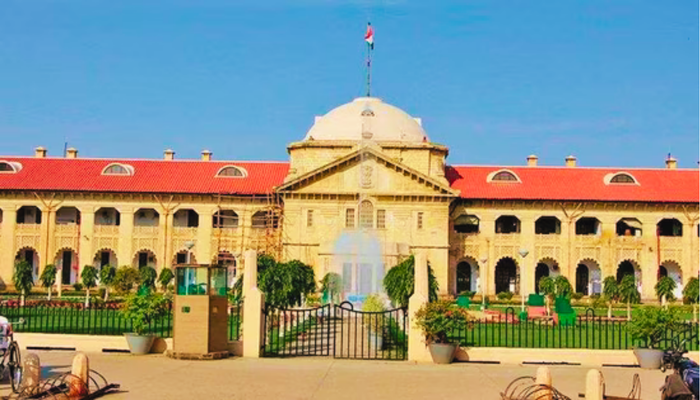
The Allahabad High Court recently expressed concern over the rising religious fanaticism among the youth in the country, calling it a disturbing trend. The High Court’s remarks came during the hearing of writ petitions filed by two Muslim school girls, Aleena alias Aleena Parveen and Shabiya, seeking the quashing of the FIR against them. The FIR was lodged against the Muslim girls, studying in class 12th, under the Uttar Pradesh Prohibition of Unlawful Conversion of Religion Act, 2021, for forcing their religious beliefs on their Hindu friend.
A Division Bench of Justice JJ Munir and Justice Tarun Saxena dismissed the writ petition filed by the Muslim girls. It refused to intervene in the investigation by stating that a prima facie case was made out against them. “If this kind of trend comes to be seen amongst young people, it is all the more disturbing. This is the time in their lives when they should be thinking more towards developing their skills in different fields of education and dedicate themselves to the service of society and the nation,” the Court said, declining the petitions.
The High Court, in its order dated April 16, 2026, went on to explain the significance of the Uttar Pradesh Prohibition of Unlawful Conversion of Religion Act, 2021, amid the growing trends of people imposing their religious beliefs on others. “We must be alive to the situation that the Act of 2021 was enacted to curtail an emergent situation in society, where certain persons go about not professing or propagating their religion, but thrusting it upon others in the belief which somehow makes it to their mind the religion they believe in must be followed by others,” the High Court stated.
The High Court highlighted how the legislation was the need of the hour to address the problem of religious coercion and forced religious conversion. “The Act of 2021 was brought to curtail this emergent mischief, which is heard from different quarters in the country these days, and of which we must take judicial notice. A statute that is enacted to curtail an emergent mischief, if stopped in its tracks at the very early stages of its enforcement, would bog down the statute and frustrate its purpose,” the court added.
Background of the case
The FIR was filed by the victim’s brother on January 22, 2026, at the Police Station Bilari, Moradabad, under Sections 3 and 5(1) of the 2021 Act. In the FIR, the victim’s brother stated that the Muslim girls study along with her sister, Kumari Mahima, at a coaching centre located in Shahukunj Colony, located in Town Bilai, Moradabad. He accused the Muslim girls of forcefully making his sister, Kumari Mahima, wear a burqa and pressuring her to accept Islam. He expressed the suspicion that there could be a larger conspiracy behind the act of the accused and urged the police to investigate it.
Denying the allegations against her, Aleena said that the FIR against her was filed out of vengeance as she allegedly turned down a romantic proposal from the victim’s brother. She alleged that the victim’s brother used to stalk her and, on one occasion, proposed to her.
The victim, in her statement given to the Judicial Magistrate under Section 183 BNSS, narrated the entire incident that happened on January 20, 2026. According to the victim, after the coaching classes, her friend Aleena and four of Aleena’s Muslim friends, namely, Malishka, Shabiya, Rimsha and Zehra, invited her to a restaurant for some snacks. Before leaving for the restaurant, Aleena forced her to wear a veil (burqa), which she had carried with her. When the victim refused to wear it, all the Muslim girls forcefully made her wear the burqa, and they proceeded towards the restaurant. The victim did not disclose anything to her mother, as Aleena had forbidden her.
The victim said that Aleena tried to brainwash her into accepting Islam. Aleena and the four other girls kept saying that their religion was good. They told the victim that there was freedom in their religion and that they could go anywhere after wearing the burqa. They also told her things about the Quran and said that the entire Quran could be read in 40 days. The victim also told the Judicial Magistrate that Aleena and the four girls often brought non-vegetarian food and forced her to eat it. When she refused to consume it, they told her to at least eat the gravy. The accused girls also repeatedly asked the victim to accept Islam.
The High Court examined the footage of a CCTV camera which was located close to the place where the victim was made to wear the burqa by the Muslim girls. The court noted that no FIR was filed by Aleena against the victim’s brother, even though she alleged that he stalked and proposed to her.
“Quite apart, the stand of the victim before the learned Judicial Magistrate cannot be trashed. It carries all the necessary facts, which would prima facie attract the provisions of Sections 3 and 5(1) of the Act of 2021,” the High Court stated in its order, adding that, “In the totality of circumstances, we do not find it to be a fit case where we ought interdict investigation and quash the impugned FIR”.
The multiple allegations of sexual misconduct, religious conversion attempts and workplace harassment involving a Nashik-based BPO office of Tata Consultancy Services (TCS) have served as a sobering reminder that even the upscale offices of the corporate sector are not immune to the malicious intentions of Islamists.
9 First Information Reports (FIRs) had been filed in the case and the accused, including Danish Shaikh, Tausif Attar, Raza Memon, Shahrukh Qureshi, Asif Ansari and Shafi Sheikh were nabbed while authorities probe how repeated complaints of harassment were ignored by the corporate office.
The Indian mainstream media, captured by Islamo-leftists and their liberal cheerleaders, have rushed to support the perpetrators, dismissing the severity of the crime and conveniently downplaying the fact that the issue came to light only after female police personnel went undercover at the facility.
‘A single workplace dispute’: The process of whitewashing by dismissing the victim’s complaint
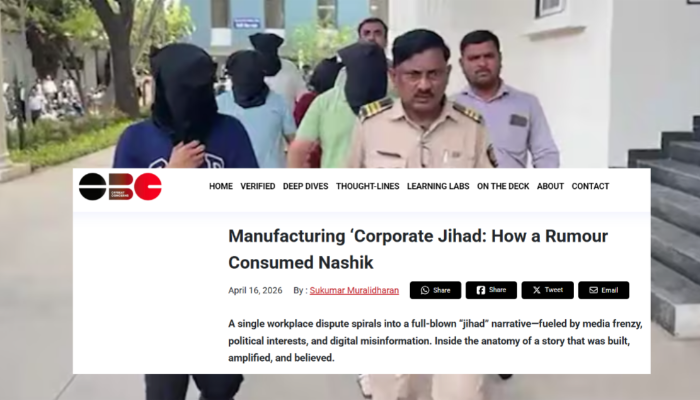
On 16th April (Thursday), “Offbeat Concerns” published an article, explicitly rejecting the pain and agony endured by the victims to claim that the accusations arise from a “single workplace dispute.” This ecosystem, which usually supports the notion of trusting women, especially in matters concerning sexual violations, is reluctant to apply the same principle in this situation due to the fact that the offenders are Muslims.
The hypocrisy is only set to intensify in the increasingly inconceivable arguments presented by the author in a bizarre defence of the Islamists.
“Manufacturing Corporate Jihad: How a Rumour Consumed Nashik,” by Sukumar Muralidharan alleged, “A single workplace dispute spirals into a full-blown jihad narrative, fueled by media frenzy, political interests, and digital misinformation. Inside the anatomy of a story that was built, amplified, and believed.”
Former member of the Rajya Sabha, Priyanka Chaturvedi, also lambasted the propaganda piece, highlighting the extensive probe and the participation of undercover policewomen in the matter. “3 more of those affected have recorded their statements and we already have people dismissing the women’s lived experiences by calling it bogus. Sexual harassment at the workplace cannot be so casually dismissed as this gentleman is doing in his column,” she conveyed.
There are 9 FIRs and an intense investigation that had women police officers go undercover to check what’s happening there. 3 more of those affected have recorded their statements and we already have people dismissing the women’s lived experiences by calling it bogus. Sexual… pic.twitter.com/dd8pTxcN9y
According to Sukumar, the scandal is intricately constructed to advance an anti-Muslim narrative by the “evil nexus” of media, politics and similar forces, whereas the individuals who have abused and coerced women are “innocents” facing prosecution. He then proceeds to depict that jihad is used to “impart deeply sinister connotations” referencing “Love Jihad” and complaining that the latest incident is being labelled as “Corporate Jihad.”
The author is aiming to trivialise the concerns as serious as consistent workplace sexual harassment faced by women and their complaints being ignored by the management, by portraying terms like ‘corporate Jihad’ and ‘love Jihad’ as mere fantasies with no substance in reality, while the truth is drastically opposite. However, the alarming frequency of Hindu females, including minors, exploited from Amravati to Ajmer and Beawar to Bhopal through coordinated schemes that also offer substantial financial rewards to the perpetrators, is a validation of the appalling reality that the Leftist media fervently seeks to deny or gloss over.
OpIndia, and others who highlighted the issues and reported the victims’ complaints, have been labelled as ‘BJP-associated’
After the whitewashing of jihad, Sukumar attacked “BJP-associated OpIndia” and other media organisations for their factual reporting on the case, outlining the jarring conduct of the perpetrators, which included “manipulation, sexual harassment, molestation, forced beef consumption and insults directed at the Hindu religion.” He expressed, “It had been uncovered following the strange conduct of a woman employee who had taken to wearing a burqa and observing the Ramzan fast in March,” stressing that the blame was assigned to “seven professionals, all with names readily identified with the Muslim faith,” and they were arrested.
Sukumar intentionally omitted that Ashwini Chainani, the HR head and operations manager of the company, was also apprehended for supporting the accused, as this would have contradicted his disinformation project. However, he seemed to imply that the authorities targeted these men because of their identity, illustrating how this faction evaluates everything only through a religious perspective rather than with objectivity.
He mentioned, “The whole matter began to be investigated after a female employee in March complained of physical intimacy with one of the accused men, followed by broken promises of matrimony and blackmail threats. She also spoke of a pattern of harassment based on faith and belief, stretching back to July 2022,” while pointing out Rashtriya Swayamsevak Sangh (RSS) owned Organiser’s reporting on the occurrence.
The allusion to the BJP and RSS with OpIndia and Organiser is written in a manner that insinuates an association with Right-wing ideology is a bigger crime than workplace sexual harassment and vulgar sexual innuendos on women co-workers. Sukumar Muralidharan’s article lacks any factual counter or evidence to support his contentions; instead, it is saturated with word salads and juvenile attempts to ridicule the media coverage of the case.
Facts are ignored and coverage is painted as a rat race for TRP
“All TV channels by this time had joined the effort at finding more salacious and sordid depths, including the possibility of funding from abroad and a sinister link with a recent bomb blast in Delhi’s Red Fort area. The ratings game left them no alternative,” Sukumar declared.
On one hand, he condemned the TV channels for using the incident to improve their ratings, while he himself negated not only the existence of a broader network but also the accusations. The authorities are scrutinising the matter from every angle, including foreign funding and the likelihood of linked terror plots, to ascertain the complete truth. However, the court of Sukumar has made a decision before the inquiry has reached its conclusion.
To reinforce his propaganda he stressed, “Local police had evidently been alerted to the strange behaviour of a female employee who had begun observing the Ramzan fast and living in an Islamic manner (whatever that may mean). Once the local police contacted the family of the woman in question, her family had stopped her from going to work. This had, in turn, led to the creation of an undercover team to infiltrate the TCS establishment in Nashik.”
IE report misused to announce the success of propaganda narrative
Sukumar pointed to an IE article, which has also been brought up by the Leftist ecosystem as a conclusive rebuttal of every accusation in the case. It presented an interview with the wife of an accused, who reduced the matter to an office affair between Danish Shaikh and a 23-year-old Dalit woman that went awry.
This story was exploited by the cabal, including Rajdeep Sardesai, to either undermine the inquiry or to escalate the narrative of Muslim victimhood and invent conspiracy theories about a focused agenda against “the educated and employed men of the Muslim community,” while sidelining all the information. He also followed suit by terming the police operation as just a “sting guided by political motives.”
“By implication, the rest of the story was manufactured by the local police with the obvious intent of pleasing the political masters in Mumbai. The TCS Nashik episode holds several warnings for the Indian media as it descends collectively into a state of abject servitude to power,” Sukumar likewise remarks, absolving the accused while criticising the media, the BJP government and all other factors responsible for revealing the truth.
This illustrates that the sensitive matters of sexual assault and forced conversions are of little concern to left liberals when the culprits are Muslims, who are always displayed as either victims or innocent parties, with a total disregard of the victims.
It is not unexpected for a family member or relative of an accused to portray them as clean. However, for media persons to dismiss the victims’ story completely, trivialise workplace sexual harassment as ‘love affair gone wrong’ and give a clean chit to the accused just to suit the political narrative is shocking. Interestingly, the whitewashing is rather quick and ‘automatic’ when the perpetrators are Muslims.
The violent ‘protests’ by factory workers in Noida were a “planned and multi-layered conspiracy” orchestrated with the aid of two Pakistani social media handles. The Uttar Police has made a startling revelation that two Pakistani X handles misused VPN and circulated false claims of deaths in police firing to incite protestors and trigger violence in Noida.
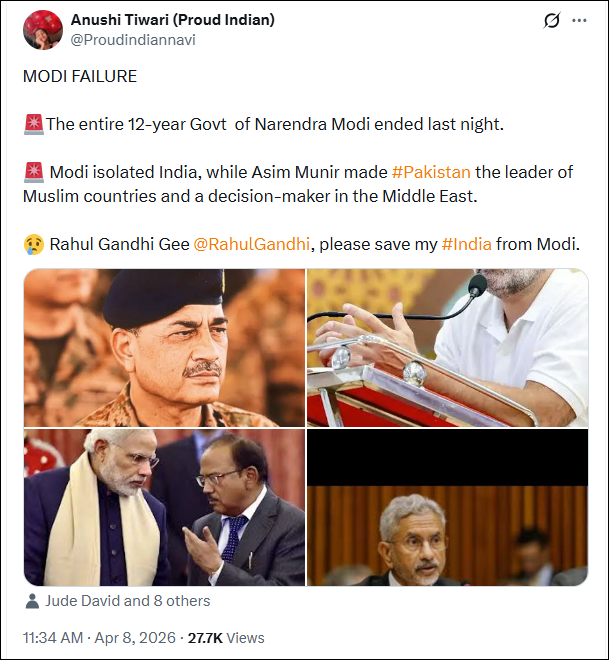
The two X handles, operated from Pakistan for nearly three months under the names Mir Ilyas and Anushi Tiwari.
Addressing a press conference on 16th April, Police Commissioner Lakshmi Singh said that the unrest, which began as a demand for higher wages, was hijacked by external elements. The officer confirmed that the situation has now returned to normal, with workers satisfied by the Uttar Pradesh government’s decisions and are back at their jobs.
“The situation was under control, but two X handles then began circulating disinformation claiming multiple deaths in police firing. “We got it verified and found that the two X handles are being operated from Pakistan. VPN is being misused,” she said.
So far, thirteen FIRs have been registered in connection with the violence, and 62 people have been arrested. Most of those booked were outsiders rather than local workers. Central agencies, including the Intelligence Bureau and Anti-Terrorism Squad, are assisting with the probe into the Pakistan link.
While the Pakistani handles with names fake names, Mir Ilyas and Anushi Tiwari, have gained widespread attention over their role in inciting Noida violence, these two have consistently been pushing anti-India and pro-Pakistan narrative ever since their debut on X. A cursory glance at the X feed of these two Pakistani propaganda accounts shows how they have been operating with the mission of stirring violence and anarchy in India, while also sowing distrust among Indians against the Modi government.
Their X feeds perfectly exemplify how countries like Pakistan weaponise social media to pick issues, exploit faultlines, influence opinions and instigate violence in India. An interesting point about both the fake Pakistani propaganda accounts is that they both are supporters of the Congress party, particularly, Rahul Gandhi. In many of their posts, they subtly push the idea that somehow Rahul Gandhi would be a better Prime Minister than Narendra Modi and that Gandhi alone can “save India”.
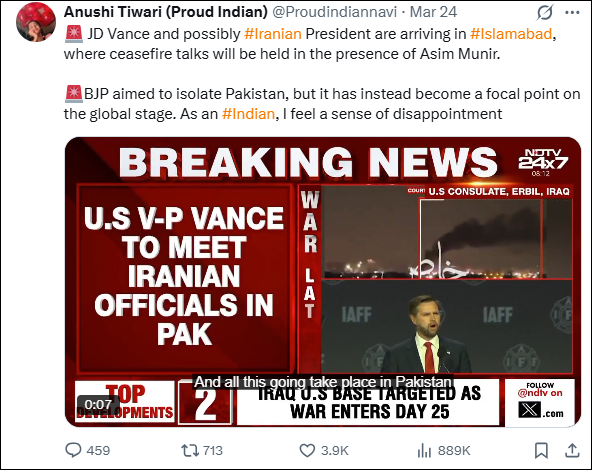
In one such post published on 24th March, Anushi Tiwari, who goes by the username @ProudIndianNavi, wrote, “JD Vance and possibly #Iranian President are arriving in #Islamabad, where ceasefire talks will be held in the presence of Asim Munir. BJP aimed to isolate Pakistan, but it has instead become a focal point on the global stage. As an #Indian, I feel a sense of disappointment.”
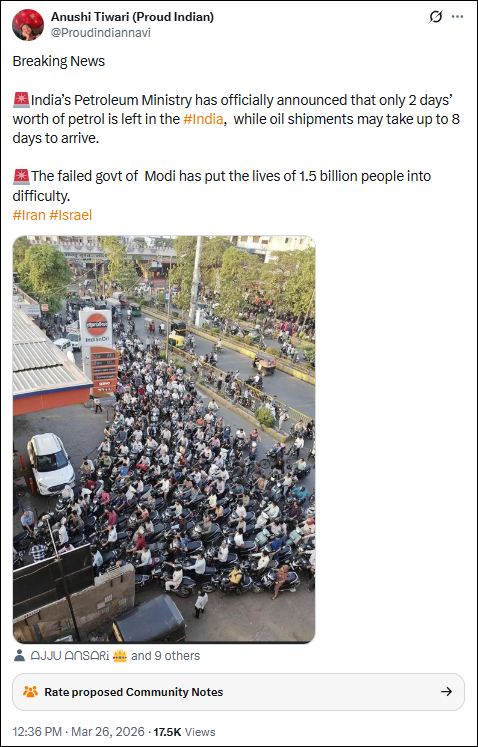
Besides pushing pro-Pakistan propaganda, the Pakistani X account has also been involved in pushing alarmist disinformation about India’s energy supplies amidst the West Asia crisis.
“Breaking News. India’s Petroleum Ministry has officially announced that only 2 days’ worth of petrol is left in the #India, while oil shipments may take up to 8 days to arrive. The failed govt of Modi has put the lives of 1.5 billion people into difficulty,” Tiwari wrote.
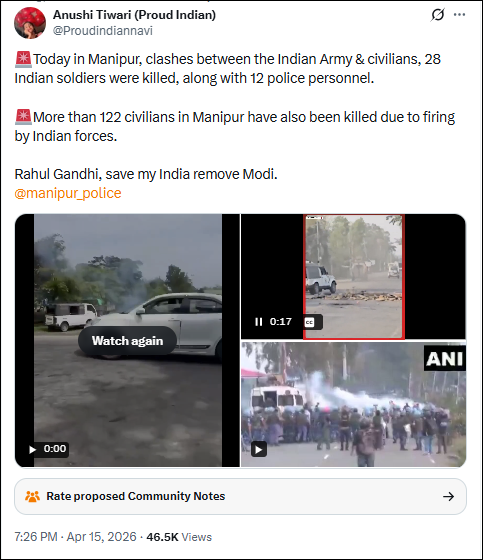
The fake Pakistani account has also peddled blatant fake news, 28 Indian soldiers were killed, along with 12 police personnel, in Manipur after the Indian forces opened fire on civilians.
“Today in Manipur, clashes between the Indian Army & civilians, 28 Indian soldiers were killed, along with 12 police personnel. More than 122 civilians in Manipur have also been killed due to firing by Indian forces. Rahul Gandhi, save my India remove Modi,” Tiwari wrote.
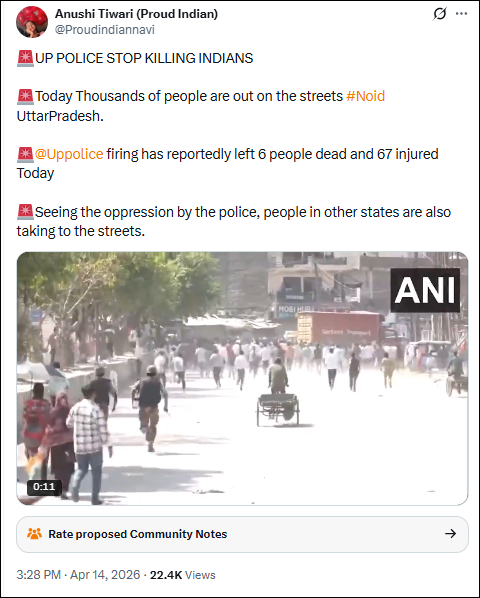
Notably, X posts by this Pakistani account, which incited violence during factory workers’ protests in Noida, are still visible in its timeline. The post claimed that the Uttar Pradesh Police was “killing Indians” in Noida and that the firing left “6 people dead and 67 injured”. The claim was absolutely baseless and peddled with the intention to fuel violence in the BJP-ruled state.
Since the anti-India propagandist is located in Pakistan and only hiding behind the veneer of the ‘South Asia’ location feature on X, it audaciously even tagged the UP Police, apparently to give an impression to the viewers that since the account has confidently tagged UP Police, the claims of protestors being killed in police firing must be true.
“POLICE STOP KILLING INDIANS Today Thousands of people are out on the streets #Noid UttarPradesh.@Uppolice firing has reportedly left 6 people dead and 67 injured Today. Seeing the oppression by the police, people in other states are also taking to the streets,” Tiwari wrote.
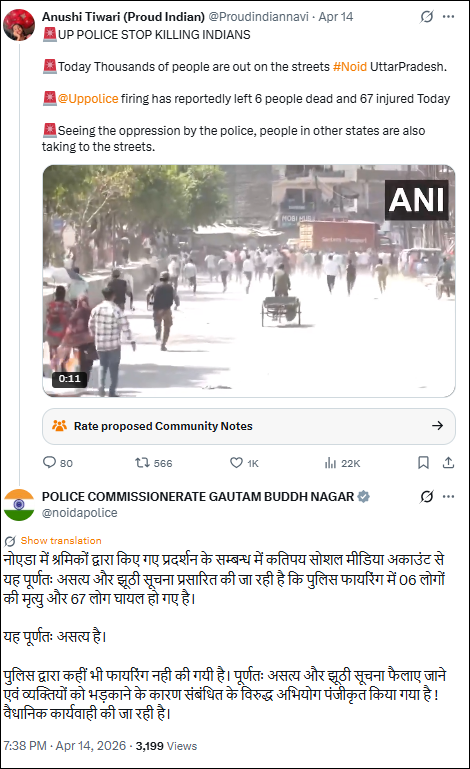
The Pakistani propaganda account’s fake news was debunked by the Gautam Buddh Nagar Police on 14th April. “Regarding the demonstration carried out by workers in Noida, certain social media accounts are disseminating completely false and fabricated information claiming that 06 people were killed and 67 others were injured in police firing. This is entirely false. No firing was carried out by the police anywhere. Due to the dissemination of completely false and fabricated information and incitement of individuals, a case has been registered against the concerned parties! Legal proceedings are underway,” the police said.
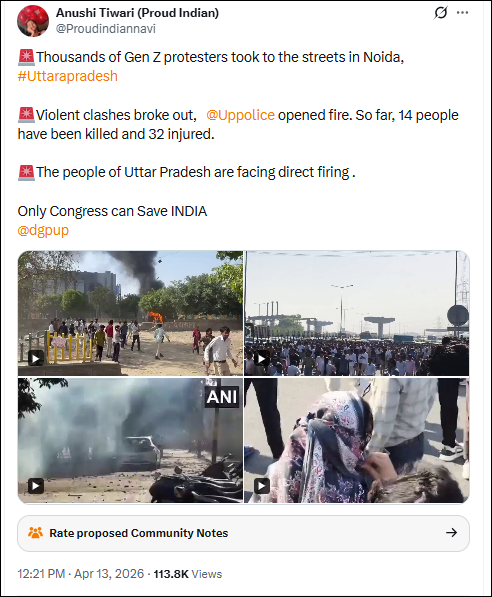
On 13th April, Tiwari claimed that thousands of “Gen X protestors” had taken to streets in Noida and UP Police opened fire, killing 14 people and leaving 32 injured. It also asserted that only “Congress can save INDIA”.
The Pakistan-based anti-India handle coupled fake news with ‘Congress is a saviour’ narrative, indicating how systematically local Indian issues with potential to snowball into a big crisis are being picked, disinformation is being peddled to incite violence, project it has BJP government’s failure, and push Congress as the natural political alternative. It is almost an unpaid PR exercise for the Congress party by Pakistan.
In another post in furtherance of ‘Modi failed, bring Rahul Gandhi’ and Pakistan faring better than India bogey, the Pakistani account wrote, “MODI FAILURE The entire 12-year Govt of Narendra Modi ended last night. Modi isolated India, while Asim Munir made #Pakistan the leader of Muslim countries and a decision-maker in the Middle East. Rahul Gandhi Gee @RahulGandhi, please save my #India from Modi.”
Tiwari’s timeline is replete with fake news, pro-Pakistan, anti-India propaganda, in addition to reposts of Rahul Gandhi’s posts and pro-Congress trolls.
Similar has been the track record of the second Pakistani X ‘Mir Ilyas’ account named by Uttar Pradesh for inciting violence in Noida. Ilyas is also an open supporter of the Congress party and has the username @Mir_Ilyas_INC. He even claims to be a “Nominated Social Media Coordinator” of the Congress party.
Ilyas’s X feed is also filled with misinformation, anti-India and anti-BJP propaganda, in addition to reposts peddling anti-Hindu narratives.
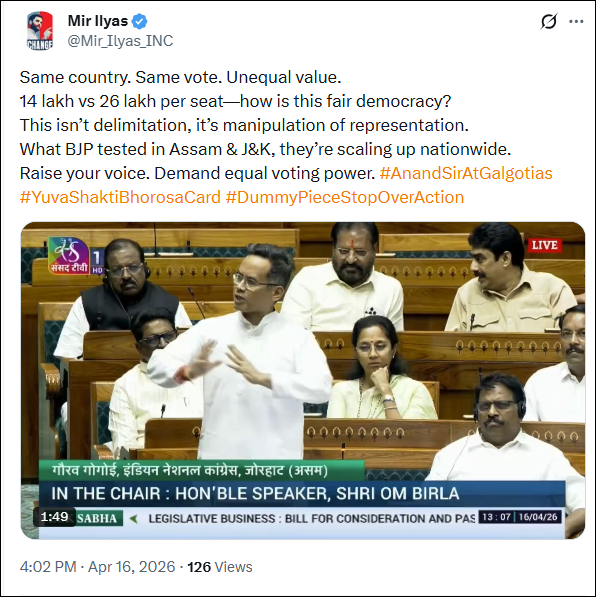
He was found amplifying alarmist propaganda about the proposed Delimitation exercise. “Same country. Same vote. Unequal value. 14 lakh vs 26 lakh per seat—how is this fair democracy? This isn’t delimitation, it’s manipulation of representation. What BJP tested in Assam & J&K, they’re scaling up nationwide. Raise your voice. Demand equal voting power,” Ilyas posted.
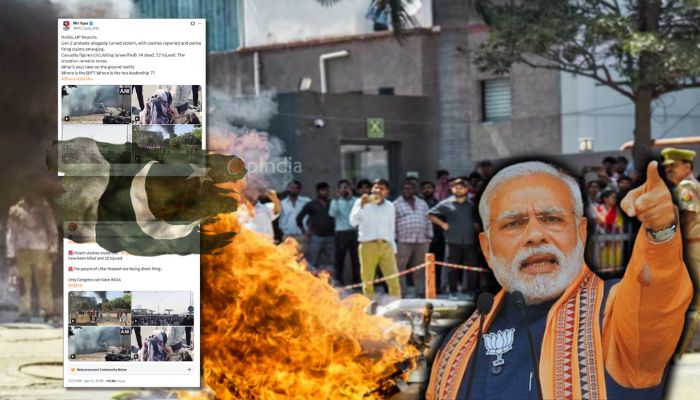
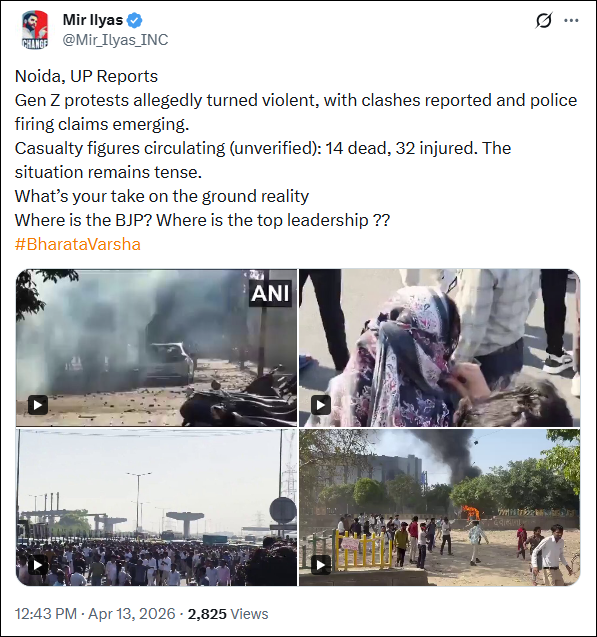
Mir Ilyas had also made similar claims as Anushi Tiwari about the death of protestors during the Noida wage workers protests. The Pakistani X account, using VPN to fake his location as the United Kingdom, wrote, “Noida, UP Reports Gen Z protests allegedly turned violent, with clashes reported and police firing claims emerging.Casualty figures circulating (unverified): 14 dead, 32 injured. The situation remains tense. What’s your take on the ground reality. Where is the BJP? Where is the top leadership ?? #BharataVarsha”
This post was factchecked by Gautam Buddh Nagar Police Commissionerate, which stated that the police did not open fire at any of the protest sites. “Inspired by workers from other states, demonstrations have been held at several places in Noida, and in the case of just one violent demonstration, the police have controlled the situation by using minimum force. The police have not resorted to firing anywhere. No person has died in the said demonstrations. Do not spread rumours or misleading information,” the police said.
350 taken into custody, Pakistan and Naxal angle under investigation: What the authorities said about Noida violence
Protests by factory workers over wage-related demands turned violent in Noida on 13th April, and workers in areas like Phase 2 and Sector 60 were involved in stone pelting, arson, and vandalism. Several vehicles were set on fire, and industrial units were damaged. Most of the violence occurred in Sector 62 and Phase-2, where the accused, armed with clubs, sticks, and belts, ran wild, shattering glass facades of manufacturing units, damaging businesses and setting cars on fire. Witnesses reported that four to five automobiles were burnt outside a service centre in Sector 63, and at least a dozen vehicles, including police cars, were set ablaze.
By evening, over 300 protesters were arrested under preventive provisions for arson and vandalism, while more than 100 were detained for questioning.
The investigation into the matter pointed fingers towards suspected ties ranging from organised disinformation to attempts at unrest supported by Pakistan and even a likely Naxal threat.
Over 350 persons were taken into custody by police in connection with arson and vandalism, and more than 100 more have been held for interrogation. To identify people responsible for the disruption, authorities are also looking through CCTV footage from factories. Multiple WhatsApp groups also came under investigation. The incident resulted in injuries to at least 10 cops and 30 other individuals.
“The incident appears to have been carried out with the intention of disrupting the development and law and order of the state. In recent days, four suspected terrorists have been arrested from Meerut and Noida, whose links were connected to handlers based in Pakistan. In such a situation, the possibility of a conspiracy to create instability in the state gains strength. Agencies are seriously investigating the entire matter,” stated Anil Rajbhar, the labour minister for Uttar Pradesh.
The Minister added that “anti-national forces” wanted to instigate instability in the state and suspected that the chaos might have been planned to interfere with Chief Minister Yogi Adityanath’s program in Muzaffarnagar earlier in the day.
The role of Pakistani propaganda accounts in inciting violence in Noida should raise alarms. Pakistani ISPR bots have been masters of social media disinformation campaigns and regularly circulate AI-generated content, often adding anti-India and defeatist commentary on unrelated videos of Indian Army officials, ministers and other key officials in the context of Pakistan and Operation Sindoor. Besides the wartime disinformation, Pakistani accounts are now monitoring major issues in India that can be used to instigate Indians against the Modi government and incite riots.
OpIndia discussed earlier how the Congress party, the main opposition party in India, has long been itching for a Bangladesh/Nepal-like violent Gen-Z revolution. There is a dangerous game at play. On one side, a pro-Congress Pakistani online propaganda nexus is active, on the other, a political party expresses joy over Noida violence and says that the “country has at least started to stir”. Somehow, their shared disdain for the Modi government is becoming dangerous for India’s national security and stability.
The Indian National Congress, after tirelessly advocating for “jitni abadi utna haq (rights proportionate to population),” has started its propaganda against the demarcation process, which is critical for ensuring fair representation in the Lok Sabha and State Legislative Assemblies in light of the demographic transitions and to prevent the possibility for underrepresentation or overrepresentation of particular areas.
However, the opposition has sought to cast aspersions on the move, wary of its potential impact on long-cultivated vote banks. Leading the charge, Rahul Gandhi has accused the Bharatiya Janata Party of attempting to “gerrymander Lok Sabha seats to secure an advantage in the 2029 elections.”
On 15th April (Wednesday), he tweeted that the “proposed bills remove all Constitutional safeguards on delimitation, giving full power to the Delimitation Commission which the govt itself will appoint and direct” in his usual fact-free diatribe, which he is known for delivering after every progressive decision taken by the Centre.
Notably, the commission is appointed by the President of India, but the grand old party has never concerned itself with the truth and is unlikely to alter its ways, particularly when its underhanded plans to favour the second-largest majority and its long cultivated vote bank — Muslims — at the expense of Hindus to secure its electoral future are on the brink of being washed over.
One of the BJP's dangerous plans is to “gerrymander” all Lok Sabha seats to its advantage for the 2029 elections
The proposed Bills remove all Constitutional safeguards on delimitation, giving full power to the Delimitation Commission which the govt itself will appoint and… pic.twitter.com/7iFz4GmcAH
The Gandhi scion then invoked the delimitation that took place in Assam and Jammu and Kashmir and alleged that it was “hijacked” and “anti-BJP regions and communities were split-up for electoral advantage.” He then switched to the superfluous and unfounded rhetoric about how the Election Commission has been taken over by the saffron party and PM Modi “is confident that he can capture the Delimitation Commission too.” Gandhi added that the “Congress will not allow this to happen.”
“Delimitation should be based on a transparent policy framework, developed after wide consultations with a consensus. Indians of all communities and States should feel confident that they will be represented and their voices will be heard. This is the only way forward to protect and strengthen our democracy,” he declared.
The underlying reason for distress is not “concern for democracy” but the dread of losing the long-nurtured electoral advantage
Rahul Gandhi’s lofty assertions about democracy and the constitution might appear impressive and even sincere to an unsuspecting or naive mind, however, the politics practised by his party over the years reveal the true motivations of his fears. Telangana Chief Minister Revanth Reddy correctly articulated this when he stated, “Congress signifies Muslims, and Muslims signify Congress.”
The fundamental issue revolves around the party’s appeasement of Muslims, which has only grown stronger over time, accompanied by special awards bestowed upon on the community for their loyalty, while Hindus have consistently faced the fallout of these actions, as their appeals for justice have been purposefully disregarded.
The delineation is vital to escape this perilous monopoly of the second-largest community over specific neighbourhoods, termed as “Muslim areas,” which essentially devolve into no-go zones, each with its own regulations where even a perceived infraction can provoke a deadly reaction for Hindus and even for authorities merely fulfilling their responsibilities, as has been observed time and again.
The onslaught on Hindus during their sacred occasions for daring to hold a procession have already become a norm in the country. The attack on the Durga procession that culminated in the brutal killing of Ram Gopal Mishra in Bahraich in 2024 stands as yet another stark testament. Devotees are refrained from conducting the religious event at specified sites to avoid “triggering” Muslims and avert communal incidents.
The Congress-led opposition and their ecosystem, which react like popcorn in a hot pan at the mention of a “Hindu Rashtra,” in the name of secularism, had a crucial part in establishing these exclusive sectors and the sentiment of unchallenged authority among Muslims based on numerical strength. The anti-majoritarian principle of Congress unsurprisingly flips on its head in relation to the Muslim community.
As a result, the phenomenon of ghettoisation persisted relentlessly, bolstered by political support in lieu of votes, enabling Muslims to treat these localities as sovereign territories within the country. This is used to rationalise assaults on Hindus, their religious processions, administration, officials, security forces, cops and any individuals who ventured there in defiance of the “consent” of the locals, in a complete travesty of law and order.
These places are proudly designated as “mini-Pakistan” by both the residents and politicians such as Bobby Firhad Hakim, as well as employed not only to normalise religious extremism but also to intimidate Hindus and non-Muslims via horrific acts.
The house is for sale: Hindus forced to migrate; authorities also not spared
Hindus are always at the receiving end from Kashmir to Kerala and Maharashtra to West Bengal as Islamists need no excuse to incite unrest and target them. This trend remained unchanged over the years from the valley to Murshidabad, where the Hindus had to abandon their homes to protect their lives and dignity in the face of terrorism and violence.
These scenes have regularly played out where aggressive Muslim mobs chanting “Allah Hu Akbar” have caused Hindus to flee for their safety and the protection of their women. A similar incident took place in Delhi’s Hauz Qazi over a parking dispute, which escalated into the desecration of a Durga Mandir in 2019, eventually forcing another wave of Hindu exodus.
Hindu families in the national capital put up “houses for sale” posters in 2025. The matter began with an argument over the expansion of a mosque in Brahmpuri. Stones were thrown by radicals, prompting the Hindus to resort to this action out of fear of communal clashes. The Dalit Hindus of Daudpur Kota village in the Aligarh district encountered a similar fate that year due to harassment from Muslims.
40 Hindu families also decided to abandon their properties after suffering continuous attacks from a Muslim neighbour and his aides in Bhagwan Nagar Block A, under the Kamala Nagar area of Agra, in February. Times progressed, but the situation for Hindus has continually remained dire.
On the other hand, those in uniform or personnel trying to carry out their legal obligations are also not exempt. Stone pelting and attacking the administration and authorities when acting against illegal Islamic structures is a frequent occurrence, but the risk to their lives is plausibly heightened when they operate in Muslim-majority regions, as illustrated in the Banbhoolpura area of Haldwani, Uttarakhand.
This is the reason for the protests preceding the anti-Hindu Delhi riots, most notably articulated by the likes of Sharjeel Imam, leveraging the strength of his community to cut off the “Siliguri Corridor” or “Chicken’s Neck”.
Only Muslim candidates can represent “Muslim areas”
Jammu and Kashmir has witnessed all of it, from Pakistan-sponsored jihad to the exodus of Kashmiri Pandits, except a Hindu chief minister. The position has been continuously filled by Muslim persons and suggesting otherwise is met with firm rejection and controversy. People from different belief systems can sit in the highest offices in a Hindu-majority India, but to even consider the same in a region dominated by Muslims is viewed as blasphemy.
This is visible in other such constituencies as well, for instance, Baharampur which removed Congress leader Adhir Ranjan Chowdhury after All India Trinamool Congress (AITC or TMC) put forward the candidacy of former cricketer Yusuf Pathan from Gujarat. A Hindu candidate has no place in the presence of one who shares the faith of the majority population in these constituencies.
This is electoral exclusion and an affront to the democratic rights of the non-Muslim communities. They are not afforded the opportunity to contest from these areas, and if they try, the likelihood of victory is negligible as faith supersedes every single issue, including development and progress, for the Muslim voters. The minorities in these regions are politically and otherwise marginalised, with a low probability of improving their circumstances.
How Congress fostered and appeased Muslims for its political goals
The street power of Muslims transforms into a veto power during elections, as the community is known for voting as a unified block and parties comply with their unreasonable demands and shower them with extravagant privileges for electoral success. This is the rationale behind the tendency to segment Hindus by caste while considering Muslims as a single unit during elections.
Furthermore, the disdain they openly voice for the saffron party and their willingness to collaborate with anyone they believe can defeat it is also apparent. Congress is well aware of this and has left no stone unturned in its efforts to appease the community, enacting controversial policies to solidify their support against the BJP.
Sonia Gandhi, who was leading the United Progressive Alliance (UPA), won against Atal Bihari Vajpayee’s National Democratic Alliance (NDA) in the 2024 general elections. A few months later, the central government passed a resolution to explore measures aimed at benefiting the “socially and economically backward sections among religious and linguistic minorities.” The BJP had vehemently opposed the implementation of the report and resisted reservations for Dalit Christians, accusing the Congress of engaging in vote bank politics.
However, this was not the first time Sonia Gandhi, the super prime minister and real centre of authority in the government, tried to curry favour with her cherished community disguised as “welfare schemes for the underprivileged” for defeating the BJP. The government established the Minority Affairs Ministry in January 2006 by splitting the Ministry of Social Justice and Empowerment. Abdul Rahman Antulay served as the first minister in 2006, and Salman Khurshid took over in 2009.
It’s interesting to note that the United States Ambassador to India, David Mulford, mentioned Antulay in a private memo that WikiLeaks made public. The cable unveiled that the latter had expressed scepticism concerning the 26/11 terror attack, claiming that “Hindutva forces” might have been involved in it. Congress notoriously refrained from taking any decisive action against the Islamic Republic following the deadly attack, in order to avoid upsetting its Muslim voter base in India.
Meanwhile, the government headed by Congress even attempted to adopt volatile measures to pass legislation consisting of the Communal Violence Bill, in addition to the countless programs put up for minorities, particularly Muslims. The bill was tabled by UPA1 in 2005. A revised draft of the same was presented by UPA2 in 2011 under the direction of the National Advisory Council (NAC).
It basically declared that only minorities and Scheduled Castes (SCs) and Scheduled Tribes (STs) could be considered “victims” and the majority Hindus would always be projected as the perpetrators of communal violence. Its definition of “offences” was so broad that it might apply to any kind of crime. The accused were presumed guilty with the burden of proof resting with them. There were several other provisions that expressly targeted Hindus, perhaps as a gesture of gratitude to the Muslim community for returning Congress to power.
Delimitation threatens to disrupt Congress’ appeasement politics
The aforementioned clearly highlights the perverse politics employed by the Congress party to maintain its grip on power in the country. However, the delimitation is a major obstacle in their corrupt strategy to pander to the Muslim community for electoral gains. The “Muslim areas” that the Congress facilitated for its use as a voting bloc against the BJP might lose their influence.
They could now lose the unfair status and become regular voters, similar to Hindus, who have had to grapple with the consequences of the political ploys executed by Congress. Hence, Rahul Gandhi is irked not due to a supposed “threat” to democracy, or the Constitution but rather because the “vote bank” politics of his party is at stake.
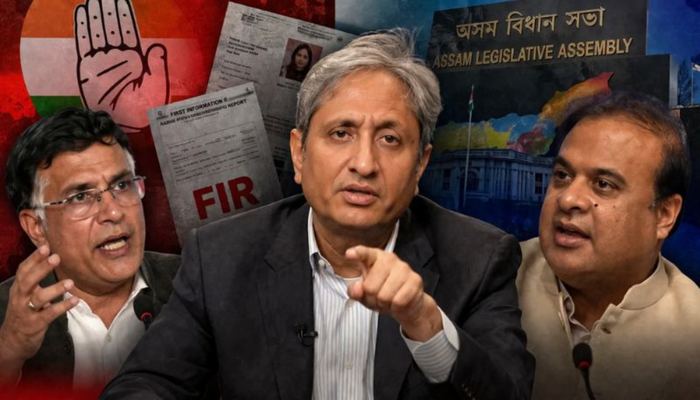
YouTuber Ravish Kumar claims to be an impartial journalist, but his so-called ‘journalism’ does not have an iota of impartiality. His recent statement, loaded with baseless claims, once again demonstrated that his arguments are based less on facts and more on prejudice. Ravish’s comment regarding the allegations levelled by Congress leader Pawan Khera against Riniki Bhuyan Sarma, wife of Assam Chief Minister Himanta Biswa Sarma, was a failed attempt at pushing his self-claimed ‘impartial journalist’ image.
In his comment, Ravish Kumar questioned the FIR filed against Congress leader Pawan Khera in this connection with his statements about Riniki Bhuyan Sarma. He said, “The appropriate course of action would have been to refute the allegations or order an investigation. How can the police be sent after the accuser? This may sound like a matter of principles, but the reality is that they either ignored or deliberately suppressed the basic facts of the entire case.”
बिहार चुनाव के दौरान प्रशांत किशोर ने सम्राट चौधरी से लेकर अनेक नेताओं के ख़िलाफ़ आरोप लगाए। उनके ख़िलाफ़ तो FIR नहीं हुई है लेकिन पवन खेड़ा के मामले में तुरंत FIR हो गई। कायदे से आरोप का खंडन करना चाहिए या जाँच के आदेश देने चाहिए। आरोप लगाने वाले के पीछे पुलिस कैसे भेज सकते हैं? https://t.co/ULy00YMK1x
Congress leader Pawan Khera had levelled some serious allegations against Riniki Bhuiyan Sarma, alleging that she possessed three foreign passports and owned properties in Dubai. He made these allegations without offering any evidence. Khera did present some documents, but they were full of discrepancies. When questioned over the discrepancies in the documents presented by him, Khera evaded the question by promising to provide concrete evidence, which he did not provide.
Ravish Kumar harping on about ‘refutation of allegations’ and his ignorance of facts
Notably, the ‘refutation’ of Khera’s allegations that Ravish Kumar is demanding has already been done. Chief Minister Himanta Biswa Sarma himself came forward and detailed the discrepancies in the documents. The surname was misspelt, the photo did not match biometric standards, and numerous other discrepancies raised suspicions about the authenticity of these documents.
Riniki Bhuyan Sarma also refuted the allegations, saying that the images in the documents were AI-generated. Ravish Kumar’s assertion that the Assam government didn’t refute the allegation despite a clear and public clarification by the Assam CM and his wife suggests he either ignored the facts or presented selective information to support his narrative.
Why did Pawan Khera not take the legal course?
So far as Ravish Kumar’s grievance about the FIR against Khera is concerned, his argument appears to be unfounded. An FIR is not an arbitrary action; it is a legal process that is a vital part of any democratic system. If serious allegations are publicly levelled against someone, a legal action naturally follows.
Pawan Khera also had the choice; if he had solid and credible documents, he could have filed an FIR or directly approached the court against Riniki Bhuyan Sarma. But he did neither, which speaks volumes.
On the contrary, when Riniki Bhuiyan Sarma filed an FIR against Pawan Khera, the entire situation flipped. Pawan Khera immediately approached the Telangana High Court seeking anticipatory bail. The question arises: why was the Telangana court approached when the case concerns Assam? When the matter reached the Supreme Court, it objected and questioned how the Telangana High Court’s jurisdiction could be invoked in a case arising in Assam.
Meanwhile, Ravish Kumar was irritated by the Supreme Court’s order. He began advocating for an investigation into the case. Ravish Kumar should know that ordering an investigation in such cases is not an option, but a necessary step, as it directly affects the reputation and credibility of the person concerned.
Chief Minister Himanta Biswa Sarma has also expressed concern over the issue. He clearly stated that just like fake documents are being presented as evidence to implicate him and his wife amid elections, similarly, fake allegations could be levelled against prominent leaders like Union Minister Amit Shah during elections. Therefore, such cases must be investigated.
Ravish Kumar’s one-sided arguments
A look at the entire controversy reveals a clear picture. Pawan Khera made allegations at his own convenience, fueled them without solid evidence, and when it came to accountability, he backed down. While he directly attacked Riniki Bhuyan Sarma’s reputation, simultaneously, he navigated ways to evade his own legal scrutiny.
In such a situation, expecting the person against whom the allegations have been made to remain silent and not take any legal action is not logic but sheer hypocrisy. If the accuser had genuine evidence, they too would have gone to court or filed an FIR, but that requires presenting evidence, and this is where the entire story seems to fall apart.
Such a move by the Congress Party amid the assembly elections in Assam shows how the party is ready to go to any lengths to gain political advantage. However, the party’s lies and fraud did not last, and it tasted defeat in its attempt to malign the reputation of Riniki Bhuyan Sarma.
Ravish Kumar also seems to be toeing the line of the Congress Party by peddling lies, where he habitually makes biased comments without revealing the full story. If he doesn’t know the full facts, it’s his own fault. Even after clear rebuttals and legal action, raising suspicions about Sarma seems like merely pursuing an agenda. If he wants to speak in favour of the Congress Party, he should do so openly. But by making such statements based on incomplete information and twisted facts, he may become a Congress soldier, but he will lose his ‘journalistic credentials’.
(This article is a translation of the original article published on OpIndia Hindi.)
The Congress party has been out of power in the Centre for over a decade. The people of India have rejected the grand old party in three consecutive Lok Sabha elections. The chagrin of being out of power has taken a toll on Congress’s sanity to such an extent that the party is now itching for a violent ‘revolution’ to topple the Modi government. In this vein, Congress leader Supriya Srinate used the recent violence and arson during protests by industrial workers in Noida over wages to launch an attack on the “Modi model” of governance.
Expressing glee over the Noida violence, the Congress party said that “India has at least started to stir”, as if it’s a dream-come-true moment. The party linked Noida labour violence with the state of the Indian economy to assert that it marks the beginning of a broader public ‘awakening’ against exploitation, inflation, and repression under the Modi government.
“…Is this the fastest-growing economy just for the billionaires? Is this what Narendra Modi’s cruel Amrit Kaal is—where the nation is being looted to enrich some, and those who build the country are being left destitute? The Modi government hastily implemented 4 Labour Codes in November 2025 without any discussion or deliberation, extending work hours to 12 hours. Today, exploitation is happening on that very basis. Every time the Modi government brings any policy, its negative impact falls on employees and labourers. Whereas for the apple of Modi’s eye, people like Adani, it’s all hunky-dory. If the government doesn’t pay attention in time, the situation will become even more dire in the coming days, because speeches don’t fill stomachs, and slogans don’t run families,” Congress spokesperson Supriya Shrinate said.
नरेंद्र मोदी और BJP यह बताते नहीं थकते कि भारत दुनिया की Fastest growing इकॉनमी है, चौथी सबसे बड़ी अर्थव्यवस्था है, हम विश्वगुरु हैं, वगैरह वगैरह…
इसके साथ ही देश का मीडिया – हर टीवी चैनल, रेडियो, अखबार तुरंत सरकार के सुर में सुर मिलाने लग जाते हैं, लेकिन इसी गाने-बजाने और… pic.twitter.com/WSOui7EQmv
The authorities investigating the Noida violence that transpired on 13th April accused outside elements of being involved and pointed to a potential larger conspiracy. A parallel investigation has been launched into suspected links ranging from organised disinformation to attempts at unrest supported by Pakistan and even a likely Naxal threat.
However, the Congress party resorted to handing a clean chit to Pakistan, even as the hostile neighbour has a record of weaponising social media to stir unrest in India.
“But instead of finding solutions and making the right policies for these people, those in power have already declared it an international conspiracy. They’re even making absurd arguments about Pakistan’s hand in it. Meaning, demanding fair wages for one’s hard work, raising a voice against exploitation—demanding one’s rights—is a conspiracy?” Shrinate asked.
Expressing joy and enthusiasm over the violent conspiracy that unfolded in Noida under the pretext of protests over wages, the Congress spokesperson said, “But amid all this, there’s also a ray of hope. People have had enough and, instead of fake ‘good days,’ workers and toilers are demanding their due for their labour. Say what you will, the country has at least started to stir.”
The Congress party’s disgraceful joy over the country ‘stirring’, essentially plunging into violence and chaos perhaps, stems from its desire to watch the country undergo a Nepal or Bangladesh-like violent ‘revolution’ to topple the Modi government, which despite a 2024 general election setback has managed to have its grip on power and popularity.
The defeats in 2014, 2019, and 2024 Lok Sabha elections and multiple state assembly elections have rendered the Congress party desperate to manufacture momentum via street-level anti-government protests rather than introspection and alteration in political approach. “The country has at least started to stir” a remark by the Congress leader is essentially an attempt to glorify, romanticise, and amplify street violence and vandalism as the spark of a nationwide ‘revolution’.
After failed attempts at riling up Gen-Z despite repeated calls and incitements, the Congress party seems to be shifting focus to labour unrest. Congress leadership, including Rahul Gandhi, consistently addressed and incited the Gen-Z, hoping that just the anti-quota protests in Bangladesh snowballed into nationwide ‘movement’, toppling Sheikh Hasina’s elected government amidst deaths, arson, and chaos, Nepal-like agitation wherein the ‘protests’ resulted in ouster of KP Sharma Oli, the Indian youth would topple the Modi government. For multiple reasons, however, the tactic did not work, dashing Rahul Gandhi’s Prime Ministerial dream.
Congress and its supportive ideological ecosystem have long been itching a Bangladesh, Nepal-like violent regime change in India even as it comes at the cost of a democratic collapse, devastation of economy, political instability, national security going for a toss, loss of global stature, deaths, destruction and outright anarchy. Apparently, they are happy to rule the ruins, as long as they get to rule.
The Congress party appears to be testing the waters by portraying the violence in Noida during wage protests as the opening act of an anti-BJP ‘uprising’. Perhaps, they are signalling encouragement and extending political support to violent elements ever-ready to hijack legitimate issues for ideological gains.
While Congress demonstrated its desire to use chaos as a ladder to grab power way back in 2019-2020, when Sonia Gandhi declared an “aar ya paar ki ladaai” inciting a do or die fight against the Citizenship Amendment Bill, calling it ‘discriminatory against Muslims’, even as the bill had nothing to do with Indian Muslims.
It was on the 14th of December 2019, Sonia Gandhi – the interim President of Congress at the time – spoke about an “aar ya paar ki ladai” (do or die) in the context of the Citizenship Amendment Act. Speaking at a “Bharat Bachao Rally”, Sonia Gandhi from the Ramlila Maidan delivered a war cry.
She said that people should come out on the streets to agitate against the Modi government. She also said that the Congress and the people should be ready to make any sacrifice to “protect” India and that this is an ‘aar paar ki ladai’ (the final battle) and people should be willing for any ‘Qurbani’ (sacrifice). The provocative speech was later held responsible for the anti-Hindu Delhi riots by some of the victims themselves.
It was seen how the initial ‘peaceful’ protests soon snowballed into ‘chakka jam’ and violence against Hindus. Islamists like Sharjeel Imam gave calls to cut off the chicken neck and divide India, as well as carry out ‘chakka jam’ to cause disruption. Meanwhile, part-time students, full-time Islamists like Umar Khalid, whom the Congress party wholeheartedly defends, held clandestine meetings with co-conspirators to mobilise rioters and unleash violence.
Although the Modi government managed to brave this massive violent agitation, which was not confined to Delhi alone. This was the first major, though failed, violent attempt at toppling the Modi government.
Another major opportunity came in 2025, when Islamists rose in protests against the Waqf Amendment Bill. Congress, which essentially made Waqf Boards powerful and invincible, joined several Muslim-appeasing opposition parties in attempts at stoking anarchy based on perfunctory criticism, calling the Waqf Amendment Bill ‘unconstitutional’, ‘anti-Muslim’ and somehow even ‘anti-democracy’. Violence erupted in West Bengal’s Murshidabad and in other states
In addition to this, the Congress party has also been pushing the ‘vote chori’ bogey. Congress prince Rahul Gandhi has, in the last few months, been levelling unfounded allegations about the EVMs, VVPATs, electoral roll, fake voters and whatnot to establish a false narrative that the ECI is colluding with the Bhartiya Janata Party to manipulate voter lists and rig elections. Gandhi attempted to drop a ‘hydrogen bomb’, alleging the presence of fake voters in the electoral rolls, casting aspersions on the integrity of the ECI, and whatnot to sow distrust in the minds of people against the government and poll body. However, the tactics so far have not yielded desired results.
Congress has also attempted to exploit caste faultlines to push its divisive agenda and perhaps ‘stir’ things up. In recent years, Rahul Gandhi has been obsessing over “Jitni aabaadi utna haq”, advocating impractical ideas like caste-based wealth, increasing reservations and whatnot.
Now once again, the Congress party has placed its hopes in the workers’ wage issue and the Delimitation proposal that aims to raise the strength of the Lok Sabha from 543 to 850, to see the country not just ‘stir’ but descend into chaos so that their political dreams could turn into reality if not through EVMs, then through street unrest. However, the Indian voters have seen through this sustained pattern and rejected Congress in elections so far.