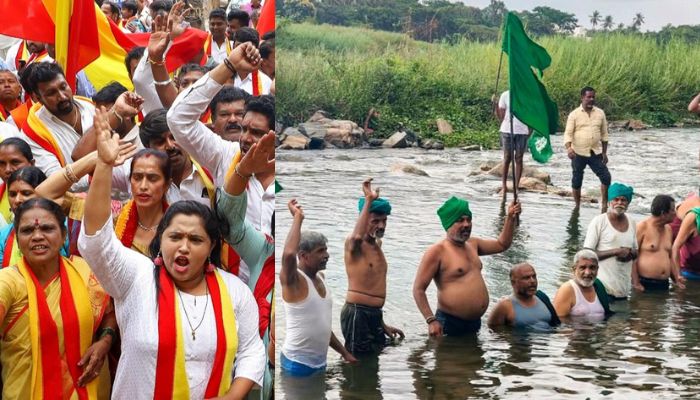
On Thursday, 13th August, Karnataka is observing a statewide bandh over the long-running Cauvery water-sharing dispute with Tamil Nadu. Pro-Kannada organisations have called the shutdown from 6 am to 6 pm, mainly to oppose the release of Cauvery water to Tamil Nadu.
VIDEO | Mandya, Karnataka: Pro-Kannada groups protest against the release of Cauvery water to Tamil Nadu, urging the state government not to release water. Police security tightened in the district amid a call for a bandh.
The protesting groups are also demanding progress on the Mekedatu, Mahadayi and Kalasa-Banduri projects. However, the bandh has not brought normal life across the state to a complete stop, particularly in Bengaluru, where several essential and public services continue to operate.
Essential services continue during the bandh
Despite the statewide shutdown call, several important services are functioning normally. Hospitals, pharmacies and other healthcare services are expected to remain open, with emergency medical services continuing without interruption. Bank branches and government offices are also expected to function, while online banking and other digital financial services remain available.
Schools across Karnataka are also expected to remain open. The Karnataka Associated Managements of Schools had initially called for schools to stay closed during the bandh but later withdrew the appeal, citing concerns about disruption to the academic calendar. The organisation has instead extended moral support to the protest and suggested that schools may show solidarity by wearing black ribbons or bands.
In Bengaluru, Namma Metro services are running normally, while BMTC buses are also operating. However, commuters may still face delays or changes in movement around areas where protests are being held. Autos and taxis could see some disruption, while private buses, including services connecting Karnataka and Tamil Nadu, may also be affected.
Shops, markets, malls, hotels and restaurants are more likely to be affected because pro-Kannada organisations have appealed to commercial establishments to support the bandh. Hotel owners in Bengaluru and Mysuru have also been urged to shut their establishments. However, there is no blanket government order requiring all commercial establishments to close, so the impact may differ from one area to another.
Why have pro-Kannada groups called the bandh?
The immediate reason behind Thursday’s protest is the Cauvery Water Management Authority’s (CWMA) direction asking Karnataka to release 12,000 cusecs of Cauvery water every day to Tamil Nadu for 15 days from 12th August.
Pro-Kannada organisations and farmers’ groups are opposing this direction. They argue that Karnataka itself needs sufficient water for drinking and farming, particularly when rainfall and reservoir storage are under pressure. Along with opposing the water release, the groups are demanding progress on the Mekedatu, Mahadayi and Kalasa-Banduri projects.
The Cauvery issue has repeatedly become a major source of tension between Karnataka and Tamil Nadu, especially during years when rainfall is poor. Whenever water levels fall, the question of how much water Karnataka should release to Tamil Nadu becomes a major political and public issue in the state.
Congress government detains protestors at the Attibele border
The bandh also saw protests at the Attibele border between Karnataka and Tamil Nadu. More than 20 members of the Kannada Jagruthi Vedike were detained after they attempted to block the highway at the border.
The protesters staged a road blockade at around 8 am and marched from the Attibele toll area towards the state border. The protest was led by the organisation’s state president, Manjunath Deva. The protesters raised slogans against the Tamil Nadu government and warned it against obstructing the implementation of the Mekedatu project. They were taken into police custody after attempting to block the highway.
The arrests and detentions took place under the Congress government in Karnataka as police moved to prevent the protest from disrupting traffic and movement at the busy state border. Security had already been increased in the area as a precaution. An Additional SP, three inspectors and around 50 police personnel were deployed at the border.
What is the Cauvery water dispute?
The Cauvery dispute is a more than century-old disagreement over the sharing of river water between Karnataka and Tamil Nadu. The Cauvery originates in Karnataka’s Kodagu district, flows through Tamil Nadu and eventually reaches the Bay of Bengal. Kerala is also part of the Cauvery river basin.
The river is important for drinking water, irrigation, hydropower and the livelihoods of millions of people across southern India. Because both Karnataka and Tamil Nadu depend heavily on the Cauvery, any shortage of water can quickly lead to disagreement between the two states.
The dispute has been dealt with through agreements, tribunals, court proceedings and central government mechanisms over the years. The Cauvery Water Disputes Tribunal delivered its final award in 2007 after years of hearings. It allocated 419 TMC ft to Tamil Nadu, 270 TMC ft to Karnataka, 30 TMC ft to Kerala and 7 TMC ft to Puducherry from the basin’s assessed utilisable water.
Supreme Court formula and water management bodies
The Supreme Court modified the tribunal’s water-sharing formula in February 2018. Under the revised arrangement, Karnataka’s share was increased to 284.75 TMC ft, while Tamil Nadu received 404.25 TMC ft. Kerala was allocated 30 TMC ft and Puducherry 7 TMC ft.
The Supreme Court also reduced the quantity Karnataka was required to ensure at the Biligundlu gauging point on the Karnataka-Tamil Nadu border from 192 TMC ft to 177.25 TMC ft during a normal water year. Following the judgment, the Union government notified the Cauvery Water Management Scheme in 2018. The Cauvery Water Management Authority and Cauvery Water Regulation Committee were established to oversee and monitor implementation of the water-sharing arrangement.
However, having a legal framework has not completely ended the dispute. The main disagreements now often arise over how the water-sharing formula should be implemented during years of poor rainfall.
Fresh Dispute over water release in 2026
The Cauvery issue has once again intensified in August 2026. Tamil Nadu has approached the Supreme Court amid a fresh disagreement over Karnataka’s compliance with directions to release Cauvery water. The latest dispute involves a release direction of 3,500 cusecs per day for 15 days.
The Cauvery Water Management Authority has upheld the Cauvery Water Regulation Committee’s release direction. Karnataka, however, has pointed to deficient rainfall and declining reservoir storage while opposing the order or seeking a deferment.
At the centre of the latest disagreement is the question of how water releases should be decided when the river basin does not receive enough rainfall. Karnataka says factors such as rainfall, inflows, reservoir levels and drinking-water requirements must be considered before releasing water. Tamil Nadu maintains that Karnataka should follow the prescribed water-sharing and release schedule.
Why the dispute keeps returning
The Cauvery dispute continues because water availability changes from year to year. During a normal water year, the existing arrangement provides a framework for sharing the river. But when rainfall is below normal, and reservoirs in Karnataka have less water, pressure builds over how much water should be released downstream.
Tamil Nadu continues to seek the water it says is due under the established arrangement, while Karnataka stresses its own drinking-water and irrigation needs. These differences often lead to protests, political pressure, meetings before water-management bodies and court proceedings.
The 13th August bandh has therefore brought an old dispute back into the centre of public attention. With pro-Kannada organisations protesting the latest release direction, commercial establishments facing possible disruption and more than 20 protesters detained at the Attibele border, the Cauvery issue remains highly sensitive in Karnataka.
Despite the Supreme Court’s decisions and the creation of dedicated bodies to manage the river-sharing arrangement, disagreements continue whenever rainfall falls short. The latest developments show that the Cauvery dispute is still closely linked to Karnataka’s water needs, Tamil Nadu’s demand for its share and the wider political tension between the two states.
The Assam government’s decision to notify a 1-kilometre Eco-Sensitive Zone (ESZ) around Kaziranga National Park has drawn intense criticism from environmentalists and the opposition. Critics argue that reducing the buffer from the existing 10 kilometres will restrict the movement of rhinos and elephants during Assam’s annual floods, when animals migrate to the higher Karbi Anglong hills. The Congress has strongly opposed the move, labelling it an “eviction notice to animals” designed to benefit industrialists. They allege the government is deliberately diluting environmental safeguards to facilitate commercial tourism, pointing to proposed luxury hotel projects and the recent arrest of an indigenous rights activist as proof of malintent.
However, the state government has firmly defended its decision, clarifying that the narrative of “reducing” the ESZ is factually incorrect. According to the Himanta Biswa Sarma-led administration, Kaziranga did not previously have a finalised, site-specific ESZ. In the absence of a permanent boundary, a default 10-kilometre buffer was simply operating as a temporary, interim measure. The state points out that its proposal to notify a 1-kilometre boundary is strictly in compliance with the directives issued by the Supreme Court of India, which require finalising site-specific zones rather than relying indefinitely on an interim default buffer.
Furthermore, the Assam government asserts that formalising this 1-kilometre ESZ is an essential step for the region’s overall progress. The administration maintains that the decision aims to strike a pragmatic balance between vital wildlife conservation and the legitimate developmental needs of the indigenous communities living on the park’s fringes. By defining clear, legally backed boundaries, the government states it can seamlessly facilitate essential public infrastructure and livelihood opportunities for local residents, while continuing to protect the core habitat of the world-famous UNESCO World Heritage Site.
The Congress opposition highlights the blatant hypocrisy and double standards of the party regarding this issue. While the state Congress unit enthusiastically accuses the ruling government of ecological vandalism to favour capitalists, they conveniently ignore their own party’s track record. In multiple Congress-ruled states, similar policies limiting eco-sensitive zones around wildlife sanctuaries have been seamlessly adopted to accommodate regional development. Their manufactured outrage over the Kaziranga ESZ appears to be mere political grandstanding, deliberately overlooking the Supreme Court’s legal mandates to falsely project themselves as environmental champions while directly contradicting their own past actions.
The report of the Comptroller and Auditor General (CAG) on the finances of the Delhi government for 2024-25 was tabled by Delhi CM Rekha Gupta in the Assembly on Monday (10th August). The CAG report paints a worrying picture regarding the financial health of the national capital. It exposed how, under the previous Aam Aadmi Party (AAP) government, which made several tall promises, funds remained underutilised and how various schemes were never implemented.
According to the report, Delhi registered slower economic growth than the rest of the country, and its contribution to the national GDP also declined over the past 10 years. The report concluded that the national capital failed to prioritise asset creation, which could impact its long-term growth. Notably, the annual growth of Delhi’s per capita GSDP, measured in terms of compound annual growth rate (CAGR), stood at 6.39 per cent during 2015-25, lower than the 8.14 per cent annual growth in the country’s per capita GDP during the same period.
Capital expenditure dropped
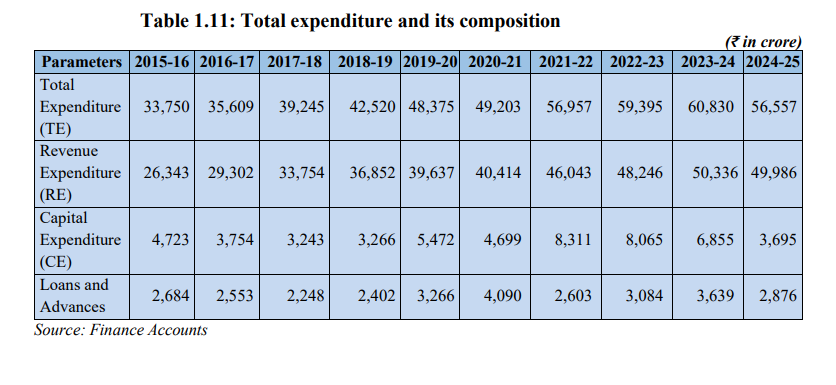
The CAG report highlighted that capital expenditure in Delhi plummeted over the years, being reduced to less than half. The data shows that in 2021-22, ₹8,311 crore was spent on capital projects in Delhi, but by 2024-25, the amount registered a sharp fall to ₹3,695 crore. In a single year, the expenditure on road transport infrastructure fell from ₹1,448 crore to ₹390 crore. Notably, capital expenditure includes the money spent by the government towards long-term assets and infrastructure creation, such as building roads, schools, and hospitals.
Screenshot from the CAG report
In terms of the share of the total budget, capital expenditure has been limited to single digits. The government spent ₹ 3,695 crore only on capital account during 2024-25, which was 6.53 per cent of the total expenditure. During 2023-24, the expenditure stood at ₹ 6,855 crore. As per the report, the decline was a direct consequence of reduced expenditure under different heads.
Money sanctioned remained unutilised
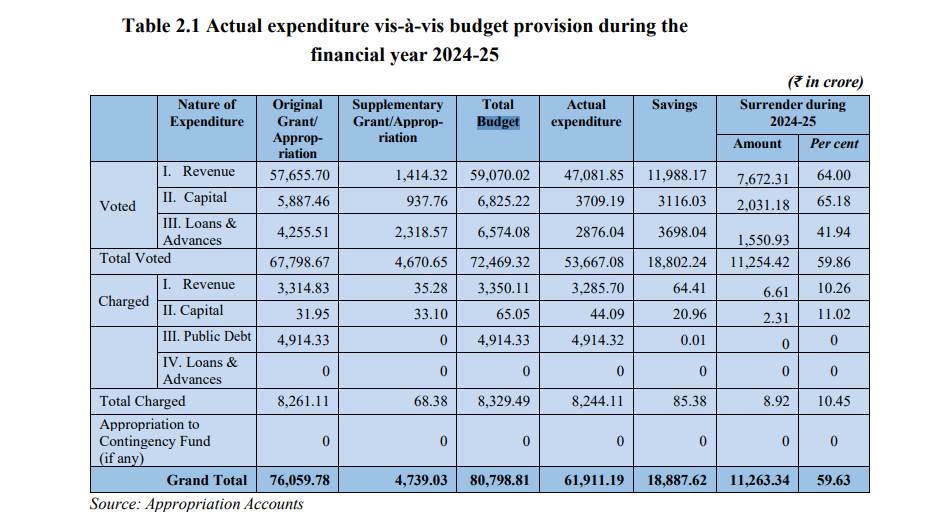
The CAG report also flagged how, under the AAP government, several schemes were announced, and funds were received for them, but they remained unimplemented. Out of a total budget estimate of ₹ 80,798.81 crore for 2024-25, the AAP government could only spend ₹61,911.19 crore. This led to the saving of ₹ 18,887.62 crore, out of which ₹ 11,263.34 crore was surrendered and the remaining ₹ 7,624.28 crore lapsed at the end of March 2025.
This means that 23.38 per cent of the budget authorised by the legislature to be spent on various activities and schemes could not be utilised by the AAP government. “Estimating expenditure much more than actual requirement was indicative of a deficient budgeting exercise,” the report stated.
Screenshot from CAG report
The report pointed out that the government received supplementary funds mid-year, but even those remained unspent as the total expenditure could not even reach the level of the original estimated budget amount.
“The supplementary provisions during the years 2020-21 to 2024-25 constituted 1.37 per cent to 6.23 per cent of the original provisions. However, the supplementary provisions proved unnecessary as the expenditure did not come up even to the level of original budget provisions,” the report mentioned.
Money moved from one budget head to another
The report also revealed that the government kept moving money from one department to another during the year. This is referred to as “re-appropriation”. However, part of the amount re-appropriated also could not be fully utilised by the government. “Scrutiny of Appropriation Accounts for the year 2024-25 revealed that under 16 sub-heads (Appendix-2.2) spread across six Grants (wherein there were final savings of more than ₹ 15 crore in each case), augmentation of provision proved unnecessary, as the expenditure was either equal to or did not come up to the level of original/supplementary budget provision,” the report said.
Again, as an indication of a deficient budgeting exercise, the re-appropriation resulted in cumulative non-utilisation (savings) of ₹ 1,445.72 crore (including the re-appropriation of ₹ 889.10 crore).
Expenditure on subsidies kept mounting
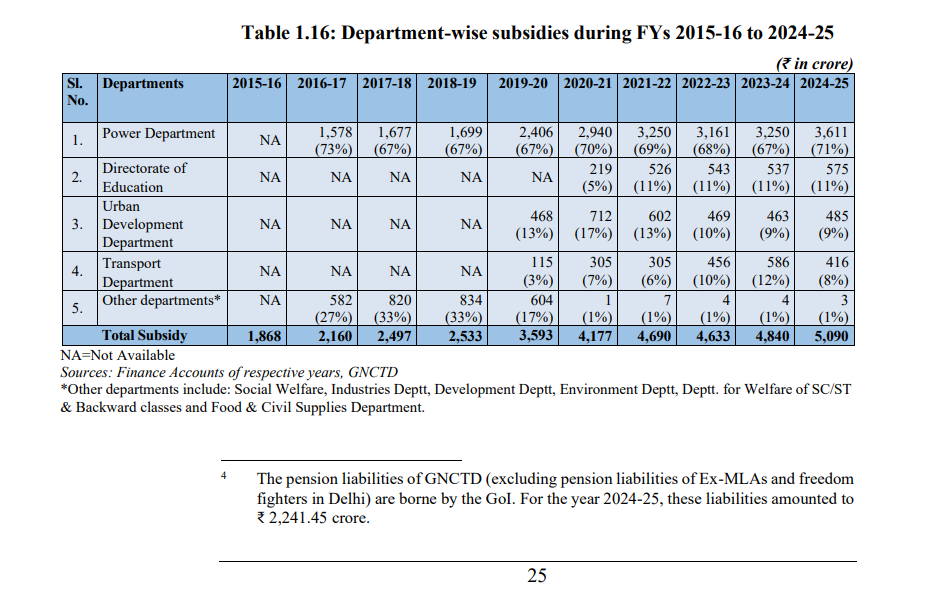
While the AAP government failed to spend the public money on capital expenditure and on various schemes, it generously spent the money on subsidies. “Delhi’s subsidy expenditure was 10.18 per cent of total revenue expenditure in 2024-25. Subsidies for power continued to dominate the total subsidy outgo, ranging from 67 to 73 per cent,” the report noted.
According to the report, the subsidies during the current year increased by ₹ 250 crore (5.17 per cent) from the previous year. The increase was mainly due to an increase of ₹ 361 crore on account of power subsidy, ₹ 22 crore on account of Urban Development (Water Subsidy) and ₹ 38 crore on account of Education subsidy.
Screenshot from the CAG report
The report cautioned that excessive spending on subsidies could “pose a serious challenge to fiscal sustainability, as excessive subsidy expenditure can crowd out critical development spending and strain budgetary resources needed for long-term growth”.
“There is a need for revenue augmentation, better expenditure control and structural reforms to ensure long-term fiscal health. Transparency should be enhanced in ensuring timely accounting and reporting. Steps should be taken for more judicious budget provisioning,” the report suggested.
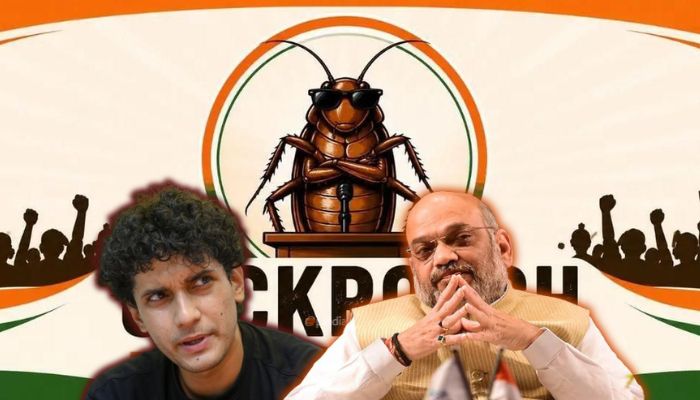
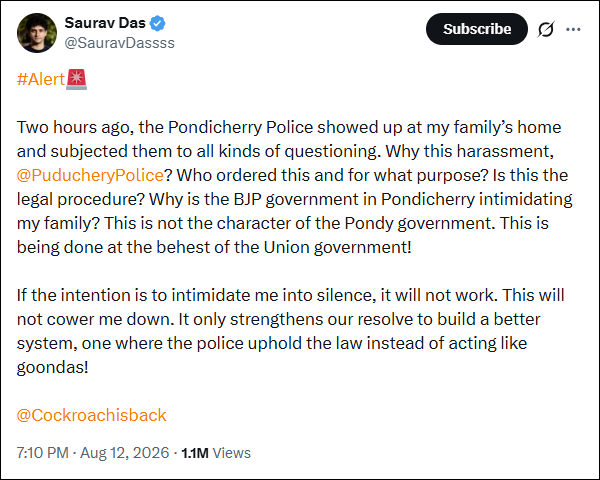
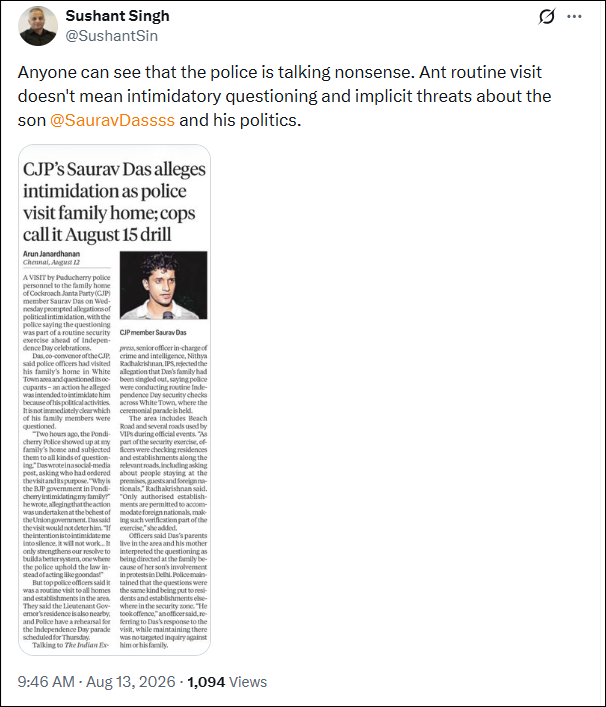
On Wednesday (12th August), Saurav Das, the Co-convenor of the Cockroach Janta Party (CJP), claimed that the Puducherry Police visited his family home and questioned them. Saurav Das claimed that the BJP government in Pondicherry was “intimidating” his family to ‘silence’ him.
In an X post, Das claimed this ‘harassment’ was being done at the behest of the BJP-led Central government.
“Two hours ago, the Pondicherry Police showed up at my family’s home and subjected them to all kinds of questioning. Why this harassment, @PuducheryPolice? Who ordered this and for what purpose? Is this the legal procedure? Why is the BJP government in Pondicherry intimidating my family? This is not the character of the Pondy government. This is being done at the behest of the Union government!” Das wrote.
The CJP leader Saurav Das even labelled the Puducherry Police as “goondas”.
“If the intention is to intimidate me into silence, it will not work. This will not cower me down. It only strengthens our resolve to build a better system, one where the police uphold the law instead of acting like goondas!” he added.
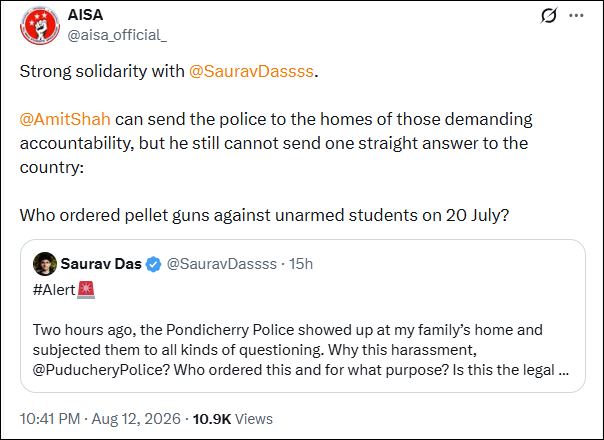
In no time, the CJP supporters and extended anti-BJP cabal began expressing ‘solidarity’ with Saurav Das. They peddled the victimhood narrative that the BJP government was attempting to harass, intimidate and silence those who seek accountability.
Puducherry Police refutes ‘harassment’ and ‘intimidation’ claim of CJP leader Saurav Das
The Puducherry Police confirmed that it did visit the White Town residence of CJP leader Saurav Das on 12th August 2026. However, the police refuted Das’s ‘harassment’ and ‘political intimidation’ claims, terming them “false”.
A senior Puducherry Police official said that it was a “routine exercise” ahead of Independence Day. The official added that police visit all houses and establishments in important areas, adding that the residence of the Lieutenant Governor, Beach Road, and several other roads used by VIPs during official events are also nearby.
“As part of the security exercise, officers were checking residences and establishments along the relevant roads, including asking about people staying at the premises, guests and foreign nationals. “Only authorised establishments are permitted to accommodate foreign nationals, making such verification part of the exercise,” senior officer in-charge of crime and intelligence, Nithya Radhakrishnan, IPS, told The Indian Express.
Despite the clarification by the Puducherry authorities, Saurav Das and the anti-BJP cabal are portraying the police’s visit to his parents’ house as a ‘targeted inquiry’.
The leftist ecosystem is claiming that the police asked intimidatory questions and even issued implicit threats to the family of CJP spokesperson Saurav Das due to his role in the recent Delhi protests.
Saurav Das accuses Home Minister Amit Shah of planning ‘intimidation tactic’ to silence CJP cockroach
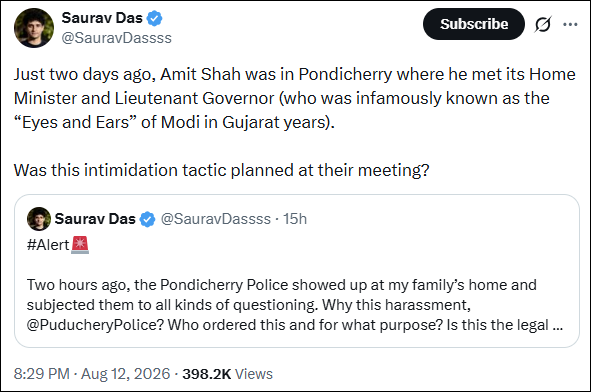
Saurav Das linked Union Home Minister Amit Shah’s recent visit to Pudduchery to the police’s visit to his family home. He claimed that Shah met Pondicherry Home Minister and Lieutenant Governor and “planned the intimidation tactic”.
“Just two days ago, Amit Shah was in Pondicherry where he met its Home Minister and Lieutenant Governor (who was infamously known as the “Eyes and Ears” of Modi in Gujarat years). Was this intimidation tactic planned at their meeting?” Das wrote on X.
The Puducherry Police, however, maintains that there was no targeted inquiry against Saurav Das or his family. The police also stated that contrary to Das’s ‘intimidatory questioning’ claims, the police officials asked the same kind of questions they asked other residents in the security zone.
The police emphasised that the officials did not even enter Das’s house, let alone ‘intimidate’ his parents.
Such is the Leftist art of victimhood that they portray even the ordinary as conspiratorial.
The CJP ‘cockroach’ Saurav Das not only portrayed an expected pre-Independence Day security sweep near parade routes and VIP areas as a deliberate ‘intimidate me into silence’ plot, and labelled the police doing their job as ‘goondas’, but also audaciously claimed that Home Minister Amit Shah might have planned an ‘intimidation tactic’ to silence him.
It is ridiculous even to imagine that the country’s Home Minister would sit in a meeting with the UT Home Minister and Lieutenant Governor and plan how to deploy police to ‘intimidate’ Saurav Das into silence. Union Home Minister’s portfolio covers issues as big as national security; there is no way he would indulge in specifically sitting and tailoring an ‘intimidation tactic’ against yet another anti-BJP activist.
If sending police to the doorsteps of Amit Shah’s critics and adversaries could really intimidate them into silence, more than half of the Islamo-leftist cabal would have abandoned their perpetual pursuit to vilify Shah, and by extension the Modi government.
However, Saurav Das has had a knack for peddling conspiracy theories even during his days of legal ‘investigative’ journalism.
Amidst widespread criticism over the CJP’s initial reluctance and subsequent performative support to the Jharkhand Student Protest, Saurav Das apparently found the police routine verification visit to his family home as an opportunity to garner support and portray himself as a crusader against a ‘fascist regime’ refusing to cower against harassment and efforts to intimidate him into silence.
Apparently, Saurav Das has taken a page from the Aam Aadmi Party’s victimhood playbook, wherein AAP leaders claim to be persecuted by the BJP government despite there being no such evidence. This, however, is not surprising given the CJP itself is an unofficial B-Team of the Aam Aadmi Party, with its National Working Committee comprising mostly former AAP members.
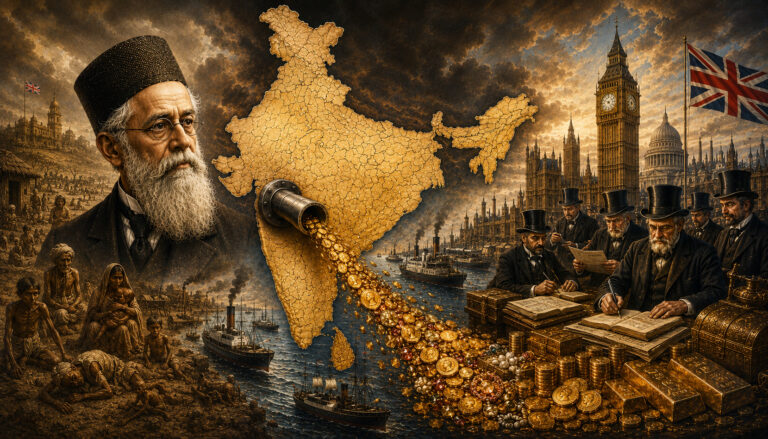
In 1901, Dadabhai Naoroji built one of history’s most devastating economic arguments from a colonized nation, using nothing but the empire’s own numbers. His starting point was strange: India was consistently exporting more than it imported. By the economics taught in London, that should’ve meant India was growing richer. Instead, Naoroji spent 60 years watching that surplus coexist with famine.
Born in Bombay in 1825, Naoroji became the first Indian full professor at Elphinstone College before moving to London in 1855 to run a trading firm. Living there gave him rare access to British Parliamentary records most Indians never saw, and what he found troubled him. In 1867, using official customs and Parliamentary data, he argued that a huge share of India’s trade earnings was simply leaving the country and never coming back. He zeroed in on ‘Home Charges’, British officials’ pensions, interest on debt India never chose to take on, guaranteed payouts to British railway shareholders, war costs, even a rule forcing India to buy supplies from British manufacturers even when cheaper local options existed.
The real mechanism, though, was subtler than outright theft. Through something called the Council Bill system, a British merchant buying Indian cotton paid in London, money that funded British expenses, while the Indian farmer got paid in rupees drawn from India’s own tax revenue. The books balanced. India even ran a trade surplus most years. But no real wealth ever entered the country. Naoroji didn’t stop at the macro picture. Using colonial prison food cost records, he built one of the world’s first data driven poverty lines, and found huge numbers of Indians living below what the government spent to feed convicts.
This wasn’t just personal outrage; it became the movement’s intellectual backbone. Ranade, Dutt, and Gokhale carried it forward; Congress formally adopted the drain theory by 1896, and Naoroji later became the first Indian elected to the British Parliament, eventually calling for ‘Swaraj’ in 1906.
The debate over Naoroji’s exact numbers has raged for over a century, from 1960s skeptics to Utsa Patnaik’s headline-grabbing $45 trillion estimate in 2017, which drew real methodological criticism too. The takeaway isn’t which total is right; it’s that Naoroji’s itemised, sourced approach has aged far better than any single dramatic figure.
The scrutiny surrounding digital news platform Newslaundry has acquired another troubling dimension after journalist Jyoti Yadav publicly recounted her experience of being isolated and hounded by the organisation after she pursued a story that it had itself considered worth covering.
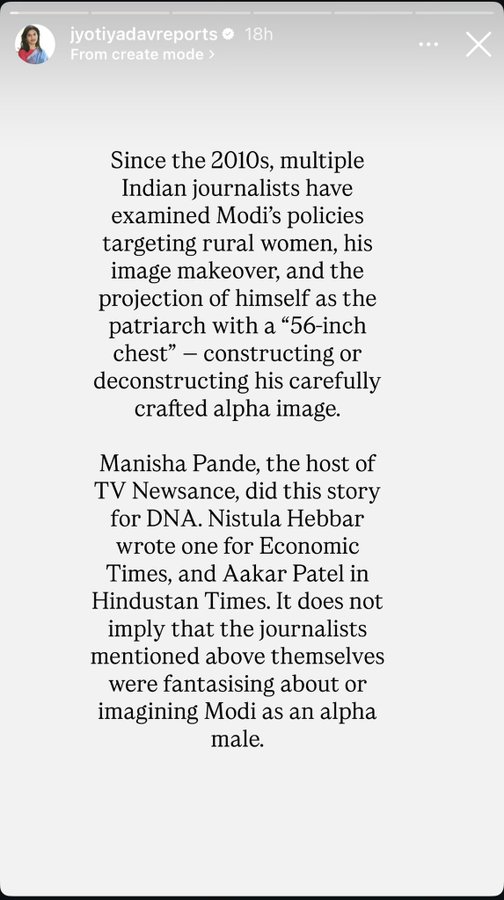
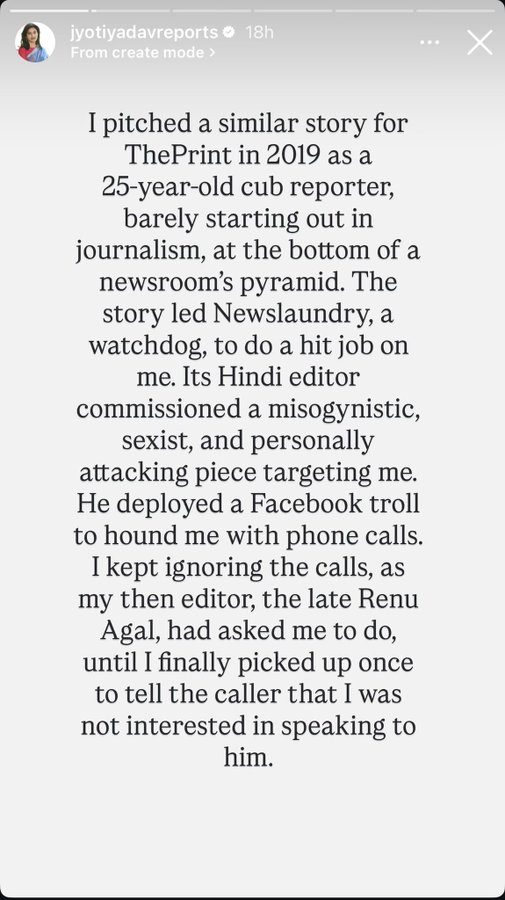
Yadav, in a series of Instagram stories, recalled an episode from 2019 when she was a 25-year-old cub reporter at ThePrint. She said she had pitched a story examining how Narendra Modi’s “carefully cultivated” image as a powerful, authoritative and “alpha” leader was perceived by rural women.
According to Yadav, the subject was hardly unique to her. She pointed out that journalists across publications had examined Modi’s image, including Newslaundry’s own Manisha Pande, Nistula Hebbar of The Economic Times and Aakar Patel of Hindustan Times.
Yet, she alleged, Newslaundry chose to turn the story into a personal attack on her.
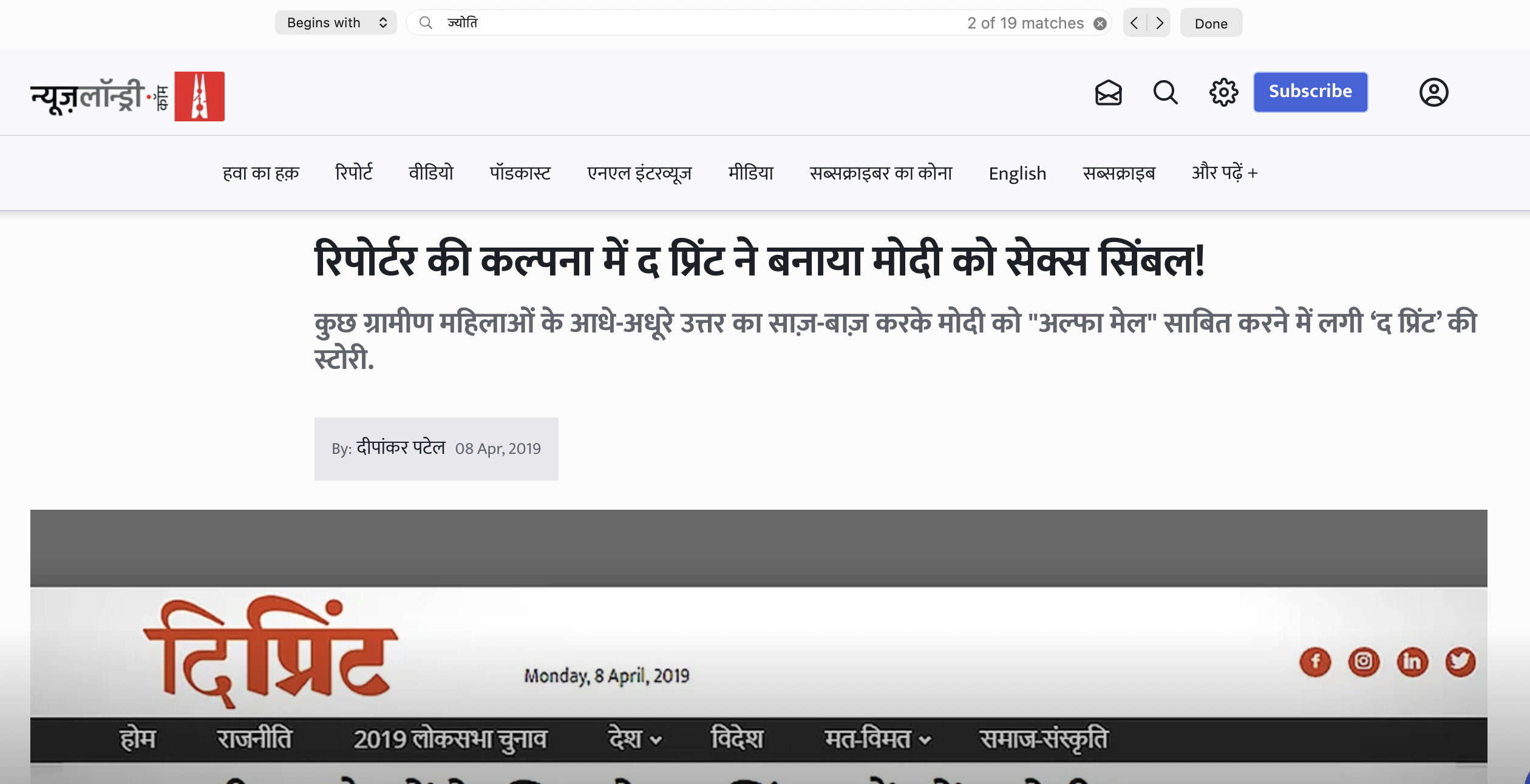
The irony becomes sharper when the publication’s 2019 Hindi article is revisited. Authored by Dipankar Patel, the article carried the headline: “रिपोर्टर की कल्पना में द प्रिंट ने बनाया मोदी को सेक्स सिंबल!”, effectively accusing ThePrint’s story of attempting to establish Narendra Modi as a sex symbol among rural women.
The article went well beyond criticism of the methodology or framing of the story. It repeatedly questioned Yadav’s journalistic judgement, described the piece as sensationalist and sexually obsessed, and sought to dissect her reporting choices.
It questioned why Yadav had asked rural women whether they would marry Modi, whether descriptions of Modi as confident, well-dressed, authoritative and capable of taking action against wrongdoers could legitimately be interpreted as sexual attraction, and whether references to Modi’s photographs with celebrities such as Priyanka Chopra and Ivanka Trump had any relevance to rural women’s perceptions.
The article even challenged Yadav’s understanding of the term “sex symbol”, contrasting her explanation with the dictionary definition of sexual attractiveness.
There can certainly be legitimate disagreement over whether Yadav’s 2019 report justified the headline or whether the methodology supported the conclusions drawn from it. Journalism should be open to such criticism. But that is precisely what makes Yadav’s latest account significant: she says Newslaundry did not merely critique the report. It singled her out personally despite other journalists having explored essentially the same broad subject.
‘A hit job’ on a young reporter
In her Instagram stories, Yadav says she pitched the story to ThePrint in 2019, when she was just beginning her career. According to her account, the story subsequently “led Newslaundry, a watchdog, to do a hit job on me.”
She alleges that its Hindi editor commissioned a “misogynistic, sexist, and personally attacking piece” targeting her and that a Facebook troll was used to repeatedly call her.
Yadav says she initially ignored the calls on the advice of her then editor, the late Renu Agal, but eventually answered one call and told the caller she was not interested in speaking to him.
The more serious allegation concerns the manner in which the Newslaundry article was produced and promoted.
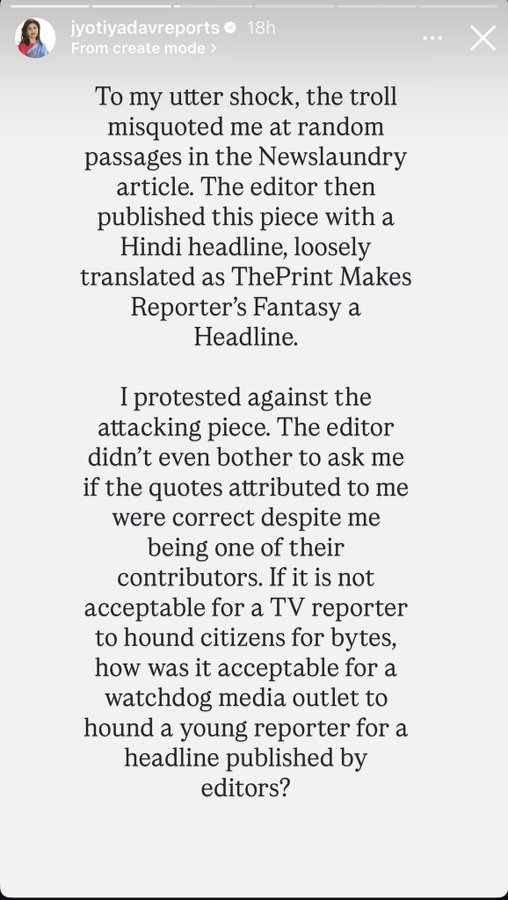
Yadav says the Facebook account used to contact her misquoted her at random passages from the Newslaundry article.
She says she protested against the article, but that the editor did not bother to ask whether the quotations attributed to her were accurate, despite her being a contributor to the organisation.
That allegation raises a basic editorial question: if a publication considers a journalist’s reporting sufficiently problematic to warrant a detailed takedown, why would it not seek clarification from the journalist before publishing quotations attributed to her?
More importantly, why was a story examining the media’s construction of Modi’s public image transformed into a personalised attack on a young woman reporter?
Yadav also points to what she sees as an obvious double standard.
“If Newslaundry deemed it worthy of a hit job, why not include their own editor, Manisha Pande, who had written a similar article?” she asks.
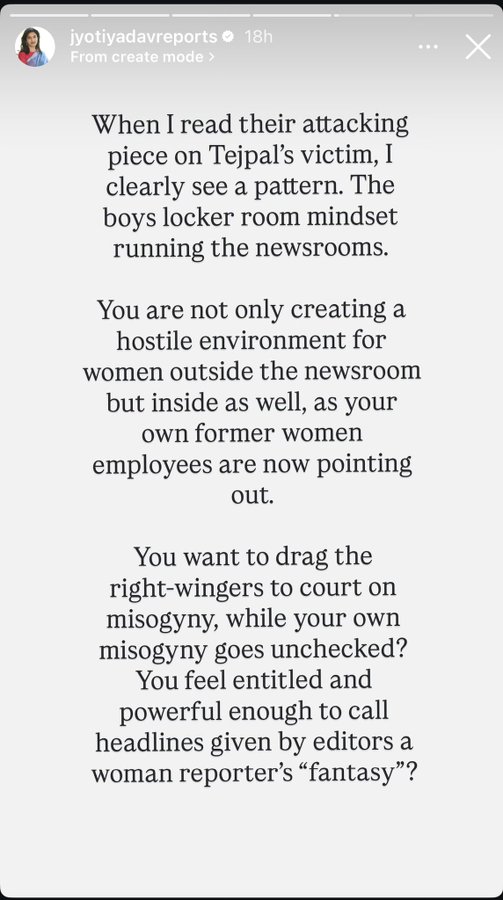
Exposing the Left’s hypocrisy, Yadav wrote: “You want to drag the right-wingers to court on misogyny, while your own misogyny goes unchecked?”
She argues that, at its lowest, the episode could have been understood as two women reporters arriving at similar journalistic questions, one at ThePrint and one at Newslaundry. Instead, she says, the publication chose to isolate and target her.
The Tejpal connection
That account assumes greater significance today because Newslaundry is itself facing questions about the treatment of women within its newsroom.
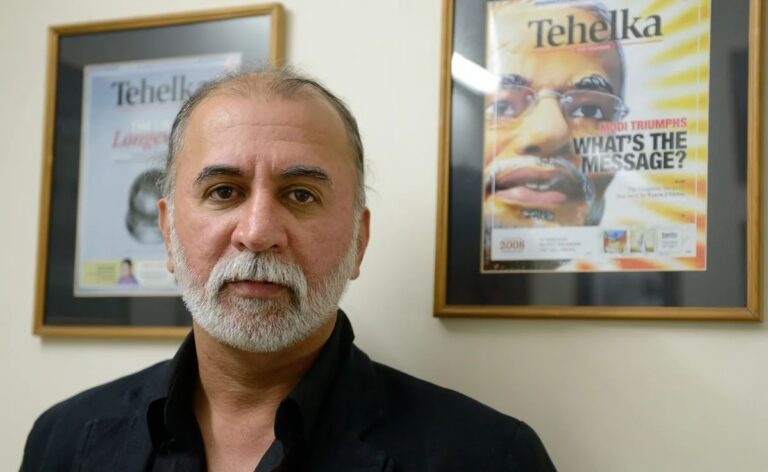
The organisation’s current controversy erupted into the open after the conviction of former Tehelka editor-in-chief Tarun Tejpal. The Bombay High Court recently overturned Tejpal’s earlier acquittal in the 2013 sexual assault case and sentenced him to 10 years’ rigorous imprisonment.
The timing is uncomfortable for Newslaundry because the organisation has a particularly long association with the Tejpal controversy.
In 2012, Newslaundry published an interview with Tejpal, discussing journalism, ground realities and the media’s tendency towards simplistic narratives. The interview remains available on Newslaundry’s website.
But the far more controversial episode came in 2014, when Newslaundry published an open letter by Nirupama Sekhri, sister of Newslaundry co-founder Abhinandan Sekhri, addressed to the woman who had accused Tejpal of sexual assault.
The article was not merely sympathetic to Tejpal. It questioned the complainant’s status as a victim and referred to her as a victim of “bubblegum feminism”. It questioned her conduct and suggested that the incident had been portrayed as something far more serious than it was.
Newslaundry subsequently published a defence of its decision to carry the article, arguing that it was providing a counterpoint to what it described as a one-sided media narrative.
That old article has now been removed from the website, with Newslaundry subsequently explaining that it no longer reflected the values guiding its journalism.
The irony of that history is difficult to miss. A publication that once devoted considerable editorial space to questioning a sexual-assault complainant’s conduct is now being asked to answer questions about allegations concerning the treatment of women who worked inside its own newsroom.
Former employees begin speaking out
Those allegations have come from multiple former employees.
Former Newslaundry senior correspondent Sumedha Mittal publicly said she hoped the organisation would reflect as seriously on sexual-harassment complaints within its own newsroom as it had on the Tejpal article. Former employee Priyanka Ishwari separately raised concerns about alleged workplace conduct, including an allegation that senior journalists shouted at women editors and threatened them during work calls.
But the accounts did not stop there.
On August 10, journalist Sayantan Ghosh also publicly recounted his experience of working at Newslaundry, alleging that the newsroom environment was deeply toxic and that co-founder Abhinandan Sekhri used abusive language towards employees.
Ghosh said that when he received an offer from Newslaundry, he understood that he would work as a trainee journalist for three or four months and could subsequently be hired if his work was good. He described it as, essentially, an unpaid internship, something he was willing to accept because he was young and wanted to become a journalist.
But, according to Ghosh, what he encountered after moving to Delhi was very different from what he had expected.
“The space, as I experienced it, was extremely toxic. The language used by Abhinandan Sekhri towards employees was deeply hurtful to me. People around me told me that this was ‘normal’ in the media—that this was how newsrooms functioned and that one had to develop a thick skin.”
Ghosh said he had previously worked in mainstream newsrooms, including The Telegraph and The New Indian Express, but had never encountered editors abusing reporters or interns in the manner he experienced at Newslaundry.
“So when I was told that such behaviour was ‘normal’ in the media, I could not accept it. It was not normal to me. For everything, in my experience, the person in question was abused. I had never seen people speak to their own employees in that manner before. But I was repeatedly told that this was simply how things were.”
According to Ghosh, the experience became so traumatic that one particular incident remained etched in his memory.
He recalled writing a story on Section 66A and alleged that the abuse directed at him afterwards was so severe that he fled the office.
“One day, after I wrote a story on Section 66A, the abuse was so harsh that I remember lying to the person I was reporting to and fleeing. I stayed in Delhi for another week, until my parents could arrange a train ticket, and then I returned to Kolkata.”
Ghosh said he had considered writing about the experience several times but remained silent because he feared being bullied or intimidated and began questioning whether he was simply being “too sensitive”.
“I questioned whether I was being too sensitive, whether this really was ‘normal’, whether I simply did not understand how the media worked.”
His decision to speak now, he acknowledged, could invite criticism.
“I know the kind of responses that are waiting for me. I know what will be said and I know that many people may question me. Maybe I am prepared today. But I think I should have spoken about this much earlier.”
Ghosh’s account is significant because it adds an allegation of workplace toxicity from a former male employee to the allegations concerning the treatment of women that have surfaced in recent days.
It should, however, be treated as an allegation and an account of his personal experience, rather than as an established finding against any individual. Sekhri and Newslaundry should be allowed to respond to the specific allegations.
Allegations from women employees
The accounts from women who previously worked at Newslaundry are particularly relevant to the questions now being raised about its workplace culture.
Sumedha Mittal, a former senior correspondent, said she hoped Newslaundry would “reflect just as seriously” on sexual-harassment complaints within its own newsroom.
Priyanka Ishwari, another former employee, alleged that women editors were subjected to inappropriate conduct by senior male journalists.
“Also hope they train senior journos not to scream at women editors and threaten them saying ‘Kabse dekha raha hun mein tereko’ over work calls. Training male reporters to behave professionally around female colleagues and not make the office a boy’s lockeroom maybe too much to ask?”
Again, such public allegations do not by themselves establish that a particular act of harassment occurred or that any complaint was mishandled. But when multiple former employees independently raise concerns about the same workplace environment, they warrant scrutiny rather than dismissal.
There is also a separate historical issue involving Vikram Kilpady, who worked at Newslaundry.
Journalist Lamat R Hasan had previously described an alleged 2005 incident involving Kilpady, saying she was “almost” raped. Recounting the incident, she said:
“He turned violent, pulled my hair, grabbed my wrists, held me against a wall and then pushed me on the bed. My attempts to break free failed. I started crying. He let me go. That’s the closest I have come to being raped.”
Kilpady was subsequently associated with Newslaundry, which itself published an article about the allegations against him during the #MeToo period.
The point is not to suggest that employment at Newslaundry establishes guilt in relation to an allegation made years earlier. It does not. The relevant question is instead how media organisations evaluate allegations of serious misconduct when deciding whom to employ, platform or defend, and whether they apply the same standards internally that they demand of others.
When the ‘watchdog’ becomes the subject
These allegations, by themselves, do not establish that any particular complaint was mishandled or that a particular employee committed harassment. That determination belongs to the appropriate internal or statutory mechanisms.
But the accumulation of accounts is difficult to ignore.
One former employee describes a toxic workplace and alleged verbal abuse. Former women employees have raised concerns about workplace conduct and sexual-harassment complaints. Another journalist, Jyoti Yadav, says she was personally targeted by the organisation after it chose to scrutinise her reporting.
The common thread is not necessarily the nature of each allegation. It is the question of power.
What happens inside a newsroom when editors exercise enormous power over young reporters? What happens when criticism is directed not at someone’s journalism but at their character? And what safeguards exist when the people responsible for enforcing professional standards are themselves accused of violating them?
This is where Yadav’s account becomes relevant to the present controversy.
Her allegations do not concern sexual harassment. They concern the treatment of a young female journalist who says she was personally targeted after her work became the subject of a Newslaundry attack.
That distinction matters.
One should not conflate allegations of editorial bullying with allegations of sexual harassment. But together, the accounts being placed in the public domain raise a broader question about newsroom culture: what happens when women inside or outside an organisation become inconvenient to the people exercising editorial power?
Yadav’s allegation is particularly striking because she says the same basic subject had been examined by Newslaundry’s own Manisha Pande and by other established journalists.
She therefore asks a question that goes beyond the 2019 article: why was she isolated and targeted?
“When I read their attacking piece on Tejpal’s victim, I clearly see a pattern,” Yadav wrote in her Instagram stories. “The boys locker room mindset running the newsrooms.”
That is an allegation, not a judicial finding. But it is precisely the sort of allegation that an organisation committed to accountability should be willing to answer with facts rather than rhetoric.
The POSH Questions
And that scrutiny is no longer confined to social media.
The Delhi Commission for Women has taken cognisance of allegations concerning Newslaundry’s handling of workplace sexual-harassment complaints and the functioning of its Prevention of Sexual Harassment mechanism, according to a report by Storyboard18 cited in the material surrounding the controversy. The commission’s chairperson, Lata Gupta, said the matter was sensitive and that the commission was examining the available information before deciding on further action.
Newslaundry, for its part, has rejected the broader allegations.
Editor-in-Chief Manisha Pande has said that the organisation’s workplace-harassment committee acted on every complaint it received and that dismissals and suspensions were imposed wherever warranted. She has also said that none of those complaints was against the organisation’s CEO and that an external member of the committee conducted a POSH training programme in November 2025.
Those responses deserve to be placed on record. But they also leave legitimate questions unanswered.
How many complaints have actually been received over the years? How many were formally investigated? What were the findings? How many resulted in disciplinary action? Was the Internal Complaints Committee properly constituted throughout? Were employees informed whenever its composition changed? And were mandatory POSH and gender-sensitisation requirements consistently followed?
These are not questions that can be dismissed as an attack on independent journalism.
Indeed, the larger issue is not whether Newslaundry is “anti-government”, “left-wing”, “right-wing” or anything else. A publication’s ideological position does not exempt it from the standards it expects from everyone else.
If an organisation routinely lectures governments, corporations, political parties and media houses about institutional accountability, it cannot reasonably object when the same questions are directed at its own newsroom.
Accountability cannot be selective
Newslaundry has built much of its public identity around challenging powerful institutions and demanding accountability from those who believe their stature puts them beyond scrutiny. Its journalism frequently asks institutions to explain how they treat the vulnerable, how complaints are handled and whether internal systems actually work.
It is now facing those questions itself.
And this time, the demand for answers is not coming from a government ministry or a political party. It is coming from former employees, women journalists and a statutory women’s commission examining the allegations.
The lesson from the Tejpal case should be obvious. Institutions cannot decide for themselves which allegations deserve to be taken seriously based on who is making them, how powerful the accused person is, or how inconvenient the allegations may be.
For Newslaundry, the question now is not whether it can produce another statement defending itself. It is whether it is prepared to subject its own institutional practices to the same level of scrutiny it demands from everyone else.
The organisation has every right to dispute allegations against it. But if it answers that its internal mechanisms functioned properly, then transparency about those mechanisms should not be treated as an unreasonable demand.
Because accountability cannot be a principle reserved for political opponents.
And feminism cannot begin and end at the newsroom door.
The woman who accused former Tehelka editor-in-chief Tarun Tejpal of sexually assaulting her in 2013 has reportedly taken to Substack to share a deeply personal account of the ordeal she has endured over the past 13 years. In a lengthy essay, she revisited her childhood, the assault, the subsequent trial and the manner in which her identity, relationships, choices and conduct were repeatedly scrutinised during the legal battle.
Her account comes days after the Bombay High Court overturned Tejpal’s acquittal by the Goa sessions court, convicted him of rape and sentenced him to 10 years’ rigorous imprisonment. The High Court also criticised the trial court for relying on stereotypical notions of how a survivor of sexual assault should behave.
‘My first lessons in politics were in male rage’
In her essay, the survivor reflected on how her childhood shaped her relationship with male anger.
She recalled that her father, a journalist, would discuss politics at home and quiz her about ministers, political parties and Parliament. Yet, despite growing up around political conversations, she said her “first lessons in politics were not from Parliament.”
“They were in male rage,” she wrote.
She described her father as a man who drank heavily and became violent, beating her mother and destroying things around the house before eventually falling asleep. The following morning, she added, he would return to being affectionate and remorseful.
The experience taught her to anticipate male anger and to modify her own behaviour accordingly.
A childhood of learning to appease angry men
The victim recounted being sexually abused as a five-year-old by a teenage boy who had been left to look after her following her parents’ divorce. She said the abuse was discovered by her grandparents, following which her male relatives beat the boy before sending him away.
Yet even then, she said, the violence did not make her feel vindicated.
Instead, she became frightened by the rage she witnessed in the men around her.
As she grew older, she encountered similar aggression outside her home, from men on Delhi’s streets and public transport to strangers and acquaintances who harassed, stalked or threatened women.
Those experiences, she explained, taught her to assess the mood of men around her constantly.
“I learned to read the room, to keep smiling when I wanted to cry,” she writes, describing how she became adept at soothing angry men.
The lesson would eventually shape how she responded to the events that followed years later.
‘I turned myself into an obedient and terrified woman’
The survivor said growing up around violence turned her into someone who tried to avoid confrontation at almost any cost.
While her professional life allowed her to express anger through journalism and political writing, she said her personal life was governed by an entirely different instinct.
“In my personal relationships, I stayed small,” she wrote.
She described herself as pleasing, light and non-threatening, someone who continued to prioritise the emotions of men and suppress her own.
For years, she said, this psychological split appeared to work.
Until the night of the assault.
The night that changed her understanding of politics
At 27, she was sexually assaulted by a man nearly twice her age, a senior figure who was responsible for her livelihood and someone her family knew and trusted.
She said that, in that moment, she was not thinking about politics or ideology. She was thinking about preventing the man from becoming angry with her.
That response, she argued, was the product of years spent learning that male anger could have devastating consequences.
Only later did she understand that the issues she had studied and written about, gender, class, sexuality, power and hierarchy, were present in the room that night.
“Politics lives in the body,” she wrote.
The trial became another battle over her body
The survivor’s account then turns to the 13-year legal battle that followed.
She said the trial repeatedly forced her to defend not simply her allegation, but her entire identity.
Her relationships, photographs, text messages, clothes, financial circumstances and professional conduct were scrutinised. She was questioned about why she did not cry, why she froze, why she continued working after the assault and why she later left her workplace.
Her cross-examination, she said, ran to more than 1,000 pages.
The result was a series of competing labels imposed upon her: “good victim” or “bad”, survivor or liar, journalist or activist, reliable or unreliable.
The Bombay High Court’s recent judgment has brought renewed attention to precisely this question of how survivors are assessed in court.
Bombay HC rejects the ‘ideal victim’ framework.
In overturning Tejpal’s acquittal, the Bombay High Court criticised the Goa trial court’s reasoning and rejected stereotypical assumptions about how a survivor of sexual assault should behave.
The High Court’s ruling comes after years in which the complainant’s conduct following the assault became a major part of the legal and public debate surrounding the case.
The survivor’s Substack essay offered a personal explanation for why such scrutiny can be deeply damaging.
She argued that power does not operate only through institutions such as Parliament, courts or governments. It also operates through bodies, determining whose body receives dignity, privacy and protection, and whose body is subjected to scrutiny and judgment.
‘Victim. Liar. Journalist. Activist.’
The survivor listed the contradictory identities that have been imposed upon her during the thirteen-year ordeal.
The list captured the central argument of her essay: that a survivor is often forced into simplistic categories that leave little room for the contradictions and complexities of an actual human being.
Her Substack account is therefore not merely a retelling of the events of 2013. It is an account of what followed, thirteen years in which she said her credibility, politics, relationships, personality and even her response to trauma were repeatedly placed under the microscope.
After more than a decade of litigation, the survivor has now chosen to tell that story in her own words, not from the witness box, but on an online forum.
In recent years, it has become ritualistic for the leftist media cabal to vilify Kanwariyas and Kanwar Yatra, in their ideological pursuit of peddling Muslim victimhood and their perverted idea of secularism. While the likes ofThe Wire indulge in explicit Hinduphobic propaganda, The Indian Express veils their identical manoeuvres with layers of nuance.
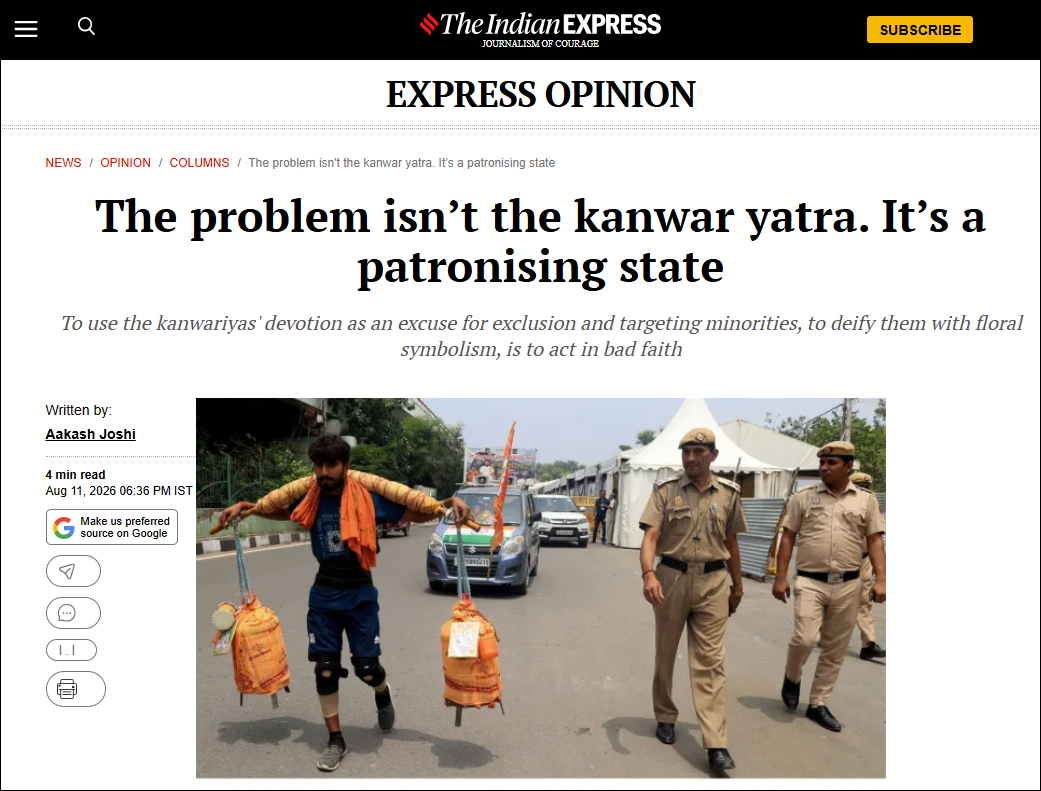
On the last day of this year’s Kanwar Yatra, 11th August, The Indian Expresspublished an opinion piece headlined, “The problem isn’t the kanwar yatra. It’s a patronising state”.
Beginning with how upper-middle-class and car owner view Kanwariyas as a traffic nightmare and a threat to safety, author Aakash Joshi comes to the real agenda. The author argues that since 2014, essentially with the coming of the BJP in power at the Centre, government authorities have been “trying to “facilitate” the yatris.”
“In doing so, they are not only undermining the secular foundations of the Indian state — the Union of India has no religion — they are also falling into an old trap, which is both dangerous for the Republic and patronising to the believer,” The Indian Express article reads.
Floral showers on Kanwariyas by administrative officials undermine Indian Express’s idea of secularism
How is it that facilitating Kanwar Yatra for Hindus ‘undermines’ India’s secular foundations but the government facilitating and even offering subsidies to Muslims for Haj is not?
How is it that ministers of ‘secular’ (read Muslim-appeasing) political parties organising or partaking in Iftar parties does not undermine secularism? Does showering flowers on Kanwariyas alone undermine India’s secular foundations?
While it is true that the Union of India has no official or state religion, India’s foundation is rooted in Hindu consciousness. Without a Hindu majority, India would, without a scintilla of doubt, lose its legal and, in spirit, secular character.
The article further claims that after 2014, governments are not just facilitating the Kanwar Yatra but are “imposing assumed taboos and even prejudices.”
By ‘governments’, the author specifically meant the BJP governments. The article laments the 2023 decision of the BJP governments in Uttar Pradesh and Uttarakhand to ban sales of non-vegetarian food along the Kanwar Yatra route.
Government directions to shopkeepers to display proprietor name is ‘dog whistle’ against ‘minorities’: For Indian Express, basic transparency is ‘attack on Muslims’
Aakash Joshi described the government orders to shopkeepers and eateries to display their proprietor’s name as “a dog whistle to food segregation and against minority-owned and run businesses.”
How is displaying proprietor’s name a dog whistle? Kanwariyas are free to purchase fruits and other goods from anyone, and the government’s directions to put the names of the street vendors and the hotel owners on their boards were for all and not specifically for Muslims.
There have been numerous incidents wherein Muslims were found to be running shops with the names of Hindu deities, giving an impression that the shop is owned and run by Hindus; however, upon paying via UPI, which displays the real name of the user, it turned out that the shop belonged to a Muslim person. Why this subterfuge, if intentions are right?
How can basic transparency be deemed a dog whistle? Will Aakash Joshi be fine with Hindus selling pork in a Muslim-dominated area during Ramzan, Muharram, or Eid?
It is amusing that the same liberal coterie that describes a mere call to mention the proprietor’s name as religious discrimination, segregation and whatnot shamelessly defends the exclusionary Halal certification of a vast range of products.
There have been instances of Muslim-owned shops being caught spitting on the food or fruits and vegetables they sell. In such a situation, not only Kanwariyas during Sawan but Hindus otherwise also would want to be cautious and informed about who is serving them food.
The article draws a contrast that on one hand, Muslim shopkeepers are being arrested for selling non-veg food along the Kanwar Yatra route, on the other, the senior police officials are showering flower petals on Kanwariyas.
“Has there been an outpouring of demand to target Muslim businesses from the young pilgrims? Have they demanded floral showers?” the author asks.
The Hindu Kanwariyas have certainly demanded ‘targeting’ of Muslim businesses; they have also not demanded floral showers.
During the Kanwar Yatra in the holy month of Sawan, Kanwariyas maintain a Sattvic diet and strictly refrain from even visiting non-veg eateries, let alone consuming non-veg. It is for this reason that food compatibility was implemented along the Yatra route. Is all secularism, accommodation, and adjustment for communal harmony reserved only for Hindus?
It is also interesting that liberals never show such outpour of concern for targeting of one community to appease other when Muslims attack Kanwariyas, pelt stones, or obstruct their path.
“A kanwar yatri is no less a citizen, no less rational and no less demanding of their government than the student protestor in Jantar Mantar and Jharkhand. To use their devotion as an excuse for exclusion and targeting minorities, to deify them with floral symbolism, is to act in bad faith,” the IE article reads.
Floral showers by state officials only signify respect and are cultural symbolism; this gesture is deification of Kanwariyas. Even the supposed ‘Hindu hardliner’ and ‘Islamophobic’ Modi government garlands Haj pilgrims before departure to Saudi Arabia. Does this mean the ‘Hindutva’ government mocks rationality, intellect, and uses their devotion for political optics despite knowing that Muslims largely never vote for the BJP?
Amusingly, the Indian Express also has a problem with Shiv Bhakt Kanwariyas ‘revelling’. In fact, Aakash Joshi wants the ‘powers’ to ask why Kanwariyas revel, why they undertake the Yatra, and what they pray for.
“Perhaps, the powers should listen to the pilgrims — ask them why the release of religious revelry matters so much to them, why they undertake the journey, what they pray for when they do. Then, maybe, they might do what governments are supposed to, instead of believing that pandering is the only politics the pious understand,” the article adds.
One wonders if The Indian Express editor would ask why raising ‘Sar Tan Se Juda’ slogans in Muharram processions matters to Muslims so much, why they remain adamant about slaughtering cows on Bakrid despite no religious compulsion, why they even take out their Juloos, and what they pray for when they offer namaz by blocking roads. Patronising cuts both ways.
Floral showers on Kanwariyas or ensuring that the sanctity of their Yatra is not violated does not amount to insulting their rationality. Patronising cuts both ways. History of independent India is witness to which community has relied on pandering and appeasement by the country’s ‘secular’ parties and government and which community has been subjected to constant neglect, mockery, scrutiny, and villainization.
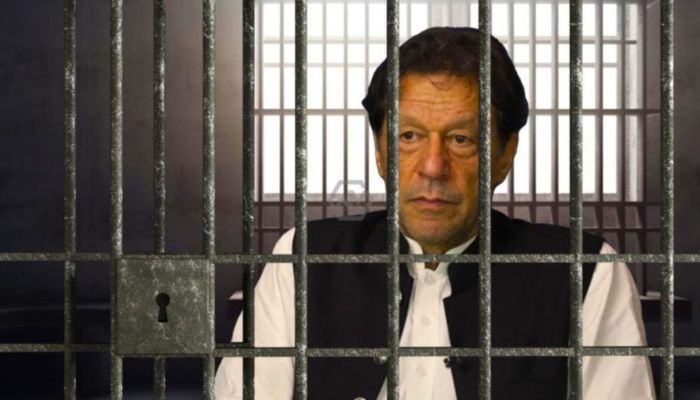
Fresh claims about the death of jailed former Pakistan Prime Minister Imran Khan have once again sparked concern and confusion in Pakistan. Pakistani journalist Wajahat Saeed Khan has claimed that three senior military sources believe Khan may have died in prison. However, the claim has not been independently confirmed, and the journalist himself said that his sources had not personally seen Khan.
BIG: Senior Pakistani Journalist Wajahat S Khan claims that his sources who are three Senior Officers in Pakistani Army have said that they fear Former Pakistan PM Imran Khan is dead inside prison and hence Pakistan Army Chief Asim Munir is hiding him from the entire country. pic.twitter.com/IDjeqFEh1s
Wajahat, an Emmy-nominated journalist based in the US, made the claim in a YouTube video posted on 10th August. He said the information came from senior officers based at the Pakistan Army’s General Headquarters (GHQ) in Rawalpindi.
According to him, at least three officers separately expressed the view that Imran Khan was “no longer with us”. At the same time, Wajahat admitted that none of his sources had personally seen Khan. He repeatedly stressed that the information had not been confirmed and said he hoped the claim was not true.
The claim has gained attention at a time when Khan’s family, lawyers, party leaders and doctors have complained about difficulties in meeting him. His sisters and Pakistan Tehreek-e-Insaf (PTI) leaders have repeatedly sought access to the former prime minister, while the party has demanded an independent medical assessment of his health.
Khan has been in prison since 5th August, 2023 and is currently serving a 14-year sentence in the £190-million Al-Qadir Trust corruption case. His wife, Bushra Bibi, was sentenced to seven years in the same case in January 2025. Both have challenged their convictions. Khan also faces pending cases linked to the 9th May, 2023 protests, during which PTI supporters attacked military installations across Pakistan.
Death claim fuels fresh tension
The uncertainty over Khan’s condition has added to tensions between PTI and Pakistan’s military establishment. Khyber Pakhtunkhwa Chief Minister and PTI leader Sohail Afridi has claimed that more than two million people are ready to take to the streets.
Afridi said PTI was not making an unconstitutional demand and maintained that meetings with Khan would not be used to pass political messages. He also warned of growing anger among young Pakistanis. PTI has announced a long march towards Islamabad on September 27 and has threatened earlier protests if Khan’s family and doctors continue to be denied access to him.
With access to Khan still a major issue, the latest claim has once again raised the question: Is Imran Khan dead? For now, there is no confirmation in the material available to establish that he has died.
Similar rumours surfaced last year
This is not the first time rumours of Imran Khan’s death have surfaced. Similar claims spread in November last year after his family and party colleagues struggled to meet him and confirm that he was safe.
The rumours were put to rest on 2nd December, when Khan’s sister Uzma Khanum met him at Adiala Jail. She said that he was physically well, although he was being kept in isolation.
Another major death rumour surfaced in November when Afghanistan Times reported that Khan had been killed inside Adiala Jail. The report claimed that the 72-year-old former prime minister had died after suffering torture in prison and that his body had been moved outside the jail. Pakistani authorities denied the claim and said Khan was alive.
A fake ‘government press note’ also claimed Khan’s death
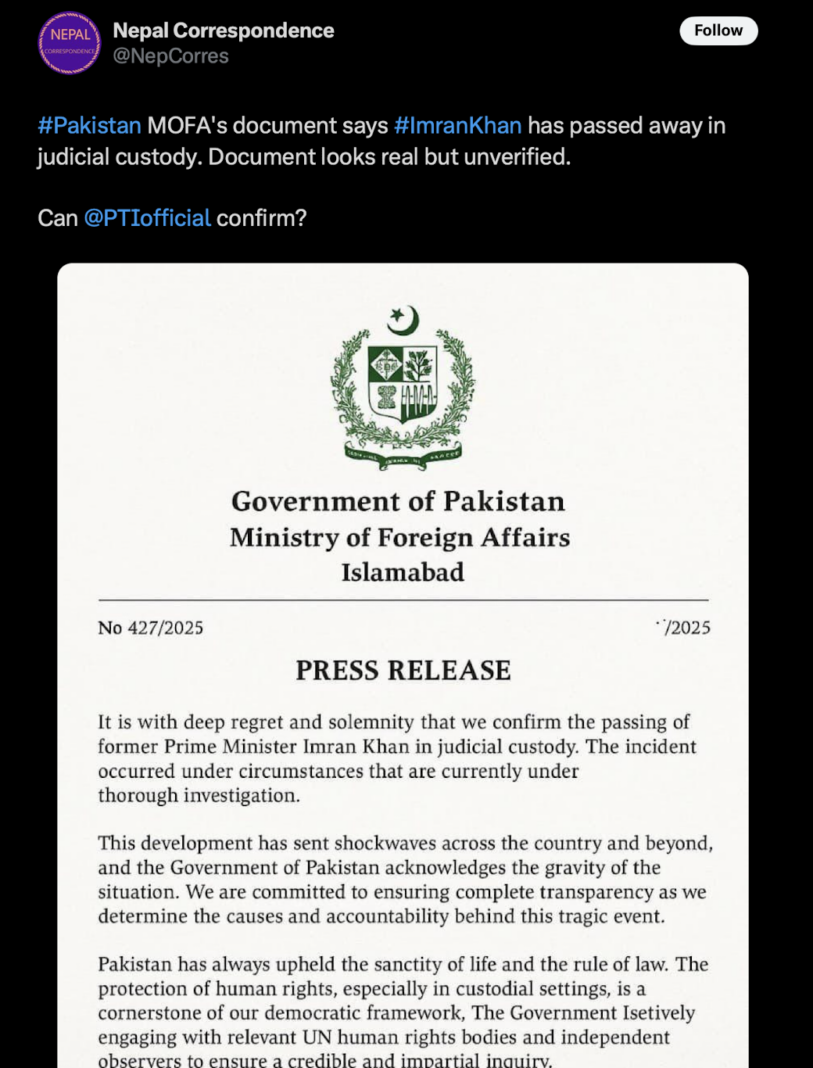
In May 2025, social media was flooded with an image presented as a press release from Pakistan’s Ministry of Foreign Affairs. It claimed that the government had confirmed Khan’s death in judicial custody.
The document, however, contained several signs that raised questions about its authenticity. It did not carry a proper date, despite being marked “No 427/2025”, and contained formatting, punctuation and language mistakes. There was also no confirmation from major Pakistani or international news organisations, the Ministry of Foreign Affairs or the Prime Minister’s Office.
The document was therefore found to be a doctored image rather than a genuine government statement. It came amid other unverified claims about Khan’s treatment in prison, adding to concerns over misinformation surrounding his health and safety.
Claims of assault in jail also turned out to be false
Death rumours were not the only claims surrounding Imran Khan’s time in jail. In May 2025, a purported medical report circulated on social media claiming that Khan had been sexually assaulted in prison.
The document, said to be from Pak Emirates Military Hospital (PEMH), described serious injuries and mentioned tests for HIV, hepatitis and other sexually transmitted infections. It also claimed that Khan’s release depended on clearance from Pakistan’s Chief of Army Staff.
However, the document contained a major inconsistency: it was dated 3rd May, 2025, but had already started circulating online on 2nd May. More importantly, official information indicated that Khan’s medical evaluation had been carried out by doctors at the Pakistan Institute of Medical Sciences (PIMS) in Islamabad, not PEMH.
These discrepancies strongly indicated that the medical report was fake. Khan’s legal team did not issue a public statement confirming sexual assault, and no credible reporting or official statement supported the claim.
The repeated rumours about Imran Khan’s death, health and treatment in jail have continued to spread whenever his family and supporters face difficulties accessing him. The latest claim by Wajahat Saeed Khan has therefore revived an old question around the jailed former prime minister, but until there is confirmation from credible official or independent sources, the claim that Imran Khan has died remains unverified.
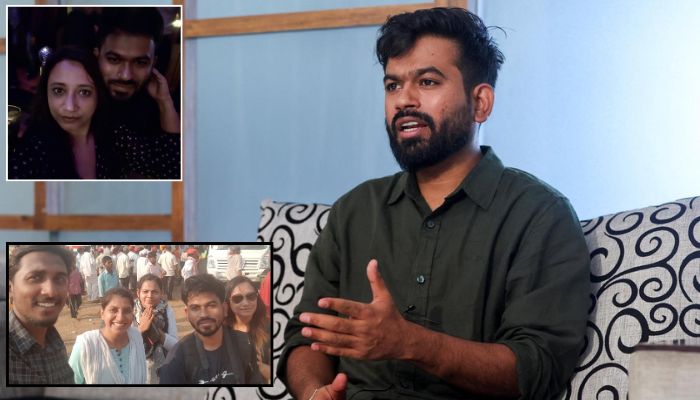
The self-proclaimed neutral student leader who created the Cockroach Janta Party from the US, under the guise of education reform in India over the alleged leak in the NEET examination, has resurfaced with AAP links again, and his lies are no longer hidden. While Dipke has tried hard to project himself as a spontaneous youth icon who simply stumbled into public advocacy out of frustration with the system, digital footprints and viral posts tell a completely different story.
Recent viral social media posts have proven that Dipke was actively associated with the Aam Aadmi Party (AAP) as far back as 2016, and not merely from 2020 to 2023 as he falsely claimed during his televised interview with News24. This revelation blows a massive hole in his narrative of being an independent voice operating without political backing.
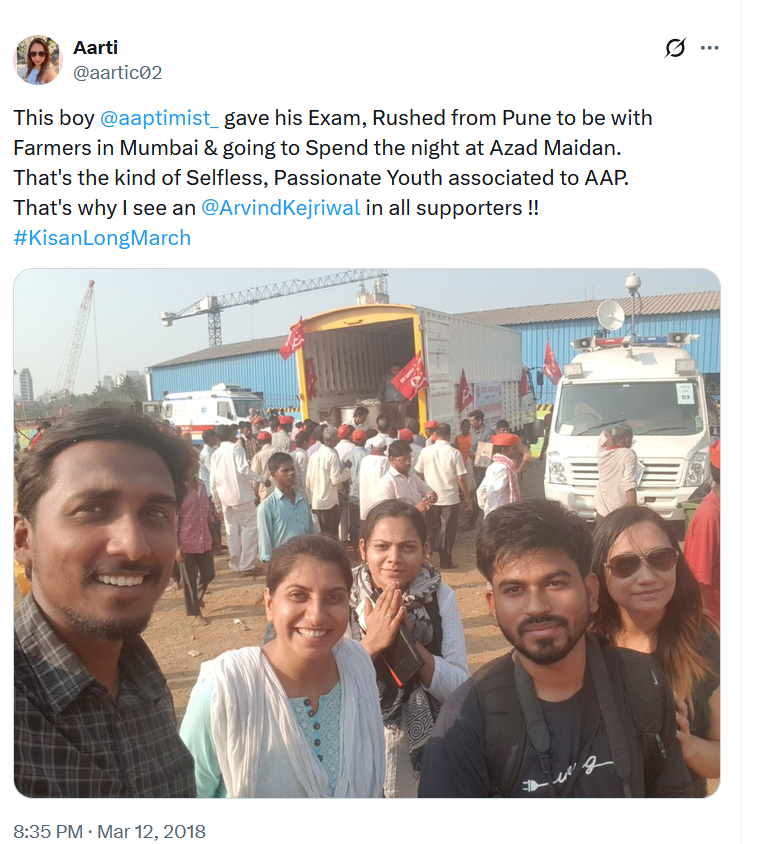
The truth began spilling out when an old 2018 post by Aarti Chadha resurfaced on X (formerly Twitter). The photo of Aarti Chadha and CJP founder Abhijeet Dipke has gone viral, drawing intense attention online. Chadha, who was identified as a key member of AAP’s social media team, had posted a picture with Dipke on 12th March, 2018, explicitly tagging his former handle @aaptimist_, a username he actively maintained until 2020, and which proves his association with AAP without any doubt.
This boy @aaptimist_ gave his Exam, Rushed from Pune to be with Farmers in Mumbai & going to Spend the night at Azad Maidan. That's the kind of Selfless, Passionate Youth associated to AAP. That's why I see an @ArvindKejriwal in all supporters !!#KisanLongMarchpic.twitter.com/NBbsoARDcB
Praising him at the time, Chadha wrote: “This boy @aaptimist_ gave his Exam, Rushed from Pune to be with Farmers in Mumbai & going to Spend the night at Azad Maidan. That’s the kind of Selfless, Passionate Youth associated to AAP. That’s why I see an Arvind Kejriwal in all supporters !!”
Years later, on his birthday in 2024, Chadha tagged his updated handle while warmly acknowledging his crucial role in the party’s online rise: “Happy Birthday Dude @abhijeet_dipke One who worked tirelessly behind the scenes & added the Missing Zing to AAP SM Rise & Shine.” Dipke even replied to her post with a cordial thank you, confirming their long-standing professional bond.
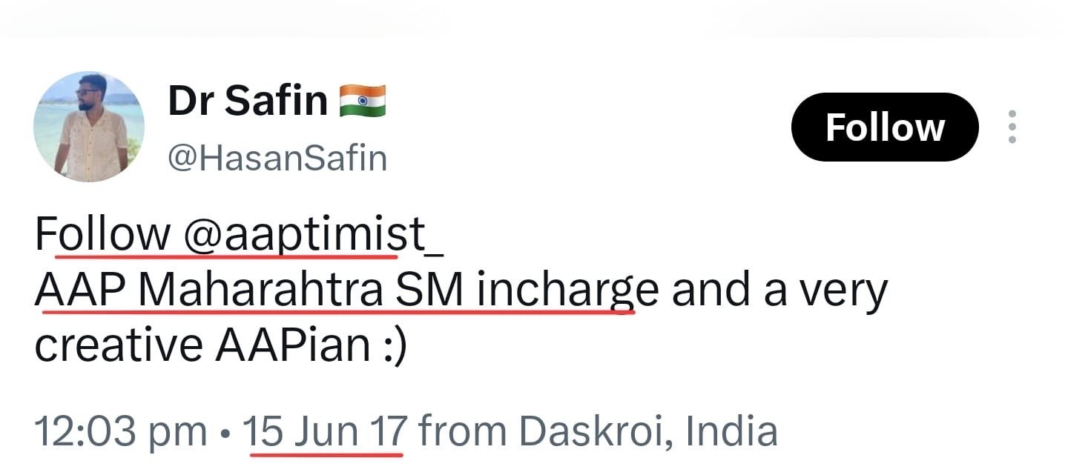
Despite this clear paper trail, Dipke flatly claimed in his News24 interview that his formal association with AAP only spanned from 2020 to 2023. Yet, multiple other AAP insiders have publicly documented his involvement much earlier. On 15th June, 2017, AAP member Hasan Safin openly promoted Dipke’s account, writing: “Follow aaptimist_ AAP Maharashtra SM in-charge and a very creative AAPian.”
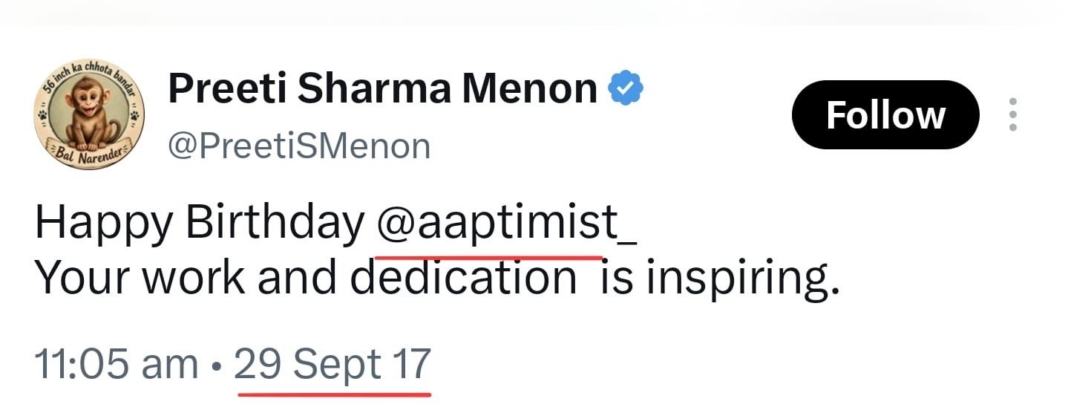
Further establishing his deep-rooted ties, AAP Mumbai President Preeti Sharma Menon publicly wished him on his birthday on 29th September, 2017, directly tagging his @aaptimist_ handle.
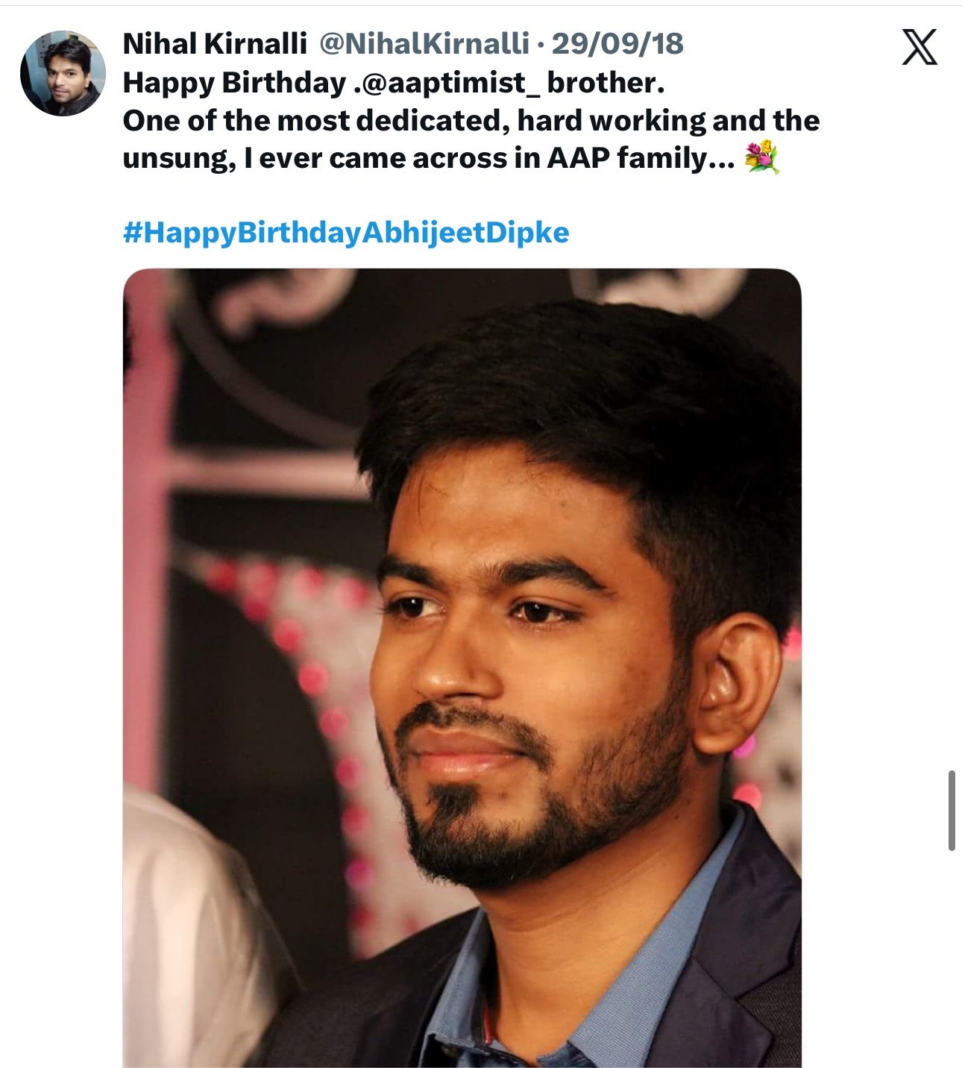
Another party activist, Nihal Kirnalli, posted a photo of Dipke on his birthday in 2018 along with the message: “Happy Birthday, aaptimist_ brother. One of the most dedicated, hardworking and the unsung, I ever came across in the AAP family.”
A history of political warfare and campaign strategy
This is far from the first time Dipke has found himself at the centre of controversy over his direct operational links with AAP. During the 2020 Delhi Assembly elections, media reports identified him as a 23-year-old strategist from Pune operating at the core of AAP’s IT war room under social media head Ankit Lal. He was heavily credited with transforming the party’s digital strategy by crafting catchy one-liners, Bollywood parody videos, and viral memes to project “Brand Kejriwal” while launching sharp attacks on political rivals.
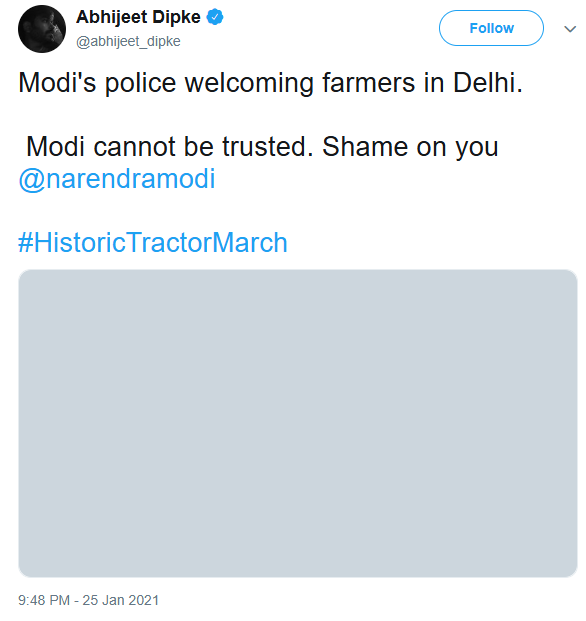
His history reveals a consistent pattern of anti-government messaging. During the violent farm law protests in Delhi, Dipke posted videos of police line movement, tweeting: “Modi’s police welcoming farmers in Delhi. Modi cannot be trusted. Shame on you @narendramodi #HistoricTractorMarch.”
More recently, he began pushing conspiracy theories surrounding election outcomes, alleging without proof that voter deletion was behind opposition defeats, a radical claim that later mysteriously made its way directly into the CJP manifesto, demanding the arrest of the Chief Election Commissioner under UAPA.
From the so-called NEET reforms to anti-National slogans
Armed with a polished background in digital manipulation, this AAP-backed operative managed to orchestrate a massive political movement from thousands of miles away in the US. Dipke emotionally manipulated thousands of honest, stressed students across India, convincing them that the CJP was an independent student uprising fighting solely for NEET paper leak accountability and national education reforms.
However, once thousands of young aspirants gathered at Delhi’s Jantar Mantar, the ground reality quickly degenerated. The protest was rapidly hijacked by far-left student organizations like AISA, AFI, SIMI and JNUSU. Instead of staying focused on exam fairness, speaker after speaker took the microphone to push radical political agendas. Danish Ali, Joint Secretary of JNUSU, addressed the crowd by openly defending individuals jailed under anti-terror laws: “Friends, my name is Danish, and I come from the Centre for Historical Studies. This is the same centre from which our friends Sharjeel Imam and Umar Khalid come. Ask why they have been in jail for so many years. It is because they dared to challenge the ruling government and question those in power.”
The demonstration soon spiralled into chaos, with activists shouting “Azadi” slogans, making inflammatory statements, and, in earlier demonstrations, even harassing women journalists on duty.
The betrayal of India’s youth
Ultimately, the mask has completely fallen off the CJP movement. What was presented to the nation as an organic, youth-led uprising turns out to have been calculated political theatre designed by an experienced party handler operating remotely from the US.
By pulling strings from abroad, lying about his political history, and exploiting the genuine anxieties of NEET candidates, this so-called well-wisher of students created immense public disruption across India.
Thousands of naive students who trusted his “neutral” banner were used as political props, leaving a trail of broken promises, hijacked protests, and exposed falsehoods in his wake.
Despite attempting to erase his footprint and claim neutrality, even Dipke’s current X account retains a telling tweet from 2023, in which he wrote: “Still with AAP and will always be with AAP.” His long-standing political ties demonstrate that the movement was used to serve party interests under the guise of an independent youth uprising.