Home Blog Page 1174

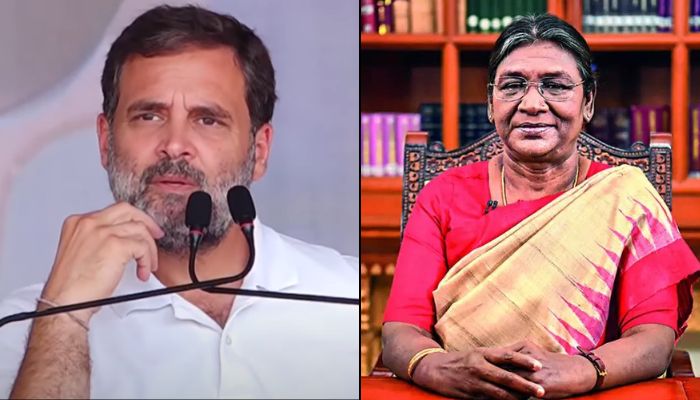
‘President not invited for Ram Mandir inauguration because she is Adivasi’: Congress leader Rahul Gandhi peddles vicious lies during election campaign

On Saturday (13th April), Congress scion Rahul Gandhi courted controversy after he falsely claimed that President Draupadi Murmu was not invited to the Pran Prathistha ceremony of Ram Mandir for virtue of being an Adivasi.

He made the outrageous remarks during a public meeting in Bastar district of Chhattisgarh. At about 34:50 minutes into the event, Rahul Gandhi alleged, “During the inauguration of Ram Mandir, the President of India, who is an Adivasi, was told that she could not come to the programme.”

“They had told her not to come for the Pran Prathistha of the Ram Mandir. Why? Because she is an Adivasi. This is the only reason,” he claimed.

The Congress scion did not stop here and continued to peddle lies. “This is the message that PM Modi gave to the country that we will not let an Adivasi visit Ram Mandir on the occasion of its inauguration. This is their mindset,” he brazened out.

The truth is that President Murmu was formally invited by a delegation representing the Ram Temple Trust to attend the consecration ceremony in Ayodhya.

The invitation was extended on 12th January this year by a delegation comprising Vishva Hindu Parishad (VHP) working president Alok Kumar, Rashtriya Swayamsevak Sangh leader Ram Lal, and Ram Mandir construction committee chairperson Nripendra Mishra.

However, President Murmu had said that she would soon decide the time to visit Ayodhya. In fact, on 21st January, the President hailed the Ram Mandir inauguration ceremony and sent heartfelt wishes to the Prime Minister for making the temple appear into reality.

“The nationwide celebratory atmosphere around the inauguration of the grand temple of Prabhu Shri Ram at Ayodhya Dham is an uninhibited expression of the eternal soul of India. We all are fortunate to witness the commencement of a new cycle in resurgence of our nation,” President Murmu was quoted as saying.

The President also appreciated ‘Maa Shabri’s’ reference made by PM Modi in his address before the inauguration of the Ram Mandir.

Uttarakhand: Kids taught namaz in the name of Eid event at play school, parents and Hindu outfits protest, principal denies accusations

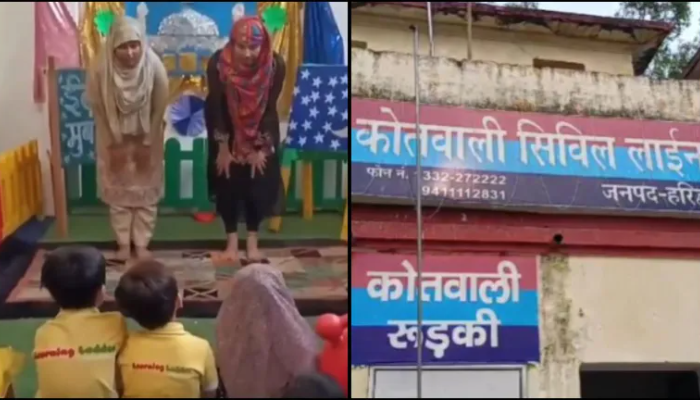
On 10th April, a playschool in Roorkee, Uttarakhand organised an event on Eid al-Fitr where small children were taught how to read namaz, the videos of which became viral on social media. Now, parents of the students have filed a police complaint and accused the institution of coercing the impressionable minds of young kids. However, the school has refuted the allegations.

The matter pertained to the Learning Ladder Play School located in the Civil Lines area in Roorkee. Two female teachers were observed wearing hijabs and offering namaz in front of the little kids in the footage. The Learning Ladder is written on the t-shirts of the pupils witnessed sitting in the clip. A small girl is also donning a hijab in the 14-second video.

After the video came out, several parents contacted the Roorkee police station. Speaking to the media, the parent of a student at the school stated that his daughter had been present when namaz was being taught. He added that they contacted the school administration but they brushed it off as a program. He further asked why his daughter was taught namaz when she was a Hindu. According to him, no such event had been planned in the previous three years, but it happened this time. He informed that he submitted a police report and requested that a case be launched in the matter.

The workers of Bajrang Dal and Vishva Hindu Parishad also protested against the occurrence. A complainant pointed out that the purpose of the school is to educate students, not to convert them. He asserted there was a jihadist conspiracy being supported by the institution. Another person charged that the school is manipulating the kids to perform namaz. OpIndia also spoke to Ruchi Handa, Principal of Learning Ladder School in this matter.

“The school organized an Eid Milan event for Upper KG children on 10th April 2024. The parents were also given this notification beforehand. The kids were not taught namaz but were told about how Eid is celebrated. We conveyed to the youngsters that people who celebrate Eid pray first and then embrace others,” she alleged. The principal claimed that the video from the program was made viral online to highlight the namaz.

She mentioned that the institution had provided a clarification concerning the police complaint and also taken down the footage. She claimed that the school hosts similar occasions regularly to teach the students about diverse festivals from various religions. She promised to be careful in such sensitive matters in the future. OpIndia also talked with the Roodekee police and was informed that a complaint has been received and an investigation is underway.

Government instructs e-commerce platforms to remove drinks and beverages including Bournvita from ‘Health Drink’ category

The Ministry of Commerce and Industry has instructed all e-commerce platforms to remove beverages, such as Bournvita, from the classification of ‘health drink’ on their websites and platforms. This notification was published on 10th April. The instructions issued by the ministry came after the FSSAI, on 2nd April, asked all e-commerce companies to ensure appropriate categorisation of food products sold on their websites.

The FSSAI’s reaction followed observations of food items licensed as ‘proprietary food’, such as Dairy-based Beverage Mix, Cereal-based Beverage Mix, and Malt Based Beverage, being marketed on e-commerce platforms under misleading categories like ‘health drink’ or ‘energy drink’.

The ministry cited a finding by the child rights body National Commission for Protection of Child Rights that there is no beverage category called Health Drink under the rules.

The statement by the ministry said, “National Commission for Protection of Child Rights, a statutory body constituted under section (3) of the Commission for Protection of Child Rights (CPCR) Act, 2005 after its inquiry under Section 14 of CPCR Act, 2005, concluded that there is no “Health Drink defined under FSS Act 2006, Rules and regulations as submitted by FSSAl and Mondelez India Food Pvt Ltd.”

It added, “Therefore, FSSAI has advised all e-commerce companies to promptly rectify this misclassification by removing or de-linking such drinks or beverages from the category of ‘health drinks/energy drinks’ on their websites and placing such products in the appropriate category as provided under the extant law.”

The statement further said, “Proprietary foods are items of food that are not standardised in food safety and standards (food product standards and food additives) regulations and food safety and standards (health supplements, nutraceuticals, food for special dietary use, food for special medical purpose, functional food, and novel food) regulations, but use standardised ingredients.”

The ministry made it clear that the corrective measures aim to improve clarity and transparency regarding the characteristics and functional attributes of the products. This ensures that consumers can make informed decisions without being misled by inaccurate information.

Asking e-commerce websites not to put dairy, cereal or malt-based beverages under the Health Drink’ or Energy Drink’ category, the FSSAI on 2nd April said that the term ‘Health Drink’ has not been defined in the food laws of India. On the other hand, the term ‘Energy Drinks’ is allowed to be used only for the products licensed under the Food Category System (FCS) and the carbonated and non-carbonated water-based flavoured drinks.

Australia: At least five killed after mass stabbing in a Sydney mall, multiple victims, including a 9-month baby, in critical condition; attacker shot dead

At least Five people have been brutally killed while multiple victims are said to be in critical condition after a horrifying incident of mass stabbing in a mall in Sydney, Australia. According to the latest information, the attacker too has been shot dead by the police. In the afternoon hours (Indian Standard Time), the incident took place at a Westfield shopping centre at Bondi junction n Sydney. 

Shocking footage has emerged on social media in which the crowd can be seen fleeing in panic and terror to save their lives.

As per reports, the mass stabbing incident unfolded at 3.20 pm (local time) on Saturday afternoon (13th April) when a man in an NRL jersey began stabbing shoppers at random, including a woman and her nine-month-old baby. He attacked as many as nine people, before a police officer shot him, police assistant commissioner, Anthony Cooke told reporters. The police said that hundreds of people were evacuated from the shopping centre after the incident and the police advised people not to go there.

According to the Guardian, at a press conference, Cooke confirmed that the attacker was shot dead by a nearby police officer who was on her own.

The officer said, “She confronted the offender who had moved by this stage to level five [of the mall] as she continued to walk quickly behind him to catch up with him. He turned, faced her, and raised a knife. She discharged a firearm and that person is now deceased.” 

Cooke added that the suspect acted alone and there was “no continuing threat.” He said that officials didn’t know who the offender was yet, and there was no indication of motivation.

He added, “I’m advised that there are five victims who are now deceased as a result of the actions of this offender.”

Describing the incident as ‘devastating’, the Australian PM Anthony Albanese tweeted, “ I have been briefed by the AFP on the devastating events at Bondi Junction. Tragically, multiple casualties have been reported and the first thoughts of all Australians are with those affected and their loved ones.”

Australian PM added, “Our hearts go out to those injured and we offer our thanks to those caring for them as well as our brave police and first responders.”

Crowdfunding collects Rs 34 crore “blood money” in 4 days to save Kerala native Abdul Rahim, convicted of killing a 15 years old, from death penalty in Saudi Arabia

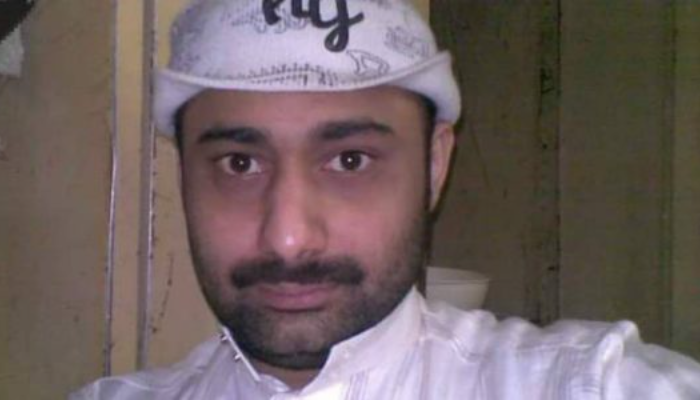
People from Kerala came together to raise a staggering 34 crore in solidarity to save Abdul Rahim who was given a death sentence in Saudi Arabia. Kozhikode native Abdul Rahim has been imprisoned in Saudi Arabia for 18 years, after he was accused of killing a 15-year-old youngster in Riyadh in 2006. The young boy, who was under the man’s care and on a life support system, passed away while he was being driven by Rahim.

The minor ate and breathed through a special device that was fastened to his neck. Abdul Rahim claimed that he inadvertently dislocated the instrument while trying to calm down the adolescent who sat in the back seat. The teenager was apparently creating a fuss and demanding that the former run a red light on the street. The teenager fainted due to lack of oxygen and by the time the driver rushed him to the hospital, he had already died.

A court in Saudi Arabia sentenced Abdul Rahim to death and the nation’s highest court maintained the ruling. He was sentenced in 2012 and although there were appeals against the decision, the death penalty was upheld twice, in 2017, and also in 2022. Later, the deceased’s family stated that they would be willing to forgive Rahim in exchange for blood money worth 15 million Saudi riyals (around INR 34 crore). The deadline set by the mediators to pay the compensation and spare Abdul Rahim from the death penalty was 16th April.

The action group that was established to work toward Rahim’s release was only able to raise Rs 5 crores until five days ago, but as the campaign gained traction, support from Keralites all over the world began to flood in. The members of the action committee informed the media that although the highest courts had dismissed the appeals, the teenager’s family had subsequently agreed to pardon Rahim provided he paid the “blood money.” A member of the action group mentioned, “More than 75 organisations in Riyadh, Kerala-based businessman Bobby Chemmannur, various political organisations in the state and the common people all helped us to raise the money.”

“We have reached the goal of ₹34 crore needed to secure his release. Please do not send us any more money. We have raised Rs 34.45 crore, and the excess funds will be audited and used for a good cause. The global Malayali community has once again done its magic and joined hands irrespective of our political, caste and religious differences. This is the real story of Kerala,” noted trust member Ashraf Vengat.

Abdul Rahim’s mother Pathu claimed she never imagined that amount could be raised. “I had no hope as we have no means to raise Rs 34 crore. But somehow it was all made possible.”

Residents of his neighbourhood in Kozhikode established an action group during the last week of March with the goal of gathering the sum. They also released an app called ‘Save Abdul Rahim’ to facilitate crowdfunding.

The crowdfunding campaign garnered Rs 5 crore till last week. Then, when the call to rescue Abdul Rahim gained momentum on social media, many well-known people, prominent lawmakers and NRI organisations joined the cause. A yatra from Thiruvananthapuram in south Kerala to Kasaragod in the north was initiated by businessman Boby Chemmanur, chairman of the Boby Group of Companies, to generate one crore rupees. The action committee managed to raise the necessary Rs 34 crore by combining this donation with all other global contributions. Bobby Chemmanur also arranged several fund-raising events in the last several days. Furthermore, he planned the sale of one of his products and gave the full proceeds to the charity.

“Blood money” or “diya” in Arabic, is if someone makes a payment to the family of someone who has been killed, they pay that person’s family a sum of money as compensation, it is highly prevalent in Arabic countries. It is a monetary settlement decided upon by the court using Sharia law or negotiated by the parties involved. The Abdul Rahim Legal Assistance Committee is going to deposit the funds in a Saudi court by 15th April and anticipate Abdul Rahim’s release shortly after.

Abdul Rahim was 26-year-old at the time when he went to Saudi Arabia in 2006 to work as a driver for a family. Afterwards, the family gave him the responsibility of care-giving for their 15-year-old paraplegic son who required artificial breathing assistance. The boy died on 24th December of the same year. The incident occurred merely 28 days following Abdul Rahim’s arrival in the country and he has been incarcerated since then.

Rameshwaram cafe blast mastermind Abdul and bomber Mussavir used fake Hindu identities while on the run, were planning the next attack

After evading arrest by NIA for 42 days, the Rameshwaram cafe blast mastermind Abdul Matheen Tahaa and bomber Mussavir Hussain Shazib were nabbed from their hideout in West Bengal on Friday (12th April 2024). As per reports citing intelligence sources, the anti-terror agency tracked the pattern that the terrorist duo had been following for 42 days which ultimately led to their arrest from West Bengal’s Digha. 

Incidentally, in a clandestine move, the arrested terrorists had been using fake Hindu aliases to make logistical arrangements. Maintaining a low profile following the explosion, the Bengaluru cafe blast accused only stayed at low-cost hideouts like guesthouses and private lodges where verification is not strict. While on the run, they opted for road travel, paid in cash, used mobile phones for very short durations, and visited crowded tourist places to escape scrutiny. As per sources, parallelly they were also looking out for the “next target”. 

The intel sources said, “The interesting part is there was no desperation for money and the amount received was also not huge. They wanted things to settle down and were also on the lookout for the next target during these 42 days.” 

The officials said that Shazib had placed the Improvised Explosive Device (IED) at the cafe and Tahaa was the mastermind behind the planning and execution of the blast.

Repeat of earlier terror modules: The arrested terrorists used fake identities, predominantly of Hindus

Intelligence sources added, “Nothing was planned after the blast. They decided everything on the spot and kept moving to avoid being apprehended. Their longest stay was at a Digha lodge which was a possible mistake. They used all identities, including of Maharashtra domicile, Jharkhand, Karnataka, and Tripura. They ensured different fake IDs for all hotels and lodges, including surnames like Patel, Das, and Agarwal according to the demography of the place.” 

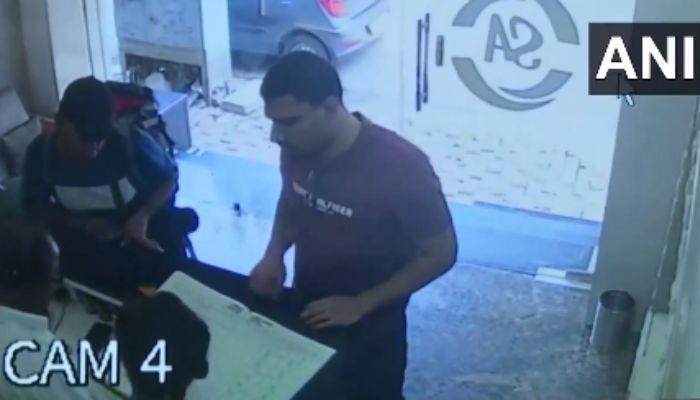
A day after their arrest, new CCTV footage surfaced on social media in which both the terrorists can be seen checking into a guest house which is reportedly located in Kolkata’s Ekbalpur. As per reports, Shazib and Tahaa checked into this guest house on 25th March and stayed there for three days. They had told the hotel staff that they were tourists, hailing from Karnataka and Maharashtra.

Tahaa, the mastermind of the Bengaluru blast, had used fake Hindu names as aliases at various locations for accommodation. It is pertinent to note that the agency had released “wanted posters” for the terrorist noting that “he has been using hindu identity documents, forging names such as Vignesh or other similar forged ID documents”. 

During the absconding period, they had stayed at a lodge in New Digha for the past four days and had switched several locations in Bengal.

The Bengaluru blast bomber, Shazib had used a fake Aadhaar card of one Yusha Shahnawaz Patel from Maharashtra’s Palghar at the two Kolkata hotels. Likewise, Tahaa used fake Hindu aliases Vignesh BD from Karnataka at one hotel and Anmol Kulkarni in another.

According to a Times of India report, at another hotel, they used the identities of Hindu men namely Sanjay Agarwal and Uday Das, hailing from Jharkhand and Tripura respectively.

Linked with other ISIS modules

Following their arrest, the special NIA court gave the agency a three-day transit remand of the arrested terrorists. While presenting them before the court, the agency stated that they seized some electronic gadgets and about 70 articles from the arrested duo. 

Both the terrorists are residents of Thirthahalli in Karnataka’s Shivamogga district and are linked to the 2022 Mangaluru pressure cooker blast. While Tahaa is an IT engineer, Shazib is an accused in the Islamic State’s (IS) Shivamogga-based module.

The intel sources said, “They are close friends of Mohammad Shariq, who was involved in the Mangaluru blast. They may have been planning to make one big IED and carry out a major blast. Their handler is foreign-based, who is hiding and funding them.” 

OpIndia had earlier reported that according to intelligence sources, Rameshwaram cafe blast accused used the cryptocurrency route to finance the operation. 

As per reports, Shazib, Tahaa, and another suspect — Shareef — all associated with ISIS modules, were also involved in the Shivamogga graffiti case as well as the Mangaluru cooker blast case reported in November 2023. Tahaa is said to be linked with the Al Hind module case in 2020 as well.

Earlier, the NIA had declared rewards of Rs 10 lakh on information leading to the arrest of each person on the run on 29th March. Various state police agencies including those of Uttar Pradesh, Kerala, Telangana, West Bengal, and Karnataka assisted the NIA in apprehending the duo. 

As per India Today report, mastermind Tahaa is suspected to be one of the “high-value assets” of the Islamic State terrorist group in India. For NIA, he has been a wanted terrorist for the past five years. He maintained direct communication with an individual identified as a ‘colonel,’ whose name has emerged in numerous cases spanning South and Central India. 

NIA officials intend to interrogate Tahaa and Mussavir Hussain Shazib regarding the ‘colonel’s’ identity, the frequency of their meetings with him, methods of payment for terrorist activities, and their future intentions. 

According to sources speaking to India Today TV, following the cafe explosion, Tahaa devised an escape plan for himself from Tamil Nadu and one for Mussavir Hussain from Bengaluru.

Muzammil Shareef, who was arrested two weeks ago, was told by Tahaa to gather materials for the IED and assemble it before placing it in the cafe. Tahaa spent over a week scouting the cafe to find its weak spots. He also made plans for how the bomber could enter and exit the hotel and the city.

Nation-wide manhunt for 42 days and how NIA tracked down the terrorists in their hideout in West Bengal

Following the low-intensity IED blast in Bengaluru’s Rameshwaram cafe, the investigators found the first clue in the form of CCTV footage of Shazib leaving a bag that contained the IED device near the restaurant’s cash counter. On tracking his movements, the officers learned that he boarded a Bangalore Metropolitan Transport Corporation(BMTC) bus that took him outside of the city limits and then again in a Karnataka state government bus in Tumakuru.

He was next spotted at a bus stand in Ballari where he was seen speaking to two other persons. 

An NIA officer said, “Two unreserved seats were occupied by individuals who alighted at the Ram mandir circle and central bus stand in Kalaburgi late on March 1.” 

According to NIA officials, another clue discovered by investigators was a cap left behind by Shazib. Their investigation revealed that it was purchased from a mall in Chennai. The NIA officers stated that this detail helped establish a connection between Shazib and Taha. Additionally, they found that the two had stayed in Tamil Nadu in January and February while preparing for the blast, as one officer added.

According to the Hindustan Times report, the officer said that the central agency was able to trace the movements of the two accused from Bengaluru to north Karnataka, to Mumbai, and then to Ratnagiri in Maharashtra.

The officer said, “It appears from there they went to Nellore in Andhra Pradesh and then to Chennai. After staying in Chennai for a few days, they went to Assam and finally reached West Bengal a few days ago.” 

Investigations also revealed that the two men rented a room at Hotel Paradise in Lenin Sarani in central Kolkata on 13th March. From there, they checked out the next day. They had used fake documents of men named Y Shahnawaz Patel and Anmol Kulkarni. 

On 26th March, the NIA carried out raids at 18 locations across three states. During these raids, they arrested Muzammil Shareef, who has since been charged with helping with logistics. 

17 days later on 12th April, at around 2 am, Shazib and Tahaa were arrested by the NIA officials in a joint operation with the West Bengal Police.


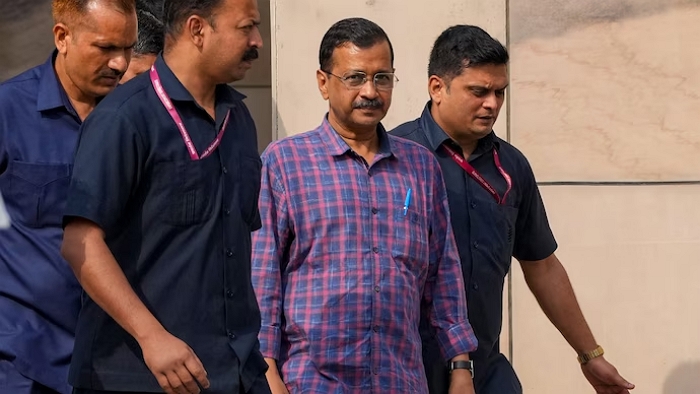
Supreme Court to hear Arvind Kejriwal’s petition against his arrest in Delhi excise policy scam case on 15 April

0

The Supreme Court will hear on April 15 the plea of Delhi Chief Minister Arvind Kejriwal challenging his arrest by the Directorate of Enforcement (ED) and his subsequent remand in the excise policy case.

A bench of Justices Sanjiv Khanna and Dipankar Datta will hear the matter.

Aam Aadmi Party (AAP) leader Kejriwal approached the Supreme Court challenging a Delhi High Court judgement that dismissed his plea against arrest by the ED and his subsequent remand in the excise policy case.

While filing an appeal in the apex court, he contended that his arrest after the announcement of the general elections was “motivated by extraneous considerations.”

The appeal stated that the sitting Chief Minister had been arrested in a “motivated manner” in the middle of the election cycle, especially after the declaration of the schedule of the Lok Sabha election in 2024.

On April 9, the High Court dismissed his plea for release from jail and rejected his argument of political vendetta amid the looming Lok Sabha elections.

The High Court had said that Kejriwal’s absence from nine ED summons over six months undermined any claims of special privilege as Chief Minister, suggesting his arrest was an inevitable consequence of his non-cooperation.

Seeking urgent intervention from the Supreme Court, the Chief Minister’s appeal stated, that it is an issue of illegal curtailment of Kejriwal’s liberty.

Kejriwal’s arrest also constitutes an “unprecedented assault on the tenets of democracy” based on “free and fair elections” and “federalism,” both of which form significant constituents of the basic structure of the Constitution, the appeal further stated.

The petition, while seeking the release of the Delhi Chief Minister from jail, said the ED has “allowed its process to be used and misused by vested interests” as an instrument of oppression to not only “invade the liberty of the political opponents” in the midst of general election, 2024 of such vested interests but also “to tarnish their reputation and self-esteem.”

Such lawlessness cannot be allowed to be perpetrated under any circumstances, it said while urging the apex court to declare Kejriwal’s arrest illegal.

“The petitioner’s arrest, therefore, bears serious, irreversible ramifications for the future of electoral democracy in India, for if the petitioner is not released forthwith to participate in the upcoming elections, it will establish a precedence in law for ruling parties to arrest heads of political opposition on flimsy and vexatious charges before elections, thereby eroding the core principles of our Constitution,” the petition stated.

Filing the appeal against the High Court judgement, Kejriwal said that there is no material in the possession of the Enforcement Directorate on the basis of which an inference of guilt can be made under Section 19 of the Prevention of Money Laundering Act (PMLA).

“Moreover, the circumstances and chronology of events clearly show that there was no necessity to arrest the petitioner (Kejriwal),” it added.

The arrest was made solely based on the subsequent, contradictory, and highly belated statements of co-accused who have now turned approvers, the appeal stated.

An appeal against the High Court order stated, “Moreover, such statements and material were in possession of the Enforcement Directorate for the last nine months and still the arrest has been made illegally in the middle of the 2024 general election.”

These statements relied upon in the grounds of arrest were recorded by the ED from December 7, 2022, until July 27, 2023, and subsequently no further material has been collected against Kejriwal, it stated.

“There was no legal or factual basis for “reason to believe” or “material in possession” to consider the petitioner “guilty” for effecting an arrest. Obviously, there was no necessity for the arrest on March 21, 2024, based on this “material,” as stated in the appeal.

Also, no statement was recorded before the arrest on March 21, 2024, to seek any explanation about this old material, before deciding on the requirements of Section 19 of the PMLA, it added.

Kejriwal was arrested by ED on March 21 in connection with a money laundering probe relating to alleged irregularities in the now-cancelled Delhi excise policy 2021-22.


This news report is published from a syndicated feed. Except for the headline, the content has not been written or edited by OpIndia staff)

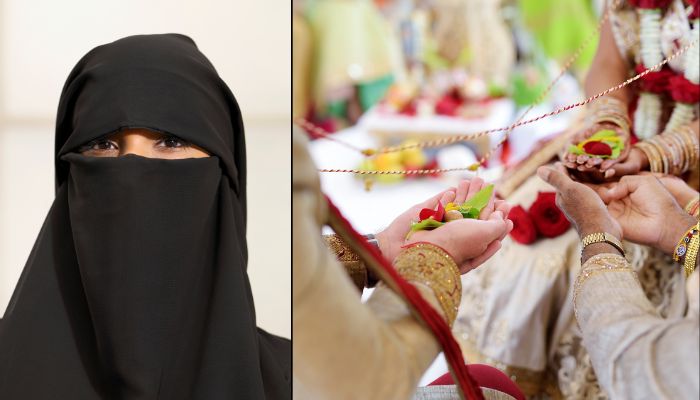
Uttar Pradesh: Shehzadi pretends to be ‘Naina Verma’ to entrap Hindu man in Meerut, forces him to convert to Islam and circumcises minor step-son

A Hindu man named Vipin Verma has filed a police complaint against his wife Shehzadi, who entrapped him into her love trap by pretending to be a Hindu woman. The incident took place in Meerut city of Uttar Pradesh.

As per reports, Shehzadi forged documents and assumed the identity of ‘Naina Verma’ before getting married to Vipin. According to the victim, she had forcibly circumcised his 10-year-old son during a trip to Saharanpur.

Vipin has informed that Shehzadi also coerced him and his three children (from a previous marriage with a woman named Komal Verma) to offer Namaz and convert to Islam. He was given custody of the children after his divorce from his first wife in 2022.

Vipin said that Shehzadi’s behaviour with his children was not good from the start of their marriage. He added that the Muslim woman passed off as Hindu by forging documents.

He informed the police that she forcibly circumcised his underage son with the help of her sister Rani. According to Vipin, Shehzadi also burnt the skin of his child by pouring hot water.

The victim further added that he was held hostage and thrashed by 3-4 men during his visit to Saharanpur. He narrowly escaped from the hostage situation and filed a complaint with the police.

FIR registered against Shehzadi and her accomplices

Based on the complaint of Vipin Verma, a First Information Report (FIR) was registered against Shehzadi, her sister Rani and 4 other unknown people for fraud.

They were also booked under relevant provisions of the Uttar Pradesh Prohibition of Unlawful Conversion of Religion Act, 2021. While speaking about the matter, SP Ayush Vikram Singh stated that the accused would be arrested soon.

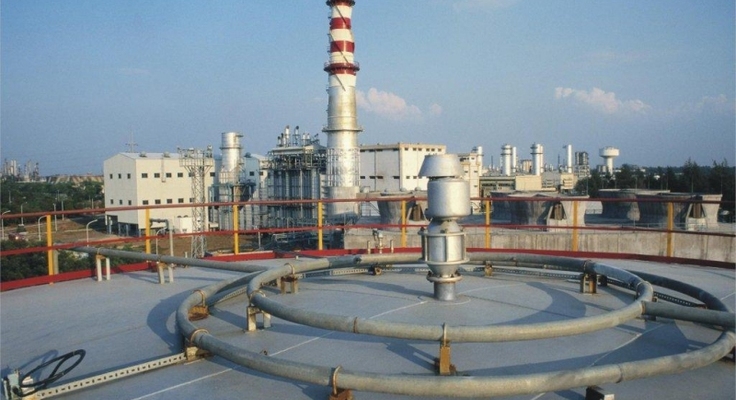
Power ministry issues order to operationalise all gas-based power plants to meet increased electricity demand during summer

In order to help meet the high electricity demand in the country during the summer season, the Government of India has decided to operationalize the gas-based power plants in the country. To ensure maximum power generation from Gas-Based Generating Stations, the Government has issued directions to all Gas-Based Generating Stations under Section 11 of the Electricity Act, 2003, said a statement issued by the power ministry.

Under Section 11 of the Electricity Act, 2003, the appropriate government may specify that a generating company shall, in extraordinary circumstances operate and maintain any generating station in accordance with the directions of that Government.

The order under Section 11, which is on similar lines as done for imported-coal-based power plants, aims to optimise the availability of power from Gas-Based Generating Stations during the ensuing high demand period. The order shall remain valid for the generation and supply of power from May 1, 2024, to June 30, 2024.

The decision has been taken in view of the Indian Meteorological Department (IMO) predicting above-normal maximum temperatures over most parts of the country during the 2024 hot weather season till June 2024.

As per the ministry, a significant portion of the Gas-Based Generating Stations is currently unutilized, primarily due to commercial considerations. At present, 85% of demand during non-solar hours is being met through coal and lignite generation. “It is necessary to ensure that the operational capacity of the Gas-Based Generating Stations (GBSs) is utilized during the crunch period to optimise the availability of power during ensuing high demand period,” said the order issued by the ministry.

As per the arrangement, GRID-INDIA will inform the Gas-based Generating Stations in advance, of the number of days for which Gas-based power is required. Gas-Based Generating Stations holding Power Purchase Agreements (PPAs) with Distribution Licensees shall first offer their power to PPA holders. If the power offered is not utilised by any PPA holder, any other Distribution Licensee may schedule such capacity.

If no Distribution Licensee schedules the power, the Gas-Based Generating Station shall then offer such power in the power market. Any surplus capacity shall be made available to GRID-INDIA to provide grid support.

A high-level committee headed by Chairperson of the Central Electricity Authority has been constituted to facilitate the implementation of this direction.

The decision to operationalize gas-based generating stations is part of a series of measures taken by the Government of India, to ensure that the electricity demand in the summer season is met. The Union Minister for Power and New & Renewable Energy Shri R. K. Singh held a series of meetings on this, emphasizing the need for ensuring adequate availability of power to meet the load during the hot-weather season.

Apart from operationalising gas-based power stations, the government has also taken several other steps to meet the increased demand for electricity during the summer. This includes:

  • Planned Maintenance of Power Plants to be shifted to Monsoon Season.
  • New Capacity Additions to be Speeded up.
  • Partial Outages of Thermal Power Plants being brought down.
  • Surplus Power with Captive Generating Stations to be Utilized.
  • Surplus Power to be offered for sale in Energy Exchange.
  • Section 11 Directions for Imported-Coal-Based Power Plants, to make full capacity available for generation.
  • Shifting of hydro power generation to peak hours.
  • Advance planning by all stakeholders to ensure coal availability.

India’s electricity demand has been rising rapidly, driven by economic growth, particularly during hot-weather and high-demand periods. The Indian Meteorological Department (IMD) has predicted above-normal maximum temperatures over most parts of the country during the 2024 hot weather season. The above measures are being taken in this context, in anticipation of the high electricity demand during the season.

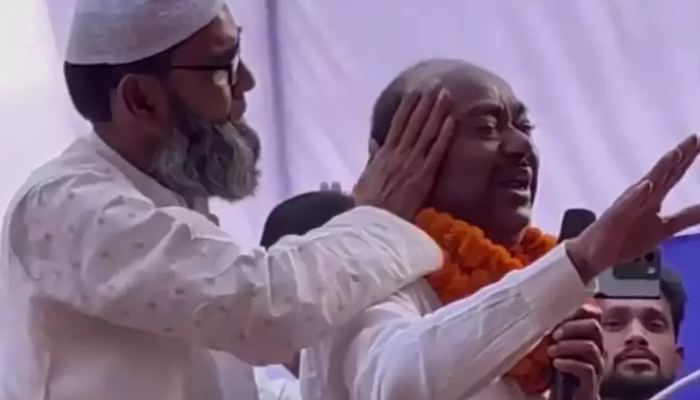
‘Muslims not bonded labours of RJD, won’t tolerate Nazi attitude’: RJD leader Sarfaraz Alam slams Lalu and Tejashwi after party gives his ticket to his younger brother

Former Rashtriya Janata Dal (RJD) MP Sarfaraz Alam got emotional and broke down in tears after the party cancelled his ticket and replaced him with his younger brother Mohammed Shahnawaz Alam as Lok Sabha candidate from Araria constituency in Bihar. On 12th April, he was holding a meeting with supporters in Araria during an Eid Milan event organised by him. He also remembered his late father who was the ex-Union Minister of State for Home Affairs, Mohammed Taslimuddin. He also lashed out at the party president Lalu Prasad Yadav and his son Tejashwi Yadav.

The politician was seen in tears as people around him tried to pacify him. He claimed that Muslims in Bihar, particularly in the Seemanchal region are not RJD’s bonded labour. Muslims have historically been a voting bloc for the party. The current party candidate, according to him is a kind leader. However, he declared that he is the son of Seemanchal’s Gandhi Taslimuddin and flattery and sycophancy are absent in his DNA.

He voiced that the Muslims of Seemanchal will not tolerate the Nazi attitude of Tejashwi Yadav. He charged that they (RJD leadership) solely offered tickets to their family members and then sold the rest. He complained that not only had RJD deceived him, but also stabbed a knife in his back.

Sarfaraz Alam noted that RJD is acting as the Bharatiya Janata Party’s B team because they are afraid of the Central Bureau Of Investigation (CBI) and the Enforcement Directorate (ED). “My tone was devoid of fawning. What was my fault more than this,” he asked and added, “I don’t do politics by selling my conscience.” He took the opinion of his supporters about contesting the Lok Sabha election. The RJD has nominated his sibling and Jokihat MLA Mohammed Shahnawaz Alam as I.N.D.I Alliance candidate from Araria state which has infuriated Sarfaraz Alam and he lambasted Lalu Prasad Yadav and Tejashwi Yadav.

Sarfaraz Alam is the subject of multiple criminal cases in several areas including Araria. He came into the limelight for misbehaving with a couple in Rajdhani Express while being an MLA from Janata Dal-United. He was also arrested later. His younger brother, according to the locals, is completely different from him and was given the ticket for this reason only. The miffed politician slammed Lalu Prasad Yadav and accused him of selling tickets for the poll.

Meanwhile, former RJD MP Ahmad Ashfaque Karim has also quit the party and accused Lalu Prasad Yadav of oppressing the Muslims. He was also angry about not receiving a ticket from the Katihar constituency. He is expected to join JDU soon.