Wednesday, April 1, 2026
Home Blog Page 141

Death toll in Vaishno Devi landslide reaches 32, rescue operations underway as several people feared trapped under the debris

0

Incessant torrential rains in Jammu and Kashmir triggered a massive landslide at Ardhkuwari cave temple near the Vaishno Devi shrine on Tuesday (26th August), resulting in the death of at least 32 people and leaving around 20 injured. The landslide occurred at Indraprastha Bhojanalaya at the Ardhkuwari cave temple on the Vaishno Devi shrine route.

In view of the alarming weather conditions, the Shri Mata Vaishno Devi Shrine Board has halted the yatra and advised the pilgrims to replan their journey after the weather conditions improve.

Frightening visuals have been emerging from the site of the landslide as the rescue operations are underway. Many people are feared trapped under the debris. Teams of the local administration, Central Reserve Police Force (CRPF) and the National Disaster Response Force (NDRF) are engaged in the rescue operations.

Images via X/AIRNewsHindi

The landslide occurred near Ardhkuwari, approximately 12 km from Trikuta Hill, at around 3:00 pm on Tuesday. Huge boulders and debris fell from the hill on the track, destroying the tin sheds and metal railings.

The Shri Mata Vaishno Devi Shrine Board issued Helpline numbers for inquiring about the situation and missing people.

Prime Minister Narendra Modi expressed condolences over the tragic incident, calling it saddening. He said that the administration is assisting all those affected.

Ceaseless downpours have caused massive devastation across the mountainous state of J&K, causing flash floods and landslides. Critical infrastructure in the state has been severely hit, with roads being washed away, bridges collapsing, and communication and power supply being cut off. Around 35,00 residents were reportedly evacuated till Tuesday after consistent rains and cloudbursts.

As per the authorities, 20 to 30 low-lying areas, including those in Jammu and Samba, have been submerged by flash floods. Besides, Jammu city, RS Pura, Samba, Akhnoor, Nagrota, Kot Bhalwal, Bishnah, Vijaypur, Purmandal, and parts of Kathua and Udhampur have been the worst affected. Continuous but lighter rains have been falling in Reasi, Ramban, Doda, Billawar, Katra, Ramnagar, Hiranagar, Gool, Banihal, and nearby parts of Samba and Kathua districts.

TheWire and Newslaundry peddle misleading claims about SIR in Bihar, get factchecked by ECI

On 26th August, the Chief Electoral Officer of Bihar fact-checked misleading reports published by leftist propaganda outlets The Wire and Newslaundry regarding the Special Intensive Revision (SIR). The Bihar CEO not only gave a pointwise rebuttal, but also raised questions over the credibility of these propaganda outlets cherry-picking data to malign ECI’s reputation and lend credence to the opposition’s anti-ECI campaign.

In its ‘ground report’ published on 25th August, The Wire claimed that the ECI’s verification methods for SIR were questionable. The leftist propaganda outlet claimed had that in five constituencies, 1,50,000 voters are clustered around just 1200-1,300 households. Citing its interaction with locals, The Wire claimed that the supposed ‘unusually’ high voter registration indicates that in many cases, the majority of those listed at a given address were actually living elsewhere. The report claimed that there were 14 cases wherein “a few dozens to several hundred names registered at a single address.”

The Wire report says that in many cases, 200 to 389 voters are registered a single address. It alleged that voter clustering is taking place in East Champaran, Bishunpur, Katihar and other areas.

Alleging supposed ‘irregularities’, The Wire asserted the Election Commission did not conduct a house-to-house verification of voters. Moreover, The Wire claimed that in many in cases locals said that they could not recognise certain voters who were registered in their area. It used unfamiliar names and supposedly incorrect addresses argument to cast aspersions on the integrity of the Election Commission and transparency of the SIR exercise.

Chief Electoral Officer of Bihar factchecks The Wire’s propaganda

Refuting The Wire’s propaganda, the Bihar CEO first detailed the scope of SIR in an X post on 26th August, and said that verification of 7.89 crore voters was conducted house-to-house by booth level officers. The CEO added that documents of 99.11 percent of the 7.24 crore electors have already been received.

“1. Scope and Procedure of Special Intensive Revision (SIR): In Bihar, during the Special Intensive Revision period, verification of 7.89 crore voters was conducted house-to-house by booth level officers. As of the Draft list published on August 1, documents of 99.11 percent of the 7.24 crore electors have already been received, and verification is ongoing in the remaining cases. Therefore, the claim that “house-to-house verification was not done in the Special Intensive Revision” is beyond facts and fabricated,” the Bihar CEO said.

Addressing The Wire’s ‘voter clustering’ claims, the Bihar CEO said that the leftist propaganda outlet’s claims are false. The CEO said that in rural and semi-urban areas of Bihar multiple families live at the same address. The absence of land or house number in revenue records, the CEO said, is matter of local socio-geographical reality and not any ‘irregularity’.

“2. The Claim of Voter Clustering is Incorrect: In rural and semi-urban areas of Bihar, multiple families live at the same address under the same house number / same account (Khata Number) / tola / mohalla. Due to the absence of land or house number in revenue records, sometimes hundreds of voters appear registered at the “same address.” This is a local socio-geographical reality, not any kind of irregularity. Therefore, considering clustering as “irregularity” based solely on data is misleading and beyond facts,” the Bihar CEO said.

Regarding The Wire’s assertion that since some locals do not recognise certain voters registered in their area, or notice unfamiliar names, the Bihar CEO said that these are not essentially fraudulent voters as The Wire tried to insinuate, rather, these are students, migrants workers or tenants. Regarding incorrect addresses, the Election Commission official said that during claim objection period, the BLOs did necessary deletion and correction.

 3.“So-Called Incorrect Addresses and Unfamiliar Names: Often, names of students, migrant workers, or tenants are listed in the voter list, but current local residents may not have information about them. During the claim objection period, in such cases, BLOs have taken action to fill Form-7 (Deletion) or Form-8 for address correction. Therefore, saying that “local people do not have information about the electors’ names” is not in itself a certified error, and there is no rational basis for such claims,” the CEO said.

4. Only 14 cases from 5 constituencies out of 7.89 crore voters across 243 constituencies

Lastly, the Chief Electoral Officer pointed out that The Wire report cites only 14 cases in the assembly constituencies of Katihar, Purnia, Madhuban, and Harsiddhi while the SIR’s scope is extended to 7.89 crore voters across 243 constituencies. The CEO asserted that although even in the context of mere 14 cases, ECI has refuted The Wire’s misleading claims, “raising questions on the credibility of the entire process based on such a small partial selected cases (14 cases under investigation) is neither rational nor objective.”

Newslaundry published the same claims

Notably, leftist propaganda outlet Newslaundry also published the same article on its website. Although the contents of the article were same as The Wire’s, the Bihar CEO put up a separate X post refuting their falsehoods about the SIR exercise.  

The Bihar SIR exercise program has revealed a significant number of fraudulent voters in Bihar. It uncovered around 65 lakh non-existent voters who were then purged from the electoral rolls. The names that have been deleted are mostly those of people who have passed away or who were not found at their registered addresses. The opposition in the state has been mobilizing since the initiative was announced. A significant number of these counterfeit voters are their supporters. No wonder the opposition was even against the carrying out of SIR exercise.

It is essential to mention that ever since the SIR exercise began in Bihar, the opposition parties, particularly, Congress, Rashtriya Janata Dal (RJD) have been making one misleading claim after the other to establish a false narrative that the Election Commission is compromised and is acting in favour of the BJP.  Beyond the pursuit of immediate electoral gains in poll-bound Bihar, the broader motive is to convince the public that the anti-BJP parties did not lose any election in the last decade but were ‘made to lose’ by ECI to ensure its co-conspirator BJP’s victory.

What initially seemed like Congress’s coping mechanism has turned out to be a full-fledged electoral strategy. On 11th August, the I.N.D.I. Alliance marched to the Election Commission of India’s (ECI) New Delhi headquarters, protesting against the Special Intensive Revision (SIR) of the Bihar electoral registers and at the same time claiming ‘vote chori’ and voter list discrepancies. They claimed that the drive would result in disenfranchisement and charged that was an attempt by the Bharatiya Janata Party (BJP) led-government to steal votes. 

Earlier, Congress alleged ‘vote chori’ in Maharashtra assembly elections since it suffered a surprising defeat at the hands of the BJP-led alliance even as the ECI refuted their baseless claims. Recently, Rahul Gandhi claimed that a ‘vote theft’ happened in Karnataka during Lok Sabha elections last year. Just as The Wire claimed in Bihar, Rahul Gandhi also alleged voter clustering in Karnataka’s Mahadevpura constituency.  Gandhi claimed that 80 fake voters were registered at one house in Mahadevpura, but it turned out that they were not fraudulent but migrant voters.

 As OpIndia reported earlier, New York Times, Al Jazeera, and others have amplified Rahul Gandhi’s bogus ‘vote chori’ claim, apparently, to discredit India’s democratic institutions. While the foreign leftist media is amplifying opposition’s vote theft bogey, the Indian leftist media is concocting its own web of lies to aid the anti-BJP parties and allege a ‘democratic collapse’.

Milords, why do you want to be above criticism and questioning, you are not God, this is not how a democracy works

On 26th August, a group of retired judges, bristling at the earlier defence of former Justice B Sudershan Reddy by a group of judges and activists, said plainly that judicial independence was not under threat from Amit Shah’s remarks. Justice Reddy is the Vice President candidate of the Opposition parties. In the latest letter, the former judges reminded their colleagues that once a judge enters the electoral arena, he is fair game for criticism. This counter, to the earlier letter, lays bare the larger question that is, why do milords want to be above criticism in a democracy?

What Amit Shah said and why

On 22nd August, the Union Home Minister was speaking at a conclave organised by Malayalam news outlet Manorama in Kochi where he went straight for the jugular. He accused the Congress party of succumbing to Leftist pressure by fielding Justice Reddy as its Vice President candidate. HM Shah tied this decision to Reddy’s past as the judge who, along with Justice SS Nijjar, disbanded Salwa Judum, the anti-Maoist civilian force that had been deployed in Chhattisgarh.

In HM Shah’s words, “The opposition (Congress) vice presidential candidate Sudarshan Reddy is the same person who gave the Salwa Judum judgment in support of leftist extremism and Naxalism. If this had not been done, extremism would have been eradicated by 2020.” He reminded the people of Kerala that the state itself had borne the sting of Naxalism and extremism. He argued that Congress had revealed its true ideological tilt by elevating such a figure under pressure from its Leftist allies.

HM Shah’s attack was not an abstract rant against the judiciary. It was a pointed political critique of a rival candidate’s track record which is entirely natural in an electoral democracy.

The judgment in question

To understand why a group of judges and activists were stung so badly by the criticism, it is essential to revisit the Salwa Judum verdict of 2011. The Supreme Court bench of Justices Reddy and Nijjar struck down the Chhattisgarh government’s policy of arming tribal youth as Special Police Officers (SPOs) to fight Maoists. Nandini Sundar and other Leftists had filed a petition against the decision of the state government. The Court acted on the petition and ordered the government to disband the force, recall all firearms, and protect the young men from Maoist reprisals.

The judgment also ordered the state to investigate all allegations of human rights violations and criminal acts committed by Salwa Judum members or those known as Koya Commandos. The bench made it clear that no group could be allowed to take the law into its own hands or act outside the Constitution.

“The effectiveness of the force cannot be the sole criterion to judge whether it is constitutionally permissible,” the bench observed. It added that even if SPOs were somewhat effective in fighting Maoists, the “dubious gains” came at the cost of massive constitutional violations and damage to social order.

The judgment came as a severe blow to the state government and the Centre as Salwa Judum, despite whatever flaws were claimed, had been one of the few ways of countering Maoists in their stronghold. The apex court’s intervention tied the hands and left security forces exposed. Amit Shah’s argument is straightforward. If the judiciary had not stepped in, the war against Naxalism might have been concluded by 2020.

The first reaction – ‘eminent’ judges rise to defend

Barely two days after Amit Shah’s statement, on 24th August, a group of retired judges and activists issued a letter attacking Shah. They accused him of “publicly misinterpreting” the judgment and insisted that the verdict never endorsed Naxalism. They lectured that campaigns for high office should be conducted with dignity and without questioning ideology.

Source: LegallySpeakingTarun/X

The signatories included former Supreme Court judges like Madan Lokur, J Chelameswar, Kurian Joseph, Abhay Oka, and AK Patnaik, along with former high court judges and activists like Sanjay Hegde and Mohan Gopal. Their tone was pompous: how dare a political functionary interpret a judgment? They warned that Shah’s words could have a “chilling effect” on the independence of the judiciary. In other words, milords demanded immunity from critique, even when one of their own has entered the rough and tumble of electoral politics.

The counter reaction – judges who see through the act

However, the pushback came quickly. Another group of retired judges, clearly unimpressed by this theatrical self-righteousness, issued their own statement. They called out the pattern of certain retired judges cloaking partisanship under the garb of judicial independence. They reminded everyone that once Justice Reddy chose to contest the Vice-President’s election, he stepped into politics and must defend his record like any other candidate.

Source: Amit Malviya/X

This counter-statement is crucial as it demolished the idea that HM Shah’s criticism amounted to an assault on judicial independence. They argued that independence of the judiciary is not threatened by critique. What damages the judiciary is when retired judges repeatedly issue partisan political statements, giving the impression that the institution itself is aligned with one side of the political spectrum.

In one sharp line, they noted that the larger body of judges ends up painted as a partisan coterie because of the fault of a few. They warned that it is neither healthy for the judiciary nor for democracy.

Criticism of judges is not contempt of democracy

This is where the real issue lies. Retired or sitting judges are not gods. They are not prophets. They are human beings who delivered judgments that affected millions of lives. Those judgments, especially when they reshape national security policy, will inevitably invite criticism. That is the essence of democracy.

However, in India, milords seem to nurse a belief that they are somehow untouchable. They, for some reason, believe that criticism of their rulings is tantamount to an attack on the Constitution itself. Nothing could be more anti-democratic. If politicians, bureaucrats, generals, and media are subjected to public scrutiny, why should judges, especially those entering politics, expect exemption?

Free speech does not end at the courtroom doors. In fact, democracy demands that judgments that impact the security of citizens must be openly criticised. HM Shah’s statement may have been politically charged, however, it was legitimate commentary on how a past judicial decision shaped the trajectory of the Maoist insurgency.

To brand this as “misinterpretation” or “chilling” is to demand a monopoly over interpretation, as if only the judiciary has the right to explain its own words. The hypocrisy becomes glaring when retired judges themselves issue political manifestos under the guise of defending judicial independence. It is not right to sign letters that align perfectly with one political bloc on one hand but complain that a politician’s criticism is partisan on the other. That is having it both ways, and the public can see through it.

Democracy means accountability for all

This controversy is not just about HM Amit Shah versus Justice Reddy. It is about the role of the judiciary in a democracy. Once judges step into politics, they must accept that their record will be examined. Their judgments, especially those that changed the course of national security policies, will be scrutinised and their ideological leanings will be exposed in public. This is not an attack on the independence of the judiciary but the price of accountability.

The judiciary deserves respect but only if it stays above politics. When its retired members behave like political actors, they cannot demand immunity from criticism. If democracy means anything, it means that no institution or individual is beyond question.

So, to the milords who cry foul at every critique, here is a simple reminder. You are not gods, you are not above questioning, and this is not how a democracy works.

People in Bihar say dead, duplicate and illegals should not be in voter list, OpIndia Ground Report finds massive public support for SIR amid 5 questions asked by ECI

Amidst the drama of INDI Alliance on Special Intensive Review (SIR) of voter list in Bihar, Election Commission has asked 5 questions to every citizen. These are the same questions which OpIndia heard people asking during its ground reporting in Bihar.

People of Bihar have rejected the ‘vote chori’ campaign of Rahul Gandhi and Tejashwi Yadav, and said that the dead, duplicates, and people from Bangladesh should be removed from the voter list. OpIndia’s correspondent spoke to people in the same areas of Bhagalpur, Purnia, Katihar, and Araria from where Rahul Gandhi’s ‘Voter Adhikar Yatra’ has passed.

The questions asked by the Election Commission while seeking cooperation for voter list authentication are:

1- Should there be a thorough checking of the voter list or not?

2- Should the names of deceased people be removed or not?

3- If someone’s name is in two or more places in the voter list, should it be kept in only one place or not?

4- Should the names of those people be removed who have moved to another place?

5- Should the names of foreigners be removed or not?

The public dismissed claims of ‘vote chori’ and blamed Congress

When the people of Bihar were asked whether their names have been added to the voter list, everyone said that their names have been added. The people said that Election Commission is adding votes online and the BLOs themselves are coming to people’s homes to add names to the voter list. In Bhagalpur district, Congress is massively pushing the issue of ‘vote chori’, though people’s main concern is only development. In the district of Katihar, people openly expressed their anger towards Rahul Gandhi and Tejashwi Yadav when OpIndia spoke to them.

OpIndia spoke to several voters across various districts of Bihar to gauge the mood of the public over the SIR.

Vipin from Purnia said, “I added my son and daughter’s name in the voter list online.” On the cancellation of votes, he said, “Names of dead people will be cancelled. If the name remains, anyone can vote by using their Aadhar card.”

Rakesh Ranjan, who has a tea stall in Bhagalpur, said, “You (Congress) won Karnataka, Telangana, then the Election Commission was not bad, then the Commission was working fine. Now what has happened in Bihar that vote chori has happened. Where you win, the votes are correct and where you lose, the votes are stolen. The people of Bihar are not blind. The Nitish-Modi government is good.”

Midhuranjan, a resident of Zero Mile in Bhagalpur, said, “Earlier as well, it (Congress) was the one who used to do ‘vote chori’. Ballot box after ballot box were thrown into the river. In one panchayat, a voter used to vote 10 times. Now after the Modi government, vote chori through EVM has stopped. Now a lot has changed. SIR is a good process, it should be done everywhere.”

He further saaid, “BLOs are going from house to house. Anganwadi workers work the whole day. There is no ‘vote chori’ anywhere. Tejashwi Yadav cannot understand the pain of the poor people. We have seen Bihar changing under the Nitish government.”

Bhim Kumar Shah, a resident of Kumdi block of Katihar district, said, “The tea stall was demolished because of Rahul Gandhi’s Vote Adhikar Yatra. I have shown black flag to Rahul Gandhi. Rahul Gandhi has harmed the poor. Tejashwi Yadav will never become the Chief Minister in his life. How can a person whose father is involved in fodder scam become the Chief Minister?”

Shah further said, “Modi is giving 5 kg ration. He is doing good work for Hindu nation. Earlier, even dead people used to vote. I am a former ward member, this used to happen during my time too. I had written a letter to Amit Shah to complain about this.”

Party workers who joined the ‘Voter Adhikar Yatra’ could not explain the grievance

Even the workers who came to join Rahul Gandhi and Tejashwi Yadav’s ‘Voter Adhikar Yatra’ said that their names are there in the voter list. but not of the others. Nobody knows who are the others here. Some people said that 5 kg ration is being provided by the government but Modi-Nitish are harassing the poor.

Islamuddin, holding RJD’s flag in his hand, said, “My name is included but names of thousands of people have been deleted.” When he was asked how many people’s names were deleted and who they were, he had no answer. Shahzad Alam, standing next to him, did not even know anything about ‘vote chori’. Shahzad said, “I have come on the Yatra for change and development. I do not know anything about vote tchori.”

Another participant, Victor Yadav, who could not even take Rahul Gandhi’s name correctly, alleged that BLO is doing fraud. However, he also confirmed that his name has been added to the list. A person standing nearby said that he has brought a flag in the name of Lalu Yadav. They were all hoping that Tejashwi Yadav government will come to power in Bihar.

Some people reached the rally who did not even know on what issue the rally was being held. One such person, Vipin Saini, said, “We were asked us to go, so we went. We do not know what vote chori is.”

The surprise came when a person who joined the ‘Voter Adhikar Yatra’ said that he is a ‘Modi supporter’. Raising questions on the rally itself, he said, “Vote chori does not happen anywhere. Give an account of where it has happened. When the Election Commission is telling the truth, then what is the meaning of allegations of vote chori.”

Women appeared happy with the double engine government of Bihar

When women were asked about ‘vote chori’, they said, “Only those who are thieves will talk about theft.” Women were generally happy with the double engine government of Bihar. They said that PM Modi and CM Nitish Kumar are messiahs of the poor.

Nitya Devi of Katihar said, “Our names have been added (in the voter list), there is no problem. Modi-Nitish give us everything. Increased pension from 400 to 1100. Modi-Nitish have worked for women.”

Mala Devi said, “Only those who are thieves will talk about theft. Rahul Gandhi wants to turn the vote against us. Modi-Nitish government works for development. Provides ration and water. Provides gas and electricity for free.”

Jhugia Devi, a resident of Haldarpur said, “BLO came to our house and added our name in the voter list. Modi-Nitish are working well. We will vote for them in the coming elections.”

A woman from Araria said, “Ration, electricity, gas cylinders are available under the Modi-Nitish government. There was no problem in adding names to the voter list. Modi-Nitish are not vote thieves.”

Bangladeshi intruders snatched rights

In Bihar’s districts like Bhagalpur and Purnia, the major problem of people is Bangladeshi infiltration. Infiltrators are constantly coming and settling in the border districts of Bihar. People say that due to this unchecked infiltration, the rights of locals are being snatched away.

Midhurajan of Bhagalpur said, “Our problem is Bangladeshi infiltrators, we are being misled with the issue of vote chori. Infiltrators come to Bhagalpur via Katihar-Purnia and then they move to Delhi. Their (Tejashwi Yadav and Rahul Gandhi) focus should be on how to stop the infiltrators.”

A person living in Katihar said, “Those who have come from outside and settled here are snatching the rights of the people here. They will be removed by SIR. Bangladeshis have come from Bengal and settled here. There has been improvement since Modi-Nitish have come to power, security system has improved. Duplicate voters should be removed. Bangladeshis have built houses by paying double the money. They have snatched our daily wages.”

Bhim Kumar Shah said, “People coming from outside are consuming all the ration. These people are getting our share of rights. They are earning by settling on our land. The number of Bangladeshis has increased.”

The people of Bihar have made one thing clear, that Tejashwi Yadav and Rahul Gandhi can not understand that the people are not fools. Development and other issues cannot be suppressed by raising the issue of ‘vote chori’. The people have not forgotten the ‘Jungle Raj’ that was going on 20 years ago, which has ended under the double engine government of Modi-Nitish. The opposition should now stop misleading the people of Bihar in the name of SIR.

The original Ground Report in Hindi can be read here.

Our aim is to make India a Vishwaguru; the essence of 100 years is ‘Bharat Mata ki Jai’: RSS chief Mohan Bhagwat on true meaning of Hindu Rashtra

Rashtriya Swayamsevak Sangh (RSS) chief Mohan Bhagwat often makes headlines with his statements, and this time too, he has delivered a message that is bound to spark discussion. On the occasion of his organisation completing 100 years, he made it clear that people should know the RSS not through speculation and hearsay, but on the basis of truth and facts.

Bhagwat said the ultimate aim of the RSS is to make India a “Vishwaguru” (world teacher). According to him, the essence of the Sangh’s 100-year journey can be summed up in just one phrase: “Bharat Mata ki Jai” (Victory to Mother India). He explained that this is not just a slogan, but a pledge to unite the entire nation.

Defining Hindu in a new and liberal way, Bhagwat said a Hindu is one who follows his own path but also respects other ideas and beliefs. He clarified that when the RSS speaks of a “Hindu Rashtra” (Hindu nation), it does not mean opposition to anyone, but walking together with all. With this statement, Bhagwat sought to project a more inclusive image of the Sangh.

Hindu nation means: Walking together

The RSS is often accused of being focused only on Hindus while sidelining other communities. But Bhagwat addressed this criticism directly. He made it clear that a Hindu nation does not mean opposing anyone or seeking to capture power.

According to him, a Hindu is one who remains rooted in his faith and culture, yet respects others’ ways of living. In his words, “Even if someone does not identify as Hindu, they are still one of us.” His emphasis was that the goal is not to divide society, but to unite it.

He stressed that India’s true strength lies in its diversity. Many faiths, many ideas, yet moving together as one—that, he said, is the Sangh’s vision. The real purpose of the RSS is to bring the country together on this very foundation.

Sangh’s mission: Making India a Vishwaguru

The RSS chief reiterated that the Sangh’s real mission is to make India strong so that it can claim its rightful place in the world. He said the RSS has never stood against anyone; instead, it has stood for unity and harmony in society. Citing Swami Vivekananda, Bhagwat said every country has a contribution to make to the world, and now it is time for India to give its own contribution and make its voice heard globally.

Bhagwat also mentioned those who were once opposed to the RSS but today stand with it. To this, he remarked simply, “They were ours then, and they are ours even now.” He explained that the Sangh’s work is to bring unity in society, regardless of belief, thought, or religion. Only through this path, he said, can India regain its place as a true Vishwaguru.

Revolutionaries and the Congress

In his speech, Bhagwat recalled India’s freedom struggle, noting that there was a time when a strong wave of revolutionaries swept across the country. They lived and died for the nation, and among them shone the name of Veer Savarkar. According to Bhagwat, leaders like Savarkar were inspirations of that era. But sadly, he said, the fervour began to fade after Independence.

He pointed out that after the 1857 revolt, some people turned politics into the path for achieving freedom, and eventually that movement took shape as the Congress. While the Congress movement did succeed in winning Independence, Bhagwat remarked that had the same spirit of sacrifice and resolve continued after freedom, perhaps today’s India would have looked very different.

Bhagwat clarified that he was not pointing fingers at anyone, but only stating historical truth. His intention, he said, was not to blame but to remind people of where we started and where we stand today.

Stop waiting for a ‘Messiah’, take responsibility together

Bhagwat also delivered a thought-provoking message: the responsibility of reforming or saving the country does not rest with one leader or one organisation alone. The mindset that someone will come and fix everything has to be abandoned. In his words: “How long will we wait for Ram or Shivaji to come? Now we ourselves must become Ram or Shivaji.”

By this, Bhagwat meant that if India is to progress and grow stronger, every citizen must play his or her part. Blaming only leaders or institutions will not help. The country belongs to all of us, and so does its responsibility.

In this way, Bhagwat sought to show that the RSS is not just about sloganeering or politics, but about instilling unity and a sense of responsibility in society. His message connects directly with people—because true change, he reminded them, begins not somewhere else but within ourselves.

Eggs thrown at Ganesha idol in Vadodara, three including Sufyan-Shahnawaz arrested, pre-planned conspiracy suspected

On the one hand, preparations are underway for the Ganeshotsav in Gujarat, and on the other hand, miscreants are throwing eggs at the statue of Ganesha to hurt the religious sentiments of Hindus in Vadodara.

On Tuesday (August 26), when Hindu youth were bringing the statue of Ganesha to their home in Vadodara, eggs were thrown at the statue in a Muslim-majority area. As soon as the incident was reported, Hindu organizations reached the spot demanding justice and the police also took up the matter. After investigation, the police have arrested three accused, including a minor, within a few hours.

The accused have been identified as Sufyan Salim Mansuri and Shahnawaz Mohammad Irshad Qureshi. The third accused, a minor, has also been detained. Vadodara Joint Commissioner of Police Leena Patil confirmed the arrest of the accused in a conversation with OpIndia. He further said that the police are conducting further investigation and action in this matter. Whether more accused are involved in this act is also being investigated. If other accused are involved, they will also be arrested and further action will be taken.

Vadodara Police also held a press conference in this matter, in which it was informed that the police had registered a case against unknown persons in this matter at night itself and started the investigation. After that, with the help of CCTV footage, human intelligence and technical surveillance etc., the accused were caught within a few hours. Currently, further investigation is underway in this matter and detailed interrogation of the accused will also be conducted.

‘Pre-planned conspiracy, severe punishment should be awarded’ – Hindu organisation

In a conversation with OpIndia, Vishwa Hindu Parishad Vadodara Metropolitan Minister Vishnu Prajapati said that this incident has taken place as part of a pre-planned conspiracy. He said that the area where the incident took place has a Muslim majority and the Madar Market building from which the eggs were thrown is also mostly inhabited by people of the Muslim community. He said regarding the incident that the eggs were thrown in the presence of the police. He demanded strict action in this matter.

Prajapati alleged that this was part of a pre-planned conspiracy as eggs were being thrown simultaneously from both sides of the road. He said that eggs were also thrown at Hindu activists. Demanding immediate arrest and appropriate punishment of all those involved in this incident, he added, “Anti-social elements should be given exemplary punishment, otherwise this will continue to happen again and again.”

The original ground report can be read here.

12,000 kg rotten meat seized in Jammu and Kashmir, the chemically-treated rotten meat was sourced from Delhi’s Ghazipur mandi and sold in J&K restaurants

In Jammu and Kashmir, a massive row has erupted after it was found that rotten meat, synthetic paneer, and expired Rasgulla were being sold. Earlier this month, the authorities seized tonnes of rotten and stale meat which was to be distributed to restaurants ahead of the festive season.

Since the first week of August, more than 12,000 kg of expired fish and chicken have been seized and destroyed by the J&K Food and Drug Administration (FDA).

The incident has raised serious concerns over food safety and now locals and tourists are avoiding meat dishes like wazwan at restaurants and preferring vegetarian dishes like dosas, rajma chawal etc. While hoteliers profited from serving meat dishes, the rotten meat scandal has triggered outrage, leading to people avoiding meat dishes.

How the rotten meat scandal came to light in Kashmir

The crackdown against rotten meat supply in Kashmir started in early August, when an insider in the meat trade informed a local news outlet about rotten meat making its way into Jammu and Kashmir markets from Delhi’s Ghazipur mandi. Notably, the Ghazipur mandi is Asia’s largest livestock market.

The whistleblower revealed that chicken, mutton and beef rejected by restaurants for not meeting FSSAI standards catch the eye of ‘meat mafia’ who collect the rotten meat in Ghazipur. The rejected meat is then treated with chemicals like chloride, ammonium hydroxide, and nitrate acids to give it a fresh and reddish appearance.

Subsequently, the treated meat is packed into ice boxes and supplied to Jammu and Kashmir markets in trucks. There, meat is supplied to food business operators and they sell it to restaurants, hotels and small eateries. Eventually, unsuspecting customers both locals and tourists, end up consuming rotten and chemically treated meat believing that it is fresh and probably healthy.

As the matter came to light, the food department swung into action and launched raids on restaurant, hotels, dhabas and roadside carts. It turned out that the rotten meat trade was going on at a massive scale.

In no time, the local police recovered thousands of kilos of rotten meat storage facilities and markets. It was found that the meat had no labels and was covered in synthetic colours to make it look fresh.

As the crackdown intensified, decomposed meat was found in water bodies as local shopkeepers dumped the stock to avoid getting caught by the police.

Meanwhile, Chief Minister Omar Abdullah held a high-level meeting with food safety officials recently and issued necessary guidelines. The police is taking punitive action against those found storing or selling rotten meat.  Laboratories have been set up near border check posts to test the meat being brought for sale in Jammu and Kashmir. In addition, mobile food testing vans have also been deployed in marketplaces where there are eateries, to screen meat.

After this disturbing incident, the meat market supply is expected to get more organized and transparent as food distributors, vendors and traders have been ordered to get formal registration with the government.

To ensure further transparency, the FDA has directed that packaged meat products must clearly display manufacturing date, batch number, expiry date, and details of the manufacturer. The FDA also instructed that frozen meat must be stored in -18 degrees. The authorities have warned that those found violating FDA directions and violating the laws will have to pay penalties of up to Rs 5 to 10 lakh or six years jail terms.

As per Hilal Ahmad Mir, Assistant Commissioner Food Safety Kashmir, they recovered over 3000 kgs of rotten meat from Ganderbal, Pulwama and Srinagar in a week.

“We are now recovering rotten meat from roadsides, nallahs and rivers.  As surveillance has been increased, the unscrupulous elements are now throwing rotten meat on roadside and nallahs,” the officer said.

In addition to rotten meat, the Food Safety Department has also confiscated and destroyed 2,500 kebabs which were processed using frozen meat which contained unpermittedbfood colour and 150 kilograms of meatballs (Gushtaba) in Srinagar.

Jammu and Kashmir High Court takes note of the rotten meat scandal

On 26th August, the Jammu and Kashmir High Court appointed Senior Advocate Jehangir Iqbal Ganaie as Amicus Curiae in the PIL moved by advocate Mir Umar. The supplementary affidavit filed by the petitioners alleged that the practice of smuggling rotten, unhygienic and diseased poultry and meat into Jammu and Kashmir, especially the Kashmir Valley has been going on for years.

The court took serious note of the PIL and the supplementary affidavit and observed that the sale of rotten meat and poultry, in addition, other unregulated food items is a matter of public concern with serious health implications.

The petitioner referred to a 2017 order by Divisional Commissioner Kashmir, which directed that there should be a blanket ban on the import of rotten poultry and meat in the Kashmir Valley. He added that despite court orders, the illegal import of rotten and diseased poultry and meat products has been going on for years with the concerned authorities failing to take any “concrete or pre-emptive measures to curb such unlawful and unethical practices.”

Asserting that an alarming lack of manpower and resources have prevented the department from ensuring an effective implementation of food safety laws, the petitioner claimed that the UT government led by CM Omar Abdullah also showed gross negligence in conducting recruitments for important posts of Food Safety Officers across Jammu and Kashmir.  

Meanwhile, Smita Sethi, Commissioner, Food & Drugs Administration, J&K informed the court that frequent raids are being conducted and the FDA has confiscated 12,000 kg of meat, 21 quintals of synthetic cheese, and 440 quintals of Rasgulla ahead of the festival season.

“Yesterday, a big raid was carried out in Jammu. Today, around 100 kg of synthetic cheese was seized, bringing the total seized products to 12,000 kg of meat, 21 quintals of cheese, and 440 quintals of Rasgulla. The Rasgullas were expired, torn, kept in cold storage in tins without packaging or labelling, and likely to flood markets. They had no proper storage solution, so we destroyed them,” Sethi said.

The authorities have suspended licenses of several establishments found violating the rules and serving rotten meat to customers. These include: M/S Al-Taqwa Foods (Lasjan, Srinagar, Altaf Ahmad Chadinoo); M/S Aarif Enterprises (Bulbul Bagh, Tengpora, Srinagar); M/S Sunshine Foods (Industrial Estate, Zakura, Srinagar); M/S Anmol Foods (Parimpora Ghat, Qamarwari, Srinagar); M/S Jubilant Food Works Ltd. (Domino’s Pizza, KP Road, Anantnag); M/S Shaun Shahi Biryani (KP Road, Anantnag); M/S Shan Fish Fry (Achabal Adda, Anantnag); M/S Bismillah Sweets (Industrial Estate, Anantnag); and M/S Khanday Poultry (Kadipora, Anantnag).

J&K eateries reel from declining customers due to rotten meat scandal

In April this year, the Pakistan-sponsored Islamic terror attack in Pahalgam killed 26 Hindu tourists who were singled out and shot dead by Jihadi terrorists for simply being Hindus. While Jammu and Kashmir were witnessing sharp increase in tourist footfalls and overall development, the jihadist attack caused a massive setback to tourism sector as hotel bookings and planned trips began to be cancelled by people across the country. It is notable that Kashmir’s economy is mostly dependent on tourism.

Gradually, tourists began to flock in to Kashmir and normalcy returned to the region. However, the rotten meat scandal has severely tainted the image of tourism industry, fuelled distrust among tourists. To deal with the decline in customers and To deal with the decline in customers and win back the trust of visitors, the restaurants in Kashmir are roping in famous food vloggers to articulate their source of meat and hygiene standard-related information.

Exclusive: Complaint against Pinaki Misra alleges Odisha trust used for financial fraud, money laundering and anti-Russia questions undermining India’s defence

0

On 25th August, OpIndia accessed two complaints filed with Ministry of Home Affairs and Enforcement Directorate (ED) against former MP and senior advocate Pinaki Misra that raised serious national security concerns. In one of the complaints, there were details of financial irregularities and property transactions, while the second complaint detailed his conduct in Parliament where he repeatedly asked questions on India’s most sensitive defence assets. The complainant alleged these matters concern national security and corporate conflict of interest.

The complaints are split into two distinct areas. One is centred on alleged irregularities in property purchases and financial dealings. The second complaint revolves around Misra’s activity in Parliament where he asked specific questions related to India’s nuclear submarines, missile systems and key defence agreements. These two complaints build a case that warrants closer investigation. Notably, both the complaints have been accepted by the concerned authorities and further investigation in these matters has been initiated.

The complainant drew parallel between alleged wrongdoings by Pinaki Misra and his now-wife Mahua Moitra who was accused of helping a businessman by asking questions targeting businessman Gautam Adani in the Parliament.

Financial impropriety, property acquisitions and past associations

In his complaint, the complainant raised serious red flags over the financial transactions and property acquisitions of Misra. Furthermore, he also raised concerns over his past associations, especially with Chandraswami, born as Nemichand Jain.

The complainant highlighted how two prime properties in Delhi’s Golf Links and Jor Bagh were not bought in the conventional manner but were acquired through purchase of company shares. Instead of registering the bungalows directly, Misra is said to have acquired the holding companies, Jupiter Estates Pvt Ltd and White Lily Estates Pvt Ltd, both purchased from the same seller, Narindejit Koli.

The complainant argued that this method of acquisition allowed the transactions to be routed in a way that Misra was able to avoid scrutiny of the actual sale deed in his own name. The timing of these purchases made the matter more concerning as at that time, Misra was still a relatively young lawyer. His professional income at that time, according to records examined by the Delhi High Court, was only in the range of a few lakhs.

In its 2017 judgment on income tax appeals involving Misra and his ex-wife Sangeeta Misra, the court noted that the declared income could not reasonably justify the purchase of such high-value assets. More significantly, tax authorities had flagged remittances amounting to USD 3,05,000 sent from a Hong Kong-based individual to Sangeeta Misra’s account, shown as tax-exempt “gifts” given out of “love and affection”.

The complainant argued that it was unusual, if not suspicious, for a foreign individual with no visible family ties to transfer such large sums without any commercial consideration. The affidavit filed to justify the gifts only deepened the doubts. On this basis, it was alleged that these were not simple irregularities or technical lapses in reporting but transactions requiring a thorough official investigation into the true source of funds.

The complaint also revisited Misra’s long association with Chandraswami, the godman who rose to notoriety in the 1980s and 1990s for his influence over politicians, businessmen and international figures, and who was closely linked with controversial arms dealer Adnan Khashoggi. The dossier submitted by the complainant and accessed by OpIndia recorded that Misra became Chandraswami’s lawyer soon after graduating in 1983 and remained closely associated with him for more than a decade.

According to the complainant, Misra had accompanied him on at least 22 overseas trips, mainly to London and New York, where Chandraswami’s financial dealings and contacts with controversial figures were the subject of intelligence attention.

The dossier also pointed to an Income Tax raid in 1996 that revealed the absence of professional receipts to substantiate Misra’s claim that the foreign trips were for legal work. Around the same time, Misra’s uncle Ranganath Misra had recently retired as Chief Justice of India, and Misra himself had claimed to have briefly worked as Officer on Special Duty to Prime Minister PV Narasimha Rao. This combination of family influence, professional connections and unexplained wealth added to the suspicions raised by the complainant.

In parallel, the acquisition of the Jor Bagh and Golf Links properties further fuelled questions about the sources of funds. The method of acquisition, by purchasing companies that held the properties rather than direct sale deeds, was described as a device to avoid scrutiny.

In his memoirs, former CBI officer Nirmal Kumar Singh described Misra’s alleged role in obstructing investigations against Chandraswami, including preventing officers from entering the ashram, obtaining case files and intimidating witnesses. These accounts, alongside the tax findings and court records, are cited by the complainant to argue that questionable financial and professional dealings have been a recurring pattern throughout Misra’s career.

Questions in Parliament and national security angle

The second complaint is more concentrated on Misra’s role as a Member of Parliament. It compiles a record of over six hundred questions raised across four terms in Lok Sabha. A significant proportion of the questions were linked to India’s military preparedness and defence acquisitions. Though it is common for MPs to ask the government about governance, budgets, and development, Misra’s questions were of an unusual level of technical detail about highly classified areas.

The complainant cited examples of questions asked by Misra where he sought information about the operational status of India’s nuclear-powered submarines, including INS Arihant and INS Chakra. In one of the starred questions, which the government refused to answer on the grounds of “national security”, he had asked about the damages suffered by INS Arihant, the estimated cost of repairs and the timeline by which it would be made seaworthy. In another question, he asked similar details about INS Chakra.

Furthermore, he asked questions on the Rafale deal with France, on proposed pilot training programmes with Vietnam using Sukhoi-30 aircraft, and on the alleged use of outdated defence equipment by the Indian Army. According to the complaint, the specificity of these questions suggested that these were designed to elicit sensitive information rather than to seek broad policy clarification. The complainant therefore argued that these went beyond legitimate parliamentary oversight and bordered on attempts at intelligence collection.

Defence queries and alleged anti-Russia tilt

The dossier accessed by OpIndia indicated a consistent pattern in the nature of the questions asked by Misra in Parliament. A number of them were focused on defence platforms sourced from Russia, which raised concerns about an apparent anti-Russia tilt. For example, he repeatedly asked questions about the leased submarine INS Chakra, the status of the ATV programme under which INS Arihant was built, and the S-400 air defence system that India contracted from Russia.

One of the concerning questions he asked was whether the United States had raised objections to India’s purchase of the S-400 system. In another question, he sought commercial details of the deal, including payment obligations and instalments, information that would normally be kept confidential between governments. The complainant noted that the line of questioning was in line with what American arms manufacturers would have sought, who wanted to sell systems like THAAD and Patriot to India.

Furthermore, there were questions about budgetary allocations. For example, he asked if India’s defence budget factored in payments for past arms deals, and what amount remained for new weapon purchases. The complainant argued that such questions, if answered in detail, could provide a roadmap of India’s procurement priorities to foreign powers. The dossier, in whole, asserted that these repeated questions show a bias that warranted further examination.

Conflict of interest and corporate links

Other than the national security angle, the complainant also underlined a corporate conflict of interest. As a practising lawyer, Misra represented several entities in the coal, power and steel sectors during the same period when he asked questions in Parliament on coal reserves, power plants, and the role of coal mafias in state-run mines.

Between 2015 and 2017, Misra raised questions about modernisation of coal mines, theft and pilferage during loading and unloading, and interference of mafia elements in coal management. The complainant stated that these questions closely overlapped with cases he was arguing as counsel for companies in the sector, including Jindal Steel and Power Ltd and Meghalaya mining interests.

Furthermore, the overlap was not limited to coal. He also asked multiple questions in the aviation sector, including airline routes, expansion of airports, and promotion of seaplanes. At the same time, he served as a director of companies like Brady Air Pvt Ltd and Brady and Morris Engineering, which had stakes in aviation and infrastructure.

The complainant asserted that this dual role of legislator and corporate insider represented a misuse of parliamentary privileges. He called it a “brazen conflict of interest” that undermines the purpose of an elected MP.

Questions highlighted by the complainant

The complainant highlighted 13 questions to support his assertions against Misra. According to the complainant, Misra’s stint on using his parliamentary position to get sensitive information started from his first term as MP itself.

In August 1996, in a question in the Lok Sabha, he asked the Home Minister about the RDX and weapons recovered in Delhi in June that year. The government informed about the seizures including AK-56 rifles, grenades, timers and RDX and confirmed arrests were made with legal action taken. However, the complainant questioned the intention as Misra, being an MP, was pressing for specific operational details of an ongoing counter-terrorism investigation. Such information is generally considered time-sensitive and agencies do not disclose details unless the judicial proceedings are over.

Earlier that year, in July, Misra also asked the Prime Minister if the government had signed revised agreements with Enron for the Dabhol Power Projects and details related to it. Though the government provided the information, the complainant questioned why an MP from Puri was probing into a controversial Maharashtra power project that had already drawn allegations of corruption and undue foreign influence.

Moving to 2017, Misra asked the Defence Ministry in March whether Vietnamese fighter pilots would be trained on Sukhoi-30 MKI aircraft in India. He further sought details of the number of pilots to be trained, the duration of training, and whether Indian fighter pilots would be trained abroad on jets the government proposed to acquire. Though the information was provided by the government that India and Vietnam had agreed to take forward a proposal for training Vietnamese Air Force personnel on Su-30 aircraft, the complainant raised concern that Misra’s question sought precise operational details including numbers and duration of training. Such information is sensitive and not normally raised in Parliament.

In February 2018, Pinaki Misra asked the External Affairs Ministry if India was under pressure from the US to scale down its ties with Pyongyang after North Korea’s missile test. He further asked if the government had urged North Korea to roll back its nuclear and missile programme, whether India was engaging the international community to address the issue, and what results had been achieved.

The government replied that India shared international concerns about DPRK’s destabilising activities which have impact on India’s national security. Furthermore, the government added that India had called upon North Korea to refrain from such actions. The complainant raised concerns that Misra’s line of questioning sought to probe India’s diplomatic posture in sensitive negotiations involving North Korea, the United States and the global non-proliferation framework which in whole is strategically delicate.

In March 2018, Misra asked the Defence Ministry if INS Chakra had suffered extensive damage and been dry-docked. He further pressed for details on whether the damage had been assessed, its extent, the estimated cost of repairs, and the time by which the submarine would be ready to sail again.

Again, in the same month, he asked the ministry about the extent of damage suffered by INS Arihant. He specifically sought details of the estimated cost of repairs and the timeframe by which the submarine would be repaired and returned to service with full operational capability. Both questions went unanswered by the ministry stating such information could not be divulged in the interest of national security. The complainant asserted that if the government had answered, the information could have been of immense value to adversarial powers. In a way, Misra went far beyond legitimate parliamentary oversight into areas of classified defence capability.

Then in April 2018, Misra asked the Defence Ministry to provide details of the budgetary allocation for new weapon systems and modernisation in the 2018–19 budget. He further pressed whether this allocation included instalments of earlier arms deals and, if so, the details, and sought the actual amount left for new procurements for the Indian Army. Though the information was provided, the complainant asserted that such questions seeking information on exact figures about India’s defence procurement planning reveal sensitive financial priorities that could be of interest to foreign arms suppliers and adversarial entities.

In July 2018, he asked the Defence Ministry if a 6% increase in the budget, including Rs 86,488 crore for modernisation, would stagnate defence preparedness. He also asked if China’s defence budget was nearly triple that of India and how the government planned to modernise the armed forces with limited increases. Though the information was provided, the complainant asserted that the questions were framed in a way that could be considered a sensitive national security issue.

In August 2015, Misra and other MPs asked the Defence Ministry about the number of defence personnel killed due to insurgency, terrorism and cross-border firing in the last three years and the current year. He further sought details on whether the government had analysed the reasons for these casualties, whether compensation had been paid to families, how many procurement requests had been invited or cancelled since the Kargil war, and the steps taken to equip personnel against infiltration and terrorism. Though the information was provided, the complainant said that such questioning sought detailed procurement requirements and operational vulnerabilities. If disclosed fully, this could reveal India’s capability gaps and aid defence lobbyists pushing foreign arms sales.

In August 2016, Misra and two other MPs asked the Defence Ministry if negotiations on pricing and related issues for the purchase of 36 Rafale fighter aircraft from France had been completed. They further pressed for details of the present status, the expected timeline for completion of negotiations and delivery of aircraft, and additional steps to address the shortage of fighters in the Indian Air Force. Though the information was provided, the complainant asserted that such questions could have exposed India’s negotiation position and revealed operational capabilities to adversaries.

In March 2018, Misra and other MPs asked the Ministry of Shipping if operationalisation of the Chabahar Port in Iran would boost trade for India, contribute to regional development, and with which countries India was likely to expand commerce. They further sought details of products expected to benefit and whether any stakeholder connectivity events were planned. While the information was provided, the complainant said that such detailed disclosures, if misused, could expose India’s strategic vulnerabilities and aid lobbying interests.

In July 2019, Misra and three MPs asked if the government planned to acquire Russia’s S-400 system and sought details such as cost, and concerns expressed by other countries. Though the information was provided, and the government noted that India takes sovereign decisions based on threat perception, and operational and technological aspects, the complainant said that such queries about cost and third-country pressure details around a strategic purchase, potentially amplified foreign objections and exposed negotiation sensitivities.

In December 2019, Misra asked about the steps taken by the government to indigenise critical weapons, plans to boost defence exports, and measures to encourage start-ups. The government provided the information. However, the complainant asserted that such detailed disclosures can reveal procurement and export priorities useful to foreign suppliers.

In December 2022, Misra asked the Ministry of Mines if the committee constituted for reviewing royalty rates for minerals had submitted its report, what action had been taken on it, whether the government had fixed a timeline for revision of royalty rates, and if not, the reasons. The information was provided by the government. However, the complainant asserted that the detailed information on coal and mineral royalty revisions being asked by him raised issues of conflict of interest as he also appeared as counsel for major mining companies.

DGIT complaint on Vidya Jyoti Trust, money laundering and demonetisation deposits

In his complaint to the Directorate General of Income Tax (DGIT) concerning Vidya Jyoti Trust which operates Delhi Public School (DPS) Kalinga in Cuttack, the complainant asserted that while the trust enjoys exemption under Section 12A of the Income Tax Act, it has been used as a conduit for tax evasion, layering of illicit funds, and laundering of black money.

The trust was incorporated in 2001 by Mahimananda Mishra and Mala Mishra, with Pinaki Misra, his ex-wife Sangeeta Misra, and Mahimananda Mishra’s sons, Charchit and Chandan Mishra, as trustees. The complainant alleged that large cash deposits, ranging from Rs 1 crore to over Rs 12 crore annually, were deposited in school bank accounts between FY 2015–16 and FY 2024–25. Notably, around Rs 8 crore were deposited in FY 2016–17, the year of demonetisation, which the complainant argued showed deliberate intent to launder unaccounted money.

The school, with an enrolment of about 3,000 students, charges annual fees between Rs 1.2–2 lakh per child, suggesting an average turnover of Rs 40–50 crore a year. However, the complaint highlighted that declared income remained consistently below Rs 40 crore, indicating suppression of receipts and diversion of funds for trustees’ benefit. It further alleged that while the trust claimed application of income towards expenses like salaries, advertising and maintenance, it failed to deduct TDS on payments worth Rs 20–30 crore annually for a decade. The complainant described these as bogus or unverifiable expenses designed to maintain tax-exempt status.

Furthermore, the complainant argued that there were direct transfers to trustees Mala and Sangeeta as “professional fees”. The complaint said these individuals lacked qualifications to justify such payments, terming them sham transactions in violation of Section 13(3) of the Act. It also pointed to the use of related entities like OSL Prestige Pvt Ltd, where Charchit and Chandan Mishra are directors, for the purchase of luxury assets with trust funds.

Furthermore, the complainant alleged that Pinaki Misra acquired high-value properties and art worth upwards of Rs 300 crore through dubious means, undervaluing assets in tax declarations. It specifically pointed to art valued at Rs 80 crore but declared at only Rs 6–8 crore, and claimed that in FY 2020–21, Misra sold a Jor Bagh property under market value to route funds via hawala for the purchase of a London property in his son Dhanraj Misra’s name.

Why the complaints are being flagged

These complaints show that the matter is not just about finances or corporate conflicts. It is about national security. The repeated focus on India’s nuclear assets, missile systems and defence deals has been presented as evidence that parliamentary privilege may have been misused.

Fiji, a small nation with a big role in India’s Indo-Pacific strategy, read why their PM’s visit to India was highly important

Prime Minister of Fiji, Mr. Sitiveni Rabuka, was on an official visit to New Delhi from August 24 to 26, 2025. He was visiting India on the invitation of PM Modi. The visit drew attention for its meaningful and wide-ranging results. The meeting was firmly aligned with the larger context of India’s Indo-Pacific vision and the growing strategic competition in the Pacific Ocean.

The trip was highly symbolic for Mr. Rabuka, on his first visit to India in his current capacity. Accompanied by his spouse, Fiji’s Health Minister Antonio Lalabalavu, and senior officials, he was given a warm welcome in New Delhi. It clearly highlighted the renewed energy in India’s engagement with the Pacific Islands. For India, this was a crucial opportunity to deepen ties with a strategically important region at a time when global politics in the Pacific has intensified.

The Outcomes of the Visit

During their meetings, the two prime ministers discussed issues related to defence, health, agriculture, education, trade and investment, cultural cooperation, sports, and skill development. Both leaders repeated the importance of such a comprehensive partnership to serve not only bilateral interests but also regional and global stability.

A joint statement noted their “shared interests in advancing regional peace, stability, and prosperity.” This was not just lip service. The agreements reflected real progress:

  • Cooperation in UN peacekeeping operations and military medicine.
  • The creation of a Defence Attaché post in India’s High Commission in Fiji.
  • A commitment to capacity-building of the Fijian military, with India gifting ambulances to the Royal Fiji Military Forces.
  • An Indian Naval Ship’s scheduled port call to Fiji in 2025.

Beyond defence, 8 bilateral agreements and 17 concrete announcements were made. These included India assisting in the construction of a new hospital, intensifying trade ties, deputing a Hindi-Sanskrit teacher to the University of Fiji, and sending a cricket coach to train Fiji’s budding cricket fraternity. These may seem like small steps, but in diplomacy, such gestures build goodwill, trust, and visibility.

Culturally, Fiji’s Indian-origin group, who are descendants of more than 60,000 indentured labourers (Girmitiyas) settled there between 1879 and 1916, contributes a dynamic 38% to the country’s population. Prime Minister Rabuka specifically recognised the significance of Girmitiyas in developing the identity and economy of Fiji. His appreciation of India’s participation in the 146th Girmit Day commemoration held earlier this year in Fiji reflects the centrality of these cultural and historical ties.

Why Fiji Matters to India

For observers who ask why India is so invested in a country that is small in size and population, the answer lies squarely in geography and geopolitics. Geographically, Fiji is situated in the South Pacific Ocean, a region that is no longer considered peripheral in international politics. The importance of the Pacific has risen in recent years, primarily due to China’s growing footprint. Beijing has been actively courting Pacific island nations with infrastructure development, loans, and security cooperation agreements.

In this context, Fiji’s location makes it a gateway between larger Pacific powers and smaller island states. It also acts as both a regional hub and a natural connector. For India, building goodwill and deep cooperation here is not just about bilateral relation, but it is about ensuring a presence in the wider Pacific region. While India has a strong presence in the Indian Ocean, extending its reach into the Pacific is crucial for the overall Indo-Pacific strategy.

India and Fiji are also natural partners in this vision. Fiji can become a maritime security partner, complementing India’s capabilities in the Indian Ocean. Just as India anchors forums like the Indian Ocean Rim Association, similar active engagement in the Pacific through partnerships with Fiji and other island states broadens India’s role as a balancing power.

Cultural Diplomacy as a Foreign Policy Tool

India’s robust people-to-people connections with Fiji are one of its strongest assets. As mentioned above, around 38% of Fiji’s population is of Indian origin, and this cultural foundation provides New Delhi with a ready-made bridge of trust and familiarity. Prime Minister Modi’s government has widely used Indian diaspora as a foreign policy tool andFiji is a prime example of how historical ties can be reshaped into current partnerships.

By sending Hindi teachers, Cricket coaches, and technical experts, India is investing not only in today’s needs but also in future generations of Fijians who will grow up with a positive perception of India. In a region where larger powers often lean heavily on economic leverage India’s approach of using soft tools such as promoting education, language, healthcare, and sports makes it stand out as a genuine partner.

India’s great power aspirations

Fiji may not make headlines as often as partnerships with the US, Japan, or Australia, but in the great power game of the Indo-Pacific, smaller nations carry extreme importance. A stable and cooperative Fiji not only enhances India’s diplomatic standing but also may help in bringing multipolarity in global politics.

Prime Minister Rabuka’s visit has deepened this relationship, moving it beyond symbolic gestures to pragmatic cooperation. For India, this represents another step in constructing a resilient network of partnerships throughout the Indo-Pacific that will help safeguard its interests and contribute to regional stability.

As India seeks to establish itself as a Great Power, its engagement with partners like Fiji shows that foreign policy is not only limited to the larger nations but also incorporates smaller nations. In fact, sometimes, smaller nations play a more crucial role than larger nations in shaping the regional and global order.

UK Rape Gang Inquiry says Pakistani Muslim rape gangs have been active in 85 areas: British MP shares detailed report

On 26th August, Great Yarmouth MP Rupert Lowe said that the Rape Gang Inquiry report has found that Pakistani Muslim rape gangs have been operating in as many as 85 areas across the United Kingdom.

The Rape Gang Inquiry has identified eighty-five local authorities in which the gang-based sexual exploitation of children is taking place, or has historically done so. As per the Inquiry, hundreds of survivors, their family members and whistle-blowers approached them since the Rape Gang Inquiry started by MP Rupert Lowe was launched.
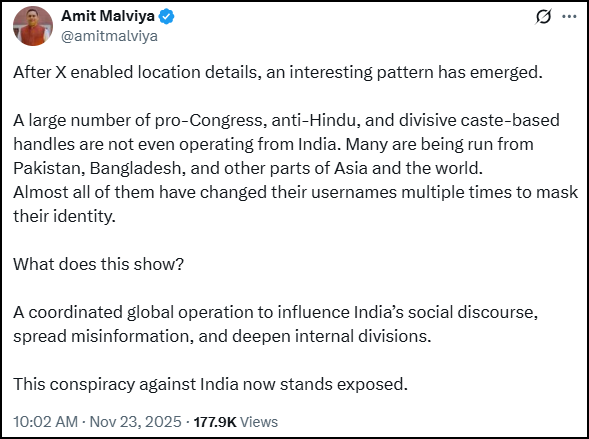
The report highlights that although the survivors have their own unique stories of abuse and torment they were subjected to, however, “patterns of targeted exploitation by predominantly Pakistani males, combined with gross negligence from public bodies, are identifiable.”

The Rape Gang Inquiry has identified eighty-five local authorities in which the gang-based sexual exploitation of children is taking place, or has historically done so.

Hundreds of brave survivors, family members and whistleblowers have approached the Rape Gang Inquiry since our launch, each with unique stories. However, patterns of targeted exploitation by predominantly Pakistani males, combined with gross negligence from public bodies, are identifiable.

“Further research, following the submission of thousands of Freedom of Information requests by our data investigation team, has enabled the Rape Gang Inquiry to produce one of the most comprehensive exposes of the nationwide scandal to date”, the report posted.

“Cases have been identified across the United Kingdom, from Aberdeen to Plymouth, Antrim to Canterbury – some going back as far as the 1960s. Evidently, more will sadly exist outside of this list. The Rape Gang Inquiry is working with our legal team and shall commence our hearings later this year. This is a chance for victims to speak, experts to be interviewed and a full report/recommendation to then be drafted,” the Rape Gang Inquiry statement reads.

Notably, as per the Rape Gang Inquiry, Pakistani Muslim rape gangs have been operating in Aberdeen City, Angus, Antrim and Newtownabbey, Argyll and Bute, Barnsley, Bexley, Birmingham, Blackburn with Darwen, Blackpool, Bradford Brent Bristol, City of Bromley, Buckinghamshire, Burnley, Calderdale, Camden, Canterbury, Chelmsford, Cherwell, Cheshire East, Cheshire West, Chester City of Edinburgh, Coventry, Croydon, Cumberland, Dacorum, Derby, Doncaster, Dorset, East Hertfordshire, East Staffordshire, Glasgow City, Greenwich, Hammersmith, Fulham, Havering, Hillingdon, Hounslow, Kingston upon Hull, City of Kirklees, Lambeth, Leeds, Leicester, Lewisham, Luton, Manchester, Medway, Merton, Middlesbrough, Monmouthshire, Newcastle upon Tyne, Newham, North Tyneside, North Yorkshire, Northumberland, Norwich, Nottingham, Oldham, Oxford, Pembrokeshire, Peterborough, Plymouth, Preston, Redbridge, Rochdale Rossendale, Rotherham, Sheffield, Somerset, Stockport, Stoke-on-Trent, Swansea, Telford, Wrekin Tower Hamlets, Vale of White Horse, Wakefield, Wandsworth, Warrington, Watford, West Berkshire, Westmorland, Furness, Wirral, Worcester and Wyre Forest.

Meanwhile, Rupert Lowe MP, Chair of the Rape Gang Inquiry, said: “Our inquiry has shown that this rotting scandal is more widespread than thought – hundreds of thousands of lives have been ruined at the hands of predominantly Pakistani rape gangs. It is over two months since Labour promised nationwide action, yet the government has been seemingly idle since. The message from survivors is clear: get on with it. There have been too many broken promises, now is the time for action and for hard justice to be delivered by those in power.”

Tesla owner and billionaire Elon Musk, who has been vocal about UK’ failure to act effectively against Muslim grooming gangs wrote on X, “85 cities in Britain where local authorities were complicit in the rape of children…”

British Pakistani Muslim men form the majority of grooming/rape gang crimes in the UK

Notably, the issue of child sexual abuse at the hands of grooming gangs led by British Pakistani men has been a serious issue demanding attention for years. In the late 90s, young girls, some as young as 11, were picked up, raped, beaten, sold, and even killed by grooming gangs or rape gangs for a full forty years. In Rotherham alone, it was found that 1,400 children had been sexually abused over 16 years by British Pakistani men.

Earlier this year, The National Audit on Group-Based Child Sexual Exploitation and Abuse report prepared by Baroness Louise Casey revealed that  more than 500,000 children a year were likely to experience child sexual abuse, with police recording some 100,000 offences in 2024. Of these, an estimated 17,100 were flagged as child sexual exploitation. The only figure for gang grooming came from a new police database, totalling just 700. Lady Casey said it was “highly unlikely” that this accurately reflected the true scale of grooming gangs.

The report revealed that Pakistani men are responsible for 64 per cent of cases of child sexual exploitation in Rotherham. Moreover, of the total 42 individuals convicted for child sexual exploitation offences under Operation Stovewood, most were Pakistani men.

The fears of appearing Islamophobic and racially insensitive prevented UK authorities and even courts, from effectively acting against Pakistani Muslim groomers/rapists for years and the Muslim-appeasing political parties of the United Kingdom also ensured that the Muslim community remains sacrosanct to criticism even as members of this community, especially those of Pakistani origins continued to sexually abuse White and other non-Muslim girls.

Police complicity, crackdown on victim families, lenient sentences: How the collective failure of UK authorities helped Pakistani Muslim rape gangs to thrive

Beginning in the 1980s in the town of Telford, vulnerable girls as young as 11 were picked up, raped, beaten, sold, and even killed by grooming gangs or rape gangs for a full forty years. The young girls, mostly white, were tossed from one rapist to another, most of whom were of British Pakistani origins. Three girls were murdered and two others died in tragedies linked to the scandal. As many as 1,000 girls suffered in a town of 170,000 people. In Telford, these Pakistani grooming gangs were literally running a rape house while they made the victims believe they were in love by buying them alcohol, cigarettes, doing their mobile top-ups, buying gifts etc.

A similar racket was unfolding in Rotherham wherein around 1,500 girls were raped, abused, sold, and bought by men of Pakistani descent in a town of 260,000 people. Many victims were gang-raped and the abuse went on unabated from 1997 to 2013. In Rochdale, the horror began in 2002. At least 47 young girls were subjected to abuse. Such has been the (Non) response of administrative and legal authorities that the grooming gangs continue to walk freely on the streets of “Great Britain”.

Sexual abuse scandals were widely uncovered in a series of locations in the UK, including Huddersfield, Rotherham, Rochdale, Oxford, Bristol, Peterborough, and Newcastle. Nearly 19,000 adolescents in England are estimated to have been sexually groomed based on government numbers. Despite multiple reports and inquiries, investigative operations like Stovewood, Tourway,  the true scale of sexual exploitation by the grooming gangs is not known.

These ‘grooming’ crimes continue to haunt the United Kingdom as the National Society for the Prevention of Cruelty to Children (NSPCC) reported in 2023 that there has been an 82% increase in online grooming offences against youngsters over the past five years.

The issue of Pakistani-origin men-led grooming gangs raping vulnerable white and other non-Muslim girls first became widely known in towns like Rotherham, Rochdale, and Telford. According to the 2014 Jay Report on Rotherham, almost 1,400 children were sexually exploited over 16 years, predominantly by men of Pakistani descent. The pervasive inaction by the authorities can be attributed to concerns of triggering racism against Pakistani immigrants. To put it in simple words, the UK authorities were reluctant to act and adopted a silence and denial approach against the grooming/rape gangs believing that acting against the Pakistani-origin rapists would reinforce ‘negative stereotypes’ about the ‘minority’ community.

OpIndia earlier reported how politician in the UK, especially the Labour Party downplayed grooming Jihad cases. Sarah Champion, a Labour Party MP had to apologise for an article published in The Sun in 2017 wherein she wrote that “Britain has a problem with British Pakistani men raping and exploiting white girls”. Champion had to not only apologise but also resign from her post as a shadow minister.

In 2012, Keith Vaz, a Labour Party leader and Chair of the Home Affairs Select Committee, downplayed the grooming jihad crimes calling them not racially motivated and emphasised that the entire community should not be ‘stigmatised’.

A Nottingham Crown Court judge who convicted two Pakistani men who groomed and raped several minor white girls, downplayed the identity of the perpetrators by asserting that the race of both, the victims and the abusers were ‘coincidental’.

In many cases, instead of arresting the rapists, the police ended up arresting the victims and their families. This was commonly due to a ‘misreading’ of the situation, a failure to probe the grooming part and in most cases a deliberate cover-up, with young victims being treated as offenders for small violations while still in contact with their abusers. This demonstrates an intentional diversion in the approach to child safety, spurred by an obsessive avoidance of racial-religious profiling. Fear of being perceived as racially ‘insensitive’ appears to have taken precedence over safeguarding young girls, culminating in a serious miscarriage of justice.

While the UK has, for a change, started grooming gangs as what they truly are—Pakistani rape gangs, they are yet to discover that the drivers of these rape crimes are not essentially racial but religious.