Home Blog Page 1411

Tamil Nadu, whose leaders want to eradicate Sanatan Dharma, give ‘communal harmony’ award to fake news peddler and Islamist Mohammad Zubair: Details

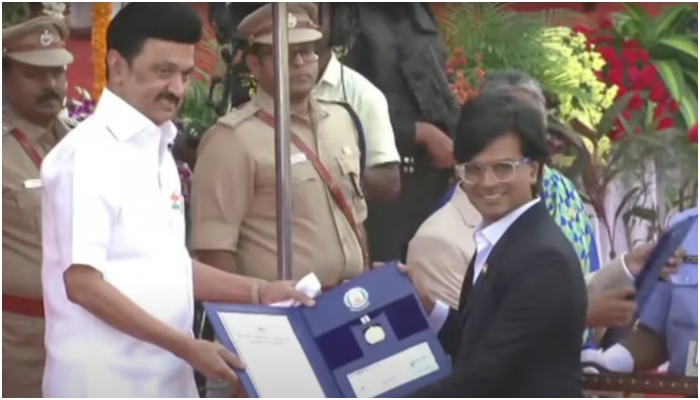
The Tamil Nadu government on the occasion of 26th January, Republic Day presented the Kottai Ameer Communal Harmony Award to Alt News co-founder Mohammed Zubair who is known for spreading fake news and false information in the name of fact-checking.

The video of the ceremony was shared on social media by some of his followers. “Tamil Nadu Govt felicitate Fact Checker and Alt news co-founder Mohammed Zubair with Kottai Ameer Communal Harmony Award. Congrats!! Hope that unbiased Fact-check continues at Alt News against all Fake News peddlers across all parties!” the tweet by one of the users read.

Another similar tweet was shared by a ‘journalist’ named Arvind Gunasekar who is associated with the Jawaharlal Nehru University (JNU). He shared the official document revealing that Zubair had been felicitated for his work through the website Alt News.

“Zubair has created a website called Alt News and has been analyzing the veracity of the news coming out on social media and posting only the real news on his website. His work helps to prevent the occurrence of violence in society likely to be caused by fake news,” the document read.

It further added that Zubair played a major role in ‘debunking’ the lies that were being spread against the state in March 2023. “In March 2023, there was a rapid spread on social media that migrant workers were being attacked in Tamil Nadu. After verifying the authenticity of the video footage, he published on his website Alt News that the footage in the video was posted on social media and had not actually taken place in Tamil Nadu. His report stopped the spread of rumours against Tamil Nadu and acted to prevent violence caused by caste, religion, race, and language in Tamil Nadu,” the document read.

In March last year, a report was published by several media outlets that stated that several migrant labourers from Bihar working in Tamil Nadu were attacked and that more than a dozen of them had lost their lives. The article published in the Hindi daily on 2 March 2023 claimed that as many as 15 Hindi-speaking migrant labourers lost their lives in “Talibani” style attacks in Tamil Nadu. As a result of these attacks, the labourers were fleeing from the state.

Later, Zubair who is known for spreading false information and provoking the Muslim community against the Hindus, is said to have published on his website that the incident had not taken place in Tamil Nadu. However, Zubair failed to highlight several such incidents from Tamil Nadu in which the migrant workers were discriminated against.

DMK tactics to spread hatred against North Indians

While the incidents mentioned in the Hindi media, in this case, were questioned, the multiple instances of discrimination against North Indians could be seen as a result of the DMK leaders’ ongoing hate campaign, which includes several Ministers, Seeman’s Naam Tamilar Katchi, Dravidian Stock YouTube channels, and other fringe elements. Slurs such as ‘Vadakkan’, ‘Paani Puri wala’, and ‘Panparag vaayan’ have been normalized by DMK officials and supporters on social media. Previously, the DMK used racist language to spread hatred towards North Indians.

In the run-up to the 2021 Assembly elections, the DMK launched political advertisements in which young people claimed that the Edappadi Palaniswami government was giving Tamil Nadu jobs to north Indians. Full-page advertisements were distributed, claiming that Hindi-speaking north Indians were taking Tamil jobs.

DMK wanting to ‘eradicate Sanatan Dharma’

The DMK and its ministers, and supporters have also made derogatory comments about the Hindu faith and Sanatan Dharma time and again. Recently, in September 2023, DMK Minister Udhayanidhi Stalin spewed venom and made a vitriolic speech against Hinduism and its followers. He opined that ‘Eradicating Sanatan Dharma’ was much more apt than opposing it.

“Mosquitoes, dengue, flu, malaria, corona – we should not oppose these things. They’ve to be eradicated completely. The same is the case with Santanam (Hinduism). Our first work should be to abolish/eradicate Sanatanam instead of opposing it,” he was quoted as saying. The video of the incident had also massively gone viral over the internet.

It is pertinent to note that earlier he used to claim that he was an atheist but recently he identified himself as a proud Christian. 

Interestingly, the selective ‘fact-checker’ did not comment on the genocidal comments by the DMK leaders against Hindus.

Zubair and the DMK govt act as confidants to each other

In such a scenario, the DMK government lauding and praising ‘fact-checker’ Mohammed Zubair does not come as a surprise. Both, the DMK ministers and supporters and Zubair are widely known for making anti-Hindu statements and opposing the Hindu faith. They both seem to see Hinduism and Sanatan Dharma as their adversaries.

Mohammed Zubair has a history of spreading false information and propaganda against Hindus. Alt-News and its co-founders Mohammed Zubair and Pratik Sinha have been accused of peddling erroneous, false, and purposefully controversial information in the past, as documented here and here.

Zubair was the one who shared an altered clip of former BJP leader Nupur Sharma’s statements, which sparked a targeted echo of ‘Sar Tan Se Juda’ slogans around the country, with mobs calling for Nupur Sharma’s death. It also resulted in the deaths of countless innocent Hindus who backed Nupur Sharma, tailor Kanhaiya Lal for example, who was beheaded by Jihadis.

Mohammed Zubair and the aftermath of his dog whistle against Nupur Sharma

In May 2021, ex-BJP spokesperson Nupur Sharma found herself at the centre of a raging storm after Islamists, egged on by the likes of AltNews co-founder Mohammed Zubair, issued multiple threats against her and her family for expressing her views on Prophet Muhammad and Islam. 

Sharma was part of a debate panel on Times Now, discussing the finding of Shivling in the Gyanvapi complex and the subsequent mockery of the Hindu Gods and Goddesses that followed in the wake of the discovery.

Islamists had claimed that the Shivling discovered inside the wuzukhana of the Gyanvapi disputed structure was not a Shivling but a fountain. Across social media platforms, detractors had repeated ad nauseam that the Shivling found inside the Gyanvapi premises was a fountain and not an idol of a Hindu God.

In response to the contempt and scorn poured over Hindu Gods and Goddesses, BJP spokesperson Nupur Sharma asked them to refrain from insulting Hindu Gods and cited Islamic scriptures to substantiate her remarks on Prophet Muhammad and Islam.

Zubair shared an incomplete video of the debate, touching off Sar Tan Se Juda protests all over the country. While Islamists went on a rampage on the streets in many cities across the country, it was essentially Mohammed Zubair who was responsible for kindling a fire that had gone on to assume uncontrollable proportions.

It was Zubair’s dog whistle that made a mountain out of a molehill and painted a target behind the back of Nupur Sharma and anyone and everyone who came out in her support. It is pertinent to note that despite claiming to be a fact-checker, Mohammad Zubair or his portal Altnews never bothered to fact-check the statements made by Nupur Sharma.

The ominous hounding of Nupur Sharma prompted many to extend their support to her. Kanhaiya Lal from Udaipur, Umesh Kolhe in Amravati, and many others extended their solidarity with the beleaguered leader, voicing their support for her amid the death threats from Islamists. 

And so, Lal was a marked man the moment he came out in support of Nupur Sharma. Islamists, provoked by Mohammed Zubair, dished out death threats to him for what they considered an unpardonable sin committed against the Prophet.

And days later, the Hindu man was killed for something as trivial as just sharing a social media post in support of Nupur Sharma.

A similar fate befell Umesh Kolhe, a chemist living in Maharashtra’s Amravati, who was murdered by four Muslim assailants while he was returning from his pharmacy on the night of June 22, 2022. Kolhe, too, was murdered for his social media post supporting Nupur Sharma.

Opindia had reported in detail cases of murders and assaults faced by the Hindu community for extending their support to the former BJP spokesperson.

This makes Mohammed Zubair guilty of ‘stochastic terrorism’, a concept defined as the public demonization of a person or group resulting in the incitement of a violent act, which is statistically probable but whose specifics cannot be predicted.

How AltNews works as an Islamic propaganda website using shield of fact check

Propaganda website AltNews has been largely peddled as an authentic source of fact-checks by the entire Left cabal. Their articles are peddled by any anti-government, anti-Hindu riffraff that the ecosystem has to offer and they often claim that their method is rather elaborate and authentic. With patrons like Arundhati Roy, who regularly speaks in a language that can only be called one that resonates with Naxals and every element that wishes to tear India apart, AltNews has gained a reputation amongst right-thinking individuals as a mouthpiece of Islamists. The so-called fact-checking website regularly furthers fake news, obfuscates the truth, concocts details to shield Islamists and sometimes, even creates fake news simply to fact check it later. 

In their quest to exonerate perpetrators from the Muslim community, AltNews has employed several methods over the years. Their methods, have now almost become predictable and standardised. While subtly peddling Islamic propaganda, AltNews keeps up the veneer of fact-checking to make their propaganda far more palatable to their already gullible readers, and that, they have the help of the entire ecosystem for their nefarious plans certainly helps move things along.

There have been numerous occasions when they have whitewashed the crimes of Islamists or falsely accused Hindus of guilt. They tried to whitewash the crime of Zahid and Aslam who murdered a three-year-old in Aligarh last year. They spread misinformation about the Hindu Swastika. They were even caught shielding the Islamists who committed the brutal terror attack in Sri Lanka. It would be difficult to find an Islamist crime which AltNews hasn’t played its propaganda over. From spreading downright lies to deliberately misleading their readers, whitewashing deplorable Islamist crimes, doxxing Hindus on social media and collaborating with global Jihadis and Leftists, AltNews employs every tactic in the book to downplay crimes against Hindus and act as an Islamist mouthpiece.
Uttar Pradesh: Islamists in Bareilly attack Hindu family for celebrating Ram Mandir Pran Pratishtha

0

On Wednesday (24th January), Islamists attacked Hindus in Bareilly (Uttar Pradesh) when they were celebrating the consecration of the Ram Mandir. At the time when the Hindus were attacked, local Hindus were setting off fireworks to commemorate the consecration of Lord Ramlala in Ayodhya. Women have also been beaten up in this attack.

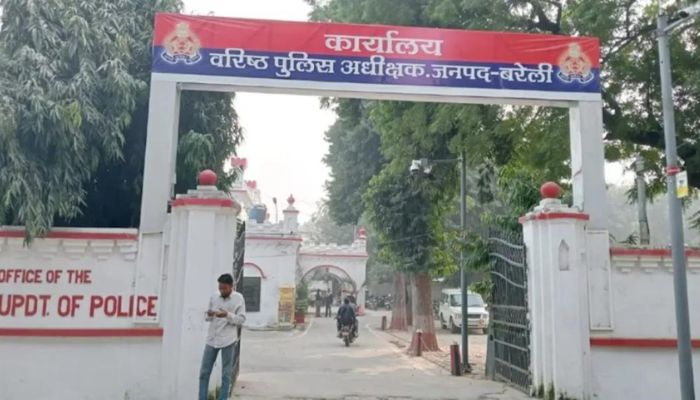
On 24 January 2024 in Sirauli, Bareilly, Varun Rastogi was celebrating the Pran Pratishtha of Ramlalla with his family in the street outside the house. During this time they were doing fireworks. Muslims in the locality objected to it. Soon the argument escalated into violence when more Muslims arrived at the spot and attacked the Hindu family. Shahavez, Wasim, Suhail, Qayyum, Danish and Sahana, all residents of Sirauli, attacked Varun and his children with sticks.

Radical Muslim attackers attacked Varun Rastogi, saying ‘You are a big devotee of Ram, today we will kill you’. During this time, his wife, who came to save him, was also attacked by Islamist attackers and she was also beaten up. When other people in the locality came to rescue the couple, the assailants attacked them too.

Following the assault by Islamists, Varun Rastogi’s wife hurried into their residence with their two children. Islamists followed them to enter the house and continued to beat the family. During the attack, one of the Islamists Danish also snatched a gold chain of a Hindu youth named Sachin Gupta, who had arrived to protect the family. When more people came to rescue the family, the Islamist attackers threatened the family again before leaving the spot.

Varun, along with others, including his children, sustained severe injuries during the assault, and they are currently undergoing medical treatment. Varun Rastogi, the victim, has filed a First Information Report (FIR) against the assailants at the Sirauli police station, and a copy of the FIR is with OpIndia. The police have initiated a case, incorporating charges such as attempted murder and rioting, and are actively working to apprehend the suspects. As of now, all the accused remain at large.

Inspector Rajesh Kumar said that an FIR has been registered on the basis of the complaint. The accused will be arrested soon. On Thursday, CO Mirganj Deepshikha Ahivaran Singh reached the spot and investigated the incident, examined the CCTV cameras and also prepared a map of the spot.

To prevent any tension as a result of the incident, police force has been deployed in the area.

Another incident of an attack on Hindus has been reported from Bareilly. A group of Islamists targeted Hindus worshipping Lord Shri Ram in the Laxmiapur Harvanshpur village of the Bhojipura police station area. On the occasion of the Ram Mandir Pran Pratishtha, local Hindus were engaged in their religious rituals. Islamists pelted stones at them.

On the night of 22nd January, Anwar, Nanhe, Rafiq, and Qadir threw stones at Hindus worshipping Lord Ram. The sudden stone pelting triggered a stampede in the area. Additionally, these attackers issued threats, stating their intention to force Hindus out of the region. Subsequently, the police apprehended three individuals in connection with the incident.

‘Raja Ramchandra Ki Jai’ reverberates on Kartavya Path as Rajputana Rifles march on the 75th Republic Day parade

0

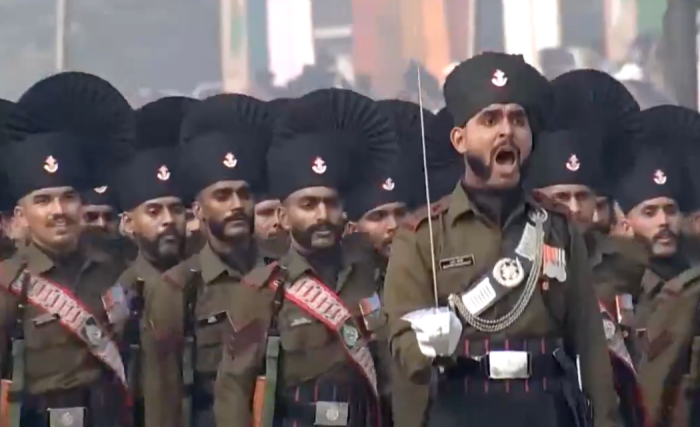
Rajputana Rifles led by Lieutenant Sanyam Chaudhary of 20th Batallion marched past the Kartavya Path as part of the Republic Day parade, with war cry ‘Raja Ram Chandra Ki Jai!’ echoing in sync on their mouths.

With first battalion of Rajputana Rifles having being raised in 1775, it is the oldest Rifle Regiment of the Indian Army.

It also has the distinction of winning the first Victoria Cross in 1856. The Regiment has displayed exceptional valour and bravery, wherever it has been deployed.

During the Kargil war of 1999, the gallant action of 7th & 11th battalions of Rajputana Rifles led to the capture of Tololing and Haneefuddin sector.

The Regiment has a rare and impeccable distinction of winning 10 Arjuna Awards.

Subedar Neeraj Chopra and Subedar Deepak Punia have brought laurels in the Olympic and Asian Games for the nation.

Its motto is ‘Veer Bhogaya Vasundarah’ and the war cry is ‘Raja Ram Chandra Ki Jai!:

Meanwhile, India is celebrating its momentous platinum celebrations of the country’s Republic Day with an enthralling showcase of its military prowess and rich cultural heritage at the majestic ‘Kartavya Path’ in the national capital.

Viksit Bharat’s rich cultural diversity, the ‘Aatmanirbhar’ military prowess and the growing Nari Shakti are the dominating themes of the 90-minute parade that will be graced by French President Emmanuel Macron as Chief Guest.

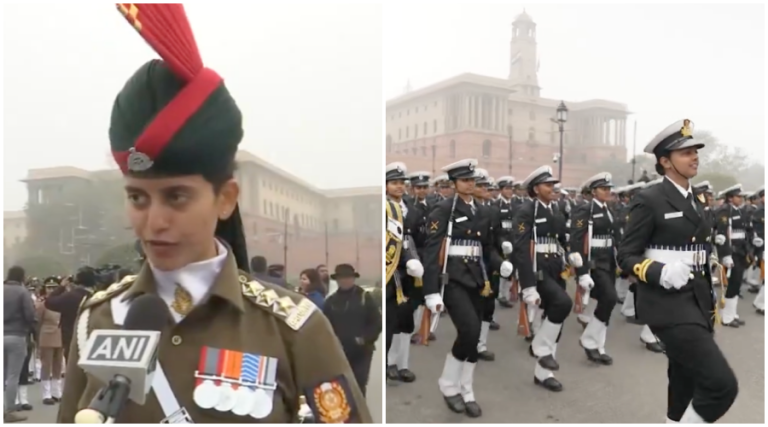
For the first time ever, an all-women Tri-Service contingent marching down the Kartavya Path. Women pilots will also enthral the audience during the Indian Air Force’s fly-past, representing Nari Shakti (women power).

Based on the twin themes of ‘Viksit Bharat’ and ‘Bharat – Loktantra ki Matruka’, this year’s parade will witness the participation of around 13,000 special Guests – an initiative which will provide an opportunity to people from all walks of life to take part in the celebrations and encourage Jan Bhagidari in this national festival.

Tableaux of 16 States and nine ministries will also take part.

The grand performance includes 30 folk dance styles uniquely prevalent in different states, as well as contemporary classical dance and Bollywood styles. The artists include tribal dancers, folk dancers, and classical dancers.

As per officials, over 8,000 security personnel have been deployed and security has been increased with the help of technology and human intelligence surveillance in Delhi.

(This news report is published from a syndicated feed. Except for the headline, the content has not been written or edited by OpIndia staff)

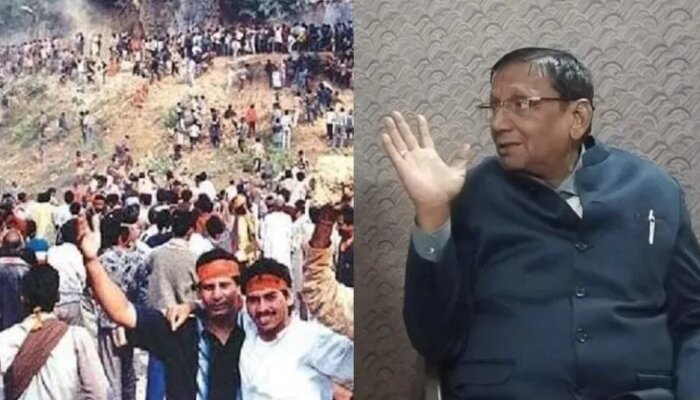
Even if shots had been fired, the disputed structure at Ram Janmabhoomi was bound to be demolished that day: An eyewitness account of December 6, 1992

The Pran Pratishtha (consecration ceremony) of Lord Ram Lalla was magnificently concluded on 22nd January 2024 at the recently constructed Ramjanmbhoomi temple in Ayodhya. Hindus celebrated Diwali across the country and the world at their respective places. This day is the result of the uncountable sacrifices made by Ram devotees over the course of 500 years of struggle.

While many of them have passed away, some are still alive and can recount the incident from firsthand memory. Ramji Gupta is one of those surviving followers of Lord Ram. He is the first karsevak to be held by the CBI (Central Bureau of Investigation) following the contentious building’s demolition on 6th December 1992.

The OpIndia team present in Ayodhya met Ramji Gupta and obtained information about the circumstances both then and today. He is originally from Faizabad, which is presently in the Ambedkar Nagar district’s Tanda, an area populated primarily by Muslims. He joined the Vishva Hindu Parishad (VHP) at a young age. Ramji Gupta once had a big handloom business in Tanda. His family is still counted among the prominent merchants of the town.

Yes, I was there during the demolition

Ramji Gupta is over seventy years of age and perfectly healthy. He told us that he had also been at the karseva in 1990. He witnessed the structure collapsing in front of his eyes on 6th December 1992. He asserted that the government and administration had to bow down to the passion of the karsevaks. Vishva Hindu Parishad had instructed Ram devotees to bring sand from Saryu and put it on the disputed structure. Meanwhile, many Ram devotees went ahead and brought the structure down.

Karsevaks did not listen to anyone

People were incensed at the 1990 slaughter of Ram bhakts at the hands of the government, according to Ramji Gupta. The administration then erected iron barricades around the disputed structure. A few karsevaks expressed their indignation at the contentious construction. Those who were there at the time became agitated as well.

Ramji Gupta maintained that Vishva Hindu Parishad and Rashtriya Swayamsevak Sangh functionaries were unable to stop them despite their best efforts. The crowd’s rage also rendered the local law enforcement authorities helpless. He feels that it would have been nearly difficult for the contested structure to survive even if bullets had been fired on Karsevaks like 1990. However, Kalyan Singh, the chief minister at the time, flatly refused to give orders to shoot.

Couldn’t leave Lord Ram’s idol in the open

Nearly all of the Karsevaks had departed by the evening of 6th December 1992 after the structure was demolished, as per Ramji Gupta. The idol of Lord Ram was laid in the open and flanked by security personnel. Ramji Gupta and a few of his companions created a makeshift tent on the spot.

The idol of Lord Rama was placed in this tent under tight security beside a few local saints. The idol of Lord Ram was housed in this tent from 1992 till 2024. Late at night, Ramji Gupta and his friends left the idol and headed back to their houses. Kalyan Singh’s government collapsed in the interim. The Senior Superintendent of Police and the District Magistrate of Faizabad (now Ayodhya) were held responsible and suspended.

CBI captured him and took him to Lucknow

Ramji Gupta revealed that a CBI team unexpectedly stormed his home in Tanda on 11th December 1992. This squad was accompanied by local law enforcement. He was asked to accompany them for questioning by the former. He was initially taken to the district headquarters in Faizabad. The team thereafter departed for Lucknow. He was interrogated comprehensively by numerous officials in Lucknow. “Lord Ram’s wish,” Ramji Gupta declared at this point. Ramji Gupta was ultimately sent to Lucknow District Jail.

High Court granted bail after a month

Ramji Gupta unveiled to us that he was set up by the CBI on the basis of a media story. He assumed responsibility for tearing down the controversial structure in a video. He kept worshipping God while incarcerated. Ramji Gupta had applied for his bail in the High Court. The High Court granted bail to him only after a month. The court ruled that the sole grounds for bail were merely the admission of guilt in front of the media and the lack of hard evidence presented by the investigating authorities. Ramji Gupta has been visiting the courts regularly for decades.

All the accused were acquitted in September 2020

The Lucknow CBI Court heard arguments regarding the contested structure for nearly 27 years. LK Advani, Uma Bharti, Sadhvi Ritambhara, Jai Bhagwan Goyal, Vinay Katiyar, Kalyan Singh, Mahant Nritya Gopal Das, Champat Rai, Murali Manohar Joshi, Sakshi Maharaj, Brijbhushan Sharan Singh and Satish Pradhan were named as accused in the matter. A total of 32 people were mentioned as accused in the same case as Ramji Gupta.

In addition to him, Sakshi Maharaj and Brijbhushan Sharan Singh were also nabbed in this case. In September 2020, the CBI court in Lucknow exonerated all of them due to a dearth of proof. In the meantime, the court stated in its remarks that the contested structure’s demolition was not a planned event.

Loss of lakhs in business personally funded the lawsuit

Ramji Gupta divulged that the majority of the workforce in his factory were members of the Muslim community. Additionally, the majority of the small Muslim traders used to visit and purchase their goods. Several refused to pay their dues after he was arrested by the CBI in the contentious case involving the demolition of the structure.

The Muslim labourers likewise declined to work in addition to this. He recalled that in 1992–1993, his family suffered a commercial loss of about 50 lakh rupees. The family of Ramji Gupta covered every cost out of their wallet, including the trial, bail, and other charges.

He fought against fanaticism since childhood

Ramji Gupta remembers his early years. He mentioned that communal tension often erupted in the Tanda market since he was a teenager. There was an instance involving love jihad in the 1980s. Ramji Gupta had to step in to save the Hindus as the situation turned into a riot. Additionally, Ramji Gupta informed us that despite being 70 years old, he is still willing to sacrifice everything for his Dharma.

From Jageshwar Yadav of Chhattisgarh to ‘Nariyal Amma’ of Andaman & Nicobar: How Padma Awards celebrate India’s unsung heroes

0

The Padma Awards 2024 were announced on Republic Day eve, Thursday. For this year, the President has approved the conferment of 132 Padma Awards, including 2 duo cases (in a duo case, the Award is counted as one).

The list also comprises 5 Padma Vibhushan, 17 Padma Bhushan and 110 Padma Shri Awards. 30 of the awardees are women and the list also includes 8 honorees from the category of Foreigners / NRI / PIO / OCI and 9 Posthumous awardees.

The list includes several unsung heroes who have made a remarkable impact on society.

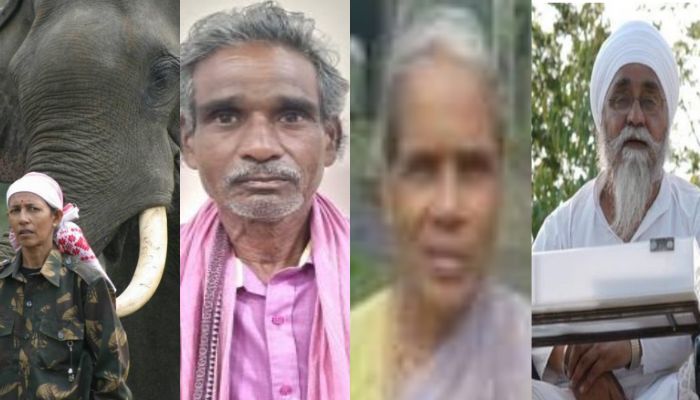
Parbati Baruah, a native of Assam and India’s first female elephant mahout, who overcame stereotypes to create a space for herself in a traditionally male-dominated field was awarded Padma Shri in the field of Social Work (Animal Welfare).

The 67-year-old stood out for her commitment towards mitigating human-elephant conflict with the help of the application of scientific practices – assisted 3 state governments to tackle and capture wild elephants.

She inherited the skill from her father, she started at the age of 14 – he relentless efforts over 4 decades have played a vital role in saving & shaping the lives of many rogue tuskers.

Despite coming from a well-off background, she chose to live a simple life, dedicating it to serving the complex yet playful creature.

Jageshwar Yadav, a Tribal Welfare Worker from Jashpur, Chhattisgarh who dedicated his life to the upliftment of marginalized Birhor Pahadi Korwa people, has been awarded Padma Shri in the field of Social Work (Tribal PVTG).

Yadav, 67, is a welfare worker who dedicated his life to the betterment of PVTG tribes of birhor and korwa. He established Ashram in Jashpur which worked for eradicating illiteracy and elevate healthcare standards by setting up camps.

Yadav also facilitated vaccinations during the pandemic, addressing hesitancy – also helped reduce infant mortality. Despite financial hardships, his passion remained to bring about social change.

Chami Murmu, 52, is a Tribal Environmentalist and Women empowerment champion from Seraikela Kharsawan and will receive Padma Shri in the field of Social Work (Environment afforestation).

She spearheaded afforestation efforts planting over 30 lakh plants with 3,000 women. She ushered socio-economic change by empowering over 30,000 women across 40+ villages through the formation of numerous SHGs & providing employment opportunities.

Through her NGO ‘Sahayogi Mahila’, initiated impactful programmes in safe motherhood, anaemia & malnutrition, & emphasized adolescent girls’ education.

Her relentless campaign against illegal logging, timber mafia & naxal activities & dedication towards protecting wildlife & forests has made her a force to reckon with.

Gurvinder Singh, 53, a Divyang Social Worker from Sirsa, worked for the betterment of the homeless, destitute, women, and orphans and Divyangjan has also been awarded Padma Shri in the field of Social Work (Divyang).

With his unwavering dedication, he nurtured 300 children’s dreams by setting up a childcare institute named Bal Gopal Dham.

He provided free ambulance services to over 6,000 accident victims and pregnant women. He was paralyzed from the waist down after being hit by a truck & is confined to a wheelchair for life. Despite the odds, he channelled his personal tragedy to work for welfare of others.

Sathyanarayana Beleri, 50, a paddy farmer from Kasaragod who emerged as a custodian of the paddy crop by preserving over 650 traditional rice varieties, will receive Padma Shri in the field of Others (Agriculture Cereal Rice).

He successfully introduced ‘Rajakayame’ rice, boosting production and conservation across 3 states – Karnataka, Kerala & Tamil Nadu.

Through 15 years of hardwork, innovated technique, ‘Polybag Method’ – conserved not only indigenous rice varieties but also traditional seeds of arecanut, nutmeg and black pepper.

Fostered research and conservation by providing 50 rice varieties to research centers and distributed free rice seeds to farmers.

Dukhu Majhi, 78, a Tribal Environmentalist from Sindri village, Purulia planted over 5,000 Banyan, Mango and Blackberry trees on barren land while travelling to new destinations on his bicycle every day, will receive Padma Shri in the field of Social Work (Environment Afforestation).

He dedicated 5 decades to planting trees & spreading awareness for a greener future. Planted over 5,000 Banyan, Mango and Blackberry trees on barren land, while traveling to new destinations on his bicycle every day.

Raised awareness about tree planting and featured in the documentary ‘Rukhu Mati Dukhu Majhi’. Working for a greener tomorrow since the age of 12.

Could not complete his education due to financial constraints, but that did not stop him from coming up with innovative solutions for protecting and safeguarding against wood theft and spreading awareness about the
importance of trees.

K Chellammal, 69, an organic Farmer from South Andaman who successfully developed a 10-acre organic farm, will receive Padma Shri in the field of Others (Agriculture Organic).

She has developed efficient coconut and palm tree damage control measures. Used intercropping method for cultivation of crops like Clove, Ginger, Pineapples, Banana and motivated more than 150 farmers to adopt it.

She devised innovative & economical solutions for coconut & palm tree damage control measures. She harvested over 27,000 coconuts per annum & cultivated 2 hectares of coconut plantation with 460 palms of Andaman Ordinary Tall variety.

Studied till class 6, but innovating in farming for past 5 decades with commitment and enthusiasm.

Sangthankima, 63, a social worker from Aizawl who has been running Mizoram’s largest orphanage ‘Thutak Nunpuitu Team’, to receive Padma Shri in the field of Social Work (Children).

Over the course of 3 decades, addressed issues related to children’s welfare, addiction, HIV-AIDS awareness, education, and other civic issues.

Continuously providing shelter and rehabilitation services to orphans, divyangjan, drug addicts, and alcoholics.

Worked for North Eastern communities and Burmese through his rehabilitation centres in 4 districts of Assam.

Hemchand Manjhi, 70, a traditional medicinal practitioner from Narayanpur providing affordable healthcare to villagers for over 5 decades, having started serving the needy at the age of 15, to receive Padma Shri in the field of Medicine (AYUSH Traditional Medicine).

He is known for his special knowledge of herbs in remote forests of Abujhmarh. Charges meagre amount to treat patients suffering from varied diseases.

Despite repeated threats & personal attacks by Naxals, he continued to serve people with sincerity and zeal.

Yanung Jamoh Lego, 58, East Siang-based herbal medicine expert who has provided medical care to over 10,000 patients, educated 1 lakh individuals on medicinal herbs and trained SHGs in their use, will receive Padma Shri in the field of Others (Agriculture Medicinal Plants).

She planted over 5,000 medicinal plants annually & promoted setting up of herbal kitchen gardens in every household across the district.

Despite financial constraints & personal challenges, she dedicated her life for revival of the lost traditional healing system of Adi tribe in particular & the entire Arunachal Pradesh as a whole – becoming instrumental in keeping the traditional knowledge of medicines alive.

Somanna, 66, a Tribal Welfare Worker from Mysuru working tirelessly for the upliftment of the Jenu Kuruba tribe for over 4 decades, has been conferred Padma Shri in the field of Social Work (Tribal PVTG).

He assisted in acquiring title deeds to ensure the legal recognition and protection of more than 500 tribal communities residing in forest areas.

His social work extended to environmental conservation, emphasizing the importance of preserving natural habitats.

Jenu Kuruba is a honey-collecting tribe from Nilgiris with around 40,000 inhabitants.

Previously a bonded labourer, he realised the true importance of freedom and rights and went on to dedicate his life to advocating for the rights of tribals.

Prema Dhanraj, 72, a Plastic Reconstructive Surgeon Social Worker dedicated to the care and rehabilitation of burn victims her legacy extends beyond surgery, championing burn prevention awareness and policy reform, will receive Padma Shri in the field of Medicine (Indigenous Burns).

She founded Agni Raksha NGO, provided free surgery to 25,000 burn victims + Authored 3 books on Plastic Surgery.

As part of her global humanitarian efforts, established Ethiopia’s 1st burns unit, and educated doctors in Kenya, Tanzania, Norway, Ethiopia.

A survivor of 50% burns at age of 8 (when a stove burst on her face while playing in the kitchen), she triumphed over personal tragedy to become a driving force of change.

She underwent more than 14 surgeries as a child at Christian Medical College Vellore – and went on to become a Surgeon & HoD in the same hospital.

Sarbeswar Basumatary, 61, a Tribal Farmer from Assam’s Chirang successfully adopted a mixed integrated farming approach and cultivated varieties of crops like coconuts, oranges, paddy, litchis and maize from Assam.

He has been awarded the Padma Shri. Demonstrating a community-focused approach, he transmitted his knowledge and learnings to other farmers, helping increase efficiency and uplift livelihoods.

Once a daily wage labourer, his enduring spirit and enthusiasm has become a role model for the agricultural community – despite lacking any formal education and against heavy odds.

Uday Vishwanath Deshpande, 70, International Mallakhamb Coach, who worked relentlessly in reviving, revitalizing and popularizing the sport at the global level, has been awarded Padma Shri in the field of Sports (Coach – Mallakhamb).

He personally trained over 5,000 people from 50 countries – introduced Mallakhamb to diverse groups including women, divyangjan, orphans, tribals and senior citizen.

As director of Vishwa Mallakhamb Federation, played a pivotal role in contributing significantly to it’s international reach.

He created a rule-book with criteria of judgement and competition and standardizing all regulations which was recognised by Indian Olympic Association.

Yazdi Maneksha Italia, 72, has been awarded Padma Shri for dedicating his life to fight sickle cell anemia amongst Tribals of Gujarat.

He pioneered development of India’s inaugural Sickle Cell Anemia Control Program (SCACP).

He pioneered newborn screening through heel prick dry blood samples in collaboration with ICMR – prevented & controlled new births with SCD by screening 2 lakh tribals.

He screened more than 95 lakh tribal individuals across Gujarat, identifying 7.2 lakh Sickle Cell trait cases, and issuing colour-coded cards for effective counselling.

Among the other honorees were Shanti Devi Paswan and Shivan Paswan (Bihar) in the field of Art (Painting – Folk – Madhubani), Ratan Kahar (West Bengal) in the Art (Vocals- Folk – Bhadu), Ashok Kumar Biswas (Bihar) in the field of Art (Painting – Folk – Tikuli), Balakrishnan Sadanam Puthiya Veetil (Kerala) in Art (Dance – Classical – Kathakali), Uma Maheshwari D (Andhra Pradesh) in Art (Storytelling – Harikatha), Gopinath Swain (Odisha) in the Art (Vocals – Bhajan – Odia), Smriti Rekha Chakma (Tripura) in Art (Textile – Weaving – Loinloom) in Art (Theatre – Folk – Mach), Omprakash Sharma (Madhya Pradesh), Narayanan EP (Kerala) in Art (Dance – Folk – Theyyam), Bhagabat Padhan (Odisha) in Art (Dance – Folk – Sabda Nrutya), Sanatan Rudra Pal (West Bengal) in Art (Sculpture), Badrappan M (Tamil Nadu) in Art (Dance – Folk – Kummi), Jordan Lepcha (Sikkim) Art (Craft – Bamboo) in Art (Craft – Pottery – Black) , Machihan Sasa (Manipur), Gaddam Sammaiah (Telangana) in Art (Dance – Yakshagana), Jankilal (Rajasthan) in Art (Theatre – Folk – Rajasthani), Dasari Kondappa (Telangana) in Art (Music – Instrument – String – Burra Veena), Babu Ram Yadav (Uttar Pradesh) in Art (Craft – Brass), Nepal Chandra Sutradhar ( West Bengal) Art (Craft – Mask Making – Chau) have also been awarded Padma Shri. (ANI)

(With agency inputs)

UP: Zubair raped a Dalit girl in Noida, blackmailed her to convert to Islam, arrested

0

A shocking case of alleged love jihad has come to the fore in Noida wherein a Dalit girl working in a company in Sector-63 was allegedly raped and was being blackmailed to convert to Islam by the accused identified as Zubair. The accused has been arrested after the victim lodged a complaint at Sector-63 police station. The victim is a resident of Shani Bazaar Chowk in Ghaziabad.

According to the FIR copy obtained by OpIndia, the 20-year-old victim claimed that the accused Zubair, who resided in the same area, had been following her and pressuring her to talk to him for over five years. On January 11, she was on her way to her office when accused Zubair approached her and offered to drop the girl at her office.

However, instead of leaving the victim off at her workplace, the accused drove her to a hotel near the Bahlolpur police station. Following this, the accused sexually assaulted the victim and filmed the act. The victim stated that when her brother went to get the obscene video deleted Zubair and his brother assaulted him.

In a video statement, the victim alleged that the accused was pressuring her to accept Islam.

The accused was threatening the victim to make her objectionable video viral on social media if she refused to convert to Islam. The reports say that after getting frustrated over persistent harassment, the victim lodged a complaint against the accused. After registering an FIR based on the victim’s complaint, police arrested the accused Zubair. Accused Zubair has been booked under sections 376 (Punishment for sexual assault) and 323 (Punishment for voluntarily causing hurt) of the IPC.

The station’s in-charge stated that the victim, a Ghaziabad resident, works at a company in Sector 63. She met accused Zubair, a Chhijarasi resident some time back. The girl alleged that on January 11, Zubair took her to a hotel and raped her. Meanwhile, he recorded a video of his crime on his phone. Since then, the accused have been pressurising her to convert to Islam, Hindustan reported.

‘Pakistan will reap what it sows’; Ministry of External Affairs rejects Pakistan’s claim that Indian agents killed two of their citizen terrorists

On Thursday (25th January) the Ministry of External Affairs (MEA) gave a befitting reply rejecting Pakistan’s claim that Indian agents killed two Pakistani citizens on Pakistani soil. MEA said that Pakistan will reap what it sows. Notably, on Thursday, Pakistan claimed that it had credible evidence to prove that “Indian agents” killed two Pakistani citizens.

By these two citizens, Pakistan was referring to two terrorists associated with the Jaish-e-Mohammed and the Lashkar-e-Taiba who were killed in Sialkot and Rawalkot last year.

MEA spokesperson Randhir Jaiswal shared a press release in response to media queries regarding remarks made by the Pakistan Foreign Ministry. In this press release, he said, “We have seen media reports regarding certain remarks by Pakistan Foreign Secretary. It is Pakistan’s latest attempt at peddling false and malicious anti-India propaganda.”

Randhir Jaiswal added, “As the world knows, Pakistan has long been the epicentre of terrorism, organised crime, and illegal transnational activities. India and many other countries have publicly warned Pakistan cautioning that it would be consumed by its own culture of terror and violence.”

He further said, “Pakistan will reap what it sows. To blame others for their own misdeeds can neither be a justification nor a solution.”

Pakistan’s foreign secretary Muhammad Syrus Sajjad Qazi held a press conference on Thursday. In this press conference, he alleged that India was carrying out extra-territorial and extra-judicial killings inside Pakistan.

On 11th October 2023, Shahid Latif, a key aide to Masood Azhar, the chief of the terrorist organisation Jaish-e-Mohammed, and the mastermind behind the 2016 attack on the Indian Air Force base in Pathankot, was shot dead in a mosque in Sialkot, located in the Punjab province of Pakistan. This attack was carried out by unidentified gunmen.

On 8th September 2023, unidentified gunmen killed Riyaz Ahmad, also known as Abu Qasim, associated with the banned Lashkar-e-Taiba terrorist outfit. He was a key conspirator in the Dhangri terror attack that occurred in Jammu and Kashmir on 1st January 2023. He was killed during pre-dawn prayers inside the Al-Qudus mosque in the Rawalakot area of Pakistan-Occupied Kashmir.

Referring to these two killings, Qazi said, “Indian agents used technology and safe havens on foreign soil to commit assassinations in Pakistan. They recruited, financed, and supported criminals, terrorists, and unsuspecting civilians to play defined roles in these assassinations.” The Ministry of External Affairs has now debunked these claims.

132 Padma Awards 2024: Venkaiah Naidu, Chiranjeevi, among 5 Padma Vibhushan recipients, Foxconn CEO awarded Padma Bhushan

0

Former Vice President and Rajya Sabha Chairman M Venkaiah Naidu, along with four other recipients, including the late social worker and founder of Sulabh International Bindeshwar Pathak, was honoured with the country’s second highest civilian award, Padma Vibhushan, on the eve of Republic Day.

Popular Indian actress Vyjayantimala Bali; actor, film producer, and former politician Konidela Chiranjeevi; and classical Bharata Natyam dancer Padma Subrahmanyam have also been honoured with the Padma Vibhushan on Thursday.

Bollywood actor Mithun Chakraborty, Indian pop and playback singer Usha Uthup, former Supreme Court justice M Fathima Beevi (posthumous), and consultant in the department of cardiology Ashwin Balachand Mehta are among the 17 recipients who were given the third-highest honor–the Padma Bhushan.

Khalil Ahamad, Badrappan M, Kaluram Bamaniya, Rezwana Choudhury Bannya, Naseem Bano, and Ramlal Bareth are among the 110 recipients who have been awarded the Padma Shri, the fourth highest honour.

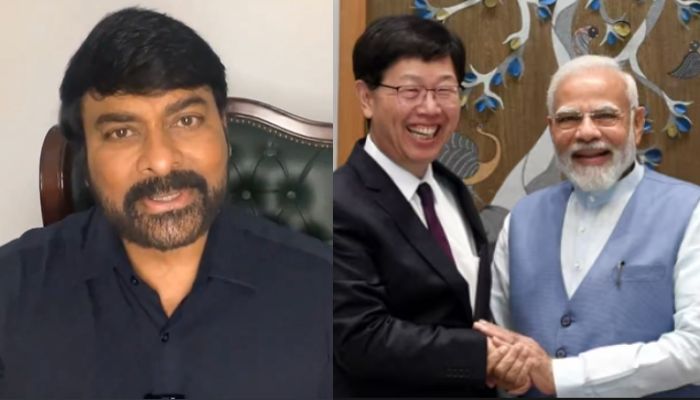
The Chief Executive Officer and Chairman of Taiwanese technology giant Hon Hai Technology Group (Foxconn), Young Liu, was honoured with the Padma Bhushan on Thursday. Foxconn is the world’s largest electronics manufacturer and a leading global science and technology solutions provider.

As per Foxconn’s official website, Liu is a recognised entrepreneur and innovator with over four decades of industry experience. He has founded three companies– a motherboard company in 1988 known as Young Micro Systems; a northbridge and southbridge IC design company in 1995 focused on the PC chipset and an ITE Tech and an ADSL IC design company, ITeX in 1997.

Foxconn has rapidly expanded its presence in India by investing as part of its supply chain diversification from China in an evolved post-pandemic world order.

Megastar Konidela Chiranjeevi has been awarded with Padma Vibhushan. He is regarded as one of the most successful stars of Indian cinema.

There are 132 names on the list of Padma Awardees this year, including two duo cases (in a duo case, the award is counted as one), as per the list below. The list comprises five Padma Vibhushan, 17 Padma Bhushan, and 110 Padma Shri Awards. 30 of the awardees are women, and the list also includes 8 persons from the categories of foreign non-resident Indian (NRI), person of Indian origin (PIO), overseas citizenship of India (OCI), and nine posthumous awardees.

The Padma Awards, which were instituted in 1954, are one of the highest civilian honours of India and are announced annually on the eve of Republic Day. The awards are given in three categories: Padma Vibhushan (for exceptional and distinguished service), Padma Bhushan (distinguished service of higher order), and Padma Shri (distinguished service). The award seeks to recognise achievements in all fields of activities or disciplines where an element of public service is involved.

The Padma Awards are conferred on the recommendations made by the Padma Awards Committee, which is constituted by the Prime Minister every year. The Padma Awards Committee is headed by the Cabinet Secretary and includes the Home Secretary, Secretary to the President, and four to six eminent persons as members. The recommendations of the committee are submitted to the Prime Minister and the President of India for approval.

Last year, the government announced 106 Padma Awards, including three duo cases. The list then comprised six Padma Vibhushans, nine Padma Bhushans, and 91 Padma Shri Awards. 19 of the awardees were women, and the list also included two persons from the category of foreigners: NRI, PIO, OCI, and seven posthumous awardees. (ANI)

(With agency inputs)

75th Republic Day: Kartavya Path to witness Nari Shakti, all-women Tri-Service contingent, all-women Armed Forces Medical Service contingent to march

Kartavya Path in the national capital is set to witness the nation’s Aatmanirbhar military prowess and growing ‘Nari Shakti’ on the occasion of the Republic Day tomorrow.

The marching contingents that will roll down the Kartavya Path include an all-women Tri-Service contingent led by Captain Sandhya of Military Police, with three supernumerary officers Captain Sharanya Rao, Sub Lieutenant Anshu Yadav and Flight Lieutenant Shrishti Rao, and an all-women Armed Forces Medical Services contingent, headed by Major Srishti Khullar with Captain Amba Samant of Army Dental Corps, Surgeon Lieutenant Kanchana of Indian Navy and Flight Lieutenant Dhivya Priya of Indian Air Force.

The first Army contingent leading the Mechanised Column will be of 61 Cavalry, led by Major Yashdeep Ahlawat. Raised in 1953, the 61 Cavalry is the only serving active Horsed Cavalry Regiment in the world, with the amalgamation of all the ‘State Horsed Cavalry Units’.

It will be followed by 11 Mechanised Columns, 12 marching contingents, and a fly-past by Advanced Light Helicopters of Army Aviation Corps, the Defence Ministry said in a release.

Tank T-90 Bhishma, NAG Missile System, Infantry Combat Vehicle, All-Terrain Vehicle, Pinaka, Weapon Locating Radar System ‘Swathi’, Sarvatra Mobile Bridging System, Drone Jammer System, and Medium Range Surface-to-Air Missile System among others will be the main attractions in the mechanised columns.

The Army Marching Contingents will include The Madras Regiment, The Grenadiers, the Rajputana Rifles, the Sikh Regiment and the Kumaon Regiment.

The Indian Navy contingent will consist of 144 men and women Agniveers, led by Lt Prajwal M as Contingent Commander and Lt Mudita Goyal, Lt Sharvani Supreiya and Lt Devika H as Platoon Commanders. It will be followed by the Naval Tableau, depicting the themes ‘Nari Shakti’ and ‘Sea Power Across the Oceans Through Indigenisation’.

The first part of the tableau showcases the women in the Indian Navy in All Roles and in All Ranks across the Navy while the second depicts the very first indigenous Carrier Battle Group, comprising the Aircraft Carrier Vikrant, her highly capable escort ships Delhi, Kolkata and Shivalik, the Light Combat Aircraft and Advanced Light Helicopter, the Kalvari Class Submarine and the GSAT-7, Rukmani Satellite.

The Indian Air Force (IAF) will comprise 144 airmen and four officers, led by Squadron Leader Rashmi Thakur. Squadron Leaders Sumita Yadav & Pratiti Ahluwalia and Flight Lieutenant Kirti Rohil will march past as supernumerary officers behind the Contingent Commander. The IAF tableau is on the theme ‘Bharatiya Vayu Sena: Saksham, Sashakt, Aatmanirbhar’.

The tableau depicts LCA Tejas and Su-30 flying over the IOR, and a C-295 transport aircraft being flown by women aircrew in the cockpit. The GSAT-7A positioned on the tableau represents the IAF’s incorporation of space technology in its operations. The tableau shows that IAF has been at the forefront of rendering humanitarian aid, both within and across borders.

The Indian Coast Guard (ICG) contingent will be led by Assistant Commandant Chunauti Sharma followed by officers of the guard Assistant Commandants Priya Dahiya, Hardik and Pallavi. The ICG, with a fleet of 154 ships and 78 aircraft, is capable of countering threats at & to the sea. It is also the nodal agency for coordinating Maritime Search and Rescue in the 4.6 million square km Indian Search & Rescue Region. It has saved about 11,516 lives at sea since inception which translates to saving one life every second day.

The contingents of Central Armed Police Forces (CAPF) and Delhi Police will be led by women personnel.

“Border Security Force marching contingent will be headed by Assistant Commandant Monika Lakra; Central Industrial Security Force by Assistant Commandant Tanmayee Mohanty; Central Reserve Police Force by Assistant Commandant Megha Nair; Indo-Tibetan Border Police by Assistant Commandant Moniya Sharma; Sashastra Seema Bal by Deputy Commandant Nancy Singla; and Delhi Police by Additional Deputy Commissioner of Police Shweta K Sugathan,” Defence Ministry said.

The Camel Contingent of Border Security Force will be led by Deputy Commandant Manohar Singh Kheechee. For the second time, female camel riders on their decorated camels will be taking part in the parade.

Various contingents of the NCC will witness female representation. For the first time, there will be an all-girl Tri-Service Marching contingent, which will be headed by Senior Under Officer Tanu Tevatia of Uttar Pradesh Directorate.

The Girls Marching contingent (Army), comprising 148 cadets, will be led by Senior Under Officer Punnya Ponnamma from Karnataka & Goa Directorate. The NCC band will also have an all-girl representation. The Combined Band consisting of Girls from Birla Balika Vidya Peeth Pilani, Rajasthan and the North-Eastern Region will be headed by Senior Under Officer Yashasvica Gaur and Ankita Sharma.

Two hundred (200) female volunteers will form the National Service Scheme (NSS) contingent. It will be led by Ragina Tamang from Sikkim, Regional Directorate of NSS, Guwahati.

(This news report is published from a syndicated feed. Except for the headline, the content has not been written or edited by OpIndia staff)

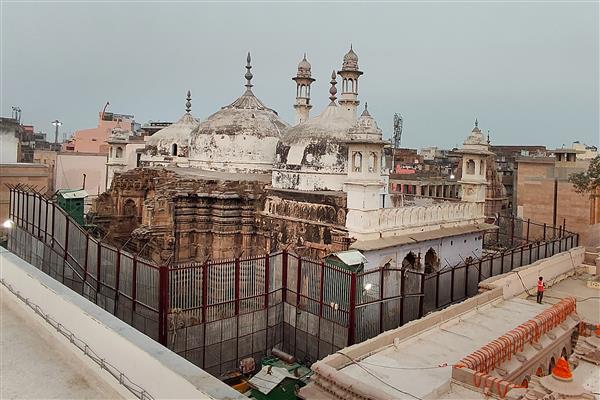
A large Hindu temple existed before the construction of the existing structure, pillars and plasters were reused: ASI report on Gyanvapi

A day after the Varanasi District Court allowed to make the Archaeological Survey of India (ASI) report on the Gyanvapi structure public, the report released by the Hindu said that the study and survey of the structure strongly suggests the existence of a substantial Hindu temple structure at the Gyanvapi mosque complex.

This was revealed by advocate Vishnu Shankar Jain, representing the Hindu side, while giving details about the ASI study to the media. It is notable that the court had asked ASI to give hard copies of the report to both the Hindu and Muslim sides.

Reading from the ASI report, Jain quoted, “The pillars and plasters used in the existing structure were studied systematically and scientifically. For the enlargement of the mosque and constructing sahn, parts of preexisting temple including pillar and plasters were reused with little modification”. This means that pillars of an existing Hindu temple were used in the construction of the mosque, Jain explained.

The report further states that the carvings on the pillars and stones make it clear that they were originally parts of a Hindu temple, which was demolished to construct the mosque. “Minute study of the pillars and pilasters in the corridor suggests that they were originally part of the pre-existing Hindu temple,” ASI says.

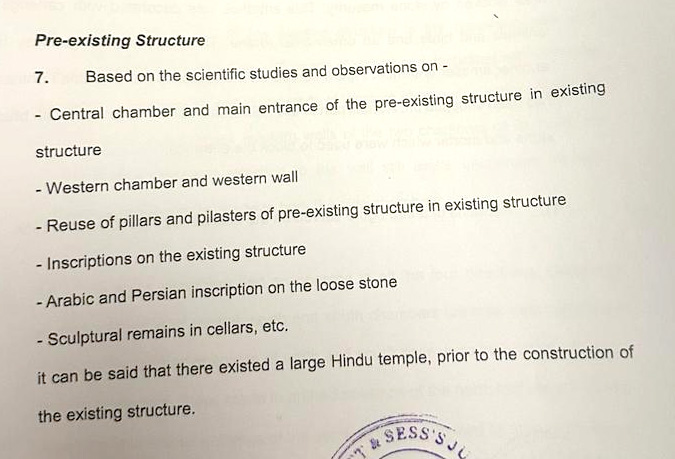
OpIndia has accessed relevant pages of the report, which states that it can be said that there existed a large Hindu temple, prior to the construction of the existing structure. The study states that for the reuse of pillars in the existing structure, vyala figures carved on either side of lotus medallion were mutilated and after removing the stone mass from the corners that space was decorated with floral design. This observation is supported by two similar plasters still existing on the northern and southern wall of the western chamber in their original place.

Central chamber and entrance

The pre-existing structures noted in the report included the Central chamber and main entrance of the pre-existing structure in existing structure, Western chamber and western wall, reuse of pillars and plasters of pre-existing structure in the existing structure, inscriptions on the existing structure, Arabic and Persian inscription on the loose stone, Sculptural remains in cellars, etc.

As per the ASI report, the Hindu temple had a big central chamber and at least one chamber to the  north, south, east and west respectively. Remains of three chambers to the south and west still exist but the remains of the chamber to the east and any extension of it could not be ascertained physically, as the area is covered under a platform with stone flooring.

It states that the Central chamber of the pre-existing structure forms the central hall of the existing structure. This structure with thick and strong walls, along with an architectural components and floral decorations was utilised as the main hall of the mosque. Animal figures carved at the lower ends of decorated arches of the pre-existing structure were mutilated, and inner part of dome is decorated with geometric designs.

Main entrance to the central chamber of the temple was from the west which was blocked by stone masonry, says the report. This entrance was decorated with carvings of animals and birds and an ornamental torana. This large arched gateway had another smaller entrance. Figure carved on the lalatbimba of this small entrance has been chopped off. A small part of it is visible as most of it is covered with bricks, stone and mortar which were used to block the entrance.

Talking about the Western wall of the existing structure which was clearly a part of a Hindu temple, the ASI report states that Eastern half of the western chamber still exists whereas the superstructure of western half has been destroyed. This chamber was also connected with north and south chambers through a corridor accessible from its north and south entrances respectively. Remains of this corridor in the northwest side came to light on removal of garbage and debris.

The western wall of the existing structure is the remaining part of a pre-existing Hindu temple, the ASI report categorically states. This wall, made of stones and decorated with horizontal mouldings, is formed by remaining parts of western chamber, western projections of the central chamber and western walls of the two chambers on its north and south. Central chamber attached to the wall still exists unchanged whereas modifications have been made to both the side chambers, the report states.

All these chambers had an opening in all the four directions. Decorated arched entrances of central, north and south chambers towards west have been blocked. The arched openings of north and south halls were converted into steps leading to the roof. Steps made in arched entrance of the north hall are still in use. Steps made in arched entrance of the south hall were blocked by stone masonry at some later date, however one can still enter from roof.

Inscriptions

The ASI report also gives details of the instructions found in the structure that proves the existence of a Hindu temple. During the survey, a number of inscriptions were noticed on the existing and pre-existing structures. A total of 34 inscriptions were recorded during the present survey and 32 estampages were taken. These are, in fact, inscriptions on the stones of the pre-existing Hindu temples, which have been re-used during the construction/ repair of the existing structure. They include inscriptions in Devanagari, Grantha, Telugu and Kannada scripts, as per ASI.

ASI says that that the reuse of earlier inscriptions in the structure suggest that the earlier structures were destroyed and their parts were reused in construction/ repair of the existing structure. Three names of deities such as Janardhana, Rudra, and UmeSvara are found in these inscriptions.

ASI further states that terms such as Maha-muktimarfapa mentioned in three inscriptions is of significance.

Talking about the inscription on Loose Stone found in the structure, ASI said that they contain recorded of a construction of the mosque in the 20th regnal year of Mughal Emperor Aurangzeb corresponding to year 1676-77. This inscription also recorded that in the year 1792-93 CE, the mosque was repaired with sahan, etc.

ASI said that the inscriptions on the loose stones matches with contents of the biography of Emperor Aurangzeb, Maasir-i-Alamgiri, which mentions that Aurangzeb “issued orders to the governors of all the provinces to demolish the schools and temples of the infidels (Jadu-Nath Sarkar (tr.) 1947, Maasir-i-Alamgiri, pp. 51-52). On 2nd September, 1669 “it was reported that, according to the Emperor’s command his officers had demolished the temple of Viswanath at Kashi” the ASI quotes.

Study of cellars

The report then says that a series of cellars were also constructed to the east to create additional space and a large platform in front of the mosque for accommodating large number of people for prayers. It states that pillars from earlier temples were reused while making cellars in eastern part of the platform. A pillar decorated with bells, niches for keeping lamps on all four sides, and bearing an inscription of Sarhvat 1669 (corresponding to 1613 CE, January 1, Friday) is reused in cellar N2.

Sculptures of Hindu deities and carved architectural members were found buried under the dumped soil in cellar S2, ASI report says.

Nature and Age

Talking about the nature of the earlier structure, ASI said that the existing architectural remains, decorated mouldings on the walls, karna-ratha and prati-ratha of central chamber, a large decorated entrance gate with torana on the eastern wall of the western chamber, a small entrance with mutilated image on lalatbimba, birds and animals carved for decoration in and outside suggest that the western wall is remaining part of a Hindu temple. Based on art and architecture, this pre-existing structure can be identified as a Hindu temple, it categorically mentions.

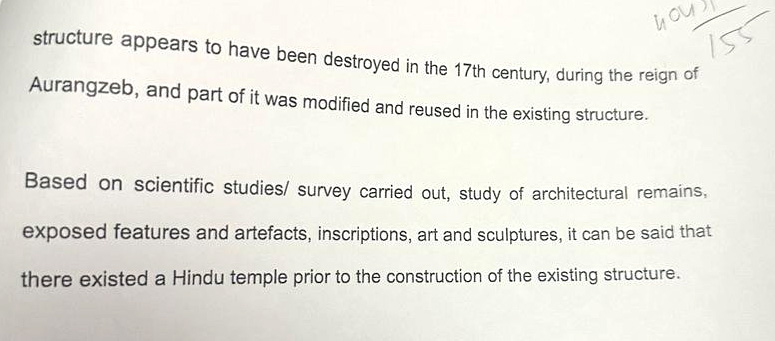
The Arabic-Persian inscription found inside a room mentions that the mosque was built in the 20th regnal year of Aurangzeb (1676-77 CE). Hence, the pre-existing structure appears to have been destroyed in the 17th century, during the reign of Aurangzeb, and part of it was modified and reused in the existing structure, the ASI report says.

The report concludes by saying that based on scientific studies/ survey carried out, study of architectural remains, exposed features and artefacts, inscriptions, art and sculptures, it can be said that there existed a Hindu temple prior to the construction of the existing structure.