Tuesday, March 31, 2026
Home Blog Page 1687

London: Sikh restaurant owner’s car shot at and vandalised months after he spoke against Khalistanis, had received death and rape threats but no action from UK Police

The act of open support for Khalistani terrorists and extremists by the Canadian authorities and their like-minded political outfits in the West has emboldened Khalistanis in the United Kingdom as well. Evidently, on Saturday (30 September), unknown assailants allegedly fired shots at the car of Sikh restaurant owner, Harman Singh Kapoor, who had spoken against the Khalistan issue earlier this year. 

As per the information received, the assailants seemingly Khalistanis had also vandalised parts of his properties in what seems to be two attacks within the span of a few hours against the family.  

According to a UK-based Journalist and Researcher Charlotte Littlewood, the attack on Harman Singh Kapoor’s family is still ongoing and police have not provided them any kind of security cover or protection from Khalistani elements despite looming threats against them. 

As per Littlewood, the family was in anticipation of police personnel hours after some unknown assailants, believed to be Khalistani extremists, fired shots at their vehicle in London. She emphasised that the Canada row has virtually emboldened the Khalistani extremists and it is feared that more such attacks could be seen in the near future. 

She also questioned the UK Police for reportedly removing their panic alarm. 

Earlier in the day, she had highlighted that Harman’s car was attacked by some unknown miscreants and covered in red paint. 

Notably, the family was forced to live in hiding after they were getting repeated death and rape threats against family members for speaking against Khalistani extremism, earlier this year. 

It is being said that despite the fact that the family was receiving rape and death threats on a constant basis, the responsible authority decided to remove their panic alarms. 

Apparently, today’s attack comes within days after the panic alarm was removed.  Following the attack on their property, Harman’s family asserted that they would feel safer living in India as they felt that the establishment in the UK didn’t care for them. 

Drawing attention to these attacks on Harman’s family, Littlewood asked, “Within days of the removal of the alarm, their property is targeted. They have so little trust now in policing and government they feel that the Khalistani extremists have a way of knowing their alarm system has been removed. Why?”  

Claiming that this ‘was more of an Indian problem’, the security agencies in the UK have responded slowly to such attacks and at times have even indulged in victim blaming,  insinuating that the family brought this on themselves. 

Meanwhile, earlier in May 2023, OpIndia had highlighted how Harman Singh Kapoor, a Sikh restaurant owner in London, and his family had become the target of persistent threats since the time they uploaded a video about the Khalistan movement on social media.

The Khalistanis targeted his family despite several police guarantees of safety and specialised safety procedures. The family had been the target of three attacks and felt unsafe in London. Just days after the Khalistanis vandalised the Indian High Commission in London, pro-Khalistan supporters attacked Harman’s restaurant named ‘Rangrez, the Taste of Punjab’.

Afterward, Harman released a video that garnered two million views in just two days, which prompted threatening phone calls, online harassment, and social media trolls to target him and his family. Kapoor stated that the threats began after he posted a video on TikTok, in which he said, “This Khalistan movement started a while back and then it died down. Today again, a section of people who are settled in Canada, England, and Australia want Khalistan but those in India don’t want it. Those who need Khalistan should go back to India and ask for it.”

Harman said that after the video, he started getting death threats and that people started attacking his restaurant. He was threatened with death if he didn’t take down the video, shout pro-Khalistan, and burn the Indian flag.

The restaurant located in Hammersmith, West London, was also vandalised by the Khalistani elements in March in reaction to the video. Several men in masks and hoods had arrived at the restaurant, banged on the doors and asked those inside to come out and face them.

3 persons from areas outside Scotland disrupted planned interaction with Indian diplomats, bigger incident prevented:  Indian High Commission in London

The Indian High Commission in London has issued a statement regarding the incident whena mob of Khalistanis stopped the Indian High Commissioner to the United Kingdom, Vikram Doraiswami, from visiting a Gurudwara in Glasgow city of Scotland. In a press release, the high commission said that three persons were involved in this disruption, and all of them were from outside Scotland.

The incident took place outside the Glasgow Gurdwara on Albert Drive soon after Vikram Doraiswami arrived to attend a scheduled meeting with the Gurdwara committee.

The high commission said that the three persons deliberately disrupted a planned interaction organized by the Gurudwara Committee for the community, the High Commissioner and the Consul General of India. This interaction was organised to discuss community and consular issues.

The organisers of the meeting included senior community leaders, ladies and Committee members, and a member of Scottish Parliament, the press release said. It added that they were threatened and abused by these elements. In an effort to prevent any potential altercation, the High Commissioner and Consul General decided to leave the premises shortly upon their arrival.

The High Commission added that one of the three non-local extremist elements attempted to violently force open the Doraiswami’s car door, calling it a serious matter that will require suitable police consideration. A bigger incident was avoided due to the quick reaction of one of the organisers, who physically intervened at the car door, the statement added.

The High Commission of India said that it has reported this disgraceful incident to the Foreign, Commonwealth & Development Office (FCDO) and the Metropolitan Police. Multiple community organisations including the organisers have formally regretted the incident and have urged the authorities to take action against the culprits.

A video of the incident has emerged on social media, showing Khalistan extremists gathering near the Indian diplomat’s car. In a massive security breach, a Khalistani extremist tried to forcibly enter the car of Vikram Doraiswami. Although the doors were locked from inside, the man was seen pulling the handle of the vehicle.

The Khalistanis reportedly told the Indian High Commissioner to the UK that he was “not welcome”. The Indian diplomate chose to avoid any confrontation and drove away from the spot immediately.

Later a pro-Khalistsan activist said that when they learned that the Indian envoy was visiting the Gurudwara, they decided to go there and tell him that he is not welcome there. “I don’t think the gurdwara committee is too happy about what happened. But Indian officials are not welcome in any gurdwara in the UK. We are fed up with the UK-India collusion,” the Khalistani added.

Bangladesh: ‘Celebrities’ push and punch each other over umpiring decision during ‘friendly’ Cricket League match: Video goes viral

On Saturday, September 30, the Celebrity Cricket League which was organized at Dhaka’s indoor stadium devolved into a boxing ring with ‘celebrities’ from their film industry hurling punches and blows at each other. The ‘friendly’ match was being played to motivate the Bangladesh team ahead of the upcoming 2023 Cricket World Cup, however, it took an unexpected turn during a group match between filmmakers Mostafa Kamal Raz and Dipankar Dipon.

Some media reports suggest that during the match, a verbal altercation broke out between the members of the two teams over a wrong decision by the umpire. Local media house Dhaka Tribune report added that it all started over sledging.

It said that during the match after the umpire made a wrong decision, Raz’s team began sledging Dipankar Dipon’s players, which enraged the latter. A scuffle ensued with the ‘celebrities’ pushing, punching and slapping each other. Soon they started using cricket bats to hit each other. The two groups even threw chairs at each other. Six people were reportedly injured in the brawl.

The injured people were identified as Shishir Sardar, Raj Ripa, Joy Chaudhry, Atiq Rehman, Sheikh Shuvo, and Ashiq Jahid.

A video of Bangladeshi actress Raj Ripa crying over the umpire’s wrong verdict also went viral on social media. Accusing the management of match-fixing, she claimed that the umpire should have actually her a four on that particular bowl as the fielder’s foot hit the boundary.

Reports also said that Raj Ripa said on social media that Mustafa Kamal Raj would be responsible if anything happened to her career and accused his team of throwing water bottles at her. 

Joy Chowdhury, a member of Dipankar Dipon’s team, meanwhile, alleged that producer Raj threatened to kill actor Manoj Praman. He also accused the organizers of match-fixing and warned of legal action.

The tournament eventually had to be cancelled. Dipankar Dipon and the organizers stated that they would be issuing an official statement and explanation for what transpired.

“Why prayer room for one community? You have got places to worship, go there,” Gauhati HC to petitioner seeking prayer room for Muslims at Guwahati Airport

0

On Friday, September 29, the Gauhati High Court refused to issue a notice as sought by a PIL requesting a separate prayer room for Muslims at the Lokpriya Gopinath Bordoloi International Airport in Guwahati. A bench comprising Justice Sandeep Mehta and Justice Susmita Phukan Khaund questioned the petitioner if such a right is provided under Article 25 of the Constitution.

The High Court bench asked the petitioner, who was present in person, what public harm would be averted with the construction of a separate prayer room. “Where does Article 25 give a right to any citizen to enforce or seek a writ that in every public institution, there should be a prayer room?” the bench said asking the petitioner to mention one judgment in this regard.

The bench further told the petitioner Saidur Zaman that just because the government has built separate prayer rooms at a few airports, it does not mean every citizen comes up with the demand to construct a prayer room at all public establishments. “Is it a fundamental right? You have places of worship, go there and worship,” the bench stated.

The court further questioned the Petitioner as to why the plea was limited to a single community. “What is the fundamental right in this regard? Our country is a secular country, why a prayer room for a particular community? What public harm can be prevented by building a prayer room? We are not on one community. There are designated spaces outside. Those who want to can go there and pray,” the Chief Justice said.

The bench continued to grill the petitioner when he argued that some flights are scheduled around the time Muslims are supposed to offer Namaz. The court said that since there is a possibility that flight timings may clash with the namaz time, the Muslim passengers should choose a flight accordingly. Not satisfied with the petitioner’s argument, the bench stated that such relief cannot be sought by a specific religious community.

“Then you choose a flight of your apt time. That is your choice, so you can complete your prayers. The airports give you a choice. Sorry, we are not satisfied. How can relief be sought for a particular community?” Chief Justice Sandeep Mehta said.

When the petitioner argued that the rules laid down by the Airport Authority of India provide for spas, smoking zones and commercial establishments such as restaurants, but not prayer rooms, the court said that offering namaz or praying is a religious sentiment and not a commercial activity.

The court also rejected the petitioner’s argument that as spaces are demarcated for smoking rooms, similarly prayer rooms can also be set up. Chief Justice Sandeep Mehta told the petitioner that smoking rooms are there to prevent damage to the health of other persons, thus preventing public harm.

The Court has granted the petitioner 15 days to prepare and address the Court with the reliefs requested. This came after the court observed that the petitioner was not well prepared.

Tamil Nadu police register FIR against Firstpost columnist Abhijit Majumder over opinion piece on Udhayanidhi Stalin’s anti-Hindu remark: What happened

More than three weeks after journalist and FirstPost columnist Abhijit Majumder wrote a critical piece on the anti-Hindu remarks of Tamil Nadu DMK MLA Udhayanidhi Stalin, the Tamil Nadu police reportedly lodged a First Information Report (FIR) against him.

On Friday (September 30), Majumder took to X (formerly Twitter) to inform that a team of 4 Tamil Nadu police personnel reached a prominent news studio office and were looking for him. As the journalist was travelling elsewhere, the cops could not get hold of him.

“What a day. Got a call from the media house I write and do TV for that 4 Tamil Nadu cops came looking for me for a piece I had written criticising Udhayanidhi Stalin’s call to eradicate Sanatan Dharma. Apparently, FIR has been filed. Then lawyers, cops. They say Modi is fascist,” he tweeted.

OpIndia learnt that Abhijit Majumder was also not provided a copy of the First Information Report, registered against him by the Tamil Nadu police.

On September 3 this year, the FirstPost columnist wrote an article, highlighting the ‘genocidal nature’ of the anti-Hindu speech delivered by Udhyanaidhi Stalin.

“Udhayanidhi Stalin’s genocidal call to exterminate those who follow Sanatan Dharma, or the timeless Hindu faith, is not surprising in Tamil Nadu, a state whose ethos has long been poisoned by EV Ramaswamy ‘Periyar’,” he had written.

Screengrab of the article by Abhijit Majumder on FirstPost

Abhijit Majumder pointed out that the likes of EVR Ramaswamy (aka Periyar), the anti-Hindu activist revered by Stalin’s party, had been at the forefront of normalising Hindu hatred in Tamil Nadu.

“Even in the ’70s, Hindu deities were smashed or hit with slippers in the name of fighting historical injustices meted out to lower castes by Brahmins.
Udhayanidhi’s rant comparing Hindus with malarial mosquitoes and Covid virus could have easily gone without the kind of outrage we are seeing today,” he said.

The FirstPost columnist noted that the backlash faced by Udhayanidhi Stalin was an indication of the revival of Sanatan Dharma in Tamil Nadu. “Hinduness has been in Tamil Nadu for as long as it existed in the rest of India, tracing back to the Vedic times. It is not possible to keep that fountainhead of Sanatan Dharma muted forever with the rock of Dravidianism,” he added.

In his article, Abhijit Majumder talked at length about the rise of the BJP in Tamil Nadu under the leadership of State President Annamalai.

“Udhayanidhi Stalin’s message has also gone out loud and clear. The innate bigotry and violence of it may gladden many of his supporters, but it will also polarise and consolidate votes against him,” he remarked.

“His own mother is a devout, practising Hindu. In that sense, his rant is not just anti-Hindu and anti-Bharat, but it is also in a sense matricidal. The DMK may not be able to live it down,” the journalist had concluded.

This is not the first time that a case has been lodged against Abhijit Majumder. Earlier in June 2020, the All India Congress Committee (AICC) served a legal notice to him for criticising the grand-old party.

The Background of the Controversy

The development came nearly a month after Udhayanidhi Stalin stirred the hornet’s nest by comparing the Hindu civilisational religious philosophy with ‘malaria’ and ‘dengue.’

On September 2 this year, the DMK leader claimed, “Mosquitoes, dengue, flu, malaria, corona – we should not oppose these things. They’ve to be eradicated completely.”

“The same is the case with Santanam (Hinduism). Our first work should be to abolish/eradicate Sanatanam instead of opposing it. So, my appreciation to you all for giving an apt title to the meeting,” he stated. 

Later, he went on a tirade against the Hindu civilisational religious philosophy on social media. While taking to X (formerly Twitter), Udhayanidhi Stalin wrote, “Sanatan Dharma is a principle that divides people in the name of caste and religion.”

“Uprooting Sanatan Dharma is upholding humanity and human equality…I spoke on behalf of the oppressed & marginalized, who suffer due to the Sanatan Dharma. I spoke on behalf of the oppressed & marginalized, who suffer due to the Sanatan Dharma,” he reiterated his sinister plan.

Tamil Nadu Congress leader Karti Chidambaram also extended his support to Stalin on Saturday (September 2). “Sanatan Dharma is nothing but code for a Caste Hierarchical Society. All those batting for it are hankering for the Good Ole Days! Caste is the Curse of India,” he went on a vitriolic rant against the Hindu civilisational religious philosophy.

On September 3 morning, he posted another tweet defending DMK leader Udhayanidhi Stalin. “There was no call for “Genocide” against anyone, this is a mischievous spin,” Karti Chidambaram claimed.

Tamil Nadu Congress spokesperson and General Secretary Lakshmi Ramachandran also courted controversy for equating Hinduism (Sanatan Dharma) with hate-mongering.

Later, Communist Party of India (CPI) leader D Raja refused to acknowledge Sanatan Dharma as a religious philosophy and blamed it for propagating inequality and patriarchy.

FIRs and counter FIRs

A First Information Report (FIR) was registered against Udhyanidhi Stalin for his derogatory remarks against Hinduism. The FIR, registered by the Mira Road police, was filed under Sections 153A and 295A of the Indian Penal Code (IPC).

On September 12, a BJP delegation in Tamil Nadu handed over a memorandum to the police demanding registration of an FIR against the DMK leader for his remarks. 

Earlier on September 7, 2023, Tiruchirappalli police filed an FIR against BJP spokesperson Amit Malviya for supposedly ‘distorting’ the speech of DMK Minister Udhayanidhi Stalin on Sanatan Dharma.

Will be back next year to review the success of the Aspirational Blocks Programme: PM Modi launches week-long ‘Sankalp Saptaah’ at Bharat Mandapam

On Saturday (30 September), Prime Minister Narendra Modi addressed a programme to launch the ‘Sankalp Saptaah‘ which is linked to the implementation of the Aspirational Blocks Programme. During the event held at Bharat Mandapam in Delhi, PM Modi stated that the Aspirational Districts Programme, which brought a change in 112 districts, will form the basis of the programme to uplift aspirational blocks. 

PM Modi asserted that he would be back next year to review the success of the programme. He noted that the Aspirational Districts Programme has changed the lives of more than 25 crore people in 112 districts. He emphasised that these aspirational districts have now become “inspirational districts”. 

Commending the ADP, PM Modi said, “The Aspirational Districts Programme has changed the lives of more than 25 crore people in 112 districts of the country. There has been a change in their quality of life.” 

During his address, he urged officials from various ministries to select 100 blocks and elevate their performance above the national average across multiple criteria.

He added, “Similarly, in the next one year, out of the 500 aspirational blocks, at least 100 will become inspirational blocks.” 

The notable attendees of the event included government officials, public representatives from approximately 3,000 panchayats & blocks, and functionaries from all corners of the country. Additionally, around two lakh individuals, including farmers and locals virtually joined the event.  

Assuring the audience that he will be back as the Prime Minister of Bharat next year, PM Modi said, “I am sure, in 2024, we will meet again in October-November … and evaluate the success (of the programme). I will talk to you again next year in October-November.” 

The event was hosted at Bharat Mandapam, the newly built international convention and exhibition centre at Pragati Maidan. It had hosted the G20 summit earlier this month on September 9-10. Regarding this, PM Modi noted the venue that hosted top world leaders and witnessed discussions on global matters a month ago is now hosting a programme to discuss issues of the grassroots level, with people from far-flung areas participating in the event. 

During the event, PM Modi also highlighted the importance of judicious use of resources, convergence, and public participation for development at the grassroots level. He noted that it is not necessary that change could be brought in through budgetary allocations only. 

He said, “Very few people get the chance to run a government for as long as I have. And I say from experience that it is not only that the budget brings change if we ensure optimum utilisation of resources and convergence, then work can be done without any fresh funds coming in for the blocks.”  

He asserted that the precondition of good governance is the optimum utilisation of resources.

PM Modi also emphasised the need for equal distribution of resources and called for driving people’s participation in meeting the goal. 

During the event, he interacted with representatives from three aspirational districts — Uttar Pradesh’s Baheri, J&K’s Mankote, and Meghalaya’s Resubelpara.

Earlier this year on 7 January, PM Modi launched the nationwide Aspirational Blocks Programme which aims to improve governance and public services delivery at the block level to improve citizens’ quality of life. The pan-India programme is being implemented in 500 blocks across 329 districts. 

From October 3 to October 9, each day of the ‘Sankalp Saptaah’ will be dedicated to a specific development theme. All aspirational blocks will have to work on these themes. 

According to an official statement, ‘Sampoorna Swasthya’, ‘Suposhit Pariwaar’, ‘Swachhta’, ‘Krishi’, ‘Shiksha’ and ‘Samridhi Diwas’ will be the themes for the first six days. On 9 October, the last day of the programme, there will be a celebration of the work conducted during the entire week as ‘Sankalp Saptaah Samavesh Samaroh’.

Reserve Bank of India extends deadline for depositing Rs 2000 notes to October 7; reiterates that it would continue to remain a legal tender

On Saturday, September 30, the Reserve Bank of India (RBI) issued a press release wherein it specified that the last date for depositing Rs 2000 notes has been extended to October 7, which means that the public has another week to deposit the currency in the banks. The RBI reiterated that the Rs 2,000 note will remain a legal tender even after the deadline to exchange ends. The previous deadline was today (September 30).

Notably, data has revealed that 96 per cent of the Rs 2,000 banknotes in circulation as on May 19 have since been returned.

From October 8, banks will no longer accept 2,000 notes for exchange however people would still be able to exchange 2,000 notes. RBI specified options that people could avail for depositing or exchanging Rs 2000 banknotes from October 8, 2023.

The options specified are as follows:

  • Rs 2000 banknotes can continue to be exchanged by individuals/entities at the 19 RBI Issue Offices up to a limit of Rs 20,000/- at a time.
  • Individuals/Entities can tender Rs 2000 banknotes at the 19 RBI Issue Offices for credit to their bank accounts in India for any amount.
  • Individuals/Entities from within the country can also send Rs 2000 banknotes through India Post, addressed to any of the 19 RBI Issue Offices for credit to their bank accounts in India.
  • Such exchange or credit shall be subject to relevant RBI/Government regulations, submission of valid identity documents and due diligence as deemed fit by RBI.
  • Courts, law enforcement agencies, government departments or any other public authority involved in investigation proceedings or enforcement, may, as and when required, deposit/exchange Rs2000 banknotes at any of the 19 RBI Issue Offices without any limit.

According to the RBI, it received Rs 3.42 lakh crore in Rs 2,000 notes from a total of Rs 3.56 lakh crore in circulation as of May 19. This has resulted in approximately Rs 0.14 lakh crore worth of Rs 2,000 notes remaining in circulation as of September 29.

RBI urged the public to deposit or exchange the Rs 2000 banknotes without any further delay.

It may be recalled that on May 19, 2023, the Reserve Bank of India announced that it was withdrawing the circulation of Rs 2000 currency notes. However, the central bank said that the currency notes will still continue to be legal tender, and added that the public can exchange the notes till 30 September. RBI also said that printing of the high-value banknotes was stopped almost five years ago, and most of the notes in circulation have reached their end of life and have become mutilated.

The Reserve Bank of India has advised banks to stop issuing 2000 denomination banknotes with immediate effect.

RBI clarified that the banknotes in the 2000 denomination will continue to be legal tender and that RBI had undertaken a similar withdrawal of notes from circulation in 2013-2014.

The Rs 2000 rupee note was introduced along with the new Rs 500 note after demonetisation on 8th November 2016, when existing Rs 500 and Rs 1000 notes were withdrawn. It was widely speculated at that time that the highest denomination introduced was a temporary provision.

Sharukh Saifi set the coach on fire with the intention to kill people: NIA files chargesheet in Kerala train arson case, invokes UAPA, IPC and other acts

0

On 29 September the National Investigation Agency (NIA) charge-sheeted the 27-year-old Sharukh Saifi who is the sole accused in the Kerala train arson instance that claimed the lives of three individuals including a man, a woman and a 2-year-old female child as well as injured nine others.

NIA released a statement which read that he has been charged under various sections of the Indian Penal Code, Unlawful Activities (Prevention) Amendment Act, Railways Act and Prevention of Damage to Public Property Act. He is accused of carrying out a terrorist act on 2nd April of this year by setting fire to the D1 Coach of the Alappuzha-Kannur Executive Express.

According to the grisly details in the NIA chargesheet, he committed the crime intentionally by tossing and sprinkling petrol on the passengers and setting the coach ablaze with a lighter. It stated, “A resident of Shaheenbagh, New Delhi, Saifi had boarded the moving Alappuzha- Kannur Executive Express, committed the terror act and continued to travel in the same train till Kannur, before escaping to Ratnagiri, Maharashtra, from where he was eventually arrested.”

He left the national capital on 31st March and arrived in Kerala on 2nd April. The notification informed, “The accused purchased petrol from a Petrol bunk in Shoranur and a lighter from a nearby store at Shoranur Railway Station.” He selected the southern state because he intended to carry out his Jihadi act in a place where he would not be recognised.

The perpetrator “intended to return to normal life” after executing his dreadful plan which was designed to inspire fear in the public. The official notice revealed, “He was self-radicalised through various online propaganda material available on social media in favour of violent extremism and Jihad as propagated by radical Islamic preachers of Indian and foreign nationalities.”

He employed social media channels to follow hardline and extreme Islamic preachers during this period of time particularly those with the name Menk and who were based in Pakistan. He had been radicalised online and orchestrated the arson as a terrorist attack.

The statement conveyed, “The case was initially registered as First Information Report No. 38/2023 at Kozhikode Railway Police Station, Kerala State, and later by Special Investigation Team, Kerala. On 17th April, the NIA took over the investigations of the case (RC-01/2023/NIAIKOC) on orders from the Ministry of Home Affairs.”

The NIA searched 10 sites in Delhi as part of its investigations and confiscated digital gadgets from those locations. The Railway Station’s CCTV footage was also seized and several witnesses were questioned during the inquiry in the case.

Background of the incident

On 2nd April, a fire broke out in the Alappuzha-Kannur Executive Express after Sharukh Saifi, a resident of Delhi’s Shaheen Bagh set a bogey on fire by pouring petrol on the passengers when the train reached Korapuzha bridge near Elathur in Kozhikode at around 9.45 p.m. The deceased were identified as Rahmat, her sister’s daughter, Sahara Bathul and a neighbour Rasiq.

The accused allegedly worked as a carpenter and a YouTuber. He was hauled into prison from Ratnagiri where he was receiving medical attention for burn wounds he is believed to have sustained while engaging in the terrorist act. Furthermore, he also suffered injuries when he jumped from the moving train.

According to Additional Director General of Police M R Ajith Kumar, who also served as the head of the special investigative team in Kozhikode he is a fanatic and an ardent follower of Islamist preacher Zakir Naik. He highlighted, “Sharukh Saifi has been constantly watching Naik’s videos. He is an extremely radicalised man who arrived in Kerala with the intent to do the crime. All of the evidence linking him to the crime has been acquired.”

He changed his lifestyle in June last year as he quit smoking and started to spend more time praying. He was understood to have been approached by extremists because of his social media activities even though his YouTube channel had a minuscule number of viewers. He went missing from his residence on 30 March following which his parents lodged a missing person complaint. 

MP: Hindus protest against Hinduphobic cartoon by TOI cartoonist blaming cow-worshipping Hindus in Ujjain rape case, burn newspaper copies

On Saturday, September 30, the Hindu outfit Hindu Chetana Sewa Samiti held a massive protest against the Times of India (TOI) which recently targeted the Hindu religion through its cartoon on the Ujjain rape crime. The members of the Hindu organisation gathered at the Madhavganj railway station in Vidisha, Madhya Pradesh and burnt TOI newspaper copies in a show of rage against the publication.

Hindu Chetana Sewa Samiti sought action against the Times of India Editor and its chief cartoonist Sandeep Adhwaryu for the blatant display of Hinduphobia through the cartoon on the Ujjain rape case. It warned of a statewide ban against TOI circulation if strict legal action is not taken by the state authorities against the publication.

Hindu Chetana Sewa Samiti members protest against TOI in Vidisha, Madhya Pradesh

The founder of the committee, Rampal Singh Rajput, condemned the insensitive way in which the minor rape victim was depicted in the cartoon and also lambasted the cartoonist for portraying Hindus in poor light. He warned that the Hindu outfit would continue to protest throughout the state if appropriate action is not taken against the publication.

Hindu Chetana Sewa Samiti members protest against TOI in Vidisha, Madhya Pradesh

Meanwhile, Hindu Chetana Sewa Samiti District President Nitin Sirbhaiya also stated that a case should be filed against cartoonist Sandeep Adhwaryu and the director of The Times of India should apologize.

The controversy erupted after TOI’s Chief Cartoonist Sandeep Adhwaryu posted a cartoon he drew a day after the horrific case of rape of a 12-year-old girl came to the fore from Madhya Pradesh’s Ujjain city. The cartoon showed Hindus worshipping a cow while the girl walked with injuries seeking help from the locals in Ujjain.

Times of India cartoon on the Ujjain case

In the cartoon, what Sandeep essentially represented was not the angst of the girl or the apathy of the society – he represented how Hindus were busy worshipping a cow they consider their mother, while their daughter – a Hindu girl – roamed bleeding, brutalised and helpless.

However, the cartoon missed a major detail, that the girl was helped by a Hindu priest identified as Rahul Sharma. As reported earlier, the victim girl was scared and walking on the streets of Ujjain seeking help. She had injuries on her private parts and was bleeding.

She walked for around 8 km in the city seeking help but to no avail. Finally, when she reached near Dandi Ashram on the Badnagar road in the city, where Rahul Sharma offered her clothes and called for emergency medical service. He informed the police, who recovered the girl and took her to the hospital.

After the cartoon triggered outrage on social media, Sandeep Adhwaryu issued a ‘clarification’, saying that it was his personal cartoon and had nothing to do with Times of India, even though the cartoon clearly carried the heading: TOI- Line of no control. He claimed, “The presence of TOI logo in my previous post was inadvertent as I had forgotten to remove it from the standard format of the frame before posting.”

Jaipur: Riots break out in Subhash Chowk after one Iqbal died in a road rage incident, tensions prevail as counter-protests erupt

0

On Saturday (30 September), a tense situation gripped Jaipur’s Subhas Chowk area following the death of an 18-year-old youth named Iqbal in a road rage incident yesterday night. Following the incident, people from the Muslim community took to the streets and created a riot-like situation forcibly calling for the market bandh and roadblock.

Subsequently, local businessmen opposed the protestors and rioters from the Muslim mob. They staged a counter-protest to oppose the market bandh and rioting activities. This has led to communal tension in the area. 

However, to assuage the protestors, the Rajasthan government announced a compensation of Rs 50 lakh, a job, and a dairy booth for the family of Iqbal who died yesterday night after a scuffle broke out over a road accident. 

Informing about the government decision, MLA Amin Kaggi stated that CM Gehlot (CM Gehlot On Ramganj) has announced a compensation of Rs 50 lakh, a job on contract, and a dairy booth to the family of the victim. He added that the accused will be arrested as soon as possible.

Additionally, a heavy police presence has been deployed to prevent communal tensions from flaring in the Subhash Chowk police station area that has erupted after Iqbal’s death. 

According to media reports, the incident unfolded yesterday night when two bikes had a minor accident in the Subhash Chowk area, Jaipur. 

Following the collision, both the bikers started abusing each other and calling for their respective people. Meanwhile, an old man standing there tried to pacify the situation and asked both of them to stop abusing each other and not call for more people to escalate the fight.  

However, Iqbal started hurling abuses at them and engaged in an argument with the people who had come there to mediate and stop the scuffle. Subsequently, when he didn’t desist from showing an aggressive attitude, the people gathered there caught him. Seeing this, the other biker ran away.  

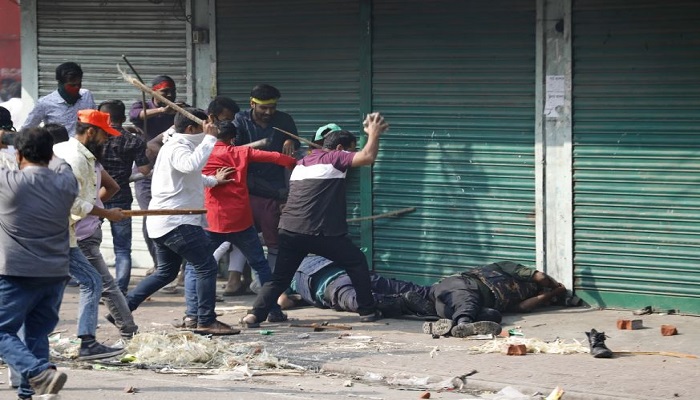
Following the heated arguments violence broke out and people allegedly started beating Iqbal with sticks and rods. It is alleged that he was brutally attacked on his legs and head and left bleeding. According to media reports, he died last night during treatment in Sawai Mansingh (SMS) Hospital.

Iqbal’s relatives have alleged that he was hit by a rod on the head and murdered. However, they refuse to give permission to conduct a post-mortem of the body.

The police called the FSL team to collect evidence from the spot and got Iqbal’s bike parked at the police station. SHO Suresh Singh Khatik stated that Iqbal (18), son of Abdul Majeez, resident of Phuta Khurra Ramganj in Jaipur, has been murdered. At around 10.45 pm, Iqbal was going home on a bike from Jaisinghpura Khor. Meanwhile, his bike collided with another bike in the market in Gangapol. They had a scuffle over the issue of bike collision.