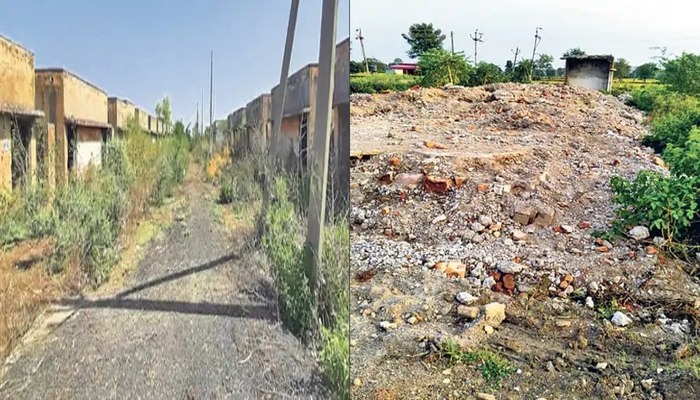
In the Jhalawara district of Rajasthan, around 372 houses of the Gharonda Affordable Housing Scheme in the Aklera area ‘disappeared‘ when one of the house owners went to see his house there. Reportedly, during the period of the last eight months, 372 houses and 2 parks have ‘disappeared’ and only their debris is found at the spot.
In the year 2021, one Tariq bought a house under the Gharonda Affordable Housing Scheme. In January this year, when he went to the said housing colony in Aklera to see his house, not only his house but the entire colony was there, properly constructed. However, months later, when the house owner revisited the colony, he found to his surprise that neither the house that he bought nor the colony was standing at the spot rather only debris of the same could be seen.
Which means, the entire colony disappeared in just 8 months. Evidently, entire houses in the colony were dismantled and stolen by thieves. Not just windows and doors, thieves took away bricks and steel rods and everything else found in the house, leaving rubbles of concrete and mortar. Even the foundations of some houses are missing, and owners are unable to identify the plots they own as the entire place is covered with debris.
Neither the house owners nor the officials of the Housing Board had any information about the ‘disappeared’ or ‘stolen’ houses. Moreover, even the local police were not aware when an entire colony was razed to the ground.
Meanwhile, Aklera Station House Officer (SHO) Lakshmi Chandra Bairwa said that the police do not at present have any details regarding the matter adding that the police have not received any complaints as of now.
According to a Dainik Bhaskarreport, several house owners who bought the houses constructed under the Gharonda Affordable Housing Scheme have submitted their complaints to the Housing Board officials. The complainants stated that they had purchased fully constructed houses, however, now even the foundation of their house is not found. The affected house owners have demanded that the Housing Board officials should at least get the marking of the plots done again to facilitate the house owners in identifying their plots.
Reportedly, the colony in question was built in 2012-13, however, as it was located far from the town, nearly 80 percent of houses remained unsold. In the year, 2019 the Housing Board offered a 50 percent discount on unsold houses. Subsequently, all the unsold houses in the colony were sold. Many people even bought more than one house after the discount. However, nobody moved into the houses to live, and the owners only visited them from time to time.
Everything was normal till January this year, however, in the last eight months, the entire colony was removed like it never existed, meanwhile, the police have no idea about what happened there.
‘Conspiracy theories’, it is said, often have a grain, or a sack full of it, truth to them. There is enough idiomatic proof to it – ‘there is no smoke without fire’, for example. However, one of the ‘conspiracy theories’ that turned out to be true was that the CIA was using American Abstract Expressionist painting as a tool for propaganda, covertly, during the Cold War.
One must read this excellent report on The Independent to understand the details of it. The CIA used American modern art – including the works of such artists as Jackson Pollock, Robert Motherwell, Willem de Kooning and Mark Rothko – as weapons in the Cold War at a time when American society abhorred the very idea of modern art itself. The Russian art at that time was crude – rife with communist messages and propaganda – right in the faces of people. The CIA instead chose subtle messages through modern art – to give the impression that the USA was a free society, of intellectualism and culture. The ‘Long Leash’ program to use modern art as CIA propaganda essentially aimed at diminishing the romantic allure of communism – which, realities aside – spoke of love, justice, equality and more.
CIA agent Donald Jameson had said, “Regarding Abstract Expressionism, I’d love to be able to say that the CIA invented it just to see what happens in New York and downtown SoHo tomorrow!” he joked. “But I think that what we did really was to recognise the difference. It was recognised that Abstract Expressionism was the kind of art that made Socialist Realism look even more stylised and more rigid and confined than it was. And that relationship was exploited in some of the exhibitions. In a way, our understanding was helped because Moscow in those days was very vicious in its denunciation of any kind of non-conformity to its own very rigid patterns. And so one could quite adequately and accurately reason that anything they criticised that much and that heavy-handedly was worth support one way or another.”
Jameson had also explained how the CIA would never be seen too close to the artists that they were promoting, in fact, if the artist was seen closer to Moscow or its ideology, it would bode better for the Long Leash program. What it led to was the formation of the Congress for Cultural Freedom – a vast network of artists, intellectuals etc. – who worked – some of them without their knowledge – for the CIA. The organisation was controlled by the CIA (it was a front), and the museums where the art was displayed were also controlled by the CIA – but nobody would really know about it until much later.
Art has always been considered a reflection of society at large, however, unrevealed to many, art often is the representation of religious, political and ideological propaganda that has to be furthered by those who commission or support the art. Italy, which is considered rightfully as the home of Renaissance art, also represented its religious and political aspirations and realities through commissioned art.
Propaganda is not necessarily a bad word and representing religion and politics through art isn’t either. However, the subtle influence that art is meant to bear on the mind of the impressionable cannot be underscored, especially when that art is used to demonise and victimise the already victimised. For example, art, cartoons and artistic posters were used extensively during the reign of Hitler to psychologically manipulate the masses to accept the stereotyping and victimisation of Jews.
“Is propaganda, as we understand it, not also a form of art?” asked Joseph Goebbels, Nazi Propaganda Minister, in June 1935. Using art for propaganda is a classic Communist/Socialist strategy and the Nazis had adapted to it greatly. Through films, art, exhibitions, cartoons, posters and more, Nazi Germany influenced their people to accept their vision of Nazi Germany – one without the ‘terrible Jews’.
Goebbels wrote in his diary, “No one can say your propaganda is too rough, too mean – these are not criteria by which it may be characterized. It ought not be decent nor ought it be gentle or soft or humble – it ought to lead to success.” Hitler wrote in Mein Kampf that to achieve its purpose, propaganda must “be limited to a very few points and must harp on these in slogans until the last member of the public understands what you want him to understand by your slogan. As soon as you sacrifice this slogan and try to be many-sided, the effect will piddle away.”
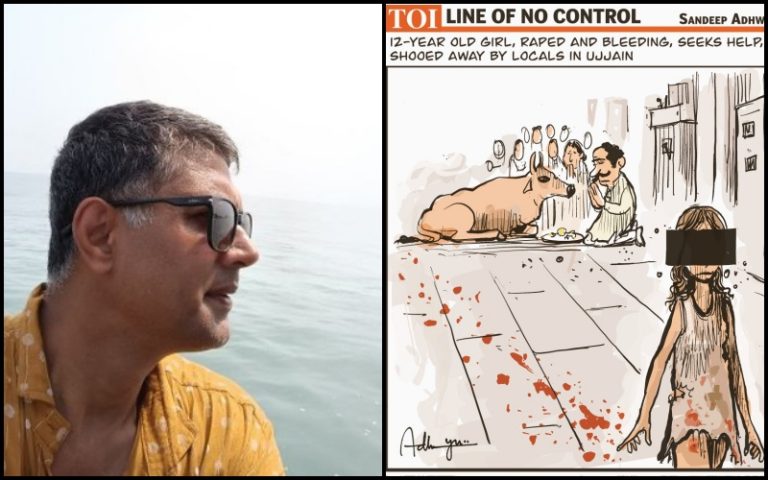
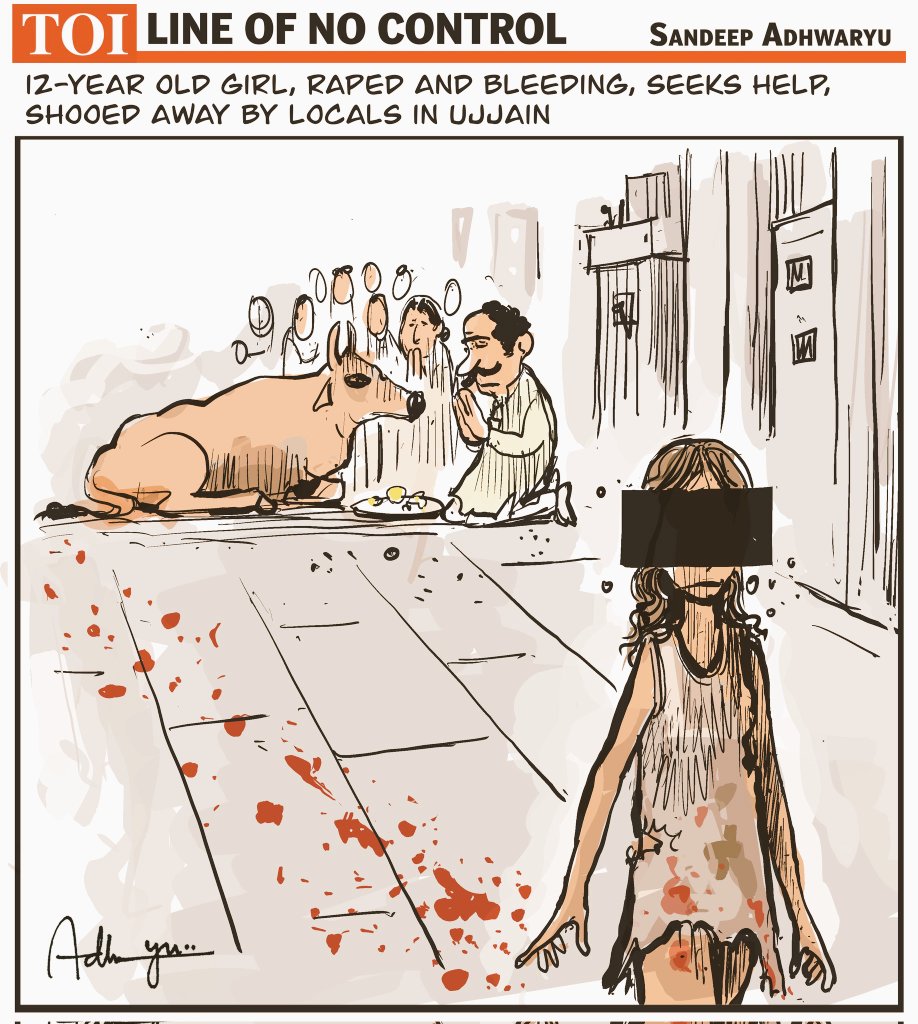
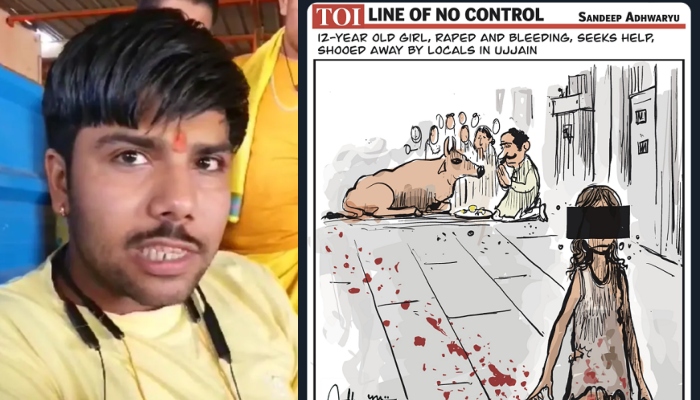
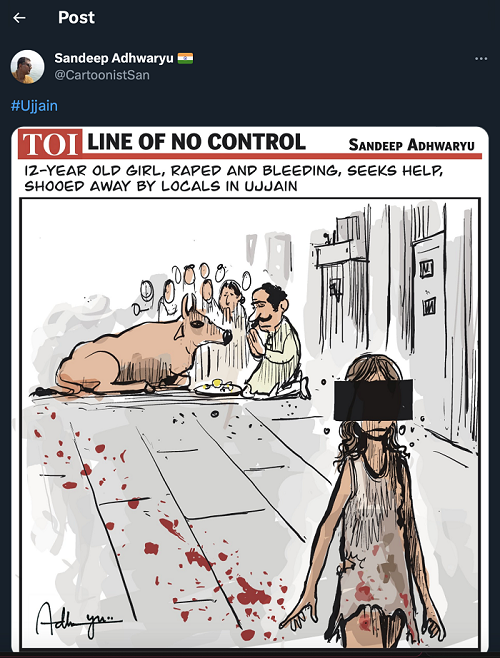
Indian propagandists, perhaps instinctively so or by training, have learnt from Nazi Germany rather effectively. Chief cartoonist of Times of India, Sandeep Adhwaryu, posted this cartoon today. He claimed later that the cartoon was not for Times of India but he had used the logo ‘by mistake’. He deleted the one with the TOI logo and apologised for it – not for the Hinduphobic cartoon – but for adding the logo of the organisation that could potentially sue his pants off.
Times of India cartoon on the Ujjain case
The cartoon was representing a horrific case that emerged from Ujjain, Madhya Pradesh. A little 12-year-old girl was raped and bleeding, roaming from house to house on the roads asking for help. The video of this horrific incident went viral on social media, leading to a rightful public outcry. ‘Why did nobody help the little girl’, was a question that everyone was asking.
The cartoon by Sandeep Adhwaryu is meant to represent that grim reality – of a little girl being brutalised and the society at large refusing to help.
But does it? Does it represent only that?
In the cartoon, what Sandeep essentially represented was not the angst of the girl or the apathy of the society – he represented how Hindus were busy worshipping a cow they consider their mother, while their daughter – a Hindu girl – roamed bleeding, brutalised and helpless.
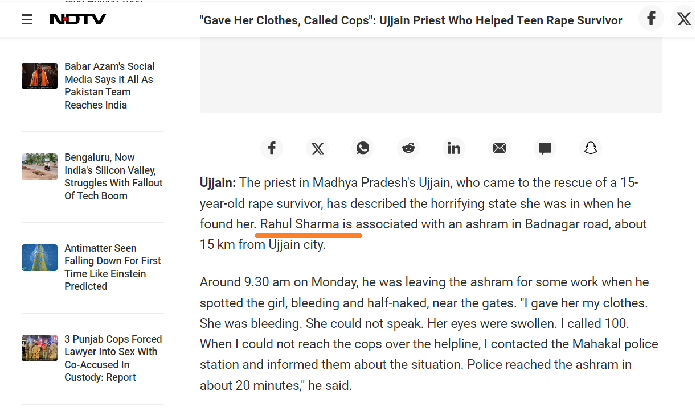
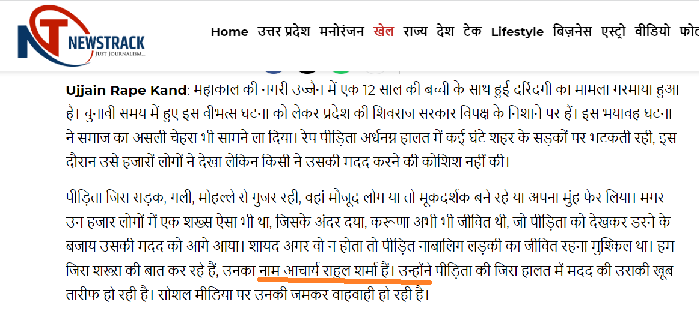
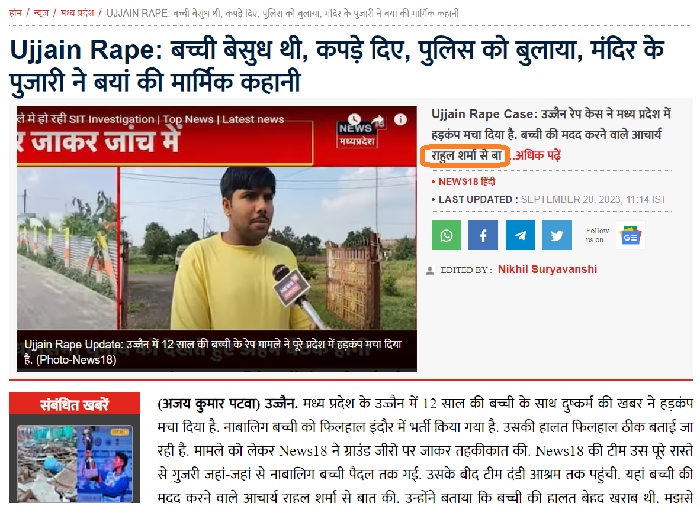
What Sandeep did not consider was that while everyone looked away, it was indeed a cow-worshipping priest who put clothes on the girl and took her to the hospital. The little girl walked 8 km in the city before she reached Dandi Ashram on the Badnagar road in the city, where Rahul Sharma offered her clothes and called for emergency medical service. He informed the police, who recovered the girl and took her to the hospital. Rahul Sharma said, “I gave her my clothes. She was bleeding. She could not speak. Her eyes were swollen. I called 100. When I could not reach the cops over the helpline, I contacted the Mahakal police station and informed them about the situation. Police reached the ashram in about 20 minutes.” Sharma said that at around 9:30 AM on Monday, while he was leaving the ashram, he saw the girl near the gates, who was partially naked and clearly injured with blood running down both of her legs.
Sharma added that although the girl was terrified of everyone, she was able to trust him to some extent. “Whenever someone else approached her, she tried to hide behind me. Then police came and took her with them,” he said.
But none of it really matters to Sandeep. As Hitler as his witness, he stuck to the winning strategy – keep the propaganda limited to a few points and harp on it till the public understands what you want them to understand. Sandeep understood what Hitler meant when he said that the message would piddle away if you focused on too many sides.
You see, but that is how truth is. Truth has many sides, varying contexts and facts that often need to come together to paint the entire picture. Hitler-esque propaganda has no space for many sides, many contexts and many truths – not if you don’t want your insidious impact to be pittered away.
The Hitler-esque propaganda against Hindus has hinged on three legs in the recent past – Islamophobia, Cow Worship and Caste. The messaging has to be simple – facts don’t matter – stick to the basic slogans – keep repeating – measure the propaganda by how effective it is – not by whether it is soft, humble, honest – the Nazi strategy was. Sandeep stuck to the magic potion – the facts did not matter to him, he kept the messaging simple – he stuck to the ISIS-prescribed trope of ‘cow worshipping Hindus’ being evil – and ensured that it was effective because it was deployed when the nation was emotionally vulnerable after seeing a little girl roaming the streets brutalised and helpless.
Showing Hindus as those barbarians who care about their cow worshipping more than actual human lives is not a new phenomenon. It is a simple recipe to use the faith of Hindus and use it to dehumanise them, blaming them for dehumanising others in pursuit of only their ritualistic faith. Further, the aim is also to show Hindus as a regressive, barbarous and hypocritical lot – those who care about an animal because they think of her as a mother, but either rape women or refuse to help raped Hindu girls when she comes knocking on the door.
Facts don’t matter – Hitler said. And of course, they don’t. Sandeep did not care that nobody really knew the religion of those who refused to help the little girl. There is no evidence to show that the little girl was helped or not helped because of her religion or the religion of the people living in the neighbourhood. In fact, the most obvious (and heartbreaking, might I add) reason for average people not to help even a little girl in such immense distress is that they fear a semi-functioning law enforcement system will persecute them for helping this girl – they might be questioned, suspected, harassed or worse.
But imagine the amount of hate it takes for cow-worship to be the first thought when the Ujjain news surfaced. So Sandeep read that a little girl was brutally raped and bleeding, she walked the streets of Ujjain with nobody helping her. He then read that a cow-worshipping pujari called Rahul helped her and finally called the emergency services. He then read the tweets and responses of those angered by people not helping this girl sooner. Immediately, Sandeep thought that this news was worthy of an editorial cartoon – I don’t fault him for that – it is literally his job.
He then proceeded to sit at his desk (I am presuming he has a working desk but then, who works from his bed – but who knows with these unbathed communists) and start ideating – “what could the cartoon be”, he must have thought. “How do I accurately capture the angst that people feel and that this little girl felt in that moment”.
The obvious answer – an obvious answer to Hitler’s disciples at least – is that ‘here is a tragedy and the perfect opportunity to emotionally and psychologically manipulate people with art’. He then picked up his pen and proceeded to disregard the last bit he had read – about the priest helping the little girl – and took refuge in the oft-repeated trope used to dehumanise Hindus – cow worship – a trope that ISIS uses often.
What this does is precisely what the aim (successful) of Nazi Germany was – dehumanising the subject so much by manipulating the emotions and insecurities of the society – that even their genocide does not shake their conscience.
For the liberal media and their coolies, the privilege of being seen as cherubic saints is only reserved for hardened criminals who work against the interest of India, murder Hindus, and for Jihadis who actively work towards ‘teaching Kafirs a lesson’. The eternal villains are Hindus – when they commit a crime (even if it’s non-religious) and even when a Hindu is victimised. They tug on the heartstrings, play on the society’s vulnerabilities and manipulate the collective conscience of the nation to ensure that pious Hindus – those who do not succumb to their liberals and/or Jihadi rules of the game – are demonised to such an extent, that the recipients of this propaganda rejoice when they are ultimately killed by the very Jihadis who they deem as cherubic saints – and all of this is achieved by a potent tool – art. Who would suspect that a cartoonist – the fuzzy, loveable creature who just wields the pen to send out messages of love and brotherhood to the nation – is secretly a Hinduphobe aiding an impending genocide of Hindus? Secretly working to dehumanise millions of people? Secretly disseminating the message of ISIS – Cow-worshippers are evil.
Sandeep Adhwaryu is a Hinduphobe. Sandeep Adhwaryu is a genocide enabler. Sandeep Adhwaryu is a liar. Sandeep Adhwaryu is a willing or unwitting ally of ISIS and by dehumanising “cow-worshippers”, he is only enabling those who wish to annihilate them – much like it was done to the Jews.
“There is way no out from this predicament and humiliation for the Muslims in India unless they respond to the call of jihad against these cowardly cow-worshipping Hindu filths”, ISIS had said in its latest magazine. They should perhaps thank Sandeep Adhwaryu and those like him for making their job easier.
As Canada levels baseless allegations against India for killing a Khalistani terrorist in British Columbia, reports have emerged that the Canadian police had reportedly warned Gurmeet Singh Toor, another Khalistani ‘activist’ in Canada, about potential threats to his life. This came months after Khalistani terrorist Hardeep Singh Nijjar was killed in Surrey, British Columbia. The document, titled “Duty to Warn”, addressed to Gurmeet Singh Toor, has been brought ahead by the Khalistani terrorist outfit Sikhs For Justice.
According to reports, Gurmeet Singh Toor said that Surrey RCMP and the Integrated National Security Enforcement Team (INSET) paid him a visit and delivered the warning to his residence at approximately 11:30 p.m. on August 24th. Gurmeet Singh Toor belongs to the same gurdwara as Hardeep Singh Nijjar.
The document “Duty to Warn” issued to Gurmeet Singh Toor read, “Police have determined by way of one or more investigative avenues that your life may be in peril. At this time we are unable to provide you with specific details of the threat.”
In a statement issued by the Khalistani terrorist organisation Sikhs For Justice, it is said that Toor is a senior member of the Guru Nanak Sikh Gurdwara, and was a “close associate” of Hardeep Singh Nijjar. According to this statement, after Hardeep Singh Nijjar’s killing, Gurmeet Singh Toor “began actively campaigning to secure votes in a non-binding vote in B.C. in support of an independent Sikh state Khalistan”
It is notable here that Gurmeet Singh Toor is also a witness to the murder of Hardeep Singh Nijjar. He and another witness Bhupinderjit Singh had tried to chase the car where the murderers of Nijjar had escaped, as per their own statements to the media. Witness statements in the case had revealed that the shooters who fired at Nijjar were Sikh men, with their turbans visible beneath their hoodies.
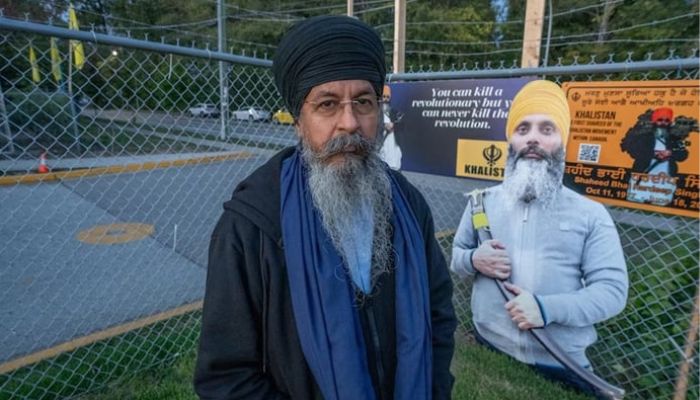
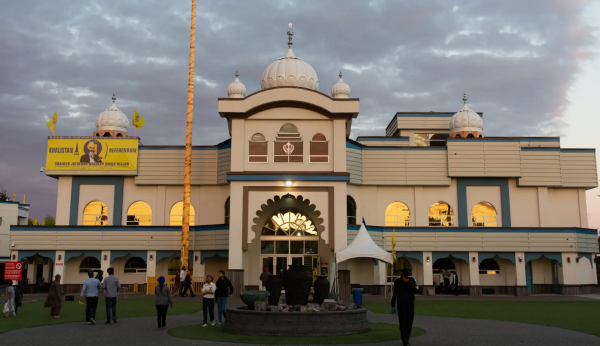
The Guru Nanak Sikh Gurudwara has been openly displaying anti-India and pro-Khalistan posters. It also has display banners declaring the Khalistan Referendum.
The Guru Nanak Sikh Gurudwara where Nijjar worked and Toor works, displayed Khalistan banners, image via NYT
Regarding this warning received by the Royal Canadian Mounted Police, Khalistani Gurmeet Singh Toor said that RCMP asked him what activities he is involved in. He said officers declined to provide him with more details about the threats. Since receiving the warning, he has expressed heightened concerns for his safety and has remained extremely vigilant about his surroundings.
Gurmeet Singh Toor received this warning from the Canadian police about a month before Canada’s Prime Minister Justine Trudeau leveled allegations against India and said in Canada’s parliament on 19th September 2023 that Indian agents were involved in the killing of Hardeep Singh Nijjar.
Canada expelled a senior Indian diplomat as a result of the allegations. The allegations against India opened a can of worms as the allied countries of Canada refused to issue a joint statement against India. Furthermore, India denied the allegations and expelled a Canadian diplomat in retaliation.
Hardeep Singh Nijjar was a Khalistani terrorist wanted by the Indian government. The 46-year-old hailed from the village Bhar Singhpura of Jalandhar. He was President of the Guru Nanak Sikh Gurdwara Sahib in Canada. His name was recently added to the list of designated terrorists by the Indian Government.
In 2022, the National Investigation Agency (NIA) declared a Rs 10 lakh reward on Nijjar after his name appeared in a conspiracy to kill a Hindu priest in Jalandhar, Punjab. Hardeep Singh Nijjar was killed in his truck in the parking lot of Guru Nanak Sikh Gurdwara in Surrey on June 18 evening by unidentified gunmen.
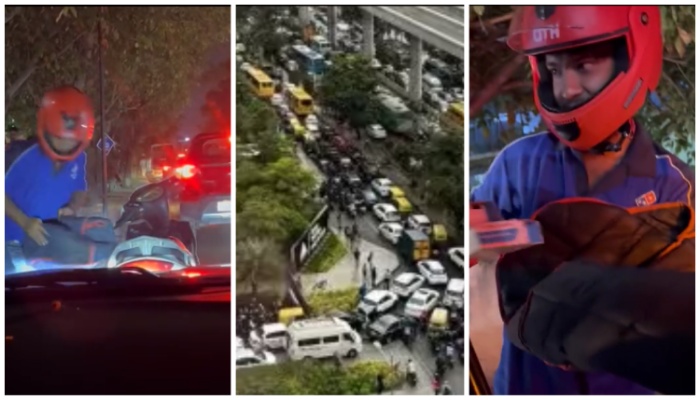
On Wednesday, September 27, in the midst of severe traffic congestion in Bengaluru, a man dialled Dominos, and the next thing one knew, two delivery boys from the pizza shop arrived at the car within 30 minutes to bring hot pizzas to its customer. The video of the incident went viral on X, formally Twitter after the happy customer himself posted a video of his unique experience.
“When we decided to order from @dominos during the Bangalore choke. They were kind enough to track our live location (a few metres away from our random location added in the traffic) and deliver to us in the traffic jam,” X user @rishivaths wrote along with hashtags #Bengaluru #bengalurutraffic#bangaloretraffic. He posted a 0.30 seconds clip where the two delivery boys from Dominos were seen delivering pizzas to him on the Outer Ring Road (ORR) area of the city.
While several Netizens praised the delivery boys who cleverly tracked the customer’s live location and delivered the pizzas on time even in the traffic chaos, several others criticised the traffic situation in the capital city of Karnataka.
Several social media users, who were stuck in the traffic jam on the ORR on Wednesday, took to X to share their horrifying experiences.
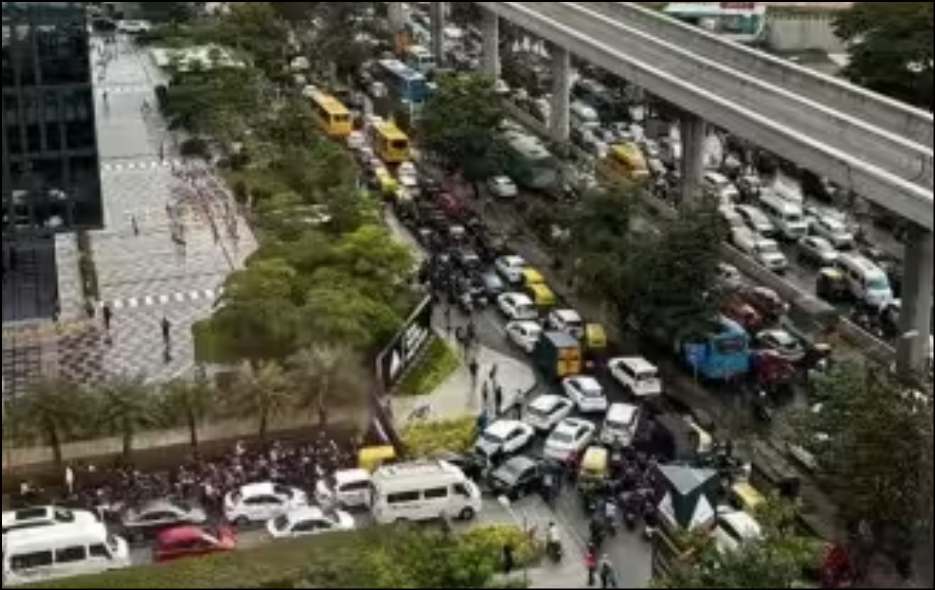
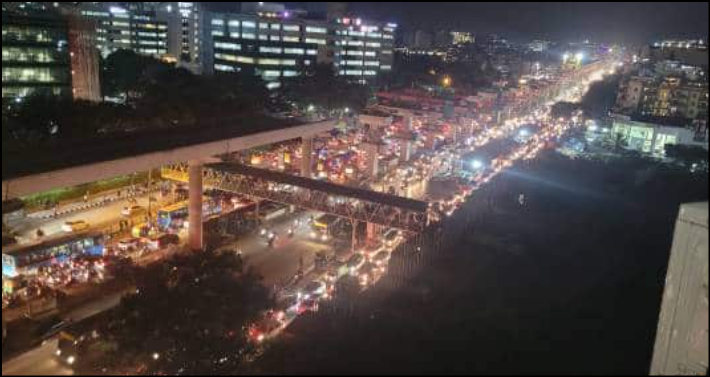
While Bengaluru is known for its crazy traffic congestion, the situation in the city was exceptional on Wednesday, September 25, with the city’s tech corridor ‘Outer Ring Road (ORR)’ experiencing an unprecedented traffic jam. Commuters, including children in school buses, travelling through areas like Marathahalli, Bellandur, Sarjapur, Varthur, Whitefield and Iblur, took almost double the usual time to reach their destinations.
Traffic gridlock on ORR in Bengaluru (Source: X)
Traffic gridlock on ORR in Bengaluru (Source: Moneycontrol)
The Mahadevapura task force, which gives regular updates on roads and traffic management in the city, also shared a picture of a massive traffic jam on the Outer Ring Road.
Traffic congestion heat map today as compared to a typical Wednesday
Joint Commissioner of Police (Traffic) M N Anucheth, who personally monitored the situation at the ORR, said that the stretch from Marathahalli to Silk Board Junction usually sees 1.5 lakh to 2 lakh vehicles on Wednesdays. That number shot up to 3.59 lakh as of 7.30 p.m. on September 25.
JCP Anucheth gave a few of the main reasons for the traffic gridlock Bengaluru experienced on Wednesday, namely the bandh declared on Tuesday over the Cauvery River water row, Ganesh Visarjan, and Comedian Trevor Noah’s show that was cancelled later.
According to Anucheth, because of Tuesday’s bandh, a lot of employees have come back to work and tried to exit at the same time. The upcoming long weekend only added to the problem. “Lots of people are leaving Bengaluru,” he added.
Bengaluru Bandh: Pro-Kannada outfits and farmers protest against govt for releasing Cauvery water to Tamil Nadu
On Tuesday, September 26, farmers and Karnataka Rakshana Vedike staged a protest against the Cauvery Water Management Authority’s (CWMA) decision to release 5,000 cusecs of water to Tamil Nadu. Bus services from Tamil Nadu to Karnataka were affected due to the bandh in Bengaluru. Several buses from Tamil Nadu were stopped at Zuzuvadi in the state’s Krishnagiri district.
While the city’s schools and universities had announced a holiday, some industry and trade organisations, as well as a number of hotels, had also stated that they would remain closed. The Namma Metro services continue as usual. Section 144 was also imposed in the city.
The police detained some of the pro-Kannada protesters, including the BJP leaders after the protesters surrounded the Raj Bhavan in Bengaluru.
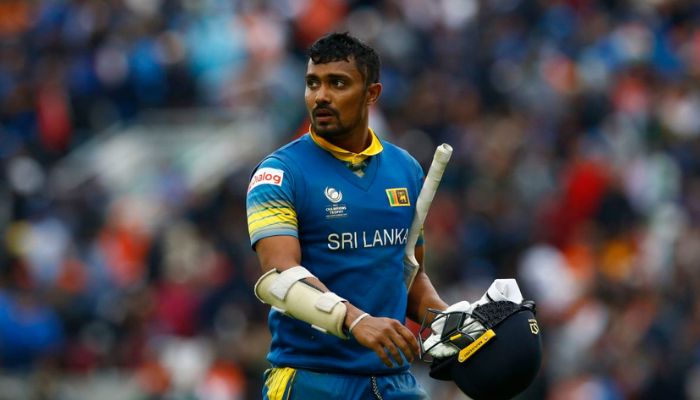
Sri Lankan cricketer Danushka Gunathilaka has been acquitted of sexual assault charges by a Sydney court. The 32-year-old was arrested in November 2022 during the T20 World Cup, following an accusation of non-consensual sexual intercourse made by a woman. Initially facing four counts of rape, the court proceeded with only one count during the trial.
Gunathilaka pleaded not guilty and underwent a four-day trial presided over by Judge Sarah Huggett at the Downing Centre District Court. Despite being under suspension from all cricket activities by Sri Lanka Cricket (SLC), Gunathilaka is now cleared to return to Sri Lanka.
Judge Sarah Huggett noted that the cricketer had “answered every question asked of him” by the police and gave a “distinct impression he was doing his best to be truthful”. The judge said, “The evidence establishes that there was no opportunity for the accused to remove the condom … because that intercourse was continuous.”
Judge Sarah Huggett said, “There is no reason at all to reject or disbelieve what he said in that interview. The complainant did not strike me as a witness motivated by a desire to give deliberately false evidence. However, there were occasions when I formed the impression that some of her evidence had the appearance of being motivated by a desire to paint the accused in an unfavourable light.”
Danushka Gunathilaka said outside the court in Sydney, “I think the judge’s verdict says everything. The last 11 months have been really hard for me. I’m happy that my life is normal again. So I can’t wait to go back and play cricket.”
Notably, the woman had alleged that she was sexually assaulted four times in her Rose Bay house on November 2, 2022, after going out on a date with the Sri Lankan cricketer, who was in town for the T20 World Cup. Danushka Gunathilaka was then arrested from Sydney’s Hyatt Regency Hotel by the Sydney police when the rest of the members of the Sri Lankan team were preparing to return home following the team’s elimination from the Super 12 stage.
Danushka Gunathilaka has played 8 Tests, 47 ODIs, and 46 T20Is for his country. He is a left-handed batsman and a right-arm leg-break bowler. In ODIs, Gunathilaka has scored 1601 runs at an average of 35.57, with two centuries and eleven half-centuries. His highest score is 133, which he scored against India in 2017. He has also taken one wicket in ODIs. In T20Is, Gunathilaka has scored 741 runs at an average of 16.46, with three half-centuries. His highest score is 57, which he scored against New Zealand in 2019. He has not taken any wickets in T20Is.
There seems to be no end to student suicides in the coaching hub of Kota in Rajasthan. A NEET student from Uttar Pradesh’s Maharajganj district committed suicide by hanging himself in his room in a shocking episode which transpired on 27 September. The deceased has been identified as 20-year-old Mohammad Tanvir Khan. Notably, his father is also a teacher in Kota.
The incident took place in the Kunhadi police station area of Kota. The body was taken into custody and sent for post-mortem. The reason behind the extreme measure is being investigated by the authorities.
The victim was reportedly staying in a rented house in Krishna Vihar with his father and sister in Kunhadi neighbourhood. He was living in the city for the last 12 months and was studying for the prestigious national medical exam after completing 12th grade.
His father, Mohammad Hussain, taught class 11 and 12 students at a coaching facility in Kota. However, the youngster used to do self-study and was not admitted to any coaching institution.
Circle Inspector Meena stated that his sister was present at home during the suicide. He told his sister that he was changing his clothes before entering the room on the fateful night. The sister got suspicious when he did not come out for a long time. He was discovered hanging from a noose after the door of the room was forced open. She immediately informed the father who rushed to their place and informed the police.
A probe into the incident has been initiated by the local police. The official mentioned that the suicide took place on the afternoon of September 27. The student was brought to the hospital by his father where doctors pronounced him dead. The dead body was then subjected to autopsy before it was handed over to the family who left for Maharajganj along with it. The cop conveyed that the victim was ill and undergoing treatment.
Notably, more than 25 students have ended their lives in Kota this year and at least 9 students have embraced death in the last 2 months. A 17-year-old student from Mau, Uttar Pradesh killed herself on 18 September in Kota by ingesting pesticide. She came out of her coaching establishment vomiting and was rushed to hospital where she passed away during treatment.
The alarming increase in suicide cases over the past few months has alarmed the local authorities and prompted them to take action. They have ordered coaching institutions to stop holding exams for a two-month period and mandated that anti-hanging mechanisms be installed in ceiling fans.
Furthermore, the Kota police are attempting to recruit hostel staff members including wardens, mess employees and tiffin suppliers to look for any indications of stress or depression among the students residing in hostels and as paying guests.
The district administration has created a quiz for pupils to determine whether they are experiencing depression. The results of this test would determine how many of them suffered from depression, anxiety and stress.
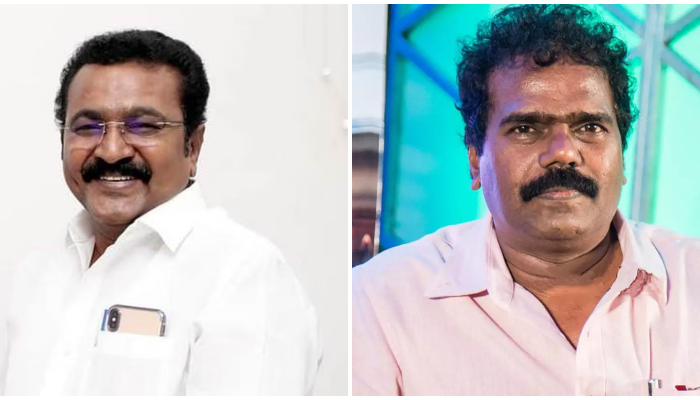
The Madras High Court has issued an order for a comprehensive probe into a contentious land acquisition matter involving 186 acres of public property located in Silampanathanpettai in Tamil Nadu’s Cuddalore district. T. R. V. S. Ramesh, a member of parliament for the DMK (Dravida Munnetra Kazhagam), is accused of transferring land titles to associates of renowned filmmaker Thangar Bachchan.
The court was shocked upon learning that the public land was unlawfully designated as patta land and granted to the family members of the DMK leader and the film director who have built a cashew nut business along with an opulent edifice on the government property.
Justice SM Subramaniam passed the interim orders on 26 September and proclaimed, “The nature of allegations and the magnitude of the government land converted as patta lands, conversion of waterbody as patta land are a shocking revelation.”
The judge ruled that the concerned revenue divisional officer was accountable for turning government-owned ‘tharisu land’ (land left without cultivation) and ‘waterbody’ into patta land illegally and warned that public employees who act as party servants risk being fired and forced to find new employment. The Commissionerate of Land Administration (CLA) was appointed by the judge as a court-appointed officer to investigate, submit a report to the court and take appropriate action.
Justice SM Subramanian strongly voiced his opinions throughout the proceedings. He highlighted that public service should come before political connections for government employees, especially the Revenue Tax Officer (RTO) whose salaries are reimbursed by taxpayers. He emphasised the responsibility of public workers to serve the people diligently and impartially.
The issue took an alarming turn when it emerged that the government property had been registered in the names of T. R. V. S. Ramesh and the family of Thangar Bachchan reportedly without the necessary paperwork. The Cuddalore Revenue Commissioner was called to appear in court by the justice after Panchayat Chairman Devayanai complained about these violations.
Government lands, according to the petitioners, were recorded in the names of the accused. They asserted that the land was used for cashew farming without permission. The government, on the other hand, refuted the accusations and alleged that the petitioner was referring to a separate plot of land.
The judge expressed alarm about the nature of the charges, particularly the transformation of public lands and waterbodies into registered properties. He stated that the engagement of government representatives was implied for such practices to commence. He warned all government workers that legal action would be taken if corruption transpired within their ranks.
The petitioner’s request to have the registrations cancelled was initially denied by the Cuddalore Revenue Commissioner. Dissatisfied with the response, the court sought a thorough investigation into the case and the delivery of an extensive report to the Land Commissioner within three months.
The court wanted to make sure that the property acquisition scam was fairly and effectively looked into so the next hearing in the case is set for 22 January of the next year. The Madras High Court has made it clear that it would not stand for any illegal actions that infringe on the rights of communities with a high vulnerability and the misappropriation of public funds.
The decision was reached in response to a writ case brought by the president of the Silambanathanpettai village panchayat in the Cuddalore district which accused officials of forging documents and converting government-owned ‘tharisu’ (dry) land and waterbodies into patta land that was then given to the families of the Cuddalore MP and the film director.
Notably, the politician who is designated as the main accused in the case is also charged with murder. He was arrested on suspicion of killing a worker at a cashew unit in Panruti town.
The district administration in Sultanpur, on Monday, September 25, bulldozed properties belonging to Ajay Narayan Singh and his kin. Ajay Narayan Singh is the prime accused in the Sultanpur doctor murder case, wherein a doctor posted at a Community Health Centre (CHC) in Uttar Pradesh’s Sultanpur was allegedly beaten to death on Saturday, September 23 over a land dispute.
Accused Ajay Narayan Singh is the nephew of Bharatiya Janata Party’s former district president Girish Narayan Singh alias Babban Singh.
#WATCH | Sultanpur, UP: Demolition of unauthorised illegal encroachment by Ajay Narayan Singh, the accused in the murder case of a doctor in Sultanpur. pic.twitter.com/1h24ZyvBQt
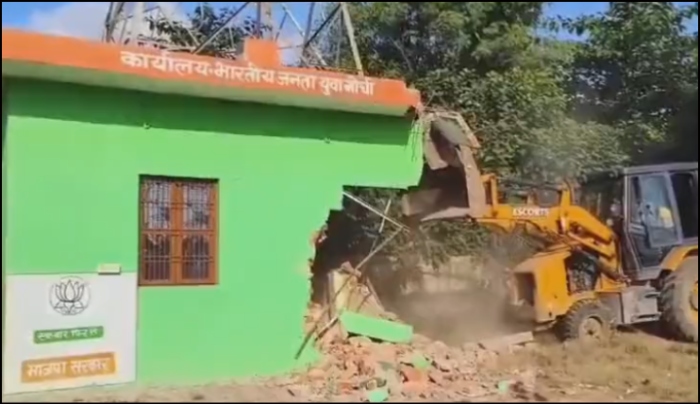
Video of the bulldozer action taken against the unlawful encroachment on government land by the BJP leader went viral on social media. In the video, the authorities can be seen running the bulldozer on the office of Bharatiya Janata Yuva Morcha in Sultanpur, reportedly built on municipality land, usurped by the accused and his relatives.
According to reports, the land that was freed by the officials was worth Rs 4 crores.
कल सुल्तानपुर में डॉक्टर तिवारी की हत्या की खबर आयी। और आज आरोपी के भाई भाजपा नेता अजय नारायण की क़ब्ज़ाई प्रॉपर्टी पर बुलडोज़र चल गया। अजय पर पुलिस ने 50k इनाम रखा है और उसके आरोपी पिता को गिरफ़्तार कर लिया।
Following this move, the administration’s bulldozer arrived at the land in Shastri Nagar that the deceased doctor had purchased through a deed of sale. The administration, in collaboration with revenue officials, completed the delineation and removed the illegal encroachment on the land owned by the deceased doctor. The administration has so far removed encroachment from property valued at approximately Rs 4 crore.
According to DM Jasjeet Kaur, protection has been provided to the deceased’s family.
Besides the bulldozer action, the Sultanpur police in Uttar Pradesh arrested Jagdish Narayan, the father of Ajay Narayan Singh, who has been accused of beating Ghanshyam Tiwari, a 53-year-old doctor to death over a land dispute. Police announced a reward of Rs 50,000 on Ajay Narayan’s arrest.
Also, Kotwali Nagar SHO Ramashish Upadhyay was removed from his post for his laxity in handling the murder case.
The police had also carried out multiple raids to arrest the accused. Superintendent of Police (SP) Somen Burma had assured that the accused would be arrested soon, adding that several teams, including the city police, are conducting raids to arrest the culprits.
The actions were taken based on a complaint filed by the deceased’s doctor’s wife Nisha Tiwari on Monday September 25. In addition to the primary accused, Ajay Narayan Singh, she accused BJYM President Chandan Narayan Singh, former BJP National Working committee member Girish Narayan Singh, Vijay Narayan Singh, and Jagdish Narayan Singh of being complicit in the murder.
Sultanpur doctor murder case
Dr Ghanshyam Tiwari, a resident of Shastri Nagar, was posted at Jaisinghpur Community Health Centre. On Saturday (September 23), he stepped out for some work. Later in the evening, an auto-rickshaw driver dropped him off outside his house in a critical condition and fled. Reports suggested that the doctor was beaten to death by Ajay Narayan Singh and his associates.
The doctor had reportedly purchased land from Ajay Narayan Singh’s father, Jagdish Narayan but there was a dispute over its possession, police had said earlier.
Speaking about the murder, the deceased’s wife Nisha Tripathi cited a land dispute to be the reason behind her husband’s murder. She said, Ajay Narayan Singh who lives in Narayanpur physically assaulted my husband, leading to his death.”
“My husband came to the house in the evening, took Rs 3,000 from me and said it was for a person making a map. He left the house after having some snacks. Later, he was dropped off on a rickshaw in an injured state,” she added. Dr Ghanshyam Tiwari was rushed to a hospital where he succumbed during the treatment.
Following the doctor’s death, former MLA Devmani Dwivedi and District President Dr R A Verma reached the hospital, demanding strict action against the accused.
How SP and Congress grabbed the opportunity to play petty politics
Since the accused was the cousin of an ex-BJP leader, the Samajwadi Party chief Akhilesh Yadav and leaders of the Congress party grabbed the opportunity to berate the BJP-led state government in Uttar Pradesh. They accused the state government of not taking action in the case since the accused belonged to the family of a former BJP leader.
However, the Yogi Government has silenced the opposition by proving yet again that the law and order in Uttar Pradesh under his reign does not distinguish between offenders.
A video in which a temple priest claims that Prime Minister Narendra Modi donated merely Rs 21 in a white envelope in the temple’s donation box, has been going viral on social media in the past few days. Soon after, several I.N.D.I. Alliance leaders and their supporters started mocking PM Modi for donating a small amount in the “daan peti”.
The viral video is from January this year when Prime Minister Modi visited the Devnarayan Temple in Rajasthan’s Bhilwara to pay his respects at the temple while the celebration of Lord Devnarayan’s 1111th birth anniversary was ongoing. According to the temple’s priest Hemraj Poswal, as seen in the viral video, “When the donation box was opened, Rs 21 came out of the envelope.” The priest claimed that three envelopes were found in the donation box nine months after it was opened. He added that Modi had dropped a white envelope in the box and in the same envelope, just Rs 21 have been found. The others contained Rs 101 and Rs 2100 as claimed by the temple priest.
The said video was then used by the political opponents of PM Modi to target him saying that PM Modi “deceived” the Gurjar community as the temple holds special significance for the Gurjars.
Congress leader Dheeraj Gurjar claimed that PM Modi “deceived” the Gurjar community as he offered merely Rs 21 in the donation box saying that ” It is not a good thing for the Prime Minister of the country to deceive any society by showing them a dream.”
गुर्जर समाज एक सीधी, सच्ची, ईमानदार, सरल एवं स्वाभिमानी कौम है और किसी कौम व समाज को इस तरह छलना अच्छी बात तो नहीं है माननीय प्रधानमंत्री श्री @narendramodi जी।
याद है ना प्रधानमंत्री मोदी जी, जब आपका देव दरबार के 1111वें प्राकट्य दिवस पर देव धाम भीलवाडा-आसींद मालासेरी डूंगरी… pic.twitter.com/Eppt7ibWbI
Samajwadi Party leader I.P. Singh claimed that while PM Modi gave Rs 21 lakh crore to businessman Gautam Adani, he offered just Rs 21 to the Hindu deities. “Modi ji put Rs 21 lakh crore in Adani’s donation box but offered Rs 21 to the deities. Even the poorest Hindu does not put so much money in the charity box anymore,” the Samajwadi Party leader posted on X.
अडानी के दान पात्र में मोदी जी ने 21 लाख करोड़ रुपये डाल दिये पर आराध्य देवी देवताओं को 21 रु0 चढ़ाये।
Another Congress leader Surendra Rajput claimed that while PM Modi gives Rs 21 to the temple, he gifts diamond worth lakhs of rupees to the wife of the American President. “Prime Minister Shri Narendra Modi gives Rs 21 to the temple and gives a diamond worth lakhs of rupees to the wife of the President of America! After that he also gives sermon on Sanatan Dharma,” Rajput posted on X.
It is amusing to see the audacity of the Congress leader to even mention Sanatan Dharma when his party is in alliance with DMK, a party that openly calls for the eradication of Sanatan Dharma.
प्रधान मंत्री श्री नरेंद्र मोदी मंदिर में 21 रुपये देते हैं और अमरीका के राष्ट्रपति की पत्नी को लाखों रुपये का हीरा देते हैं! उसके बाद सनातन धर्म पर प्रवचन भी देते हैं। pic.twitter.com/Lr7RO85xFN
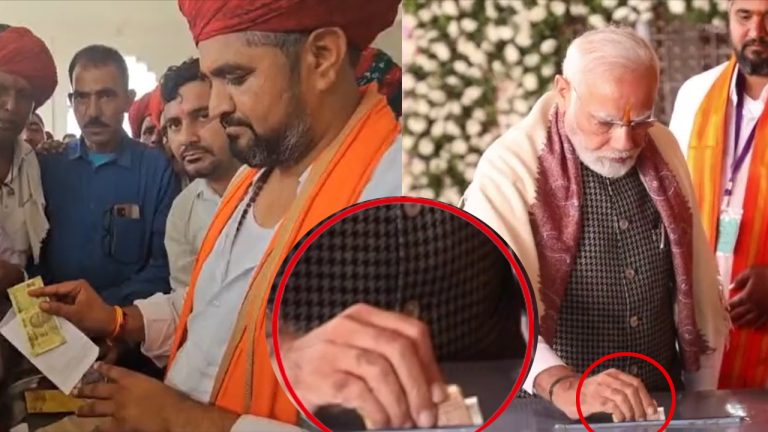
Amidst the online attack on PM Modi over Rs 21, another video has surfaced on social media wherein it is clearly seen that PM Modi did not put any envelope in the donation box as claimed by priest Hemraj Poswal, in fact, PM Modi had directly dropped some currency notes into it.
As seen in the video, Prime Minister Modi proceeded through the temple, performing rituals, praying, and eventually making a donation (without an envelope) as an expression of respect and reverence. While all this was happening, priest Hemraj Poswal was standing behind PM Modi at some distance.
Fake News is being spread with malicious intent by leftists & Congress paid media that PM Modi donated ₹21 in an envelope in Bhilwara temple .
The visuals make it clear that PM Modi didn’t use a white envelope to make the donation, as alleged by the priest. This raises questions about the veracity of the claims made by the priest. Moreover, the question arises if there is more to the picture than what meets the eyes ahead of the coming state assembly elections.
A day after the horrific case of rape of a 12-year-old girl came to the fore from Madhya Pradesh’s Ujjain city, the Times of India has targeted the Hindu religion through their cartoon on the crime.
In a cartoon sketch shared by Times of India, Chief Cartoonist Sandeep Adhwaryu showed Hindus worshipping a cow while the girl walked with injuries seeking help from the locals in Ujjain. The cartoon sketch also indicates that Hindus chose to worship the cow and deliberately ignored the girl while she sought help.
However, the cartoon missed a major detail, that the girl was helped by a Hindu priest identified as Rahul Sharma. As reported earlier, the victim girl was scared and walking on the streets of Ujjain seeking help. She had injuries on her private parts and was bleeding.
She walked for around 8 km in the city seeking help but to no avail. Finally, when she reached near Dandi Ashram on the Badnagar road in the city, where Rahul Sharma offered her clothes and called for emergency medical service. He informed the police, who recovered the girl and took her to the hospital.
Rahul Sharma told NDTV, “I gave her my clothes. She was bleeding. She could not speak. Her eyes were swollen. I called 100. When I could not reach the cops over the helpline, I contacted the Mahakal police station and informed them about the situation. Police reached the ashram in about 20 minutes.”
Sharma said that at around 9:30 AM on Monday, while he was leaving the ashram, he saw the girl near the gates, who was partially naked and clearly injured with blood running down both of her legs. Several other media reports also highlighted that the girl was saved by a Hindu priest associated with the Dandi Ashram.
Sharma added that although the girl was terrified of everyone, she was able to trust him to some extent. “Whenever someone else approached her, she tried to hide behind me. Then police came and took her with them,” he said.
The Times of India cartoon, however, instead of recognising and lauding the Hindu priest for rescuing the girl, targeted Hinduism by showing Hindus worshiping a cow and ignoring the girl while she sought help.
After the cartoon triggered outrage on social media, Sandeep Adhwaryu issued a ‘clarification’, saying that it was his personal cartoon and had nothing to do with Times of India, even though the cartoon clearly carried the heading: TOI- Line of no control. He claimed, “The presence of TOI logo in my previous post was inadvertent as I had forgotten to remove it from the standard format of the frame before posting.”
Three persons have been arrested by the Police in the rape case, including an auto-rickshaw driver. According to Narottam Mishra, the home minister for Madhya Pradesh, a suspect has been detained and a special investigation team (SIT) has been established to look into the situation. The accused has been charged with rape in accordance with the Protection of Children from Sexual Offences (POCSO) Act.
The girl belongs to Prayagraj, Uttar Pradesh, and says that her mother has also been raped and assaulted. The Police have filed a case and are investigating as to why the girl and her mother had come to Ujjain and why were they being followed