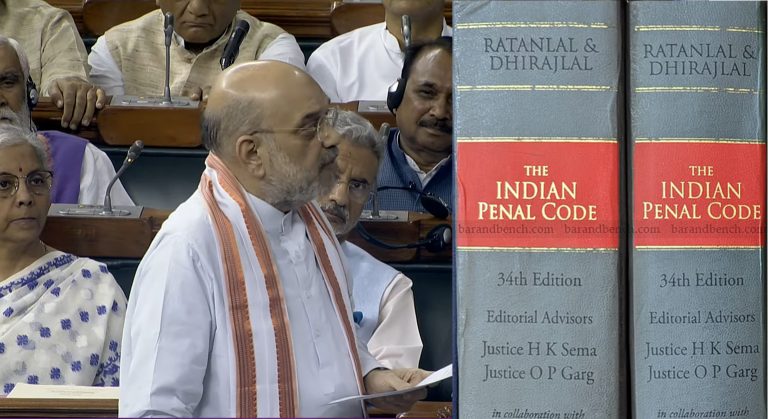
Union Minister Amit Shah on Friday introduced the Bharatiya Nyaya Sanhita, 2023 in Lok Sabha and said that the new bill to replace the Indian Penal Code (IPC) will repeal the offence of sedition under Section 124A. This section will be replaced with Section 150 in the new bill.
Section 124A of the IPC reads “Whoever, by words, either spoken or written, or by signs, or by visible representation, or otherwise, brings or attempts to bring into hatred or contempt, or excites or attempts to excite disaffection towards, the Government established by law shall be punished with imprisonment for life, to which fine may be added.”
In the new bill, provisions under Section 150 have replaced this section and they relate to dealing with the act of endangering the sovereignty or unity and integrity of India.
The section reads, “Whoever, purposely or knowingly, by words, either spoken or written, or by signs, or by visible representation, or by electronic communication or by use of financial mean, or otherwise, excites or attempts to excite, secession or armed rebellion or subversive activities, or encourages feelings of separatist activities or endangers sovereignty or unity and integrity of India; or indulges in or commits any such act shall be punished with imprisonment for life or with imprisonment which may extend to seven years and shall also be liable to fine,” the bill read.
The bill further reads under Section 151, “Whoever wages war against the Government of any foreign State at peace with the Government of India or attempts to wage such war, or abets the waging of such war, shall be punished with imprisonment for life, to which fine may be added, or with imprisonment of either description for a term which may extend to seven years, to which fine may be added, or with fine.”
Amit Shah today introduced three bills in the Lok Sabha to replace the IPC, the Code of Criminal Procedure (CrPC), and the Indian Evidence Act.
Speaking on the three bills in the Lower House, Amit Shah said, “Under this law, we are repealing laws like Sedition.”
“From 1860 to 2023, the country’s criminal justice system functioned as per the laws made by the British. With these three laws there will be a major change in the criminal justice system in the country,” he said.
The key bills include a new penal code against mob lynching, death provision for the rape of minors and a time-bound approval to prosecute civil servants. A provision has been brought to try absconding criminals such as Dawood Ibrahim in absentia.
The bill will be sent further for scrutiny by a Parliamentary panel.
(This news report is published from a syndicated feed. Except for the headline, the content has not been written or edited by OpIndia staff)
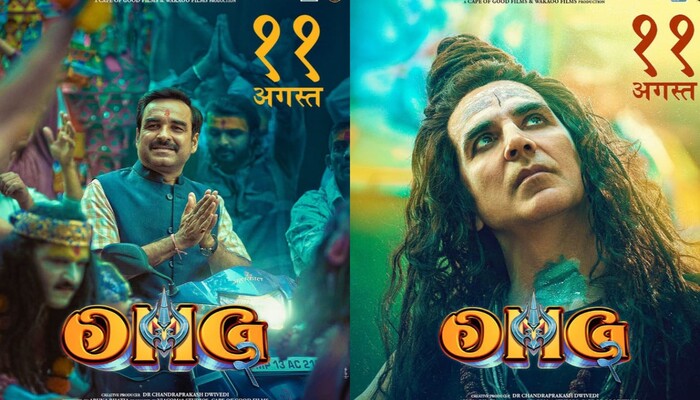
Film OMG 2 starring Akshay Kumar, Pankaj Tripathi, and Yami Gautam in the lead roles has been released in the theatres on August 11. The film is a sequel to the 2012 hit ‘OMG: Oh My God’ and has been in controversy ever since its teaser came out.
The Amit Rai directorial has been given an ‘Adults Only’ certification by the Central Board of Film Certification (CBFC), that too after 27 alterations were asked to be made which includes tweaking Akshay Kumar’s character of Lord Shiva to his messenger.
The film is based on the subject of sex education. The plot centers around Kanti Sharan Mudgal (Pankaj Tripathi), a devotee of Lord Shiva who owns a pooja shop near a temple. His life changes upside down when his son Vivek is admitted to the hospital for exhaustion caused by excessive masturbation and is expelled from school on the grounds of obscene and vulgar behavior after a video of him performing the act in the school toilet goes viral online.
At this point, Kanti Sharan Mudgal decides to relocate with his family, however, Akshay Kumar as a messenger of god steps in and the movie takes a dramatic turn with Kanti Sharan Mudgal dragging sex therapists, a doctor, a chemist, and saints to the court. Yami Gautam plays a lawyer in the film named Kamini Maheshwari. Actor Arun Govil known for his portrayal of Lord Rama in Ramanand Sagar’s iconic Ramayan television series has been cast in a negative role in the film.
The mainstream media is heaping praises on the film for ‘reducing the gap between Indian parents and the children’ and ‘normalising sex and sexual desires which are otherwise seen as a taboo in society’. The film mentions Indian scriptures including Kamasutra as well as the sculptures of Ajanta-Elora and Khajuraho to justify masturbation as normal behavior.
Some social media users have accused the makers of selectively choosing Hindu characters and Hindu themes for the movie because plot association with any other religion would have generated outrage.
Contrary to what most people believe, Rishi Vastyayan authored Kamasutra is more of a study of ancient Indian power dynamics, gender roles, and pleasure etiquette than a sex handbook. While the Rishi did note that sex education among adolescents is pertinent keeping in view that early marriages were prevalent in those times, however, in the modern era, the minimum age of marriage in India is 18 for girls and 21 for boys.
Inside the courtroom in the film, a woman is asked to tell how she and her husband consummated their marriage. A sister explains why her brother’s masturbating was appropriate. A Shiva devotee describes the attractiveness of his opposing counsel’s buttocks. ‘How a child is born’ is a point of debate in court. Young men and women in the crowd shout that they masturbate. The question here is whether the film intended to discuss sex education or simply exploit the subject because the West is doing so.
There is a prevalent misconception that Westernization is modernization, the film feeds into this misconception as the makers of OMG 2 use Hindu dharma to justify and defend nudity in the name of modernization.
OMG 2 does the balancing act by asserting that the Macaulay education system and the disappearance of Gurukuls caused great damage to Indian education.
While the first installation of OMG films had a scene where Paresh Rawal tells the court how milk was being ‘wasted’ at a Shiva Temple in the name of offering to the god, some fans of Akshay Kumar were seen pouring milk on the actor’s poster outside a theatre, of course out of love and affection for the actor.
The Kashmir Files fame filmmaker Vivek Agnihotri who is himself a member of the CBFC has said that the Board should not exist at all. He also opined that giving A certificate to the film is also not justified. Agnihotri went on to assert that CBFC is a vulnerable body that easily succumbs to pressure adding that CBFC’s action against OMG 2 came due to religious and social pressure.
The Mahakal Temple priests have served legal notices to film director Amit Rai, producers Vipul Shah and Chandraprakash Dwivedi, and actor Akshay Kumar. Additionally, they have also sent a legal notice to Censor Board Chairman Prasoon Kumar Joshi.
Ujjain Mahakaleshwar temple priests send legal notice to makers of OMG-2
The priests of the Ujjain Mahakaleshwar temple submitted a legal warning to the filmmakers of the controversial film ‘Oh My God-2,’ starring Akshay Kumar, on August 7. They allege that Lord Shiva was misrepresented and trivialized in the film. According to them, in one scene, Lord Shiva is seen purchasing Kachori from a shop, which offended Lord Shiva devotees.
Priests demand a ban on OMG 2
Several priests from Ujjain have spoken out against the film’s release. They opined that films based on gods should not contain obscene content and that the CBFC should not authorize the release of such films. They believe that stern action should be taken against the makers of such films.
‘I personally feel that films attacking Hindu gods should not be made,’ said Shrawan Trivedi, a priest at Birla Mandir told FPJ.
Sanjay Agarwal, a trustee and priest at Badwale Mahadev temple, stated that he vehemently opposes the film if it contains any references to God or disrespects Hinduism in any manner adding that films like OMG 2 misguide the younger generations about religion.
The media in the West have a peculiar sense of entitlement that leads them to think they have the right to pontificate on and meddle in India’s internal matters. The Western media, with the unwavering support of several propaganda outlets in India and opposition parties like the Congress, has been relentless in its efforts to portray India as ‘discriminatory’ and ‘prejudiced’ against Muslims, particularly in the last 10 years since PM Narendra Modi has been at the helm of affairs.
These international outlets, which are always eager to push their anti-India and anti-Hindu bias while peddling the falsely concocted ‘Dara Hua Musalman’ narrative, have recently found fodder in the violence that took place in Manipur.
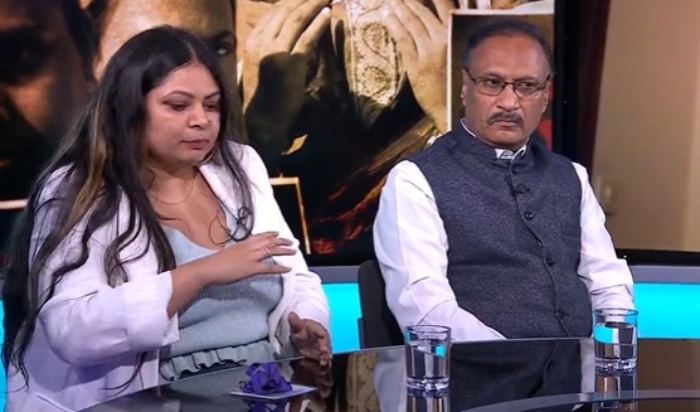
British Broadcasting Corporation (BBC), going by its propensity to portray India in a bad light, recently hosted an interview to discuss the Manipur violence. The interviewer attempted to utilize the episode to throw doubt on India and its ability to respond to violent incidents. By using a few isolated acts of violence, the BBC journalist also attempted to subtly advance the narrative that India, under Modi, is a majoritarian country that routinely persecutes its minorities, particularly Muslims.
Amana Begum Ansari – Researcher and Policy Analyst, who was a part of the program, however, gave a befitting reply busting several anti-India propaganda and claims peddled by the likes of BBC.
Got a chance to speak on @BBCNewsnight and present facts and reality about my country, India. Thank you, BBC for giving me a platform. pic.twitter.com/k9hDSGufuF
In a 2.53-minute clip of the interview shared by the Indian Muslim journalist, Ansari is seen hitting out at Western media for its biased perception of India. Citing the example of how the crime rate in Uttar Pradesh has dropped by over 60% over the past ten years, Ansari slammed Western Media for creating a false perception of India based on a few isolated incidents of violence.
Ansari further argued that the West should first understand India’s complexities before drawing any judgements.
Retorting firmly to questions posed to her about the Manipur violence, the Indian journalist said, “When the Western world looks at India, they must recognize that we encompass six major world faiths. We have been living in diversity before the West understood what diversity is”, she said, adding that as an Indian Muslim, it saddens her to see how the Western media attempt to paint an inaccurate picture of India by focusing on a few isolated acts of violence.
At this point, the BBC journalist cuts Ansari short and questions her on her views on how critics of PM Modi blame his idea of Hindu Nationalism for the polarisation happening in the country. Coming out in strong defence of the Modi government, Ansari said, “It’s multifaceted. When we talk about Hindus we also talk about Hindu culture. India embodies Hindu culture. Many Indian Muslims like myself, were once Hindus and converted. We must acknowledge this reality,” she said.
Ansari went on to condemn the incorrect perception that “Indian Muslims are under attack” or that “Muslim genocide is taking place in the country” which the Western media consistently tries to push to vilify India. Citing the freedom she enjoys in India compared to non-secular Islamic countries, she said that she valued her Indian Muslim identity.
“I feel blessed to be born in India. Imagine being born in a Muslim-majority nation. The freedom I experience in India would not be possible,” she said.
Ansari gave the Modi administration advice over the Manipur issue, saying that they “could have handled it better.” She pleaded with the Prime Minister to urgently spread a message of harmony and peace and quickly find a solution.
Ansari also emphasized the need for a social movement to promote communication between the Metei and Kuku populations in order to find a solution to the situation.
Notably, during the burqa debate that erupted out of Karnataka in 2022, Amana Ansari was one of the very few women who spoke out vehemently against the regressive practice which the liberal ecosystem and Islamists went on to defend and support wholeheartedly, advocating it as a matter of individual liberty.
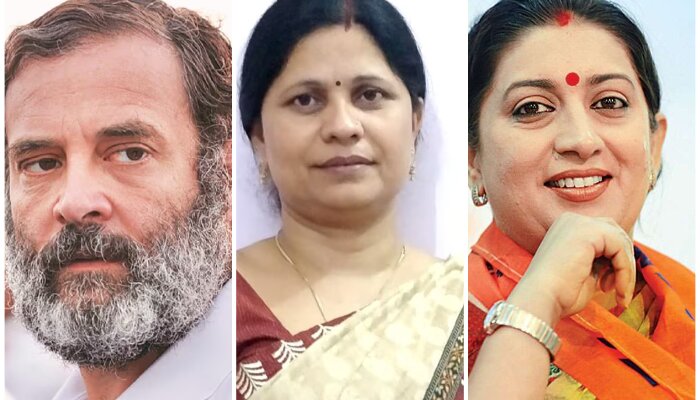
Recently, Congress leader Rahul Gandhi blew a flying kiss towards Union Minister Smriti Irani in the Lok Sabha, adding another instance to the list of his peculiar conduct inside the Parliament.
However, as always, Congress loyalists and party cadre have risen up to defend their beloved prince. Neetu Singh, Congress MLA from the Hisua constituency in the Nawada district of Bihar has engaged in a disturbing and derogatory rant in her attempt to defend Rahul and slander Smriti Irani.
“Our leader, Rahul Gandhi, has no dearth of young females. Why would he blow a flying kiss to a 50-year-old woman and not a young girl,” she asked in a bizarre and disparaging statement. The lawmaker further claimed, “All these allegations against Rahul Gandhi are baseless.”
Interestingly, Smriti Irani is 47-year-old who is 6 years younger than the 53-year-old Gandhi scion who is often projected as a youth leader by Congress and its allies in the media.
The members of the Bharatiya Janata Party were offended by her insulting remark and attacked the Congress party for the same. Gaurav Bhatia, senior advocate in the supreme court and party’s national spokesperson quoted her utterance and wrote, “Shameful statement of Bihar’s Congress MLA Neetu Singh.”
'राहुल गांधी के पास लड़कियों की कमी नहीं है, अगर फ्लाइंग Kiss देना होगा तो किसी लड़की को देंगे 50 साल की बुढ़िया को नहीं'
Another Bharatiya Janata Party spokesman, Shehzad Poonawalla termed Congress “anti-women” and accused that the party “can even defend Rahul’s misdemeanours inside the House”
If Rahul Gandhi wants to give flying kiss he has many women available
“Congress leaders every time insult women with their indecent behaviour,” posted Neetu Dabas, national media in-charge of BJP Mahila Morcha (women wing). She took a dig at Pandit Jawahar Lal Nehru and voiced, “This is the narrow-mindedness of Congress MLA Neetu Singh. Means the work that Nehru used to do is now done by Rahul Gandhi.”
She further asked, “Can there be anything more shameful than this” while tagging both Rahul Gandhi and Priyanka Gandhi Vadra’s account.
कांग्रेस नेता हर बार अपनी अमर्यादित व्यवहार से महिलाओं का अपमान करते हैं।
राहुल गांधी के पास लड़कियों की कमी नहीं है, flying kiss 50 साल की बुड्ढी को थोड़ी देंगे”
यह संकीर्ण मानसिकता कांग्रेस विधायक नीतू सिंह की है…. मतलब जो काम नेहरू करता था वही अब राहुल गांधी करता है।
Another BJP leader, Abhishek Acharya Kulshrestha posted, “This is Congress MLA Neetu Singh, whose fallen mentality and words are of such a low level that Supriya Shrinate’s dirty language falls short. Your Rahul ji is right in saying that there is no dearth of girls, we have seen many of his viral videos and we also know why Rahul Gandhi goes to Bangkok.”
Supriya Shrinate is a leader of the Congress party who is also infamous for her misconduct and unruly behaviour on national television.
ये है कांग्रेस विधायक नीतू सिंह, जिनकी गिरी हुई मानसिकता ओर शब्द इतने निम्नस्तर है कि @SupriyaShrinate की गंदी जीभ छोटी पड़ जाए। सही कह रही है आपके राहुल जी को लड़कियों की कमी नही है उनके कई वायरल वीडियो में हम देख भी चुके है और राहुल गांधी बैंकोक क्यो जाते है ये भी पता है।… pic.twitter.com/DMSRoAvOI0
— Abhishek Acharya Kulshrestha (@iAbhiAcharya) August 10, 2023
The flying kiss controversy
Bharatiya Janta Party MP from Amethi, Smriti Irani called the Wayanad MP a misogynist and stated that the house had never seen such an “indecent act” after he blew a flying kiss in the Lok Sabha. She charged, “I want to object in the house. The MP who was permitted to speak before me today indulged in a derogatory action while leaving the house.”
She added, “Only a misogynistic man can give a flying kiss to a parliament which seats female members of Parliament. Such a limitless action has never been seen in the Parliament of this country. The country has seen that family’s culture via this Parliament.” The treasury benches booed him as he left the lower house after taking part in the debate. He then turned around and gave them a flying kiss.
Later, the party’s female parliamentarians requested stringent action against him after they met with Lok Sabha Speaker Om Birla. According to a complaint signed by more than 20 BJP women members of parliament, the Congress stalwart made an inappropriate gesture towards his female colleague in the house while speaking during the discussion of the no-confidence motion against the government.
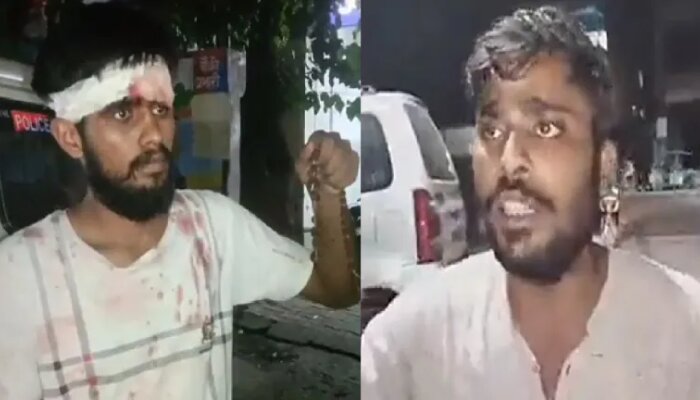
Two Hindu men, named Naveen and Hrithik, were thrashed by a Muslim mob near a mosque in Meerut, Uttar Pradesh. The former worked as a Zomato delivery boy who had gone to fulfil a food delivery order along with his friend on the evening of 9 August, when a crowd of 30 to 40 people thrashed him and left them bleeding.
The incident pertained to the Shyam Nagar area of the Lisari Gate police station area of Meerut. According to the victims, the reason behind the unwarranted assault was the rudraksha beads around the neck. They were first asked their names and then attacked by the mob.
Naveen stated that he had to deliver food in the neighbourhood, but didn’t know the route. He had brought the other man along for that reason. When they reached close to Hari Masjid, they saw a throng. He went a little further and tried to inquire about the delivery address.
— भारत समाचार | Bharat Samachar (@bstvlive) August 9, 2023
Meanwhile, the persons standing near the mosque approached the two and asked them about their names and addresses. They were surrounded by the mob and made to sit on the ground.
Naveen mentioned that he told them with folded hands that he was a delivery boy and had come to drop an order but to no avail. He repeatedly showed them his identity card but they didn’t pay any heed to it.
Furthermore, they broke the holy beads donned by Hrithik while having a conversation with both of them and began beating the duo. He was bleeding profusely as a result of it. The police arrived at the scene after learning about the situation and they were then taken to a nearby hospital.
The locals, on the other hand, alleged that four youths arrived on two bikes and were filming the mosque. People interrupted them and they started abusing in retaliation after which a physical altercation ensued.
Naveen informed the police, “I went to Hari Masjid Wali Gali with a friend. About 40 people had already gathered there. We continued to move after spotting them. However, they started following us. They stopped me after travelling a little distance and questioned why I was roaming there and told me to hand over my mobile so that they could go through the device.”
He further added, “I don’t know who those individuals were. However, all of them came from the mosque. They started assaulting us and didn’t listen to what we were saying. They also destroyed my friend’s rudraksha rosary.”
The police opened an investigation and filed a case against the accused based on the accusation of the victims. The arrest of a youth has been confirmed as of now. Lisari Gate police station in-charge Sanjay Verma revealed that two boys had gone to deliver a Zomato order and had a fight due to some misunderstanding. He assured that strict action would be taken against the perpetrators.
Circle Officer Amit Rai remarked that the fight had definitely happened in the Shyam Nagar area and the exact reason behind it is being probed in detail. He reiterated that the guilty would be punished.
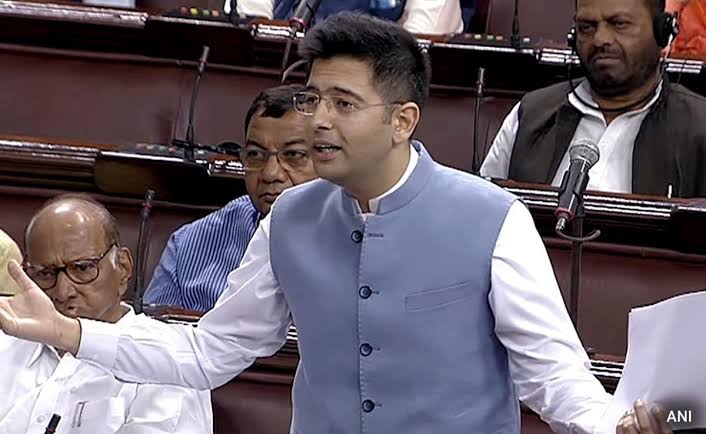
On Friday, AAP MP Raghav Chadha, who faced accusations of ‘forging’ signatures of five Rajya Sabha MPs, was suspended from the Upper House of Parliament. This suspension will remain in effect until the committee of privileges concludes its investigation and submits its report.
The suspension comes days after AAP Rajya Sabha member Raghav Chadha was accused of naming fellow members as a part of a proposed select committee to scrutinise the Delhi Bill without their consent.
Invoking the names of Members of Parliaments without their consent is a violation of parliamentary privilege.
A resolution was presented by Raghav Chadha in Rajya Sabha today, containing the names of five MPs – Thambi Durai, Sudhanshu Trivedi, Sasmit Patra, Phangnon Komyak, and Narhari Amin – without their consent. Union Home Minister Amit Shah sternly reacted to it, insisting the deputy speaker take appropriate action against this act of perjury.
Speaking in Rajya Sabha, Shah said that two members, BJD MP Sasmit Patra and BJP MP Dr Sudhanshu Trivedi, stated that they did not sign the motion moved by Raghav Chadha, adding that there should be an investigation as to who forged their signatures.
The four MPs had claimed that their names were mentioned on the proposal to send the Delhi NCR Amendment Bill to the Select Committee without their consent. The Rajya Sabha Deputy Chairman had reportedly assured that a probe will be conducted into this.
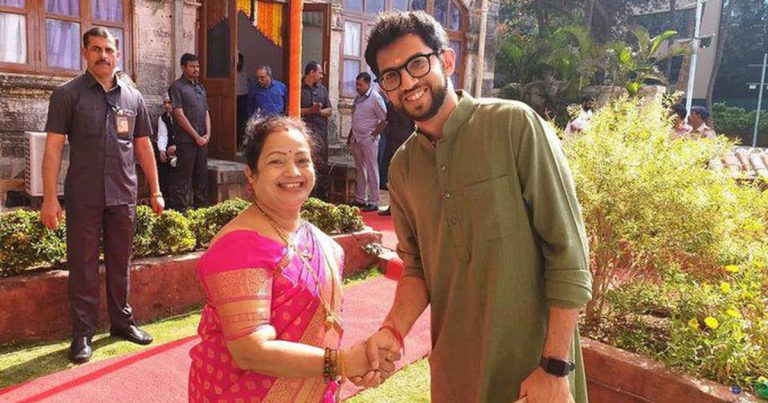
Trouble has mounted for former Mumbai Mayor and Shiv Sena (UBT) leader Kishori Pednekar after a case was registered against her by the Economic Offenses Wing (EOW) over charges of corruption. The Enforcement Directorate (ED) has reportedly obtained details and documents from the Mumbai Police pertaining to the irregularities in the purchase of body bags and other medical supplies during COVID.
A case was registered on 5th August by the EOW of the Mumbai police against Pednekar and two civic officials after a complaint was filed by BJP leader Kirit Somaiya in July. The case was filed under several Indian Penal Code (IPC) sections including 420 (cheating) and 120 (B) (criminal conspiracy), breach of trust by government officials for purchasing body bags at inflated rates amounting to Rs 50 lakh from Vendanta Innotech Pvt Ltd.
Somaiya has alleged that each body bag worth Rs 1500 was purchased for a whopping Rs 6,700 and that funds worth crores of rupees were siphoned. One of the civic officials booked is senior IAS officer P Velarasu.
COVID Ghotala
'Body Bag' Scam by Uddhav Thackeray Sena Leader Kishori Pednekar Vedant Innotech
₹1500 of Dead Body Bag bought at ₹6,700.
Mumbai Police registered FIR registered against Kishori Pednekar & AMC
The ED has now sought information about the crime cases filed against Pednekar from the EOW. ED could likely initiate a fresh money-laundering case linked to the Covid jumbo centre scam. According to the EOW FIR, BMV officials bought 1,200 body bags since 2020 for about Rs 80 lakh, a fraud committed under instructions from the former mayor.
The central agency suspects that huge kickbacks from Vedanta might have been received by the accused as BMC hospitals procured the body bags regularly at low costs. In the first two Expression of Interest (EOI) floated by the BMC, Vedanta emerged as the sole eligible vendor but a fresh tender was floated for EOI-3 in which two bidders qualified.
One was Care One Solutions which initially quoted Rs 2,610 per bag and later settled for Rs 2,583, and the second was Vedanta which initially quoted R3,939 and settled for R2,610. It is alleged that Pednekar summoned Haridas Rathod, then deputy dean of the BMC central purchase department to her residence and instructed him to award work to Vedanta.
The Covid Jumbo Centre scam included the listing of fake doctors, and also fake patients in order to source funds from the BMC. The total estimate of the scam amounts to Rs 4,000 crore involving other contractors besides Lifeline Hospital Management Services.
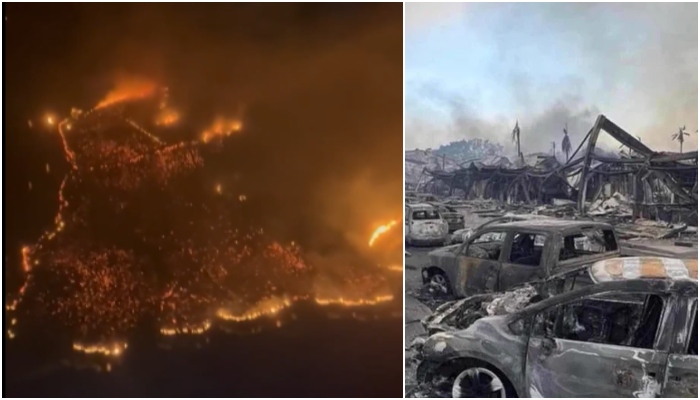
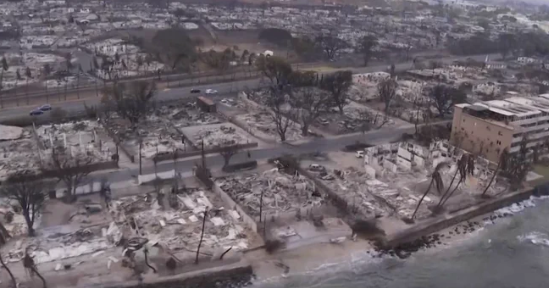
Rapidly spreading wildfires are ravaging the Hawaiian island of Maui, killing at least 55 people as on Friday, August 11. According to the reports, strong winds from a far-off hurricane Dora fueled the fires in the city of Lahaina, the island’s primary tourist attraction, resulting in the fatalities.
The flames are one of the numerous ongoing disasters that have completely destroyed entire neighbourhoods in the Hawaii locality. A state of emergency has been issued, forcing thousands of people to leave their homes and take shelter either in the actively serving hotels or evacuation centres.
There is a significant search and rescue effort underway, but some people are still missing. In the wake of wildfires in western Maui, Hawaii, on August 10, 2023, an aerial photograph shows burned-out homes and other structures in Lahaina.
President Biden declared the wildfire in Hawaii a “major disaster” on Thursday and ordered federal aid to areas affected by wildfires, according to the White House. Assistance can include grants for temporary housing and home repairs, low-cost loans to cover uninsured property losses, and other programs to help individuals and business owners recover from the effects of the disaster.
Federal funding will also be available to state and eligible local governments and certain private nonprofit organizations on a cost-sharing basis for debris removal and emergency protective measures.
Several videos of the destructive fire are going viral over the internet. The wildfires started early on August 8 and have burned thousands of acres while endangering 35,000 people’s lives on Maui and their homes, businesses, and property, according to a statement from the Hawaii Emergency Management Agency.
— Breaking Aviation News & Videos (@aviationbrk) August 10, 2023
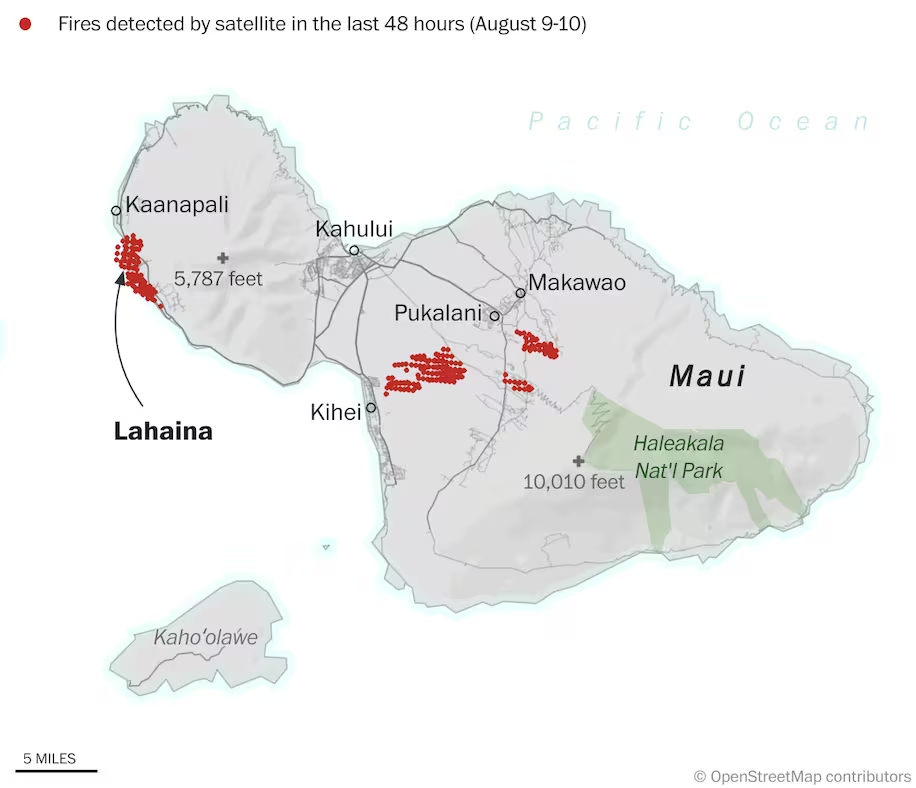
Major wildfires are burning in four major sites in Maui, along with several other places. The fires have not been contained fully yet, and they continue to spread into new areas.
Spread of the fire in Maui (Image: Washington Post)
It will take years, billions of dollars to rebuild
Meanwhile, Maui Mayor Richard Bissen stated on Thursday that during the wildfires, all of the hotels were suggested to shelter people who lost their homes. “Authorities will not close the entire island of Maui, only the west side. Hotels will be needed to shelter those who lost their homes,” Bissen added.
Wildfires have burned historic Hawaii town Lahaina to the ground, at least 36 people lost their lives and 11,000 have been evacuated. Don’t skip this post without leaving a heart for Hawaii. pic.twitter.com/wFo12czpxT
Mayor Richard Bissen warned residents who had fled their homes that those structures might be gone and said it’s best not to return now. “There’s no power, there’s no water back on the west side,” Bissen said. Hawaii Lt. Gov. Sylvia Luke said that the historic and popular tourist town Lahaina is completely destroyed by fire, saying it has been “decimated” and “forever changed.”
Police face challenges as no power, internet, or radio coverage
Also, reports mention that several people have been shifted to evacuation centres. Many have lost their loved ones and also their homes. While the police are trying to help the civilians and save them from getting destroyed, they say that the situation is challenging as the power, internet and other modes of communication have been cut down.
“The death count is rising. It’s going to be horrible and tragic when we get that number. So far we know that 53 have lost their lives. We don’t know. And here’s the challenge: There’s no power. There’s no internet. There’s no radio coverage,” the police officials and the fire officials were quoted as saying.
Several media organizations have managed to talk to the victims who have been shifted to the evacuation centres amid the wildfires. They are worried, shattered, and concerned about the safety of their loved ones. They are also feeling helpless as said by one Kamuela Kawaakoa who is now in an evacuation centre.
“We barely made it out in time. It was so hard to sit there and just watch my town burn to ashes and not be able to do anything. I was helpless,” a man who escaped along with his partner and six-year-old son, told the media.
Beth McCleod told CNN that her mother-in-law, Linda Vaikeli has gone missing since the wildfires spread through Lahaina. Vaikeli’s spouse, according to McCleod, had a doctor’s appointment on the opposite side of the island, and when he tried to go home, the roads were blocked by the fire that had engulfed the area around him.
Linda Vaikeli, Beth McCleod’s mother-in-law (CNN)
“She has some health issues, and she doesn’t get around very well. She needs some assistance. I just hope someone was able to get to her and help her to evacuate. They are looking but we have not heard anything yet. And from what I’ve seen, it looks like their apartment complex is completely gone,” McCleod told CNN.
Control, and evacuation operations underway
Amid this, Hawaii Lt Governor Sylvia Luke has stated that the place is no more safe to be in. Helicopters poured water on the fires from above as firefighters continued to battle the fires active till yesterday.
With only one main road passable, the western portion of the island, which is the second-largest in the Hawaiian chain, has been nearly completely cut off. To escape the fires, some local residents have resorted to diving into the river, while others have called the situation the “end of the world”.
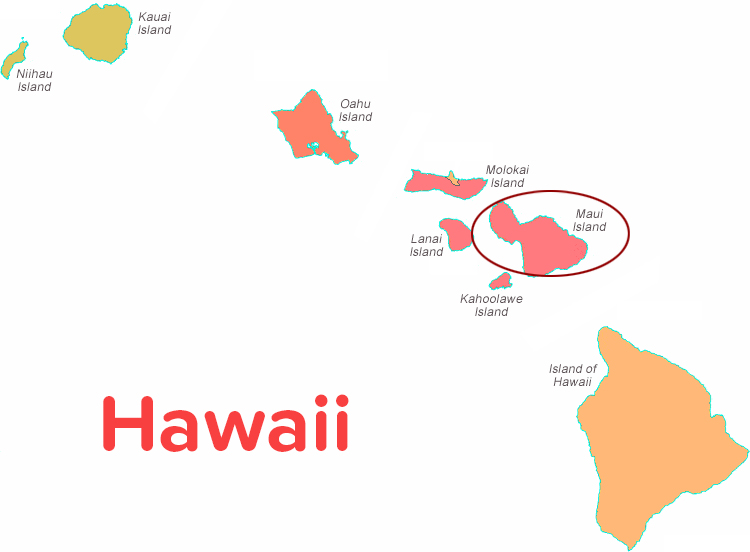
Map Hawaii
Rock stars, Hollywood celebrities, and business moguls have long been drawn to Maui because of the island’s breathtaking scenery and relaxed way of life. These include former President Barack Obama, media mogul Oprah Winfrey, actor Clint Eastwood, rock star Steven Tyler, and also Amazon founder Jeff Bezos.
More than 130 members of the Hawaii National Guard have been activated, and helicopters are searching for those who have been abandoned in places without electricity or navigable roads. In Maui, around 11,000 residents still lack access to electricity and other modes of communication.
On 10th August 2023, a renewed discourse surfaced concerning an island that was once given away from India to Sri Lanka, casting a spotlight on the historically enduring relationship between the two nations. Prime Minister Narendra Modi accentuated this matter during his parliamentary address, as he responded to the opposition’s no-confidence motion.
Notably, the resonance of Modi’s statement regarding the island, which had been ‘gifted’ to Sri Lanka during the regime of Indira Gandhi, reverberated as strongly as the overwhelming victory secured by the Bharatiya Janata Party-led National Democratic Alliance in the Lok Sabha voting on the no-confidence motion.
Indira Gandhi gave Katchatheevu Island to Sri Lanka
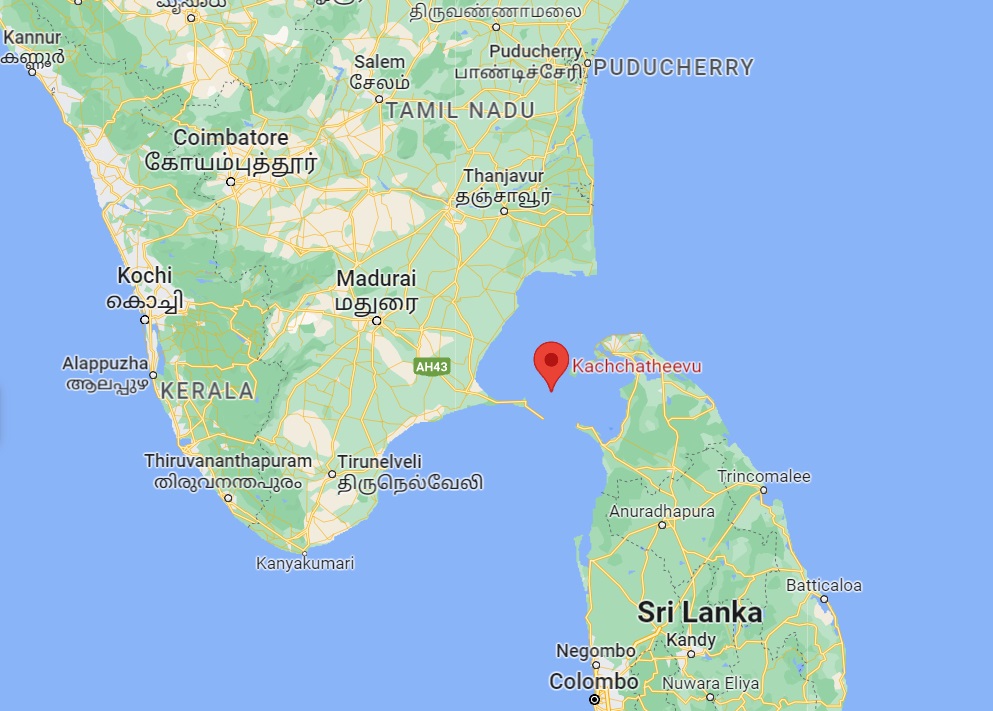
The Katchatheevu Island, nestled within the confines of the India-Sri Lanka border near Rameswaram, has evolved into a contentious focal point, giving rise to a burgeoning call for its repossession. Historically, this island has served as a shared enclave for Tamil fishermen hailing from both India and Sri Lanka.
The year 1974 witnessed a pivotal juncture when the island transitioned hands, as the then-Indian Prime Minister, Indira Gandhi, relinquished its sovereignty to Sri Lanka as part of a bilateral accord.
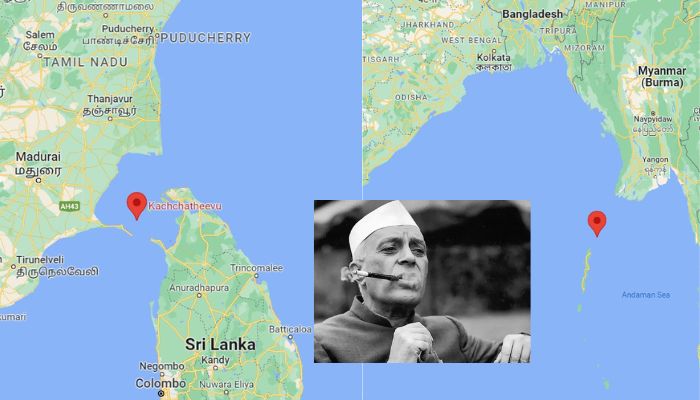
The location of Katchatheevu Island is strategically important. Image Source: Google Maps
In 1974, an accord was inked between Indira Gandhi, the Prime Minister of India, and Sri Lankan President Shrimavo Bandaranaike, resulting in the island’s integration under Sri Lankan jurisdiction. Not long after Katchatheevu island changed hands, a clamour emerged within India for its reinstatement.
The year 1991 witnessed the Tamil Nadu Assembly’s adoption of a resolution, articulating the demand to reclaim sovereignty over the island. Subsequently, in 2008, the issue resurfaced prominently when the then Chief Minister of Tamil Nadu, Jayalalithaa, challenged the matter before the Supreme Court, seeking the annulment of the island agreement.
History of Katchatheevu Island
Katchatheevu Island, a desolate landmass distanced from the coastal expanse, is believed to have emerged following a volcanic upheaval during the 14th century. Throughout the era of British dominion, this island served as a shared domain for both India and Sri Lanka. The contention over its ownership persisted unabated even after both nations asserted their claims to the territory in 1921.
During the preceding period, fishermen from both nations engaged in fishing activities across each other’s waters, blurring the lines of maritime jurisdiction. However, the trajectory shifted in the years spanning 1974 to 1976 when the two countries formalised the Maritime Boundary Agreement, definitively demarcating the international maritime boundary that separates them.
Following this pivotal accord, Indian fishermen were granted restricted access to Katchatheevu Island, permitted solely for activities like net drying and participating in the annual St. Anthony’s Festival. Fishing activities, however, were expressly prohibited on the island. Yet, despite these stipulations, Indian fishermen persisted in venturing toward the Sri Lankan sea border to harvest their catches.
In 2009, the security vigil along the maritime border was heightened by Sri Lanka, marking a departure from years of relative calm. This heightened security stance aimed to forestall any resurgence of Tamil rebels in the region. Subsequently, with the conclusion of the conflict in 2010, Sri Lankan fishermen began reclaiming their presence in the area and advanced assertions of sovereignty over the island.
Demands of reclaiming the island
According to the Ministry of External Affairs website, the island falls under Sri Lanka’s territory under the agreements signed between India and Sri Lanka in 1974 and 1976. The case is currently going on in the Supreme Court. Sri Lanka has allowed Indians to visit the island for religious reasons without any visa.
In 2022, off the shores of Katchatheevu Island, fishermen hailing from Rameswaram encountered a distressing incident as they found themselves subjected to an assault by the Sri Lankan Navy. These fishermen recounted their ordeal, stating that while engaged in their fishing activities in the vicinity, they were intentionally targeted by a patrolling vessel of the Sri Lankan Navy. This aggressive encounter culminated in the destruction of one of their boats, causing the fishermen to be plunged into the sea. Fortunately, their fellow fishermen promptly came to their aid, effecting a successful rescue operation.
Following a series of recurrent incidents, a fervent call for the reclamation of Katchatheevu Island has gained momentum. The government of Tamil Nadu has advocated that reinstating India’s sovereignty over this landmass holds the key to resolving this enduring predicament. The Chief Minister of Tamil Nadu engaged with Prime Minister Narendra Modi in both June 2021 and April 2022, during which two memorandums were presented outlining the imperative to regain control of Katchatheevu Island. These memorandums underscored the substantial losses and hardships endured by the fishermen of Tamil Nadu.
Jawaharlal Nehru lost the Coco Islands
The repercussions that India has borne as a result of strategic missteps made during the Nehruvian period are graver than they appear. Many blunders by Jawaharlal Nehru remained undiscussed and hence unknown to the common people of India for decades, maintaining the dignified image of the rose-bearer which he seldom deserves owing to his deeds against the national interest.
Beyond the relinquishment of lands to Pakistan and China, the Congress party, led by former Prime Minister Jawaharlal Nehru, bears responsibility for India’s surrender of territories possessing profound strategic importance. The vacillations exhibited by Prime Minister Nehru have exacted a toll far beyond the substantial areas of Jammu Kashmir and Ladakh.
Nehru’s deficiency in strategic understanding and his failure to adeptly negotiate with the British have led to the forfeiture of an exceptionally pivotal island in South Asia, ranking alongside the Andaman and Nicobar Islands – the Coco Islands.
History of the Coco Islands
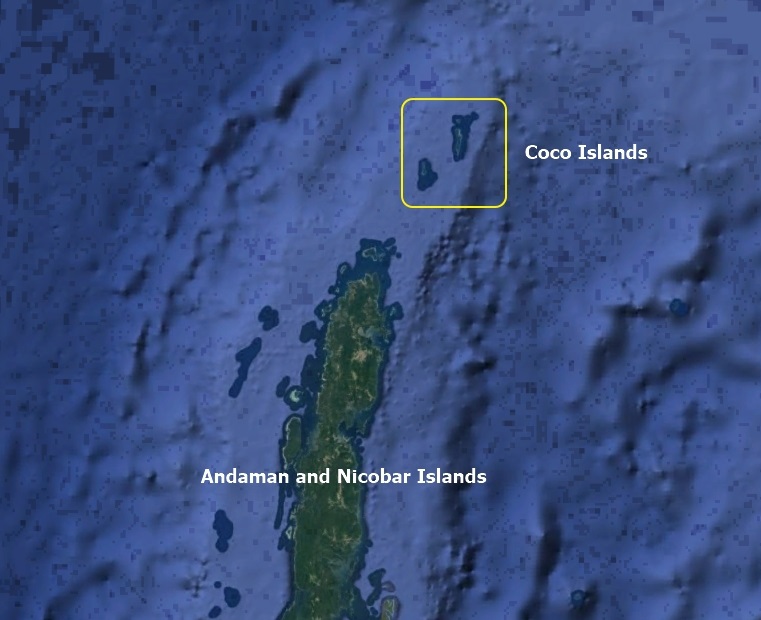
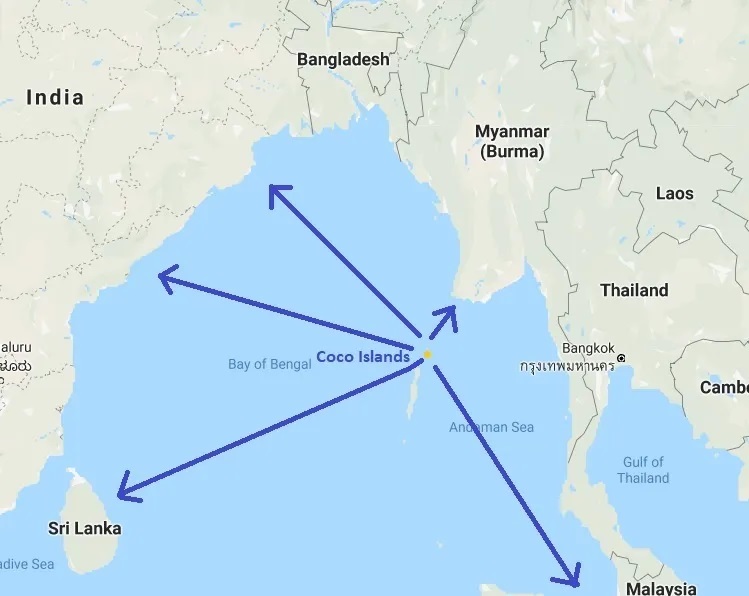
The Coco Islands, situated approximately 1255 kilometres southeast of Kolkata, stand as a paramount entity within South Asia. Geologically stemming from the extended framework of the Arakan Mountains, or Rakhine Mountains, this island cluster submerges into the Bay of Bengal, forming a continuous chain, only to reemerge later in the configuration of the Andaman and Nicobar Islands.
Positioned to the north of the Andaman archipelago, these strategically significant islands share a topographical kinship with India’s own Andaman & Nicobar Islands. Regrettably, the Coco Islands presently fall under Myanmar’s jurisdiction due to the hesitancy of Indian leadership to assert a robust claim over them.
During the early 19th century, the British Indian government established a penal colony on the Andaman Islands to incarcerate convicts from the Indian subcontinent. Notably, the Coco Islands served as a crucial food source for this settlement. Historical accounts suggest that the British government had entered into a lease arrangement with the Jadwet family of Burma for these islands.
Coco Islands. Image Source: Google Earth
The decision to lease control of the Coco Islands led to inadequate administration, prompting the British Indian government to relinquish authority to the government of Lower Burma in Rangoon. This transition occurred in 1882, formally integrating the islands into British Burma. Despite Burma’s separation from British India in 1937, the islands retained their status as a self-governing crown colony.
Similar to the situation with the Lakshadweep Islands and the Andaman and Nicobar Islands, the fate of the Coco Islands remained uncertain as the British made preparations to depart from India in 1947. In the final days of British rule in India, imperial authorities were exploring various measures that could potentially impede the rise of a robust and independent India.
Against this backdrop, the British Raj was devising a strategy to withhold key strategic sites from the newly emerging India, encompassing not only the Lakshadweep Islands but also the Andaman and Nicobar Islands, along with the Coco Islands. The British sought to fragment India into distinct segments, a move that would enable them to maintain dominance and influence even as they relinquished direct control.
The British aimed to deprive India of its strategic islands
The imperialists had their eye on many strategic islands in the Indian Ocean, the Bay of Bengal and the Arabian Sea, which they thought could be useful for keeping their dominance intact in the region. The Britishers thought that the non-inclusion of these islands with free India would also devoid India a strategic influence in the region, which will enable them to keep India in check.
As per an article in The Tribune India, written by KRN Swamy, the official documents accessed many years after Independence revealed information pertaining to the British Empire’s plans over these strategic islands. The astute statesmanship of Sardar Patel safeguarded Lakshadweep and Andaman and Nicobar islands for the nation, as he engaged in resolute negotiations with the British, steadfastly resisting their pressures.
With the British Empire relinquishing its hold on both the Lakshadweep and the Andaman Islands, their focus shifted towards asserting control over a significant island within the Bay of Bengal. This ambition led to negotiations for the Coco Islands, encompassing both the Great Coco Island and the Little Coco Island. The British, eager to establish authority over these islands, pursued a tripartite agreement aimed at fulfilling their defence requisites through strategic utilisation.
However, the empire’s chiefs of staff harboured reservations about the Coco Islands becoming part of an independent India. Instead, their preference was for the islands to be governed by a Commissioner under the auspices of the Governor-General of India until the culmination of the agreement. Their objective was to persuade Indian leaders that the Coco Islands were integral to the newly formed dominions rather than being under the jurisdiction of free India.
The strategic location of Coco Islands. Image Source: File Photo
So, the Viceroy Lord Mountbatten knowing the shrewdness of Sardar Patel, took the matter to Nehru and convinced the proposal in informal terms in which he highlighted that India would lease these Islands to Britain for communication purposes.
Lord Mountbatten on July 19, 1947, reported that he had spoken to Nehru, who was quite friendly and had said that there was no objection to an official approach being made, though he could not commit himself until all implications had been considered. Following these talks, an official request to make the proposed arrangements was sent to the Government of India, which agreed to it “without prejudice”.
The decision of Nehru not to hard press the British for the control of the Coco Islands has emerged out to be another historical blunder of the former Prime Minister. These islands, which were later taken over by Burma, have now been used by the Chinese to keep an eye on India. The strategic islands are now utilised by the Chinese military to spy on the country, where they have already built an airstrip and radar station.
If it was not for Sardar Patel’s brinkmanship, perhaps, India would have lost Lakshadweep and Andaman & Nicobar Islands just like former Prime Minister Nehru gave away the opportunity to take control of the strategic Coco Islands, which has now emerged as a national security risk to India.
In a big development, the United Kingdom’s Security Minister Tom Tugendhat has announced funding of 95,000 Pounds, around ₹1 crore, to tackle Khalistani terrorism in the country.
UK's Security Minister Tom Tugendhat announces 95,000 pound funding to enhance Britain's capability to tackle "pro-Khalistan extremism".
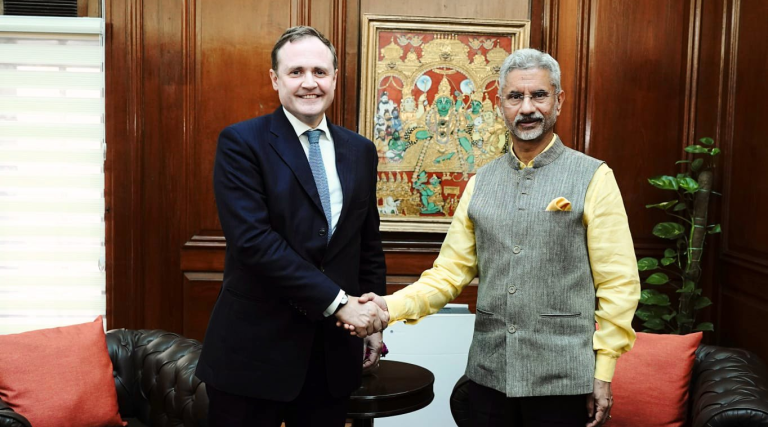
The announcement comes hours after the UK Minister met External Affairs Minister S Jaishankar in New Delhi. After the meeting, Minister Tom Tugendhat took to Twitter and wrote, “It was a pleasure to meet Minister of External Affairs Dr Jaishankar. We strongly agree on the importance of proactively tackling violent extremism – whatever form it takes. I look forward to working closely with him to combat the full range of threats we face.”
It was a pleasure to meet Minister of External Affairs Dr Jaishankar.
We strongly agree on the importance of proactively tackling violent extremism – whatever form it takes.
I look forward to working closely with him to combat the full range of threats we face.
Tugendhat also tweeted that India’s top investigative agency CBI works closely with UK’s intelligence agencies to tackle serious and organised crime. “Together, we’re making both our countries safer. It was great to share the results of that progress today,” he wrote.
The British High Commission in India said, “During a meeting with India’s External Affairs Minister, Dr S. Jaishankar, in New Delhi on Thursday (10 August), UK’s Security Minister Tom Tugendhat announced new funding to enhance the UK’s capability to tackle Pro-Khalistan Extremism. The £95,000 investment will enhance the government’s understanding of the threat posed by Pro-Khalistan Extremism, complementing the joint work already underway between the UK and India through the Joint-Extremism Task Force.”
In a high-level meeting held on 7 July 2023, between National Security Advisers Ajit Doval of India and Tim Barrow of the United Kingdom, India raised concerns over Khalistani terrorist elements threatening officials of the Indian High Commission in the UK.
India called upon the British government to take decisive action against the Khalistani terrorists, including deportation or legal prosecution, to safeguard the diplomatic staff. The meeting, part of the ‘India-UK Strategic Dialogue,’ aimed to strengthen cooperation in addressing violent extremism and radicalism. On 6th July, Khalistani terrorists in the UK announced a “Kill India” rally outside the Indian High Commission.
On 3rd June, EAM Dr S Jaishankar said that India has urged its partner countries like Canada, the United States, the UK, and Australia not to give space to the Khalistanis. He added, “This will affect our relations. We will raise this poster issue with the government of these countries.”
On 19th March, Khalistani terrorists barged into the Indian High Commission in London and removed the Tricolor from the premises. A video showed a mob of Khalistanis staging a protest outside the Indian High Commission. Amidst chants of ‘Khalistan Zindabad’, a man sporting an orange turban was seen scaling the walls of the building and pulling down the Indian flag.
Despite assurance from the London Metropolitan Police to raise the level of protection to the Indian High Commission, Khalistani terrorists four days later again breached the security cover and threw eggs and inks to deface and vandalize the building.
In a retaliatory measure, India then removed the security cover outside the British High Commission in the national capital. Indian authorities removed barricades in front of the British High Commission and the British High Commissioner’s residence and removed all external security that was provided to the British mission in India.
Almost a month after a five-member team from the National Investigation Agency (NIA) conducted an inquiry into the 19th March incident, Indian intelligence agencies revealed that the attack, among many others, was masterminded by Khalistani terrorists Hardeep Singh Nijjar and Avatar Khanda. Nijjar was shot dead in Surrey on 18th June while Khanda died mysteriously four days later in a UK hospital.
The Khalistani menace continues to target India operating with deep links and nexus in the UK, US, and Canada. An independent report released in UK, called Bloom Report, reportedly highlighted that young, impressionable minds from the Sikh community were being manipulated by Khalistani terrorists in the UK.