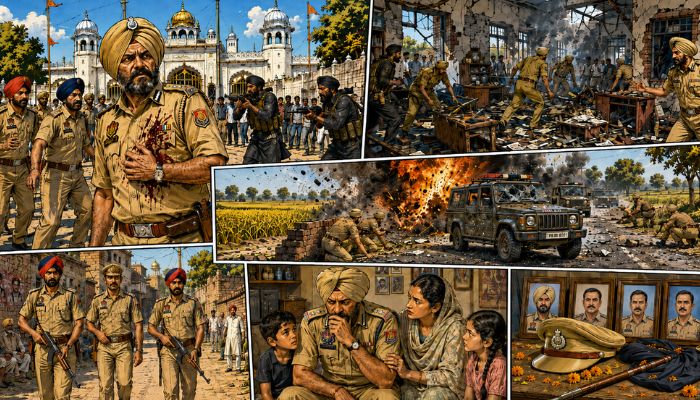
During the Punjab insurgency, Khalistani terrorists did not restrict their attacks to senior police officers or personnel engaged in operations. Policemen were assassinated outside religious places, ambushed on patrol, bombed inside headquarters and abducted from their homes. Their guards, drivers and eventually their families were also targeted. Punjab Police says 1,784 of its officers and personnel were killed during the terrorism period.
One of the earliest shocks came in April 1983, when DIG Avtar Singh Atwal was shot dead after offering prayers at the Golden Temple. Three years later, terrorists wearing police uniforms entered the Punjab Armed Police headquarters in Jalandhar and opened fire on police chief Julio Ribeiro and his wife. Inspector General of Prisons Trilok Chand Katoch was killed near his Chandigarh home in 1987, demonstrating that senior officers were vulnerable even away from duty.
Lower-ranking personnel faced the same danger without the protection available to senior officers. Inspectors and ASIs were killed during raids and patrols, while guards and drivers often died in attacks aimed at their commanders. In 1991, ASI Lalu Ram and ASI Amin Chand were killed when a remote-controlled explosive targeted Chandigarh SSP Sumedh Singh Saini’s convoy. District memorials preserve the names of many constables, Home Guards and Special Police Officers whose deaths received little wider attention.
The conflict changed further when terrorists began targeting police families. KPS Gill wrote that 506 policemen were killed in 1990, most while at home on leave, while relatives were increasingly threatened and murdered. Families fled villages and some even published newspaper notices pleading with terrorist organisations not to punish them for having relatives in the police. Fear was becoming intensely personal.
By the early 1990s, repeated assassinations, bombings, attacks on homes and threats to families had helped transform the psychology of the force. Sections of Punjab Police moved from conventional law enforcement towards increasingly aggressive counterterrorism, and eventually brutal retaliation. The article argues that this context helps explain how the police response hardened, but does not justify unlawful killings, torture, disappearances or fake encounters.
The dead also challenge attempts to portray the insurgency simply as a Hindu-Sikh conflict. Many policemen killed by Khalistani terrorists were themselves Sikhs who opposed separatist violence and served the Indian state. The police force that eventually crushed the insurgency had itself been hunted for years, at work, at home and through its families.
Professor Annapurni Subramaniam, one of India’s most accomplished astrophysicists, has been awarded the COSPAR Vikram Sarabhai Medal 2026, becoming the first Indian woman scientist and only the fourth Indian to receive the prestigious international honour.
She received the medal at the 46th COSPAR Scientific Assembly in Florence, Italy, in recognition of her outstanding contributions to space research in developing countries. The honour also places her among a select global group, as she is only the third woman worldwide to receive the award.
Currently serving as the Director of the Indian Institute of Astrophysics (IIA), Bengaluru, and heading the Centre for Nano and Soft Matter Sciences (CeNS), Professor Subramaniam has spent more than three decades advancing India’s capabilities in astronomy and space science through research, scientific leadership and mentoring.
A childhood fascination with the night sky
Born in Palakkad, Kerala, Professor Subramaniam’s interest in astronomy began long before she entered the world of scientific research. During her school years, she would wake before sunrise in the summer to study and spend time observing the night sky.
One sight in particular fascinated her, the bright band of the Milky Way, which appeared in the same part of the sky every morning. Curious about what it was and why it remained in the same position, she found herself searching for answers, although there was no one around her who could explain the phenomenon. That childhood curiosity eventually shaped her life’s work.
After completing her Master’s degree in Physics, she was determined to pursue a career connected with astronomy. She joined a collaborative astronomy programme involving the Indian Institute of Science (IISc), the Indian Institute of Astrophysics, ISRO, and the Raman Research Institute before joining the Indian Institute of Astrophysics as a Research Fellow in 1990.
Nearly three decades later, in 2019, she created history by becoming the first woman to head the Indian Institute of Astrophysics.
Contributions to astronomy and space science
Professor Subramaniam’s research spans a broad range of subjects, including star clusters, stellar populations, nearby galaxies, classical Be stars, blue straggler stars, young stellar objects, the Magellanic Clouds and ultraviolet astronomy. Her work has significantly advanced understanding of stellar evolution and the life cycles of stars.
She has authored around 175 scientific publications and supervised 15 PhD scholars, while mentoring numerous young researchers in astronomy and astrophysics.
Among her most significant contributions has been her role in AstroSat, India’s first dedicated space observatory, launched in 2015. As the calibration scientist for the Ultraviolet Imaging Telescope (UVIT) onboard AstroSat, she led the telescope’s in-orbit performance verification and played a crucial role in ensuring its scientific success.
Building on that experience, she now serves as the Principal Investigator of INSIST (Indian Spectroscopic and Imaging Space Telescope), India’s proposed next-generation ultraviolet-optical space telescope.
Professor Subramaniam has also played an important role in the Thirty Metre Telescope (TMT) project, one of the world’s largest international astronomy collaborations. India is among the partner nations in the project, with the Indian Institute of Astrophysics serving as the country’s coordinating centre.
The prestigious COSPAR Vikram Sarabhai Medal
The COSPAR Vikram Sarabhai Medal is among the highest international honours in space science. Instituted in 1990, it commemorates Dr Vikram Sarabhai, the founder of India’s space programme and the Indian Space Research Organisation (ISRO).
The medal is jointly awarded every two years by the Committee on Space Research (COSPAR) and ISRO to scientists from developing countries for exceptional contributions to space research. COSPAR is an international scientific organisation affiliated with the International Science Council and recognised by the United Nations Committee on the Peaceful Uses of Outer Space (UN-COPUOS).
With the 2026 honour, Professor Subramaniam joins an exclusive group of Indian recipients that includes U R Rao (1996), former ISRO Chairman, Gurbax Singh Lakhina (2014), noted space plasma physicist, and Anil Bhardwaj (2024), Director of ISRO’s Physical Research Laboratory.
Leadership beyond research
In addition to her scientific contributions, Professor Subramaniam has held several important leadership positions within India’s scientific community. Along with directing the Indian Institute of Astrophysics, she heads the Centre for Nano and Soft Matter Sciences (CeNS) in Bengaluru.
She is a Fellow of the Indian Academy of Sciences and the National Academy of Sciences, India, and a life member of both the International Astronomical Union (IAU) and the Astronomical Society of India.
She has chaired the Membership Committee of the International Astronomical Union, served as Chief Editor of the Journal of Astrophysics and Astronomy between 2019 and 2024, and currently serves as Scientific Editor of Research in Astronomy and Astrophysics.
Recognition and interests beyond science
Over the years, Professor Subramaniam has received numerous honours for her contributions to science. These include the Rashtriya Vigyan Puraskar – Vigyan Shri (2024) in Space Science and Technology, the NDTV Science Icon of the Year 2024, the Future Forward Female Award by CNBC-News18, the Devi Award, the Vanitha Ratna Award (2023)from the Government of Kerala, and recognition among India Today’s Top 100 Women Achievers (2023).
Away from astronomy, she is also a trained violinist, having grown up in a family deeply rooted in Carnatic music. She has often credited her musical upbringing for shaping her creativity and discipline. Another passion is creating traditional kolam (rangoli) designs, which she has described as a “morning puzzle” that stimulates her mind.
From a child captivated by the mysterious glow of the Milky Way to becoming one of India’s most distinguished astrophysicists, Professor Annapurni Subramaniam’s journey reflects decades of scientific excellence, perseverance and leadership. Her latest international recognition underscores India’s growing stature in global astronomy while inspiring a new generation of scientists, especially women, to pursue careers in space research.
HMS Trincomalee, still afloat in a naval museum in England, was laid down in 1816 at Bombay’s Wadia yard from Malabar teak by Indian craftsmen. Nine generations of the Wadias built more than 400 ships for the British. The paradox is that the same industry was then systematically suffocated by the colonial rulers.
The Registry Act of 1815 blocked India-built ships from profitable British trades precisely because Malabar teak was superior to European oak and India-made ships were seen as a threat to the British shipbuilding industry. Indian yards were allowed to work for the Empire, as employees, not as independent commercial competitors.
After Independence, the state rebuilt shipbuilding around defence needs. Mazagon Dock, GRSE, Hindustan Shipyard and Cochin Shipyard delivered warships and submarines, but commercial export scale never followed.
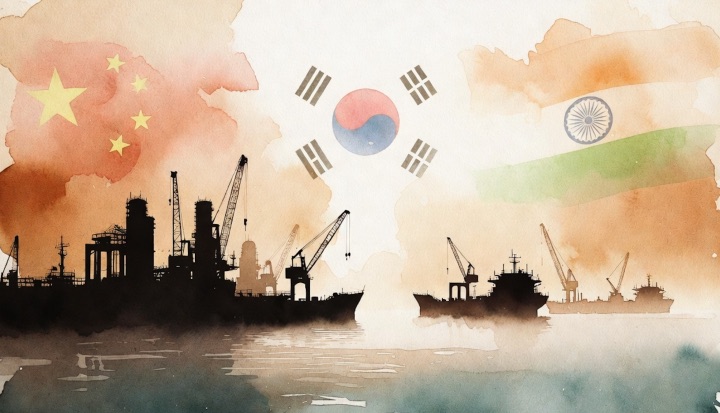
South Korea, starting in the 1970s with an explicit export strategy and aggressive state finance, captured high-value orders globally. India stayed a minor commercial player. By 2026 the global market is extreme: China, South Korea and Japan account for more than 90% of output and orders. China holds roughly 65–70% of the order book and completed over 53 million DWT in 2025. Japan’s share has fallen. Europe has largely left bulk commercial work. India’s output rose 41% from 40,923 GT in 2024 to 57,637 GT in 2025, but it still sits far outside the top ten.
Gaps remain in large bulk carriers, tankers, container ships, LNG/LPG vessels and green designs. Productivity is lower, financing costlier, high-grade steel and engines are often imported, and complex commercial designs are still frequently licensed. The ₹69,725 crore package aims to close that gap through financial assistance, a Maritime Development Fund, capacity expansion and three greenfield clusters in Andhra Pradesh, Gujarat and Tamil Nadu. Early movement is already visible: SBFAS and MDF guidelines are out; HD Hyundai has signed for a mega yard in Tamil Nadu and a block-fabrication JV with Cochin Shipyard; Cochin won a $360 million CMA CGM feeder-container order; private yards have booked tankers and bulk carriers; demand aggregation covers hundreds of vessels. India is finally shifting from protected defence yards toward export-competitive commercial scale. Whether that succeeds depends on supply chains, design houses and sustained execution.
The article reflects on the gaps in India’s shipbuilding capabilities compared to global players and how the government push is starting to show results on the ground. The full article can be read on Chapter One Mag.
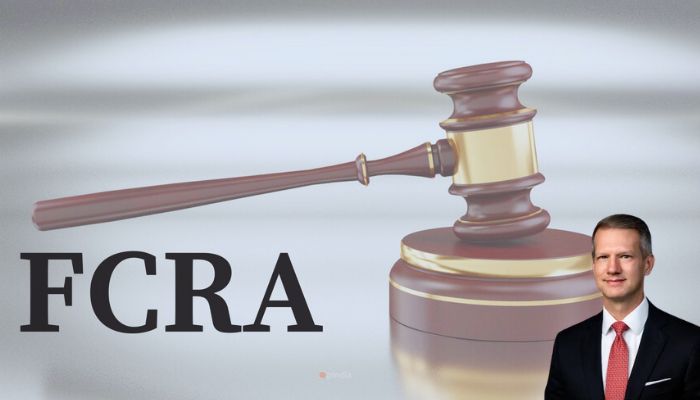
US Representative Riley M. Moore has criticised the proposed Foreign Contribution (Regulation) Amendment Bill, 2026. The first-term Congressman claimed that the FCRA Amendment Bill permits the government to “take over churches and religious charities”, calling it “a clear attack against Christians.”
“Christians have been in India since St. Thomas the Apostle travelled to the Malabar Coast just decades after the resurrection of our Lord Jesus Christ. But despite this long Christian history, India’s Parliament is considering amending Foreign Contribution Regulation Amendment (FCRA) rules to permit government takeovers of churches and religious charities,” Moore wrote on X on 4th August.
“This is a clear attack against Christians. If this bill proceeds in this way, it would be a point of major concern in our bilateral relationship with India,” the Congressman representing West Virginia’s 2nd District added.
Christians have been in India since St. Thomas the Apostle traveled to the Malabar Coast just decades after the resurrection of our Lord Jesus Christ.
But despite this long Christian history, India’s Parliament is considering amending Foreign Contribution Regulation Amendment…
Amusingly, Moore’s “takeover of churches” claim is as true as his claim about Thomas the Apostle’s visit to South India in the 1st century.
However, the factual inaccuracies and alarmist framing of the FCRA Bill by the US Congressman warrant scrutiny. Introduced in March 2026, the FCRA Amendment Bill primarily addresses organisations whose FCRA registration is cancelled, surrendered, or fails renewal. The Bill empowers the Central government-appointed “Designated Authority” to manage “foreign contributions and assets created from those foreign funds” in such cases for oversight and to prevent diversion or abandonment.
Separately, the Foreign Contribution (Regulation) Rules, 2011, which were amended by a Gazette notification published by the Union Ministry of Home Affairs on 22nd June 2026, have excluded proselytisation for several groups within the religious community.
Interestingly, Moore is not the first US senator to cry hoarse over India’s FCRA. Amendment Bill. Ahead of US Secretary of State Marco Rubio’s late May 2026 visit to India, US Congressman Chris Smith has urged him to bring up the issue of suspension of the Foreign Contribution Regulation Act (FCRA) licence of the controversial Mother Teresa’s Missionaries of Charity.
Indulging in fear mongering, Smith claimed that if adopted, India’s FCRA Amendment Bill, “the total property of entire churches and dioceses could soon be at risk of being taken over by the Indian state.”
Similar to Riley Moore’s threats, Smith had also threatened that if the FCRA Bill was not put on hold, it might cause long-term harm to relations between the two sides.
Not only foreign politicians, but even Indian media outlets are framing the FCRA Bill as some sort of attack on religious minorities and civil society.
FCRA is a foreign funding regulatory law, not religious legislation
Riley Moore, however, has surpassed even the Indian left liberals in fear-mongering and victimhood propaganda. His claim that the FCRA Amendment Bill will empower the Indian government to arbitrarily take over churches is false. The authorities cannot take over or alter the religious character of places of worship.
As per the rules, the powers of the authorities are limited to foreign-funded assets under specific cessation conditions, and even those orders are subject to revision or appeal.
It is also interesting that Riley Moore, and even several Indian NGOs and ‘prominent’ individuals, have singled out Christians even as the law is religion-neutral and applies to all FCRA entities. Existing FCRA law, and even if the proposed amendment bill is passed, shall remain a funding law and not transform into a religious law. The law explicitly states that it applies uniformly.
In fact, comparable laws exist in other democracies to regulate foreign funding. The US has the Foreign Agents Registration Act (FARA), the United Kingdom has the Foreign Influence Registration Scheme (FIRS), the Foreign Influence Transparency and Accountability Act (FITAA), and many other countries have similar foreign funding regulatory laws.
The only core difference in India’s FCRA is that it operates as a pre-approval and permission-based regime, in view of national security.
A question here arises: Why is the US opposing, and even ‘warning’ of damage to India-US relations over the FCRA Amendment Bill? The answer is geopolitical interests and religious ambitions.
Numerous US-based evangelical and missionary networks have channelled huge funding into India over decades for church planting, conversions among vulnerable groups, be it poor tribals or Dalits, and related works. From Compassion International to World Vision India, Joshua Project, to several other foreign Christian groups are still active in India, furthering Christian conversion and geopolitical interests of their home countries.
OpIndia has consistently raised alarms over the activities of the US-based World Vision International. The Christian NGO received funding from the now-defunct USAID, which had a record of funding anti-India and anti-Hindu outfits and individuals. With activities confined not just to Northeast India, World Vision pretends to be a humanitarian organisation; in reality, it is a Christian fundamentalist organisation that has allied with other Christian fundamentalists to convert unsuspecting Hindus, especially children and women, for seven decades, as the Nehru government gave the Christian fundamentalist outfit a free hand.
In 1972, the Indira Gandhi government even allowed World Vision’s Billy Graham to visit Nagaland, much to Graham’s own surprise, since at that time, due to instability, foreigners were not getting permission to visit the Indian state. World Vision openly ran its conversion activities to harvest thousands of Hindu souls for Christianity under Indira Gandhi’s watch.
In 2024, the Modi government revoked its FCRA license, denting its conversion activity in India. OpIndia earlier reported how US-based Christian outfits like the World Council of Churches, the World Evangelical Alliance and World Vision rallied against anti-conversion laws. And now, foreign and local Christian missionaries are outraged over the FCRA Amendment Bill since it will cut the uninterrupted flow of funds for entities aiming to alter the religious demographics of India and undermine national security.
Besides, several NGOs and leftist ideological networks have long faced scrutiny for roles in inciting protests, anti-development agitations, and dissemination of propaganda undermining Indian interests.
In fact, government lists of FCRA cancellation reasons included anti-development acts, inciting protests, and forced religious conversions.
Kudankulam Nuclear Project and how foreign-funded NGOs stalled the project for years
It is important to recall how the Kudankulam Nuclear Power Plant Project was stalled for years by leftist political parties and foreign-funded NGOs.
Kudankulam Nuclear Power Plant (KKNPP), located in the Tirunelveli district of Tamil Nadu, was envisioned as India’s largest nuclear power station, with a total capacity of 6,000 megawatts. The construction of the facility began in 2002, but continuing demonstrations and political resistance hampered it.
This protest reached its peak in 2011 when people feared a Fukushima-style disaster would strike the nuclear plant. SP Udayakumar, leader of the People’s Movement Against Nuclear Energy (PMANE), was a significant figure in the anti-Kudankulam movement.
Back in 2012, many international Christian propaganda outlets had boasted how Churches and Catholics were playing a central role in leading the protests. The Lady of Lourdes Catholic Church in Idinthakarai and two Catholic priests were on the Coordinating Committee for PMANE.
Most of the anti-nuclear activists, including PMANE’s convenor S P Udayakumar and activist G Sundarajan, joined the Aam Aadmi Party (AAP). Sundarajan was also AAP’s Lok Sabha candidate in the 2014 elections. It is an interesting fact that the founder of Cockroach Janta Party (CJP), which led the recently concluded ‘students protests’ in Delhi, Abhijit Dipke, has also been an AAP functionary in the past.
Notably, the court petitions, protests and continued fearmongering about the Kudankulam Nuclear Power Plant Project came despite the former President and noted scientist APJ Abdul Kalam assuring that there was no need to panic as the KNPP had state-of-the-art safety features.
In fact, then Prime Minister Dr Manmohan Singh had publicly called out the NGOs involved in activism for stalling the Kudankulam Nuclear Power Plant project.
Singh had said that these NGOs received foreign funding, particularly from the US, and were deliberately stalling the use of genetic engineering in agriculture and leading protests against the KNPP.
“There are NGOs, often funded from the United States and the Scandinavian countries, which are not fully appreciative of the development challenges that our country faces. The atomic energy programme has got into difficulties because these NGOs, mostly I think based in the United States, don’t appreciate the need for our country to increase the energy supply,” PM Singh told the journal Science in an interview in February 2012.
Behind the veneer of human rights advocacy, promotion of democracy and education, foreign-funded NGOs under India’s development
Exploiting human rights, democratic freedom, economic fairness, government accountability, promotion of education and other such high-sounding purposes, several non-governmental organisations in India receive foreign funding. However, their real agenda has been to stall Indian development projects, stir anarchy, and fracture the economy.
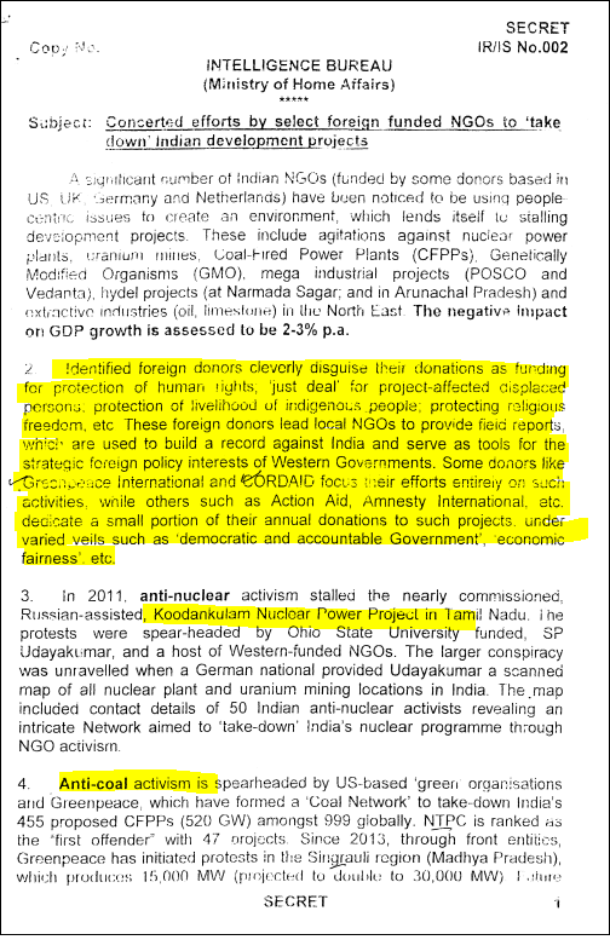
A 2014 leaked Intelligence Bureau (IB) report revealed the modus operandi of several foreign NGOs making concerted efforts to stall various development projects.
The report said that a significant number of Indian NGOs receiving funding from the UK, US, Germany, Netherlands, etc, were picking up people-centric issues to create an environment which lends itself to stalling development projects.
“These include agitations against nuclear power plants, uranium mines, Coal-Fired Power Plants (CFPPs), Genetically Modified Organisms (GMO), mega industrial projects (POSCO and Vedanta), hydel projects (at Narmada Sagar; and in Arunachal Pradesh) and extractive industries (oil, limestone) in the North East. The negative impact on GDP growth is assessed to be 2-3% p.a,” the report said.
Explaining the modus operandi of these foreign-funded NGOs, the IB report said, “Identified foreign donors cleverly disguise their donations as funding for protection of human rights; ‘just deal for project-affected displaced persons: protection of livelihood of indigenous people; protecting religious freedom, etc.”
“These foreign donors lead local NGOs to provide field reports, which are used to build a record against India and serve as tools for the strategic foreign policy interests of Western Governments. Some donors like Greenpeace International and CORDAID focus their efforts entirely on such activities, while others such as Action Aid, Amnesty International, etc. dedicate a small portion of their annual donations to such projects. under varied veils such as ‘democratic and accountable Government’, economic fairness’, etc,” it added.
The IB had cited examples of anti-nuclear activism against the Kudankulam Nuclear Power Project, Anti-coal activism against 455 proposed CFPPs, and anti-Genetically Modified Organism activism targeting mega industrial projects, like POSCO and Vedanta. The report found that foreign entities were funding and using NGOs in India as proxies to stall India’s development projects and to undermine the country’s economy.
Not to forget how the United States Agency for International Development (USAID) was funding dubious NGOs in India and was involved in attempts to execute regime change operations in India and Bangladesh. OpIndia has earlier highlighted how the US was actively backing anti-Sheikh Hasina elements in Bangladesh, and how Hasina herself had warned about the US’s efforts to carve out a Christian nation out of some regions of Bangladesh, Myanmar and India’s Northeast.
Christian victimhood is a facade; the real chagrin is FCRA targeting funding networks behind proselytisation and anti-India groups
The broader “attack on Christians” bogey peddled by Indian Christian entities and leftists, as well as their foreign sympathisers, however, is only a facade. The real outrage is over the tighter scrutiny of foreign funds that have historically flowed into India for proselytisation and anti-India activities.
The Modi government has not only hammered the menace of proselytisation but, through the FCRA Amendment Bill, is also ensuring that cancelled licenses would have actual, immediate, and permanent consequences.
At present, when an organisation loses its license, its owned assets, land, buildings, hospitals, schools, and equipment built over the years with foreign funds often fall into a legal vacuum. The gap in question would be completely closed by the Bill. The Consolidated Fund of India would receive the proceeds from the Designated Authority’s oversight, management, and, if needed, disposal of those assets. This completely changes enforcement instead of causing lengthy court proceedings during which assets remain intact, and operations essentially continue; a cancelled license would have actual, immediate, and permanent consequences.
There is no doubt that the Modi government’s in-process overhaul of the FCRA hits organisations dependent on overseas evangelical pipelines for religious conversion activities.
It is apparently for these reasons that several Christian bodies in India, and the US have vehemently opposed the FCRA Amendment Bill, framing them as ‘existential threats’ or ‘attacks on minorities’.
Be it the Catholic Bishops’ Conference of India (CBCI), All India Christian Council, or Archbishop Joseph D’Souza, who called the FCRA-related amendments a “loot” of properties linked to Christian organisations, to US Christian groups like National Hispanic Christian Leadership Conference, all are collectively seeking the withdrawal of the FCRA Amendment Bill.
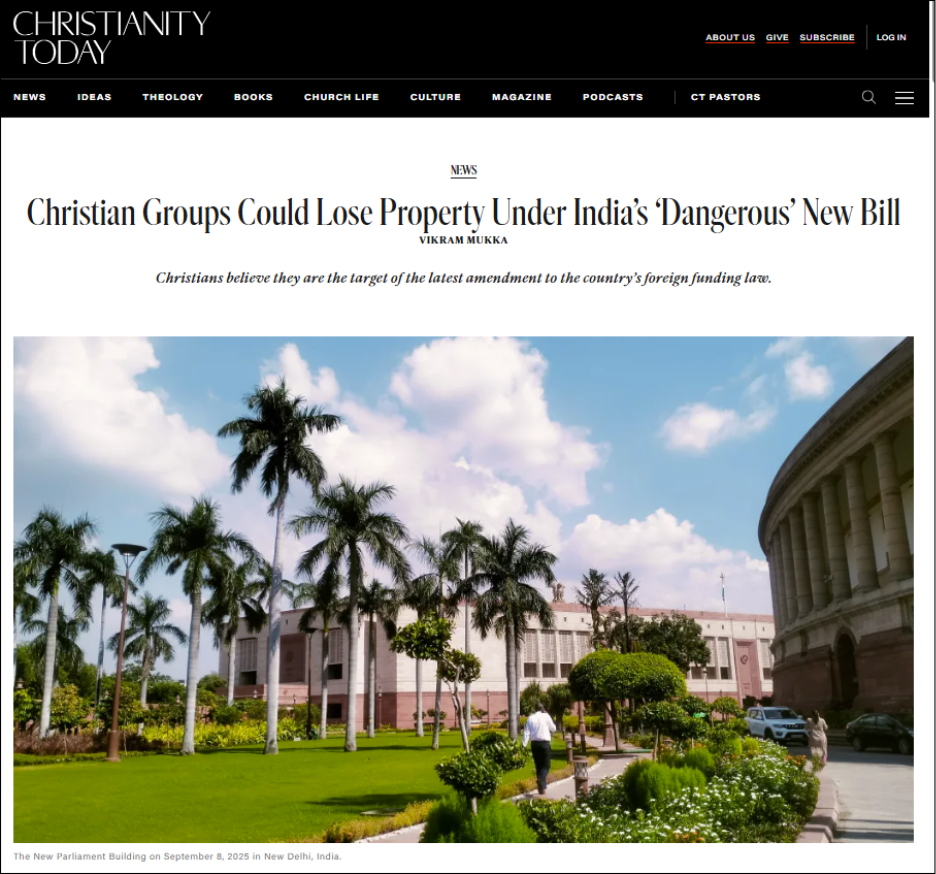
Similarly, Christian publications like Christianity Today, International Christian Concern, among others have been publishing propaganda pieces against the FCRA Amendment Bill to magnify “Christians under attack in India by the Hindu nationalist government” victimhood lies.
In fact, the recent Cockroach Janta Party (CJP) protests in New Delhi, several Catholic priests were seen marching alongside CJP supporters to oppose the FCRA Bill. The Delhi Police have also said that the role of several NGOs and linked individuals is also under scanner now.
It is apparent that because the new FCRA rules, and the FCRA Amendment Bill impose a tighter check on opaque foreign funding flows into entities linked to religious proselytisation and an anti-India agenda, they and their foreign backers are riled up and aggressively campaigning against the FCRA Amendment Bill.
There is also a political angle to the ongoing campaign against the FCRA Amendment Bill. The intensity of the outrage against the FCRA Bill, and the bill’s politicisation hint at the threat it poses to foreign funding pipelines that have long supported religious conversion work and left-leaning advocacy NGOs.
Congress, the main opposition party, is leading the political agitation against the FCRA Amendment Bill. The party, however, has its own history with foreign-funded entities. The Rajiv Gandhi Foundation, chaired by Congress leader Sonia Gandhi, with Rahul Gandhi as its trustee, previously received funds from China and even faced FCRA license cancellation after a probe uncovered irregularities.
OpIndia has reported earlier about how Rahul Gandhi has on numerous occasions sought foreign intervention in India’s domestic political affairs by falsely claiming a collapse of democracy under the Modi government. And now, much to Rahul Gandhi’s joy perhaps, US politicians have started threatening damage to India-US bilateral relations over the Indian government’s policy decisions.
The FCRA Amendment Bill aims to disrupt and destroy the financial network of foreign anti-India entities funding their puppets in India. The bill is fundamentally about sovereignty over foreign funding flows that are directed to fuel religious conversions, demographic alterations, protests, anarchy or parallel power structures. Apparently, for this reason, foreign elements like Riley Moore are amplifying alarmist narratives to incite religious sentiments by framing a mere asset-management and foreign funding regulatory law as a weapon for the seizure of churches and persecution of Christians.
For nearly two weeks, thousands of Jharkhand Public Service Commission (JPSC) aspirants have been protesting in Ranchi over alleged irregularities in the recruitment process. Students allege paper leaks, manipulation in recruitment and a complete lack of basic facilities at the protest site, including drinking water, food and toilets. The agitation has snowballed into one of the biggest youth movements in the state in recent years, with critics accusing the Hemant Soren-led Jharkhand Mukti Morcha (JMM) government of displaying remarkable indifference towards the protesters.
Conspicuous by its absence, however, was the Cockroach Janta Party (CJP), a group that built its entire public identity around championing students’ causes.
Only after facing days of criticism on social media and being repeatedly accused of hypocrisy did CJP founder Abhijeet Dipke finally announce that he and his colleagues would visit Jharkhand in solidarity with the protesting students.
The timing is difficult to ignore.
An excuse that collapsed under its own weight
As questions mounted over why CJP had stayed away from Ranchi despite projecting itself as a national student movement, Dipke attempted to explain the absence.
In a now-viral interaction with journalist Sanket Upadhyay, Dipke claimed that he and other CJP leaders were unable to travel because they were exhausted and unwell following the prolonged Jantar Mantar protests.
Now this fraud Abhijeet Dipke is saying that his entire CJP team is sick, and that's why none of them are going to the Jharkhand JPSC protest.
Had events ended there, the explanation may have appeared plausible.
Instead, reality punctured the narrative.
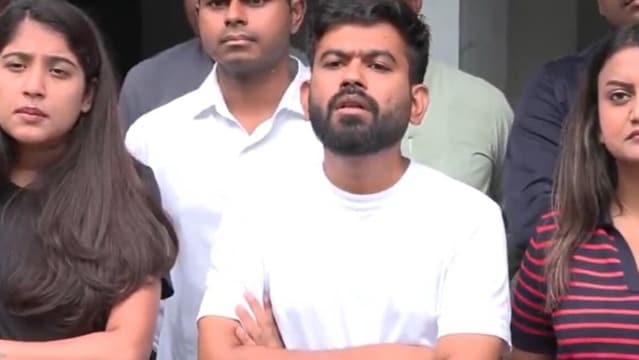
Soon afterwards, CJP leaders travelled to Dipke’s hometown of Sambhaji Nagar. Videos showed Dipke comfortably interacting with supporters outside his residence in the company of senior CJP leaders. Ironically, it was during this very interaction that Dipke finally announced the long-awaited Jharkhand visit.
"Definitely, we will go to Jharkhand. We stand with the students protesting there. We support their every demand."- CJP founder Abhijeet Dipke on Jharkhand Student Protest
If the leadership was genuinely too ill to travel to Ranchi to support students protesting for nearly two weeks, how was it healthy enough to undertake a political visit to Sambhaji Nagar and participate in public interactions?
The sequence strongly suggests that the Jharkhand visit was announced not because CJP suddenly discovered the students’ plight, but because remaining absent had become politically untenable.
A protest that became inconvenient
The political backdrop makes the episode even more revealing.
Jharkhand is not governed by the BJP.
It is ruled by the Jharkhand Mukti Morcha under Chief Minister Hemant Soren, with the Congress as a principal alliance partner.
For months, Dipke has faced allegations from critics that CJP functions less as an independent citizens’ movement and more as a pressure group whose activism disproportionately targets the BJP-led governments while remaining noticeably restrained when Opposition governments are under scrutiny. Dipke’s pictures with Kejriwal and Sisodia and his past links with AAP only adds weight to the allegation that CJP is yet another political movement under the guise of “championing students’ rights.”
Whether one agrees with that criticism or not, the Jharkhand protests have certainly strengthened that perception.
Had Dipke rushed to Ranchi from day one, he would have been compelled to question a JMM-Congress government over allegations of examination irregularities and administrative apathy. Instead came silence, followed by excuses, followed by mounting criticism, followed by an announcement only after social media users began openly questioning CJP’s credibility.
That is not how principled activism operates.
The movement that made CJP
The irony is difficult to miss because CJP owes much of its public visibility to student protests.
The organisation rose to prominence during the NEET paper leak controversy by aligning itself with activist Sonam Wangchuk’s fast and positioning itself as the face of student anger over alleged examination irregularities. CJP leaders projected themselves as uncompromising defenders of students and repeatedly claimed they would stand with young aspirants irrespective of political considerations.
Yet Jharkhand appears to have exposed the limits of that claim.
If student welfare is indeed the guiding principle, then the political identity of the government should be irrelevant.
A student protesting against alleged irregularities in Ranchi deserves no less solidarity than a student protesting over NEET in Delhi.
Celebrating a resignation while protesters struggled
Questions over CJP’s priorities did not begin with Jharkhand.
After sustained protests over the NEET controversy, Union Education Minister Dharmendra Pradhan resigned. Almost immediately, Abhijeet Dipke, Ashutosh Ranka, Saurav Das and other CJP leaders projected the resignation as a historic victory for their movement.
However, Pradhan himself presented an entirely different explanation.
In his resignation letter, he stated that he was stepping down so that vested interests would not mislead students into abandoning their studies and taking to the streets. According to him, his resignation was intended to remove himself as a political flashpoint and allow students to focus on preparing for their examinations and securing their future.
Whether one accepts that reasoning or not, it was certainly different from the triumphalist narrative promoted by CJP.
The optics became even more uncomfortable soon afterwards.
Videos of an “after-resignation party”, particularly featuring CJP leader Saurav Das, began circulating on social media. The celebrations triggered criticism not merely from political opponents but from individuals who had once associated themselves with the movement.
Among them was former Newslaundry journalist Meghnad S, who had briefly been associated with CJP during its formative phase. He publicly expressed disappointment, pointing out that while CJP leaders were celebrating, many volunteers and protesters were occupied arranging food, water and other necessities for fasting students at Jantar Mantar.
The criticism carried weight precisely because it came from someone who had once worked alongside the organisation.
It reinforced the growing perception that sections of the leadership were increasingly invested in optics and political theatre, while ordinary volunteers continued to perform the difficult work that sustains protest movements.
Jharkhand reinforces an old prejudice
Viewed against that backdrop, CJP’s delayed response to the Jharkhand protests appears less like an isolated lapse and more like a continuation of a familiar pattern.
When protests can be used to corner the BJP-led Centre, CJP displays extraordinary urgency.
When the allegations concern Opposition governments, hesitation suddenly sets in.
If CJP truly claims to represent students rather than political interests, its response should not vary depending on who occupies the treasury benches.
Selective activism inevitably invites accusations of political opportunism.
Public credibility is built on consistency. It cannot survive double standards.
Abhijeet Dipke’s eventual announcement of a Jharkhand visit may help contain immediate criticism, but it cannot erase the sequence that preceded it: prolonged silence, implausible explanations, contradictory public appearances and a sudden expression of solidarity only after accusations of hypocrisy began threatening CJP’s credibility.
For a movement that rose to prominence by claiming to speak for students across India, Jharkhand has become an uncomfortable test. Unless CJP demonstrates that it is willing to hold Opposition governments to exactly the same standards it demands of the Centre, the charge that its activism is guided more by political convenience than by principle will continue to shadow every future campaign.
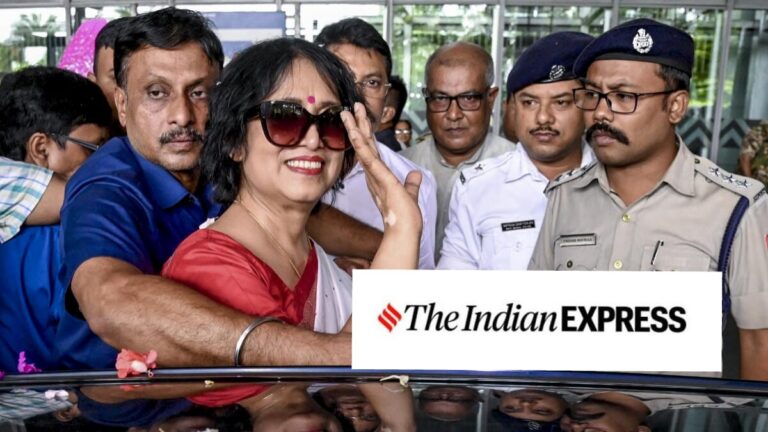
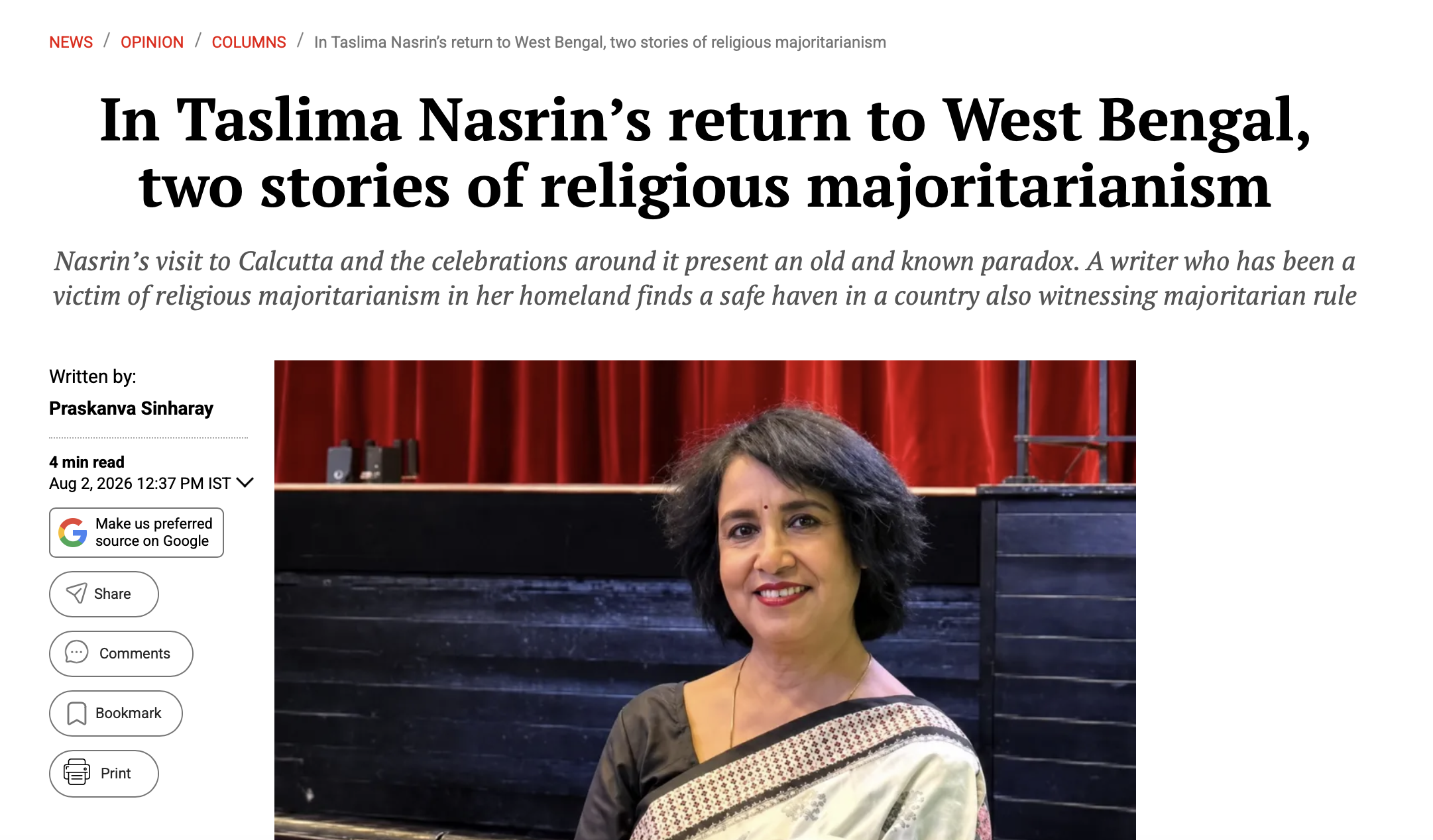
The left-liberal media ecosystem in India has perfected a singular art form over the decades: the mental gymnastics required to sanitise Islamic fundamentalism while finding a way to blame Hindus for the resulting chaos. No matter how egregious the display of radicalism, no matter how clear the identity of the perpetrators, the habitual apologists at publications like The Indian Express will unfailingly bend over backwards to spin the narrative. Their latest attempt to obfuscate reality comes wrapped in an analysis of exiled Bangladeshi author Taslima Nasreen’s return to West Bengal.
Titled ‘In Taslima Nasrin’s return to West Bengal, two stories of religious majoritarianism’, the piece is a masterclass in pseudo-intellectual dishonesty. It reveals the sheer desperation of a media apparatus that cannot bring itself to name Islamic bigotry without immediately inventing a false equivalence to vilify Hindus.
Source: Indian Express
The reality of 2007: Islamic violence forced Nasreen out
To understand the absurdity of the Indian Express piece, one must first revisit why Taslima Nasreen had to flee Kolkata in 2007. She was not driven out by abstract concepts or nameless phantoms. She was forced out because radical Islamic mobs took to the streets of Kolkata, rioting, damaging property, and baying for her blood over her writings, particularly her novel Lajja and Dwikhandito, books which documented the persecution of minority Hindus in Bangladesh by the Muslim majority.
Faced with violent street power from Islamist groups like the All India Minority Forum, the Buddhadeb Bhattacharjee-led Left Front government chose cowardice. Rather than upholding law and order and defending free speech, the state capitulated completely, effectively hounding Nasreen out of Bengal to appease a fundamentalist vote bank. Subsequent years under the Mamata Banerjee-led Trinamool Congress saw no change in stance; appeasement remained the ruling ideology, and Nasreen remained persona non grata in the city she called home.
The twisted logic: Welcome an exiled author, get accused of a ‘sinister plot’
Fast forward to her return. When an exiled feminist writer, who faced death threats from Islamic extremists for decades, finally gets to return to Kolkata under an administration willing to guarantee her security, one would expect commentators concerned with human rights and free expression to welcome the move. Instead, The Indian Express views the welcome extended to her not as a victory for free speech, but as a sinister plot by “Hindu nationalists.”
The article laments that billboards were put up, conch shells were blown, and her arrival was hailed as a “ghar wapsi” or a return of confidence. To the left-liberal mind, welcoming a persecuted dissident with traditional Indian customs is apparently an act of provocation. The piece goes on to claim that providing security to Nasreen is a “double-edged sword” because it allows the BJP to essentialise and vilify Muslim culture and politics as anti-women and regressive.
Consider the sheer inversion of cause and effect in this logic. First, radical Islamists issue death threats and violently drive a female writer out of a state. Then, political parties capitulate to these extremists for decades to secure vote banks. Finally, when a government provides her safety and calls out the radicalism that drove her away, that government is accused of “vilifying” Muslims.
According to this convoluted worldview, pointing out the documented actions of Islamic fundamentalists is worse than the fundamentalism itself. The perpetrators of violence are shielded from criticism, while those providing refuge to the victim are painted as the true villains.
The dog-whistle of “majoritarianism”
The centrepiece of the article’s intellectual sleight of hand is the deployment of the word “majoritarianism.” By titling the piece “two stories of religious majoritarianism,” the author attempts to draw a moral symmetry between two vastly different phenomena. On one hand, you have Islamic fundamentalism driving mobs to riot on the streets, issue fatwas, and demand the expulsion or death of a writer for expressing her views. On the other hand, you have what the author frames as “Hindu majoritarianism,” consisting of citizens blowing conch shells, putting up welcome banners, and guaranteeing the physical safety of that same writer.
To equate the violent intolerance that exiled Taslima Nasreen with the cultural welcome that facilitated her return is not just bad analysis, it is deliberate propaganda.
The term “majoritarianism” has become a favourite dog-whistle for the Left media and its ideologues. It is deployed specifically to defame the Hindu majority whenever they assert their cultural identity or challenge the entrenched system of selective secularism. In the vocabulary of the left-liberal establishment, any policy or action that protects victims of Islamist aggression is reflexively branded as “majoritarian,” thereby turning the concept of justice upside down.
Secular humanism as a shield for appeasement
The article concludes by invoking Nasreen’s call for “secular humanism” and her criticism of all organised religions, attempting to weaponise her philosophical stance against the very people offering her refuge. It lectures the reader that her visit is not a story of party politics, but the tale of the return of the writer-activist who stands against religious fundamentalism and majoritarian politics.
This is the ultimate irony. For decades, self-proclaimed “secularists” in India ignored Nasreen’s plight, turned a blind eye to the fatwas against her, and allowed fundamentalists to dictate state policy. They discarded “secular humanism” the moment it conflicted with electoral arithmetic. Now that her return highlights the utter failure of their favoured political models, these same commentators retreat into high-minded abstractions about “humanism” to avoid confronting the specific, real-world source of her persecution.
The Left’s primary objective: Fiction over facts, propaganda over reality
The Indian Express article is a textbook illustration of why mainstream media commentary has lost credibility among observant readers. It demonstrates an ideological framework where Muslims must always be framed as potential victims, even when the context is the return of a woman fleeing Islamist death threats, and Hindus must always be cast as aggressors, even when blowing conch shells to welcome a persecuted author.
Taslima Nasreen’s return to Kolkata should have been a straightforward story about the triumph of free expression over violent intolerance. By converting it into a narrative about the dangers of “Hindu majoritarianism,” the left-liberal media once again proves that its primary commitment is not to truth, justice, or free speech, but to the defence of a broken, one-sided narrative at all costs.
Recently, an interview of Nivedita Menon, a former professor at Jawaharlal Nehru University (JNU), was uploaded on journalist Mandeep Punia’s YouTube channel. In this interview, Nivedita used student movements and education issues as a shield to directly attack the nation of India, the country’s sovereignty, democratic institutions, and constitutional setup, calling India a “cursed” country.
For a professor who was associated with teaching and learning for a long time at a prestigious university like JNU to make such statements from public platforms is not merely expressing dissent, but a well-thought-out strategic attack on the country’s sovereignty and social fabric.
Her words spoken throughout the interview clearly reveal the extent to which the leftist-radical ecosystem is filled with malice and hatred towards India.
Disrespecting the country by calling India ‘cursed’, along with filthy remarks on Hindus
In her interview, while discussing the protests of the Cockroach Janata Party (CJP) in the country, various student movements, and the condition of minorities, Nivedita Menon made her inherent hatred towards the nation of India public. She used the derogatory word ‘cursed’ for a great, tolerant, and democratic country like India.
Speaking on the CJP’s protests, she said, “When a child like Junaid is killed and thrown off a train, and the entire country remains silent, I feel that over the last 12 years they are being repeatedly made to feel that you don’t belong here. We will bulldoze you, we will do anything to you, and you cannot utter a word. The CJP protest provided a little breathing room, and Muslims perhaps started feeling that maybe in this cursed country, there is a place for us too.”
Portraying a great nation like India, where millions of citizens take pride in their cultural heritage and sovereignty, as a ‘cursed’ structure proves that so-called leftist intellectuals have nothing left in the name of constructive criticism except spewing anti-national poison.
By using such misleading language, she also attempts to project India’s image internationally as an oppressive nation.
Glorification of CJP and chaotic movements: A conspiracy to put institutions in the dock
Nivedita’s entire focus remained on justifying and glorifying the protests of the Cockroach Janata Party. An attempt was made to present left-leaning and radical organisations, as well as rioters who attacked police and conspired to enter Parliament under the guise of students at Delhi’s Jantar Mantar, as victims.
Menon termed these movements a ‘democratic victory.’ She said, “This word ‘accountability’ that CJP’s protest made so common, everyone is talking about accountability. You might remember a student reading the description of democracy from an NCERT textbook and saying that accountability is a feature of democracy. So, the biggest victory of this movement is that the word accountability has entered our dictionary and our everyday language.”
Speaking on the leadership and nature of the movement, she further added, “The kind of people who came out on CJP’s call, I am hearing the word ‘organic’ a lot, that it became organic. Now, it did become organic, but organic does not emerge on its own. Somewhere there has to be a centre giving the call, and in this, the name of Abhijit Dipke and his role cannot be forgotten. We cannot reduce him.”
She also claimed that such movements broke the silence of the last 12 years and brought various leftist groups onto a single platform. She said, “The dense silence that had prevailed for 12 years- whatever happened in these 12 years- that is why left groups could join him. That is why so many people across the country, and actually across the world, supported it.”
Attacks on RSS, Central Government, and the education system
During the interview, Nivedita Menon’s political malice towards the Central Government and the Rashtriya Swayamsevak Sangh (RSS) was clearly visible. She made sharp and indecent remarks about the country’s new Education Minister, the newly formed task force, and the National Education Policy (NEP).
She also alleged that their mindset regarding women is very cheap. Questioning the government’s intent, she said, “Dharmendra Pradhan left, but the person who came as Education Minister is an even more radical Sanghi and an even more radical RSS preacher. He spoke very supportively about the rapists of Bilkis Bano. So, a person like that has been made Education Minister. We thought no one could be worse than Dharmendra Pradhan, but they brought out another one from their bag.”
Menon made several other vile allegations against the new Education Minister and made vulgar comments about Hindu society. Mocking the formation and members of the task force created by the government for educational reforms, she said, “Look at the kind of people in the so-called high-powered task force they formed. It has IAS bureaucrats, the chief of Infosys, and what will Infosys tell us about education? Then there is another person who praised cow urine (Gomutra), saying many diseases are cured through it. So, they have formed a task force of this kind from which we have no hope.”
Completely rejecting the country’s political structure and democratic setup, she alleged, “It has been a Hindu Rashtra here for 12 years; attempts were made to make it a Hindu Rashtra, and in a way, it has become a Hindu Rashtra. We are all living under the shadow of a Hindu Rashtra.”
Support for anti-CAA protests, Umar Khalid, and separatist continuity
In the interview, Nivedita Menon openly defended anti-Citizenship Amendment Act (CAA) protests and suspects of the Delhi riots. She glorified the narratives spread by jailed accused like Umar Khalid and presented them as a grand revolutionary journey.
She said, “The seeds that were sown in anti-CAA and farmers’ protests, which were suppressed in a way, the seeds sown by youths like Umar Khalid emerged as plants. And now it is a continuity, a continuity from anti-CAA to here.”
Furthermore, expressing complete distrust in the country’s electoral process, judiciary, and the fairness of democratic institutions, she said, “This kind of behaviour by any government shows us that they have no intention of winning an election. It means they are not afraid of elections because at every level, with EVM, ECI, SIR, Delimitation, they feel they don’t even need to win elections anymore.”
Abuses hurled at PM Modi termed as ‘resistance’, ‘anti-patriarchal’, and a ‘bourgeois’
To justify the vulgar and indecent abuses directed at the Prime Minister and constitutional figures during student movements, Nivedita Menon and Mandeep Punia took the support of feminist and ‘queer’ theory. Terming it as the youth’s ‘revolutionary resistance’, she said, “When an abuse is hurled repeatedly at any group, picking up that abuse and making it a bouquet and a badge of honour is also a historical process.”
Further defending the abuses, she said, “Most of the abuses are actually anti-patriarchal. Listening to the abuses, I felt that this too is a poke of resistance; this is a kind of resistance which our generation… so listening to abuses, I felt this is also part of resistance.”
A former university professor encouraging youth rudeness, indecent language, and abuses towards persons sitting in constitutional positions by calling them a ‘badge of honour’ and a ‘bouquet’ represents the peak of moral decay among the leftist intellectual class.
Misuse of JNU platform and attempts to poison the minds of youth
Towards the end of the interview, Nivedita Menon openly admitted that she is learning from the chaotic working style of these youths and wants to promote it.
She said, “When the RSS and BJP do propaganda, I will learn from them. I will learn how, when mud is thrown at you, instead of throwing mud back at them, you turn it into a balloon or a bouquet and toss it back.”
A professor’s responsibility is to make students aware of studies, disciplined debate, nation-building, and constitutional dignity. But on the contrary, leftist thinkers like Nivedita Menon remain engaged in stoking feelings of anger and separatism in the minds of youth against the Indian state system, police, and judiciary.
Nivedita Menon’s record: Complete list of controversial statements
Calling India a ‘cursed country’ or attacking the Indian Army and constitutional setup is not the result of any new line of thinking by Nivedita Menon. If her past career and record are reviewed, it becomes clear that her entire history is filled with anti-India statements, insults to the army, support for separatists, and an anti-Hindu agenda.
India is illegally occupying Kashmir: Nivedita’s controversial statement
In March 2016, during the controversy over ‘Azadi’ slogans on the JNU campus, Nivedita Menon gave a public lecture on ‘What Nationhood Means to Me’. In this speech, she openly stated, “We all know that India’s occupation of Kashmir is illegal. It is accepted world over that India is illegally occupying Kashmir.”
JNU Prof Nivedita Menon is the same Urban naxal who claimed that India illegally occupies Kashmir.
Referring to controversial maps in international magazines like Time and Newsweek, she argued that if the entire world considers India an aggressive power in Kashmir, then slogans of ‘Azadi’ in the valley are completely justified and natural. Her statement sparked massive outrage across the country.
Insulting Indian soldiers and alleging they work only for ‘Roji-Roti’
In February 2017, Nivedita Menon was the keynote speaker at a national seminar organised at Jai Narain Vyas University (JNVU), Jodhpur. There, she not only displayed a controversial map of India but also severely insulted the Indian Army soldiers protecting the country’s borders.
She had said, “Soldiers do not stand on the borders for the country’s defence or patriotism; rather, they work in the army only for their livelihood (employment) and to earn their Livelihood.” She had further added that India should withdraw its army from regions like Siachen and give up its claim over it.
Following this anti-national statement, protests broke out from the university campus to the streets in Jodhpur, an FIR was registered against Menon, and the professor who organised the seminar was suspended.
Questioning India’s official map and integrity
In several of her lectures and articles, Nivedita Menon has rejected the validity of India’s geographical map. Citing controversial maps from ‘Himalayan Magazine’ and foreign publications, she has repeatedly argued that India is an ‘artificial nation-state’.
She presents the merger of North-East India and Kashmir into India as ‘military coercion’, which is a stance directly challenging India’s sovereignty and integrity.
Leftist-Islamic nexus on ‘Love Jihad’: Arfa Khanum and Nivedita Menon mocking Hindu victims
An analysis of an old conversation between Nivedita Menon and ‘The Wire’ propagandist Arfa Khanum Sherwani clearly reveals how leftists and Islamists join hands to mock serious issues related to the safety of Hindu society.
In one of their podcasts, Arfa Khanum and Nivedita Menon not only completely dismissed an organised social crime like ‘Love Jihad’ with leftist trickery, but also made extremely shameful comments about victimised Hindu families and Hindu men.
When Arfa Khanum pushed her agenda by asking why ‘Hindu girls like Muslim boys’, Nivedita Menon laughed out loud and gave a highly irresponsible reply, saying, “Muslim men must be so attractive, and they probably don’t get that in their own religion.”
This duo of Arfa and Nivedita tried to hide the deep, bitter truth behind Love Jihad, where Muslim youths conceal their religious identity, tie sacred threads (Kalawa) on their wrists, adopt fake Hindu names to trap Hindu girls, and later indulge in sexual exploitation and pressure for religious conversion.
Nivedita bursting into laughter at this malicious question asked by Arfa Khanum proves that these women wearing the garb of so-called liberal-feminists leave no opportunity to demean Hindu society to provide intellectual protection to radicals.
Absurd comments on the Indian Constitution, Hinduism, and Hindutva
Professor Menon has continuously launched sharp attacks on the cultural traditions and customs of Hindu society, and the concept of Hindutva in her speeches. She portrays Hindutva as a fierce, violent, and anti-women ideology, while remaining completely silent on rigid radicalism and evils present in other religions.
Targeting Hindu beliefs to spread discontent against the majority population has been a core part of her strategic rhetoric.
Attacks on the credibility of the country’s judiciary, police, and administrative setup
Menon has a track record of trusting no constitutional institution in India. In cases of separatists or terror supporters convicted by courts, she always questions judicial verdicts. She calls court-ordered inquiries ‘state suppression’ and legal action taken by police ‘political persecution’. In this manner, she works to create complete distrust towards the Indian state setup in the minds of the youth.
Real mirror of ideological anarchy and anti-national narrative
This recent interview of Nivedita Menon and her past controversial history clearly reveal that her entire narrative is not just opposition to a political party or government, but a deep strike against the nation-state of India, its sovereignty, and its constitutional setup.
Calling a diverse and tolerant country like India ‘cursed’, terming the valour of the Indian Army protecting the country as merely a ‘means of earning bread and butter’, calling India’s sovereign rights over Kashmir illegal, and describing accused involved in anti-national activities as ‘seeds of revolution’, all of this is part of a planned leftist-separatist mindset.
If platforms of prestigious educational institutions like JNU, which run on the money of ordinary taxpayers, are used to fill the minds of youth with hatred towards the nation, borders, police, and judiciary, it will weaken the roots of the country.
Dissent and ideological criticism are always welcome in a democracy, but when the very existence of the nation is denied in the name of dissent, abuses are presented as a ‘badge of honor’, and anarchy is promoted, it cannot be called freedom of expression, but ‘ideological terrorism’.
This complete record of Nivedita Menon is a clear message to conscious society and the youth of the country that it is extremely necessary to recognise and rationally refute this anti-national agenda hidden behind an intellectual cover.
The demand to release “Bandi Singhs” has become one of Punjab’s most persistent political issues, drawing the SGPC, Shiromani Akali Dal, AAP, Congress, BJP, hardline Panthic organisations and, more recently, supporters of jailed MP Amritpal Singh into competing campaigns. But “Bandi Singh” is not a legal category. The term brings together prisoners in very different situations, including death-row and life convicts, people already on parole and undertrials facing ongoing terror-related prosecutions.
The SGPC’s core campaign focuses on nine prisoners, including Balwant Singh Rajoana, Jagtar Singh Hawara, Jagtar Singh Tara, Devinder Pal Singh Bhullar and Gurdeep Singh Khera. Seven are connected with the 1995 assassination of Punjab Chief Minister Beant Singh, in which he and 16 others were killed. Bhullar was convicted in the 1993 Delhi bombing targeting MS Bitta that killed nine people, while Khera received life sentences in bombing cases.
Over time, however, the definition has expanded. Lists have included dozens of prisoners and newer terror accused such as Jagtar Singh Johal, Hardeep Singh Shera and Ramandeep Singh Bagga. Amritpal Singh, who is an undertrial rather than a decades-old life convict, has also been brought into the release campaign by Akali Dal Waris Punjab De. This expansion has transformed separate legal cases into a broader political cause.
A central argument of campaigners is that many prisoners have “completed their sentences”. Legally, that description can be misleading. Life imprisonment ordinarily lasts for the convict’s natural life unless remission or commutation is granted. Fourteen years can make a prisoner eligible for consideration in certain cases, but does not automatically end a life sentence. Different governments may also have jurisdiction depending on where the conviction occurred.
The movement has grown through hunger strikes, the SGPC’s signature campaign and the Qaumi Insaaf Morcha’s permanent mobilisation near Chandigarh. It has also witnessed violent confrontations in which police personnel were injured and public property damaged. Meanwhile, Punjab’s political parties continue balancing Sikh sentiment, electoral considerations, humanitarian arguments and national-security concerns.
Individual cases can legitimately be reviewed for remission, parole or clemency based on age, health, conduct and law. But the article argues that blanket release through political or religious mobilisation risks turning men convicted of terrorism and murder into political heroes while pushing their victims out of the debate.
In early August 2026, the National Highways Authority of India (NHAI) found itself at the heart of a controversy after visuals showing dangerous and substandard ‘rumble strips’ on National Highway-25 (NH-25) near Rajasthan’s Prathvipura village went viral online. After an initial rebuttal of social media posts flagging the safety hazard the strips posed, NHAI ended up getting fact-checked by social media users and suspending a concerned project director.
The viral video showed raised asphalt ridges at a median opening causing vehicles to bounce sharply. Highway users quickly flagged the so-called rumble strips, which actually were poorly constructed speed humps or breakers, on NH-25 as hazardous on a high-speed national highway corridor.
As the videos of the rumble strips across NH-25 near Prathvipura village surfaced online, several netizens raised questions over the design of the strips, the necessity of such rumble strips on a national highway, and whether they met road safety norms.
People raised concerns that such unusually high and inconsistent ‘rumble strips’ can cause vehicles to experience sudden jolts and lead to loss of control, abrupt braking, or collisions, especially during night or in poor visibility.
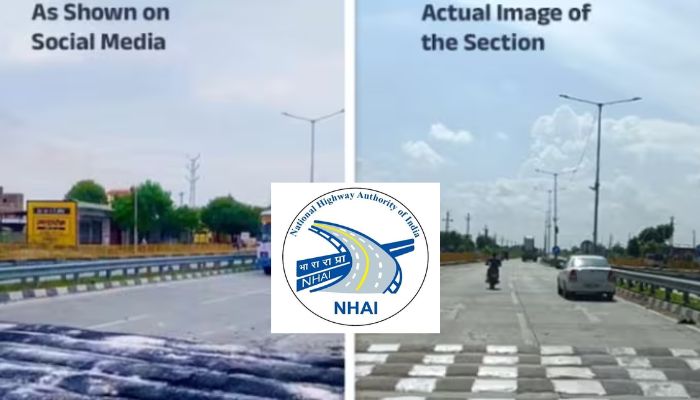
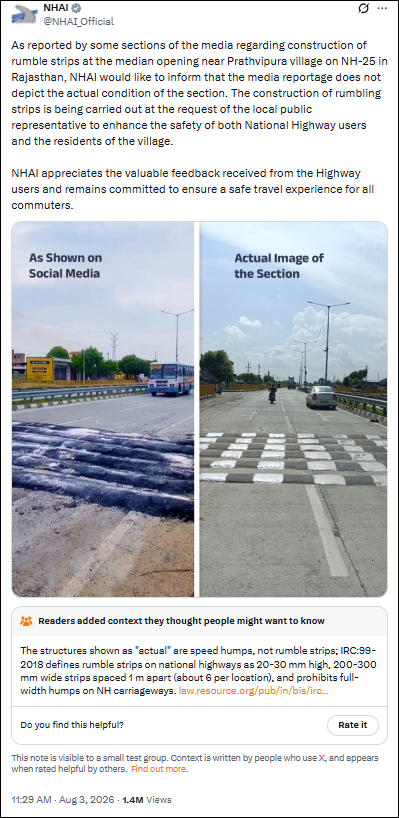
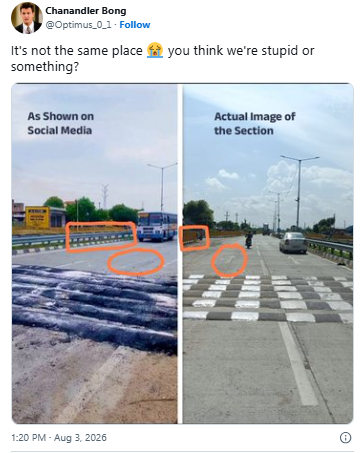
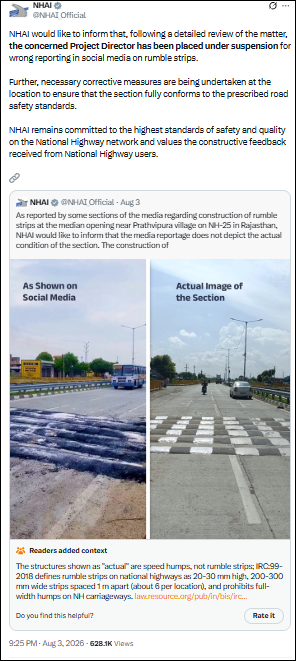
In response to the social media outrage, the NHAI published an X post on 3rd August 2026 and claimed that the viral visuals of the rumble strips on NH-25 in Rajasthan do not depict the actual condition. It shared a comparison picture, captioned: “As shown on social media vs actual image of the section”.
The NHAI also said that the rumble strips were constructed at the request of a local public representative for the safety of local villagers and highway users.
“As reported by some sections of the media regarding construction of rumble strips at the median opening near Prathvipura village on NH-25 in Rajasthan, NHAI would like to inform that the media reportage does not depict the actual condition of the section. The construction of rumbling strips is being carried out at the request of the local public representative to enhance the safety of both National Highway users and the residents of the village. NHAI appreciates the valuable feedback received from the Highway users and remains committed to ensure a safe travel experience for all commuters,” it said.
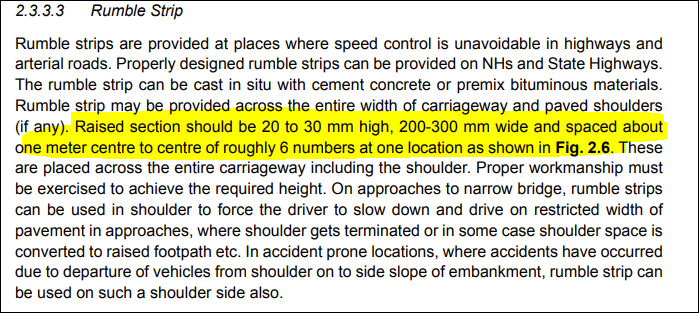
A closer look at both the images, however, makes it clear that even the supposed ‘actual image’ does not really show standard rumble strips, but speed humps. As per the rules, rumble strips on national highways should be 20-30 mm high, 200-300 mm wide strips spaced 1 m apart (about 6 per location). In addition, there is a prohibition on full-width humps on NH carriageways.
Source: Indian Roads Congress 2018 document.
The NHAI’s ‘rebuttal’ intensified the backlash further, as people called out the authorities for passing off hazardous flat-topped speed breakers or humps as rumble strips.
One X user wrote, “That’s certainly not rumble strips. You are sadly mistaken if you think you can pass off flat-topped speed breakers as rumble strips. These are speed breakers and are undoubtedly a safety hazard for highway drivers.”
That's certainly not rumble strips. You are sadly mistaken if you think you can pass off flat-topped speed breakers as rumble strips. These are speed breakers and are undoubtedly a safety hazard for highway drivers.
Pertinently, several social media users shared longer videos of the same location and drew comparisons between the “actual image” shared by the NHAI with elements from the additional on-site videos.
It emerged that the “actual image” the NHAI shared was actually either of a different location or the opposite carriageway.
Social media calls out mismatched ‘factcheck’ imagery, NHAI backtracks
By the evening, the NHAI backtracked from its own rebuttal of the viral claims about the substandard and hazardous rumble strips, rather, speed breakers.
At 9:25 pm on Monday, the NHAI published an X post informing that it has conducted a detailed review of the matter. The NHAI said that following a review, it has suspended the concerned Project Director for “wrong reporting in social media on rumble strips.”
The NHAI further stated that it is undertaking corrective measures at the location to ensure conformity with prescribed road safety standards.
“NHAI would like to inform that, following a detailed review of the matter, the concerned Project Director has been placed under suspension for wrong reporting in social media on rumble strips. Further, necessary corrective measures are being undertaken at the location to ensure that the section fully conforms to the prescribed road safety standards. NHAI remains committed to the highest standards of safety and quality on the National Highway network and values the constructive feedback received from National Highway users,” the NHAI said.
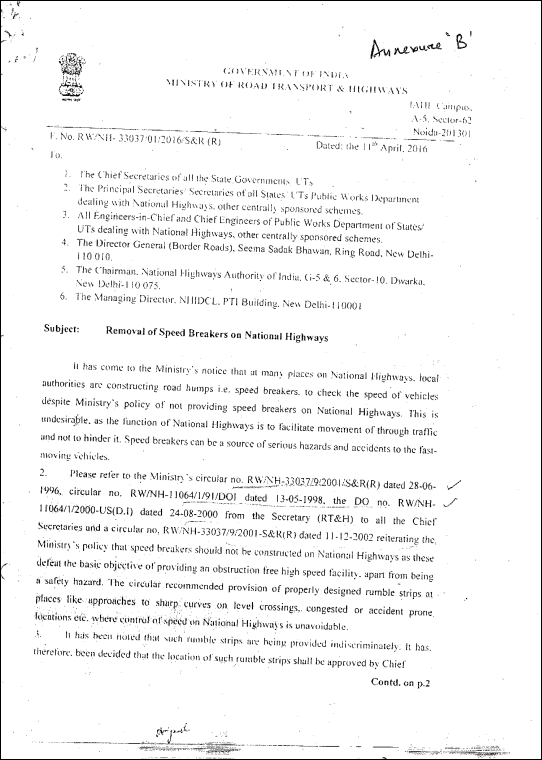
The NHAI’s initial clarification remains problematic for another reason. The Ministry of Road Transport and Highways has reiterated on multiple occasions, including in a 2016 circular, that constructing speed breakers or humps on National Highways by local authorities or by NHAI at their behest/request is against the rules. Constructing speed humps on National Highways is prohibited because it essentially is a safety hazard and also defeats the basic objective of providing an obstruction-free high-speed facility.
Instead of speed humps, the authorities recommend properly designed rumble strips at places like approaches to sharp curves on level crossings, congested or accident-prone locations, etc., where control of speed on National Highways is unavoidable.
However, in the present case, the NHAI first said that the ‘rumble strips’ were constructed at the request of a local political representative and later admitted “wrong reporting” and undertaking of corrective measures. It is being highlighted that not only did the actual installations exceed the IRC specifications, but also that the NHAI justified non-standard construction work solely on political request, subordinating engineering principles to local political pressure.
The NHAI’s handling of the whole matter has revealed a mixed picture. On one hand, the NHAI quickly committed to physical corrections, demonstrating seriousness about accountability. On the other hand, however, the NHAI initially denied ground reality by sharing mismatched imagery.
Not only this, the NHAI passed off a series of small speed bumps as ‘rumble strips’. It must be recalled that back in September 2023, the NHAI itself, in response to an RTI query, said that the construction of rumble strips and speed breakers has been banned on National Highways.
“There are no guidelines to erecting rumblers on NHs. In this regard, specific instructions have been issued to all Project Directors for removal of speed breakers from all NH stretches and ensuring patchless roads for road users (including ambulances),” the NHAI responded in its official reply to the query filed by one Nikhil Desai.
The NHAI could have first conducted a thorough review, ascertained complete facts, and then issued a clarification instead of rushing to discredit the viral claims.
Politics in Tamil Nadu has often been marked by fierce rivalries, but some episodes have transcended ordinary political confrontation to become defining moments in the state’s history. One such moment unfolded on 25 March 1989, when then Leader of the Opposition J. Jayalalithaa walked out of the Tamil Nadu Assembly with a torn saree, dishevelled hair and visible injuries after proceedings descended into chaos.
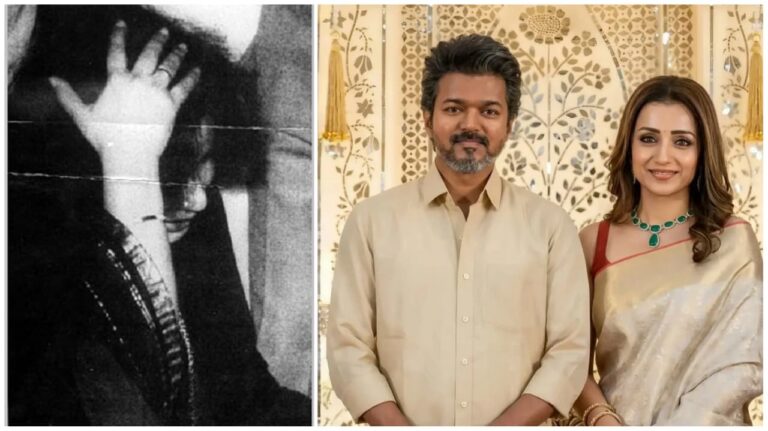
Nearly four decades later, another controversy involving a woman has once again placed the Dravida Munnetra Kazhagam (DMK) under scrutiny. Udhayanidhi Stalin, the former Deputy Chief Minister and a senior DMK leader, was arrested after drawing widespread criticism over an alleged double-meaning remark widely interpreted as targeting actress Trisha Krishnan during a political speech against Tamil Nadu Chief Minister C. Joseph Vijay.
While the two incidents are vastly different in nature, one involving alleged physical assault inside the Assembly and the other a controversy over public remarks, they have together revived a larger political debate about the treatment of women in Tamil Nadu’s political discourse.
The day that changed Jayalalithaa’s political career
The Assembly session of 25 March 1989 remains among the most controversial in Tamil Nadu’s legislative history.
Jayalalithaa, then 41 and serving as the Leader of the Opposition, accused the Karunanidhi-led government of corruption during the Budget session. The proceedings soon deteriorated into unprecedented disorder as AIADMK and DMK legislators clashed on the Assembly floor.
Jayalalithaa later alleged that she was physically attacked amid the chaos. According to her contemporaneous account, legislators directed blows towards her, hurled objects across the House and, while AIADMK MLAs were escorting her out, a DMK minister allegedly pulled her saree, causing it to tear and resulting in injuries.
She emerged from the Assembly with a torn saree, dishevelled hair and tears in her eyes, a scene that was widely reported and became one of the defining images of Tamil Nadu politics.
Jayalalithaa declared that she would return to the Assembly only as the Chief Minister of Tamil Nadu.
Two years later, in 1991, she fulfilled that pledge by leading the AIADMK to a sweeping electoral victory.
Competing versions of the 1989 events
The events of that day have always remained politically contested.
Jayalalithaa consistently maintained that she had been assaulted and humiliated inside the Assembly.
Karunanidhi, however, rejected those allegations. In statements issued later, he maintained that DMK legislators had remained calm despite provocation and instead accused AIADMK MLA K. A. Sengottaiyan of attacking him and breaking his spectacles after Jayalalithaa called him a criminal.
The contrasting accounts have remained part of Tamil Nadu’s political history, with both parties continuing to narrate the incident through sharply different lenses.
Regardless of those competing claims, the events of 25 March 1989 are widely remembered as one of the darkest days in the history of the Tamil Nadu Assembly and marked a turning point in Jayalalithaa’s rise as a mass political leader.
The Trisha Krishnan controversy
The latest controversy erupted during a DMK protest meeting over the Cauvery water-sharing issue.
While attacking the ruling Tamilaga Vettri Kazhagam (TVK) government, Udhayanidhi Stalin remarked that sections of the crowd repeatedly chanted actress Trisha Krishnan’s name. His comments were widely interpreted by political opponents and many social media users as a double entendre referring to media speculation linking Trisha Krishnan with Chief Minister Joseph Vijay.
Although Udhayanidhi immediately added, “I meant the Cauvery,” the clarification did little to contain the backlash.
The remarks triggered criticism from across the political spectrum.
The ruling TVK described the comments as degrading and accused the DMK leader of normalising the objectification of women in political discourse. The party approached the National Commission for Women seeking action. The Tamil Nadu BJP also condemned the remarks, calling them vulgar and demanding legal action.
Earlier controversies involving women
The Trisha controversy is not the first time Udhayanidhi Stalin has faced criticism over comments involving women connected to political rivals.
Earlier this year, while criticising Chief Minister Joseph Vijay, he referred to Vijay’s wife, Sangeetha Sornalingam, mentioning reports about their personal differences during a political speech. Those remarks also drew criticism for dragging family members into political attacks.
During the 2021 Assembly election campaign, Udhayanidhi also mocked then Chief Minister Edappadi K. Palaniswami over his political relationship with V. K. Sasikala, invoking her while attacking his political credibility.
Each of these episodes has attracted criticism from opponents, who argue that women associated with political rivals are unnecessarily drawn into partisan political battles.
Echoes of the past
The circumstances surrounding Jayalalithaa’s 1989 Assembly experience and the Trisha controversy are fundamentally different.
One concerns allegations of physical assault during legislative proceedings. The other concerns remarks delivered at a political rally.
Yet both incidents have generated debate over how women become part of political confrontation in Tamil Nadu.
For Jayalalithaa, the events of March 1989 transformed her political image from an opposition leader into a symbol of resilience. The images of her leaving the Assembly remain among the most enduring in the state’s political history.
The current controversy has similarly reopened conversations about political language, public conduct and the standards expected from elected representatives.
Whether the Trisha row ultimately proves to be a fleeting controversy or another defining moment in Tamil Nadu politics remains to be seen. What is undeniable, however, is that nearly four decades after the events of 1989, women continue to be dragged into Tamil Nadu politics.