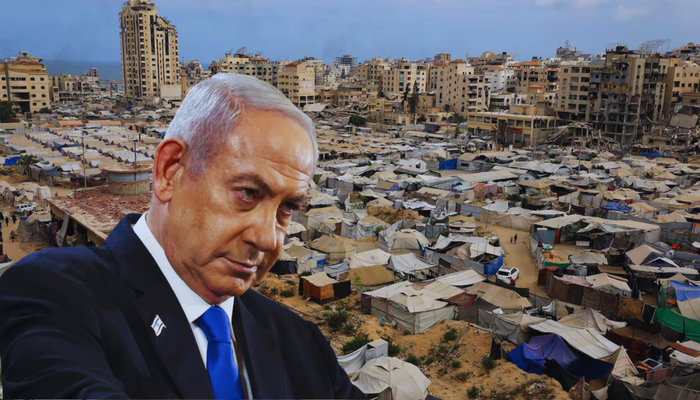
Israel’s political-security cabinet on Friday (8th August) approved a plan proposed by Prime Minister Benjamin Netanyahu for the Israeli military to take over Gaza City. “The IDF will prepare to take control of Gaza City while providing humanitarian aid to the civilian population outside the combat zones,” Netanyahu’s office said in a statement, referring to the Israeli Defence Forces. The decision comes after the attempts to mediate a ceasefire failed in July this year.
Yesterday, Netanyahu had reportedly expressed the intention to take military control of the entire Gaza Strip, but the plan approved by the security cabinet is limited to Gaza City, the largest urban centre of the territory, located in its north.
The Israeli military operaration will involve displacement of all Palestinian civilians from Gaza city to camps in central Gaza. The broader plan envisions the disarming of Hamas, which has run the enclave since 2007, the return of all the hostages kept by Hamas, and the demilitarization of the entire Gaza Strip and Israeli control of it.
The PM’s proposal has been approved despite threat by Hamas to kill the remaining Israeli hostages if Israeli forces proceeds towards Gaza City. The IDF has also warned that he operation risks the lives of the remaining hostages, apart from the possibilty of sparking a humanitarian disaster.
Evacuation of Palestinians from the territory will take 2 months
As per the approved plan, the Palestinians have two months’ time until October 7, 2025 (which coincides with the second anniversary of Hamas terror attack on Israel), to evacuate Gaza City. Subsequently, the IDF will lay a siege on the territory, and any remaining Hamas operatives will be eliminated. After that, the IDF will proceed to acquire the remaining areas of Gaza.
According to reports, a statement by the Prime Minister’s office said that Israel would provide humanitarian aid to the civilian population outside combat zones. A Day before yesterday, US Ambassador to Israel Mike Huckabee said that the US- and Israeli-backed Gaza Humanitarian Foundation will expand its operations from 3 to 16 distribution sites that will be operational around the clock.
The statement from the PM’s office also stated that the cabinet, by majority, also approved a list of five principles that Israel would demand to be fulfilled before agreeing to a ceasefire with Hamas. The principles are- (1) The terror group’s disarmament;
(2) the return of all 50 remaining hostages — 20 of whom are believed to be alive;
(3) the demilitarization of the Gaza Strip;
(4) Israeli security control over the Gaza Strip; and
(5) the existence of an alternative civilian government that is not Hamas or the Palestinian Authority.
IDF warns of risk to the lives of hostages, ministers go ahead with the plan
The development is said to have come amid the warnings of the Israeli Defence Forces that the operation might risk the lives of the remaining hostages in Gaza. The IDF Chief of Staff, Lt. Gen. Eyal Zamir, reportedly expressed his opposition to Netanyahu’s proposal.
“The lives of the hostages will be in danger if we go ahead with this plan to occupy Gaza. There is no way to guarantee that we will not harm them. Our forces are worn out, the military tools need maintenance, and there are humanitarian and sanitary (concerns regarding the Palestinian population),” the IDF chief was quoted as saying. He added that a complete occupation of the Gaza Strip would take a year or two, involving an initial phase of about five months of intensive fighting.
The IDF Chief reportedly presented an alternative plan to Netanyahu’s plan, but the majority of ministers agreed with the Prime Minister’s plan. The ministers believes that the alternative plan will not be able to defeat Hamas and secure the release of the hostages. The Prime Minister’s office said that the operation is intended to defeat Hamas, and that it can be stopped at any point if Hamas agrees to Israel’s demands. Around 50 hostages are still said to be held in Gaza, out of whom around 20 are believed to be alive by the Israeli officials. The hostages were captured during October 7 terrorist attack by Hamas.
A complete occupation of the Gaza territory by Israel would amount to reversing a 2005 decision of the country, wherein it withdrew thousands of Jewish settlers and military forces following Palestinian militant attacks, but retained control of its borders, airspace and utilities.
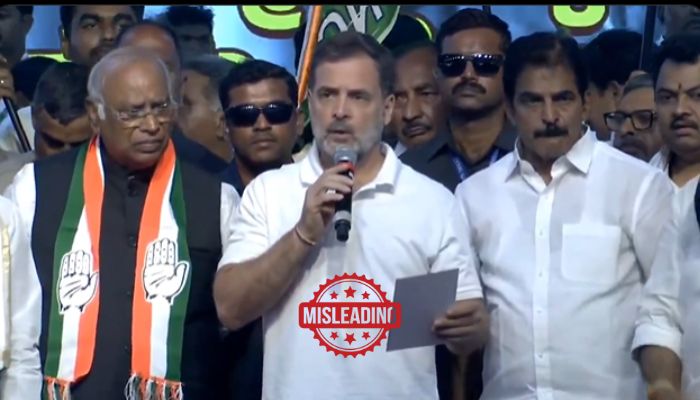
On Friday (8th August), the Election Commission of India (ECI) debunked the lies peddled by Congress leader Rahul Gandhi as part of his campaign to undermine the integrity of the nodal election body.
In a video shared by him, Rahul Gandhi posed 5 rhetorical questions before the ECI. These included –
Why are you not giving voter lists in digital machine-readable format to the people of India?
Why are you destroying video evidence?
Why is ECI committing massive fraud in the voter lists?
Why is ECI threatening opposition instead of answering our questions?
Why is ECI behaving like an agent of the BJP?
However, the Congress leader did not expect a point-by-point rebuttal of his falsehoods and vicious propaganda.
— Election Commission of India (@ECISVEEP) August 8, 2025
At the very onset, the Election Commission of India made it clear that the Supreme Court had turned down Congress’ petition for providing machine machine-readable voter list in 2019. As such, the nodal election body is under no compulsion to entertain this demand of the grand-old party.
It pointed out why CCTV footage is destroyed after 45 days and the rationale behind its preservation in specific case.
The Election Commission of India stated, “Any aggrieved Candidate can file an election petition (EP) to challenge his election in the concerned High Court within 45 days. If an EP is filed, CCTV footage is retained; otherwise, it serves no purpose unless someone intends to breach voter privacy. For example, reviewing CCTV footage from 1 lakh polling stations would take 1 lakh days-that’s approximately 273 years-with no legal outcome.”
While responding to the claim of ‘committing mass fraud’, ECI pointed out how almost no appeals were made by the Congress party across 36 States and Union Territories, following the 2024 Lok Sabha election. This was despite the fact that the grand-old party had the legal sanction to challenge the nodal election body.
The Election Commission further stated, “Many such allegations are being made by Shri Rahul Gandhi and are being reported by the media, despite no written complaint ever being submitted by him. In the past as well, he has never personally sent a self-signed letter. For example, he raised the Maharashtra issue in December 2024. Subsequently, an advocate from AICC wrote to ECI. Our reply, dated 24 December 2024, is publicly available on ECI website. Yet, Shri Rahul Gandhi claims that ECI never responded.”
The nodal election body has therefore requested the Congress leader to submit his specific claims and objections against voters and sign the Declaration/Oath as per Rule 20(3)(b) of the Registration of Electors Rules, 1960.
“If Shri Rahul Gandhi does not sign the Declaration, it would mean that he does not believe in his analysis, resultant conclusions and is making absurd allegations. In which case, he should apologise to the nation,” it concluded.
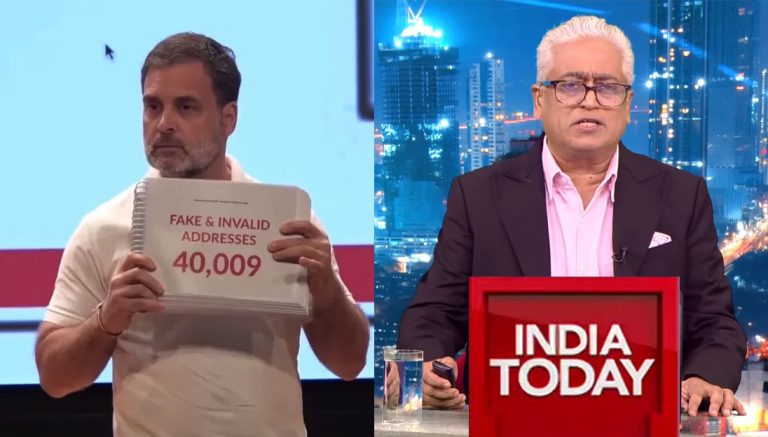
Congress leader Rahul Gandhi has once again attacked the integrity of the Election Commission of India. In his latest attack, Rahul Gandhi claimed that 1,00,250 “fake votes” in the Mahadevapura Assembly segment in the Bangalore Central Lok Sabha constituency in Karnataka to ensure a win for the BJP. As an example of such ‘faker voters’, the Congress leader claimed that at House No. 35 in Muni Reddy Garden, around 80 voters fraudulently registered.
On 8th August, IndiaToday ‘journalist’ Rajdeep Sardesai amplified Gandhi’s claims. Taking to X, Sardesai said, “Fact check by @IndiaToday @sagayrajp reveals that yes, 80 voters are registered at one tiny Bengaluru home as claimed by @RahulGandhi. Will there be a free and fair investigation by @ECISVEEP?”
In his desperation perhaps to prove loyalty to the Congress party, Rajdeep Sardesai did not read the very India Today report he quoted to question the ECI and amplify Rahul Gandhi’s claim of fraudulent registration of 80 voters. Notably, Sardesai is currently the consulting editor and anchor of India Today Television.
As per the India Today factcheck report, a large number of voters are indeed registered with the address in question— House No. 35 in Muni Reddy Garden. However, the report shows that there is no scam in it, because it is a rental house, and various tenants who lived there at various times used the address to register themselves to the voter list.
The house is at present occupied by a food delivery worker named Dipankar. The present occupant of the house is originally from West Bengal and moved here one month ago.
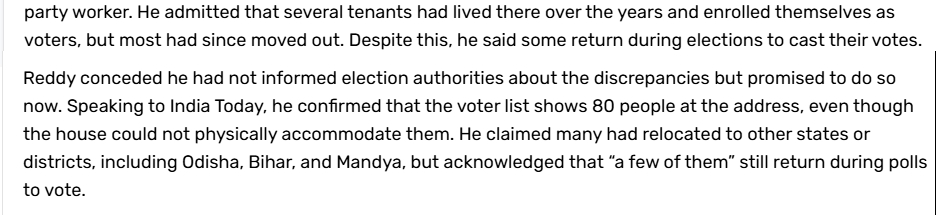
The house in question is owned by one Jayaram Reddy, who claims to be a BJP voter-supporter. As per IndiaToday report, “He (Reddy) admitted that several tenants had lived there over the years and enrolled themselves as voters, but most had since moved out. Despite this, he said some return during elections to cast their votes.”
“He confirmed that the voter list shows 80 people at the address, even though the house could not physically accommodate them. He claimed many had relocated to other states or districts, including Odisha, Bihar, and Mandya, but acknowledged that “a few of them” still return during polls to vote,” the report adds.
However, the claims of ‘fraudulent’ voter registration or “vote chori” as alleged by Rahul Gnadhi, seem unfounded since BLO Munirathna has clarified that several migrant workers living in small houses along the IT corridor use rental agreements to obtain voter IDs. “These occupants are typically job seekers working as security guards, housekeepers, or domestic helpers. After acquiring voter IDs, many vacate the premises, but their names remain on the electoral rolls,” the India Today reported.
Many these voters who have moved from here, refuse to have their names removed saying that they need the voter ID and return to cast votes during elections. Contrary to Rahul Gandhi’s insinuation that these 80 ‘fraudulent’ voters live together in 10 sq. ft. house, although these people have their voter IDs registered at the same address, these voters, mostly security guards, house helps etc, are not living together at the same time. They came, stayed for some time and moved to other places for some or the other reason.
This does not imply any ‘fraud’ and also does not prove that they may or may not be essentially voting for the BJP. Clearly, Rahul Gandhi and his media cheerleader Rajdeep Sardesai have labelled migrant voters as ‘fraudulent voters’. Moreover, the SIR exercise conducted by EIC in Bihar, is specifically aimed at addressing issue of migrant voters. But Rahul Gandhi and Congress party have been opposing the move.
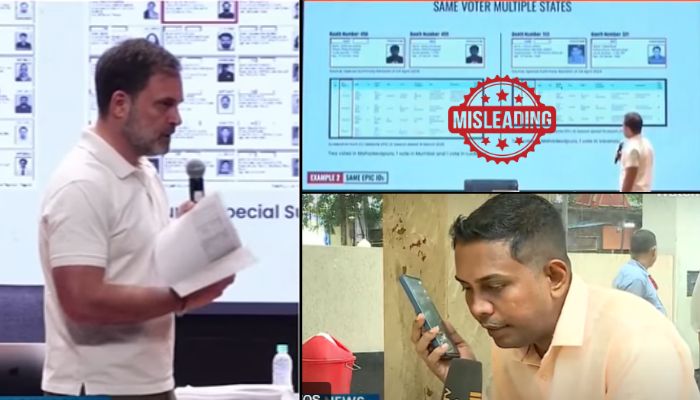
As reported earlier, Rahul Gandhi while alleging ‘vote chori’ had zeroed in on Mahadevapura, one of eight Assembly segments under Bangalore Central Lok Sabha constituency, claiming that over 1 lakh votes out of 6.5 lakh were either duplicated or linked to fake addresses.
As an example, Rahul Gandhi cited the case of one Gurkirat Singh Dang, whose name allegedly appeared on voter rolls at four different booths. From this single instance, he extrapolated a sweeping claim of “thousands” of such cases, without presenting any independently verified evidence. What Gandhi fails to acknowledge, however, is the very real and common phenomenon of intra-city and inter-state migration, particularly in urban hubs like Bengaluru, where people frequently shift residences for work, education, or housing constraints.
In such cases, it’s not unusual for individuals to be enrolled at their new address without having formally applied for the removal of their names from earlier rolls. This administrative overlap can result in multiple entries, but it does not automatically mean that the person voted more than once, let alone that they were part of any coordinated fraud. To conflate registration anomalies with actual voting malpractice is not just misleading; it grossly misrepresents how electoral rolls evolve in dynamic urban settings.
Moreover, Gandhi also conveniently overlooked the fact that parties receive voter rolls well in advance and are free to raise objections during the verification phase. If such large-scale discrepancies truly existed, why weren’t they flagged before polling day? Clearly, Congress is manufacturing outrage by alleging ‘vote chori’, while the party’s media allies are amplifying its conspiracy theories.
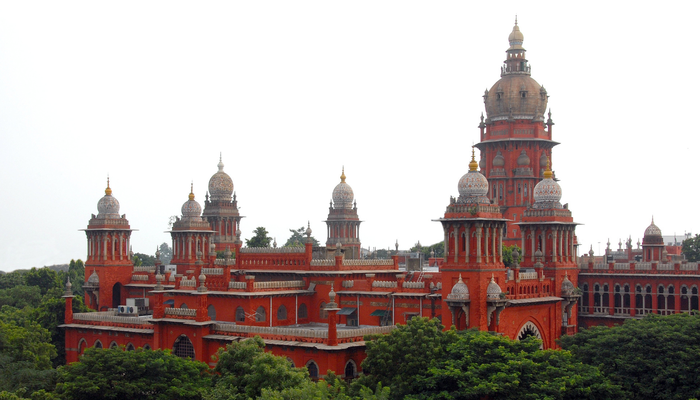
The Madurai Bench of the Madras High Court pulled up the Tamil Nadu police on Monday (4th August) for not diligently pursuing a case registered on a complaint filed against a derogatory Facebook post about the Hindu God Krishna. The High Court also criticised the concerned Judicial Magistrate, Thoothukudi, who ordered the closure of the case based on the final report and concealing certain facts.
A single bench of Justice K Murali Shankar allowed a criminal revision petition filed by one P Paramasivan and directed the police to conduct an investigation into the case and submit a final report within three months from the date of the receipt of a copy of the order.
While ordering a re-investigation in the case, the High Court remarked, “Depicting Hindu Gods in a disrespectful manner, intentionally hurting the sentiments of millions, cannot be justified. Such actions have the potential to spark enmity, religious outrage, social disorder, and undermine communal harmony. Given the deep-rooted respect for religious symbols and deities, disrespect can lead to social unrest and hurt a large section of society. Therefore, it is crucial to approach such depictions with sensitivity. The Government must ensure that freedom of expression does not translate into hurting religious feelings.”
Brief facts of the case
An offensive Facebook post was published by a Facebook profile named Sathish Kumar on August 19, 2022, about the Hindu God Krishna. The Facebook post contained an obscene image and two Tamil comments. The image showed some nude girls taking a bath in a pool and Lord Krishna stealing their clothes, and the Tamil comments said that Krishna Jayanti was a celebration of a man who stole the clothes of bathing women. The misleading post deeply hurt the sentiments of the petitioner, who filed a complaint with the police. The complainant said that the post was uploaded with the intent to defame Hindu gods and tarnish the image of Hindu women, and could potentially trigger law and order problems.
Based on the complaint, an FIR was registered on August 26, 2022, under Sections 298, 504, 505(2) I.P.C., and Section 67 of the Information Technology Act, 2000. After completing the investigation, a final report was submitted by the Tamil Nadu police on March 12, 2025. Aggrieved by the order of the concerned Judicial Magistrate, the petitioner approached the High Court seeking a direction to the police for re-investigating the case.
Police did not try to verify the details of the Facebook profile: HC
After examining the facts of the case, the High Court noted that the police did not pursue the case diligently. In the final report, the police said that they requested Meta (which owns Facebook) to provide information about the Facebook user who made the offensive post. Meta, in an email, refused to provide the details about the Facebook user and said that a Mutual Legal Assistance Treaty (MLAT) request or letter rogatory was required for it to give the information sought.
The Court observed that after receiving a negative response from Meta, the Investigating Officer did not take any further steps and instead went on to file a negative final report and closed the case as ‘undetected’. The court said that the Investigating Officer limited the entire investigation to requesting Meta for information, while, as pointed out by the petitioner, the Facebook profile named Sathish Kumar had personal details, including educational background, work history, residence, and a photograph, which could have provided a lead to the police.
“The prosecution has not verified the accuracy of these details or provided any explanation for not doing so. While the Investigating Officer identified the post’s potential to create law and order issues and disturb communal harmony, the investigation was not pursued diligently, and the final report appears to have been filed mechanically,” the court said in its judgment accessed by OpIndia.
The concerned Judicial Magistrate concealed the facts and closed the case
The High Court also criticised the concerned Judicial Magistrate, who ordered the closing of the case based on the police report. The Court said that the Judicial Magistrate concealed the facts about the appearance of the petitioner before the court. The Magistrate in the impugned order noted that the petitioner (complainant) did not appear despite notice and thus failed to file any objection against the final report of the police.
It was brought to the knowledge of the High Court that the complainant did appear before the magistrate through his Counsel and raised objections. “But the learned Magistrate, without disclosing the above aspects, has proceeded to close the case as the complainant has not turned up. Moreover, the learned Magistrate has neither referred nor considered the objections raised by the de facto complainant’s side at the enquiry,” Justice Shankar said.
Ordering a reinvestigation, the High Court ruled that the final report and the order passed by the concerned Judicial Magistrate “cannot legally be sustained.”
As anticipated, Donald Trump’s tariff assault on India has resulted in Indian government having a rethink on multi-billion-dollar defence equipment import from the USA. Days after Trump announced 50% tariff on imports from India for buying Russian oil, the Modi government has reportedly put on hold the plans to procure new weapons and aircraft from the USA.
As per a report by Reuters, the two most important procurements put on hold are Stryker combat vehicles and Javelin anti-tank missiles. The report stated, “Reuters is reporting for the first time that discussions on India’s purchases of Stryker combat vehicles made by General Dynamics Land Systems and Javelin anti-tank missiles developed by Raytheon and Lockheed Martin have been paused due to the tariffs.”
The report also confirmed earlier reports that India has paused a $3.6 billion deal to purchase six Boeing P-8I Poseidon maritime patrol aircraft. Indian Navy currently operates 12 P-8I aircraft, and India was buying 6 more to augment the navy’s capacity. Talks over the deal were at an advanced stage, but now that has been put on hold.
Reuters stated that Defence Minister Rajnath Singh was to visit Washington DC in the coming weeks to finalise some of these deals, but now that visit has been cancelled. However, the report added that these are all oral instructions, and no written official order has been issued.
This means, if Trump reverses his Tariff stand, India may also revive the procurement processes for American defence systems. Reuters cited a source saying that the defence purchases could go ahead once India had clarity on tariffs and the direction of bilateral ties.
Trump’s tariffs have effectively halted plans for India’s procurement and joint production of American defence equipment. Trump had also proposed to sale the F-35 aircraft to India, but multiple sources in the govt and the IAF have stated that they are not keen on acquiring the American fifth generation fighter jet. While India’s own fight generation jet AMCA will be ready after a decade, India may procure Russian Su-57 jets to meet its current needs.
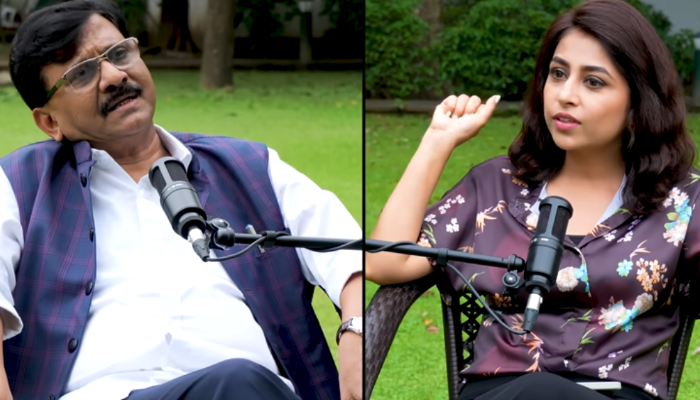
Shiv Sena (Uddhav Balasaheb Thackeray) stalwart Sanjay Raut, reflecting the dramatic ideological shift within his party, recently sought to mitigate the jihadi aspect of the Pahalgam terror attack, represented Kashmiri Muslims as the genuine victims and even accused the ruling party of trying to incite riots in India.
Moreover, he slammed Prime Minister Narendra Modi for fostering an environment akin to the Emergency while endorsing the brutal Emergency, as a necessary evil, imposed by the Congress regime under late Prime Minister Indira Gandhi. His shocking remarks were part of an interview with Shalini Kapoor Tiwari which was published on her official YouTube channel on 8th August.
Raut refused to accept that the tourists were murdered in Pahalgam solely because they were Hindus as the assassins verified their religious identity prior to executing them. He stated, “The majority of the victims were Hindus but one Muslim was also killed. It is important to understand. He must have also been questioned regarding his faith. Establishing this narrative in such situation is detrimental to the nation.”
Launching an indirect attack on the Bharatiya Janata Party, he added, “The political parties wanted to replicate the events in India that followed Godhra which led to riots (because Hindus were burnt alive). They intended the same to happen across the entire country. They have a desire for Hindu-Muslim violence after Belgaum (or Belagavi). They want the nation to burn in unrest. The don’t want peace and harmony. Certain individuals possess this type of mindset.”
The anchor maintained that the Hindu men were specifically targeted due to their faith and referenced her interview with the family members of the victims along with testimonies of the eyewitnesses including those from Maharashtra. The Rajya Sabha MP agreed but asserted that this truth should not be emphasized.
When she pointed out that the Muslim person was only attacked because he tried to save the tourists and tried to show him the proof, he interrupted her and countered, “I cannot say for certain as we were not present at the scene. I am not interested in such claims. I do not want to see them. Furthermore, the tourists from Kashmir who travelled from various parts of the country were predominantly Hindus and the people of Kashmir provided them with protection. We should also remember this.”
“Had it been so, Kashmiris would not have helped the Hindu women and their families following the events in Pahalgam. The entire region of Kashmir was in lockdown. I have witnessed many Kashmiris with tears in their eyes,” the Shiv Sena (UBT) leader alleged and further tried to dilute the communal nature of the assault while painting Kashmiris as the victims.
According to him, the statements from Himanshi Narwal, who lost her naval officer husband Vinay Narwal in the incident, did not include any of such indication (that Hindus were particularly targetted). “Many might hold this belief while others do not. That is not the issue,” Raut declared as he dismissed the relentless attempts to present him with facts.
Moreover, rather than addressing the Islamists responsible for the deaths of 26 innocent Hindus, he decided to criticize the Modi government claiming that they had an ideal chance to attack the neighbouring nation and unfurl the tricolor there. “Why did you step back and did not end the conflict once and for all,” the parliamentarian asked and termed it a “blunder” of the centre while repeatedly trying to underplay the jihadi ideology that underpinned the massacre.
“Pakistan is founded on the basis of a religion unlike India. It presented a great opportunity to destroy the country using the same religious grounds,” he further mocked.
We stood with Congress during Emergency: Raut
In a bizarre instance of ironic contradiction, Raut supported the Emergency imposed by late Prime Minister Indira Gandhi while simultaneously complaining that Prime Minister Narendra Modi has created a similar situation in the country. He conveniently concealed the fact that the entire Opposition was thrown behind bars and defended, “She constitutionally imposed the Emergency through the Parliament and securing its approval.”
“However, the Emergency that has been enforced in this nation over the past decade is unlawful and constitutes a grave issue. Such a scenario is not seen anywhere else in the world. One can observe the situation abroad and understand how the Opposition’s voice is suppressed while the law and Constitution are trampled upon. The Emergency slapped by Indira was not like this,” he made the outrageous comparison.
"We stood with the Emergency imposed by Indira Gandhi because it was constitutional."
– Sanjay Raut
These people dream of imposing the same “constitutionally right Emergency” if they come to power. pic.twitter.com/UuGUDfd14E
The politician acknowledged that even Shiv Sena’s official newspaper was shut down and many political leaders were arrested but claimed, “Yet, we supported the Emergency due to the anarchy in the country. There were attempts on Indira Gandhi’s life. This is why some people installed bomb factories. Dr Lalit Narayan Mishra, the Railway Minister was killed in Samastipur by a bomb. MPs were being assassinated. Citizens took to the streets with the intention of killing them and the Opposition incited them. We have witnessed this.”
When the journalist attempted to prompt him to recall the severe oppression of the media, politicians and others, Raut insisted that a similar situation is occurring currently and accused, “I was also imprisoned because I spoke out against the current government.”
She highlighted the hypocrisy of his statements but he challenged the government to implement an official Emergency in the country. “There is a provision for this in the law, and if you believe that the internal and external secutiy of India is under threat, then do it. Who can stop you,” the MP stated.
“I urge you to come to the Parliament and elucidate the reasons for your decision. You even lack the courage to hold a special session concerning “Operation Sindoor” or the Palagam incident. How, then, can you have the nerve to speak about the Emergency? Democracy revolves around debate. Have a discussion with us on this (implementing Emergency),” he further dared.
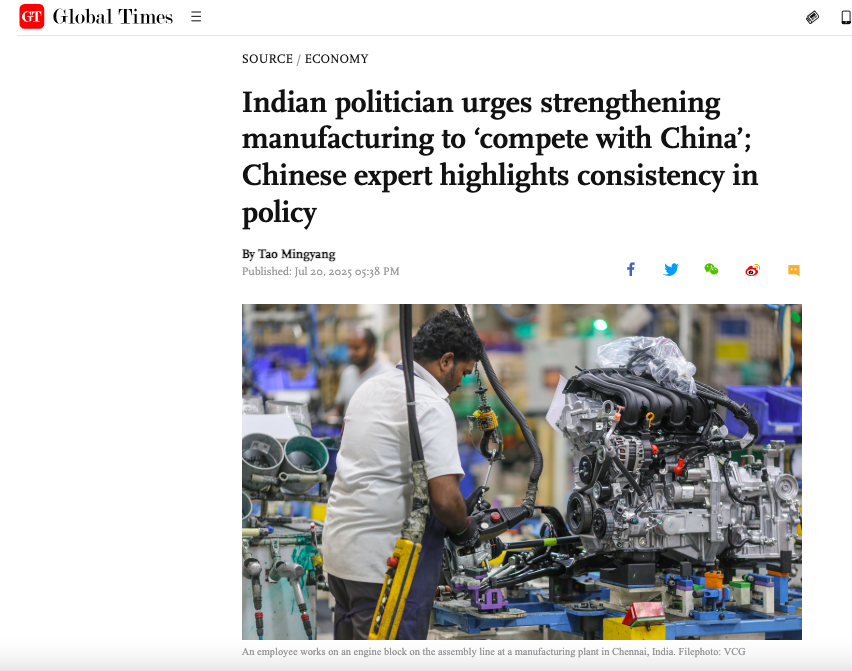
One of the biggest unintended consequences of US President Donald Trump’s tariff war against BRICS nations has been to give a push to India and China’s potential reconciliation. Trump’s weaponisation of tariffs, aimed at weakening BRICS and ‘punishing’ India for its Russian oil purchases, has drawn sharp, though unexpected, criticism from China. As the shifting dynamics between India and China mark a fascinating turn in global geopolitics, the Chinese state media has also begun changing tones about India.
Chinese government mouthpiece, Global Times, which has a history of peddling anti-India narratives, has now been talking about development and friendship with India. From hawkish tones to softened rhetoric, it seems that Beijing does not want to miss the opportunity to bolster ties with India, in the face of Trump’s tariff imposing spree.
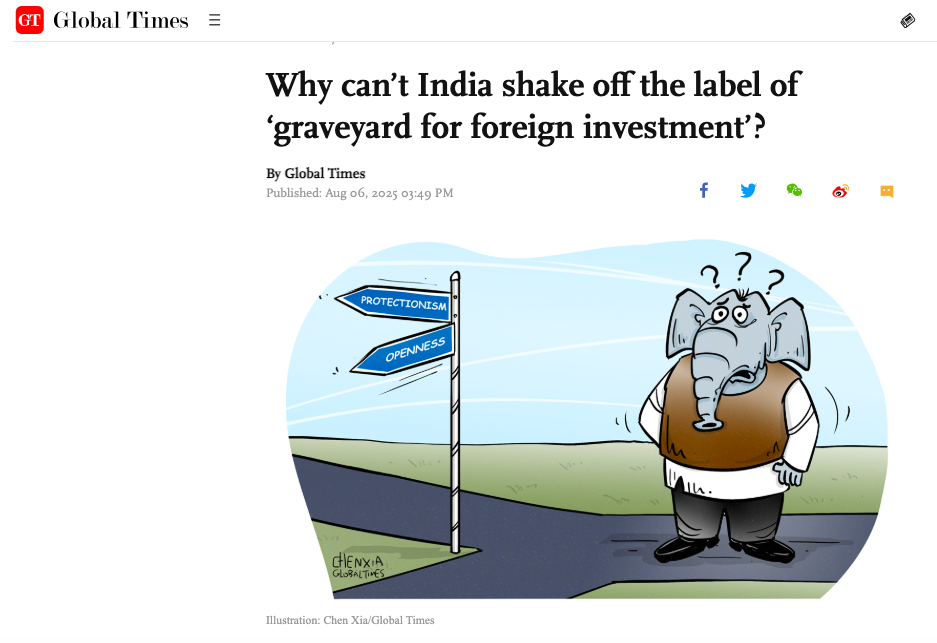
On 6th August, Global Times published an opinion piece headlined: “Why can’t India shake off the label of ‘graveyard for foreign investment’?The Chinese newspaper argued that the Western media-pushed “who will replace whom” between India and China holds little substantive value.
“India and China have a long history of cooperation and their economies are complementary. China highly values cooperation with India, and is one of India’s most important trade partners. In today’s complex and ever‑changing global landscape, rather than debating who replaces whom, it makes far more sense to utilize each other’s strengths, work on practical cooperation, and promote mutual benefit, win‑win outcomes and shared development,” the article reads.
It further highlighted a “critical juncture” in China-India relations, advocating for “practical cooperation” and “mutual benefit” to achieve “shared development.”
Taking to X, Yu Jing, the spokesperson of Chinese Embassy in India, said “Share with you an article @globaltimesnews. Western media create narrative of “who will replace whom” between #China and #India, which has little substantive value. In today’s complex landscape, it makes far more sense for both nations to deepen trust, manage disagreements, foster consensus, widen cooperation, and promote peace in Asia and globally.”
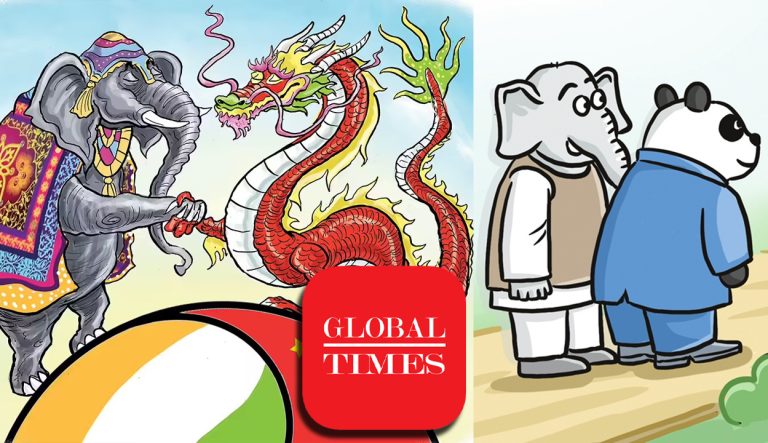
Jing also attached an image which showed an Elephant and Dragon being friends, with India and China as two halves of the world shown as Yin Yang symbol. The symbolism says it all!
Share with you an article @globaltimesnews. Western media create narrative of "who will replace whom" between #China and #India, which has little substantive value. In today's complex landscape, it makes far more sense for both nations to deepen trust, manage disagreements,… pic.twitter.com/W0CUcX9FRL
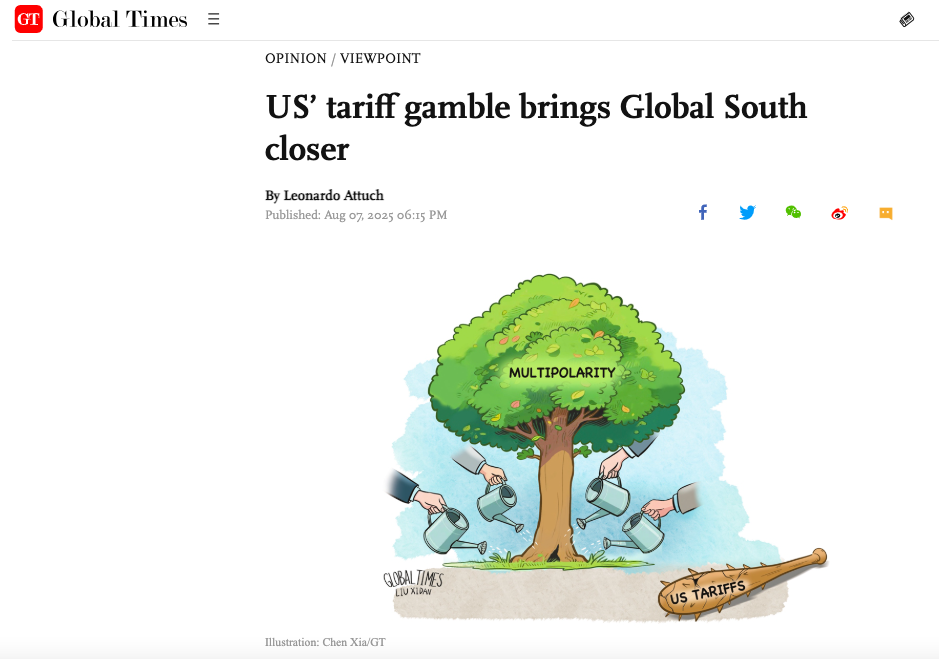
On 7th August, Global Times published an opinion piece authored by a Brazilian journalist, wherein it emphasized the significance of a multipolar world, strengthening of the Global South against US’s economic coercion.
“By trying to isolate and punish strategic partners in the Global South, the US achieves the exact opposite effect – bringing emerging economies closer together and strengthening cooperation mechanisms that reduce dependence on Washington,” the article states.
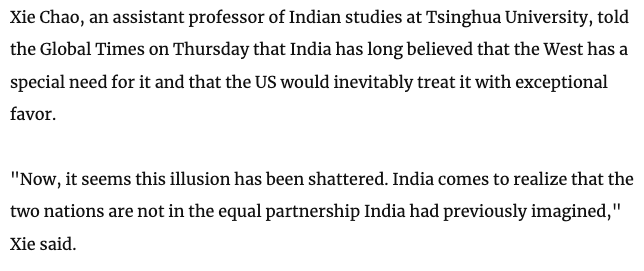
In another article put out on Thursday, Global Times highlighted that India, along with Brazil, is resisting against US tariffs. The newspaper cited a Chinese analyst’s comment that “India’s illusion that US will treat it with exceptional favor shattered.”
Excerpt from Global Times’s article headlined: India, Brazil continue to resist against US tariffs
However, India never really was in this illusion that the US would treat India with exceptional favour. New Delhi very well understands that the US may consider India a key ally to counterbalance China, but Washington does not shy away from snubbing its ‘allies’ and ‘friends’ if they even slightly deviate from the US’s agenda. Thus, there is no question of any illusion being shattered.
If India had actually not been an equal partner in its ties with the US, India would have gladly genuflected before the US and signed the trade deal on Trump’s terms. India’s refusal to open its agriculture and dairy sector for the US at the cost of harming the livelihood of Indian farmers, New Delhi’s refusal to discontinue Russian oil purchase, as well as calling out the US and EU’s hypocrisy in the strongest words, demonstrates that India cannot be treated as an unequal partner. India is no Pakistan.
While India indeed is a counterweight to China in Asia, and US has also backed India in this respect, however, Washington misread India phenomenally when it thought that a ‘counterweight’ India would function as America’s vassal in the region. India’s presence in both, the BRICS bloc as well as QUAD should have made it clear that New Delhi’s strategic alignment is not one-sided. India, in principle and practice, believes in multipolarity, not in the global dominance of a single superpower.
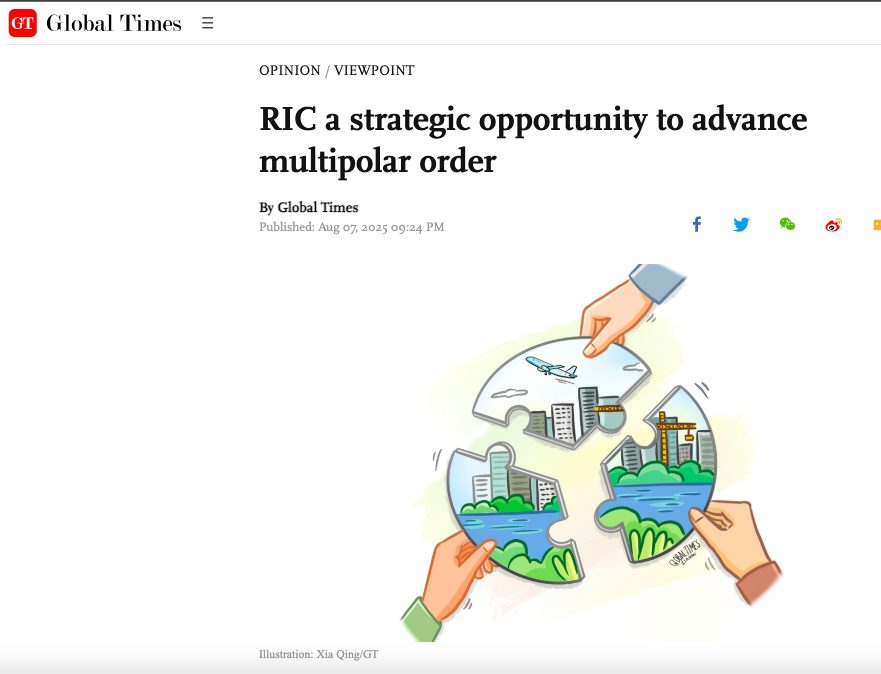
Another article published in Global Times on 7th August, Global Times stressed that Reviving China-Russia-India (RIC) trilateral cooperation “must transcend symbolism”. “For all three, it represents a strategic opportunity to unite against external sanctions pressure, reaffirm foreign policy autonomy and advance a multipolar order,” states the article headlined: “RIC a strategic opportunity to advance multipolar order”.
In an editorial published on Thursday, Global Times said that “If India can take Modi’s visit as an opportunity to promptly adjust its China policy and remove unnecessary barriers, there will be much greater room for the development of China-India relations.”
Global Times pointed out that, unlike the Western media’s interpretation of PM Modi’s upcoming China visit as an attempt to “hedge against” the US, “Defending free trade and countering unilateral tariffs is the shared will of most countries in the world today.” It further highlighted that India and China, two ancient civilisations, emerging major economies and key members of the Global South, are a critical point in their modernisation journey. Welcoming PM Modi to visit China, the Global Times even cited a Hindu proverb, “Help your brother’s boat across, and your own will reach the shore.”
Global Times used the humble Panda to represent China in the editorial, instead of the aggressive Dragon traditionally used
“As regional powers, China and India have extensive shared interests in areas such as counterterrorism, trade, and cultural exchange,” the GT article reads.
Indeed, China and India have many shared interests where the two neighbours can cooperate, especially in counterterrorism. China’s military and policy support to Pakistan, with the Pakistani Army being its de facto ruler, is deeply problematic to India. China backing a state sponsor of cross-border Jihadi terrorism against India is unacceptable to India, and for Sino-India ties to get any better, this pressing issue needs to be addressed by Beijing. India has not forgotten China’s defence support and vow to protect Pakistan against India when the latter launched Operation Sindoor in May this year.
For the Dragon and the Elephant to “dance together”, the Markhor needs to be kept in check. Pakistan’s pivot towards US, as reflected in the former’s Trump sycophancy, should be an eye opener for China that it’s ‘all weather’ ally is in reality, only dollar’s ally.
It is rightly said that the best thing about time is that it changes. Now that China is facing its own tariff battles with the US, Beijing sees value in aligning with India as a key partner and counterbalance against Western pressure. While China itself has had its ambitions of regional dominance and an expansionist agenda, it is now openly backing India’s advocacy of a multipolar world order against the US’s agenda of a rigid unipolar world order where Washington plays the ‘big brother’.
India has used various platforms, be it BRICS or SCO, to assert its vision of strategic autonomy and a balanced global order. China’s embrace of India’s vision, as reflected in the recent articles of Global Times, suggests Beijing’s willingness to find common ground with India and deepen ties while facing the bully (US) together. Now time alone will tell whether China genuinely wants to improve ties with India or it is a case of desperate times call for desperate measures.
While Global Times is now changing tones, it must not be forgotten how the Chinese daily has consistently been pushing anti-India narratives.
In May this year, when India launched Operation Sindoor against Pakistan’s terror and military establishments in the aftermath of the deadly Pak-sponsored Islamic terror attack in Pahalgam, Global Times, joined by other Chinese propaganda outlets like Xinhua, peddled fake news that Pakistan’s Chinese JF-17 jet destroyed India’s S-400 air defence system in Adampur, Punjab. It, however, turned out that the Chinese and Pakistani media were peddling blatant lies as the Indian Armed Forces refuted these claims by giving proper evidence.
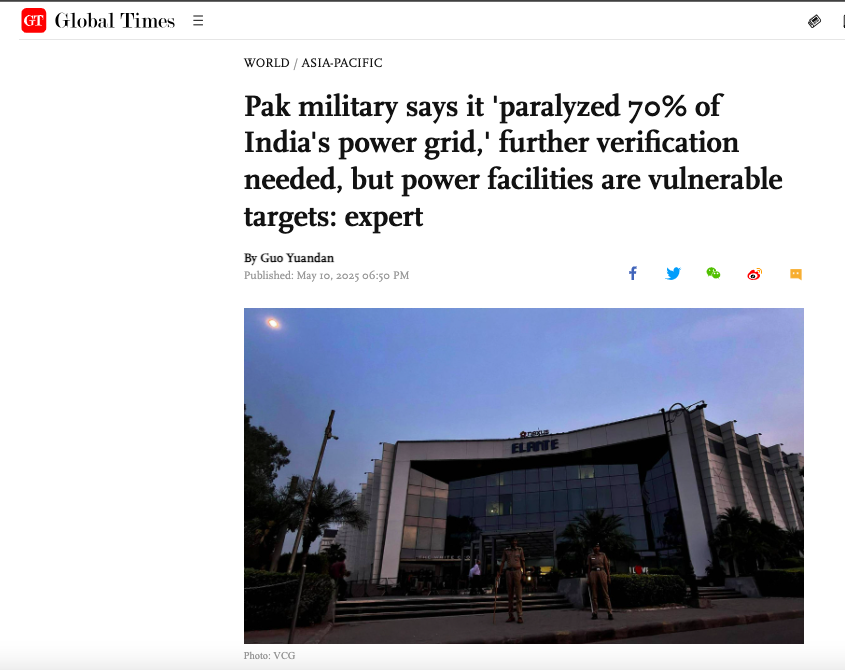
Global Times had also amplified Pakistan ‘Aand’ Force’s fictitious and hilarious claims of having ‘paralysed’ 70% of India’s power grid through a cyberattack. These claims were also amplified by other Chinese state media outlets like Xinhua.
China.com had also reported that Pakistan’s fake claim of having destroyed a BrahMos missile storage facility in India. Similarly, Sina News had amplified Pakistan’s false claim that India targeted the Neelum-Jhelum hydropower station. Pakistani fake claims of capturing an Indian female pilot were also amplified by Chinese media platforms.
Not to forget, Chinese state media outlets like Xinhua had even reported the Pahalgam Islamic terror attack carried out by Pakistani terrorists belonging to the outfit Lashkar-e-Taiyba’s offshoot, The Resistance Front, as a ‘shooting incident’. Over two dozen innocent people were religiously singled out and shot dead for not being Muslims, and Chinese media downplayed the attack as just a ‘shooting incident’.
After Pakistan’s Chinese weapons failed against India in May, China relied on propaganda in Western media to save face and present the Indian military as weak, even as in reality, India rendered Pakistan’s Chinese air defence system defunct for a limited time period during its attack deep inside Pakistan.
This, however, has not been a new phenomenon. Chinese state media have been targeting India’s foreign policy as well as pushing sinister narratives pertaining to India’s domestic issues. OpIndia has reported earlier about Congress leader Rahul Gandhi’s China love; it however, has never been one-sided. Global Times and other Chinese media outlets have on many occasions, used Congress and Rahul Gandhi’s remarks to target India.
While China itself is infamous for its expansionist policies and hostile attitude towards neighbours over territorial sovereignty, Chinese state media is now stressing strategic autonomy and sovereignty. However, when India commissioned its second nuclear -powered ballistic missile submarine (SSBN), INS Arighat in August 2024, Global Times published a malicious piece titled ‘India’s second nuclear missile submarine should be used responsibly: experts’, virtue-signalling India over the ‘responsible use’ of its military arsenal.
Historically, India and China’s relations have been fraught with tensions, border disputes, especially Doklam (2017) and Galwan (2020) clashes, economic rivalry, strategic mistrust and differing geopolitical alignments. However, the winds are changing now.
The fresh efforts to resolve differences are promising, but India remains sceptical of China’s intentions. The Modi government sees Beijing’s advocacy of Sino-India friendship with cautious optimism.
However, Trump’s tariff tirade has inadvertently done the unthinkable—brought China and India on the same page. A tightly controlled Chinese state media’s shift in tone is significant. This confrontational-to-conciliatory shift signals a deliberate policy directive from Beijing. It seems that ahead of PM Modi’s China visit and amidst the ongoing tariff war, China is trying to bridge ideological and strategic gaps.
As ironic as it sounds, China’s pivot from rivalry to rapprochement suggests that Trump’s ‘America First’ dream, is turning out to be a ‘BRICS First’ reality.
A day after Rahul Gandhi defamed a common man named Aditya Srivastava, the victim on Friday (8th August) debunked the lies peddled by the Congress leader to amplify his ‘vote chori’ conspiracy theory.
On Thursday (7th August), Rahul Gandhi conducted a press conference wherein he claimed that a man named Aditya Srivastava was voting in 3 different States simultaneously.
“He is Aditya Srivastava. His name is in the electoral rolls of Maharashtra, Karnataka (Bengaluru Urban) and Uttar Pradesh (Lucknow). His name appears 4 times. Same photo and same address,” the Congress leader alleged.
“And there are thousands of such people. 11,000 votes have been stolen like this,” he claimed. Rahul Gandhi defamed Aditya Srivastava by suggesting that the latter is somehow a part of a vote fraud scheme.
On Friday (8th August), the victim debunked the lies peddled by the Congress leader during a telephonic interview with India TV.
Aditya Srivastava hails from Lucknow in Uttar Pradesh. As such, his first voter ID was registered in that city. In 2016, he began living in Mumbai and had transferred the voter ID to his new address in Maharashtra.
He had cast his vote from Mumbai during the 2019 Lok Sabha election. Later, he shifted to Bengaluru for work in 2021 and re-transferred his voter ID to new address in Karnataka.
Aditya Srivastava had voted from Bengaluru during the 2024 Lok Sabha election. He had updated all details on the website of the Election Commission of India as per the facility provided by the nodal election body.
The common man lashed out at Rahul Gandhi for leaking his personal details to the world. He clarified that he never cast his vote in multiple States at one time.
Aditya Srivastava even dared Rahul Gandhi to show call records and CCTV footage from polling booths, which can prove that he cast votes in Uttar Pradesh, Maharashtra and Karnataka at the same time.
He pointed out that his EPIC number (10-digit unique identification number) on his voter ID cards has remained consistent during all constituency transfers, and there is no evidence of fraud.
A team from India TV visited the Mumbai address of Aditya Srivastava. The tenant confirmed that he left the apartment back in 2021. This coincides with the victim’s own testament of leaving the city in the same year.
Conclusion
OpIndia had previously reported how claims of Rahul Gandhi about Aditya Srivastava are not supported by publicly available data on Voter’s Services Portal on Election Commission.
It appears as if the ‘research team’ of Rahul Gandhi deliberately conflated the records of the 2019 and 2024 Lok Sabha elections to come to this false conclusion of Aditya Srivastava’s complicity in election fraud.
Rahul Gandhi had been peddling ‘vote chori’ conspiracy theory to tarnish the reputation and integrity of the Election Commission of India and rationalise Congress’ unbeaten streak of losing elections.
The Supreme Court on Friday (8th August) recalled its order against Allahabad High Court judge Justice Prashant Kumar, which ordered his permanent removal from the criminal roster. The development came after the intervention of the Chief Justice of India, BR Gavai, who wrote to a bench of Justices JB Pardiwala and R Mahadevan, which passed the said order, to reconsider the order against Justice Kumar.
The order against Justice Kumar was passed by the Supreme Court on August 4, 2025, criticising his decision of allowing criminal proceedings in a civil suit regarding unpaid money in a sale. Making scathing remarks against the High Court judge, the Apex Court directed the Chief Justice of the High Court, Arun Bhansali, to permanently bar Justice Kumar from hearing criminal matters and to make him sit with a senior judge in a division bench of the High Court.
“The judge concerned has not only cut a sorry figure for himself, but has made a mockery of justice. We are at our wits’ end to understand what is wrong with the Indian Judiciary at the level of the High Court,” the Supreme Court sternly remarked in its order.
13 Allahabad High Court judges wrote a letter not to implement the Supreme Court direction against Justice Kumar
However, the Supreme Court order was not received well within the judiciary fraternity, as three days after the passing of the order, some Allahabad High Court judges sent a written request to the Chief Justice of the High Court not to implement the order against Justice Kumar.
13 judges of the Allahabad High Court wrote to the Chief Justice of the High Court on August 7, 2025, urging him to convene a full court to consider not implementing the Supreme Court order. The following judges signed the letter: Justice Krishan Pahal, Justice Sameer Jain, Justice Anish Kumar Gupta, Justice Manish Nigam, Justice Saurabh Shyam Samshery, Justice Gautam Chowdhary, Justice Donadi Ramesh, Justice Shekhar Saraf, Justice Manoj Bajaj, Justice Kshitij Shailendra, Justice Saurabh Srivastava, and Justice PK Giri.
The letter reportedly quoted the principles laid down by the Supreme Court, which stressed that the higher courts must exercise restraint when commenting on judicial officers who are not present to defend themselves. Pointing out that the Supreme Court did not have administrative superintendence over the High Courts, the letter stated that the Full Court expressed disappointment over the “tone and the tenor of the said order”.
CJI Gavai urged the Supreme Court bench to reconsider the order
Subsequently, CJI Gavai intervened, and the case was listed for today (8th August) for fresh directions. On receiving the CJI’s letter, Justice Pardiwala said that the court has directed the Registry to re-notify the matter today. “We have received an undated letter from the hon’ble Chief Justice of India requesting the reconsideration of the observations in paras…In such circumstances, we directed the Registry to re-notify the main matter for considering the request made by the Chief Justice of India,” Justice Pardiwala said.
The bench clarified that it did not intend to embarrass the HC judge
The Supreme Court bench disposed of the matter today and passed a fresh order. The court clarified that it did not intend to embarrass the judge but to protect the dignity and honour of the institution. “At the outset, we must clarify that our intention was not to cause embarrassment or cast aspersions on the concerned Judge. We would not even think of doing so. However, when the matters cross a threshold and the dignity of the institution is imperilled, it becomes the constitutional responsibility of this Court to intervene even when acting under its appellate jurisdiction under Article 136 of the Constitution,” Justice Pardiwala stated while pronouncing the order.
However, maintaining that the order passed by Justice Kumar was “perverse” and “illegal”, the bench said that it was concerned about the dignity of the judiciary, as the High Courts are not separate from the institution.
In the fresh order, the bench directed the deletion of the paras (25 and 26) containing harsh remarks against Justice Kumar. “In any view of the matter, since a request in writing has been received from Hon’ble the Chief Justice of India and in due deference to the same, we hereby delete para 25 and 26 from our order dated 4th August 2025. The order be corrected accordingly. While we are deleting the paragraphs, we leave it to the Chief Justice of the Allahabad High Court to now look into the matter,” the Court said.
The bench also clarified that it was not interfering in the administrative power of the Chief Justice of the High Court. We fully acknowledge that the Chief Justice of a High Court is the master of the roster. The directions are absolutely not interfering with the administrative power of the Chief Justice of the High Court. When matters raise institutional concerns affecting the rule of law, this court may be compelled to step in and take corrective steps,” the Court added.
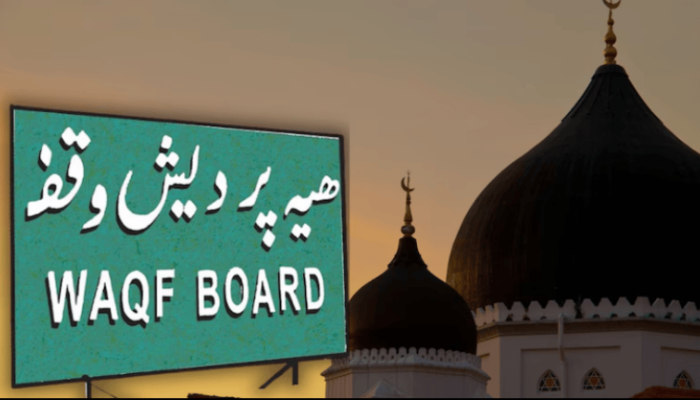
Only 69 makers for Waqf have provided the information regarding their properties on the Unified Waqf Management, Empowerment, Efficiency and Development (UMEED) portal which was initiated by the central government two months ago for the administration of Waqf properties.
All details pertaining to Waqf properties are expected to be uploaded onto this portal within six months of its inception. Although 8.72 lakh properties are recorded on the previous Waqf Management System of India (WAMSI) portal concerns are currently being expressed regarding the lag in uploading Waqf-related properties onto the new portal.
Only 663 initiated the data uploading process
Minority Affairs Minister Kiren Rijiju conveyed in a written reply in the Lok Sabha that, as of now, only 663 makers of Waqf have commenced the data uploading process with the highest number, 163 from Odisha, 102 from Uttarakhand and 69 from Andhra Pradesh.
Arunachal Pradesh, Nagaland, Mizoram, Sikkim, Goa, Ladakh, Lakshadweep, Chhattisgarh, and Nagaland have not yet started the procedure. Twenty-seven shared their information from Himachal Pradesh. Odisha accounted for eleven, Manipur for five, Andhra Pradesh for four, Rajasthan and Punjab for three, Uttarakhand for two, and Uttar Pradesh, Maharashtra, Madhya Pradesh, Telangana and Delhi for one each.
According to the data, 4 properties have been rejected so far, including 3 from Andhra Pradesh and 1 from Odisha. Additionally, it has been reported that not even a single submission has been approved to date.
How does the UMEED portal work
Kiren Rijiju inaugurated the UMEED portal in Delhi on 6th June. Over 9 lakh waqf properties are estimated to exist in India, according to data released by the ministry at the time.
The government highlighted that this website will function as a central digital platform for the real-time uploading, verification, and monitoring of Waqf properties. The government expressed hope that this initiative would enhance accountability and transparency in the management of Waqf properties nationwide.
As per the information provided, the platform features a three-tier verification system known as “Maker-Verifier-Approver.” A Mutawalli inputs the property details as the “Maker” which are then verified by Waqf Board officials and subsequently approved after the records are examined by the designated government authority.
“About 140 grievances/suggestions have been received from across the country as on July 28 and their resolutions have also been uploaded on the portal to help other boards to understand and handle the portal’s functioning effectively,” Rijiju mentioned.
The creation of Project Management Units (PMUs) at the district, Waqf board, state/Union Territories and central levels has also been recommended by the ministry in order to guarantee that all property details are posted on the portal.
8.72 lakh properties on the old portal
As of now, the specifics of all Waqf properties are accessible on WAMSI portal. According to the information, 32 Waqf Boards from different states and union territories oversee 8,72,985 immovable properties. These include more than 1.5 lakh graveyards, 1.4 lakh associated with agricultural land and 1.19 lakh mosques.
According to the portal, Uttar Pradesh Sunni Central Waqf Board has the highest number of properties totaling 2.17 lakh. The West Bengal Waqf Board and the Punjab Waqf Board have registered 80,922 and 75,965 properties, respectively.
Why are Waqf boards avoiding registering properties
There were multiple grievances regarding the misuse of Waqf properties and the unlawful occupation of numerous sites. Issues of corruption within the state Waqf Board also surfaced, prompting the Modi administration to initiate efforts to improve the management of Waqf. Hence, Waqf Amendment Act was introduced by the centre.
The UMEED portal was included to enhance the management of Waqf properties and ensure that accurate records pertaining to them are accessible to the government. Portals such as WAMSI which do not require extensive legal procedures for property registration have seen hundreds of thousands of properties registered.
Consequently, it appears that the boards are reluctant to register properties on the new portal. This has led to a number of questions being raised in relation to the situation.
There has been a controversy regarding the Waqf law, leading to nationwide protests. Questions arise about whether those affiliated with the Waqf Board believe that this law will be repealed, allowing them to evade disclosing information about the properties.
Furthermore, there have been charges of properties being forcibly designated as Waqf after being illegally occupied in various locations. Is it also possible that the boards lack documentation for a significant number of these properties and are now evading the disclosure of details concerning them?