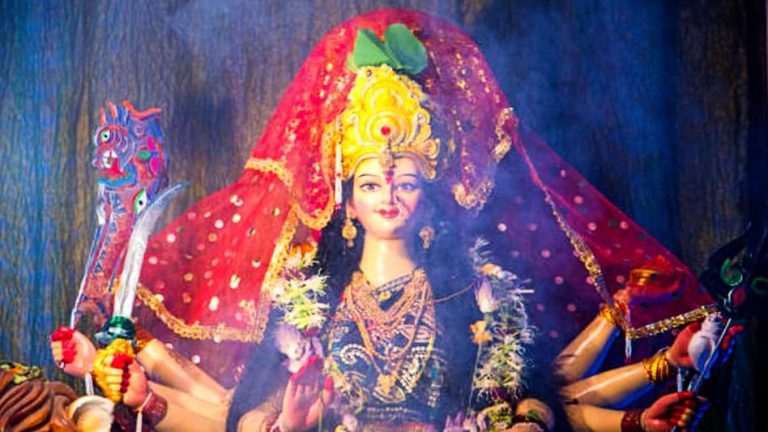
Navratri, the nine-night long festival is here. Being away from home, I make do with the pictures, videos my folks send me and the Instagram reels I come across, thanks to the algorithm. Since the festival is celebrated across India in various ways, but the basis is the upasana (worship) of the Devi Shakti. The Mother Goddess.
Some people fast for these nine days, surviving only on water, some don’t even take water. They pray to the Maa, welcome Her in all her finery and there is absolute joy everywhere. Amongst many forms of worship is the dance form. Which in Gujarat is ‘garba’. Once I had the privilege of going to Ambaji, one of the 51 Shaktipeeth in Gujarat during Navratri and in the ‘chowk’, right outside the sanctum sanctorum the devotees were dancing their heart out. Women were wearing their finest clothes all dressed up because ‘they have come home to their mother’, I was told. And why not?
The idol, image of the Maa Amba is put in centre of an open space and men, women and children dance around it in circles to traditional songs which talk about the goddesses. With time, things have changed and commercialisation has crept in, but the basis still remains dance as a means of worship. No matter which place you go, garba will always start with an Aarti of Maa Amba.
I’ll just put it out here because I am feeling nostalgic and I miss home and Navratri back home.
Coming back. The very essence of Navratri is invoking the Maa and worshipping Her.
So, while the ‘liberals’ in India may want to appropriate it and call it a ‘cultural’ festival, they are wrong. Navratri is very much a Hindu religious festival. The dance is a form of worship of Maa. It is as religious as it could get.
Which is they I don’t understand the force-fitting of secularism. When people who do not believe in our gods and goddesses, including atheists, why should they be participating in the worshipping? Especially when their faith propagates idol worship is a sin, why do you then want to whine when you are denied entry into garba events.
Every year, much hue and cry is raised that Bajrang Dal volunteers are checking IDs of people entering the venue. ‘Liberals’ cry hoarse about discrimination. But then, what is wrong to ensure only those who at least by virtue of their birth are born into a faith that worships the goddess are allowed to enter the venues? Of course, one should not take law into their hands and India being a free country, one could not deny someone entry to public places. But then why would anyone want to go to a place which is a sin?
Of course, there is this thing about mutual respect and I am all for it. So, if you agree to bow down to the goddess and accept the prasad, maybe then you could too participate in this dance form of idol worship.
Because my Maa nurtures, protects and blesses those who believe in Her.
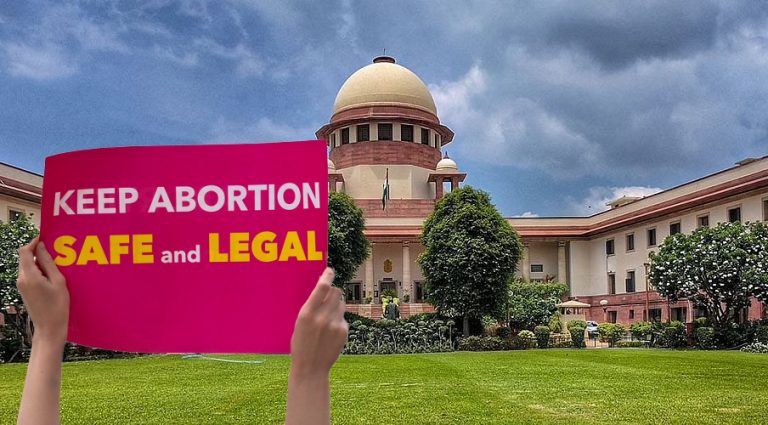
On Thursday, the Supreme Court rules that the rights granted to married women under the Medical Termination of Pregnancy Act of 1973 to abort a foetus would be extended to unmarried women. While the 1971 Act is concerned with married women, the statement of purposes and reasons for the 2021 amendment did not distinguish betweeerefore “all women entitled to safe and legal abortion,” said a bench comprising of Justices DY Chandrachud, AS Bopanna and JB Pardiwala.
The Court found that it is unconstitutional to exclude unmarried women who conceive outside of a live-in relationship from the Medical Termination of Pregnancy Rules. According to the reports, the issue was whether the exclusion of unmarried women from Rule 3B of the Medical Termination of Pregnancy Rules is valid. Rule 3B mentions the categories of women whose pregnancy in the duration of 20-24 weeks can be terminated.
SC says, meaning of rape must be held, incl marital rape, for purpose of Medical Termination of Pregnancy Act SC says,distinction b/w married&unmarried women “artificial&constitutionally unsustainable”,it perpetuates stereotype that only married women indulge in sexual activities
“If Rule 3B(c) is understood as only for married women, it would perpetuate the stereotype that only married women indulge in sexual activities. This is not constitutionally sustainable. The artificial distinction between married and unmarried women cannot be sustained. Women must have autonomy to have free exercise of these rights”, Justice Chandrachud said.
“The rights of reproductive autonomy give an unmarried women similar rights as a married women”, the Court stated adding that excluding unmarried women would be violative of Article 14 of the Constitution. Reports mention that the foetus survives on the woman’s body and as a result their decision to terminate stems from their right to bodily autonomy. “If the state forces a woman to carry an undesired pregnancy to term, it is an insult to her dignity”, the Court maintained.
The case came to the fore when a 25-year-old unmarried woman approached the Delhi High Court seeking termination of her 23-week-and-5-day pregnancy, saying that her pregnancy was the result of a consensual relationship. She said she couldn’t give birth to the child because she was an unmarried woman and her partner had refused to marry her.
A split judgement by a bench of the Delhi High Court comprising of Chief Justice Satish Chandra Sharma and Justice Subramonium Prasad, however, denied her temporary relief. The High Court found that unmarried women whose pregnancy resulted from a consensual relationship were not protected by any of the clauses in the 2003 Medical Termination of Pregnancy Rules. She subsequently petitioned the Supreme Court, which issued an ad-interim decision on July 21, 2022, permitting her to terminate her pregnancy subject to a medical board convened by AIIMS Delhi deciding that the unborn might be aborted without endangering the woman’s life.
The Supreme Court panel concluded that the Delhi High Court had taken an unduly ‘restrictive approach’ since Rule 3(b) refers to a woman’s ‘change in marital status,’ which is followed by the phrases widowhood or divorce. The bench considered amendments made to the Medical Termination of Pregnancy Act in 2021, which replaced the word ‘husband’ with the word ‘partner’, and concluded that excluding unmarried women and single women from the statute goes against the purpose of the legislation.
“There is no basis to deny unmarried women the right to medically terminate the pregnancy, when the same choice is available to other categories of women”, the Court noted on September 29.
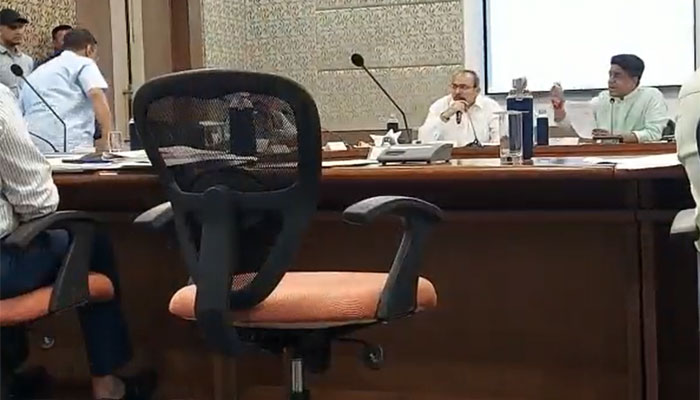
On September 28, a video of Chief Minister of Delhi Arvind Kejriwal went viral on social media where he was seen running away from a New Delhi Municipal Corporation meeting after Bharatiya Janata Party’s New Delhi General Secretary and NDMC member Kuljeet Singh Chahal confronted him over AAP government’s claims about school development. Chahal cited an RTI query where multiple questions were asked, and one of them was about if Kejriwal utilised funds from his MLA quota for development in NDMC schools. As per the reply to the RTI query, not even a single paisa was given by Kejriwal from 2015-16 to 2021-22.
➡️ केजरीवाल ने MLA फंड से अपनी नई दिल्ली विधानसभा के स्कूलों में कोई विकास क्यों नहीं? ➡️ #NDMC शिक्षकों, छात्रों व अभिभावकों के साथ कोई भी मीटिंग क्यों नहीं
Notably, Kejriwal is an ex-officio member of the New Delhi Municipal Corporation. During the members’ meeting, Chahal raised questions over the claims made by CM Kejriwal and the Delhi government about the development of the Schools. Chahal cited the RTI during the meeting and questioned Kejriwal over his inactions towards the development of the schools.
Instead of answering Chahal, Kejriwal got irked and left the meeting in a hasty manner. The video of the meeting has gone viral on social media platforms.
RTI revealed Kejriwal’s inaction toward the development of NDMC schools
In the RTI application submitted to the NDMC Education Department by Chahal himself, he had asked eight questions. In the first question, it was revealed that from 2015-16, CM Kejriwal did not visit a single school under NDMC.
Furthermore, in answer to the second question, it was revealed that CM Kejriwal did not talk even once to the parents of the students studying in NDMC schools. The next question was if Kejriwal talked to the teachers of these schools and the answer remained the same. CM Kejriwal did not hold any talk with the teachers of NDMC schools.
The answer to the fourth question revealed that CM Kejriwal did not have any conversation with the officials to discuss the development of NDMC schools. The next answer revealed that a request for filling posts of 298 teachers was sent by NDMC to the Delhi government. However, there was one more part of the question where information was sought on if Kejriwal took any action on demand. There was no reply to that particular part of the question. It is fair to assume that the CM did not take any action.
The Education Department of NDMC said in answer to the sixth question that there was no information available if Kejriwal took any action to fill the empty posts of the teachers on at urgent basis.
While answering the seventh question about the allotment of funds from the MLA quota by CM Kejriwal for the development of the schools in the area, the NDMC’s Education Department revealed that since 2015-16, not even a single paisa was released by CM Kejriwal from his MLA fund for the same.
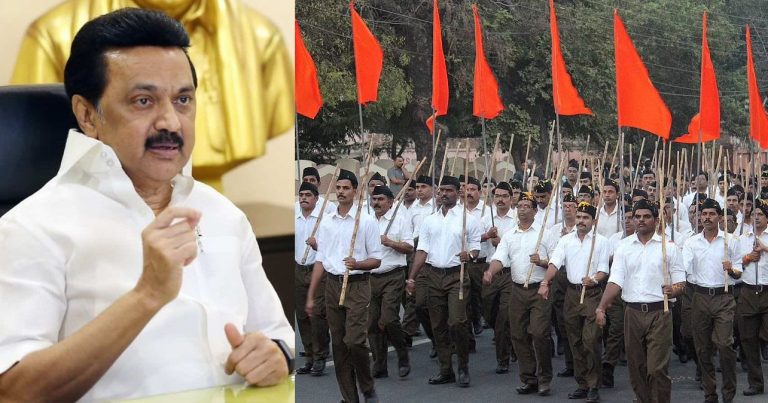
On Wednesday, the Tamil Nadu government rejected permission to the Rashtriya Swayamsevak Sangh (RSS) to perform a march on October 2, citing law and order concerns. This is after the RSS had served a notice to senior state government officials, including the Home Secretary, in response to the Tiruvallur police department’s refusal to provide permission for the march, despite a Madras High Court judgment in its favour.
Earlier on September 22, the Madras High Court had directed the Tamil Nadu government to approve the proposed march by RSS on October 2 at 50 locations in the state. A bench of justice GK Ilanthiraiyan had said that the state government must grant the permission on or before September 28. But despite the High Court order, the Tamil Nadu Police on Wednesday denied permission to the march by RSS, saying that the law and order situation in the state in the aftermath of the ban on PFI is not conducive for the march. The state govt said that it will not grant permission to any organisation for rallies or marches.
Following the refusal of permission for the march, the Rashtriya Swayamsevak Sangh members served a legal notice on State Home Secretary Phanindra Reddy, DGP C Sylendra Babu, the local SP, and the town police inspector, asking why they should not face contempt charges for defying the court order.
#UPDATE | Tamil Nadu Government denies permission for RSS march which was planned to be held on October 2, citing law and order issues.
RSS counsel B Rabu Manohar argued in his legal notice that in light of Justice G K Ilanthiraiyan’s judgment dated September 22, none of the four had any jurisdiction to reject permission or set any new conditions for the event other than those imposed by the High Court.
“It is the duty cast upon the police to give adequate protection, enabling the successful completion of the mission without acting otherwise. The rejection order passed by the inspector (attached to Tiruvallur town police station) is ex facie illegal and contemptuous, as the three are parties before the High Court and are duty bound to ensure strict compliance of the order, failure of which would amount to committing contempt”, the notice read.
B Rabu Manohar also asked the four authorities to unconditionally lift the rejection decision and allow the route march and public gathering on October 2. He further threatened that failure to comply would result in contempt proceedings before the High Court for willful disobedience of the September 22 order, with costs.
Last week on September 22, the Madras High Court granted permission to the Rashtriya Swayamsevak Sangh (RSS) to march in several venues across Tamil Nadu on October 2 with reasonable limits. A bench led by Justice GK Ilanthiraiyan had urged authorities to allow the RSS authorization by September 28. RSS had requested authorization and petitioned the High Court to arrange a parade on October 2 with its members dressed in their uniforms, led by a music band, and followed by a public assembly.
During the hearing, the petitioners stated that every person has the right to lawfully assemble within acceptable limits and that because the organization has not been outlawed, there is no reason why they cannot carry out their parade. The RSS stated that the march would be held to promote social and communal peace and that no members of the RSS would be allowed to carry weapons. The organization further asserted that while other states and the union territory of Puducherry had been granted permission to carry out the parade, “Tamil Nadu’s representation was put on hold”.
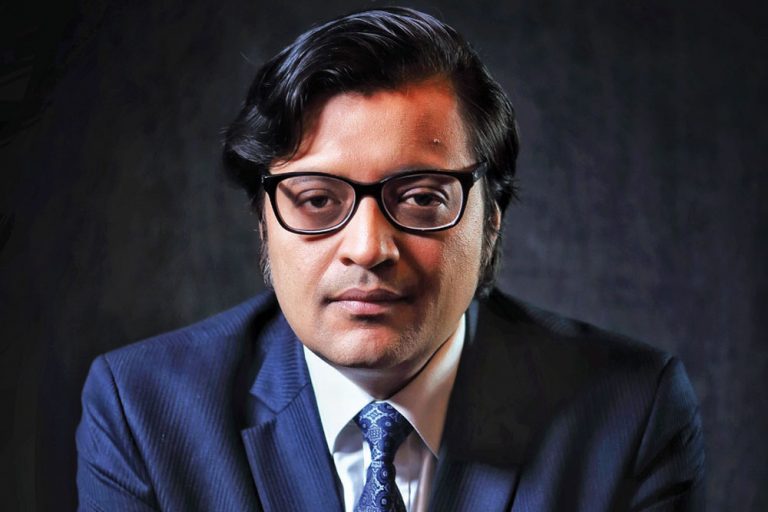
The Enforcement Directorate has filed a charge sheet before a special court in Mumbai in which it confirmed that no evidence was found against Republic Media Network and Arnab Goswami in the fake TRP case. On Wednesday, Judge MG Deshpande of the special Prevention of Money Laundering Act (PMLA) court took cognizance of the charge sheet.
The charge sheet that has been filed by the ED categorically said that the investigation by the Mumbai Police and the charge sheet filed thereof was at “variance” with the findings of the ED. According to the charge sheet, the panel households denied taking money to watch Republic TV or Republic Bharat. The charge sheet said that the regional managers who admitted to paying household panels to watch particular television channels denied doing the same for Republic TV. There was no indication of Republic TV or Republic Bharat engaging in these practices, “either by a statement or by digital data evidence,” it noted.
As the ED charge sheet gives a clean chit to Arnab Goswami in the TRP manipulation case, one is reminded of the harassment that Arnab Goswami faced in a case that was clearly rigged against him. The charge sheet by the ED clearly says that the Mumbai Police’s charge sheet in the case has missed the mark and that the ED findings in the case are in conflict with that of the Mumbai Police, essentially indicating that while the police had implicated Republic TV and Arnab Goswami, the ED has found no evidence against the channel.
While the case was being investigated by the Mumbai Police, Arnab Goswami was interrogated and several employees of Republic Media were harassed for hours. In what is a vindication for the channel and its representatives, the charge sheet also mentions Sachin Vaze and how he recieved a bribe by BARC in order to stop them from harassing BARC officials in the case.
“Thus, it appears that illegal gratifications have been received by investigator-A of the Mumbai Police. As the matter was of serious nature, the same was referred to CBI on 01.07.2021. The outcome of CBI investigation on the above-said input is awaited for further action at this end”, the charge sheet says.
In the charge sheet, Enforcement Directorate says under PMLA 2002, conducted raids against two entities in Delhi after they received specific vigilance inputs. The charge sheet says, “The searches and the statements of concerned persons of these entities revealed that they had received an amount of around Rs. 30 lakhs from M/s BARC through a circuitous route. The stated purpose of receipt of this amount was civil renovation work of M/s BARC office in Mumbai, however, the money (Rs. 25 lakhs) was returned in cash to BARC after deduction of usual commissions and GSTfTaxes etc”.
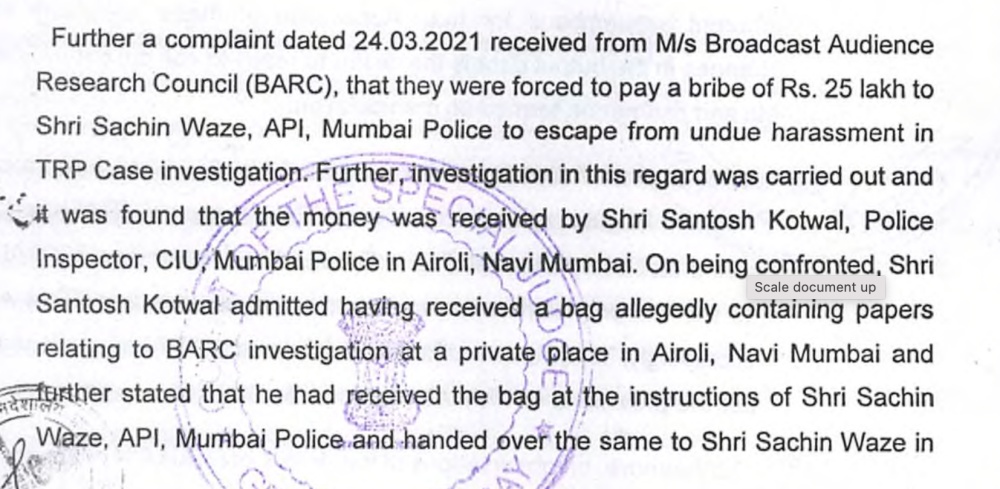
The charge sheet further said that on the 24th of March 2021, a complaint was filed by BARC stating that they were forced to pay a bribe of Rs 25 lakhs to Sachin Vaze the API of Mumbai Police, to allegedly escape undue harassment in the TRP case.
Charge sheet filed by ED
The charge sheet said that a detailed investigation was carried out by the ED in this regard and it was found that one Santosh Kotwal, Police Inspector of the Crime Investigation Unit of Mumbai Police had received the cash from BARC. When the ED questioned Kotwal, he admitted that he had indeed received a bag allegedly “containing papers” related to the BARC investigation in a “private place”. Thereafter, the bag, on the instructions of Sachin Vaze, was handed over to him in his private cabin.
“Further, it is highly improbable that papers relating to investigations will not be received in office but in a private place outside the jurisdiction of Mumbai Police”, said the charge sheet.
“With reference to abovesaid findings, statements of following individuals were recorded Section 50(2) & (3) of PMLA, 2002:- 1. Statement dated-24.03.2021 of Shri Dharamveer Mahecha, Head-Vigilance and Investigations – of M/s Broadcast Audience Research Council; 2. Statement dated 25.03.2021 of Shri Sameer Saddrudin Gilani, Assistant Vice President of BARC: 3. Statement dated 25.03.2021 of Shri Varun Krishan, Senior Vice President — Finance of BARC; 4. Statement dated 25.03.2021 of Shri B. Shivaraman, Financial Controller of BARC; and Statement dated 07.06.2021 of Shri Santosh Baban Kotwal, Police Inspector, Mumbai Police“, the charge sheet added.
It is, therefore, the observation of the Enforcement Directorate that illegal gratifications and bribes had been received by the Mumbai Police officials while investigating the TRP case. The CBI is further investigating the extent of the bribery and how it affected the investigation into the TRP manipulation case. The findings of the report by the CBI are awaited.
Sachin Vaze and Param Bir Singh had revealed that Anil Deshmukh wanted Arnab Goswami falsely implicated and arrested in the TRP case
While the ED has given a clean chit to Arnab Goswami, it is pertinent to remember why this saga had erupted. In September 2021, Sachin Vaze, the Maharashtra police officer currently under arrest had told the Enforcement Directorate that the former Maharashtra Home Minister and NCP leader Anil Deshmukh had wanted Republic TV Editor-in-Chief Arnab Goswami to be arrested in the TRP rigging case.
The tainted cop had revealed that Anil Deshmukh, NCP leader and former Maharashtra Home Minister, had been personally involved in the attempt to get Arnab Goswami arrested, apart from demanding bribes and extortions worth crores from business owners.
Sachin Vaze had submitted before the ED that after he was reinstated into the force by Mumbai Police Commissioner Param Bir Singh after paying Rs 2 crores, Anil Deshmukh used to personally call him at his office or home to brief him on various cases. These included the TRP rigging case, Arnab Goswami’s arrest in the abetment to suicide case regarding the death of architect Anvay Naik, Dilip Chhabria’s case, and the social media fake follower case.
“In the TRP case Anil Deshmukh wanted to arrest Arnab Goswami. In the Dilip Chhabria Case, Anil Deshmukh wanted me to get some kind of settlement with his partner of approx. Rs.150 crores. In Social Media Fake follower case he wanted to have all-out action against the culprits.” Vaze revealed this in his statement to the ED.
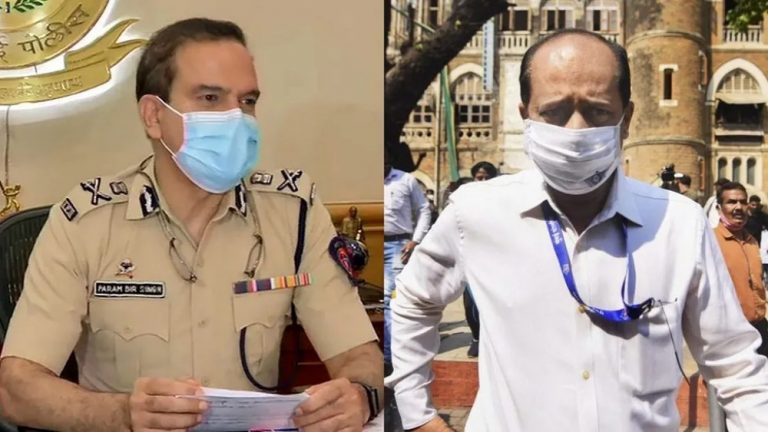
It is also pertinent to note that recently, the tainted ex-Police Commissioner of Mumbai Param Bir Singh, facing a probe by central agencies in the Antilia bomb scare and Mansukh Hiren murder case, confirmed that the TRP case against Republic Media Network was a hoax and part of a planned conspiracy against Journalist Arnab Goswami. During an interrogation by the Enforcement Directorate (ED), Singh also alleged that ex-Police Officer Sachin Vaze was taking instructions from the then Home Minister Anil Deshmukh in the TRP case along with other cases.
On Tuesday, the managing director of the Bihar Women Development Corporation, IAS Harjot Kaur Bhamra sparked outrage after giving a shocking response to a school girl who asked if they can be provided with sanitary pads at Rs. 20-30.
“The government provides a lot of freebies. Can’t they offer us sanitary pads that cost Rs 20-30?” a student inquired.
To this question, IAS officer Harjot Kaur said, “Is there any end to the demands? You’ll say tomorrow that the government can provide jeans and nice shoes. Eventually, when it comes to family planning, you’ll want free condoms as well.”
When the girl said that the votes of the people determine who rules, the officer replied, “This is the height of stupidity. Then do not vote. Pakistan, Ban Jao (become like Pakistan). Do you vote for money and facilities?”
To that barb, the student responded, “I am an Indian. Why should I?”
The incident occurred during a workshop called “Sashakt Beti, Samriddh Bihar” (Empowered Daughters, Prosperous Bihar), which was part of a program called “Towards Enhancing the Value of Girls.”
The senior official’s remark has sparked widespread outrage on social media. Bihar BJP secretary Amrita Rathod slammed the IAS officer over the “ban jao Pakistan” remark while sharing a video of the incident. Amrita Rathod took to Twitter and wrote, “Meet an IAS officer of the Nitish-Tejashwi government who wants a student to go to Pakistan for having asked for sanitary napkins.”
अब नितिश-तेजस्वि सरकार के IAS से मिलिए। हरजोत कौर बिहार की बेटियों को सानिटरी नैपकिन माँगने पर पाकिस्तान भेजेंगी। pic.twitter.com/VjVv0EF0AP
Harjot Kaur later issued a statement in which she stated, “I am well-known for being one of the most outspoken advocates for women’s rights and empowerment. Some wicked elements, against whom WCDC has taken rigorous action for omissions and commission of wrongdoing, have now resorted to such low level tactics to slander my character, having lost at every forum.”
According to reports, an unidentified gunman opened fire inside a dental clinic in Karachi, Pakistan, on Wednesday, killing a Chinese national and injuring two others. This is the latest in a string of attacks in Pakistan targeting Chinese nationals. There has been no claim of responsibility for the attack yet.
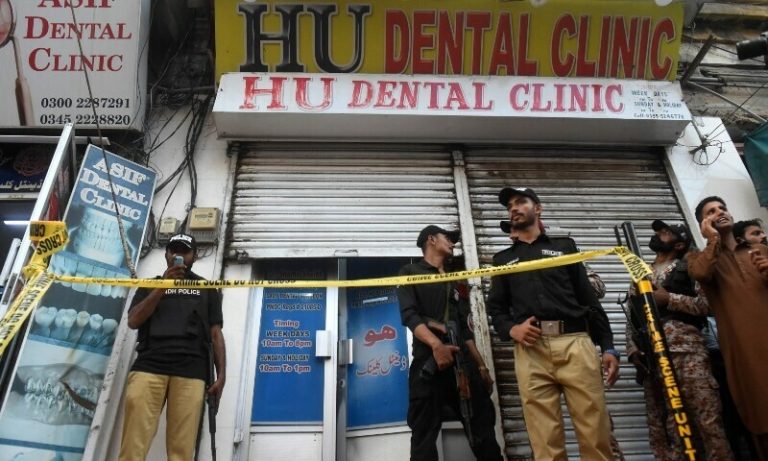
According to Dawn, South SSP Asad Raza told reporters that one person was murdered and two others were injured and taken to a hospital for treatment. He verified that the three people were Chinese. He stated that an unidentified individual acting as a patient entered Dr Richard Hu’s private dental office on Preedy Street and waited in the waiting room for dental treatment.
Pakistan | A Chinese national was shot dead and two others were injured on Wednesday after unknown assailants opened fire on a clinic in Karachi’s Saddar area, a police official said: Pakistan media
The assailant then entered the clinic area after around 15 to 20 minutes and opened fire with a 9mm pistol on Dr Richard Hu, his wife Mrs Phen Teyin, and Ronald Raymond Chou. The suspect managed to flee the murder scene with the assistance of an accomplice who had parked his motorcycle around the corner on Preedy Street.
Dr Richard and Phen Teyin were injured by bullets as a consequence of the shooting, and Ronald, their employee, died on the scene. The dentist and his wife were both Pakistani-Chinese citizens who had long worked at the dental clinic.
Following the incident, Interior Minister Rana Sanaullah asked the chief secretary of Sindh to provide a report on the shooting and to apprehend the offenders as soon as possible. He criticised the act and expressed condolences for the death of the Chinese citizen in a tweet.
ایسے واقعات ناقابل برداشت ہیں؛ ملزمان کو جلد سے جلد گرفتار کیا جائے۔ وزیر داخلہ
It is worth noting that Chinese nationals have been the target of persistent attacks in Pakistan. Three Chinese nationals were killed in a suicide bombing at Karachi University in April by the separatist Baloch Liberation Army, which is hostile to China’s involvement in Balochistan and accuses China and Pakistan of exploiting the resource-rich province. Several other incidents in Pakistan have also been linked to extreme Islamic terrorist groups.
Gunmen on motorbikes opened fire on a van carrying two Chinese manufacturing workers at Karachi’s Nuclear Power Plant in July 2021, injuring both. In November 2018, BLA rebels attempted to raid the Chinese embassy in Karachi’s Clifton neighbourhood, killing four people, including two police officers and two of the assailants.
According to reports, Pakistan’s security systems are no longer trusted by the Chinese population, particularly the Chinese labourers there. Chinese employees in Pakistan feel frightened and don’t trust Pakistan’s security apparatus to keep them safe in an emergency. It is worth noting that China has made significant investments in Pakistan’s infrastructure. The China-Pakistan Economic Corridor(CPEC) is one of the projects that heavily relies on Chinese labour and funding.
On Wednesday, Forbes, Dyson, Mazda, PBS Kids, Walt Disney, NBCUniversal, Cole Haan, and Coca-Cola have all halted their Twitter advertising after their promos allegedly appeared next to messages requesting child pornography. Around 30 advertisements allegedly were shown on the profiles of Twitter accounts with ties to child pornography.
According to the reports, some of the tweets included key terms like ‘rape’ and ‘teens’, and they were shown alongside promotional tweets from corporate marketers. In an instance mentioned by Reuters, a promotional tweet for Cole Haan was shown next to a tweet in which a user stated that they were ‘trading teen or child’.
Cole Haan’s brand president, David Maddocks, said that the company is shocked and that either Twitter will correct it or Cole Haan will address it by whatever means it can, including not buying Twitter advertisements in the future. “We’re horrified”, he was quoted. Also, Forbes’ spokesperson condemned the incident and said that the company was horrified to learn about it. “We immediately ceased any paid activity on Twitter. We have no plans to resume our marketing on Twitter this time. They need to fix this mess”, the spokesperson stated.
In a statement, Twitter spokesperson Celeste Carswell said the company ‘has zero tolerance for child sexual exploitation’ and is investing more resources dedicated to child safety, including hiring for new positions to write policy and implement solutions https://t.co/Mde4DCX8bupic.twitter.com/DWgt2oFwi0
In another instance, a user searched for “Yung girls ONLY, NO Boys,” which was swiftly followed by a promotional tweet for Texas-based Scottish Rite Children’s Hospital. Twitter spokesperson meanwhile commented on the situation and said that it is working closely with its clients and partners to investigate the situation and take the appropriate steps to prevent this from happening in the future.
“The company has zero tolerance for child sexual exploitation. Twitter remains committed to providing a safe environment for all people, and this includes ensuring advertisers can connect with their customers safely”, Twitter spokesperson Celeste Carswell was quoted.
According to Ghost Data’s investigation, over 500 accounts publicly posted or solicited child sexual assault content for more than 20 days this month. However, Reuters in its exclusive report mentioned that Twitter had failed to delete more than 70% of the accounts over the research period. The dozens of accounts that remained online and were inspected by the agency which revealed that they were hunting for ’13+’ and ‘young looking nude’ content.
The news agency happened to share a sample of 20 accounts with Twitter on Thursday (September 22) after which the social media firm banned around 300 accounts from its network. However, more than 100 additional accounts continued to exist on the site the next day. On Monday, Reuters then released the complete list of over 500 accounts, which were investigated by Twitter before being permanently terminated for violating the company policies.
On Wednesday, reportedly the social media company sent emails to its advertisers to inform them that it had discovered advertising running within profiles that were ‘publicly selling or soliciting child sexual abuse content’. Separately, Twitter stated in its transparency report that the number of accounts that breached its child sexual exploitation policy increased by 31% during the second half of 2021. During this reporting period, it suspended 596,997 unique accounts, a 32% rise from the prior report. 91% of these banned accounts were detected proactively via the use of internal proprietary techniques and industry hash-sharing programs.
Twitter is also in court with Tesla CEO and billionaire Elon Musk, who is seeking to back out of a $44 billion plan to purchase the social media giant due to concerns about the frequency of spam accounts and their influence on the business. In a study dated February 2021, a team of Twitter workers determined that the firm needed greater investment to detect and delete child exploitation content on a large scale, adding that the company had a backlog of cases to analyze for possible referral to law authorities.
Brand safety continues to be a problem in this digital era. Reportedly, Twitter is not the only firm that is facing the heat. In 2017, companies such as Amazon, Cadbury, eBay, Mars, Diageo, Adidas, HP, and Deutsche Bank suspended their YouTube advertising due to worries that their commercials were appearing on videos of minors who were being targeted and exploited. According to the reports, YouTube enabled sexual pictures of children to be easily accessible and failed to live up to commitments to properly monitor and control its services to safeguard children.
The Enforcement Directorate has filed a charge sheet before a special court in Mumbai in which it confirmed that no evidence was found against Republic Media Network in the fake TRP case. On Wednesday, Judge MG Deshpande of the special Prevention of Money Laundering Act (PMLA) court took cognizance of the charge sheet.
It is pertinent to note that recently, the tainted ex-Police Commissioner of Mumbai Param Bir Singh, facing a probe by central agencies in the Antilia bomb scare and Mansukh Hiren murder case, confirmed that the TRP case against Republic Media Network was a hoax and part of a planned conspiracy against Journalist Arnab Goswami. During an interrogation by the Enforcement Directorate (ED), Singh also alleged that ex-Police Officer Sachin Vaze was taking instructions from the then Home Minister Anil Deshmukh in the TRP case along with other cases.
The charge sheet that has been filed by the ED categorically said that the investigation by the Mumbai Police and the charge sheet filed thereof was at “variance” with the findings of the ED. According to the charge sheet, the panel households denied taking money to watch Republic TV or Republic Bharat. The charge sheet said that the regional managers who admitted to paying household panels to watch particular television channels denied doing the same for Republic TV. There was no indication of Republic TV or Republic Bharat engaging in these practices, “either by a statement or by digital data evidence,” it noted. According to the charge sheet, the forensic audit report relied on by Mumbai police was “superficial” and based on a review of “limited aspects.”
OpIndia has obtained a copy of the charge sheet filed by the Enforcement Directorate, and apart from the clean chit given to Republic TV, there are several other revelations in the report which need careful consideration including the names of other channels, who actually manipulated TRP.
How the TRP scandal began and how the names of Republic TV and Arnab Goswami was dragged in
On the 8th of October 2020, the then Commissioner of Police Param Bir Singh held a press conference and accused Arnab Goswami and Republic TV of gross TRP manipulation. He said that three channels, including Republic TV and two other Marathi channels- Fakt Marathi and Box Cinema have been reportedly involved in distorting the apparatus used by BARC to rate television channels. The FIR that had been filed by the Mumbai Police was based on a complaint by Hansa Research. It emerged later that the contents of the complaint were much different from what Param Bir Singh had claimed in his press conference.
Hansa Research had filed a complaint against one of its employee Vishal Bhandari, who had confessed to having received money to pay to BARC panel houses to watch the India Today channel for 2 hours a day. The complaint filed by Hansa Research and the FIR filed by the Mumbai Police in the case named India Today multiple times, however, on the 8th of October, Arnab Goswami and Republic TV’s name emerged seemingly out of nowhere. What followed was a saga of persecution where Republic TV employees were questioned for hours on end and later, Hansa Research also claimed in court that they were being forced to implicate Republic TV. The case was thereafter handed over to ED for investigation. While the ED charge sheet exonerates Republic TV, is it also pertinent to note that Param Bir Singh had revealed in custody that the entire TRP saga was a plot to implicate Arnab Goswami in a fake case the sanction for which came from the then Home Minister of Maharashtra, Anil Deshmukh.
What the charge sheet by ED says about the role of Republic TV and Republic Bharat in the TRP manipulation case
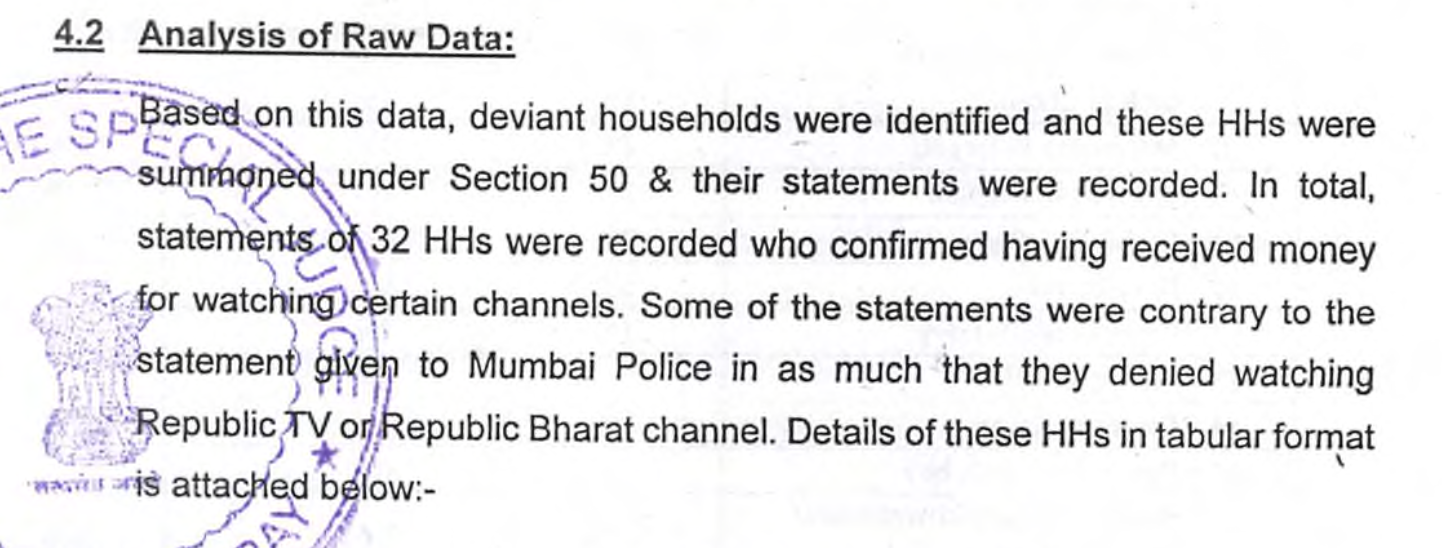
Straight off the bat, the ED charge sheet says that the households that were interrogated for receiving the money to watch certain channels denied having watched Republic TV or Republic Bharat. The additional relationship managers who were interrogated by the ED also denied having gotten money from Republic TV or Republic Bharat to induce households to watch either of the channels led by Arnab Goswami.
Chargesheet by ED
In the charge sheet, an entire section is dedicated to outlining what the ED found regarding the role of Republic TV and Republic Bharat in the alleged TRP manipulation. In the section, the ED exonerates Republic completely and says that its findings are not in consonance with what the Mumbai Police has alleged in their charge sheets and supplementary charge sheets.
The raw data of those panels where the alleged manipulation in favour of Republic TV took place were sought and analysed by the ED. The ED then places a table where it is evident that these households, that Mumbai Police said were paid to watch Republic, were watching other channels and not Arnab Goswami. The channels that were being watched by these households were Box Cinema, Fakt Marathi, Mahamovie, Aaj Tak, India Today and News Nation.
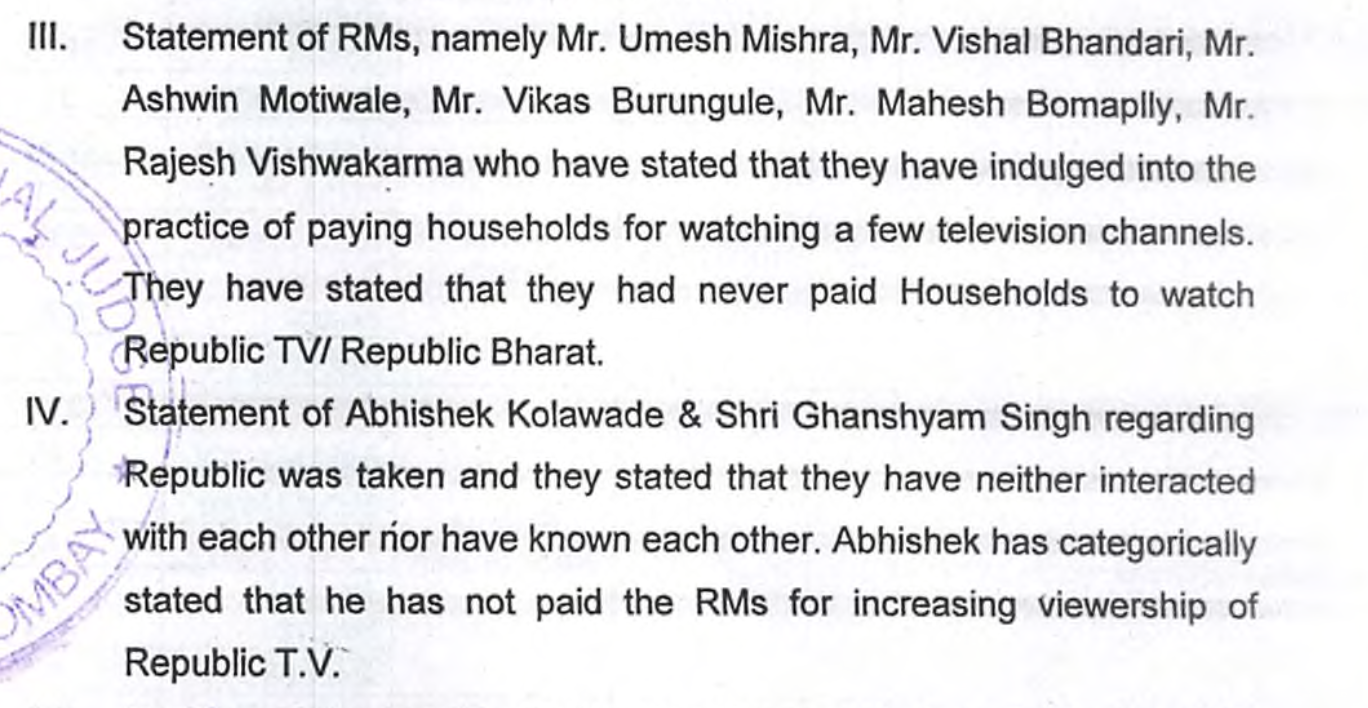
The Relationship Managers who were interrogated have also corroborated that they have never paid households to watch Republic TV or Republic Bharat.
Chargesheet by ED
The charge sheet also says that the allegation by Mumbai Police, that Rs 13 lakh was found in the house of Abhishek Kolwade that was paid to him as a bribe to induce households to watch Republic was found incorrect since there is no money trail between Republic TV, its representatives like Ghanshyam and Kolwade. In fact, the charge sheet says that the “statement of Abhishek Kolawade and Shri Ghanshyam Singh regarding Republic was taken and they stated that they have neither interacted with each other nor have known each other. Abhishek has categorically stated that he has not paid the RMs for increasing the viewership of Republic T.V”.
Further, customer-wise Raw Viewership Data from the Broadcast Audience Research Council has been collected during the course of the investigation so far. The same has been analyzed in respect of Households suspected to be receiving monies for watching one or more of the particular channels namely Maha Movie and Fakt Marathi daily. These households were alleged by Mumbai Police to have watched News Nation, Maha Movie, Fakt Marathi and Republic TV in lieu of illegal gratification in form of cash.
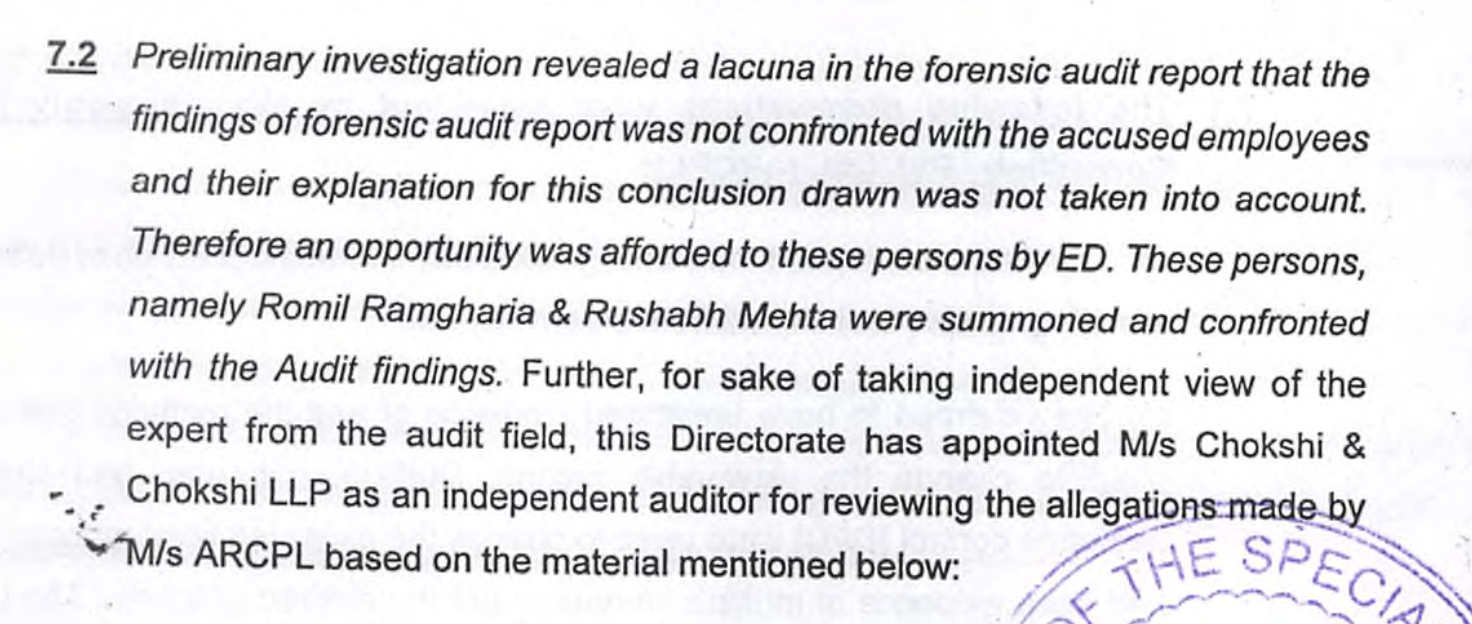
During the course of the investigation, an internal forensic audit report was made on the instruction of BARC and provided to the investigating agencies. BARC had received several complaints about weekly viewership data manipulation and therefore a company called ARCPL was approached to carry out an audit. BARC had also shared a list of individuals who they believe could be potentially colluding to alter weekly data released by BARC. Along with that, certain whistleblower allegations were also shared with the auditing firm. The ARCPL suspected that in certain cases, the weekly viewership data was already predecided and that manipulation in the English News genre had taken place. This report had apparently indicted Republic TV in several cases.
The ED found that the audit report itself was not accurate and had missed taking several aspects into consideration.
Chargesheet by ED
ED in its charge sheet says, “From the above discussion and table, it becomes apparent that the allegations made in the report are superficial and based on the analysis of limited aspects. Various other aspects such as the response of the Key Management Persons, video recording regarding allurement to three Households & show cause to Times Now, software developed by BARC to counter the TRP due to Landing Page, Vigilance Complaints, impact from surveying companies such as M/s Chrome were not taken into account while preparing the report The auditors were also not aware of various mechanisms (duly approved) adopted by BARC to streamline the system and to iron out irregularities. Further, a letter from BARC to MIB which categorically states that there are no irregularities by Republic TV after the audit report and no action taken by BARC post audit report, clearly indicates that BARC has not taken cognizance of this report. Therefore, it is difficult to place reliance on this report in this criminal investigation”.
The final findings of the investigation by ED find no evidence that Republic TV and Republic Bharat had any role in manipulating TRP or bribing households to watch the channel. The charge sheet says:
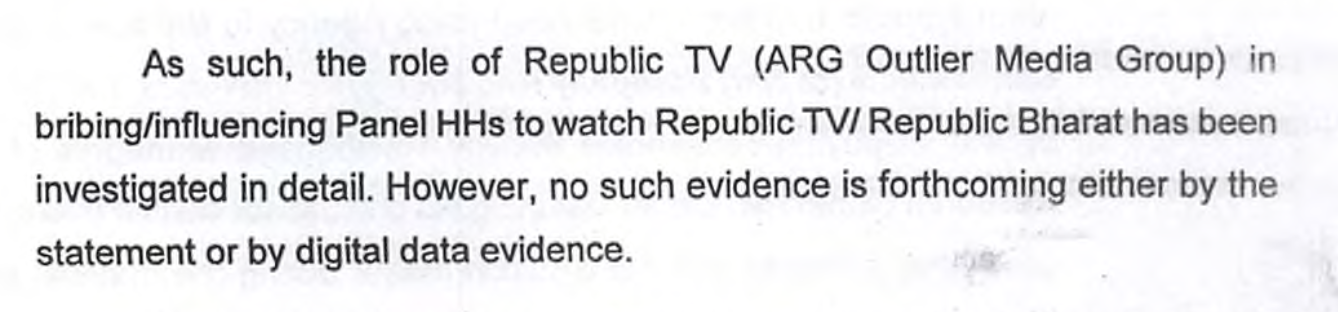
The role of Republic TV (ARG Outlier Media Group) in bribing/influencing Panel HHs to watch Republic TV/ Republic Bharat has been investigated in detail. However, it became evident that the investigation done by Mumbai Police is at variance with the investigation done by the Directorate in this matter. The grounds for the same are as follows:
● Raw data for the panel households who were allegedly watching Republic TV (as per Mumbai Police Chargesheet) was sought from BARC. Analysis of the viewership pattern of those households clearly showed that these HHs were watching channels other than Republic Channels.
● Panel HHs denied having taken money for watching Republic TV or Republic Bharat. Their statement corroborates with the raw data which was maintained independently by BARC.
● In their statements, RMs who have stated that they have indulged in the practice of paying households for watching a few television channels, have denied to have paid Households to watch Republic TV/ Republic Bharat.
● No financial/fund trail so far to connect payment of monies by Republic of any of these persons.
Chargesheet by ED
The charge sheet thus clearly states, “As such, the role of Republic TV (ARG Outlier Media Group) in bribing/influencing Panel HHs to watch Republic TV/ Republic Bharat has been investigated in detail. However, no such evidence is forthcoming either by the statement or by digital data evidence”.
Sachin Vaze had revealed that Anil Deshmukh wanted Arnab Goswami falsely implicated and arrested in the TRP case
While the ED has given a clean chit to Arnab Goswami, it is pertinent to remember why this saga had erupted. In September 2021, Sachin Vaze, the Maharashtra police officer currently under arrest had told the Enforcement Directorate that the former Maharashtra Home Minister and NCP leader Anil Deshmukh had wanted Republic TV Editor-in-Chief Arnab Goswami to be arrested in the TRP rigging case.
The tainted cop had revealed that Anil Deshmukh, NCP leader and former Maharashtra Home Minister, had been personally involved in the attempt to get Arnab Goswami arrested, apart from demanding bribes and extortions worth crores from business owners.
Sachin Vaze had submitted before the ED that after he was reinstated into the force by Mumbai Police Commissioner Param Bir Singh after paying Rs 2 crores, Anil Deshmukh used to personally call him at his office or home to brief him on various cases. These included the TRP rigging case, Arnab Goswami’s arrest in the abetment to suicide case regarding the death of architect Anvay Naik, Dilip Chhabria’s case, and the social media fake follower case.
“In TRP case Anil Deshmukh wanted to arrest Arnab Goswami. In the Dilip Chhabria Case, Anil Deshmukh wanted me to get some kind of settlement with his partner of approx. Rs.150 crores. In Social Media Fake follower case he wanted to have all-out action against the culprits.” Vaze revealed this in his statement to the ED.
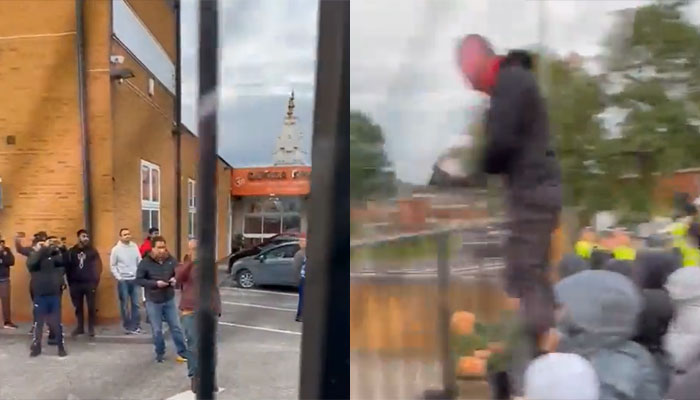
On September 28, new videos of the Birmingham Hindu temple attack surfaced on social media platforms where the Islamists were seen hurling abuses, including cow jibes, at the Hindus present inside the temple premises.
In the first 2-minute and 10-second video shared by Twitter user INSIGHT_UK, the person recording the video called the Hindus ‘p*ss drinking bast**ds’ and then asked them to ‘go eat some cow sh*t’. The abuses were accompanied by abusive words, including ‘motherf**ker’ and others. Towards half of the video, the Police came and started pushing the mob away from the temple wall. They started screaming ‘Allah Hu Akbar’ as the Police pushed them. At 1:34 timestamp, someone threw a bottle at female Police personnel that did not hit her.
Shocking #Hinduphobia. The shameful silence of the British Media. Assault on a Hindu temple & Hindus in #Birmingham by Muslim extremists.
– Screams of Allah Hu Akbar – Go drink some cow pi*s – Go eat cow s**t – Piss drinking b****ds – Abusing the police & throwing missiles pic.twitter.com/Vln8eSRBq9
In the second video shared by the Twitter user, the mob called Hindus racists and kept raising ‘Allahu Akbar’ slogans. The person recording the video then turned the camera towards himself and called Hindus ‘P*ss drinking motherf**kers’ again. His face was completely covered. The mob also made sexist comments toward the female Police officers present at the scene.
A dangerous plot. This is not a Hindu-Muslim clash, this is an outright attack on Hindus by #Islamists. And then they play the victim!
Their hate is clear to see. This has always been the case of Islamist hate and not being able to accept non-Muslims, particularly #Hindus. pic.twitter.com/vRDn7diCeW
In the third video, the person recording the video abused Prime Minister Narendra Modi by saying, ‘Modi di Maa di P**di’ and then called Hindus ‘p*ss drinking bast**ds’. This video was in sync with another video shared earlier where a man climbed the wall of the temple premises. That particular man can also be seen in this video at a 20-seconds timestamp. This video was an extended and clearer version of the first video.
In the past couple of months, the anti-Hindu attacks in the United Kingdom, especially in Leicester and Birmingham, increased by several folds. What appeared to be a reaction to the defeat Pakistan faced in the T20 Asia Cup match against India, it was later found that Islamists were just using the match as an excuse to attack the Hindus as they did not stop even after Pakistan defeated India in the same series a week later.
The attacks intensified to the extent that Hindu families left Leicester, and some of them reportedly have not returned so far. The houses, businesses and properties of Hindus were vandalised. Contrary to what was happening, mainstream media and Islamists tried to cover up the anti-Hindu attacks and blamed Hindus for the clashes.
In Birmingham, they used an event where Sadhvi Ritambhara was scheduled to appear as an excuse to attack a Hindu temple. The event was postponed owing to Sadhvi’s health. However, the Islamists did not back off and attacked the temple. It was evident that they were well aware of the fact that not only that particular event but the whole tour was postponed, but they moved ahead and called to circle the temple to intimidate Hindus. More such so-called “peaceful protests” at Hindu temples and establishments in the UK have been planned by the Islamists in the coming days.
Hinduphobic Gaumutra jibe is the language of terrorists
‘Cow p*ss’ or ‘cow urine’ or ‘Gaumutra’ jibe is often used by Islamist terrorists before attacking Indians, especially Hindus. In 2019, a Pakistan-backed Jaish-e-Muhammad terrorist in a suicide attack killed as many as 40 CRPF soldiers in Pulwama, Kashmir. Following the attack, a video was released in which the terrorist could be heard saying he wanted to punish and kill the ‘cow urine drinkers’ in the name of Allah. The terrorist identified as Adil Ahmed Dar alias Waqas was seen admitting that he had joined the Jaish-e-Mohammad a year ago. In the video, he referred to Indians as “Gae ka Peshab Peene Wale” (People who drink cow urine).