Reports of a ruckus have emerged a day after AAP national convenor Arvind Kejriwal’s rally in Ahmedabad was held on Saturday, April 2. Delhi CM Arvind Kejriwal along with the newly sworn-in Punjab CM Bhagwant Mann organised a roadshow at Ahmedabad’s Bapunagar in view of the upcoming assembly elections in Gujarat tentatively scheduled for December 2022.
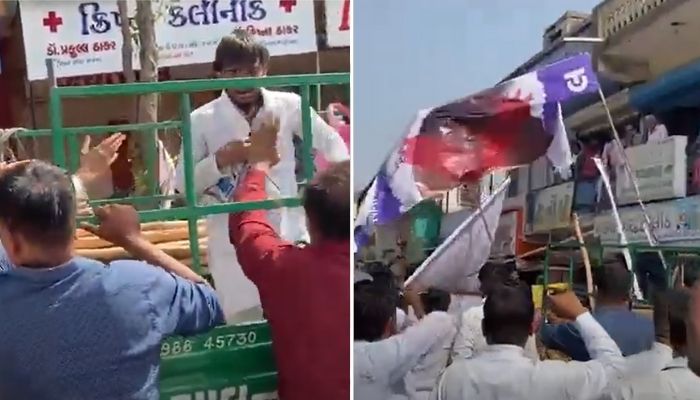
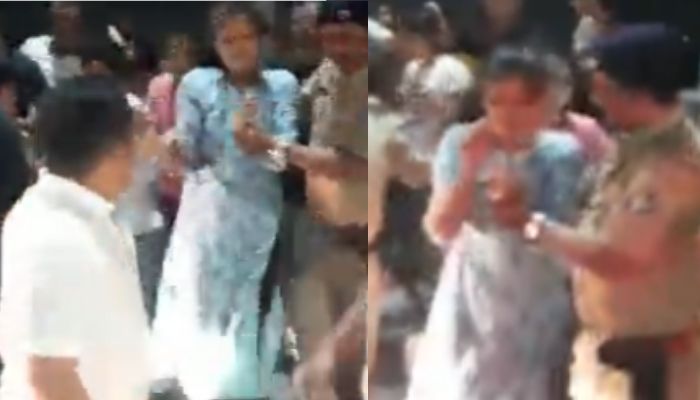
From the rally which has been touted as a massive success for Arvind Kejriwal in Gujarat, videos have emerged where AAP workers can be seen engaged in what appears to be infighting. Amidst scenes of ruckus, AAP workers during the rally were seen giving slogans such as ‘Nahi Chalegi’ (Not Done!) against each other. In the pulled out posters that were lying on the road, two workers could be clearly seen trampling them under their feet. Reportedly multiple scenes of disturbance among AAP workers were witnessed during the course of the rally.
In another video which was taken from the Nikol area of Ahmedabad, workers can be clearly seen pulling posters of the Aam Admi Party and tearing them down on the road. AAP workers could be identified wearing AAP t-shirts and AAP topis depicting CYSS (Chatra Yuva Sangharsh Samiti) – the youth wing of AAP in both of the videos. An enraged party worker helped himself climb on a loaded tempo and was seen drawing bamboo poles from the vehicle. Other party workers tried to control the situation.
Behind the AAP rally which drew many numbers in Ahmedabad, it has already been exposed that AAP workers were found bribing the public to attend the rally. The video was posted by SBJP Social Media Head leader Amit Malviya on Twitter.
AAP distributing cash to people to participate in Arvind Kejriwal’s roadshow in Gujarat…
Amidst reports of bribery during the rally, Arvind Kejriwal contrastingly claimed that Delhi is free of corruption and that Punjab is also corruption-free in just 10 days of Mann taking over as Chief Minister. From bribery to infighting, Kejriwal’s debut campaign in the run-up to the assembly elections hangs his fate in the state, which has long been a BJP bastion since 1995.
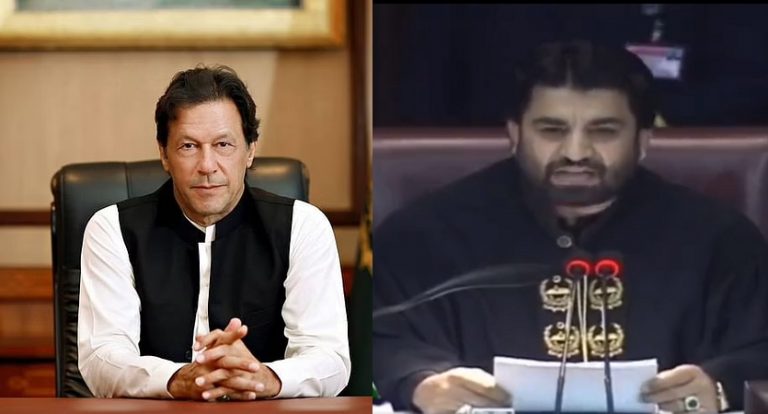
Pakistan politics saw high drama and rapid surprising developments today as the national assembly was scheduled to vote on the no-confidence motion against the Imran Khan govt brought by the united opposition. In a surprising move, the no-confidence motion against the Imran Khan-led PTI government was rejected by the Deputy Speaker of the house. Minutes after that, Imran Khan announced that he has asked the president to dissolve the assembly and called for fresh elections.
While the National Assembly was readying for the no-confidence voting, Deputy Speaker Qasim Suri dismissed the motion. He read out a pre-written note and stated that the motion was inspired at the behest of an unnamed “foreign power” and therefore it is unconstitutional.
Pakistan National Assembly Deputy Speaker rejects the no-confidence motion against PM Imran Khan, declares it unconstitutional
This discretion by the deputy speaker came after Minister of Information Fawad Chaudhry made a statement in the assembly stating that this is an effective operation for regime change by a foreign government. Soon after the statement by Fawad Chaudhary, Deputy Speaker dismissed the no-confidence motion against Imran Khan’s PTI government without voting attributing it to foreign conspiracy.
After the motion was overturned and ruled unlawful, the opposing parties began sloganeering in the assembly, sparking a ruckus.
Following that, Prime Minister Imran Khan delivered an address in which he praised the Deputy Speaker for the decision and said that he would seek that the assembly be dissolved so that new elections could be held. He further stated that this move was part of a foreign conspiracy to destabilise Pakistan and transfer power to corrupt individuals who would then operate on foreign commands.
I have written to the President to dissolve the assemblies. There should be elections in a democratic way. I call upon the people to Pakitan to prepare for elections: Pakistan PM Imran Khan
Imran Khan said that he has recommended the president to dissolve the national assembly and call fresh elections. He said that the govt in Pakistan should be elected by people in a democratic process, not by foreign powers. He asked the people of Pakistan to get ready for elections. Imran Khan added that “the conspiracy to take down this government has collapsed.”
After the non-confidence motion was dismissed, the opposition parties announced that they will move the Supreme Court against the deputy speaker and the prime minister.
It is worth noting that Fawad Chaudhry recently announced that Punjab Governor Chaudhry Mohammad Sarwar had been fired by the federal government. It is also noteworthy that Imran Khan appointed Fawad Chaudhary as Law Minister just one day before the no-confidence resolution was to be voted on.
Pak PM Imran Khan appoints Fawad Chaudhry as Law Minister in desperate bid to hold reins https://t.co/LJEmt14kth
The security around the Pakistan National Assembly was also increased looking at the vote for the no-confidence motion. Section 144 was imposed in Islamabad.
Islamabad | Security personnel deployed near Pakistan’s National Assembly, as Prime Minister Imran Khan is set to face the no-confidence vote today
Shehbaz Sharif, the leader of the Pakistan Muslim League (Nawaz) and brother of former Pakistan Prime Minister Nawaz Sharif, tabled a no-confidence motion against Imran Khan’s government in the National Assembly on March 8. The resolution of no confidence was passed against Imran Khan in the midst of surging inflation and dire economic conditions in Pakistan.
In a significant decision to prevent the inhuman slaughtering of animals, the Karnataka state government has asked the Bruhat Bengaluru Mahanagar Palike (BBMP) to make it mandatory for meat shops and abattoirs to stun the animals before slaughtering them.
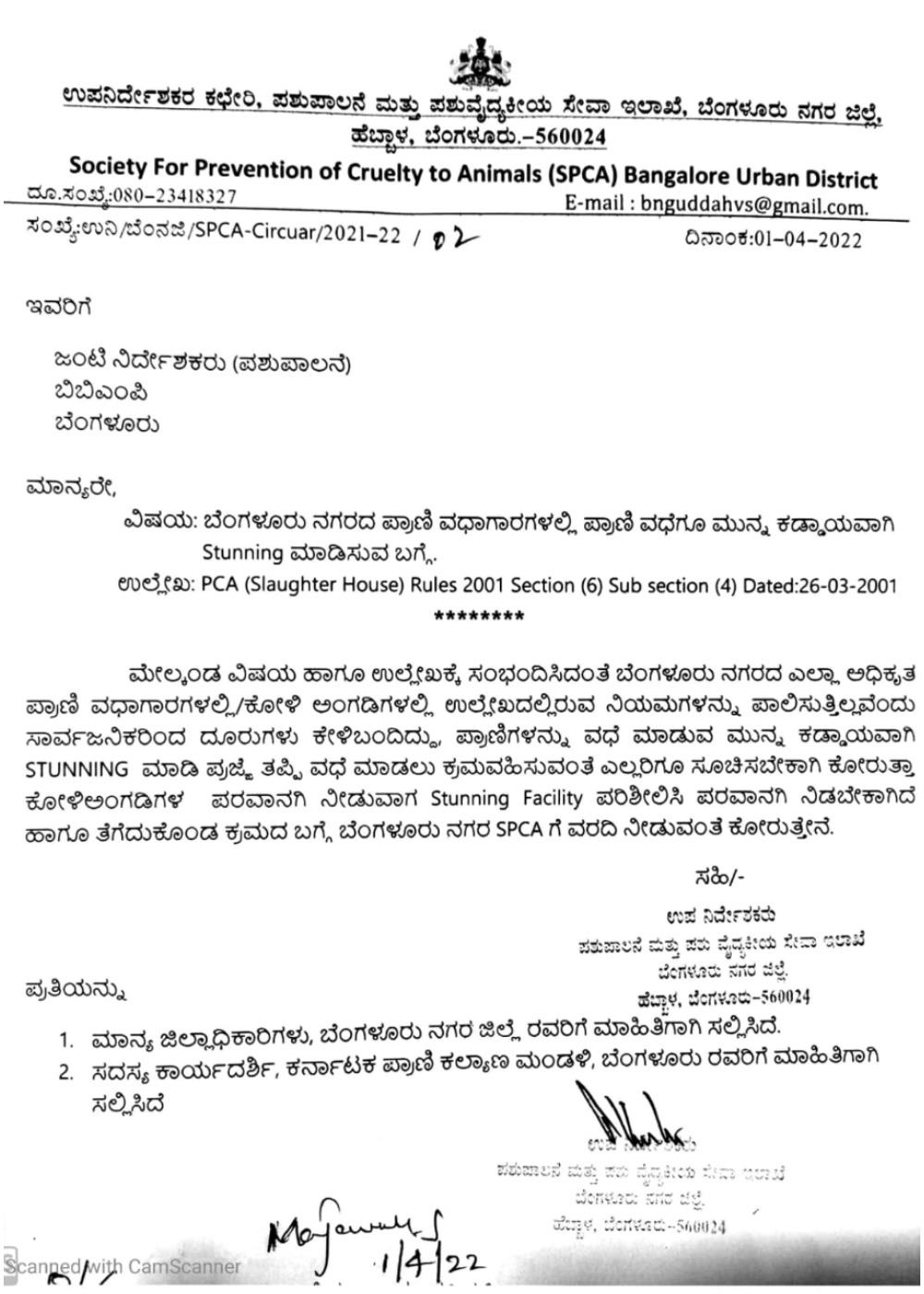
The Animal Husbandry department has asked Bruhat Bengaluru Mahanagara Palike (BBMP) to enforce compulsory stunning of animals at slaughterhouses and meat shops in Bengaluru. The department has also asked the BBMP authorities to make sure stunning facilities are in place before giving licences to meat shops.
“We have received complaints from people about the stunning procedure not being followed at slaughterhouses and chicken stalls,” the department said.
It also sought a report on the action being taken by the Bengaluru municipal body.
BBMP order on stunning animals before slaughtering/ Image Source: BBMP
The order from the BBMP comes amidst the ongoing debate over the Islamic traditions of ‘Halal’, which intensified last week after the Hindu activist group Hindu Janajagruti Samiti gave a call to boycott halal meat while launching a nationwide campaign demanding a ban on Halal products.
The Halal certification labels food products permissible to consume in Islam excluding pork-related edibles, animal fats and other dairy generated products and all types of alcohol.
Is stunning of animals before slaughter halal
Stunning is a process where various methods of shock are used to ‘stun’ the animal so that it becomes unconscious before slaughter and has a relatively painless death. However, as per some Islamic scholars, stunning animals before slaughter is ‘against the principles of Islam’ and an ‘evil innovation’. Many Islamic scholars urge Muslims to avoid stunning when slaughtering animal.
Further, the animal needs to be alive at the time of slaughter. If the method of stunning is irreversible, the chances are high that the animal stunned will die before being slaughtered. A practicing Muslim of sane mind will chant ‘Bismillah’ (in the name of Allah) before slaughtering. However, if the animal is already dead by stunning before slaughter, it would not be able to hear the phrase, which could render the meat non-halal.
However, Mohammed Zubair, cofounder of website AltNews, which often works as islamic propaganda website, has said that stunning the animal before slaughtering might still be halal compliant.
‘Stunning’ process violates Halal compliance? No It Doesn't. Condition: Animal should be alive during Stunning procedure. If the animal is found dead due to the stunning procedure, it's non halal slaughter. https://t.co/q88Ei5geWI
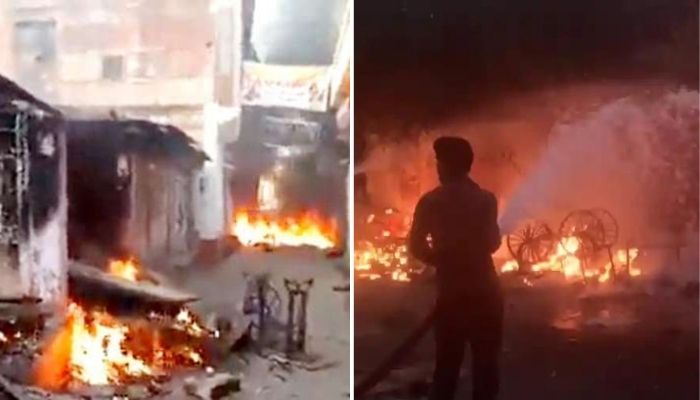
Rajasthan Police has imposed curfew, and internet services have been shut down in Karauli as a consequence of the violence that broke out after stone-pelting at a bike rally in a Muslim ghetto. Internet services have been shut down in the city after a bike rally celebrating the Hindu New Year was attacked on Saturday evening.
On April 2, communal violence broke down in the Hatwara Bazaar area of Karauli when stones were pelted by miscreants at a Hindu bike rally while more than a dozen shops and three bikes were set on fire. Reportedly, 42 people, including policemen, have been injured in the mob attack while the rally celebrating ‘Nav Samvatsar’ passed through a Muslim-dominated area. Additional Director General of Police (Law and Order) Hawa Singh Ghumariya informed that over 30 people were detained by the police so far.
Meanwhile, a curfew has been imposed in the city until the night of April 4, Monday. Internet services would also remain shut in the city to control the menace of polarization and fake news through social media. Those who were injured were discharged from a local hospital after receiving first aid. One person whose condition remains serious is being treated at the SMS hospital in Jaipur.
To avoid further clashing, 600 policemen including 50 deputy superintendents of police have been deployed in the city. Rajasthan Chief Minister Ashok Gehlot has failed to condemn the violence equivocally. Taking a calculated stand, he told PTI, “Some miscreants happen to be there…they can be in any religion and anywhere and they should be avoided because they are not harmed, the common man is harmed. They are not hurt, common man is hurt,”
BJP leader and Ex-Chief Minister Vasundhara Raje Scindia has criticised the incumbent government’s lethargy in taking the law-and-order situation in control. She tweeted, “This incident of attack could have been averted if the administration had taken precautions before the enthusiasm rally being taken out on the occasion of Nav Samvatsar in Karauli. Communal harmony also deteriorated due to the apathy of the administration. The State government should take immediate action!”
करौली में नव संवत्सर पर निकाली जा रही उत्साह रैली पर विरोधी मानसिकता के लोगों द्वारा किए गये हमले की मैं कड़ी निंदा करती हूं। शांति प्रिय राजस्थान में नफरती मानसिकता को नहीं पनपने दिया जा सकता। प्रशासन को दोषियों पर सख्त कार्रवाई करनी चाहिए।#Rajasthan#Karauli
She further wrote, “I strongly condemn the attack on the ‘Utsah Rally’ being taken out on Nav Samvatsar in Karauli. Hate mentality cannot be allowed to flourish in peace-loving Rajasthan.” BJP State President Satish Poonia noted that the incident is a result of Congress’ policy of appeasement.
On Saturday (April 2) night, Gujarat Home Minister Harsh Sanghavi stopped his convoy and talked to a girl for over 5 minutes, who had gone to the Pal Umra Bridge in Surat to commit suicide. The sensitive approach of the BJP Minister helped save a life.
As per reports, the girl wanted to end her life by jumping into the Tapi river. She was stopped by locals. At that time, the convoy of Harsh Sanghavi, who was in his hometown of Surat, was passing by the bridge.
On seeing a large crowd, he pulled over and stepped out to inquire about the matter. Although Sanghavi had to attend a programme in Adajan area of the city, he put them on hold once he learnt that the girl wanted to commit suicide.
સુરત: હર્ષ સંઘવીએ યુવતીને આપઘાત કરતા બચાવી
રસ્તામાંથી પસાર થતા સમયે કાફલો રોકી યુવતીને 5 મિનિટ સમજાવી
The Gujarat Home Minister took the time to explain to her the importance of life. Sanghavi successfully persuaded the girl from taking such a drastic step. It was only after he ensured her safety that he left for his programme. Given that the girl did not want to go home, she was taken to the local police station.
The Home Minister drew praise from all corners for his instinctive gesture. As per a report in News 18, Sanghavi had earlier also tried to saved the life of an individual who tried to commit suicide by jumping from the Sardar Bridge in Surat. However, at that time he was unsuccessful.
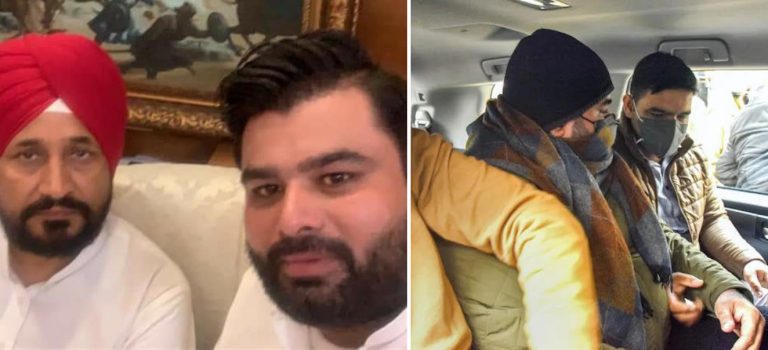
The Enforcement Directorate (ED) has filed a chargesheet in the illegal sand mining case against Punjab’s former Chief Minister Charanjit Singh Channi’s nephew Bhupinder Singh and his aide Kudratdeep Singh at the special PMLA court in Jalandhar under money laundering charges.
ED files charge sheet against ex-Punjab CM Channi’s nephew in sand mining case
Honey was detained by the ED on the intervening night of February 3 and 4. He was put in judicial custody for 14 days after the ED produced him before the Jalandhar Court last month.
The chargesheet was filed in accordance with Sections 3 (offence of money laundering), 4 (punishment for money laundering), 44 (offences triable by special courts), and 45 (offences cognisable and non-bailable) of the Prevention of Money Laundering Act (PMLA), 2002. Rupinderjit Chahal, the special PMLA judge, has scheduled the next hearing for Wednesday.
The Enforcement Directorate (ED) disclosed in a statement that Honey acknowledged accepting Rs 10 crore in cash for assisting sand mining activities and the transfer of officials in the state. During the searches, the agency also claimed to have recorded the testimonies of Kudratdeep Singh, Bhupinder Singh (Honey), Honey’s father Santokh Singh, and Sandeep Kumar. They seized Rs 10 crore which was later proven to belong to Bhupinder Singh.
The illegal sand mining case
Based on an FIR filed by the Punjab police in 2018 against Kudrat Deep Singh, the ED is probing a money laundering case under the Prevention of Money Laundering Act. The major suspect is Kudrat Deep Singh, who operates a quarry in Nawanshahr, Shaheed Bhagat Singh Nagar district.
According to reports, Kudrat Deep Singh formed the Punjab Realtors firm in order to obtain sand mining contracts. Bhupinder Singh Honey is one of the company’s directors.
In connection with the illegal sand mining case, the ED recovered more than Rs 10 crore in cash, gold worth more than Rs 21 lakh, and a Rolex watch worth Rs 12 lakh from the residential premises of Bhupinder Singh Honey and others in a raid on January 18 this year. The seizures were confirmed by the ED after a two-day search of the accused’s properties in Mohali, Ludhiana, Rupnagar, Fatehgarh Sahib, and Pathankot.
A fight on Halal meat controversy erupted in Kangana Ranaut hosted show Lock Upp after the contestants were shown news reports that Karnataka CM had said he would look into the demand of banning Halal meat. Reportedly, CM Basavaraj Bommai had said on Wednesday that his government would look into the matter as serious objections have been raised about it. After learning about the development, several contestants, including Munawar Faruqui, Zeeshan khan and others, objected to the reports leading to an argument between the contestants.
It may be noted that Lock Upp is a captivity-based reality show produced by Alt Balaji and hosted by Kangana Ranaut, which is streamed on two OTT platforms, Alt Balaji and MX Player.
So-called comedian Munawar Faruqui, who was arrested for making derogatory comments on Hindu Gods and mocking victims of the Godhra train burning incident, called it a stupid decision. One of the contestants questioned what was Halal, to which he replied, “There are two types of meat. One is in which an animal is killed by shock in a machine, and the second is Halal, in which they cut the animal’s neck and let the blood flow. Muslims prefer Halal.” Poonam Pandey, who was supporting Munawar, claimed that the blood contains all the diseases, and by letting it flow, the diseases in the meat get removed. Munawar said the killing by shock should be banned but not Halal.
Payal Rohatgi, who was sitting with the other contestants, supported the ban on Halal meat and said, “I think the way animal is butchered in Halal where it sees its blood flowing, that torture should be done. Halal meat means you are promoting a religion indirectly through the selling of that meat.” Zeeshan Khan, who was sitting next to Rohatgi, claimed that a lot of times, when a chicken is killed using the Jhatka method does not die instantly. “It is not about the way it is killed. The argument will lead to okay everyone should turn vegetarian,” he said.
Though the discussion ended there, it re-erupted and turned into a fight later between Rohatgi and Zeeshan. During some argument over the game, both the contestants suddenly started arguing about Halal meat again. Rohatgi said Halal meat should be banned and, during the argument, spat on Zeeshan, alleging he spat on her first.
‘Halal meat should be banned’
Rohatgi further said he is promoting terrorism by promoting halal meat, which further irked Zeeshan. He threatened her to ask her lawyer to be prepared. Rohatgi again claimed Halal meat promotes terrorism, and Zeeshan is a product of it. Later, Rohatgi apologised for her behaviour in the camera and said, “I am being extensively bullied. I am sorry for my behaviour but see their real colours.”
During the conversation with the contestants, the host of the show Kangana Ranaut said things like Halal meat and Gau Mutra are strictly religious practices. If you feed some Gau Mutra or Halal meat without their approval, they will feel overwhelmed. However, there are a lot of places in our country where people are fed Halal meat forcefully or without their knowledge. Flight food is among them. The international food chains where you eat burgers and pizzas use Halal meat. When the discussion to ban Halal meat is happening, it is for those who do not prefer or follow Halal practices. Just like you cannot feed anyone Gau Mutra forcefully, similarly, Halal meat should be an option.
She also called out Zeeshan for promoting Halal meat on the show. She said, “There was a Guru on the show who promoted Gau Mutra, and we objected to that. Similarly, for Those who do not eat Halal meat, it is overwhelming for them.”
Rohtagi had urged to boycott Halal meat
This is not the first time Payal Rohatgi has demanded a ban on Halal meat. In December 2020, she released a video in which she called for a boycott of Halal meat. She said the way animal is slaughtered in the Halal process is torturous and should be boycotted.
Halal meat controversy
For years, people from the Hindu and Sikh community have been calling for a ban on Halal meat or at least providing a choice to choose between Jhatka and Halal. Interestingly, Halal is no longer limited to meat and has expanded to vegetarian food, investments, housing and more. As per Islamic regulations, if anything has been certified Halal, the company must have Muslim employees to ensure Halal practices are followed. Halal, which is a billion-dollar industry, is now receiving sharp criticism as other communities, including Sikhs and Hindus, claim they are being forced to eat Halal products, and companies fail to inform them about Halal endorsements.
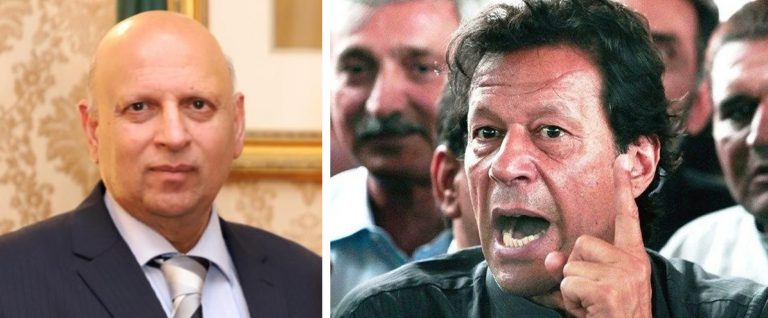
In an unexpected move, Pakistan Information Minister Fawad Chaudhry announced that Punjab Governor Chaudhry Mohammad Sarwar has been ousted from his position by the federal government.
Fawad Chaudhry announced this in a tweet today. He wrote, “The federal government has removed Punjab Governor Chaudhry Muhammad Sarwar from his post. The new governor of Punjab will be announced later. According to the constitution, the deputy speaker will be the acting governor.” (Machine translated from Urdu)
وفاقی حکومت نے گورنر پنجاب چوہدری محمد سرور کو ان کے عہدے سے برطرف کر دیا ہے، نئے گورنر پنجاب کا اعلان بعد میں کیا جائیگا، آئین کے مطابق ڈپٹی اسپیکر قائم مقام گورنر ہوں گے
The announcement came only hours before a crucial session of the National Assembly on Prime Minister Imran Khan’s no-confidence motion, as well as a session of the Punjab State Assembly to elect a new leader of the house following the resignation of Chief Minister Usman Buzdar.
Sarwar, according to reports, was not towing the government’s line. According to certain reports, Sarwar conducted backdoor conversations with the leadership of the Pakistan Muslim League (Nawaz) and was empathetic towards the opposition party.
Who is Chaudhry Mohammad Sarwar?
Sarwar is a former British parliamentarian who left his profession in Glasgow in 2013 to serve in Pakistan. He joined the PML-N and was appointed Punjab governor after the party won both the national and provincial elections in 2013.
He did, however, resigned as governor of Punjab in January 2015 and promptly joined the Pakistan Tehreek-e-Insaf (PTI). He was sworn in as governor for a second term in September 2018.
No confidence motion against Imran Khan
Shehbaz Sharif, the leader of the Pakistan Muslim League (Nawaz) and brother of former Pakistan Prime Minister Nawaz Sharif, tabled a no-confidence motion against Imran Khan’s government in the National Assembly. Imran Khan needs the support of 172 members of the 342-member National Assembly to prevent his government from dissolving.
The resolution of no confidence was passed against Imran Khan in the midst of surging inflation and dire economic conditions in Pakistan. The voting for the motion is expected to take place today
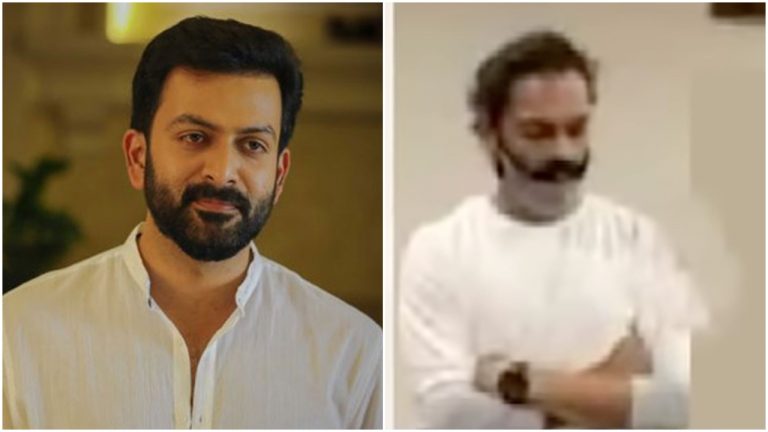
In a massive drug bust, the Kerala Excise sleuths have raided an apartment owned by the controversial Kerala actor Prithviraj Sukumaran and arrested a person for procuring a huge amount of narcotic substances such as cocaine, LSD stamps and ganja.
According to the reports, the Kerala excise team raided an apartment owned by Prithviraj Sukumaran in Thevara, Kochi and recovered a huge cache of drugs, including 6.92 grams of cocaine, 47.2 milligrams of LSD and 148 grams of ganja. The police have arrested a 33-year-old person named Nujum Salim Kutty, a native of Punalur who was living at the actor’s apartment.
The police said that the arrested person has been procuring drugs from some main peddlers in the state. The Kerala officials claimed that the actor had allegedly rented out his apartment to the accused. The police have now launched a detailed investigation to find out the persons from whom he procured the drugs.
“He is from a rich family. He completed his studies in the USA and came to Kochi this year for starting a business. He was paying Rs 85,000 in rent per month for the apartment. The actor who owns the apartment has no involvement in the case. Nujum’s parents have been in a West Asian country for years. He admitted that he started using drugs while studying in the USA,” an official said.
The team had carried out the raid based on a tip-off received after a similar drug bust. They had arrested about one Fazalu, a native of Kozhikode. Fazalu was arrested after the excise seized a parcel containing LSD stamps intercepted at the Foreign Post Office in Kochi.
Meanwhile, the police have registered four cases in connection with the drug smuggling case in Kochi. The accused, Fazulu and Nujum, are currently in the custody of the Kerala excise officials.
Apparently, the police have not registered any case against the actor or will be investigating the alleged involvement of the actor in the drug bust.
Prithviraj Sukumaran was once part of absolving crimes of ‘Jihadis of Moplah’
This is not the first time that the actor’s name has been involved in controversies. Last year, the controversial actor Prithviraj Sukumaran had stoked a massive controversy after jumping in to exploit the Lakshadweep controversy for their personal gain. Malayalam actor Prithviraj Sukumaran was caught peddling anti-developmental agenda against Lakshadweep to gain the limelight.
After the centre had initiated a major reform initiative at Lakshadweep, the actor had jumped in to discredit them by peddling fabricated stories. A Kerala director, who often associates with the actor, had contradicted Prithviraj Sukumaran’s fabricated stories, leaving the actor embarrassed.
Prior to this, Sukumaran was involved in another scandal by becoming part of a movie titled ‘Vaariyamkunnan’, based on the life of a Jihadi named Variyam Kunnathu Kunjahammed Haji, who was responsible for carrying out genocide against thousands of Hindus in Kerala during the early 1920s.
Prithviraj Sukumaran was supposed to produce and act in his period film titled ‘Vaariyamkunnan’. The controversial movie is based on the story of a Muslim leader of the Moplah community, who massacred thousands of Hindus during the Malabar or Moplah communal riots in 1921.
The movie had to be shelved after the filmmakers received massive backlash against their attempts to whitewash crimes committed by Jihadi Moplahs against innocent Hindus in Kerala.
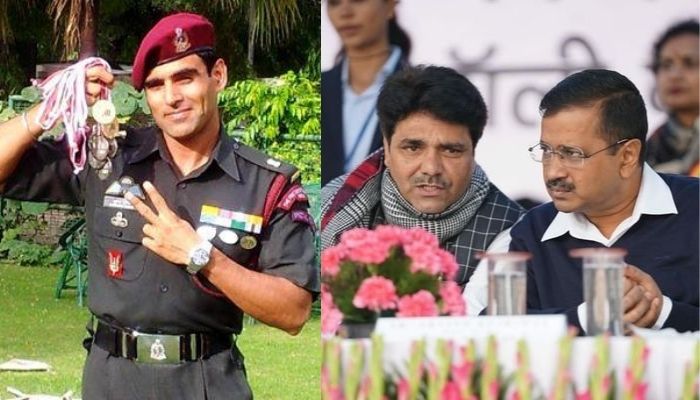
Hours after Punjab police failed in its attempt to arrest BJP spokesperson Tajinder Pal Singh Bagga, Aam Aadmi Party (AAP) lawmaker Naresh Balyan threatened retired Army Major Surendra Poonia with arrest for voicing his support for Bagga.
On Saturday night (April 2), Major Poonia took to Twitter to inform that the AAP-administered Punjab government sent police personnel from the State to the National Capital to arrest the BJP spokesperson.
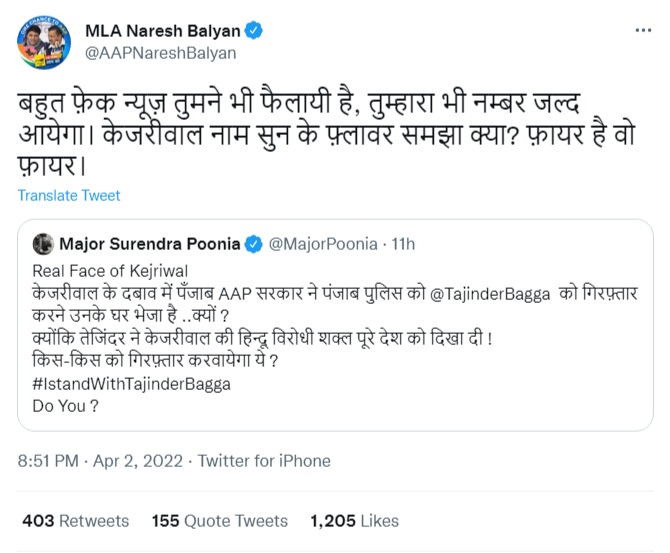
“This is because Bagga exposed the anti-Hindu face of Kejriwal before the world. How many people will you arrest? #IStandWithTajinderBagga. Do you?”, he wrote. The tweet enranged AAP Utam Nagar MLA Naresh Balyan so much so that he threatened the retired Army major with arrest.
Screengrab of the tweet by Naresh Balyan
“You have peddled fake news on several occasions. Your turn (of arrest) will come soon,” Balyan threatened. While repeating dialogue from the movie ‘Pushpa: The Rise’, the AAP legislator claimed that his party supremo isn’t a ‘flower’ but a ball of ‘fire.’
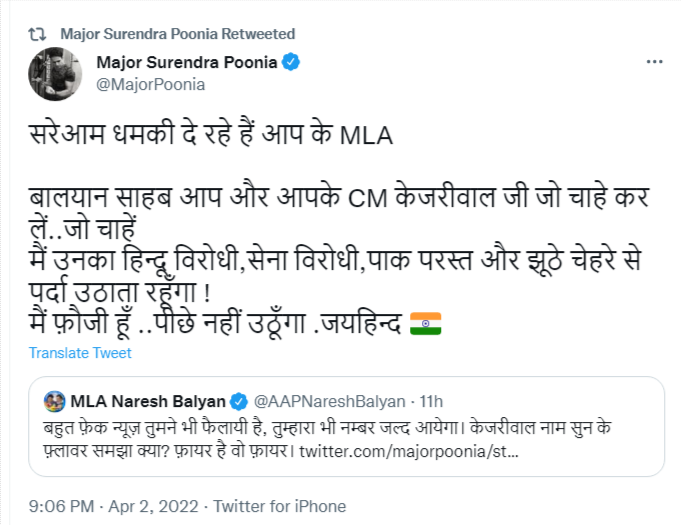
Major Surendra Poonia responded, “AAP MLA is openly threatening me. You and your CM Kejriwal can do whatever you want. I will continue to expose Kejriwal’s anti-Hindu, army hating, Pakistan loving stance.”
“I am a soldier. I will not back off. Jai Hind”, the retired army Major reiterated.
Screengrab of the tweet by Surendra Poonia
Punjab police reached my home to arrest me without FIR: Tajinder Bagga
On Saturday night, Tajinder Pal Singh Bagga had revealed that Punjab Police reached his house in Delhi to arrest him. According to him, Punjab Police took this step without intimating him about any FIR against him, and even without informing the local police, as per the norms.
He had tweeted, “Punjab Police Car number PB65AK1594 reached my home to arrest me without informing local police. Now they are tracking my friends’ addresses and going to their homes. No information of FIR, Police station, Sections against me to me till now.”
Earlier, Punjab Police had registered an FIR against Bagga for his criticism of Arvind Kejriwal after the Delhi CM mocked ‘The Kashmir Files’ movie during the budget session of the Delhi assembly calling it a jhoothi film.
The film depicts the sufferings of the Kashmiri Hindus during the genocide they suffered in Kashmir in late 1980s and early 1990s. Subsequently, the FIR against Bagga was withdrawn the next day as revealed by Tajinder Pal Singh Bagga in a tweet.