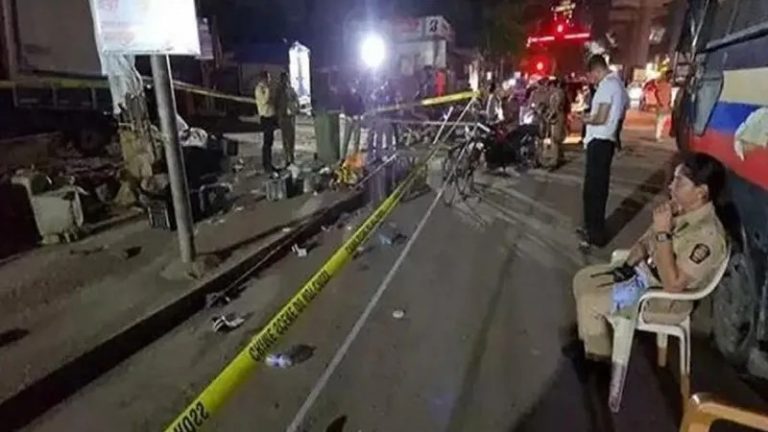
In the Nagpur violence case, details of how the Muslim mob specifically targeted Hindu houses and vehicles on 17th March have been gradually emerging. The local Hindus have revealed that the Muslim rioters threw Tulsi pot/ plant containers installed in Hindu houses.
Aurangzeb ke ρille identified Tulsi plants and attacked Hindu houses. Each time you think they can't go any lower, they prove you wrong! #NagpurViolencepic.twitter.com/oS6Inep2sF
Speaking to TimesNow Navbharat, a local Hindu woman revealed that during the Islamist mob violence on 17th March, the jihadis threw “Tulsi ki Kundi” which the Hindus worship, upon failing to find any other object at the Hindu houses. They were also hurling abuses and raising inflammatory slogans.
“They (Muslim rioters) were telling local Hindus to go away. When I went to pick up my daughter, they threatened an auto rickshaw driver that if you entered here, we will chop you down,” a local Hindu woman said.
Another one told Republic that the rioters were hurling abuses at Hindus while vandalizing property. “Hindus we will see how you stay here and live here in Nagpur,” the Hindu woman revealed.
A Hindu woman also raised concern over what would have happened if the Muslim rioters caught hold of any women during the violence.
The local Hindus added that the rioters were mostly teenagers.
It has also been reported that the Muslim rioters with their faces covered, identified Hindu-owned vehicles by checking for pictures or idols of Hindu deities as well as Hindu symbols like Swastik. It was only after it was confirmed that the cars and bikes belonged to Hindus that the Muslim rioters set them ablaze or vandalized them. The rioters did not attack Muslim houses or vehicles owned by Muslims.
Several witnesses stated that the enraged Muslims, armed with petrol bombs also stone-pelted children, indiscriminately attacking all nearby people and property. They further unveiled that the rioters wielded swords, weapons and bottles but concealed their faces. “They came in large numbers. They had big stones and petrol bombs in their hands. They pelted stones, vandalised property and torched vehicles,” disclosed a witness.
Two police cars were set on fire near Geetanjali Chowk in addition to two cranes employed for the ongoing road construction using petrol bombs, reported “The Times of India. The Muslims shouted anti-Hindu slogans and threw communal insults at Hindu police officers. Petrol bombs were also used to injure officers.
It has been reported that most of the injured victims have head injuries due to stone pelting with multiple victims requiring CT scans and surgical intervention. Those injured mostly included men in the age range of 24 to 40.
Islamist violence in Nagpur
As reported earlier, on the evening of 17th March, Nagpur underwent violent unrest that left more than 30 people wounded over rumours of the burning of a copy of the Quran during a protest by Hindu organisations demanding the removal of Aurangzeb’s tomb in Chhatrapati Sambhajinagar. Demonstrators covered an effigy of the Mughal despot with a sheet and then put it on fire during the agitation.
Muslim mob molested a woman officer
During the violence, a Muslim mob molested a woman police officer in the Bhhaladarpura area of Nagpur, Maharashtra, and attempted to disrobe her during the violence by the mob over Hindus demanding the removal of Aurangzeb’s tomb. An FIR has been filed against the rioters at Ganeshpeth police station.
Curfew is effective in several parts of the city as part of measures to restore peace.
CM Devendra Fadnavis assures action
While addressing the state assembly on 19th March, Maharashtra Chief Minister Devendra Fadnavis said, “Those who attacked police during the arson in Nagpur will be dug out from their graves. Attacks on police are unpardonable. They will get the strictest punishment. We won’t spare them.”
Nagpur riots mastermind Faheem Khan arrested
The Nagpur police have arrested 84 people so far, including mastermind Faheem Shamim Khan, city president of the Minority Democratic Party (MDP). However, on Wednesday, Maharashtra’s Minister of State for Home Yogesh Kadam had put the number at 69. These include eight Vishwa Hindu Parishad (VHP) workers.
19 accused have been sent to police custody till 21st March. Mastermind Faheem is accused of gathering more than 500 rioters and instigating violence. Khan was reportedly arrested within hours of filing the FIR at the Ganeshpath Police Station wherein he is named as an accused. The FIR includes charges of conspiracy to rape, molestation and misconduct. Police had released a photograph of 38-year-old Khan, a resident of Sanjay Bagh Colony in Yashodhara Nagar. He has been remanded to police custody till 21st March. A video had also reportedly emerged showing Khan delivering a provocative speech moments before the violence. Reports say that murderous “Sar tan se juda” slogans were also raised by the Muslim rioters.
Meanwhile, the police have registered a sedition case against Faheem Khan. In a press conference, Deputy Commissioner of Police(DCP), Lohit Matani informed that four FIRs have been registered by the police in this incident and in one of them, Faheem Khan is explicitly named as an accused alongside five others.
Bangladeshi connection emerges in Nagpur riots
Maharashtra Police has found social media accounts from Bangladesh that issued a threat to incite violence. 97 social media accounts which posted offensive and false rumours have been identified. Most of these posts were published from computers with Bangladeshi IP addresses. One such post threatened that Monday’s riots were just a small incident and there would be bigger riots in the future. The cyber cell has taken action against 34 social media accounts for spreading rumours and inciting violence and 10 FIRs have been registered.
Congress forms fact-finding committee to ‘investigate’ anti-Hindu violence in Nagpur
The Congress party has formed a fact-finding committee to assess the aftermath of the violence unleashed by Muslim mobs in Nagpur on 17th March. As per a TOI report, the committee comprises senior Congress leaders including former MPCC president Manikrao Thakre, former MP Hussain Dalwai, ex-ministers Nitin Raut and Yashomati Thakur, and MLA Sajid Pathan. Nagpur City Congress president MLA Vikas Thakre shall serve as the convener, whilst AICC secretary Praful Gudde Patil has been appointed coordinator.
Given the Congress party’s historical record of Muslim appeasement, it remains a question whether the party is in search of truth or will they try to shield the Islamist aggressors.
The 130-year-old Dewi Sri Pathrakaliamman Temple in Malaysia, which is located directly across Jakel Mall on the crowded Jalan Masjid India street, in the center of Kuala Lumpur, is in danger of being removed from there. On the site, a mosque will be constructed instead. Kuala Lumpur City Hall (DBKL), however, alleged that it had found a new site for the temple’s relocation following protests by the Hindu community.
The temple was built before Malaysia’s independence. The mosque which is set to replace it, has already held its groundbreaking ceremony. “The mosque is to be named Masjid Madani,” per media reports. The temple committee had earlier requested a suitable alternative parcel of land that would be accessible to Hindu worshippers in the vicinity of Masjid India, but the request was not accepted.
United for the Rights of Malaysians Party (Urimai) chairman P Ramasamy maintained that the move has a deeper meaning. According to a statement, he questioned why the temple’s land was picked for a mosque and why the land was sold to Jakel Trading before its status was settled. Additionally, he inquired why a different site for the mosque was not taken into consideration and highlighted that there was sufficient property closeby that did not need the temple to be moved.
“This issue is not just about relocation, it is about historical preservation, religious rights and responsible governance. Knowing the historical and religious significance of the temple, how did Dewan Bandaraya Kuala Lumpur (DBKL) approve a mosque project on the very land where the temple stands? Why should a place of worship with deep historical and cultural significance be relocated at all? It is unacceptable for such a significant heritage site to be forcibly moved for a new development. The temple’s history, cultural identity and the religious sentiments of its devotees must be respected. This is not just about one temple, it is about setting a precedent for how heritage and religious rights are treated in Malaysia. Hindu temples are not placed on wheels to be moved at the whims of the powerful,” Ramasamy conveyed while voicing his opposition.
The administration of the temple complained that the government and the private firm made multiple attempts to force a move and threatened legal action if temple authorities did not cooperate. The announcement of a groundbreaking ceremony for the construction of a mosque on government land, that DBKL (Kuala Lumpur City Council) sold to the textile company Jakel Trading came as a shocking news to the devotees. “We fail to understand how a groundbreaking ceremony can be held when talks on the status of the temple have yet to reach a conclusion,” Raj Mohan Pillai, deputy president of Dewi Sri Pathrakaliamman Temple stated in a press conference in Petaling Jaya.
Prime Minister Anwar Ibrahim also planned to attend the event. DBKL has, however, pledged not to destroy the temple. However, it sent the temple a letter last year stating that it would not be responsible for any potential losses and they had 14 days to leave the property or face “the necessary enforcement action.” Urimai and the temple committee, Ramasamy disclosed, are adamantly against the move and have called for the temple to stay where it is.
“There is no need to tear down the temple. The adjoining lot is big enough to build the mosque,” Pillai expressed as human rights advocates and Hindus suggested that a mosque could be constructed at the place without requiring the temple to shift. The land reportedly comprises of two lots, one of which belonged to the government and the other to a private firm. Human rights advocates contended that the government had to be aware of the delicate nature of constructing a mosque on land that was cleared by displacing another religion’s place of worship.
According to Pillai, the proposed alternate piece of property was too distant from the Masjid India region and only half as large as the existing site. He added, “It is very unfair to us. A big part of the Indian community in Masjid India come to the temple to visit and worship.” He further outlined, “Since 2016, there have been efforts by the government and the private company involved to force the temple to move from this location.”
Lawyer N Surendran also challenged DBKL’s assertion that it was not associated with the plan to erect a mosque. “In fact, DBKL is the one that gave the development order on 12th Feb 2020. It is aware of the proposed construction,” he pointed out. The area has been converted to private property due to the government’s own activities, he added.
The Dewi Sri Pathrakaliamman Temple was first built in 1893. It was moved to the present location in 2008 and the property was purchased by Jakel in 2014.
On Thursday (20th March), Congress leader Rahul Gandhi courted controversy after he attacked merit in India as ‘unfair’ to the Scheduled Castes, Scheduled Tribes and Other Backward Castes. He also promoted ‘caste census’, meant to divide the Hindu community
He made the disturbing remarks during his podcast with ‘economist’ Sukhadeo Thorat. During the course of the 15-minute programme, Rahul Gandhi claimed, “I have had discussions with people about the caste census, where I am saying, look, all we are doing is exposing the truth. Nothing else. And they will say to me directly that no, one must not expose this truth.“
The Gandhi scion then mouthed platitudes about the Indian constitution and how the equality of Indians could only be ensured through a ‘caste census.’
He alleged that the concept of ‘merit’ is flawed and inherently discriminatory to the Scheduled Castes, Scheduled Tribes and the Other Backward Castes. The Congress leader also claimed that merit is unfair and an ‘upper-caste narrative’.
“There is a completely flawed concept of merit where I confuse my social position with my capability. Because for anybody to say that our education system or our bureaucratic entry systems are fair to Dalits and OBCs and tribals, that is just a complete fallacy. Because they are culturally not connected to these communities at all. So the entire narrative is an upper-caste narrative. This notion of merit is actually itself an unfair idea,” Rahul Gandhi was heard saying.
He also claimed that electoral representation of SCs, STs and OBCs meant nothing as the ‘real power’ lay with the bureaucracy, corporations and intelligence agencies.
Rahul Gandhi claims BJP, and RSS are eliminating Dalit history without evidence
Without furnishing any evidence, the Gandhi scion alleged that the BJP and the Rashtriya Swayamsewak Sangh (RSS) have been eliminating the history of SCs, STs and the OBCs.
“There is another bigger problem. The history of the Dalits, the history of the OBCs, the histories of tribals have just been eliminated. I never heard of a Dalit narrative. And then at the same time, there is this idea that is being pushed by the RSS and the BJP – it is basically to destroy their history, to destroy the history of the Dalits and the Adivasis and the OBCs,” he brazened out.
Rahul Gandhi suggested a deep-seated ‘conspiracy’ behind the supposed ‘non-existence’ of Dalit history in mainstream Indian education.
“No, but that history is not available to, through the main education system. An upper-caste boy or girl who is going to a school in New Delhi has no idea about this. You know, that’s how they can say things like, oh, I don’t see any caste discrimination.Obviously, you don’t see caste discrimination,” he was head saying.
Rahul Gandhi misleads about caste census through emotional appeal
During the course of the podcast, Rahul Gandhi was seen making an emotional appeal (bereft of logic and rationale) to convince his audience about the ‘merits’ of the caste census. He suggested that a ‘caste census’ would magically expose the ‘truth of discrimination’.
“But I think the idea that truth of discrimination in India should be known to everybody. This is a powerful idea. Why are people so much against the caste census? Like what don’t they like about it? What is it that creates this reaction?” he claimed.
The Gandhi dynast insinuated that the incumbent BJP govt had somehow captured the political, education, healthcare and bureaucratic system and thus prevented the SC, ST and OBCs from knowing the ‘actual truth’.
Rahul Gandhi claimed that the caste census is a fundamental exercise and those not supporting it are somehow ‘anti-national.’
“I think not supporting the caste census is actually anti-national. Because what you are saying is that we are not ready to accept the truth of what is going on in our country. So I’m quite wedded to the idea of the caste census,” the Congress leader alleged.
He further recommended ‘deepening’ the exercise to further divide the nation along caste lines and make the exercise more ‘sophisticated.’
Rahul Gandhi and his anti-national agenda
After having failed to counter the BJP on issues of development, national security and cultural preservation, Congress has taken it upon itself to divide the Hindu community by exploiting existing fault lines.
Besides promising a caste census, the party has also assured to lift the upper limit on reservation in its 2024 election manifesto.
Rahul Gandhi himself has been campaigning with the slogan‘Jitni abadi utna haq,‘ hinting at proportional representation in government jobs, admission to colleges and more.
This has the potential to further polarise and divide the society. Not only that, once such demands are fulfilled, it can extend to electoral politics.
Given that India’s demography is changing fast, it may not be long until certain religious communities like Muslims to demand fixed representation based on their population size. It would then be akin to setting the nation on the path to disaster.
The nefarious objective behind the caste census is to divide the Hindus into castes and unify the Muslims, rendering the Hindu majority helpless and weak in the face of Muslim vote bank consolidation.
The Congress party, led by Rahul Gandhi, thereby hopes to gain electorally through such a strategy and return to the corridors of power.
While the drastic implications of the exercise of ‘caste census’ may look far-fetched today, it will not take long for the country to plunge into chaos when dangerous ideas of proportional representation manifest in reality.
OpIndia had previously reported how the concept of ‘proportional representation’ turned out to be a disaster for a peaceful country like Lebanon and why India must be wary of it.
The Board of Control for Cricket in India (BCCI) has made some significant changes in rules for IPL 2025, which begins on March 22.
BCCI has introduced rule changes in IPL 2025, including the lifting of the saliva ban, the continuation of the Impact Player rule and slow over rate ban cannot be imposed on Captains anymore, IPL chairman Arun Dhumal to ANI
The removal of the saliva ban, introduced as a COVID-19 precautionary measure, is a major move.
The rule against using saliva was introduced in May 2020 as a temporary measure, but the ICC made it permanent in September 2022.
Several fast bowlers have opined that the ban impedes their effectiveness by not allowing reverse swing, which has become uncommon in white-ball cricket, including ODIs, where two new balls are utilized.
Bowlers were only allowed to use sweat to shine the bowl. From time to time, bowlers have raised their voices to revise the saliva ban.
Captains will no longer face a ban for slow over rates.
Mumbai Indians skipper Hardik Pandya had received a one-match ban after the team’s last encounter in IPL 2024 against the Lucknow Super Giants (LSG) for maintaining a slow over-rate.
The much-debated Impact Player rule, introduced in IPL 2023, will continue to be a part of the tournament. The rule allows teams to substitute one player during a match, adding a strategic element to the game.
These changes are expected to have a significant impact on team strategies and gameplay in the IPL.
(This news report is published from a syndicated feed. Except for the headline, the content has not been written or edited by OpIndia staff)
Rajendra Rajanna, Congress MLC and son of Karnataka Minister KN Rajanna, on Thursday, March 20, responded to allegations of a honey trap attempt, revealing that both he and his father have been targeted for the past six months with similar allegations.
Speaking to ANI, Rajendra said that what initially seemed like a routine phone or video call escalated over time, prompting him to raise the issue in the Assembly.
He also urged the state Home Minister to launch a thorough investigation into the matter.
“For the last six months, it has been going on with me and my father. We thought it would be a normal phone call or video call, but day by day, more calls (we) have been getting. I have spoken in the Assembly and requested the (state) Home Minister to investigate. It should be investigated,” he said.
Karnataka Cooperation Minister KN Rajanna on Thursday alleged a honey trap attempt was made on him and called on the State Home Minister G Parameshwara to investigate the matter.
During the budget session discussion, Vijayapura MLA Basanagouda Patil Yatnal raised the issue, saying that an attempt had been made to trap the Cooperation Minister in the state.
“This is a bad culture. People’s representatives are being blackmailed,” he said.
Since his name was mentioned, KN Rajanna responded, acknowledging the allegations.
“Many people say Karnataka has become a CD and pen drive factory. This is a serious allegation. It is being said that an influential minister from Tumakuru has been caught in a honey trap. The ones from Tumakuru are G Parameshwara and me,” Rajanna said in the Legislative Assembly.
He further said, “I will file a complaint regarding this. The Home Minister must investigate this matter.”
Responding to this in the assembly, Home Minister G Parameshwara said that he will order a high-level investigation into the allegation. “If we have to uphold the dignity of the House, this issue must be concluded appropriately. If Rajanna submits a written request, based on that, I will order a high-level investigation. The truth must come out,” he said in the Assembly.
(This news report is published from a syndicated feed. Except for the headline, the content has not been written or edited by OpIndia staff)
Two men were arrested on Wednesday for writing pro-Pakistan slogans and abusive remarks against Kannadigas on the walls of a factory washroom in Karnataka’s Ramanagara district. Haimad Hussain and Sadiq, contractual workers of Toyota Boshoku plant, have been arrested for writing the slogans, and they have confessed to the same.
The slogans such as ‘Pakistan Ki Jai’, ‘May Pakistan win’ and abuses for Kannadigas like “Kannadigas are Sons of Bi**hes” were spotted by workers inside a washroom of the Toyota Boshoku plant in Bidadi.
The incident triggered an outrage among the workers, who were further angered after the management only issued a warning notice instead of identifying the culprits and taking strict action. But after visuals of the slogans went viral on social media, a complaint was registered by the Human Resources (HR) department with the police, who then launched a probe.
Using CCTV footage, handwriting analysis and linguistic style analysis, the Bidadi police identified the culprits, Haimad Hussain and Sadiq, and arrested them. Both of them are from are from North Karnataka and were working on a contract basis with the Japanese company that manufactures automotive components.
In Bidadi’s Toyota factory restroom, Ahmed Hussain & Sadik wrote "Pakistan Jai" and "Kannadigas are Sons of Bchs"** on the walls!
Ever since @INCKarnataka took power, Pak sympathizers are openly insulting Kannadigas. Will this Halal Sarkara shield them as "mentally unstable" &… pic.twitter.com/4XWmO2MoVm
During questioning, Haimad Hussain and Sadiq said that that they were angry with their colleagues who allegedly mocked them after Pakistan lost to India in the recently concluded ICC Champions Trophy, that is why they wrote pro-Pakistan slogans in the factory wall.
Superintendent of Police (SP) Srinivas Gowda confirmed that a case has been registered under Section 67 of the Information Technology (IT) Act (publication or transmission of obscene material), as well as sections 193 (liability of landowners or occupiers for failing to prevent or report unlawful assemblies or riots on their property) and 356 (defamation) of Bharat Nyay Sanhita.
Apart from arresting the two who wrote the slogans, police are also trying to identify those who attempted to spread the content online, and have issued police notices accordingly.
30 Naxalites were neutralised by security personnel in two different operations in the Chhattisgarh districts of Bijapur and Kanker. 26 Maoists were killed by the security forces during a clash in the forest near the Bijapur-Dantewada border, according to Inspector General (IG) Bastar P. Sundarraj. One member of the Bijapur District Reserve Guard also died in the conflict. The police reported that the altercation began at 7 am on 20th March. The conflict lasted for several hours, during which time both sides engaged in heavy gunfire.
“Today our soldiers have achieved another big success in the direction of ‘Naxal Mukt Bharat Abhiyan’ (Naxal free India campaign). 22 Naxalites were killed in 2 separate operations of our security forces in Bijapur and Kanker of Chhattisgarh. The Modi government is moving forward with a ruthless approach against Naxalites and is adopting a zero tolerance policy against those who are not leaving their arms despite all the facilities ranging from surrender to inclusion. The country is going to be Naxal-free before 31st March next year,” Union Home Minister Amit Shah remarked on social media.
‘नक्सलमुक्त भारत अभियान’ की दिशा में आज हमारे जवानों ने एक और बड़ी सफलता हासिल की है। छत्तीसगढ़ के बीजापुर और कांकेर में हमारे सुरक्षा बलों के 2 अलग-अलग ऑपरेशन्स में 22 नक्सली मारे गए।
मोदी सरकार नक्सलियों के विरुद्ध रुथलेस अप्रोच से आगे बढ़ रही है और समर्पण से लेकर समावेशन की…
The corpses of 18 Naxalites have been recovered from the scene of the encounter, according to earlier confirmation from Bijapur Police. However, the number rose to thirty, later. They also seized a sizable stash of explosives, ammunition and weapons. Police revealed that a combined squad from the DRG, Special Task Force (STF), and Central Reserve Police Force (CRPF) conducted the anti-Naxal operation. The search teams are still working in the region in an effort to find any lingering Naxal members and recover more weapons.
Security forces grounded four Naxalites close to the village of Koroskodo in the Chhotebethiya police station area during the other confrontation at the Kanker-Narayanpur border area. The authorities noted that while the intermittent firing still continues, automatic firearms have been retrieved. Both areas are currently undergoing search operations. “Four Maoist cadres died in the encounter with security forces near village Koroskodo in Kanker district. The operation and area sanitization are continuing,” officials informed.
19 Naxalites surrender in Bijapur
According to a senior police official, at least 19 Naxalites turned themselves on 17th March in the Bijapur area and nine of them had cash prizes totaling ₹28 lakh on their heads. The cadres, along with a couple, surrendered to Central Reserve Police Force (CRPF) and senior police officers. Bijapur Senior Superintendent of Police Jitendra Kumar Yadav conveyed that the Naxalites expressed dissatisfaction with the “hollow” and “inhuman” Maoist doctrine, abuse of defenseless tribal people by top cadres, tensions developing within the group and the growing influence of security forces.
He added that they were impressed with the ‘Niya Nellanar’ (your good village) initiative, which has been working to provide basic facilities and develop interior areas via the efforts of administration and security forces. Each of them participated in the Gangaloor (or Pamed) area committee of the banned Maoist group in various roles. They were active in the Andhra Odisha Border division. One of them, Dinesh Modiam (36), a Maoist divisional committee member, was wanted in 26 cases in the Bijapur district and carried a ₹8 lakh reward.
Modiam’s wife Jyoti Tati, also known as Kala Modiam (32) and Dula Karam (32), who are both active members of the area committee, each bore a prize of ₹5 lakh. Six of the cadres who turned themselves in had a ₹1 lakh reward each. The cadres received ₹25,000 in aid per person and would receive additional rehabilitation peline with the government’s plan to integrate them into society.
Deva Padam and his spouse, Dule Kalmu, were active members of People’s Liberation Guerrilla Army (PLGA) Battalion No. 1 and were among the cadres who gave up their arms, per other reports. They each had a bounty of ₹8 lakh. Five members of the area committee, including Suresh Kattam held ₹5 lakh reward, one of the cadres who turned themselves in had ₹2 lakh and five others had ₹1 lakh each.
4 Naxalites killed in gun battle
On 19th February, an altercation with the security forces in Madhya Pradesh’s Balaghat district killed at least four Maoists, all of whom were women. According to the police, the state’s anti-Maoist Hawk Force and local police started a joint fight early in the morning near Rhonda Forest Camp in the Supkhar Forest Range, near the Chhattisgarh border, based on the intelligence of Maoist movements. Police found three rifles in their possession: an INSAS (Indian small arms system), a self-loading rifle and a 3o3 rifle.
Balaghat additional superintendent of police Vijay Dabar stated, “Acting on tip off movement of Maoist near the Raunda Forest camp of Soopkhar forest area, more than 12 teams of Hawk force, Central Reserve Police Force (CRPF), Commando Battalion for Resolute Action (CoBRA) and district police force conducted a search operation.” The authorities mentioned that the Maoists were trying to hit security officers in the Supkhar forest because they were “angry by recent setbacks due to intensified security operations.”
“Intelligence reports indicated increased Maoist presence and activity in the area, prompting the deployment of the Hawk Force for a search mission. During the operation, the Maoists launched a deadly attack on security personnel with the intent to kill and seize their weapons,” an official stated. The forces responded by fighting back in self-defense with controlled fire. “Overwhelmed by the counteroffensive, several Maoists managed to flee into the dense forests and hilly terrain,” he added.
31 Naxals killed in an encounter
On 9th February, a well-planned intelligence-based operation in the Bijapur district of Chhattisgarh, around 400 kilometers south of Raipur, which borders Telangana and Maharashtra, eliminated 31 Maoists, including 11 women, in one of the largest strikes against Naxalism, in February. The confrontation resulted in the death of head constable Naresh Dhruv of the District Reserve Guards and constable Vasit Raote of the Special Task Force. They were taken to the district headquarters. Two other personnel were injured. After being flown by helicopter from the scene of the incident to Raipur for prompt medical care, the two were declared out of danger.
A composite team of personnel from various security forces was out on an anti-Naxalite operation in the morning when the gunfight broke out in a forest in the Indravati National Park area which is frequently used by Maoist ultras for regrouping and is frequently referred to as the “resting place” or “safe haven” of the Naxals. A huge cache of weapons and explosives has also been seized from the site.
Inspector-General of Police (Bastar Range) P. Sundarraj informed, “The encounter began around 8 am and the exchange of fire between the security forces and Naxalites continued intermittently till 4 pm. The bodies of 31 uniformed Maoists, including 20 men and 11 women, were recovered from the encounter site.” Chhattisgarh Home Minister Vijay Sharma stated, “Police and security forces, more than 650, entered their den from various directions after several days of operations. They were able to neutralize 31 Naxals, all of whom were in uniform. From them, we seized weapons like AK-47s, INSAS rifles, BGL launchers, and other heavy automatic weapons.”
8 Naxalites eliminated in face off with security forces
On 1st February, security forces in the Bijapur district of Chhattisgarh conducted an anti-Naxal operation that resulted in the deaths of eight Maoists. Their hideouts yielded weapons, including a Barrel Grenade Launcher (BGL) Launcher and an INSAS rifle. A police officer stated, “Based on specific information about the presence of armed Maoists in the remote forest area, a joint team of security forces comprised District Reserve Guard (DRG), Central Reserve Police Force (CRPF), its elite unit Commando Battalion for Resolute Action (CoBRA) and Special Task Force (STF) left on anti-Maoist operation from Gangaloor on 31st January.”
He added, “On Saturday morning, there ensued an exchange of firing between the troops and the Maoists. After the encounter, the forces have recovered eight bodies.” He mentioned that there could be more terrorist casualties. According to reports, the killed cadres belonged to the West Bastar Division of Maoists.
10 Naxals gave up the armed struggle in Bijapur
On 31st January, ten Naxalites, five of whom possessed a total reward of ₹6 lakh on their heads, surrendered in the district of Bijapur. According to an official, Arjun Madkam, also known as Arjun Genne (20) was a member of the Andhra-Odisha Border (AOB) division of the banned Communist Party of India (Maoist) and served on the Niyamgiri local committee. He had a bounty of ₹2 lakh.
Hadma Tati alias Morli (38) was the chairman of the Chetna Natya Mandli, a Maoist culture wing, and the vice-president of the Jantana Sarkar-led Palaguda Revolutionary Party Committee (RPC). “Tati, Madvi, Bhima and Nanda carried rewards of Rs 1 lakh each. Dula Madvi alias Bodda was the Palaguda RPC Jantana Sarkar member and headed the agriculture wing. The other four were lower rung cadres.” the official unveiled.
16 Naxalites eliminated by security forces
At least 16 Maoists were slain in Chhattisgarh’s Gariaband area on 21st January and 12 of them bore a reward of over ₹3 crore. They had been identified, according to Inspector General of Police, Raipur Range Amresh Mishra and had a total bounty of ₹3.13 crore in Chhattisgarh, Odisha and Andhra Pradesh. The most infamous of them was Chalapathi alias Ramchandran, Pratap Reddy, Appa Rao and Ravi, who carried a reward of ₹90 lakh and was a member of the central committee of the banned Communist Party of India (Maoist).
The amount had been offered by Andhra Pradesh (₹25 lakh), Odisha (₹25 lakh) and Chhattisgarh (₹40 lakh). Chalapathi lived in the Andhra Pradesh district of Chittoor. The commander of the Dhamtari-Gariaband-Nuapada (DGN) division of Maoists, Satyam Gavde (43),and Jairam alias Guddu (50), a member of the Odisha state committee and secretary of the division, were also identified in addition to Chalapathi. Both had a total reward of ₹65 lakh across three states and were locals of Chhattisgarh.
The total bounty on the four members of the area committee, Shankar, Kalmu Deve alias Kalla, Manju, and Rinki, was ₹13 lakh. Three additional people, including party member Sukhram and members of the Mainpur LGS (local guerilla squad) Rame Oyam (28) and Jaini (24) each had a reward of ₹3 lakh on their heads. 17 automatic weapons, including one Self-Loading Rifle (SLR) and an AK-47 rifle, were located at the scene of the incident.
Personnel from the Central Reserve Police Force (CRPF), its anti-Naxal commando unit CoBRA (Commando Battalion for Resolute Action), the Odisha Police’s Special Operation Group (SOG) and the Gariaband district police unit E-30 participated in the operation. Furthermore, the security personnel have neutralized over two dozen explosive devices that the Naxals planted near the encounter spot. According to a police statement, security officers were fired upon by Maoists, who then suffered retaliation The action resulted in the injuries of two security officers, one from the Odisha police SOG and one from CoBRA.
12 Naxalites gunned down
On 16th January, a violent clash with security forces in the Bijapur area of Chhattisgarh claimed the lives of at least 12 Naxalites. A joint security force conducting an anti-Naxalite operation in a south Bijapur forest was engaged in a gunfire that began at around 9 am and continued intermittently until late in the evening.
According to reports, the operation, which was started in south Bijapur, which borders Telangana, involved approximately 1500 security personnel from the state police’s District Reserve Guard (DRG) from three districts, five battalions of CoBRA (Commando Battalion for Resolute Action), an elite jungle warfare unit of the CRPF and the 229th battalion of the CRPF.
The security officers also retrieved weapons from the site of the encounter. After learning that senior Maoist cadres were present, the state police launched a joint interstate operation. Tthe encounter started in the south Bijapur jungles of Pujari Kanker-Murudbaka. The teams of security forces ambushed the Maoists from all sides.
5 Naxals eliminated in fierce gun battle
Five Naxalites were shot dead by security troops in Bijapur’s Madded area on 12th January. An encounter with the security forces in the vicinity of Indravati National Park resulted in the deaths of the five Naxals, two of whom were women. Inspector General of Police (Bastar Range) P. Sundarraj stated that when the gunfight started, a combined group of members from the District Reserve Guard (DRG), Special Task Force, and District Force were involved in an anti-Naxal operation.
“On Sunday since early morning onwards, there was an intermittent encounter between the security forces and the Naxalites in the forest of Bandepara-Koranjed, which lasted till three to four pm. Later, during the search from the spot, the bodies of two women and three men, i.e. five Maoists in uniform were recovered,” he informed. According to the police, they also found explosives, Maoist literature, a 12 Bore, two single-shot rifles, a country-made pistol, a BGL launcher and an SLR (Self-Loading Rifle) at the scene of the encounter.
More Naxalities killed in multiple clashes this year
On 29th January, security forces and the CPI (Maoists) clashed in Jharkhand’s West Singhbhum district, killing two Maoists. Two INSAS rifles were found at the location. “A joint team of Jharkhand Police and 209 Cobra Battalion had an encounter with Maoists during which two, including one woman, were killed. A security personnel sustained a minour injury in his hand,” Chaibasa SP (Superintendent of Police) Ashutosh Shekhar conveyed.
At least three Naxalites lost their lives in a clash with police forces in Bijapur, Chhattisgarh, on 12th January. According to police sources, the gunfight started at a forest in the Indravati National Park area when a joint team of security personnel was out on an anti-Naxalite operation. The police team included personnel from the District Reserve Guard (DRF), Special Task Force (STF) and the district force were involved in the operation. Three Naxalites wearing “uniform” were discovered dead at the scene after the sporadic gunfire ceased, along with explosives and weaponry, including automatic ones.
On 9th January, three Naxalites were killed in an encounter with security forces in the Sukma area of Chhattisgarh. The Maoists perished in an anti-Naxal search operation by the state police’s District Reserve Guard and Special Task Force, together with members of the CRPF’s elite Commando Battalion for Resolute Action, according to a senior police officer. The members were alerted about the existence of prominent Maoists in the border regions of Bijapur and Sukma.
“During the operation, on 09.01.2025, at around 10:00 a.m., an encounter started between security forces and Maoists in the jungle hill between village Paliguda-Gundrajgudem, which continued intermittently. After the end of the encounter, when all the teams searched, the bodies of three male Maoists were recovered along with BGL launcher, other weapons, a large amount of explosives and Naxal material was found,” a police statement read.
On 6th January, five Naxalites were eliminated in an encounter with security forces in the Bastar district. When a combined team of security officers went out on an anti-Naxalite operation in the evening, a shootout broke out at a forest in south Abujhmaad along the border of Narayanpur and Dantewada districts. Sannu Karam, the head constable of the District Reserve Guard (DRG), was also killed in the gunfight.
The Special Task Force (STF) and DRG personnel from four districts, Narayanpur, Bastar, Kondagaon and Dantewada were part of the operation. According to initial reports, top members of Dandakaranya Special Zonal Committee of Maoists battalion number 32 of the PLGA (People’s Liberation Guerrilla Army were among the deceased. Automatic firearms were uncovered on the scene, including self-loading rifles (SLRs) and AK-47 rifles.
A Naxalite was killed on 3rd January in the Raipur division’s Gariaband district during a confrontation with security forces. More Naxalites died in similar operations launched by the security forces this year.
6 Naxalites surrender in Karnataka
Six Maoists, who were active in Karnataka surrendered before Chief Minister Siddaramaiah on 9th January. The six are Sundari Kuthlur, Vanajakshi Balehole, Marappa Aroli, Jisha, K Vasanth and Mundagaru Latha, who is regarded as the head of the armed movement in South India. Jisha is from Kerala and Vasanth is from Tamil Nadu while the others are from various regions of Karnataka.
Latha reportedly had 85 cases, followed by Sundari with 71 cases, Balehole with 29, Aroli with 50, Jisha with 17 and Vasanth with 8. They were given copies of the Constitution by Chief Minister Siddaramaiah and Latha symbolically handed over their olive green uniform and a charter of demands. Siddaramaiah then announced that the state was “Maoist-free.” He promised that the state administration will make a sincere effort to meet their requests.
This occurred less than two months after Maoist leader Vikram Gowda was killed on 18th November in the Peetabailu village of Udupi district during a clash with Anti-Naxal Force.
Moreover, many arrests have also been made, including one in Kanker in North Bastar where police captured an accused Naxalite named Malti, also known as Raje or Nirmala Kange, who had a ₹8 lakh bounty, in January. Shyamnath Usendi, a Kanker resident who had offered refuge, has also been taken into custody. Kanker Police earlier nabbed Prabhakar, also known as Balmuri Narayan Rao, Raje’s husband and Maoist cadre.
During an operation in three distinct places in the Bijapur district in February, security personnel detained 18 Naxalites and retrieved explosives from them. Ten Naxalites and explosives were reportedly taken into custody from the Gunjeperti jungles near the Usur police station. Along with explosives, seven people were apprehended from the Rajpenta forest near the Basaguda police station. One Maoist with explosives was also captured as a result of a coordinated operation by the District Reserve Guard (DRG) and the Bhairamgarh Police station.
Action against Naxals in recent months
An encounter with security forces in the Narayanpur area of Chhattisgarh in December ended up in the killings of at least seven Naxals. The Central Reserve Police Force and a police squad were conducting an anti-Naxalite operation in the early hours of the morning when the gunfight started in the south Abujhmaad forest. The following day, two more Naxalites were shot dead during a confrontation with security forces in the Bijapur area of Chhattisgarh. The gunfire happened in the morning as a group of security guards were on an anti-Naxalite operation in the forest between the villages of Nendra and Punnur.
A shootout between the Telangana police and seven other Maoists, including a top commander, took place in the Chalpaka jungles of the Mulugu district of Telangana, in the same month. A member of the CPI (Maoist) Telangana State Committee and the commander of the Yellandu-Narsampet area committee, Bhadru alias Kursam Mangu (35) was among the dead. Egolapu Mallaiah (43), Mussaki Deval (22), Mussaki Jamuna (23), Jai Singh (25), Kishore (22) and Kamesh (23) were the other six Maoists.
Along with other weapons and explosives, police found AK-47, G3 and INSAS (Indian Small Arms System) rifles at the scene. The operation was a part of the effort intended to prevent the Maoist revival in the area. On 23rd November 2024, a police task group targeted Maoist movements in Wazeedu Mandal during the People’s Liberation Guerrilla Army (PLGA) week celebrations in response to intelligence reports.
Five members of the Maoist JMWP (Jayashankar, Mulugu, Warangal and Peddapally) division committe were captured near the Velugu Vagu stream on 1st December 2024, at approximately 6:18 am. Police confiscated a number of weaponry, including one G-3 rifle, explosives, INSAS rifles and AK-47 along with Maoist literature and several kit bags. According to reports, the detained individuals assisted senior CPI (Maoist) cadres with recruitment, logistics and operational support.
Approximately 500 kilometers south of Raipur, in the hilly, forested area of Bhandarpadar-Korajuguda-Nagaram in the sensitive district of Sukma, at least ten cadres of the outlawed Maoist CPI were killed in November 2024 during a gunfight with state forces. Sanjay Ganjhu, the zonal commander, was one of the Maoists slain in the conflict. The other one was the female acquaintance of Anal Da, the infamous Maoist with a ₹1 lakh bounty on his head.
On 8th November, three Naxalites were killed in a clash with police forces in the Bijapur district of Chhattisgarh. Around 11 am, a shootout started on the wooded hills of Rekhapalli-Komathpalli, which are located in the district at the intersection of Usoor-Basaguda-Pamed. The operation, which was started in response to information on the presence of Maoists in the area, involved personnel from the District Reserve Guard (DRG), Special Task Force, Central Reserve Police Force (CRPF), and its elite unit CoBRA (Commando Battalion for Resolute Action).
31 ultras were shot dead in an encounter near the boundary between the districts of Dantewada and Narayanpur on 4th October, marking the greatest win in Chhattisgarh’s four-decade-long battle against the red-terror. Previously, 29 Naxalites were exterminated in the Kanker district’s Chhotebethiya region on 16th April.
War on Left-wing terrorism
The recent victories against left-wing extremism are a significant step in the direction of the deadline set by Prime Minister Narendra Modi and Union Home Minister Amit Shah for ending naxalism on 31st March 2026. “Under the leadership of Prime Minister Narendra Modi, we broadly devised a four-pronged strategy to replace weapons and violence with development and trust in the so-called Red Corridor that extended from Pashupatinath in Nepal to Tirupati in Andhra Pradesh,” he voiced in a recent interview with India Today.
The Bijapur district in the state’s Bastar range has seen the surrender of 84 Maoists so far this year. Seven districts in the Bastar area, including Bijapur, witnessed 792 Maoists surrender last year. “The security forces penetrated into the stronghold territory of Maoists to strike and eliminate them. The success achieved by the troops is commendable. Hats off to their courage and bravery. In the last 13 months, 282 Maoists have been neutralised, 1033 arrested and 925 have surrendered in Chhattisgarh,” Chief minister Vishnu Deo Sai highlighted after February’s Naxal encounter.
Bijapur continues to be one of Bastar’s most severely Maoist-affected districts and is known as a hub for left-wing extremists in south Chhattisgarh. According to police, 23 Naxalites turned themselves in to authorities in the Bijapur area in 2025, while 46 were taken into custody and 17 were shot dead. The ongoing battles with left-wing radicals are a part of the revised strategy to rid the state of Chhattisgarh of the influence of the banned Maoists. The Maoists experienced the greatest loss in their history in 2024 when 219 of them were killed in conflict-torn Bastar.
“First, the political will of the central as well as the state government is on the same page, which has helped the forces move forward aggressively, making forward camps filling up the security vacuum in places like Abujhmad (an unsurveyed area larger than the state of Goa) and south Bastar, which were considered to be safe havens for Maoists. These camps are not only restricting the movement of Maoists, but are also helping forces to conduct major operations,” Chhattisgarh’s former Additional Director General of Police (Naxal operations), RK Vij told “The Indian Express.”
He added, “Moreover, the Niyad Nellanar scheme, where basic amenities are being provided to villagers from these camps, is sending a positive message to local residents.” The number of forward base camps has significantly increased in recent months. These camps make it possible to install mobile tower networks and build roads deep within forests. According to officials, this has assisted in closing the security vacuum and shrinking regions that had been affected by Maoists for more than 40 years.
Image via INSIGHTS IAS
Amit Shah stated in October of last year that 14 key CPI (Maoist) leaders nationwide and 85% of the strength of left-wing extremists in Chhattisgarh had been decimated in the previous ten years. According to current data, around 8551 Naxal terrorists were eliminated between 2014 and 2024, while many more gave up their weapons nationwide.
Amit Shah disclosed the government’s multifaceted approach, which focuses on filling the security void and promoting progress while including the impacted states, has resulted in a 53% decrease in Left-wing extremism violent occurrences between 2014 and 2024 compared to 2004 and 2014. The number of districts reporting Left-wing extremism violence decreased by 57% and the number of civilian and security force deaths also decreased by 70%.
He declared that, in comparison to 2004-14, the amount reimbursed to impacted states under the center’s security-related expenditure plan increased threefold to ₹3,006 crore in 2014-24. Over the past ten years, ₹3,590 crore has been spent under the special central support initiative.
As previously reported by OpIndia, the Indian government has made significant strides in dismantling the strongholds of red terror, marking a notable achievement. However, further efforts are required to eradicate it completely from the nation. Nevertheless, the government appears to be progressing in the right direction, given its successes in combating left-wing extremism and fostering democracy and welfare in the impacted regions.
Bowlers will be allowed to use saliva on the ball in IPL 2025. The decision was made by IPL following a meeting on Thursday at the BCCI headquarters in Mumbai, where most of the franchise captains expressed support for the change to the decision-makers of the tournament, as per a report by ESPNcricinfo.
Several captains agreed to revoke the saliva ban adopted by the ICC in the wake of COVID-19 pandemic. Several fast bowlers have opined that the ban impedes their effectiveness by not allowing reverse swing, which has become uncommon in white-ball cricket, including ODIs, where two new balls are utilized.
The rule against use of saliva was introduced in May 2020, during the COVID-19 pandemic, as a temporary measure, but ICC made it permanent in September 2022, the report said.
Bowlers were only allowed to use sweat to shine the bowl. From time to time, bowlers have raised their voice for revoking saliva ban. Following India’s win over Australia in the Champions Trophy in which Mohammed Shami starred with a three-wicket spell, the bowler had called upon ICC to let bowlers use saliva on the ball again to bring reverse swing back into the game.
“We are trying [to get reverse swing], but using saliva on the ball is not allowed. We keep appealing that we should be allowed to use saliva so that we can bring reverse swing back into the game and it becomes interesting,” Shami had said, according to ESPNCricinfo.
Southee, who also feels the absence of reverse swing in the game, especially in batting-friendly conditions, had backed Shami. Southee said on ESPN Cricinfo’s Match Day programme during the semifinal between New Zealand and South Africa that, as a bowler, one wants some advantage.
“That was a rule brought around COVID-19 with the virus going around the world, but I think as a bowler, you want to have a slight advantage. We see the game going the way it is going and seeing sides score 362, more often than not over 300 in this format. I think there needs to be something in the bowlers’ favour, and whether that’s a little bit of saliva, then yeah, I do not see why they could not afford to get that back in,” Southee had said, according to ESPNcricinfo.
Fast bowlers feel that using saliva will also help add to their craft in the Test matches.
(This news report is published from a syndicated feed. Except for the headline, the content has not been written or edited by OpIndia staff)
Under the chairmanship of Defence Minister Rajnath Singh, the Defence Acquisition Council (DAC), on Thursday accorded Acceptance of Necessity (AoNs) to eight capital acquisition proposals amounting to over Rs 54,000 crore.
For the Indian Army, AoN for procurement of 1350 HP Engine was accorded to upgrade the present 1000 HP Engine for the T-90 Tanks. This will enhance the battlefield mobility of these tanks, especially in high-altitude areas by increasing the power-to-weight ratio, accc=ording to the Ministry of Defence.
For the Indian Navy, AoN for procurement of Varunastra Torpedoes (Combat) was accorded by DAC.
Varunastra Torpedo is an indigenously developed ship-launched anti-submarine torpedo developed by the Naval Science & Technological Laboratory. Induction of additional quantities of this torpedo would enhance the Navy’s capability against adversaries’ submarine threats.
For the Indian Air Force, AoN for procurement of Airborne Early Warning & Control (AEW&C) Aircraft Systems was accorded by DAC. AEW&C systems are capability enhancers which can change the complete spectrum of warfare and exponentially increase the combat potential of every other weapon system, said Ministry of Defence.
As a part of celebrating 2025 as the ‘Year of Reforms’ in the Ministry of Defence, DAC also approved the guidelines for reducing the timelines at various stages of the Capital Acquisition Process to make it faster, more effective and more efficient.
Meanwhile, the Defence Ministry has sanctioned Rs 100 crore for construction of a new Sainik School in Karbi Anglong district of Assam. The new Sainik School will be constructed at Langvoku in Karbi Anglong district.
The Defence Ministry has released the amount of Rs 100 crore as grants-in-aid for construction of Sainik School building for the financial year 2024-25. This amount is released out of a total allocation of Rs 335.87 crore.
(This news report is published from a syndicated feed. Except for the headline, the content has not been written or edited by OpIndia staff)
In a public display of hooliganism, Shamsul Huda, the AIUDF MLA from East Bilasipara in Assam, thrashed a man with a banana plant during the foundation stone laying ceremony on Tuesday (18th March). A video of the incident that went viral on social media shows Huda pulling a man, said to be an employee of a contractor, by his collar and slapping him. He even uprooted a banana plant used in the ceremony and beat up the man with it.
Bilasipara East MLA Shamsul Huda publicly assaulted a contractor's clerk, Sahidur Rahman, with a banana plant during a bridge inauguration at Daikhowa Market!
The act was caught on camera and has since gone viral, sparking massive outrage.
As per reports, the MLA was there to lay the foundation stone of a bridge at the Chuapata Daikhowa market. Huda was dissatisfied with the arrangements for the foundation stone laying ceremony. He got angry when he saw the colour of the ribbon and the size of the banana trees. The MLA expected a red ribbon tied to tall banana plants for the ribbon-cutting ceremony. The contractor arranged a pink ribbon that was tied to one and a half feet tall banana plants. This would have made him bow down to cut the ribbon. A furious Huda pulled the employee of the contractor standing next to him by the collar and slapped him hard. He did not stop at that. He uprooted one of the two banana plants and started thrashing him and people standing there tried to stop him.
Following the MLA’s outburst, the contractor Avinash Agarwala sought an apology from him for the errors in arrangement.
The MLA’s action drew widespread criticism after which he issued an apology. “Yesterday I was laying the foundation stone of various works in a gram panchayat in my Bilasipara East constituency since morning. Earlier we laid the foundation stone of Rs 11 crore which went well. This unexpected accident happened as it was a big bridge work and I told the contractor to do it a little better,” Huda said explaining the incident.
Apologising for his action, Huda said that it should not have happened but he was compelled to do it. “It was not right for me to do that in public. But the environment forced me. So I apologize to all the people of Assam and our people of Bilasipara for what happened,” Huda said.
The MLA alleged that no bricks or stones were given to break the coconuts at the foundation stone laying ceremony. He said that he had to wait for about half an hour for bricks to break the coconuts.