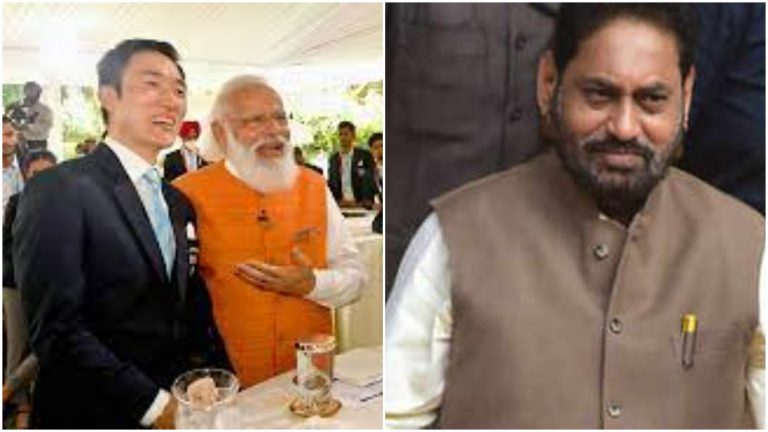
Prime Minister Narendra Modi on Wednesday, August 18, interacted with Indian athletes after their success at the Tokyo Olympics 2020. While interacting with Tae-sang, Indian shuttler PV Sindhu’s Korean coach, PM Modi asked him whether he had visited Ayodhya. He then asked him to visit the place as there is a historical bond between South Korea and India. On expected lines, PM Modi’s suggestion to the Korean coach has ruffled the feathers of the Congress party.
Many left-liberals also attacked PM Modi on social media for bringing up Ayodhya while talking to Sindhu’s coach. Congress party’s Maharashtra SC chairman and a cabinet minister in the Uddhav Thackeray ministry, Nitin Raut, today took to Twitter to accuse the Prime Minister of playing politics over the sacred city. “This is his nauseating 24×7 politics”, exclaimed the senior Congress leader, sharing a snippet of Modi’s interaction with India’s Olympic heroes’ coach over breakfast.
PV Sindhu introduces her Korean coach to PM. First question PM asks him, “have you heard of Ayodhya?” This is his nauseating 24×7 politics. pic.twitter.com/XYhHycX6is
Knowing his party’s perception of Ayodhya’s Ram Mandir issue, Raut’s remark does not come as a surprise, however, his ignorance is distressing.
As rightly said by PM Modi, there is a special relationship between Ayodhya and South Korea. According to legends, Queen Hu was Suriratna, an Ayodhya princess who journeyed to South Korea in 48 AD to marry King Suro of Geumgwan Gaya. The princess is thought to have arrived in Korea by ship. She was dubbed Queen Hu Hwang ok after marrying the king. They formed the Karak dynasty in the present-day Gimhae province of South Korea, along with King Kim Suro.
According to reports, millions of Koreans trace their lineage to the dynasty founded by Queen Hur Hwang and King Suro. They consider Ayodhya to be the maternal home of their ancient Queen and that is the reason Ayodhya sees hundreds of Korean visitors every year.
In fact, OpIndia had reported that Bimlendra Pratap Mishra, a member of the Royal Family of Ayodhya had recounted his cordial relationship with the Korean Royal Family. He said that he was invited to South Korea by the Royal Family as they believed that they are the descendants of a princess of Ayodhya. Kim Jong-Pilmm the then Prime Minister of South Korea, was the 72nd generation descendant of King Kim Suro of the Garak Kingdom.
Health experts have once again questioned the cognitive abilities of US President Joe Biden after he bungled his way through an interview on Afghanistan with George Stephanopoulos of ABC. Joe Biden has earlier suffered from two brain aneurysms and a heart condition that causes dizziness and confusion.
Top cardiologists told Mainonline that both the conditions are linked to cognitive memory difficulties and confusion, as well as dementia. Dr. Aseem Malhotra, an NHS consultant, told Mailonline, ‘Just as a doctor observing him, given his medical history and age, I’m worried about early onset dementia… I would be worried about anyone exhibiting issues with recall and memory at Joe Biden’s age.’
Dr. Amit Bajaj, associate professor in speech science at Emerson University in Boston, Massachusetts, too concurred that Joe Biden could be committing more and more gaffes due to a cognitive decline due to his old age.
Dr. Bajaj said, ‘He has a reputation for gaffes. It’s hard to say if it is interlacing with anticipatory anxiety… I think there are several contributing factors. Part of is the speech. Part of it is cognitively where he might be at because he is old. But the relative influence of any one of them is uncertain. It’s probably a mix of both.’
But others disagreed and said that his gaffes are not necessarily indicative of a cognitive decline. James Rowe, a dementia and neurodegeneration expert at Cambridge University, said that such gaffes ‘are common and do not in themselves indicate a condition, let alone dementia’.
Professor Sophie Scott, an expert in cognitive neuroscience, told Mailonline, ‘Forgetfulness is a normal part of ageing – names in particular can be a problem for people as they age, maybe because there is not much information in a name to help you to connect it to the person.’
Joe Biden gaffe during ABC interview
During the interview with Stephanopoulos, Joe Biden claimed incorrectly that his late son Beau served in the Navy in Afghanistan before correcting himself that he served in the Army in Iraq. The moments where he committed the gaffes were not aired but were revealed in the transcript that were revealed.
Fox News anchor Tucker Carlson had said earlier that ABC had selectively edited the interview to remove portions where Biden appeared incoherent. Carlson remarked, “ABC News appears to have chosen to edit out portions that made Joe Biden look, how to put it, not presidential, incoherent, confused.”
“We think it’s worth knowing what happened, especially in a moment of national crisis,” he added.
Biden’s past gaffes
Americans had questioned his mental health after Joe Biden made an appearance on a CNN Townhall. The appearance was marked by the US President rambling incoherently and other unfortunate errors.
In another video that went viral on social media recently, Biden responded to a question saying, “Are there people in the Republican Party who think we are sucking the blood out of kids?” People had questioned who was running the country, given Biden’s health condition.
Earlier in May, veterans had questioned his health and his fitness to lead the United States of America. “The mental and physical condition of the Commander in Chief cannot be ignored. He must be able to quickly make accurate national security decisions involving life and limb anywhere, day or night,” they had said in a letter.
Former President Donald Trump had repeatedly questioned Biden’s mental health during the 2020 presidential campaign, but the mainstream media and ‘experts’ brushed aside concerns and dubbed it a ‘conspiracy theory’.
Muslims participating in a Muharram procession in Purnia district in Bihar reportedly attacked a car, which was trying to pass through the procession, with iron rods and sticks. The mob also allegedly looted Rs 7000 in cash and mobile phones from the family that was travelling in the car. The incident reportedly happened on Friday, August 20, on NH-31 near Moosapur in Katihar’s Korha police station area. The video of the incident has been doing the rounds on social media.
According to one of the victims- Mohd Masood Alam, a resident of Doomar, they were returning home from Purnia after the treatment of his mother when their car got stuck in the Muharram procession on NH-31. The driver was following an ambulance and slowly trying to move the car through the procession when it mistakingly touched a person in the crowd. Though there was hardly any impact nor was anyone hurt, the mob got so infuriated that they attacked the car with rods and sticks.
The mob broke all the windows and the windscreen of the car. They assaulted Masood Alam and his family members, who were sitting in the car and also snatched their mobile phones and money.
Masood’s mother- Amina Khatoon and three other family members, namely Tabassum Khatoon (32), Farzana Khatoon (6) and Wasim (30) were injured in the assault. They have reportedly been admitted in the Community Health Center in Korha for treatment, informed SHO Rupak Ranjan Singh.
On receiving information of the scuffle, the Katihar Sub-Divisional Police Officer (SDPO) Amarkant Jha along with Sub-Divisional Officer Shankar Sharan Omi reached the spot with their team to take control of the situation.
The police said that mass gatherings and processions have been banned in the state due to the COVID-19 pandemic, adding that inquiry will be conducted as to how the procession was carried out on NH-31 without due permission.
OpIndia tried to get in touch with the Korha police station to get more information about the aforementioned incident, but could not get through the phone number.
In a tragic incident, a 15-year-old girl in Indore decided to end her life believing that dying on the day of Muharram could get her to Jannat or heaven.
Before committing suicide, the girl reportedly asked her mother, “Was Imam Hussein martyred today, will those who die today go to heaven?”
As per reports, the girl, who is identified to be a resident of the Champabagh area of Indore, was fasting for Muharram along with her family members. The girl’s father later informed media persons that while eating kheer, Rabia asked a question of her mother, “will those who die today attain martyrdom? Will they go to heaven?”
The mother of the girl reportedly responded in affirmative and a while later, the girl was found hanging from the ceiling in her room. Shocked at the sight, the family members quickly pulled the girl down and rushed her to the hospital, where the doctor declared him brought dead.
As per family members of the deceased, the girl had recently taken admission in Class XI and had bought books for herself. She was generally happy about her life, which is why the family members are still unable to reconcile to the reality of her committing suicide.
However, as per Raoji Bazar police station in-charge, Savita Choudhary, the girl was not mentally well for a few months because of the death of one of her close friends. She had also gone to her aunt’s place without informing her family members a few days ago. The police would now record the statement of her family members to ascertain the cause of suicide, Choudhary said.
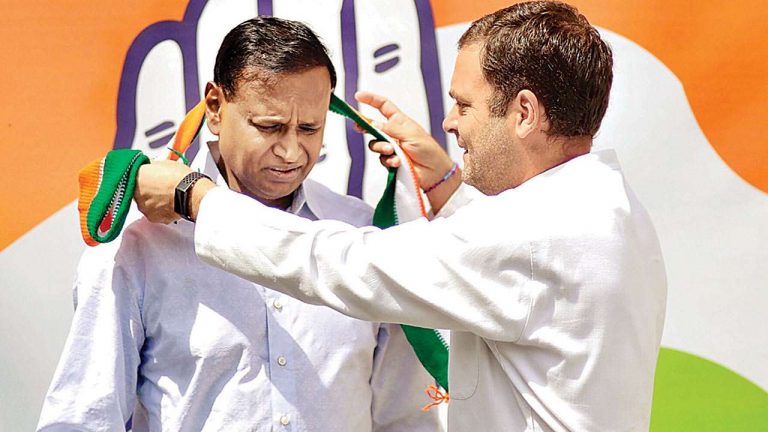
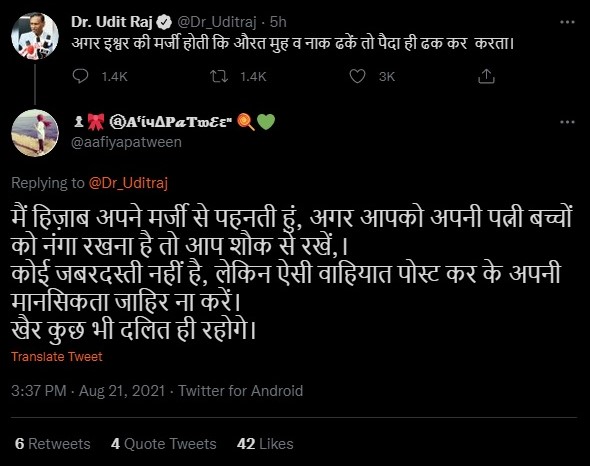
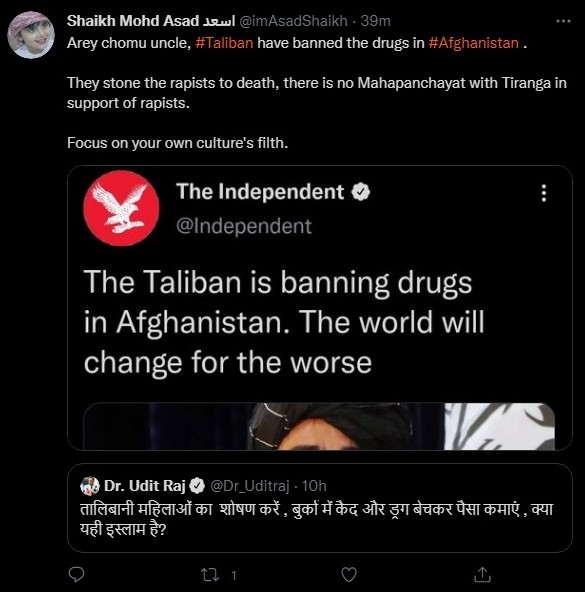
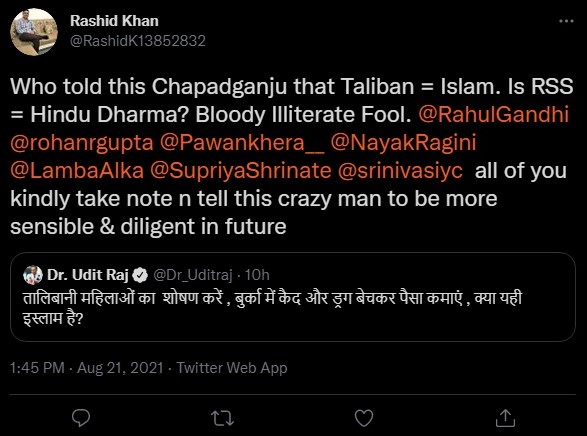
Congress leader Udit Raj was trolled by Islamists again on social media on Saturday, days after he was abused on Facebook by Islamists for a post on Afghan women. In that post, Udit Raj had said that women in Afghanistan had been subjugated by Burkha. He again criticised the Islamic attire on Twitter on Saturday.
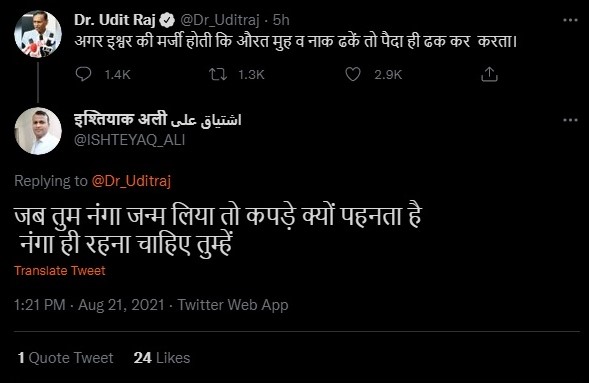
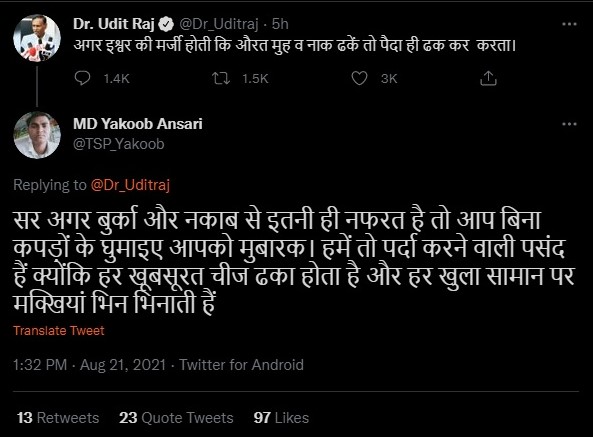
The Congress leader posted a tweet that said, “If God wanted women to cover their mouth and nose, then he would have ensured that they born that way.” Islamists were not pleased with the comment and said that Udit Raj was born naked, so he should have remained that way.
Source: Twitter
One Muslim woman said that she wears the Hijab according to her own choice and if the Congress leader wanted his children and wife to roam around naked, then it is his own choice and nobody is forcing him.
Source: Twitter
Another Muslim man made a similar comment and said that they keep their women covered because all beautiful things are covered and flies hover around things that are uncovered.
Source: Twitter
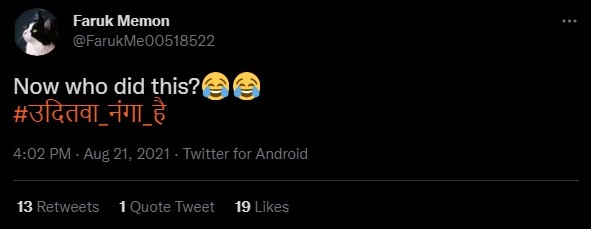
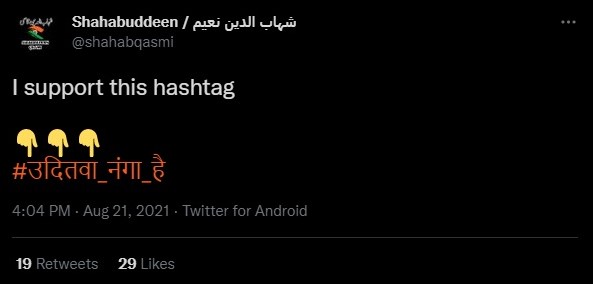
The Muslim community on Twitter is also trending #उदितवा_नंगा_है on the platform, ostensibly to troll Udit Raj.
Udit Raj had earlier posted a tweet where he said that Taliban was subjugating women in Burkhas and earning money by selling drugs and questioned whether it was Islam. Islamists resorted to defending the Taliban and drawing comparisons with the RSS for that tweet.
Raj was trolled by Islamists on Sunday for a post on Facebook highlighting the dangers of Islamic Extremism and Taliban. Udit Raj shared a photograph from 1960s Afghanistan to claim that the women in the country have been enslaved by slavery and Burkha.
He said, “This is the college scene of 1960s Afghanistan but where has the bigotry led it today. Today women there have been imprisoned in slavery and Burkha. India is also moving in that direction.” The comments irked Islamists on social media who resorted to abuses against him and the women in his family.
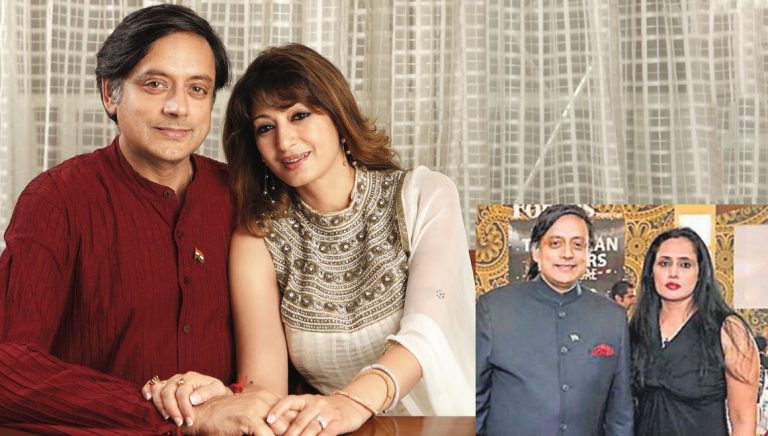
The death of Sunanda Pushkar, the former wife of Congress politician Shashi Tharoor, has been mired in controversies. After almost 7 years since her death on January 17, 2014, her husband was ‘acquitted‘ of all charges on August 18. “The accused (Mr. Tharoor) is discharged,” remarked Special Judge Geetanjali Goel and asked him to pay a requisite bond.
Following the verdict, a relieved Tharoor commented, “This brings a significant conclusion to the long nightmare which had enveloped me after the tragic passing of my late wife Sunanda. I have weathered dozens of unfounded accusations and media vilification patiently, sustained by my faith in the Indian judiciary, which today stands vindicated.” While the Congress Parliamentarian, his fans, and party workers have been celebrating the Court verdict, the arguments by the prosecution have dismantled the image of a ‘loving husband’ that Tharoor had been trying to portray all this while.
Circumstances leading up to the mysterious death of Sunanda Pushkar
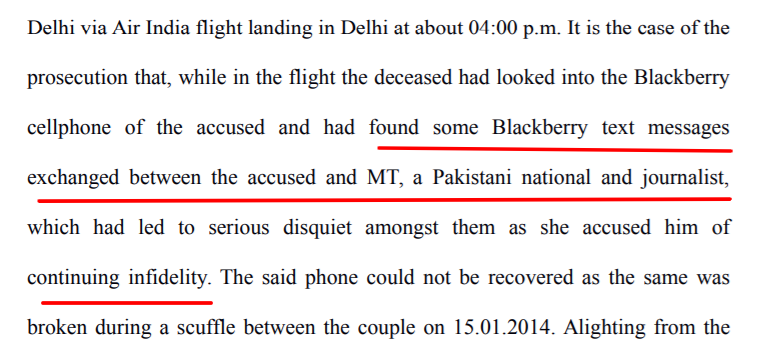
It was submitted[pdf] before the court that the deceased Sunanda Pushkar had found ‘intimate messages’ between Shashi Tharoor and a Pakistani journalist named Mehr Tarar during their journey from Dubai to Delhi on January 15, 2014. The incident led to a situation of ‘serious disquiet’ amongst them as Pushkar accused the Congress leader of ‘continuing infidelity’. Later on that day, Sunanda Pushkar reached the Hotel Leela Palace, and checked in at Room No. 307.
Excerpt from the verdict
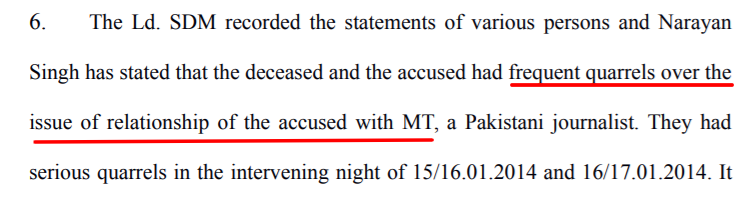
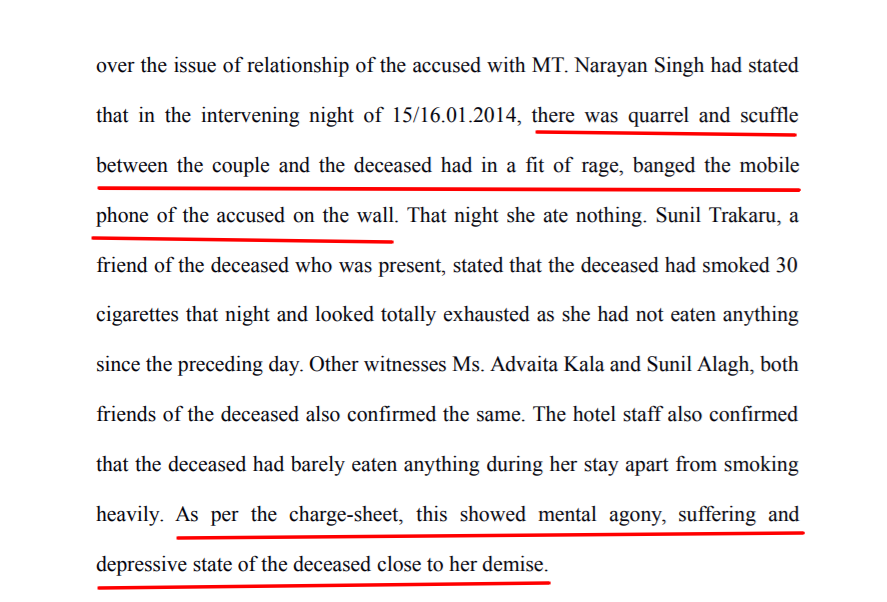
In a statement recorded before the Sub-Divisional Magistrate, Sunanda Pushkar’s domestic help Narayan Singh and other witnesses testified about the ‘frequent quarrels’ between Shashi Tharoor and the deceased over Tharoor’s relations with Mehr Tarar on the nights (January 15, January 16, and January 17). He added that on the intervening night of January 15 and January 16, there was a heated argument between Shashi Tharoor and Sunanda Pushkar during which the latter banged the phone of the Congress leader on the wall.
Excerpt from the verdict
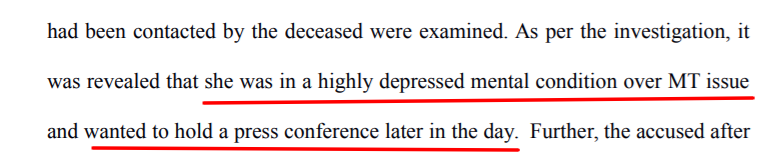
The extra-marital affair of Shashi Tharoor and Mehr Tarar had left Sunanda Pushkar mentally depressed. “As per the charge-sheet, this showed mental agony, suffering and depressive state of the deceased close to her demise,” the Court was told. Sunanda Pushkar wanted to hold a press conference on January 17, 2014, the day she was found dead.
Excerpt from the verdict
Post-mortem and findings of the AIIMS Autopsy Board indicates ‘chemcial poisoning
On January 18, 2014, the post-mortem of her body was conducted by an AIIMS Autopsy Board, comprising of Dr. Sudhir Kumar Gupta, Dr. Adarsh Kumar, and Dr. Shashank Pooniya. The Autopsy Board noted 15 ante-mortem injuries (inflicted prior to the death of the victim) on her body, which were caused 12-96 hours before her death.
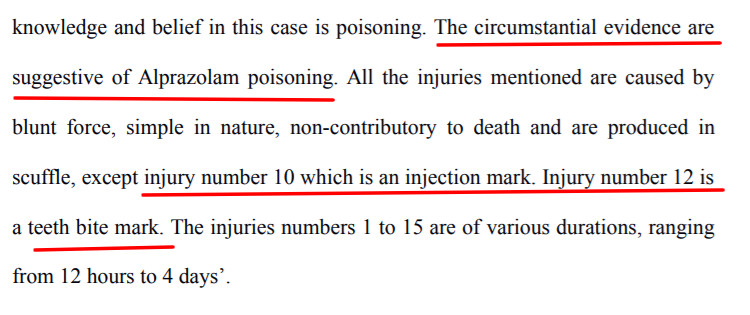
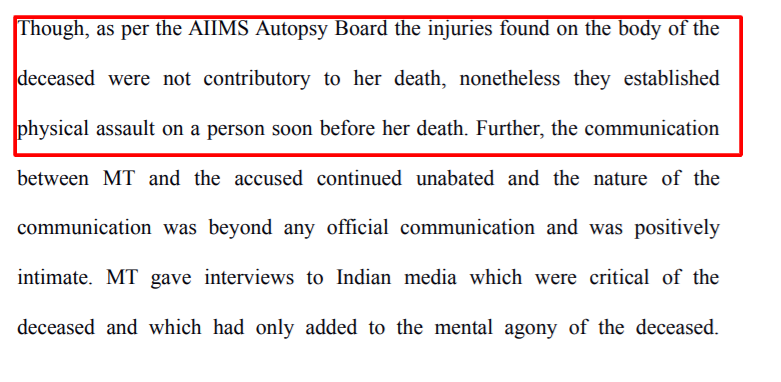
Based on the circumstantial evidence, the Board ruled her cause of death to be ‘Alprazolam poisoning.’ The doctors however specified that there was not only an injection mark on her body but also a teeth bite mark, indicating the torture that she was subjected to prior to her death. Although the AIIMS Autopsy Board found that the injuries did not contribute to her death, it was a clear indicator that she was subjected to physical assault.
Extract of the Court order
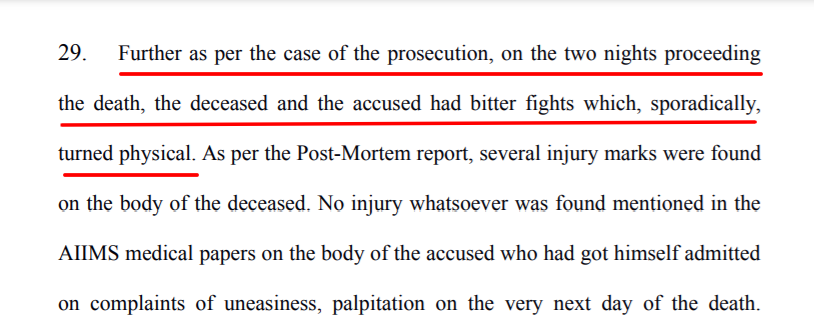
Given that the fights between the two ‘sporadically turned physical’, it cannot be ruled out that the 15 injuries inflicted on the victim’s body were caused by Tharoor. And the bone of contention between Sunanda Pushkar and Shashi Tharoor was the latter’s extramarital relationship with Mehr Tarar. “The communication between Mehr Tarar and the accused continued unabated and the nature of the communication was beyond any official communication and was positively intimate.”
Screengrab of the order
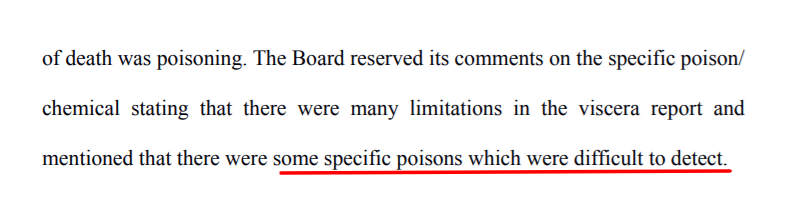
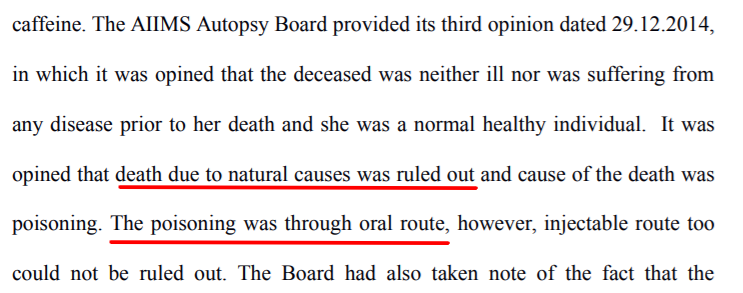
Although the AIIMS Autopsy Board was convinced that Sunanda Pushkar died due to chemical poisoning, the limitations in the viscera report meant that it was not possible to detect specific poisons. On December 29, 2014, the doctors gave their third opinion and ruled out the possibility of death due to natural causes. They re-emphasised that the cause of death was poisoning, which must have been administered orally or through intravenous injection.
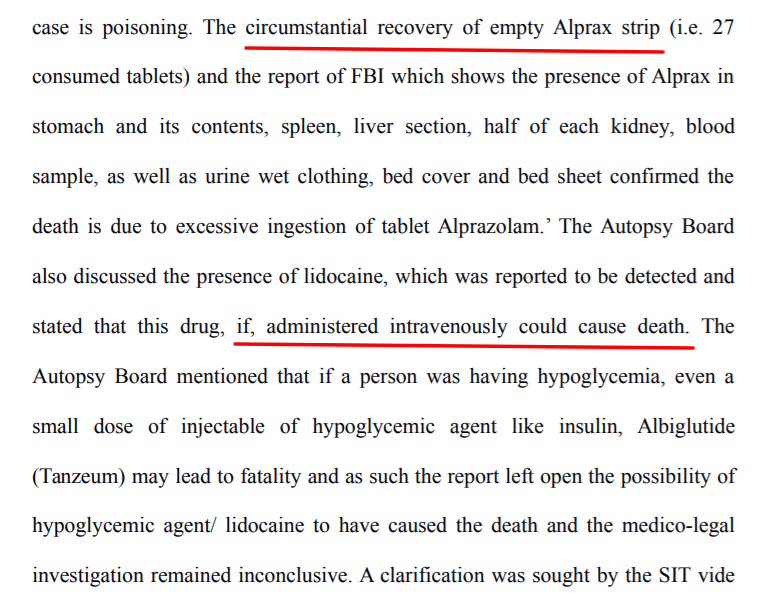
Screengrab of the Court order
Shashi Tharoor caught in his own web of lies
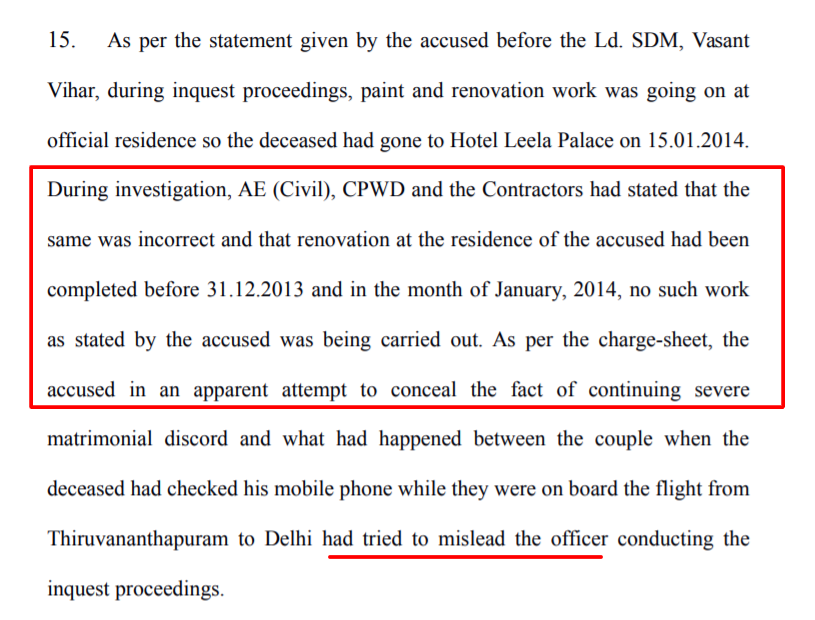
During the probe in the Sunanda Pushkar case, it came to light that Shashi Tharoor had lied to the investigative agencies. In a statement made before the Sub-Divisional Magistrate, he claimed to have gone to the Hotel Leela Palace on January 15, 2014, as there was renovation work underway at his house.
“During the investigation, AE (Civil), CPWD and the Contractors had stated that the same was incorrect and that renovation at the residence of the accused had been completed before 31.12.2013 and in the month of January, 2014, no such work as stated by the accused was being carried out,” the Court said.
Screengrab of the court order
It further added, “As per the charge-sheet, the accused in an apparent attempt to conceal the fact of continuing severe matrimonial discord and what had happened between the couple when the deceased had checked his mobile phone while they were on board the flight from Thiruvananthapuram to Delhi had tried to mislead the officer conducting the inquest proceedings.”
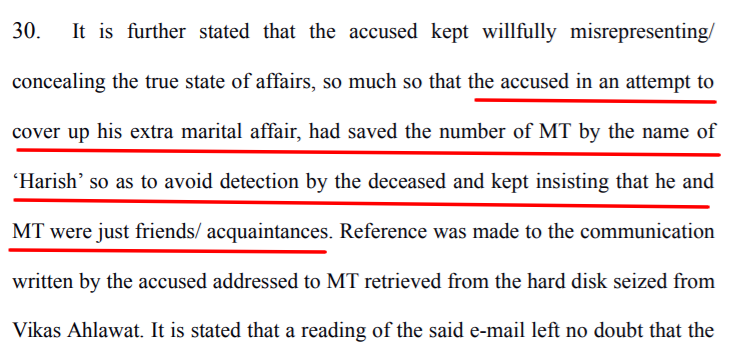
During the hearing, it also came to light that the Congress Parliamentarian had been lying to his wife about his extra-marital affair with Mehr Tarar. In a bid to cover up his ‘illegitimate relationship’, he saved the Pakistani journalist’s number in the name of one ‘Harish.’ By doing so, he avoided suspicion of Sunanda Pushkar while insisting that Mehr Tarar was just a friend/acquaintance.
Extract from the Court order
Adultery, Cruelty and Insensitivity: The Holy Trinity of Shashi Tharoor
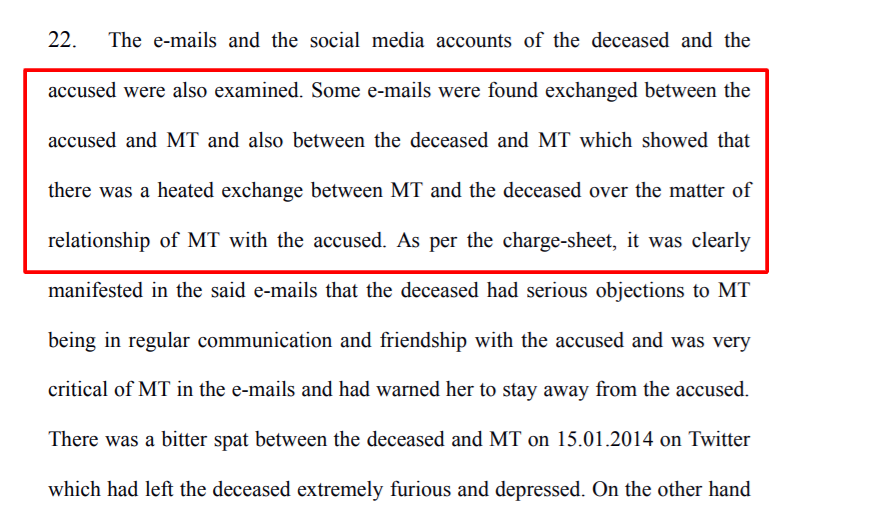
When investigative authorities began scouring the social media accounts of Mehr Tarar, Sunanda Pushkar, and Shashi Tharoor, they found that e-mails were shared between the three. There was a heated exchange between Pushkar and Tarar over the latter’s relationship with Tharoor. She had even warned Tarar to stay away from the Congress leader.
Extract of the Court order
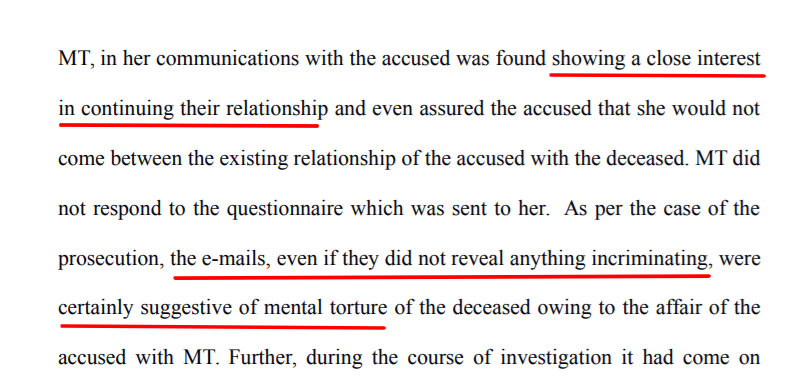
Mehr Tarar’s communication with the Congress Parliamentarian indicated a ‘close interest in continuing their relationship.’ To ensure that there were no issues between him and Sunanda Pushkar, the Pakistani journalist vowed to not come in between Tharoor and his legally wedded wife. The prosecution noted, “The emails, even if they did not reveal anything incriminating, were certainly suggestive of mental torture of the deceased owing to the affair of the accused with Mehr Tarar.”
Extract of the Court order
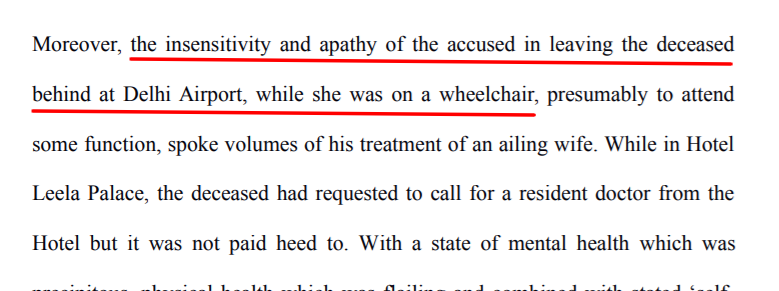
The Prosecution highlighted the insensitivity and apathy displayed by Shashi Tharoor after he deserted his wife at the Delhi airport under the pretext of attending a function. This is despite the fact that she was wheeler chair-bound. Later in the day, when Sunanda Pushkar required medical assistance, a resident doctor was not sent in by the hotel staff.
Extract from the Court order
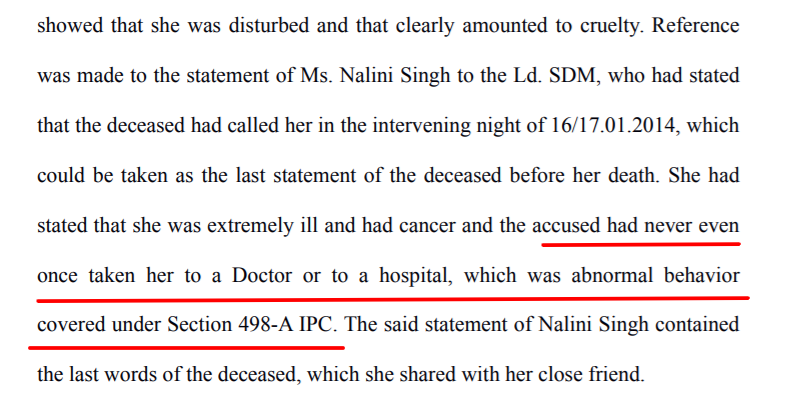
It was further highlighted in the Court that Sunanda Pushkar had called Nalini Singh on the intervening night of January 16 and January 17. It is considered to be the last statement made by the deceased prior to her death. “She had stated that she was extremely ill and had cancer and the accused (Shashi Tharoor) had never even once taken her to a doctor or to a hospital, which was abnormal behaviour covered under Section 498A of the Indian Penal Code (IPC),” the prosecution emphasised. According to independent journalist Deepika Narayan Bhardwaj, the court did not pay heed to the last statement of the deceased.
Screengrab of the Court order
Alprazolam poisoning, treatment by a child specialist and a Kerala connection
The AIIMS Autopsy Board had confirmed on four different occasions that the cause of Sunanda Pushkar’s death is related to Alprazolam poisoning. “The circumstantial recovery of empty Alprax strip (i.e. 27 consumed tablets) and the report of FBI which shows the presence of Alprax in the stomach and its contents, spleen, liver section, half of each kidney, blood sample, as well as urine wet clothing, bed cover and bed sheet confirmed the death is due to excessive ingestion of tablet Alprazolam,” the Court was told.
Besides, it was pointed out that the intravenous injection of lidocaine (found in FBI report) in hypoglycemia (low blood sugar content) patients could lead to death. According to the AIIMS autopsy Board, the administration of hyperglycemic agents such as insulin, tanzeum, or lidocaine intravenously can cause death. “As such, the report left open the possibility of hypoglycemic agent/ lidocaine to have caused the death, and the medico-legal investigation remained inconclusive,” the prosecution said. Although a clarification was sought by the SIT from the AIIMS Autopsy Board, no reply was ever received.
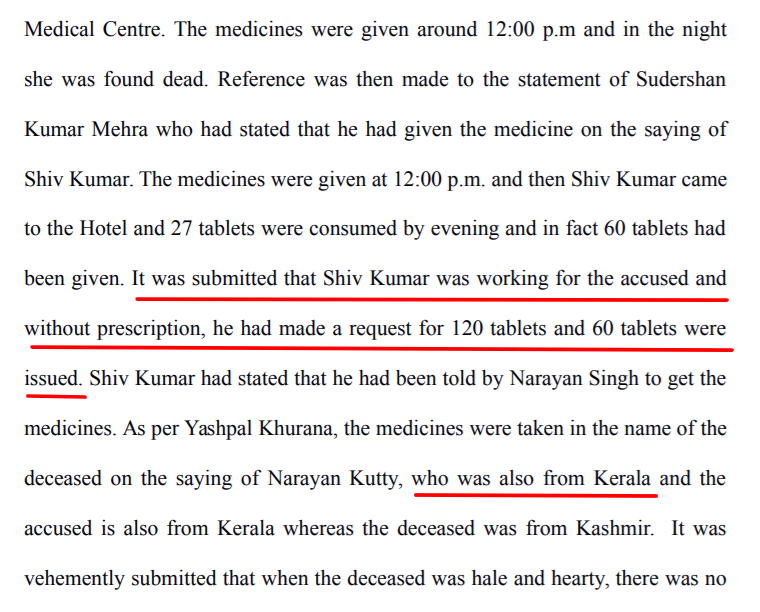
It had also come to light during the Alprax medicines were provided to the patient at around 12 pm on January 17, 2014, hours before Sunanda Pushkar was found dead. Although the medicines were not available at the government store, one Dr Sudershan Kumar Mehra had procured the same on the behest of Shashi Tharoor’s aide Shiv Kumar. It must be mentioned that Kumar had initially demanded 120 tablets but was given only 60. Kumar had claimed that he was tasked by domestic help Narayan Singh to procure the medicines. However, one Yashpal Khurana alleged that the Alprazolam medications were taken in the name of Sunanda Pushkar on the behest of a Kerala resident Narayan Kutty.
“It was vehemently submitted that when the deceased was hale and hearty, there was no need for her to start or to be given so much amount of Alprax. It was contended that at the stage of charge, suspicion was enough. It was submitted that how the tablets were procured and the quantity confirmed that it was not a natural death but it was due to poisoning as had been opined in the Post-Mortem report,” the prosecution argued. To make matters worse, the prescription was written by Dr. Mishra, who is a child specialist and not a psychiatrist.
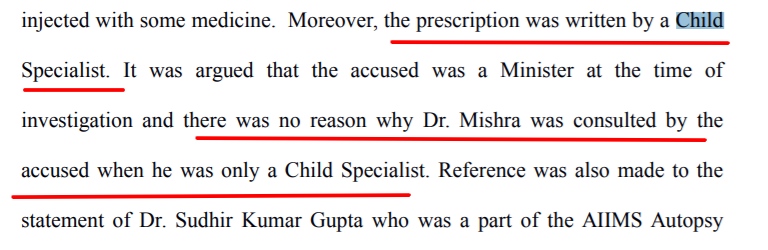
“It was argued that efforts were made by the accused to mislead the investigation and he had sent an e-mail to the doctors. Injection mark was found on the deceased so there was possibility of her being injected with some medicine. Moreover, the prescription was written by a Child Specialist. It was argued that the accused was a Minister at the time of investigation and there was no reason why Dr. Mishra was consulted by the accused when he was only a Child Specialist,” the excerpt from the Court verdict read.
Mehul Vavalia, brother of Aam Aadmi Party councillor Dharmendra Vavalia, was arrested by Kapodra police in Surat after a divorced woman accused him of raping her. A case was lodged against him at Kapodra police following which he was arrested.
As per reports, Mehul entrapped the woman after he came to know that she was seeking to learn to drive. Mehul reportedly lured the woman into travelling with him to Navsari by promising to get her a license there. On their way to Navsari, Mehul allegedly raped the woman.
Following the incident, BJP workers took out a rally outside the Aam Aadmi Party office in the Hirbagh area in Surat, demanding justice for the victim. A large number of BJP workers gathered on the streets and slammed the councillor for the sexual assault allegedly carried out by his brother. The protest also saw participation from the BJP’s women wing, who called for exemplary action accused Mehul.
AAP councillor Dharmendra Vavaliya, the brother of accused Mehul, also gave his reaction on the matter. Distancing himself from his brother, Dharmendra said although Mehul is his brother, the two of them have not been in contact with each other for years now. He further demanded severe punishment for Mehul if he is found guilty of raping the woman.
“Mehul is my brother and he has not been with me for many years now. I demand strict punishment for my brother if he is found guilty of any wrongdoing. He should be punished severely if charges against him are proved to be true. I urge Kapodra Police and the Commissioner of Police to take strict disciplinary action against the perpetrators of such acts,” Dharmendra said.
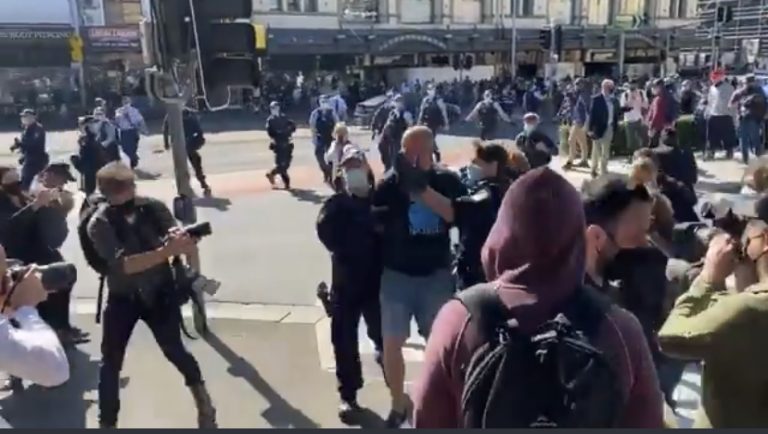
Australian police on Saturday employed harsh measures, including the use of rubber bullets and tear gas, to disperse crowds that had gathered on roads in a nationwide protest to oppose the imposition of lockdown by the government.
Widespread protests were witnessed in Australia over the weekend as thousands of unmasked protesters carried out anti-lockdown rallies in various cities throughout the country in defiance of the restrictions imposed by the government in the wake of the resurgent coronavirus outbreak.
Violent clashes erupted between protesters and law enforcement officials in Melbourne, Brisbane and Sydney as the latter accused the former of having “violence in mind”. Hundreds of protesters were detained and seven officers were hospitalised as a result of clashes a day after the country saw its highest-ever single-day rise in COVID-19 cases.
The scene of violence and chaos were particularly stark in Melbourne, where more than 4,000 people had come out to oppose the coronavirus-induced lockdown in the country. Victoria police arrested 218 protesters and six police officers were hospitalised in a series of altercation that ensued between the two sides.
The police also issued 236 fines and kept three people in custody for assaulting police. The arrested people face fines of A$5,452 ($3,900) each for breaching public health orders.
The Victoria police later issued a statement, defending its ham-handed measures against the protesters, whom they claimed were so hostile and aggressive that the police officials had no option but to use all tactics available to them.
Videos of the clashes that have gone viral show police officials using tear gas, rubber bullets and pepper-spray to break the crowds. Some of the videos show protesters, cheering, hurling objects at police officers and letting off flares during the demonstrations.
Crazy scenes in Victoria right now. Melbourne anti-lockdown protests have turned violent. Dozens of police officers seen pepper spraying and tackling demonstrators @abcnewspic.twitter.com/X27qKS6igE
The protests in Melbourne took place after Victoria’s premier, Daniel Andrews, announced that the strict lockdown imposed in the city would be extended across the entire state. The state recorded 77 new cases of coronavirus on Saturday.
Much like the anti-lockdown rallies in Melbourne, protesters in Sydney also took to streets to register their protest against lockdown. More than 1,500 officers were deployed in the city to control to the demonstrations. Taxis and Ubers plying in the city were banned until 3 pm on Saturday. Trains were not allowed to stop at city centre stations. About 137 tickets were issued by the police after stopping around 38,000 cars approaching Sydney.
The New South Wales Police issued a statement saying they made 47 arrests and issued at least 261 penalty infringement notices across the Sydney CBD and regional NSW.
Similarly, thousands of protesters also demonstrated on the streets of Brisbane in Queensland after restrictions were imposed in the city to curb the spread of the coronavirus outbreak.
Police officers said actions taken by demonstrators would most likely prolong the lockdown instead of cutting them short. There was a general resentment among people after The Australian government and local administration resorted to imposing lockdown as vaccination has continued at a snail’s pace.
“The actions they have taken are likely to prolong the very lockdown they were protesting about.”
South Australia police said no arrests were made at an anti-lockdown protest in Rundle Park in Adelaide.
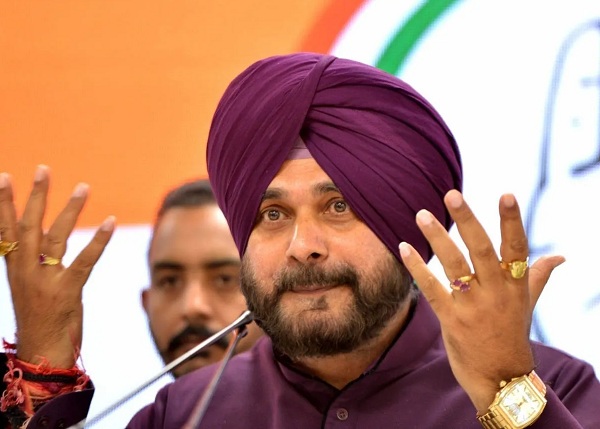
The Bhartiya Janta Party and Akali Dal have trained guns on the newly-appointed Punjab Congress chief Navjot Singh Sidhu for his silence over Malvinder Singh Mali, one of his four advisors. Mali had made a controversial remark on August 17th on Kashmir being a separate country and India and Pakistan being illegal occupants of Kashmir.
Irked by Navjot Singh Sidhu’s decision to appoint Malvinder Singh Mali as his advisor and his silence over the matter, senior BJP leader Vineet Joshi called Navjot Singh Sidhu an “unstable politician”.
“BJP gave him a political identity. His wife was given a party ticket and then he switched his loyalties and joined Congress. The infighting within the Punjab Congress unit is the outcome of the unfulfilled political ambitions of Navjot Sidhu. He can go to any length and now he is trying to sprinkle salt on the wounds of martyrs’ families,” Vineet Joshi stated.
He claimed that the appointment of Mali as an advisor, signalled where Sidhu was headed in political discourse.
“Many Army and allied forces personnel, besides the Jammu and Kashmir police, have sacrificed their lives to save Kashmir from Pakistan-sponsored terrorists. A number of martyrs belong to Punjab. Mali is trying to shrink the supreme sacrifices made by these martyrs,” Vineet Joshi said.
SAD slams Navjot Singh Sidhu, questions Congress scion Rahul Gandhi
Similarly, senior Shiromani Akali Dal (SAD) leader Bikram Majithia also slammed Malvinder Singh Mali’s for his inflammatory social media post which he said was an attempt to insult martyrs who had sacrificed their lives fighting for India in Kashmir.
“He [Mali] said that Kashmir is the country of Kashmiris, which means Kashmir is a separate country. He also said that India and Pakistan have illegally encroached upon Kashmir. Rahul Gandhi, is this not an insult to martyrs?” Bikram Majithia said.
Taking a dig at the Gandhi scion, Majithia added: “If he [Rahul Gandhi] endorses Mali’s views, then the real face of the Congress will be exposed. If not, what action will he take against Mali?”
Further, raking up the old controversy around Sidhu’s Pakistan visit, Bikram Majithia scorned him for his affinity towards Pakistan: “While Chief Minister Captain Amarinder Singh has been accusing Pakistan of disturbing the peace in Punjab, Navjot Singh Sidhu is hugging Pakistan’s army chief General Qamar Javed Bajwa.”
BJYM planned to gherao Sidhu’s residence
The Amritsar Bharatiya Janata Yuva Morcha (BJYM) leaders also protested against Punjab Pradesh Congress Committee (PPCC) president Navjot Singh Sidhu claiming that his advisor’s remark amounted to sedition.
Led by state BJYM in-charge Rajesh Honey and state president Bhanu Partap, the activists planned to gherao Sidhu’s residence in Holy City, a private township. Police, however, stopped them at the entrance to the complex by installing barricades and locking the main gate.
“Mali must be tried under sedition for his anti-national view on J&K,” claimed BJYM district president Gautam Arora, adding: “Every Indian will be enraged to see the post of Mali, as he doesn’t consider J&K to be an integral part of the country. It also shows that Sidhu in inclined towards Pakistan. Sidhu supports Pakistani extremists and separatists of Kashmir. He must tender an apology to the country.”
Sidhu faces the wrath of Netizens
Besides, Sidhu has also faced the wrath of Netizens for the silence he has maintained over his advisor’s controversial remark.
Shocking & Treacherous ! Navjot Singh Sidhu’s advisor Malwinder Mali saying-“Kashmir is separate country..india captured it..” It again proved that Sidhu is working on instructions of Imran & Gen Bajwa@RahulGandhi आपकी पार्टी के लोग क्यों देश को तोड़ना चाहते हैं ? pic.twitter.com/9KNe3kAoed
@sherryontopp siddhu is phuddu!!! He sold Indian’s interests to Bajwa. Now Malwinder Singh Mali, advisor to Punjab Congress chief Navjot Singh Sidhu, just confirm that by calling Kashmir a separate country and India as an occupier @RahulGandhi just promoted Siddhu to do this
Malvinder Singh Mali claims Kashmir is a separate country
The controversy erupted after Navjot Singh Sidhu’s advisor Malvinder Singh Mali wrote in his Facebook post that Kashmir is a separate country and that India captured it.
Malvinder Singh Mali in his August 17 post wrote, “Kashmir is a separate country and India and Pakistan are illegal occupants. It belongs to the people of Kashmir.”
He spoke about the 1947 agreement made with Kashmir’s King Hari Singh. The Congress leader’s post also attacked the Union Government’s decision to scrap Article 370 and questioned: “What was the meaning of Article 370 and 35 A, which gave special state status to Kashmir in the Constitution of India?”
“Kashmir is a country of Kashmiri people, on the rules set to leave India in 1947, on the decisions of UNO, on the decisions made by India, Kashmir is divided into two pieces by Pakistan and India on top of that Occupied,” read Malvinder Singh Mali’s post.
Mali courts controversy soon after being appointed as advisor by Navjot Singh Sidhu
This is not the first time the Congress leader has sparked a row, earlier on August 13, Mali had accused CM Amarinder Singh, Prime Minister Narendra Modi, and Union Home Minister Amit Shah of creating communal tensions in the state. This statement came hours after Malvinder Singh, who is a staunch critic of the Punjab CM, was named by Navjot Sidhu as one of his advisors.
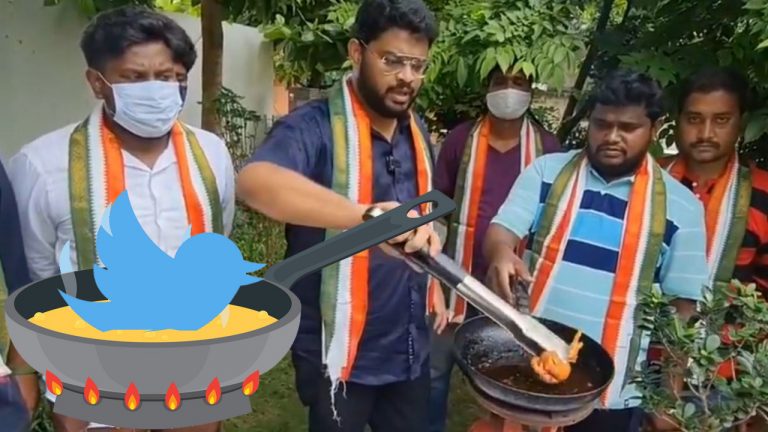
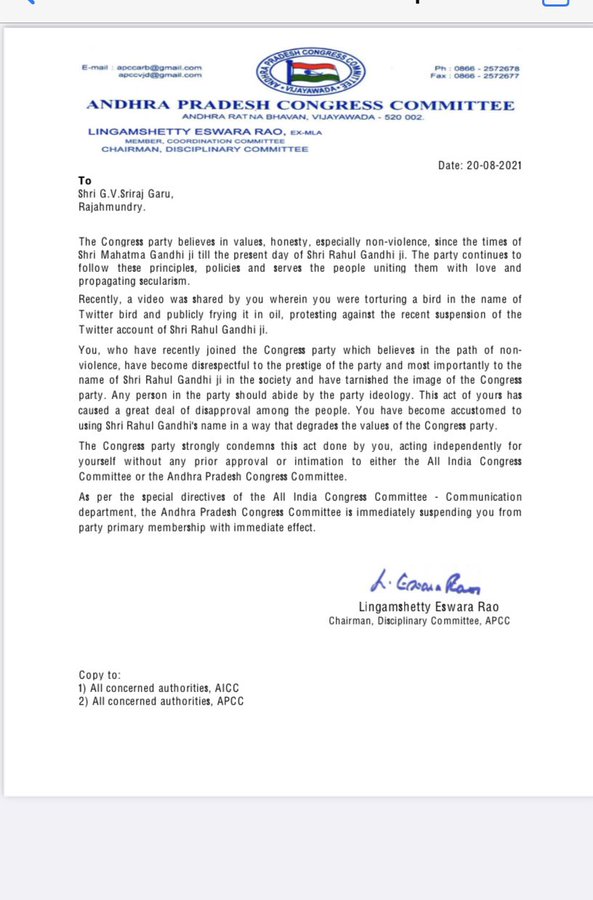
A Congress leader in Andhra Pradesh has been suspended by the party for his stunt of frying a ‘Twitter bird’ in protest of Twitter locking Rahul Gandhi’s account. The Andhra Pradesh Congress suspended the youth leader G V Sriraj on Friday from the primary membership of the party for tarnishing the image of the party. The party took the step after the video of the ‘protest’ had gone viral on social medial.
The letter addressed to Sriraj mentions that he had recently joined the party, and he has become disrespectful to the party and Rahul Gandhi. The party said that he had tortured a bird in the name of Twitter bird in public, and he tarnished the image of the party, which beliefs in nonviolence, with this act.
The letter states that any person in the party should abide by the party’s ideology, and his act has caused a great deal of disapproval among the people. It also mentions that Sriraj has become accustomed to using Rahul Gandhi’s name in a way that degrades the values of the party.
The party says that the act was done by the Congress leader independently and without prior approval or intimation of the party, and therefore he has been suspended from the party’s primary with immediate effect.
GV Harsha Kumar is the son of former MP and Congress leader GV Harsha Kumar. On Monday, he had fried a quail bird, symbolising the Twitter bird, in oil in public in protest against locking of the Twitter of Rahul Gandhi by the company for violating its rules. Sriraj and some other Congress workers fried the bird at Rajahmundry of East Godavari district. Later he had also couriered the fried bird to the Twitter offices in Mumbai.
After Rahul Gandhi violated the law of the land by revealing identity of the minor rape victim, his account was locked by Twitter. However, the Congress workers and leaders have been protesting against it, alleging that Twitter had this on the behest of Modi government. The account has been unlocked since then.