Home Blog Page 4013

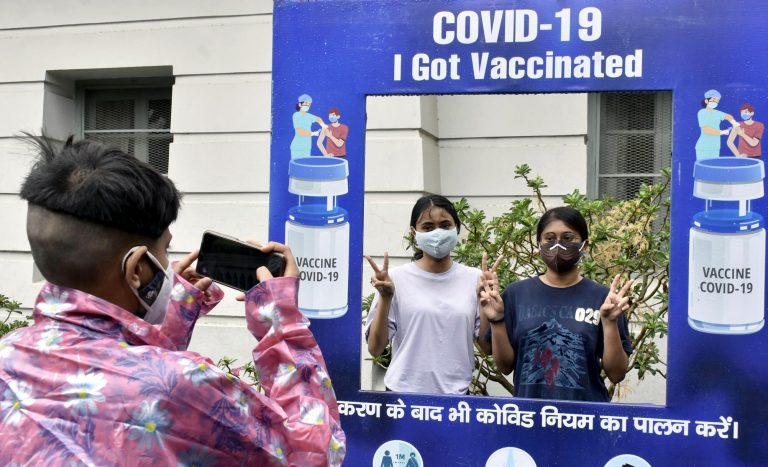
Total Covid-19 vaccinations in a day cross 1 crore for the first time in India, more than 62 crore doses administered so far

The number Covid-19 vaccine doses administered today in the country created a record, as the number crossed 1 crore (10 million) for the first time. According to the latest data provided in the CoWIN portal, the total doses administered today was 1,02,06,475, which is expected to go up further later in the night.

With this, the total number of Covid-19 vaccine doses given in India has crossed 62 crore, the second-highest in the world after China.

1 crore doses of vaccine administered in a day is a very significant achievement. This is more than the population of over 100 countries in the world.

While the vaccination in the country had started at a slower rate, largely due to the availability of doses, it has picked up in the last two months. The daily average vaccination in the country has gone up substantially since 21st June, the date from when the union govt took the responsibility of all citizens above 18 years of age.

Before that, as the non-NDA ruled state governments had demanded independence in the procurement of Covid-19 vaccines, the central govt had tasked states with vaccinating people in the 18 to 44 years age group, while the central govt was vaccinating Indians above 45 years of age for free. But due to the global shortage of vaccines, the state governments could not procure enough vaccines, resulting in low vaccinations. After that, the central govt had decided to vaccinate everyone aged above 18 years for free, while also allowing private hospitals to run vaccinations against payments.

21 June had seen a record vaccination of over 86 doses in a single day. Since then, daily vaccinations are hovering between around 40 lakh to 80 lakh per day, barring holidays. On 16th August, that record was broken and the 90 lakh mark was crossed, when 92.39 doses were administered in a single day.

And now in just 11 days, the record has been again broken, with more than 1 crore doses in a single day. The Country is consistently administering above 50 lakh doses per day for the last several weeks, signifying the acceleration in the inoculation programme.

Screenshot of CoWIN dashboard on 27 August

More than 14 crore people have received two doses of Covid-19 vaccines so far, while more than 48 crore people have received the first dose. Uttar Pradesh leads with 6.97 crore total doses and more than 29 lakh doses administered today. UP is followed by Maharashtra (5.63 crore), Gujarat (4.5 crore), Madhya Pradesh (4.46 crore) and Rajasthan (4.22 crore)

India has approved six Covid-19 vaccines so far, Covishield developed by Astra Zeneca and Oxford University, Covaxin developed by Bharat Biotech, Sputnik V developed in Russia, Spikevax developed by Moderna, the Johnson & Johnson COVID-19 vaccine, and ZyCoV-D developed by Zydus-Cadila.

The bulk of the vaccination programme in the country is dependent on Covishield and Covaxin, both made in India. The union health ministry on Friday informed that above 4.05 crore Covid vaccine doses are still available with states and Union Territories for inoculation, while more than 17.64 lakh doses are in the pipeline.

As vaccinations have picked up, the Covid-19 cases are going down in the country. India has now around 3.5 lakh active cases, with Kerala contributing 1.95 lakh cases.

JeM chief Maulana Masood Azhar met the Taliban leaders in Kandahar to seek support for fomenting terror in Kashmir: Report

Jaish-e-Muhammad chief Masood Azhar visited Kandahar in the third week of August to meet the Taliban for seeking their support in inciting terror in Jammu and Kashmir, a report published by India Today said.

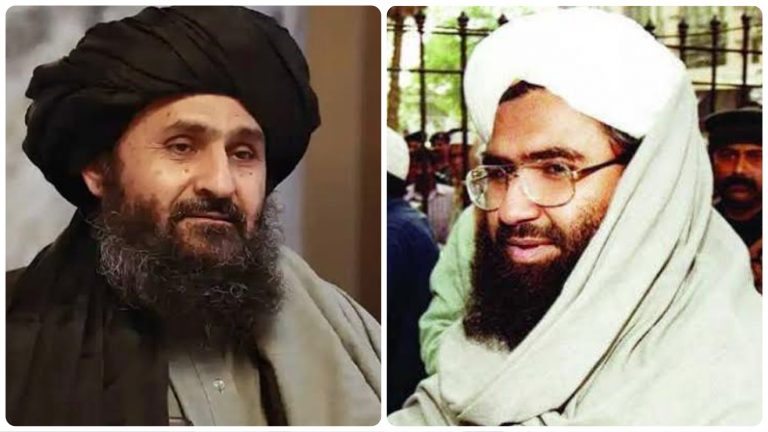
Citing sources, the report said Maulana Masood Azhar met Taliban leaders, including Mullah Abdul Ghani Baradar, the head of the political committee. Azhar has reportedly asked for help from the Taliban to foment unrest in the Kashmir Valley and help JeM for its operations in the Indian Union Territory.

Reportedly, Masood Azhar also conveyed his happiness for the Taliban’s “victory” after they formally took control of Afghanistan following the seizure of Kabul on August 15. As per sources, the terror chief has lavished praises on the Taliban for ousting the “US-backed Afghanistan government”. Even in their write-up titled “Manzil Ki Taraf”(towards the destination) on August 16, the JeM chief commended the terror group for the success of their “mujahideen” against the western forces.

Besides, congratulatory messages were also being exchanged between the JeM functionaries at its Markaz(headquarters) at Bahawalpur in Pakistan after the Taliban took over Afghanistan.

It is worth noting that the Taliban and Jaish-e-Muhammad share the same ideological fountainhead—the Deobandi School of Sunni Islam. Jaish-e-Muhammad has been carrying out terror activities in Jammu and Kashmir and other parts of India after it was founded by Masood Azhar in 1999.

Azhar was languishing in an Indian jail when an Indian Airlines flight IC 814 was hijacked by Pakistani terrorists, who got the plane to the Talibani controlled Kandahar. They demanded the release of Masood Azhar and other terrorists in exchange for the safety of passengers who were on the flight when it was hijacked while it was on its way from Kathmandu to Lucknow.

According to the reports, soon after the Pakistani terrorists got the Indian flight landed in Kandahar, the Talibani terrorists created a perimeter around the airbus, ensuring that they remain in control of the situation till terrorists, including Masood Azhar, were released by the Indian government.

The return of the Taliban to power in Afghanistan has obviously raised concerns among Indian security experts, who believe the JeM and other Pakistan-based terror outfits might benefit from the rise of their ideological counterpart in the neighbouring country. The Taliban had recently vowed that it won’t allow its territory to be used for terror activities, but like its other promises, it is hard to believe if the Taliban would honour its promise.

Ujjain: 200 shops, houses built illegally on government land demolished as per Madhya Pradesh High Court order

On Friday (August 27), the district administration demolished 200 shops built illegally on government land in the Ujjain district of Madhya Pradesh, reported Zee News. The demolition drive was carried out as part of the Smart City Project in accordance with the order of the High Court.

Under the Smart City Project, the government is building an urban forest, a hawker zone, gardens, and parking spaces. The Mahakaleshwar Temple is also being expanded to 10 times its original size under the project. It must be mentioned that the High Court of Madhya Pradesh had ordered to demolish illegal shops and houses in Mahakal Tekri, located within a radius of 500 metres from the temple. The Court had directed the administration to issue notice to the illegal encroachers and provide them 45 days’ time to vacate the government land.

After the notice period expired on Thursday (August 26), the district administration carried out the demolition drive today. The development was confirmed by Municipal Corporation Commissioner Kshitij Singhal. Reportedly, the illegal shops and houses were built on 2.5 hectares of government land located near Sanwer road in the Begum Magh area of Ujjain. The area falls under the jurisdiction of the Neelganga police station. and connects Mahakaleshwar temple, Chintaman Ganesh, Harisiddhi, Kshipra Ghat, Badnagar, and Indore-Ujjain Marg.

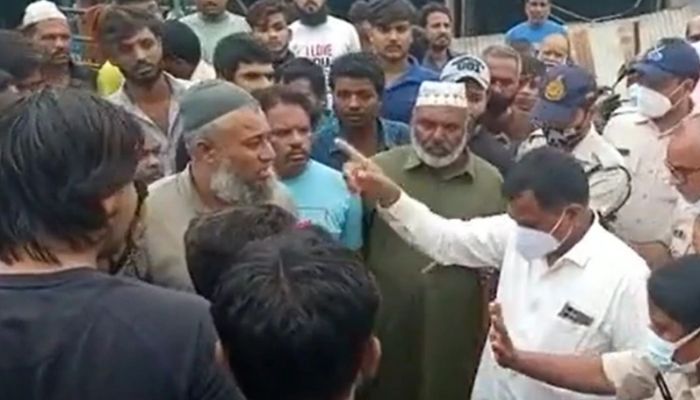
Zee News reported that a large contingent of police personnel was deployed to avert any law and order situation during the demolition drive. In visuals, a large crowd of seen watching as the district administration bulldozed the illegal encroachments. Most shops, which were demolished during the drive were garages. Earlier in July, a total of 100 houses were removed for the expansion of the Mahakaleshwar temple. The Madhya Pradesh government is paying ₹3 lacs to each family and about 130 people had recieved the compensation as of July this year.

Atmanirbhar Bharat: Mahindra Defence bags Indian Navy contract worth ₹1,349.95 crore for Integrated Anti-Submarine Warfare Defence Suite

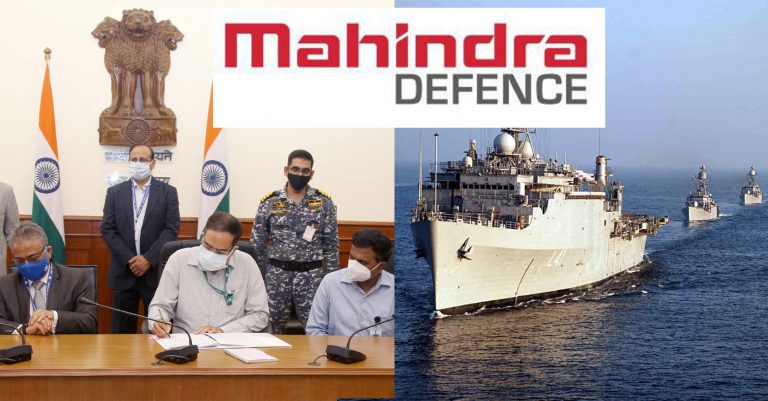
Mahindra Defence Systems Limited (MDS) has bagged a major defence deal from the Indian government for the manufacturing of Integrated Anti-Submarine Warfare Defence Suite (IADS) for the Indian navy. The Mahindra & Mahindra Ltd group company signed a contract worth Rs 1,349.95 crore for manufacturing of 14 IADS systems for modern warships of the Indian Navy with the Union Defence Ministry on August 27.

The system will enhance the anti-submarine warfare capability of the Indian Navy. The IADS comes with an integrated capability for detecting enemy submarines and torpedoes at extended ranges as well as diverting incoming torpedoes fired by enemy submarines. It is high-end underwater equipment designed to detect underwater threats and protest the ships from them. According to a statement issued by Mahindra Defence, the complex array of sensors in water undertakes surveillance, and provides inputs for signal processing and analysis, to enable necessary action.

The company informed that competitive bids from Indian companies were invited by the defence ministry through open tender, wherein the systems fielded were put through detailed trials at sea to prove their capability. Mahindra Defence said that the company was qualified in the tender by proving the capability of the system through comprehensive testing by the Indian MoD in actual operations at sea. After the technical qualification, the company was declared the winner of the commercial bid.

The company added that it would be supplying 14 IADS systems for the Indian Navy warships. “It is the first major contract with the private sector meant for underwater detection and protection from threats. This contract once again epitomises the success of the Atmanirbhar Bharat initiative,” Mahindra Defence Systems Ltd Chairman SP Shukla said.

In a statement, the defence ministry said that the contract with an Indian firm under the ‘Buy and Make (Indian)’ category of defence procurement is an important boost to India’s ‘Atmanirbhar Bharat’ mission and provides a major fillip to the indigenous defence industry in technology development and production. “The MoD has continued to demonstrate its resolve to augment the ‘Make in India’ initiative of the Government and the resolve of the country to become ‘Atmanirbhar’ in advance technologies with induction of multiple equipment through home-grown defence industry,” the ministry added. Mahindra Defence Systems Limited had tied up with UK based Ultra Electronics for manufacturing of underwater warfare equipment for the Indian Navy.

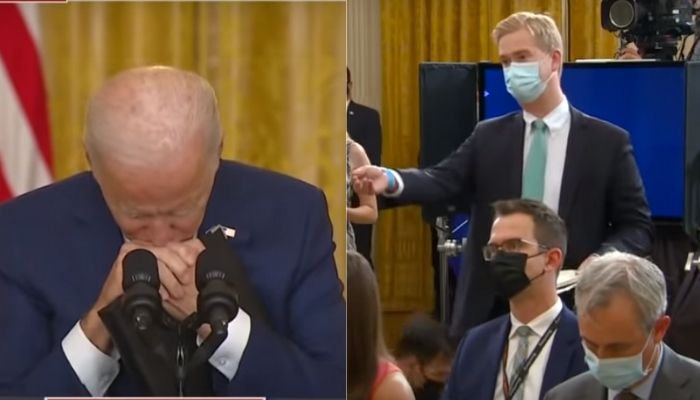
‘Weak, disastrous optics’: Joe Biden condemned after he lowered his head in frustration after facing tough questions on Kabul terror attack

On Thursday (August 26), United States President Joe Biden appeared visibly frustrated on being quizzed about the death of 13 US Marines in a deadly terror attack at the Hamid Karzai International airport in Kabul.

Without mincing any words, Fox News White House correspondent Peter Doocy asked Biden whether he was willing to take any responsibility for the Afghanistan crisis. “Mr. President, there had not been a U.S. service member killed in combat in Afghanistan since February of 2020. You set a deadline, you pulled troops out, you sent troops back in, and now 12 Marines are dead. You said the buck stops with you. Do you bear any responsibility for the way that things have unfolded in the last two weeks?” he inquired.

Joe Biden, who kept Doocy waiting till the end, fumbled as he was pressed with a tough question. The US President managed to get his act together and said that he bore responsibility for everything that had occurred ‘of late’. However, he blamed former President Donald Trump for setting May 1 as the final date of exit for all US troops from Afghanistan. “This was a year before. In return, he was given a commitment that the Taliban will continue to attack others but not attack the American forces. Remember that? I am being serious,” he engaged in rhetorics.

(Video Courtesy: Youtube/Fox News)

After having comprehended the US President’s tactics to avoid answering hard questions, Peter Doocy emphasised, “Donald Trump is not president right now.” Biden tried to interject and stop the Fox News correspondent halfway. At about 1:27 minutes into the conversation, he went on bend his head, close his eyes and rest his hands on the podium. It was evident that Biden was irritated with Doccy’s line of questioning. His gesture was widely criticised by the netizens for showcasing the US government’s weakness and incompetence in dealing with the situation.

While commenting on the incident, Donald Trump Jr. tweeted, “This is what weakness looks like.”

A Twitter user (@MarcusJoannou) wrote, “Weakness, incompetence and evil personified.”

Another user remarked, “This bloke has destroyed a 20 year US/UK presence in #Afghanistan in less than 2 weeks.OMG America, what have you done?”

Another user stated, “History will not be kind to USA for voting this fool as the President.”

US Senator from Missouri Josh Hawley tweeted, “To say that today’s loss of American lives in Kabul is sickening does not begin to do justice to what has happened. It is enraging. And Joe Biden is responsible. It is now clear beyond all doubt that he has neither the capacity nor the will to lead. He must resign”

It must be mentioned that the incumbent US President Joe Biden had initially decided to withdraw all the American troops from Afghanistan by September 21 this year. His administration had extended the timeline from May 1 to coincide with the 20th anniversary of the 9/11 attacks. Halfway through, he decided to facilitate an early exit on August 31 without considering the aftermath.

Suicide bombing by ISKP at Kabul airport kills stranded Afghans

On Thursday, August 26, bomb blasts near the Hamid Karzai international airport in Afghan’s capital Kabul killed more than 100 people, including 13 US troops, disrupting the ongoing Afghan evacuation of tens of thousands of stranded civilians. Soon after the attacks on their forces, the United States officials attributed attacks that killed more than 100 people at the Kabul airport to Islamic State’s regional affiliate Islamic State Khorasan Province (ISKP). The ISKP has also taken responsibility for the bombing of the Kabul airport and has released images of the terrorist who blew himself up inside the Kabul airport. Abdul Rehman Al-Loghri of the ISKP was allegedly the suicide bomber.

Not just weapons and helicopters, US left biometric data of allies in Afghanistan

Days after the Taliban took over the reins of Afghanistan, it has now come to light that the United States has also left its allies in Afghanistan vulnerable to attack by the radical Islamist outfit. As per an exclusive report by Politico, the Biden administration had handed out a list of American citizens, Afghan allies, and green card holders to the Taliban so as to allow their evacuation from the Hamid Karzai International airport in Kabul. Despite being well aware that the Taliban has a history of killing US allies, the decision to provide specific names to the Islamist outfit by the Biden administration has put their life in jeopardy.

Not just the lists, the Taliban reportedly also have biometric data of all Afghans who had worked with US and NATO forces. After the capture of Afghanistan, a large number of biometric devices, along with weapons, vehicles, and ammunition left behind by American and fleeing Afghan forces were captured by the Taliban. With the US-built military devices, the Taliban now potentially have the access to the biometric database of Afghans. Some devices also store local copies for such databases, which will be easily accessible to the new tech-savvy Taliban. Politico also reported that The Taliban is now going door-to-door in search of Afghan interpreters and US allies after the Biden administration ‘outsourced’ the security to the Taliban.

Is the Modi govt really ‘selling off India’ as claimed by Rahul Gandhi? Here is what Asset Monetisation Plan is and what Congress does not tell you

Earlier this week, the union government unveiled the National Monetisation Pipeline (NMP), through which several national infrastructure assets are being monetised. The plan lists the assets that will be monetised through leasing in the next four years. Expectedly, the Congress party has launched an attack on the scheme, alleging the Modi government of selling the country to crony capitalists.

In his first tweet after his Twitter account was restored, Rahul Gandhi criticised the move terming it as ‘Rashtriya Mitrikaran Yojana’, implying it is a scheme to benefit few friends of PM Modi.

Continuing with his familiar rant, the Kerala MP said that these assets have been built over 70 years and they are being handed over to 3-4 industrialists as gifts, even though the scheme has only been announced and no asset has been handed over to anyone yet.

The Congress party has posted several tweets alleging that national assets are being sold to the friends of PM Modi. They alleged that everything is being sold to the friends of the Prime Minister at cheap rates.

They termed it Monsoon Offer Sale for the friends of BJP, where national assets are being sold at discounted rates.

However, as always, the allegations of the Congress party are completely false and baseless. First, the plan was announced only on Monday, and it is too soon for any asset to monetised in just one week. The scheme will go through detailed tendering processes, where the higher bidders will be able to acquire the monetised assets. At present, nobody knows which company will win which infrastructure.

Therefore, it is more than premature for the Congress party to allege that the plan is designed to benefit Modi’s friends. But this is not the only falsehood being spread by Rahul Gandhi and his party, most of the allegations they are levelling are false.

Contrary to the Congress claim that the Modi govt is selling not just land but also the air, actually, land assets are not included in the monetisation pipeline. Only brownfield assets will be monetised to unlock their value.

The most important point of the scheme is that the assets will not be handed over to the private sector forever, and their ownership will remain with the government. The assets are being leased out, and after the expiry of the lease period, the assets will be mandatorily taken back by the government.

The government has made it clear that only ‘rights’ of the assets are being monetised, not the ‘ownership’. The Asset Monetisation Pipeline does not even include monetisation through disinvestment and monetization of non-core assets such as land and real estate, therefore, it does not including ‘selling’ of anything.

Therefore, the union government is not selling the assets, but only leasing them to generate cash, which is needed for various development and welfare activities. The funds raised from the monetisation of the assents will be used for further augmentation of and maintenance of infrastructure, therefore, it will lead to improvement of the infrastructure in the country.

The National Monetisation Pipeline, developed by NITI Ayog, has identified infrastructure assets including roads, ports, airports, telecom, railways, warehousing, energy pipelines, power generation, power transmission, hospitality and sports stadiums for monetisation. Apart from these, assets from mining and housing redevelopment sectors have also been identified.

Highways and Railways will contribute the most value through the plan, followed by power, oil & gas pipelines, and Telecom, which constitute the top 5 sectors.

Sector wise Monetisation Pipeline

Even though the pipeline has been announced now, the monetisation program of infrastructure is already going on in several sector. For example, the public-private partnership is already widely used in the Highway sector. NHAI has started the Infrastructure Investment Trust (InvIT) for monetisation of Highways and plans to offer 19 projects worth Rs 35,000 crore under this model.

Under this model, the assets are placed in an InvIT in which investors invest money, and the income generated from such assets is paid as dividends to the investors.

Asset monetisation in Railways is also going on with Railway stations, good sheds, freight corridors etc being handed over to private players. The Railways is also in the process of allowing the private sector to run passenger trains.

Similarly, public power transmission and telecom companies have established extensive infrastructure which can be monetised and their value can be unlocked. Powergrid has already monetised some of its transmission lines, and BSNL and MTNL have cellular transmission towers and fibre optic networks which will be offered for monetisation.

Ownership of all these monetised assets will remain with the government, as they will be handed over to the private partners only on long term lease basis under various models of PPP, like BOT (Built Operate Transfer), ROT (Rent Operate Transfer) etc. The assets will be leased for various periods ranging from 4 to 10 years. After the expiry of the leases, the assets will return to the govt, if the lease is not renewed.

The govt is generating money from these assets without outright selling them, contrary to what the Congress party is claiming. The Indian government plans to raise ₹6 lakh crore in the next 4 years through monetisation of assets, in the 2022-2025 period.

The NMP is in line with Prime Minister Narendra Modi’s strategic divestment policy, under which the government will retain presence in only a few identified sectors, in line with “Minimum Government, Maximum Governance”, and the rest will be handed over to the private sector to operate them. This asset monetisation will unlock resources which will lead to value unlocking of underutilised brownfield assets which have been languishing for decades. This will also create productivity gains in the concerned sectors.

The objective of the asset monetization programme is to unlock the value of investment made in public assets which have not yielded appropriate or potential returns so far. It is designed to serve as a medium-term roadmap for identifying potential monetisation ready projects across various infrastructure sectors.

The National Infrastructure Pipeline (NIP) seeks to create infrastructure assets of Rs 111 lakh crore in the next few years. Given this huge funding requirement, the govt has come up with the Asset Monetisation Pipeline to partly fund it.

‘Eent se eent baja dunga’: Threatens Navjot Sidhu if not given decision-making power in Congress

Newly appointed Punjab Congress President Navjot Singh Sidhu in a recent speech threatened to create chaos if he is not given decision-making power in the party. “The party high command should allow me the freedom to take decisions,” demanded Sidhu intensifying the ongoing feud in Punjab Congress. 

Speaking at an event in Amritsar on Friday, Sidhu roared, “Eent se eent baja dunga (won’t spare anyone).”

The All India Congress Committee (AICC) general secretary in-charge of party affairs in Punjab, Harish Rawat reacted to the unwarranted statement by the state president.

“Who will have the power to take decisions if not the state presidents?” remarked Rawat specifying that state chiefs are free to take their decisions within the party’s norms and constitution. He added thatg he cannot comment on the basis of media speculation and he has to first understand the context of Sidhu’s comments. Rawat will reportedly meet Rahul Gandhi and Sonia Gandhi tomorrow.

Sidhu’s statement comes at a time when his advisor was in the line of fire for making sensitive comments on Kashmir and Pakistan.

Advisor to the Sidhu, Malwinder Singh Mali had stirred controversy after he in a social media post said if Kashmir was a part of India then what was the need to have Articles 370 and 35A.’ “Kashmir is a country of Kashmiri people,” read his post further. 

Sidhu received severe criticism from not just the opposition but also his own party ministers. Congress MP Manish Tewari said in a Tweet, “I urge Harish Rawat, AICC Gen Secy in-charge Punjab to seriously introspect that those who do not consider J&K to be a part of India and others who have ostensibly Pro-Pakistan leanings should be a part of Punjab Congress.”

Mali resigns as adviser

Owing to the backlash for his social media post, Sidhu’s adviser Mali has tendered his resignation. “I withdraw my consent given for tendering suggestions to Punjab Congress President Navjot Singh Sidhu,” wrote Mali in a letter. 

He, however, alleged that a hate campaign was orchestrated against him by some political leaders. 

Karnataka: Men caught ferrying 25 fruit bat carcasses, were taking to sell for meat

0

As many as 25 fruit bat carcasses were recovered from the Tumakuru district while being transported in a four-wheeler on Wednesday night. While the 34-year-old man ferrying the dead fruit bats was arrested, his three aides managed to escape when stopped by forest department officials at Hanumanthapura.

As reported by TOI, Range Forest Officer Nataraja L informed that a nylon net used to capture and kill the mammals was recovered from the vehicle carrying the carcasses. As per forest officials, fruit bats are killed for meat and supplied to Tumakuru and Bengaluru. 

Taking cognizance of the matter, deputy conservator of forests S Ramesh said, “I got information that fruit bats are being killed in the district and sent to non-vegetarian hotels in Tumakuru and other areas. The department will step up patrolling and take action to prevent such incidents.”

“Killing fruit bat for meat rampant”

As per Times Now report, Environmentalist BV Gundappa said, “Killing fruit bats for meat is rampant in Devarayanadurga forest, Jagannathapura, Sira taluk and Huliyurdurga of Kunigal taluk in Tumakuru.”

The large-eyes bats fly out in search of fruits and get trapped in the nylon nets erected between trees where they are found the most. People then gather them from the nets, put them in bags and sell. The bat meat seller sits at one place, sends out a message to the villagers who then come and purchase the meat, informed the environmentalist. 

Gundappa further informed that only two types of bats: Salim Ali’s Fruit Bats and Wroughton’s Free-Tailed Bats are legally protected under the Wildlife Protection Act. Since others are considered ‘vermin’, killing bats for meat is rampant in some areas. 

Economic crisis, starvation, chaos or stability and possible partnership with the USA? The road ahead for Afghanistan under the Taliban

The Kabul airport attack was what so many feared would happen following the withdrawal of US forces from Afghanistan. Before the USA invaded Afghanistan, the country was a haven for global terrorists under the Taliban and many feared that once US forces left, it will again turned into a rallying point for Global Jihad.

After the Taliban managed to capture Afghanistan on the 15th of August, it stands on the precipice of a new era, the dawn of a new chapter in its history. At such a juncture, there is much to fear for the future of the country and at this point in time, there is very little that gives hope.

Human rights and women empowerment is already receding in Afghanistan and in addition to that, there are grave implications of a Taliban regime in India’s neighbourhood. Thus, it is perhaps an appropriate time to discuss the primary areas for concern not only India but for the whole world.

Economic Crisis in Afghanistan

After the collapse of the Afghan Government, the US froze $9.5 billion of Afghan funds and has blocked its access for the Taliban. Moreover, ATMs are running out of cash and banks are closed. Furthermore, according to the World Bank, 40% of Afghan GDP came from international aid.

Under such an environment, a grave economic crisis looms over the country. The state of the job market is unlikely to improve, given the instability in the country. And a flailing economy is a recipe for further chaos. It is a self-perpetuating cycle. Poor economy fuels instability and instability destabilizes the economy.

Ahmal Ahmady, former head of the Central Bank in Afghanistan, said in an article for Financial Times, “I expect the economic impact to be felt in three main ways. First, the afghani currency will probably decline, increasing inflation. There are already reports that wheat prices have doubled in Kabul. Even those depositors with money will not be able to fully withdraw their savings.”

Due to the Taliban takeover, top donors have suspended aid to the country. At the same time, there is risk of widespread starvation. One-third of Afghans are estimated to be at risk of severe or acute hunger. According to the United Nations, half of its children under five are already malnourished.

All of this is likely to get worse within the next few months.

The End of Civil War?

The Kabul Airport Attack was a rude awakening to the obvious reality that the civil war in Afghanistan may be far from over. After 20 years of warfare against US forces, Taliban, it appears, might have to go to war against Islamic State of Khorasan Province next.

Taliban has condemned the attack, which it was expected to do given its penchant for international legitimacy. But the condemnation rings hollow as soon after their takeover, they had released hundreds of prisoners from Afghan jails, many of whom were affiliated to Al Qaeda or Islamic State of Khorasan Province, the very same group which has claimed responsibility for the terror attack.

The relationship between Taliban and ISKP are a bit complicated. Although they have collaborated in the past to commit terror attacks, there is significant infighting between the two as well. Omar Khorasani, aka Mawlawi Ziya ul-Haq, was reportedly executed by the Taliban. He was the head of ISIS-K.

Also, multiple clashes have been reported between the two groups in the past. Thus, while some have suggested that the Taliban was in cohorts with the ISIS-K with regards to the terror attack in Kabul, it appears more likely that the terror attack was committed without the ruling Jihadist group’s prior knowledge.

It also has to be conceded that it does not make sense for the Taliban to orchestrate or participate in a terror attack that could jeopardise their victory. It is not to say that they are not capable of such a thing, it is only an admission that conventional wisdom dictates that it is unlikely for the Taliban to have participated in the attack.

But even so, the possibility that Taliban did have some degree of culpability for the attack cannot be negated altogether. There are also speculations that they colluded with ISKP for the attack. For instance, it is a known fact that Taliban released ISKP prisoners after they took over the administration of the country. Were any of them involved in Thursday’s attack?

Surely, the Taliban was aware that some of them presented a legitimate threat to internal stability but they released them anyway. Why did they so if they were aware that some of them might go on to commit suicide attacks or aide them? But most importantly, did they permit the attack to happen because they wanted to humiliate the US further for two decades of warfare? These are tough questions the international community must ask of the Jihadist outfit.

Jeff Smith, research fellow at the Heritage Foundation, pointed out, “Folks (are) having trouble grasping that ISIS and Taliban can both have links to the Haqqani Network or ISI, and still dislike each other. Those two assertions are not incompatible. Unless US military commanders giving firsthand accounts of brutal ISIS/Taliban clashes are all lying.”

That, however, does not present a very rosy picture for them either. It means that they are not as much in control of the country as they would want to be and should they be unable to prevent such attacks in the future, it would be to the detriment of their own credibility.

A large section of Afghans did support them because they were viewed as means to stability, however warped their notion of laws and societal structure might be. If they are unable to deliver on that promise, it could prove to be catastrophic for them.

And this is entirely without taking into consideration the situation in Panjshir Province, which has still not fallen to the Taliban. Amrullah Saleh has declared himself the caretaker president of the country. The events of Thursday have certainly strengthened his position at the negotiations table as Taliban is unlikely to wish to fight a civil war on two fronts.

A strategic alliance between the United States and Taliban

While some may be shocked by the suggestion, there is sufficient indication that there is great collaboration underway already between the USA and Taliban. US officials have revealed that they are relying on the Taliban for security around the airport and according to reports in the media, US authorities have also handed over a list of Americans and their Afghan allies to the Jihadist group in order to felicitate their save evacuation.

Furthermore, US forces had left billions of dollars of military equipment for the Afghan forces, which are now in the hands of Taliban. While the US would obviously deny there is a strategic understanding between the two but there are far too many coincidences to deny the possibility. The first time is chance, second is coincidence and the third is a pattern.

And a pattern is what we see here. Too much weight should not be placed on boastful claims made by the US that “we do not negotiate with terrorists” or that negotiating with “terrorists” and “terrorist outfits” are beyond what the US is capable of.

It is a known fact that the US armed Jihadists against Basshar al-Assad in Syria, groups which were associated with Al Nusra and Al Qaeda. It is also widely known that the rise of ISIS was directly fueled by US policies in the Middle East. Furthermore, the US also arms neo-Nazis in Ukraine against Russia.

Therefore, it is certainly not beyond the realm of possibilities for USA to form a strategic partnership with the Taliban. If they can form a tactical alliance with Al Qaeda, responsible the most devastating terror attack on US soil, they can certainly partner with Taliban, even though they have spent two decades at war against them.

The alliance between USA and Pakistan is the greatest evidence of it. The USA is fully aware that Pakistan aided the Taliban against them and yet, it has not soured relations between the two countries to any significant degree.

The partnership would make sense for the Taliban as well, which would aid them in securing international legitimacy and access to international aid and funds from abroad. For the US, it could mean an assurance that Afghan soil will not be used to plot attacks against them.

In turn, the Taliban would wipe out terrorist outfits such as ISKP for Americans. It is not an unrealistic stretch to assume that the military equipment left by the US could be used by Talibs against ISKP. The distinct possibility arises that USA had to choose between the government it had backed in Afghanistan, which was unpopular, and the outfit opposing the said government.

Thus, the US came to the conclusion that its objective or preventing Afghan soil from being used against them would be better served by opting to back Taliban over the latter. And everything that has happened in recent weeks is a logical conclusion of the decision made by USA.

But there are downsides to such an arrangement. The Afghan Government was unpopular among significant sections of Afghans because it was perceived to be allying with ‘foreign invaders’. Now, if Taliban is seen to be doing the same, it might lead to disenchantment with them as well.

Subsequently, it might inadvertently strengthen support for the ISKP. Nonetheless, the situation in Afghanistan as of this moment remains tense and only the future would reveal what is in store for the nation.


Uttar Pradesh Ex-IPS officer Amitabh Thakur arrested in abetment to suicide case after woman who immolated herself dies: All you need to know

Retired IPS officer Amitabh Thakur was on Friday arrested for abetment to suicide after a woman who had set herself fire outside the Supreme Court a few days ago succumbed to her injuries in a hospital in Delhi. A case was registered against Thakur in which the retired IPS official was accused of provoking the woman for taking the extreme step.

A video of Thakur being arrested by the UP police officials has surfaced on social media websites. In the video, Thakur could be seen desperately trying to resist the arrest as police officials shove him inside their vehicle.

The arrest came hot on the heels of the death of the woman who had self-immolated herself outside the Supreme Court complex earlier this month. The UP Police says it arrested Thakur based on a complaint filed by the deceased victim on November 10, 2020. In her application to SSP Varanasi, the victim had alleged that Amitabh Thakur took money from BSP MP Atul Rai for tampering with the evidence in the case. The Hazratganj police said Thakur was charged with abetment to suicide.

A woman and a man had immolated themselves outside the Supreme Court complex on August 16. The man had sustained 65 per cent burns and had died last Saturday while the woman had suffered 85 per cent burns before succumbing to her injuries on Tuesday this week.

The duo had accused jailed BSP MP Atul Rai of sexual harassment and alleged that several police officers, including Amitabh Thakur, had supported the accused.

It is worth noting that Rai has been in judicial custody in the case for the last two years. Before committing suicide, the woman, along with her colleague, had recorded a Facebook Live Video session, in which they had disclosed their identity and claimed that they had filed a rape case against the BSP MP in 2019.

Thakur was reportedly kept under house arrest earlier this month

Significantly, Thakur had earlier accused the UP Police of keeping him under house arrest. In a video released on social media websites, Thakur said when he was preparing to leave, the Gomti Nagar police arrived and told him that he can’t go ahead with the planned visit citing security reasons.

The former IPS officer had asserted that the police didn’t let him go even when he asked them to provide him security instead of cancelling the visit.

Before his arrest, Amitabh Thakur had announced floating a new political party to fight against Yogi Adityanath

Interestingly, as UP assembly elections approach, Thakur had earlier today announced that he will float a new political party soon. “After consulting my supporters and well-wishers, I have decided to float a new political party,” Thakur said.

He named his new political party Adhikar Sena and asked his supporters to suggest more names, along with the purpose, mission and structure of the party.

The Yogi Adityanath government had issued a directive for Thakur’s premature retirement on March 23 this year, stating that he was “not found fit to be retained for the remaining tenure of his service”.

Thakur’s wife Nutan Thakur had also recently announced that her husband would be fighting the forthcoming UP assembly elections against CM Yogi Adityanath.

“Yogi Adityanath has presided over several undemocratic, improper, suppressive, harassing and discriminatory steps during his tenure as chief minister. Hence, Amitabh shall be contesting the election against Adityanath from wherever he contests,” she had said.

Amitabh Thakur is a B-Tech graduate, an IIM Lucknow pass out and an IPS officer of the 1992 batch. An officer of Uttar Pradesh cadre, Thakur would have retired in 2028, but his service was cut short in 2015, days after he accused the Samajwadi patriarch Mulayam Singh Yadav of threatening him. A vigilance inquiry was also initiated against him.

But the Lucknow Bench of the Central Administrative Tribunal stayed his suspension in April 2016 and ordered his reinstatement with full salary with effect from October 11, 2015.