Saturday, April 4, 2026
Home Blog Page 42

What are puberty blockers, and why is the UK pushing ahead with a £11 million puberty blocker trial on children, despite safety concerns? Explained

The United Kingdom is preparing for a new clinical trial in January involving medications that prevent puberty. A group of over 200 kids who believe they might be transgender, possibly as young as eight years old, would participate in the research. The development occurred after drugs were banned for gender treatment last year, owing to concerns expressed by an extensive evaluation regarding the lack of clinical data regarding their safety for minors.

According to reports, the new trial has received public funding and has been submitted for ethics approval. A staggering £11 million budget has been allocated, and nearly 220 youngsters under the age of 16 who are going through puberty are expected to engage in the trial. The information was submitted by the researchers from King’s College London (KCL), who will look into the effect of the drugs on their physical, social and emotional health.

Professor Emily Simonoff asserted that young people and their parents seeking aid for gender distress “tell us that they don’t know what to do – they look at the information that’s out there, and they don’t know what’s best for them,” reported BBC (British Broadcasting Corporation). She is the study leader and professor of child and adolescent psychiatry at the institution.

Simonoff further claimed, “We are looking very much at the balance between, possibly, benefits for mental health and quality of life, and any possible risks or harms.” She added that it will involve keeping an eye on the physical well-being of the individuals. This is also the first study to examine the effect on brain development.

Cass Review and the truth about puberty blockers

Drugs called puberty blockers or puberty-suppressing hormones (PSH) are used to postpone or avoid puberty. They were utilised on young people with gender dysphoria. However, doctors can now only administer them to patients under the age of eighteen as part of a research study due to the uncertainty around their safety. The details were brought to light by the Cass Review into gender care.

Dr Hilary Cas,s who headed the research, pointed out, “We don’t have good evidence” that puberty blockers are suitable to take to “arrest puberty,” while talking to the BBC. The former President of the Royal College of Paediatrics and Child Health (RCPCH) stated that the initial clinical trial had been expanded to a larger group of youth before the trial’s findings were disclosed.

The paediatrician also noted, “It is unusual for us to give a potentially life-changing treatment to young people and not know what happens to them in adulthood, and that’s been a particular problem that we haven’t had the follow-up into adulthood to know what the results of this are.”

Cass suggested creating a puberty blocker trial as an element of a “full program of research” as she observed that gender medicine was “built on shaky foundations” and “an area of remarkably weak evidence.” She emphasised, “My review uncovered a very weak evidence base for benefits from the use of puberty blockers for children and young people with gender dysphoria. In fact, some children had more negative than positive effects.”

“However, given that there are clinicians, children and families who believe passionately in the beneficial effects, a trial was the only way forward to make sense of this,” she added. Hence, Wes Streeting, the Health Secretary, outlawed puberty blockers after the four-year independent review concluded that the data supporting their use was “remarkably weak.”

The government then implemented an indefinite prohibition on the medications being prescribed to children and young persons who are unsure about their gender identity, either privately or through the National Health Service (NHS).

“Sale and supply of puberty blockers via private prescriptions for the treatment of gender incongruence and/or gender dysphoria to be banned indefinitely in the UK for under 18s. It follows a targeted consultation and advice on patient safety from the independent Commission on Human Medicines and the Cass Review,” declared the Department of Health and Social Care.

The fresh trial is on the cards

A study named “Pathway” has been approved by the UK to purportedly ascertain “how the NHS can best support children and young people with gender incongruence,” per the World Health Organisation’s diagnostic manual. The subjects are expected to meet specific criteria. All of them should have reached puberty, but not be above 16. They must also fulfil certain requirements and undergo extensive medical and psychological testing before the commencement of the process.

A group of specialised NHS doctors need to have a complete overview of their health before approving their candidature. The youngsters also have to demonstrate that they have a sufficient grasp of the possible consequences of using puberty blockers alongside the permission of their parent or legal guardian to gain consent. They will also receive continuous psychological assistance.

The researchers intend to start the trial on one group immediately and a second group after a year. The drugs will be offered for two years to one group and one year later to the other. The kids in these groups shall be selected at random.

For girls and boys, puberty usually begins at age 11 and 12, respectively. However, the researchers stated that there would be no minimum age to take the medications. The experiment will focus on factors including brain development, bone density and long-term mental health and wellness.

Only patients under specialised care from NHS Children and Young People’s Gender Services will be eligible for the trial. There will be another study to compare the brain health of persons given puberty suppression with those who were not.

According to the research team, the trial has received ethical approval and is poised to begin soon. Five to six children will be recruited each month,th and the preliminary outcome should be accessible in about four years. Moreover, a bigger observational study with 3,000 kids is going to probe various forms of assistance and their efficacy.

Interestingly, the trial protocol was reportedly declined to be made public by the Health Research Authority (HRA), which is in charge of ethics approvals for such initiatives in the nation.

Pathway sparks outrage, warning of legal action

The trial has generated massive controversy, with opponents even threatening legal action. Keira Bell, who sued the Tavistock gender identity clinic in 2020 after receiving cross-sex medication and puberty blockers as a teenager, has threatened legal action if the trial is not terminated right away.

The NHS closed the Tavistock Clinic, a facility for services related to gender identity development, after an inquiry discovered that it was unsafe for children. Bell regretted her decision and expressed that the staff should have challenged her more about the critical life-choice.

She has conveyed that it is “disgusting” to administer these drugs to kids after being barred because of their perils. “Children are essentially going to be harmed from this trial,” she voiced in an interview with the BBC. She added that it could impact fertility and sexual function while disclosing how she was “extremely angry” about her personal experience with puberty blockers.

Bell and fellow activist James Esses, a psychotherapist,t even issued legal letters to Streeting and medical research institutions in relation to the matter. “Some of the children who are going to be taking part in this trial are not even old enough to open a current account or open a Facebook profile,” Esses mentioned.

The Health Research Authority (HRA) and the Medicines and Healthcare Products Regulatory Authority (MHRA) have received legal letters from the campaigners. The clearance for the trial has been granted by them. The South West London and Maudsley NHS Trust, King’s College London, NHS England and Streeting have also been contacted over the concern.

The trial provokes widespread disapproval

The trial has likewise drawn condemnation from two former Tavistock Clinic members. Susan and Marcus Evans, who worked for the Tavistock and Portman NHS Trust, demanded that the trial be put on “immediate halt.” They argued, “The stakes are too high and the lessons from recent failures too fresh to ignore,” in a nine-page letter and asked Streeting to halt investing in “this shallow, harmful medical trial.”

The two stressed, “There is huge value in learning more about the ongoing longer-term outcomes for them before we impose puberty blockers on a new cohort of children.” They recommended that studies on those who have already taken puberty blockers be restarted.

“The trial design is incapable of answering the important questions about risk that have been raised – to cognitive function, bone health, fertility and long-term health. It is unethical as it will be exposing children to risk for no clear benefit,” ex-psychiatrist and Tavistock whistleblower Dr David Bell told The Telegraph.

Associate sociology professor Dr Michael Biggs of the University of Oxford speculated that the impending trial might turn into a recurrence of the Tavistock blunder, “this time with even more children being subjected to an unethical experiment.”

Dr Louise Irvine, co-chairman of the Clinical Advisory Network on Sex and Gender, condemned the HRA, complaining that its “supervision, regulation and accountability process was totally inadequate” and the previous experiment “failed to do its job.” She added, “The world is watching” this time.

Former education secretary Sir Gavin Williamson signed a letter written by independent MP Rupert Lowe accusing the move to proceedofs caving in to political pressure. The letter outlined, “We cannot and must not repeat the catastrophic failures of the Tavistock era, and we cannot allow twisted ideological pressure to override our duty to protect children.”

Canterbury MP Rosie Duffield remarked that she could not “believe I came to Parliament to have to point out that we should never use experimental/irreversible drugs in trials on children under 13 which halt their puberty.” She stepped down as the Labour whip in protest last year.

Reform UK leader Nigel Farage even sent a letter to Prime Minister Keir Starmer, asking him to pay heed to the concerns and roll back the trial. He wrote, “The Pathways trial represents state-sponsored child abuse, dressed up as research, and is wholly incompatible with the NHS duty to safeguard children and do no harm.”

Conservative Party leader and former Equalities Minister Kemi Badenoch reiterated Cass Review’s results that treating kids required “a holistic approach” and voiced, “Puberty blockers have never been certified as a safe or effective treatment for children with gender distress, and it is hard to believe there could ever be an ethical way of trialling these irreversible drugs for this purpose.”

Anti-trial petitions attract support from JK Rowling and Richard Dawkins

On the one hand, legal action is imminent accompanied by huge protest over the matter, with endorsement from various politicians, while on the other hand, campaigners have launched online petitions that have already garnered significant backing from both netizens and prominent British figures such as author JK Rowling and biologist Richard Dawkins, thereby intensifying pressure on the government to address the gravity of the situation.

A petition titled “Memorandum of Understanding on the Role of Puberty in Adolescent Development” by Genspect, which outlined the dangers associated with the forthcoming clinical trial and demanded its cancellation, was signed by Dawkins.

The petition stated that each child has a right to an open future with “the freedom to enter adulthood as whole as reasonably possible – physically, emotionally, and cognitively – and to have the opportunity to assume adult responsibilities and fully participate in society.” It added that “medically suppressing puberty to relieve gender-related distress infringes upon this right.” The petition described the puberty blockers for gender-distressed minors as “ethically unjustified, medically unnecessary and potentially harmful.”

It mentioned that this natural process has been hampered by the adoption of puberty blockers, stressing, “Approximately 98% of minors starting puberty blockers proceed to cross-sex hormones, with many also undergoing irreversible surgeries, contradicting claims that these interventions merely pause development. Puberty suppression poses considerable risks to physical health and presents significant uncertainties regarding its impact on cognitive and psychosocial development.”

Esses, who serves as a spokesperson for Sex Matters, launched a similar petition named “Cancel the clinical trial into puberty blockers & safeguard vulnerable children.” The cause received support from Rowling, who also encouraged others to back the petition,n which is inching closer to 125,000 signatures.

Launched on the official Parliament website on 8th January, the petition experienced a spike in popularity after the Harry Potter author shared it. A petition must gather 100,000 signatures to qualify for discussion in the Parliament.

“Most people really, truly hate the idea of harming children in the name of ideology,” commented Helen Joy,ce who is director of advocacy, Sex Matters. “The government needs to take note – people loathe the idea of the puberty blocker trial and won’t forgive anyone who is involved,” she warned.

“I’ve spent over half a century in medicine, and I certainly do not approve of using puberty-blocking medicine on healthy young children. It is dangerous and wrong,” pointed out Professor Karol Sikora, a consultant oncologist, also spoke of her satisfaction over the positive response to the petition.

Furthermore, Labour MP Jonathan Hinder expressed, “The speed of this petition reaching 100k signatures shows the strong public opposition to this.” He contended that his party’s “voters oppose puberty blockers by a margin of four to one. Wes Streeting must think again.”

Conclusion

This trial has encountered considerable flak spanning the political spectrum and including concerned citizens from all walks of life for legitimate reasons. There are substantial reservations that Pathway could mirror the Tavistock issue, but on a grander scale, affecting a greater number of vulnerable lives.

The Bayswater Support Group, which assists 600 families with gender-confused children, expressed that it was “inconceivable” that the NHS was geared up “to re-open a back door to further vulnerable children taking medically unnecessary and potentially irreversible drugs.”

“All the way through, I’ve had to weigh up the risk of harm to children and young people, which is why it’s not straightforward, why I’ve leaned on clinical advice from people far more qualified than us to make these decisions. But this is not easy, and it is not a comfortable decision, and it’s one that I wrestle with daily,” Steerling has stated amid the mounting attacks regarding Pathway.

The trial would be “watched like a hawk” to make sure that “everything is done absolutely by the book,” vowed Shadow Health Minister Dr Caroline Johnson, who is a paediatric consultant. However, the guarantees have not managed to mitigate the criticism stemming from real concerns.

More importantly, the medications inflict enduring and irreversible harm, especially on young patients who are already at a sensitive age. Adolescence is also a crucial period for the rapid acquisition of new cognitive skills, and therefore, the possible effects of puberty blockers on brain growth and function have been a major source of concern. The same apprehensions have been put forward,d including by those who underwent these operations and were left to cope with their repercussions, underscoring the negligence on the government’s part.

The youngsters are relegated to the status of guinea pigs, gs disregarding their future and well-being, while millions are wasted to devastate lives just to validate a warped perception of gender identity and liberalism, instead of offering genuine help to resolve the problem at hand.

Reuters journalist Saad Sayeed writes dubious ‘exclusive’ stories to boost unrealistic Pakistan defence deal narrative, makes self citation loop obvious

Within a span of six days, a series of “exclusive” reports by Reuters journalist Saad Sayeed have projected Pakistan as an emerging force in the global arms market. In his reports, Saad claimed Pakistan is in talks with multiple nations for multi-billion-dollar defence deals spanning South Asia, the Middle East, and Africa. Interestingly, Saad’s back-to-back Pakistan-centric bylines came almost a year after his last byline had appeared on Reuters.

Source: Reuters

These reports, published at a questionable pace and in a uniform tone, have raised questions not only over the claims themselves but also over the sourcing practices and narrative building. Interestingly, Pakistan, a country that is neck-deep in loans and facing massive inflation, is being projected as a rising arms supplier in a region where India is increasing its dominance in military equipment exports.

Saad’s Muck Rack profile suggests his location is Hong Kong and the bio on the website says he is based in Islamabad.

Source: Muck Ruck

A rapid burst of defence exclusives

The sequence began on 7th January with two reports. In the first report, Saad claimed that Pakistan was in talks with Bangladesh over a defence pact involving JF-17 Thunder fighter jets and Super Mushshak trainers. The second report suggested that Saudi Arabia was considering converting existing loans into a potential $4 billion JF-17 deal.

Both reports written by Saad foregrounded the aircraft’s “combat-proven” credentials. They cited the India-Pakistan conflict of May 2025, which took place after India initiated Operation Sindoor to eliminate terrorist camps inside Pakistan and Pakistan-occupied Jammu and Kashmir (PoJK). Operation Sindoor was a military response to the Pahalgam terrorist attack, in which 26 innocent Hindu tourists were killed by Pakistan-sponsored terrorists.

Saad claimed that the jets Pakistan is trying to “sell” to Bangladesh and Saudi Arabia are combat-tested against India, a claim the hostile nation has failed to prove with evidence. He framed the negotiations as part of Islamabad’s efforts to stabilise its economy through defence exports.

In the Bangladesh report, Pakistan’s defence minister Khawaja Asif was quoted claiming that a surge in defence orders could make International Monetary Fund (IMF) assistance unnecessary within months. The statement appeared without analytical challenge or economic counterweight.

Notably, in the past few years, Pakistan has gone to the IMF multiple times with a begging bowl, seeking financial assistance to support its drowning economy. The IMF imposed several restrictions to issue loans. Apart from the IMF, Pakistan has also taken loans from China, Saudi Arabia, and other nations.

On 9th January, another “exclusive” was published in which Saad claimed that Pakistan was nearing a $1.5 billion arms deal with Sudan, involving aircraft, drones, and air defence systems. Interestingly, when India launched Operation Sindoor, Pakistan’s “air defence” could not stop even a single missile, and India not only managed to neutralise several terrorist camps but also attacked military installations after Pakistan retaliated. On the other hand, India’s air defence successfully neutralised a swarm of drones and missiles during the conflict.

On 12th January, yet another “exclusive” report was published in which Saad claimed that Indonesia was in advanced talks to acquire more than 40 JF-17 jets and Shahpar drones. Four exclusives in under a week, all reinforcing the same trajectory.

Dependence on anonymous and retired military sources

Across the reports written by Saad, the sourcing patterns remain strikingly consistent. Key details are attributed to unnamed officials described as “sources close to the military” or “sources with knowledge of the matter”. Furthermore, the reports were supplemented by commentary from “retired Pakistani air marshals” who were “informally” briefed on defence affairs.

Official confirmations, where cited, were limited to acknowledging meetings or discussions, not the scale, financial structure, or finality of the alleged deals. The substantive claims rest almost entirely on these unnamed or semi-detached figures.

When it comes to defence-related reporting, anonymity is common. However, the repeated reliance on similar categories of sources, without named independent analysts or dissenting assessments, raises questions about verification and balance.

A closed loop of internal citations

Another notable feature is the dense web of self-referencing within Reuters’ own coverage, especially to reports written by Saad himself. Each new article cited earlier reports as evidence of Pakistan’s growing defence footprint.

The Indonesia report points back to the Sudan, Saudi, and Bangladesh pieces. The Sudan article references the Saudi and Bangladesh talks, along with an earlier Libya deal. The Saudi and Bangladesh reports cross-reference each other. While some of the reports were written by Saad, co-authored with Mubasher Bukhari in the Sudan report or Ananda Teresia in the Indonesia report, others were written by Ariba Shahid and Asif Shahzad, who have produced hundreds of Pakistan-centric reports.

This internal citation loop is risky as it creates the appearance of corroboration, even when the sources behind the actual stories remain largely unchanged. Such circular reinforcement is often used to create a narrative that, in reality, does not exist, and in this case, it appears to have been done to position Pakistan as a key player in the defence sector in the Indian subcontinent.

A consistently favourable framing

Across all four reports, Pakistan’s defence ambitions were framed as economically transformative and strategically successful. Potential downsides received limited attention.

The Sudan report briefly noted the country’s civil war but focused on how Pakistani arms could “revive” the Sudanese army, offering little engagement with the ethical implications of supplying weapons amid a humanitarian crisis.

In the Indonesia-centric article, the authors acknowledged Jakarta’s wider fighter jet considerations but positioned the Pakistani option as competitively advanced. However, this was done without comparable scrutiny of performance claims or geopolitical trade-offs.

The cumulative effect is a narrative that foregrounds Pakistan’s gains while downplaying risks associated with arms proliferation, sanctions exposure, and regional instability.

Editorial responsibility and trust

These patterns sit uneasily with Reuters’ own Trust Principles, which emphasise accuracy, independence, and restraint in the use of anonymous sources.

Exclusivity may drive attention, but on sensitive defence matters with global implications, repetition without diversification of sources risks blurring the line between reporting and amplification.

The question is not whether Pakistan seeks to expand its defence exports. That is well established. The more pressing issue is whether journalism, especially from a global wire service, should appear to advance that narrative with such confidence, speed, and uniformity, without visibly testing the claims it carries.

In today’s time, information itself shapes geopolitics. How a story is built matters as much as the story itself, as it can affect decision-making processes. If these reports have been written to boost Pakistan’s position as a key player in the defence sector, it is worth exploring on whose behest this is being done, especially when India has positioned itself as a major defence exporter in the last decade.

China provokes again, claims Shaksgam Valley based on illegal 1963 deal with Pakistan: Know why this Himalayan territory was always a part of India

Even as efforts are being made to improve bilateral relations between India and China, territorial claims continue to cause friction between the two countries. The fresh tensions are triggered by China’s construction of infrastructure, including a new road, in the Shaksgam Valley. While China is asserting that the region is a part of its ‘sovereign territory’, India has called this a blatant violation of its territorial integrity.

India and China engage in a war of words over territorial claims on the Shaksgam Valley

Days after China made a delusional claim that the Indian state of Arunachal Pradesh is a Chinese territory named ‘Zangnan’, China provoked India again by asserting its illegal claim over the Shaksgam Valley, which is a part of Pakistan-occupied-Kashmir (PoK) illegally ceded to China in 1963.

In response to a question during a press meet on 12th January, Mao Ning, the Chinese Foreign Ministry spokesperson, said, “First of all, the territory you mentioned is part of China’s territory. The Chinese side has been implementing infrastructure and construction activities in its own territory. China signed a border agreement with Pakistan in the 1960s, which determined the borders between the two countries as an authority for Central Asia as their sovereign state in the 1970s.”

Regarding India’s objections to the China-Pakistan Economic Corridor, which passes through the Indian territory illegally occupied by Pakistan, Ning said, “You mentioned China-Pakistan Economic Corridor, as an initiative to promote local economic development and improvement. The border agreement between China does affect its position on Kashmir, and China’s position remains unchanged in this regard.”

China’s provocative remarks come after India rejected China’s “efforts to change the ground reality in the Shaksgam Valley”. New Delhi stated that it reserves the right to take requisite measures to protect its interests in the region.

During a press conference on January 9, Randhir Jaiswal, the spokesperson of the Ministry of External Affairs, stated that India has never recognised the illegal and invalid 1963 Sino-Pakistan Agreement, under which Pakistan ceded the Shaksgam Valley to China. He added that India has also rejected the China-Pakistan Economic Corridor (CPEC), which passes through territory that is “forcibly and illegally occupied” by Pakistan.

“Regarding Chinese infrastructure buildup via CPEC, as also in the Shaksgam Valley, which is Indian territory. We have never recognised the so-called China-Pakistan boundary agreement of 1963. We have consistently maintained that the agreement is illegal and invalid. We do not recognise the so-called China-Pakistan Economic Corridor (CPEC) either, which passes through Indian territory that is under forcible and illegal occupation of Pakistan,” the MEA spokesperson said.

The MEA spokesperson reiterated India’s position that the entire Union Territories of Jammu and Kashmir and Ladakh are “an integral and inalienable part of India.”

“We have consistently protested with the Chinese side against attempts to alter the ground reality in the Shaksgam Valley. We further reserve the right to take necessary measures to safeguard our interests,” he said.

China has been building infrastructure in the Shaksgam Valley over the years

Various media reports claim that around 75 kilometres of a 10-meter-wide road has already been constructed by China in the Shaksgam Valley, while further construction continues. Earlier, the Chinese People’s Liberation Army (PLA) built a 36-kilometre stretch of the road. With the continuous construction of this road, China is inching closer to India’s Siachen.

Satellite Imagery shows that this road is connected to two Chinese military posts outside the Shaksgam Valley. One of the could be the headquarters of the PLA unit operating in the area. The road holds significance as it lies in the Trans-Karakoram Tract region, which is historically a part of Kashmir, and the entire Jammu and Kashmir, including the PoK and the Shaksgam Valley, ceded illegally by Pakistan to China, belongs to India.

Satellite images captured by the European Space Agency in 2024. Source: IndiaToday

Back in 2021, the illegal authorities in the Pakistan-occupied Gilgit-Baltistan announced plans for constructing a new road connecting Muzaffarabad to Mustagh Pass, which sits on the Pakistan border with the Shaksgam Valley. It was reported that this road would be connected with Yarkand in Xinjiang, meaning that the road would likely pass through the Shaksgam Valley to link with China’s national highway G219.

While the road may have been constructed for the transportation of minerals like Uranium mined in Pakistan-occupied Gilgit-Baltistan, China and Pakistan can use the road for military manoeuvres in the face of a full-fledged conflict with India.

Notably, the road in question enters the Aghil Pass. This pass has historically been Kashmir’s frontier with Tibet. During the India-China border negotiations in 1960, the Indian side led by J. S. Mehta, Director, China Division in the Ministry of External Affairs, told the Chinese side, “The official maps of the Government of India, including the one attached to the 1907 edition of the Imperial Gazetteer of India and the political maps published by the Survey of India showed this area in Indian territory.”

“The official maps of the Government of India, including the one attached to the 1907 edition of the Imperial Gazetteer of India and the political maps published by the Survey of India showed this area in Indian territory. Official Chinese maps published in 1917, 1919 and 1923 also showed this area as a part of India,” the Indian side pointed out back in 1960.

Relevant excerpts taken from the India-China Official’s Negotiations -1960 document.

Shaksgam Valley: Pakistan ceded to China the territory that never belonged to it

The Shaksgam Valley is a remote, high-altitude area in the Karakoram mountain range, extending approximately 5,180 kilometres. The Valley lies in the north of the Siachen glacier and holds immense strategic significance given its proximity to key passes and its role in PoK with China’s Xinjiang. While the 1963 Sino-Pakistan Agreement is deemed the root of the Shaksgam Valley’s disputed status, the issues go back to 1947.

Before the partition of India on Islamic lines in 1947, the Shaksgam Valley was a part of the princely state of Jammu and Kashmir ruled by Raja Hari Singh. This region fell under local chieftain Mir of Hunza’s suzerainty. Hunza acknowledged the Hindu Maharaja’s authority. Historical evidence indicates that the Shaksgam Valley, along with the adjacent Raskam Valley, was included in Jammu and Kashmir’s boundaries. Even the British surveys in the late 19th and early 20th century recognised it as such. Although China made occasional claims relying on vague historical links with the Qing dynasty, these were not formalised.

After India’s partition and the birth of Pakistan in 1947, Pakistan-backed tribal invaders attacked Jammu and Kashmir, triggering the first India-Pakistan War. Amidst the war, Maharaja Hari Singh signed the Instrument of Accession on 26th October 1947, formally integrating the entire Jammu and Kashmir, including the Shaksgam Valley, into the Indian Dominion.

Pakistan, however, occupied a major portion of northern Kashmir during the conflict, including the areas that gave access to the Shaksgam Valley. Since this occupation was illegal, the entire region, including the Shaksgam Valley, remains Indian territory under international law.

There is a prevalent misconception that China-Pakistan relations became strong only after Pakistan and China joined hands for the illegal CPEC. However, Pakistan has long been cajoling China, with the ‘India containment’ goal being the unifying factor. Contrary to the prevalent narrative, China-Pakistan relations encompass six decades of military cooperation, economic and diplomatic alignments, the 1963 agreement on Shaksgam Valley, the onset of nuclear cooperation in the 1970s, Gwadar’s transfer in 2013, and the official launch of the CPEC.

In the aftermath of the Sino-Indian War in 1962, Pakistan seized the opportunity to bolster ties with China. On 2nd March 1963, China and Pakistan signed the Sino-Pakistan Frontier Agreement. Under this agreement, Pakistan ceded control of the Shaksgam Valley to China in exchange for border adjustments in other areas. This agreement, however, was conditional, stating that the ceded territory would be subject to final resolution in any future India-Pakistan settlement on the Kashmir issue.

Aside from being illegal, this agreement was deeply flawed, rather dishonest. How could China take control of the Shaksgam Valley, integrate it into its Xinjiang province, while also claiming that the territory will be subject to final resolution on Kashmir? Hypothetically, if India and Pakistan agree on Kashmir, and the Shaksgam Valley is decided to be returned to India, will China, after investing heavily in infrastructure there, just hand over the strategically significant Valley to India?

India has consistently rejected the 1963 Sino-Pakistan Agreement on the grounds that Pakistan illegally occupied the parts of Jammu and Kashmir now called PoK, and thus had no legal authority to negotiate or cede the territory that belongs to India. Since the Shaksgam Valley was a part of Jammu and Kashmir at the time of accession, Pakistan’s control over PoK is an illegal occupation. Islamabad had no locus standi to enter into bilateral agreements regarding Indian territory with China. It must not be forgotten that Mir of Hunza recognised the authority of Maharaja Hari Singh, and the Maharaja legally and wilfully ceded the entire Jammu and Kashmir to India.

In 1949, the PoK government signed the Karachi agreement with the then Government of Pakistan, wherein all the land rights of Gilgit-Baltistan were passed on to Pakistan. The agreement reportedly was signed by Mushtaq Ahmed Gurmani (Minister of Kashmir Affairs), Sardar Mohammad Ibrahim Khan (President of so called ‘Azad Kashmir’) and Chaudhary Ghulam Abbas.

In this agreement, the so-called ‘Azad Kashmir’ handed over the entire administration of Gilgit-Baltistan to Pakistan (which gave away part of the region to China). It is from this region that Pakistan handed over 5000 Square kilometres (the Shaksgam valley) to China. In fact, Sardar Ibrahim later revealed that his signatures were forged by Muhammad Din Taseer. Soon after the signing of the Karachi Agreement, Ibrahim was removed from office.

Be it the occupation of PoK or the ceding of the Shaksgam Valley, Pakistan has historically been an illegal occupier, with no legal standing to enter into any agreement with any country regarding the entire Jammu and Kashmir region. Thus, China’s control over the Shaksgam Valley and its infrastructure construction there is illegal.

OpIndia Exclusive: SP turned KGMU into a ‘markaz’ of Love Jihad and Islamic conversions, with links from Red Fort blast accused Dr Parvez to Zakir Naik

0

King George Medical University (KGMU), Uttar Pradesh, is recognised for its research and treatment of various diseases. However, the emergence of Islamic radicalism within its walls has recently come to public attention, followed by the incident involving a Hindu doctor who faced harassment from Dr Rameezuddin Naik and accused him of love jihad.

The layers of this radical conspiracy are gradually being exposed. This case highlighted the suffering caused by the oppression of women, the machinations of Islamists such as Rameez and the reported protection offered by political entities like the Samajwadi Party (SP) and the Bahujan Samaj Party (BSP).

The origin of this matter traces back to Pilibhit, the native place of Rameezuddin and his father, Salimuddin, who then relocated to Khatima and took the surname “Malik.” The latter established a homoeopathic medical store and began to make connections with women through this. Salimuddin entered into marriages with four Hindu women, pressuring them to embrace Islam.

According to reports, Salimuddin maintained contact with a Qazi (Islamic judge) from Pilibhit and made regular trips to Deoband. The family witnessed a rise in religious extremism, and this animosity towards Hindus was inherited by Rameez. He excelled academically and was given admission to Agra Medical College in 2012. This marks a pivotal moment in the story.

“Islamic Medicos Meet” at Agra Medical College: A centre for religious conversion

Bhupendra Singh, a former doctor at KGMU, recalled that the event occurred in 2012 when Rameez joined the MBBS program at SN Medical College in Agra. At that time, the Samajwadi Party had assumed power in the state, emboldening the fundamentalists. Afterwards, meetings commenced at the institution in the name of “Islamic Medicos Meet” where Maulanas (Islamic clerics) and senior students began instructing juniors on how to approach Hindu girls. Additionally, there was a WhatsApp group named “Islamic Medicos” which they used to remain in touch with one another.

Bhupendra stated, “Many Muslim doctors trapped Hindu girls in romantic relationships at that college and later changed their religion. Rameez also had four or five close Muslim associates who were pursuing the same objective. One of his acquaintances at KGMU has been engaged in similar activities for the past year.”

He added, “Rameez also had the backing of his family. His father consistently told him to convert girls. He, with Salimuddin’s consent, would acquire American marijuana to showcase his sexual abilities to the girls. He would then assert that his sexual prowess was a gift from Allah.”

Links between KGMU and Zakir Naik

Bhupendra recounted that some medical students at KGMU formed contact with the fugitive Islamic radical, Dr Zakir Naik, in 2004. Over time, the practice of sporting beards and hijabs became prevalent in certain areas of the campus. During this timeframe, radicals linked to Zakir Naik’s ideology started to target Hindu girls. It is reported that Bachelor of Dental Surgery (BDS) students were particularly active in this regard.

“These students became confident during the regime of the Samajwadi Party and the Bahujan Samaj Party. Within three to four years, they turned seniors and commenced delivering speeches. This group remained active until around 2011-12,” Bhupendra mentioned. Medical students were being gathered and indoctrinated under the pretence of an “Islamic Medicos Meet” in Agra. A trend of Muslim doctors marrying Hindu girls was increasingly common at Agra Medical College.

It remains uncertain whether the groups at KGMU and Agra were interconnected or functioning independently. However, the involvement of Maulanas in medical colleges has become a norm. They began visiting Basti Medical College approximately a year ago. A first-year Head of Department in Bulandshahr Medical College was even accused of incorporating examples from the Hadith into his medical science lectures, a practice that had to be stopped after intervention from other faculty members.

The principal faced pressure to provide prayer facilities given the significant number of Muslim students in Bulandshahr. Nevertheless, their objective did not come to fruition after the protests. The presence of clerics is now prevalent in various medical colleges.

It has been revealed that an ex-principal of a medical college, who is currently the principal of a college in Purvanchal, is living with one of her Muslim students in a live-in relationship. She has decided to divorce her husband, and the legal proceedings are ongoing in court.

Conversion, love jihad racket has been going on at KGMU for years.

Bhupendra noted that KGMU served as a major centre for religious conversions almost 10-15 years ago. During that period, the Samajwadi Party and Bahujan Samaj Party were in power, and clerics from local mosques regularly arrived at the campus. However, things were stable for an extended time after the rise of the Yogi government. Now, these activities have reemerged in recent years.

He indicated that some Muslim nurses are deliberately fostering friendships between their Hindu colleagues and Muslim staff. These connections are steered towards physical closeness with time, followed by pressure for religious conversion. A female nursing staff member became Muslim and tied the knot in the Gandhi Ward of KGMU. The conversion has already taken place in another instance,e and arrangements for the wedding are reportedly in progress.

Likewise, a female contract worker has claimed that a middle-aged Muslim employee tried to manipulate her in the Microbiology department. There are accounts which suggested that individuals linked to Rameez’s gang are engaged in similar activities.

Mohammed Adil, an intern doctor at KGMU, was recently charged with raping a nursing student. He was in multiple relationships with Hindu girls, which he later ended to pursue a relationship with a much younger nursing student from his religion. He informed a Muslim female friend that his past affairs with Hindu girls should not be misconstrued, as he believed it was “good work.”

Students, professors and VC: Multiple faces of extremism at KGMU

The issue extends beyond students or junior doctors. It is disclosed that this extremist ideology has infiltrated KGMU at all levels, from the Vice-Chancellor down to the professors. Rameez’s case illustrated how this ilk pressurises the victims. The case came to light, and the female doctor’s father reached out to the Head of Department, Suresh Babu, on the same day his daughter attempted suicide.

However, Dr Sumaira Qayyum and Dr Wahid Ali, faculty members within the department, influenced Babu during a meeting. Afterwards, he declared that the young woman was mentally unstable and Rameez was a good person before the faculty and resident doctors. Furthermore, resident doctors were pushed to speak against her, but they declined to comply.

The father of the victim simply expressed that he did not wish for the accused to approach his daughter. He also had a meeting with the Chief Proctor, yet no decisive action was taken. Sumaira Qayyum and Wahid Ali were actively attempting to protect Rameez while the entire university administration continued to delay the issue. The Vice-Chancellor eventually formed a committee composed of her trusted associates when the pressure from Hindu organisations escalated.

Moreover, serious concerns were being raised about the administration. KGMU Vice-Chancellor Soniya Nityanand disregarded the rules by appointing a Muslim contractual employee as her advisor and improperly facilitating his transition to a permanent position, along with pension benefits. This person in the VC’s officeprotectso Muslim employees in the institution.

A large number of Muslim faculty members were appointed to the Critical Care department during the Samajwadi Party government. It is charged that rules are repeatedly violated in the department. It is even accused that Nityanand’s advisor discards complaint letters submitted by the Head of Department (HOD), who is a Hindu.

Bharatiya Janata Party spokesperson and attorney Prashant Umrao also remarked that the Vice-Chancellor’s office exhibits bias in favour of Muslims. “The office is actively endorsing Muslims. Whether it pertains to cases of jihad or radicalism, the Vice-Chancellor has taken a lenient stance in all instances,” he voiced.

Rameez’s link to the Delhi blast perpetrator

Rameez’s association with Dr Parvez Ansari, who was nabbed in relation to the bomb explosion near the Red Fort in Delhi, has also been revealed. They had created a network aimed at converting female students at SN Medical College. The two stayed in the hostel together and devised plans to lure Hindu girls. They created a collective that comprised several clerics. Any new Muslim student who enrolled in the college was incorporated into their group.

The medical students and junior doctors would first establish friendships with their female classmates with the objective of conversion. They would meticulously observe their every move, remaining with them from the lecturetheatrer to the library. Once a level of intimacy was achieved, they would record compromising videos of the girls and then leverage the same to pressure them into converting to Islam. It has been reported that several female students fell victim to this conspiracy.

Read the report in Hindi here.

No, Shankarsinh, the train coach in Godhra massacre was not set on fire from inside: Even if shame eludes you, is your conscience dead?

Whether politics is a circus or not could be a debate, but it is no exaggeration to say that there certainly are some clowns in it. Despite having their political career ended, and relevance lost, some retired politicians have a penchant for making random and outrageous statements to remain hog attention in the media and social media. There is no evidence that any special census has been conducted to know the number of clowns in Gujarat, but Shankarsinh Vaghela seems to have been trying to get his name included for a long time.

Former Chief Minister Shankarsinh has been largely disengaged from mainstream politics since he broke away from the Congress a few years ago. Vaghela no longer contests the election. It is a different story that before every election, he comes up with a new party, only to make a lot of noise and then calm down after the results.

After staying out of media headlines for a long time, Shankarsinh Vaghela has made a comeback, though a disastrous one. His social media has become more active than it was. If you look at Shankarsinh’s Facebook wall now, you will see two to five reels posted every day. Most of the clips have been taken from interviews he has given to various channels.

In most of his interviews, Shankarsinh Vaghela always targets the BJP, Modi-Shah, and the Gujarat government on different issues, and there is no objection to it. As the leader of the opposition, that is his job; however, now he has changed direction and taken a dangerous path. He has brought up the Godhra Hindu massacre in the middle to accuse the BJP, Modi, of polarising Hindu-Muslim communalism.

A clip of an interview with Shankarsinh on the Godhra Hindu massacre was posted four days ago (January 8) and contains extremely derogatory, factually incorrect, and absurd remarks.

Shankarsinh Vaghela said that the Sabarmati Express coach in Godhra was set on fire from the inside, not the outside, and the local Muslims did not even know what time the train was due to arrive and who was in which coach.

Not only this, Shankarsinh further argued that someone inside had set the box on fire. He further said that this was done so that the BJP could benefit in the elections by creating enmity between Hindus and Muslims.

Shankarsinh Vaghela said,

“Polarize Hindus, polarize Muslims, divide people religiously. What if you want to divide people religiously? There was a plan to do that, a conspiracy I would say, in this conspiracy, the coach of the kar sevaks was burnt in Godhra… It was not the time for these kar sevaks to return but to go to Ayodhya to do kar seva.”

“Who knew that they were going to return? Only an insider would know… How did the Muslims of Godhra know who was where? On which coach was it written that there were karsevaks in it? That coach was set on fire from the inside as a conspiracy. All of them were Hindus. Not only this, the plan was to wrap the dead body in white cloth and take it on a procession in Ahmedabad. What a monstrous plan this must have been. The coach was set on fire in Godhra because of the BJP’s coming to Gujarat. Not only this, the guards became eaters,” he added.

Even after two decades of independent investigation into what happened in Godhra, after the country’s Supreme Court gave its verdict, and after many Muslim criminals were punished, such reckless talk still happens. However, here the seriousness is even greater because it was not made by a common man but by the former Chief Minister of the state where this horrific crime unfolded two decades back.

Is Shankarsinh so stupid that he doesn’t know what really happened on February 27? Doesn’t he know what the Supreme Court’s verdict says about this incident? Doesn’t he know that the local Muslims, having planned and plotted the day before, had gathered stones and petrol and, the next day, when the Sabarmati Express arrived at the station, had locked two of its coaches from the outside and set them on fire? The answer is, of course, no.

Can a politician, a former Chief Minister, go to such lengths to insult the 59 Hindu Karsevaks who were killed in the massacre? To say that the coach was set on fire from inside isn’t that an insult to the Kar Sevaks, their sacrifices, their relatives, their families? Is Vaghela suggesting that the Hindu karsevaks decided to burn themselves to death to frame Muslims and spark a riot?

Who knew that the train would arrive at this time? – Such childish arguments have been made by Shankarsinh; however, doesn’t he know that the conspiracy was already hatched, and a meeting was also held in a guest house the previous day? ‘How did the Muslims know when the train would arrive and who was sitting in which compartment?’ Shankarsinh, who asked this question, does not know that these same Muslim criminals had already stored petrol, and all this has been proven in court. The court has already sentenced the criminals and rejected their bail.

The 59 Hindus who were killed in the burning of the Sabarmati Express coaches on February 27 were Kar Sevaks. Among them were 27 women and 10 children. Their ‘crime’ was that they were returning from the birthplace of their beloved after doing Kar Seva. They had to pay the price of their lives for demonstrating their faith. So that even after that, for years, they would continue to be accused of burning the coaches from within, or that some politician would just put the blame on these same Kar Sevaks to shine his politics and to gain the love of a particular community.

This reel of Shankarsingh has crossed 1 million views so far. It is our collective misfortune that people in the comment box are taking Shankarsingh’s words as truth and promoting them. Let us pray that Shankarsingh gets good sense and may Shankarsingh never meet the families of those 59 karsevaks in his life. Because we do not want a senior politician who has crossed eighty-one to face the same difficulties that he will have in facing these families.

Muslim man who defecated inside Hindu temple in Hyderabad dubbed as ‘mentally unsound’: List of cases where similar alibi has been used to whitewash hate crime and Hinduphobia

On Saturday (10th January) night, a Muslim man identified as Altaf barged into the premises of the Katta Maisamma Temple in Telangana’s Hyderabad and defecated near the idol of the deity.

The incident sparked outrage among the Hindu community after the video of the temple desecration went viral on social media.

After the accused was apprehended and handed over to the police, the 26-year-old Muslim man was dubbed ‘mentally unsound’ by the law enforcement authorities of the Congress-ruled State.

This is not a new phenomenon. Whenever an accused belonging to the Muslim community defiles a Hindu place of worship, he is quickly branded ‘mentally unsound’ or ‘mentally unstable’ either by the police force of a minority-appeasing government or by a concerted group of intellectuals online.

In this way, the accused, by virtue of his faith, gets a clean chit and the motivated religious hatred against other communities is conveniently whitewashed.

But this begs the question – Why does a ‘mentally unsound’ Muslim man rarely desecrate a mosque or a dargah? How does he automatically know about committing blasphemous acts against idol worshippers?

A series of incidents in which mentally unstable Muslim men have desecrated Hindu idols and temples

On Friday (9th January), a 55 year-old Ahmed Sheikh was taken into custody after he attempted to offer Namaz inside the sacred Ram temple.

According to reports, he barged into the high security premises and began preparing to desecrate the holy site. He was soon apprehended and handed over to the place.

After being caught, he reportedly raised Islamic slogans inside the Ram Mandir complex. Later, his family claimed that he was ‘mentally ill’.

In March 2025, a Muslim man named Sheikh Indu vandalised the idol of Goddess Shitala and then set it on fire. The incident occurred in Baruipur city in the South 24 Parganas district of West Bengal.

Visuals of charred idols and the damaged Hindu temple could be seen in multiple posts on social media. The locals were able to apprehend the accused, Sheikh Indu, who was involved in the vandalism and arson attack.

The Baruipur police posted a tweet claiming that the accused is a ‘person of unsound mind’ with ‘mental health issues.’

Screengrab of the tweet by the Baruipur police

“Local people apprehended him and police took custody of the person. A case has been registered and investigation is on. The detained person is an outsider and has mental health issues,” it alleged.

A few days later, BJP leader Dilip Ghosh took to X (formerly Twitter) to inform about the attack on a Kali temple and the vandalism of the idol of the Hindu deity.

The incident occurred in Shankchura Bazar in Basirhat city in the North 24 Parganas district of West Bengal. The BJP leader stated that the attack on the temple took place under the leadership of local TMC politician Shahanoor Mondal.

Screengrab of the tweets by the Basirhat police district

Hours later, the West Bengal Police took to social media to claim that there was ‘no communal angle’ behind the heinous crime.

The cops went on to claim that the extremist behind the vandalism of the idol of Goddess Kali has ‘mental health issues.’

In November 2023, a Muslim man named Ara Sheikh was caught on camera, in which he can be seen entering a Hindu temple and urinating near the Shivling. The incident occurred in Kandar village in Murshidabad district of West Bengal.

The video of his shameful act left the internet fuming and sparked massive outrage, with the Hindu community demanding strict action against the perpetrator.

In September 2022, 2 Muslim women vandalised an idol of Goddess Durga using a spanner in Hyderabad’s Khairatabad area. Before this, they also attempted to destroy the idol of Mother Mary outside a church. As expected, these women were also dubbed ‘mentally unstable’.

When the two women were vandalising the idols, a Hindu man tried to stop them. These women then attacked and injured him. Later, the locals caught hold of them and handed them over to the police.

DCP (Central Zone) stated, “These two women live with their parents. They are mentally ill. They returned from Jeddah in 2018 and have been facing it ever since. They also have a brother who lives together.”

The brother of the accused women, Aseemuddin, claimed, “My mother and sisters have schizophrenia, and my brother has paranoid schizophrenia.”

Around the same time, a Muslim man identified as Rameez Ahmed broke into a Hindu temple in Ranchi and vandalised the idol of Lord Hanuman. The local Hindu community learnt about the incident only on the following morning.

Ahmed was identified only after analysing the CCTV footage. After he was arrested, the police claimed that the accused was ‘mentally unstable’. 

In April 2022, a Muslim man named Ahmed Murtaza Abbasi laid siege to the Goraknath temple in Uttar Pradesh. Armed with a sharp knife, he screamed Allah hu Akbar before attempting to barge into the temple premises.

When the police deployed at the Hindu place of worship attempted to stop him, he severely injured 2 personnel using his weapon.

It was later revealed that Abbasi had taken an oath of allegiance to the ISIS. He used to read online articles, watch videos related to weapons such as AK-47 rifle, M4 Carbine, missile technology etc with the intention to carry out terror attacks.

It had also come to light that he was involved with th terrorist organisation since 2013 and wanted to commit Jihad against Kafirs. However, Abbasi too was labelled as ‘mentally unstable’ by his family and Muslim appeasers alike.

They highlighted his academic credentials to downplay the severity of the attack on the Gorakhnath temple. However, a doctor later confirmed that the terrorist was mentally fit.

In May 2018, a Muslim man named Sonu Khan vandalised idol of Lord Hanuman and Goddess Durga placed inside a temple. The incident occured in the Shahganj region of Agra in Uttar Pradesh. It was reported how the accused carried out vandalism to instigate communal tension.

After Khan was handed over to the police, it was reported that the accused was ‘mentally challenged.’

In 2016, a Muslim man named Yasir barged into a Hindu temple in Jammu, pelted stones at the windowpanes, and attempted to damage the idol of the Hindu deity. Several media outlets downplayed the incident by labelling the accused ‘mentally disturbed’.

Conclusion

It is therefore hardly surprising that the ‘mentally unstable’ trope is being used to defend Altaf, the Muslim perpetrator who defecated inside the premises of the Hindu temple.

And often, no evidence is required to support such claims with the extensive media coverage in favour of the accused. The media, police and government alike are ready to peddle excuses for Jihadis and their dreams of world dominion.

It is a rather convenient excuse to say that the Jihadi was mentally unstable, as if he was turned into a radical Jihadi without his explicit consent. The aim of peddling such nonsense is often rather simple, so simple in fact, that it almost escapes our attention.

The moment you say that a man was mentally unstable, the immediate assumption of the public is that he was lured and deceived into becoming a Jihadi – that he is actually not a dangerous man, but a misguided one.

The Telangana government wants us to dismiss the Hyderabad temple desecration case as just another mentally unstable, educated boy indulging in some ill-advised conduct, but the truth is far from it.

Altaf seems to be our very own Jihadi John, just like the several hundred we document daily.

Australia places India in ‘highest risk’ category for student visa applications days after fake degree scam busted in Kerala. Here’s what happened

Days after a massive fake degree scam was unearthed in Kerala, Australia has moved India into the “highest risk” category for student visa applications. India joins the list with Bangladesh, Bhutan, and Nepal. The new categorisation came into effect on 8th January 2026. Under the Simplified Student Visa Framework (SSVF), India and the other three South Asian nations have been shifted from Evidence Level 2 to Evidence Level 3.

This out-of-cycle re-rating came amidst what the Australian authorities call “emerging integrity risks”.

“This change will assist with the effective management of emerging integrity issues, while continuing to facilitate genuine students seeking a quality education in Australia. The Australian government wants all students to have a positive study experience during their stay in Australia and receive a high-quality education. It is important that Australia’s international education system and Student Visa Program has the right settings to provide international students with confidence they are investing in the best possible education,” the Australian administration said.

Following the re-rating, Indian nationals applying for Australian student visas will be subject to greater scrutiny. The Australian authorities may ask for more documents, seek English language evidence, and conduct rigorous background checks. In addition, bank statements would be verified manually. The relevant officials will have the authority to call institutions and referees.

Notably, India accounts for about 1,40,000 of the 6,50,000 student visas Australia issues annually.

Fake degree racket busted by Kerala Police

The Australian government’s decision came days after a fake university certificate racket was busted by Kerala Police in India. This racket was operated by a repeat offender named Dhaneesh, also known as Dany. He was previously jailed in a similar case in 2013. After completing his jail term, Dany rebuilt and expanded the fake degree scam. He established a clandestine printing operation in Tamil Nadu’s Pollachi town and hired skilled workers from Sivakasi who produced degree certificates bearing forged signatures, holograms and university seals.

These certificates, printed in Tamil Nadu, were routed via Bengaluru and even moved to Kerala, Tamil Nadu, Karnataka, Andhra Pradesh, Maharashtra, Goa, Delhi, and West Bengal, where agents distributed them to the beneficiary parties in exchange for money.

As the scam was uncovered, the authorities seized around 1 lakh fake degree certificates linked to 22 universities outside Kerala. In addition, the police also confiscated computers, printers and counterfeit seals used by the scamsters. Reports say that the printing centre in Sivakasi has led to a fraud certificate network worth about Rs 750 crores.

The police said that the scamsters made crores of rupees by selling the fake degree certificates for Rs 75,000 and Rs 1.5 lakh each.

Image via Mathrubhumi

The main accused, Dhaneesh, was investing the proceeds of crime in luxury properties in n Malappuram and Pune, five-star bars, as well as businesses in the Middle East. 

Dhaneesh alias Dany was arrested by the police in Kerala’s Kozhikode, while allegedly fleeing the country along with his family. The Kerala Police has launched an investigation into whether any officials from the 22 universities provided the accused scamsters with certificate templates, etc. The authorities are also trying to trace individuals who may have secured jobs using the fake degree certificates sold to them by Dhaneesh’s syndicate.

Other than Dhaneesh, the Kerala Police have arrested three other accused scamsters, Jainulabdeen, Venkatesh, and Arvind Kumar from Tamil Nadu’s Sivakasi. Later, Jahangir, who had supplied the papers for the certificate, and Paramashivam, who had made the hologram, were also arrested.

Political storm in Australia after fake degree racket busted in India

Following the exposure of a fake degree racket in India, a political storm erupted in Australia, with Senator Malcolm Roberts linking this racket to the Australian government’s systemic failures in preventing fake degree holders from entering the country and securing jobs. Taking to X on 6th January, Roberts shared a video of him raising the matter in the Australian parliament.

“Police in India have allegedly seized 100,000 forged certificates from 22 universities, with 1 million plus likely used for jobs abroad. I warned about this in August (and asked questions during October Estimates), 23,000 foreign students in Australia were found with ‘purchased’ degrees, many in aged care and early childhood,” Roberts wrote on X.

“I asked Minister Watt if he’d deport those who committed this fraud. All I got was waffling and gaslighting. The Albanese Government is refusing to act, even though these are clear visa breaches,” he added.

PM Modi to flag off the first Vande Bharat sleeper express from Guwahati, Assam: Read about New India’s major Railways upgrade, set to roll soon

On 17th January (Saturday), Prime Minister Narendra Modi is scheduled to launch the nation’s first Vande Bharat sleeper train from Malda in poll-bound West Bengal. The regular passenger services are going to start between Howrah and Guwahati (Kamakhya) from the next day. Railway Minister Ashwini Vaishnaw recently announced that the trains will offer a new overnight travel option between Howrah in West Bengal and Guwahati in Assam.

With the development, Indian Railways is poised to transform overnight travel in India. The new trains promise to improve the experience of nighttime travel since they are designed for high speed, modern comfort and greater security.

Image via The Times of India

An official statement conveyed, “The Vande Bharat Sleeper train is a shining example of the Make in India initiative, as its three most critical systems – the bogie, propulsion system and vehicle control system – have been entirely designed and developed within the country, making it a fully indigenous train set.”

The first Vande Bharat Sleeper train will stop at Bandel, Katwa, New Farakka, Malda Town, New Jalpaiguri, New Coochbehar, New Bongaigaon and Azimganj on its way from Howrah to Guwahati (Kamakhya).

A “Make in India” marvel to enhance connectivity and comfort

Bharat Earth Movers Limited utilised ICF (Integral Coach Factory, Chennai) technology to develop the trains which have a maximum design speed of 180 kilometres per hour (kmph), the number it touched during the last high-speed test, but will only operate at 130 kmph for safety reasons. The speed fluctuates due to a number of circumstances, such as the track’s geometry, stops along the way, section maintenance, etc.

The 16-coach self-propelled train has a first-class air-conditioned (AC) coach, four two-tier AC coaches and eleven three-tier AC coaches. 611 of the 823 berths are set aside for 3AC, 188 for 2AC and 24 for 1AC. The train is equipped with the latest innovations, including automated doors with vestibules, ergonomic sleepers, improved suspension for more comfortable trips and noise-cancelling technology.

Image via News18

The Kavach automatic train protection system and an emergency talk-back system are also present to guarantee passenger safety. The aerodynamic appearance and automated external doors significantly improve passenger comfort. The Vande Bharat sleeper train has similarly placed a high priority on sanitation standards. Vaishnaw outlined, “The disinfectant technology will kill 99.9 per cent of germs. The same technology is being used on the Vande Bharat chair-car version.”

The train even has better cushions and redesigned ladders along with modular bio vacuum toilets akin to those in aeroplanes, as well as a shower cubicle area for the passengers. There are driver cabins at both ends for shorter turnaround times between trips.

A concerted effort has also been made to ensure that the journey is just as enjoyable for the people, particularly for those who take pleasure in food. According to the Ministry of Railways, people will be able to savour regional cuisine as Assamese meals will be provided on trains from Guwahati, while Bengali food will be on trains that commence their respective journeys in Kolkata.

Image via News18

The fresh service is anticipated to assist a broad range of travellers and will cover nine districts, Howrah, Hooghly, Purba Bardhaman, Murshidabad, Malda, Jalpaiguri and Cooch Behar in West Bengal, while Kamrup Metropolitan and Bongaigaon in Assam, leading to better rail connectivity between eastern and Northeast parts of the country. These will be overnight travel that starts late at night and ends early in the morning.

No RAC, only passengers with confirmed tickets

These trains do not have Reservation Against Cancellation (RAC). RAC tickets are frequently granted in the event of non-confirmation, although waitlisted tickets are not accepted and are promptly cancelled in AC class on other express trains. A side lower berth could be shared by two persons under RAC. Every seat will be available starting on the first day of the advance reservation window.

Tickets for the Vande Bharat sleeper train would cost a little more than those for current luxury trains like the Rajdhani Express, and travellers will have to pay a minimum rate equal to that of a 400-kilometre trip. A Railway Board circular informed, “Minimum chargeable distance shall be 400 kilometres. Only confirmed tickets shall be issued for this train. Accordingly, there shall be no provision for RAC, waitlisted, or partially confirmed tickets. All available berths will be available from the day of the Advance Reservation Period (ARP).”

image via News18

All tickets must be purchased digitally, and refunds will be processed within 24 hours. Other guidelines include the requirement for only fully reimbursable passes to obtain purchase tickets. Tickets acquired through concessions or free gratis passes that are not compensated will not be accepted. Furthermore, a lower berth would be assigned based on availability for a kid who does not need a separate berth, at standard child fare.

The effect on the wallets of passengers

The pricing has been designed with the financial capacity of the middle class in consideration. Passengers will pay Rs 2.4 per kilometre for 3AC, Rs 3.1 per kilometre for 2AC, and Rs 3.8 per kilometre for first AC. Therefore, the minimum fare for a 400-kilometre Vande Bharat sleeper train is Rs 960 for 3AC, Rs 1,240 for 2AC, and Rs 1,520 for 1AC. These charges include meals, but Goods and Services Tax (GST) will be assessed independently.

The ticket is priced at Rs 2,400 for 3AC, Rs 3,100 for 2AC and Rs 3,800 for 1AC for the 1,000-kilometre journey between Howrah and Guwahati. The costs are Rs 4,800 for 3AC, Rs 6,200 for 2AC, and Rs 7,600 for 3AC over a 2,000-kilometre distance. The rates are increased to Rs 6,720 for 3AC, Rs 8,680 for 2AC and Rs 10,640 for 1AC for travel up to 2,800 kilometres.

People have to shell out Rs 8,400 for 3AC, Rs 10,850 for 2AC and Rs 13,300 for 1AC for a maximum route of 3,500 kilometres. Officials mentioned that fares change gradually on the basis of the distance covered. The Howrah-Guwahati (Kamakhya Junction) route in Saraighat Express has the highest fares of Rs 1,410 for 3AC, Rs 1,985 for 2AC and Rs 3,320 for 1AC.

Image via The Times of India

The train will take nearly 14 hours to travel 1,000 kilometres and will run six days a week, with trains 27575 and 27576 not running on Thursdays and Wednesdays, respectively.

Vande Bharat sleeper, like other trains, will have quotas for women, persons with disabilities (PwD), and senior citizens, in addition to the Duty Pass quota for employees. These trains won’t have any more quotas. According to reports, the reservation system will guarantee that lower berths are assigned to male passengers at 60 years of age and older, alongside female passengers who are 45 years of age and above.

What the future has in store

Indian Railways intends to swiftly grow this service in the future. Vaishnaw highlighted that eight more Vande Bharat sleeper trains would be introduced over the course of the next six months. It will take the total to twelve by the end of the year and greatly strengthen the long-distance rail connection.

He noted, “By this year, 12 trains will be ready. From next year onwards, production will ramp up rapidly as the entire supply chain will be in place by then.” The semi-high speed Vande Bharat sleeper trains are set to establish the standard for lavish, cosy and secure travel. Notably, the fusion of modern comfort with connectivity, expressed through indigenous means, adds even greater importance to it.

Image via The Times of India

The Modi government has proactively worked to bring far-flung and previously neglected regions closer to one another, linking them to the rest of the country through infrastructure and a vast rail network that expands all four corners of India. The Vande Bharat Express has been instrumental in fulfilling this goal and the latest addition represents another crucial extension in the realisation of these efforts.

Ajit Doval’s ‘revenge through nation building’ triggers outrage from usual Left-liberals who misread history, memory and intent

On 10th January, National Security Adviser (NSA) Ajit Doval addressed young Indians at the Viksit Bharat Young Leaders Dialogue. His speech was rooted in civilisational decline, historical memory and national rebuilding. However, it was quickly stripped of context and projected as a communal provocation by a section of political leaders and self styled liberal commentators.

At the centre of the manufactured outrage was Doval’s use of the word “revenge”. He qualified and contextualised the term himself during the speech. What followed was not a reasoned disagreement but a predictable escalation. History itself was put on trial, and any discussion of India’s past humiliation was branded as hatred.

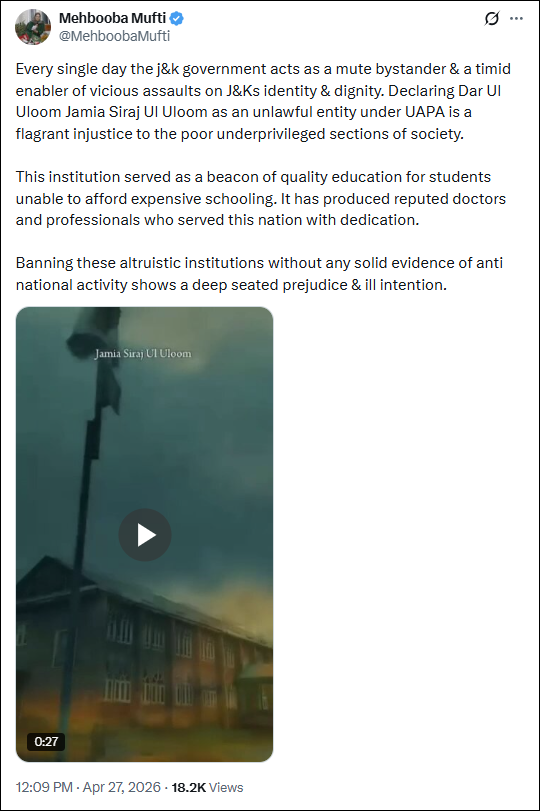
The likes of former Chief Minister of Jammu and Kashmir Mehbooba Mufti, The Wire’s propagandist masquerading as journalist Arfa Khanum Sherwani, Tavleen Singh and Suhasini Haider did not take much time to frame the speech as “insecure”, “Islamophobic” and “dangerous”.

Yet none of these reactions engaged with what Doval actually said during his speech. They relied on insinuation, assumption and a deliberate narrowing of a civilisational argument into a communal box.

What the NSA actually spoke about

During his address, Doval did not say anything that could be marked as impulsive or rhetorical. It was a structured reflection on how India’s freedom came at the cost of centuries of humiliation, executions, destroyed villages, looted cultural sites and economic collapse. Doval spoke of how generations lived without agency, forced to watch their civilisation weaken without the capacity to respond.

Importantly, he emphasised not grievance but responsibility. He asked the young generation to understand history not as a source of perpetual sorrow but as a reservoir of strength. The word “revenge” that he used, and which the so called critics seized upon, was immediately explained by him as rebuilding India into a strong, self confident nation rooted in its own values, institutions and capabilities.

Doval did not call for violence. There was no naming of a religious community. There was no incitement. The speech remained focused on historical lessons and national capacity.

Colonialism and decline, not a Muslim exclusive narrative

One of the most misleading claims made while criticising him was that he targeted Muslims or framed history through a Muslim invader lens. This assertion collapses when the speech’s content is examined.

Doval clearly spoke about foreign rule, civilisational decline and colonial exploitation. His speech included references to economic devastation, and he cited academic work that documents how India and China together once accounted for over half of the world economy before centuries of decline. He did not attribute the decline to a single community but to repeated external domination and internal vulnerability.

To reduce such a wide historical argument to a Muslim exclusive narrative is not analysis. It is projection. Those who criticised him inserted a communal reading where none existed.

Civilisational memory is not hatred

A deeper discomfort is hidden in plain sight behind the outrage. The idea that India should remember history without judgement, without naming loss and without acknowledging trauma is what the “critics” want. This demand is neither realistic nor intellectually honest.

The memories of civilisations are built on records, archaeology, economic data and historical documentation. Remembering destroyed villages, looted temples or cultural erosion is not an act of hatred. It is an acknowledgement of facts. No civilisation erases its past to appear polite in the present.

Countries across the world openly discuss slavery, genocide, colonial exploitation and war crimes. No one accuses them of hatred against contemporary communities. However, in India, the so called intellectual setup is such that the act of remembering history invites accusations of bigotry.

The misuse of islamophobia as a shutdown tool

Another troubling pattern in the backlash was the casual expansion of the islamophobia label. Any uncomfortable discussion of historical facts was quickly reframed as violence normalisation or dog whistles. This approach is adopted not to protect minorities but to undermine serious discourse.

In literal terms, Islamophobia should be used when Muslims are targeted, discriminated against or harmed for their faith. In this case, or in similar cases where atrocities of the past are discussed, Muslims in the present are not harmed at all. Merely remembering the humiliation, cultural decline, genocides and looting India faced does not make it fall under the category of “Islamophobia”, even if Muslims were among those who carried out the atrocities.

The revealing contradiction in the outrage

There is also a contradiction that remains largely unaddressed. Many Indian Islamists consistently claim that Muslim rule in India was peaceful, tolerant and benevolent. However, the same voices erupt in outrage when even a general mention of historical atrocities is made.

If history was uniformly peaceful, why does discussion provoke such hostility? The discomfort suggests an anxiety about narratives that are no longer fully controlled.

Acknowledging that periods of rule involved violence, destruction and decline does not delegitimise any modern community. It only recognises that power, across history and geography, has rarely been benign.

Reading Doval in strategic continuity

Doval’s address cannot be read as a standalone moment. It fits into a larger shift in how India now views itself and its place in the world. The present leadership functions through an interconnected strategic outlook rather than isolated voices.

The Prime Minister defines the framework, placing India’s interests first, asserting independence in decision making, and ending the habit of seeking external approval. The External Affairs Minister translates this approach into action overseas by pushing back against unsolicited mediation, moral lectures and double standards.

Doval reflects the same mindset domestically, asking Indians to move beyond viewing history as a catalogue of grievances and instead treat it as a source of strength for rebuilding national capacity. This posture is not hostility. It is self assurance. Those who label it insecurity often find it difficult to accept an India that no longer feels the need to explain or apologise for itself.

Memory versus grievance

The self styled critics of India’s current leadership often collapse memory into grievance. For them, remembering historical loss automatically implies resentment and hostility. This confusion lies at the heart of the panic over Doval’s remarks.

In his speech, Doval did not argue for eternal victimhood. He argued for learning from failure, recognising vulnerability and ensuring it is never repeated. There is a significant difference. Nations that forget their past do not become enlightened. They become careless.

Power built quietly, not theatrically

India’s growing stature today is not the result of loud slogans but structural decisions. Foreign policy credibility, economic resilience and strategic autonomy were built by refusing to apologise for existence.

The next challenge, as Doval implicitly underlined, lies at home. Capacity building in manufacturing, judicial efficiency, urban infrastructure, education and governance. This is where power compounds. This is the revenge Doval spoke of, slow, institutional and irreversible.

Conclusion

Ajit Doval’s speech was not a call to hatred. It was a call to responsibility. The outrage surrounding it reveals less about the speech and more about the discomfort of those who fear a nation that remembers, reflects and rebuilds without seeking validation.

Nation building is not revenge against people. It is revenge against decline.

Iran used Russian tech and Chinese research to jam Starlink? Inside Tehran’s playbook to enforce an internet blackout as Starlink’s packet loss surges to 80 per cent

Iran is witnessing massive street protests against the Mullah regime and a violent crackdown on the protestors. The Khamenei regime has imposed a complete blackout in the country, restricting anti-government protestors from accessing the internet. SpaceX activated its satellite internet, Starlink, in Iran to help protesters bypass the internet ban. However, now even Starlink is being shut down, reportedly using Russian technology and Chinese research.

Iran government shut down the internet in hopes of crushing the protests but Starlink stunned the Mullah regime

The internet and social media have been crucial in communication and coordination among anti-government protestors in Iran. Taking note of the impact, the Mullah regime imposed a nationwide blackout on 8th January. The blackout started at around 6:45 pm UTC (10:15 pm local time) on Thursday, and Cloudflare Radar reported internet traffic in Iran had slumped to “effectively zero.

Before the imposition of a total blackout, a significant drop in IPv6 traffic was recorded, suggesting that the Iranian government was selectively shutting down the internet as protests intensified.

Iran’s internet shutdown is said to be highly sophisticated, selectively allowing specific government communications while cutting off most external access. Reports say that even VPNs and proxy services, which the Iranian people have historically used to bypass internet blackouts, are largely ineffective this time.

Popular government-monitored platforms like Rubika and Eita have also been shut down. Banking systems, ride-hailing apps, including Snapp and Tapsi, online shopping platforms, as well as international phone calls have been restricted in Iran. While this move was supposed to quell protests, locals say that boredom and frustration have only motivated more and more people to hit the streets against the Khamenei-led regime.

However, as Elon Musk’s SpaceX enabled Starlink in Iran for free on 9th January, protestors with smuggled Starlink terminals bypassed government-imposed restrictions and gained access to an uncensored internet. It must be recalled that Starlink has been a major workaround in the 2022 Mahsa Amini and the 2019 anti-government demonstrations in Iran. Tens of thousands of Starlink terminals were smuggled into Iran, as there is a ban on owning the device or using SpaceX’s satellite internet.

It is estimated that there are around 40,000 to 50,000 Starlink subscribers in Iran.

Iran government achieves startling success in jamming Starlink signals

Amidst a violent crackdown on anti-government protestors, the Iranian authorities are reported to have successfully jammed Starlink signals in many areas, causing massive disruptions. Experts have found that the Iranian regime is using military-grade jammers to cause packet loss on Starlink’s uplink and downlink traffic, rising from 30% to 80% by 9th January.

The disruption caused by Iranian authorities includes interference with GPS signals, on which Starlink relies for terminal-satellite connections. This resulted in patchy or near-total internet outages in protest hotspots across Iran.

Internet researcher and Director of Internet Security and Digital Rights at the Miaan Group, Amir Rashidi, said that he has never come across, during his 20 years of research, the military-grade jammers the Iranian regime is using to block Starlink. Rashidi said that such a sophisticated technology was either provided to Iran by Russia or China, if it was not developed domestically.

“I have been monitoring and researching access to the internet for the past 20 years, and I have never seen such a thing in my life,” Rashidi said.

It is essential to note that blocking Starlink is not an impossible feat. Previously, Russia has been able to jam Starlink internet in Ukraine. However, Iran pulling this off at such a massive scale is quite surprising, ending the myth of ‘LEO’ or Low Earth Orbit satellite constellations being nearly impossible to jam.

While there is no official confirmation from Russia’s, Iran’s or China’s end, reports suggest that Iran’s ‘Kill Switch’ tactic has resulted from a combo of Russian hardware, Chinese tech manual and Iran’s testing ground.

However, this ‘Kill Switch’ approach adopted by the Iranian regime, the experts estimate, is draining the country’s fragile economy of $1.56 million for every hour of internet shutdown.

Notably, the jamming technology is sophisticated and unprecedented and reportedly involves Electronic Warfare (EW) systems delivered by Russia, particularly, the Murmansk-BN and/or Krasukha-4 systems. Russia has been developing EWs for decades, and has deployed three major EW systems: Krasukha-4 for radar jamming, Leer-3 for disrupting cellular networks and Murmansk-BN for strategic electronic disruption. Russia has used these systems in its ongoing war against Ukraine and has managed to disrupt Starlink in Ukraine, though not permanently. Russia’s success in causing Starlink internet jamming prompted SpaceX to deploy software updates to mitigate it.

Besides Russia, China, which can launch an offensive in Taiwan anytime, has also researched Starlink countermeasures through synchronised jamming from multiple ground stations. In November 2025, Chinese researchers reportedly simulated jamming Starlink internet in case of a potential conflict in Taiwan.

In their research titled: Simulation research of distributed jammers against mega-constellation downlink communication transmissions, Chinese researchers found that it would take about 1,000 to 2,000 airborne devices to effectively jam the Starlink internet system.

“The orbital planes of Starlink are not fixed, and the movement trajectories of the constellation are highly complex, with the number of satellites entering the visible area constantly changing. This spatiotemporal uncertainty poses a significant challenge for any third party attempting to monitor or counter the Starlink constellation,” the study reads.

 “A grid-based deployment approach for jammers is adopted to enhance the spatial distribution flexibility of the adversarial side, along with a jamming probability calculation method and a jamming effectiveness evaluation metric. Based on actual satellite operation data, taking the Starlink system as an example, the jamming coverage range is calculated under different conditions of radio frequency power, grid spacing, and antenna radiation patterns. Simulation results show that when the node transmission power is 26 dBW, the average jamming coverage per node can reach 38.5 km², providing support for the regulation and management of mega-constellations,” states the study by Zheijang University and Beijing Institute of Technology researchers Gu Hanqing, Yang Zhuo, Zhang Peng, and Wen Xiaowen.

Being heavily-sanctioned and constantly at loggerheads with the US and Israel, in addition to mounting domestic discontent, the Mullah regime in Iran has for years been upgrading its internet control capabilities. The Iranian government intends to develop a national intranet akin to China’s Great Firewall. While Starlink was used by many Iranian people during last year’s Israel-Iran conflict amidst internet shutdown, this is the first time that Iranian authorities have effectively targeted the satellite internet service on this scale in the country.

Needless to say, SpaceX will come up with countermeasures, including frequency hopping or beam adjustments, among others, to counter the interference by Iranian authorities.  

Economic crisis, hyperinflation and oppressive Islamist Mullah regime: Iran’s protests triggered by economic downslide

What began as a localised strike by shopkeepers and bazaar traders in Tehran on 28th December 2025 soon snowballed into protests spreading across almost all of the 31 provinces in Iran. Slogans like “Death to Dictator,” referring to Supreme Leader Ayatollah Khamenei, are being raised on the streets of Iran even as the Islamic Revolutionary Guards continue to hunt down agitators. Calls for the return of Iran’s exiled Shah Reza Pahlevi are also being made. So far, over 500 people, including children, have been killed. Meanwhile, around 48 security personnel have also lost their lives.

According to the US-based Human Rights Activists News (HRANA), more than 10,600 people have been arrested by the Mullah regime.

The ongoing protests in Iran are primarily triggered by a serious economic crisis, although regime change voices are also significantly loud. The immediate trigger is the dramatic collapse of the Iranian Rial (Iran’s currency), which plunged to a historic low of around 1.42–1.45 million to the US dollar. The Rial lost nearly half of its value in 2025 alone.

It is notable that Rial was never in a very strong position against the US dollar, as when Mohammad Reza Farzin took charge as the Central Bank’s chief, the exchange rate of Rial was 430,000 to the USD. However, the sudden drop to 1.42 million showed the quagmire the Iranian currency has descended into.

This record depreciation of the Iranian currency is fuelled by prolonged international sanctions, slashed oil revenues after the June 2025 clash with Israel, and domestic economic mismanagement. The depreciation of the Iranian currency’s exchange rate is reported to have been significantly triggered by the government’s liberalisation policies.

Resultantly, Iran is grappling with hyperinflation, with official rates surging 42.2% in December 2025 and food prices reaching an alarming high of 72% year-on-year, while medical goods rose by 50%.

With growing reliance on imports, failure to access frozen funds abroad and foreign exchange, Iran’s economy is in deep trouble. The country’s GDP growth dropped from 5.7% in 2023 3.7% in 2024 and to a projected 0.6% in 2026, as per the IMF.

Due to eroding purchasing power, millions of people are struggling to afford basic goods, food, and healthcare. Besides the unbearable living costs, what has further exacerbated the situation is the impending tax hikes in the new Iranian year. The Iranian taxpayers fear that their condition is going to worsen further after tax levies are raised.