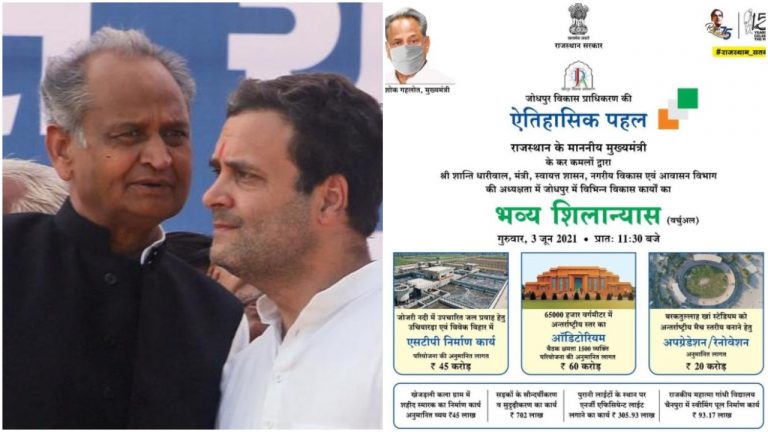
Since the Modi administration announced the much-needed ambitious project, Rahul Gandhi and his Congress party have been lobbying against the Central Vista plans, coercing the central government to abandon the plans for the project. While the Gandhi scion had called the redevelopment of Central Vista a “criminal wastage”, his coterie Shashi Tharoor had also rubbished the idea of the Central Vista Project.
Although the Congress scion and his acolytes have generated a ruckus in order to halt the ongoing reconstruction of Central Vista, calling it a wastage of public funds, interestingly, the Congress party-led government in Rajasthan has given a nod for redevelopment work worth over Rs 125 crores in the state.
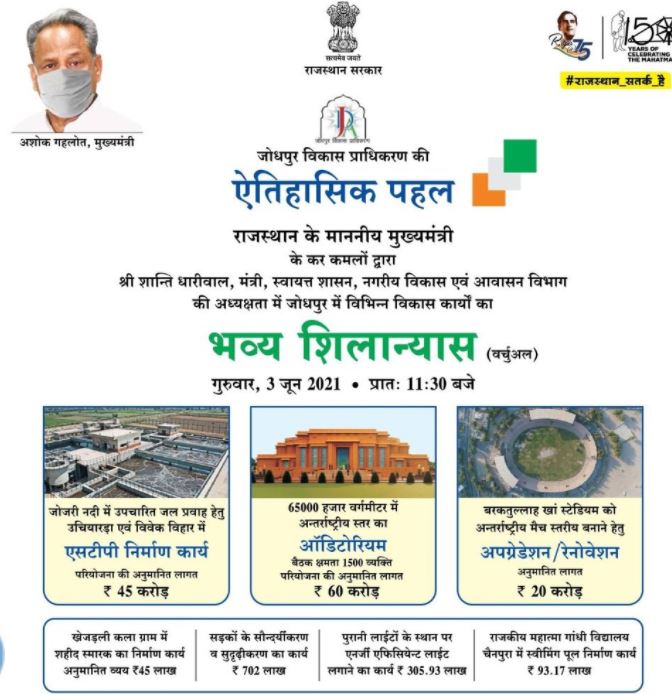
An advertisement published by the Rajasthan government showed that the Rajasthan CM and Congress stalwart Ashok Gehlot would be laying the foundation stone of three such multi-crore projects in Jodhpur, Rajasthan on June 3rd, 2021.
Advertisement published by Rajasthan Congress
The first project is the construction of a Sewage Treatment Plant (STP) for which the state government has approved a budget worth Rs 45 crores. Second is the construction of an ‘International standard’ auditorium for which a budget of Rs 60 crore has been approved. The third is the renovation and up-gradation of Baraktullah Khan stadium for which the state government has sanctioned a sum of Rs 20 crores. In total, the state government has approved a budget of Rs 125 crores for redevelopment work in Jodhpur.
Apart from these, other projects totally several crores were also listed in the Rajasthan Congress ad.
As soon as the Rajasthan Congress Government’s advertisement surfaced online, Netizens fumed and slammed the Congress leadership over their hypocrisy. Social media users commented that while Congress is crying hoarse over the alleged ‘wastage of public funds’ in the Central Vista project in the midst of the pandemic, the party itself is splurging same funds in Rajasthan where they rule, spending crores on redevelopment projects.
Congress tried to hold central vista project amid covid.
Others raged that the Congress leadership in Rajasthan has been unfettered by the state’s waste of coronavirus vaccinations, but is prepared to spend billions on rebuilding projects in the face of the epidemic. Union Minister Hardeep Singh Puri raised similar concerns.
Meanwhile in Rajasthan…
After dumping more than 11.5 lakh vaccines in dustbins in a ‘एतिहासिक पहल’
& with Congress leaders going hysterical over ongoing Central Vista Avenue redevelopment, the state govt announces Bhumi Pujan of several projects!
While Congress calls Central Vista project a ‘wastage’, the Maharashtra govt spends 900 crores on MLA residences
The Congress government had displayed similar hypocrisy when, amid the raging pandemic, the Congress-led Maha Vikas Aghadi government floated tender seeking bids for the redevelopment of MLA hostel Manora at Nariman Point at an estimated cost of Rs 900 crore.
The Maharashtra government’s redevelopment tender aroused concerns in the state, with critics pointing to the government’s excessive spending, especially at a time when the state is suffering financial difficulties due to the ongoing pandemic.
Interestingly, Rahul Gandhi stayed away from questioning the Maharashtra government about the expenditure of Rs 900 crore on the construction of luxury apartments for legislators or grilling the Rajasthan government for approving redevelopment work worth Rs 120 crores at a time as critical as this. Nevertheless, the Congress leader was unwavering when it came to politicising the development projects in the national capital, attacking the Modi government over the ambitious Central Vista project, which was planned and funded even before the Chinese virus began wreaking havoc in India.
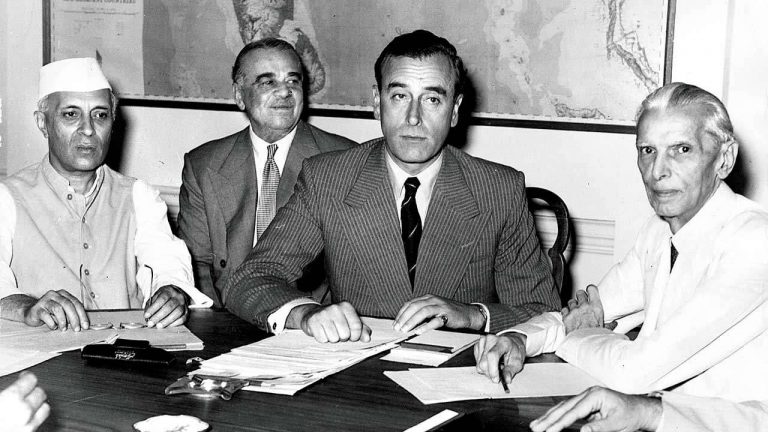
On this day, 74 years ago, Lord Mountbatten, the last Viceroy and the Governor-General of India, announced a plan to tear up India into two nations – India and Pakistan. The day June 3 will always be remembered in the country as the day when Indian National Congress-led by Jawaharlal Nehru, lost large Indian territories to yet-to-be-created Islamic nation – Pakistan.
On this day in 1947, Lord Mountbatten announced that British India would be free from the shackles of the Britishers and would become a free country. However, the independence for India also came at a huge cost as it was decided that British India would be partitioned on the religious lines – Hindu-majority India and Muslim-majority Pakistan.
Fearing the onslaught of Muslim League supporters, the Indian National Congress-led by Jawaharlal Nehru, readily agreed to the Mountbatten plan that sought to gift Indian territories to Mohammad Ali Jinnah-led Muslim League to establish their own Islamic nation – Pakistan.
So how did it all start?
On February 20, 1947, Clement Attlee, the then British Prime Minister, declared that the British would quit India in June 1948. As Indians united and stood up against the century-old British oppression, the mighty British Empire began to crumble and finally decided to quit India after two hundred years of its imperialism.
The statement in the British Parliament by Attlee meant that a deadline was already fixed for the transfer of power even if the Indian politicians had not agreed on a constitution. Secondly, the British would relinquish control either to some form of central government or in some areas to the existing provincial governments if the constituent assembly was not fully representative, i.e., if the Muslim majority provinces did not join the assembly.
It is important to mention that Muslim League-led by Mohammad Ali Jinnah, had boycotted the Constituent Assembly after Cabinet Mission had rejected the idea of Pakistan. The ‘Direct Action’ call given by Muslim League leaders and the inability of the Congress leadership to stop violence and negotiate a better deal with Pakistan had eventually provided MA Jinnah with an upper hand in the talks with the British.
In his statement, Attlee had stated that the British paramountcy on the princely states would lapse with the transfer of power, but these would not be transferred to any successor government in British India. The statement by Attlee had contained clear hints of partition and even Balkanisation of the country into numerous states, sending jitters across the country.
Earl of Mountbatten, the last Viceroy, arrives in India
To perform this job, George VI, King of the United Kingdom and the Emperor of British India, sent his cousin Lord Louis Francis Albert Victor “Dickie” Mountbatten to India as his last viceroy.
Earl Louis Mountbatten, the last British Viceroy and the Governor-General of India, who arrived in India on March 22, 1947, had his task cut out – to liquidate the British empire and quit India as soon as possible. Initially, he was given time until June 1948 – not 1947 – to complete his mission. But, in a hurry to get back to Britain to advance his naval career, Dickey decided to prepone the transfer of power by ten months, to August 1947. To achieve this, he worked out a plan after having long discussions with Congress and the Muslim League leaders.
As Mountbatten’s efforts to keep India united failed and with increasing communal riots in the country, he asked Ismay, his Chief of Staff, to prepare a plan for the transfer of power to responsible hands and the division of the country. It was discussed that the entire plan was to be kept secretive, and none of the parties in India should have any information before the plan was finalised.
However, even before the announcement of the plan, Jawaharlal Nehru, who was staying with Mountbatten as a guest at his residence at Simla, had a look at the plan, who rejected the plan in totality. Mountbatten then asked VP Menon, the only Indian working in his personal staff, to present a new plan for transferring power.
Later, Mountbatten went to London, where he got it approved without any alteration. Attlee and his cabinet approved in a meeting that lasted not more than five minutes. On May 31, Mountbatten returned to India and met the Indian leaders, including Jawaharlal Nehru, Sardar Patel, Acharya Kripalani, Mohammad Ali Jinnah, Liaqat Ali, and Baldev Singh. After both Congress and Muslim League leaders approved the plan without raising any objections. Later, Mountbatten discussed it with Gandhi and convinced him saying partition was the best plan under the circumstances.
Mountbatten Plan:
On 3 June 1947, Lord Mountbatten announced a plan offering a key to the political and constitutional deadlock created by the refusal of the Muslim League to join the Constituent Assembly formed to frame the Constitution of India.
Under this Plan, the British would immediately transfer power to two successor authorities — the Congress and the Muslim League and the plan envisaged dividing British India into two dominions – India and Pakistan on a territorial-cum-communal basis. The idea of Mountbatten was to divide India but to retain maximum unity, to which Congress readily agreed.
Accordingly, the country would be partitioned, especially the two major British provinces – Punjab and Bengal so that a limited Pakistan would emerge. The initial plan said that each of the 11 provinces of British India and each of the 559 princely states would be allowed to join India or Pakistan or remain independent.
Finally, on June 3, the plan was made public by Viceroy Lord Mountbatten, and it is thus known as the 3rd June Plan.
1. The provincial Legislative Assemblies of Punjab and Bengal were to meet in two groups: the Muslim majority districts and the non-Muslim majority districts. If any of the two decided in favour of the division of the province, then the Governor-General would appoint a boundary commission to demarcate the boundaries of the province based on ascertaining the contiguous majority areas of the Muslims and the non-Muslims.
2. The Legislative Assembly of Sindh was to decide either to join the existing Constituent Assembly or the New Constituent Assembly.
3. To decide the future of the North-West Frontier Province, a referendum was proposed. The electoral college for the referendum was to be the same as the electoral college for the Provincial Legislative Assembly in 1946.
4. Baluchistan was also to be given the option to express its opinion on the issue.
5. If the people of Bengal decided in favour of partition, a referendum would be held in the Sylhet District of Assam to determine if it would continue as a part of Assam or be merged with the new province of East Bengal.
Thus, the League’s position on the creation of Pakistan was tactically conceded by the Indian National Congress in exchange for the Congress’s position on the unity of the future Indian state, especially on not granting independence to princely state, but be a given to choice to join either India or Pakistan. The idea was to keep Pakistan as small as possible.
On June 3, 1947, Mountbatten was able to bring leaders of both – Indian National Congress and Muslim League around a conference table, where they collectively endorsed Mountbatten’s plan. In less than half a day, the new plan was accepted by both sides – Congress and the Muslim League, paving the way for the partition.
The acceptance of the plan by the Congress and the Muslim League meant that British India would be partitioned into two newly independent nations – Indian and Pakistan.
Under the plan, the dominions of India and Pakistan would remain within the British Commonwealth. The British paramountcy over 559 princely states in India would not be transferred to the two dominions and would lapse consequentially. The princely states would be free to join either of the two dominions.
Radcliffe partition and communal violence:
As per the plan, a Boundary Commission headed by Sir Cyril Radcliffe was constituted by the British government tasked to delineate the boundaries between India and Pakistan in the provinces of Bengal and Punjab. Radcliffe, who had never previously set foot in India, was assigned to create artificial boundaries between the two countries. Apparently, he had worked with Mountbatten earlier, and since he had never been to British India, he was considered unbiased. Both Nehru and Jinnah agreed to the appointment, which the Partition Council formally approved.
What followed it was a rapid transformation. There were communal riots on an unprecedented scale, which left several thousand dead as British Empire was preparing for a hurried exit from India, which turned a blind eye to the communal violence. The botched process of partition saw the slaughter of more than a million people. More than 20 million people along religious lines were displaced, creating overwhelming refugee crises in the newly constituted dominions. Untold numbers were maimed, mutilated, dismembered and disfigured as British Empire stood and silently watched the dissolution of its ‘crown jewel’ India.
Indian Independence Act
On July 5, 1947, the British Parliament passed the Indian Independence Act, which was based on the Mountbatten Plan. The Act that was implemented on August 15, 1947, provided for the creation of two independent dominions of India and Pakistan with effect from August 15, 1947. The Indian Independence Act was the legislative culmination of the Mountbatten Plan, and the passing of the act is considered as the official declaration of Indian Independence.
According to the act, the two new dominions – India and Pakistan-were to have a governor-general responsible for the effective operation of the Act. In addition, the constituent assembly of each new dominion will have to exercise the powers of the legislature of that dominion, and the existing Central Legislative Assembly and the Council of States were to be automatically dissolved.
Until each dominion adopted a new constitution, the governments of the two dominions were to be carried on according to the Government of India Act, 1935, the Indian Independence Act stated.
As per the provisions of the Indian Independence Act, 1947, Pakistan became independent on August 14, while India got its freedom on August 15, 1947. Mohammad Ali Jinnah became the first Governor-General of Pakistan. India requested Lord Mountbatten to continue as the Governor-General of India.
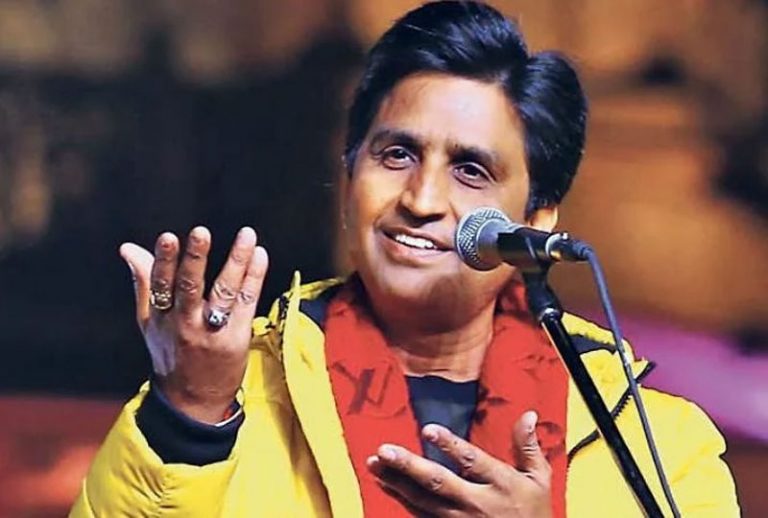
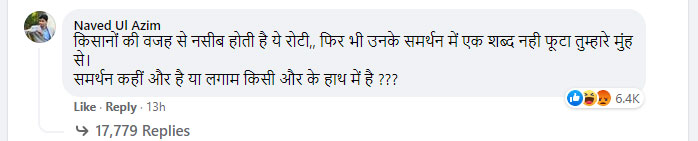
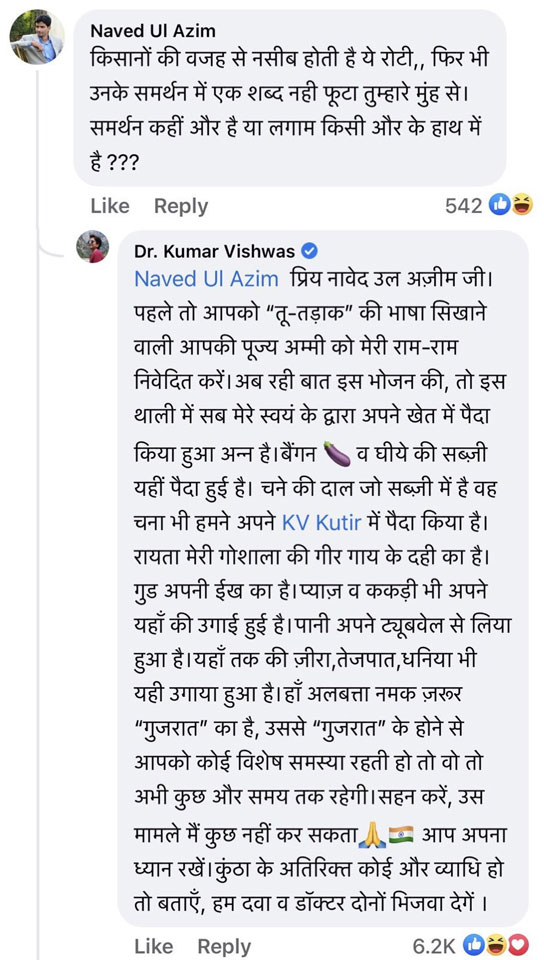
On June 2, former Aam Aadmi Party leader and Hindi Poet Dr Kumar Vishwas posted a photograph of food and made a pun on “do June ki roti”. Many of his followers made positive comments on his post; however, one Facebook user Naved Ul Azim was not happy with the post. He pointed out that Kumar Vishwas failed to raise his voice in favour of farmers who are protesting against the three farm laws enacted by the Government of India in September 2020.
Azim said, “The food you are eating is because of the farmers. However, you did not say a word in favour of them. Do you support the other side, or someone has control over you?”
Vishwas schools Azim
Vishwas gave a befitting reply to Azim and said, “First of all, give my warm regards to your mother, who taught you the “decent” language you have used in your comment. The food you see on my plate was grown on my farm. Brinjal and bottle gourd was grown here. The chickpea lentil you see on my plate was grown at my KV Kutir. Raita was made with milk produced by the Gir Cow at my gaushala. The jaggery you can see in the photo was made using sugarcane grown here. Onion and cucumber were also grown at my farm. Water was taken from our tubewell.”
Befitting reply by Kumar Vishwas
He further added that the spices like cumin, bay leaves, and coriander were also grown at his farm. “However, salt is from Gujarat. If you have a problem with the salt produced in Gujarat, then it will remain for some more time. You have to tolerate it as I cannot do anything about it. If you have any problem other than frustration, do let me know. I will send medicine and a doctor,” he added.
Farmer protests against Agriculture laws
Since the three agriculture laws were enacted by the Government of India in September 2020, so-called farmers, especially from Punjab and Haryana, have been protesting against them. Calling the laws “black laws”, the farmer union leaders have alleged that the government introduced the laws for the welfare of the corporate sector. On the contrary, the laws not only provide an option to the farmers to sell the produce in private markets but also give them an upper hand in case anyone tries to cheat them in contract farming.
Notably, the laws were put on hold by the Government of India for 15 months, but the farmer unions, along with thousands of farmers, are still lodged at the Delhi border. There have been reports that the farmer protests have caused a surge in the Covid-19 cases in Punjab. On January 26, a group of alleged farmers barged into Delhi and raised two flags with Sikh Holy symbol on Red Fort. Several Police personnel were injured, and property worth crores were damaged during the Republic Day riots in Delhi.
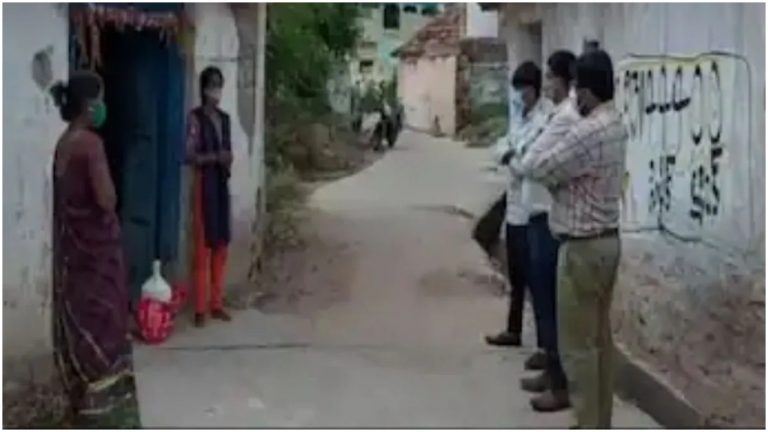
Upset over being isolated after testing positive for Covid-19, an agitated old lady forcefully embraced her daughter-in-law in Telangana and infected her with the virus.
According to the reports, the Covid-19 infected woman not only infected her own family knowingly by hugging them but also threw her daughter-in-law and her two children out of the home after infecting them with the Chinese virus.
The bizarre incident occurred in a village in Rajanna Siricilla district in the North Telangana area. The older woman who was quarantined at home after testing positive for Covid-19 could not bear the social distancing maintained by her daughter-in-law. With her ego hurt over COVID appropriate behaviour., the older woman decided to spread the virus to her family members.
The older woman frequently hugged her 20-year-old daughter-in-law and transferred the infection to her. The two grandchildren have also became victims of circumstances now.
According to the local authorities, the mother-in-law observed the sudden change in behaviour of the daughter-in-law who was maintaining a distance, providing food from a distance and not allowing her two children near her. This reportedly hurt her ego, said the officials.
Elderly woman throws her daughter-in-law out of her house
The daughter-in-law in her mid-20s, who belongs to Thimmapur village in Ellareddipeta Mandal of the district. She got married to a person of Nemaligutta Thanda, a tribal village in the Somaripeta area of Machareddy Mandal in the Kamareddy district three years ago. She said that her mother-in-law was upset that everyone in the family kept a distance from her after she tested positive for Covid.
“My mother-in-law hugged me, saying that I should also get infected with Covid-19,” the woman said. The husband left for Odisha seven months ago, who works there as an auto driver.
After the daughter-in-law tested positive for Covid, the elderly woman has thrown the lady and her two children out of the house. Her sister later took her to her parents’ home in Thimmapur village.
Meanwhile, the daughter-in-law’s relatives and the local people in the village are demanding action against the old woman. They asked the local authorities to punish the woman and her husband for not only throwing out daughter-in-law and two children but also for deliberately infecting them with coronavirus.
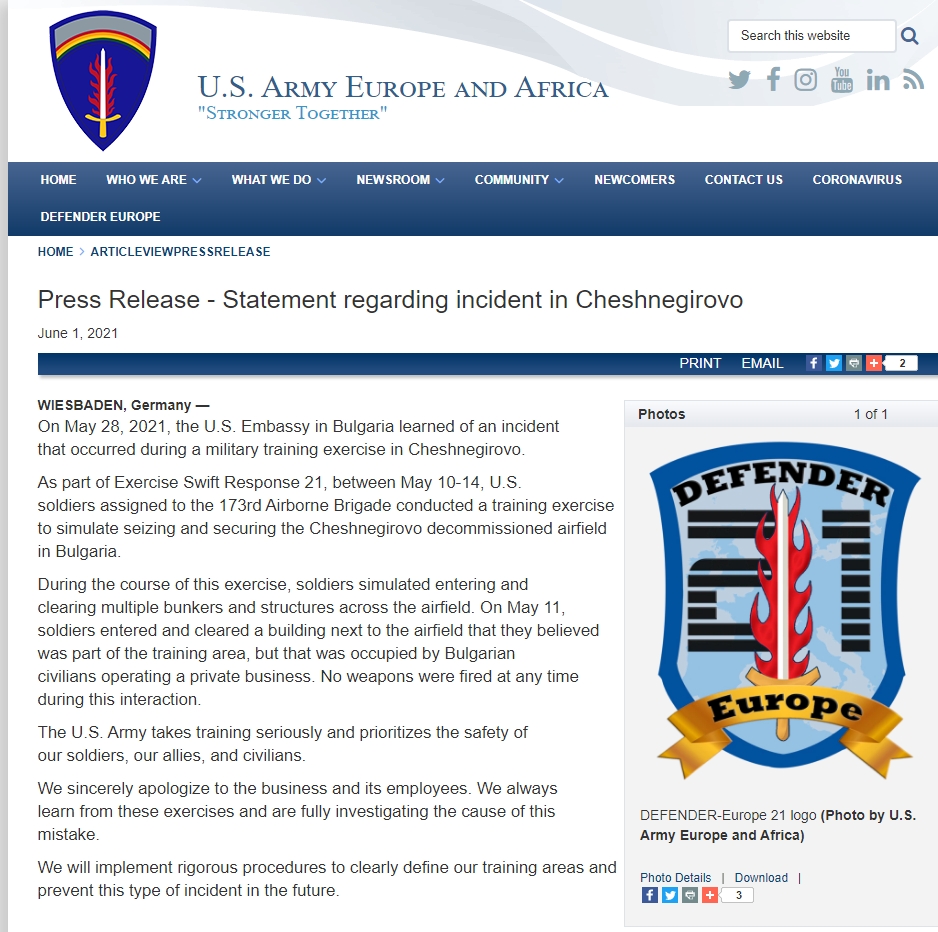
The US military has issued an apology after its soldiers accidentally raided an olive oil factory in Bulgaria last month. The incident happened during a joint training exercise at the Cheshnegirovo airbase in Bulgaria.
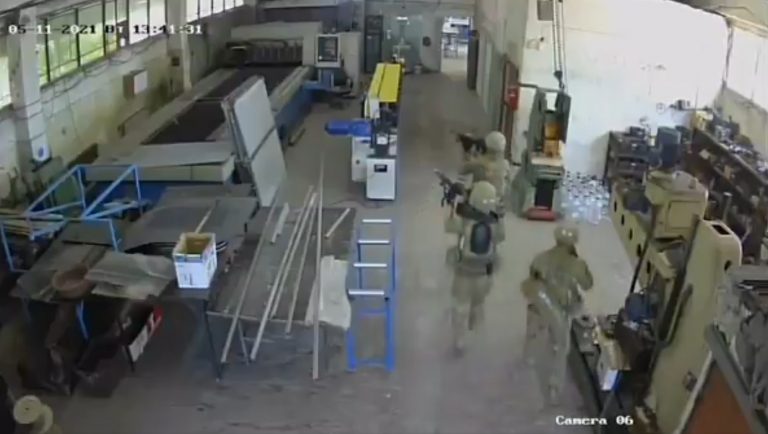
American soldiers belonging to 173rd Airborne Brigade accidentally raided the factory located next to the airbase while training for seize and secure operations at the decommissioned airbase at Cheshnegirovo. The incident happened on 11th May, but According to a press release issued on 1st June by US Army Europe and Africa, “On May 11, soldiers entered and cleared a building next to the airfield that they believed was part of the training area, but that was occupied by Bulgarian civilians operating a private business. No weapons were fired at any time during this interaction.”
Statement issued by US Army Europe and Africa
The statement apologised to the factory by saying, “We sincerely apologize to the business and its employees. We always learn from these exercises and are fully investigating the cause of this mistake.” They further added, “We will implement rigorous procedures to clearly define our training areas and prevent this type of incident in the future.”
US Army Europe and Africa informed that as part of Exercise Swift Response 21, between May 10-14, U.S. soldiers assigned to the 173rd Airborne Brigade conducted a training exercise to simulate seizing and securing the Cheshnegirovo decommissioned airfield in Bulgaria. The mistaken raid took place when the soldiers had simulated entering and clearing multiple bunkers and structures across the airfield during the exercise.
CCTV footage from the olive oil factory shows US Army soldiers armed with guns and other gear entering the factory, searching the entire premises and then going out, even as confused workers at the factory looks on.
US special forces mistakenly storm a factory producing machinery for olive oil during #NATO drills in #Bulgaria. The owner has filed a law suit pic.twitter.com/3NRM558Q7g
— Dilyana Gaytandzhieva (@dgaytandzhieva) May 30, 2021
Bulgarian president condemns the incident, demands probe
Bulgarian president Rumen Radev condemned the incident, saying that there should an investigation in the case. “The exercises with our allies on the territory of Bulgaria should contribute to building security and trust in collective defence, not breed tension”, he said. The president added, “It is inadmissible to have the lives of Bulgarian citizens disturbed and put at risk by military formations, whether Bulgarian or belonging to a foreign army”.
President Radev said that he expects a thorough investigation into the incident, disclosure of the names of the officials responsible and a review of the organization and safety measures. “The exercises with our allies on the territory of Bulgaria should contribute to building security and trust in collective defence, not breed tension,” he added.
However, the country’s defence minister Georgi Panayotov underplayed incident saying it was an ‘an obvious misunderstanding’, and added that no violence or force was used against any civilian. He also apologised to the olive oil factory owner and workers, and offered to compensate for any material damage suffered by the plant.
The factory’s owner has submitted a report on the incident to the District and Military Prosecution Offices. According to journalist Dilyana Gaytandzhieva, the owner has also filed a lawsuit on the incident. She has also quoted a worker seen in the video saying that the US soldiers had ordered the workers to remain seated during the raid.
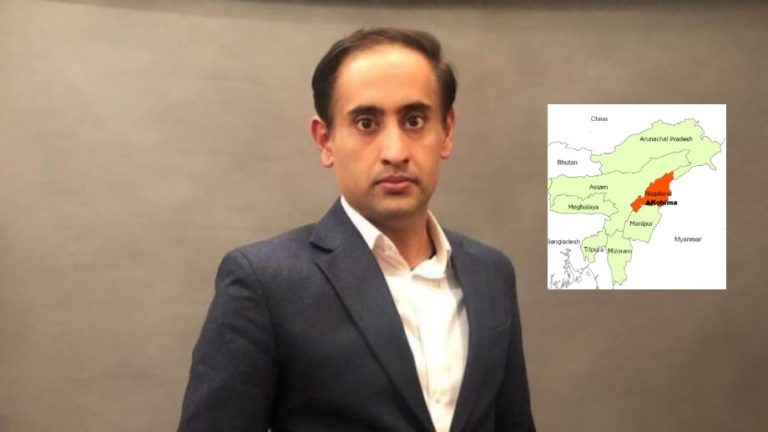
India Today journalist Rahul Kanwal while discussing fugitive diamantaire Mehul Choksi’s extradition from Dominica made quite an embarrassing faux pas.
— Tajinder Pal Singh Bagga (@TajinderBagga) June 3, 2021
Kanwal was discussing the repartition of Choksi from Dominica with Rupin Sharma, Nagaland DGP and author of the book ‘Extradition’ when Sharma briefly loss his connection. After being reconnected to the live feed, Sharma apologised and said that there was a power cut and apologised. “Don’t worry, you are in Nagaland, electricity goes off even in India, please go on,” he said.
Netizens were quick to question Kanwal if he thought Nagaland was not a part of India.
BJP leader Mmhonlumo Kikon said that they’d need to invite Kanwal to Nagaland soon for a lesson in geography.
We need to invite @rahulkanwal to Nagaland very soon! We need major geography class for major media professionals too!
Dear Rahul, be sensitive to every part of India. Your speech exposes your mindset towards NE part of India. @himantabiswa Da, may be we should prepare a suitable learning module for @rahulkanwal to make him more Indian..
— Dr. Himadri Bhushan Das (হিমাদ্ৰী ভূষণ দাস) (@daskyabola) June 3, 2021
Some even asked him to issue a correction.
pathetic @rahulkanwal ! Issue a correction ASAP !????
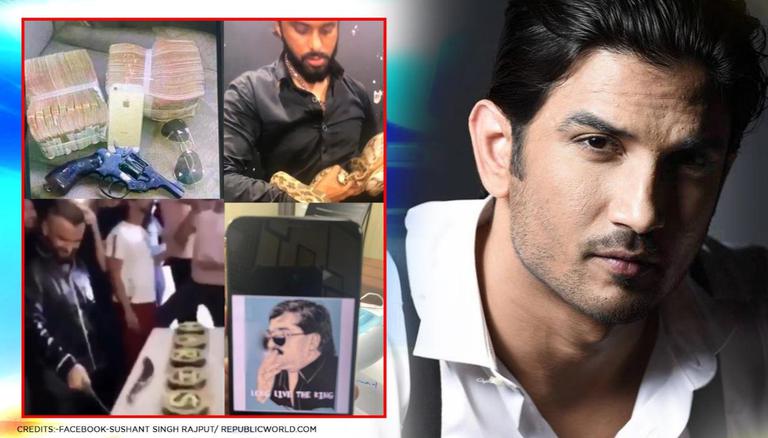
The Narcotics Control Bureau (NCB) on June 2 (Wednesday) detained a drug peddler named Haris Khan because of his alleged ties to gangster and drug dealer Parvez Khan alias Chinku Pathan. Haris Khan’s alleged role in a narcotics case connected to the death of late Bollywood star Sushant Singh Rajput last year would also be investigated by NCB.
Parvez Khan aka Chinku Pathan is a henchman of Dawood Ibrahim and a cousin of the late mafia don Karim Lala. He was nabbed by the NCB in Navi Mumbai in January this year after the agency busted a narcotics trafficking network.
Haris Khan was apprehended on June 1 (Tuesday), according to a source, after an NCB team led by zonal director Sameer Wankhede conducted searches in suburban Andheri, Lokhandwala, and Bandra.
When the officials raided Haris Khan’s house, they not only seized drugs but also found some endangered species of snakes and weapons from the premises.
“As of now, the NCB has arrested Khan in connection with the Chinku Pathan drugs case, but his role in the drug case linked to Rajput’s death will also be investigated,” the official said.
The drug peddler has been earlier booked under IPC section 188 (disobedience to order duly promulgated by public servant), 269 (negligent act likely to spread infection of disease dangerous to life) and 34 (common intention) of the Indian Penal Code (IPC) and section 4 (licence for acquisition and possession of arms of specified description in certain cases) and 25 (possession of arms) of the Arms Act, 1959 and section 37(1) (prohibit certain acts for prevention of disorder), 135 (contravention of rules) of the Maharashtra Police Act, 1951 and Arms Act, 1959 for using a sword.
The NCB will now look into his alleged involvement in the suspicious death of late actor Sushant Singh Rajput.
Siddharth Pithani, the flatmate of late actor Sushant Singh Rajput arrested by NCB
In the narcotics case connected to Bollywood star Sushant Singh Rajput’s suspicious death, Siddharth Pithani, a friend and flatmate of Sushant Singh Rajput was arrested by the Narcotics Bureau Control from Hyderabad on May 28. Pithani has been questioned by the federal authorities several times following the death of actor Sushant Singh Rajput.
On the 14th of June, actor Sushant Singh Rajput was allegedly discovered hanging at his home. Many issues were raised after his death, including the alleged drug abuse and financial exploitation by his then-girlfriend Rhea and her family. Sushant’s father KK Singh’s FIR had blamed Rhea for financial exploitation and harassment of the late actor.
On Bihar Police’s plea and the Supreme Court’s directives, the matter was subsequently transferred to the CBI. The case, which was supposed to be a simple open-and-shut case for Mumbai Police, has morphed into a far larger conspiracy including drug trafficking, money laundering, and emotional exploitation in Bollywood.
Several top celebrities including Deepika Padukone, Shraddha Kapoor, Sara Ali Khan and Rakul Preet Singh were interrogated during the investigation into the drug syndicate allegedly prevalent in the film industry.
The 18th century saw the decline of the Mughal empire and the rise of the Hindu Maratha empire. By the 1750s, the Marathas had grown sufficiently strong so as to be able to annex Malwa, Gujarat, Odisha, Berar as also some parts of the Ganga Jamuna Doab and Bundelkhand.
As such, the Marathas were the dominant political power in the Indian subcontinent, and the Mughal emperor had been reduced to a figurehead.
Starting from approximately 1747, the Afghan tribes – which had been in perpetual disarray, found a leader in Ahmed Shah Abdali. The Afghan ruler, over the next decade, built a kingdom that stretched from today’s Uzbekistan all the way into Punjab and from Herat in Iran to parts of Kashmir in the East. It was only a matter of time before the two powers – Ahmed Shah Abdali and the Marathas clashed.
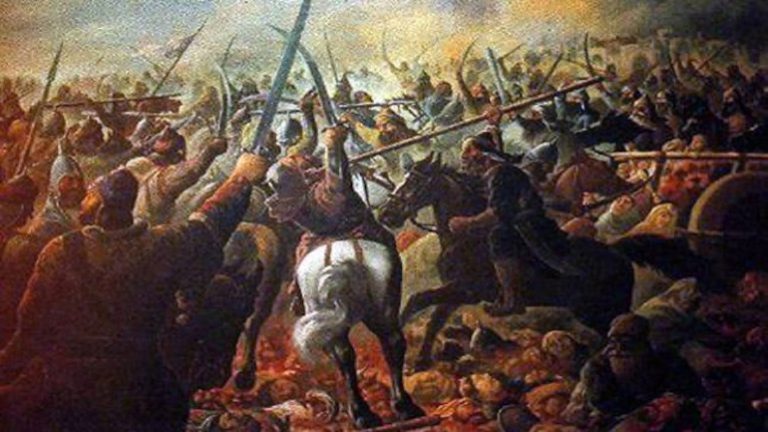
In 1757, Ahmed Shah Abdali mounted his fourth invasion of India. The series of events that started here, culminated in the Battle of Panipat four years later. In that invasion, Abdali attacked Delhi and Mathura. At Mathura, a carnage was carried out. Many temples were destroyed and looted, with over twenty thousand camels taken away. It is not that the Marathas did not oppose this invasion of Abdali. Antaji Mankeshwar did fight three battles against Abdali on the outskirts of Mathura. But the opposition was insufficient. By the time Raghunathrao arrived from Pune, Abdali had left.
In the time Raghunathrao arrived in the north, Abdali moved to Delhi and installed his favourite Najib ud Daulah as the Amir ul Umrah. He then proceeded west to Amritsar and Lahore, where his deputies bombarded the Harmandir Sahib and filled the Sarovar with carcasses of cows.
Raghunathrao and Malharrao Holkar, then in the south, assembled an army that moved north and by the winter of 1757 had trained their guns on Delhi. The city soon capitulated and Najib ud Daulah was deposed. Here, in hindsight which as we know is always perfect, the Marathas ought to have fortified Bundelkhand and turned towards Varanasi. Instead, in alliance with the Sikhs and the Mughal faujdar Adina Beg, a campaign into Punjab was undertaken. Lahore was reached in April 1758 and the Afghans ousted. Dattaji Scindia pushed further on, and by October 1758 had reached Peshawar having gone beyond Attock on the Indus. For the first time in over five hundred years, a Hindu army had ruled over such a large part of Punjab (Panipat 1761 – Shejwalkar).
But the distances from Pune to Peshawar were vast. The Marathas had kept a mere fifteen thousand troops in various garrisons. Raghunathrao Peshwa and Malharrao Holkar returned to the south. The Maratha garrisons were inadequate and stretched.
Ahmed Shah Abdali started off from his base in Kandahar towards the Maratha outposts in Punjab. Almost simultaneously, following the negotiations at Patdur near Jalna in Maharashtra, a Maratha army under Sadashivrao Bhau began marching north. The stage was set for a showdown.
I do not intend to describe the various battles and politics, decisions and movements which finally culminated at Panipat. Nor do I wish to describe the battle. Instead, let us focus on the Maratha desire to “liberate holy places” and the Muslim reaction to it.
Panipat III – Importance and religious nature
Throughout the eighteenth century, the Marathas strove to bring the Hindu holy places under another rule. As early as 1736 AD, we find Peshwa Bajirao demanding the holy towns of Kashi, Mathura, Prayag and Gaya from the Mughal Emperor (Marathi Riyasat – Sardesai). This was even before the formal annexation of Malwa to the. But the politics of the day precluded an all-out attack on the Doab to annex it. The crumbling Mughal empire had for the most part created Nawabs, Nizams and other Muslim potentates.
It was only in a few places like Rajputana, Bundelkhand and the Jat regions that power had devolved to Hindus. A polarisation of Muslim power brokers could still cause a big headache. Especially if they were provided with a leader like Ahmed Shah Abdali. The best course of action then was to play divide and rule at the Mughal court. This, combined with military victories over various opponents such as the Nizam led the Marathas to obtain sanads and firmans with the seal and stamp of the Mughal emperor. He would remain the figurative ruler of India, but with increasing lands given to the Marathas. The Marathas called these “taxation rights in name of the Mughal”, but as is quite obvious – losing the right to tax is more or less equal to losing everything altogether.
There were two powerful factions at the Mughal court – the Iranis and the Turanis. By playing them against each other, the Marathas avoided the headache of having to face everyone at the same time in a faraway province. One such stage of the Irani Turani or Shia Sunni conflict was the Doab region, which had all the holy places the Marathas were so eager to secure. But those plans had to wait, since Safdarjung a Shia, had joined hands with them to crush the Rohillas, an Afghan tribe operating out of Rohilkhand. In fact, when Malharrao Holkar planned to demolish the Gyanvapi mosque in 1751, the locals opposed it saying that the rule of the “Yavans” was too powerful to ignore.
That they would face the brunt of the Marathas left after destroying the mosque. Thus, the importance of political power becomes clear. There was even an attempt at obtaining these places from the Mughal via the good offices of Jai Singh of Jaipur in 1741 (New History of Marathas Vol 2 – Sardesai).
Also, there was the problem of Punjab being in a largely lawless state under a Mughal faujdar. The rise of the Sikhs was still in the future. Even as late as 1754, the Mughal faujdar of Lahore – Mir Mannu had massacred Sikhs and announced rewards of Rs 10 for every head of a Sikh brought to him. It was more than the average monthly salary of the common man. Thus, the threat from that end remained – of being attacked from the rear in case an invasion of the doab was mounted. In fact, one of the invasions mounted by Ahmed Shah Abdali was precisely to relieve the pressure on Rohilkhand by the combined armies of Holkar and Scindia.
It was only in 1758, after obtaining full control of Delhi and moving into Punjab that the Marathas thought of decisively turning towards the Doab and liberating the holy places. Various attempts at obtaining Sanads to that effect had ended up in a wild goose chase, with the Mughal emperor and the Nawab of Awadh not staying true to their word.
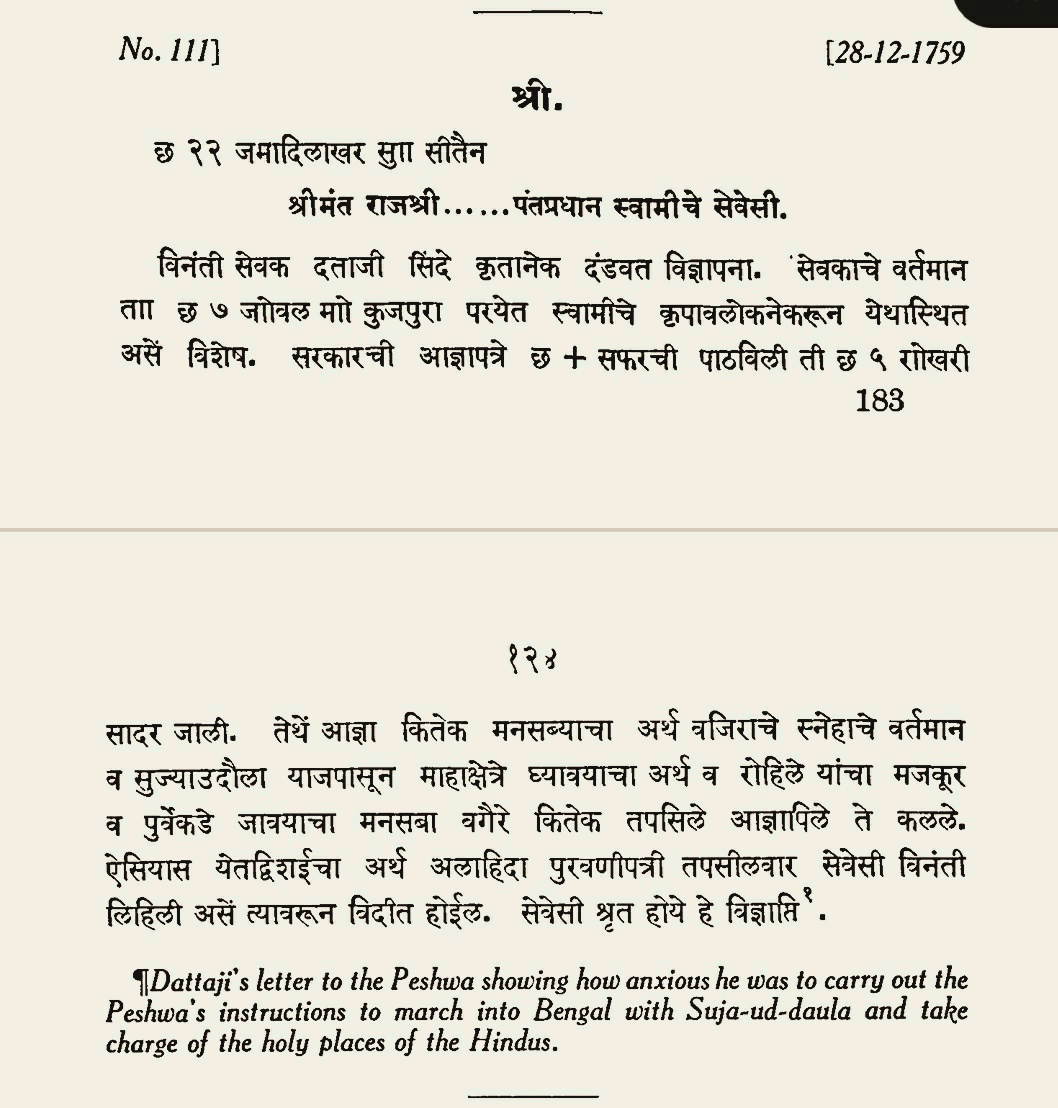
A letter by Nanasaheb Peshwa to Dattaji Scindia, written in Dec 1759 is quite telling. It talks of how the Marathas plan to invade the Doab and annex Kashi, Prayag and Gaya. Further, quite interestingly, it talks of marching into British ruled Bengal (Peshwe Daftar).
Source: Peshwe Daftar
At the same time, it became apparent that the Maratha stranglehold on Delhi would only get firmer – what with their sights firmly set on Punjab and Doab.
It was to be expected that Ahmed Shah Abdali would mount another attack to retake his lost Punjab. What queered matters though, was the call for Jihad given out by Shah Wali Ullah Dehalvi and enthusiastically advertised by Najib ud Daulah. This was at the close of 1759.
Wali Ullah was an influential Islamic theologian who had memorised the Quran in childhood and spent considerable time doing studies in Arabia. The revival of lost “Muslim prestige” forms the basis of his work.
Shah Wali Ullah said (Shah Wali Ullah and His Times – Syed Athar Abbas Rizvi):
“One of the crucial conditions leading to the Muslim decline was that the real control of the government was in the hands of the Hindus. Hindus controlled the wealth, while Muslims were destitute. Only Ahmed Shah had sufficient manliness, gallantry and foresight needed for annihilating polytheism. It was therefore his religious duty to declare Jihad and liberate the enslaved Muslims. We beseech you, in the name of the Prophet to fight a Jihad against the infidels of this region”
Interestingly, he also mentions how Nadir Shah’s invasion had devasted Delhi and reduced the Muslim leaders of Delhi to being “mere puppets”; although truth be told Bajirao’s invasion of 1737 had given ample proof of that.
Najib ud Daulah stressed heavily on this Jihad and saving Islam point to make a case for Shuja ud Daulah to leave the Marathas.
Almost immediately, alliances that were hitherto thought to be impossible to achieve in such short order now materialised. The Rohillas and the Shias of Awadh united. Merely ten years previously, Shuja ud Daulah’s predecessor Safdarjung had allied with the Marathas against Najib and caused widespread destruction in Rohilkhand. In one of the many battles between them, Safdarjung nearly got killed. Hafiz Rehmat Khan was another character who had actually battled Ahmed Shah Abdali in 1748 but now waited on him in concert with Najib ud Daulah and Shah Wali Ullah.
Then there was the Imad Ul Mulk at Delhi. Few years prior Panipat, Delhi had seen Shia Sunni riots which left many dead. The Imad Ul Mulk and Safdarjung were believed to have egged on their respective parties.
Finally, Ahmed Shah Abdali himself was besieging the fortress of Kalat in Balochistan in 1758 – 1759 when the Marathas began their march to Peshawar. Nusir Khan Baloch was his ally who had fallen foul because of some activities of the Zikri sect. It was evidently not an open shut case, and ought to have created bad blood between the two (Khan e Baloch – Mir Nasir Khan).
Another, rather inexplicable statement given out is that the Marathas marched to Panipat to ‘defend the Mughal empire’. But considering that there was hardly any Mughal empire left to speak about, it was merely a case of protecting the rubber stamp. So that the old process of annexation by firman could continue. By ruling in the name of the Mughal, the Marathas intended to create a smokescreen that would prevent the entire Delhi aristocracy from combining against them. But on the eve of Panipat, the Marathas threatened to take an unassailable grip on the Mughals. This avers Tukojirao Holkar, created fear in Delhi and turned many against the Marathas. Such was the total control over Delhi that Sadashivrao even had the ceiling of the Diwan e Khas melted.
The stage for a conflagration had been set from 1760 itself. The Marathas could have chosen to leave north India to its devices and been content in their Deccan and Malwa strongholds. But that was unlike the people who strove to plant their flags on Attock and had repeatedly conquered Delhi. If Peshwa Bajirao could prepare an army to oppose Nadir Shah in 1739, why shouldn’t they field one to oppose Abdali in 1761? In case Abdali had been allowed a free pass, perhaps the Afghans would have grown too powerful at Delhi. Any hopes of liberating Kashi, Mathura, Prayag could then be forgotten altogether. That the Marathas would have finished the Muslim rule in the Ganga Yamuna doab after dealing with Abdali is a given.
A clarion call for liberating the Hindu holy places was given by the Peshwa. The Marathas demanded their border should be fixed on the Indus. In this, Shah Wali Ullah saw the eclipse of Muslim power in north India and reacted the way he knew best – by declaring a Jihad. This formed an important facet of the third battle of Panipat. There were other factors – such as the Marathas becoming too strong in Punjab and Delhi for Abdali’s comfort but religion definitely played a part.
Dr Kanungo of the IHRC faults the Marathas for taking this religio-political line in one of his papers, but this too confirms that Hindu religious centres were inextricably linked to the Panipat conflict.
He says (Indian Historical Records Commission Vol 1):
“This religious weakness which to a certain extent shaped the policies of the Peshwa, cost the Marathas dear in the long run, because both the Ruhelas and the Nawab of Oudh, though natural and hereditary foes could agree on one point, namely, to keep the Marathas south of the Ganges. Shuja Ud Daulah perhaps would not have joined Abdali if the Marathas had not entertained any such designs against this part of his territory”
One may or may not agree with this paper, but it also goes to prove the religio–political nature of the conflict. If the Marathas had not strived to annex Benares and Prayag, there would probably be no Panipat. But better die fighting at Panipat than take the second option.
If the Marathas had won at Panipat, it would probably have meant the liberation of the holy towns along with the demolition of the Gyanvapi mosque and restoration of the Kashi Vishwanath temple.
Panipat set back these plans by a whole decade at least. When Mahadji grew powerful enough, Shuja Ud Daulah joined hands with the British in Bengal, and the annexation of Awadh remained just a dream. Quite interesting that the Nawab of Awadh joined hands two times with invaders to save himself from the Hindu Maratha Empire.
Another criticism is that the Marathas antagonised fellow Hindus by extracting ‘Chauth’ from them and hence none came to help at Panipat. As we have already seen, there was no love lost among the various constituents who made up Abdali’s army at Panipat. Anyone – Rohillas, Shias, Afghans, Balochis could point to their co-religionist for some previous hurt and skip the battle. They could point to the sacking of Delhi or the previous three invasions and many other reasons to not join hands. But on 14th January 1761, it was time to “save Islam” and protect their extensive jagirs in north India, their internal fights could wait for a day. Their opposition, however, remained divided as ever. Why Madho Singh of Jaipur received a letter from Abdali describing how the “Marathas had been destroyed”.
Almost immediately after the battle Ahmed Shah Abdali and his allies went back to fighting amongst themselves. Merely two months later, the Sunnis of Abdali’s army battled against the Shias from Shuja ud Daulah’s forces in Delhi. Some years later, Hafiz Rehmat Khan killed by a combined army of the Nawab of Awadh and the East India Company in 1774.
The exception to everything and perhaps one of the greatest personas in our history was Ibrahim Khan Gardi. A name that is rarely taken when the “Muslims who fought for Hindus” troupe is pulled out. Is it because he stayed loyal to the Hindu Marathas even when a Jihad call was given out? If Ibrahim Khan had gone over, an even bigger disaster awaited the Marathas.
Not all Hindus deserted the Marathas. The Sarv Jaat Khap Panchayat sent over fifteen thousand Jats who fought on their side.
The battle itself has been discussed threadbare from any and every angle. I do not intend to repeat it here. Having a huge number of camp followers definitely had an adverse impact. The battle tactics deployed by Sadashivrao had their pros and cons. Thousands of Marathas died. With their defeat went the chance of Hindu armies marching through the Ganga Yamuna doab region.
This is not to say that the Marathas were faultless. They made mistakes. Of not building an impregnable base at Delhi, of not stationing a massive force at Bundelkhand, of undertaking a rapid campaign into Punjab which stretched their resources to the limit. Above all, of not understand the political power of Jihad and blindly trusting Najib ud Daulah. But, when it came to opposing the temple destroying armies of Abdali, it was the Marathas who sacrificed thousands of their men hundreds of miles from their homes.
As opposed to the previous two battles of Panipat, the losing side in this instance survived the debacle. And because the Marathas survived the shock, the later day rule of Mahadji Scindia, of Ahilyabai Holkar and Madhavrao Peshwa could still materialize.
But the loss at Panipat had far-reaching effects. The Maratha plan to invade Awadh and Bengal was aborted. The Nawab of Awadh invited the EIC. Panipat III gave the English a respite. Forty years later, they would capture India from the Marathas.
Failure to destroy the zamindari based Muslim aristocracy of the United Provinces of Awadh and Agra had repercussions that crystallized much later in the Pakistan movement. Again, their political power was threatened. Again, like at Panipat III differences were all forgotten (especially in the 1946 elections) and the “Islam in danger” flag went up. The Hindu opposition to the Partition plan was never strong enough to scuttle it.
Also like after Panipat, after defeating the “infidels”, Pakistan split into two. But the damage was done.
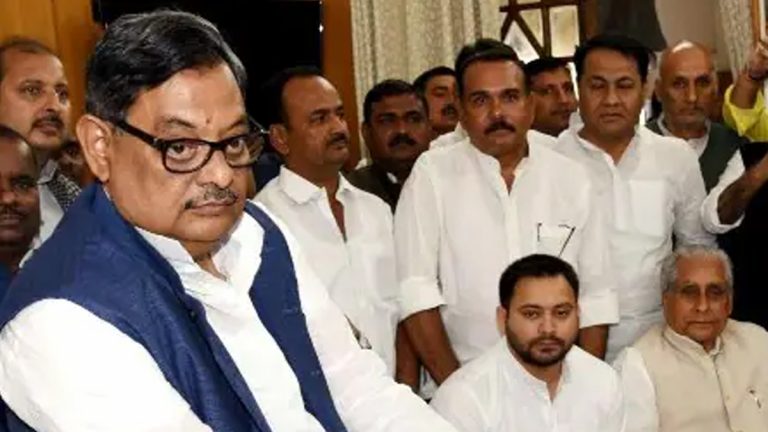
The Enforcement Directorate (ED) on Thursday morning arrested Rashtriya Janata Dal (RJD) MP Amarendra Dhari Singh from New Delhi in connection with a money-laundering probe linked to a fertilizer scam case.
ED said that Singh has been arrested under various sections of the Prevention of Money Laundering Act (PMLA). Singh was first taken for a medical examination and is now under interrogation at ED’s Delhi office.
Recently, the CBI had lodged a case against Singh after which the case was taken over by ED for further investigation. The agency had conducted raids at 12 locations in Delhi, Haryana and Mumbai in connection with the case.
The money laundering case is linked to a fertilizer import scam, in which CBI had filed a case against top officials of IFFCO and Indian Potash Limited limited. Amarendra Dhari Singh is a partner in Jyoti Trading Corporation, a firm linked to the scam.
Jyoti Group had come under the scanner last month when the CBI had filed a case against IFFCO chairman U S Awasthi, former MD of Indian Potash Limited Parvinder Singh Gahlaut and their sons for allegedly earning commission from overseas suppliers by inflating prices of imported fertilisers and claiming subsidies via a web of companies. CBI had alleged that Awasthi, Gahlaut, their family members and several others had received kickbacks of tens of millions of dollars.
Party sources claim that Singh has been a close aid of Lalu Prasad Yadav and was sent to the Rajya Sabha on his behest.
Who is A D Singh?
As per the election affidavit, Singh is a graduate of Kirori Mal College and resides in Defence Colony in Delhi.
Singh, who is involved in the export and import of fertilizers, has immovable property worth Rs 188.57 crore and movable property worth Rs 49.6 crore. He also owns land, apartments and offices in Rajasthan, Delhi, Haryana and Mumbai.
Singh’s nomination for Rajya Sabha elections in March 2020 had taken most party leaders by surprise. RJD MLAs, who were present when Singh filed his nomination papers remarked that they have never met him.
His nomination was justified by RJD leader and Lalu Prasad Yadav’s son Tejashwi Yadav who said, “The RJD is not just a Muslim-Yadav party. We give representations to all castes and religions.”
An RJD leader, however, had attributed Singh’s nomination to the fact that every party needs money in the election year.
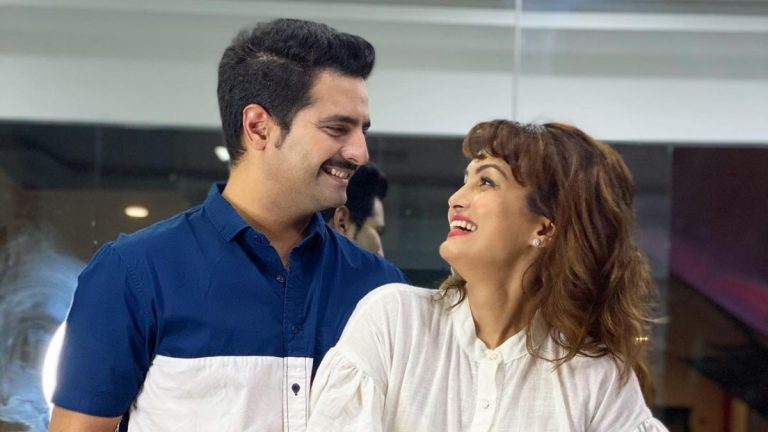
A day after TV actor Karan Mehra, best known for his portrayal of Naitik in the daily soap ‘Yeh Rishta Kya Kehlata Hai’ was arrested by the Mumbai Police after his wife, Nisha Rawal accused him of domestic violence, accusations and counter-accusations are being levelled in the case.
What was the case about?
Karan was arrested by the Mumbai Police on Tuesday after his wife, Nisha Rawal, who is also a TV actor filed a police complaint against him, accusing him of domestic violence. The 38-year-old actor was taken into custody from his Mumbai house. Shortly afterwards, he was granted bail.
According to reports, the Goregaon Police has filed a case against him under Indian Penal Code sections 336 (endangering human life or the personal safety others), 337 (causing hurt by an act which endangers human life), 332 (voluntarily causing hurt to deter public servant from his duty), 504 (intentional insult with intent to provoke breach of the peace) and 506 (criminal intimidation).
Karan refutes his wife’s claims, says attack was staged by Nisha and her brother Ritesh Sethia
After he was released on bail, Karan refuted his wife’s allegations and said that their marriage was in turmoil for the last couple of years and they were both trying to sort things out.
“We have been in a strained relationship for a couple of years now, and since we could see there was no point staying together, we decided to part ways. Given we have a son, I wanted to separate amicably so that we can give him a good future. I came back from Chandigarh to talk things out and got infected with Covid-19. After having recovered, I called her rakhi brother Ritesh Sethia home so that he can help us come to a mutual decision,” shared Karan.
Karan further added, “A heated discussion ensued between us and I told her that the pandemic is still here and I cannot give her what she is demanding and that I would want to give my son the best.”
Rawal and her brother Rohit Sethia stepped out and returned later that night. Mehra adds, Sethia then told him that if he didn’t agree, they would go to court and fight.
Karan also alleged that his wife was bipolar, violent and wanted more alimony amount that he could give after their divorce.
Karan then said when he was in talks with his mother, Nisha barged in and started abusing him and his family. He also added that Nisha spat on him twice and kept threatening him that she will play dirty now. When he told her to leave, she smashed her head on the wall and told everyone that he attacked her.
“After she spat on me and I calmly told her not to behave in this manner and to go back to her bedroom. I didn’t want to talk right then. I got up to go into the bathroom when she suddenly banged her head on the wall and said, ‘ab dekho kya hota’,” he said.
Karan further added that her wife had mood swings and anger management issues. He said she had a tendency of throwing stuff around in the fit of anger and hit herself and others. About 5-6 years ago, she was diagnosed as bipolar, he revealed.
Karan and his wife had cameras installed in their home as they had house help but Mehra alleged that Rawal and her brother had switched off the cameras before she banged her head. Karan alleges there is no proof of what they did and after banging her head, she suddenly took her phone out to record what had happened.
Kashmera Shah flips flop on Karan Mehra-Nisha Rawal controversy after saying he used to hit her
While Karan claimed ignorance and blamed his wife and her brother for staging an attack, actor Kashmera Shah, who is close friend of Nisha Rawal, claimed in an interview that Karan Mehra did hit her and has been hitting her for the last couple of times. The actor also blamed Karan for messing up the couple’s finances.
However, shortly later, Kashmera changed her stance and posted a long Instagram post, sharing the picture of Karan, Nisha and their son. She said that all three of them were her friends and therefore she would maintain a silence on the issue and not take any sides.
Rohit Verma and Munisha Khatwani come out in support of their friend Nisha Rawal
Meanwhile, Nisha also received support from her friends, Rohit K Verma and Munisha Khatwani. In their social media posts, the two have claimed they knew about the problems in Karan and Nisha’s marriage for a long time but were asked to stay silent.
Rohit K Verma, a fashion designer, uploaded a picture of Nisha where her head is bleeding and wrote, “I have been seeing her silently suffer for years. Finally, she decided to let out her cry for help and stand for herself and her child…Aghast to see my bestie in such a state. What makes a man become a demon in no time ?? My entire being is with my friend in this dark patch of her life .. she must rise up and give it a brave fight. Her pain, agony and harassment are beyond me to describe. Standing by her as a pillar of strength, we are in this together my friend I hold your hand firmly to make u see the light. Hugs and courage.”
Munisha Khatwani, who is a Tarot card reader, also posted Nisha’s photo and wrote on Instagram, “Time to break the silence … time to wake up ..never judge a book by the cover as the saying goes and here is the proof .. as a tarot card reader and astrolger I had been told to keep mum .. as one of her closest friends .. I cannot be quiet anymore 🙁 @missnisharawal we stand by you .. I have known for years but had to maintain silence.. not anymore…I think we all know who did this…Karan no more protection…”
Karan and Nisha have been married for nine years now and have known each other for 14 years. They also a have a son. Mehra rose to prominence playing Naitik Singhania in Yeh Rishta Kya Kehlata Hai, opposite Hina Khan. In 2016, he quit the show citing health issues and took a break from his work. Mehra then participated in Bigg Boss 10 but failed to dazzle his fans. He then made a comeback with Khatmal E Ishq and has since then played various roles in many shows, including Ek Bhram…Sarvagun Sampanna, Shubharaambh, and others.
Nisha, on the other hand, is also a TV actress, who is best known for playing the role of Soumya Diwan in TV serial Main Lakshmi Tere Aangan Ki.