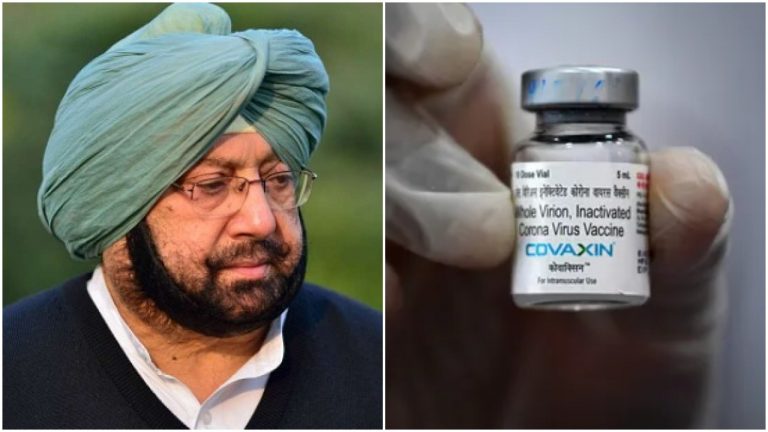
The Punjab government’s decision to sell government-procured Covaxin doses to private hospitals for profit has fulled a new political controversy in the state.
According to the reports, the Congress government in Punjab is accused of making a profit of Rs.660 per dose in the name of Corporate Social Responsibility (CSR) by selling government procured vaccines to the private hospitals in the state. On top of it, the private hospital is making a profit of Rs.500 per shot as the customer pays Rs.1,560 for each jab.
Reportedly, the Punjab govt sold at least 20,000 vials of Covaxin to private hospitals in the name of Corporate Social Responsibility (CSR) across the state at a rate of Rs.1,060 per dose. It was sold from a batch of one lakh vials procured by the govt at the rate of Rs 400 per dose, the rate fixed by Bharat Biotechfor state governments.
The state govt has justified the higher price charged from private hospitals by saying that they would have to pay that price if they had purchased the vaccine from the manufacturer directly. It may be noted that while the price of Covaxin for state governments is Rs 400, it is Rs 1200 for private hospitals. This means private hospitals save Rs 140 by purchasing from Punjab govt instead of the manufacturer.
“We have purchased it at a rate of ₹400 and are giving to the private hospitals at a rate which they would have paid had they bought it from the directly from the manufacturer. Private hospitals are depositing the money in the CSR Fund account created only to purchase vaccine,” said senior IAS officer Vikas Garg, who is the nodal officer for vaccine in Punjab.
The vaccines were purchased for the 18-44 age group by the state govt, and now the private hospitals are administering the doses to those who have booked slots for the vaccine.
The private hospitals that are buying from the government authorities are charging at least Rs.1,560 per shot from the people, making it not only costly for the common man but also creating artificial scarcity in the government vaccination centres where the doss would have been available for free.
Meanwhile, officials have said that the government has created a different bank account in the name of Vaccination CSR Fund and private hospitals deposit the money in this account only. The state authorities involved in the procurement of vaccine have claimed that the additional money collected from the private hospitals will be used to purchase more doses of the vaccine.
The decision of the Punjab government to sell the vaccines is seen as an attempt of the state government to make profits at a time when people are striving hard to get vaccination amidst a shortage of vaccine at the government-run centres.
Experts slam Punjab govt for profiteering in the times of pandemic
Several experts have criticised the decision and have asked how the state government can indulge in profiteering in the name of the CSR Fund when the country is suffering a health crisis.
“How can the state make money out of this? It’s shameful that when the state-run free vaccination centres had to be closed due to a vaccine shortage, govts are making profits. The justification that the fund will be used for procuring the vaccine is like using money collected by loot for the welfare of people,” said Dr Balbir Singh, an eye surgeon and health activist from Patiala, who is also a former state convener of the AAP.
Another individual from Jalandhar reportedly said she had no option but to pay Rs.1,560 for the jab at a private hospital as there is no availability of vaccines at the government centres.
“I was surprised to know that the state has sold these doses to private hospitals. If it was the state quota, why common people should pay for it,” she said.
Punjab making profits in donations for vaccine also
Apart from selling vaccines to private hospitals for profit, the Punjab government has also invited donationsof vaccines for beneficiaries in the 18-44 age group. Under the scheme, vaccine donors can deposit money in a Vaccination Donation Account of the state government to sponsor the vaccination of others. And in this scheme too, the state govt is making a small profit.
The government procures Covaxin at the rate of Rs.400 per dose. However, the donor has to pay Rs.430 for a single dose of vaccine for an individual. Therefore, the government is making a profit of Rs.30 for each dose of vaccine through this scheme.
A report by Indian Express said that the govt is buying two doses of Covaxin at Rs 430, and giving one dose against a donation of the same amount. That would mean that the govt will be making a profit of Rs 430. But that seems unlikely, as Bharat Biotech has announced that the price for its Covid vaccine for state governments is Rs 400, therefore it may not possible for Punjab to buy two doses at Rs 430. There is no report that the company is selling the doses at the discounted rate of Rs 215 per dose to Punjab, and any such discount will be applicable to all the states.
Corporates can sponsor the vaccination of their employees, or anyone willing to pay for vaccination of others can donate Rs 430 per dose under this scheme. Govt has only included Covaxin in this scheme, as the gap between two doses in Covishield is longer and officials say it may be difficult to maintain records of the beneficiaries for such long periods.
This donation scheme essentially means that while the Punjab govt offers vaccines in the 18-44 age group for free, they are also selling the shots at Rs 430 per dose in the name of the donation scheme, and thereby making a profit.
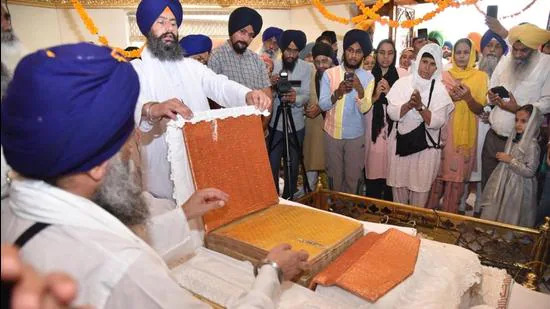
Just ahead of the 37th anniversary of Operation Bluestar, the Shiromani Gurdwara Parbandhak Committee (SGPC) has put the bullet-hit Bir of Guru Granth Sahib on display, along with the bullet that had hit it. The Bir was struck by a bullet during operation blue star in 1984. Devotees jostled to the Golden Temple on Thursday where the Granth has been put up for a three-day display.
The decision of putting the Granth Sahib on display was taken in a special meeting of the SGPC executive committee in Amritsar on Wednesday. SGPC president Bibi Jagir Kaur while addressing the media said, “Sikh qaum (community) can never forget the June 1984 Ghallughara (holocaust).”
“It is an oozing wound that is still painful after 37 years. The available relics associated with this holocaust will be shown to the sangat (devotees) so that the future generations can remember the atrocities committed on the community,” added Kaur.
She informed that the golden plates of Sri Harmandar Sahib and Sri Akal Takht Sahib, which were also shot upon during the military operation against the terrorists, would also be kept for devotees to see.
The saroop, which was installed in the sanctum sanctorum at that time, was hit by a bullet when Operation Blue Star was underway. The Saroop was showered with flowers as it was taken from Akal Takht to Shaheedi Asthan of Baba Gurbaksh Singh, where it was installed for darshan.
In a first, this move by the Shiromani Akali Dal-dominated SGPC comes at a time when SAD leadership is facing political heat over the 2015 sacrilege incidents.
Live telecast and media coverage of the event
Emotions ran high as devotees ran to the temple to catch a glimpse of the saroop. LED screens were installed at various points around Akal Takht relaying live feed for the devotees. The event was also telecasted live on social media platforms for those who could not visit the shrine.
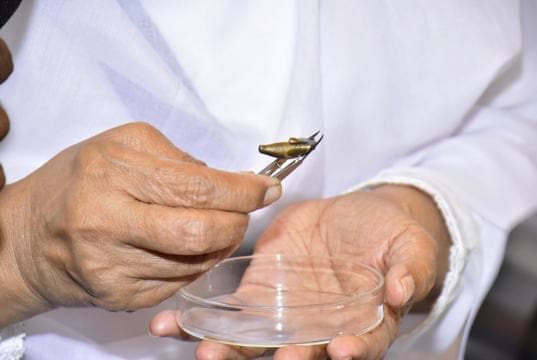
SGPC president Bibi Jagir Kaur displayed the bullet while Akal Takht head granthi Giani Gurmukh Singh showed the saroop to the media.
SGPC chief Bibi Jagir Kaur holding the bullet that hit the bir of Guru Granth Sahib in 1984. Image Source: Hindustan Times
The saroop was not opened fully fearing the damage, however, the hole made by the bullet was visible clearly.
Devotees express shock
A devotee named Dalbir Singh came all the way from Patiala to pay obeisance along with his wife and son. On viewing the saroop he remarked, “So far, we had only heard from preachers about the holy bir being attacked in 1984. Finally, today we have seen it. It’s painful,” he said.
Amandeep Kaur, a newlywed from Ajnala, said: “I was aware of the army action at Darbar Sahib and Akal Takht Sahib, but not on the holy saroop. Seeing it is shocking and distressing. We never got justice.”
SGPC president gets emotional on seeing the saroop
Expressing agony and holding the central government of that time responsible, Kaur said, “During the attack of June 1984, the central government of the time had not only demolished Sri Akal Takht Sahib, the highest institution of the Sikh community, but also targeted the most sacred shrine of the world, Sachkhand Sri Harmandar Sahib.”
“Foreign invaders like Zakariya Khan and Abdali also targeted Sikhs and Sri Harmandar Sahib, but the military attack of June 1984 is even more painful because it was carried out by the Congress government of our own country. This Sikh holocaust will always be a part of the Sikh psyche,” she added.
6th of June is when the 37th anniversary of Operation Blue Star will be observed. The bullet-hit relics will be on display for the devotees from June 3 to 5.
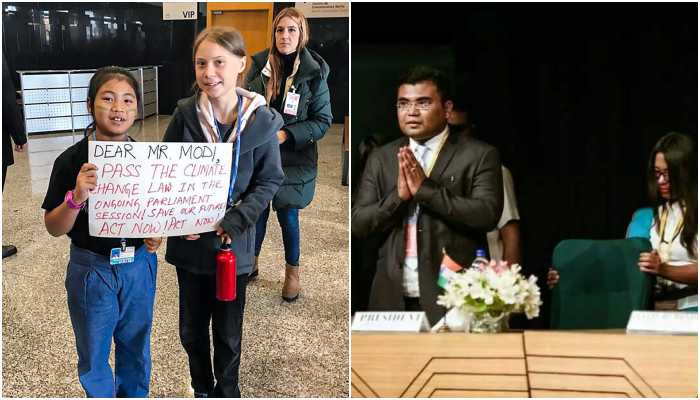
The arrest of rent-a-cause activist Licypriya Kangujam’s father has opened a can of worms with many people coming to the fore to share anecdotes of how they were duped by fraudster Kanarjit Kangujam.
Projecting his 9-year-old daughter as the face of a national and international ‘climate activism’ campaign, Licypriya’s father Kanarjit Kangujam has reportedly duped nearly 100 children from 12 countries under the garb of activism as per a Vice report. The fraud amount is estimated to be approximately $44,685, just from fees collected from students.
Paojel Chaoba, a Manipuri investigative journalist, in an interview to the Vice revealed how the ‘too good to be true’ tall claims made by Kanarjit Kangujam led to journalists flocking his events.
In 2015, a Manipuri news outlet quoted Kangujam saying that politician and actor Arnold Schwarzenegger and now-ousted Myanmar leader Aung San Suu Kyi will be attending a youth conference organized by International Youth Committee, a shady organisation run by Kangujam where he portrayed his daughter as ‘India’s Greta Thurnberg’.
“Myanmar’s supreme leader visiting our small state sounded too wild to be true,” remarked Chaoba in the Vice report.
To add to this were other claims, including a supposed nomination for Licipriya to the “Global Youth Icon Award 2015” jointly with Malala Yousafzai (Nobel Peace Prize 2014 winner) and Felix Finkbeiner (German Child Activists).
Journalist who exposed Licypriya’s father compared him to Charles Sobhraj
Chaoba who not only published several articles exposing Kangujam but also helped with the police investigation called Kanarjit absolutely “brilliant.” Comparing Kangujam to a 1970s serial killer who targeted tourists in Asia, he said, “He is like the Charles Sobhraj of Manipur – minus the looks and murders.”
The alleged scams committed by Kangujam by preying on earnest activists revealed how he looted children activists across the globe using logos of the UN and UNESCO to legitimize his events.
Through IYC, Kangujam claimed to host international-level seminars for activists from India, Nepal, Indonesia, Azerbaijan, Nigeria and Croatia. He even collected fees citing exchange programs and activities but the contributors never saw any exchange programs, the report stated.
Modus operandi of Kanarjit Kangujam
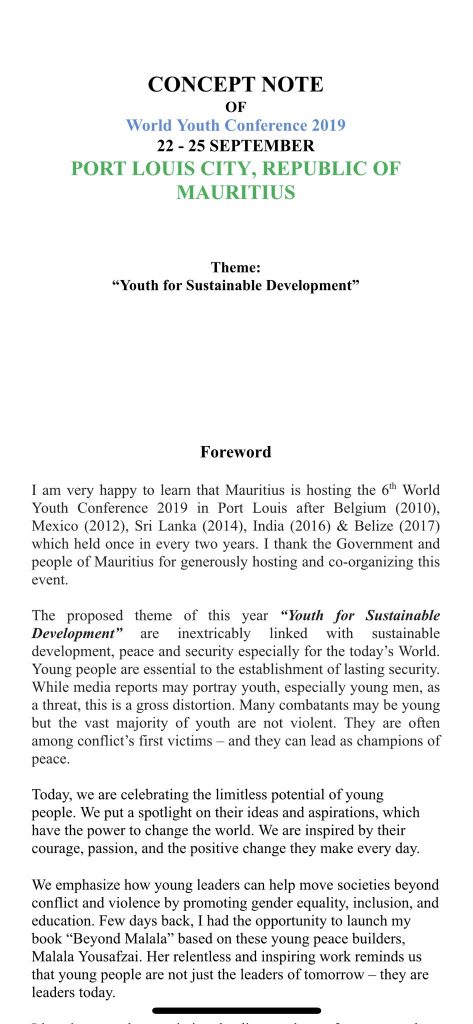
A source on the condition of anonymity informed OpIndia that Kangujam would create hoax events with well-drafted documents claiming that the UN, UNESCO and the government of India are hosting an exchange program.
Fake document created by Kangujam
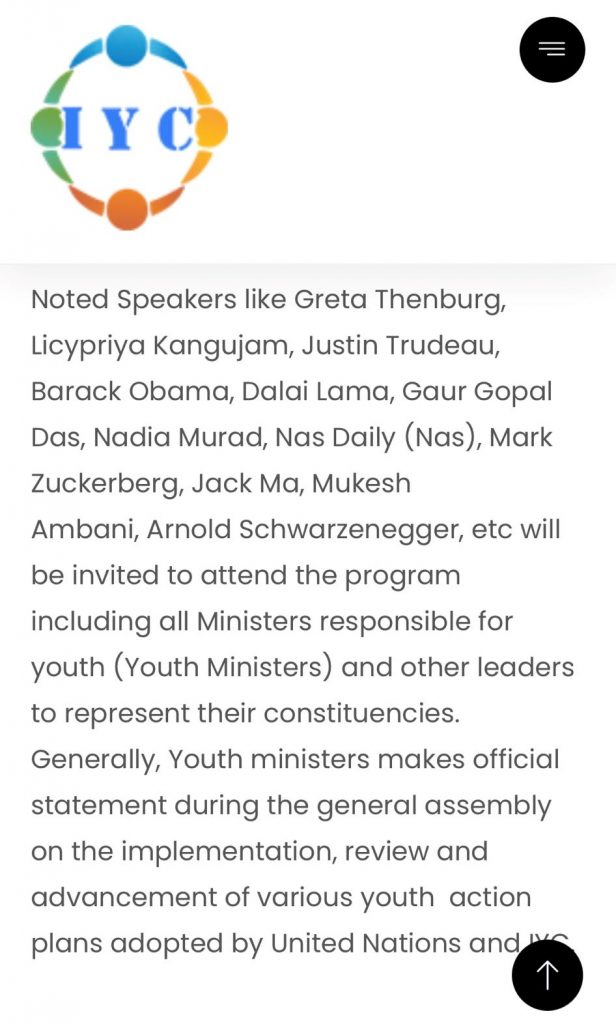
He would then call for participants, misusing the logos of the global entities. The proceeds of the participation fee would go into his personal account, informed the source.
Image Source: IYC website
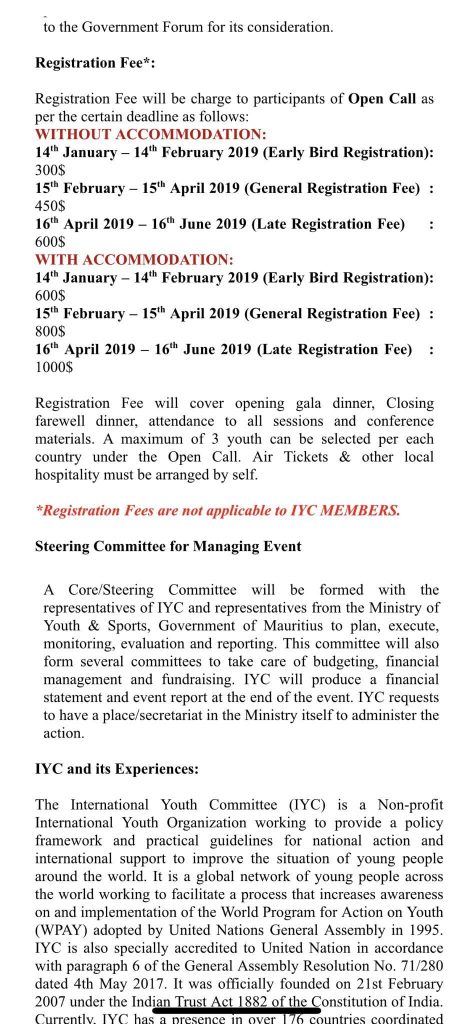
Kangujam claimed to host events in Japan, Europe and Mauritius for which he collected hefty participation fees, however, the events never took place. When the volunteers called up the respective organizations and ministries to confirm the event, each one of them declined to know Kangujam or the so-called events planned by him.
Registration document created by Kangujam
When the participants asked for refunds, he declined, threatening elimination from the program which would make them ineligible for any refunds and passed every complaint to the volunteers to handle.
Licypriya’s father duped children in the name ‘exchange programs’
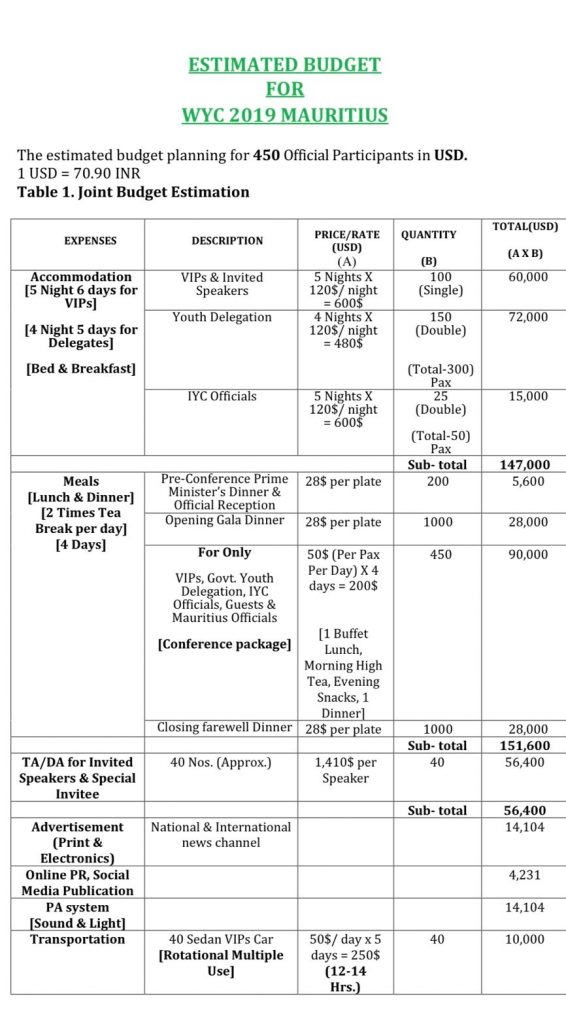
As per a document shared by the source, Kangujam drafted budget documents to justify the participation fee.
Budget document by Kangujam
With this, he duped several Pakistani participants to the tune of $160 each, Bhutanese participants of $300-420 each and Mauritian participants of €1200 each. As per the source, the participation fee varied as per nationality and sometimes individually.
As per the Vice report, a legal complaint by Prajesh Khanal, a youth activist from Nepal led to Kangujam’s arrest.
“I only interacted with him on messenger and email, and to be honest, he looked very legit,” confessed the 20-year-old to Vice World News. Khanal revealed to have paid over $460 for an exchange program, which is yet to be refunded.
Kangujam’s arrest led to more participants revealing how they were duped by the ‘activist’. Pallabi Roy, a dentist from Delhi, informed that she along with her friend paid $410 each in 2017 for an IYC event.
“It’s just unfair to my family that worked hard and funded this trip,” said the 24-year-old, who is now preparing to file a criminal case against Kangujam, as per the Vice report.
Simardeep Syal from India almost lost $273 to Kangujam until he filed a police complaint in 2020. “He has a pattern,” the 24-year-old revealed. “He shows off his so-called connections. And for people, when someone claims political connections, they tend to believe them. I did too,” Syal added.
Licypriya Kangujam’s Ketto campaign
Additionally, Licypriya Kangujam’s Ketto campaign reeks of possible FCRA violation. We reported earlier how multiple discrepancies were found in a fundraising campaign being run by Licypriya and questionable association with Noble Citizen Foundation.
Kanarjit Kangujam arrested by Delhi Police
As of now, Kangujam Kanarjit has been arrested in a joint operation by Delhi Police and Manipur Police on 31 May and was be produced before the Court.
Kanarjit has been accused of cheating multiple people, with amounts as high as Rs 19 lakh. In 2015, he was arrested in Manipur with charges of criminal case number 176 of 2015 under Section 420 (Fraud), 324 (Assault) and 406 (Criminal breach of trust).
Kanarjit had also invented the fake achievements of daughter Licypriya Kangujam in order to propel her to international fame. In Multiple press investigations and reports, it was found that Licypriya’s so-called UN invite and other attendances were all fake, cunningly drafted and used by her father for media hype.
Controversial Congress leader Imran Masood, known for his anti-Hindu and anti-Modi comments, has been appointed as a secretary in the All India Congress Committee (AICC). Today the AICC announced the appointment of 5 secretaries in charge of different states, and Imran Masood has been made a secretary in-charge of Delhi.
Congratulations Sh.Imran Masood for the new responsibility as AICC Secretary incharge Delhi ,
We assure you that under the leadership of AICC incharge Sh @shaktisinhgohil & with your guidance Delhi Congress will definitely work hard to strengthen the party. pic.twitter.com/PkHEb09yHq
Other appointments of secretaries announced by AICC are Odisha MP Saptagiri Sankar Ulaka for Chhattisgarh, Jharkhand MLA Deepika Pandey Singh for Uttarakhand, Sanjay Dutt from Himachal Pradesh, and Brijlal Khabri for Bihar.
Newly appointed AIIC secretary in-charge of Delhi Imran Masood is a former MLA from Uttar Pradesh of the Congress party, and he is known for threatening to “chop Narendra Modi into pieces” ahead of the 2014 Lok Sabha elections. Masood was contesting the Lok Sabha election from Saharanpur in UP in 2014, and during an election rally, he had said, “Narendra Modi se kaun ladega? Jo thok ke jawab dena jaane Modi *&*#@ ko.” (Who will fight against Modi? The one who knows how to give it back to this &@*&# Modi).
He had then added, “Who Gujarat samaj raha hai, 4% Musalman hai Gujrat mei, yaha 42% Musalman hai. Yaha Gujarat bana denge, @#$@# ko boti boti kaat denge… choti choti…” (he thinks this is Gujarat, Gujarat has 4% Muslims, here Muslims are 42%, we will make Gujarat here, will chop @#$@# in small pieces).
Ahead of the 2019 Lok Sabha elections, PM Narendra Modi had evoked the ‘boti boti’ threat of Imran Masood during an election rally in Saharanpur. He had said, “Here (in Saharanpur), there is one individual who threatens to cut [me] into pieces. He is the favourite of the Shehzada of Congress… he (Rahul) loves him (Imran) a lot.” The PM had then said, “Remember, they are the ones who threaten ‘boti-boti’ and we are here to ensure safety and honour of ‘beti-beti’ (every daughter).”
Following his hate speech, Masood was arrested in March 2014. But keeping in tradition with rewarding hate speech, in the 2017 Uttar Pradesh Assembly elections, Imran Masood contested on a Congress ticket from Saharanpur’s Nakur seat which he lost to BJP’s Dharam Singh Saini. After that, in June 2017, he had threatened forceful agitations by Dalits and Muslims against the Yogi Adityanath government. Congress too had supported Masood’s stand on the issue. “Imran is our leader and we support the stand that he has taken locally,” Uttar Pradesh Congress President Raj Babbar had said.
Ahead of the 2019 Lok Sabha elections, Imran Masood was made part of the Congress party’s election committee in Uttar Pradesh. He was also made the party candidate for Saharanpur, which he had lost and had come third in terms of votes after BSP and BJP candidates. Masood was also seen in the luxury bus with Priyanka Gandhi, Rahul Gandhi, Jyotiraditya Scindia during Priyanka Gandhi’s first roadshow in Lucknow in 2019.
Prior to joining Congress, Masood was with Samajwadi Party. He was declared the Lok Sabha candidate for Samajwadi Party from Saharanpur in September 2013. However, in March 2014 he defected to Congress and contested from the Saharanpur seat on a Congress ticket.
Gandhi scion Rahul Gandhi’s decision to unfollow over 60 Twitter handles, including some of the members of the Congress ecosystem, has become a talking point in the country. Initially, it appeared that he had unfollowed only a few pro-Congress propagandists, however, it later came to light that he has followed more people, including ‘journalists’ and other prominent individuals of the country.
Interestingly, another significant personality unfollowed by Rahul Gandhi is Bollywood superstar Amitabh Bachchan.
The sudden unfollowing of Amitabh Bachchan by Rahul Gandhi has ignited a fresh debate on what might have transpired between the two, as the ties between the two families – Gandhis and Bachchans – go back to three generations and almost six decades.
The decade-old ties between Gandhis and Bachchans
The ties between the two families can be traced back to Amitabh Bachchan’s father, Dr Harivansh Rai Bachchan, who worked in India’s Foreign Ministry as a Hindi Officer. Former Prime Minister Jawahar Lal Nehru apparently had high regards for Dr Bachchan, which resonated in the families ties as well.
Harivansh’s wife and Amitabh’s mother, Teji Bachchan, became a close friend of Nehru’s daughter, Indira. As they moved to Delhi, Teji Bachchan worked as a social activist, and her friendship with Indira Gandhi became deeper.
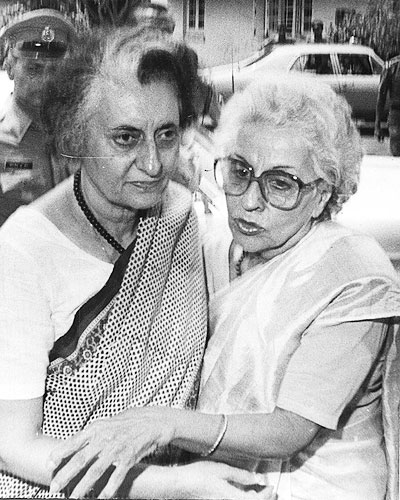
Indira Gandhi with Teji Bachchan/ Image Source: NBT
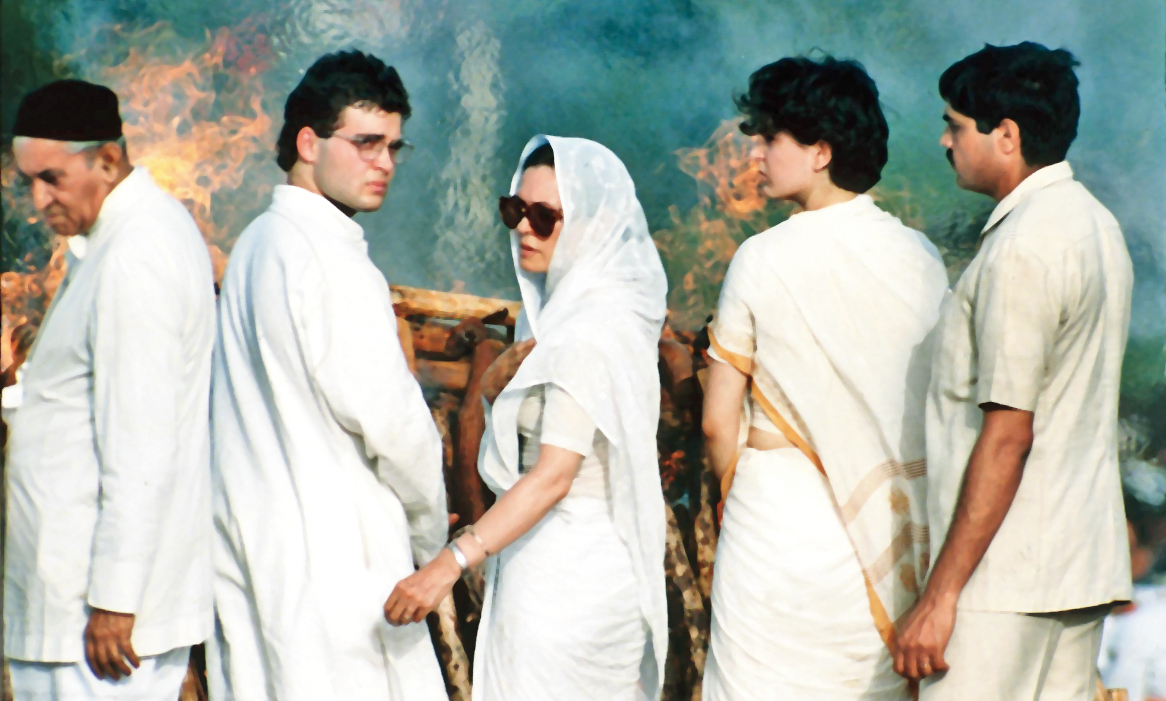
Their friendship between the two families reached the peak when Bachchans lent moral support to Rajiv Gandhi in the late 1960s during his marriage with Sonia, which Indira opposed. When Rajiv Gandhi was courting the young Italian girl Sonia Antonio Maino, Teji Bachchan acted as a mediator between the two families as Indira disapproved of their relationship.
In 1968, when Sonia Gandhi arrived in India as Rajiv Gandhi fiancee, it was the young Amitabh Bachchan who drove to Palam airport to receive her. When the marriage was finally fixed in 1969, Sonia Gandhi and her family moved in briefly and stayed at the Bachchans’ New Delhi residence at 13, Willingdon Crescent, to learn about Indian customs and traditions from Teji.
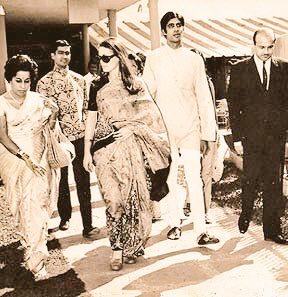
Bachchan’s with Sonia Gandhi in early 70s/ Image Source: Quora
And she spent the next 43 days with Bachchans before her civil marriage to Rajiv Gandhi on 25 February. The Bachchans had attended the wedding and had wished the newlywed couple.
During an interview with Dharamyug magazine in 1985, Sonia had opened up about her initial association with the Bachchans. “Mummy [Indira] had asked me to stay with the Bachchans [before her wedding] so that I could learn Indian customs and culture from close up. Slowly I came to learn a lot from that family. Teji aunty is my second…No, my third mother. My first mother is in Italy, and the other was my mother-in-law, Mrs Indira Gandhi, the third is Teji Aunty. Amit and Bunty [Ajitabh] are my brothers”.
Rajiv wanted Amitabh Bachchan to be active in politics, Big-B fought on Congress ticket
The friendship between the two families continued throughout the next decade. It was speculated then that both families had held wide-ranging discussion regarding Big-B’s possibility of entering full-time politics. However, the relations touched a new high in 1984 when Rajiv Gandhi persuaded Amitabh Bachchan to enter politics and contest the election from Allahabad on a Congress ticket.
Eventually, Amitabh Bachchan was given a Congress ticket in 1984, who won from Allahabad with a handsome margin. His emphatic win over Hemvati Nandan Bahuguna took the bonhomie between the two high-profile families to a new high. In the next few years, Amitabh Bachchan became the face of the famous youth brigade in Delhi, comprising Satish Sharma, Arun Nehru, Arun Singh and Kamal Nath.
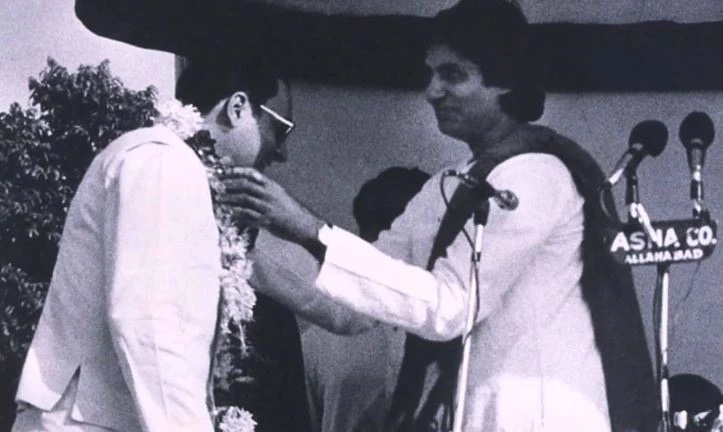
Amitabh Bachchan with Rajiv Gandhi/ Image Source: Wiki
However, things started taking a different turn in the late 1980s when the Bofors scandal was exposed and many, including Rajiv Gandhi and Amitabh Bachchan, were alleged to have received kickbacks. This was the turning point when Bachchan started distancing himself from Rajiv to avoid tarnishing his image.
Three years later, Amitabh quit politics and resigned after a newspaper reported his involvement in the Bofors scam. This marked the beginning of the souring of relations between the two families. Years later, Amitabh Bachchan was given a clean chit in the case by the Supreme Court.
In the early 1990s, the relationship between families turned sour after the assassination of Rajiv Gandhi. The Gandhi family was expecting Amitabh Bachchan to join the Congress party to assist Sonia Gandhi, which he clearly refused, citing his engagements. Apparently, this offended the Gandhis, who thought Big-B betrayed the family.
Image Source: Telegraph
A few years later, when Big-B was in a financial crisis, he felt cheated by the Gandhi family, who did not come to his rescue. The mutual feeling of betrayal got complicated and led to further events of betrayals and rifts, which widened especially after the Bachchan family’s ties with Amar Singh became stronger.
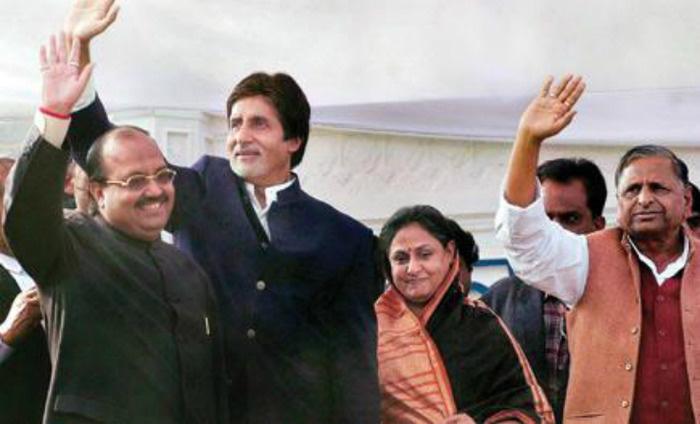
Amar Singh, who was with the Samajwadi Party then, helped Amitabh Bachchan during the financial crisis. The two became very close, and later, Jaya Bachchan was nominated to Rajya Sabha as a Samajwadi party member. The rift between the Bachchans and Gandhis widened as the Bachchans grew close to Amar Singh, who, according to some, was never liked by the Gandhis.
Amitabh Bachchan and Jaya Bachchan with SP Chief Mulayam Singh Yadav and Amar Singh/ Image Source: Indiatimes
Gandhis vs Bachchan
The cold war between the two reached a pinnacle when Bachchans and Gandhis engaged in a mudslinging affair, pulling each other down by putting out statements against each other in the media.
The relations got spoiled when Amitabh’s wife, Jaya Bachchan, went public with her disappointment. In an interview, Jaya had expressed her disappointment against Gandhis, saying, “Those who brought us into politics left us midway. They left us when we were in a crisis. They are known to betray people.”
Subsequently, Rahul Gandhi, then the youth leader, had hit back, saying, “The Bachchans are lying. Why are they levelling the charge now after so many years? Amitabh was introduced to politics two decades ago. They have changed loyalties. Those who know the Gandhi family know we’ve never betrayed anyone. People know better about who betrayed whom. People also know who their loyalties are with.”
Following the controversy, Amitabh Bachchan too had aired his views on the controversy. “They (the Gandhi family) are the rajas (rulers), and we (the Bachchans) are runk (subjects). Any continuation of the relationship depends on the rulers’ mood. Now, they accuse my family of lying.”
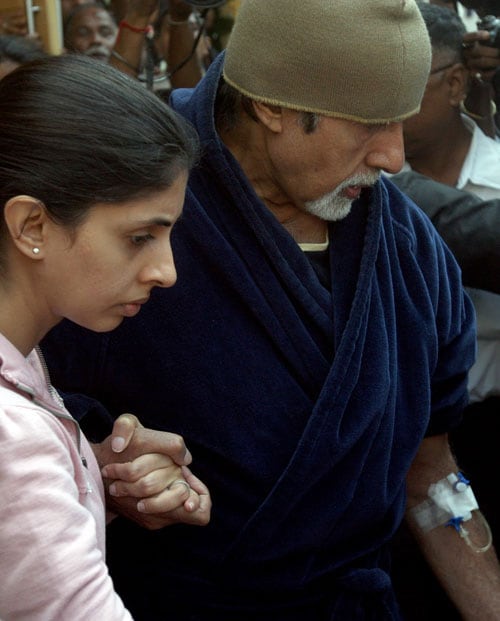
To add more fuel to the already deteriorating relationship, the UPA government in 2005 had slapped Big-B with Income Tax notices for alleged illegal possession of agricultural land while he was still at the Lilavati Hospital in Mumbai recovering from a severe intestinal ailment. Apparently, the Congress government had made Amitabh Bachchan pay the bill from his hospital bed.
Amitabh Bachchan coming out Lilavati Hospital after his surgery iin 2005.
In 2010, Amitabh became the face of the ‘Khushboo Gujarat Ki’ campaign under Narendra Modi, who was the then Chief Minister of Gujarat. Amitabh Bachchan’s close relationship with Bal Thackeray, a bitter political enemy of the Congress, had also irked the Gandhis.
Given the twists and turns into the relationship between the two elite families – Bachchans and the Gandhi family, the latest controversy over Rahul Gandhi deciding to unfollow the senior actor has added more fuel to the fire. Though the official reasons for unfollowing Amitabh Bachchan are yet to be revealed, some within the Congress party have suggested that the Gandhi-scion will not follow any film stars on Twitter in the future.
Ex-Aam Aadmi Party MLA Sukhpal Singh Khaira along with Pirmal Singh and Jagdev Singh Kamalu today joined Congress at a low-key event at Punjab CM Captain Amarinder Singh’s residence. Khaira, a former Congress leader had quit the party to join AAP in 2015. He contested 2017 Punjab Assembly elections on AAP ticket and won the Bholath constituency. However, he quit the party in January 2019 and floated his own outfit ‘Punjab Ekta Party’.
However, Khaira’s stunt as a politician has been full of controversies.
Heroin smuggling controversy
Khaira’s name was linked to drug peddlers in heroin smuggling case back in 2015 after one of his close aide Gurdev was accused in a cross-border drug smuggling racket. However, in the charge sheet that was filed, his name was not included by the police. The police had said that Gurdev had allegedly funded all elections Khaira contested since 1997. In March 2021, the Enforcement Directorate raided his premises in the case. The ED conducted the raid under provisions of the Prevention of Money Laundering Act (PMLA) and is aimed at gathering more evidence to take forward the probe.
Referendum 2020
Khaira has been very vocal about the support to Referendum 2020, which intends to create a separate State for Sikhs. In 2018, Khaira had allegedly said, “I support the Sikh referendum 2020 movement as Sikhs have the right to demand justice against atrocities suffered by them.” However, he had later ‘clarified‘ his stand and claimed that he was ‘not in favour of Referendum 2020’, but added that it was “result of a consistent policy of bias, discrimination in persecution of Sikhs ever since partition, be it attack on Darbar Sahib, genocide of Sikhs in 1984”.
Anti-Hindu views
In November 2020, Khaira had appealed to people to celebrate ‘Black Diwali’ to protest against the new farm laws which aim to actually benefit the farmers. In 2015, too, he had urged the Sikhs to wear black turns till Diwali to protest against alleged sacrilege of Guru Granth Sahib.
Khalistan support and other allegations
In 2015, when he had joined Aam Aadmi Party, Congress leader Laal Singh had accused Khaira of having raised Khalistan flag in Kapurthala. He had also alleged that Khaira was a ‘landgrabber’ and said that the house he was then living in belonged to a film actress and he had forcibly occupied it. Singh also said that Khaira was never a spokesperson of Congress but used it as a card to negotiate better post as he joined AAP.
Now, five years after quitting Congress for AAP, Khaira is back to Congress.
Renowned medical journal The Lancet has started to publish a lot of propaganda articles against the Modi government in India. They have been attacking the govt alleging mismanagement of the Covid-19 pandemic. However, most of their criticism of the Indian govt is not based on any fact, they are mostly based on familiar rhetoric that Indian left-liberals keep peddling.
Earlier this month, the journal had published an editorial, where it had placed the entire burden for the crisis at the feet of the Prime Minister while giving every other political party a free pass. The article was riddled with a series of inaccuracies in terms of data, claiming that India will see a million death from Covid-19 by August.
While the Lancet claims that India has failed to contain the Covid-19 infection in the country, it fails to recognise that number wise, India’s position is still better compared to several developed nations. What the journal fails to mention is the population of India, which is the second largest in the world.
The table below shows Covid-related data to population and economy (as collected on 9th May 2021) : –
Country
Population
Covid cases
Covid deaths
Deaths per million
Population density per sq.km
Per capita GNI in USD (2019)
USA
33,10,02,651
3,41,54,305
6,11,020
1836
36
65,850
EU
445250514
3,22,59,542
7,21,135
1620
117
46,467
Brazil
212559417
1,67,20,081
4,67,706
2186
25
9,130
Russia
145934462
50,90,249
1,22,267
837
9
11,260
Mexico
128932753
24,23,928
2,28,146
1753
172
9,480
UK
67886011
44,94,699
1,27,794
1873
281
42,220
Argentina
45195774
38,52,156
79,320
1740
16
11,130
TOTAL
1,37,67,61,582
9,89,94,960
23,57,388
1716
94
27,934
India
1,38,00,04,385
2,84,41,986
3,38,013
243
424
2,120
This shows that compared to a total of 33 countries with a combined population similar to India’s population, India has done much better in terms of managing the pandemic. While those countries have reported almost 10 crores of Covid-19 cases, India has reported 2.84 crore cases. Similarly, while 23.58 lakh people have died of Covid-19 in those countries, the fatality figure for India is 3.38 lakh. The fatality rate at deaths per million in India is also significantly lower. This is despite the fact that India’s population density is much more compared to the other countries, which is a major factor in a highly contagious disease like Covid-19.
Most of these countries have better infrastructure, far superior healthcare, very deep economic pockets, have printed untold amounts of money, spent enormous amounts of money on healthcare and yet they have 3.5 times more infection and 7 times more deaths. India’s population density is 4.5 times the average population density of all these countries. In simple terms, for every 1000 people in these countries, India has 4,500 people to be managed in a given area. This puts India at a distinct disadvantage, compared to sparsely populated countries where social distancing can be much more easily maintained.
If we understand that India alone is more than 33 countries put together that includes USA + entire EU with 27 counties + UK + Russia + Brazil + Mexico, then the Indian Prime minister and the government is doing the job equivalent to 37 Heads of state (and their governments) put together. Therefore, we can say that Team India under the leadership of PM Modi along with the cooperation and collaboration of the Chief Ministers of various states have been doing a relentless job and fighting this Covid war.
But the Lancet failed to consider these important factors and declared that India has failed in the war against the pandemic.
While the article is overall misleading, some points it makes are correct. Some of them are:
That India declared its victory too early with union health minister Harsh Vardhan calling it an end game, disregarding warning.
Assuming herd immunity with 21% seropositivity, encouraging complacency, and inadequate preparation.
Mistakes of allowing super-spreader events like religious festivals and political rallies.
Inadequate and slow vaccination and opening it up for 18 years – a botched vaccination strategy.
Ill-preparedness of Indian States for oxygen, beds, etc.
But some of them have context, and it needs to view them from a more complete perspective.
Dr Harsh Vardhan’s optimism
In hindsight, we can say that Dr Harsh Vardhan’s optimism in the first week of March was premature. But all preparations made then, based on the data then available from the first wave, probably appeared to be adequate. This is because, even during the height of the pandemic last year, we managed the pandemic well. In fact, many healthcare facilities and hospitals were asking the governments to release the beds for regular medical work. The optimism was in the air. That tsunami of the second wave, much larger, hit us, with an unprecedented speed and force, rising quickly and spreading like an uncontrollable wildfire, took us by surprise.
So, in the first instance, did people of India, fed up of prolonged lockdown lasting for months, wanting to get back into normal life, needing to start earning their livelihood, their industries, their businesses, for their mental stability and emotional release went about normally, going to markets, malls, offices, shops, factories, taking public transports and forgetting or unable to comply with social distancing, with or without mask? The Answer is Yes. And this happened despite both federal and state governments repeatedly, almost daily, reminding people to wear masks, keep social distance, avoid crowding, reminding people that their safety was their responsibility, urging them to take precautions as covid was still going on.
Our social media, mainstream media, billboards, caller tunes, Arogya Setu and other Apps were full of these reminders with governments taking even punitive actions against those who did not wear masks. The Lancet’s call to do so now, laying blame on the government, probably therefore is based on lack of knowledge or lack of awareness of ground reality and ignorance of human behaviour.
Because not only ordinary common man wants to get on with his life but also the people with privileges and powers would like to get back their lives. None other than the Pope himself expressed his delight, “I am happy to restart this face-to-face meeting again”, after the lockdown was lifted.
Selective blaming of super-spreader events
One can accept the criticism of religious gatherings or election rallies becoming a super‑spreader. Therefore, let us consider the farmer’s agitation which started in mid-November 2020 at the time of 45000 cases per day and went on for more than 4 months (and is still not called off), with thousands of farmers and many rallies in and around NCR – Delhi and Punjab. While religious gathering and election rallies found mention in the Lancet editorial, this was conspicuously absent. Just curious, Why?
Were the religious festivals and political rallies cleverly cherry-picked to make a political point or were they based on scientific medical data? Does The Lancet have scientific data that farmers’ rallies and sit-ins had no impact on Covid-19 cases in NCR Delhi and other parts of India, but only the religious festivals caused a phenomenal second wave in India?
It would be enlightening to know from The Lancet why one gathering would be a super‑spreader and another held for much longer wouldn’t be. Such discovery by The Lancet may give a clue to the world as to what kind of gatherings would not spread infections!! Of course, their insight into many such gatherings all across the world, where only a particular political rally or religious festivals were super‑spreaders and others aren’t would be an eye opener too.
Vaccination
It is better not to talk about vaccination and preach India. Team India has been working on it, and as there are inter-State bickering and complaints in Europe about unavailability or non-delivery of vaccines, so do we have in India. It is because the challenge itself is unprecedented and overwhelming.
When after much hard work and as much as possible due diligence, the two vaccines produced indigenously were released under EUA, there was a blitzkrieg of negative publicity that was unleashed in mainstream media and social media raising doubts and fears about a certain vaccine amongst people in India, despite central government’s assurances, that resulted in serious issue of vaccine hesitancy, with people avoiding rather than taking vaccines, with millions of doses going waste.
So probably for decision makers it was like walking on eggshells, should a serious or large-scale untoward event take place, the government would have been at the receiving end. At such times, with cases declining, vaccine hesitancy at its height, with data of vaccine effectiveness vs side effects still coming in, for example, some European countries selectively banned the use of one of the vaccines in certain age group, India still went ahead and even helped quite a few nations sharing the precious vaccines on humanitarian grounds. So, The Lancet’s criticism of India on the vaccine front is unwarranted and unjust.
The decision for opening up vaccination for 18-45 years, which forms a major part of the work force and an aspiring student population, was to protect the younger population, nation’s intellectual assets, and working class, which form the backbone of Indian society and economic health. Moreover, it was done after major opposition parties like Congress and non-NDA ruled states like Maharashtra and Delhi had started demanding that vaccination should be opened for all.
Economic revival equally important
Every Head of Nation, around the world, is not only looking at Covid-19 alone, but also an economic revival, jobs, industrial, financial and every aspect of human existence to be restarted as soon as possible, or nations will be staring at the destruction of industries, job loss, debts, poverty, hunger, depressions, suicides, disruptions, social unrest, political instabilities and anarchy, which will be far more devastating than the number of covid deaths. PM Modi and the Chief ministers of various States do understand this and are trying to hold this nation afloat together against this dire challenge.
In India one can’t wait for herd immunity or vaccination of 138 crore Indians which may take about 1½ -3 years before restarting the nation’s engine of growth. It is a fine balancing act, like walking on a razor’s edge.
Therefore, the Lancet’s proposal for a new federal lockdown of the nation would be economic suicide for the nation, that India can ill afford. And, till now we the Indians, despite our failings here and there, despite a challenge even to our national sovereignty from our hostile neighbours, with our defence forces guarding our boundaries, we the people of India have done relatively well and better than many that you might have overlooked. That Covid can spread quickly in dense populations and in great numbers is beyond human control, unless every single individual is isolated in a cocoon, which is practically impossible or the world would have solved this pandemic long ago. And India can’t escape this vulnerability. The second wave of tsunami has proved that.
Genome sequencing
The Lancet suggests that Genome sequencing needs to be expanded to better track, understand, and control emerging and more transmissible SARS-CoV-2 variants. They should have known that 6. Indian SARS-COV2 Consortium on Genomics (INSACOG) was established by the Central government in December 2020 and is already doing genomic studies of circulating Covid Viruses and their epidemiological trends.
The Consortium is expected to help in expanding whole genome sequencing of SARS-CoV-2 virus across the nation, aiding the country’s understanding of how the virus spreads and evolves. Any changes to the genetic code, or mutations, can be observed in the samples. The ten regional genome sequencing laboratories spread across the country cater to the nearest states, which send 5% of the positive samples to these labs for genome sequencing. The viral genome sequencing data generated by the eight regional genome sequencing laboratories are analysed by the respective centres and sent to the National Centre for Disease Control (NCDC), Delhi for collation and integration.
The overall aim of the Indian SARS-CoV-2 Genomics Consortium is to monitor the genomic variations in the SARS-CoV-2 on a regular basis through a multi-laboratory network. This vital research consortium will also assist in developing potential vaccines in the future.
False accusation of stifling criticism
Sadly, the fact is that there are political and other forces inside and outside India that would want PM Modi dethroned, for their own personal agendas. But it is for the people of India to decide who they want as their prime minister. And the journal’s comment on the PM stifling the media is totally incorrect, as many in India are aware that there is a large number of dedicated anti-Modi mainstream media, social media, organisations, think tanks and individuals. The organisations and individuals have been writing, talking and expressing themselves freely even obsessively against Modi, for more than two decades now. And it is not possible to stifle all of them by anyone, let alone Narendra Modi.
Also, the readers of Lancet may understand that in India’s federal structure health is a state subject, and the prime minister could achieve little without the consent and collaboration of the chief ministers, health ministers and chief secretaries of states, who are responsible for implementation. Therefore, it is team India, not Modi alone, which is fighting this relentless battle.
A war unleashed against humanity
Let us realise that this pandemic is not just any infection, but a war, a war unleashed against humanity, in the form of a tiny virus. Till now all strategies have failed to completely resolve the challenges from this tiny smart (mutating and adapting) virus. What appears a good strategy in foresight often appears poor in hindsight. And today’s hindsight on which we may take our decisions may again be proved to be poor foresight in future. What guarantee do we have that a mutant may not outwit our present-day Wuhan strain specific vaccine strategy in future? Maybe they will have an editorial, “Mutants strike back!”
Let us assess Science frankly. Has science given a foolproof answer as to cure, complete elimination of virus without any side effects and zero morbidity or mortality? No! Has science created a preventive vaccine that is 100% effective and 100% safe? The answer is no! Has science accurately predicted who would and who wouldn’t get infected? the answer is no! Has science resolved this pandemic? No! Has science provided a blueprint of solutions for the challenges arising out of pandemic which deeply affect human society in ways other than health? The answer is no! No doubt science has helped, and significantly too in various fields, but it is still searching for the answers.
Today, an over inflated human ego, based on achievements of science and technology, that has made human beings more arrogant, selfish, greedy, insensitive, careless and destructive, stands decimated in front of a tiny virus.
By the way, despite the information on overwhelmed healthcare in European countries and the number of deaths, neither Indian Medical journals nor Indian media criticised or chastised European Heads of states, but empathised with them for the difficult situation they were in.
So, we thank lancet for the editorial and their scathing criticism. One presumes that a premier medical journal like The Lancet’s editorial is not written with a political agenda or a colonial or racist intention to look down upon India in the name of Modi bashing, because the noble editors, one hopes, wouldn’t allow such a hallowed page to be cunningly misused for such a thing.
We are sure that the humble editors wouldn’t be pompously criticising people, but forthwith give, with their wisdom, the foolproof blueprint of a solution, that has somehow escaped the best think-tanks around the world, and teach all countries how to defeat this raging Covid-19 pandemic that has not only affected the physical and mental health of billions, but has also harmed economies, industries, jobs, and the social and emotional lives of all.
We request the Lancet to provide a perfect blueprint of action for the world, that has not only science at its heart but also the economics, the jobs, the industries, the social and emotional wellbeing, and multitudes of all the complex issues at its heart, so as to solve all these challenges simultaneously and save the world.
Now that data of equivalent population and the information about Covid in some First World countries are staring at us, The Lancet will surely give some credit to PM Modi and his team of Chief Ministers for managing the Covid pandemic slightly better, with comparatively much lesser economic resources and a much greater and denser population. Who knows, with their enlightenment, The Lancet may come out with many more editorials, so as not to appear racist, colonially patronising or politically motivated, more severely censuring the Heads of the States of these countries who tried to do their best in this raging pandemic storm that has engulfed the entire world.
Author: Kalpesh Gajiwala, honorary Consultant Plastic and aesthetic surgeon with more than 30 years of experience at many hospitals in Mumbai.
The COVID-19 pandemic that gripped the world, with millions of deaths and several more being affected, has affected India severely as well. When India managed to battle first wave effectively, the world wondered how India managed to ‘escape’ without more dead bodies piling up. With the second wave, a large part of the world finally for what they wanted. The second wave did hit India with an intensity that was perhaps unforeseeable to the people.
However, understanding just how prepared India was for the second wave and whether India managed to actually fight the second wave effectively becomes important in the face of criticism regarding the ‘mishandling’ of the situation.
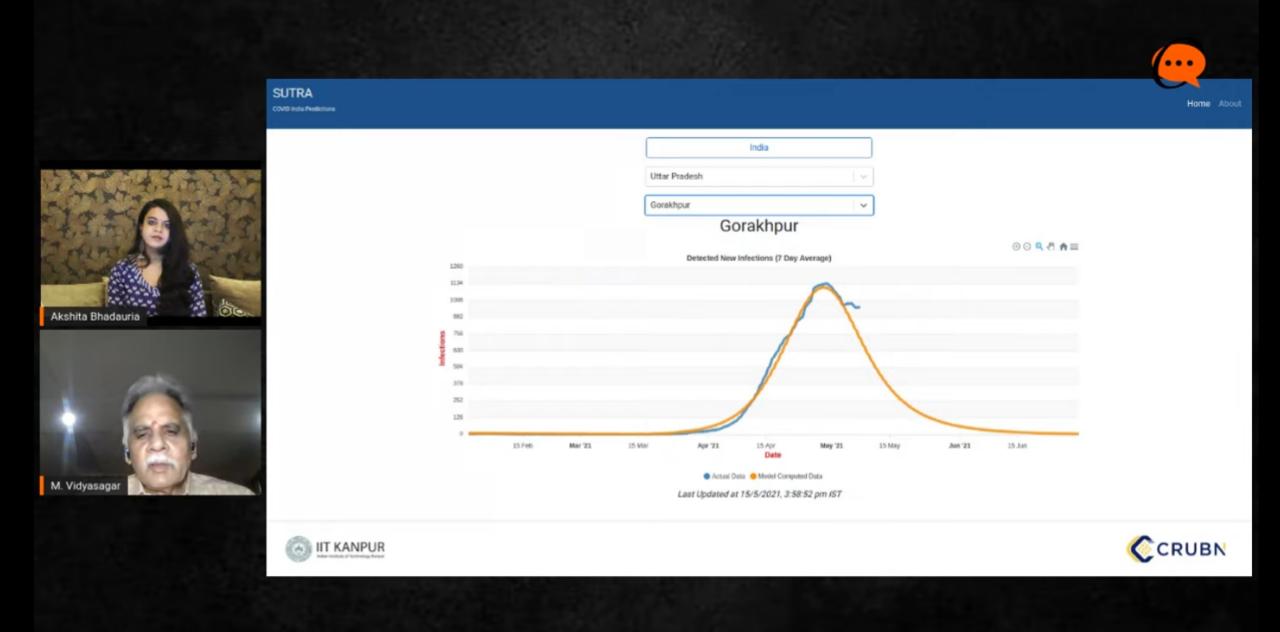
Professor M Vidyasagar, IIT Hyderabad and Chair of India’s Covid Supermodel Committee spoke to OpIndia spoke about India’s handling of the pandemic and the ‘Sutra’ model.
How prepared were we for the second wave of the pandemic? Were we able to predict the numbers considering the second wave hit us much hard than the first one?
If you judge by the events, we were not prepared at all and complacent at all levels from the government to the people’s level. I think people thought that while the world had already experienced 2 to 3 waves, we were magically immune to it. We went around wearing no masks, without any precautions thinking nothing will happen to us.
In the first wave, while the implementation was left on the states, the strategies were developed by the Centre which I think worked really well whereas in the second wave even when it was not at its peak, the strategies were left to individual states so this led to a great variety of responses with varying responses.
With the peak in September last year, around 10-11 million had contracted the virus and as per the Sutra model, 50 times of that number were asymptomatic and not detected so one cay say half a billion of the population was infected and therefore immune for a while. With the passage of time, their immunity eroded and they were back to square one.
People also stopped following the (Covid-19) guidelines. With 11 million people infected in the first wave and 14 million infected since March 01, 2021, considering that to be the start of the second wave, while the difference in number is not much, the intensity varied for various reasons.
The first reason being the concentration of the cases as the first wave lasted for about four months but the rise of new cases in the second wave was extremely steep.
Next, the first wave predominantly hit the less affluent section of the society whereas the second wave hit the affluent section or people who escaped the first wave so to say.
This wave also affected the younger lot who were barely touched by the pandemic in the first wave with reports of even children being infected.
How well did we manage to predict the daily new Covid-19 cases?
We made a presentation in early April to the government where we said the peak will arrive between May 15-17 with about 1 lakh cases a day. While we were accurate with the dates, we were completely off in predicting the numbers as the parameters varied very quickly. We kept recalibrating our Sutra model and by the time we reached the peak our variables stabilized.
Prof Vidyasagar also took us through the Sutra model (sutra-india.in) developed by the committee for charting the trajectory of Covid-19 in India, gave an insight into daily data vis-a-vis the prediction made for each state and district. Prof Vidyasagar said, “This is the kind of data that the states want where they can see the deviation (of reported cases) from the prediction for each district which will help them take immediate on-ground actions.”
Screengrab of the online interview
Since the onset of the pandemic, there has been a rise in misinformation with publications and organizations coming up with their own ‘models’ to ascertain that the numbers reported by the government are not real. How can we deal with this?
Reports suggesting 5 times or 10 times the reported numbers cannot be called a model. A model should be able to give predictions and logic to the pattern and statements. When that is not available it is just a guess. In order for it to be a scientific statement, it should either be verifiable or refutable. Now if someone says the number of deaths is 2 times than reported, how do you prove it? Someone else will come and say no it is 5 times. When the so-called experts cannot agree amongst themselves then it is just a prediction and not a model.
How do you think vaccine hesitancy can be tackled? And if the vaccination drive and process could have been managed differently?
India has never been a vaccine-hesitant country, unlike the US. The hesitancy is being manufactured deliberately. There is a graph going around which shows a rise in cases with the inoculation numbers going up resulting in the false assumption that the rise in cases is because of the vaccine. But if you think of it, the vaccination centres are poorly organized and the congregation of people at these centres might be a reason for it but it is ridiculous to say that vaccine is causing a rise in cases.
Talking about the efforts put in by the government to communicate about the vaccine and mitigate the hesitancy, Prof Vidyasagar opines that the government has not done enough. He suggested that the government should have come up with an extensive advertisement campaign along with volunteers on-ground talking to people about the vaccine.
He also suggested that there is a need to ramp up the vaccination drive in moderating the third bump.
Have we predicted the third wave, the severity and when is it expected?
The third wave will, unfortunately, hit the younger people and even children. We need to think of the virus as a big bully which attacks the most defenceless first and then changes the target. The wave can be expected from six to eight months from now.
Talking about the precautions, Prof Vidyasagar informed that we cannot let the lockdown fatigue set in as we saw between the two waves.
Informing about the committee’s latest study, Prof Vidyasagar said that a study is being done to analyze the different lockdown models implemented by states to assess which lockdown model worked the best. As the paper has not yet been released, Prof Vidyasagar just revealed that shutting everything down and cramping people in a two to three hours window is not the best model as it increases the contact rate between people while we should be focusing on preventing congregations.
Ending the discussion, Prof Vidyasagar advised, “Don’t let your guards down.”
Himanta Biswa Sarma, BJP leader and the new Chief Minister of Assam, has stated in an interview to Indian Express that he is grateful to Congress prince Rahul Gandhi for ignoring him and shunting him out of the Congress party, an insult that eventually led him to leave Congress and become the Chief Minister of Assam.
Speaking to Indian Express, Assam Chief Minister Himanta Biswa Sarma said, “I am grateful to Rahul Gandhi. I would not have become the Chief Minister of Assam and served the state, had he not shunted me out of the Congress party. So, if I am today in this position, that also because of its famous meeting and also because of the fact that Rahul Gandhi did not appreciate I being in the Congress party”.
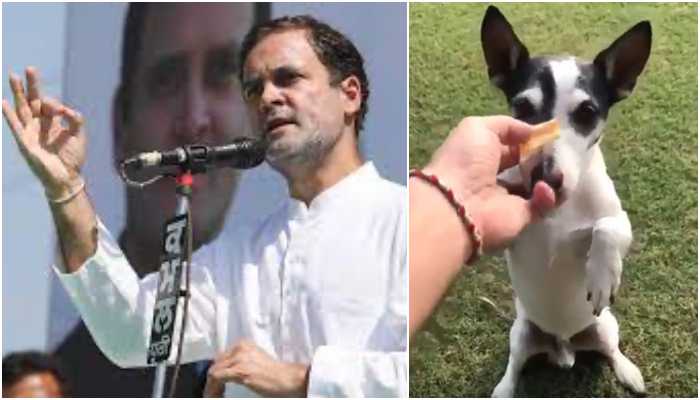
The Chief Minister of Assam remembered the infamous meeting of his with Rahul Gandhi, in which the Gandhi-scion was busy playing with his pet dog ‘Pidi’.
In the run-up to the 2016 Assam assembly polls, Himanta Biswa Sarma, who was still in the Congress party, had met Rahul Gandhi to discuss Assam’s problems.
However, the Congress VP was busy playing with his canine friend and had paid no attention to regional leaders from the North-Eastern state. After waiting for long in vain, an affronted Himanta Biswa Sarma had left the party and joined BJP, helping the party come to power in Assam.
Congress leaders were habituated to being insulted and ignored by Rahul Gandhi: Sarma
Remembering the meeting, Himanta Biswa Sharma also revealed how Congress leaders were habituated to such humiliations meted out to them by the Gandhi-Parivar.
Narrating another incident from the same meeting, Sarma revealed that the Congress leaders feared Gandhi so much that they ate biscuits from the same plate that had served biscuits to Rahul Gandhi’s dog ‘Pidi’. Sarma noted that several Congress leaders, including former Assam CM Tarun Gogoi, had visited Rahul Gandhi to apprise him of the political developments in the state.
However, Rahul Gandhi was busy playing with his canine friend ‘Pidi’ and ignored the state leaders. Biscuits from the same plate were given to the dog and were presented to the visiting congress leaders, said Sarma.
Remembering the incident, Sarma said to Indian Express that, “We were served with tea and biscuit, the dog went up to the table and picked up one biscuit from the table. Rahul looked at me and smiled at me. I was thinking why he is smiling, I was waiting for Rahul Gandhi to press the calling bell and ask someone to change the plate.”
Shockingly, Tarun Gogoi and other Congress leaders took the biscuit from the same plate, said Rahul Gandhi.
“After some time, I saw Congress leaders Joshi, Gogoi all taking the biscuits from the same plate and started eating. I was not a frequent visitor, and then I realised that this is normal for everybody as it happens in every meeting. That day I decided that enough is enough and decided that I cannot stay with that person (Rahul Gandhi),” added Himanta Biswa Sarma, narrating the experience from the infamous meeting.
Second meeting with Rahul Gandhi
According to Sarma, the infamous meeting with Rahul Gandhi was not a standalone event that highlighted the apathy of the Gandhis. He said that the meeting was a culmination of several meetings that were held for over a year in the run-up to the 2016 Assam elections. The former Congress leader said that he had held several meetings with Sonia Gandhi, who was then the President of the party, Ahmed Patel and other Congress leaders.
Himanta Biswa Sharma said that he resigned after the ‘Pidi’ episode and met Sonia Gandhi, who asked him to meet Rahul Gandhi one more time. So, upon her request, Sarma met Rahul Gandhi once again at Tughlaq Road residence. Sarma said that he did not speak about the meeting in public as it was “very, very disgusting”.
“If I raised some issue in the meeting, Rahul Gandhi would say, “So What?” His typical answer for every statement was the same. I was there for 20 minutes with him, and I heard the word “So What?” more than 50 times. It is a feudal culture,” Sarma noted.
PM Modi advised me to introduce a concept like the ‘Zero Hour’ in the cabinet to listen to internal criticism
In his interview, Assam Chief Minister Himanta Biswa Sarma said that Prime Minister Narendra Modi had advised him to introduce a concept like the ‘Zero Hour’ during the cabinet meetings to know the negative feedback about the government.
“In the Cabinet, ministers will compile all the negative feedback (collected from MLAs) and give it to a senior minister. Then I will join the Cabinet, and the senior minister will explain only the negative feedback about the government so that we can immediately take remedial action,” Sarma said.
The Assam Chief Minister Sarma said the Prime Minister had learnt this from his experience as the Chief Minister in Gujarat.
“Modiji said he did it in Gujarat, so I should start that practice in Assam. He said, “Achcha bolne wala toh tumko bahut milega, lekin burai suno, tabhi you will be able to rectify”, he said.
“He listens to negative feedback, he rather encourages it,” Sarma pointed.
Himanta Sarma met Prime Minister Modi in New Delhi on Wednesday for the first time after taking oath as Assam’s Chief Minister.
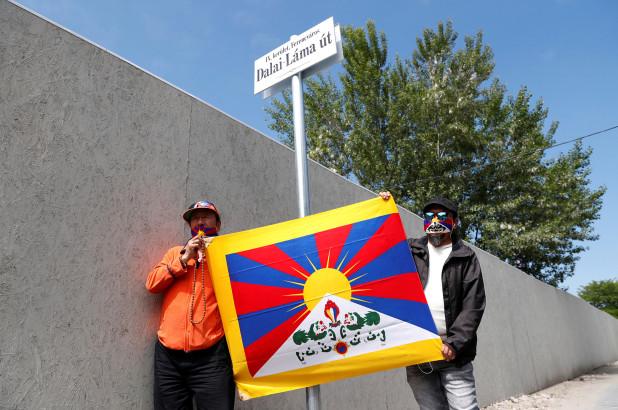
In an attempt to bring forth the human rights violations committed by China, the liberal opposition mayor of Budapest, Hungary, announced on Wednesday that the city authorities will be renaming streets near a planned campus of a Chinese university in the Hungarian capital.
Listing out all the atrocities enacted by Beijing, the mayor announced the renaming of the streets as follows:
One street will be named after the exiled spiritual leader Dalai Lama who China regards as a “dangerous separatist”
Another street will be renamed “Uyghur Martyrs’ Road” to highlight the persecution of the indigenous ethnic Uyghurs in China at the hands of the CCP
A third street will be called “Free Hong Kong Road”
While the fourth street will be renamed after a Chinese Catholic bishop as Xie Shiguang Road, who was persecuted and jailed by China.
The decision comes after the current government agreed to spend $2 billion of Hungarian taxpayers’ money to build China’s Fudan University which will offer masters programmes in liberal arts, medicine, business and engineering for 6,000 students with 500 faculty members.
Why is the project facing opposition?
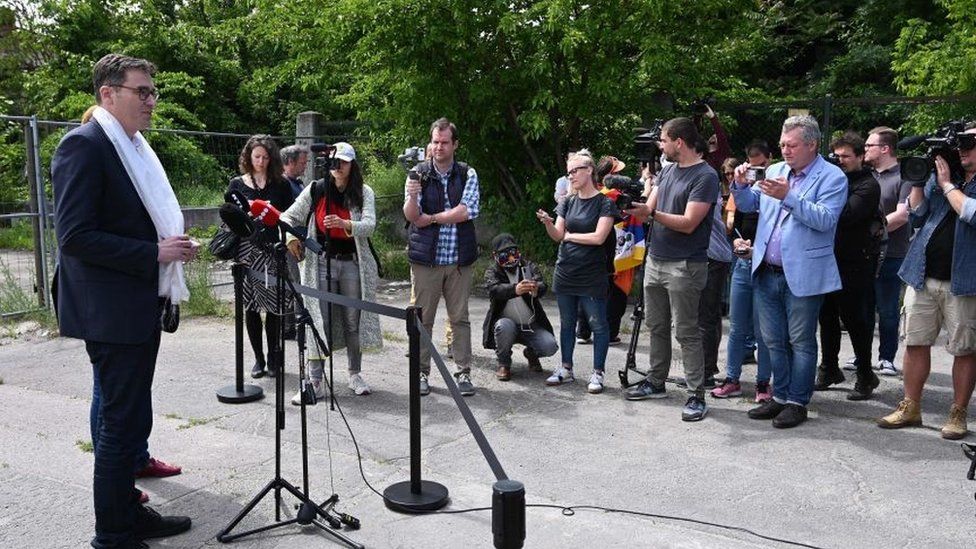
Liberal mayor Gergely Karacsony has been at the forefront of voicing concerns about “Chinese influence-buying” in Hungary.
Budapest Mayor Karacsony. Image Source: bbc.com
Mayor Karacsony, a liberal opposition figure who plans to run next year to unseat current right-wing Prime Minister Viktor Orban, said, “This Fudan project would put in doubt many of the values that Hungary committed itself to 30 years ago,” at the fall of Communism.
Viktor Orban’s govt accused of ‘flattering’ China
The current government is also accused of flattering China, Russia and other illiberal governments while angering Hungary’s European allies. Karacsony informed that the Fudan project went against an earlier deal with the government to build dormitories and facilities for Hungarian students in the district.
As per documents obtained by Direkt36, a Hungarian investigative-journalism outlet, the construction cost of the university is expected to be around $1.8 billion which is more than the Orban government’s spend on the entire higher-education system in 2019. Additionally, the government has taken a loan worth $1.5 billion from a Chinese bank.
“We still hope the project won’t happen, but if it does then it will have to put up with these names,” Karacsony remarked at a press conference.
As per an opinion poll conducted by liberal think tank Republikon Institute, 66% of Hungarians opposed the idea of the university while 27 per cent were in support of it.
On the other hand, Tamas Schanda, deputy minister for innovation and technology said, “The presence of Fudan University means that it will be possible to learn from the best in the world.”
“Fudan has brought the topic of relations with China to the forefront of politics,” he added.
Viktor Orban faces criticism from Hungarian ‘liberals’
Orban’s government was criticized by ‘liberals’ in 2019 for enacting legal changes which led to Hungary’s leading private university, Central European University, shifting to Austria. The government was also accused of launching a public hate campaign against its founder George Soros.
Orban also faced criticism over a deal to reconstruct the Budapest-Belgrade railway with the help of a $2.1 billion Chinese loan. The Hungarian Prime Minister also fast-tracked the approval of a Chinese coronavirus vaccine which still has not been approved in the EU resulting in resentment.
The government justified it by saying that the Chinese doses have helped accelerate the vaccine program.