Home Blog Page 4274

When ‘activist’ Teesta Setalvad was accused financial fraud and embezzling money meant for Godhra riot victims

‘Activist’ Teesta Setalvad is widely respected in liberal echo-chambers as a great humanitarian activist who has dedicated her life towards the welfare of marginalised communities. The truth, however, is far from it. She rose to national fame due to her involvement in the Gujarat Riots case and the dedicated campaign she ran against then Chief Minister Narendra Modi.

Her infamy, ironically, derives from her conduct related to the same event. She is accused of siphoning off funds contributed for the welfare of those affected by the riots. Raees Khan, a former associated of Setalvad, had claimed that funds which were to be used for educational purposes were misused. He had registered a complaint with Ahmedabad crime branch in connection with the same.

Teesta Setalvad was also accused of fraudulently securing financial aid from the HRD Ministry when Kapil Sibal was the Minister during the UPA regime. She was accused of embezzlement of funds to the tune of Rs. 1.51 crores.

One of her trusts was also found to be in violation of the FCRA laws in the country. Sabrang Communication and Publishing Pvt Limited (SCPPL), with which Teesta is associated, recieved $ 2.9 lakh from Ford Foundation as grant to “address communalism, caste-based discrimination in India, including media strategies”. But unlike the Sabrang Trust, this company was not registered under FCRA and hence was a violation.

Subsequently, the CBI in 2015 had conducted searches at her residence and offices in connection with the case. Following the searches, the entire liberal echo-chamber was quick to come to the defense of the ‘activist’.

The Gujarat Police said that Teesta Setalvad and her husband Javed Anand had spent money collected for constructing a memorial for riot victims and their aid on personal expenses that included wine and liquor, expensive mobile phones, movie CDs, romantic novels, hair-styling, dining among other avenues. According to the police, the two committed “colossal fraud”.

The police said that the two had “misappropriated the funds of charity and converted to their own use funds meant for the rehabilitation and welfare of the unfortunate victims of riots in Gujarat in Feb-March 2002”. The investigation revealed that Setalvad had claimed reimbursement on the purchase of sanitary napkins and “surprisingly” her husband had claimed the same as well.

The investigation also revealed that 45% of the funds received by Sabrang Trust between 2008-13 were transferred to Setalvad and her husband either directly or through SCPPL. It also said that she drew a salary of Rs. 8.75 lakhs and flew 113 times in a year.

“The inescapable conclusion is that the entire amount paid by Sabrang Trust to SCPPL has been siphoned by petitioner under the guise of cash withdrawal and cheque payments. SCPPL is a vehicle used by the petitioners for the purpose of siphoning donations to the Sabrang Trust,” the affidavit filed in connection with the matter said.

“Limited documents furnished by the petitioners unambiguously disclose the patent fraud on their part and expose their protestations as being hollow,” it added. Among her many FCRA related issues, it was discovered that Rs 1 lakh was allegedly transferred to domestic account, which is considered as misutilisation of funds. Furthermore, 65% of the foreign funds were spent on administrative expenses, something that is not allowed as per law.

The activist and others were booked under Sections 13 (1)(D) and 13(2) of the Prevention of Corruption Act as well as under Sections 120 B, 153 A, 153 B, 406, 409 and 420 of the IPC in 2018.

In an unrelated note, Rana Ayyub recently ended her Covid-19 fundraiser after potential illegalities were exposed in her campaign related to FCRA laws. Consequently, she decided to return the money received from foreign donors.

West Bengal: BJP worker found hanging from a tree in Cooch Behar, party blames TMC of political vengeance

On Sunday (May 30), the body of a BJP worker was found mysteriously hanging from a tree in Sitai in Adabari in the Cooch Behar district of West Bengal.

As per reports, the deceased has been identified as one Anil Barman. His dead body was spotted by locals in a garden, which is located near his residence. The BJP has accused the ruling Trinamool Congress dispensation of murdering its party worker. The party informed that Anil Barman was on the hitlist of the TMC during the time of elections. It has also claimed that the TMC hoodlums had earlier vandalised the deceased’s house.

TV9 Journalist Anindya Banerjee took to Twitter on Sunday to share the image of BJP worker Anil Barman’s body hanging from a tree.

While speaking about the matter to ABP Ananda, a BJP leader said that the ruling party took vengeance for losing elections from Cooch Behar district. She further complained about the inaction of the police and added that the law enforcement was working at the behest of the ruling party. The Trinamool Congress has denied the charges. It has alleged that the BJP is supposedly trying to give a ‘political colour’ to the incident by defaming the Mamata Banerjee government.

(Video Courtesy: Youtube/ ABP Ananda)

TMC goons attacked Central forces during elections in Cooch Behar

Cooch Behar district of West Bengal was the hotbed of political violence during the West Bengal State Legislative elections of 2021. After TMC supremo Mamata Banerjee asked her followers to gherao the central forces, a mob of 300-350 TMC hoodlums had attacked the CISF team and tried to snatch their arms. In an act of self defence, the central forces open fired at the mob leading to 4 casualties. The incident took place at the Jorpatki area of the Mathabhanga block in the Sitalkuchi Legislative Assembly of Cooch Behar district.

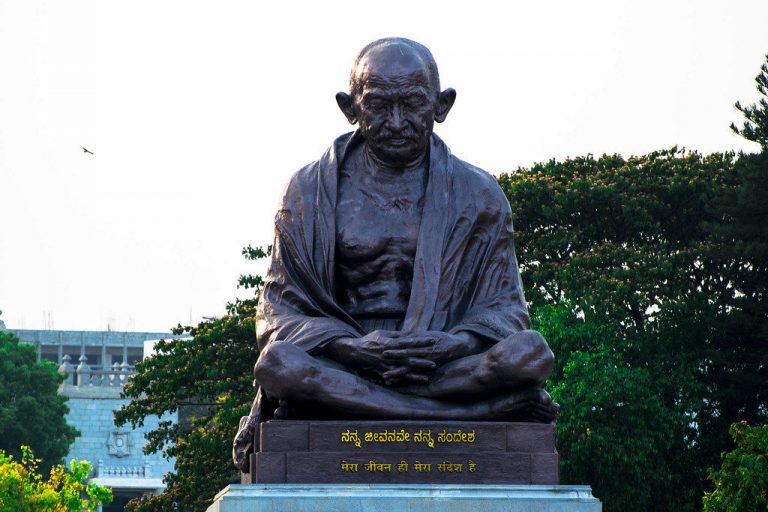
Netizens trend #Gandhi4Lakshadweep demanding installation of Gandhi statue in Lakshadweep following opposition by local Muslims

People on social media are raising their voices for the installation of a Mahatma Gandhi statue in Lakshadweep. We had reported recently that a bust of Mahatma Gandhi could not be installed in Lakshadweep due to opposition by local Muslims against the same.

Concerned citizens on social media are saying that the Mahatma Gandhi statue must be installed in Lakshadweep and there is no valid justification to oppose it. Netizens are trying to attract attention through the hashtag #Gandhi4Lakshadweep.

People are also registering their angst against the Islamist influence in the Union Territory for not permitting the installation of the Mahatma Gandhi statue.

Some are demanding the installation of a statue of Sardar Vallabhbhai Patel along with a statue of Mahatma Gandhi.

As we had reported earlier, local Muslims believe that if such a statute is once installed, then they will have to pay respects to it by decorating it with flowers, which according to them, is a part of Hindutva and violates the Sharia law. Hence the Muslims in Lakshadweep vehemently opposed the installation of the Gandhi statue in Kavaratti.

On the occasion of the Gandhi Jayanthi celebrations, the United Progressive Alliance-led government had decided to install a statue of MK Gandhi at Kavaratti in Lakshadweep. In September 2010, a Rs 2 lakh statue of MK Gandhi was sent to Lakshadweep in the vessel MV Amindivi to be installed at Kavaratti.

Eleven years since then, MK Gandhi’s bust has faced a harrowing time as it has shuttled several times from Kochi to Kavaratti. Currently, it is reported that the bust is kept at the Lakshadweep administrative offices in Kavaratti, waiting to be installed. However, with protests from Muslims in Lakshadweep continue to grow, the installation of the statue of MK Gandhi will be delayed again.

Rajasthan: 350 workers died because of COVID-19 while on duty, but the state govt doesn’t believe it

As Congress leader Rahul Gandhi is busy making snide remarks at Prime Minister Narendra Modi for the handling of the Covid crisis, the state ruled by his own party has refused to acknowledge the death of 350 frontline warriors.

As per a Dainik Bhaskar ground report, the state of Rajasthan has given compensation to just 6 health workers out of the 350 who succumbed to Covid-19 while on duty, refusing to acknowledge the sacrifice of the rest.

The death certificates of several health workers cite heart attack or diabetes as the reason, thereby making them ineligible for state compensation. The state had announced a compensation of Rs 50 lakhs to the kin of the frontline warriors. however, as per the report, only 6 families have received the compensation as yet.

Allegedly, the government which was at the forefront of deducting salaries of the workers is now flinging files from one department to another, denying these families their right.

Families wait for compensation

A teacher from Bharatpur lost his life to the Chinese virus while on duty, however, his death certificate cites heart attack as the reason. When the family of the deceased requested compensation, they were sent back after objection.

An inspector on audit duty contracted the virus while on duty. Despite hospitalization, he fell prey to the virus a few days later. His family is still awaiting compensation. 

Number of government workers who succumbed to Covid in the state

As of now, 100 employees from the education department, 50 from health, 23 veterinarians, 80 from power companies, 6 from mines, 8 from cooperations, 30 from the police force and 50 from other departments have lost their lives to Covid.

Compensation guidelines remain unclear

The guidelines to claim compensation from the state government continue to remain unclear. The state government has not made it clear whether the family of a worker will be eligible in the following cases:

  1. Will the kin receive compensation only if the worker dies on duty? What about the ones who stop reporting to duty on being infected and later succumb to the virus? 
  2. Will the kin receive compensation if a worker dies of Covid-19 after he is released from his duty?
  3. Is the kin eligible to receive compensation if a worker on Covid duty dies due to an accident while reporting/ returning from duty?
  4. There have been several cases of people falling prey to the virus after their Covid-19 report reflected false negative. Will the kin receive compensation in such a scenario?

Noticing a high death rate in the animal husbandry department, the Secretary of Veterinary Employees Union, Arjun Sharma said that they intend to file a criminal case against the department. 

Ravi Acharya, Minister of Rajasthan Teachers Association National demanded that the families of workers on Covid duties should receive compensation at the earliest.

Underreporting in Rajasthan

Huge discrepancies in Covid-19 deaths were brought to light in the state of Rajasthan. We reported earlier, how while the government of Rajasthan reported 3918 deaths between April 01 to May 20 from 25 districts, as per Dainik Bhaskar’s ground report, 14,482 cremations took place in just 512 village blocks during the same period. 

Informing about the reassessment, Medical and Health Minister Raghu Sharma informed, “We got the first 4,262 deaths assessed in rural and urban areas. Out of this, 1,331 deaths (31.20%) occurred in rural areas. As of now 7,806 deaths are being analyzed, to determine how many deaths occurred in villages and how many in cities in a month.”

Vaccine wastage in Rajasthan

Rajasthan reported the highest percentage of Covid-19 vaccine wastage. According to a report by Hindi daily Patrika, a total of 11.5 lakh doses of Covid-19 vaccine, which amounts to almost 7 per cent, has been wasted in the Congress-ruled state.

Though many districts in Rajasthan have reportedly wasted several doses of vaccines, the wastage rate recorded in Rajasthan’s Churu district stood the highest at 39.7 per cent, followed by Hanumangarh, where the waste per cent was recorded to be 24.60 per cent. Bharatpur stood at number three after it reported 17.13 per cent. Kota finished fourth with a 16.71 per cent of waste rate.

New cases in the state

2,314 fresh Covid-19 cases and 70 more deaths were reported in the state on Saturday. The city of Jaipur reported the highest number of fresh cases and deaths at 401 and 13 respectively. 

Pakistan: Taliban-linked terror group issues threats to Sikh community, Nankana Sahib Gurdwara asks people to be vigilant

On Monday (May 24), the Sikh community in Pakistan was informed about threats given by banned Islamist terror outfit Balochistan Republic Army (BRA). It must be mentioned that BRA is an Afghanistan-based organisation with close ties to the Taliban.

Reportedly, a Sikh leader by the name of Ranjit Singh was warned about the threat by officials of the Evacuee Trust Property Board (ETPB). Singh, who serves as the Granthi of Gurdwara Guru Ramdas Ji in Chuna Mani in Lahore, immediately sent out a voice message alerting the Sikh community in Lahore and Nankana Sahib. The audio clip has now gone viral on social media. The Granthi had urged the Sikhs to remain vigilant and not to step outside their houses at night.

In the audio message, he said, “After the culmination of daily evening Diwan at Gurdwara Dera Sahib, an announcement was made by ETPB officials that Sikhs living in Lahore and Nankana Sahib have received life threats so they should submit their details including residential address, contact numbers etc with the police so that necessary security measures could be taken.” Ranjit Singh has urged the Sikh community to not panic and instead submit their documents to Pakistan Sikh Gurdwara Parbandhak Committee (PSGPC), or ETPB.

Given that a large number of Sikhs living in Peshawar, Khyber-Pakhtunkhwa, and Nanakana Sahib have migrated from Afghanistan, ex-PSGPC member Maninder Singh also released a voice message alerting Sikhs in Pashto language. It must be mentioned that the Counter-Terrorism Department (CTD) in Pakistan had earlier arrested four terrorists connected with BRA in April. Citing sources, Zee News reported that the alert by Evacuee Trust Property Board (ETPB) is linked with the arrest of the 4 terrorists.

A Sikh resident in Lahore, who runs a cloth shop, informed that the police visited his store to ask for documents. Another Sikh in Nankana Sahib informed that the Pakistani government had been collecting their data to make necessary security arrangements. Interestingly, ETPB Chairman Dr. Aamer Ahmad denied collecting documents from the Sikh community. He alleged, “We vehemently deny such reports, there is no threat to Sikhs in Pakistan.”

Islamists pelted stones at Gurdwara Nankana Sahib in 2020

In January last year, an angry mob of Muslims had gathered around the Sikh shrine of Gurudwara Nanakana Sahib and started pelting stones at it. The mob was being led by the family of Mohammad Hassan, the boy who allegedly abducted and converted Sikh girl Jagjit Kaur, who is the daughter of the gurdwara’s granthi. The mob of angry Muslims gheraoed the holy shrine on Friday afternoon, leaving many devotees stranded inside.

The protesters threatened to destroy the gurdwara and build a mosque in its place. Hundreds of Muslims protestors swarmed the Gurudwara Nankana Sahib and raised inflammatory slogans against the Sikhs. “We will not let any Sikh live in Nankana Sahib and will its name to Ghulam-e-Mustafa,” one of the irate Muslim protestors exclaimed.

The police along with the Pakistani Rangers and Army had rushed to the spot to quell the protest but they had failed in dispersing the violent mob away from the Gurudwara. The situation was brought under control after the local police and Pak Rangers arrested the protesters. However, the mobs dispersed only after police released Hassan, the man who had abducted Sikh girl Jagjit Kaur, daughter of the Gurdwara’s panthi.

From joining ‘farmers’ protest to converting Rohingyas for Indian citizenship: How Christian groups have exploited the pandemic

Over the years we have been made to think of the role of an evangelist or a missionary to be that of pulling the poor out of poverty, helping the destitute and in turn asking them to their God. 

They entered lands far and wide otherwise unknown to us to provide food, shelter and education. But now the evangelicals are between you and me. Spreading the ‘word of God’, supporting farmers’ protest, planting churches, floating companies on paper, even using official posts to preach their faith and now seeing the pandemic as a ‘golden opportunity’ to convert the gullible. 

To simplify the read, let’s divide their activities into five domains: preaching and conversion by evangelists, joining hands with the Break India forces, ‘cure’ and ‘healing’ methods to battle the pandemic, indulging in illegal activities and holding official positions to further their mission. 

Let’s start with how the missionaries, evangelists or preachers however we may like to call it are fueling angst against the country. 

Christian bodies support farmers

At the beginning of the year, several Priests and heads of various Christian organizations in Punjab protested against the Centre for not repealing the Farm Bills. The protest saw the presence of ArchBishop of Pentecostal Diocese of Punjab PJ Soloman, chairman of Rashtriya Masihi Sangh Fares Masih, Punjab Christian United Front chief George Soni, Punjab Christian Movement chief Hamid Masih, Pastor Ashok Masih and Pastor Surinder Gill of the United Pastors’ Association. 

Chairman of the Indian Farmers Movement (INFAM), a church-backed body based in Kerala Father Joseph Ottaplackal said that the government needs to take “a more lenient view towards the demands of the farmers because the reforms spell disaster for the farming community.”

Rohingyas taking up Christianity

A report in July 2020 brought to light how a large number of Rohingya Muslims residing in India prior to 2012 were turning to Christianity while claiming to be from Bangladesh. The activity saw an increase post the Government of India introduced the Citizenship (Amendment) Act (CAA) in the Parliament prompting many Afghan and Rohingya Muslim refugees to convert to Christianity to become eligible for Indian citizenship.

An official estimate suggests there are nearly 40,000 Rohingya Muslims across India, with the highest number in Jammu and Kashmir. 

Next, let’s look at how the evangelical organizations have thrust into the pandemic making the most of the suffering and helplessness.

Pandemic is ‘Godsend’

As the country is reeling under the aftermath of the pandemic, evangelists across the nation seem to be rejoicing the advent of the calamity. Otherwise empty churches have now found devotees as the evangelists managed to supply food kits to the ones in need.

Sharing their success story Isaac Shaw a senior pastor of Bible Bhavan Christian Fellowship in an interview to Christianity Today said gleefully, “When churches started streaming their services online, they were surprised at the audience they received. I know of small churches that normally had less than 100 people attend on an average Sunday now have more than 700 viewers online. Our own church, Bible Bhavan Christian Fellowship, which has been live streaming for more than four years, saw a 300 percent increase in viewership.”

Taking undue advantage of people’s sufferings, “As the Indian church is expressing its love for those who are suffering the most, previously antagonistic neighbors are partnering with the church in our expressions of help. This marks a new day,” added Isaac.

Isaac revealed that the churches with the imposition of lockdown refused to follow the protocol saying “churches cannot close their doors, believing that the Bible mandates weekly group worship in buildings and that God grants health to the faithful.” He said the churches took three weeks to come up with an alternative that ultimately proved to be fruitful.

Preaching in the garb of help amidst the pandemic

When the nation was staring into the unknown, taking precautions to restrict the spread of the coronavirus, preachers were out on the streets conducting Gospel campaigns. Pastors from the South of India while in an interview to Christian Chronicle revealed, “When the initial lockdowns were lifted in 2020, members of the Anna Nagar Church of Christ in Chennai conducted gospel campaigns and did street preaching. Even children as young as 7 proclaimed the Good News to their neighbors.

“Recently, church members launched a new campaign to deliver the gospel — and masks — to 30 villages in the area,” a minister added.

Pagidipalli, a physician and evangelist who works with multiple Churches of Christ remarked, “Covid is increasing exponentially here in India, but the number of souls who are turning to Jesus as their Lord is also increasing every single day.”

This comes amidst 600 preachers of Churches of Christ who succumbed to the Chinese virus last year and more than 900 preachers’ families affected in Kakinada Andhra Pradesh. Paul Renganathan, the director of World Bible College revealed that he knows of nearly 500 deaths among members of Churches of Christ in just the Chennai region, including several evangelists he worked with closely.

Missionaries say pandemic opened gates to India

Mission India, an evangelical organization working in India with a clear motive is currently working to equip its ministry partners in relief efforts to save lives and enhance their evangelism, discipleship, and church planting efforts. “Our partners see this as a tremendous opportunity to demonstrate the love of Christ in their communities,” they flaunt on their website.

The organization is simultaneously running a Children’s Bible Club introducing them to Jesus through engaging activities, songs, and prayer during either a 10 day or a year-long experience and creating new Church planters to introduce a “community to Jesus”.

Christian hymns in the form of kirtans

The conversion wave in Punjab is a well-known reality and is being widely talked about especially during the pandemic. The lesser-known fact is the modus operandi of the missionaries in the region.

The target for conversions in Punjab are people from the lower strata of society, particularly Sikh Dalits who are shunned by the upper caste Sikhs; who they entice by offering everything from money to healing chronic illnesses, free education, healthcare, compensation, and fulfillment of other needs in return for converting to Christianity.

To Indianize the experience, evangelists have gone to the extent of portraying Jesus doing Yoga and wearing a saffron robe. Churches are being built in resemblance to temples and Gurdwaras, with Christian Hymns being sung in the tune of a “kirtan”. The Christian community in Punjab and these organizations have begun to name themselves as ‘Shromani Church Parbhandak Committee’.

Raising funds for bikes and Bibles

As the common Samaritans raise funds to feed the ones affected due to the lockdown, an evangelical organization is raising funds to procure bicycles that will help their preachers wheel to hinterlands with Bibles. This year they aim to gather enough funds to be able to purchase 1,000 bikes, 100,000 Bibles, construct 6,000 new Churches in India and equip a new Church planter.

The strategies of these organizations are based on a huge database entailing details of the entire population sliced and diced basis caste, groups, ethnicity, languages and more. India Evangelical says 88% of the population is yet to be reached in India.

The Christian groups and affiliated organizations have also advocated self-healing and miracle cure quite aggressively to fight the Covid-19 virus.

A Hindustan Times article from 2016 had revealed how “faith heals, but only if one continues medication.” The article described how people developed life-threatening complications, some even lose their lives after stopping the medication and hoping their faith will cure and heal them.

Vaccine a mark of the beast

As the government relentlessly is urging people to get inoculated, a 24-hour free-to-air Christian evangelical channel Angel TV, run by a pastor Sundar Selvaraj who calls himself a ‘sadhu’ warns people against the vaccine saying ‘is a mark of the beast prophesied in the Bible.’

Selvaraj claims that the vaccines contain a chip and that his ‘prophecy’ of the chip-fitted vaccine to be given to the masses through government programs and free camps has come true.

Preaching while on Covid duty

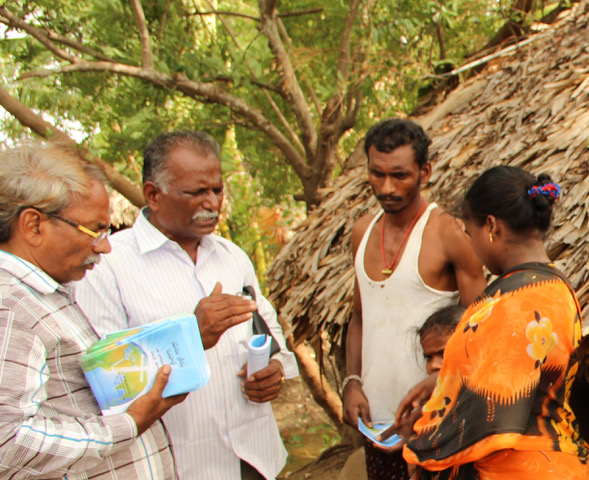
We had reported earlier on how a nurse on government duty in Ratlam, Madhya Pradesh was caught in the tribal-dominated development block of Bajala with publicity leaflets preaching Christianity on the pretext of informing people about dietary plans amidst the Covid-19 pandemic.

Moving on to evangelists using official and influential positions to further their religion while on government/ official duty.

IMA Head wants to use the association as a springboard to convert

In an interview to Christian magazines, recently appointed Dr Johnrose Austin Jayalal confessed to using the Indian Medical Association as a springboard to share the “love of Jesus Christ” and be a “living witness to God and encourage young medical students and doctors to receive Jesus as their personal saviour”.

According to Dr Jayalal, it was “Christian compassion” and Christian doctors and churches who relieved the world from lethal maladies such as leprosy, cholera and other pandemics in the past. He believes the coronavirus pandemic has provided “the urgent need of the proclamation of the Gospel to people who are suffering from the virus has allowed us to share the Gospel even in secular institutions”.

Using influential positions to preach Christianity

In a report released by Swarajya in June 2020, it was revealed that Mr. D.P. Haokip a senior official in the Indian Revenue Service (IRS) confessed in an evangelist convention to being an evangelist even while on duty. He also boasted to have summoned Rahul Dravid, former captain of the Indian cricket team to his office and did proselytizing maneuvers for an hour, preaching him Bible. Haokip’s visiting card too contains a verse from the Gospel.

In another shocking revelation a Jesuit clergy, Joe Arun, Director of LIBA (Loyola Institute of Business Administration) claimed that when the state government of Tamil Nadu asked him to be one of the mentors in the board for revising the social science syllabus from the first standard to 12th standard, the first thing he did was to introduce Jesuit ideology into the syllabus.

Heading to the last pillar, several evangelical organizations have come under the scanner for flouting fake companies, unaccounted cash and hawala.

Rampant conversions

Taking undue advantage of the lockdown imposed due to the Covid-19 pandemic, missionaries in India converted as many as 1 lakh people and adopted 50,000 villages in a span of one year. Need for medical aid and two squares meals amidst the financial crisis, pushed the economically weaker section into the trap of missionaries. The missionaries also built a record number of churches in thousands of villages where none existed before.

Pastor Praveen Chakravarty a popular name in Andhra Pradesh was arrested by the police for kicking idols of Hindu Gods. He was also booked under various sections related to creating enmity among religious groups, committing a crime at religious places etc. The pastor flaunted the creation of 699 Christ villages in the state.

In January this year, Shahjahanpur (Uttar Pradesh) police have lodged an FIR against five people, including two from Tamil Nadu, under the new anti-conversion law for allegedly convincing people to convert to Christianity. Quoting the complaint, the police informed that a few of them were seen convincing people to convert to Christianity with the promise of “good job and good education to children.”

It is imperative to understand how evangelism in India is no longer a single prong business. The organizations and individuals have camouflaged themselves in every aspect of society making it difficult to escape their grip.


PETA India wants to shut down the entire dairy industry to prevent cow slaughter, but there is another solution

Gain for one does not necessarily have to result in the loss of another. However, this is exactly what PETA India recommends. In the recent controversy raked up by the alleged animal welfare organization, PETA India wants to shut the flourishing dairy industry under the garb of ‘veganism.’

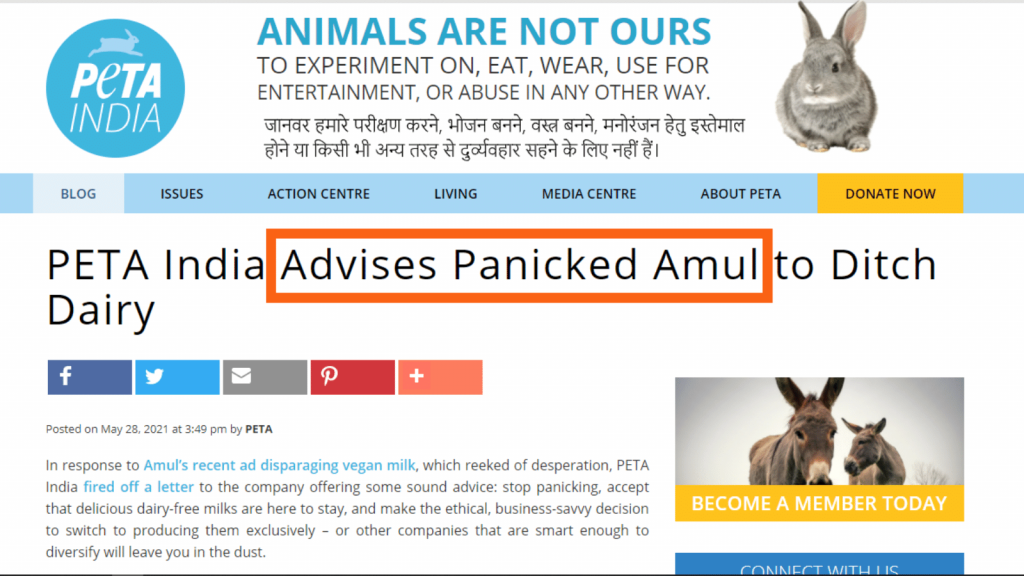
So much so, that the organization issued sermons to Amul India, one of the largest contributors to the dairy industry to start producing ‘vegan milk’ instead. The campaign being run by PETA India is not only ignorant but a direct attack on the country’s economy. 

The organization had to be schooled by Amul’s MD, RS Sodhi who questioned if the NGO will give livelihood to 100 million dairy farmers, 70% of whom are landless. “Who will pay for children school fee, how many can afford expensive lab-manufactured factory food made out of chemicals, and synthetic vitamins”, he asked.

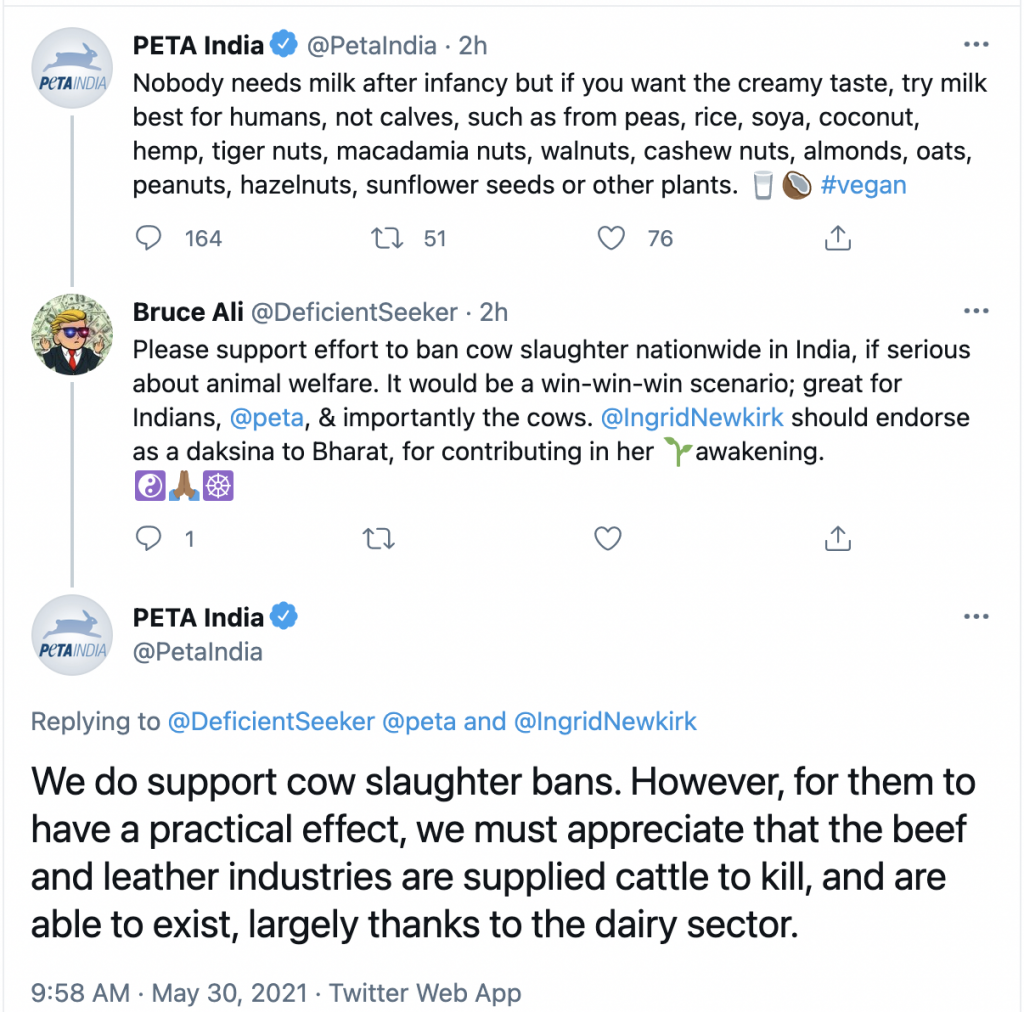
The organization continuing with its campaign indulged in virtue signalling by claiming that no one needs milk after infancy and if at all one wants to consume, one should go for non-dairy milk, like the ‘milk’ made from soya, coconut and other nuts. When questioned about the affordability by one Twitter user, the organization advised the user to produce plant-based milk at home. 

When probed by the netizens about its selective targeting and inaction on animal slaughter/ cruelty during Islamic festivals, PETA India quickly took shelter of a topic sensitive to the Hindu community. In a bizarre insinuation, the organization pinned the blame of cow slaughter on the consumption of dairy products. 

PETA India remarked that dairy consumption remains the major reason why the ban on cow slaughter in India has been inefficient and on the contrary encouraged beef consumption.

Image Source: Twitter

To justify their bizarre hypothesis, PETA India has been sharing a video from 2010 shot at a stable with no facts, figures or statistics to support the claims but simply implies that animal cruelty for milk production, abandoning milk-producing cattle and artificial insemination is prevalent across the dairy industry. 

But here’s the catch. We need not shut an entire industry to safeguard animals from cruelty. We have a better campaign plan for the organization should they choose to pay heed.

Animal shelters and gaushalas

Since PETA India claims that dairy consumption has led to an increase in cow slaughter as agriculturists are forced to sell their cattle when no longer profitable, the organization can instead encourage building gaushalas and animal shelters.

In fact, as an animal welfare organization, PETA India must start its own gaushala to rescue the cattle allegedly abused by the dairy industry. 

The organization in fact can also run extensive online campaigns urging people to support organizations like Dakshin Vrindavan, Peepal Farm, Bhaktivedanta Swami Goshala and Gau Nandi Seva which work towards rescuing cows from slaughter and giving them a home and treatment if needed. 

Image Source: PETA India website

The aforementioned gausadans do not in fact milk cows and just act as a shelter home where they are given proper care, medical attention and love. 

Some gausadans instead make use of cow dung to create products in demand to help sustain themselves. A little help from a world-renowned organization will surely help them take care of more cows and cattle thus contributing to their cause of animal welfare. 

So instead of snatching away the livelihoods of 8.4 million diary farmers and jobs of millions, the organization can promote animal shelters, thereby opening new avenues of animal welfare, employment as well as income in the nation. 

Why shutting down of dairy industry can prove lethal

The dairy sector not only provides employment to millions of rural households but also contributes to the economy accounting for 67.2 per cent of the livestock sector. As per a report, 8.4 million farmers depend on the dairy sector for their livelihoods annually, out of which 71 per cent constitute of women. Empowering the farmers, around 60 per cent of the consumer price from milk goes to the farmer in India. 

While a dairy company may be able to switch to plant-based products from milk, the dairy farmers won’t be able to. As already pointed out by the Amul MD, most of dairy farmers are landless, which means they can’t cultivate the crops that can be used to produce ‘vegan milk’. While cows can be reared almost anywhere, the specific crops that can produce milk alternatives may not be suitable for all climates and land types. This means, even the dairy farmers with land may not be able to grow them.

Another important fact is that contrary to claims by PETA India, ‘vegan milk’ may not be safe like dairy milk. This is because, the ‘plant-based milk’ is produced from soya, nuts, rice etc in food processing industries where the crop goes through extensive processing, and where several chemicals are used to extract the ‘milk’. It also means that while at present the Amul is owned by millions of farmers, only few big corporates having such processing plants will control the ‘milk’ market, if the market moves from dairy milk to ‘vegan milk’.

Sexual violence, targeted attacks and use of state machinery: Report on Bengal post-poll violence documents horrific crimes by TMC cadres

The Group of Intellectuals and Academicians (GIA) has submitted a report on the post-poll violence in West Bengal where they have documented the concerted campaign against opposition party workers by the cadres of the Trinamool Congress.

The report has been authored by Monika Arora, Advocate, Supreme Court of India, Delhi High Court, Prof. Vijita Singh Aggarwal, Professor, GGS IPU, Ms. Sonali Chitalkar, Assistant Professor, Delhi University, Dr. Shruti Mishra, Assistant Professor, Delhi University and Ms. Monicca Agarwaal, Entrepreneur.

In the report, the GIA states that the victims primarily belong to the very marginal sections of Hindu society which have voted for the BJP in the assembly elections. The report says, “The main modus operandi of the TMC is to debilitate political opponents by targeting their bodies, economic resources and their psychological wellbeing. This involves physical and sexual attacks, destruction of living spaces, property and means of production however small they are.”

“Thus shops will be taken over and released back only after payment of a hefty amount to the local TMC cadre. This brings the political opponents to their knees. Almost all our respondents mentioned having to pay up large amounts of extortion money to TMC after the election results came out,” it adds.

The report adds further, “Women have been singled out for most horrific terror and intimidation. Our data reveals many incidents of grievous bodily harm, threat of rape, stripping and sexual violence. The streets were sites of dehumanization of women of all ages. The horror is compounded by most of the victims being from marginal SC-ST communities or from Below Poverty Line (BPL) and extremely fragile economic sections in West Bengal.”

The report documents several instances of sexual assault on women by TMC cadres due to political motivations.

According to the report, victims say that their Ration cards and Aadhar cards have been stolen by the TMC cadres, landing them in a severe crisis. Children were exposed to the severe violence as well. It also says that state machinery was employed to target political opponents.

Recommendations on West Bengal post-poll violence

The report recommends an SIT investigation into the post-poll violence in West Bengal as well as an NIA investigation as the violence could very well have a cross border angle. It also recommends compensation for the victims and fast tracks for speed justice.

The report suggests action against police officers as well who failed to perform their constitutional duties. It also recommends inquiries by the National Commission for Human Rights, National Commission for Protection of Children, National Commission for women, National Commission for Scheduled Castes and National Commission for Scheduled Tribes.

Sikh refugees from Afghanistan express happiness after Modi government invites applications for Indian citizenship

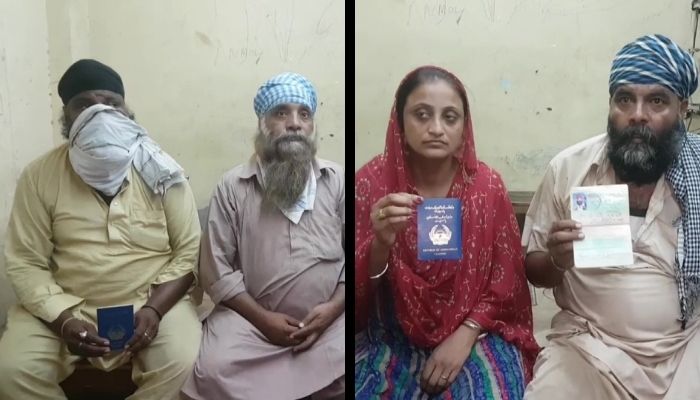
Hours after the Modi government invited applications from non-Muslim refugees for granting them Indian citizenship, Sikh refugees from Afghanistan have expressed their happiness over the decision.

While speaking to ANI, a persecuted Sikh by the name of Amrik Singh said, “I came here from Kabul (Afghanistan) in 2013. We were being forced to convert to Islam. We thank the govt for this decision.” Singh currently resides in the Ludhiana district of Punjab. The elated Afghan Sikh refugee, who has been living in India for the past 8 years, showed his passport to the media.

It must be mentioned that the applications are open for persecuted Hindus, Sikhs, Jains, Parsis, Jains, and Buddhists belonging to Afghanistan, Bangladesh, and Pakistan and residing in 13 districts in Gujarat, Rajasthan, Chhattisgarh, Haryana, and Punjab.

The Union Home Ministry issued a notification asking people belonging to six persecuted communities to apply for a certificate of naturalisation under the Citizenship Act 1955 and the citizenship rules framed under the law in 2009. Even though the centre passed the Citizenship Amendment Act (CAA) in 2019 to grant citizenship to these persecuted non-Muslim minorities belonging to three neighbouring countries, the centre is yet to frame the rules. The fresh order is in no way connected to the Citizenship Amendment Act enacted in 2019.

The notification said that the application for registration as a citizen of India through naturalisation under the said rules (Citizenship Rules, 2009) would be made by the applicant online. Under naturalisation rules, a person can acquire citizenship by naturalisation if he/she is ordinarily resident of India for 12 years and fulfils all qualifications in the third schedule of the Citizenship Act.

New book details how the New York Times peddled Nazi propaganda in 1939 and relied on Nazi publications as main sources in its reports

A new book, ‘The Gray Lady Winked’, that was released earlier in May 2021, details the manners in which the New York Times’s journalistic failures altered the course of history. Author Ashley Rindsberg details the manner in which the newspaper engaged in journalistic malpractices, and its general incompetence, at critical junctures of history.

In a publicly available excerpt, the book elaborates the manner in which the New York Times almost served as the propaganda wing of the Nazi Regime in Germany. The newspaper regurgitated Nazi propaganda of a Polish attack on Germany, which was furthered to justify by the regime to justify its invasion of Poland.

The author writes in the book, “The New York Times bought the Nazi dupe without flinching. Underneath its famous banner, “All the News That’s Fit to Print,” the paper reported that, according to “Chancellor Hitler,” Germany had been attacked. Already in the second paragraph of the Times’s frontpage article, the reporter, Otto Tolischus, went on to reprint verbatim Hitler’s infamous war speech to the Reichstag, which the Führer used to justify to the world, as much as to the German people, his invasion of Poland.”

How the NYT regurgitated Nazi claims without questioning any of it

The NYT had reported, “At 8 P.M., according to the semi-official news agency, a group of Polish insurrectionists forced an entrance into the Gleiwitz radio station [in Germany], overpowering the watchmen and beating and generally mishandling the attendants. The Gleiwitz station was relaying a Breslau station’s program, which was broken off by the Poles.” The author writes that all such details were Nazi fabrications written in NYT’s “characteristically deliberating and objective tone”.

Ashley Rindsberg says of reporter, “Tolischus printed the entirety of the proclamation in his front-page article and then went on to report German military restrictions and warnings. He never once mentioned the possibility that the Nazis, so well versed in propaganda and so ready to use that weapon, as they had proven many times by 1939, might be lying. For his error-ridden, propaganda-friendly reporting, Tolischus was awarded the Pulitzer Prize in 1940 “for his dispatches from Berlin.”

In one NYT report soon after the false flag operation in 1939, it was mentioned that “according to the semi-official news agency, a group of Polish insurrectionists forced its way into the Gleiwitz radio station.” Rindsberg says that the “semi-official news agency” mention here was a Nazi propaganda organ and it was cited as the report’s main source.

In another instance, the NYT relied on the official mouthpiece of the Nazi Party to report that the Gleiwitz incident referred here was supposed to serve as a signal for a wider all-encompassing Polish attack on Germany. In reality, the attack was orchestrated by Nazi officials who directed Polish-speaking Nazi officers to dress up as Polish guerrillas and kill prisoners dressed up as German guards.

The entire charade was part of Adolf Hitler’s propaganda initiative aimed at global audience and more specifically, at the American public who were not extremely enthusiastic about the prospects of USA joining what they saw as a European war. At the time, there was serious debate between the anti-war factions among the American public and those who were willing to march against Hitler’s Germany.

“Hitler knew that American production capabilities, resources, and military. His ultimate aim was to keep the US out of the war for as long as possible and then turn the wrath of the German military, backed by the natural resources, ports, fleets and arms of conquered Europe, to the Americas. For Hitler, American delay meant German victory,” Rindsberg writes, elaborating on the objectives of Hitler’s propaganda initiative.

NYT did not have meager circulation at the time

The NYT was not a small time newspaper in 1939 with meager circulation. By 1917, the NYT news service had become the biggest in the United States. By the 1920s, it had emerged as “the most prominent position in foreign reporting, since its communications chief had built a super-heterodyne receiver for direct reception of press dispatches from Europe.” Thus, NYT’s journalistic malfeasance had significant impact on the public perception of the Nazi regime at the time.

The author concludes, “For nearly ten years, the New York Times reported many of these stories by simply reprinting Nazi claims, particularly when it came to Hitler’s peaceful intentions. There was very little journalistic counterbalance in the Times’s reporting on Germany and even less editorial outrage when it came to the Nazi regime’s early crimes. But a closer look at the Times’s coverage of Germany during the Nazi era—especially when compared to the accurate and incisive reporting of other American papers—raises more questions than it answers.”

The book by Ashley Rindsberg is available at Amazon and can be purchased here.