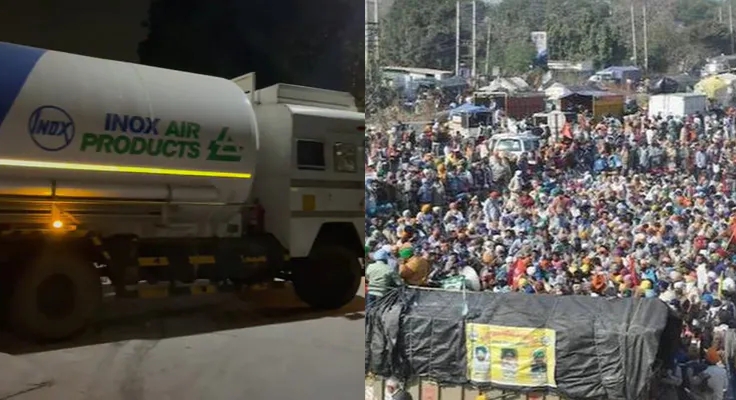
While the Delhi CM Arvind Kejriwal has been saying for the last two days that Delhi is facing an acute shortage of oxygen, it has been revealed that the supply of the vital gas has been disrupted by the ongoing farmer protests in and around Delhi, which is being supported by the AAP govt.
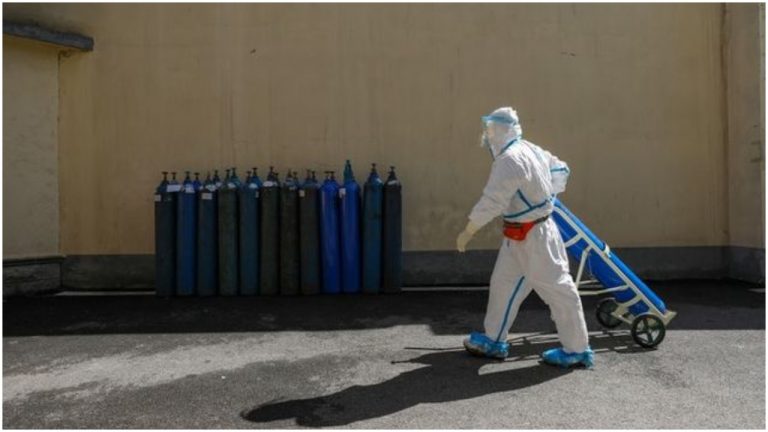
On Monday night, the Delhi police had created a green corridor to enable fast transport of oxygen to Sri Action Balaji Hospital in the city, where the oxygen levels had reached a critical point. A dedicated corridor was created by the police for two oxygen tankers carrying 19,500 litres of liquid oxygen from the UP and Haryana borders. While the police had said that the tankers were stuck at the two borders due to ‘traffic jam’, a letter written by the supplier of the oxygen has now revealed the real reason: the tankers were stuck at the farmer protest sites at the border points.
According to a letter sent by Inox Air Products, a supplier of oxygen, to the central govt, they are facing blockages while transporting oxygen from their plants in Rajasthan and Uttar Pradesh to Delhi due to the highway blockades enforced by the protestors. They mentioned the incident yesterday, when the Sri Balaji Action Medical Institute in Paschim Vihar had almost run out of oxygen. According to the company, this happened as the delay of liquid medical oxygen to the hospital was delayed by 2 hours due to the blockade of NH24 on the Delhi-UP border at Ghazipur by the farmers. According to the company, their vehicles are having to travel an additional distance of 100 kms from their unit in Modinagar, Uttar Pradesh to reach hospitals in Delhi.
The letter by Inox Air Products Pvt Ltd further added that its oxygen supply from IOC facilities is also hampered due to the farmer protests. The company has been asked by the union govt to lift liquid oxygen from Indian Oil Corporation’s Panipat unit, but while transporting oxygen from there to Delhi, they are facing delays due to the blockage at the Singhu border.
Due to this situation, the company requested the union govt to extend support for making green corridors for the movement of tankers and trucks carrying oxygen.
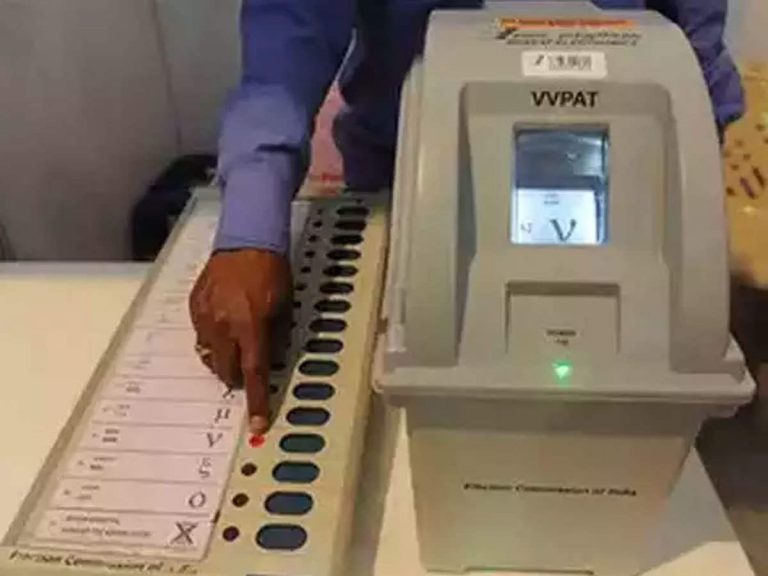
The Supreme Court of India on Monday dismissed a plea seeking 100 per cent matching of the voter-verifiable paper audit trail (VVPAT) slips with the electronic voting machines (EVMs) vote count to ensure transparency in the elections. The court said that it will not interfere in the middle of the poll process.
Supreme Court of India rejects the plea seeking 100% VVPAT verification of votes: Election Commission of India
“We are not going to interfere in the middle of the election process,” a bench comprising Chief Justice S A Bobde and Justices A S Bopanna and V Ramasubramanian noted.
“The special leave petition is dismissed. As a sequel to the above, pending interlocutory applications, if any, stand disposed of,” the bench said in its order.
The judgment came in the wake of the ongoing election process in the state of West Bengal. The election process for the other four states has already been over and the counting of the votes for all the seats will be held on May 2.
The plea was filed by Trinamool Congress leader Gopal Seth, who had approached the top court after being rebuffed by the Calcutta High Court.
In the petition to the Supreme Court, the counsel contended that the high court had said that the apex court had earlier passed the order on this. However, the bench of the Supreme Court did not entertain his requests and dismissed the plea.
The Supreme Court in 2019 had rejected a plea filed by several political parties for 50 per cent VVPAT verification during the Lok Sabha elections.
In 2019, the Supreme Court had rejected a plea by several political parties for 50% VVPAT verification during the Lok Sabha elections. However, the top court had then directed the EC to increase random matching of VVPAT slips with EVMs to five polling booths per assembly segment.
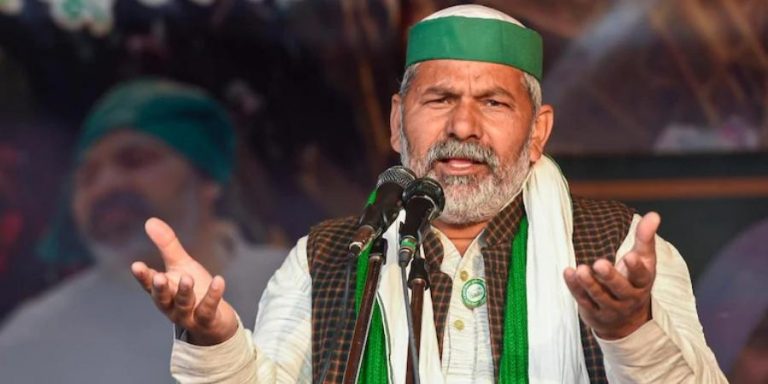
Amidst the alarming surge of COVID-19 cases in Delhi, BKU spokesperson and self-proclaimed ‘farmers’ leader Rakesh Tikait held the central government responsible if farmers protesting at the borders of the national capitals are infected with the coronavirus. Even as Delhi is under a strict 6-day lockdown, Tikait insisted that it cannot be a reason to put the ‘farmers’ protest on hold.
Tikait, who has gotten vaccinated himself, said that it is the central government’s responsibility that farmers protesting along the Delhi borders do not contract the coronavirus.
Speaking with Republic Media Network, Tikait said, “Responsibility lies solely with the government if the farmers get infected with the virus. When the COVID-19 cases are rising across the country, who is responsible for it? Are farmers responsible for that too?”
He further added, “If there is a disease, then the government should ensure treatment for it and build hospitals for it. Politicians are collecting funds for other purposes. They are conducting rallies and contesting elections.”
A couple of days ago, while on his visit to Jammu, Rakesh Tikait had asserted that the ‘farmers’ agitation was not Shaheen Bagh that can be ended in the name of coronavirus.
It is worth noting that Rakesh Tikait, who is spearheading the ‘farmers’ protests and insisting that the protests should not stop because of the coronavirus outbreak, has himself got vaccinated at a hospital near the Delhi-UP border on Tuesday. Tikait took the first dose of coronavirus vaccine at a hospital situated near the Ghazipur border protest site on April 13.
While the national capital went under a 6-day lockdown, Tikait asserts that farmers, many of whom may not have got vaccinated, persist with their protests along the border, even if that means exposing themselves to the coronavirus that is spreading at an alarming rate, especially in Delhi.
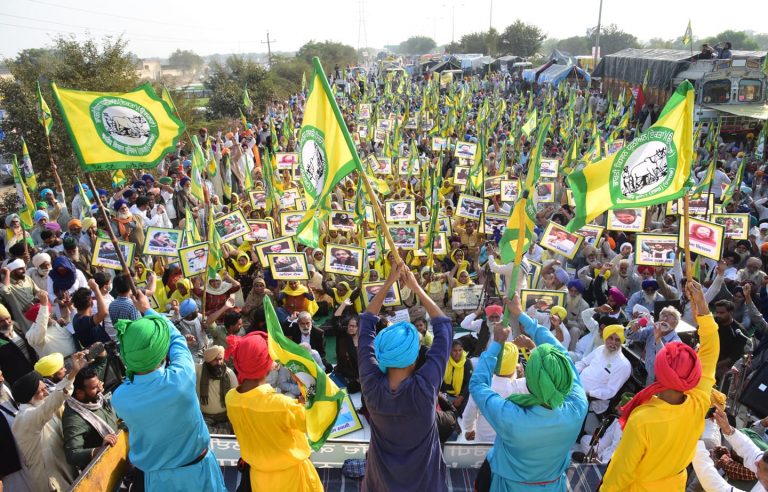
In the meantime, Bhartiya Kisan Union (Ekta Ugrahan), a Punjab-based farmers group that had demanded the release of suspects in both the Elgar Parishad case and the Delhi riots case, has announced a march to Delhi on April 21 in order to protest against the Farm laws. This march comes at a time when Delhi is going through a surge in Coronavirus cases, with testing facilities getting overwhelmed. Yogendra Yadav, the icchadhari protestor, has now alleged that the Modi government is trying to quell the protest in the name of COVID-19 and that is something he will not let happen.
Bhartiya Kisan Union (Ekta Ugrahan), a Punjab-based farmers group that had demanded the release of suspects in both the Elgar Parishad case and the Delhi riots case, has announced a march to Delhi on April 21 in order to protest against the Farm laws. This march comes at a time when Delhi is going through a surge in Coronavirus cases, with testing facilities getting overwhelmed.
According to their statement, the farmer union leaders said apart from farmers, women, tribals, unemployed people and socially disadvantaged groups will also participate in the march.
Several other farmer groups are also doing preparations for a march to Delhi. Kul Hind Kisan Sabha, a farmer union, is organizing farmer meets at the village level in order to increase participation at the protest in Delhi.
“Rumours are being spread that farmers have started leaving the protest sites. Farmers have not lost hope and will leave their villages on April 21 after the harvest season is over. We will implement whatever directions will be issued by the Samyukt Kisan Morcha,” said Karmvir Kaur Mahewhwari, an activist of Kul Hind Kisan Sabha.
On Monday, the Samyukt Kisan Morcha (SKM) decided to launch the ‘Phir Delhi Chalo’ movement from April 24, marking 150 days since the start of the Farmer protests. The SKM is a joint forum of farm unions that spearheads the farmer’s protest.
According to SKM Member Ashish Mittal, as farmers were away for wheat harvesting, the focus of SKM would first be on calling them back. He also said that BKU (Ugrahan) had called upon its members to start reaching the Tikri border from April 21.
Amid rising Coronavirus cases, the Centre and Haryana government have urged farmers to vacate the protest sites, but protesting farmer union leaders have urged the opposite
“Now that the reaping season is over, we are asking farmers to return. Repeated requests from ministers asking us to move out are just a prelude to an effort at uprooting us,” said Yogendra Yadav, president of Jai Kisan Andolan.
Yogendra Yadav further alleges that the government is hatching a conspiracy in the garb of anti-Covid measures to quell their protest. “They used the same trick last year. We will not let it happen,” he said.
“We will spread awareness about health and hygiene protocols one needs to adopt in view of Covid-19. All our colleagues will be asked to wear masks,” added Yadav.
The farmer leaders also said that they will set up vaccination camps at all protest sites. Anyone above 45 years can walk in and get vaccinated, they say, in addition to ambulances being available.
Thousands of farmers are protesting mainly at three sites around Delhi– Tikri, Singhu, and Ghazipur, since late November. The protestors are mainly from Punjab, Haryana, and Uttar Pradesh.
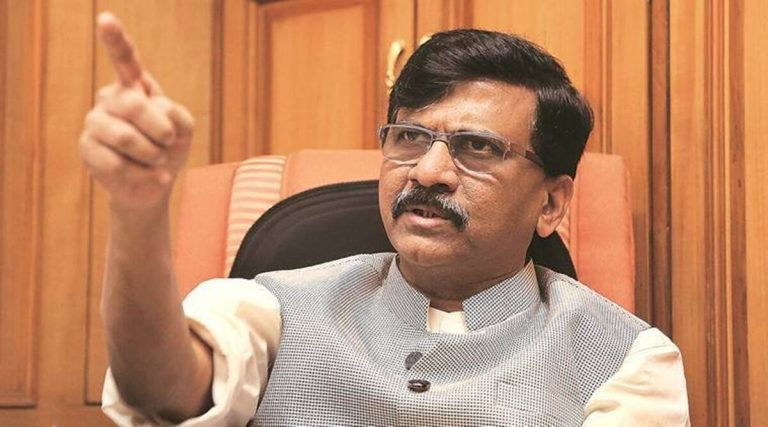
Earlier today, Shiv Sena Rajya Sabha MP Sanjay Raut, who is known for his indiscreet utterances, threw open a can of worms when on Sunday he issued a warning alleging that Kannadigas in Mumbai may find it difficult to do business if clashes between the linguistically divided groups were to reach the financial capital.
Raut made the above remarks in reference to the enduring linguistic disputes in Belagavi and the bordering districts that are a bone of contention between Maharashtra and Karnataka since the linguistic reorganisation of the states.
In an editorial published on April 18 in the Shiv Sena mouthpiece Saamana, Sanjay Raut urged Uddhav Thackeray-led Maha Vikas Aghadi government to open an office in Belagavi in Karnataka and claimed that when Marathi-speaking people are attacked in this border district, Shiv Sainiks retaliate by vandalising transport buses belonging to Karnataka coming into their state.
The Rajya Sabha member further added that if such an incident happened in Mumbai, then it would be “difficult for Kannadigas here (Mumbai) to conduct their trade and business,” though he clarified that “one should not stoop down to that level”. Nevertheless, the subtle threat dished out to Kannadigas in Maharashtra was hard to miss.
BJP terms Sanjay Raut’s remarks on Kannadigas ‘anti-national’
Raut’s threat elicited a sharp reaction from the BJP, along with fellow Kannadigas who took to Twitter to condemn the divisive language used by Mr Raut against the Kannadigas. BJP MP Tejasvi Surya denounced Sanjay Raut’s remarks on Kannadigas and raised question over the silence of the Maha Vikas Aghadi leaders on the issue, saying that it shows “their love for power is more than love for Karnataka”.
“Shiv Sena-NCP-Congress govt (in Maharashtra) is proving to be a disgrace to the country every day. When the country has to stand united in the hour of distress, MVP leaders are dividing people on issues of language,” he tweeted.
Shiv Sena-NCP-Congress Govt is proving to be disgrace to the country everyday.
Surya also warned the Maharashtra government that the comments passed by Sanjay Raut on Kannadigas would not be taken lightly by the youth of India, reminding them that India has rejected politicians who had espoused the language of hate and division.
Social media users slam Sanjay Raut for threatening Kannadigas working in Mumbai
Raut is also facing flak from several social media users who slammed him for having a parochial outlook and exhibiting xenophobic tendencies.
One social media user rightly pointed out that Mumbai is what it is because of the outsiders. She further added that if the city were left to be governed by the likes of Sanjay Raut and his ilk, it will soon run into the ground.
Would like to see what Mumbai is without it’s “outsiders”. Left to Raut and his sort, they’ll run it to the ground. https://t.co/0hsnNUPrib
Another social media user pointed out that Sanjay was simply trying to sow discord in the society with his inflammatory remarks.
This shit is trying to create indifference between people in the name of language. Loll some pappus might listen to you but be aware that this is 21st century kid. Learn to run a government first and talk about kannadigas #kannadigas#sanjayRauthttps://t.co/6Jwo0XaVso
Some users were flummoxed as to why the Indian Constitution still allowed people like Sanjay Raut to remain on a constitutional post. “Are we a banana republic?” one of them questioned.
Another social media user said Maharashtra’s health infrastructure is crumbling under the weight of the COVID-19 outbreak but Sanjay Raut wants to politicise and polarise.
Maharashtra’s health infra’s crumbling the most and this man wants to politicize and polarize. https://t.co/475ceWCuey
Maharashtra and Karnataka are at loggerheads over the territorial claims on some areas, including Belagavi, Karwar and Nippani, which are part of Karnataka. Maharashtra has claimed that the region belongs to it, contending that the majority of the population in these areas are Marathi-speaking.
A team of police personnel from Jaripatka Police station in Nagpur are facing an inquiry after using heavy-handed forceful tactics in order to arrange oxygen cylinders for fifteen critical COVID-19 patients admitted in an ICU at a private hospital. The police officers gave oxygen cylinders to the hospital which barely had two hours of oxygen supply left.
Shortly after Sunday midnight, the Nimunabai Tirpude Hospital sent Jaripatka Police Station a message informing the police that the lives of 15 COVID-19 patients are at risk because the oxygen supply may not last beyond 5 AM. According to Dr. Shivaji Supalkar of the Tirpude Hospital, the regular oxygen plant which supplied the hospital did not respond to repeated pleas, going as far as to disallow the hospital vehicle from entering its premises.
However, as per reports, the hospital authorities did not inform the Collector or the Nagpur Municipal Corporation (NMC) control room about their need for oxygen. Instead, they raised their issue on a social media group comprising nodal officers and other senior officials of the civic body and the district administration. NMC Additional Commissioner Jalaj Sharma directed the hospital to pick up 10 oxygen cylinders from a plant in Hingna. By that time, the hospital had already informed the Jaripatka police station about their situation.
Police Sub-Inspector (PSI) Mahadeo Naikwade, who was on duty at the time, alerted the control room about the hospital’s grave oxygen situation. The control room told Naikwade about another oxygen plant in Yashodhara Nagar, where PSI Naikwade showed up with his team.
Initially, the Yashodhara Nagar plant refused to hand over any spare oxygen tanks because of an earlier direction from the Collector to only supply oxygen cylinders as per the quota allotted. However, PSI Naiwakde, who was reportedly emotionally moved by the situation, forcefully took 7 oxygen cylinders and delivered them to Tirpude Hospital, in what was a virtual robbery.
Though he may have acted with noble intentions, the action did not please senior officials due to violations involved including that of the Collector’s orders.
Hospital authorities say they were panicked by the dire situation and approached the police fearing anger from the patient’s relatives if something untoward happened. “The PSI’s act ensured oxygen for our patients and we are ready to pay whatever amount is due. The cylinders helped us continue till our normal supply was restored,” said Dr. Supalkar.
Zonal Deputy Commissioner of Police Neelotpal says that an inquiry has been instituted under the concerned Assistant Commissioner of Police.
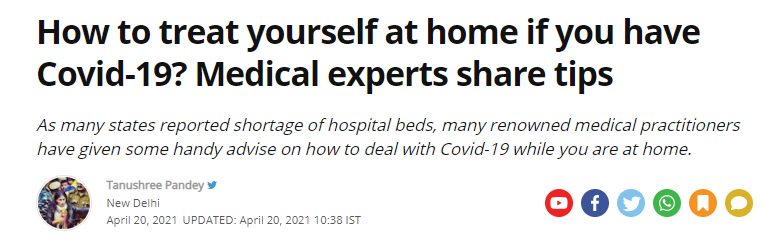
On Tuesday (April 2020), India Today stirred controversy by sharing prescription medicines for the general public for the treatment of Coronavirus infection at home.
In an article titled, “How to treat yourself at home if you have Covid-19? Medical experts share tips”, India Today cited one Canada-based infectious disease physician named Dr Zain Chagla to urge people to ‘self-medicate’ in the face of the Coronavirus crisis. The article suggested a list of medicines that are used in the treatment of Covid-19, but which can trigger dangerous side effects if administered without medical supervision.
One of the medications involved inhaling 2 puffs of Budesonide (steroid) twice a day if the oxygen saturation level was above 92%. Citing Zain Chagla, India Today wrote that Dexamethasone (steroid) 6 mg must be taken daily for 10 days if oxygen saturation level dropped below 92%. India Today also cited Lt. Gen Dr Ved Chaturvedi of the Sir Ganga Ram Hospital and Dr Vikramjeet Singh of Aakash Healthcare but unlike Dr Zain Chagla, they did not prescribe any medicine.
Screengrab of the article by India Today
Lt. Gen Dr Chaturvedi and Dr Singh said that there is a scarcity of hospital beds and a Coronavirus patient can choose home isolation over hospitalisation, provided the symptoms range from mild to moderate. However, India Today went a step ahead and quoted Dr Zain Chagla to list the names of even steroidal medicines as a quick fix for Coronavirus infection. Administering prescription medicines without considering the medical history of a patient can be fatal and life-threatening. The irresponsible reporting by India Today sets a dangerous precedent for the general public, who often get carried away with information they read online.
Both Budesonide and Dexamethasone must be taken only under medical supervision. The same list of medication was also shared yesterday by the controversial physician, Dr Kafeel Khan. After being called out on social media, he posted another tweet saying that Dexamethasone should only be consumed under trained medical supervision. But by then, it was too late and the tweet had received hundreds of retweets and thousands of ‘likes’. As a responsible media platform, we urge people to consult a physician before following any recommendation on social media.
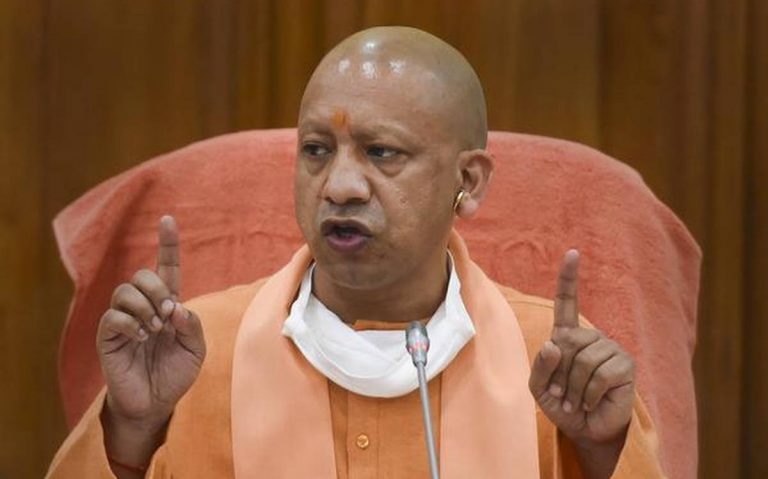
The Supreme Court today granted an interim stay on the Allahabad High Court order calling for a lockdown in the State of Uttar Pradesh on account of the COVID-19 situation. Prior to the SC order, the Yogi Adityanath government had also batted against Allahabad High Court’s proposal to put 5 cities of UP under complete lockdown.
“There is no need to impose a complete lockdown. Weekend lockdowns will continue to curb the spread of COVID-19”, the CMO had said.
The Uttar Pradesh CM had said in an official statement: “The state government is working with full commitment to control coronavirus infections and a strategy is being worked on for extensive testing, tracking and tracking of continuous supply of oxygen along with the availability of ICU beds for prevention of Covid-19.”
CMO listed steps taken to tackle Covid
Today, the CMO listed a series of steps taken by the Uttar Pradesh government to tackle the rising Covid-19 cases in the state.
Among the steps taken by the Uttar Pradesh government to tackle the coronavirus crisis, Yogi Adityanath said that in districts where there are more than 500 active cases, public activities will be restricted except for essential services from 8 pm to 7 am. This rule will be implemented with immediate effect, said CMO.
Moreover, weekend curfews will continue to be in place to check the spread of the pathogen in the state.
जिन जिलों में 500 से अधिक एक्टिव केस हैं, वहां प्रतिदिन रात्रि 08 बजे से अगले दिन प्रातः 07 बजे तक आवश्यक सेवाओं को छोड़कर शेष गतिविधियां प्रतिबंधित रहेंगी। इस नियम को तत्काल प्रभाव से लागू किया जाए: मुख्यमंत्री श्री @myogiadityanath जी महाराज
Yogi Adityanath specified that special arrangements have to be made at border areas to make sure that the migrant workers returning from Delhi, Maharashtra and Rajasthan are tested before entering the state, but at the same time, he asked authorities to make sure that the migrants do not face any difficulty in returning to their native place.
गृह विभाग और परिवहन विभाग समन्वय बनाकर आवश्यक कार्यवाही करें। इन प्रवासी कामगारों/श्रमिकों की टेस्टिंग और आवश्यकतानुसार इलाज की समुचित व्यवस्था होनी चाहिए: मुख्यमंत्री श्री @myogiadityanath जी महाराज
“Necessary action should be taken in coordination with the state Home Department and Transport Department to ensure that proper arrangement for testing and treatment of these migrant workers are in place at border areas, stated the CM.
The UP CM furthered that the state should ensure all necessary security arrangements for the police force and other personnel working for the ongoing panchayat elections. He ordered that the candidates in the ongoing panchayat elections will be allowed to campaign only in groups of five.
Double the number of Covid beds
Uttar Pradesh government recognised the need to double the number of Covid beds in all districts of the state including Lucknow, Kanpur Nagar, Prayagraj, Varanasi, Jhansi, Gorakhpur, and Meerut districts. The government has informed that 200 beds equipped with oxygen facilities would be increased in each of these districts with immediate effect.
CM Yogi Adityanath has ordered the deployment of an officer of Secretary level in each district who would overlook the expansion of hospital beds in these districts. He said that in this regard, the medical education minister and health minister should ensure prompt action by communicating with the district administration in all the districts of the state.
सचिव स्तर के एक अधिकारी की तैनाती प्रदेश में बेड विस्तार के कार्य के लिए लगाई जाए।
चिकित्सा शिक्षा मंत्री व स्वास्थ्य मंत्री इस संबंध में प्रदेश के सभी जिलों में जिला प्रशासन से संवाद स्थापित कर कार्रवाई सुनिश्चित कराएं: मुख्यमंत्री श्री @myogiadityanath जी महाराज
Yogi Adityanath furthered that authorities have been ordered to increase the number of dedicated Covid Hospitals in Lucknow, and prepare King George’s Medical University (KGMU) and Balrampur Hospital as designated Covid Hospitals. Besides, Era Medical College, TS Mishra Medical College, Integral Medical College, Hind Institute of Medical Sciences and Mayo Institute of Medical Sciences will also be expanded as dedicated Covid Hospitals.
लखनऊ के KGMU तथा बलरामपुर चिकित्सालय, एरा मेडिकल कॉलेज, टीएस मिश्रा मेडिकल कॉलेज, इंटीग्रल मेडिकल कॉलेज, हिन्द इंस्टीटूट ऑफ मेडिकल साइंसेज तथा मेयो इंस्टीटूट ऑफ मेडिकल साइंसेज को डेडिकेटेड कोविड हाॅस्पिटल के रूप में क्रियाशील रखा जाए: मुख्यमंत्री श्री @myogiadityanath जी महाराज
He added that a new consignment of 20,000-30,000 Remdesivir vials reached the state on Monday. The chief minister said three new oxygen plants will also be set up at different places in the state each week.
“With DRDO’s help, a new oxygen plant with a capacity of 220 cylinders will be installed and made operational in the next 2-3 days. The government of India has allocated 750 MT oxygen,” Yogi said.
He added that before any medical college is recognized in the state, it should be ensured that the respective college has its own oxygen plant. The CM has also ordered that all vehicles carrying oxygen will have to be GPS-tracked, oxygen plants will be provided police protection and steps will be taken to prevent black marketing. He also ordered that oxygen plants should take up supply to the nearest hospital and all hospitals with L1, L2, and L3 facilities will be tracked separately for oxygen demand and supply, ensuring a backup of at least 36 hours.
50 per cent of 108 ambulances will be dedicated for Covid-19 patients and rapid testing will begin at airports, bus and railway stations of inter-state passengers, he added.
Data showed on Monday Uttar Pradesh recorded 28,287 Covid-19 cases, which have pushed the tally of infection in the state to 879,831. The state currently has 208,523 active cases. The deaths rose by 167, the highest daily rise so far, to reach 9997. A health bulletin said the number of recoveries has increased with over 10,978 patients discharged in a day and that 661,311 people have recuperated so far from the disease in the state.
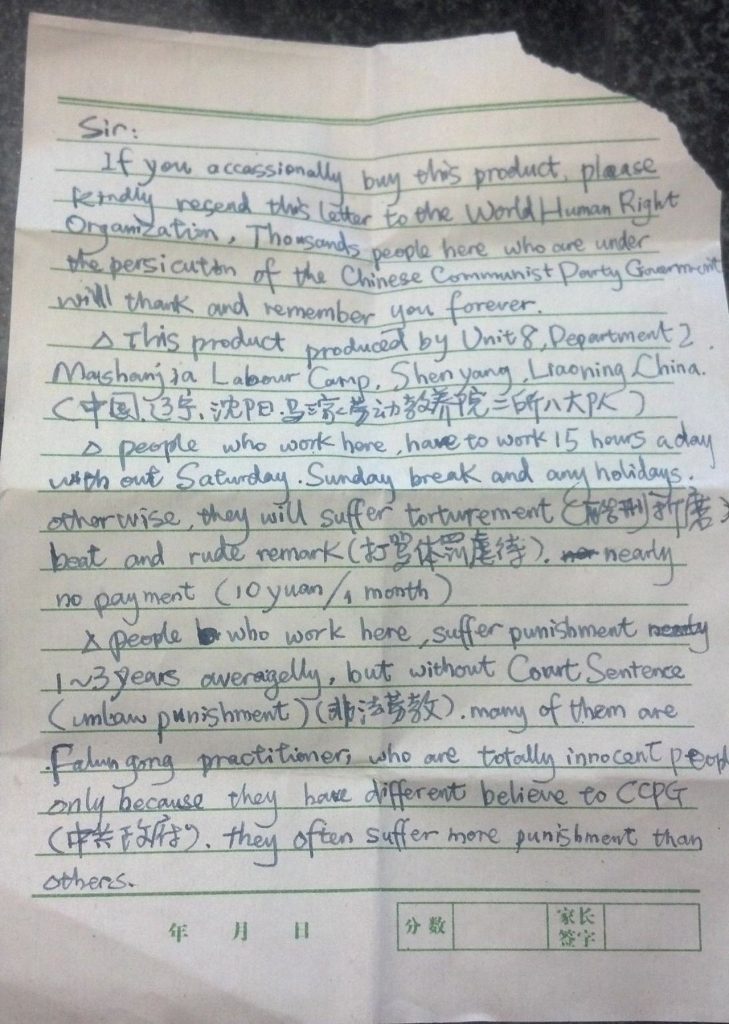
In 2012, a woman from Oregon, USA bought decorations for Halloween, namely styrofoam tombstones. Hidden between the decorative tombstones was a letter from a man, asking for help.
In broken English mixed with Chinese, the letter read, “If you occasionally (sic) buy this product, please kindly resend this letter to the World Human Right Organization. Thousands people here who are under the persicution (sic) of the Chinese Communist Party Government will thank and remember you forever.”
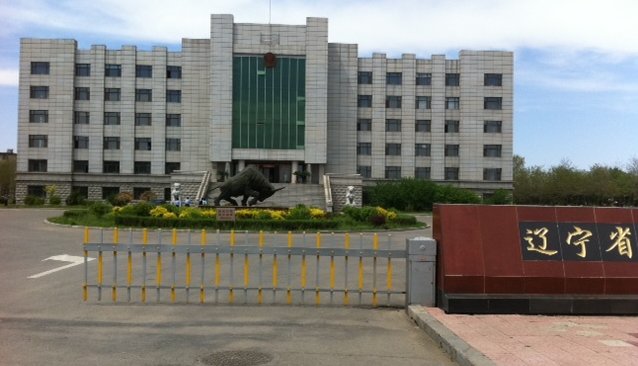
The letter went into detail about the conditions at China’s Masanjia Labor Camp, including the gruelling hours, verbal and physical abuses as well as torture that inmates making the products had to endure.
At first, the woman, Julie Keith, thought that the letter might be a hoax. However, the tone of the letter prompted her to research further. At the time, Masanjia Labor Camp was unknown in the West, but an online search on it revealed that it was an infamous place, known for forced labour, torture, and ideological reprogramming. Julie took her story to the local newspaper, which in turn caused the story to go mainstream and gain worldwide attention.
In April 2013, China’s Lens Magazine included a 14-page exposé on abuses at Masanjia Labor Camp. The investigative story was based on interviews with approximately a dozen former inmates, who recalled being subjected to forced labour and a variety of torture methods in the camp.
The Chinese journalists also spoke to former officials at the labour camp who said Masanjia housed more than 5,000 inmates as free labourers at its height and created annual revenues of nearly 100 million yuan ($16 million), including revenue generated from exports. This exposé in Lens Magazine caused a huge outrage domestically in China and reinvigorated calls to reform the forced labour system.
In 2013, under intense international and domestic scrutiny, China announced that it was abolishing its “re-education through labour” system. The Laojiao system, called the Re-education through labour system in English, was introduced in 1957 by Mao Zedong himself. Active from 1957 to 2013, the system was used to detain persons who were accused of minor crimes such as petty theft, prostitution, and trafficking illegal drugs, as well as political dissidents, petitioners, and Falun Gong followers.
However, just after abolishing the Laojiao system in 2013, China built re-education camps in Xinjiang, targeting a much wider context than petty crime or being politically dissident. By 2017, these camps became the massive Xinjiang internment camps holding 1–3 million people, utilizing forced labour, and now recognized as re-education camps by many nations, intergovernmental organizations such as the United Nations and European Union, and human rights groups.
The Falun Gong connection
In 2018, the mysterious man behind the letter, imprisoned in Masanjia Labor Camp, crying out for help was finally revealed for a Canadian documentary. Sun Yi, the author of the letter, was an engineer who was released from the labour camp in 2010 after his 2½-year sentence, even before the news of his hidden S.O.S. letter made international headlines.
Sun Yi revealed that he had been in and out of labour camps no fewer than 10 times. Sun Yi explained that this continuous persecution on part of the Chinese state was because of his Falun Gong beliefs. Falun Gong is a neo-spiritual movement with millions of estimated followers in China. In 1999, the Chinese Communist Party launched a severe crackdown in the form of a persecution campaign against followers of the Falun Gong movement which continues to this day.
In 2008, Beijing police sold Sun Yi to Masanjia Labor Camp for the equivalent of USD $800. He worked 15-hour days making forced-labour products, including Halloween decorations. Realizing that the products were destined for export markets in the West, he secretly wrote dozens of notes calling for help in the darkness of his cell. Only one of his notes, the one in Oregon, USA, was ever discovered.
When Sun Yi refused to renounce his Falun Gong beliefs and swear fealty to the Communist Party — he claims that he was strung up by his wrists for 20 hours a day for eight consecutive months. Sometimes the guards shocked him with electric truncheons and extinguished cigarettes on his skin. When he went on a hunger strike, he says they pried his mouth open with a metal instrument and violently force-fed him.
The story of Sun Yi is just one of many horror stories which went on at Masanjia Labor Camp. There have been persistent reports of torture and other human rights abuses being committed at the camp.
“I went through all sorts of torture. I would shout, ‘Falungong is good!’, all the time, and then they would beat me on the mouth with a big plank of wood or tie me up,” said one Falun Gong detainee at Masanjia, showing indentations on her wrists she said came from a rope.
“I still can’t forget the pleas and howling,” said Liu Hua, 51, a petitioner who was imprisoned at Masanjia on three separate occasions. “That place is a living hell.”
According to former inmates, roughly half of Masanjia’s population is made up of Falun Gong practitioners or members of underground churches, with the rest a smattering of prostitutes, drug addicts, and political prisoners.
Aftermath
In October 2017, just a mere eight days shy of his 51st birthday, Sun Yi died from a lung infection and acute kidney failure. Since his death was so sudden and he didn’t have kidney problems before, some of his friends speculated that the Chinese communist government was involved. But since his body was cremated without an autopsy, that is impossible to prove.
His ashes were brought to his hometown of Xi’an, where they rest alongside his mother’s and father’s remains.
“I so badly wanted a happy ending for him,” Keith said in 2018. “He was the most resilient, strong person I have ever met. For someone to go through what he did and come out and be able to talk about it and share his experiences with the world — it’s just incredible.”
Four years after Sun Yi’s death, the Chinese Communist Party still maintains its large scale in internment camps in Xinjiang, which holds millions of Uyghurs and other minorities, according to several international human rights groups. Therefore, it is important to remember and honor Sun Yi’s memory, who was a devout believer in his faith, so much so that he endured persecution for years by the Chinese Communist state, along with thousands of others Falun Gong, along with other minorities which are being systemically oppressed in China.
Amidst the rising cases of Coronavirus in the country, Lutyens’ journalist Barkha Dutt has hit the streets. In what appears like bid to restore her dwindling reputation in journalistic circles and among her viewers, she has decided to up her ‘ground reporting’ in such challenging times.
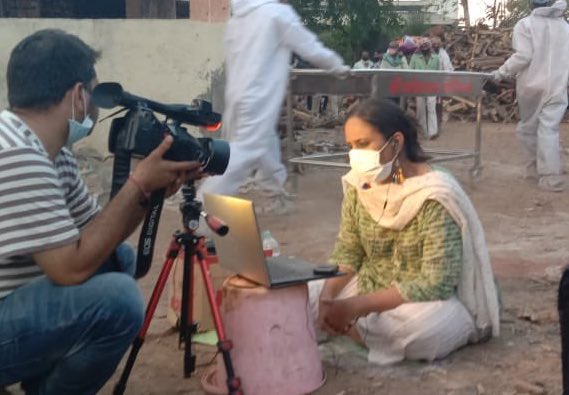
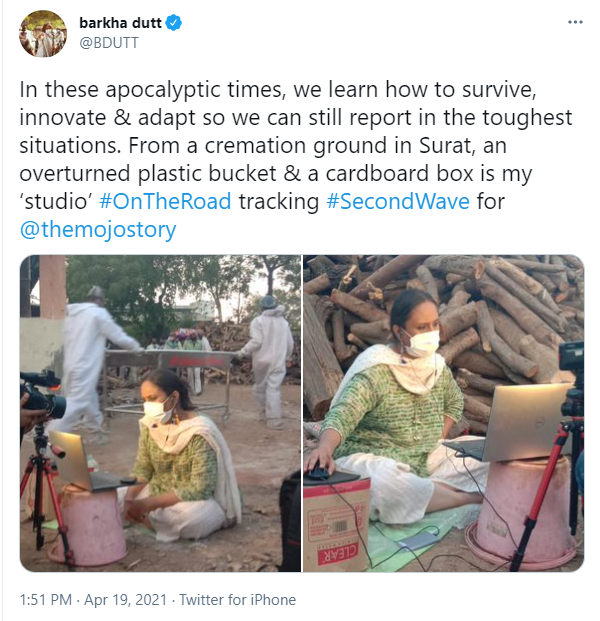
From camping outside civil hospitals to crematoriums, Barkha has been sharing her pictures where she sits on an upturned tin can and puts her laptop on upturned plastic dustbins to bring us ground report. It is not yet clear why Barkha, who could quite possibly afford portable desks, has resorted to upturned tin cans as desks.
Wooden logs, used for cremation, could also be seen in the background of the image. While posting such shocking visuals, Barkha Dutt wrote, “In these apocalyptic times, we learn how to survive, innovate & adapt so we can still report in the toughest situations. From a cremation ground in Surat, an overturned plastic bucket & a cardboard box is my ‘studio’.”
Screengrab of the tweet by Barkha Dutt
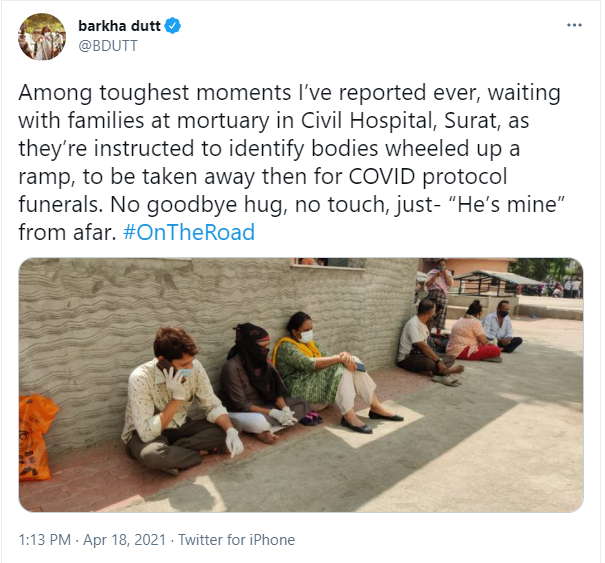
On Sunday (April 18), she had shared images of family members of Coronavirus patients, who had died at the Civil Hospital in Surat. Barkha Dutt tweeted, “Among toughest moments I’ve reported ever, waiting with families at mortuary in Civil Hospital, Surat, as they’re instructed to identify bodies wheeled up a ramp, to be taken away then for COVID protocol funerals. No goodbye hug, no touch, just- “He’s mine” from afar.”
Screengrab of the tweet by Barkha Dutt
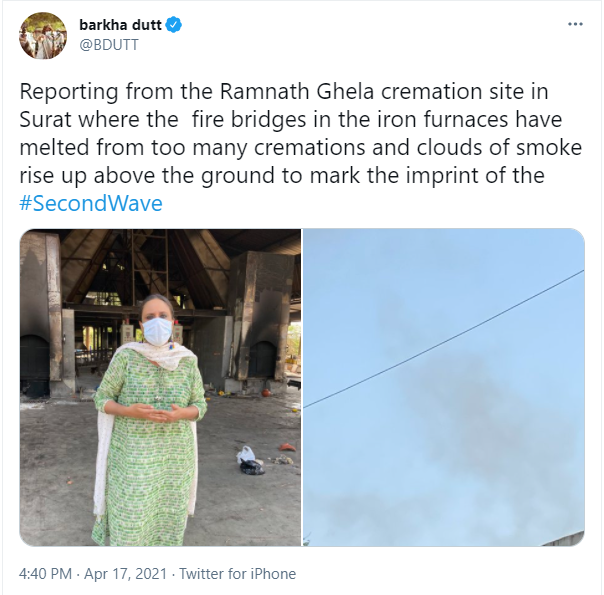
In another tweet on Saturday (April 17), Barkha Dutt shared her picture from the site of Ramnath Ghela cremation centre in Surat. Far from making the story the epicentre, she tweeted her picture and claimed that the iron furnaces used for cremation have melted due to overuse. “Reporting from the Ramnath Ghela cremation site in Surat where the fire bridges in the iron furnaces have melted from too many cremations and clouds of smoke rise up above the ground to mark the imprint of the SecondWave,” she added.
Screengrab of the tweet
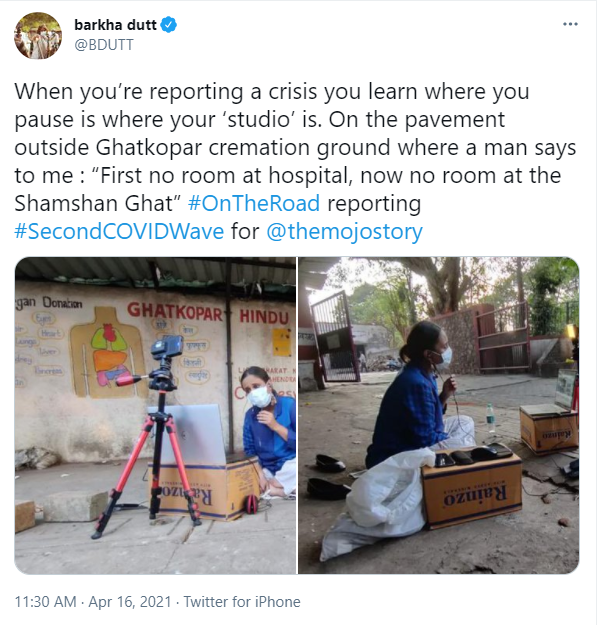
A day prior to this, the Lutyens’ journalist had shared another story from Ghatkopar cremation ground. And yet again, she was at the epicentre of the story. Her laptop was carefully placed over a wooden box while she sat on the ground. In her tweet, she said, “When you’re reporting a crisis you learn where you pause is where your ‘studio’ is. On the pavement outside Ghatkopar cremation ground where a man says to me: “First no room at hospital, now no room at the Shamshan Ghat.”
Screengrab of the tweet by Barkha Dutt
While the situation on ground is indeed grim, people on social media have been calling out the dramatics by journalists who could have perhaps focused on the news instead of their brand building.
Netizens call out Barkha Dutt on social media
The repetitive use of wooden boxes as support for her laptop, attempts to fearmonger the public about the Coronavirus crisis through stories on deaths/ crematoriums and morgues and her ‘self-obsession’ did not miss the public eye. Slamming her for theatrics, one Twitter user (@i_sid007) wrote, “You are such a drama when you can easily get a foldable laptop table for as little as 600 rs anywhere …”
You are such a drama when you can easily get a foldable laptop table for as little as 600 rs anywhere …?
A similar point was raised by another Twitter user (@Bassappamv). He wrote, “Mumbai to Surat average flight price round trip Rs.6000. By this you can buy very good mobile furniture. Don’t do drama sitting on floor.”
Mumbai to Surat average flight price round trip Rs.6000. By this you can buy very good mobile furniture. Don’t do drama sitting on floor ?
Others slammed her for clicking images alongside families mourning the death of their loved ones. Shivangi asked, “Why would you click your picture there? How shameful?” When one user named Shashank Baranwal pointed out about her photo Op, he was immediately blocked by the Lutyens’ journalist.
WHY WOULD YOU CLICK YOUR PICTURE THERE? HOW SHAMEFUL!
Twitter user Zafar Abbas criticised the narcissism of Barkha Dutt. He wrote, “She did it again…This lady is self obsessed. Crime reporters do it as a normal practice outside mortuaries. Last time it was her dirty shoes when she felt it was only hers that get dirty. Kamaal hai..Aisi situation me bhi ‘Me, I and Myself “
She did it again…This lady is self obsessed. Crime reporters do it as a normal practice outside mortuaries. Last time it was her dirty shoes when she felt it was only hers that get dirty. Kamaal hai..Aisi situation me bhi ‘Me, I and Myself ” !
Barkha Dutt was also slammed for doing politics over dead bodies. Col Hunny Bakshi inquired, “Where is that queue (of corpses), long line she is talking about ?”
Where is that queue, long line she is talking about ?#RUDALI
— Col Hunny Bakshi, VSM (@colhunnybakshi) April 16, 2021
Can journalism around dead bodies be termed as Vulture journalism ….
More the people die more people will log on to @BDUTT channel.
Another user (@finproedge2) said, “Can journalism around dead bodies be termed as Vulture journalism ….More the people die more people will log on to @BDUTT channel. Guess what she would be wishing now…….?” Despite her attempts to project herself as an ‘independent journalist’ who has not lost the common touch, Barkha Dutt ended up exposing her self -obsession, ability to do theatrics to draw more eyeballs and draw political influence from the corpses of the deceased Coronavirus patients.