Monday, March 30, 2026
Home Blog Page 4580

Rakesh Tikait gives another indication about how the farmer protests are completely political: Here is what he said

0

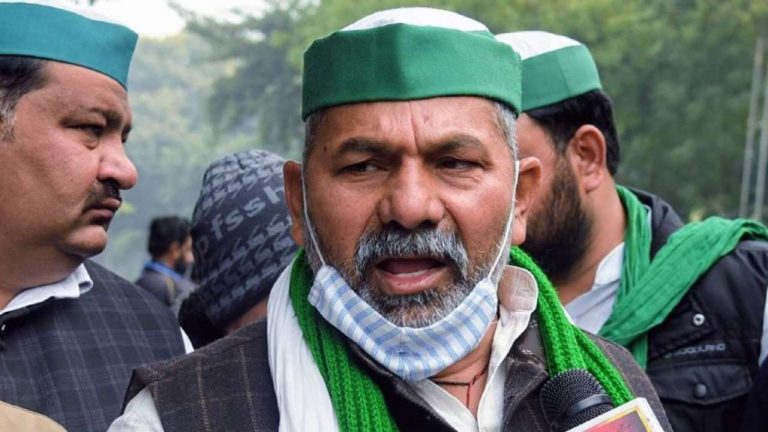
If there was any proof needed to understand how the ongoing so-called ‘farmers protest’ is entirely political and has nothing to do with the interest of farmers, Rakesh Tikait has provided one. After the Supreme Court put the implementation of farm laws on hold and ordered for a committee to be formed, Bharatiya Kisan Union (BKU) spokesperson Rakesh Tikait has issued a statement wondering if the democratically elected government had hold office for 5 years, then why the protests cannot last for 5 years too.

It is pertinent to note that the farmers’ groups had rejected the offer and said that they would not appear in the Supreme Court-appointed committee’s proceedings. They said that the Central government’s attitude in the court had made it clear they will not repeal the three laws.

When asked about the duration of the protest and how long he plans to keep this up, Tikait reportedly told IANS, “It the government can function for five years, why can’t the movement go on? We respect the Supreme Court’s decision but are not happy with the committee (set by the apex court). Our movement will continue till the government withdraws the farm laws”.

Further, Tikait said that farmers’ organisations, led by Samkyukta Kisan Morcha have planned to intensify their stir and are planning on their protests with an eye on Republic Day (26th January 2021).

He said that they had already started procuring several Indian flags and had planned to take out protest marches all over India on Republic Day. “Our preparations for January 26 event are complete. We will have a meeting to see where we can hold the parade in Delhi,” he said.

It is pertinent to note here that the farmers protest, mainly by Punjab farmers and a few clearly politically motivated organisations has lasted for over 50 days now. These so-called farmers are unrelenting and have said that their demand is the complete repeal of the three laws and that no other compromise can be reached with the government. This, while several other farmer organisations across the country have come out in support of the farm laws. In fact, it was also noted that Rakesh Tikait and his other friends had expressed displeasure at the government talking to farmer organisations from other states and demanding that the government limits its discussion to Punjab farmers and these specific organisations.

Even as the protests have now been hijacked by Khalistanis and separatist, banned organisation Sikhs For Justice is openly betting for it, as per reports, protestors from Haryana have announced a ‘tractor parade’ to Delhi from its borders on January 26. While speaking about the decision, Haryana BKU president Gurnam Singh Chaduni emphasised, “As per our strategy, all farmer brothers with their tractors should reach Delhi borders by January 24. We will enter Delhi on January 26, even if the police use lathis or bullets. ” He added, “We will break all their (police) barricades to enter Delhi.”

In anticipation of their planned parade, they have scheduled a rehearsal on January 17 on the Dadri-Bhiwani highway and on January 18 in Siwani. Chaduni has been at the forefront of leading protestors from Ambala to Delhi on November 25 by breaking through security barricades placed on Ambala-Delhi national highway to reach Delhi. He warned, “Our next programme will take place on January 26 but if Khattar sahab plans a rally even before it, we will oppose that event too.” 

While these so-called farmers are marching towards Delhi on Republic Day and setting the stage to foment trouble, elements like Yogendra Yadav, who is fondly called ‘icchadhari protester’ has issued tacit warnings to farmers from other states because they have refused to join these protests.

The motives of these protests came into further question after Naxal supporter Arundhati Roy joined the protests and compared them to Naxals fighting in Bastar.

These so-called farmers have already resorted to violence and vandalism. They had damaged and vandalised several Jio towers and only recently, vandalised a public rally by CM ML Khattar.

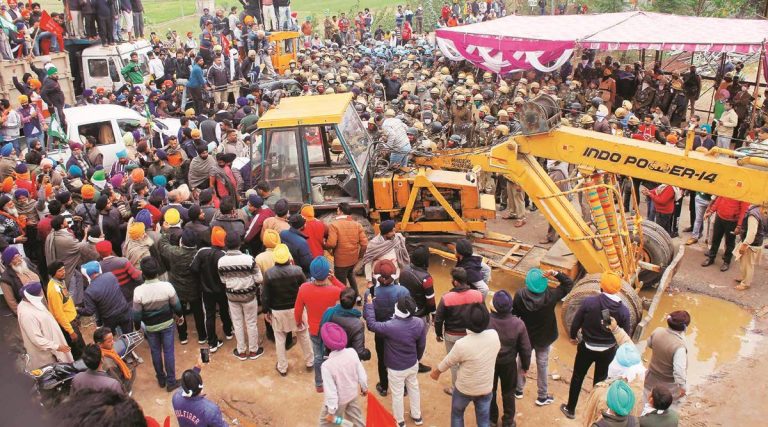
Recently, they ambushed the Kisan Mahapanchayat programme in Karnal, where Haryana CM Manohar Lal Khattar was supposed to address a large gathering of 2000 farmers. The protestors first gathered near Bastara toll plaza in Karnal on the Delhi-Chandigarh Highway before making their way to the village. They were successful in breaching 6 checkpoints and reaching the helipad in Kamila village where the CM was supposed to land.

The mob was seen digging up the interlocking tiles and vandalising the helipad, thereby forcing authorities to find an alternate site for the CM’s landing. In a bid to oppose the newly enacted farm laws, they vandalised the venue, tore down banners and flung the chairs. The anti-farm law protestors tore down the tents, forcing Haryana CM Manohar Lal Khattar to cancel the event.

With Khalistanis, Congress leaders and others fanning these protests, Rakesh Tikait’s recent statement only goes to show that these protests are not really being held for the interests of the farmers, rather, it is yet another attempt to unseat a democratically elected government. While the politics continue, several farmers have come out in support of the laws and described how the three farm laws have helped them procure a fair price for their produce.

With Rakesh Tikait’s rejection to participate in the committee constituted by the Supreme Court, his statements about continuing the protest till the Modi government is in power and his exception to the government talking to farmer organisations from the rest of the country, it becomes evident that these protests are merely politically motivated and have no substance other than embarrassing the government of the day.

World’s oldest known artwork is of a warty pig, found in Indonesia’s Sulawesi Islands

Archaeologists working on an ancient site on Sulawesi island, Indonesia have discovered the oldest known figurative artwork said to be at least 45,500 years old. As per reports, the artwork which is an image of a wild pig provides the earliest evidence of human settlement in the area. The cave painting is also said to be the oldest surviving image of an animal.

The painting is reportedly made using red ochre pigment. The animal in the painting appears to be observing a fight or social interaction between two other pigs. According to CNN, there are several other limestone caves in the region where other discoveries have been made. In 2014, a team of archaeologists had found human hand stencils in Sulawesi. These were dated 40,000 years old. In 2019, the same team of archaeologists had discovered cave art in the region depicting a hunting scenario dating to 43,900 years ago.

A doctoral student had found the painting in 2017

Wion reported that study co-author Maxime Aubert of Griffith University, Australia told that the warty pig painting was found in 2017 by a doctoral student named Basran Burhan as part of the surveys that his team was carrying out with Indonesian authorities. The Leang Tedongnge cave where the painting is found is located in a remote valley enclosed by sheer limestone cliffs. The cave is accessible during the dry season only as flooding makes it impossible to reach the cave during the rainy season. The painting measures 136 by 54 centimetres.

Prior to the discovery of the warty pig cave painting, the oldest known cave art was considered to have appeared in Europe 40,000 years ago showing abstract symbols. The art became more sophisticated showing animals like horses by 35,000 years ago. According to National Geographic, scientists have identified images in around 300 caves over the last 70 years in Sulawesi alone.

Dating of the cave painting

According to study co-author Aubert, a calcite deposit formed on the top of the painting was used to date it. He used Uranium-series isotope dating to reach the conclusion that the painting was at least 45,500 years old. This means that the painting could be older than that.

Ormanjhi beheading case: Ranchi Police arrests main accused Shaikh Bilal

0

Ranchi Police has arrested the main accused of Ormanjhi beheading case. Bilal had beheaded his second wife and buried her head in a pit in his field in Chandwey village. Naushad Alam, SP Ranchi Rural said that they are interrogating Bilal to discover the reason behind the killing.

“Ranchi Police arrested the main accused, Sheikh Bilal who allegedly beheaded a woman and dumped her body in Ormanjhi area. He is being interrogated to discover the reason behind this gruesome murder,” SP Alam said in his statement.

Ranchi beheading case

On January 3, Ranchi police recovered a headless body which was later identified as 22-year-old Sophia. During the investigation, Police found that her husband Sheikh Bilal had murdered her as Sophia informed Police about his whereabouts after which he was arrested. At that time a pistol was found in his possession.

Bilal came out of jail a few days back. He took Sophia on the pretext of spending some time together and killed her in the forest area. He brought her head back home and buried it with salt in his field. Police interrogated his first wife Shabbo Khatoon who told Police where the head was buried. Bilal was on the run, and Ranchi police had formed teams to find him. A poster was released with his information to seek help from the public.

This is an ongoing investigation. More details will follow.

Jammu and Kashmir: Cracks appear in Gupkar alliance after BJP wins big in DDC elections. Read details

Following the success of the BJP in the District Development Council elections in the Union territory of Jammu and Kashmir, a much anticipated political turmoil has emerged within the Gupkar alliance. The political alliance is the grand coalition of National Conference (NC), People’s Democratic Party (PDP) and four other parties.

As per reports, after the Gupkar alliance only managed to win only 110 seats out of 280, they have begun blaming one of their key allies aka the National Conference. The infighting began after other coalition partners accused the NC of partiality in seat-sharing and fielding candidates against its own coalition party candidates. Reportedly, Ghulam Hasan Mir, Jammu and Kashmir Apni Party, has hinted that several disgruntled political leaders from the Gupkar alliance might defect to his party in the upcoming days.

Reportedly, the biggest bone of contention within the Gupkar alliance has been the seat-sharing for the District Development Council elections. The coalition partners have alleged that National Conference was given an unfair share of candidates and that the party ensured the defeat of coalition candidates by fielding its own proxy candidates. Imran Raza Ansari, the General Secretary of Peoples Conference (PC), said that the party fared better than other coalition partners. He claimed that proxy candidates had undermined PC’s performance in the elections and lamented that the party could only contest 10 seats out of 140 in the Valley.

National Conference cadre in dilemma after Omar Abdullah’s statement

NC scion Omar Abdullah had claimed that he has become demotivated and jaded, forcing him to wonder whether he should continue in politics. While talking about his political career, he said, “I find it very difficult to motivate myself, I have lost motivation. A certain light inside may not have been switched off but it’s a lot dimmer. I have never been like this.”

His statement has however increased the worries of an already demotivated party cadre. The party workers said that their ultimate fight is against the BJP and restoration of Article 370. They conceded that the morale of party cadre would fall, if leaders talk about being demotivated and withdrawal from electoral politics.

BJP emerges as the largest party in the recently conducted DDC polls

For the first time since the abolition of Article 370 and the transition of the erstwhile state of Jammu and Kashmir into Union territory, the elections for the local body were held in Jammu and Kashmir over a period of 25 days. Polls were held for 280 seats of the District Development Council (DDC) in 20 districts of the Union Territory. The polling was held in eight phases beginning on November 28 and concluding on December 19.

Six Kashmir-centric political parties including the National Conference (NC) and the Peoples Democratic Party (PDP) contested the election under the banner of an alliance named the Peoples Alliance for Gupkar Declaration (PAGD) which was formed for the restoration of Article 370. Initially, the Congress was part of the Gupkar alliance but later the grand old party distanced itself from the alliance. While the PAGD has won 110 seats, the BJP has emerged as the single largest party with 74 seats.

The Gupkar alliance and its anti-India leanings

In October this year, six political parties the National Conference (NC), Peoples Democratic Party (PDP), Peoples Conference (PC), Communist Party of India Marxist (CPI-M), Peoples Movement (PM) and Awami National Conference (ANC) had formed the Gupkar alliance demanding the restoration of Article 370. Gupkar alliance member PDP’s President Mehbooba Mufti had denounced the Indian national flag after being released from detention on October 13. She said that she would not raise the Indian flag until the flag of the erstwhile state of J&K gets restored. NC’s Farooq Abdullah had sought China’s help to revert the central government’s decisions.

After opposing the Jallikattu tooth and nail, Rahul Gandhi looks to salvage image by attending the festival

Congress leader Rahul Gandhi has again made an appearance after vanishing to some undisclosed location for New Year. Gandhi is going to Madurai and will mark his presence at the famous Jallikattu festival On January 14. Jallikattu bull race is a part of traditional Pongal celebrations in Tamil Nadu.

Gandhi shared a tweet in which he said, “Coming to celebrate Pongal with you in Madurai, Tamil Nadu. I am participating in the Jallikattu festival in Madurai.” Interestingly, Congress has been vehemently opposed to the festival just a few years back.

A brief history of Jallikattu ban and Congress’ opposition of the tradition

In 2011, the Ministry of Environment and Forest under the Congress-led UPA government had banned the use of bulls in the festivities. However, under the Tamil Nadu Regulation of Jallikattu Act No 27 of 2009 the festival continued. In 2014, the Supreme Court of India then struck down the state’s law and banned Jallikattu. Since then, the people of Tamil Nadu have been fighting for their traditional event. Between 2014 and 2017, Jallikattu was held but it was deemed against the orders of the apex court.

Notably, in 2017, the Tamil Nadu government passed a bill with the support of the Prime Minister of India that exempted Jallikattu from Prevention of Cruelty to Animals Act (1960). First legal Jallikattu celebration was held on February 1, 2017, in Madurai district.

‘Jallikattu is a cruel form of entertainment’: Former PM Dr Manmohan Singh

From former Prime Minister Dr Manmohan Singh to several Congress leaders, the party has always opposed Jallikattu. In a letter addressed to NG Jayasimha of Humane Society International, Dr Singh called the festival a cruel form of entertainment. He said, “We have to discourage bullfights that provide a cruel form of entertainment.”

Source: Twitter user @/smkamatchi

In 2014, Jairam Ramesh, then-Environment minister, had welcomed the ban on Jallikattu and said, “I welcome the Supreme Court judgement. It will put an end to a barbaric practice.” Speaking to media, Ramesh had later even criticised the BJP’s efforts to let the festivities continue. He had called it a ‘barbaric practice’ and had said the BJP was supporting some local leaders to appease them ahead of the elections.

In 2016, Congress leader Shashi Tharoor claimed Jallikattu results in the torture of bulls. He said, “Disgraceful BJP political pandering to retrograde elements inTN&Maharashtra results in the torture of bulls. Urge Animal Welfare Board to appeal.”

Source: Official Twitter handle of Congress leader Shashi Tharoor

In 2016, Congress party released its manifesto for Tamil Nadu’s Assembly elections in which it promised ban on Jallikattu.

Screenshot of 2016 news report of Zee News in which it stated that Congress party had promised ban on the festival

In 2017, Congress leader Abhishek Manu Singhvi, who represented PETA against Jallikattu in the Supreme Court said, “Jallikattu is not a sport, it is a brutal and wanton torture of an animal.” Though he said that he was speaking as the counsel of PETA and not as Congress leader, his views were in sync with several other Congress leaders.

Congress’ U-turn

Congress and its supportive media ecosystem are highlighting Rahul Gandhi’s visit to Madurai to enjoy the Jallikattu celebrations. However, the social media is awash with old tweets, screenshots and videos of the Congress’ relentless battle to get the Hindu traditional event banned.

Trouble mounts for Dhananjay Munde: After rape allegations, BJP demands NCP leader’s resignation and EC action

Days after Renu Sharma, a playback singer from Mumbai, levelled allegations of rape and blackmail against NCP leader and a minister in Uddhav Thackeray’s cabinet Dhananjay Panditrao Munde, BJP Maharashtra has demanded Munde’s resignation. BJP has also asked the state election commission to take action against him for withholding the information about his second wife in his election affidavit.

Renu Sharma had taken to social media to share the copy of the complaint she has lodged with Mumbai police against Dhananjay Munde, the social justice minister in the Maharashtra Vikas Aghadi (MVA) government. In her complaint she said that Munde was her brother-in-law.

While state BJP chief Chandrakant Patil said that Munde should be asked to resign as a minister, another leader Kirit Somaiya wrote a letter to the Election Commission ‘seeking appropriate action’ against him for not disclosing details of his second wife and children in the affidavit. Kirit Somaiya added that Munde has “no right” to hold the position of a Cabinet Minister until he comes clean on the allegations.

NCP leaders come out in defence of Munde

Despite serious rape allegations, Sharad Pawar’s Nationalist Congress Party (NCP) was seen backing its minister, with state NCP chief and minister Jayant Patil saying: “These are only allegations against him. He has given his clarification in this regard. This is his family issue. It takes years for one to get established in politics and so without investigating the incident, it would be unfair to finish off someone’s career.” He added, “Munde has also filed a case in the court, the matter is sub judice. Till the judiciary gives a verdict.

Dhananjay Munde accused of rape and blackmail

On January 12, the upcoming singer Renu Sharma had accused Dhananjay Panditrao Munde of sexual assault and rape under the pretext of marriage and blackmail. Sharing a copy of her complaint, Renu Sharma revealed how Munde had lured her under the prestext of marraige and bright prospects in Bollywood. The victim accused the NCP leader of sexually exploiting her and blackmailing her with her intimate pictures and video.

In a tweet tagging top NCP leaders including Sharad Pawar, she added that she had approached Mumbai police earlier but her complaint was not accepted. She also requested help from former Chief Minister Devendra Fadnavis and PM Narendra Modi, alleging that her life was under threat.

NCP leader Dhananjay Munde admits of his extramarital relationship

Dhananjay Panditrao Munde refuted the allegations. However, while denying the charges, Munde, inadvertently, admitted of his extramarital relationship with Renu Sharma’s sister, which, in turn, added insult to his injuries. In his Facebook post, the NCP leader said that he had been in a relationship with the woman’s sister since 2003 and has two children with her. After the minister’s Facebook admission, the BJP’s women’s wing wrote to Chief Minister Uddhav Thackeray and demanded his sacking.

Is collapse of Congress making the left ecosystem more openly Hinduphobic?

In his latest book titled “Our Hindu Rashtra,” Aakar Patel argues that India’s descent into “majoritarianism” begins when “Vande Mataram, the Hindu nationalism trope, became popular as the anthem of Indian nationalism”. This is around 1905, at the time of the partition of Bengal. He points out that the Muslims then began formally demanding representation as a political community and the Muslim League was formed in 1906.

Obviously, that narrative is absurd. Sir Syed Ahmed Khan had championed the infamous two nation theory at least three decades before that.

But this is not about some specific author. There is wider question here. What is driving this change of worldview in the ranks of the Indian left?

Let me explain. The secular, sarkari consensus around Indian history has roughly been something like this. With a handful of exceptions, Muslim emperors generally treated their Hindu subjects well. As such, Hindus and Muslims used to live in mutual harmony and something called composite culture emerged. Then, the British came along and used the policy of divide and rule to cement their position in India. This ultimately led to a breakdown of society along religious lines and partition followed. From history textbooks to movies, this was the standard script.

That vision of the past, however contrived, is changing now. And among the intelligentsia at least, a far more sinister consensus is emerging. In this view, the British are no longer the villains and certainly not the Muslim emperors of the past. In this new vision, the Hindu is the enemy and has always been. The Hindu nationalists forced the land of the Muslims to break from India. They bear the entire guilt for partition of India. The British are benign overseers who couldn’t have cared either way.

Remember how Harsh Mander said that only Indian Muslims are citizens by choice and those of all other religions are citizens by chance? This argument, that Muslims have a higher moral standing than Hindus as citizens of modern India, was one of the core talking points of the anti-CAA protests.

How did this happen? Wasn’t the rise of the BJP supposed to demolish contrived myths about India’s past? The myth of composite culture is breaking, yes. But not in the way one would have anticipated. At least among the self appointed intelligentsia who, for better and for worse, still hold commanding positions in deciding how the world sees India. And how Indians are taught to see themselves.

To understand, we have to look at what holds the left ecosystem together. As long as the Congress was on top, the discourse was mostly shaped by the Congress worldview. The Congress fights all its elections in India. For the Congress, blatant Hinduphobia was not an option. Would the Congress be able to win an election in Rajasthan or Maharashtra in the name of Aurangzeb? Would the Congress be able to survive in say Madhya Pradesh by blaming Indian Hindus for partition?

But now, as the Nehru-Gandhis lose their grip on power, the approach of the Indian left is beginning to change. The Amar-Akbar-Anthony narrative on history now has few takers in India. The leftist elite can only look abroad for inspiration. They are under pressure to construct a narrative on Indian history that the west, especially American liberals, can easily pick up and understand.

This pressure is visible nowadays in odd, rather hilarious ways. Every time a political slogan takes off in America, have you noticed how Indian liberals coin a slogan for us that rhymes with theirs? The easiest and most intellectually lazy way is to take “white” and replace it with “Hindu.” That’s how “Hindu supremacists” came to be blamed for the recent attack on Capitol Hill.

This kind of intellectual output is perhaps best described as “Ctrl+R liberalism.” Americans are used to referring to people of color as “minorities.” In India, Hindus are the majority community and Muslims are the largest minority community. And everyone on the American left already believes that “Islamophobia” is a real thing. So, in theory, you could take any commentary from the New York Times, replace “white” with “Hindu” and you would have something that passes off as “liberalism” in India.

At one point, they used to replace “white” with “Brahmin” instead of attacking Hindus as a whole. Some still do, but their number is gradually diminishing. The power of any narrative lives in its simplicity. Explaining the caste system to an American would take too long. It would require Indian liberals to teach the Americans at least four or five new words, the names of the various castes, which the latter would find difficult to pronounce. Also, there is no way for an American to decide quickly which caste a particular Hindu belongs to.

Americans already know about Muslims and Hindus. The binary is simple to explain. That’s what Indian liberals are doing. Indian Hindus are the privileged majority. Indian Muslims are the underprivileged minority who have faced discrimination and injustice for over one thousand years. So, if you want to be a good person, you must abhor “Hindu supremacists.”

And there you go. In just three sentences, you have taught an American everything you want them to know about Indian history. And how to think about modern Indian politics, which is the part you are really interested in!

That is why all the mental gymnastics to make a hero out of even Aurangzeb. The historian who specializes in this also wrote recently that the Bhagavad Gita rationalizes mass slaughter. Of course, to maintain some facade of academic integrity, you qualify the claim with some context. But everyone knows the power of one liners. You declare one thing a religion of peace and the other as rationalizing mass slaughter. Which side are well meaning people going to take?

And once you have prepared their minds well, they will take just about anything. That’s why the same historian saw the riot at Capitol Hill, saw an Indian flag and jumped to conclusions. She promptly announced that her conclusion would now be part of the official syllabus at Rutgers University. All this based on a social media rumor, which turned out to be false. The narrative is appealing precisely because it requires so little intellectual input.

To enforce this binary, all Hindus, any Hindus, are to be demonized now. Where Gandhi was once universally accepted as Mahatma, people like Divya Dwivedi have come to dominate. In this new vision, Gandhi is a super villain who invents “Hinduism” in the late 19th century as a vehicle for perpetuating systems of social oppression in India. In any case, Audrey Truschke has referred to Gandhi’s love for the Bhagavad Gita. You know, the book that rationalizes mass slaughter. In Truschke’s world, Gandhi comes across as a simpleton at best and propagandist at worst, who puts a happy spin on the Gita. So Gandhi is somewhere between a simpleton and a villain. Meanwhile, Aurangzeb becomes a hero.

Why? Because Gandhi is one of the handful of Hindus that every American has heard about. They’ve always heard that Gandhi was a good person. The new binary of Hindu = bad and Muslim = good requires that Gandhi’s image should be sullied too!

In this new narrative, Gandhi, Ambedkar and even Nehru are increasingly pushed to the margins. While Dr. Ambedkar was severe on Hindus and the caste system, he didn’t mince his words about problems within Muslim society. That means the new binary has no use for him. Even Nehru. A recent article in a liberal outlet accused Nehru of presiding over a massacre of Muslims when Hyderabad was brought into the Indian union. Now that the Nehru-Gandhi family no longer wins elections, why would they spare him?

Indians have stopped listening to their liberals. For Indian liberals, it is now all about what America thinks. So Nehru is just another Hindu now. He is on the wrong side of the binary.

Have you noticed that one of India’s most well known historians, known for his loyalty to Nehru’s ghost, has recently begun ranting against his dynasty on every possible forum? How do you think that happened?

History is constantly changing, based on who gets to write it and what they are trying to say. As with trade, India’s domestic politics and its history are also becoming part of the global supply chain. Our history is rather unique, which will lead to some unique challenges here. As Hindus look to assert themselves after one thousand years, the challenge becomes acute. On the one hand, Indian Hindus want to tell the world about their real story. On the other, Hindus don’t want to be perceived as “weak,” craving sympathy from others.

But the lingua franca of history itself has changed. It’s not English nor French, but wokeness. What is wokeness? It is the language in which the strong pretend to be the weak. They have been using it to demonize us. We Hindus better learn how to express ourselves in it or our narrative, stories and historical suffering shall forever remain buried.

Adultery should be a crime in armed forces: Centre tells SC

The Centre has sought clarification from the Apex Court regarding the application of the law of adultery on the armed forces. A three-judge Bench of the Supreme Court headed by Justice Rohinton Nariman considered the application filed by Ministry of Defense on Wednesday.

In a 2018 judgment (Joseph Shine v Union of India) the Supreme Court had decriminalised adultery under section 497 of the Indian Penal Code. Issuing notice on the Centre’s application, the Supreme Court said that since the 2018 judgment was passed by a Constitution Bench, it would be appropriate that a Constitution Bench considered the application.

Explaining why the clarification was sought, Attorney General KK Venugopal said that the 2018 judgment did not take into consideration the Armed Forces Act which penalises an ‘unbecoming act’. Under the act, a personnel can be court martialed on the ground of ‘unbecoming act’ for committing adultery with a colleague’s wife.

Deliberating on the ambit of the words ‘unbecoming conduct’ in the Armed Forces Act Justice Nariman noted that ‘unbecoming conduct’ would include things which do not strictly amount to adultery. “The Armed Forces Act is on a different footing because the expression used is ‘unbecoming conduct’. Something which is not strictly adultery because the section (497, IPC) has been struck down will strictly be ‘unbecoming conduct’. The person would be liable under that”, Justice Nariman observed.

Decriminalising adultery might cause instability: Centre

In its application, the Centre has contended that decriminalising adultery might cause instability as military personnel are separated from their families for long durations. “In view of the judgment, there will always be concern in the minds of the army personnel who are operating far away from their families under challenging conditions far away from their families about the families indulging in untoward activity”, the application read.

Sections 45 and 63 of the Army Act, sections 45 and 65 of the Air Force Act and sections 54 (2) and 74 of the Navy Act deal with unbecoming Act. However, the Army Act and the Rules thereunder do not specifically deal with ‘adultery’. The Defense Service Regulation refers to ‘plural marriage’ but does not mention adultery. In the Military Manual drafted by the British prior to the commencement of the Constitution and the enactment of the Army Act there was a reference to ‘stealing the affection of a brother officer’s wife’ in the Armed Forces.

Court not apprised of peculiar working conditions of defense personnel in Joseph Shine case: Centre

The application filed by the Centre said that the judgment passed by the Apex Court in Joseph Shine case did not consider the peculiar working conditions of defense personnel. It was further submitted in the application that in view of the judgment in Joseph Shine case, if a personnel is charged with adultery under the provisions of unbecoming act or for the violation of good order and military discipline then an argument may be raised that the army are bypassing the law and are trying to do indirectly what cannot be done directly.

Advocate on Record Sachin Sharma raised raised two important questions of law in the application:

  1. Whether the persons subject to the Army Act by virtue of Article 33 of the Constitution of India being a distinct class should continue to be subject to section 497 of the IPC by making an exception in regard to application of section 497 IPC vis-à-vis persons subject to Army Act?
  2. Whether promiscuous or adulterous acts by persons subject to Army Act should be allowed to be governed by the relevant provisions of Army Act, Navy Act and Air Force Act being special legislations irrespective of Joseph Shine judgment by treating as an abrogation of Fundamental Rights in terms of Article 33 of the Constitution?

The Joseph Shine judgment

A Constitution Bench of the Supreme Court that included Justice Nariman had unanimously decriminalised adultery under 497 of the IPC as violative of Article 14, 15(1) and 21 of the Constitution. The provision relating to adultery is a civil offence now forming a ground for divorce. The court held that the provision was an archaic and paternalistic law infringing upon a woman’s autonomy and dignity.

History books should teach India’s civilisational, linguistic heritage, not unfounded claims: Parliamentary Committee meets to discuss NCERT books

The Parliamentary Standing Committee on Education met on Wednesday to discuss the revision of current National Council of Educational Research and Training (NCERT) history textbooks in schools. During the debate over the need for change in the syllabus, former NCERT director JS Rajput and representatives of the Bhartiya Shikshan Mandal (BSM) told the committee that current history textbooks in schools are not doing justice to the subcontinent’s contribution in cultural, artistic advances and a lot of other topics.

It sparsely mentions the role of Indian rulers including the Cholas and Pandyas, which has resulted in the distortion of ancient Indian history.

On Wednesday, the panel heard the arguments presented by the ex-NCERT director JS Rajput and Professor at the NCERT Shankar Sharan, as well as representatives of the Bharatiya Shikshan Mandal and the Shiksha Sanskriti Nyas. The two organisations are affiliated to Rashtriya Swayamsevak Sangh (RSS).

Director of NCERT, CBSE Chairman and Secretary of School Education were also present at the meeting. 

Need to ensure proportionate references to all periods of Indian history

The panel had met to mainly discuss the need to remove references to un-historical facts and distortions about our national heroes, to ensure proportionate references to all periods of Indian history and to highlight the role of great women in Indian history.

“It has been over two decades since textbook reforms have been discussed at the platform of a Parliamentary Committee. We thought it fit to apply our mind considering the new National Education Policy is in place and new syllabus is being written,” Parliamentary Standing Committee on Education chairman and senior BJP leader Vinay Sahasrabuddhe told media.

According to reports, the Bharatiya Shikshan Mandal emphasized that history textbooks should be written keeping in mind:

  • India’s cultural unity and linguistic heritage, including Sanskrit, Pali, Prakrutik and their international spread and influence.
  • Linking Indian languages
  • Civilisational development-Vedic to present
  • Comparison of scientific temper with other civilisations on scientific and objective ground
  • History of sacrifices of various segments of Indian society for preserving cultural values
  • Social inclusion
  • India and its cultural boundaries
  • Civilisational proofs of India in other countries of the world
  • Ensuring a proper place for religio-cultural emissaries from India

The representatives of the Bharatiya Shikshan Mandal and the Shiksha Sanskriti Nyas also argued on similar lines, opining that there was a need for children to learn “Indian Culture from Vedic era onwards”. They also asserted that there is also the need to correct the influence of Marxist historians on Indian textbooks.

They stated that the publication agency should be able to provide proof and evidence of the text. They also added that colonial myths and their reality, like the Aryan Invasion Theory, which has now been dismissed with scientific evidence, should be discussed in the books too.

NCERT is currently in the process of revising textbooks and is likely to complete the process by 2024. The revision of the curriculum framework for school education is being done after 15 years. The Ministry has directed the National Council of Education Research and Training (NCERT) that while redesigning textbooks, it is to be ensured that nothing but the core content is placed in them.

NCERT says it has no information on source of claim made in textbook

Only yesterday, one Shivank Verma had filed an RTI application seeking evidence for the claim made in the NCERT textbook ‘Themes of Indian History (Part II)’ for class XII which mentioned that grants were issued by the Mughal emperors for the repair of temples destroyed in war during the reigns of Shah Jahan and Aurangzeb.

The NCERT had, however, said that it has no evidence to prove that Mughal emperors had rebuilt temples destroyed in wars, even when it claims the same in its history textbook. As per a report in The Hindu, the meeting also discussed how the ‘Mughal-era’ is overemphasized in current books, often whitewashing their crimes, while ignoring most Hindu rulers and their contributions to the subcontinent’s heritage.

Founder of ‘Freedom ‘251’ mobile phone arrested yet again, this time, for defrauding dry fruit traders: What we know so far

0

In a major development on Sunday, the Noida police had arrested the founder of ‘Freedom 251’ mobile phones for defrauding dry fruit traders to the tune of 200 crores.

As per reports, the accused Mohit Goel, who founded Ringing Bells that offered the world’s cheapest phone ‘Freedom 251’, ran a dry fruit business in Noida Sector 62 in Uttar Pradesh. The business named Dubai Dry Fruits and Spices Hub was operated by Goel along with 5 other individuals. Initially, they would purchase fruits at price, higher than the market rates. They would also make timely payment to the traders.

After Goel and his accomplice won the trust of the dry fruit traders, they would place orders in bulk. The company would then make 40% payment in advance via net banking and would assure the traders of making the remainder of the payment in the form of cheques. But, the cheques would bounce when traders tried to encash them. Meanwhile, Goel and others would sell the dry fruits in the open market while evading payment to the traders.

Police arrests Mohit Goel and his accomplice, hunt for other accused underway

The police swung into action after they received 40 complaints from traders across several States including Punjab, Haryana, Rajasthan, West Bengal, Andhra Pradesh, Delhi and Uttar Pradesh. The cops arrested Mohit Goel and his aide Omprakash Jaangid on Sunday. The police recovered several key documents, 60 kg dry fruits, and two cars including an Audi. A manhunt has been initiated to nab three other accused, namely, Rajiv Kumar, Sumit Yadav, and Praveen Singh Nirwan. The cops also informed that the company was the 4th business venture of Mohit Goel, which he started after three others shut down following criminal cases.

“They would procure goods from suppliers at rates higher than normal market price initially and make timely payment, in a bid to make good impression on their target. They would later place bulk orders and make 30 to 40 per cent of payment in advance, further assuring suppliers of their credibility. So basically, they would buy genuine goods from suppliers officially at higher rates but not pay them full money in return and sold the goods in open market in cash and make money there,” Additional Commissioner of Police (Law and Order) Love Kumar informed.

The story of Freedom 251

In February 2016, Mohit Goel owned Ringing Bells launched the world’s cheapest phone, dubbed ‘Freedom 251’. While the promotional price of ₹251 was offered initially, the company claimed that it would charge ₹500 for regular sale. Nonetheless, the phone generated a sudden hype and captivated the imagination of Indian customers so much so that they had bookings worth ₹1.75 crores.

BJP leader Kriti Somaiya had called for an investigation in the claims made by the company. The Indian Cellular Association (ICA) had also raised questions about the ‘Freedom 251’ smartphone and emphasised that even with subsidies, the company could not sell the phone below ₹3500.

It was found that the company did not have a Bureau of Indian Standards certification for its product. The initial prototype, handed out by the company, also differed significantly from its later units. Mohit Goel was arrested in February 2017on charges of fraud.