Home Blog Page 4871

Good news for festive season: India sees consistent decline in active and new cases of Coronavirus since mid-September

0

As the United States and Europe grapple with fresh surges in coronavirus cases, the outbreak in India is slowing for the first time since the pandemic began. After seeing a drastic surge in the number of active cases in the month of September, the number of new infections per day in India dropped sharply in the month October.

In the month of September, India had overtaken Brazil to become the country with the second-highest number of COVID-19 patients in the world. However, things started to take a positive turn and the number of active cases began to slow down in India thereafter. In fact, on October 19, as per Government records, for the first time since July end, India recorded less than 50,000 new infections of the novel coronavirus.

According to the graphical representation of the new daily cases in India in worldometers, one can see a consistent decline in the number of daily coronavirus cases in India after September 16, 2020. According to the graph, on September 16, India recorded 97,859 active COVID cases. Yesterday, November 8, this number fell to 46,661.
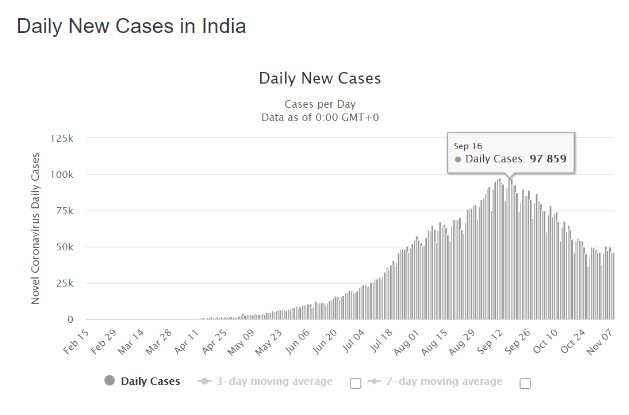
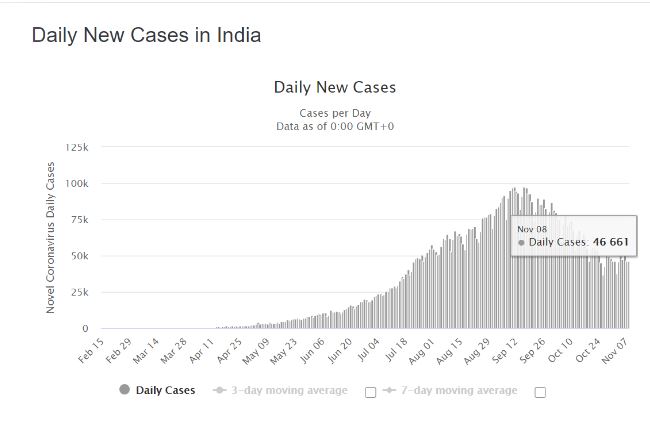
Total new cases in India on September 16 according to Worldometer
Total number of new cases in India declined to 46,661 on November 8 according to Worldometer

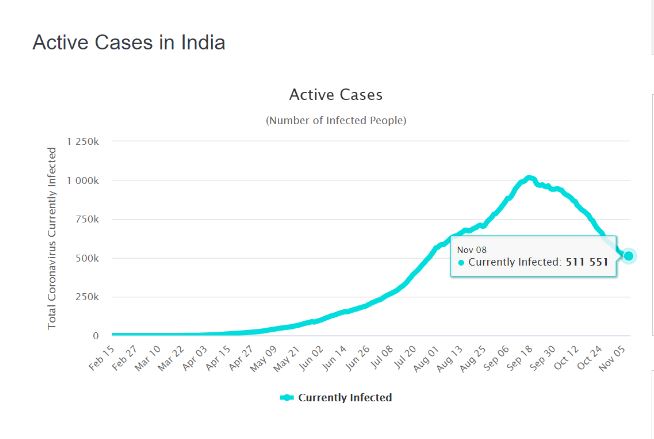
The total number of active cases in India also witnessed a steep fall since the middle of September. The active cases which were 10,14,649 on September 18 fell to 5,11,551 on November 8. India has seen a significant bent in the curce of active cases since mid-September and if the trend continues, India might be heading for some good news.
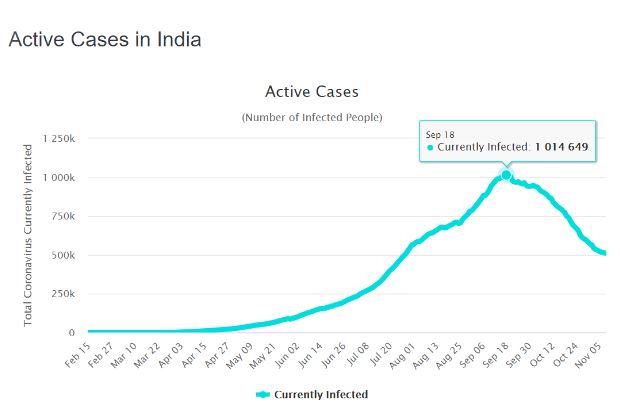
The total active cases in India stood at 10,14,649 on September 18
The total active cases in India stood at 5,11,551 on November 8

There does not appear to be an overall decline in testing across the country. India appears to be conducting well over a million tests everyday on an average. The number of total tests in India conducted on November 9 stood at 8,35,401 against the normal range of 10 to 12 lakh tests every day.
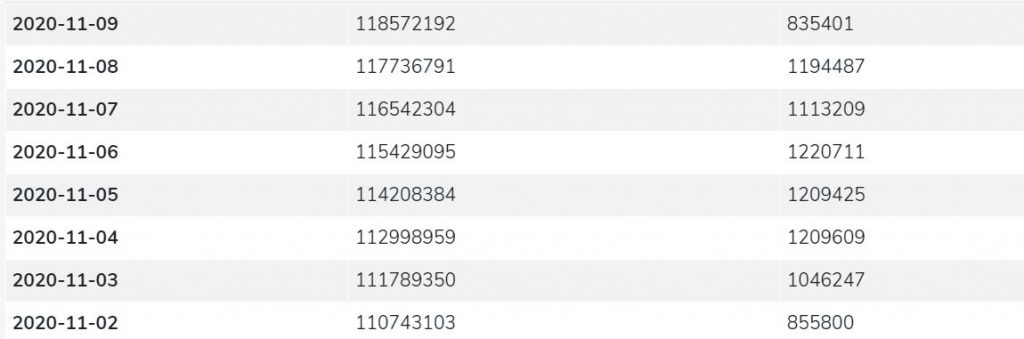
Data taken from Corona India tracker

There was a concern that India could witness a sharp spike as the country enters its festive season. That does not appear to be happening thus far. Given the consistent decline in the number of active cases, it appears good news for the country during the festive season. However, as can be witnessed in Europe which is currently suffering from a second wave of a Coronavirus surge, there remains ample reason to exercise caution.

Based on mathematical and statistical forecasting on the spread of the deadly pathogen, a panel of scientists and doctors had claimed on October 20 that if all protocols are followed, the pandemic can be controlled by end of February 2021 with minimal active symptomatic cases.

The panel, which used the real-time dataset to make the prognosis, claimed that 30 per cent of India’s population was already projected to have developed antibodies, which indicated that they had been infected with the virus. Further, the panel estimated that there would be around 106 lakh symptomatic infections during the course of the pandemic. Currently, the panel claimed, there are an estimated 66 lakh symptomatic infections.

The panel also said that in a ‘no lockdown’ scenario, cases would have been at least 14 times of what they actually were in the month of June, when the peak had begun.

Currently, India stands second behind the US in terms of active cases of COVID-19 as well as total caseload, according to Worldometer. Also, the country is in the dominant position in terms of the number of recovered cases and third in terms of fatalities globally behind the US and Brazil.


NGT could destroy local cracker industry even as politicians preach ‘vocal for local’, orders severe Diwali restrictions nationwide

0

The National Green Tribunal (NGT) on Monday has ordered a complete ban on firecrackers in cities and towns across the country where the ambient air quality fell under the poor category or above (worse) in November. Furthermore, in places where the ambient air quality fell under the moderate or below (better) category, the selling of only green crackers will be permitted and only two hours would be provided for bursting firecrackers.

“We are also of the view that since we have taken the view that pollution aggravates COVID-19, not only crackers are to be banned or restricted depending upon air quality, all State pollution control boards and committees must take special initiative to contain air pollution by regulating all other sources of pollution,” a bench headed by Justice Adarsh Kumar Goel said. The NGT said that data from November 2019 would be taken into account as well.

“The cities/towns where air quality is ‘moderate’ or below, only green crackers be sold, and the timings for use and bursting of crackers be restricted to two hours during festivals like Diwali, Chhath, New Year/Christmas Eve etc., as may be specified by the state concerned. At other places, ban/restrictions are optional for the authorities but if there are more stringent measures under orders of the authorities, the same will prevail,” the bench said.

The order will come into effect at midnight and last till the 30th of November. The NGT said on Wednesday that it may have to prohibit the use of firecrackers in order to protect the health of vulnerable groups, alluding to 122 cities across 22 states and Union Territories which have consistently demonstrated a poor ambient air quality. The cities include Delhi, Varanasi, Bhopal, Kolkata, Noida, Muzaffarpur, Mumbai, Jammu, Ludhiana, Patiala, Ghaziabad, Varanasi, Kolkata, Patna, Gaya, Chandigarh etc.

The order passed by the NGT has the potential to destroy the local cracker industry. Chief Minister of Tamil Nadu, E Palaniswami, had appealed to states that had banned firecrackers during Diwali to revoke their order as it would impact the lives of lakhs of people in his state. With the order by NGT, his cause for worry appears to have worsened. At a time when politicians are preaching ‘vocal for local’, destroying a local industry appears to be a very bad idea.

Furthermore, such orders at the last moment would cause huge losses to business owners who have already made investments. Firecrackers during the festival of Diwali has huge significance for the Hindu community. Governments in India, unwilling to take decisive measures to curb pollution, appear to have decided to make firecrackers a scapegoat as a quick-fix in order to give the impression that they are taking the issue seriously.

The ambient air quality in Delhi has been terrible for weeks now which makes it clear that firecrackers are not the significant contributors of pollution. Under such circumstances, the ban on firecrackers has caused much anguish among the Hindu community. Karnakataka Chief Minister Yeddyurappa was forced to walk back a little on his cracker ban following outrage.

‘Tanishq, you failed to understand the essence of Diwali’: Here is how netizens reacted to the dull, bizarre ad

Tanishq Jewellery, which recently came under the fire by social media users for allegedly glorifying love jihad, has been facing criticism yet again for the dull portrayal of Diwali in its new digital ad.

The new ad shows actresses Nimrat Kaur, Nina Gupta, Alaya Furniturewala and Sayani Gupta, all over-loaded with makeup, wearing clothes in pastel shades and telling the audience what they would like to do for Diwali. One actress, wearing some heavy strange orange-brown shade of make-up that makes her face almost unrecognizable, even preaches that everyone should celebrate a cracker-free Diwali.

(Video Courtesy: Politics Videos)

Netizens irked at the dull portrayal of Diwali

Popular Twitter user Maya asked Tanishq to fire the ad firm that they hired for the production of the digital ad. “Dear Tanishq, FIRE your ad firm! This looks like a obituary ad, a funeral one not a diwali ad.” She complained about the dull theme that the ad portrayed for the festival of lights.

“How can anybody get a Diwali themed ad so wrong. Why are the women there pretending so much? Wearing dull clothes bad make up? Just bloody enjoy.. wear colourful clothes.. the Tanishq gold looks so bad in the ad. Damn.. pathetic stuff by ekatvam by Tanishq,” Maya emphasised.

Another Twitter user Neerja wrote, “Such a bland diwali ad. No colors, no bindi !!, just plain dull boring monotones… Don’t remember diwali being so boring !! Tasteless ad Tanishq….”

Another user, Ash, pointed out that people do not wear such dull clothes, as shown in the ad, on the occasion of Diwali. “We don’t wear dull colours on Diwali ….we wear bright colours…and we speak in our mother tongue…. we have poojas all 4 days including cow, Dhan Laxmi, Lord Ram, Chopdi pooja …ok … and we don’t call our mothers MUM ….fake angrej (English)…. !!Tanishq…change ur team …dumbs”, she tweeted.

Other Twitter users too complained about the advertisement, resembling a kitty party instead of Diwali, due to the dull attire of the actresses featured in it.

Tanishq earlier promoted love jihad

Earlier, a massive controversy broke out on various social media platforms with users calling for the boycott of the jewellery brand Tanishq for their advertisement. The ad, in question, showcased a Hindu woman married into a Muslim family, preparing for her baby shower. Heeding to criticism, the controversial advertisement was pulled down from YouTube.

The ad was criticised by social media users for trying to paint a rosy picture while the grim reality of the situations faced by non-Muslim women marrying Muslim men. As dozens of cases of forced conversions and kidnap of minors by older Muslim men are reported across the country, the ad faced criticism for promoting such unions.

Congress leader Jitu Patwari imagines Joe Biden’s swearing-in ceremony and invites Manmohan Singh as chief guest, gets mocked on Twitter

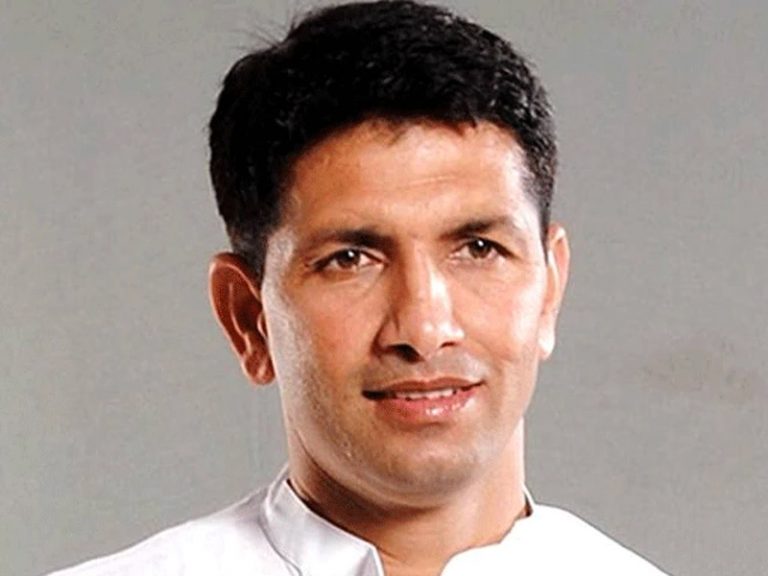
Did Jitu Patwari fall for fake news on WhatsApp? It seems so! The former Cabinet Minister for Higher Education, Sports and Youth Affairs of Madhya Pradesh shared “happy and proud” news with his followers on social media that former Prime Minister of India, Manmohan Singh, will be ‘chief guest’ for the swearing-in ceremony of presumptive President-elect Joe Biden.

Jitu Patwari was caught spreading fake news about former Prime Minister Manmohan Singh being invited to Biden’s swearing in ceremony

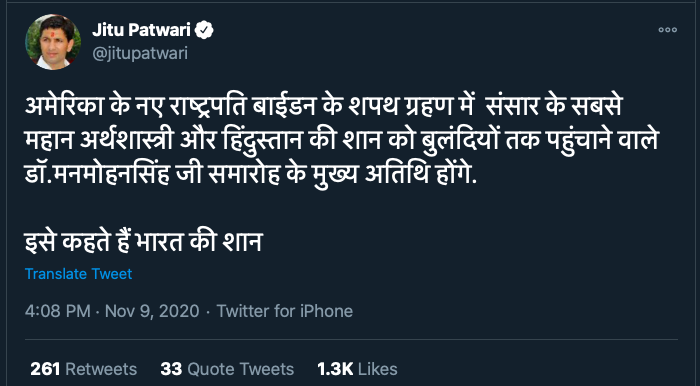
Patwari wrote, “Dr. Manmohan Singh will be the chief guest of the ceremony at the swearing-in of the new President of America, the greatest economist of the world, and who has brought the pride of India to great heights. It is called the pride of India.”

His tweet triggered a laugh-riot on Twitter as netizens mocked the Congress leader for sharing fake news.

Previous misadventures of Jitu Patwari

This is not the first time Jitu Patwari has fallen for fake news or gotten himself tied in some misadventures. In August 2020, he shared fake news claiming that PM Narendra Modi was flying in a luxurious private jet. He also claimed in the same tweet that Railways had been sold. He later deleted the post.

In June 2020, NCPCR issued a notice to Patwari and asked him to apologize for calling the birth of a girl child a misfortune. In March 2020, he was caught on camera, creating ruckus at Bengaluru resort as police stop him from meeting rebel MLAs. In December 2019, he was seen assaulting his own party workers as he kicked and pushed party man out of the room.

Days after the Kabul university attack killed 25, suicide car bomber kills 4, injures 40 in Afghanistan

0

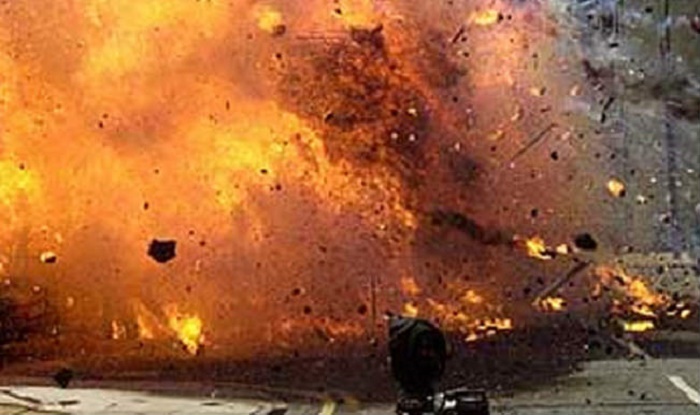
Days after a deadly day-long encounter between terrorists and security forces in Kabul’s biggest university left at least 25 students dead and several injured, a suicide car bomber killed at least four people and wounded 40 in an attack on a police base in the southern Kandahar province of Afghanistan late Sunday night.

Those wounded included both soldiers and civilians, said Mohammad Ashraf Nadery, the provincial director of Kandahar public health department, as paramedics continue to search the debris of homes destroyed in the attack in the province’s Maiwand district. Though no terrorist outfit has yet taken the responsibility for the attack, there are speculations that the Taliban is behind the attack.

Kandahar province in Afghanistan is notoriously known for being the stronghold for the Talibani terrorists. In July this year, in a gunfight with the Afghan security forces Maruf and Arghistan districts in Kandahar in Afghanistan, 14 terrorists of the Islamic terror outfit Taliban were neutralised. The security forces had recovered Pakistani ID cards from the terrorists.

University in Kabul, Afghanistan attacked by terrorists

Last week, a book exhibition was held at Kabul’s biggest university when the varsity was stormed by terrorists, leaving as many as 25 students dead and several injured. Interior Ministry spokesman Tariq Arian had confirmed that in the gunfight, two of the three attackers involved in the dastardly attack were eliminated by the security forces and the third one blew himself with explosives. Several videos had surfaced on social media which shows students fleeing the varsity in the wake of the dastardly attack by gunned terrorists.

Then too, no terrorist group has taken responsibility for the attack on the university. Taliban had also denied any involvement in the same. Despite Afghan government efforts, the country has continued to be under constant threat from the Taliban terrorists. Taliban is an Islamic fundamentalist terror outfit originating in Afghanistan, waging war in the country in the form of an insurgency. The dreaded terrorist organisation has reportedly carried out several attacks on Afghan forces, despite aiming to talk to Kabul.

Last month, the Islamic State (IS) had claimed responsibility for a suicide attack on an educational centre in Kabul’s Shi’ite dominated neighbourhood of Dasht-e-Barchi in which at least 24 people, mostly students, were killed. Last year, at least two people were killed and 10 injured in an explosion outside the Kabul University campus’ gate. In 2016, the American University in Kabul had come under attack, leading to the death of 13 people.

Delhi HC hears Bollywood suit against Republic TV and Times Now, praises media’s work but asks not to use ‘sharp words’

0

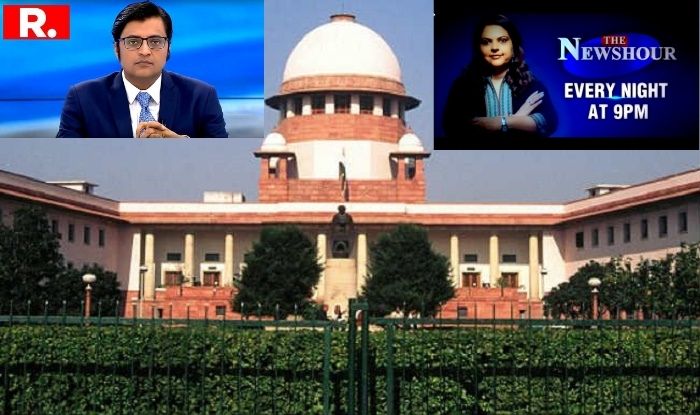
The Delhi High Court, while hearing a suit filed by leading associations and production houses of Bollywood against Republic TV, Arnab Goswami, Pradeep Bhandari, Times Now, Navika Kumar and Rahul Shivshankar has issued summons and notices in the matter, directing Republic TV and Times Now to respond within two weeks.

The Court has directed Republic TV and Times Now to ensure that no defamatory content is displayed on their channels or uploaded on social media, in the meanwhile. The matter has been posted to be taken up next on December 14. While hearing the plea, the court observed that reporting by media houses is not the issue but it is the manner of reporting which has been creating a problem.

Referring to an incident where a school teacher almost got killed by lynching by residents after media reported that she disseminated obscene material or how in the case of Princess Diana, she died because she was racing away from the media, the court claimed that though this kind of reportage is taking place all over the world, ‘we expect clear reportage and neutrality’.

It raised objection to the kind of language being used by participants on Live TV channels. “Now participants on TV are using cuss words on live TV channels because they get so excited. If you keep egging them on, that is what happens”, opined the court. The court furthered that there are certain guidelines that have been set by the News Broadcasting Standards Authority (NBSA) which all the media houses should follow. It said that toning down of language while reporting is what needs to be followed by media houses.

“What is that should be put in place to change the way the reporting is carried out?… There needs to be some toning down. There are orders of NBSA. But it seems that news channels are not following that. As an officer of the Court, what is the next step here if you do not follow self-regulation? What are we to do about this? It is a general remark across the board. All of you have to think about it. It is a little disheartening and demoralises everyone,” observed the court.

The plaintiffs had in the suit alleged that media, especially the two channels (Republic TV and Times Now) in question have been interfering with the right to privacy of persons associated with Bollywood. The court observed that though no one wants to have his private life dragged in public, that element of privacy does get diluted for public personas to a certain extent. “If you live on public praise, you are likely to get a certain amount of flak as well“, said the court.

Delhi High Court asks media to refrain from using sharp language

The court concurred that media has been doing outstanding work, when Malvika Trivedi of Phoenix Legal representing Republic in court, highlighted that it cannot be ignored that there were two mysterious deaths here (that of actor Sushant Singh Rajput and his manager Disha Salian) and a lot of the information came to the public domain because of the media’s work. However, it asked media to refrain from using sharp language.

Justice Shakdher hesitated in restraining media reports since it is a constitutional right but maintains that it expects fair reportage which has been somehow diluted “not only in India but even globally”. The court was answering Akhil Sibal, son of senior Congress leader Kapil Sibal, appearing as the counsel for the plaintiffs who in this case are some Bollywood’s leading associations and production houses.

While claiming that the “vitriolic attack” by these media houses are impacting “vulnerable individuals”, Akhil Sibal said before the court that Republic TV and Times Now represent 70% of English news audiences, admitting that the high TRP of Republic TV is rather accurate, that too when the Maharashtra alliance government his father’s party is a member of has accused Republic TV of manipulating TRP and generating fake stats to claim high viewership.

Bollywood biggies join hands to target Arnab Goswami and Republic TV in Delhi High Court

On October 12, Bollywood’s leading associations and production houses, including that of Aamir Khan, Karan Johar, Farhan Akhtar, had filed a suit in Delhi High Court against Republic TV, Arnab Goswami, Pradeep Bhandari, Times Now, Navika Kumar and Rahul Shivshankar. As per reports, the suit asks them to refrain from making ‘irresponsible, defamatory and derogatory remarks’ against Bollywood in wake of mysterious death of Sushant Singh Rajput and subsequent drug scandal that has emerged. The suit also asks them to take down all “defamatory” content published by them against the film industry.

The Bollywood bigwigs are upset at the alleged use of words like “dirt”, “filth”, “scum”, “druggies” & expressions such as “all the perfumes of Arabia cannot take away the stench and the stink of this filth and scum of the underbelly of Bollywood” to describe the film industry.

OpIndia accesses internal communication of Bollywood cine-associations

It is pertinent to note here that days after four cine-associations and 34 movie production houses filed a petition against Republic TV and Times Now over the coverage of Bollywood-drug nexus, it has been revealed that the original petition included more TV news channels which were dropped in the final petition, without informing some of the petitioners.

OpIndia had accessed email exchanges between Solicis Lex, the law firm representing CINTAA (Cine & TV Artists Association), and the Producers Guild, which discuss about possibility of adding more channels in the petition so that it does not look like targeted against two channels.

Chemical found from ex-AAP councillor Tahir Hussain’s house was acid, video clips of him on the rooftop were undoctored: Reports

0

From the 24th of February to the 25th of February, Delhi burnt with perhaps one of the worst anti-Hindu riots that the country has seen in recent times. One of the main protagonists of the sinister ploy was Tahir Hussain, the AAP leader who spearheaded the Delhi riots in which IB staffer Ankit Sharma was murdered brutally by a mob and several Hindu properties were burnt to ashes.

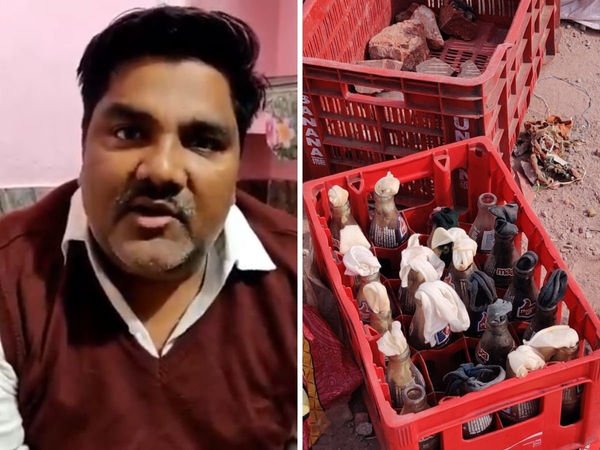
Post the deadly riots, the crime branch had seized a large number of bottles containing chemicals and commercially used acid from the terrace of Tahir Hussain’s residence in the Chand Bagh area of north-east Delhi. According to the police, approximately 50 litres of acid was seized by them. Now, Times Now has reported that the State Forensic Science Laboratory has confirmed that the chemical found at the house of Tahir Hussain was “acidic and lethal for human body”.

Submitting its report to the Delhi Police crime branch after analysing the chemical bottles seized from Tahir Hussain’s terrace, the Forensic department confirmed that the chemicals found on his terrace were indeed acid.

CCTV footage and video clips showing Tahir Hussain walking about on his terrace and pelting stones and petrol bombs at the Hindus were “not doctored”

Moreover, it also confirmed that the videos clips and the CCTV footage which had surfaced showing the suspended AAP leader Tahir Hussain walking about on his terrace and pelting stones and petrol bombs at the Hindus were “not doctored”.

According to TOI report, this report by the Forensic department will now be part of the supplementary charge sheet that will be submitted by the crime branch. “This forensic report will help the prosecution in building a strong case,” said a senior officer in the crime branch on the condition of anonymity.

Sources in the probe team, however, say they are yet to get the ballistic report of Hussain’s revolvers which can be matched with cartridges recovered from the bodies of those who died in the riot. “We will submit the ballistic report as soon as SFSL gives its final opinion,” he added.

The suspended AAP MLA Tahir Hussain has over ten criminal cases registered against him. He was the first to be charge-sheeted in the Delhi riots for violence that broke out in Chand Bagh area.

Tahir Hussain admitted of stocking bricks, stones, petrol, diesel and acid on the roof of his house

In his confession, Tahir Hussain had said that Khalid Saifi introduced him to Umar Khalid, ex-student of JNU at PFI office in Shaheen Bagh. According to Delhi Police, Tahir Hussain has confessed that he had collected empty liquor and cold drink bottles from scrap dealers, and as construction was going on at his house, collecting bricks and stones without arousing doubt was not an issue. He also collected petrol and diesel by filling the tanks of vehicles full, which was transferred to containers at his house. Tahir also said that Umar had also asked him to collect acid, and accordingly, he had stocked large quantities of acid, bricks, stones, petrol, diesel etc on the roof of his house.

It is pertinent to note here that OpIndia was the first to report the statement of Ex-Aam Aadmi Party councillor Tahir Hussain confessing his involvement in the Delhi riots, which was later confirmed by Delhi police too.

How NGOs and Media, like The Wire, came together to stall doubling of railway tracks in Goa and how they are wrong

0

A controversy has been created by environmentalists and the media over Railway infrastructure projects in Goa. The infrastructure project is related to the double-lining of tracks between Hospet in Karnataka and Vasco da Gama in Goa. The project has already been sanctioned by the Union Ministry for Railways. Apart from NGOs, media outlets such as The Wire also claimed that the proposed infrastructure projects could fundamentally damage the environmental scene at Goa.

252 km of the 342 km between Hospet and Vasco has already been completed, 245 km of that was in Karnataka and 7 km in Goa. Of the remaining 90 km, 70 km lies in the state of Goa. It is the completion of this remaining portion that has now generated controversy. The need for the infrastructure projects was generated by the inability to introduce 24 coach length passenger trains due to the existing length of platforms and others concerns.

Improved railway connectivity is also expected to benefit the people of Goa as tourist footfall will increased. The introduction of new passenger trains will improve connectivity with Maharashtra, Karnataka, Andhra Pradesh, Telangana and other parts of the country. Currently, a majority of stations in Goa lack suitable passenger amenities such as adequate length of platforms, platform shelters, water booths, foot over bridges, platform toilets, ramp for disabled passengers among other things.

Concerns that have been raised

Certain NGOs and village panchayats in recent times have raised certain objections seeking to stop the doubling of railway tracks in Goa. Village Panchayat, Sao Jose De Areal, Salcete, Goa has issued a notice to South Western Railway demanding an immediate stop to construction work near the Railway gate at Nessai and also at Railway station, Ralloi, Sao Jose De Areal in connection with the doubling of tracks.

The notice was issued under Section 64(j) of the Panchayat Act. Other Village Panchayats are also agitating for the stoppage of work relate to doubling of tracks. At Railway Gate, Nessai, around 200 people of Sao Jose De Areal gathered for stopping the work on 28th October, 2020. The concerns that have been raised can be broadly categorised as:

  1. Concerns of environment related to Bhagwan Mahaveer Wildlife sanctuary as well as in Mollem National Park
  2. Damages to heritage buildings
  3. Damage to the environment due to increased transportation of coal
  4. Stay granted by the High Court, Goa Bench against doubling in protected area
  5. Railway Board order dated 28.07.2020 for stopping the infrastructure work
  6. Railways has not sought approval from village panchayat for execution of doubling under section 64 (j) of the Goa Panchayat Act.

What does the Union Railway Ministry say?

Sources within the Railway Ministry with knowledge of the matter told us that the concerns that have been raised do not have a basis in fact and the local public is being misled by those with vested interests.

Concerns regarding wildlife sanctuary and national park

Sources told us that the existing single line track has been in existence for over a century. The construction of the track was started in 1882 and was completed in 1905. The railway track passes through the Bhagwan Mahaveer Wildlife Sanctuary and Mollem National park where the Railway is in possession of having only 0.869 square km of land as against 240 SqKm area of Bhagwan Mahaveer Wild Life Sanctuary. Thus, Railways occupies a negligible 0.36% of area of the Wildlife Sanctuary.

Furthermore, the Railway has already conducted an Environment Impact Assessment Survey through IISC, Bangalore, one of the most prestigious institutes in the country and it has been scrutinized by the Forest Department and Ministry of Environment as well. With a view towards permitting safe crossing for animals in the area, 5 new under passes and 3 new over passes are planned for construction along with doubling which are not currently available on the existing single line track.

Heritage Buildings

Sources clarified that not a single heritage building will be dismantled in the process of doubling of tracks.

Coal

Sources informed that as a matter of policy, the Government of India is cutting down its dependence on imported coal.

High Court, Goa Bench

A public interest litigation was filed before the Goa bench of the Bombay High Court by the Goa Foundation in July, 2020. The Railways have filed a counter reply in response to it, however, the matter has not yet come up for hearing. Sources told us that there is no stay on the infrastructure work from the High Court.

Railway Order

There is no such order from the Railway Board instructing the doubling of tracks to be stopped.

Approval from Village Panchayat

Sources told us that as per the provisions of the Railway Act, 1989, the Railway Administration does not require approval from any local body or village panchayat given the fact that the infrastructure work is being conducted on land that belongs to the Railways. “The Railway administration is authorized to execute any modifications to existing structures or tracks or any kind or new structure constructions or tracks or any kind as and when required and for execution of works within Railway land, the Railway Administration is not bound to obtain permission from any local body or village panchayat,” sources said.

Sources also told us that according to Section 65 of the Goa Panchayat Raj Act 1994 and rules, jurisdiction of a Village Panchayat is restricted to village roads and building which are not under the control of another government organization or private. Since the Railway land is under the control of the Union Government, it is beyond the jurisdiction of a village Panchayat. Therefore, the section 65 of Goa Panchayat Raj Act 1994 is not applicable in the current scenario.

The path forward

Sources told us that there is no objection towards the completion of the remaining 20 km stretch in Karnataka and it will be completed in due course of time. We were also informed that abandoning a project sanctioned by the Ministry is now within the competency of the Zonal Railways. Moreover, the Railway administration insists that the local public is being misled by vested interests. Thus, it is extremely unlikely that the project will be abandoned henceforth.

Sameet Thakkar case: Bail rejected, sent to judicial custody

0

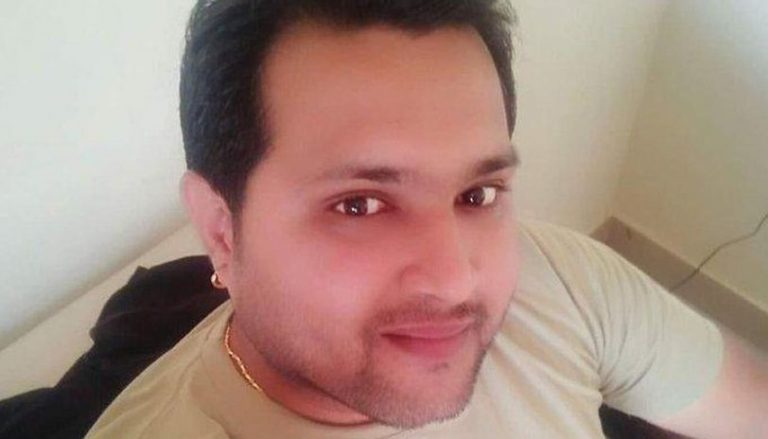
On Monday, popular social media user Sameet Thakkar has been remanded to judicial custody. He has been re-arrested and sent to judicial custody by a local court in Girgaon. The development was confirmed on Twitter by his sister Sneha Singhvi.

Singhvi tweeted, “Hearing is over. Sameet Thakkar has been re-arrested for making the grave mistake of tweeting (against the Maharashtra CM and his son)…Earlier, he was kept in police custody and now sent to judicial custody.” Multiple FIRs have been registered against Thakkar in Nagpur and Mumbai for his remarks where he has allegedly referred to the Maharashtra Environment Minister Aaditya Thackeray as “baby penguin”.

Activist Sunaina Holey had tweeted that Thakkar was re-arrested by BKC Police.

Earlier, the Mumbai Police rearrested Sameet Thakkar from the court premises after a Nagpur court granted him bail. “After being in police custody for 7 days, my brother(Sameet) was granted bail by the Nagpur Court today. However, just after he got bail, he was once again arrested. This time by Mumbai VP Road Police who are now taking him to Mumbai in Nagpur-Mumbai Duronto Express,” Smaaet’s brother Rishi had stated.

Sameet Thakkar tied with a rope, his face covered in black cloth

Earlier last week, an unsettling video of Sameet with his hands being tied with a rope and his face covered with a black cloth, led by police officials had surfaced on the internet. The video was from October 30, when Sameet was being taken to the court which extended his police custody till November 2. In the video, it could be seen that a man with a black cloth wrapped around his head was being led by a man with a rope. The video was captured from a distance and there are policemen clearly visible. Sneha Singhvi, the person who shared the video on Twitter, confirmed to us that the man with a black face cover was indeed Sameet Thakkar.

Sameet’s brother Rishi Thakkar had then reacted that it was gross “human rights’ violation by police as his brother’s hands were tied & face was covered with black cloth when he was brought to court. Rishi Thakkar also added that his brother was being treated like a hardened criminal. He further told ANI, “My brother is paying the price of calling Maharashtra CM a modern-day Aurangzeb & his son, a baby penguin – the terms coined by NCP leaders who are currently in govt with them”.

Punjab Railway blockade: Shekhar Gupta ignores Punjab govt’s inability to clear tracks, blames Modi for cancelling trains

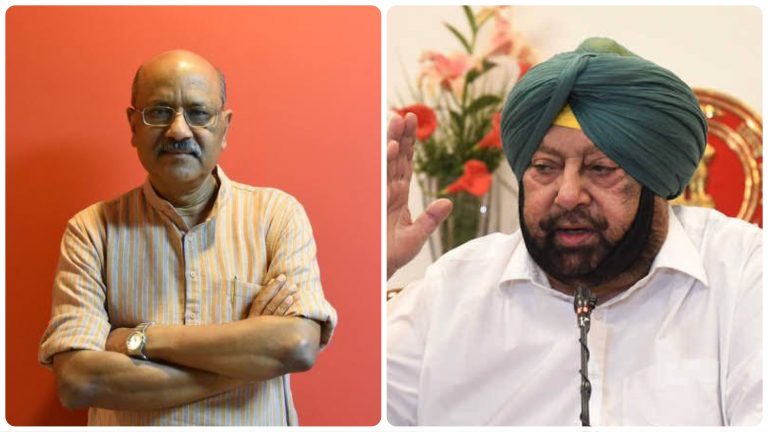
Even as Indian Railways are bearing huge losses due to the ongoing ‘Rail Roko’ agitation by the farmers in Punjab, journalist Shekhar Gupta has attempted to shield the inaction of the Punjab government in getting the tracks cleared and instead passed the buck of the continuing deadlock on the Modi government.

Taking to Twitter, Gupta critiqued the Modi government’s handling of Punjab protests by stopping all the rail traffic, alleging that the government’s decision to stop trains was to “subdue” the farmers. He added that instead of “arm-twisting”, Punjab farmers should be provided with incentives to switch their produce from paddy to corn and citrus.

“Modi Govt’s handling of Punjab protests by stopping all rail traffic is unwise. Can’t subdue Punjab farmers like this. It must work with Amarinder & restore confidence. Punjab farmer needs incentives to switch to corn & citrus from paddy. Arm-twisting will boomerang,” Gupta tweeted.

In essence, there are two points that Shekhar Gupta has made in his tweet. Firstly, he believes that the Modi government should continue to operate the railways in Punjab amidst the looming threat of vandalism and attacks, despite the fact that several cases of assault on locomotive pilots have been reported in the state.

It would be incredibly unwise of the central government to run the railways business as usual even as farmers in Punjab have occupied the tracks and protesting against the government. Railways run the risk of being vandalised, attacked and delayed if the government heeds to Mr Gupta’s suggestions and continue operating the trains, in disregard of the threat posed by the agitation. The protests can take an ugly turn if the trains are allowed to operate even as agitating farmers continue to squat on the tracks.

What is also evident from Mr Gupta’s tweet is that the entire task of allaying the concerns of farmers is Modi government’s responsibility. He has conveniently passed the buck from Punjab CM Captain Amarinder Singh to the Modi government. While the central government does have a big say in the country’s agricultural policies, however, the state governments are also equally invested in ensuring the welfare of the farmers and therefore it is their responsibility as well to assuage the misgivings of the farmers in their state.

Besides, law and order are the state’s responsibility and if the Punjab government cannot stop the so-called ‘farmers’ from squatting on railway tracks and blocking the passage of trains, there is little that the railways can do here except to cancel the trains to prevent damages and vandalism.

Secondly, Gupta suggests that the government should offer incentives to Punjab farmers to shift from paddy farming. There is merit to the argument made by the Print founder here. Mr Gupta is not wrong when he advises the government to employ inducements to spur farmers away from growing paddy but such ideas cannot be the sole premise for restarting of railways through Punjab.

Initiatives such as offering incentives to the farmers to dissuade them from farming paddy can work on average days when the state is not roiled with agitations and protests. In the current scenario, the railways cannot afford to take the chance of operating in Punjab, where the farmers are occupying the tracks and risk being ransacked and attacked by the agitators. The reports of loco pilots getting assaulted in Punjab indicate how the situation can devolve if the railways are asked to resume their operations in Punjab.

Punjab Government’s inaction responsible for the current railway blockade

Furthermore, it is the responsibility of Captain Amarinder Singh’s government in Punjab to persuade the farmers into calling off their agitation and clear the railway tracks of squatting protestors. However, the fecklessness of the Punjab government, demonstrated in their lack of action to get the railway tracks cleared, suggests that the Captain Amarinder Singh-led Congress regime in the state views the festering of the issue as beneficial to its brand of politics.

Indian Railways has lost over Rs.500 crores in revenues due to the ‘Rail Roko’ agitation in Punjab. All Industries and Trade Forum president Badish Jindal said that the overall loss the state’s businesses have incurred is close to Rs.5000 crore as ‘farmers’ continue to block railway lines. From the steel industry to essential commodities, Punjab is facing a shortage of almost everything. Due to the inaction of the government of Punjab, power stations are unable to get coal for power generation leading to a severe shortage across the state.

High Court had rebuked the Punjab govt over failure to clear railway tracks

The Punjab and Haryana High Court has expressed its displeasure on the failure of the Punjab government to clear the railway tracks. The High Court had said on 29th October that the Punjab government is unable to handle law and order. The High Court had even stated that in case the government fails to get the tracks cleared, it will issue an order and write that the Punjab government has failed to follow the constitution. However, even a rap on the knuckles by the courts haven’t had the desirable effect of Punjab government pushing to end the imbroglio.

It is also pertinent to note that the Congress government in Punjab not only stoked rebellion among the farmers in the state against the central government but also staged protests against the centre for the passage of the three agricultural bills that were passed in September this year.

‘Rail Roko’ agitation started after the passage of three Agricultural Bills

The Rail Roko agitations in Punjab started in September, after which Railways suspended its services in the state stating security reasons. The services were resumed for a short span but again suspended as the government of Punjab failed to get the tracks cleared. In September, the Central government announced three new bills for the agriculture industry. These bills are aimed to remove the middlemen from the sale and purchase of the produce. However, opposition parties tried to paint the bills as an attempt to remove Minimum Selling Price (MSP) and alleged that the Modi government brought these bills to facilitate large players in the agriculture business. Captain Amrinder had tabled a resolution to bypass the new regulations.