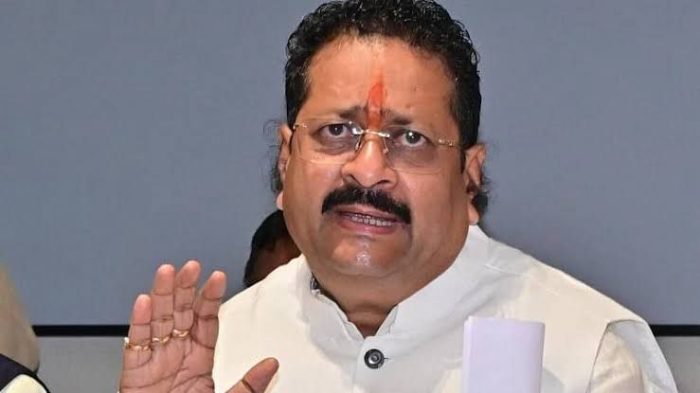
Rajendra Rajanna, Congress MLC and son of Karnataka Minister KN Rajanna, on Thursday, March 20, responded to allegations of a honey trap attempt, revealing that both he and his father have been targeted for the past six months with similar allegations.
Speaking to ANI, Rajendra said that what initially seemed like a routine phone or video call escalated over time, prompting him to raise the issue in the Assembly.
He also urged the state Home Minister to launch a thorough investigation into the matter.
“For the last six months, it has been going on with me and my father. We thought it would be a normal phone call or video call, but day by day, more calls (we) have been getting. I have spoken in the Assembly and requested the (state) Home Minister to investigate. It should be investigated,” he said.
Karnataka Cooperation Minister KN Rajanna on Thursday alleged a honey trap attempt was made on him and called on the State Home Minister G Parameshwara to investigate the matter.
During the budget session discussion, Vijayapura MLA Basanagouda Patil Yatnal raised the issue, saying that an attempt had been made to trap the Cooperation Minister in the state.
“This is a bad culture. People’s representatives are being blackmailed,” he said.
Since his name was mentioned, KN Rajanna responded, acknowledging the allegations.
“Many people say Karnataka has become a CD and pen drive factory. This is a serious allegation. It is being said that an influential minister from Tumakuru has been caught in a honey trap. The ones from Tumakuru are G Parameshwara and me,” Rajanna said in the Legislative Assembly.
He further said, “I will file a complaint regarding this. The Home Minister must investigate this matter.”
Responding to this in the assembly, Home Minister G Parameshwara said that he will order a high-level investigation into the allegation. “If we have to uphold the dignity of the House, this issue must be concluded appropriately. If Rajanna submits a written request, based on that, I will order a high-level investigation. The truth must come out,” he said in the Assembly.
(This news report is published from a syndicated feed. Except for the headline, the content has not been written or edited by OpIndia staff)
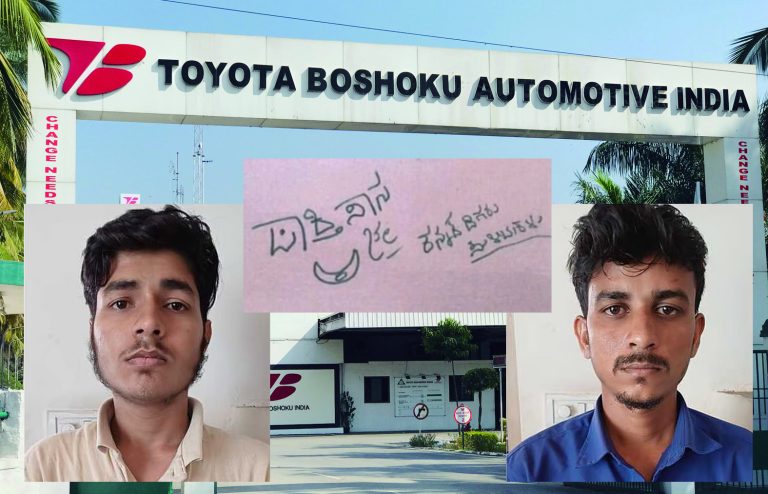
Two men were arrested on Wednesday for writing pro-Pakistan slogans and abusive remarks against Kannadigas on the walls of a factory washroom in Karnataka’s Ramanagara district. Haimad Hussain and Sadiq, contractual workers of Toyota Boshoku plant, have been arrested for writing the slogans, and they have confessed to the same.
The slogans such as ‘Pakistan Ki Jai’, ‘May Pakistan win’ and abuses for Kannadigas like “Kannadigas are Sons of Bi**hes” were spotted by workers inside a washroom of the Toyota Boshoku plant in Bidadi.
The incident triggered an outrage among the workers, who were further angered after the management only issued a warning notice instead of identifying the culprits and taking strict action. But after visuals of the slogans went viral on social media, a complaint was registered by the Human Resources (HR) department with the police, who then launched a probe.
Using CCTV footage, handwriting analysis and linguistic style analysis, the Bidadi police identified the culprits, Haimad Hussain and Sadiq, and arrested them. Both of them are from are from North Karnataka and were working on a contract basis with the Japanese company that manufactures automotive components.
In Bidadi’s Toyota factory restroom, Ahmed Hussain & Sadik wrote "Pakistan Jai" and "Kannadigas are Sons of Bchs"** on the walls!
Ever since @INCKarnataka took power, Pak sympathizers are openly insulting Kannadigas. Will this Halal Sarkara shield them as "mentally unstable" &… pic.twitter.com/4XWmO2MoVm
During questioning, Haimad Hussain and Sadiq said that that they were angry with their colleagues who allegedly mocked them after Pakistan lost to India in the recently concluded ICC Champions Trophy, that is why they wrote pro-Pakistan slogans in the factory wall.
Superintendent of Police (SP) Srinivas Gowda confirmed that a case has been registered under Section 67 of the Information Technology (IT) Act (publication or transmission of obscene material), as well as sections 193 (liability of landowners or occupiers for failing to prevent or report unlawful assemblies or riots on their property) and 356 (defamation) of Bharat Nyay Sanhita.
Apart from arresting the two who wrote the slogans, police are also trying to identify those who attempted to spread the content online, and have issued police notices accordingly.
30 Naxalites were neutralised by security personnel in two different operations in the Chhattisgarh districts of Bijapur and Kanker. 26 Maoists were killed by the security forces during a clash in the forest near the Bijapur-Dantewada border, according to Inspector General (IG) Bastar P. Sundarraj. One member of the Bijapur District Reserve Guard also died in the conflict. The police reported that the altercation began at 7 am on 20th March. The conflict lasted for several hours, during which time both sides engaged in heavy gunfire.
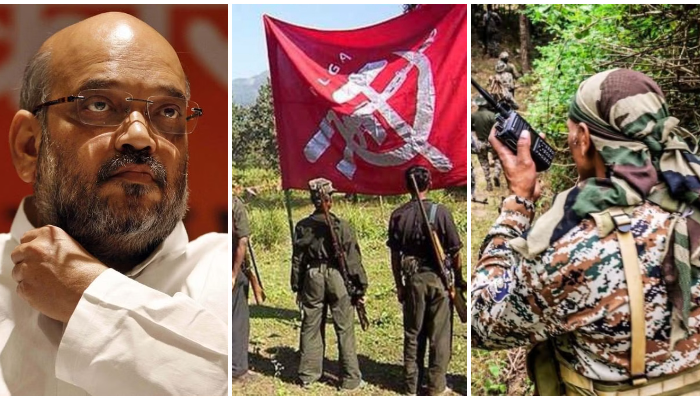
“Today our soldiers have achieved another big success in the direction of ‘Naxal Mukt Bharat Abhiyan’ (Naxal free India campaign). 22 Naxalites were killed in 2 separate operations of our security forces in Bijapur and Kanker of Chhattisgarh. The Modi government is moving forward with a ruthless approach against Naxalites and is adopting a zero tolerance policy against those who are not leaving their arms despite all the facilities ranging from surrender to inclusion. The country is going to be Naxal-free before 31st March next year,” Union Home Minister Amit Shah remarked on social media.
‘नक्सलमुक्त भारत अभियान’ की दिशा में आज हमारे जवानों ने एक और बड़ी सफलता हासिल की है। छत्तीसगढ़ के बीजापुर और कांकेर में हमारे सुरक्षा बलों के 2 अलग-अलग ऑपरेशन्स में 22 नक्सली मारे गए।
मोदी सरकार नक्सलियों के विरुद्ध रुथलेस अप्रोच से आगे बढ़ रही है और समर्पण से लेकर समावेशन की…
The corpses of 18 Naxalites have been recovered from the scene of the encounter, according to earlier confirmation from Bijapur Police. However, the number rose to thirty, later. They also seized a sizable stash of explosives, ammunition and weapons. Police revealed that a combined squad from the DRG, Special Task Force (STF), and Central Reserve Police Force (CRPF) conducted the anti-Naxal operation. The search teams are still working in the region in an effort to find any lingering Naxal members and recover more weapons.
Security forces grounded four Naxalites close to the village of Koroskodo in the Chhotebethiya police station area during the other confrontation at the Kanker-Narayanpur border area. The authorities noted that while the intermittent firing still continues, automatic firearms have been retrieved. Both areas are currently undergoing search operations. “Four Maoist cadres died in the encounter with security forces near village Koroskodo in Kanker district. The operation and area sanitization are continuing,” officials informed.
19 Naxalites surrender in Bijapur
According to a senior police official, at least 19 Naxalites turned themselves on 17th March in the Bijapur area and nine of them had cash prizes totaling ₹28 lakh on their heads. The cadres, along with a couple, surrendered to Central Reserve Police Force (CRPF) and senior police officers. Bijapur Senior Superintendent of Police Jitendra Kumar Yadav conveyed that the Naxalites expressed dissatisfaction with the “hollow” and “inhuman” Maoist doctrine, abuse of defenseless tribal people by top cadres, tensions developing within the group and the growing influence of security forces.
He added that they were impressed with the ‘Niya Nellanar’ (your good village) initiative, which has been working to provide basic facilities and develop interior areas via the efforts of administration and security forces. Each of them participated in the Gangaloor (or Pamed) area committee of the banned Maoist group in various roles. They were active in the Andhra Odisha Border division. One of them, Dinesh Modiam (36), a Maoist divisional committee member, was wanted in 26 cases in the Bijapur district and carried a ₹8 lakh reward.
Modiam’s wife Jyoti Tati, also known as Kala Modiam (32) and Dula Karam (32), who are both active members of the area committee, each bore a prize of ₹5 lakh. Six of the cadres who turned themselves in had a ₹1 lakh reward each. The cadres received ₹25,000 in aid per person and would receive additional rehabilitation peline with the government’s plan to integrate them into society.
Deva Padam and his spouse, Dule Kalmu, were active members of People’s Liberation Guerrilla Army (PLGA) Battalion No. 1 and were among the cadres who gave up their arms, per other reports. They each had a bounty of ₹8 lakh. Five members of the area committee, including Suresh Kattam held ₹5 lakh reward, one of the cadres who turned themselves in had ₹2 lakh and five others had ₹1 lakh each.
4 Naxalites killed in gun battle
On 19th February, an altercation with the security forces in Madhya Pradesh’s Balaghat district killed at least four Maoists, all of whom were women. According to the police, the state’s anti-Maoist Hawk Force and local police started a joint fight early in the morning near Rhonda Forest Camp in the Supkhar Forest Range, near the Chhattisgarh border, based on the intelligence of Maoist movements. Police found three rifles in their possession: an INSAS (Indian small arms system), a self-loading rifle and a 3o3 rifle.
Balaghat additional superintendent of police Vijay Dabar stated, “Acting on tip off movement of Maoist near the Raunda Forest camp of Soopkhar forest area, more than 12 teams of Hawk force, Central Reserve Police Force (CRPF), Commando Battalion for Resolute Action (CoBRA) and district police force conducted a search operation.” The authorities mentioned that the Maoists were trying to hit security officers in the Supkhar forest because they were “angry by recent setbacks due to intensified security operations.”
“Intelligence reports indicated increased Maoist presence and activity in the area, prompting the deployment of the Hawk Force for a search mission. During the operation, the Maoists launched a deadly attack on security personnel with the intent to kill and seize their weapons,” an official stated. The forces responded by fighting back in self-defense with controlled fire. “Overwhelmed by the counteroffensive, several Maoists managed to flee into the dense forests and hilly terrain,” he added.
31 Naxals killed in an encounter
On 9th February, a well-planned intelligence-based operation in the Bijapur district of Chhattisgarh, around 400 kilometers south of Raipur, which borders Telangana and Maharashtra, eliminated 31 Maoists, including 11 women, in one of the largest strikes against Naxalism, in February. The confrontation resulted in the death of head constable Naresh Dhruv of the District Reserve Guards and constable Vasit Raote of the Special Task Force. They were taken to the district headquarters. Two other personnel were injured. After being flown by helicopter from the scene of the incident to Raipur for prompt medical care, the two were declared out of danger.
A composite team of personnel from various security forces was out on an anti-Naxalite operation in the morning when the gunfight broke out in a forest in the Indravati National Park area which is frequently used by Maoist ultras for regrouping and is frequently referred to as the “resting place” or “safe haven” of the Naxals. A huge cache of weapons and explosives has also been seized from the site.
Inspector-General of Police (Bastar Range) P. Sundarraj informed, “The encounter began around 8 am and the exchange of fire between the security forces and Naxalites continued intermittently till 4 pm. The bodies of 31 uniformed Maoists, including 20 men and 11 women, were recovered from the encounter site.” Chhattisgarh Home Minister Vijay Sharma stated, “Police and security forces, more than 650, entered their den from various directions after several days of operations. They were able to neutralize 31 Naxals, all of whom were in uniform. From them, we seized weapons like AK-47s, INSAS rifles, BGL launchers, and other heavy automatic weapons.”
8 Naxalites eliminated in face off with security forces
On 1st February, security forces in the Bijapur district of Chhattisgarh conducted an anti-Naxal operation that resulted in the deaths of eight Maoists. Their hideouts yielded weapons, including a Barrel Grenade Launcher (BGL) Launcher and an INSAS rifle. A police officer stated, “Based on specific information about the presence of armed Maoists in the remote forest area, a joint team of security forces comprised District Reserve Guard (DRG), Central Reserve Police Force (CRPF), its elite unit Commando Battalion for Resolute Action (CoBRA) and Special Task Force (STF) left on anti-Maoist operation from Gangaloor on 31st January.”
He added, “On Saturday morning, there ensued an exchange of firing between the troops and the Maoists. After the encounter, the forces have recovered eight bodies.” He mentioned that there could be more terrorist casualties. According to reports, the killed cadres belonged to the West Bastar Division of Maoists.
10 Naxals gave up the armed struggle in Bijapur
On 31st January, ten Naxalites, five of whom possessed a total reward of ₹6 lakh on their heads, surrendered in the district of Bijapur. According to an official, Arjun Madkam, also known as Arjun Genne (20) was a member of the Andhra-Odisha Border (AOB) division of the banned Communist Party of India (Maoist) and served on the Niyamgiri local committee. He had a bounty of ₹2 lakh.
Hadma Tati alias Morli (38) was the chairman of the Chetna Natya Mandli, a Maoist culture wing, and the vice-president of the Jantana Sarkar-led Palaguda Revolutionary Party Committee (RPC). “Tati, Madvi, Bhima and Nanda carried rewards of Rs 1 lakh each. Dula Madvi alias Bodda was the Palaguda RPC Jantana Sarkar member and headed the agriculture wing. The other four were lower rung cadres.” the official unveiled.
16 Naxalites eliminated by security forces
At least 16 Maoists were slain in Chhattisgarh’s Gariaband area on 21st January and 12 of them bore a reward of over ₹3 crore. They had been identified, according to Inspector General of Police, Raipur Range Amresh Mishra and had a total bounty of ₹3.13 crore in Chhattisgarh, Odisha and Andhra Pradesh. The most infamous of them was Chalapathi alias Ramchandran, Pratap Reddy, Appa Rao and Ravi, who carried a reward of ₹90 lakh and was a member of the central committee of the banned Communist Party of India (Maoist).
The amount had been offered by Andhra Pradesh (₹25 lakh), Odisha (₹25 lakh) and Chhattisgarh (₹40 lakh). Chalapathi lived in the Andhra Pradesh district of Chittoor. The commander of the Dhamtari-Gariaband-Nuapada (DGN) division of Maoists, Satyam Gavde (43),and Jairam alias Guddu (50), a member of the Odisha state committee and secretary of the division, were also identified in addition to Chalapathi. Both had a total reward of ₹65 lakh across three states and were locals of Chhattisgarh.
The total bounty on the four members of the area committee, Shankar, Kalmu Deve alias Kalla, Manju, and Rinki, was ₹13 lakh. Three additional people, including party member Sukhram and members of the Mainpur LGS (local guerilla squad) Rame Oyam (28) and Jaini (24) each had a reward of ₹3 lakh on their heads. 17 automatic weapons, including one Self-Loading Rifle (SLR) and an AK-47 rifle, were located at the scene of the incident.
Personnel from the Central Reserve Police Force (CRPF), its anti-Naxal commando unit CoBRA (Commando Battalion for Resolute Action), the Odisha Police’s Special Operation Group (SOG) and the Gariaband district police unit E-30 participated in the operation. Furthermore, the security personnel have neutralized over two dozen explosive devices that the Naxals planted near the encounter spot. According to a police statement, security officers were fired upon by Maoists, who then suffered retaliation The action resulted in the injuries of two security officers, one from the Odisha police SOG and one from CoBRA.
12 Naxalites gunned down
On 16th January, a violent clash with security forces in the Bijapur area of Chhattisgarh claimed the lives of at least 12 Naxalites. A joint security force conducting an anti-Naxalite operation in a south Bijapur forest was engaged in a gunfire that began at around 9 am and continued intermittently until late in the evening.
According to reports, the operation, which was started in south Bijapur, which borders Telangana, involved approximately 1500 security personnel from the state police’s District Reserve Guard (DRG) from three districts, five battalions of CoBRA (Commando Battalion for Resolute Action), an elite jungle warfare unit of the CRPF and the 229th battalion of the CRPF.
The security officers also retrieved weapons from the site of the encounter. After learning that senior Maoist cadres were present, the state police launched a joint interstate operation. Tthe encounter started in the south Bijapur jungles of Pujari Kanker-Murudbaka. The teams of security forces ambushed the Maoists from all sides.
5 Naxals eliminated in fierce gun battle
Five Naxalites were shot dead by security troops in Bijapur’s Madded area on 12th January. An encounter with the security forces in the vicinity of Indravati National Park resulted in the deaths of the five Naxals, two of whom were women. Inspector General of Police (Bastar Range) P. Sundarraj stated that when the gunfight started, a combined group of members from the District Reserve Guard (DRG), Special Task Force, and District Force were involved in an anti-Naxal operation.
“On Sunday since early morning onwards, there was an intermittent encounter between the security forces and the Naxalites in the forest of Bandepara-Koranjed, which lasted till three to four pm. Later, during the search from the spot, the bodies of two women and three men, i.e. five Maoists in uniform were recovered,” he informed. According to the police, they also found explosives, Maoist literature, a 12 Bore, two single-shot rifles, a country-made pistol, a BGL launcher and an SLR (Self-Loading Rifle) at the scene of the encounter.
More Naxalities killed in multiple clashes this year
On 29th January, security forces and the CPI (Maoists) clashed in Jharkhand’s West Singhbhum district, killing two Maoists. Two INSAS rifles were found at the location. “A joint team of Jharkhand Police and 209 Cobra Battalion had an encounter with Maoists during which two, including one woman, were killed. A security personnel sustained a minour injury in his hand,” Chaibasa SP (Superintendent of Police) Ashutosh Shekhar conveyed.
At least three Naxalites lost their lives in a clash with police forces in Bijapur, Chhattisgarh, on 12th January. According to police sources, the gunfight started at a forest in the Indravati National Park area when a joint team of security personnel was out on an anti-Naxalite operation. The police team included personnel from the District Reserve Guard (DRF), Special Task Force (STF) and the district force were involved in the operation. Three Naxalites wearing “uniform” were discovered dead at the scene after the sporadic gunfire ceased, along with explosives and weaponry, including automatic ones.
On 9th January, three Naxalites were killed in an encounter with security forces in the Sukma area of Chhattisgarh. The Maoists perished in an anti-Naxal search operation by the state police’s District Reserve Guard and Special Task Force, together with members of the CRPF’s elite Commando Battalion for Resolute Action, according to a senior police officer. The members were alerted about the existence of prominent Maoists in the border regions of Bijapur and Sukma.
“During the operation, on 09.01.2025, at around 10:00 a.m., an encounter started between security forces and Maoists in the jungle hill between village Paliguda-Gundrajgudem, which continued intermittently. After the end of the encounter, when all the teams searched, the bodies of three male Maoists were recovered along with BGL launcher, other weapons, a large amount of explosives and Naxal material was found,” a police statement read.
On 6th January, five Naxalites were eliminated in an encounter with security forces in the Bastar district. When a combined team of security officers went out on an anti-Naxalite operation in the evening, a shootout broke out at a forest in south Abujhmaad along the border of Narayanpur and Dantewada districts. Sannu Karam, the head constable of the District Reserve Guard (DRG), was also killed in the gunfight.
The Special Task Force (STF) and DRG personnel from four districts, Narayanpur, Bastar, Kondagaon and Dantewada were part of the operation. According to initial reports, top members of Dandakaranya Special Zonal Committee of Maoists battalion number 32 of the PLGA (People’s Liberation Guerrilla Army were among the deceased. Automatic firearms were uncovered on the scene, including self-loading rifles (SLRs) and AK-47 rifles.
A Naxalite was killed on 3rd January in the Raipur division’s Gariaband district during a confrontation with security forces. More Naxalites died in similar operations launched by the security forces this year.
6 Naxalites surrender in Karnataka
Six Maoists, who were active in Karnataka surrendered before Chief Minister Siddaramaiah on 9th January. The six are Sundari Kuthlur, Vanajakshi Balehole, Marappa Aroli, Jisha, K Vasanth and Mundagaru Latha, who is regarded as the head of the armed movement in South India. Jisha is from Kerala and Vasanth is from Tamil Nadu while the others are from various regions of Karnataka.
Latha reportedly had 85 cases, followed by Sundari with 71 cases, Balehole with 29, Aroli with 50, Jisha with 17 and Vasanth with 8. They were given copies of the Constitution by Chief Minister Siddaramaiah and Latha symbolically handed over their olive green uniform and a charter of demands. Siddaramaiah then announced that the state was “Maoist-free.” He promised that the state administration will make a sincere effort to meet their requests.
This occurred less than two months after Maoist leader Vikram Gowda was killed on 18th November in the Peetabailu village of Udupi district during a clash with Anti-Naxal Force.
Moreover, many arrests have also been made, including one in Kanker in North Bastar where police captured an accused Naxalite named Malti, also known as Raje or Nirmala Kange, who had a ₹8 lakh bounty, in January. Shyamnath Usendi, a Kanker resident who had offered refuge, has also been taken into custody. Kanker Police earlier nabbed Prabhakar, also known as Balmuri Narayan Rao, Raje’s husband and Maoist cadre.
During an operation in three distinct places in the Bijapur district in February, security personnel detained 18 Naxalites and retrieved explosives from them. Ten Naxalites and explosives were reportedly taken into custody from the Gunjeperti jungles near the Usur police station. Along with explosives, seven people were apprehended from the Rajpenta forest near the Basaguda police station. One Maoist with explosives was also captured as a result of a coordinated operation by the District Reserve Guard (DRG) and the Bhairamgarh Police station.
Action against Naxals in recent months
An encounter with security forces in the Narayanpur area of Chhattisgarh in December ended up in the killings of at least seven Naxals. The Central Reserve Police Force and a police squad were conducting an anti-Naxalite operation in the early hours of the morning when the gunfight started in the south Abujhmaad forest. The following day, two more Naxalites were shot dead during a confrontation with security forces in the Bijapur area of Chhattisgarh. The gunfire happened in the morning as a group of security guards were on an anti-Naxalite operation in the forest between the villages of Nendra and Punnur.
A shootout between the Telangana police and seven other Maoists, including a top commander, took place in the Chalpaka jungles of the Mulugu district of Telangana, in the same month. A member of the CPI (Maoist) Telangana State Committee and the commander of the Yellandu-Narsampet area committee, Bhadru alias Kursam Mangu (35) was among the dead. Egolapu Mallaiah (43), Mussaki Deval (22), Mussaki Jamuna (23), Jai Singh (25), Kishore (22) and Kamesh (23) were the other six Maoists.
Along with other weapons and explosives, police found AK-47, G3 and INSAS (Indian Small Arms System) rifles at the scene. The operation was a part of the effort intended to prevent the Maoist revival in the area. On 23rd November 2024, a police task group targeted Maoist movements in Wazeedu Mandal during the People’s Liberation Guerrilla Army (PLGA) week celebrations in response to intelligence reports.
Five members of the Maoist JMWP (Jayashankar, Mulugu, Warangal and Peddapally) division committe were captured near the Velugu Vagu stream on 1st December 2024, at approximately 6:18 am. Police confiscated a number of weaponry, including one G-3 rifle, explosives, INSAS rifles and AK-47 along with Maoist literature and several kit bags. According to reports, the detained individuals assisted senior CPI (Maoist) cadres with recruitment, logistics and operational support.
Approximately 500 kilometers south of Raipur, in the hilly, forested area of Bhandarpadar-Korajuguda-Nagaram in the sensitive district of Sukma, at least ten cadres of the outlawed Maoist CPI were killed in November 2024 during a gunfight with state forces. Sanjay Ganjhu, the zonal commander, was one of the Maoists slain in the conflict. The other one was the female acquaintance of Anal Da, the infamous Maoist with a ₹1 lakh bounty on his head.
On 8th November, three Naxalites were killed in a clash with police forces in the Bijapur district of Chhattisgarh. Around 11 am, a shootout started on the wooded hills of Rekhapalli-Komathpalli, which are located in the district at the intersection of Usoor-Basaguda-Pamed. The operation, which was started in response to information on the presence of Maoists in the area, involved personnel from the District Reserve Guard (DRG), Special Task Force, Central Reserve Police Force (CRPF), and its elite unit CoBRA (Commando Battalion for Resolute Action).
31 ultras were shot dead in an encounter near the boundary between the districts of Dantewada and Narayanpur on 4th October, marking the greatest win in Chhattisgarh’s four-decade-long battle against the red-terror. Previously, 29 Naxalites were exterminated in the Kanker district’s Chhotebethiya region on 16th April.
War on Left-wing terrorism
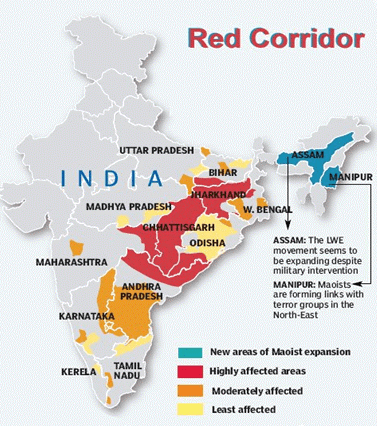
The recent victories against left-wing extremism are a significant step in the direction of the deadline set by Prime Minister Narendra Modi and Union Home Minister Amit Shah for ending naxalism on 31st March 2026. “Under the leadership of Prime Minister Narendra Modi, we broadly devised a four-pronged strategy to replace weapons and violence with development and trust in the so-called Red Corridor that extended from Pashupatinath in Nepal to Tirupati in Andhra Pradesh,” he voiced in a recent interview with India Today.
The Bijapur district in the state’s Bastar range has seen the surrender of 84 Maoists so far this year. Seven districts in the Bastar area, including Bijapur, witnessed 792 Maoists surrender last year. “The security forces penetrated into the stronghold territory of Maoists to strike and eliminate them. The success achieved by the troops is commendable. Hats off to their courage and bravery. In the last 13 months, 282 Maoists have been neutralised, 1033 arrested and 925 have surrendered in Chhattisgarh,” Chief minister Vishnu Deo Sai highlighted after February’s Naxal encounter.
Bijapur continues to be one of Bastar’s most severely Maoist-affected districts and is known as a hub for left-wing extremists in south Chhattisgarh. According to police, 23 Naxalites turned themselves in to authorities in the Bijapur area in 2025, while 46 were taken into custody and 17 were shot dead. The ongoing battles with left-wing radicals are a part of the revised strategy to rid the state of Chhattisgarh of the influence of the banned Maoists. The Maoists experienced the greatest loss in their history in 2024 when 219 of them were killed in conflict-torn Bastar.
“First, the political will of the central as well as the state government is on the same page, which has helped the forces move forward aggressively, making forward camps filling up the security vacuum in places like Abujhmad (an unsurveyed area larger than the state of Goa) and south Bastar, which were considered to be safe havens for Maoists. These camps are not only restricting the movement of Maoists, but are also helping forces to conduct major operations,” Chhattisgarh’s former Additional Director General of Police (Naxal operations), RK Vij told “The Indian Express.”
He added, “Moreover, the Niyad Nellanar scheme, where basic amenities are being provided to villagers from these camps, is sending a positive message to local residents.” The number of forward base camps has significantly increased in recent months. These camps make it possible to install mobile tower networks and build roads deep within forests. According to officials, this has assisted in closing the security vacuum and shrinking regions that had been affected by Maoists for more than 40 years.
Image via INSIGHTS IAS
Amit Shah stated in October of last year that 14 key CPI (Maoist) leaders nationwide and 85% of the strength of left-wing extremists in Chhattisgarh had been decimated in the previous ten years. According to current data, around 8551 Naxal terrorists were eliminated between 2014 and 2024, while many more gave up their weapons nationwide.
Amit Shah disclosed the government’s multifaceted approach, which focuses on filling the security void and promoting progress while including the impacted states, has resulted in a 53% decrease in Left-wing extremism violent occurrences between 2014 and 2024 compared to 2004 and 2014. The number of districts reporting Left-wing extremism violence decreased by 57% and the number of civilian and security force deaths also decreased by 70%.
He declared that, in comparison to 2004-14, the amount reimbursed to impacted states under the center’s security-related expenditure plan increased threefold to ₹3,006 crore in 2014-24. Over the past ten years, ₹3,590 crore has been spent under the special central support initiative.
As previously reported by OpIndia, the Indian government has made significant strides in dismantling the strongholds of red terror, marking a notable achievement. However, further efforts are required to eradicate it completely from the nation. Nevertheless, the government appears to be progressing in the right direction, given its successes in combating left-wing extremism and fostering democracy and welfare in the impacted regions.
Bowlers will be allowed to use saliva on the ball in IPL 2025. The decision was made by IPL following a meeting on Thursday at the BCCI headquarters in Mumbai, where most of the franchise captains expressed support for the change to the decision-makers of the tournament, as per a report by ESPNcricinfo.
Several captains agreed to revoke the saliva ban adopted by the ICC in the wake of COVID-19 pandemic. Several fast bowlers have opined that the ban impedes their effectiveness by not allowing reverse swing, which has become uncommon in white-ball cricket, including ODIs, where two new balls are utilized.
The rule against use of saliva was introduced in May 2020, during the COVID-19 pandemic, as a temporary measure, but ICC made it permanent in September 2022, the report said.
Bowlers were only allowed to use sweat to shine the bowl. From time to time, bowlers have raised their voice for revoking saliva ban. Following India’s win over Australia in the Champions Trophy in which Mohammed Shami starred with a three-wicket spell, the bowler had called upon ICC to let bowlers use saliva on the ball again to bring reverse swing back into the game.
“We are trying [to get reverse swing], but using saliva on the ball is not allowed. We keep appealing that we should be allowed to use saliva so that we can bring reverse swing back into the game and it becomes interesting,” Shami had said, according to ESPNCricinfo.
Southee, who also feels the absence of reverse swing in the game, especially in batting-friendly conditions, had backed Shami. Southee said on ESPN Cricinfo’s Match Day programme during the semifinal between New Zealand and South Africa that, as a bowler, one wants some advantage.
“That was a rule brought around COVID-19 with the virus going around the world, but I think as a bowler, you want to have a slight advantage. We see the game going the way it is going and seeing sides score 362, more often than not over 300 in this format. I think there needs to be something in the bowlers’ favour, and whether that’s a little bit of saliva, then yeah, I do not see why they could not afford to get that back in,” Southee had said, according to ESPNcricinfo.
Fast bowlers feel that using saliva will also help add to their craft in the Test matches.
(This news report is published from a syndicated feed. Except for the headline, the content has not been written or edited by OpIndia staff)
Under the chairmanship of Defence Minister Rajnath Singh, the Defence Acquisition Council (DAC), on Thursday accorded Acceptance of Necessity (AoNs) to eight capital acquisition proposals amounting to over Rs 54,000 crore.
For the Indian Army, AoN for procurement of 1350 HP Engine was accorded to upgrade the present 1000 HP Engine for the T-90 Tanks. This will enhance the battlefield mobility of these tanks, especially in high-altitude areas by increasing the power-to-weight ratio, accc=ording to the Ministry of Defence.
For the Indian Navy, AoN for procurement of Varunastra Torpedoes (Combat) was accorded by DAC.
Varunastra Torpedo is an indigenously developed ship-launched anti-submarine torpedo developed by the Naval Science & Technological Laboratory. Induction of additional quantities of this torpedo would enhance the Navy’s capability against adversaries’ submarine threats.
For the Indian Air Force, AoN for procurement of Airborne Early Warning & Control (AEW&C) Aircraft Systems was accorded by DAC. AEW&C systems are capability enhancers which can change the complete spectrum of warfare and exponentially increase the combat potential of every other weapon system, said Ministry of Defence.
As a part of celebrating 2025 as the ‘Year of Reforms’ in the Ministry of Defence, DAC also approved the guidelines for reducing the timelines at various stages of the Capital Acquisition Process to make it faster, more effective and more efficient.
Meanwhile, the Defence Ministry has sanctioned Rs 100 crore for construction of a new Sainik School in Karbi Anglong district of Assam. The new Sainik School will be constructed at Langvoku in Karbi Anglong district.
The Defence Ministry has released the amount of Rs 100 crore as grants-in-aid for construction of Sainik School building for the financial year 2024-25. This amount is released out of a total allocation of Rs 335.87 crore.
(This news report is published from a syndicated feed. Except for the headline, the content has not been written or edited by OpIndia staff)
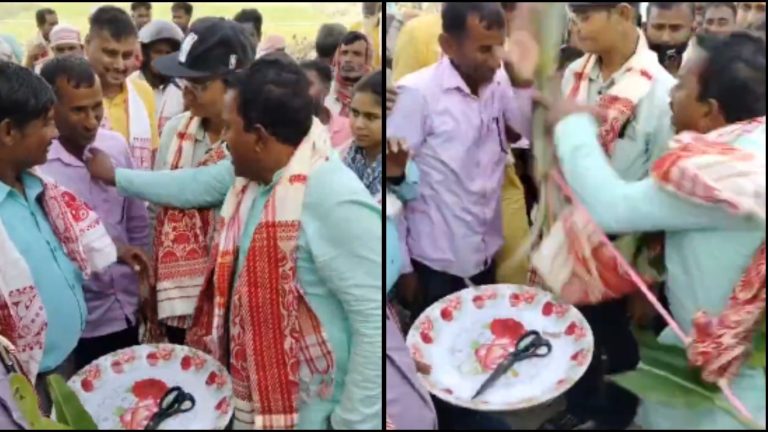
In a public display of hooliganism, Shamsul Huda, the AIUDF MLA from East Bilasipara in Assam, thrashed a man with a banana plant during the foundation stone laying ceremony on Tuesday (18th March). A video of the incident that went viral on social media shows Huda pulling a man, said to be an employee of a contractor, by his collar and slapping him. He even uprooted a banana plant used in the ceremony and beat up the man with it.
Bilasipara East MLA Shamsul Huda publicly assaulted a contractor's clerk, Sahidur Rahman, with a banana plant during a bridge inauguration at Daikhowa Market!
The act was caught on camera and has since gone viral, sparking massive outrage.
As per reports, the MLA was there to lay the foundation stone of a bridge at the Chuapata Daikhowa market. Huda was dissatisfied with the arrangements for the foundation stone laying ceremony. He got angry when he saw the colour of the ribbon and the size of the banana trees. The MLA expected a red ribbon tied to tall banana plants for the ribbon-cutting ceremony. The contractor arranged a pink ribbon that was tied to one and a half feet tall banana plants. This would have made him bow down to cut the ribbon. A furious Huda pulled the employee of the contractor standing next to him by the collar and slapped him hard. He did not stop at that. He uprooted one of the two banana plants and started thrashing him and people standing there tried to stop him.
Following the MLA’s outburst, the contractor Avinash Agarwala sought an apology from him for the errors in arrangement.
The MLA’s action drew widespread criticism after which he issued an apology. “Yesterday I was laying the foundation stone of various works in a gram panchayat in my Bilasipara East constituency since morning. Earlier we laid the foundation stone of Rs 11 crore which went well. This unexpected accident happened as it was a big bridge work and I told the contractor to do it a little better,” Huda said explaining the incident.
Apologising for his action, Huda said that it should not have happened but he was compelled to do it. “It was not right for me to do that in public. But the environment forced me. So I apologize to all the people of Assam and our people of Bilasipara for what happened,” Huda said.
The MLA alleged that no bricks or stones were given to break the coconuts at the foundation stone laying ceremony. He said that he had to wait for about half an hour for bricks to break the coconuts.
In a recent ruling, the Delhi High Court while rejecting a maintenance plea underscored a significant principle: a well-educated wife with suitable job experience should not avoid employment merely to claim maintenance from her husband.
This observation arose during a case where the petitioner, an evidently qualified woman with a master’s degree from Australia and prior professional experience in Dubai, was seeking interim maintenance.
Her actions, such as residing first with her parents and then with her maternal uncle, appeared to suggest an effort to convince the Court of her inability to earn. Justice Chandra Dhari Singh, who presided over the case, remarked that the petitioner had wide exposure to worldly affairs and a strong educational background.
Unlike women with limited opportunities who depend on their spouses for sustenance, she was equipped with the tools to achieve self-sufficiency. The Court encouraged her to actively seek employment rather than rely on maintenance.
“A well-educated wife, with experience in a suitable gainful job, ought not to remain idle solely to gain maintenance from her husband. Therefore, interim maintenance is being discouraged in the present case as this court can see potential in the petitioner to earn and make good of her education,” Justice Singh said on 19th March.
Adding to the complexity of the case, a WhatsApp conversation between the petitioner and her mother came under scrutiny. In this communication, the mother allegedly advised her daughter that taking up a job could undermine her alimony claims.
Although the legitimacy of this conversation is to be verified at trial, the Court regarded it as prima facie evidence of deliberate unemployment.
The timing of this exchange, occurring before the maintenance petition was filed, suggested an intentional attempt to remain jobless to strengthen her case for maintenance.
Consequently, the Court determined that the case did not warrant the granting of interim maintenance. It dismissed the wife’s plea challenging a family court’s earlier order, which denied her maintenance under Section 125 of the Code of Criminal Procedure (CrPC).
Popular Tollywood actors Prakash Raj, Rana Daggubati, and Vijay Deverakonda along with 22 other celebrities are facing police action in Telangana after being booked for promoting illegal betting apps. The Cyberabad police in Telangana filed an FIR against 25 celebrities and influencers based on a complaint filed by a businessman Phaninda Sarma for allegedly promoting illegal betting, gambling and casino apps and causing financial loss to the public.
The celebrities and influencers named in the FIR reportedly include Pranitha Subhash, Manchu Lakshmi, Nidhi Agarwal, Ananya Nagalla, Siri Hanumanthu, Sreemukhi, Varshini Sounderajan, Vasanthi Krishnan, Shoba Shetty, Amrutha Chowdary, Nayani Pavani, Neha Pathan, Pandu, Padhmavathi, Imran Khan, Vishnu Priya, Harsha Sai, Sunny Yadav, Shyamala, Tasty Teja, and Bandaru Sheshayani Supritha. As per reports, actors Prakash Raj and Rana Daggubati are accused of promoting Junglee Rummy through pop-up ads. Vijay Deverakonda, Manchu Lakshmi, Pranitha Subhash and Nidhi Aggarwal allegedly promoted A23 Rummy, Yolo247, Fairplay Live and Jeet Win respectively by way of pop-up ads.
The complainant alleged that people have been losing their money through these apps. He said that he could also have fallen victim to one such app by depositing his money but he was prevented by his family. He added that several celebrities have been promoting these apps for huge sums of money. The FIR stated that these apps are leading to financial distress in many families. “Thousands of lakhs of rupees are involved in these illegal platforms and it is also leading many families into distress, especially that of middle-class and lower middle-class,” the FIR stated. “These platforms are encouraging the public, especially people that are in dire need of money, to invest their hard-earned and family money into those apps/websites and slowly get addicted to them, leading to total financial collapse,” the FIR said.
The police have started an investigation into these apps and have been trying to track the people behind these apps. “This is just the beginning of that investigation. We will see what are these apps, who are the people involved, what is the source of these apps, and other aspects. Based on the merit of the case and evidence available, we will go forward,” Commissioner of Police Avinash Mohanty told Indian Express.
The FIR has been lodged under sections 318(4) (cheating), 112(petty organised crime) read with 49(abetment) of the BNS, sections 3, 3A and 4 of the Telangana State Gaming Act (TSGA) and section 66(D) (cheating by personation using a computer resource) of the Information Technology (IT) Act.
As the Israel-Hamas ceasefire has stalled followed by renewed attack by Israeli forces on Gaza Strip, Israeli Defence Minister Israel Katz has warned ‘total destruction’ of the strip if Hamas does not release the remaining hostages. The IDF on Wednesday said that it has launched “pinpoint” ground operations in central and southern Gaza Strip targeting Hamas bases.
The Israeli army said its operations were aimed at expanding the security zone near the border and creating a partial buffer between northern and southern Gaza. IDF troops have entered the Netzarim Corridor area, a route that splits Gaza into north and south, and have captured around half of it.
Defence Minister Katz said the govt would soon issue evacuation orders for combat zones in the Strip. “Gaza residents, this is a final warning. The first Sinwar ruined Gaza and the second Sinwar will completely obliterate it,” Israel Katz said. He was referring to slain Hamas leader Yahya Sinwar and his brother Mohammed Sinwar who has presumably succeeded Yahya.
“The Air Force strikes against Hamas terrorists were just the first step. Things will become much more difficult, and you will pay the full price,” he added. The defence minister said that if the hostages are not released and Hamas is not removed from Gaza, “Israel will operate with strength you have not yet seen.”
Israel Katz further said, “take the US president’s advice. Return the hostages and remove Hamas, and other options will open up for you, including leaving for other places in the world for those who desire.” He added, “The alternative is total destruction and ruin.”
IDF and Shin Bet have said that Israel’s strikes have targeted cells of terror leaders and operatives, rocket-launching positions, weapons, and other Hamas and Islamic Jihad terror infrastructure. Hamas-run health ministry in Gaza has said that over 400 people have been in the latest Israeli attack.
Israel resumed the attacks on Tuesday citing repeated refusal of Hamas to release the Israeli hostages the terror group has been holding since the 7 October terror attack on Israel.
While both sides had entered into a ceasefire resulting in Hamas returning some hostages and Israel freeing a large number of prisoners in exchange, it ended after Hamas rejected Israel’s demand to extend the first phase of the ceasefire and release more hostages. Hamas insists on moving on to the second phase which includes Israel withdrawing fully from Gaza and end the war permanently, but Israel is not willing do that until Hamas releases all the hostages.
Prime Minister Benjamin Netanyahu have said that the war will not end until Hamas’s governing and military capabilities have been demolished. He said on Tuesday that from now on, negotiations on a continued ceasefire would only be conducted “under fire.”
Terrorists in Gaza Strip are still holding 59 hostages, including 58 of the 251 abducted by Hamas-led terrorists on October 7, 2023. At least 35 of the hostages have been confirmed dead by IDF.
In the Sundar Nagri area of Delhi’s Seemaapuri, a man named Asif allegedly strangled a girl named Komal, tied her body with a stone and dumped the body into a canal after the two had an argument on 12th March 2025. The deceased victim’s dead body was recovered on 17th March. The accused has been arrested by the police.
According to Delhi Police sources, Asif, who drives a taxi in Delhi, has known Komal for a long time. On 12th March, Asif picked up Komal in his car from the Seemapuri area. During this time, the two had a fight over something and during the fight, Asif allegedly strangled Komal to death.
After killing Komal, Asif came up with a horrific method to dispose of the body. He tied the body to a heavy stone and threw it in the canal in the Chhawla area. Several days after the body was abandoned in water, it swelled up enough and came to the surface of the water. Local people saw the body in the canal and informed the police.
Earlier, Komal’s family had lodged a missing complaint with the police. After finding the body, the police registered a murder case at Chhawla police station and started an investigation. The police soon connected the dots and arrested Asif. The police are trying to find out if anyone else was involved in this crime along with Asif. Some reports say that one Javed was also involved in the murder.
Meanwhile, the deceased victim’s family has alleged that Komal’s neck was strangled with a green scarf, and there was a rope tied around her waist. The dead body has been sent for post-mortem and will be handed over to the family later.