Ahead of the historic Ram Mandir Bhoomi Pujan, Uttar Pradesh CM Yogi Adityanath, who has been personally monitoring the preparations for the event scheduled to be held on August 5th, has urged people to light earthen lamps at homes on August 4 and 5 to celebrate the historic occasion.
To witness this historic moment, it’s essential that we light earthen lamps at our homes on 4th & 5th August, religious leaders decorate temples, organise ‘deepotsav’ & ‘akhand Ramayan Path’ at temples, and remember their ancestors who sacrificed themselves for Ram Temple: UP CM https://t.co/Xui5C3aJW2
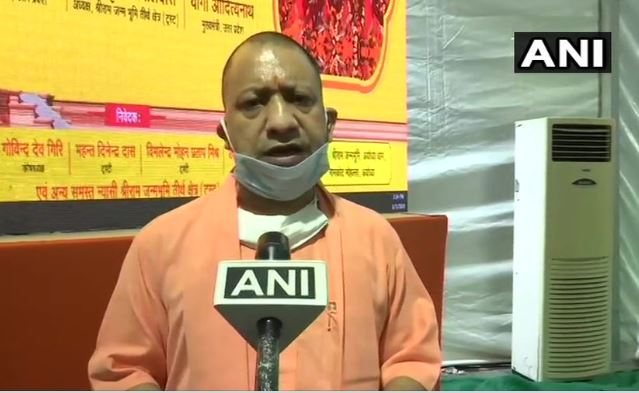
Speaking to reporters ahead of the ceremony, Yogi Adityanath said that while everyone should light diyas at their homes on August 4 and 5, the religious leaders should decorate temples, organise ‘Deepotsav’ and conduct ‘Akhand Ramayan Path’ at temples.
The Uttar Pradesh CM said this while assuring that all arrangements for the event have been made keeping all protocols in mind ensuring that there is no laxity on any count. The CM urged that keeping the Covid-19 situation in mind, all protocol should be enforced very strictly. He said that PM Modi would represent all the devotees.
“We’ve made all arrangements to ensure that there is no laxity on any count. The main focus is on COVID-19. The protocol has to be enforced very strictly. Only those who are invited should come here. All devotees want to come but PM will represent all of them,” he added.
Ayodhya spruced up for the historic event
The city has been spruced up with several Karsevaks working amid the coronavirus pandemic to finalise the preparations with only two few days left for the auspicious occasion. The 3km long stretch of road that PM Modi will take to reach the venue of the ceremony has been painted yellow. Graffiti and images depicting scenes from the Ramayan have come up, on main streets.
Around 1 lakh laddoos are being prepared for the Bhoomi Pujan ceremony.
Prime Minister Narendra Modi is all set to visit the holy city of Ayodhya to perform the auspicious event of Bhoomi pujan on the 5th.
If India appeared as a palimpsest to those who wrote on her history in the yesteryears, history of education in India is an equally competent palimpsest spanning thousands of years if not more. On restricting the scope to engineering education for its pedagogy and content in large that we recognize and associate with today, we need to go no further than the last 200 years.
The lofty samudra manthan of the yore resulted in amṛta, a panacea for immortality and in a strictly metaphorical sense one can look at the Industrial revolution of relatively recent past as another human intervention that has also resulted in providing comfort as well as sustenance to the human life.
Machination and advancements in use of engineered tools were the primary consequences of the revolution and with it the need for engineering education had also emerged as a significant outcome. Industrial Revolution impacted India, the then colony of Britain, in several ways which directly and indirectly has had its longstanding effect on the origin, design as well as implementation of technology.
In the context of Banaras Hindu University (BHU) and particularly in the initiation of the Benares Engineering College (BENCO) with which BHU made its beginning, the link to the industrial revolution can be averred at ease. The links emerge when we look at that facet of the colonial India which was loathed upon by the then constituted committee, the Industrial Commission, which, in its utmost wisdom and rationale, without mincing words went on to highlight the inconspicuousness of industry, dearth of the right mentality and technical cum physical incapability for her citizens to embrace industrialization in a pace similar to her colonial masters and counterparts elsewhere in the western part of the world.
The Industrial Commission: Its Genesis and Terms of Reference
On March 21, 1916 Ibrahim Rahimtoolla moved a resolution in the Viceroy’s Legislative Council for appointment of a Commission to report on the measures that should be adopted for the growth and development of industries in India and towards the same end he urged that the fiscal autonomy should be granted to the Indian Government as an essential step.
The industrial commission was constituted with the following members:
S.No.
Names
Role in the committee
1
Sir T. H. Holland, K.C.S.I., K.C.I.E.,D.Sc.,F.R.S.
President
2
Mr. Alfred Chatterton, C.I.E., B.Sc., F.C.G.I., A.M.I.C.E., M.I.M.E.
Member
3
The Hon’ble Sir Fazulbhoy Currimbhoy Ebrahim, Kt., C.B.E.
Member
4
Mr. Edward Hopkinson, M.A., D.Sc., M.I.C.E., M.I.M.E., M.I.E.E.
Member
5
The Hon’ble Mr. C. E. Low, C.I.E., I.C.S.
Member
6
The Hon’ble Pandit Madan Mohan MalaviyaB.A., L.L.B.
Member
7
The Hon’ble Sir Rajendra Nath Mookerjee, K.C.I.E.
Member
8
The Right Hon’ble Sir Horace Curzon Plunkett, P.C., D.C.L., L.L.D., F.R.S., K.C.V.O.
Member
9
The Hon’ble Sir Francis Hugh Stewart, Kt., M.A., C.I.E.
Member
10
Sir Dorabji Jamsetji Tata, Kt., J.P.
Member
Mr. R. D. Bell, I.C.S.
Secretary
Mr. G. H. W. Davies, I.C.S.
Joint Secretary
This committee went ahead to pen the report which comprised of nearly 300 pages which included nearly 50 pages of an independent note by Malaviya ji. This independent note was a strong rebuttal to the contents of the report. Looking retrospectively we can safely surmise that it was both the collective wisdom of this committee and the extraordinary clarity of Malaviya ji suffused with his legal acumen that the report and the note were published as a single document, in fairness of full disclosure.
An interesting side fact is that two of the committee members went ahead to open two of the mightiest educational institutions of our country that has stood the test of time for hundred years namely the Indian Institute of Science and Banaras Hindu University!
Selective Highlights from the report
The report makes the opening with a highly condescending note right from the first chapter and this tone as well as the tenor continues throughout the subsequent chapters in the report. In summary, India was projected as a country that had not yet embraced industrialization and how it was not capable to do so with all its deficiencies and idiosyncrasies. For instance, let us have a look at the following paragraph from the report:
“The first chapters of the Report deal with India as an industrial country, her present position and her potentialities. They show how little the march of modern industry has affected the great bulk of Indian population, which remains engrossed in agriculture, winning a bare subsistence from the soil, by antiquated methods of cultivation. Such changes as have been wrought in rural areas are the effects of economic rather than of industrial evolution.”
The report goes on to say, “India produces nearly all the raw materials necessary for the requirements of a modern community; but is unable to manufacture many of the articles and materials essential alike in times of peace and war. For instance, her great textile industries are dependent upon supplies of imported machinery and would have to shut down if command of the seas were lost.”
These are just the few excerpts to illustrate the very mindset with which this report was written. The committee perhaps was more inclined towards finding faults than facts that could boost the general morale of the colony. Likewise the first chapter despises on the sorry state of the non-industrialized India by citing one dearth after the other. Whereas the first chapter was in general exposition of the inadequacies of our country, the next one particularly targeted at the Indians and their ineptitudes. It opened thus,
“The next chapter deals with the “Indians in Industries.” They discuss measures designed to improve the efficiency of the Indian artisan and to encourage the educated Indian to take part in industrial enterprise. It is shown that the relative lowness of wages paid to Indian labour is counterbalanced by the comparative inefficiency of the individual Indian workman.”
Not only the blatant bigotry of the colonizers gets exposed in this excerpt, the committee’s sophistry to justify its ill deeds is indeed noteworthy. Whereas the committee takes into cognizance the disproportionate and differential wages paid to Indian and non-Indian workmen, it goes on to institutionalize and justify the discrimination on frivolous grounds.
The committee went ahead to even invoke the societal variations due to heredity while giving a rationale to the ineptitude of the Indian workforce. The report says,
“The general aversion from the industrial pursuits of the educated Indian is ascribed to hereditary predisposition accentuated by an unpractical system of education. A complete revolution in the existing methods of training is proposed.”
The existing methods that the committee is referring to is the result of the policy changes brought about half a century before this committee was formed by one of their own Lords. The overhaul of a stagnant system is always a welcome attribute but without resorting to the genesis of the rot in the system and squarely blaming the system for what it stood before the committee when they saw it, not only ill behooves the stature and the rationale of the learned committee but also raises serious doubts on the veracity of the report penned by men with perhaps clouded intellects.
Whereas the committee’s primary demand was the establishment of a department of Industries at both the provincial and imperial level, in the modus operandi the scientific and industrial heritage of the civilizational nation suffered a collateral damage. The report left no stone unturned while belittling the colonial India.
The civilizational nation which flourished in both economic and knowledge dimensions for thousands of years suffered such a pitiable plight in the hands of her invaders and colonizers. But the amber of India’s intellect had not completely cooled off. Few sparks of it lay hither and thither which did act as agents of change and some even resulting in revolution.
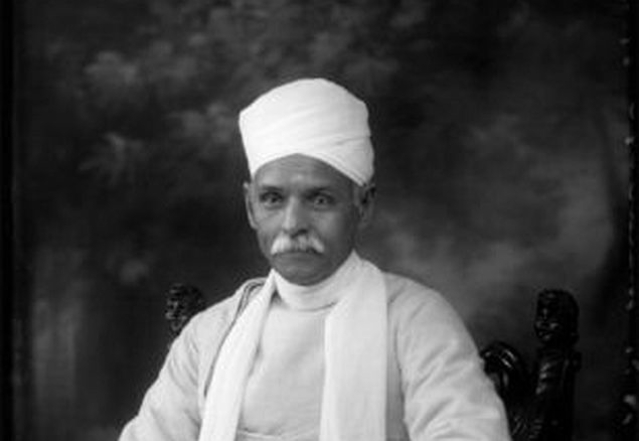
One such spark was Malaviya ji whose indomitable spirit, love for the nation and sharp intellect arose to the occasion and single handedly gave fitting response to the mischievous aspersions in the report through his separate note which he ensured to get published along with the committee’s report and it did happen this way.
Perhaps his first hand involvement in this committee which exposed him to the nuanced approaches of the colonial masters coupled with his deep love for the country reinvigorated his resolve to dedicate his life for the establishment of BHU and its growth thereafter, through which he blew life into his note of to the Industrial commission’s report.
Pt. MM Malaviya’s independent ‘Note’ to the Industrial Commission of 1916
The commission’s report, besides all its critical observation and documentation, gave the following two proposals:
That in the future Government must play an active part in the industrial development of the country, with the aim of making India more self-contained in respect of men and material….
That it is impossible to undertake that part, unless provided with adequate administrative equipment and forearmed with reliable scientific and technical advice…
Perhaps these two points appeared as faint rays of hope to Mahamana ji which should have reinforced his sankalpa for building an educational institution which will not only equip the Indian youth in the technology, engineering, science etc of the day along with copious injunction of the wisdom from the Indian yore. Mahamana ji did not quietly rest with this faint optimism rather he took this opportunity to present the glory and richness of India from her ancient days through the various onslaughts of invasion.
Mahamana ji in fact showed the white elephant in the room to the committee as well as the higher authorities by way of penning a strong note which in fact served as a fact check for the observations in the report regarding the poor state of the Indian industries in particular and on the general caliber of her people. It was through Malaviya ji’s sharp intellect, acumen of unambiguous convincing logical arguments and lucid recollection of vital evidences that in fact gives befitting rebuttal and thereby uplifting the glory of our civilizational nation.
Mahamana ji employed a unique style and logic while penning his note which was responsible for making it indefatigable. And this style was not to write his opinions or emotions or judgments but rather to quote official documents from the British Empire authored by British administrators and thereby rendering his note beyond any possible refutation.
True to the nyāya sutra of “siṃhāvalokana” Malaviya ji held the gaze of a lion by first giving a copious exposition of the civilizational India’s past scientific heritage and industrial glory in order to rebut the commission’s report.
Malaviya ji tactfully quotes from the metaphorical horse’s mouth vis a vis those foreigners, including British officers who had visited India at different points of time.
Malaviya ji coherently conveys in his note that there has been a major scale devastation of three longstanding and well flourishing industries of India, namely:
The cotton and textile industry
The iron industry
Ship making and shipping industry
Malaviya ji’s laments on the invader’s onslaught of these industry not only reveals the sufferings of the Indians at the hands of her invaders, also reveals the sagacious and sophisticated capacity of Indians in both industry as well as commercial enterprises. Malaviya ji quotes one officer after the other to initially to reveal each of these industry’s glory and then goes on to also show how it suffered and underwent decay.
One should not get an impression that Malaviya ji was indulging in cherry-picking while writing his note for there are ample evidences to show, both from the breadth of this note as well as the vast cross references that he has cited besides the independent verification of facts from other sources that the reader deems fit.
He starts with Prof. Weber who was the author of the “History of India” and Malaviya ji quotes him while referring the cotton industry of India. Prof. Weber says, and Malaviya ji quotes,
““the skills of the Indians,” says Professor Weber, “in the production of delicate woven fabrics, in the mixing of colours, the working of metals and precious stones, the preparation of essence and in all manner of technical arts has from early times enjoyed a world-wide celebrity.” There is evidence that Babylon traded with India in 3000 B.C. Mummies in Egyptian tombs, dating from 2000 B.C., have been found wrapped in Indian muslin of the finest quality….
Thus it may be safely concluded that in India the arts of cotton spinning and cotton weaving were in a high state of proficiency two thousand years ago…..Cotton weaving was only introduced to England in the seventeenth century”-(Imperial Gazetteer of India, Volume III, page 195)”
Malaviya ji goes on and gives copious evidence to show the glory of the cotton industry that not only thrived in India but also traded with hinterlands both and near far. He next takes up the glorious industry of Iron smelting, casting and molding and this time quotes from the 1892 essays of Ranade who had quoted Prof. Wilson which had the following,
“The iron industry not only supplied all local wants but it also enabled India to export its finished products to foreign countries. The quality of the material turned out had also a world-wide fame. The famous Iron Pillar near Delhi, which is at least fifteen hundred years old, indicates an amount of skill in the manufacture of wrought iron……
… The Indian steel found once considerable demand for cutlery even in England. The manufacture of steel and wrought iron had reached a high perfection at least two thousand years ago.”- (Ranade’s Essays on Indian Economics, pages 159-160)”
On the glorious ship building and sea-faring industry Malaviya ji quotes the Governor General Lord Wellesley who, while reporting to his the then authorities in Leadenhall Street in London in 1800 had observed and articulated the following,
“The port of Calcutta contains about 10,000 tons of shipping, built in India, of a description calculated for the conveyance of cargoes to England……(Quoted by Mr. Digby in Prosperous British India, page 86)”
Malaviya ji draws from copious sources to draw the committee’s attention towards the glorious industrial past of India. Then a natural question arises as to why it declined and what was the need for the committee. Malviya ji analyses the reasons for the decline and for that too he draws evidences from colonial officers.
Pt. Malaviya hits back at the Commission Report
Having given a glimpse of three continuous flourishing of Indian industries Malaviya ji puts forth the arguments, again by quoting British and other officers, to highlight the gradual decline of these three vital industries after the formation of the British East India Company. He writes in his note that the East India Company which obtained its charter from Queen Elizabeth on 31st December 1600, to trade with the East Indies, not “to exchange as far as possible the manufactured goods of England for the products of India” (Report para. 2) – for there were few English manufacturers then to be exported-but to carry the manufactures and commodities of India to Europe. Malaviya ji refers to the “history of England in the Eighteenth Century” written by one Lecky who has the following to say,
“At the end of the seventeenth century, says Lecky, “great quantities of cheap and graceful Indian calicoes, muslins and chintzes were imported into England, and they found such favour that the woolen and silk manufacturers were seriously alarmed. Acts of Parliament were accordingly passed in 1700 and 1721 absolutely prohibiting, with a very few specified exceptions, the employment of printed or dyed calicoes in England, either in dress or in furniture, and the use of any printed or dyed goods, of which cotton formed any part.”
Malaviya ji gradually marches ahead and walking us through several decades. He cites the observations of Clive as recorded in the “Economic History of British India” by Ranade. He quotes the following from the book,
“When Clive entered Murshidabad, the old capital of Bengal, in 1757, he wrote of it:-
“In the first four years of the nineteenth century,” says Mr. Romesh Chandra Dutta, “in spite of all prohibitions and restrictive duties, six to fifteen thousand bales of cotton piece-goods were annually shipped from Calcutta to the United Kingdom. The figure rapidly fell down in 1813. The opening of trade to private merchants in that year caused a sudden rise in 1815; but the increase was temporary. After 1820, the manufacture and export of cotton piece-goods declined steadily; never to rise again.” – (Economic History of British India, page 296)””
Malaviya ji elicits those strong evidences in the form of prior committee reports or officers testimony that unequivocally shows that by the conspiracy of ill-suited policies, the otherwise flourishing industries of India were gradually decimated and the country as a whole was pushed towards the agrarian model for the large part of its economy. He quotes the civil servant and economic historian Romesh Chandra Dutta from his book titled “Economic history of India under early British rule” to buttress his point on the decay of Indian industries,
“A deliberate endeavor was not made to use the political power obtained by the East India Company to discourage the manufactures of India. In their letter to Bengal dated 17th March 1769, the Company desired that the manufacture of raw silk should be encouraged in Bengal, and that of the manufactured silk fabrics should be discouraged. And they also recommended that the silk winders should be forced to work in the Company’s factories and prohibited from working in their own homes.”
If above shows us now the genesis of the decay in Indian textile Industry not very different story is about the decay of the ship making as well as shipping industry of India as well. Mahamana quotes one Mr. Taylor who has said,
““The arrival in the port of London of Indian produce in India-built ships created a sensation among the monopolists which could not have been exceeded if a hostile fleet had appeared in the Thames. The ship-builders of the port of London took the lead in raising the cry of alarm; they declared that their business was on the point of ruin, and that the families of all shipwrights in England were certain to be reduced to starvation.”- (History of India page 216)”
British administrators were, after all, loyal to their tax payers and patrons and hence decided to starve the Indian workers and shipwrights rather than the workers and shipwrights of England. Mahamana strikes right at the root of the problem and shows very clearly the devastating nature of such policies of that time.
This also reveals two important facets. One that India really thrived in her industrial manufactures and that her industrial outcome was posing serious threats to other countries. Second, the policies made during the early days of the establishment of the Company had a seriously debilitating effect on these industries that by the time the member of the Industrial Commission encountered the reality in early twentieth century they were appalled by the sorry state of affairs.
Had it not been the genius of Malaviya ji the past glory of India’s industry and the detrimental policies of the British officers that curtailed the growth of the Indian industries would never have seen the light of the day.
While summarizing the topic of Indian industries’ sunset days, Mahamana takes recourse to the observations of Prof. H. H. Wilson paraphrased in the book by Romesh Dutt and following is the content,
“It was stated in evidence (in 1813) that the cotton and silk goods of India up to the period could sold for a profit in the British market at a price from 50 to 60 per cent lower than those fabricated in England. It consequently became necessary to protect the latter by duties of 70 and 80 per cent on their value or by positive prohibition. Had this not been the case, had not such prohibitory duties and decrees existed, the mills of Paisley and Manchester would have stopped in their outset and could scarcely have been again set in motion, even by the power of steam. They were created by the sacrifice of the Indian manufacture..” – (Said by H. H. Wilson, the historian of India and quoted by Romesh Dutt in his book (vide supra) page 262)
True to the proverbial fruit on ones palm, which in the Indian nyaya tradition is phrased as “hastaamalaka” or the “karastha bilva” sutra, Malaviya ji’s role as a member of the Industrial Commission and as a founding father of BHU is a perfect point in case. If his role as a member of the Committee gave him one eye to access the thought processes of the committee in close quarters, his distilled wisdom emanating from his deep rooted adherence to the traditions of the civilizational India gave him the other eye to interpret, analyze and rebut the report. And in that process we get a detailed account of India’s industrial legacy and the way the colonial policies thwarted it.
Resources mainly used for writing this document:
History of the Banaras Hindu University by S. L. Dar and S. Somaskandan
Industrial Commission Report 1916-1918
Technical Education and Industrial Development in Madras Presidency: Illusions of a Policy in the Making: Padmini Swaminathan, Economic and Political Weekly, Vol. 27, No. 30 (Jul. 25, 1992), pp. 1611
Mahamana Madan Mohan Malaviya: An Historical Biography Vol 1; Press Publication and Publicity Cell Banaras Hindu University
The author, Dr. V Ramanathan, is an Assistant Professor at the Department of Chemistry in IIT (BHU), Varanasi.
The Delhi Police have filed a case against Rajdhani School owner Faisal Farooqui, his wife, doctor and advocate for submitting fake documents to get bail in the anti-Hindu riots case which took place in national capital in February this year. A week ago, one of the main accused of Delhi Riots Faizal Farooqui tried to get bail based on a fake medical certificate. Further, the doctor who issued the fake certificate has been suspended by Delhi Medical Council for having forged such documents earlier.
Faizal got a certificate made from the said doctor in his wife’s name that stated she needs an operation to remove a cyst. He said in his application that based on his wife’s health condition, he should get interim bail. The court had cancelled his bail plea twice since he was arrested for his involvement in the Delhi Riots.
The doctor who issued the certificate failed to produce documents
When Faizal submitted the bail petition in the court as “extremely urgent case”, along with medical certificates and some documents, the court asked the crime branch of Delhi Police to check the validity of the documents. When investigating officers tried to approach Dr Gajendra Nair, who issued the certificates, he categorically refused to provide any information in the matter. The investigating officers then visited his nursing home located on Bisarkh Village Road of Greater Noida. They found out that there were no records available in the nursing home on the name of Faizal’s wife.
Police also stated in their investigation report that his wife lives in Yamuna Vihar, Delhi. The nursing home is very far from the place, and there are much better and cheaper medical facilities available in Delhi. According to the Police, when they tried to dig more information about the doctor, they found out that his license was suspended by Delhi Medical Council last year. Dr Girish Tyagi, Registrar of Delhi Medical Council, informed the Police that they had taken action against Dr Gajendra twice in the past. The first time he faced 6-months suspension and the second time for one year. At present, he was working on a suspended license as the suspension period will end in November 2020.
When questioned by the Crime Branch, Dr Gajendra Nair confessed that he had helped many people before to get access to fake medical certificates to get bail. He also admitted that he never saw Farooqui’s wife. A broker came with a burka-clad woman and told him to prepare fake documents for her husband’s bail. Police registered a case against everyone involved in the preparation of fake documents under various charges.
The case against Faizal Farooqui
Faizal Farroqui owns Rajdhani School. The rioters used its rooftop to fire guns, throw acid packets, stones, etc. In the chargesheet filed by Delhi Police against Farooqui, there was a mention of a complaint filed by Mr Yatendra Sharma who owned DRP School located adjacent to Rajdhani School. He claimed in his complaint that the Islamic mob destroyed his school. Several calls were made from DRP School to PCR on the day of the riots.
The guard of the DRP School said that he overheard Faizal Farooqui saying “Aaj dekh lenge Hinduon ko” (Roughly translated, it means “today we will teach Hindus a lesson”). Another witness confirmed hearing the same. The Rajdhani School had a Hindu guard who fled the scene with his family fearing his life. On the second day, Faizal met the guard of Rajdhani School and assured him no one would harm him, but he never dared to return.
The chargesheet also alleged that Faizal had connections with PFI, JCC, Pinjra Tod and many other groups that were involved in instigating riots. You can read more about the chargesheet here. OpIndia report on the planning and chronology of events since December 2019 can be purchased and read here.
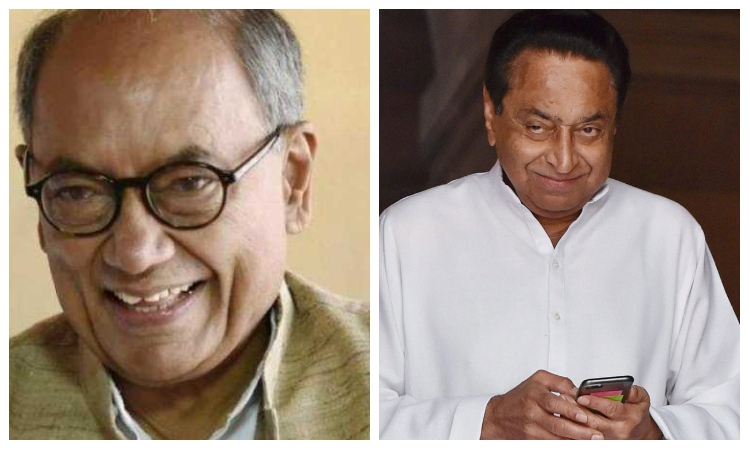
Ahead of the Ram Mandir Bhoomi Pujan on August 5, Congress senior leader and former Madhya Pradesh CM Digvijaya Singh claimed that the foundation stone of the Lord Ram’s Temple in Ayodhya has already been laid by former Prime Minister Rajiv Gandhi.
“Foundation stone has already been laid, Rajiv Gandhi ji did it,” Singh told reporters.
#WATCH Foundation stone has already been laid, Rajiv Gandhi ji did it: Digvijaya Singh, Congress on being asked about Kamal Nath’s statement that Rajiv Gandhi also wanted #RamTemple to be constructed pic.twitter.com/BvViPC2KSI
Digvijaya Singh was responding to his colleague, Kamal Nath’s statement that the former prime minister, Rajiv Gandhi wanted Ram Temple in Ayodhya.
On Saturday, Kamal Nath had welcomed the construction of the Ram temple in Ayodhya. Despite knowing that his statement would irk his party’s core vote bank, Kamal Nath posted a video message wherein he was seen welcoming the construction of the Ram Temple in Ayodhya. The video message was shared by the official Congress handle of Madhya Pradesh as well.
Kamal Nath has also gone a step ahead and declared that the Congress’ Madhya Pradesh unit would hold a “Hanuman Chalisa” recital program at his residence in Bhopal on August 4 (Tuesday), a day before the Bhoomi Pujan of the Ram temple in Ayodhya.
Congress denied the very existence of Lord Ram
This sudden shift in Congress’ stance is definitely overwhelming but speaks volumes about their hypocrisy, considering they were the ones who had refused to even acknowledge the very existence of Lord Ram. The sudden exuberance being now displayed by the Congress bigwigs over the construction of the Ram Mandir in Ayodhya clearly goes on to indicate that either the party’s senior members have forgotten history or are assuming that the public has forgotten it.
It may be appropriate for the party’s senior members to recall that it was the Congress-led Central government which had in September 2007, said that there is no historical proof of Lord Ram’s existence. In an affidavit filed in the Supreme Court, the Congress government had then said: “Valmiki Ramayana and Ramcharitmanas admittedly form an important part of ancient Indian literature, but these cannot be said to be historical records to incontrovertibly prove the existence of the characters and occurrences of events depicted therein.”
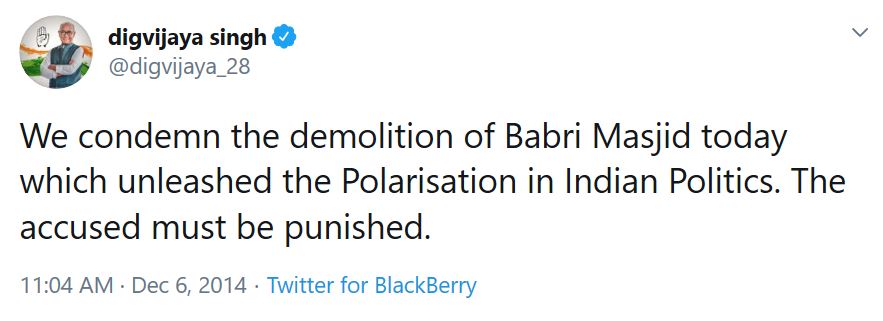
Digvijaya Singh had condemned the Babri Masjid demoition
In fact, Digvijaya Singh himself had in 2014, condemned the demolition of the Babri Masjid saying that it had “unleashed the Polarisation in Indian Politics.” He had batted for punishing the people behind the demolition, despite knowing that the Babri Masjid had been constructed after demolishing a Hindu temple at the site.
Congress leaders, Kamal Nath and Digvijaya Singh should at this point also reminisce how it was their colleague, Kapil Sibal who had fought the Ram Janmabhoomi case on behalf of the Sunni Waqf Board, opposing the building of a magnificent Ram Mandir at the disputed site in Ayodhya. Not only this but how Sibal had also employed dilatory tactics and asked the apex court to delay the decision in the Ram Janmabhoomi case till 2019 elections. It was not only Congress but its entire ecosystem that rooted against the construction of Ram Mandir.
However, now that the far-fetched dreams of millions of Hindus are actually turning into reality with the construction of the Bhavya Ram Mandir to commence soon, it would only be wise for these Congress leaders to switch their stance and speak in favour of the Ram Mandir Nirman.
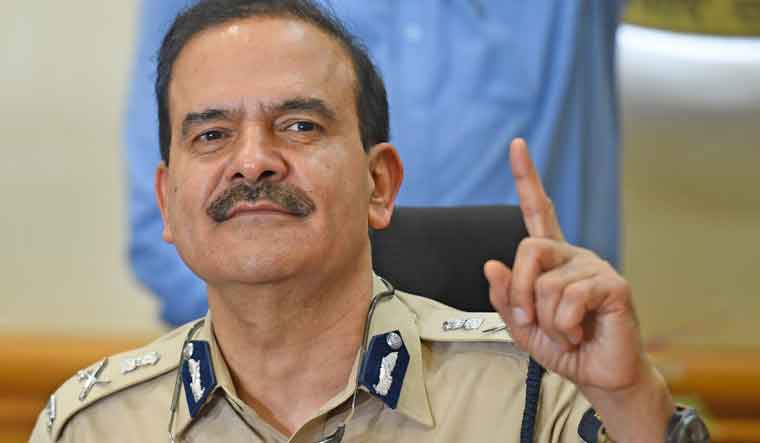
With the mystery surrounding the alleged suicide of actor Sushant Singh Rajput intensifying, the Mumbai Police Commissioner Param Bir Singh, in his media briefing, claimed that the late actor’s family, including his father, three sisters and brother-in-law had given their statement to the city police. He also added that Singh’s family did not allege any foul play in the investigation of the actor’s death.
While addressing the media, Singh informed that the Kai Po Che actor’s father, sisters and brother-in-law’s statements were recorded on June 16, two days after he was found dead in his apartment in Bandra.
“At that moment, they didn’t raise any suspicion neither they complained about any lapse in our investigation,” Singh was quoted as saying by news agency ANI.
No party held on June 13 and no politician involved: Param Bir Singh
Categorically denying the reports that a son of an influential politician had attended the party at Sushant Singh Rajput’s house, a night before his alleged suicide, the Mumbai Police Commissioner Param Bir Singh said that there had been no party at the late actor’s residence in Bandra on June 13 and no politician was involved in the case.
“There is no evidence against any politician from any party,” Singh said while denying the reports that claimed a a party took place at Sushant Singh Rajput’s residence on June 13, during which the actor had an ugly spat with an influential politician’s son.
Sushant Singh searched words like ‘painless death’, ‘schizophrenia’ and ‘bipolar disorder’ on Google: Mumbai Police
The Mumbai Police Commissioner Param Bir Singh claimed that the actor Sushant Singh Rajput searched for words like ‘painless death’, ‘schizophrenia’ and ‘bipolar disorder’ on Google.
At the press conference, the Mumbai Police chief claimed, “Sushant would search for articles and his name on Google to find out what was being written about him. He would also search for ‘painless death’, ‘schizophrenia and ‘bipolar disorder’.”
The chief claimed that it has come to the notice of Mumbai Police that the late actor was suffering from a bipolar disorder and undergoing treatment and medicines for it. The Mumbai Police chief added that the police is investigating the circumstances that led to his death.
Sushant Singh Rajput’s sisters did not cooperate in the investigation
Another shocking claim made by Mumbai Police Commissioner Param Bir Singh at his press conference was that Sushant Singh Rajput’s sisters did not help the Mumbai Police in its investigation in the actor’s death. Singh contended that Sushant’s sisters were also called to help the Mumbai police in the probe they did not join the investigation.
Nothing fishy in the financial transactions of Sushant Singh Rajput: Mumbai Police
Amidst the ongoing tussle between the Bihar police and Mumbai Police over the investigation into the death of Sushant Singh Rajput, Mumbai Police chief claimed that Mumbai Police had gone through the accounts of the late actor but is yet to find anything fishy.
This is in sharp contrast to the FIR filed by Bihar Police which states that Rs 15 crores were siphoned off from Sushant Singh Rajput’s account. “Bihar Police FIR says Rs 15 crore was siphoned off from Sushant’s account. During the probe, we found that he had Rs 18 crores in his account of which around Rs 4.5 crore are still there. Till now no direct transfer to Rhea Chakraborty’s account found. We are still probing,” Singh said.
The top official said that statements of 56 people have been recorded till date and all angles are being investigated be it a professional rivalry, financial transactions or health.
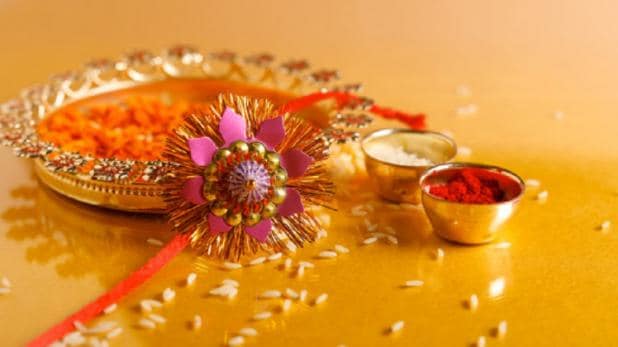
As the people across the country and the world are celebrating the festival of Rakshabandhan, a tradition that celebrates the sibling bond between a brother and a sister, wherein sisters of all age tie a ‘rakhi’ on the wrist of their brothers, investing them with the responsibility of their potential care, a particularly misleading image is doing the rounds on the Internet which says that Rakshabandhan had its origin in the Mughal-era.
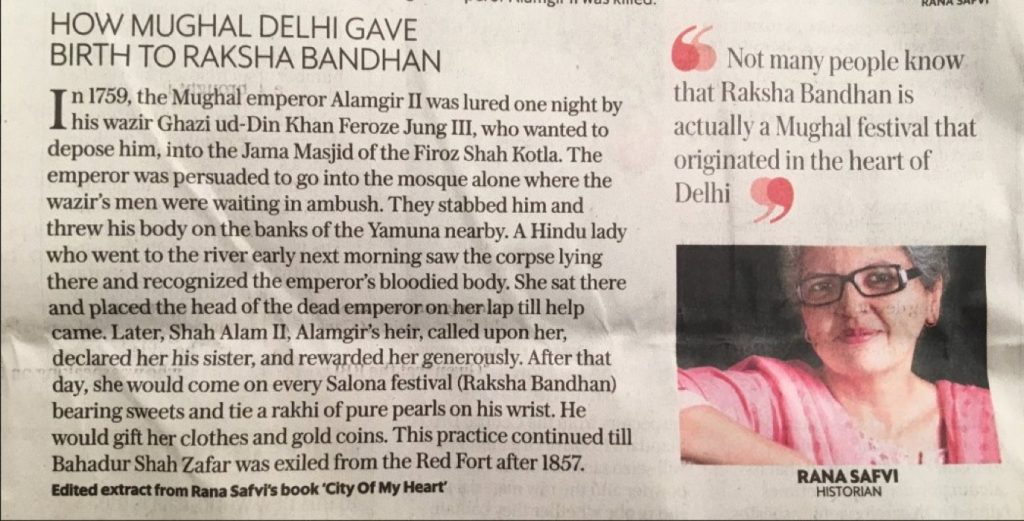
Image Source: Twitter
The above-shared image is of an extract from author Rana Safvi’s book ‘City Of My Heart’ which was published two years ago in 2018. The article titled ‘How Mughal Delhi gave birth to Raksha Bandhan’ quoted author Rana Safvi saying, “Not many people know that Raksha Bandhan is actually a Mughal festival that originated in the heart of Delhi”. The article cites a historical legend from Safvi’s book where a Hindu lady retrieves Mughal emperor Alamgir’s body from a river until help arrived. Later, Shah Alam II, Alamgir’s heir, called upon her, declared her sister and rewarded her generously. The article states the day was celebrated as Raksha Bandhan every year until Bahadur Shah Zafar was exiled from the Red Fort after 1857.
However, Rana Safvi issued a clarification shortly after the article was published. Taking to Twitter, Safvi had then claimed that she had intimated the editor about the misleading headline and blurb. She added that headline and blurb were not given by her, alleging that the text did not say that Mughal gave birth to Rakhi and just that they celebrated it.
I have intimated the editor about the misleading headline & blurb. The headline & blurb were not given by me. The text was & that does not say Mughals gave birth to Rakhi or Salona just that they celebrated it. My apologies for the confusion. @livemintpic.twitter.com/1fXRGaeoRH
While Safvi clarified the patently misleading headlines published by the media organisation, she asserted that Mughals enthusiastically celebrated Raksha Bandhan—a Hindu tradition of love and care between the siblings. However, historical evidence suggest that Mughals exhibited deep hatred for Hindus and the customs followed by them.
Mughal invaders attacked Hindus and symbols of Hinduism
Ever since the Mughals and other Muslim rulers invaded India, they have unapologetically presided over the persecution of Hindus and other non-Muslims. Scores of Hindus were slaughtered for refusing to convert to Islam. Hindu temples were pillaged by rampaging Muslim armies. The places of worship of Hindus and the idols of Hindu Gods installed there were vandalised to humiliate the local indigenous population of India. One of such places was —Ram Janmabhoomi, the birthplace of Lord Ram, the most revered Gods of the Hindu pantheon—was illegally occupied by the Mughals and a structure was erected at the place after demolishing the Ram Temple.
This week, the centuries-old-wrong will be set right as the bhoomi pujan ceremony of a Bhavya Ram Mandir is going to take place in Ayodhya on August 5. While Ram Janmabhoomi had been just one of the Hindu temples arrogated by the Mughal marauders, there had been numerous such Hindu, Buddhist, Jain and temple belonging to other communities that were forcibly occupied by the Mughal invaders and later converted to mosques or other buildings, as a sign of subjugation of aboriginals by the invading Muslims.
The famous Qutub Minar in Delhi is a forbidding reminder of how the pillaging Muslim interlopers had low regards for the indigenous religions. The inscription found on Qutub Minar and its compound allegedly reveal that the material used for its construction was used by destroying 27 Hindu/Jain temples. The Somnath temple in Gujarat was attacked and damaged at least 17 times by the Mughal plunderers. According to historical records, the original Kashi Vishwanath temple in Varanasi was destroyed by Muslim rulers. It is said that while Akbar built the temple again, his great-grandson, Aurangzeb, destroyed the temple and built what is now the Gyanvapi mosque on it.
This has been a typical modus operandi of Mughal invaders in India during the medieval era. They attacked the places of worships and temples of other religions, slaughtered Hindus who valiantly refused to adopt Islam, and suppressed the celebrations of Hindu festivals and tradition. However, the pseudo-liberals in India have a penchant for whitewashing the Mughal inequities and depict them as just rulers.
In their nefarious attempt to shore up the propaganda of Ganga-Jamuni tradition, many so-called liberals have shielded the barbarism of Mughals by glossing over the unspeakable atrocities committed by them and painted a rosier picture of the Muslim invaders as exponents of pluralism, interfaith harmony and non-violence. It is through this deception that many of them have claimed that Muslim invaders not only allowed their Hindu subjects to celebrate Raksha Bandhan but also actively participated in the festival celebrating the bond between the siblings.
The origin of Raksha Bandhan dates backs to several thousands years ago
Contrary to what these so-called liberals claim about Raksha Bandhan, it is evidently a Hindu tradition that is also followed by members of several other communities in India. The history of Raksha Bandhan dates back to ancient times. Many folksongs and popular narrations of the Hindu epic of Mahabharata mentions the brother-sister bond between Lord Krishna and Draupadi.
There are mentions of instances when Draupadi tore a piece of cloth from her saree and tied it on the bleeding finger of Lord Krishna once. In return, Lord Krishna had promised her that he will return the favour in kind. Later, when the Kauravas were trying to disrobe Draupadi, Lord Krishna had fulfilled his promise by returning so much of ‘Vastra’ that the Kaurava never succeded in their plan to disrobe Panchali inside the Dyutsabha. In many ways, the piece of cloth, or thread, symbolises a promise of protection and honour.
Besides, the ancient legend of Bhavishya Purana refers to the bond between Indra Dev and Sachi, and Bhagavata Purana and Vishnu Purana mentions the brother-sister love between King Bali and Goddess Lakshmi. The parable of Yamraj and Yamuna is another popular incident from our epics about the genesis of Raksha Bandhan, that results in the celebration of the festival of Bhai Dooj.
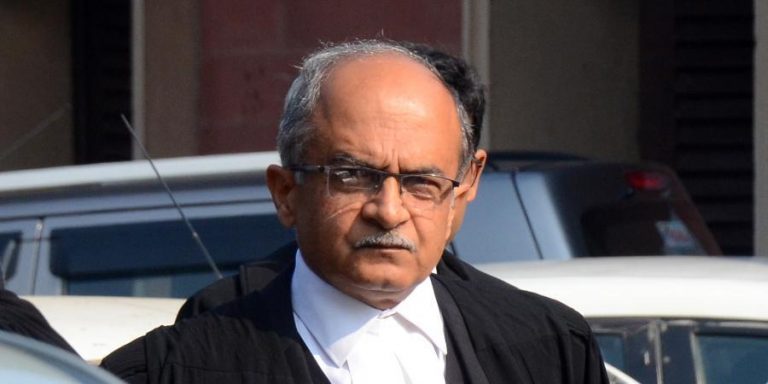
Prashant Bhushan has chosen attack as his favoured mode of defence in response to the criminal contempt proceedings that were initiated by the Supreme Court on a suo moto basis. The contempt proceedings were initiated against him for comments he had made on the previous four Chief Justices of India and also the current CJI.
The ‘PIL activist’ declared in his affidavit, “At the outset I admit that I did not notice that the bike was on a stand and therefore wearing a helmet was not required. I, therefore, regret that part of my tweet. However, I stand by the remaining part of what I have stated in my tweet.” Through the entire length of the 134-page affidavit, Prashant Bhushan refused to express any regret or apology for his conduct.
The Senior Advocate stated, “What I have tweeted is thus my bonafide impression about the manner and functioning of the Supreme court in the past years and especially about the role of the last four Chief Justices have played vis a vis their role in being a check and balance on the powers of the executive, their role in ensuring that the supreme court functions in a transparent and accountable manner and was constrained to say that they, contributed to undermining democracy.”
“To bona fide critique the actions of a CJI, or a succession of CJIs, cannot and does not scandalise the court, nor does it lower the authority of the court. To assume or suggest that ‘the CJI is the SC, and the SC is the CJI’ is to undermine the institution of the Supreme Court of India,” he contended.
Regarding his tweet on CJI Bobde riding a motorbike, Prashant Bhushan said, “The fact that he was on a motorcycle costing 50 lakhs owned by a BJP leader had been established by documentary evidence published on social media. The fact that it was in Raj Bhavan had also been reported in various sections of the media. My expressing anguish by highlighting this incongruity and the attendant facts cannot be said to constitute contempt of court. If it were to be so regarded, it would stifle free speech and would constitute an unreasonable restriction on Article l9(1Xa) of the Constitution.”
The affidavit also claimed that the Supreme Court remained silent while Delhi burned during the Delhi Riots in the month of February. It stated, “Justice DY Chandrachud, while delivering the 15th PD Desai Memorial Lecture in the Gujarat high court on February 15, had expressed his anguish at the manner in which dissent was labelled as anti-national. Yet, a week later, when the Delhi riots were unleashed, with daily videos emerging of mobs tearing down and burning mosques, the police systematically destroying public CCTVs (closed-circuit TVs) and taking an active part in stone-throwing, the SC remained a mute spectator while the national capital burnt.”
Prashant Bhushan vs Judiciary
Prashant Bhushan has irked the Judiciary on several occasions in recent times. The Supreme Court recently slammed the advocate for his critical comments passed on Twitter against the Union Minister Prakash Javadekar who had shared a picture of himself watching “Ramayana” serial amidst the national lockdown on Twitter.
In June, the apex court refused to entertain the petition filed by advocate Prashant Bhushan in connection with the decongestion of jails during the coronavirus outbreak in the country. Instructing him to take the matter to the High Courts, the Supreme Court asked him whether he would withdraw the petition or should they dismiss it.
There have been several other occasions when the Supreme Court has delivered verdicts and orders not favourable to his point of view, due to which the advocate’s anger against the Judiciary has been boiling over.
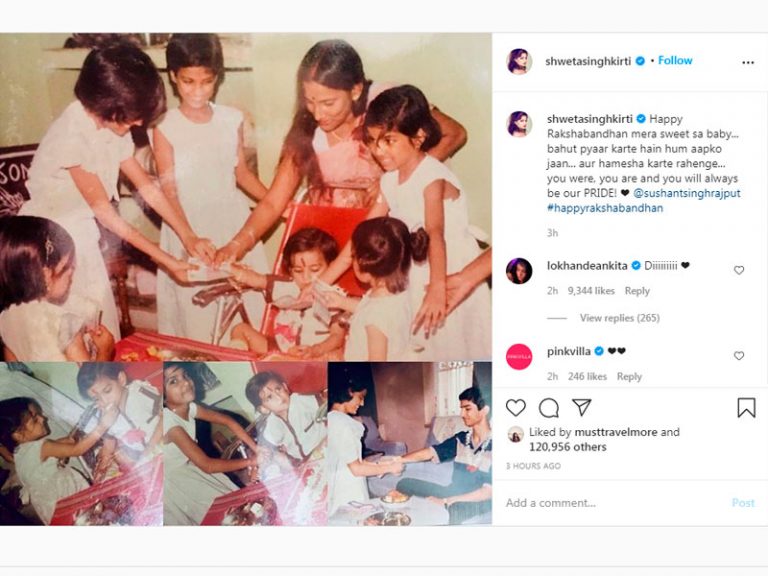
Shweta Singh Kirti, Sushant’s sister, has posted an emotional message on her Instagram remembering the moments she spent with him. She wrote, “Happy Rakshabandhan mera sweet sa baby… bahut pyaar karte hain hum aapko jaan… aur hamesha karte rahenge… you were, you are and you will always be our PRIDE!”
This is the first Raksha Bandhan for Sushant Singh Rajput’s sister after his death. Sushant’s sister was very close to his brother. Before Sushant ended his life, she stayed in Mumbai for two days with Rajput as he was allegedly upset over his breakup with Rhea. She was always worried about his health and well being before the incident. In another post, she wrote to PM Modi and requested him to look into the case.
Death of Sushant Singh Rajput
The talented actor allegedly ended his life 14th June 2020. He was best known for his roles in M.S. Dhoni, Detective Byomkesh Bakshi, Kai Po Che, Shuddh Desi Romance and many others. His death was first connected to nepotism in Bollywood, but now it is said that his ex-girlfriend Rhea Chakraborty forced him to the point where he ended his life.
Mumbai Police is probing the case from the nepotism angle and till now have interrogated more than 40 high-profile celebrities in the case. On the other hand, Rajput’s father, KK Singh, filed a case against Rhea and her family alleging that she used Sushant for money and work. He also claimed in his complaint to Bihar Police that Rhea forced him not to contact his family.
After registering an FIR, a 4-member Bihar Police team reached Mumbai to investigate the case, but Maharasthra Police refused to co-operate. It has become a fight between police departments of Bihar and Maharashtra. Currently, Rhea is hiding to save herself from possible arrest by Bihar Police. One of the senior officers of Bihar Police has been forcefully sent to quarantine by BMC after he landed in Mumbai to lead the team.
Controversy over alleged mental disorder
Sushant Singh Rajput’s alleged therapist, Susan Walker Moffat, recently came forward and made a statement in favour of Rhea. She said that Sushant was suffering from bipolar disorder and she always saw Rhea supporting him. The statement was first published by Barkha Dutt’s news portal Mojo. However, both Barkha and Moffat forgot that as per law, they could not reveal information of a patient with a mental disorder without the consent of the patient.
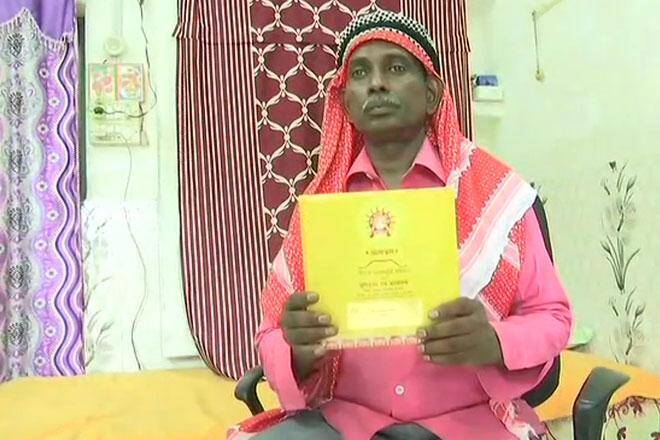
Iqbal Ansari, one of the main litigants in the Ram Janmabhoomi-Babri structure case, on Monday received the first invitation for the Bhoomi Pujan ceremony of Ram Mandir in Ayodhya.
Ecstatic on receiving the invitation, a visibly jubilant Ansari said, “It may be the divine wish of Lord Ram that I get the first invitation. I accept it.” Speaking to media, Ansari further stated that communal tension between Hindus and Muslims will only harm both communities and there should be lasting peace and harmony.
Hindu-Muslim fight will only lead us to troubles: Iqbal Ansari, the main litigant in the Ayodhya land dispute case says after he received the #RamBhumiPujan invitation.
Earlier, Ansari had stated that the building of Ram Temple in Ayodhya is akin to starting a new chapter of the development of Ayodhya. “I am very happy to have a temple in Ayodhya. There has been mutual harmony and no discrimination with anyone from the beginning. The temple will encourage positive sentiment and provide employment to the people of the city. The way many plans have been prepared here it seems that Ayodhya will also have a lot of industries”, he said.
It is pertinent to note that Iqbal Ansari’s father, Hashim Ansari, was the principal litigant of the Ram Janmabhoomi title dispute. Following his father’s demise, Iqbal had continued the legal battle in the Supreme Court. However, after the apex court, in its historic verdict in November 2019, handed over Ram Janmabhoomi site to Hindus, Iqbal had welcomed the court’s decision.
Bhoomi Pujan
The Bhoomi Pujan ceremony will be held in Ayodhya on August 5, 2020. The much-awaited event that marks the beginning of the construction of a Bhavya Ram Temple in Ayodhya will witness several top dignitaries, including PM Modi, attending the ceremony. The ceremony will be graced by Defence Minister Rajnath Singh, UP Chief Minister Yogi Adityanath among several other invitees. Keeping in accordance with the coronavirus guidelines, the ceremony will be attended by not more than 200 people.
The construction of the Bhavya Ram Mandir in Ayodhya will commence soon after the Bhoomi Pujan, which is scheduled to take place on August 5, is completed. The proposed structure to be built at the Ram Janmabhoomi site shall be made with the funds contributed by devotees from across the globe.
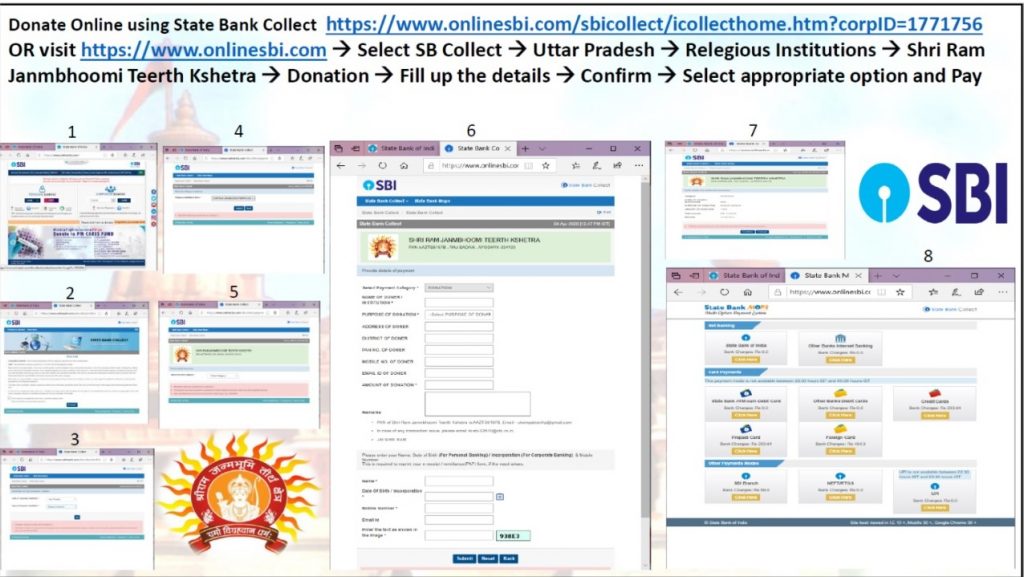
The Shri Ram Janma Bhoomi Tirth Kshetra Trust, which has been established to carry out the construction-related work, has confirmed that it will be accepting donations, support and grants from any person in cash or kind including immovable properties, without any conditions, which means that a person from any faith can make contributions towards the building of the temple.
Several eminent personalities, politicians and spiritual girus have already made their contributions towards the same. The revered Ram Katha narrator, Morari Bapu, who had pledged a total of Rs five crore for the Ram temple construction in Ayodhya, on Sunday raised it to a total of Rs 18.61 crore.
All details regarding donation for the Ayodhya Ram Mandir can be viewed here. It is perinent to note that the donation towards the Ram Mandir Nirman is 50 per cent exempted from Income Tax under Section 80G read with Section 80G(2)(b) of the Income Tax Act, 1961, for the Financial Year 2020-21.
Source: SRJBT Kshetra
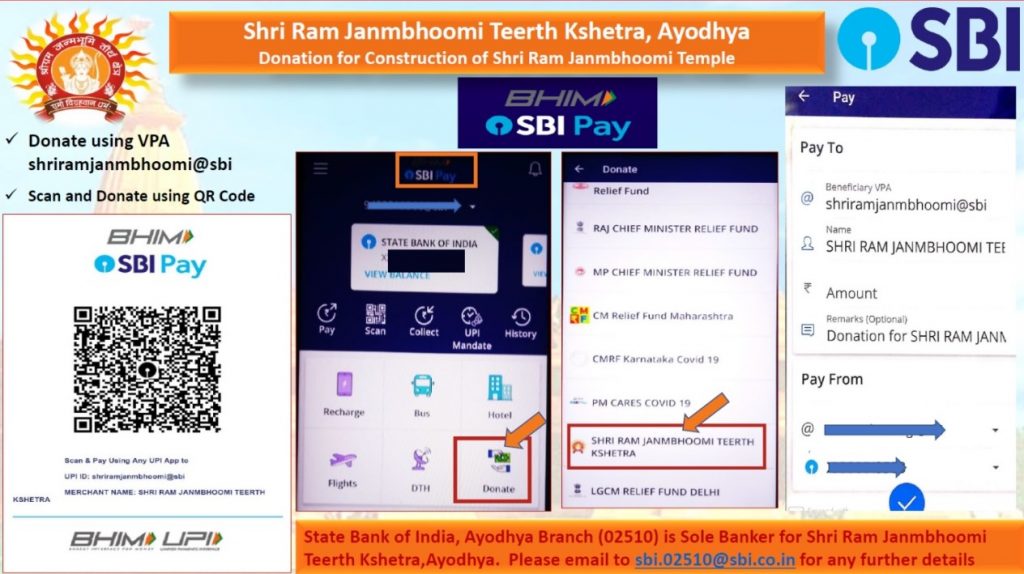
Donations can also be made using VPA through the SBI Pay app.
Source: SRJBT Kshetra
Devotees can also make a donation through State Bank Collect.
Source: SRJBT Kshetra Trust
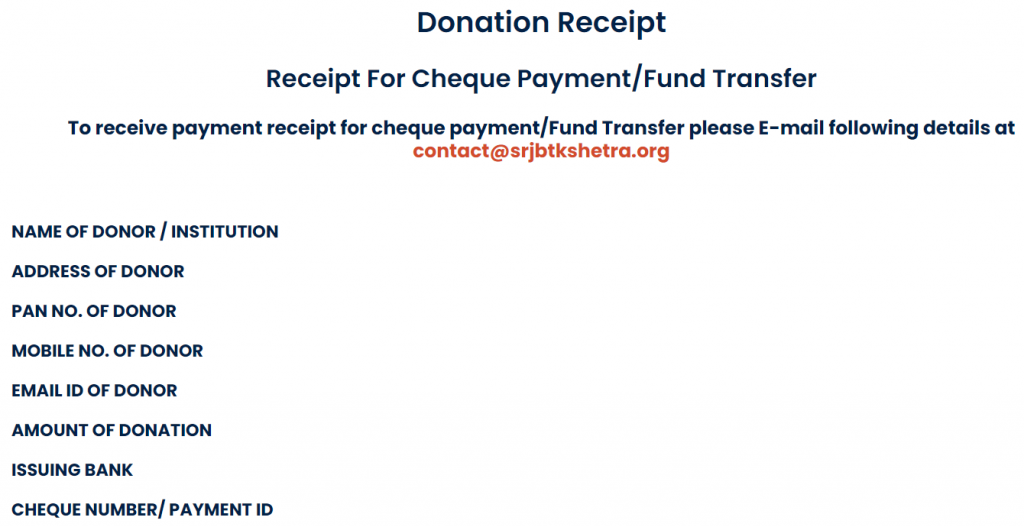
Donors can also request a receipt for the donations they have made.
Source: SRJBT Kshetra trust
The rituals prior to the Bhoomi Pujan of the Ram Mandir commenced today
The three-day ritual, ahead of the Bhoomi Pujan, began today with the Gauri Ganesh Puja. The puja began at 8 am with chanting of mantras by 11 priests while the Ramayana path was held in various other temples.
Prime Minister Narendra Modi is all set to visit the holy city of Ayodhya to perform the auspicious event of Bhoomi pujan on the 5th. As per reports, Prime Minister Modi will place a silver brick weighing 22.6 kg at the foundation site of the majestic Ram Mandir during the event. Five silver rocks denoting 5 Nakshatras will also be placed. The Prime Minister will be worshipping 5 silver rocks in the form of Nanda, Jaya, Bhadra, Rikta and Poorna and install them in the foundation of the temple.
Owing to the current Coronavirus outbreak, Hindu devotees have been urged to watch the historic and auspicious event on television. Sri Ram Janmabhoomi Teerth Kshetra, the trust established for the construction of the temple, has appealed to the general public to welcome the grand occasion by lighting diyas in their homes in the evening.