As the country was preparing itself for the historic day when the consecration of the much-awaited Ram Temple in Ayodhya would take place, habitual offender NDTV continued uploading posts on its social media pages, describing the Ram Mandir site as “disputed”.
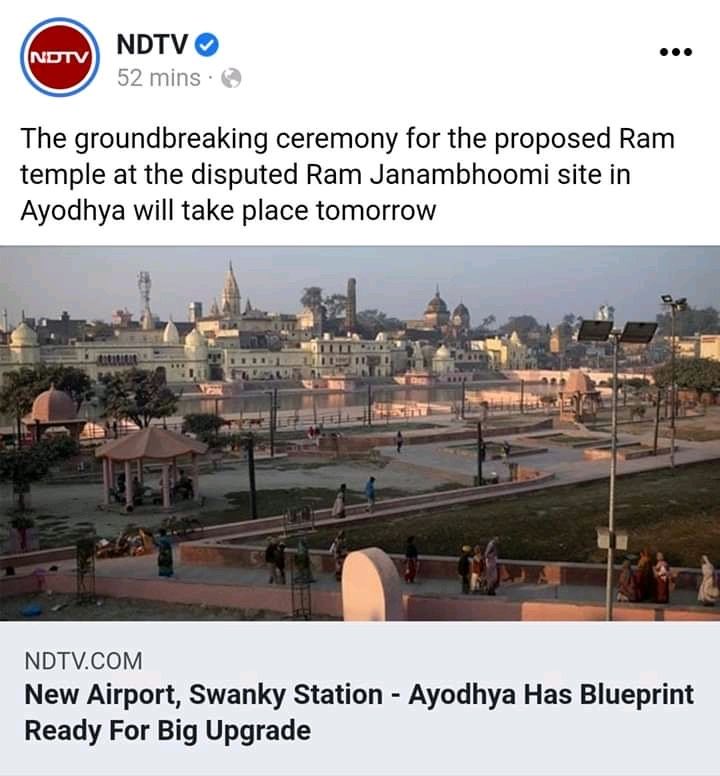
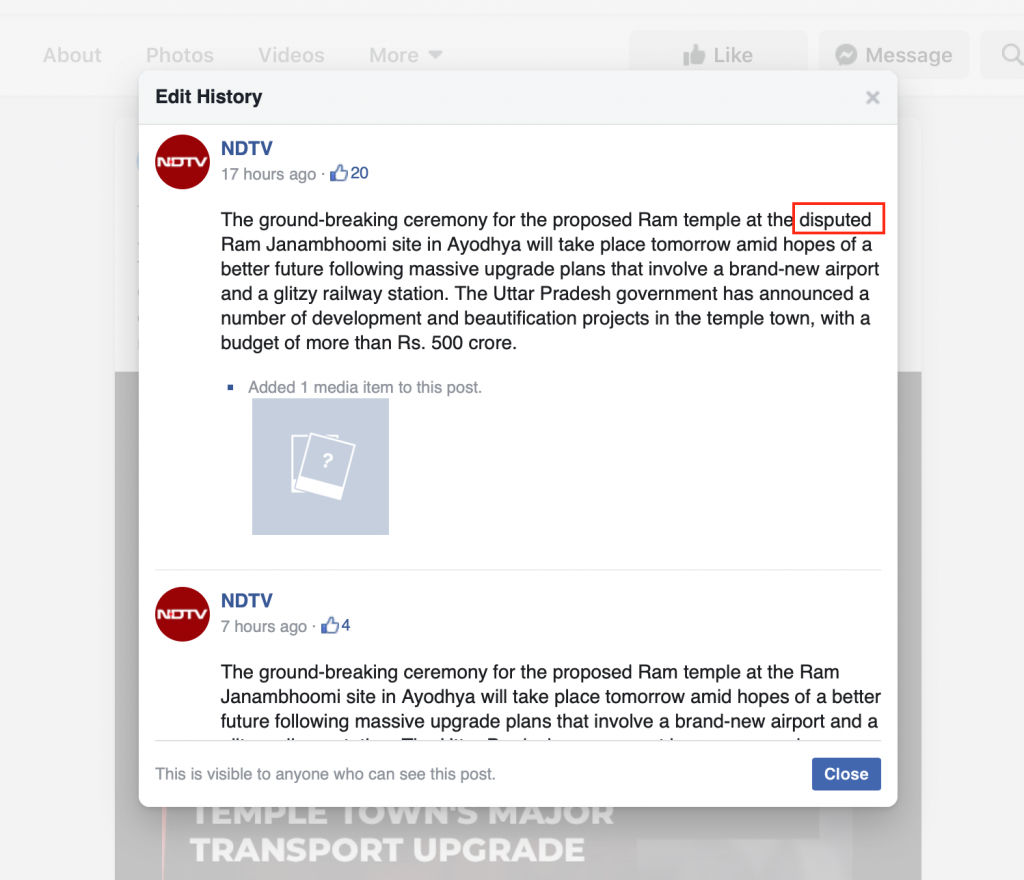
“The groundbreaking ceremony for the proposed Ram temple at the disputed Ram Janmabhoomi site in Ayodhya will take place tomorrow,” read one of the Facebook posts uploaded by NDTV yesterday.
NDTV post on Facebook describing Ram Mandir site as disputed
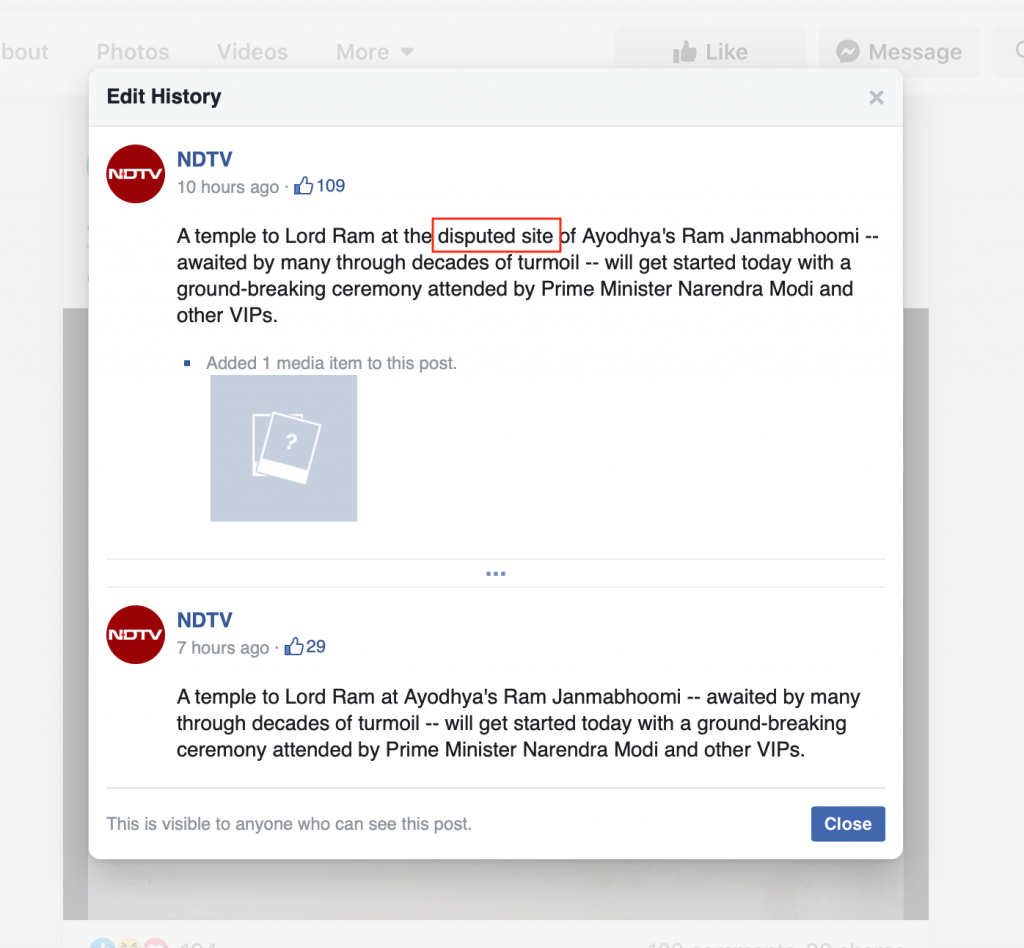
This was not an aberration as another post uploaded this morning on NDTV’s Facebook page once again described the Ram Janmabhoomi as “disputed”.
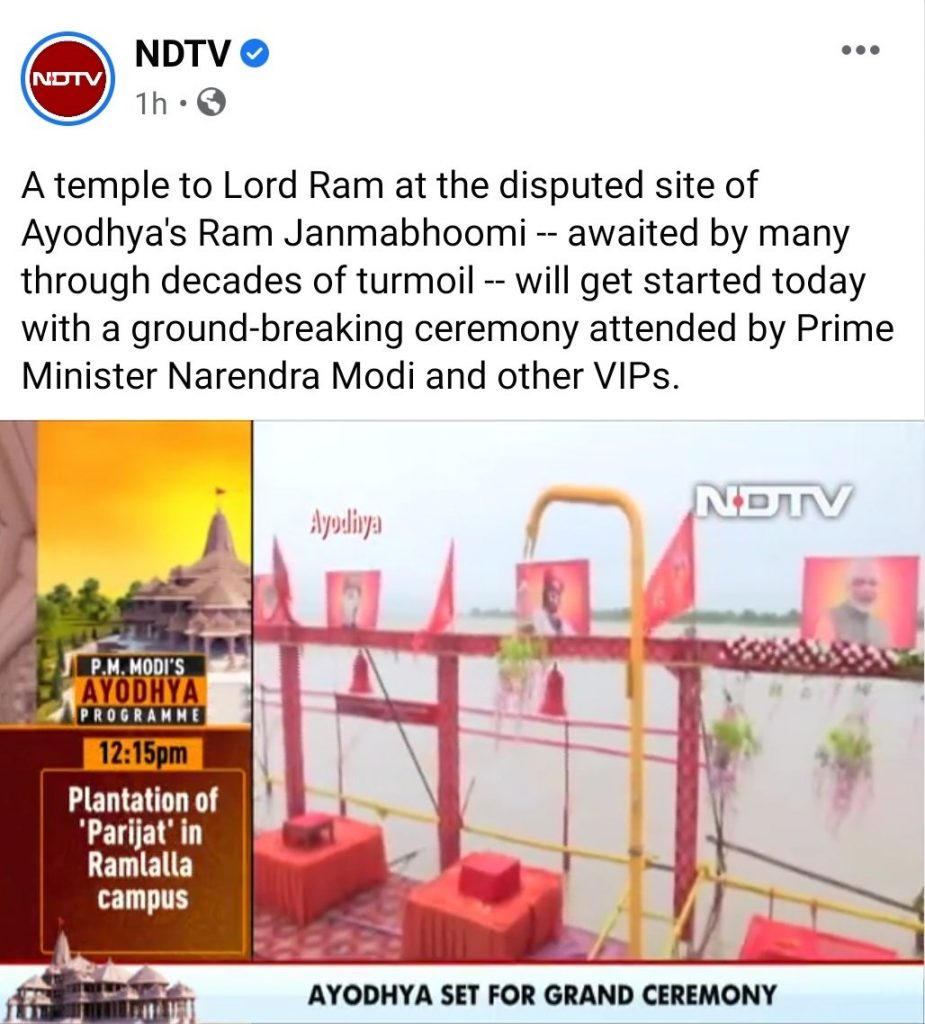
“A temple to Lord Ram at the disputed site of Ayodhya’s Ram Janmabhoomi—awaited by many through decades of turmoil—will get started today with a ground-breaking ceremony attended by Prime Minister Narendra Modi and other VIPs,” the post read.
Facebook post by NDTV describes Ram Janmabhoomi site as disputed
The perverse and prejudicial posts by NDTV drew the ire of the Hindus, who slammed the news channel for its wrongful description of the Ram Janmabhoomi site. A barrage of criticism was directed at the NDTV for continuing to depict Ram Janmabhoomi as “disputed”, even though the Supreme Court, in its landmark judgment last year, had granted Hindus the site for the construction of a Ram Mandir over it.
Similarly, there were two other posts, in which NDTV had wrongly referred to Ram Janmabhoomi site as “disputed”.
The Ram Janmabhoomi site was disputed till the time the title case over it between Hindus and Muslims was being heard in the Court. But after the Supreme Court awarded the site to the Hindus, and as no petition has been filed against the verdict by any side, the site is no longer disputed, and the highest court of the country has ruled that Ram Lalla and his devotees own the place.
As the public backlash against NDTV’s dishonest reporting grew, the channel, realising that it has infuriated the Hindus on social media, quietly proceeded to rectify its posts. The word “disputed” was edited out from the posts that had garnered negative reactions from users.
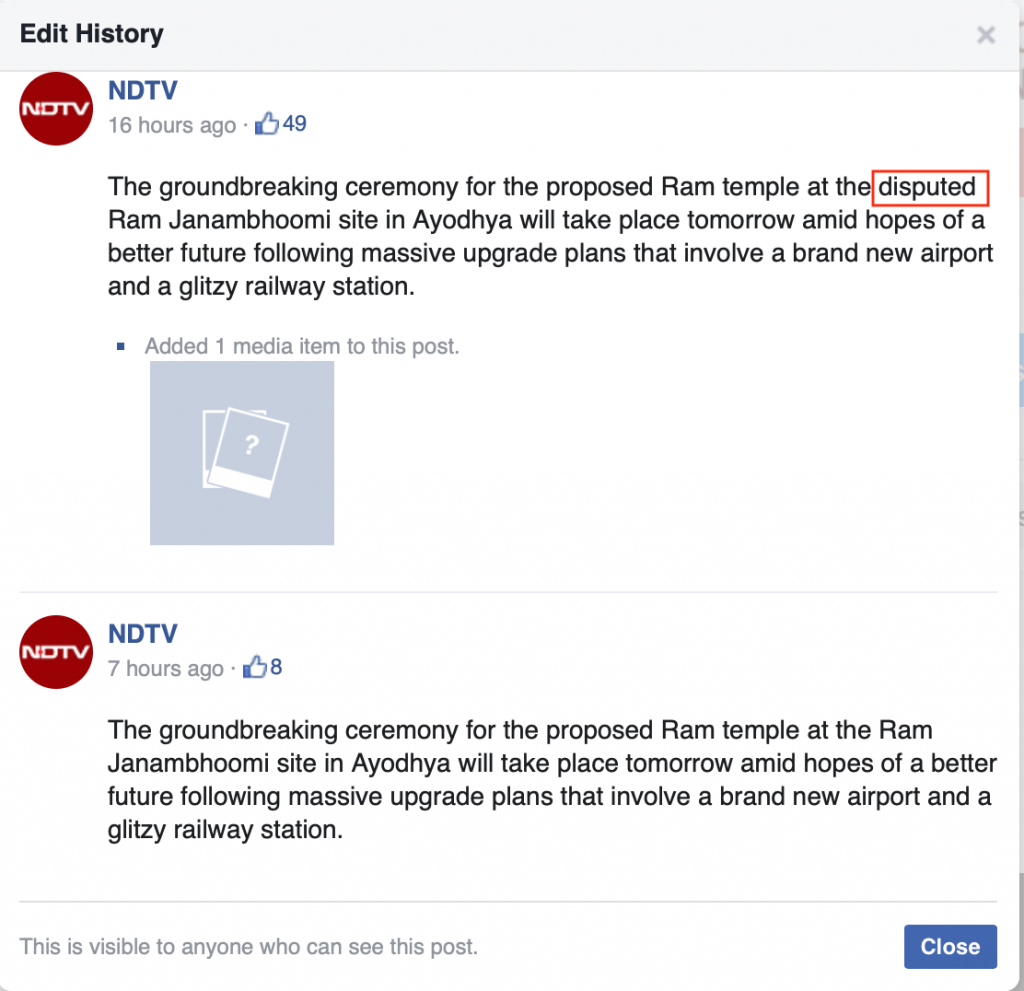
One of the posts which were uploaded yesterday and had described Ram Janmabhoomi site as “disputed” was changed about 9 hours later. The word “disputed” was removed from the post. The ‘View Edit History’ option on Facebook lets users go through the changes that were made on the posts by the admin. It can be found by selecting the ‘View Edit History’ on the dropdown menu on the top right corner of the post.
Edit history of a post uploaded by NDTV on Facebook
Another Facebook post which is shared above had been sanitised by the NDTV. The words “disputed site” were removed and the post was shared once again.
Edit history of a post uploaded by NDTV on Facebook
Similarly, one more NDTV post which had earlier mentioned Ram Janmabhoomi as disputed was edited by the admin of the NDTV page and the word “disputed” was redacted.
Edit history of a post uploaded by NDTV on Facebook
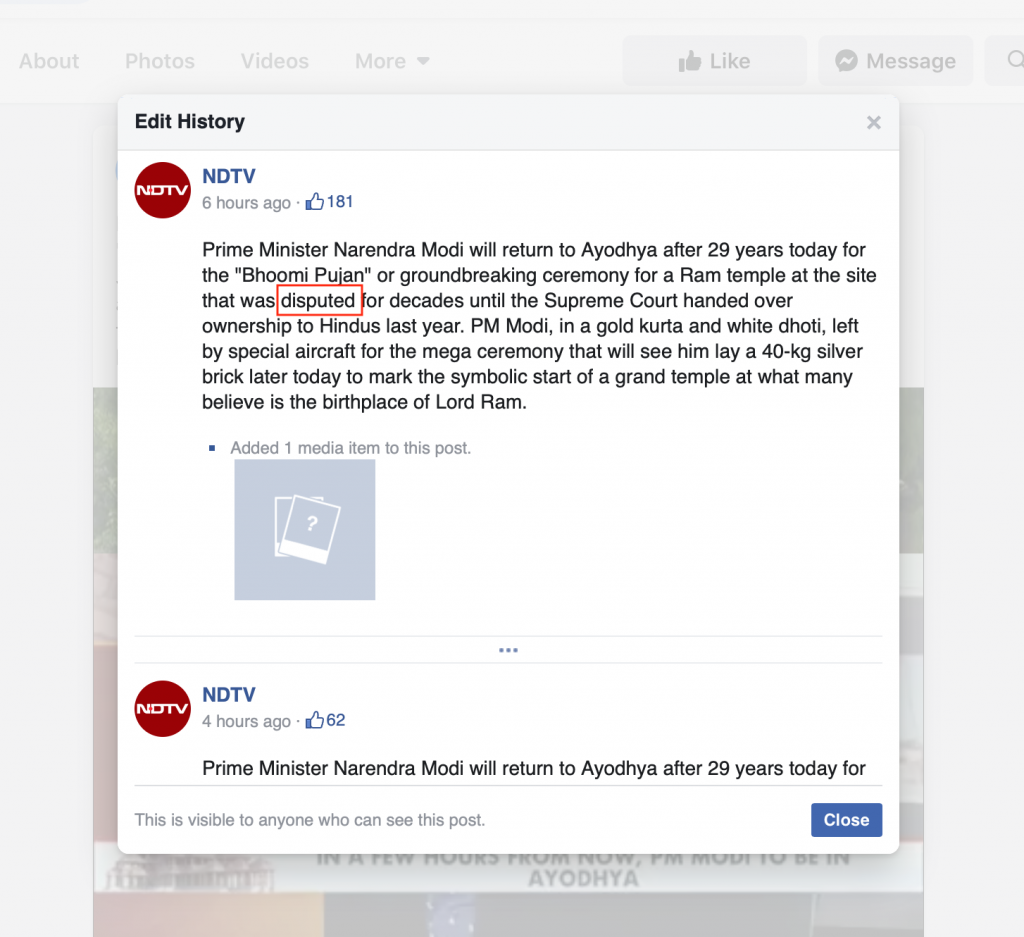
Likewise, a post that provided an account of PM Modi’s schedule for today had also referred to Ram Janmabhoomi site as “disputed”. The ‘View Edit History’ shows that even that post was tinkered with.
Edit history of a post uploaded by NDTV on Facebook
Bhoomi Pujan ceremony of Ram Mandir at Ayodhya
NDTV’s reports casting aspersions on the legitimacy of Ram Janmabhoomi site came at a time when the nation was gripped in a festive mood over the Bhoomi pujan ceremony of the Ram Mandir in Ayodhya. The Bhoomi pujan ceremony was scheduled for August 5 after the Supreme Court of India had last year gave a verdict in the protracted legal dispute of Ram Janmabhoomi and terminated its disputed status by granting it to the Hindus.
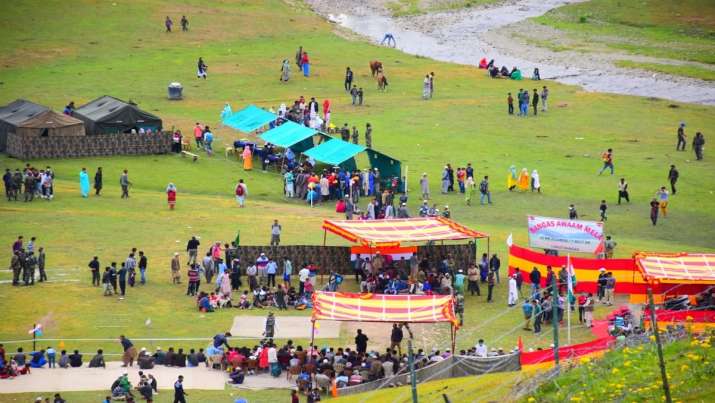
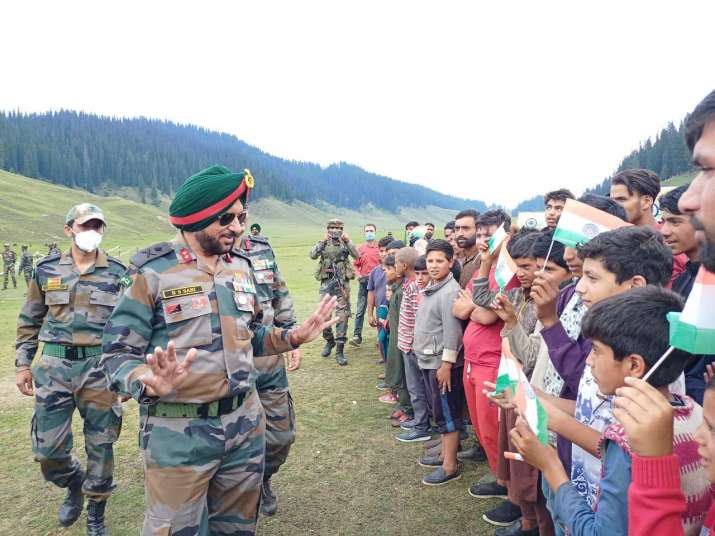
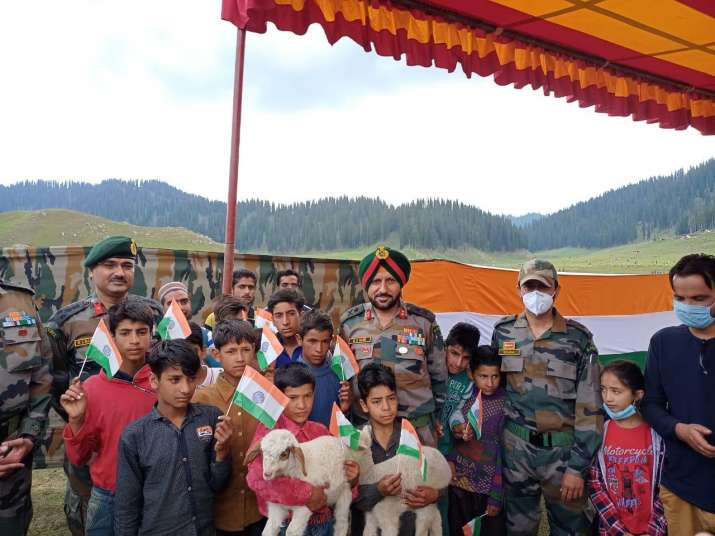
Hundreds of Gujjars, Bakarwals and other Kashmiri’s from Kupwara, Tangdhar and Handwara on Wednesday celebrated Bangus Awaam Mela to commemorate the first anniversary of the abrogation of Article 370 in the valley. The local administration officials said: “Soundly rejecting the efforts of Pakistan to create a false narrative around the first Anniversary of Abrogation of Article 370 in Jammu and Kashmir, Kashmiris on Tuesday celebrated the event by holding the Bangus Awaam Mela in District Handwara with great fanfare.”
Two-day event organised to celebrate the first anniversary of Abrogation of Article 370 in Jammu and Kashmir
The two-day event, commencing on August 3 with the grand finale on August 4, was organised in the Lokut Bangus valley by the 21 Rashtriya Rifles (GUARDS), under the aegis of Headquarters 7 Sector Rashtriya Rifles. The event was inaugurated by Col Gangandeep Singh, YSM, Commanding Officer, 21 Rashtriya Rifles on 03 August 2020 followed by free medical and veterinary camp and village games.
Free medical camp
A Veterinary and Medical Camp was organised with an aim to provide basic health care facilities along with free medicines to the locals who are residing in the remote region of Bangus valley and do not have access to the basic medical facility. The camp was a combined effort of the 03 Army doctors and 08 Civil Medical Authorities. A total of 678 patients including 328 males, 271 females, 80 children were given treatment and advice by the doctors.
Free Veterinary camp
The veterinary camp was organised to provide medical aid to 135 Live Stocks and give free medical advice.
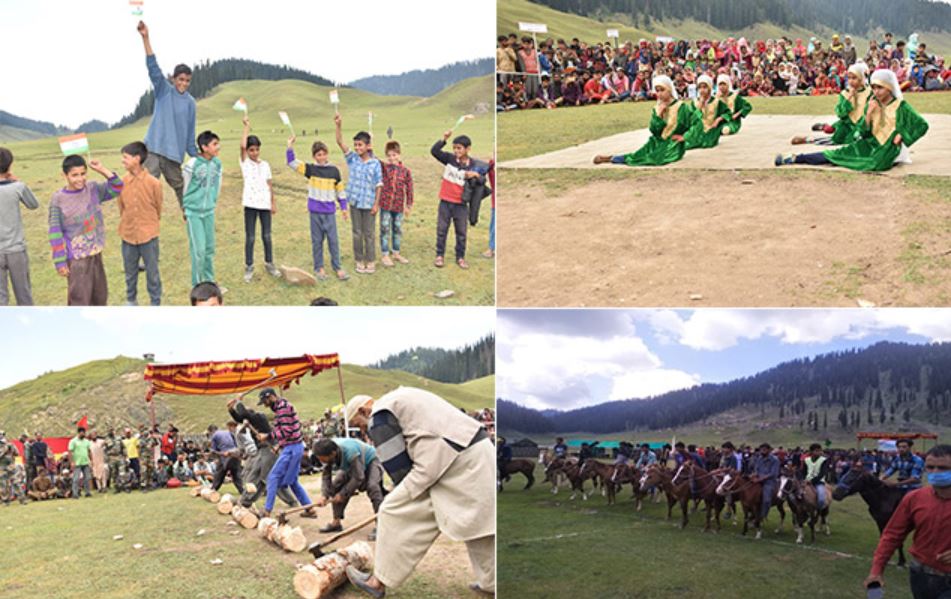
Village Games were organised
On the first day of the event, competitions like Horse Racing, Sheep Shepherding Challenge, Tugs of War and Wood Chopping were held among the residents of the Gujjar Bakerwal Community. The second day witnessed a variety of events including Karate Display, Songs by locals and School Children, Folk Song & Dance by local group and finals of village games.
The event ended with the Army distributing Solar Lamps to Gujjar Bakarwal families and prize distribution to the participants. The community elders also gave a vote of thanks to the Army for its support. The two-day event was concluded with the recitation of the National Anthem.
Apart from this event, BJP also celebrated the occasion at many places across Srinagar with functions held by party leaders. The Indian flag was hoisted at the BJP office in Srinagar and slogans were chanted.
BJP spokesperson said: “After the revocation of Article 370, the development was seen on ground in Kashmir. For a long time now the stone pelting has come down to zero. BDC members get Rs 25 lakhs for development in their own respective areas. All elections in the Kashmir valley have been held peacefully.
Besides Srinagar, BJP members also celebrated by unfurling the national flag and raising “Bharat Mata ki jai” slogan at Anantnag, Ganderbal and Kupwara.
BJP leader Altaf Thakur said that the abrogation of Article 370 provisions of the Constitution, which accorded special status to Jammu and Kashmir, had brought about many positive changes and put an end to stone pelting in Kashmir.
“There used to be stone pelting during encounters that have stopped. There used to be ISIS flag, Pakistani flag…that has stopped. That is what we are celebrating,” he added.
Social media was abuzz with pictures of local BJP Leader Rumisa Rafiq hoisting and saluting the Indian tricolour at Lal Chowk in South Kashmir’s Anantnag district on the 1st anniversary of Article 370 and 35A abrogation from Jammu and Kashmir.
Local BJP Leader Rumisa Rafiq hoists and salutes the Indian tricolour at Lal Chowk in South Kashmir’s Anantnag district on the 1st anniversary of Article 370 and 35A abrogation from J&K inspite of repeated threats of Pakistani terrorists and radical separatists. pic.twitter.com/O6i4wg86iU
Pakistan planned to organise a series of events to denounce the abrogation of Article 370 on its first anniversary
This atmosphere of celebration and exuberance in the valley is surely a big slap on the faces of the Pakistani propaganda machine which had reportedly organised a series of visits/events leading up to August 5, in a bid to once again dredge up the issue of Jammu and Kashmir. A tweet posted by retired Major Gaurav Arya had thrown light on Pakistan’s nefarious plans ahead of the first anniversary of the abrogation of Article 370.
Protests and demonstrations are also chalked out by the Pakistani propaganda machinery in its embassies around the world, perhaps, in their bid to internationalise the issue of Jammu and Kashmir and draw the international attention towards the abrogation of Article 370, notwithstanding its numerous failures at the same in the last 12 months.
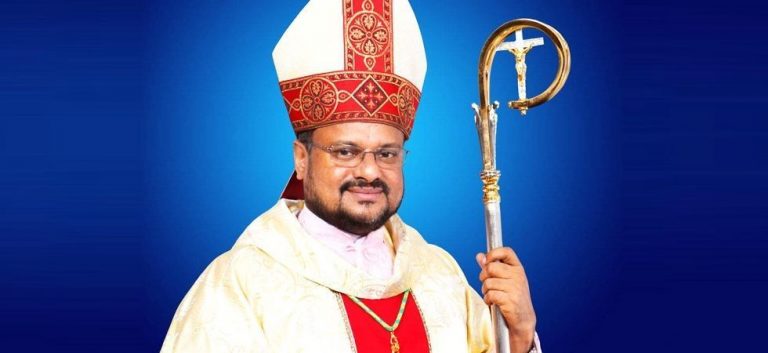
In a big setback for the rape-accused Bishop Franco Mulakkal, the Supreme Court on Wednesday dismissed his petition seeking to clear rape charges against him. Bishop Franco, who is accused of raping a 44-year-old nun will now have to face trial in the rape case.
According to the reports, Bishop Franco Mulakkal had filed a petition in the Supreme Court seeking to quash Kerala High Court’s order that had dismissed his discharge plea in the rape case. The Kerala High Court had ruled that the rape-accused Bishop must face trial in the case after the prosecution had argued that there was enough evidence against him.
“You don’t have a case and there is no merit in your petition,” said Chief Justice of India SA Bobde hearing Mulakkal’s petition.
Franco Mulakkal had moved Supreme Court after a trial court in Kottayam had cancelled his bail on grounds that he had failed to appear before the court several timings despite several warnings. On July 13, the Kottayam court had cancelled Mulakkal’s bail and had issued a non-bailable warrant against him.
However, Franco Mulakkal’s counsel had claimed that the accused had tested positive for coronavirus and hence was not able to appear before the court.
Franco Mulakkal, Bishop of the Roman Catholic Diocese of Jalandhar, was accused of raping a 44-year-old nun at a guest house in Kuravilangad in May 2014 and subsequent sexual exploitations afterwards. The nun had registered a complaint in June 2018 and has also claimed that despite her complaints, the church took no action on the bishop.
Bishop Franco was granted bail in the nun rape case in 2018
Bishop Franco Mulakkal, Archdiocese of Jalandhar, Punjab, was arrested by the police officials on September 21, 2019, after the investigating team finally found evidence that linked him in the sexual harassment case. The court had pointed out the availability of evidence to pursue the case.
However, the Kerala High Court later issued some directions to the rape accused before approving his bail plea. The court ordered the bishop to be present before the investigating officer once in two weeks.
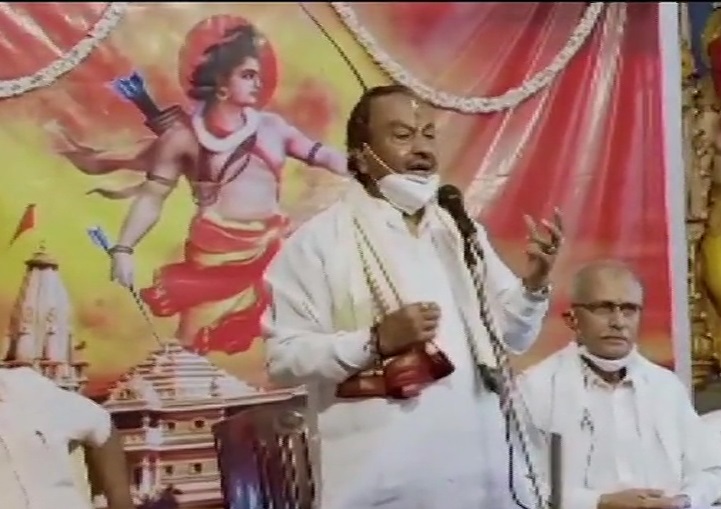
Senior BJP leader and Karnataka Minister KS Eshwarappa on Wednesday said that the Ram Mandir Bhoomi Pujan ceremony, which is being held in Ayodhya in Uttar Pradesh, is the first step towards eradicating the culture of slavery and restoring the Hindu culture in the birthplace of Lord Rama.
Speaking at an event in Shivamogga, which was organised to celebrate the Bhoomi Pujan ceremony of Ram Mandir at Ayodhya, minister KS Eshwarappa said that the Mosques at Kashi and Mathura were constructed by demolishing temples and hence there is a need to build Hindu temples at both the places. He said that there are Mosque at both the sites, which means we are still slaves.
In both these places, when we offer prayers, there are mosques on sides, which say that you are still a slave. It is necessary to liberate these temples: K. S. Eshwarappa, Karnataka Minister https://t.co/7mPMPi24Za
“It’s a good day that the foundation stone for Ram Temple has been laid. A beautiful temple will come up, but there are Kashi Vishwanath & Krishna Janmasthan temples which have to be liberated,” said KS Eshwarappa, who is the Rural Development and Panchayat Raj Minister of Karnataka.
The Minister added that Hindus feel enslaved when they visit temples at Kashi and Mathura and added that it is difficult to offer prayers with devotion at these temples as the Mosques present at the site remind Hindus of their subjugation. Hence, we need to liberate these temples, said the minister.
KS Eshwarappa also asserted that there will be temples at both Kashi and Mathura in the near future just like Ayodhya. He added all the three Hindu temples, once constructed, will be the symbol of nationalism in the country.
The senior leaders remarks comes on the day when Prime Minister Modi performed Bhoomi Pujan for the proposed Ram Mandir at Ayodhya.
Reclamation of Kashi and Mathura temples
Following the Supreme Court verdict on Ram Janmabhoomi case, there has been a growing demand among Hindus to reclaim Kashi and Mathura, along with Ayodhya. Taking back the disputed sites of Kashi Vishwanath temple and Krishna Janmabhoomi temple at Mathura has now become a priority for various Hindu groups in the country.
The Gyanvapi Mosque was built by the Islamic invader Aurangzeb after destroying the Kashi Vishwanath temple. The remnants of the ancient Hindu temple can still be seen on the walls of the Gyanvapi Mosque. The temple was an earlier restoration of the original Kashi Vishwanath temple, which was destroyed and rebuilt several times in history. The current Kashi Vishwanath was built on a site adjacent to the Mosque in 1780.
Similarly, the Shahi Idgah Mosque stands at the Krishna Janmabhoomi in the city of Mathura. The Islamic invader Aurangzeb had destroyed the ancient Keshavnath temple and built the Shahi Idgah Mosque on its plinth in 1669.
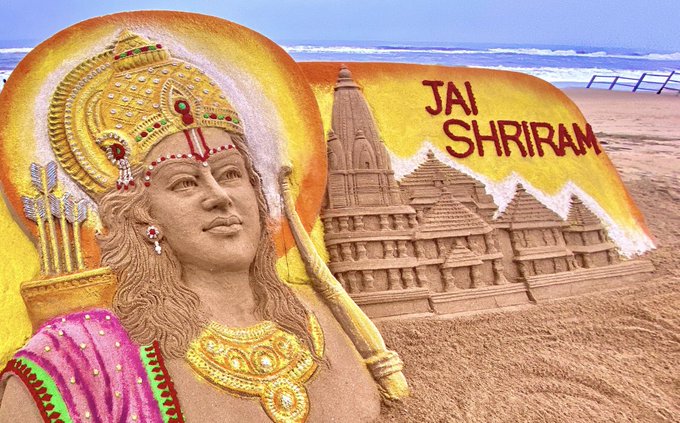
Ram Mandir Bhoomi Pujan completed in the presence of PM Modi along with 174 leaders and saints. Due to Covid-19 pandemic, Ram Bhakts could not visit Ayodhya to witness the once-in-a-lifetime event. To overcome the loss of opportunity, many artists have come up with amazing illustrations, sculptures and paintings in the last few weeks. Here are some of the best artworks we found across social media platforms.
Sudarsan Pattnaik, famous sand artist posted photos of his sand sculpture of Bhagwan Ram on his social media accounts.
Karan Acharya, who became a popular name in every household for his Rudra Hanuman sketch, made a few illustrations in the last couple of weeks. The first one is of Ram Lalla.
A post shared by pawan boloor (@pawan_acharya_boloor) on
There are hundreds of illustrations posted by artists from across the world showing their happiness and enthusiasm towards Ram Mandir. As per the information provided by Ram Janmbhoomi Teerath Kshetra Trust, it will take around 3.5 years to complete the construction work.
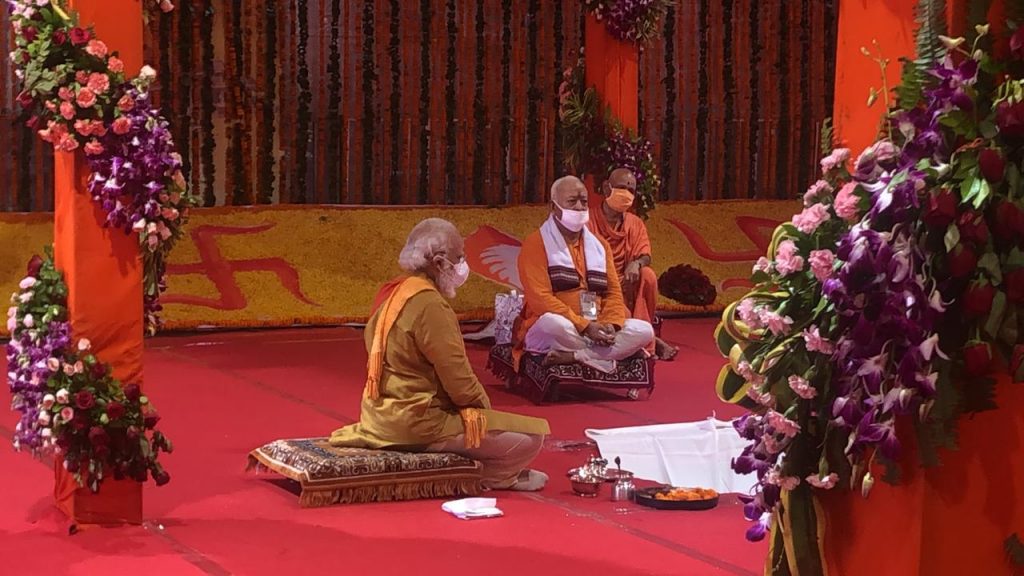
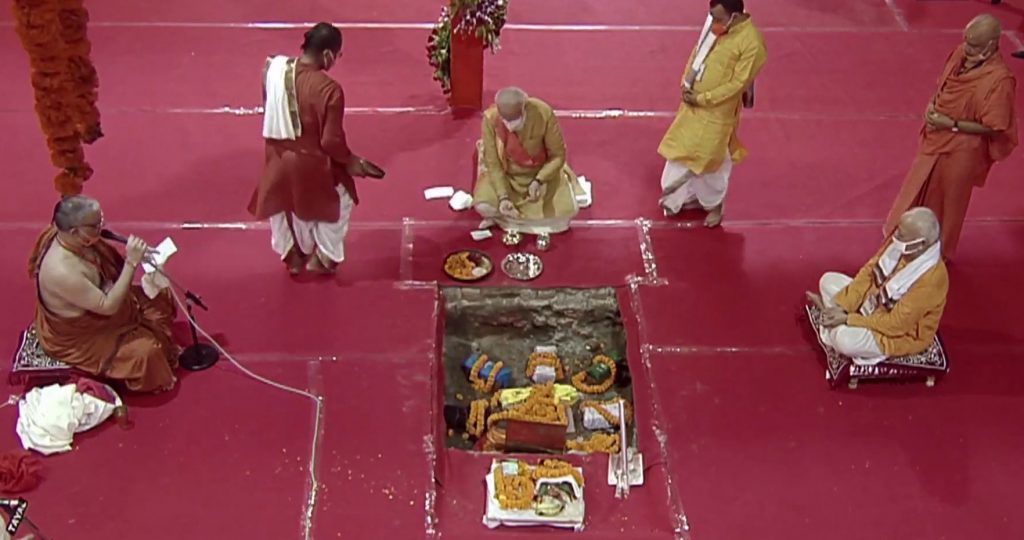
The 500 years of struggle came to fruition for millions of Hindu devotees across the world today as Prime Minister Narendra Modi performed the Ram Mandir’s Bhoomi Pujan at 12.44.08 PM. PM Modi who returned to Ayodhya after 29 years, expressed gratitude to all citizens of this nation, Indian diaspora across the world and all the Ram Bhakts on today’s auspicious occasion.
Overwhelmed by Sri Ram Janmabhoomi Tirtha Kshetra Trust’s decision to invite him and provide him with the opportunity to witness this historic moment, PM Modi said that “It is my good fortune that I was invited to witness this historical moment… From Kanyakumari to Kshirbhavani, from Koteshwar to Kamakhya, from Jagannath to Kedarnath, Somnath to Kashi Vishwanath…today entire country is immersed in Lord Ram.”
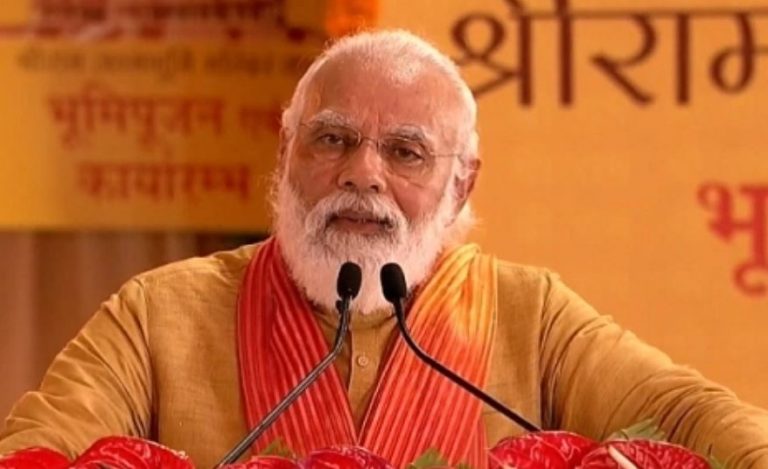
“Ram Janmabhoomi has got its freedom today. Like August 15 is Independence Day for the country, today holds a similar significance for crores of those who devoted their lives for the cause of Ram temple”, said PM Modi addressing the luminaries and dignitaries present for the Ram Mandir’s Bhoomi Pujan ceremony.
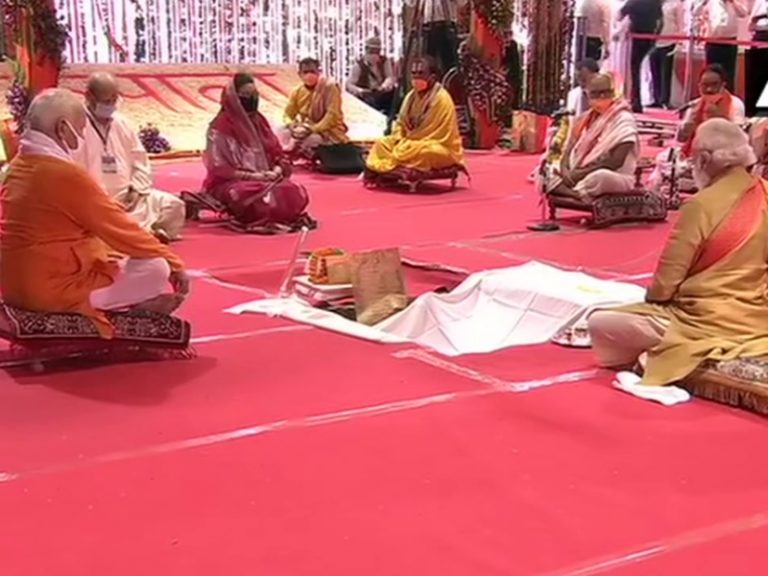
PM Modi during Bhoomi Pujna for Ram Mandir
“The way Dalits, OBCs, tribals, every section of the society supported Gandhiji during the freedom struggle, this pious work of building Ram temple has started with the cooperation of people from all over the country. The way boatmen and tribals helped Lord Ram, the way children helped Lord Krishna lift Govardhan mountain, similarly, the temple’s construction will be completed with everyone’s efforts,” he added.
There is no such aspect of life where Lord Ram does not come as an inspiration. Structures were destroyed, efforts were made to eradicate Lord Ram’s existence, but it is his immense power that he continued living in our hearts and is the basis of our culture. There has been no ruler as idealistic as Ram in the history of the world. “Ram sab me hain, Ram sabke hain”, Lord Ram is omnipresent, he belongs to all humanity, Ram is etched in our hearts and will continue to be so, said our Prime Minister.
भगवान राम की अद्भुत शक्ति देखिए।
इमारतें नष्ट कर दी गईं, अस्तित्व मिटाने का प्रयास भी बहुत हुआ, लेकिन राम आज भी हमारे मन में बसे हैं, हमारी संस्कृति का आधार हैं।
“A grand temple will now be built for our Ram Lalla who had been staying in a tent. Today Ram Janambhoomi breaks free of the cycle of breaking and getting re-built again, a process that had been going on for centuries”, said Prime Minister Modi.
This process of construction of Ram temple is an attempt to connect the entire nation. This festival is a celebration of connecting faith with the existing, connecting past with the present, the world with faith and connecting oneself with sacraments, said Modi. I believe that this grand Ram temple, like the name of Shri Ram, will reflect the rich heritage of Indian culture. I believe it will inspire the entire humanity till eternity.
PM Modi paid his tribute to the lakhs of Ram Bhakts who laid their lives for the Ram temple. He said that this auspicious day could only come into our lives because of the sacrifices made by the Hindu devotees generation after generation. “This day is proof of the truth of the resolve of millions of devotees. This day is a unique gift of the non-violence, faith and sacrifice shown by millions of devotees”.
आज का ये दिन करोड़ों रामभक्तों के संकल्प की सत्यता का प्रमाण है।
He said that we have to ensure that the message of Lord Ram and the Ram Temple, the message of our thousands of years of tradition reaches the whole world continuously.
The Prime Minister concluded his speech by chanting “Siyapati Ram Chandra Ki Jai”.
Prior to the PM’s address, Uttar Pradesh Chief Minister Yogi Adityanath has said that the centuries-old struggle for the temple was taken to its logical conclusion by the Modi government.
“The ‘Bhumi Pujan’ will not only mark the beginning of the construction of the Ram temple but also ‘Ram Rajya’ as envisaged by the Prime Minister. We started the ‘Deepotsav’ programme three years ago to give the people a feel of Ram Rajya and we also worked alongside for beautification and development of Ayodhya that will now emerge as one of the most prosperous religious destinations. The Prime Minister has already earmarked projects for the Ramayana circuit,” Yogi Adityanath said.
Similarly, Rashtriya Swayamsevak Sangh chief Mohan Bhagwat said that today is the joy of the fulfilment of centuries and that the ritual of making India self-reliant has been completed today. Remembering Ashok Singhal, Paramhans Das and LK Advani on this pious occasion, Mohan Bhagwat said that the beginning of temple constructions proves “we can do what we want to do”.
The day for which millions of Hindu devotees have been waiting with bated breath is finally here. Ayodhya’s Bhavya Ram Mandir’s construction will now speed up as the Bhoomi Pujan has been successfully completed today. It is being estimated that the Ram Mandir construction would approximately be completed in three and a half years. But as we celebrate this auspicious day today, one should also reminisce those thousands of Hindu devotees and Karsevaks whose extreme sacrifices laid the foundation for the Hindu reclamation of the Janmabhoomi of Bhagwan Ram.
The despicable act of police brutality that was inflicted on Hindus in November 1990
2nd November 1990, IG SMP Sinha said to his subordinates: There is a clear instruction from Lucknow that the crowd will not sit on the streets at any cost.
Who was sitting on the Lucknow’s chair then? Why was he giving such orders? Who was wanting to come across as the ‘Messiah’ of Muslims? Before these questions could be answered, we should know what had exactly happened in Ayodhya on 2nd November 1990.
2nd November, 1990, Hindu massacre in Ayodhya
It was 9 am on the auspicious day of Kartik Purnima when Hindu saints and thousands of Karsevaks, comprising also of women and elderly people, resumed their march towards the Ram Janmabhoomi site where the disputed structure then stood. The security forces, who were instructed to stop the Hindus from reaching the site, lined up on the road to block the way.
Whenever the security personnel tried to impede the Hindu devotees, they would sit there and start chanting the name of Lord Ram and reciting Bhajans (religious songs). They touched the feet of the security personnel, deployed to prevent them from marching ahead. Each time they did this the security personnel would move back and the Karsevaks would move forward. Though unarmed, the Karsevaks remained undeterred.
This kept happening in a loop until the IG passed orders and the police personnel sprung to action. Tear gas shells were fired, lathis were rained at the Karsevaks, but the resolute Ram Bhakts neither counter-attacked nor did they agitate or falter. Suddenly the security personnel started responding by opening fire. Many Hindu devotees were targeted and gunned down. It’s believed that the security personnel hunted and targeted Hindus in every lane and bylane leading to the Ram Janmabhoomi and within no time the streets converted into a war zone.
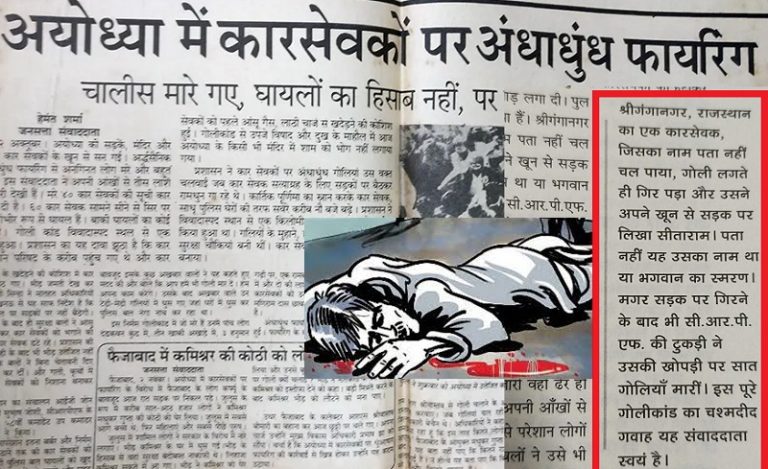
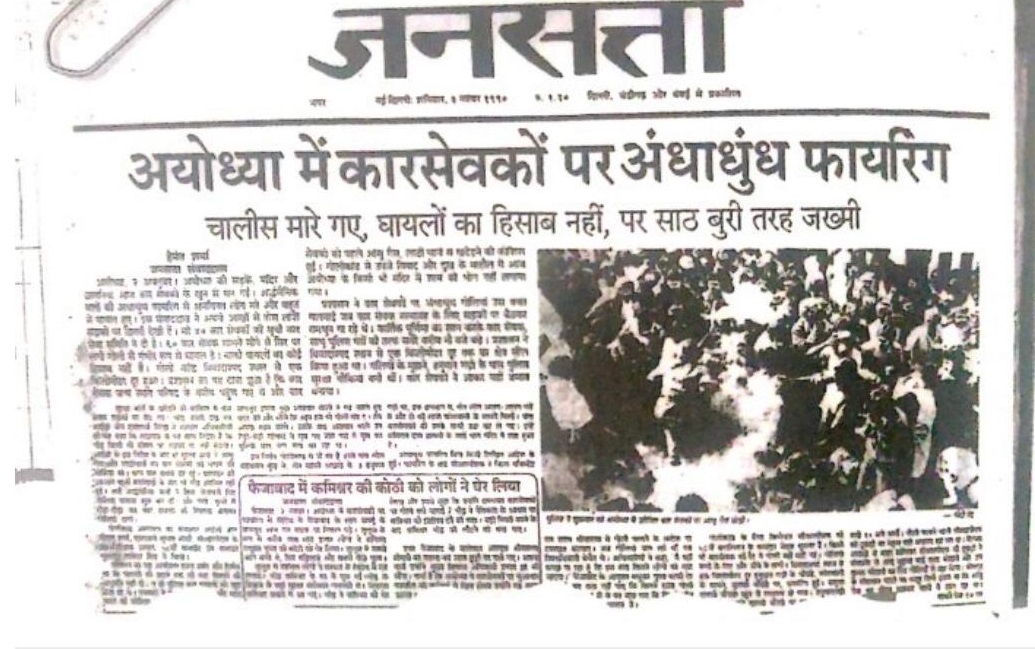
On 3rd November 1990, a report published by Hindi daily Jansatta wrote:
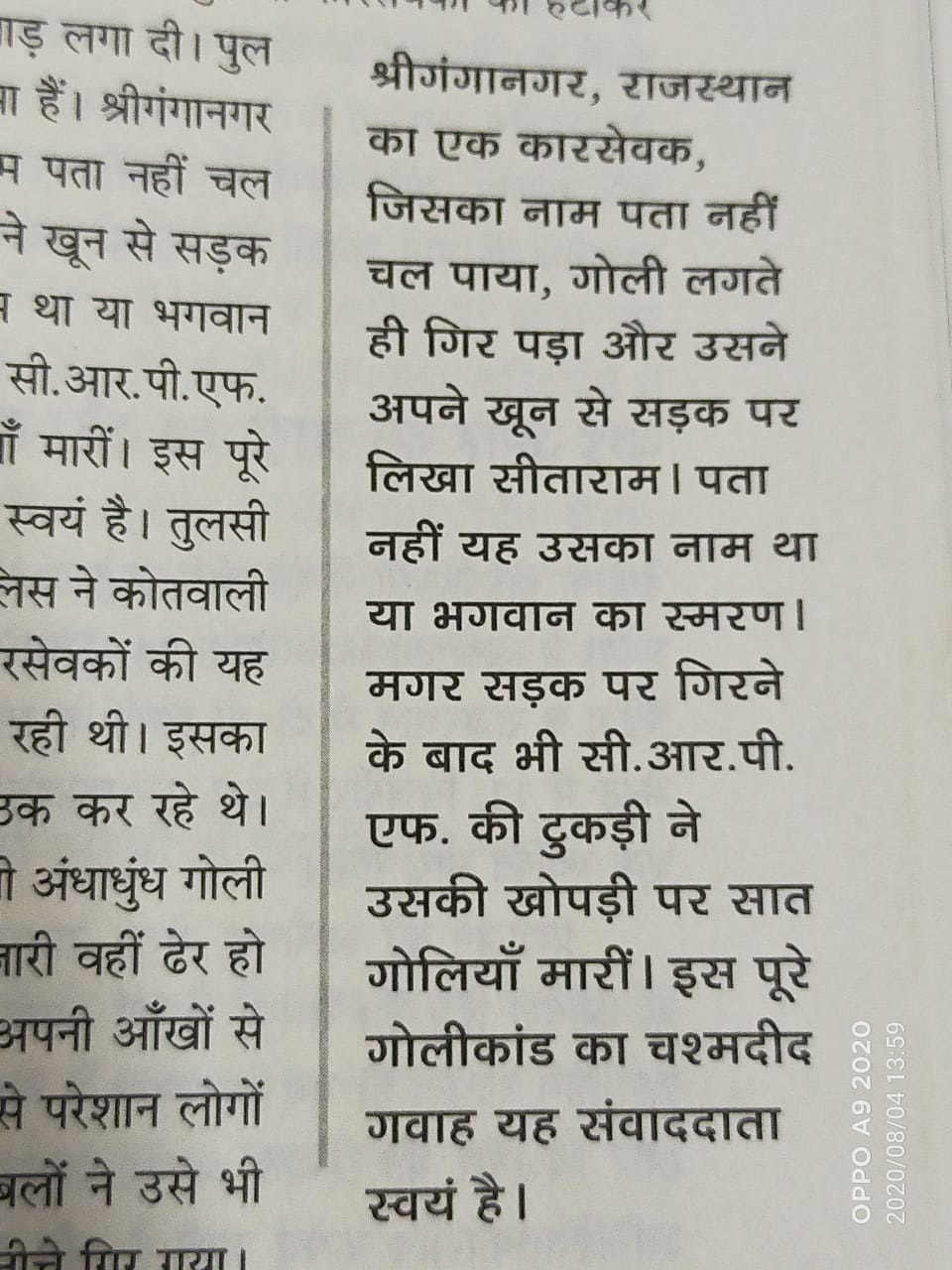
A Karsevak of Sriganganagar, Rajasthan, whose name was not known, fell as soon as he was shot by the security personnel. As he fell, he wrote “Sitaram” on the road with his blood. It remains a mystery whether the Karsevak had written his own name or was it his devotion and adherence towards Lord Ram which made him write “Sitaram” in his own blood. The report had mentioned that even after the Karsevak fell to the ground, the CRPF personnel had shot seven bullets into his skull.
The report published by Jansatta on November 3, 1990.
An extract from the e-book “Ayodhya ka Chashmadeed”
More details which had emerged regarding the November 2 carnage:
The security personnel neither offered help to the injured nor allowed anyone else to help them.
The police did not have any prior written order for firing. In fact, the district magistrate had signed the order after the police had carried out the firing.
No Karsevak was shot in the leg. All of them were shot in the head and chest. Which means that the security personnel had fired with an intention to kill and not just injure.
The Tulsi crossing was converted into a battlefield with the streets soaked in the Karsevak’s blood. Kothari brothers were dragged out of the Digambar Akhara and shot at.
Ramachal Gupta, a 26-year-old Karsevak, was attacked by the police personnel from behind, while he led a group of two dozen devotees towards the Ram Janmabhoomi.
Security forces entered the Digambar Akhada and started indiscriminately firing at the Sadhus present there.
The priest of a Hindu temple situated in front of the police station was shot at.
A Sadhu, who was standing on the rooftop and throwing buckets of water to help the tear-gassed people was also shot at.
After the firing, the bodies of the devotees lying on the streets were filled in sacks and were disposed off.
It was in this carnage that the heroic Kothari brothers lost their lives
On November 2, 1990, a large group of Karsevaks, including the Kothari brothers, started to gather in front of Hunumangarhi, a stone’s throw away from the disputed structure that was eventually demolished later. The group led by Bajrang Dal’s Vinay Katiyar started moving ahead but were stopped by police.
All of them sat on the road in protest and started singing ‘bhajans’ (religious songs) when suddenly, the security personnel at the behest of the then CM Mulayam Singh, started firing at the crowd and chased Karsevaks across the area. Many people died from head wounds. There was a stampede at the Saryu Bridge, which killed a number of people. According to eye-witnesses, the Kothari brothers mounted a saffron flag atop the Babri Masjid, but however, fell prey to the brutality meted out at the Karsevaks.
How many karsevaks actually died in the November 1990 carnage?
The incident which occurred in Ayodhya, almost 30 years back, left an ineradicable mark in the history of India. After the brutal massacre, different media houses had come up with different numbers of those killed on November 2, 1990. In a report published the next day by Jansatta, the number of dead karsevaks was stated to be 40. It had also stated that 60 others were badly wounded in the incident while it could not give the exact number of people who escaped with minor injuries. Meanwhile, a journalist who was on the spot during the incident, reported the death toll to be 45.
The Hindi daily Dainik Jagran had said that 100 people had died in the police firing, while Daily Aaj said this number was 400. Though the official report on the incident concluded that 16 people had been killed in the firing, however, the fact remained that the number was potentially far higher.
Interestingly, the administration had not provided any data on its own immediately after the incident, but the media data was not denied. Even the then Faizabad Commissioner, Madhukar Gupta could not tell how many rounds were fired until hours after the firing. He did not even have the data of the dead and the injured.
Jansatta had written clearly in its report: “By firing on unarmed Karsevaks, the administration has committed a far more heinous crime than the Jallianwalabag incident.”
What delibrated ‘Mulla’ Mulayam to take such a whimsical stance
Most of them think that the demolition of the disputed structure on December 6, 1992, altered the communal landscape of India. But there is a background to this incident which shaped the events which led to the demolition of the Babri Masjid.
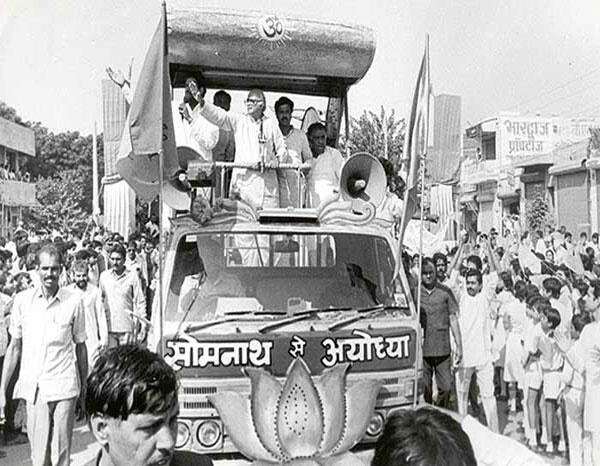
These series of events include LK Advani leading a nationwide Rathyatra, to persuade people to join in the construction of Ram temple at the Ram Janmabhoomi, where the disputed structure stood.
The VP Singh-led government then was on shaky ground at the Centre due to infighting in the ruling Janata Dal. In Uttar Pradesh, Mulayam Singh Yadav of the same party was the chief minister. The Janata Dal was vehemently against the Ayodhya campaign by the RSS, the BJP and the VHP.
“Let them try and enter Ayodhya. We will teach them the meaning of law. No masjid will be broken.” Mulayam Singh Yadav, in an attempt to please the Muslim vote bank, had declared in October 1990, opposing the rath yatra of LK Advani.
LK Advani could not enter Ayodhya as he was arrested in Bihar by the Lalu Prasad government of the Janata Dal. Advani’s arrest by Lalu Prasad proved to be a game-changer. Lalu overnight became a hero in the eyes of the Muslims. Mulayam Singh, miffed by this strategy laid by Lalu Prasad at the behest of VP Singh at the centre thought of doing something which could immediately pose him as the hero in front of the Muslim vote bank. Mulayam Singh probably then decided that killing unarmed Karsevaks will project a heroic image of him for the Muslims.
On the morning of October 30, the police had barricaded about 1.5 km-long pathway to the disputed structure. Ayodhya was in an unprecedented security cordon. Curfew had been imposed. Yet, sadhus and Karsevaks marched towards the structure.
By noon, police received orders from then Chief Minister Mulayam Singh Yadav to open fire at the karsevaks. The firing led to chaos and stampede. Police chased down the karsevaks in the streets of Ayodhya.
Another round of clash erupted on November 2, when the Karsevaks came back and resumed their march towards the Ram Janmabhoomi site.
It was reported then that the police had disposed of many dead bodies, either by cremating them at unknown places or by dumping them into the Saryu River in sacks. The news of the shootings was mostly suppressed from the Indian media then, however, the Chief Minister of Uttar Pradesh was given the sobriquet ‘Mulla’ Mulayam Singh for his pro-Muslim stance during the incident.
Self-aggrandizement is something which I loathe. But this, I guess is that kind of day and this is the story which needs to be told. Sometime in 1989 when I came to know, that Hindus are struggling to built Ram Mandir in Ayodhya, I was shocked. I got associated with Ram Janmabhoomi, when L K Advani went on Rath Yatra in 1990. Somehow that year, Secular Socialists were able to stop him. But the movement only got stronger. RSS/VHP/BJP kept the pressure on. It was decided, that thousands of Karsevaks will agitate in Ayodhya in Dec 1992.
And on the evening of 25th Nov 1992, along with many friends, I was on Mahanadi Express. As the train moved towards Bhopal, more and more Karsevaks were added. In a while, it was packed to the roof. If my memory is not failing me, the train went smoothly till Bina. From there it was sent back promptly to Vidisha. After a while it rolled again, only to be sent back immediately, not sure to which station this time.
By now more than 12 hours of the journey was gone. Not an inch to move. Dabba given by Mom was over long back. Now it had become impossible to bear inside the train. People started getting out. Reluctantly the leaders amongst us, allowed everybody to get down. After a while, it was realised that the train won’t be allowed in UP.
From there, we were put on buses and taken to the picturesque lovely temple town of Chitrakoot. Where I met Uma Bharati for the first time. We were at Chitrakoot for 3 days. It was 5 days since spoken to parents. Most of my friends in their twenties started getting jittery. Travel back towards South was available. Lot of them chose to go back. I was not sure. My childhood friend (Can’t name him) said “Wapas Nahi Jayenge.” And so we stayed.
Next 7 days were one of the most physically trying times of my life. We were taken to a small city called Banda in UP. Where we slept on open ground. (Imagine UP chill in Dec). Only to be put in detention in a school for the next 2 days by UP police. Somehow escaped with a small group. And on the banks of Ganga stayed in a temple for one day. Transport towards the South was still available and free. From there Allahabad, which on other shore was visible. Our leader asked us “Kashi ka Allahabad Kaise ho Gaya?” Valid question.
Next day morning 5.30 march towards Ram Janmabhoomi began. We walked, through the villages and green open grounds and farms. We walked early morning and when the sun was shining brightly. And when it was tilting. Villagers made sure drinking water, tea, jaggery and food is available at all times. We stopped in the evening. My legs were aching is an understatement. I had lost feelings of limbs being there. Thankfully again tea and jaggery were ready. After a little while, dinner was served. Sumptuous village food.
Took our dinner early, and slept like toddlers at 8 pm. Up again at 4.30. Started walking at 5.30. Same routine for the next 2 days. Early evening 3rd day I lost my patience. And blasted our leader, “How much longer we have to go?”. He promised, today we are going to be there. And, truly, sometime after sunset as we were walking, a local who was accompanying us showed a temple top and said “Dekho Ayodhya…”
Folks, words have limits. I can not describe my feelings! I thought Tenzing Norgay and Sir Edmund Hillary must have the same kind of feeling when for the first time they made it to the top of Kanchenjunga.
We were taken to a huge temple. Joy got multiplied to find an RSS friend from my locality already there. We were fed again and beds were made available. This was all good, it was close to 15 days since had spoken to parents and sister. And now what? Where do we go from here? Again one RSS leader told us, “Dhiraj rakho. Sleep now. Jai Shree Ram”.
Next morning we were woken and told today’s the day. As we got ready and started walking with hundreds of volunteers, news came in that the Mosque has been taken down. Police were overrun and administration has collapsed. Stay where you are. We have distributed sweets and we celebrated. Mission accomplished! The town was reverberating with “Jai Shri Ram” and “Mandir Wahi Banayenge”! It was unbelievable.
We celebrated like crazy. And wanted to visit the site. But, we were told, by our leader who was with me right from the start till here, we should stay where we are. There is nothing to be done now. And the danger of a stampede is very high. Was there through the morning. At around 10 am took a train to Lucknow. Reached at 2.05 PM. A train was getting ready to move at 2.10. I asked a Coolie, “Kaha Jayegi?” (Where to). He replied “Madras”. I thought this must be going through Nagpur. I saw a man sitting inside. Went to him, and asked “Nagpur jyegi kya”. Came back the reply in Marathi “Aat madhe ye” (Come inside). I broke down in tears!
On Wednesday, Prime Minister Narendra Modi landed in the ancient holy city of Ayodhya to participate in the historic Bhoomi Pujan ceremony for the construction of Ram Mandir.
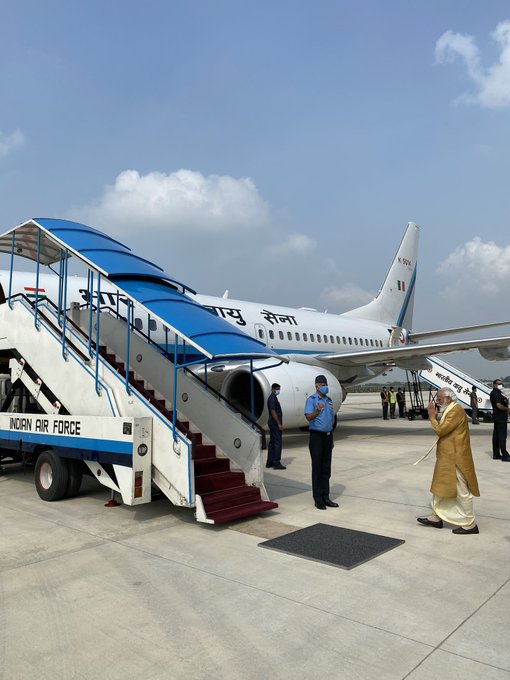
The Prime Minister had left Delhi in the morning in an Indian Air Force (IAF) plane and landed in the Uttar Pradesh capital city Lucknow from where he boarded a helicopter to travel to Ayodhya. In a gold silk kurta and white dhoti, Prime Minister Modi landed in the historic city in a helicopter for the first time in 29 years.
The Prime Minister first offered prayers at the 10th century Hanumangarhi temple – a shrine to Lord Hanuman. PM Modi was presented with a headgear, silver ‘mukut’ and a stole by Sri Gaddinsheen Premdas Maharaj, head priest of the ancient Hanuman Garhi Temple.
#WATCH: Prime Minister Narendra Modi presented with a headgear, silver ‘mukut’ and stole by Sri Gaddinsheen Premdas Maharaj, head priest of 10th-century Hanuman Garhi Temple.#Ayodhya#RamTemplepic.twitter.com/EOgqrz9hi1
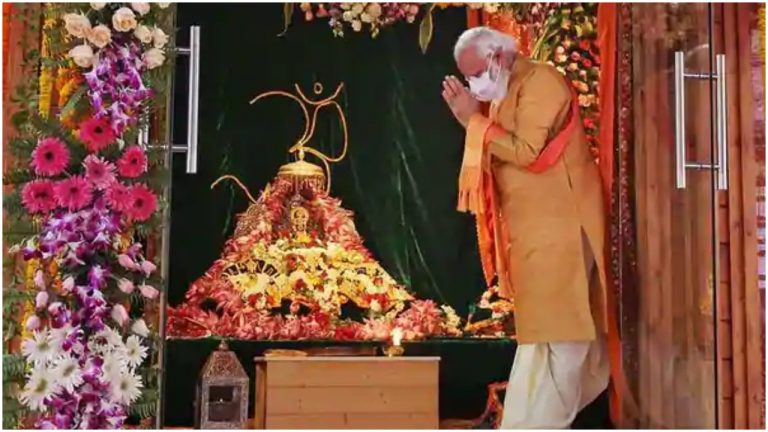
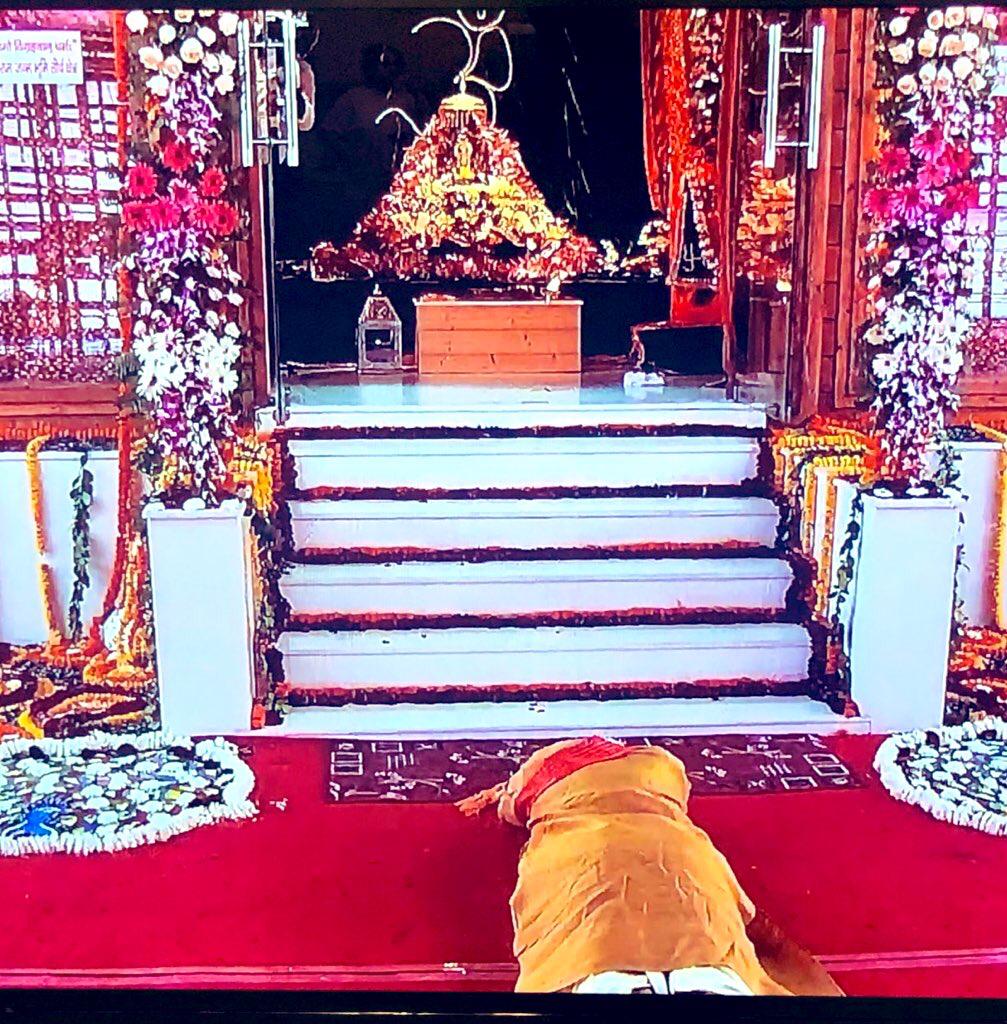
From Hanumangarhi temple, Prime Minister Modi visited the Ram Lalla or the infant Lord Ram to offer prayers and performed ‘sashtang pranam’ at Ram Janmabhoomi.
PM Modi also participated in a tree plantation programme inside the premises and planted a Parijat sapling, considered a divine plant, ahead of foundation stone-laying of Ram Mandir.
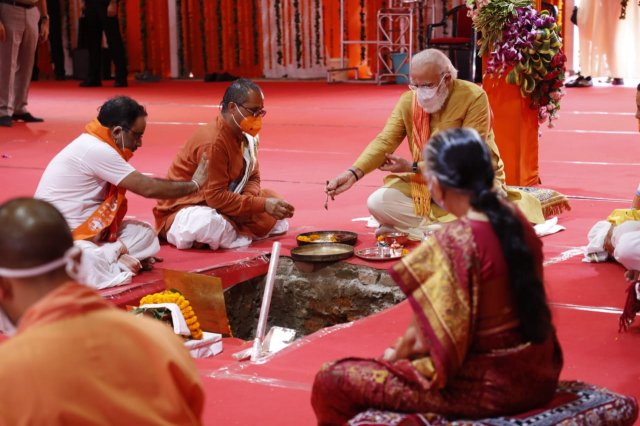
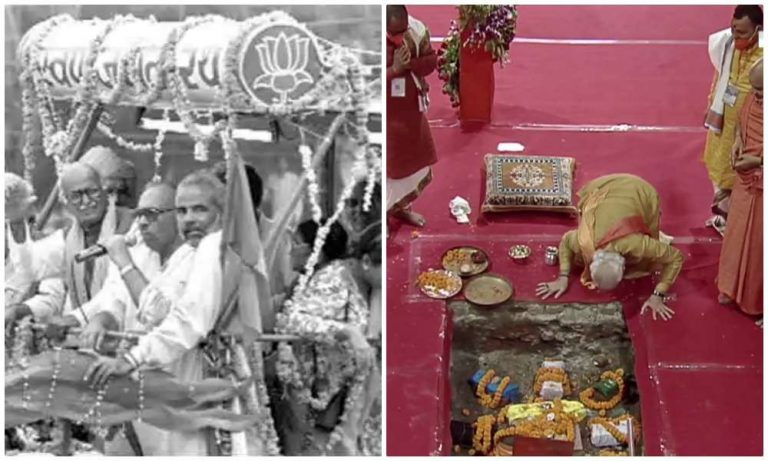
Later, Prime Minister Modi visited the Ram Mandir site to perform Bhoomi Pujan ceremony. He was accompanied by RSS chief Mohan Bhagwat, Uttar Pradesh governor Anandiben Patel and others.
During the Bhoomi Pujan ceremony, Prime Minister Narendra Modi laid a 40-kg silver brick to symbolise the beginning of construction of Ram Mandir. As per the priest at Ram temple Bhoomi Pujan, nine bricks were placed at the site of the ceremony, which was sent by the devotees of Lord Ram from around the world in 1989.
“There are 2 lakh 75 thousand such bricks out of which 100 bricks with ‘Jai Shri Ram’ engraving have been taken,” the priest said during the ceremony.
Prime Minister Narendra Modi also unveiled the plaque of Ram Mandir at Ayodhya. President of Ram Mandir Trust Mahant Nitya Gopal Das, Uttar Pradesh CM Yogi Adityanath, Governor Anandiben Patel and RSS Chief Mohan Bhagwat were also present alongside Prime Minister Modi him.
After performing the ceremony, the Prime Minister also released a commemorative postage stamp on the ‘Shree Ram Janmabhoomi Mandir’ and addressed the nation on the historic occasion.
Ayodhya: PM Narendra Modi releases a commemorative postage stamp on the ‘Shree Ram Janmabhoomi Mandir’ pic.twitter.com/fM7ACVNjKJ
PM Modi is expected to be in the city of Ayodhya till Wednesday evening, which has been decked with over 1,50,000 lamps to celebrate the historic event.
When PM Narendra Modi took charge of the government at the centre, one thing must be on his mind and that it the construction of Ram Mandir. Bharatiya Janata Party’s manifesto has always emphasized on the construction of the Mandir, but as the case was in court, there was nothing much that could have been done. There is no denying that PM Modi does not shy away from wearing his identity as a Hindu and often flaunt ethnic attire with Tilak on his forehead and Rudraksha Mala in his neck.
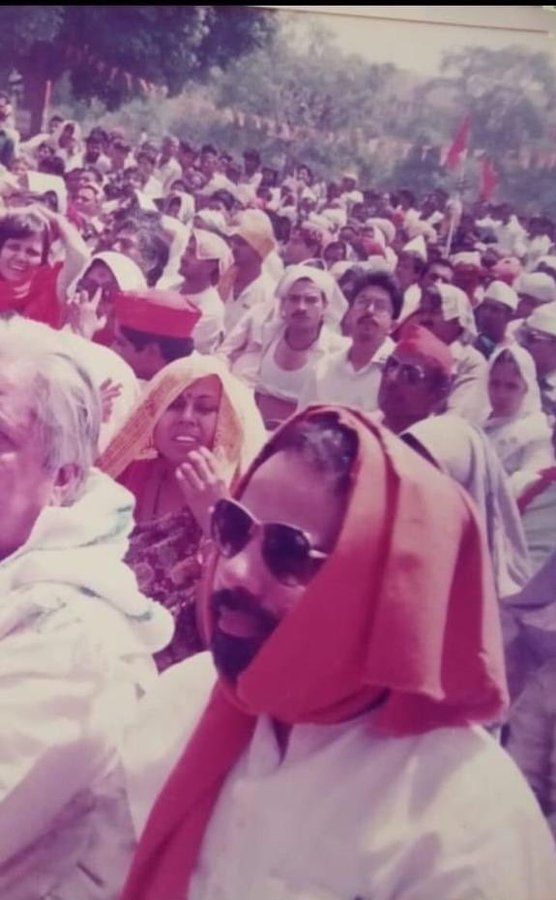
His role in Ayodhya Andolan has come to life in the last few days after several photos and stories emerged on social media. Here is a look on Modi’s journey from Ayodhya Andolan to Bhoomi Pujan in Pictures. Before we begin, here is a video of PM Modi chanting “Jai Jai Shri Ram” during his election rally in Ayodhya ahead of 2019 elections.
— Narendra Modi fan (@narendramodi177) July 26, 2020
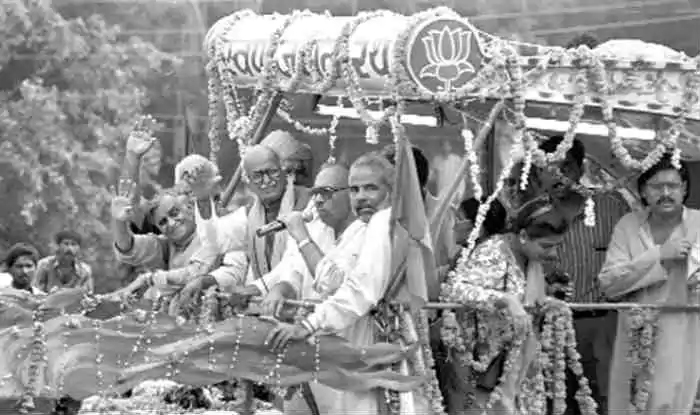
PM Modi was an important part of the Rath Yatra organized by LK Advani in 90s before demolition of disputed structure.
PM Modi was often seen as Saarthi for LK Advani during Rath Yatra (Source: Twitter)
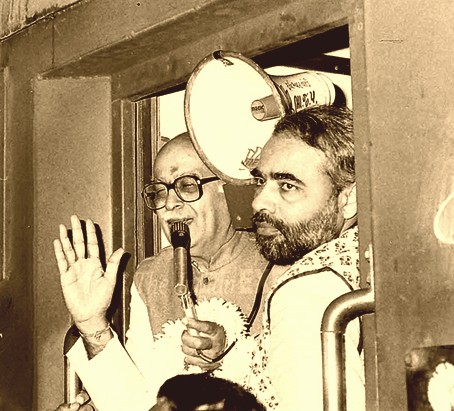
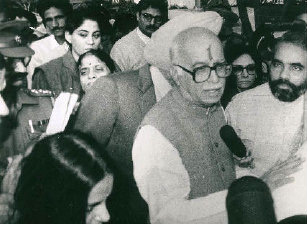
He remained on the side of LK Advani supporting him during his speeches.
PM Modi with LK Advani during his election speech (Source: Twitter)
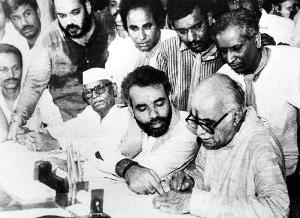
PM Modi and HM Amit Shah were present during LK Advani’s nomination filing as well.
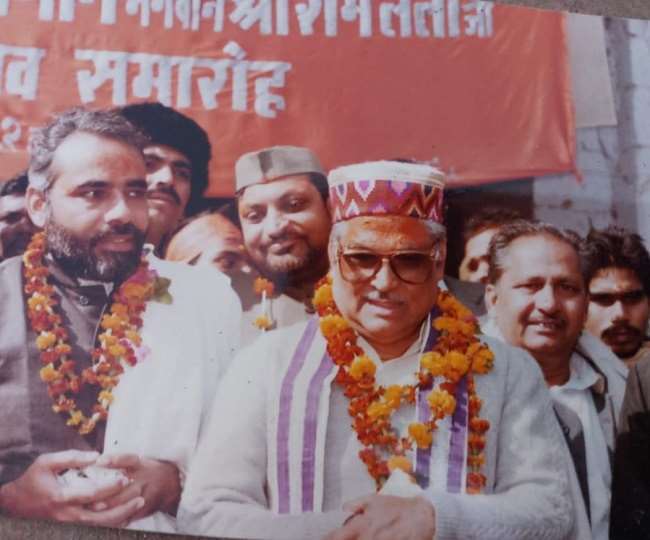
In the photo PM Modi can be seen sitting next to LK Advani and Amit Shah is visible in the background. (Source: Twitter)PM Modi with a crowd of people as volunteer at a VHP rally at the Delhi Boat Club (Source: Twitter)PM Modi with Murli Manohar Joshi (Source: Twitter)
When PM Modi was with Dr Murli Manohar Joshi in Ayodhya in 1991, veteran photographer Mahendra Tripathi clicked his photograph and asked him when will he come back to Ayodhya. As per Times of India report, he replied, “I will come back when the construction of Ram Mandir will begin.”
And so it did. On 5th August 2020, the Bhoomi Pujan of the Ram Mandir was done by Prime Minister Narendra Modi.
PM Modi leaving for AyodhyaPM Modi bowing down to Ram LallaPM Modi conducting the Bhoomi PujanPM Modi performs Bhoomi Pujan for Ram Mandir in Ayodhya
Today the chants of Jai Siya Ram echoed throughout the world as dream of crores of Hindus who have fought for the battle for over five centuries is finally coming true.