The Gujarat Government has announced the setting up of Common Technical Facilities (CTF) for the Space Manufacturing Park being developed at Khoraj GIDC near Ahmedabad. For the development of these facilities, IN-SPACe will contribute up to ₹100 crore for equipment, while the state government will bear the additional cost for construction and operations. This announcement was made during the 10th IN-SPACe Industry Connect event.
The proposed Common Technical Facilities will include a Class 100,000 cleanroom, thermo-vacuum chamber, vibration testing system with capacity for payloads up to 12 tonnes, EMI/EMC testing facilities, climate test chamber, mass properties measurement system, magnetic field testing infrastructure, and facilities for calibration of Earth Observation optics. The state government has allocated 50 acres of land at Khoraj, with provisions to expand it up to 100 acres in the future.
At first glance, this news may appear like any other announcement of a new industrial park or government project. However, if one tries to understand the broader perspective behind it, it becomes clear that this is not merely the construction of a new facility, but an effort to create the necessary infrastructure for India’s rapidly growing private space sector. In fact, to understand this project, it is first necessary to understand how anything sent into space is prepared on Earth.
Not an ordinary industrial park
When common people think of satellites, their mind often goes only to the moment of launch. The rocket roars and flies into the sky, and the satellite reaches space. But in reality, there is a process of preparation and testing that goes on for years before the launch. Space is not like Earth’s environment. There is no air, no pressure, extreme temperature variations occur, and one has to face extraordinary vibrations during launch. Therefore, before sending any satellite or other space hardware into space, it undergoes numerous tests.
The cleanroom is its simplest example. Even a small particle of dust can affect the cameras, sensors, and other highly sensitive devices installed in a satellite. Therefore, such instruments are assembled not in a normal environment but in a highly controlled and pure environment of a cleanroom. The work of a thermo-vacuum chamber is to simulate space-like conditions. Air is removed to create a vacuum, and extremely hot and extremely cold conditions are created to check whether the satellite will function properly in space or not.
Similarly, vibration testing is extremely important. When a rocket is launched, it generates heavy vibrations and mechanical stresses. If the satellite or the devices inside it cannot withstand these vibrations, the entire mission can fail. Therefore, such conditions are artificially created on Earth itself, and testing is done. EMI/EMC testing ensures that various electronic systems can function properly without affecting each other. In simple words, the facilities being built at Khoraj are such that satellites and other space systems will be tested by creating space-like conditions on Earth itself.
Why is it important for startups?
In the last few years, the number of space startups in India has increased rapidly. Many new companies have emerged in fields ranging from rocket technology to satellite manufacturing, Earth observation, communication, and data analytics. But for most startups, the biggest challenge is infrastructure.
Establishing own thermo-vacuum chamber, cleanroom, or vibration testing system is an extremely expensive matter for a startup. In many cases, this cost runs into crores of rupees. As a result, companies have to depend on other organisations for such facilities. Until now, many private companies have been using ISRO’s available facilities. After the government opened the space sector for the private sector post-2020, such access was made available in a more systematic manner through IN-SPACe.
However, ISRO’s facilities have been primarily built for ISRO’s own missions. As the number of private space companies in India increases, the demand for such facilities is also constantly rising. In this situation, the purpose of the Common Technical Facilities being developed at Khoraj is that multiple companies can use modern testing infrastructure on a single platform. This will not only reduce costs but also lower the barriers to entry into the space sector for new companies.
Although Common Technical Facilities are being discussed the most, the Khoraj project should not be viewed only as a testing centre. The plan of the state government and IN-SPACe is for a space manufacturing ecosystem where companies can not only test their products but also design, develop, assemble, and manufacture satellites, payload systems, and other space hardware. Thus, CTF is an important part of the entire project, but the objective of the overall project is much broader than testing.
what changed in India’s space sector after 2020?
To understand this entire project, it is necessary to understand the space reforms of 2020. For a long time, India’s space sector remained almost entirely ISRO-centric. The country’s space capabilities developed, historic missions like Mangalyaan and Chandrayaan were successful, but private sector participation was limited.
In 2020, the Central Government took an important decision and opened the space sector for the private sector. Along with this, IN-SPACe was established. The role of IN-SPACe is to provide necessary approvals, guidance, and coordination to private companies for entry into the space sector. As a result, today many Indian startups are working on rockets, satellites, and other space technologies.
Giving entry to the private sector in the space sector did not mean only giving opportunities to new companies. It also meant that the country would need new types of infrastructure. The Common Technical Facilities being developed at Khoraj can be seen as a part of this major transformation.
Gujarat is playing an important role
The Space Park being developed at Khoraj is envisioned not just as a testing place but as a complete industrial cluster. In the future, companies can come here that manufacture various components of satellites, develop payload systems, work on space-based applications, and then also test their products in the same ecosystem. In other words, an attempt is being made to create the necessary infrastructure for the entire process from design to flight-ready systems in a single cluster.
The importance of the Khoraj project is not only because it is being built in Gujarat. There are also several strategic reasons behind it. IN-SPACe’s headquarters is located in Ahmedabad. Moreover, Gujarat’s relationship with ISRO is also decades old. The Space Applications Centre located in Ahmedabad has been playing an important role in the country’s space programme.
In the last few years, the Gujarat Government has also focused specially on defence, aerospace, and high-tech manufacturing sectors. Major investments being made in the semiconductor sector in the state are also noteworthy. There is a close relationship between space technology and the semiconductor industry because advanced electronic components are needed for satellites and other space systems. In this view, the Space Manufacturing Park being developed at Khoraj is not a standalone project but a part of the large high-tech ecosystem emerging in Gujarat.
What could be the long-term impact?
The real impact of the Khoraj project will be visible in the coming years. If the proposed infrastructure is successfully developed and widely used by the industry, it can become an important encouragement for India’s space startups. Manufacturing capabilities will increase at the local level, the supply chain will become stronger, and it can also help in reducing dependence on imports.
Another important aspect of this project is also connected with ISRO. With the creation of a separate and dedicated testing ecosystem for the private sector, the burden on ISRO’s facilities can also gradually decrease. As a result, ISRO will be able to focus more on its scientific research, next-generation technologies, human spaceflight programmes, and other advanced missions. Thus, this initiative will not only help the private sector but can also prove to be an important step towards making the entire Indian space ecosystem more efficient.
In the end, the Common Technical Facilities being built at Khoraj should not be seen merely as a new lab or a government project. This is a part of the major transformation taking place in India’s space sector, in which the government, industry, startups, and scientific organisations are collectively trying to create an ecosystem that can give the country a stronger position in the global space economy in the coming decades. Perhaps this is why the Khoraj project holds importance not only for Gujarat but for the entire Indian space sector.
This is an English translation of the original Gujarati article published on OpIndia Gujarati
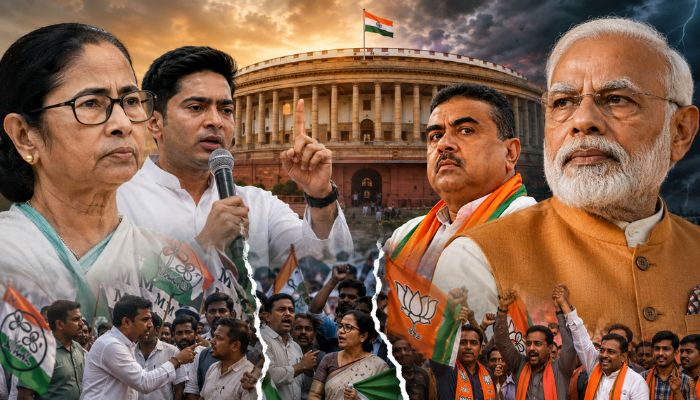
The Trinamool Congress party, which came into existence in 1998, is counting its last days. A little more than a month earlier, no one could have possibly imagined this drastic downfall of the party. Supreme leader Mamata Banerjee and her nephew Abhishek, who once threatened to teach BJP workers a lesson in violence, are now fighting for existence and political relevance. TMC’s heavyweight leaders have now created new factions and have openly declared rebellion against the Pishi-Bhaipo hegemony.
It was not until a long time ago that Mamata Banerjee was fantasising about the overthrow of the Modi government in Delhi. While Narendra Modi continues to remain in power, the TMC supremo has nowhere to go. There are now talks about Mamata merging whatever is left of her party with the Congress as a final act. This is what happens to electoral autocrats, drunk in power. When the public overwhelmingly gives its veto, politicians who took people for granted lose what they took decades to build.
TMC is in such a stage of its life. And mind you, none of this is the BJP’s doing. In fact, party leaders such as Dilip Ghosh, Samik Bhattacharjee and Swapan Dasgupta have categorically pointed out that hoodlums from TMC will not be allowed entry in the BJP. To attest to this fact, TMC goons who harassed and extorted from the public were paraded on the roads before their arrest. The message was clear: No criminal affiliated with the TMC will be shown any mercy.
But, infighting with the TMC has opened a window of opportunity for the Bharatiya Janata Party. The first, of course, is the opportunity to witness the decimation of Mamata’s regime, one party leader at a time. Three Rajya Sabha MPs belonging to the TMC have tendered their resignation. 58 MLAs have joined hands and turned down Mamata’s choice of the leader of the Opposition in the West Bengal Vidhan Sabha. 20 MPs in Lok Sabha have declared a Parliamentary majority and demanded to be identified as a separate faction.
The internal disintegration is a sight for the sore eyes of the BJP, which was battered and cornered for 15 years in Mamata’s Bengal bastion. But there is another story, far more important than the destruction of a rogue and corrupt regional party. It is the new arithmetic in the Union Parliament.
The third term of the Modi government is different from the rest. For a change, the BJP failed to secure an absolute majority in 2024. The support of the allies could take the National Democratic Alliance (NDA) to about 293 seats only. For the first time in 12 years, the BJP failed to pass a constitutional amendment. It fell short of the numbers to enact the pan-India delimitation and the women’s reservation bill. But the scenario could change with the infighting breaking out in the TMC.
A rebel faction led by Kakoli Ghosh Dastidar and 19 MPs in the Lok Sabha has pledged external support to the NDA. This alone can take the total strength of the BJP-led alliance to 313. Earlier, the BJP was able to rope in non-aligned parties and secure 298 votes during the 131st constitutional amendment. Now, the NDA is looking at a figure of 318 votes.
The Dravida Munnetra Kazhagam (DMK), which was betrayed by the Congress party to latch onto power in Tamil Nadu, could extend support to the NDA on specific issues. For context, DMK has 22 MPs in the Lok Sabha. And that could mean the possibility of securing 340 MPs to pass important constitutional amendments and legislation. In that sense, NDA is short of 20 seats to attain 2/3rd majority in the lower House with the current strength of 540.
This gives a fighting chance to the BJP-led alliance to even think of pushing critical legislation through the Lok Sabha. As for the Rajya Sabha, the BJP’s current strength is 113, and the total NDA’s tally is 148 in a House of 235 members. Given the fact that 3 TMC MPs have resigned, the BJP can get 3 new faces to the Rajya Sabha and take NDA past the 150 mark. And the 2/3rd majority mark in the Upper House is 163 members.
While this new development has made the BJP formidable and its supporters happy, a large section of Bengalis in West Bengal is watching the development with a certain sense of anxiety. It took 15 years for a community to unite and overthrow the regime of TMC. The people of Bengal do not change their political allegiance overnight. But when they do, it is brutal! The loser has no takers. And this is what happened to Mamata Banerjee and her Bhaipo Abhishek.
TMC leaders, ranging from the local grassroot-level hooligan to its MLAs and MPs, have supported, abetted, endorsed and rationalised the killings, abductions, rapes and destruction of livelihoods of BJP workers. More than 300 Bengali Hindus lost their lives at the hands of the TMC only because they supported the Bharatiya Janata Party. The BJP’s ground-thumping victory against the Mamata Raj is a testament to the Faith that the common Bengali has put in the Modi government.
The supreme sacrifice made by these BJP karyakartas facilitated the saffron surge in Bengal. Today, a large section of Bengalis is worried that many TMC heavyweight leaders who once harassed the BJP workers would join the ranks of the BJP. This would then be a grave injustice to the 300-odd families of BJP workers, who lost their lives in political violence. I have spoken to a few Bengalis who are fearful that the killer may join the party which he had once victimised.
And this is where I share this word of caution to the BJP: Understandably, the government needs to pass strong legislation and make political compromises, keeping in mind the larger picture of the nation’s interest. As such, TMC’s rebel faction extending support to the NDA in matters of legislation, and the latter accepting the same, can be thought of as one such compromise. But in no case should TMC MLAs and MPs be incorporated into the BJP. The criminal cases against them should not be dropped.
Their crimes need to be brought to justice. They cannot be granted political immunity. Because that would be a travesty of justice. The overwhelming mandate in Bengal for the BJP was also a vote against the TMC. If party leaders from Mamata’s camp find refuge in the BJP, then the same public which once adored the saffron party will become its biggest dissidents. BJP cannot afford to lose the support and trust of these Bengalis who made 4th May 2026 a reality. BJP thus needs to walk a tightrope, balance political narratives and tread carefully. One wrong step and it risks alienating the people of Bengal.
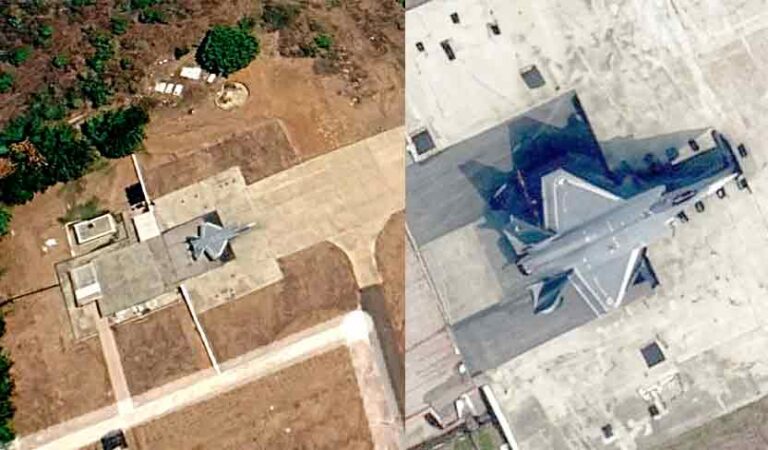
Recently, a satellite image has revealed the presence of a full-scale engineering model of India’s Advanced Medium Combat Aircraft (AMCA) at a DRDO testing facility in Hyderabad. This image might be a lovely surprise for our neighbouring country. The AMCA is India’s ambitious indigenous fifth-generation stealth fighter jet project. It is directly designed to strengthen the country’s air combat capabilities in the coming decades. The model has reportedly been spotted at DRDO’s ORANGE radar cross-section testing facility, a specialised site where scientists evaluate how visible an aircraft is to enemy radar systems.
Such testing is a crucial part of developing stealth aircraft, as it helps engineers identify areas that may reflect radar signals and make design improvements to reduce detectability. While the aircraft seen in the satellite image is not a flying prototype, its presence at the facility suggests that the AMCA programme has entered an important stage of development. The testing is expected to provide valuable data that will help refine the aircraft’s stealth characteristics before the first prototypes are built and flown. The development is seen as another significant step forward in India’s efforts to build its first homegrown stealth fighter aircraft.
What is AMCA?
The Advanced Medium Combat Aircraft (AMCA) is India’s ambitious indigenous fifth-generation stealth fighter jet programme being developed by the Aeronautical Development Agency (ADA) in collaboration with the Defence Research and Development Organisation (DRDO). The aircraft is intended to become one of the most advanced combat platforms in the Indian Air Force. It is expected to provide capabilities such as stealth, advanced sensors, internal weapon bays and network-centric warfare.
During Aero India 2025, the full-scale model of the aircraft was publicly showcased for the first time, attracting significant attention from defence experts and aviation enthusiasts. The model was manufactured by Hyderabad-based VEM Technologies and was displayed to provide a glimpse into India’s future fighter aircraft programme. The project represents India’s effort to join the small group of nations capable of designing and producing their own stealth fighter aircraft. Once operational, the AMCA is expected to play a key role in strengthening India’s air power and reducing dependence on foreign combat aircraft for future requirements.
A Crucial Step Before First Flight
The spotting of the AMCA engineering model at DRDO’s Radar Cross-Section (RCS) testing facility is an important milestone in the development of India’s first indigenous stealth fighter aircraft. Although the airframe seen in the satellite imagery is not a flying prototype, it’s key to get the aircraft ready for future flight trials. Full-scale engineering models are built to help engineers verify various aspects of an aircraft’s design before the production of the actual prototypes.
With these models, teams can ensure that various components fit into the airframe perfectly, make sure internal components can be integrated efficiently, and discover potential design problems early on. Internal bay layout, antenna and sensor placement etc are evaluated in such models.
The engineering model is also used to evaluate maintenance requirements and ergonomics. So, the engineer can examine whether technicians will be able to access key components for repairs and servicing. Designers can assess the overall layout and practicality of the aircraft’s internal structure.
Such studies help reduce future operational and maintenance challenges. By conducting extensive evaluations on the full-scale model, developers can identify and resolve issues before moving to the far more expensive and complex stage of building the actual aircraft. This process significantly reduces technical risks and improves the chances of a successful prototype development program.
According to current projections, the first AMCA prototypes are expected to be rolled out between 2028 and 2029, with the aircraft’s maiden flight targeted around 2029. Notably, the union government is yet to finalise the private partner to build the prototypes. The defence ministry has issued a request for proposal (RFP) to Tata Advanced Systems, a L&T-BEL-Dynamatic consortium, and a Bharat Forge-BEML-Data Patterns consortium. One of the three bidders will be selected for the ₹15,000 crore project to build five AMCA prototypes at a new greenfield facility in Andhra Pradesh.
One of the most important features of a fifth-generation fighter aircraft is its ability to avoid detection by enemy radar systems. For achieving the capability, aircraft developers must carefully study and minimise the aircraft’s Radar Cross Section (RCS). It is a measure of how visible an object appears to radar. In simple terms, radar cross-section means the amount of radar energy reflected back to a radar system when electromagnetic waves strike an aircraft. A larger radar signature makes an aircraft easier to detect and track, while a smaller radar signature allows it to remain hidden for longer periods, increasing its chances of completing missions without being intercepted.
This is why stealth aircraft undergo extensive RCS testing during their development. Engineers need to identify which parts of the aircraft reflect the most radar energy and make design modifications to reduce these reflections. The shape of the aircraft, placement of air intakes, alignment of surfaces, and use of radar-absorbent materials all play a crucial role in determining its radar visibility.
The AMCA engineering model has reportedly been spotted at DRDO’s ORANGE (Open Range) facility in Hyderabad. It is a specialised testing range designed to conduct Radar Cross Section evaluations. Such facilities are equipped with sophisticated instruments that transmit radar waves toward an aircraft from different angles and then measure the strength of the signals reflected back.
By analysing these reflections, scientists can create a detailed map of the aircraft’s radar signature. Areas that produce strong radar returns can then be redesigned or refined to improve stealth performance. This process helps engineers understand how the aircraft would appear to enemy radar systems under real-world conditions. Reducing radar visibility is critical because it allows a fighter aircraft to operate deeper inside hostile airspace with a lower risk of detection.
For a future stealth fighter like the AMCA, achieving a low radar cross section is essential to enhancing survivability, increasing mission effectiveness, and ensuring that the aircraft can compete with other advanced fifth-generation fighters being developed and operated around the world.
Testing an Evolving Design
It is important to note that the AMCA model seen in the satellite imagery does not represent the aircraft’s final design. The engineering model displayed at Aero India 2025 was based on an earlier configuration of the aircraft. Since then, the Aeronautical Development Agency (ADA) has reportedly incorporated several refinements, including the adoption of Diverterless Supersonic Inlets (DSI), which can improve both aerodynamic performance and stealth characteristics.
Such design changes are common in advanced fighter jet programmes, where multiple iterations are tested before the final configuration is frozen.
The Road Ahead for AMCA
The AMCA programme is expected to progress in two phases. The initial AMCA Mark 1 variant is planned to be powered by the American GE F414 engine, while a more advanced Mark 2 version is expected to feature a powerful indigenous engine currently under development.
France’s Safran and the UK’s Rolls-Royce are in the fray for developing India’s next-generation fighter engine to be used in AMCA. If current timelines are met, the first prototype could take to the skies around 2029 with GE engine, with induction into the Indian Air Force expected in the following decade.
Conclusion
The satellite image itself doesn’t show any dramatic breakthrough, but it gives a rare glimpse into a crucial phase of India’s most ambitious fighter jet project. The fact that the AMCA engineering model is at a specialised radar testing facility points to crucial stealth validation work being carried out. With India making progress with its first home-grown fifth-generation stealth fighter, every such milestone brings the programme closer to reality.
Left-wing students’ organisation All India Students’ Association (AISA) recently announced a week-long nationwide campaign ‘Cockroaches on the streets’, across Delhi, demanding the resignation of Union Education Minister Dharmendra Pradhan. The campaign began yesterday (11th June) and will continue till 18th June. Yesterday, AISA members wearing cockroach masks protested in Delhi University’s North Campus, Kamla Nagar, Patel Chest, Gurmandi and Vijaynagar.
This comes days after the Left-wing students’ organisation joined the farcical Cockroach Janta Party (CJP) protest held at Jantar Mantar in Delhi on 6th June. The protest was organised in the name of demanding the resignation of the Union Education Minister for the recent NEET exam paper leak and raising issues related to students. However, the ground reality of the protest revealed a different story, where Leftist organisations like the AISA were seen raising slogans of ‘Azadi-Azadi’ and ‘Jai Bheem’.
While AISA has not officially declared its support for the CJP, the All India President of AISA, Neha Bora, was at the forefront of the CJP protest. It is no secret that Left-wing students organistions like the AISA push their ideological and political agenda in the guise of raising students’ issues. And that’s exactly what Bora was seen doing in the pretext of demanding reforms in the education system.
Speaking to the media, Bora linked the issues of reforms in the education system and students’ rights with the UAPA accused Umar Khalid and Sharjeel Imam. Blatantly whitewashing the charges against Khalid and Imam, Neha Bora claimed that ‘Godi Media’ and the ‘BJP IT Cell’ have declared them as traitors.
She referred to the anti-Hindu Delhi riots conspiracy accused as “ordinary students” and claimed that they were being subjected to “political prosecution”. She raised questions on the judiciary by pointing out that Khalid and Imam have been languishing in jail for years, as they were not granted bail. However, she cleverly conceals the fact that the Supreme Court had denied bail to Umar Khalid and Sharjeel Imam, observing that a prima facie case was made out against them in connection with the 2020 anti-Hindu Delhi riots conspiracy.
Neha Bora’s Brahmin hatred and its justification
Neha Bora’s so-called students’ rights activism is not limited to whitewashing serious crimes like inciting riots or communal tensions; she openly advocates and promotes hatred against the Brahmin community in the name of countering caste inequality. In a post pinned on her X profile, Bora uses ‘Brahmanvaad’ (Brahmanism) as an umbrella term to refer to all kinds of discrimination prevalent in society. She defines Brahmanism as “the historical suppression of one section by another section of society”. By her logic, any discrimination in Indian society, even if it has nothing to do with caste, could be attributed to Brahmanism.
#Justice_for_रुचि_तिवारी का बस इतना सा ही सच है कि जातिवादी दंगाई को पकड़ कर पुलिस के हवाले करने को समूचे ब्राह्मण समाज का दमन बताया जा रहा है।
ऐतिहासिक अन्याय को हक़ बताया जा रहा है। अन्याय के ख़िलाफ़ आवाज़ों को गद्दार बताया जा रहा है। pic.twitter.com/L7cKlZGHgg
Bora justifies hatred and discrimination against the Brahmin community as a way of addressing and correcting years of alleged caste discrimination by the Brahmin community against weaker castes. In other words, hating and condemning Brahmins comes as a necessary corollary of achieving caste equality in society.
The ‘Dara Hua Musalman’ narrative
While Bora is very vocal about the caste discrimination in Indian society, at the same time, she is alarmed by calls for uniting the Hindu community by rising above caste lines. She perceives Hindu unity as a direct threat to the existence of Muslims in the country.
Speaking on a podcast, the AISA national president claimed that calls for uniting the Hindu community make the Muslim community feel unsafe in the country. She downplays the serious threat of Love Jihad with dismissive laughter. Unsurprisingly, she then goes on to selectively point out the suppression of women in Hindu society while omitting to mention the situation of Muslim women.
Neha Bora wants a free Palestine
It is no surprise that Neha Bora, being the leader of a Left-wing students’ organisation, residing in India, wants a free Palestine. She had made multiple posts on X condemning Israel, calling for the freedom of Palestine.
Join CITIZENS' CALL
Against the genocide of Palestinian & siege of Gaza! India must end complicity in genocide! Release all hostages of #FreedomFlotilla!
Bora’s ideological and political views and the strategy to use students’ issues for pushing the leftist agenda are not surprising. The so-called students’ organisations aligning with the Left-wing ideology have long sustained themselves in some of the most prestigious educational institutions in the country, using this strategy. They target uninformed and naive students by raising their issues and indoctrinating them with their political ideology. The CJP protest is yet another opportunity for the left-wing student groups to peddle their agenda.
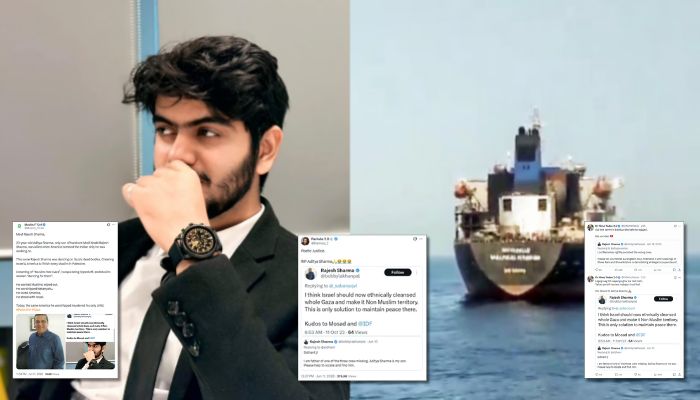
What follows death is the arrival of vultures. On the 10th of June 2026, three Indian sailors were killed in a US raid on the Palau-flagged oil tanker MT Settebello in the Gulf of Oman, near the blockaded Strait of Hormuz. Among the deceased was deck cadet Aditya Sharma. While people were mourning the sailors and criticising the US misdeeds, the Islamo-leftist vultures mocked and some even celebrated Aditya’s death because of his father’s pro-Israel viewpoint.
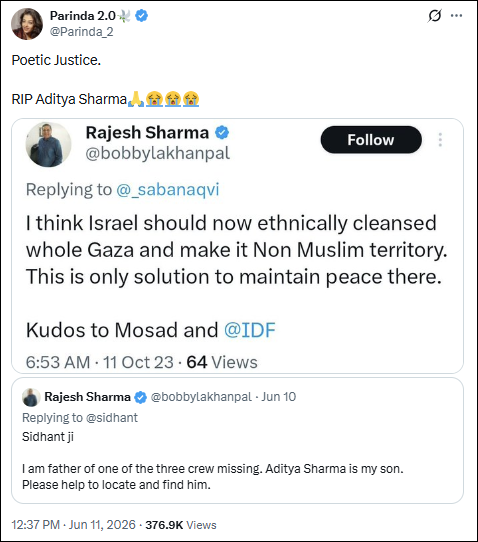
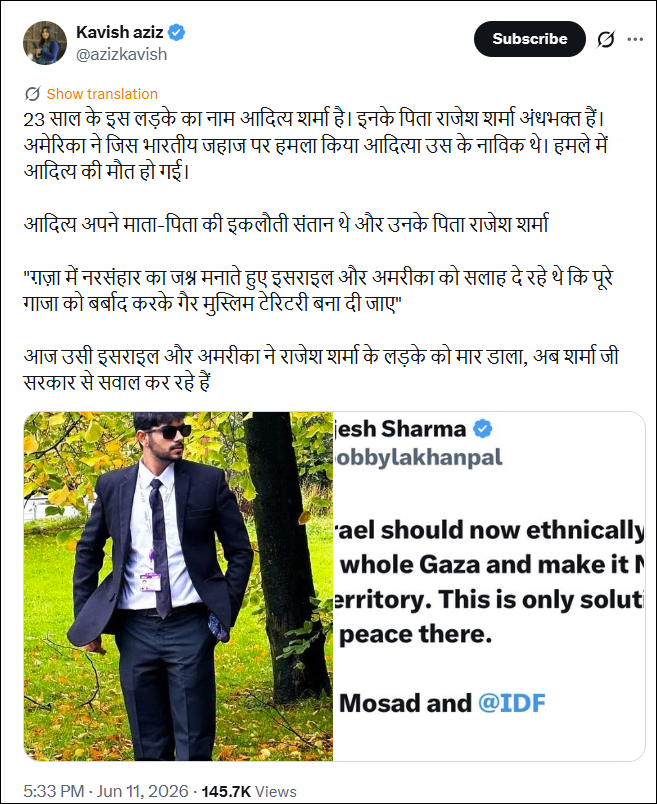
Rajesh Sharma, the father of the deceased seafarer Aditya Sharma, had publicly and strongly supported Israel during the Gaza war. Back in 2023, Sharma advocated for Israel to “ethnically cleanse whole of Gaza and make it Non-Muslim territory”. Israel’s offensive and Rajesh Sharma’s remarks came after the Palestinian Islamic terror group Hamas massacred innocent Israelis on 7th October 2023.
After the confirmation of the death of Aditya Sharma and two other seafarers, several Islamists, left liberals, and Congress supporters highlighted the old pro-Israel X posts of Rajesh Sharma and juxtaposed them with the killing of his son. Many framed the tragedy as ‘karma’, ‘irony’, or ‘deserved’.
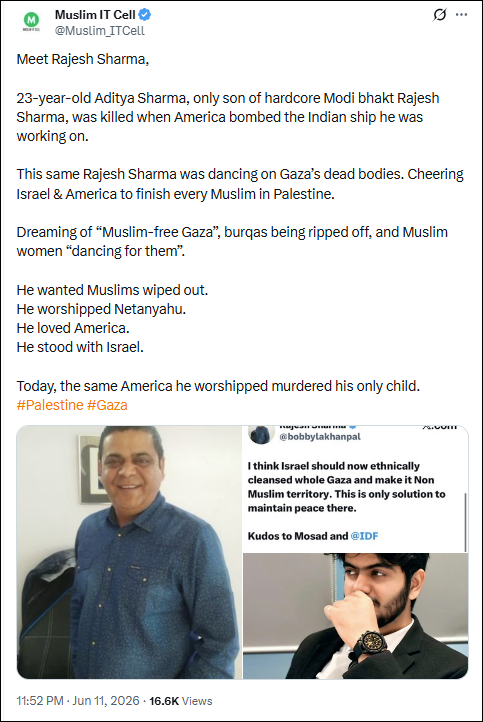
In this vein, Islamist propaganda and victimhood peddler, Muslim IT Cell wrote, “Meet Rajesh Sharma, 23-year-old Aditya Sharma, only son of hardcore Modi bhakt Rajesh Sharma, was killed when America bombed the Indian ship he was working on. This same Rajesh Sharma was dancing on Gaza’s dead bodies. Cheering Israel & America to finish every Muslim in Palestine. Dreaming of “Muslim-free Gaza”, burqas being ripped off, and Muslim women “dancing for them”. He wanted Muslims wiped out. He worshipped Netanyahu. He loved America. He stood with Israel. Today, the same America he worshipped murdered his only child.”
One pro-Islamist troll ‘Parinda 2.0’ called the killing of Aditya Sharma by the US Navy, “Poetic Justice”.
It is ironic how ‘God’ supposedly punishes supporters of Israel sitting in distant countries, but does not punish Netanyahu, the Israeli Defense Forces, and protects Hamas terrorists.
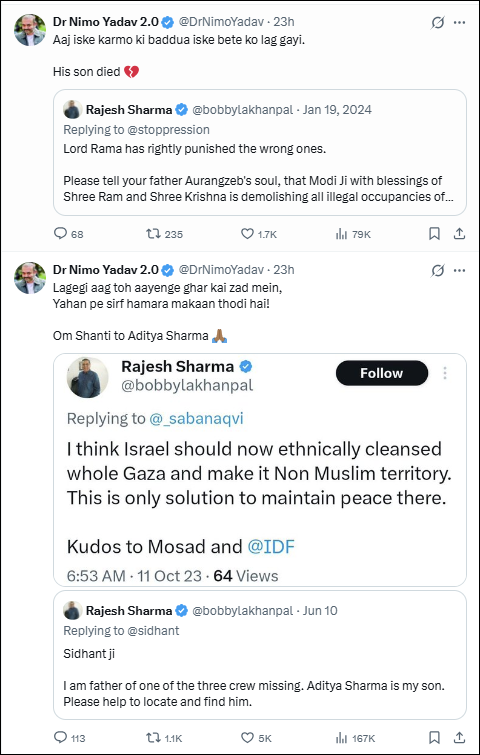
Pro-Congress troll Prateek Sharma, who goes by the pseudonym ‘Nimo Yadav’, called Aditya’s death an outcome of Rajesh Sharma’s bad karma. Nimo has published several disgusting posts, almost celebrating the innocent young man’s death, just because his father supports Prime Minister Narendra Modi and holds pro-Israel views.
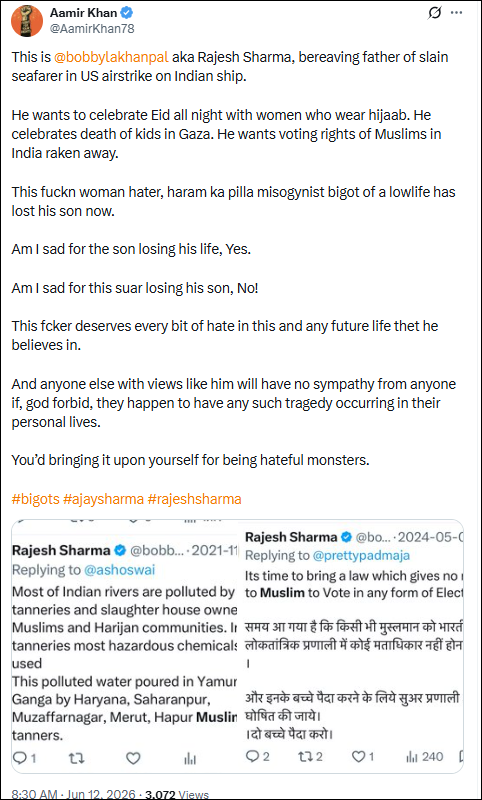
Another Islamist wrote, “This is @bobbylakhanpal aka Rajesh Sharma, bereaving father of slain seafarer in US airstrike on Indian ship. He wants to celebrate Eid all night with women who wear hijaab. He celebrates death of kids in Gaza. He wants voting rights of Muslims in India raken away. This fuckn woman hater, haram ka pilla misogynist bigot of a lowlife has lost his son now. Am I sad for the son losing his life, Yes. Am I sad for this suar losing his son, No! This fcker deserves every bit of hate in this and any future life thet he believes in. And anyone else with views like him will have no sympathy from anyone if, god forbid, they happen to have any such tragedy occurring in their personal lives. You’d bringing it upon yourself for being hateful monsters.”
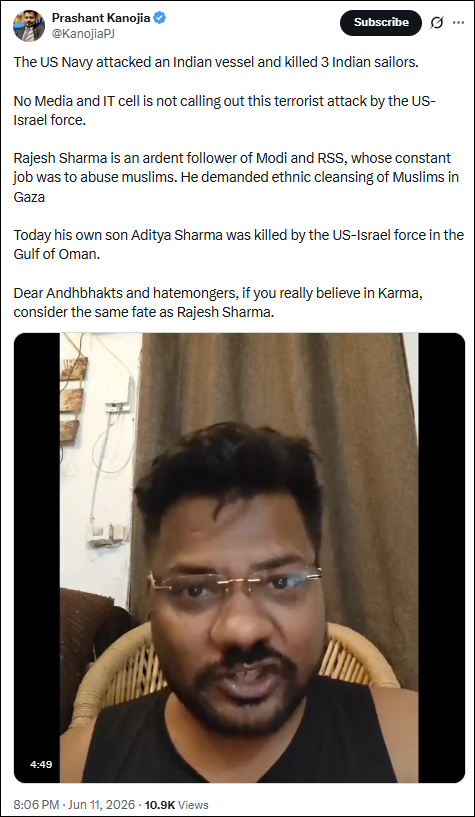
Meanwhile, former ‘journalist’, Prashant Kanojia, made a video expressing glee over the tragedy the Sharma family is grappling with and said, “The US Navy attacked an Indian vessel and killed 3 Indian sailors. No Media and IT cell is not calling out this terrorist attack by the US-Israel force. Rajesh Sharma is an ardent follower of Modi and RSS, whose constant job was to abuse muslims. He demanded ethnic cleansing of Muslims in Gaza Today his own son Aditya Sharma was killed by the US-Israel force in the Gulf of Oman. Dear Andhbhakts and hatemongers, if you really believe in Karma, consider the same fate as Rajesh Sharma.”
It must be recalled that just two days after Hamas jihadis killed innocent civilians in Israel on 7th October 2023, Prashant Kanojia had claimed that the terror attack was orchestrated by the Benjamin Netanyahu-led Israeli government for political mileage. This opprobrious whitewashing of Hamas’s crimes came when visuals of Hamas Jihadis parading and besmirching the dead body of a woman they killed.
In an X post, Kanojia had alleged, “Elections in Israel are going to take place soon. The current Israeli Prime Minister is also a coward like the Prime Minister of another nation. He also wants to attack his own citizens and win elections.”
Now preaching to others not to be blinded by hate and politics, Kanojia himself was so hateful towards PM Modi and the political ideology that he insinuated that the Indian government killed its own people in the Pulwama attack, and somehow, the Benjamin Netanyahu-led Israeli government is following suit to win elections. Following outrage on social media, Kanojia deleted his tweet without apologising.
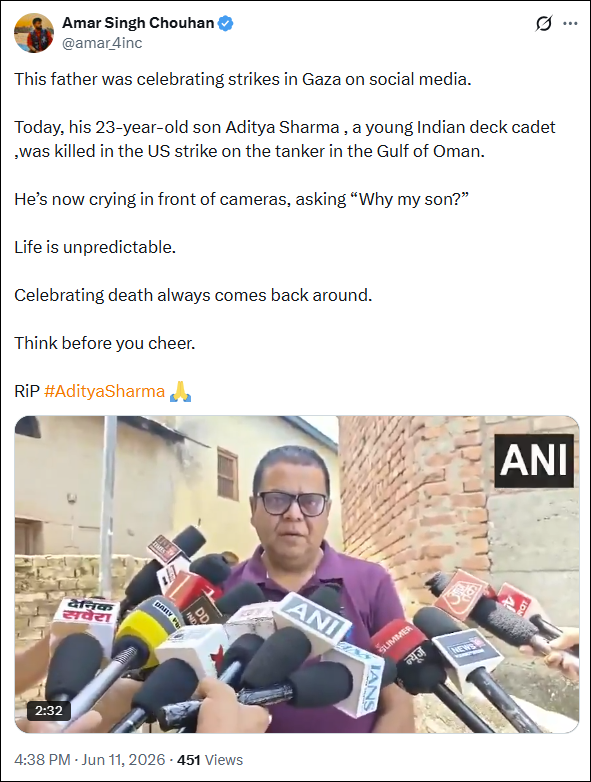
One Congress supporter, Amar Singh Chouhan, wrote, “This father was celebrating strikes in Gaza on social media. Today, his 23-year-old son Aditya Sharma, a young Indian deck cadet, was killed in the US strike on the tanker in the Gulf of Oman. He’s now crying in front of cameras, asking, “Why my son?” Life is unpredictable. Celebrating death always comes back around. Think before you cheer.”
Islamist fanatic and notorious Hinduphobe Kavish Aziz did not miss the opportunity to spew vitriol and wrote, “This 23-year-old boy’s name is Aditya Sharma. His father, Rajesh Sharma, is a blind devotee. The Indian ship that America attacked—Aditya was one of its sailors. Aditya died in the attack. Aditya was the only child of his parents, and his father, Rajesh Sharma, “while celebrating the massacre in Gaza, was advising Israel and America to completely destroy Gaza and turn it into non-Muslim territory” Today, that same Israel and America have killed Rajesh Sharma’s son, and now Mr. Sharma is questioning the government.”
Meanwhile, Islamist sympathiser, ‘Bittu Sharma’, called Aditya’s death “God’s justice”.
Social media is replete with even more hateful posts by Islamists, with one of them writing, “Good riddance. One less haraam ka pilla.”
All this hate, spite, mockery, and celebrations of the death of a fellow Indian is the outcome of the extra-territorial ideological and religious loyalties and solidarities of Indian Islamists and left-liberals. While they talk about human empathy, the same Islamo-leftist lot showed little to no sympathy for Aditya Sharma and his family. They chose to celebrate the killing of an innocent fellow Indian as some sort of ‘divine’ or ‘poetic’ justice.
Muslims have made it known on many occasions that for them, the global Muslim Ummah is the top priority and not their homeland, the Indian nation-state.
Indian Muslims would pretend not to know about the killing of Hindus by Jihadis in their neighbourhood, but keep a track of how many of their co-religionists died in Gaza. They organised protests against Israel, conducted pro-Palestine events, and many even expressed willingness to go and fight for Gazan Muslims against Israeli Jews, although they never really went.
Just a few months ago, a significant number of Indian Muslims conducted donation drives and gave away money, utensils, jewellery, and even livestock for war-hit Iranian Muslim brethren, amidst US-Israel attacks.
Compare this with the silence or equivocation from Islamists and their leftist allies on the killings, rapes, and exodus of Kashmiri Hindus from their home by Islamic terrorists, both local and Pakistani. For long, Islamo-leftists downplayed the Kashmiri Pandit exodus, even resorted to victim-blaming, driven by their hate for Hindus, and zeal to contextualise and whitewash Islamist crimes.
Islamists have their loyalties exported to foreign countries and leaders. This misplaced loyalty often reflects in the unapologetic expression of support and solidarity of countries and leaders based on religion. Several Indian Muslims and their leftist lackeys have long been involved in activities indicating that their loyalty to the Muslim Ummah is more important than the interests and security of India.
Earlier this year, Islamists peddled lies that the India-Israel joint Adani-Elbit Advanced Systems India drones manufacturing factory was exporting weapons, particularly Hermes 900 UAV drones, to Israel against Iran after doing the same for Israel’s war in Gaza.
They mourn Palestinian Muslims, Iranian supreme leader Ayatollah Ali Khamenei, and even Hamas commanders, but will celebrate the killing of Aditya Sharma. Such religion-based support for foreign leaders and countries, even at the cost of going against India’s official foreign policy, is dangerous and treasonous.
In fact, the whole situation is a dream come true for Islamo-leftists; a ‘Sanghi’ pro-Modi Hindu man’s son killed by anti-Muslim Israel and the US. They not only got to attack PM Modi, but also mock his Hindu supporter base with ‘you reap what you sow’ jibes. But the same people cry copious amounts of tears when their ideological opponents use the same ‘you reap what you sow’ jibes every time Israel kills a Hamas terrorist.
Islamists who celebrate the conversion of any Hindu or kafir to Islam as a victory of their faith, the same Islamists who believe in the religiously mandated idea of turning the entire world into Dar-ul-Islam either by converting or killing kafirs, and celebrate historical Muslim genocidaires, have the audacity to call Rajesh Sharma a bigot and hateful person over one ‘ethnic cleansing’ post.
For leftists, passing the ideological purity test on a distant conflict is more important than mourning a fellow citizen’s killing without behaving like a vulture. Clearly, Islamo-leftists will not shy away from berating the deaths of Indian citizens out of their love for Palestinian Muslims.
A Hindu family recently faced an attack in the GIDC area of Matar, in the Kheda district of Gujarat. On 7th June (Sunday), the incident transpired over a minor issue at their shop. Afterwards, a group of individuals instigated a fight, assaulted the family members and issued death threats. A victim named Arjun Solanki has filed a complaint, prompting the local police to register an FIR (First Information Report) against Reshmabanu Ferozsha Diwan, Razzaksha Ferozsha Diwan, Arifali Sabirali Sayed, Mustaksha Ferozsha Diwan and Nasirsha Zhakirsha Diwan.
They have been booked under sections 189(2), 191, 190, 109(1), 115(2), 352 and 351(3) of the Bharatiya Nyaya Sanhita (BNS) and the police have commenced further proceedings. Four of the perpetrators have already been nabbed. OpIndia travelled to Matar, where the affected family detailed the entire occurrence and shared their ordeal.
The victim family runs a small business
This brutal incident befell the family of Popatbhai Thakabhai Parmar, who has been running a modest tea stall in Matar for the past several years. He mentioned that labourers from the GIDC area and local villagers frequently visit the shop for tea. Last Sunday, a highly intoxicated Muslim man entered the shop at approximately 8:00 pm. He stated that a friend was unwell and requested some sugar, to which Popatbhai replied, “The sugar is in the container next to the tea kettle. Please help yourself.”
He took the sugar but subsequently returned to the cash counter and started ripping pages from the account ledger, apparently to pack the sugar. The shopkeeper attempted to stop him gently and said, “Please tell me what you need, and I will hand it to you, but don’t tear the account book like that.”
જ્યારે સેક્યુલર મીડિયા મૌન હોય, ત્યારે માત્ર ઑપઇન્ડિયા બને છે હિંદુઓનો અવાજ!
ખેડાના માતરમાં હિંદુ પરિવાર પર કટ્ટરપંથીઓના આખા ટોળાનો જીવલેણ હુમલો. વહુ-દીકરીઓને મારી, જમાઈનું માથું ફાડી નાખ્યું.
ગરમાળા ગામના મુસ્લિમોની દાદાગીરી, તળાવ કિનારે આવેલી શંકાસ્પદ દરગાહ અને ડેમોગ્રાફી… pic.twitter.com/INWfP36zR9
However, the man unleashed a torrent of vile insults directed at Popatbhai and his wife. The elderly shopkeeper requested him to halt the verbal abuse, but he responded by launching a physical attack along with a Muslim woman who was accompanying him. They ripped his clothes and forcibly dragged him away. Popatbhai’s wife tried to protect him, but she was also subjected to a severe beating.
The pair then left, but the ordeal was far from over. Within a mere two to three minutes, a mob of approximately 10 to 12 Muslims, armed with sticks, clubs and various other weapons, stormed the shop. They immediately resumed the assault, and a Muslim woman held Popatbhai’s wife by the throat, covered her mouth with her hand and hit her repeatedly across the face. At that moment, their son-in-law appeared, and the bloodthirsty mob launched a life-threatening assault on him as well.
Popatbhai’s wife begged, “Please spare our son-in-law. He has young children,” with folded hands, but the fanatics retorted, “No one will be spared. We will not leave anyone alive. If you escape today, we will finish you off wherever we find you next.” Popatbhai’s daughter also attempted to intervene and was mercilessly thrashed, tearing her lip. She was holding her infant child, who was heartlessly tossed high into the air by the perpetrators. Fortunately, the baby girl landed on a mattress in the shop and her life was saved.
Meanwhile, a person from the mob brandished a sharp weapon and struck the son-in-law directly on the head. His skull was split open as blood gushed out, and he collapsed on the spot. The assailants then fled the scene.
Popatbhai unveiled that they had been staying and running their business in the area for many years, which these Muslims could not bear. They intended to intimidate the family with these attacks to drive them away. Their goal is to remove Hindus from the entire area.
Their son-in-law returned to the village after two days of treatment at a major hospital in Nadiad. He was critically injured and unable to speak properly. However, he confirmed that he had merely visited his father-in-law’s shop when he was struck with a sharp weapon, rendering him unconscious, and all the attackers were Muslims.
A recurring pattern of attack on Hindus
OpIndia succeeded in identifying a Hindu youth from Garmala village who had previously endured a similarly dangerous attack by the same hardliners a few months prior. He described how they targeted him during the Makar Sankranti festival in January. Muslims had unlawfully occupied plots and constructed houses on the land adjacent to his field. On the auspicious day, they climbed on their rooftops and hurled filthy insults in front of the Hindu women. They deliberately threw “Chinese manjha” (glass-coated kite string) into the fields owned by Hindus, posing a major threat to both livestock and humans.
The Hindu youth requested, “Women and daughters present here. Please don’t use abusive language,” however, they aggressively responded, “We will do precisely that. Do whatever you can.” Someone from the group pulled out a large knife and stabbed the young man in his back over this trivial issue. The blade penetrated so deeply that it inflicted damage to his kidney. He narrowly escaped death after enduring months of treatment and significant surgery.
However, the accused are walking freely even after the heinous act. In Matar, everyone OpIndia interviewed, both on and off camera, specifically mentioned Garmala hamlet. Locals reported that this village has a Muslim population of over 70% and extremist elements partake in such acts of violence throughout the Matar region, targeting hindus.
Additionally, we uncovered another alarming detail. A Muslim structure resembling a dargah stands close to a shop on the side of a pond where Islamists gather under the cover of night to consume alcohol and drugs, harassing passersby. The mob that attacked the Hindu family on Sunday had also arrived from that very site. OpIndia reached there and found that the Dargah’s gate was locked.
Afterwards, we met with the Bajrang Dal co-convener for the Nadiad district. He affirmed that the vicinity of the pond has transformed into a haven for substance abusers and that the violence of Muslims in Matar Taluka is continuously escalating. He also noted that, prior to this incident, extremists had issued threats to Hindus against engaging in Garba during Navratri.
Bajrang Dal activists have issued a firm warning, asserting their support for the victim Hindu family since the day of the incident. They have warned that if these actions driven by a “jihadi mindset” do not cease immediately, the law will take its course, but Bajrang Dal will also address the matter in its own manner.
OpIndia spent the whole day in the region, listening to the victims talking to local residents, understanding the viewpoints of Hindu organisations and assessing the situation firsthand. The area has clearly experienced a significant demographic change, characterised by a rapid increase in the Muslim population. As this demographic imbalance has escalated, so have the occurrences of violent attacks against Hindus.
Moreover, we have received serious complaints from locals that Muslims are extensively purchasing agricultural land throughout the Kheda district, not just in Matar, and are illegally subdividing this land to construct farmhouses, resorts and unauthorised buildings without obtaining Non-Agricultural (NA) clearance.
This is the English translation of the Gujarati report published on OpIndia Gujarati
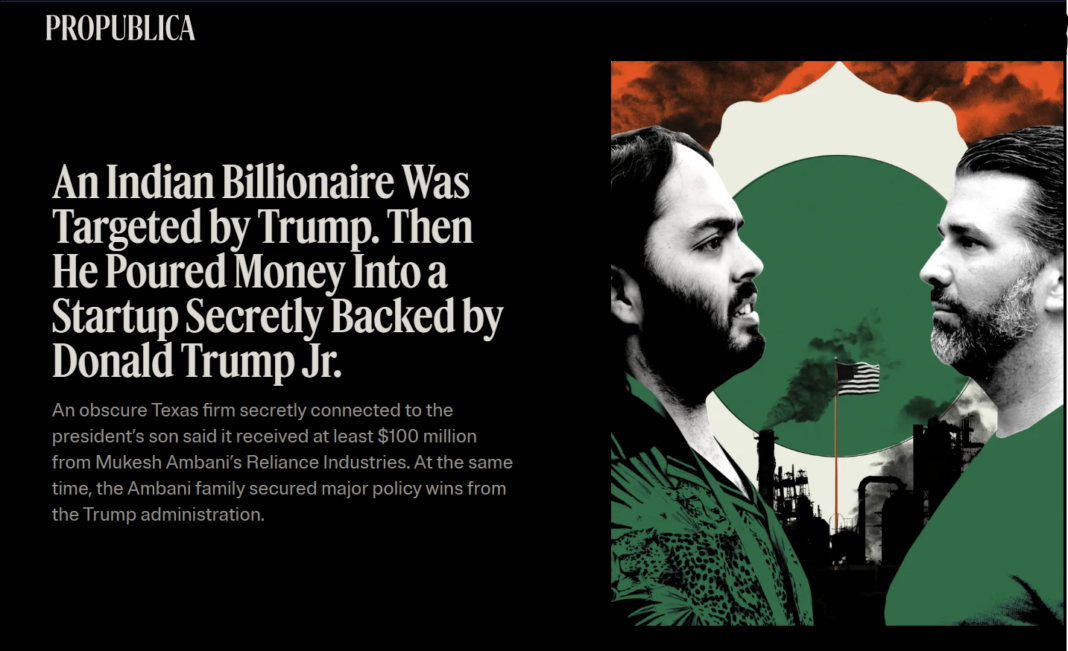
Western media has, for the record, looked at India’s energy security manoeuvres through a distorted lens of political lobbying and backroom transactions. An investigative report by US-based ProPublica, published on 9th June 2026, delved into the timeline of business dealings involving Indian businessman Mukesh Ambani’s Reliance Industries, a Texas-based America First Refining (AFR), and Donald Trump Jr.
The report suggests that there may be potential conflicts of interest in the Trump family’s dealings, and that the Ambani investment in AFR resulted from favourable policy developments for Reliance.
Source: ProPublica
Donald Trump Jr’s secret stake in AFR, US tariff war impact on Reliance, Don-Anant Ambani meet, and political ‘favouritism’: The timeline and what the ProPublica report claims
It all began in August 2025. Donald Trump was upset with India for not giving fake credit for ending the India-Pakistan conflict in May. Trump was also frustrated with his failure to even secure a ceasefire between Russia and Ukraine, despite promises of ending the war within 24 hours of assuming office as US President. These factors, coupled with his desire to arm-twist countries into signing pro-US trade deals, led Donald Trump to find a special target in India.
The Trump administration first imposed ‘reciprocal’ tariffs and doubled tariffs on India to 50%. The additional 25% was a ‘penalty’ for buying Russian oil. Trump unleashed his officials to launch rhetorical attacks on India and Indian refiners and portray New Delhi as the financier of Russia’s war against Ukraine.
India was villainised by the Trump administration as a country fuelling Russian President Vladimir Putin’s “war machine” even as China remained the largest importer of Russian oil, and America itself continued to buy non-essentials from Russia.
On 19th August, the United States Treasury Secretary Scott Bessent accused the wealthiest families in India of profiting from the significant rise in Russian oil purchases during the Ukraine conflict. He even stated that it was “unacceptable” to Washington.
“If you go back and look now, I believe India had less than 1% of their oil. And now I believe it’s up to 42%. So, India is just profiteering. They are reselling. They made $16 billion in excess profits. Some of the richest families in India. So, this is a completely different thing. What I would call the Indian arbitrage, buying cheap Russian oil, reselling it as a product, has just sprung up during the war, which is unacceptable. We have planned to up the tariffs on India, these are secondary tariffs for buying the sanctioned Russian oil,” Bessent said in an interview.
Peter Navarro, the White House’s trade adviser, even wrote an article in the Financial Times, blaming “India’s oil lobby” for buying Russian oil. In a separate rant, Navarro went on to claim that Brahmins are benefiting at the cost of the Indian citizens.
Similar statements came from Marco Rubio, Howard Lutnick and other Trump administration officials. Earlier, Donald Trump himself had thrown a divorced-from-reality, “dead economy” jibe against India on his online echo chamber, Truth Social.
As the Modi government refused to open up India’s dairy sector for American exports, Trump’s officials intensified their anti-India rhetoric.
Being India’s biggest oil importer and refiner, Reliance Industries Limited (RIL) was directly impacted by Trump’s tariff war. RIL was navigating its way through the quagmire of tariffs, political attacks, and constant villainization. By November 2025, however, things began to change, as Donald Trump Jr., son of President Trump, visited Jamnagar in India’s Gujarat state. Trump Jr. met Mukesh Ambani’s son Anant Ambani, toured the animal shelter Vantara run by Reliance Foundation, and attended cultural events. The talks between Ambani and Trump scions yielded positive results.
As India-US trade deal talks advanced, things began to ease between the two countries, although a trust deficit persisted. By February 2026, the US lowered its effective tariff rates on most Indian goods to 18% and removed the 25% Russian-oil penalty, issued Reliance a general license to buy Venezuelan crude directly, and also announced a sanctions ‘waiver’ for Russian oil purchases. The Modi government, however, made it clear that New Delhi will continue buying Russian oil regardless of whether America allows India to do so or not.
As America launched a war against Iran in February this year, and an energy crisis followed the blockade of the Strait of Hormuz, the Trump administration ‘allowed’ India to buy Russian oil to ensure global supplies and control price spikes. Ironically, the US ‘punished’ India with a 25% tariff earlier, for buying Russian oil earlier for the same reasons.
Geopolitical developments, America’s policy shift, and Reliance’s manoeuvrability brought the Ambanis and the Trumps closer. In March 2026, Donald Trump announced that a new oil refinery in Brownsville, Texas, would be part of a “historic $300 billion deal”. He called it the largest energy deal in US history.
In his post on the social media platform Truth Social, Trump said India’s Reliance Industries was involved in the project. He credited his administration’s “America First energy agenda” for attracting the investment. The announcement described the refinery as a major economic project that would boost American energy production, create thousands of jobs, strengthen national security and power global exports.
Trump boasted of the investment commitment as an outcome of his government’s policies focused on domestic production and streamlined regulatory approvals.
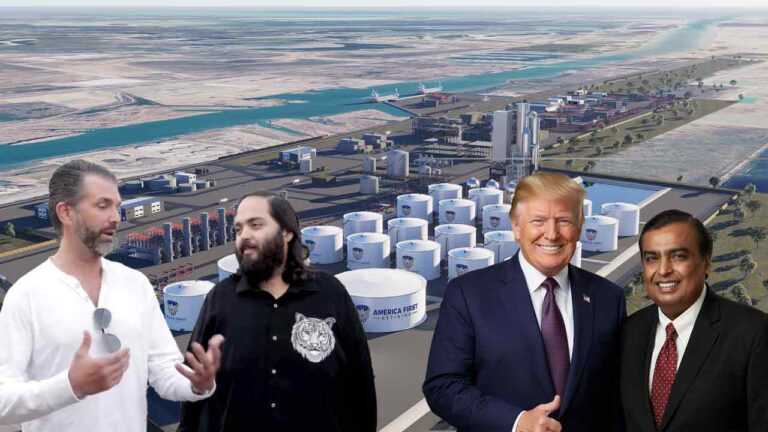
As reported earlier, AFR announced in March this year that it is planning the refinery at the Port of Brownsville in Texas, which is close to the US-Mexico border. The facility is expected to produce around 1,68,000 barrels of crude oil per day. It is designed specifically to refine light shale oil produced in the United States.
While Trump’s ‘Ambani pouring in $300 billion into AFR’ framing surprised many, Reliance has made a “nine-figure investment”, which means the investment likely ranges between $100 million and $999 million. The $300 billion figure refers to a projected long-term economic impact calculated over many years, not investment by Reliance.
Essentially, Reliance will be a long-term buyer and commercial partner, rather than the primary investor funding the construction of the refinery.
Citing Trump Jr.’s personal lawyer, ProPublica’s report claimed that the process of the transformation of Element Fuels into America First Refining LLC began the very next week after Anant Ambani and Trump Jr. met in Gujarat. The ProPublica report further claims that Trump Jr secretly bought a stake in AFR and that the Trump family is allowing foreign investors to funnel money into the American President’s personal pockets in exchange for US government favours.
“America First Refining’s unexpected breakthrough came after it forged a previously unreported relationship with Trump Jr., who secretly acquired a stake in the startup, according to records and seven people familiar with the company. The new details reveal the role the president’s son has played in a theme of Trump’s second term: overseas investors with interests before the administration putting money into the Trump family’s business interests,” the report reads.
The report further highlights how Trump Jr’s net worth has skyrocketed from $50 million to $300 million since his father returned to White House in January 2025.
“Over the past year and a half, Trump Jr. has amassed a fortune from stakes in companies ranging from crypto startups to a drone business to a firearms retailer. Some firms tied to the president’s son have received contracts or other support from the federal government, part of what critics describe as a run of Trump family self-dealing,” the report reads.
ProPublica, however, stated that it has no confirmed information on the size of Trump Jr’s stake in America First Refining. He has, however, publicly appeared in meetings and events linked to AFR.
Citing a report by Bloomberg, which has a reputation for getting frequently fact-checked by the Indian government, ProPublica claimed, “The Ambanis’ investment coincided with the family’s securing major U.S. policy wins that their company, Reliance Industries, had been lobbying for.”
It further mentions that the Ambani-owned Reliance paid $10 million to the Trump Organisation in 2024 as a “development fee” for a project in Mumbai; however, no project has been announced.
The White House has denied any conflicts of interest, while Reliance has also pushed back against the quid-pro-quo narrative and maintained that it did not receive “any unique or preferential treatment” from the U.S. government. The company stated that the investment into America First Refining was evaluated and approved strictly on “commercial merits, strategic fit, and long-term value creation potential.”
“There is no connection between Reliance’s investment in AFR and any unique measures associated with general U.S. trade, tariff, sanctions or licensing outcomes. Reliance’s investment rationale was commercial. The U.S. policy decisions were broad governmental actions affecting multiple countries, industries and market participants,” the RIL stated.
Although ProPublica fairly attempted to present the side of all stakeholders in the matter, it framed the financial dealings of Reliance as bribery or a quid pro quo arrangement.
However, from India’s perspective, Reliance’s manoeuvres appear less political influence-peddling and more strategic hedging. The Indian company has mastered the art of structured opportunism in one of the world’s riskiest industries.
From Jamnagar for the world: Inside the refining mastery of Reliance
Reliance runs the world’s largest and most complex single-site refinery complex in Gujarat’s Jamnagar. The refinery has a 1.4 million barrels per day (MMBPD) capacity. It has a Nelson Complexity Index of 21.1, the global highest.
While simple “sweet” crude refineries struggle with volatility, RIL’s Jamnagar refinery was purpose-built from the late 1990s to process what are described as opportunity crudes. These include heavy, sour, acidic, high-sulphur feedstocks, mainly the Venezuelan, Iranian, Mexican Maya crude, and Middle Eastern sour.
Reliance’s Jamnagar refinery processes these crudes while several major global refiners avoid them due to processing complexities and environmental costs. It handles over 216 different crude grades. The deep-conversion configuration involving cokers, fluid catalytic crackers, alkylation, etc, and full petrochemical integration allows RIL to transform low-cost ‘bottom-of-the-barrel’ barrels into petrochemicals, premium Euro-VI fuels, and a wide range of high-value products.
It, however, is true that geopolitical disruptions have benefited Reliance. The RIL’s margins soared as discounted feedstock was abundant during geopolitical upheavals. However, Reliance has, through its engineering and scale, reached that level where it could significantly benefit from such volatile situations, while competitors look on in awe and envy.
While the detractors of the Ambanis in India framed RIL’s Trump-announced investment in the Texas project as some sort of ‘donation’ to the US, Reliance is diversifying its footprint and securing long-term supply chains, which is not only a lucrative strategy for the company but also benefits India.
Reliance has long positioned itself wherever it finds an opportunity to secure long-term refining gains. It must not be forgotten that the global refining business is not a conventional manufacturing sector; it is an industry defined by geopolitical disruptions, sanctions, wars, trade disputes, and commodity volatility, in addition to the technical complexities.
Refiners often make multi-billion-dollar bets on assets whose profitability can change overnight due to sanctions, wars, environmental regulations, and alterations in crude supply patterns. Understanding the uncertainties, Reliance plays smart and depends less on predicting the future or anticipating favourable geopolitical situations, and more on building diverse options across multiple geopolitical scenarios.
The Ambanis have adopted an approach of not exclusively aligning with one geopolitical bloc. RIL follows the strategy that can be best described as structured opportunism. The company systematically exploits market dislocations, though not without staying within legal and regulatory frameworks.
Interestingly, Reliance’s approach aligns with the Modi government’s foreign policy approach. India proudly exercises its strategic autonomy and maintains friendly transactional relationships across competing power centres. India is arguably the only country that has good relations with Russia, the US, China, Ukraine, Iran, Israel, Palestine, EU nations and other countries that are either engaged in conventional wars or economic rivalry.
Having a refinery capable of converting discounted feedstock into high-value fuels, Reliance has enjoyed a structural advantage that allowed it not only to make big money during the geopolitical disruptions in the last few years but also to ensure global energy supplies.
It was seen how Reliance, and by extension India, kept the oil flowing globally after the outbreak of the Russia-Ukraine War in 2022. While many Western purchasers exited Russian crude markets due to sanctions, India increased purchases of discounted Russian crude dramatically. Reliance emerged as one of the largest buyers. Leveraging its refining capabilities, the RIL processed the discounted barrels of Russian crude into profitability.
Many in Europe and the US hypocritically criticised India for bolstering oil trade with Russia and accused New Delhi of ‘profiteering’ from the Russia-Ukraine war. However, the Modi government maintained that it will not step back from its responsibility of ensuring an uninterrupted and affordable energy supply for 1.4 billion Indians.
With lowered import costs of Russian crude due to discounts and improved refining margins, India protected itself from the worst inflationary effects of the global energy shock.
On many occasions, Indian External Affairs Minister S Jaishankar strongly contended that Indian purchases of Russian oil helped moderate global energy prices by keeping supplies flowing into international markets. Had India not stepped up, the global energy crisis would’ve taken a catastrophic turn.
Recently, MEA Jaishankar said that if Indian refiners suddenly stopped buying and processing ‘controversial’ crudes, the global market would grapple with an immediate supply crunch, sending oil prices skyrocketing past $150 per barrel, and triggering global inflation.
From villainising to appreciating, the US changed tunes recently, with US Ambassador to India, Sergio Gor, hailing India’s anchor role in global oil price stability amid the Russian-Ukrainian conflict and the Iran war.
India was not simply acting as a consumer; it became a significant balancing force in a turbulent global oil system, with Reliance on the centre stage.
Reliance has also navigated its way to Venezuelan crude exports. While the legal and moral aspects of America’s act of kidnapping Venezuelan President Nicholas Maduro are debatable, Washington’s subsequent policy changes allowed greater Venezuelan crude exports. Indian refiners, especially Reliance, emerged as one of the top companies best positioned to utilise Venezuelan crude supplies.
Venezuelan crude is heavy, but the Ambanis have the Jamnagar RIL refinery. Russia, Venezuela, West Asia or elsewhere, Reliance weaponised its competitive advantage to earn profits, ensure global energy supplies, while also contributing to fulfilling domestic requirements in India.
Although Reliance has not given explicit confirmation on the scale of President Trump’s $300 billion investment, RIL’s interest in US refining ventures is a continuation of its business strategy of investing where the company sees strategic value, secures access to feedstock and markets, scales significantly, and exploits refining complexities.
The contemporary decade has been an era of wars and geopolitical uncertainties, and things are expected to stay either the same or get worse in the coming years. This is a world where Russian crude may become available in one year, Venezuelan crude in another, Gulf supplies get disrupted, and US shale production may open up a new door to refining opportunities. The RIL is among those few companies that can navigate all of these environments to survive, profit globally, and contribute to energy security domestically.
India imports the majority of its crude oil requirements, and thus, having access to diverse and affordable markets is essential. Indian refiners, particularly Reliance, have enabled India to source oil from multiple regions, refine it efficiently, and export finished products globally. From the Russia-Ukraine war to the prevailing instability in West Asia, the RIL has proven its mettle.
As India faced challenges to fulfil domestic LPG needs, Reliance announced plans to maximise production of LPG at its Jamnagar refinery and divert natural gas from its KG-D6 block in the Bay of Bengal to “priority sectors”.
It would be an exaggeration to claim that India alone kept global oil prices steady, but India’s refiners undeniably played a stabilising role, benefiting India and energy-importing countries.
Compared to neighbouring countries and G20 peers, India managed to keep domestic fuel prices steadier, credit to buffers, dynamic foreign policy, and Reliance’s scaling superpower, turning geopolitical minefields into opportunities.
In the last few months, Reliance faced US criticism, braved the impacts of US tariffs, phased down imports, secured waivers, and resumed selectively via non-sanctioned routes and yet remained highly profitable. After Russian oil, Reliance has secured Venezuelan crude supplies as well for India. Amidst global uncertainties and conflict-driven disruptions, the Indian government and refiners are doing whatever it takes to keep the oil flowing.
On 10th June (Wednesday), the three Indian sailors were killed in a US-raid on the Palau-flagged oil tanker MT (Motor Tanker) Settebello operated by IOS (Indian Ocean Ship) Marine based in the United Arab Emirates. They had been identified as deck cadet Aditya Sharma, engine fitter Shivanand Chaurasiya and chief engineer Patnala Suresh.
Rajesh Sharma who is the father of Aditya Sharma took to social media after the latter was initially reported missing and requested for help. He even shared a communication from the company informing him about the grim situation. However, it was later discovered that the trio had perished in the attack. Notably, he revealed that Aditya told them about how he was exploited by a senior crew member and wanted to quit the ship in April.
Furthermore, a complaint was also lodged, but the seniors pressured him to withdraw it, subsequently subjecting him to a harrowing environment and pushed him to work for 20 hours each day. “We have all conversations in records,” Rajesh Sharma mentioned. The family also raised concerns over the captain’s decision to navigate through a high-risk area despite receiving a warning and demanded accountability.
I am father of one of the three crew missing. Aditya Sharma is my son. Please help to locate and find him. Below shipping company message to me. My son has reported exploitation by senior at ship and want to quit this ship in April. We…
IOS Marine refuted US accusations that prior messages, warnings or directives were ignored and asserted that no effective communication was set up with the vessel. Settebello was characterised as a civilian merchant ship involved in lawful economic activities, rejecting any suggestion that the ship had ties to Iran or was transporting Iranian oil.
The commercial ship was hit while passing through the Gulf of Oman. Minister of Ports, Shipping and Waterways Sarbananda Sonowal confirmed that the bodies were located and identified. He wrote, “This is a profound loss to our maritime family. The Modi government stands firmly with the bereaved during this difficult hour and is fully committed to supporting the next of kin.”
“I have directed officials to ensure immediate repatriation of the rescued crew members and swift return of the mortal remains of the deceased for their final rites,” he assured.
It is deeply unfortunate to learn of the tragic incident aboard the Palau-flagged MT Settebello. Sadly, three Indian seafarers initially reported missing are now confirmed dead after bodies have been located and identified.
This is a profound loss to our maritime family. The…
— Sarbananda Sonowal (@sarbanandsonwal) June 11, 2026
The ship reportedly had a crew of 28 individuals, comprising 24 Indians, 2 Pakistanis, a Russian and a Ukrainian. It was en route from Lianyungang port in China to Fujairah in the UAE and was purportedly struck for attempting to circumvent a US naval blockade of Iranian ports. The Omani armed forces managed to save the remaining Indian men.
India condemned the assault and released an official statement which read, “We reiterate our call for immediate de-escalation of tensions, and the conclusion of ongoing negotiations for a diplomatic solution so that peace and stability can return to the region. The targeting of commercial shipping and civilian infrastructure in the region must end, and free and unimpeded navigation and commerce through the international waterways in the region in keeping with international law must be restored at the earliest.”
Jason Meeks, American charge d’affaires in New Delhi, was summoned to Ministry of Foreign Affairs by additional secretary (Americas) Nagaraj Naidu to register “strong protest.” It was conveyed that attacks that endanger the lives of Indian seafarers are unacceptable.
A US State Department spokesperson asserted, “The department is in direct contact with the Government of India regarding this matter,” reported Hindustan Times.
3 attacks in 4 days
Tensions have increased as a result of three consecutive attacks by the United States on cargo vessels with Indian citizens close to the Strait of Hormuz over the last three days. However, they bear flags of other countries and are not under Indian ownership. Guinea-Bissau-flagged bitumen tanker MT Jalveer was hit in the latest occurrence on 11th June (Thursday).
Evacuation of crew from MT Jalveer to Shinas port is being coordinated with assistance from Royal Navy of Oman, and shall soon be completed.
— India in Oman (Embassy of India, Muscat) (@Indemb_Muscat) June 11, 2026
“Sir, please hear the coordinates. Shinas port control, this is a message from Jalveer that all crew are safe. We have a huge fire in the engine room,” a voice could be heard notifying the port authorities in an SOS call.
BREAKING | Alleged Attack on MT JALVEER Near Shinas OPL; Engine Room and Funnel on Fire!
Marine Tanks | Breaking News
An alleged attack on tanker MT JALVEER has been reported in the Shinas OPL area of Oman. According to initial reports, a fire has broken out in the vessel's… pic.twitter.com/xZT0EbBriN
“The ship was reportedly involved in a maritime security incident in the vicinity of Shinas port, Oman. It has 20 Indian seafarers on board, and all of them are reported to be safe. No casualties or injuries have been reported. As per the latest information, the evacuation of crew members to Shinas port has commenced. 6 more are to be evacuated,” highlighted Mukesh Mangal, Additional Secretary in Ministry of Ports, Shipping & Waterways.”
He added, “The Ministry is closely monitoring the situation and is in continuous coordination with the Ministry of External Affairs, Indian Missions abroad and the Indian Navy and other relevant stakeholders.”
#WATCH | On evacuation of crew from vessel MT Jalveer sailing off the coast of Oman, Additional Secretary, Ministry of Ports, Shipping & Waterways, Mukesh Mangal says, "The vessel has 20 Indian seafarers on board, and all of them are reported to be safe. No casualties or injuries… pic.twitter.com/8hpGecO5IQ
Earlier, on 8th June (Monday), MT Marivex, a sanctioned oil tanker was attacked by US forces. A “precision munition” was shot after the crew disregarded the orders, according to US Central Command (Centcom), which claimed that the ship had breached its blockade of Iranian ports. It was the 7th ship disabled by them over the same reason.
The crew started making distress calls after the ship’s engine failed and a fire erupted. The Omani military saved all 24 Indians onboard. Importantly, the US slapped sanctions on the vessel, formerly known as Arihant, for its ties to Iran. Arihant Shipping Inc., its proprietor has also been placed under sanctions by Washington which contended that the ship has been carrying “hundreds of thousands of barrels of Iranian fuel oil and bitumen within the Gulf since July 2025.”
According to ship-tracking data, MT Marivex last made a stop at the Iranian port of Bandar Abbas in early April, where it loaded cargo before sailing to Mangaluru and Karwar on the west coast of India. It was one of the few ships to depart the strait on 9th April amid ceasefire declaration. It remained in the “conflict zone” since then.
The MEA has responded to the assaults by outlining that India has forcefully condemned the attacks with the United States and underscored that the welfare and safety of its seafaring community is of “utmost importance.” The government reaffirmed that such instances have to stop.
“We further conveyed that dialogue and diplomacy are the way forward for the peaceful resolution of the conflict, and that there should be unimpeded access through the Strait of Hormuz in accordance with international law. Therefore, we made our position very clear on each of these points, while reiterating how important the lives, welfare, and safety of our people are,” stressed MEA spokesperson Randhir Jaiswal.
VIDEO | Delhi: Addressing a press conference, MEA spokesperson Randhir Jaiswal (@MEAIndia) said, “I had said that we attach high importance to the welfare and well-being of our seafaring community…When this particular attack on the ship MT Settebello occurred, we lodged a strong… pic.twitter.com/axDinSTmD4
“These attacks came from the US Navy stationed in the region, as reflected in various reports and as clarified through statements made from this podium. The three ships involved in these incidents were foreign-flagged vessels. Two of them were Palau-flagged, while the third ship, which came under attack today, was Guinea-flagged. They were not Indian-owned ships. All of them were foreign-flagged vessels,” the diplomat further pointed out.
US blockade and the reason behind the move
President Donald Trump aims to exert pressure on Iran by focusing on two economic factors: its oil earnings and the enormous charges it was asking ships to shell out to cross the strait which transports roughly 20% of the world’s oil and gas.
“Effective immediately, the United States Navy, the finest in the world, will begin the process of blockading any and all ships trying to enter, or leave, the Strait of Hormuz,” he announced in April, adding that other nations will also be involved and the Islamic Republic “will not be allowed to profit off this Illegal Act of extortion.”
“The blockade will be enforced impartially against vessels of all nations entering or departing Iranian ports and coastal areas, including all Iranian ports on the Arabian Gulf and Gulf of Oman. Centcom forces will not impede freedom of navigation for vessels transiting the Strait of Hormuz to and from non-Iranian ports,” pronounced US Central Command shortly afterwards.
Hence, Iran’s ports were blockaded which is defined as a “belligerent operation to prevent vessels and/or aircraft of all states, enemy and neutral, from entering or exiting specified ports, airfields, or coastal areas belonging to, occupied by, or under the control of an enemy state,” in US Navy Commander’s handbook on naval operations law from 2022, reported BBC.
Trump further warned that “we’re not going to let Iran make money on selling oil to people that they like and not people that they don’t like” and the intention was letting “all or nothing” move via the passage in a conversation with Fox News.
The proper locations of the deployed US Navy ships are unknown, and it is difficult to pinpoint the exact spots of these interceptions. Washington is unlikely to station its vessels close to Iran’s coast due to the threat of missile and drone offensives. Therefore, the blockade is likely to concentrate on the Gulf of Oman, which serves as a crucial transit route for a large portion of the world’s oil, including supplies from Iran.
Satellite and commercial data are likely being used by US forces to keep tabs on ships heading out of Iranian ports and wait for them to enter the open Indian Ocean before taking action. According to Centcom, there are over 100 fighter and observation planes involved, along with over 12 vessels.
The USS (United States Ship) Abraham Lincoln aircraft carrier is located about 200 kilometres (124 miles) south of the Iranian coast near the eastern edge of the Gulf of Oman, per satellite imagery from 11th April.
The decision went into effect in mid-April and 134 ships that complied with US instructions had been diverted thus far. 42 ships with humanitarian aid were permitted to pass through. However, the International Maritime Organisation, the maritime body of United Nations, has argued that no government has a legal right to halt vessels in international transit straits. Iran has termed the blockade as “piracy” and threatened to target ports of Gulf states in retaliation.
Indian lives in jeopardy
After China and the Philippines, India is the world’s third-largest source of skilled seafarers. Approximately 10% of all maritime workers worldwide are Indian seafarers. The number of onboard positions available for Indian sailors on both domestic and foreign ships has increased by 42.3% in the last five to seven years.
India fully complies with the STCW-95 Convention and Code, as evidenced by its inclusion on the International Maritime Organisation’s White List. Its inclusion on the list renders it more appealing to maritime companies. Experts predict that the proportion of Indian sailors in the global maritime industry will rise by 20% over the next ten years as a result of the existence of respectable maritime training facilities that produce competent employees, growing literacy rates, the ageing European seafarer population and the fluency in English.
The plentiful opportunities have, unfortunately, exposed them to attacks amid the ongoing hostile environment. The circumstances are equally challenging for Indians employed in the Middle East. After the Iranian attack on Kuwait International Airport, the total number of Indians killed in the region since the beginning of the dispute climbed to ten. A dhow near the Strait of Hormuz caught fire last month, killing one Indian sailor and injuring dozens of others.
The standoff claimed the lives of eight more Indian people and wounded multiple others in the region. Debris from a missile intercept in Abu Dhabi in March killed one Indian and hurt another. An Iranian attack on a power and water desalination plant in Kuwait took another Indian life in the same month. An Indian died in missile and drone assaults on Riyadh in March.
Early in the war, attacks on merchant vessels killed three sailors and two more Indians met the deadly fate due to a strike on an industrial facility in Oman on 13th March. Furthermore, one Indian national had been reported missing.
The government has repeatedly denounced the violence, emphasised the importance of ensuring safety of civilian lives, especially for Indians living in the impacted area and urged for a peaceful resolution of the confrontation. However, the situation is unstable and volatile with the threat persisting until a conclusive agreement is finalised by the warring nations.
The Jomo Kenyatta International Airport (JKIA) in Nairobi, Kenya’s busiest gateway, is set for a major overhaul. As per reports, the Kenya government has awarded a $2.9 billion engineering, procurement, and construction (EPC) contract to China Communications Construction Co. (CCCC), a Chinese state-owned enterprise, for terminal expansion, a new 4.5 km runway, and capacity upgrades to handle up to 12 million passengers annually by 2045.
This comes nearly two years after Kenya cancelled a proposed $2 billion public-private partnership (PPP) concession with India’s Adani Group for modernisation and long-term operation of the same airport. The Chinese contract is approximately 50% more expensive, an extra $900 million. Shifting the burden more directly onto Kenyan taxpayers compared to the private investment-led Adani model.
Between 2022 and 2024, Kenya engaged Adani Group for JKIA upgrades under a PPP model. Adani offered competitive private financing with no immediate burden on the Kenyan exchequer, aiming for terminal modernisation, runway improvements, and operational efficiency. The deal positioned an Indian private player in a key East African infrastructure hub.
The project unravelled in November 2024 amid intense domestic pressure in Kenya. A sustained social media campaign, led prominently by France-based Kenyan whistleblower and influencer Nelson Amenya, highlighted alleged irregularities like a lack of public tender, bypassed stakeholder consultations required by Kenyan law, tax exemptions favouring the concessionaire, and concerns over gradual airport fee hikes. Amenya leaked documents and alleged that the project lacked transparency and threatened national interests.
Kenya Aviation Workers Union organised protests and strike threats over job security and privatisation of a strategic national asset. President William Ruto cited public pressure and global allegations, including US Department of Justice (DOJ) actions against Adani Group in a separate matter, when cancelling the procurement process. Adani denied all wrongdoing and the applicability of US allegations to the Kenya deal.
Congress had amplified the campaign
The most important angle in the episode is that the Congress party had openly opposed the airport contract given to the Adani group. The opposition party had amplified the narrative internationally. On 3 September 2024, Congress leader Jairam Ramesh posted on X highlighting the Kenyan protests and warning that they could “easily convert into anger against India and the Indian Government.”
He linked it to Prime Minister Modi’s “special friendship” with Gautam Adani, using the term “non-biological PM”, compared it to controversies around Adani projects in Sri Lanka and Bangladesh, and argued that such ties undermined India’s soft power and foreign policy.
The Adani Group’s proposed takeover of the airport in Nairobi, Kenya, has led to widespread protests in the country, with the Kenya Aviation Workers Union calling for a strike to demonstrate its opposition. This is a matter of grave concern for India, because the non-biological…
After cancellation, Congress questioned the Indian government, with Ramesh stating the outcome was “expected” and that foreign policy should not be subordinated to one conglomerate’s interests. It was interesting to note that Adani Group had defeated several Chinese firms for the project, and it was alleged that Congress was targeting the Adani Group for that reason.
A fake press release purporting to be from Adani, threatening to expose alleged bribe recipients in Kenya, circulated in September 2024 and was widely shared to damage the company. Adani officially denounced it as fraudulent, stating no such release was issued.
China steps in at a premium
Now, Kenya has awarded the project to CCCC on an EPC basis. Unlike the cancelled Adani PPP (private investment and operation) project, this is a state-funded contract where Kenya pays a significantly higher price.
The around 50% cost increase has sparked debate in Kenya about value for money, transparency in the new award, and the trade-off between retaining sovereignty and accepting higher public debt. CCCC has a track record on major African projects, like Kenya’s Standard Gauge Railway, but the premium raises questions about who ultimately pays: Kenyan taxpayers funding via loans and infrastructure funds versus private investment under a concession model.
US DOJ Case collapse and Chinese AI propaganda
In May 2026, the US Department of Justice closed its criminal fraud and related charges against Gautam Adani and associates, citing a lack of conclusive evidence or inability to sustain the case. Adani had denied the allegations throughout, which were linked to a separate Indian solar deal, not related to the USA or Kenya. This closure came two years after Kenya cancelled the deal, citing the case against the company in the US.
Therefore, a baseless case against the company in the US led to the company losing the deal in Kenya, and thereby, the US govt also contributed to the Chinese company getting the project.
And recently, France’s Viginum agency exposed a network of 13 counterfeit Chinese news websites linked to state broadcaster CGTN using AI tools to spread pro-China narratives across several languages. These sites were launched primarily in early 2025, overlapping with the period after the cancellation of the project. While not directly tied to the JKIA episode, the timing and nature have fuelled speculation about coordinated information operations in global infrastructure contests.
Anti-Adani campaign benefits China
After the Kenya govt’s decision, the Congress party and others who had opposed the Adani project have come under the spotlight for the role they played in the development. The sustained anti-Adani rhetoric from the Congress party and others helped make the Indian proposal politically toxic for the Kenyan govt. This created space for a Chinese state-backed firm to secure the project at a 50% premium, representing a setback for Indian private-sector infrastructure diplomacy in Africa and a gain for China’s state-driven model.
It is also important to note that American allegations against Adani, which contributed to the cancellation of the deal, were ultimately not substantiated in court. Congress party had amplified these allegations too.
Now the Kenyan govt’s decision has come under question because a cheaper private company-led upgrade has been replaced by a more expensive state-funded contract. Kenyan taxpayers will face higher costs, and the project is now delayed by several years.
This also marks a loss for India, as it is a loss of a foothold for private Indian infrastructure firms in Africa. The development raises questions about whether domestic political attacks on specific companies like Adani Group harm India’s global competitiveness against state-backed rivals like China.
Moreover, fake press releases targeting Adani, a non-resident Kenyan-led social media campaign, and recent revelations about Chinese AI propaganda networks further raise questions about manufactured outrage versus organic local concerns over vital infrastructure projects.
Therefore, the Congress party had directly benefited China by continuing to attack the Adani group for its perceived closeness with PM Narendra Modi, resulting in the cancellation of the vital project in Nairobi for the Indian company, which would have contributed to enhancing India’s soft power in the region.
The Supreme Court of India took a decision on June 9, 2026, when it handed over the custody of a captive elephant from an individual in ownership to the Government of Kerala and found that person guilty of contempt of court for taking the animal to a temple festival in violation of a solemn commitment made before India’s top court.
In Kerala, where elephants are deeply integrated in temple life, Uttoly Raman, the elephant in question, is said to be the tallest captive elephant in the state. However, a complicated legal battle involving false documents, criminal accusations, violations of wildlife laws, and several years of institutional failure to protect an animal that cannot speak for itself lies behind the spectacle of Raman wearing a gold caparison at festival ceremonies.
A temple’s elephant, a caretaker’s claim
The case starts with a simple argument made by Jayakrishna Menon, the Contempt Petitioner, who filed the case on behalf of the Mata Amritanandamayi Mutt, the internationally renowned spiritual organisation founded by the Kollam, Kerala-based ‘Hugging Saint,’ Mata Amritanandamayi Devi.
Raman is the Mutt’s ownership; their stance is straightforward. The elephant was eventually given to a private person named Krishnankutty for maintenance and care. However, what was intended to be a temporary arrangement turned into a permanent ownership claim. Two gift deeds from February 18 and February 28, 2017, which allegedly gave Krishnankutty ownership of Raman, are the foundation of his counterclaim. The Mutt claims that these deeds are counterfeited and created. More importantly, even if these deeds were legitimate in nature, they would encounter a major legal obstacle. According to the Wildlife (Protection) Act, 1972, an elephant classified under Schedule I, which includes all Asian elephants, cannot be transferred between private owners under a gift deed. The Chief Wildlife Warden of the State must give prior written approval for such a transfer. There was no such approval received.
From trial court to supreme court
In 2023, things became even more serious. Krishnankutty was charged under Sections 406 (criminal breach of trust) and 420 (cheating) of the Indian Penal Code in Crime No. 1000 of 2023, which was filed before a Kerala court. These serious charges were related to the alleged unlawful custody and unjust treatment of Raman.
In order to obtain temporary custody of Raman, the Mutt simultaneously filed an application under Section 451 of the Code of Criminal Procedure, 1973, which permits courts to issue interim orders for the custody and disposal of property pending trial. After going through the Trial Court and the Kerala High Court (Criminal Misc. Case No. 7600 of 2023), the case was remanded back to the Trial Court for a fresh hearing in November 2023. The Mutt was granted interim custody by the Trial Court in December 2023, subject to a ₹25 lakh bond.
After that order was contested in the High Court, the Supreme Court heard the pending matter of interim custody in Criminal Appeal Nos. 4836-4837 of 2024. Raman remained with Krishnankutty while the more significant issue was being decided when the Supreme Court ordered in January 2024 that the custodial status quo be preserved.
The promise that was broken
The Mutt filed a plea before the Supreme Court in 2025 as problems over Raman’s welfare grew, claiming concerns about the elephant’s well-being and his regular participation in public processions and temple festivals despite the ongoing legal proceedings.
The Court ordered the Principal Chief Conservator of Forests or Kerala’s senior-most wildlife officer to examine Raman’s health on August 6, 2025. Crucially, Krishnankutty’s counsel specifically promised the court that the elephant would not be used for any religious or business activity while the inspection was in progress. This undertaking was noted in the Court’s order. On August 21, a month later, the inspection report stated that the elephant was in musth, a condition in which male elephants occasionally exhibit increased aggression, making a close inspection impossible. Following the conclusion of the musth period, the Court ordered a new inspection.
And then there was a breach of undertaking. According to the State’s own inspection report, which was handed over on February 3, 2026, Raman was taken out to Chavakkad for participation in the festival ceremony of a temple near Chavakkad. Put another way, Krishnankutty’s breach of his commitment was accidentally proven by the very document the State submitted to the Supreme Court for a status update.
Krishnankutty acknowledged the particular incident in his written arguments, stating that religious beliefs required an animal to be present at the ritual and that another previously scheduled elephant had fallen ill and tendered an apology.
The Court was not convinced and said, ‘We would be failing in our duty towards the voiceless, if we turn a blind eye towards such defiance,’ the bench said in unusually forthright terms.
What the wildlife law actually says
The foundation of India’s statutory framework for safeguarding wild animals kept in captivity is the Wildlife (Protection) Act, 1972. Asian elephants are classified as Schedule I animals, which is the highest level of protection under the Act and puts them on par with tigers and rhinoceroses. Without the Chief Wildlife Warden’s prior written permission, Section 40(2) of the Act clearly forbids anybody from obtaining, receiving, holding in custody, or transferring any Schedule I animal. An Ownership Certificate may only be granted to a person who is in legal possession, according to Section 42. Elephants cannot be traded commercially, according to Section 43(1).
This left Krishnankutty’s claim with a significant legal gap. Even if they are accepted at face value, the 2017 gift deeds were private arrangements made without official state approval. Such a transfer is null and void within the WPA’s framework, not just unusual. In its order, the Supreme Court stated that any such transfer ‘would ultimately be rendered void in the absence of requisite approval under the Wildlife (Protection) Act, 1972.’ Additionally, the WPA gives the State the authority to keep elephants in rescue and rehabilitation facilities and mandates that it assume custody and care of animals when needed. This is exactly what the Court finally ordered.
What the Supreme court decided
Respondent No. 1, Krishnankutty, was found guilty of contempt of court by the bench of Justices Dipankar Datta and Satish Chandra Sharma for knowingly breaking the undertaking. The Court Registry has levied a ₹2,000 fine, which must be paid within four weeks.
The fine is symbolic in every way. It shows that the Court acknowledges that the legal issue of eventual ownership is still up for debate and that it would be premature to penalise Krishnankutty too severely before the underlying appeals are resolved. The custody order, however, has the most serious consequences. The State of Kerala was ordered by the Court to take over possession of Raman and place him in an appropriate rescue or rehabilitation centre. Subject to the Court’s final judgment in the underlying criminal appeals, the arrangement is specifically temporary. Raman’s care expenditures may also be covered by the State, but it must do so while adhering to the WPA’s provisions.
The Court acknowledged that the musth time had really postponed the in-person examination, and as a result, the State officials, who had been listed as Respondents 2-9 for allegedly delaying the inspection, were discharged from contempt.
Conclusion
The primary criminal appeals are still pending before the Supreme Court, but the contempt petitions have been resolved. The basic question of who Raman truly belongs to remains unanswered. Until then, he would reside in a rehabilitation or rescue facility in Kerala under state custody, paid for by the government.
It’s questionable if the State of Kerala, which has had difficulty even performing a quick health examination of the elephant, will be able to give Raman the level of care he needs. The Court’s use of the phrase duty towards the voiceless is encouraging. However, Raman is more concerned with where he sleeps tonight than what the Court says.