Each year, countless girls and boys globally encounter sexual abuse and exploitation. Sexual violence is a pervasive issue, affecting every nation and all sectors of society. Children may experience such violations in various environments, including their homes, schools or communities. Additionally, the extensive use of digital technologies can further expose children to potential risks.
The ongoing discourse surrounding the involvement of Pakistani Muslim grooming gangs in the United Kingdom in severe crimes against little girls and minors has underscored the urgent nature of this matter, which extends beyond national and continental boundaries. India is similarly confronted with this challenge, leading to the introduction of various stringent legal measures to secure justice for the affected individuals. The judiciary has also consistently taken a strong stance in favour of the victims and even overturned previous judgments as well as decisively dismissed appeals for ‘compromise’ in the name of ‘family honor’ or shame in order to close such cases.
In that aspect, Indian Courts have certainly fared better than the administration in UK, ensuring that the perverse crimes of sexual exploitation of children does not get brushed under the carpet and culprits face the fullest extent of justice for their crimes.
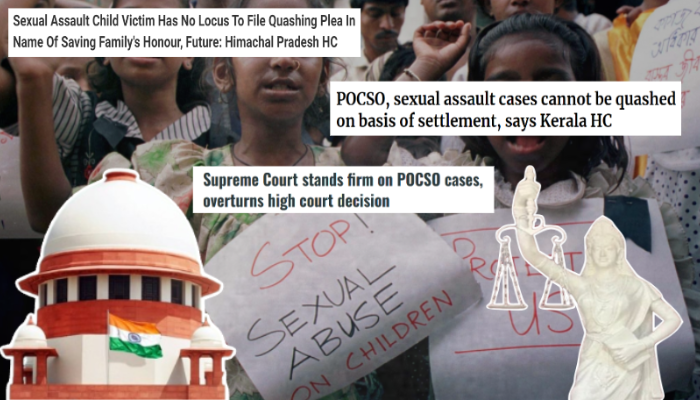
‘family reputation’ cannot be the ground to quash POCSO case: Himachal Pradesh HC
The Himachal Pradesh High Court has recently ruled that after the initiation of criminal proceedings, the role of the complainant is effectively concluded. As such, neither the complainant nor the child victim has the legal standing to file a petition for the quashing of a POCSO (Protection of Children from Sexual Offences) case, especially in the context of safeguarding the “family’s reputation.” The bench presided over by Justice Virender Singh further indicated that the decision to quash is contrary to the legislative objectives of the POCSO Act.
The court rightly pointed out, “Since, the offence is against the society and if such type of cases are quashed, on the basis of the grounds, as taken in the petition, it would encourage the other accused, who had committed such offence, to adopt the extra-constitutional means to settle the matter i.e. influencing the witness by fiduciary relationship, using the money power or threatening the victim/complainant and to settle the matter in the name of honour of the family.”
The bench articulated these points while dismissing a petition from the father of the victim, who requested the cancellation of the FIR (First Information Report) he had previously registered against the accused under Sections 363, 354-A, and 506 of the Indian Penal Code, in conjunction with Section 8 of the POCSO Act. He contended that the FIR should be quashed due to a compromise reached with the latter.
He also maintained that the FIR created a barrier to his daughter’s imminent marriage ceremony, as the family of the prospective husband had imposed a condition that no legal actions should be pending regarding the girl. However, the court declared that the complainant’s involvement ceases once the criminal process is initiated, and therefore, a request to drop the serious charge cannot be considered on behalf of the victim or the complainant.
It pronounced, “This court is of the view that the petitioner, being complainant/father of the child victim, has no locus standi to file the present petition, seeking the quashing of FIR, in question, mainly on the ground to save the honour of the family. In the name of honour of the family, the heinous offence, as committed, in the present case, cannot be quashed or swept under the carpet.”
The bench made reference to the Supreme Court’s decision in a recent case which held that sexual assault-related issues cannot be considered private matters that can be quashed based on ‘compromise’. The court then noted that granting the request for quashing would effectively allow the accused to evade legal consequences, provided the prosecution can establish the case against him beyond a reasonable doubt. As a result, the plea was denied.
Sexual assault under POCSO can’t be quashed just because victim’s family has ‘settled’ the matter: Supreme Court
Last November, the Supreme Court ruled that a sexual abuse case cannot be junked following a settlement between the conflicting parties, due to the grave repercussions such violations have on society. The apex judicial body expressed that the Rajasthan High Court’s decision to annul a POCSO case against a school teacher, which had been resolved through an agreement between him and the father of the 16-year-old victim. It had dismissed the FIR against the teacher accused of sexually assaulting the underage girl at a school in Sawai Madhopur district of Rajasthan.
The high court had utilized its inherent powers under Section 482 of the Code of Criminal Procedure (CrPC) “to make such orders as may be necessary to give effect to any order under this code, or to prevent abuse of the process of any court or otherwise to secure the ends of justice.” A panel of justices, C T Ravikumar and Sanjay Kumar, stated that the high court had incorrectly interpreted and applied the legal principles relevant to the quashing of the FIR and all subsequent proceedings.
The court cited the Supreme Court’s 2012 verdict in Gian Singh v. State of Punjab, which clearly established that “prior to invoking the authority under Section 482 of the CrPC, the high court must carefully consider the nature and severity of the offense.” It further asserted that “serious and heinous crimes cannot be dismissed, even if an agreement has been reached between the victim or the victim’s family and the perpetrator.”
Justice Ravikumar stated that the court has determined that such offenses are not of a private nature and significantly affect society. He highlighted that it is the court’s essential responsibility to evaluate whether the compromise is equitable and just, as well as free from any undue influence, before proceeding to further examine the matter. The bench remarked that a cursory examination of the high court’s order dated 4th February 2022, indicated a significant oversight in failing to give adequate consideration to the applicable law.
It conveyed that the contested order does not address the allegations presented in the FIR prior to its dismissal. “We are at a loss to understand how the high court arrived at the conclusion that in the case on hand a dispute to be resolved exists between the parties and further that to maintain harmony the FIR and all further proceedings thereto should be quashed even without adverting to the allegations raised in the FIR,” the bench stated.
The highest court also refuted the claims made by the teacher and the victim’s father, who contested the locus standi of the petitioner in the Public Interest Litigation. “When by quashing the FIR by invoking the power under Section 482, CrPC, the accused was relieved of the liability to face the trial coupled with the aforesaid circumstances and the position of law qua locus standi of third party to maintain a petition under Article 136 of the Constitution of India, as revealed from the decisions referred above, we have no hesitation to hold that the challenge based on the appellants’ locus standi got no merit at all.”
It mentioned that when an incident of such nature and severity allegedly takes place in a higher secondary school, particularly involving a teacher, it cannot be regarded merely as a private matter devoid of serious societal consequences. “In view of the nature of the offences alleged, one can only say that if they are proved they could be treated only as offences against the society and at any rate, it cannot be said that prosecuting an offender against whom such allegations are made is not in the interest of the society,” the court added.
It pronounced, “We have no hesitation to hold that in cases of this nature, the fact that in view of compromise entered into between the parties, the chance of a conviction is remote and bleak also cannot be a ground to abruptly terminate the investigation, by quashing FIR and all further proceedings pursuant thereto, by invoking the power under Section 482, CrPC.” The court stated that the actions carried out by the defendant would amount to an offense of ‘sexual assault’ as defined under Section 7 of the POCSO Act, which carries a penalty of imprisonment for a term not less than three years and potentially extending to five years, along with a monetary fine.
“They would reveal that the commission of such offences against the children should be viewed as heinous and serious. Needless to say, the commission of such offences cannot be taken lightly as offences of a private nature. In fact, such offences are bound to be taken as offences against society,” the court declared and further conveyed, “We make it clear that we shall not be understood to have made any observations on the merits of the case.”
The bench remarked that “the objects and reasons for the enactment of the POCSO Act would undoubtedly show that quashing of proceedings initiated under POCSO Act abruptly would go against the very intention of the legislature behind the enactment.”
A PIL was initiated by Ramjilal Bairwa, a resident of Gangapur city in Rajasthan, in 2022 challenging the high court’s decision to dismiss a serious non-compoundable criminal case where the accused had not been arrested. On 2nd December 2022, the Supreme Court transformed the plea into a Special Leave Petition under Article 136 of the Constitution. The petition asserted that the teacher mentioned in the FIR had not been taken into custody, and it was alleged that a ‘compromise’ had been made between the victim’s family and the accused.
After reviewing the compromise submitted to the high court, it granted the petition of the accused and dismissed the proceedings. It was observed that despite the public prosecutor’s objections, the high court concluded the case by referencing a ruling from the Supreme Court, which indicated that even non-compoundable offenses may be resolved through a compromise between the involved parties.
Supreme Court slams the Calcutta High Court’s order allowing ‘settlement’ between 14-year-old victim and accused
The Supreme Court in a historic ruling on the quashing of POCSO charges by the Calcutta High Court held that the latter could not have cancelled the prosecution even if the 14-year-old victim, who is now an adult, and the culprit had reached a settlement, in August of last year.
It voiced its disapproval of the high court regarding the inappropriate comments made by the division bench while delivering the disputed judgment related to the conviction of the accused under Section 6 of the POCSO Act, 2006, along with Sections 363 and 366, and clause (n) of sub-sections (2) and (3) of Section 376 of the Indian Penal Code, 1860. The Supreme Court had previously expressed disapproval of the high court’s “objectionable” comments and “sweeping observations.”
The Calcutta High Court, in its judgment dated 18th October 2023, overturned the conviction of the accused under the aforementioned provisions. It stated that, while the law aims to protect all individuals under 18 from sexual exploitation, it inadvertently results in the restriction of liberty for young individuals engaged in consensual relationships. The apex court conveyed its dissatisfaction with the observations and rationale employed by the high court in rendering the contested decision.
The division bench comprising Justice Abhay S. Oka and Justice Ujjal Bhuyan, overturned the high court’s judgement and remarked that “the division bench has introduced a rather unusual notion of ‘non-exploitative sexual acts’ in the context of offenses punishable under Section 376(2)(n) of the IPC and Section 6 of the POCSO Act. We find it difficult to comprehend how a sexual act, which is a grave offense, can be classified as non-exploitative.”
“When a girl who is fourteen years old is subjected to such a horrific act, how can it be termed as non-exploitative,” it further asked. It added that the bench introduced a novel and undefined category termed “older adolescents” and expressed concern regarding the insufficient acknowledgment of consensual actions among this group. It stated, “We are unable to comprehend the notion of older adolescents.”
Concerning the high court’s assertion that equates Suo Motu Writ Petition (C) no.3 of 2023, among others, with consensual and non-exploitative sexual conduct alongside rape and aggravated penetrative sexual assault, the Supreme Court commented that “what is shocking is the observation made in paragraph 23 of the impugned judgment where the high court observed that while achieving ostensible objectives to protect all children below 18 years from sexual exploitation, the law’s unintended effect has been the deprivation of liberty of young people in consensual relationship.”
“Surprisingly, carved out a non-existing category of romantic cases in the rape cases. While dealing with the offences under the POCSO Act, shockingly, the court observed that the law undermines the identity of adolescent girls by casting them as victims, thereby rendering them voiceless,” it mentioned. The bench, while voicing its disagreement with the high court’s statements, articulated, “The judges ought to have avoided expressing their personal views even assuming that there was some justification for holding the views. While the high court observed this, it forgot that in the facts of the case, the court was not dealing with the sexual acts involving adolescents above sixteen years, as the age of the victim was fourteen years and the accused was twenty-five years at the relevant time.”
“The duty of the high court was to ascertain on the evidence whether the offences under Section 6 of the POCSO Act and Section 376 of the IPC were made out. In view of ‘sixthly’ in Section 375 of the IPC, penetrative intercourse with a woman under eighteen years of age, with or without her consent, constitutes an offence of rape. Therefore, whether such offence arises from a romantic relationship is irrelevant. Therefore, whether such offence arises from a romantic relationship is irrelevant. How can an act that is an offence punishable under the POSCO Act be described as a romantic relationship,” the highest court questioned.
It further added, “The high court went to the extent of observing that the case of criminalisation of a romantic relationship between two adolescents of opposite sex should be best left to the wisdom of the judiciary. The courts must follow and implement the law. The courts cannot commit violence against the law. The findings and observations in the impugned judgment, except the finding on the applicability of Sections 363 and 366 of the IPC, cannot be sustained.”
“This extraordinary situation was created because the state machinery did not follow the provisions of law starting from sub-section (6) of Section 19 of the POCSO Act. The importance of rehabilitation of the victims of offences under the POCSO Act, which is a mandatory requirement of law, is being overlooked by all stakeholders. Perhaps, at levels, there is a need for introspection and course correction. We include even the judiciary in that,” the Supreme Court chastised.
It also restored the District Court’s (Baruipur) conviction which convicted the man under Sections 363 (kidnapping), 366 (kidnapping with the intention to compel to marry), 376(3) (rape of minor girl below sixteen years of age), and 376(2)(n) (repeated rape of the same woman) of the IPC, and Section 6 (aggravated penetrative sexual assault of POCSO victim) of the POCSO Act. He was sentenced to twenty years in prison.
Further recommendations in the case
A directive was issued for the Government of West Bengal to establish a committee comprising three experts, including a clinical psychologist and a social scientist. This committee was tasked with aiding the victim in making an informed decision about her future. Additionally, it had to evaluate the support provided by the state to both the victim and her child. The court instructed the state to create the panel with information regarding the support measures and to ensure that its recommendations were submitted by 18th October 2024.
The Supreme Court underscored the importance of self-reflection and necessary adjustments by all parties involved, including the judiciary, in the management of cases pertaining to the POCSO Act. It observed that the state machinery had failed to deliver prompt assistance and protection to the victim, resulting in this exceptional circumstance.
The court instructed state governments to enhance the effectiveness of the implementation of Section 19 (6) of the POCSO Act. This provision requires the police to report offenses to the Child Welfare Commission (CWC) within a 24-hour timeframe. It remarked that Section 19(6) is not merely a procedural formality and insisted that the CWC must take immediate action. The Supreme Court also advocated for a more vigorous enforcement of Sections 30 to 43 of the Juvenile Justice (Care and Protection of Children) Act, 2015, which relate to the care, protection, rehabilitation, and social integration of victims.
Additionally, the order instructed the Secretaries of Law and Justice Departments across all states and Union Territories to organize discussions aimed at ensuring the effective implementation of the POCSO and JJ Act provisions. It seized the opportunity to establish guidelines regarding the composition of judgments. According to the court’s order, a judgment addressing an appeal against a conviction must include a succinct summary of the case’s facts, an overview of the evidence presented by both the prosecution and the defense, if applicable, the arguments put forth by the parties involved, a thorough analysis based on a reevaluation of the evidence, and the rationale for either upholding the accused’s guilt or granting acquittal.
It further stipulated that judgments should refrain from reflecting the judge’s “personal opinions on various matters,” a concern raised regarding the high court’s judgment, which purportedly offers advice to younger generations and the legislature.
Sexual crimes can’t be settled on compromise: Kerala High Court
The Kerala High Court in July 2024 determined that offences such as rape and violations under the Prevention of Children from Sexual Offences (POCSO) Act, which undermine a minor girl’s dignity and honor, cannot be dismissed through compromise or settlement. It added that the court might, however, take into consideration quashing the case on humanitarian grounds in extraordinary circumstances where the victim and the accused have married and are cohabitating amicably.
Justice A. Badharudeen rendered a decision that dismissed the case against a man accused of sexually assaulting a 17-year-old girl, which resulted in her pregnancy. The accused faced allegations of kidnapping and rape under the Indian Penal Code (IPC) and the POCSO Act in 2021. Furthermore, the victim’s mother was charged for not reporting the crime.
The accused and the victim claimed to have reached a private settlement when they petitioned the High Court to stop the criminal proceedings in 2024. The victim, now an adult, provided the court with an affidavit and a marriage certificate attesting to their union. The Public Prosecutor and the victim’s lawyer both approved the settlement, stating that the couple’s marital and family life were happy and satisfying.
“In such cases, the tough nut standing in the way of settlement shall be crushed with humanitarian consideration as the hammer, so as to ensure the peaceful family living of the parties and most importantly to ensure the well being of the children born to them. Hence, there is no necessity to continue criminal proceedings so as to retain them in the hazards of litigation and to collapse their married life and the well being of the children,” the court declared.
Notably, it underscored that grave offenses, such as rape and those under the POCSO Act, cannot be invalidated solely on the basis of a settlement reached between the accused and the victim. “Dignity of a woman is a part of her non-perishable and immortal self and no one should ever think of painting it in clay. There cannot be a compromise or settlement as it would be against her honour which matters the most. It is sacrosanct,” the court conveyed.
The court, while aware of the potential societal consequences of permitting settlements in serious cases, stated that humanitarian factors in this instance justified the dismissal of the charges to preserve the family’s stability. It noted, “Considering the situation, this case represents a departure from the general principle, where dismissal is justified.” As a result, the plea was accepted, and all actions against the accused were terminated.
The Kerala High Court in the same month ruled that cases concerning sexual assault against minors, along with those registered under the Protection of Children from Sexual Offences (POCSO) Act and the Scheduled Castes and the Scheduled Tribes (Prevention of Atrocities) Act, 1989, cannot be annulled merely on the basis of a settlement. Justice A. Badharudeen made the observation while refusing to entertain a petition filed by Ivin, a dance educator in Thiruvananthapuram, who sought to invalidate a case against him for the sexual assault of a minor. The dismissal was based on his assertion that the case had been resolved with the victim’s parents, who had provided affidavits endorsing the settlement.
The court pronounced that “effacing abominable offences through quashing process would not only send a wrong signal to the community but also may accord an undue benefit to unscrupulous habitual or professional offenders who can secure a settlement through duress, threats, social boycotts, bribes or other dubious means.” It also quoted the phrase, “Let no guilty man escape, if it can be avoided.”
The court stated that grave offences, especially those that entail moral turpitude or have detrimental effects on the social and moral structure of society, should not be interpreted as solely involving two parties. These offences have the potential to affect the broader community. “Heinous and serious offences involving mental depravity or offences such as murder, rape, and dacoity cannot appropriately be quashed though the victim or the family of the victim have settled the dispute. Such offences are, truly speaking, not private in nature but have a serious impact upon society. The decision to continue with the trial in such cases is founded on the overriding element of public interest in punishing persons for serious offences,” it mentioned.
Conclusion
The issue of sexual abuse of children is a worldwide concern with certain cultures and societies being more susceptible to it than others. It is estimated that at least 120 million girls under the age of 20, approximately 1 in 10, have been forced to participate in sexual activities or perform other similar acts, although the actual figures are likely to be significantly higher. Most often, such abuse is perpetrated by individuals whom the child knows and trusts. About 90 percent of adolescent girls who report the crime indicate that their initial abuser was someone familiar to them.
Furthermore, many victims of sexual violence, including millions of boys, remain silent and do not disclose their experiences to anyone, adding to their trauma. It is the collective responsibility of all, including the judiciary, government, media, and community, to protect children. However, the alarming rise in these reprehensible acts indicates that society has failed to safeguard kids from predators. A case in point is the criticism directed at the British government and politicians for their complicity instead of actively addressing the issue of grooming gangs.
This matter must be approached with a level of seriousness that transcends minor vote bank politics or ideologies, as it deserves to be handled with the sensitivity it requires. The influence of social pressure and stigma especially in extremely conservative societies can drive victims to request closure regarding their cases. However, it is crucial to recognize that sexual assault against minors is a grave offence that requires a more nuanced perspective along with significant attention, comprehensive legal framework and diligent implementation.
In India, unfortunately, many families see marriage as the conclusion for cases of sexual assault, ignoring the enormity of the crime involved. In many instances, the idea of ‘settlement’ is the rape accused agreein to marry the rape victim, as if the act of marrying the ‘tainted’ girl somehow washes off the crimes of the rapist.
Everyone must acknowledge that bringing these cases to their logical conclusions is vital not only for the victims but also serves as a precedent for others in similar circumstances, providing them with hope and the courage to pursue justice. Moreover, it is the perpetrators who need to be ashamed, not the victims.
As Gisele Pelicot has famously said, “Shame must change sides”.
The lack of such consequences will not only embolden potential criminals to continue their vile conduct, but work as a catalyst for others with similar inclinations and result in even more detrimental ramifications for the society. More importantly, beyond the enforcement of rigorous laws and holding offenders accountable, it is imperative for the community to come together as a unified entity to ensure the safety of their children’s lives and futures.