Home Blog Page 753

Communal tensions flare up in Congress-ruled Telangana after Sheikh Makhdhoom attempts to rape a tribal woman

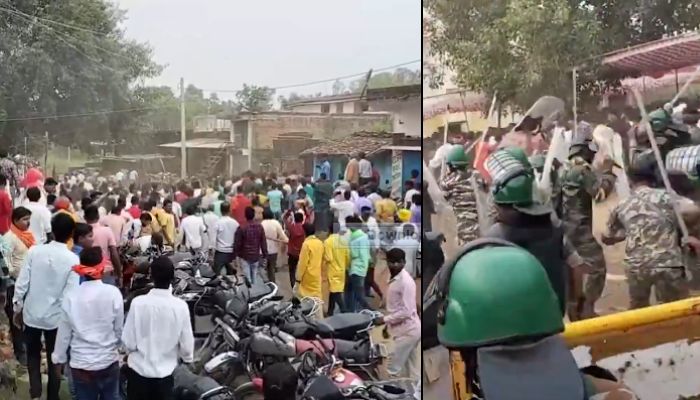
Communal tensions erupted in Telangana’s Asifabad district on Wednesday amid protests over the alleged sexual assault of a 45-year-old woman from the ST Gond community in Devuguda village. The accused, auto-rickshaw driver Sheikh Makhdhoom, allegedly attempted to sexually assault the woman on August 31. When she raised an alarm, he beat her with a stick and left her unconscious by the roadside, intending to kill her.

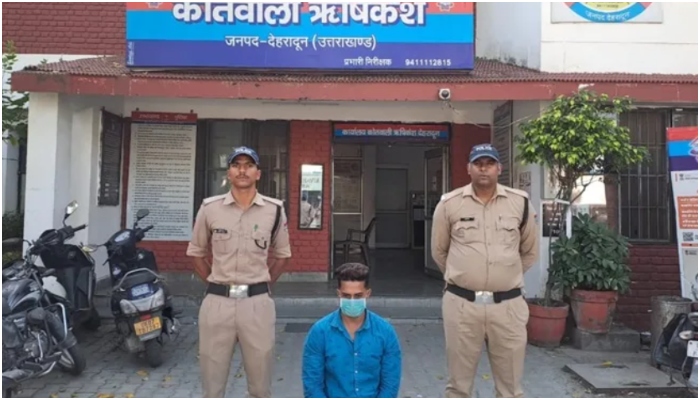
On September 1, the woman’s younger brother filed a complaint at Sirpur U Police Station, leading to a case being registered under the SC/ST Act for attempted rape and murder. DSP Sadayya Panthati took charge of the investigation and arrested the accused driver on Tuesday.

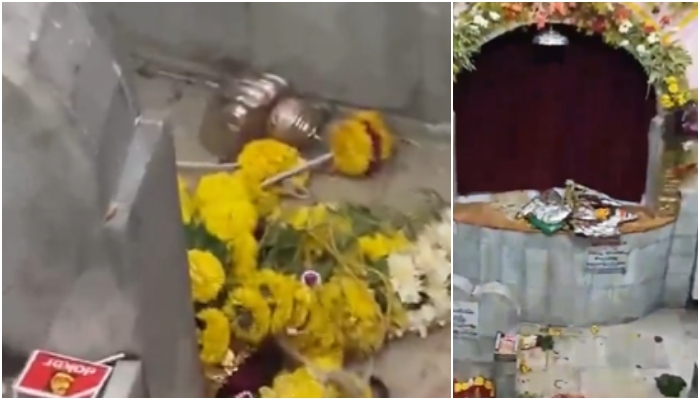
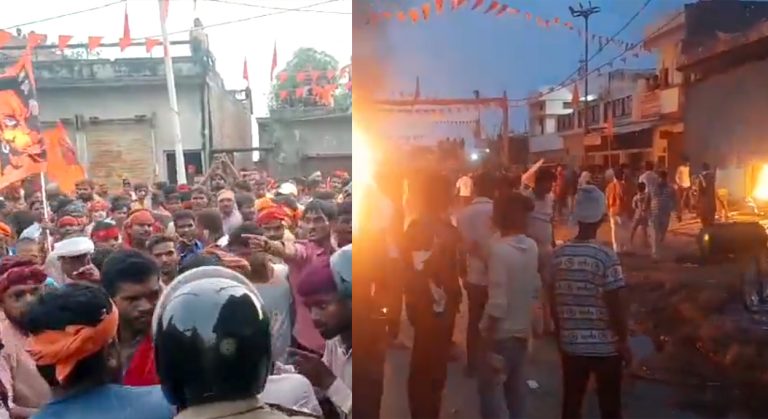
In Jainoor town, Asifabad district, communal tensions escalated as an enraged mob attacked and set fire to commercial establishments. According to Telangana Today, around 5,000 people gathered in Jainoor as part of a bandh called by various tribal organizations condemning the crime. The mob set commercial buildings ablaze and pelted stones at religious structures. Tribal rights organizations also staged a rasta roko in Jainoor, demanding the death penalty for the accused.

AIMIM Chief Asaduddin Owaisi raised concerns over the escalating violence and wrote to the Telangana DGP about the situation. He urged for peace, emphasizing that no one should be allowed to take the law into their own hands. On X, he stated that the Telangana DGP assured him that the situation is being monitored, additional forces are being deployed, and action will be taken against those who break the law.

The BJP also criticized the Revanth Reddy-led Congress government in Telangana, accusing it of favouring the accused due to his minority status. In a post on X, Telangana BJP claimed, “Sheikh Makhdhoom was the rapist who attacked a tribal woman and tried to kill her to avoid legal consequences. There’s an attempt to frame this as an accident. This is a reflection of Congress’s politics of sympathy for minorities and the shameless rule under Revanth Sarkar.”

The incident has, however, put the Jai Meem-Jai Bhim trope— long peddled by ‘secular’ parties such as Congress, which intended to carve out a new vote bank—consisting of Muslims and some sections of the Hindu society. The recent attempt by Rahul Gandhi to tether every conversation to caste equations and caste identity was one such effort to hack away at the consolidation of the Hindu society, which has been the primary cause of Congress’ undoing in the last 3 Lok Sabha elections.

SEBI denies allegations of ‘toxic work culture’, says employees are misguided by external elements to target the regulator’s credibility

0

Amidst allegations of SEBI employees protesting and complaining of ‘toxic work culture’, the market regulator on Wednesday categorically denied the issue, instead asserting that the employees are perhaps misguided by external elements to target the credibility of it and its leadership.

As per reports, SEBI officials made a complaint to the finance ministry last month, accusing the regulator’s leadership of fostering a ‘toxic work culture’.

Securities and Exchange Board of India (SEBI) believes its junior officers, who were allegedly aggrieved in respect of HRA allowances, have been misguided, perhaps by external elements.

“We would not like to speculate on who those external elements may be or what their motives might be,” SEBI said in a 5-page statement.

SEBI added it is committed to enhancing the capacity of all its employees and allowing them to actualize their full potential.

SEBI on Wednesday said that in the recent past, amongst numerous other benefits, employees were demanding 55 per cent increase in House Rent Allowance (HRA), over the allowance set in 2023.

Also, employees raised an issue on the updation of SEBI’s automated Management Information System for Key Result Areas (KRAs), which had been designed to bring more transparency, fairness, and accountability within SEBI.

“It is understood that when media reported on this protest as being “only about their working conditions and allowances and perks…” and”nothing about the issues faced by the vast majority of investors and stakeholders …”, a group of employees consciously designed a strategy to change the narrative to frame the issue as relating to the work environment, with an objective to have bargaining power to seek more benefits. Accordingly, a letter focused on “work culture” was crafted and sent to HRD on August 06, 2024,” said the market regulator.

Thereafter, after 7 days, reportedly a second letter was submitted with a long list of 16 demands, for numerous monetary and non-monetary benefits including an increase in HRA.

Further, automatic promotions at lower performance ratings without interviews have also been “demanded”, the SEBI statement said.

“SEBI officers are already well paid, and for entry-level officers at Grade A, the cost to company is approximately Rs. 34 Lakhs per annum, which compares extremely favorably even with the corporate sector. The new demands placed by them would amount to an additional CTC of almost Rs. 6 Lakhs per annum,” SEBI said.

In the statement, SEBI said it is committed to ensuring that it is responsive to the market ecosystem and all its participants, both in terms of speed of approval and facilitating ease of doing business as well as in carrying out timely investigation and enforcement against wrongdoing in the market.

“The claims of unprofessional work culture in the letter dated August 06, 2024 are misplaced and seem to stem from instances such as: Under-pitching of processing capability of officers by as low as 1/4th of actual capacity, Mis-reporting of status of achievement of KRAs, Shuttling of files between departments over a long period to avoid taking decisions, “Adjusting” appraisal marks of poorly performing officers to “somehow” make them eligible for promotion,” the statement read.

“It is unfortunate that some elements have attempted to diminish the significant capabilities of SEBI employees by instigating employees to believe that, as “employees of a Regulator” they should not be required to have such high standards of performance and accountability,” SEBI said in its statement today.


(This news report is published from a syndicated feed. Except for the headline, the content has not been written or edited by OpIndia staff)

Mamata Banerjee is playing to the gallery with her Aparajita law: Here is how it is likely to get struck down by Supreme Court, leading to Bengal CM grandstanding

On Tuesday (3rd September), the West Bengal assembly passed the Aparajita Women and Child (West Bengal Criminal Laws Amendment) Bill, 2024 with a voice note, at a time when the Mamata Banerjee government’s back is against the wall on women’s safety and law and order issue. The bill has been passed as a direct reaction to the horrific rape and murder of a trainee doctor at RG Kar Medical College and Hospital in Kolkata.

The law aims to create a safer environment for women and children in the state, reinforcing its commitment to protecting fundamental rights and ensuring that heinous acts of rape and sexual offences are met with the full force of the law. The Aparajita Woman and Child Bill, 2024, proposes amendments to several national laws, including the recently passed Bharatiya Nyay Sanhita 2023, the Bharatiya Nagarik Suraksha Sanhita 2023, and the Protection of Children from Sexual Offences Act 2012.

Now, it has come to light that the anti-rape legislation is riddled with lacunas that could render it unconstitutional. The seeming inevitability of it getting struck down in a court of law alludes that it could merely be an act to pander to the gallery rather than a true pursuit to seek Justice for women and set a deterrence against heinous crimes. 

The TMC government’s anti-rape legislation has several legal lacunas and bottlenecks, and the below-mentioned past precedences indicate that it is likely that it could be struck down in court for being ultra vires with Articles 14 and 21 of the Indian constitution among other laws –

One of the most significant provisions of the proposed Bill is the introduction of capital punishment for individuals convicted of rape in cases where the crime results in the death of the victim or causes the victim to enter a vegetative state. In such cases, the new law has the provision of only the death penalty along with a fine, and there is no provision for a lesser punishment like a jail term. And this is the most problematic provision in the bill.

As per the content of the bill, there is no provision for the courts to award a jail term, even a life sentence, to a convict in case the injuries inflicted by the convict result in the death of the victim or the victim ends in a vegetative state. Simply put, as per this legislation, courts will be compelled to either mandatorily pronounce a death sentence and impose fines on convicts, or they will have to let the convict scot-free by just imposing a monetary fine. 

It is important to note that the Supreme Court, on multiple occasions, has reiterated that the death penalty can only be awarded to a convict in the “rarest of the rare” cases. So, if that particular heinous rape fails the “rarest of the rare” test, the court will have to set the convict free with only a fine as there is no provision for a jail term under the West Bengal anti-rape legislation. 

Pertinently, the Rarest of rare was defined by SC in the Bachan Singh v. State of Punjab case. The judgement underscored the judiciary’s responsibility to ensure fairness and justice while pronouncing sentencing. It mandated judges to provide written reasons for imposing the death penalty, thus introducing a higher level of accountability and transparency in the judicial process.

Nonetheless, there are at least three landmark judgements in which the apex court has categorically held that “mandatory death sentences in legislation are unconstitutional” and such provisions/laws had been struck down for being ultra vires with Articles 14 and 21. State of Punjab vs Dalbir Singh – 2012 is the recent landmark judgement in this regard in which the court upheld this ruling. 

State of Punjab vs Dalbir Singh case

First things first, in 2006, Section 27(3) of the Arms Act, 1959 was challenged in the Supreme Court and that case has been dubbed as State of Punjab vs. Dalbir Singh. The Supreme Court delivered its verdict on this issue in 2012. 

As per the content of the law, Section 7 of the Act forbids the manufacture, sale, and use of prohibited arms and ammunition unless it has been specially authorised by the central government. Section 27(3) prescribed that any contravention of Section 7 that results in the death of any person ‘shall be punishable with death’. It was a “mandatory death” provision, as there was no provision for any other punishment.

Now, in its landmark judgement, the Supreme Court held that section 27(3) of the Arms Act that mandatory death penalty was “unconstitutional”. The court held that Section 27(3) is unconstitutional as it deprived the judiciary of discharging its duty of judicial review by barring it from using the power of discretion in the sentencing procedure, the judgement stated.

The bench also quoted relevant sections of an earlier judgment delivered in 1983, in Mithu vs. State of Punjab. Therefore, the court pronounced that Section 27 (3) of the Arms Act, of 1959 is unconstitutional.

Mithu V. State of Punjab

Section 303 of the Indian Penal Code (IPC) also made it mandatory for the courts to award the death penalty to a person who committed murder while undergoing imprisonment for life. In this case, the court had looked into the constitutional validity of the mandatory death sentence. The top court held that it was unconstitutional and it was struck down by the Supreme Court stating that it violated Articles 14 and 21 of the Constitution of India.

The final verdict ruled that a provision of law which deprives the Court of its discretion, and disregards the circumstances in which the offence was committed, can only be regarded as ‘harsh, unjust and unfair’. 

The judgment emphasised that the concept of a ‘just, fair and reasonable’ law has been read into the guarantees under Article 14 (Equality before law) and Article 21 (Protection of life and personal liberty) of the Constitution. A law that imposes an irreversible penalty such as death is ‘repugnant to the concept of right and reason’, the court held.  

Rule of Repugnancy

Additionally, the West Bengal anti-rape bill also suffers from the Rule of Repugnancy under Article 254 as the criminal laws passed by the Parliament – Bharatiya Nyay Sanhita also has laws in this regard. 

The Rule of Repugnancy states that if the state assembly and the Parliament (representing the country), make contradictory laws on an issue that is mentioned in the concurrent list, the central law will prevail. In the areas of divergence, the central law will eclipse the state law. This means that if both the Centre and a state assembly have drafted a law on the same issue, then all those provisions that are against or different from the Central law will be repugnant and will not come into effect. In the case of anti-rape legislation, the provisions of the BNS will prevail. 

Therefore, the Aparajita Woman and Child Bill will be struck down by the Supreme Court as it has a provision for the mandatory death penalty, a provision ruled unconstitutional by the apex court several times in the past. Even if not the whole law, the mandatory death penalty will be struck down, just like the same provision in Arms Act and IPC were removed by the Supreme Court.

Apart from the glaring lacunas in the hushed-up legislation as a face saviour tactic, the Mamata Banerjee court has been failing short of ensuring speedy Justice in POCSO cases. It has been caught wanted in establishing and operationalising earmarked Fast Track Special Courts (FTSCs) for expeditious trial and disposal of pending rape and POCSO Act cases in the state of West Bengal. 

The Centre has reprimanded her government for several years over this issue, however, in a watershed moment for West Bengal, as the Maa, Mati, and Manush have taken to the streets against Mamata Banerjee, she has responded with this short-sighted legislation.

Is this Mamata Banerjee’s moment of reckoning or will be end up as a mere grandstanding opportunity for the TMC Supremo?

TMC Supremo and West Bengal CM Mamata Banerjee who made ‘Maa, Mati and Manush’ her aggressive political plank, has been facing the heat for being caught wanting on the front of law and order, especially on crimes against women. Her administration received a severe dressing down from the courts for the shoddy investigation in the RG Kar Hospital rape-murder case and backing the tainted Principal, Sandip Ghosh. Banerjee who also holds the concerned portfolios of Health Ministry and Home Ministry, initially responded to the public movement by launching a protest march to seek Justice for the deceased trainee doctor. 

Hoping that the protest march would quell the public movement which also involved a section of his voter base (Mahila among others), resulted in ridicule for the TMC government. With her back to the wall, the Mamata Banerjee government finally passed this much-hyped Aparajita Women and Child (West Bengal Criminal Laws Amendment) Bill, 2024 from the West Bengal assembly yesterday. 

However, the glaring shortfall and the past precedents point out that it is highly likely to be found ultra vires and illegal, the eventuality of it getting struck down in a court of law could end up as a grandstanding opportunity for the TMC leader to play the victim as well as the messiah for the aggrieved women. In that seemingly inevitable scenario, the TMC Supremo could cry foul that her tough stance on law and order, especially for the safety of women was annulled by the courts for which the opposition alliance will hold PM Modi in the cross-hair. 

The opposition which has been gunning virtually for entrenching distrust against all premier democratic institutions has already been crying hoarse on probing agencies, media, election bodies, the financial world, the judiciary, etc accusing them of acting as a political tool for PM Modi. However, in petty politics, the new legislation seems to fail to act as a true pursuit to seek Justice for women and set a deterrence against heinous crimes. 

Uttar Pradesh: Madrasa where fake currency racket was busted received crores of foreign funding, also involved in making bogus Aadhar Cards

The inquiry into the madrasa in the Prayagraj area of Uttar Pradesh, where counterfeit cash manufacturing equipment was discovered, is yielding new information on a regular basis. The investigation agencies are now looking for 630 pupils who studied at the institution. Maulvi Tafseerul reportedly brainwashed them. Additionally, it has been revealed that the madrasa received money from overseas every year totalling around 48 lakh rupees. Teams from the Anti-Terrorist Squad (ATS) and Intelligence Bureau (IB) have begun looking into the matter along with the police.

According to media reports, about 630 students have studied and passed out from the madrasa. Notably, Rashtriya Swayamsevak Sangh (RSS) was also termed as a terrorist organization there. Maulvi Tafseerul taught in the madrasa for about 6 years from where approximately 105 students passed annually on average. The agencies believe Maulvi Tafseerul must have imparted fundamentalism into their minds. These students are now in different states of the country. ATS, IB and police have travelled to six states in search of them.

The ATS reached Prayagraj and commenced their probe on 3rd September while the IB team reached there on 28th August to begin their inquiry. It has been disclosed that the madrasa obtained thousands of rupees yearly from abroad. There is evidence that 48 lakh rupees are sent from countries including Saudi Arabia and Turkey every year and more than Rs 2 crore has been financed till now. Shahid, the Madrasa Committee manager, claimed that the amount is aid from other nations which covers the costs of the children’s maintenance and education, as well as their living expenses, while they are enrolled at the madrasa.

The agencies have not revealed the identity of those who sent the money but their Pakistan connections are being investigated. ATS and IB teams are also trying to find out who was previously in charge of the accounts where the foreign funds were deposited. Twelve bank accounts are being probed in relation to acquiring the money. The account details of family members and relatives of Maulvi Tafseerul, the madrasa principal, have also been sought. The madrasa committee’s members make up the majority of the other account holders. Transaction information has also been asked from the concerned banks.

During interrogation by the IB, Abdul Zaheer confessed that his brother in Odisha is also involved in the racket of making fraudulent Aadhaar Cards. Investigation agencies are occupied with looking into all of these people. Some people associated with the madrasa have been visiting different countries for the last five years. The madrasa has been linked to a few other states as well. All these people are the subject of investigations by the authorities.

Wikipedia editors think court order is not a ‘reliable source’, Teesta Setalvad is: Read about bias in Wiki article on 2002 Godhra train attack, which left 59 Hindus dead

Wikipedia is up to its usual shenanigans yet again. If one opens any Wikipedia article, there is a tear-jerking emotional plea for funds, begging Indians to donate money to keep the Wikimedia Foundation alive.

The donation appeal by the Wikimedia Foundation

In the appeal where Wikipedia was begging for money, it made an interesting admission. In the age of AI, Wikipedia is at the heart of online information, powering everything from personal searches to AI technologies.

This admission is not new – in a sense – we all know already that the biased information on Wikipedia is tarnishing the information pool across the internet – including AI technologies. But this admission does serve as a reminder that we need to reinforce, repeatedly, that Wikipedia has a pronounced Left bias and that the information in its articles is anti-Hindu more often than not.

In one of the pages which detail the 2002 Sabarmati Express burning by Jihadi mobs, which claimed the lives of 59 Hindus including women and toddlers, the Wikipedia editors have declared that they consider Teesta Setalvad as a ‘reliable source’, not the Supreme Court of India. This is not a hyperbole, but an actual discussion on the ‘talk’ page of the Wikipedia article titled, “Godhra train burning”.

A brief about the bias in the Wikipedia page on ‘Godhra train burning’

When one searches “Godhra Train Burning”, the first result to show up is the Wikipedia article. The first paragraph of the Wikipedia article itself reveals the utter bias of the page. 

The first paragraph of the Wikipedia article says that the cause of the fire that burnt 59 Hindu pilgrims to death “remains disputed” even though multiple people have been convicted for burning the Sabarmati Express train in Godhra. Even Indian leftists have almost stopped claiming that it was an accident, but the Wiki article in the first paragraph says that “The cause of the fire remains disputed”. 

The truth, however, is not “disputed”

On 27th February 2002, the Sabarmati Express was scheduled to reach Godhra station at about 3:30 am. On that day, the train was running four hours late. As such, it arrived at Godhra by 7:40 am.

8 minutes later, a mob of 2000 Islamists set 59 Hindus, including 25 women and 15 children, in the coach S6 of the train on fire in Godhra’s predominantly Muslim area – Signal Falia.

31 Islamists were found guilty of the Godhra massacre on February 22, 2011, by the trial court (with only 11 receiving the death penalty and 20 receiving life in prison), and all 31 convictions were affirmed by the Gujarat High Court in October 2017, resulting in everyone receiving a life sentence. Prior to that, based on the testimony of witnesses and survivors, it was obvious to anybody with even a modicum of intellectual integrity that Muslims had set the train on fire.

In February 2003, an accused person made a judicial confession in which he acknowledged that Godhra was a well-planned attack and that he had personally participated in it. A judicial confession is conclusive evidence. This proves that the Godhra carnage was a preplanned attack on the innocent Karsevaks.

In the March 2006 issue of Outlook, a report was published. This report includes the following two paragraphs:

Gayatri Panchal, a resident of Ahmedabad, who survived the incident on February 27, 2002, but lost both her parents in her reaction to the report has said, “The report of the Banerjee Commission is absolutely wrong. I have seen everything with my own eyes and barely escaped myself but lost both my parents.”

Panchal, who has three sisters, said the Banerjee Commission report was not correct as the fire could not have been accidental as no one was cooking in the S-6 coach and it was packed with passengers. “Mobs pelted stones at the coach for a long and then threw in burning rags and also poured some inflammable material so that the coach was on fire. I will maintain the same wherever I am called to depose on the matter,” Panchal said.

So, it is clear that, according to the eyewitness account, coach S-6 caught fire when Muslims drenched it in gasoline, set it ablaze, and circled the railway from all sides to prevent the Ramsewaks from leaving, according to the police’s obviously plausible statement. 

Notably, the Banerjee Commission was appointed by Railway Minister Lalu Prasad Yadav and it had concluded that the fire started inside the coach. But the commission’s report was declared “unconstitutional, illegal and null and void” by the Gujarat High Court.

It becomes necessary to refer to the Nanavati-Mehta commission’s comments which cite the forensic science laboratory’s reports. The report denies all the possibilities and conspiracies raised by Muslims and liberal activists inventing multiple reasons for the coach being set ablaze. 

These theories included ideas of an imaginary scuffle between Karsevaks and the local Muslim vendors, and an equally untrue incident of Hindus molesting a Muslim girl. Here is what the commission has concluded:

“From the evidence of all these witnesses and other material on record it becomes clear that except overcrowding in the train and occasional raising of slogans inside the train and on platforms of the intervening stations, the Ramsevaks had not done anything and no incident had happened earlier which could have led to the incident which later on happened at Godhra. In the absence of any evidence whatsoever indicating any incident on the way, the Commission has no hesitation in coming to the conclusion that the suggestion made by JamiateUlma-E-Hind that a quarrel had taken place between Ramsevaks and vendors at Ujjain railway station is without any basis. Its journey from Ayodhya to Godhra was trouble-free.”

Regarding the fire and its origin, D V Talati had told the Nanavati-Mehta Commission, 

“About 60 litres of inflammable liquid must have been used in burning that coach. The floor of the coach in some places was totally burnt. After explaining the difference between a fire in an open space and a fire in a confined place, he stated that the phenomenon of flashover can happen in a place that is small and completely closed. The size of S/6 was quite big. Its total area was 5000 sq. ft. Therefore, there was no possibility of a flashover in that coach unless the fire was big. The fire had not started from below the coach. The total quantity of liquid that was required for burning the coach could not have been thrown from outside, nor the fire which took place in S/6 could have been caused only by the burning rags thrown in it. As there was more damage in the eastern part of the coach, he had come to the conclusion that the fire had originated in the eastern part of that coach.”

When the question of bias was brought up on the “talk” page of the Wikipedia article, the senior editor of Wikipedia defended the glaring bias. 

When someone pointed out that the article was biased and that the court of India, with ample evidence, had convicted people for acts of arson, Vanamonda93, a notorious and prolific Wikipedia editor claimed that the Wikipedia policy required them to maintain a “neutral point of view” – which means summarising information from “reliable sources” – and not what the courts say. 

Essentially, Wikipedia, as a matter of policy, only collates information from Left media sources and does not even consider the court of India to be an authority after tens of Islamists were convicted for the attack.

The Wikipedia article mentions that the trial court convicted 31 Muslims for the burning, which was upheld by the High Court. However, the article still mentions that “Scholars remain sceptical about the claims of arson”. 

In one of the references, the Wikipedia article says, “Several other independent commentators also concluded that the fire itself was almost certainly an accident, saying that the initial cause of the conflagration was never conclusively determined.[21][22] Historian Ainslie Thomas Embree stated that the official story of the attack on the train—that it was organized and carried out by people under orders from Pakistan—was entirely baseless.[23] Scholar Martha Nussbaum has also challenged this narrative, stating that several inquiries have found that the conflagration was the result of an accident rather than a planned conspiracy.[24]”. 

In this regard, another discussion took place on the “Talk” page of the article. One editor had removed the reference and Vanamonde93 had reinstated it. 

The reason first given to the editor by Vanamonde93 was that the removal of the reference to Martha Nussbaum and her conspiracy theory was not “neutral”. 

The discussion thereafter about the reference to Nussbaum was dismissive, bullying and disingenuous. 

The editor who had removed the reference tagged Vanamonde93 said that the case of the Godhra train burning had been decided by the court and the perpetrators convicted and sentenced, therefore, the main peg of the article should be the conviction and what the courts said about the case. 

Vanamonde93 essentially says that Wikipedia guidelines demand that less weightage be given to police investigations and court judgements and more weight be given to observations by “experts”. The other editor then points out that nowhere does the guideline say what vanamonde93 is claiming and that “context matters” demands that the investigation is the main context of the article. Vanamonde93 then accuses the editor of being obtuse and shuts him down. 

The editor then gives further context. The editor points out that the article by this “expert” only says that a large amount of inflammable was used and therefore, she does not actually endorse the “accident theory”. 

After that, Vanamonde93 and others bully the editor to declare that the reference will stay and that he has no right to second guess an academic. 

In another conversation, there were questions raised about the quality of resources and the sentence that said that the causes of the fire are still disputed or that they have not been proven. 

The individual raising this question says that the reference for the doubts raised is from 2013 and in 2016, the police had identified and arrested the mastermind, therefore, the grey area created in this article should be removed. 

Vanamonde93 again refuses, saying that the police are not a reliable source. 

Repeatedly, Vanamonde93 refuses to acknowledge the court verdict saying that “it means very little”. 

The Wikipedia article quotes the Concerned Citizens Tribunal report which ruled that concluded that the fire was an accident. This ‘Tribunal’ was a private group convened by Teesta Setalvad, who had tutored Gujarat riot witnesses to give false statements.

The article further quotes historians and scholars to claim the fire was an accident. But the fact is that whether it was fire or accident is a matter of forensic examination, not the subject of the opinion of ‘scholars’. But for Wikipedia, ‘opinions of scholars’ are more important than scientifically proven lab tests and court verdicts after years of trials after detailed police investigations.

This shows how Wikipedia is actively involved in rewriting history even about current events, and continuing the practice of leftist historians of distorting history using their own opinions and narratives instead of evidence.

Wikipedia is known for its bias towards non-left news portals, journalists and public figures in India. The so-called “encyclopaedia” that heavily depends on user-generated content is pro-Left and the top editors that oversee the content about India often remove content that goes against their ideology. OpIndia has repeatedly explained how Wikipedia is biased and how it has been weaponised by its left-leaning editors for propaganda.

Although in theory, anyone can edit Wikipedia articles, in practice, any edit that does not align with the leftist narrative is promptly removed by editors with more powers, and many times non-left editors are banned from the platform.

In 2021, Wikipedia’s co-founder Larry Sanger categorically warned the public not to trust the platform. Said that nobody should trust the crowd-sourced online encyclopaedia as it is run by left-leaning volunteers. He said that the site is no longer trustworthy as it does allow content that does not fit the agenda of leftists, and therefore people can’t get a complete view on the topics.

Sanger, who had co-founded Wikipedia along with Jimmy Wales in 2001, said that the platform has betrayed its original mission by only reflecting the views of the ‘establishment.’ In an interview with LockdownTV, Sanger said that he agrees with the view that there are teams of Democratic party-leaning editors who remove content that they don’t like.

With Wikipedia begging Indians to pay them as little as Rs 25 if they can “to keep Wikipedia alive”, it is important to remember that Wikipedia actively espouses editors who make edits which are anti-India and anti-Hindu in nature.

IC814 hijacking: TMC MP Sagarika Ghose’s attack on Vajpayee backfires as Kanchan Gupta exposes how union minister Mamata Banerjee pushed for release of terrorists

On 4th September, journalist-turned-TMC MP Sagarika Ghose targeted the then-Atal Bihari Vajpayee-led government in 1999, accusing it of being a “soft” state for releasing three terrorists as part of the negotiations with the hijackers of the IC814 Indian Airlines plane. Notably, the hijacking is in the news after a series based on it was released on Netflix, with many accusing it of being soft towards the terrorists.

Sagarika Ghose wrote on X (Twitter), “In 1999, the #AtalBihariVajpayee government, a coalition led by BJP, released THREE of India’s most wanted terrorists during the #IC814 hijacking. Among them was Masood Azhar, who had been arrested by the Congress’s PV Narasimha Rao govt in 1994. In 1999, the IC 814 hijacking caught the Vajpayee government napping. In 1971, Indira Gandhi had invaded East Pakistan. Who runs the so-called ‘soft’ state, BJP or Congress? In my biography of Atal Bihari Vajpayee.”

Sagarika Ghosh used the current controversy over the hijacking to promote her book on Atal Bihari Vajpayee, and she posted several tweets attacking the then NDA government for releasing three terrorists to secure the release of the passengers held hostage in Afghanistan’s Kandahar. “A shamefaced India gave in meekly to the terrorists demands and released 3 wanted terrorists. It was a crushing failure of the BJP‘s first prime minister,” she wrote.

The journalist-turned-politician completely ignored the fact that her own party was a part of the save coalition government, and her leader Mamata Banerjee was a cabinet minister in the Vajpayee government.

However, her half-baked knowledge about the coalition government ran dry pretty quickly as Kanchan Gupta, Senior Advisor to the Ministry of Information & Broadcasting, Government of India, reminded her that Trinamool Congress (TMC) was part of the coalition at that time, and Mamata Banerjee was Union Minister for Railways. He added that during a crucial Cabinet meeting, Banerjee not only endorsed freeing the terrorists but aggressively pushed for it.

He wrote, “This TMC MP Sagarika Ghose is being deceitful. Her boss Mamata Banerjee was Union Minister for Railways in 1999. At a crucial Cabinet meeting, Mamata Banerjee not only endorsed freeing 3 terrorists to secure the freedom of passengers and crew of IC814, she aggressively pushed for it.” Kanchan Gupta was OSD in the PMO to then Prime Minister Atal Bihari Vajpayee and a member of the National Security Advisory Board when the hijacking took place.

By the time this report was published, Ghose had not replied to Kanchan Gupta. However, earlier, Ghose had threatened journalist Tushar Gupta with defamation when he called out her half-baked post. In a post on X, Tushar wrote, “TMC Rajya Sabha MP does not know that TMC was a part of the coalition led by the BJP in 1999. It happens when you do not earn your ticket but buy it.”

Though Tushar never specified which ticket, Ghose assumed he was referring to her Rajya Sabha ticket. She threatened him with defamation, saying, “‘Buy’ a Rajya Sabha ticket? Please prove it here with evidence. Else Tushar Gupta, you are liable for defamation immediately.” She tagged TMC leader Derek O’Brien in the post.

Source: X

Replying to her, Tushar clarified he never said Rajya Sabha ticket. He subtly questioned the missing “Freedom of Speech and Expression” when it comes to TMC leaders. He said, “So much for Freedom of Speech and Expression. I wrote about buying a ‘ticket’. She assumed I said ‘Rajya Sabha ticket’. Laughable.”

Ghose then threatened him to see him in court and wrote, “Keep laughing Mr Tushar Gupta and save your explanations for court.”

Source: X

Netflix’s web series “IC814: The Kandhar Hijack” has stirred controversy as it has been alleged that the makers of the series did not disclose the real names of the terrorists and used pseudo names that the terrorists had used. Following the controversy, the Ministry of Information & Broadcasting summoned Netflix India’s content head who promised not only to update the disclaimer but also to moderate content in the future.

Why do some ‘artists’ feel compelled to whitewash Islamic terrorism? Here are a bunch of reasons that drive them

Leftist filmmaker Anubhav Sinha has attracted significant backlash over his propaganda Netflix series IC 814: The Kandahar Hijack. This series starring Naseeruddin Shah, Vijay Verma, Pankaj Kapoor and Dia Mirza lead roles is facing criticism for whitewashing the crimes of Harkat-ul-Mujahideen terrorists who hijacked the Indian Airlines plane IC 814 in 1999. This six-episode series deliberately did not reveal the real names of the Pakistani terrorists rather only used their codenames Bhola, Shankar, Chief, Burger and Doctor to hide their Muslim identity. This leaves the audience with the impression that the plane was hijacked by Hindus rather than Islamic terrorists. This Anubhav Sinha directorial also gives ISI a clean chit, which was directly involved in the ploy. An OpIndia review of the series can be read here.

Amidst the outrage, Anubhav Sinha and the cast of the IC 814 are promoting the series. During a media interaction, actor Naseeruddin Shah who plays the role of Cabinet Secretary Vinay Kaul invoked Islamophobia to whitewash crimes committed by his co-religionists. He said that when the hijacking happened in 1999, he feared that a fresh “wave of Islamophobia” would prevail.

“I was about 50 when this happened, end of the previous century. I remember being extremely disturbed because I feared that it would provoke another wave of Islamophobia. Luckily, at that time, it didn’t. I remember feeling concerned about the situation and what it would lead to. I was left with a feeling of unease. I could not pinpoint why I felt this but I did feel that the passenger and pilot went through a horrific time. No closure. I remember feeling this,” Naseeruddin Shah said.

It is ironic that the veteran actor was more concerned about how the hijacking of the IC 814 plane would trigger Islamophobia than how Pakistani Islamic terrorists brutally killed two innocent people, held 191 passengers and 15 crew members hostage and got three Islamic terrorists released from Indian jails. He was more concerned about how the incident would lead to the spread of Islamophobia than what the terrorists freed would do in future. It is pertinent to note that Masood Azhar, Omar Sheikh, and Mushtaq Zargar were the three terrorists released in exchange for passengers held hostage.

‘Maulana’ Masood Azhar went on to form the Islamic terrorist group Jaish-e-Muhammad which carried out the 2001 Parliament Attack, and the 2019 Pulwama Attack among others. Omar Sheikh kidnapped and beheaded journalist Daniel Pearl in 2002. While Mushtaq Zargar founded Al–Umar–Mujahideen a banned terror outfit. He was trained in Pakistan and said to be linked to the Jammu Kashmir Liberation Front as well.

While it is alarming that Naseeruddin Shah is more concerned about how terror crimes of Jihadis would trigger ‘Islamophobia’, it warrants understanding why some ‘artists’ feel the compulsion to whitewash Islamic terrorism. What are the reasons that the need to defend those killing non-Muslims in the name of Islam is more important than denouncing them?

One of the reasons is the delusional belief in conspiracy theories popular in the Islamic world – where everything is an ‘inside job’ by the other side rather than willing to admit that there are terrible Muslims. Since they don’t believe that any crime was done by Muslims in the first place, it becomes their duty to whitewash. This could simply be the result of brainwashing or being fed with targeted literature/propaganda or maybe just an unhealthy love for conspiracy theories (which make for good fiction). This very belief that there are only ‘good Muslims’ and the rest are just bad people, drives those, especially in the film industry, who have weird limerence for Islamist terrorists [both armed and intellectual] to create characters, write scripts that would present Muslims either as victims or terrorists who turned to violence to fight the oppressive system. Here the Muslim religiosity is not depicted as the motivation behind turning violent but rather it is shown that the Muslim was targeted due to his religious identity by ‘bigoted’ Hindu ‘extremists’ and thus he was compelled to ‘fight’ against them. Remember? there are no bad Muslims!

Bollywood’s Islamist cheerleaders go to any extent to whitewash the crimes of Islamic terrorists, Pakistan and its barbaric army. A classic case of this was seen in Meghna Gulzar’s directorial “Raazi” which showed the Pakistan army as “humane”. The very Pakistan Army that burnt Captain Saurabh Kalia with cigarettes, gouged out his eyes, broke his bones and teeth, clipped his nails, and assaulted his face before shooting him dead was shown in a sympathetic manner.

While Pakistan, as in the words of former Prime minister of Pakistan, Zulfikar Ali Bhutto in 1990, wants to wage a “1000 years war against India”, its cheerleaders in Bollywood want Indians, particularly, the Hindu majority to not see its hostile neighbour has an enemy.

Naseeruddin Shah is not the only one who fears that if Islamic terrorists carry out terror attacks in the name of Islam against Kafirs, a ‘wave of Islamophobia’ will spread. What is Islamophobia, besides being the oxymoron it is, Islamophobia is the favourite weapon of Islamists and their sympathisers to silence those criticising Islamic terrorists even as they kill Kafirs in the name of Allah. The pro-Islamist ‘artists’ consider it imperative that the non-Muslims do not form stereotypes against Muslims because as per their brainwashed thinking, ‘true’ Muslims can never commit a crime and thus, those who kill, convert or rape non-Muslims are either angry over the ‘system’ or are simply ‘bhatke huye naujawan’. A perfect example of this was seen in the Amazon Prime series “The Family Man” wherein a shameless attempt was made to arouse sympathy for terrorists by contextualising why Muslims pick up arms against others

In their warped understanding of crime and justice, a criminal can happen to be a Muslim, but a Muslim is never a criminal. This mindset is reflected in the movies and web shows of leftist filmmakers.

Another reason behind ‘artists’ whitewashing Islamic terrorism is Wokeism—the cultural Marxism— which reduces the world into conflicts between oppressors and oppressed; here Muslim strategists and Islam apologists have been hugely successful in painting themselves as victims in almost every scenario. So much so that even if they are throwing gays off roofs, satrangis would rather stand by Hamas.

In the last few months, people from the LGBTQ+ community across the globe have been protesting screaming “Free Palestine” slogans and siding with Hamas oblivious to the fact that the religion Hamas terrorists follow shows no respect towards LGBTQ+ people but rather hates them. Despite this, the people of this community have largely been supportive of the Islamist terror group Hamas. Why? Because they have been brainwashed into believing that Palestine has been oppressed and Israel is its oppressor. This oppression has compelled them into waging Jihad against Israel, ignoring the massacre of Israelis on 7th October 2023. The oppressor and oppressed conflict come into play. This makes the ‘artists’ and extension Islam apologists in all walks of life whitewash all crimes by Islamists because Muslims must be protected from their oppressors; this is also one of the reasons why they worry about ‘Islamophobia’ more than anything.

When anti-Hindu violence was at its peak in 1947, Mohandas Karamchand Gandhi had advised Hindus saying that “Hindus should not harbour anger in their hearts against Muslims even if the latter wanted to destroy them. Even if the Muslims want to kill us all we should face death bravely. If they established their rule after killing Hindus, we would be ushering in a new world by sacrificing our lives”.

This, thought that Hindus must not retaliate even if the Muslims want to kill them has deeply impacted the psyche of left-liberal not just in the field of arts but beyond that. The Islam apologists in India have been brainwashed into believing that they should not dislike Muslims even if it’s a large number of its members hate non-Muslims simply because of their religious identity. They are convinced that ‘terrorism has no religion’, and ‘crime has no religion’, these principles, however, are only applicable in the context of Muslims. In the case of Hindus, a tilak sporting Hindu is an oppressor, those who do Devi pooja commit crimes like, the more religious you are the bigger villain you are contrary to Muslims, who is shown as the more religious the nicer person. For an inherently tolerant community like Hindus, tolerance has been presented as an act of bravery, while for Muslims violence against imaginary oppressors stemming from the perfectly carved narrative of perpetual victimhood, is deemed an act of bravery.

Thus, much like the communal violence bill, which if passed would have made sure that only minorities and SCs/STs could be “victims” and the perpetrators of communal violence would always be Hindu, tolerant Hindus are oppressors no matter what and Muslims are oppressed even if they do your Sar tan se juda in the name of their religious figures or over perceived ‘blasphemy’.

The third major reason that drives the artists, particularly, in Bollywood to whitewash Islamic terrorism is Hinduphobia. It is real, people hate Hinduism for having survived proselyting/colonising Abrahamic religions and it appears like an eyesore. Even non-Abrahamised worlds, say China and the Far East, have largely become ‘Western’ but Hindus continue to be largely neither. Thus a default feeling of putting guilt on Hindus because they are still not ‘civilised’ rather than blaming the real oppressors.

Hindu Dharma being the oldest and most authentic religion in the world, has survived numerous attacks, be it the early Islamic invaders, the Mumluk dynasty, the Mughals or the British Raj, despite their best efforts and significant success in killing and converting Hindus to their respective religions, these forces could not completely uproot Hinduism. This doesn’t sit well with the Hindu-hating lot. An average liberal who has watched movies like Mughal-e-Azam or Jodha Akbar 100 times believes that “Mughals brought culture to India”, the British brown sepoys believe that Britishers civilised a Hindu majority India. They, thus, see Hindu beliefs as the root cause of India still not being ‘civilised’.

Back in 2019, Kareen Kapoor boasted how she named her son Taimur after 14th-century Turkp-Mongol invader Timur who is estimated to have wiped out 5% world population in his lifetime. She hailed him as a “conqueror”, and “warrior”.  In an industry where ‘artists’ consider Akbar who killed 30,000 Hindus to be “Mahaan” [great], where Timur is celebrated, where invaders are presented as culture enrichers and Hindu warriors are side-lined in a Hindu majority country, the disdain for Hindus is evident. In fact, Bollywood has been the biggest contributor in furthering Hinduphobia, especially, hatred against the so-called “upper caste” Hindus.

Other than the reasons discussed above, Islamophilia – a latent/inherent belief that Islam is a better, rather the best religion, so Muslims are better people thus they can’t do any wrong. Different from wokeism where Muslims can’t do any wrong because they are ‘weak and oppressed’, here Muslims can’t do any wrong because they are inherently good because they follow a good faith. So, they must be given the benefit of the doubt and their crimes be whitewashed.

The Islamophilic artists, moviemakers, song and scriptwriters have presented Islamic beliefs as true and beyond the scope of questioning or criticism. Remember the movie “Meri Jung” where Anil Kapoor plays a lawyer and in the court, he says “Ye koi aasmaan se utari hui kitab nahi hai jisse koi galti nhi ho sakti?” that’s how Islamic beliefs have been given legitimacy by ‘atheist’ writers like Javed Akhtar. Bollywood has so much love and admiration for anything associated with Muslims that even brothels are glorified.

In conclusion, Islamophilia coupled with Hinduphobia, and wokeism among other factors drive some ‘artists’ to whitewash the crimes of Islamic terrorists. They, however, are doing a great disservice to their craft and the people of India, particularly, the Hindus. They are trying to humanise those who do not consider this life important but the “Akhirah” [afterlife], they are trying to secularise the Islamic terrorists in their films and shows who hate non-Muslims for simply existing and not believing in their god.

As once Islamic hate preacher Zakir Naik said even those non-Muslims like Ravish Kumar, Barkha Dutt, and Sagarika Ghose who side with Muslims would go to hell [Jahannum] after death, the Islamophilic artists mean nothing to Islamists and as per Islamic belief, would burn in hellfire.

Two insurgent groups give up weapons in Tripura, National Liberation Front of Tripura and All Tripura Tiger Force sign peace pacts with centre and state govt

The Central government and State government of Tripura on Wednesday signed a Memorandum of Settlement with the National Liberation Front of Tripura (NLFT) and All Tripura Tiger Force (ATTF) in the national capital.

The memorandum of settlement was signed in presence of Union Home Minister Amit Shah, Tripura Chief Minister Manik Saha among others.

After signing the Memorandum of Settlement, Amit Shah said that ever since Prime Minister, Narendra Modi assumed power of office he had through peace and dialogue, developed the northeast region.

“…This is a matter of joy for all of us that after the struggle that was ongoing for 35 years, you (armed groups) have given up weapons and joined the mainstream and expressed your commitment towards the development of entire Tripura. Ever since Narendra Modi became the Prime Minister of the country, through peace and dialogue, he developed the Northeast,” Shah said.

The Union Minister also said that PM Modi had bridged the gap between the people of Delhi and Northeast through infrastructure development.

“There was a great distance between the people of Northeast and Delhi. He (PM Modi) not only removed this distance through road, rail and air connectivity but also removed the distance between hearts of people,” he said.

Shah said that with the signing of the peace pact, more than 300 armed cadres are set to join the mainstream.

“This agreement is the 12th for the northeast and the third related to Tripura. So far around 10,000 insurgents have surrendered, given up weapons and joined the mainstream…Today, with the surrender of and agreement with NLFT and ATTF, more than around 328 armed cadres will join the mainstream…” the Union Minister said.

Chief Minister Saha lauded Amit Shah for creating an atmosphere of peace and prosperity in the entire northeast region and spoke about the peace agreements signed in the last ten years under the leadership of PM Modi.

“…I would like to express my gratitude to HM Amit Shah for being instrumental in creating an atmosphere of peace, prosperity and goodwill in the entire northeast region. Under the leadership of PM Modi and the proactive initiative of Amit Shah, a dozen of peace agreements have been signed in the northeast in the last 10 years to resolve many of the complex issues. Out of which for Tripura alone, there are three agreements so far,” Saha added.

Lauding the efforts of PM Modi, the Tripura chief minister said, “It is a matter of great satisfaction that the members of NLFT and ATTF have decided to join the mainstream for participation in the journey of development spearheaded by our PM…The future of all the people of Tripura is bright under the leadership of PM and guidance of our HM Amit Shah…”


(This news report is published from a syndicated feed. Except for the headline, the content has not been written or edited by OpIndia staff)

Jairam Ramesh fumes over Adani getting airport project in Kenya over Chinese company: How Congress hate for Indian conglomerate is blatant now

On Tuesday (3rd September), the Congress party objected to the Adani Group’s proposal to upgrade an airport in Kenya as the Indian conglomerate could pip Chinese firms who have also been eyeing the same project. While expressing concerns about the developments in Kenya, Congress leader Jairam Ramesh claimed that the ongoing protest against the Adani Group could “easily convert into anger against India and the Indian Government”. 

The senior leader responsible for disseminating the official line of the Congress party also linked and blamed the global expansion of the Adani group for the violent outcome and social unrest in India’s neighbourhood, citing the alleged collusion between the Indian Businessman and PM Modi.

However, several netizens slammed the Congress leader for targeting and besmirching an Indian firm that could secure India a strategic airport in Africa giving the country an added advantage over China whose firms had been aggressively gunning for the same project. Previously, OpIndia had in detail pointed out how the Adani Group has been aspiring to challenge China’s maritime dominance, however, the Congress party has targeted the Indian company after signing an MoU with the CCP. 

While lambasting Jairam Ramesh, several users also cited the grand old party’s ‘secretive’ Memorandum of Undertaking (MoU) with the Chinese Communist Party (CCP) and accused him of being a pro-Chinese leader and harming India’s interest in petty politics. 

Adani could pip Chinese firms to secure development project in Kenya’s largest airport; stirs protest among locals

The entire row pertains to Kenya’s largest airport – Jomo Kenyatta International Airport (JKIA) which was built in 1978. It is Kenya’s strategic national asset. According to the Kenya Airports Authority (KAA) officials, its ageing infrastructure is a threat to its regional competitiveness and therefore it has been undertaking upgradation and developing new infrastructure from time to time.

Initially, several Chinese firms secured tenders for developing and upgrading JKIA infrastructure, however, as per reports, the Indian conglomerate is now ahead in securing a project to develop a second terminal at KAA after Beijing’s botched tenders caused heavy losses to the African nation. Strikingly, despite causing heavy losses to Kenya, China on its part has been engaged in doing PR for its work on the JKIA airport.  

(China has been in the game in Nairobi’s JKIA airport for decades, Adani pipping Chinese firm would be a natural choice for Kenya as it incurred losses at the hands of Chinese firms.)

In July this year, Kenya Airports Authority (KAA) confirmed that it had received an investment proposal under the public-private partnership (PPP) from the Adani Group for the upgradation of the JKIA airport in Nairobi. 

Consequently, last month, the government of Kenya said in a statement on the Adani Group’s proposal that JKIA was stretched beyond its capacity of 7.5 million passengers a year and is in urgent need of improvements. They cited incidents like leaking roofs which it said had caused “international embarrassment”. 

The statement added that modernising JKIA could cost $2 billion, which the government was “constrained to fund due to the current tight fiscal situation”. Afterwards, it noted that Adani’s offer was “currently being reviewed” adding that if a deal is agreed, there would be safeguards to ensure Kenya’s national interests are protected.

Meanwhile, the Gautam Adani-owned Indian firm has proposed to upgrade the airport, including the construction of a second runway and a new passenger terminal under a 30-year build-operate-transfer (BOT) contract. It is a Sh246 billion deal

The Adani Group subsidiary will also be expected to carry out renovations and refurbishments to the airport as well as oversee the development and operation of JKIA, Kenya’s largest aviation facility, and East Africa’s busiest airport. 

However, the government’s assertion that Adani’s proposal was being reviewed triggered protests in Kenya. The Kenya Aviation Workers Union (KAWU) and Shippers Council of Eastern Africa (SCEA) demanded that all stakeholders involved in the deal should temporarily stop it so that they can get time to read the documents presented by the government, alluding that they are not themselves convinced about any wrongdoing in the proposed deal. 

They have urged the KAA officials to come clean on the ongoing negotiations with Adani Holdings on the JKIA takeover saying could impact freight businesses. They have expressed apprehensions that the deal could lead to job losses and bring in non-Kenyan workers as well as failure in honouring previous contracts and agreements. 

The KUWA called on the government to scrap what it referred to as the “unlawful intended sale of JKIA to Adani Airport Holdings of India” and gave a seven-day strike notice which was issued last month in August. 

Reacting to the protests, Kenya’s government has assured the protesting union that the interest of the country, its workers, and its citizens will be protected and ensured. It also noted that the airport is “not for sale” and that no decision had been made on whether to proceed with the proposed PPP to upgrade the hub.

While issuing the strike notice, KAWU Secretary General Moss Ndiema had said, “We shall reconsider our intention to engage in industrial action … only if the Adani Airport Holdings Limited’s deal is abandoned in its entirety.” He also reiterated a call for the entire KAA to resign.

Incidentally, on 3rd September, Congress leader Jairam Ramesh shared a three-week-old article to allege that massive protests are going on against Adani Group’s proposed takeover of JKIA airport. He argued that this could end up fueling anti-India sentiments in the African country and wane India’s global soft power. 

Congress’ Communication’s in-charge, Jairam Ramesh wrote, “The Adani Group’s proposed takeover of the airport in Nairobi, Kenya, has led to widespread protests in the country, with the Kenya Aviation Workers Union calling for a strike to demonstrate its opposition. This is a matter of grave concern for India, because the non-biological PM’s friendship with Mr. Adani is now globally well known. The protests can therefore easily convert into anger against India and the Indian Government.”

He then went on to level the blame of social unrest and violent coups in India’s neighbourhood – Sri Lanka and Bangladesh – squarely on the Adani group and his alleged closeness with the Indian Prime Minister.  

Jairam Ramesh targeted the Indian conglomerate saying, “In recent years, similar controversies around Adani projects in Sri Lanka and Bangladesh have undermined our national interest and contributed to bad outcomes for India. The Bangladesh Government’s contract to purchase power from Adani’s coal plant in Jharkhand, for instance, became a flashpoint in the protests that led to PM Sheikha Hasina’s resignation last month. Adani’s renewable energy projects in Mannar district in Sri Lanka were also embroiled in controversy and were a part of the widespread protests against the Sri Lankan Government in 2022.”

He concluded by alleging that PM Modi’s so-called collusion with the Adani group could diminish India’s global soft power. 

While the Congress leader alleged that “widespread protests” are ongoing in Kenya against the Adani group’s proposed takeover of JKIA, ironically, the main body, KUWA, fueling the protest against the Adani Group has called off strikes multiple times. They have repeatedly stated that they want to read more about the deal to adjudge whether there is any irregularity in the proposed agreement. 

However, while targeting the Indian conglomerate, the Congress leader failed to appreciate that the Indian firm had seemingly pipped China which has been in the game in Nairobi’s JKIA airport for decades

For a long time, Chinese firms have been involved in JKIA’s development projects and have been eyeing every new project even after Beijing’s botched tenders causing major losses to the African nation. 

Incidentally, Nation.Africa reported in June 2022, How Chinese firm pocketed Sh4.3bn for doing zero work at JKIA. 

(Nation.Africa news clipping)

The report stated, “A Chinese contractor reportedly pocketed Sh4.3 billion of taxpayers’ money for doing zero work in a mega project at the Jomo Kenyatta International Airport that has infuriated MPs. The firm had won an Sh64 billion tender for the construction of Greenfield Terminal, which was cancelled in March 2016. There were claims that its cost had been inflated by up to Sh9 billion. President Kenyatta presided over the project’s ground-breaking ceremony, which cost the taxpayer Sh75 million on May 23, 2014.” 

Additionally, according to an August 2024 Business Daily report, the Kenya Airports Authority (KAA) suffered a Sh4.2 billion net loss for the year to June 2023 as it was hit by a Sh5.4 billion payment to a joint venture of Chinese contractors. The payment was part of an out-of-court settlement over the cancellation of a tender to build a second terminal at Jomo Kenyatta International Airport (JKIA) nine years ago. 

Naturally, after suffering heavy losses at the hands of Chinese firms and in the wake-drop of well-established knowledge of China’s debt trap strategy, Kenya’s government has seemingly looked the other way resulting in a possibility of the Indian conglomerate, Adani Group, pipping Chinese firms and getting India a strategic win over China in the fiercely fought battleground in the African continent. 

Furthermore, it is pertinent to note that globalisation and FDI are bound to face protests, especially in countries that have faced economic and employment crises. Hence, protests against a foreign country’s firm over apprehensions of job losses, and the possibility arising of a compromise in the nation’s interest, among others, are a part and parcel trait of any democratic society, and upholding a nation’s sovereignty which can and should be resolved through transparency and amicable solutions through dialogue and discussion between stakeholders. However, ulterior motives and pro-Chinese entities fueling the ongoing protest in Kenya can’t be ruled out and the country should ensure that it meets its strategic goals despite all the hindrances. 

As per reports, a large delegation of officials from Kenya has arrived in India to iron out the issues while the Adani Group has moved ahead and opened its Kenyan subsidiary for the proposed JKIA deal.   

Nonetheless, Congress leader Jairam Ramesh is now receiving flakes for targeting the Indian conglomerate that has virtually defeated India’s major adversary, China which has been engaged in a territorial dispute and aggression for the better part of a century. 


The Congress party has been struggling to muster a response to the dichotomy of Adani Group’s investment in BJP-ruled states vis-a-vis non-BJP-ruled states. It has been facing severe criticism for trying to attract investment from the Gautam Adani-owned firm while constantly deriding its investment in BJP-ruled states and other countries, alluding that the deal wreaks corruption. It has been accused of not backing the Indian firm in its quest to pip expansionist China in securing more strategic ports, and airports.

Former aide to two New York Governors was spying for China, furthering Beijing agenda: With the NewsClick China funding case, here is why India needs to be careful

Linda Sun, a former high-ranking aide to two New York governors, has been charged with spying for the Government of China, raising serious concerns about the influence of foreign entities at the highest levels of state administration. Sun held prominent roles, including Deputy Chief of Staff to Governor Kathy Hochul and Deputy Diversity Officer for former Governor Andrew Cuomo. She was arrested alongside her husband, Chris Hu, from their $4 million Long Island home.

According to reports, prosecutors allege that Sun used her position in government to subtly promote the Chinese agenda, including barring Taiwanese representatives from accessing the office of New York’s governor. Furthermore, it has been alleged that New York’s official messaging was aligned with the interests of the Chinese government. In return, Sun and her husband received substantial financial benefits. Hu’s business dealings in China were reportedly assisted by the Chinese government, enabling the couple to acquire luxurious properties and vehicles.

The indictment further details how Sun allegedly made efforts to omit references to China’s human rights abuses against Uyghurs from official communications, such as in a Lunar New Year video requested by Chinese officials in 2021. The Sun-Hu couple has pleaded not guilty and is currently out on bail.

Sun, originally from China, currently holds US citizenship. Following the accusations of misconduct, she was dismissed from Hochul’s administration. Reportedly, Cuomo’s spokesperson attempted to downplay her influence in the office.

India needs to be careful of Chinese influence

While the case highlights a broader need for a federal crackdown on suspected Chinese espionage in the US, it is also a wake-up call for countries like India to scrutinise potential Chinese influence on their government, economy, and administration. The case of Newsclick, where Chinese funds were used to push Beijing’s anti-India agenda, is already a notable example.

The NewsClick Chinese funding case

In August 2023, a New York Times investigation exposed links between American businessman Neville Roy Singham and the Chinese government, revealing that Singham has been funding global media outlets, including India’s NewsClick, to propagate Chinese government narratives. Singham’s network reportedly disguised Chinese propaganda as progressive advocacy across nations like India, Brazil, South Africa, and the US.

Further revelations in the case from the Delhi Police chargesheet indicated that NewsClick employees were paid to incite violence during anti-CAA protests. Witnesses testified that funds from China were used to distribute cash to protesters, purchase firearms, and fuel unrest in Kashmir. The chargesheet also named activist Teesta Setalvad as a recipient of Singham’s funds, allegedly used to revive her portal ‘Sabrang India.’

The chargesheet described an “interoperable triumvirate” involving Singham, Setalvad, and Prabir Purkayastha, NewsClick’s founder, and suggested a coordinated effort to propagate a left-wing extremist agenda. Police raids in 2023 at multiple locations linked to the accused individuals resulted in the arrest of Purkayastha and NewsClick’s HR head under the Unlawful Activities Prevention Act. Purkayastha was, however, later released on bail over a technicality. The investigation into the matter is underway.

OpIndia’s complete coverage of the NewsClick controversy can be checked here.

Chinese funding to Rajiv Gandhi foundation

In October 2022, Rajiv Gandhi Foundation (RGF), a non-governmental organisation linked with the Gandhi family, had its Foreign Contribution Regulation Act (FCRA) licence revoked by the Centre for alleged violation of the foreign funding law. Licence of Rajiv Gandhi Charitable Trust (RGCT) was also cancelled barring both organisations from receiving foreign funding.

According to reports, the decision was made based on investigations conducted by an inter-ministerial committee constituted by the ministry of home affairs (MHA) in July 2020. A notice regarding the termination of licence has been sent to the office-bearers of the foundation.

In July 2020, the MHA formed an inter-ministerial committee led by an Enforcement Directorate (ED) officer to investigate three foundations linked to the Gandhi family, Rajiv Gandhi Foundation (RGF), Rajiv Gandhi Charitable Trust (RGCT), and Indira Gandhi Memorial Trust, for alleged violations of the Money Laundering Act, Income Tax Act, and FCRA.

In 2020, several shocking details about the financial dealings of the RGF were reported. Back then, OpIndia had extensively reported on how the Chinese government donated funds to RGF in 2006 and subsequent years. It is worth noting that Sonia Gandhi is the Chairperson of the Rajiv Gandhi Foundation, and the trustees have been Rahul Gandhi and Priyanka Gandhi Vadra since 2005.

During UPA1 in 2008, the Congress party and the Communist Party of China (CPC) had signed a deal in Beijing for exchanging high-level information and co-operation between them. The memorandum of understanding (MoU) also provided the two parties with the “opportunity to consult each other on important bilateral, regional and international developments”.

Before the signing of the MoU, the then Congress president Sonia Gandhi and her son Rahul Gandhi had held a long meeting with Xi and other senior leaders of the Communist Party of China to discuss issues of mutual interest.

In 2008, Sonia Gandhi had visited Beijing along with Rahul, daughter Priyanka, son-in-law Robert Vadra and their two children to attend the opening of the Olympic Games. A year before, Sonia Gandhi and Rahul Gandhi had also led a delegation of the Congress party to China. 

The 2008 MoU between CCP and Congress came at a time when the Left parties in India had expressed lack of trust in UPA-1 government led by Congress. The India Today report suggests that even as China was aware of the political landscape in India, Xi Jinping went ahead and signed the pact with Congress as CCP wanted deeper ties with Congress, especially the Gandhi.

Indian journalist arrested for spying for China

An Indian journalist, namely Rajeev Sharma was arrested by a special cell of Delhi police on September 14 under the Official Secrets Act for spying for China. His Twitter account was restricted following his arrest. Sharma had reportedly worked with The Tribune, Free Press Journal, Sakaal, etc. and for left-wing publications like The Quint, DailyO, etc. He also ran a YouTube channel. Sharma was also reported to have written for the Global Times which is the mouthpiece of the Communist Party of China for many years.

Sharma was accused of passing sensitive information to Chinese intelligence. One Chinese woman and her Nepalese associate also arrested for paying him large amounts of money routed through shell companies. Chinese intelligence tasked the journalist for conveying sensitive information in lieu of large amounts of money. A large number of mobile phones, laptops, and other incriminating/sensitive material were also recovered.

Sitaram Yechury, CPIM and love for Xi Jinping & China

Notably, CPI(M) leader Sitaram Yechury has never shied away from praising the Chinese government and its authoritarian Premier Xi Jinping. “As far as the world is concerned, we think the (Chinese Communist Party) Congress’ decisions will be important for strengthening multilateralism in international relations as opposed to unilateralism and imperialism,” he said in 2017. The Indian Communist leader further added, “I think in the future, challenges such as economic development, social harmony and the fight against negative features will be met more effectively in China.”

Yechury had also defended Xi Jinping’s disastrous handling of the Coronavirus pandemic. “The exemplary manner in which the PRC (People’s Republic of China) tackled and contained the Covid pandemic, reopened its society and economy with the requisite precautions and put back the economy on a growth trajectory, is a lesson for the world establishing the superiority of socialism as a system over capitalism,” he had claimed. “The efforts to eliminate inequalities and corruption, raising the quality of life have put PRC on the path for achieving the centennial goal of building a ‘modern socialist country that is prosperous, strong, democratic, culturally advanced and harmonious’ by 2049,” Yechury praised Xi’s authoritarianism. As such, it comes as no wonder that the Chinese Communist Party values its ties with the Indian leftist parties.

The recurring cases of Chinese influence in political, media, and civil spheres across various countries, including India, raise a pressing global concern. The cases of Linda Sun in the US and Neville Roy Singham in India illustrate how Chinese entities have infiltrated and manipulated foreign systems under the guise of financial assistance and progressive advocacy.

From high-ranking government officials to influential media platforms, these entities have influenced or attempted to influence every possible sector. For India, the implications are particularly stark. As evidenced by the NewsClick and Rajiv Gandhi Foundation controversies, there is a need for vigilance and scrutiny at every step to safeguard national sovereignty.