With the Central government’s deadline of 31st March, 2026, to make India Naxal-Free fast approaching, the final phase of India’s long battle against Naxalism is underway. Over the past two years, security forces have intensified operations across key strongholds, especially in Chhattisgarh, which has remained the epicentre of Maoist activity for decades.
At the same time, an equally significant process has also been going on in the background, which is the rapid development of road and bridge infrastructure in some of the most remote areas of Chhattisgarh that was once the state with the highest number of Maoists. This process is not only about infrastructure development but also about establishing peace in those areas which were once dominated by the Maoists.
Recent developments signal a major shift
The recent developments have indicated that there is a major shift in the situation on the ground. The security forces have stepped up their operations in areas which were once dominated by the Maoists, whereas the infrastructure development projects, which were stalled for years, are now going on in full swing.
Union Home Minister Amit Shah had earlier set the 31st March deadline for wiping out Naxalism. Since then, the Centre has been aggressively pursuing a two-pronged strategy, strong military action combined with development initiatives. This approach is now beginning to show results, with many previously inaccessible areas slowly opening up.
Raipur, Chhattisgarh: Chief Minister Vishnu Deo Sai says, "Chhattisgarh will definitely be mentioned the most, because a large number of Naxalites were concentrated there, and due to the double-engine government, the willpower of the Prime Minister and the Home Minister, and the… pic.twitter.com/1Jpt7WMkhn
Adding to the sense of momentum, Chhattisgarh Chief Minister Vishnu Deo Sai made a strong statement on 18th March, stating that Naxalism in the state is effectively over.
“Naxalism has ended. Only a formal declaration awaits,” he said while speaking to reporters. He added, “It is indeed welcome that due to the strong leadership of our Prime Minister Narendra Modi and the Home Minister, and the courage of our security forces, the government’s commitment to eliminate Naxalism across the country by March 31, 2026, is being fulfilled…”
Raipur, Chhattisgarh: CM Vishnu Deo Sai says, "It is indeed welcome that due to the strong leadership of our Prime Minister Narendra Modi and the Home Minister, and the courage of our security forces, the government’s commitment to eliminate Naxalism across the country by March… pic.twitter.com/9rBOXzGfaO
His remarks came during an interaction with 140 surrendered Maoists at the state Assembly. Many of them shared how their lives had changed after leaving the insurgency. According to Sai, some of them said they were now living “safe and dignified lives with their families,” and even celebrated festivals like Holi peacefully for the first time.
BRO steps in: Roads and bridges in Maoist strongholds
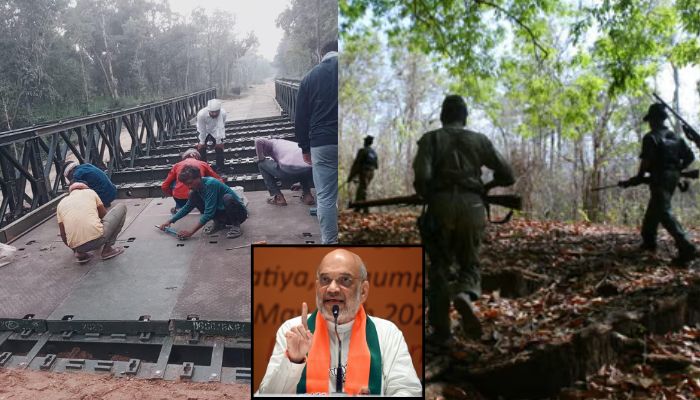
One of the biggest game-changers in this transformation has been the work done by the Border Roads Organisation (BRO). According to a report by The Indian Express, over the last 15 months, the BRO has built 20 Bailey bridges and completed 75 km of road construction in extremely difficult terrain across Maoist-affected districts like Bijapur and Sukma.
In November 2024, the BRO was assigned the task of developing a 130-km road network in these districts, areas that had seen some of the worst Maoist violence. The project includes over 10 separate road works that had remained incomplete for years due to constant threats from Naxals.
A BRO official highlighted the challenges, saying, “80% of the road projects were lying dormant for over half a decade on account of poor response from local contractors due to constant threat from Naxals.”
In the past, Maoists frequently targeted road construction. Equipment was destroyed, contractors were killed, and even security personnel deployed for protection were attacked. As recently as last year, a contractor was killed in Bijapur’s Pamed area.
The threat continues even today. Officials revealed that Maoists had planted a 50-kg improvised explosive device (IED) in Basaguda, which was later defused by the CRPF.
Tough terrain, faster work
Despite these risks, several key projects have been completed in record time. One such project is the Tadapala hill road in Bijapur district. Assigned to the BRO in January 2026, the 13-km road, with nearly 8 km passing through hilly terrain, was completed within just two months.
Officials said the road holds strategic importance as it lies along a key route used by Maoists moving between Chhattisgarh and Telangana. The area’s dense forests and steep hills had long provided cover to insurgents.
“Given the great difficulty level and the BRO’s expertise in hill road construction, it was the natural choice for the project,” an official said.
Construction here was extremely challenging, with landmines, IED threats, and hard rock formations. Yet, the BRO managed to complete the work well ahead of schedule. “Despite this, BRO personnel achieved connectivity to the Tadapala hilltop within two months,” the official added.
Another major achievement was the rerouting of a road connecting Kondapalli village in Bijapur to Puvarti in Sukma, the native village of slain Maoist leader Hidma. This reduced the distance from 38 km to just 9 km.
All-weather connectivity is changing lives
The construction of roads and Bailey bridges has improved connectivity in these regions. Over 20 such bridges have been installed in just eight months.
Explaining their importance, a BRO official said, “A Bailey bridge is a portable truss bridge developed by the British during World War II… it can be quickly assembled and moved.”
These bridges have ensured year-round connectivity, especially during the monsoon when many villages used to get cut off.
Officials say more than 25 villages in Bijapur and Sukma now have all-weather access. This has not only helped security forces but also improved daily life for residents.
Inspector General of Police (Bastar Range) P Sundarraj said, “These regions, which were once extremely remote and difficult to access due to dense forests and poor connectivity, are now gradually becoming more reachable for security forces. The improved road infrastructure has enabled faster movement of troops, better logistical support, and more effective coordination during anti-Naxal operations. As a result, security forces have been able to sustain pressure on Maoist groups, establish a stronger presence in previously inaccessible areas, and respond swiftly to operational requirements.”
Another key stretch, the 20-km road from Kondapalli to Dharmaram, is now operational, with buses already running. This route has reduced travel distance to Telangana’s Bhadrachalam from 270 km to 180 km.
Karegutta hills: Breaking the last stronghold
One of the most crucial developments has taken place in the Karegutta Hills region, considered one of the last Maoist strongholds near the Telangana border.
The BRO has completed around 70% of a key road project connecting the Tadapala hills in this area. The work involved cutting through hard rock for over a kilometre and conducting blasting operations for nearly 25 days.
This road has transformed logistics for security forces. Earlier, essential supplies had to be delivered by helicopters.
“The road project is almost complete, and CRPF troops no longer depend on Air Force helicopters,” an official said. Now, troops can move more easily, maintain a stronger presence, and carry out operations more effectively in the region.
Looking ahead, the BRO has lined up several more projects. Plans are in place to construct eight major bridges across districts like Narayanpur, Sukma, Kondagaon, and Kanker.
“These state-of-the-art modular bridges will be constructed in a short timeframe,” officials said, adding that proposals have already been sent to the Centre.
Additionally, over 10 detailed project reports (DPRs) have been prepared for new infrastructure projects in Maoist-affected regions.
Operation Kagar and the Modi govt’s push for a Naxal-free India
These developments are part of a larger national strategy. In January 2024, the Centre launched Operation Kagar to eliminate Naxalism across states like Chhattisgarh, Maharashtra, Odisha, Jharkhand, Madhya Pradesh, and Telangana.
As part of the operation, about 1 lakh para-military forces, including the Central Reserve Police Force (CRPF), its elite forces CoBRA (Commando Units of CRPF), District Reserve Guards (DRG), and state police forces, armed with modern technology, have been deployed in the areas affected by left-wing terrorism to completely root out the naxal terrorism from its last remaining strongholds.
The success of the centre’s anti-Naxal operation can be judged by the fact that, from 2015 to 2025, the number of Naxal-affected districts reduced from 106 to 18. Of these districts, 12 were considered the worst-affected by Naxalism. However, this number was further reduced to only 6 worst Naxal-affected districts, including Bijapur, Kanker, Narayanpur, and Sukma in Chhattisgarh, West Singhbhum in Jharkhand, and Gadhchiroli in Maharashtra.
On 19th February, Bihar authorities announced that the state is now “Naxal-free” after the surrender of prominent Maoist Suresh Koda, also known as Mustakim, who had a reward of Rs 3 lakh. He surrendered himself to the Special Task Force (STF) of the Munger district police a day ago. It is pertinent to note that the number of districts affected by left-wing extremists (LWE) has also decreased to seven, as per a recent analysis of the affected region.
In January this year, the Centre released a detailed 10-point plan to ensure that areas cleared of Left-Wing Extremism remain peaceful. The plan is meant for the post-Left-Wing Extremism phase and focuses on stabilising districts that have lived through years of violence. It aligns with the development-oriented part of the Cen.
A region in transition
The impact of the security operations and infrastructure development is now visible in the region. Areas which were previously totally inaccessible are slowly becoming part of the mainstream.
The increased connectivity is not only helping the security forces but is also bringing about positive changes in the region. With the development of roads, there is now easier access to schools, hospitals, markets, and government schemes.
Currently, the roads that are being constructed through the forests and hills of Bastar are not just connecting the places; they are also symbolising the transition from conflict to development.
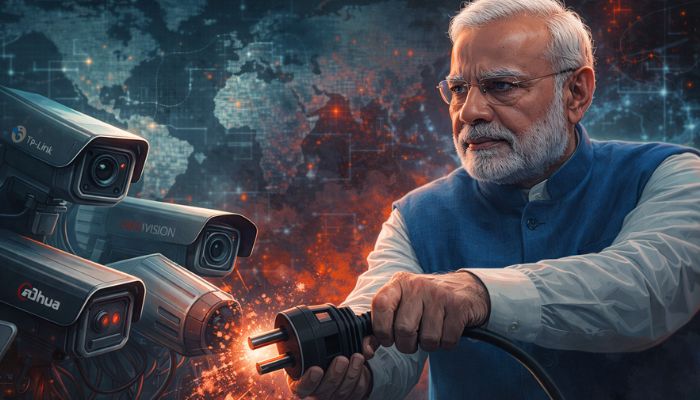
The surveillance system in India is getting a sweeping reset. Chinese CCTV makers including TP Link, Hikvision and Dahua are effectively being pushed out of the internet connected camera market as stricter certification norms are all set to kick in on 1st April. Companies that have failed to secure mandatory security certification under the government’s STQC regime will no longer be allowed to sell such products in the Indian market. This change will mark a decisive shift driven by national security concerns, trusted supply chains and data sovereignty.
What is happening in the market
The immediate impact of the new certification regime is visible in the CCTV market in India. Chinese brands that until recently held around one third of the market are now either exiting or drastically altering their business models.
According to industry data published in media reports, Indian manufacturers such as CP Plus, Qubo, Prama, Matrix and Sparsh have already taken over 80% of the CCTV market. Global firms such as Bosch and Honeywell have consolidated their position in the premium segment. On the other hand, Chinese and smaller players have disappeared due to non compliance.
Companies that heavily relied on Chinese chipsets and firmware have struggled to meet certification requirements. Major industry players including Hikvision have been forced to explore joint ventures with Indian firms and move away from Chinese supply chains due to regulations imposed by the Government of India. Dahua’s presence has also shrunk by almost 80% in the Indian market.
Household names from the Chinese ecosystem including Xiaomi and Realme, who rule the smart home camera segment, have also withdrawn from the market due to compliance challenges. Reports suggest that the shift has increased costs by 15% to 20% due to localisation and alternative sourcing. However, dominant players have managed to stabilise prices in the lower end of the market.
The transition stems from the Essential Requirements norms introduced by the Ministry of Electronics and Information Technology (MeitY) in April 2024. With the norms, the government mandated security testing, declaration of component origin, and vulnerability assessment before the products can be sold in the Indian market.
The policy architecture explained
As recent as 4th February 2026, the Government of India issued a circular that clarified the policy architecture behind the market shift. The circular made it clear that security certification for CCTV cameras will now be uniformly governed through STQC testing under the Essential Requirements framework.
The government has aligned two regulatory mechanisms, the Compulsory Registration Order and the Public Procurement Preference to Make in India framework, by ensuring that a single STQC security test report will suffice for compliance under both. This effectively removes ambiguity and tightens enforcement.
It is important to note that the circular has clarified that security certification is independent of value addition requirements under Make in India norms. In other words, even if the product meets localisation criteria, it cannot bypass security testing.
The IoT System Certification Scheme plays a crucial role here. CCTV cameras fall under IoT devices, meaning they are subject to cybersecurity scrutiny that goes beyond basic hardware compliance. Under this framework, devices must meet stringent requirements such as secure communication protocols, encryption, tamper resistance, and controlled access to hardware interfaces.
The IoT section further clarifies that STQC certification applies to all such devices uniformly, ensuring that no manufacturer can escape scrutiny by exploiting regulatory overlaps. It also enables government authorities to standardise testing procedures and certification outputs across sectors.
The government has also publicly published names of companies that have secured the clearance certificate along with a PDF of the certificate on the website which can be accessed here.
Government refused to extend certification deadline in 2025
The groundwork for the current market disruption was laid in 2025 when the government expanded the scope of CCTV scrutiny to include hardware, software and even source code level inspection.
As reported earlier by OpIndia in May 2025, manufacturers were mandated to submit their devices for deep security assessment in government labs. This included analysis of firmware, encryption mechanisms and potential vulnerabilities that could allow remote access or data exfiltration.
The move was driven by concerns that internet connected cameras could act as surveillance tools if compromised. Experts had warned that such devices could be accessed remotely from adversarial locations, posing espionage risks.
Manufacturers had raised objections at the time, citing delays, inspection burdens and risks to proprietary source code. Industry bodies warned of financial losses and disruption to infrastructure projects. However, the government refused to dilute the policy, maintaining that it addressed a genuine national security concern.
The rules also empowered authorities to inspect manufacturing facilities, even outside India, and mandated robust cybersecurity features such as encryption, malware detection and secure communication protocols.
Government flagged vulnerabilities in CCTV ecosystem
Concerns around CCTV related data security are not new. Back in 2021, while responding to a Lok Sabha query, the government had already flagged vulnerabilities associated with foreign made surveillance systems. It shows that the Narendra Modi led government has been trying to weed out possible data leaks via the CCTV ecosystem for a long time.
The government stated that around 10 lakh CCTV cameras installed in government institutions were sourced from Chinese companies. It acknowledged that video data captured through such devices could be transferred to servers located abroad, raising serious security concerns.
The government had pointed to systemic vulnerabilities and said measures such as filtering of URLs and IP addresses had been implemented to mitigate risks. It also highlighted steps taken under existing laws to regulate imports and ensure compliance with Indian safety standards.
These early warnings laid the foundation for the current regulatory tightening and signalled a long-term policy trajectory that is focused on securing surveillance infrastructure.
The Gazette notification that changed the CCTV ecosystem for good
The legal backbone of the current regulatory regime lies in the Gazette notification issued on 9th April 2024. With the notification, the government formally brought CCTV cameras under the Compulsory Registration framework.
The notification amended the Electronics and IT Goods Order to include CCTV cameras as a regulated category requiring mandatory certification before sale. It made compliance with Indian safety standards and newly introduced Essential Security Requirements compulsory.
At its core, the notification mandates that CCTV systems must be secure at multiple levels, hardware, firmware, network and supply chain. The requirements go far beyond basic quality checks and focus on cybersecurity resilience.
Manufacturers must ensure physical security through tamper resistant enclosures, preventing unauthorised access to device internals. At the software level, devices must implement strong authentication systems, role-based access controls and regular updates.
One of the most critical aspects is encryption. Data transmission from cameras must be encrypted, ensuring that video feeds cannot be intercepted or manipulated. Devices must also be capable of resisting cyberattacks through penetration testing and vulnerability assessments.
The certification process requires vendors to submit detailed technical documentation, including system architecture, firmware details, and security protocols. They must also provide evidence of secure boot processes, protection against firmware tampering, and safeguards against backdoor access.
Another key requirement is the supply chain integrity. Manufacturers must disclose the origin of critical components such as chipsets and demonstrate that they come from trusted sources. This is particularly significant given concerns over Chinese components.
The notification also emphasises lifecycle security. Devices must support secure firmware updates, prevent rollback to older vulnerable versions, and maintain logs of software components and vulnerabilities.
Testing is conducted in accredited laboratories recognised by the Bureau of Indian Standards. Only after successful evaluation can a product receive certification and be allowed for sale in the Indian market.
In essence, the Gazette notification transforms CCTV cameras from simple surveillance devices into tightly regulated digital infrastructure components, where security, transparency and traceability are non-negotiable.
Why unmonitored CCTV networks pose a national security risk
The seriousness of the threat is evident from the fact that central agencies have recently ordered a pan India audit of CCTV networks across major cities. The directions came after a Pakistan linked spy ring was busted. According to a News18 report, the directive is not a routine administrative exercise. It follows the discovery that the espionage network had not merely exploited existing cameras but had installed its own covert surveillance systems at sensitive sites, including Delhi Cantonment Railway Station and Sonipat Railway Station.
Some of these cameras were fitted with solar power systems to ensure uninterrupted live footage, which, according to investigators, was relayed to ISI linked handlers across the border. Central agencies have therefore asked police forces and law enforcement units to physically verify installations, identify unauthorised cameras, and examine if the existing systems have adequate access controls.
Surveillance cameras are not just passive crime prevention tools. Once compromised, they can become hostile intelligence assets. A fragmented network of cameras installed by different agencies, contractors and local bodies, without a unified oversight protocol, creates blind spots that can be exploited by enemy states, terror groups or espionage handlers.
The danger of compromised surveillance infrastructure is not theoretical. It has already been demonstrated globally in the most chilling way. According to earlier reports by OpIndia, Israel spent years penetrating Iran’s traffic camera network and mobile phone systems to track the movements of the now-deceased Supreme Leader of Iran, Ayatollah Ali Khamenei, and his security detail before the strike that killed him.
The surveillance effort reportedly allowed Israeli intelligence to monitor the movements of bodyguards, drivers and senior officials, study parking patterns inside a heavily guarded compound, map commuting routes, and build algorithm driven dossiers on the routines of those tasked with protecting the Iranian leadership. Traffic camera feeds were allegedly encrypted and transmitted to Israeli servers, while mobile networks around the target zone were interfered with to delay or block possible alerts.
It shows how cameras, if infiltrated, can become instruments of battlefield grade intelligence. They reveal patterns, routines, vulnerabilities and timing. Combined with signal interception, data analytics and human intelligence, a compromised CCTV grid can help an adversary identify targets, monitor strategic locations and support precision attacks.
Therefore, for India, it is not merely a question of cyber hygiene or bureaucratic compliance. It is a question of sovereignty, counter espionage and national defence. An unsecured or unaudited surveillance network is not just a technical lapse, it is a tactical opening.
A structural shift, not just a market change
The combined effect of policy decisions taken by the government over the years has resulted in a structural shift in India’s surveillance ecosystem.
What began as a concern over data security has now evolved into a comprehensive regulatory framework that reshapes supply chains, promotes domestic manufacturing, and restricts unverified foreign technology.
While the transition has led to higher costs and short term disruptions, it has also opened opportunities for Indian manufacturers to dominate a market expected to grow significantly in the coming years.
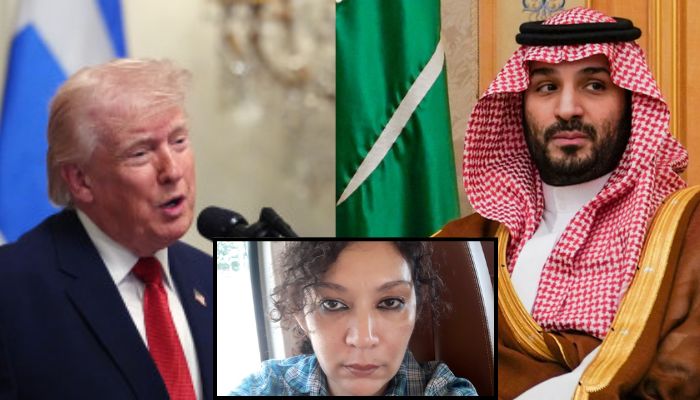
The complex world of the Middle East took another sharp turn, following some highly unfiltered remarks from President Donald Trump. Speaking at the Future Investment Initiative conference in Florida, Trump didn’t hold back when describing his relationship with Saudi Arabia’s de facto ruler, Crown Prince Mohammed bin Salman, widely known as MBS. In a statement that has since gone viral, Trump claimed that the Saudi leader was effectively “kissing my a**” while describing the current power dynamics between Washington and Riyadh.
US President Donald Trump has claimed that Saudi Arabia's Crown Prince, Mohammed bin Salman, is "kissing his ass" during a speech at an investment summit in Miami pic.twitter.com/V3uwkSd1nX
According to media reports, Trump recounted a conversation regarding the US resurgence under his presidency. He claimed that MBS hadn’t expected such a strong American comeback. “He didn’t think this was going to happen… he didn’t think he’d be kissing my a**… he thought it’d be just another American president that was a loser… but now he has to be nice to me,” Trump said. While these words were biting, Trump did balance them with praise, calling the Crown Prince a “fantastic man” and a “warrior,” suggesting that Saudi Arabia should be proud of his leadership.
These comments didn’t happen in a vacuum. They come at a time when the US and Israel are engaged in a significant military campaign against Iran, which began on 28th February. Reports from the New York Times suggest that behind closed doors, MBS has been encouraging Trump to stay the course, calling the war a “historic opportunity” to weaken the Iranian government. However, publicly, Saudi Arabia has maintained a more cautious stance, calling for a peaceful resolution while focusing on defending its own borders. Despite this official neutrality, Trump’s public mockery has struck a sensitive nerve across the globe, particularly within the Muslim community of the Indian subcontinent.
The outrage of the Indian Subcontinent Muslims
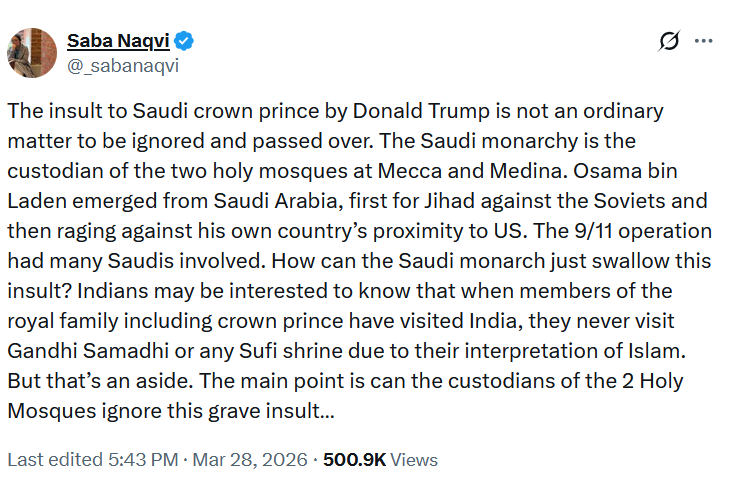
The reaction from the muslims of the Indian subcontinent was swift and deeply rooted in the concept of the “Ummah.” One of the most prominent voices to react was journalist Saba Naqvi. On Saturday, 28th March, she shared a lengthy and provocative post on X. In her post, Naqvi invoked the name of Al-Qaeda terrorist Osama bin Laden and referred to the Saudi monarchs by their religious title, the “custodians of the two holy mosques in Mecca and Medina.”
She wrote, “Osama bin Laden emerged from Saudi Arabia, first for Jihad against the Soviets and then raging against his own country’s proximity to the US. The 9/11 operation had many Saudis involved.” By referring to the horrific 9/11 terrorist attacks as an “operation” and a sharp attempt to legitimise it, she seemed to be drawing a parallel between past Saudi-US tensions and the current perceived insult.
Naqvi didn’t stop there. She touched upon the Saudi royal family’s visits to India, noting that they rarely visit the Gandhi Samadhi or Sufi shrines due to their specific interpretation of Islam.
However, her main objective was clear: to provoke a religious reaction. “The main point is, can the custodians of the 2 Holy Mosques ignore this grave insult…” she questioned. Her choice of words appears to be a calculated attempt to stir the “Ummah” into not accepting Trump’s remarks, essentially suggesting that as an Indian Muslim, her loyalty lies with the dignity of Islamic leadership over diplomatic nuances.
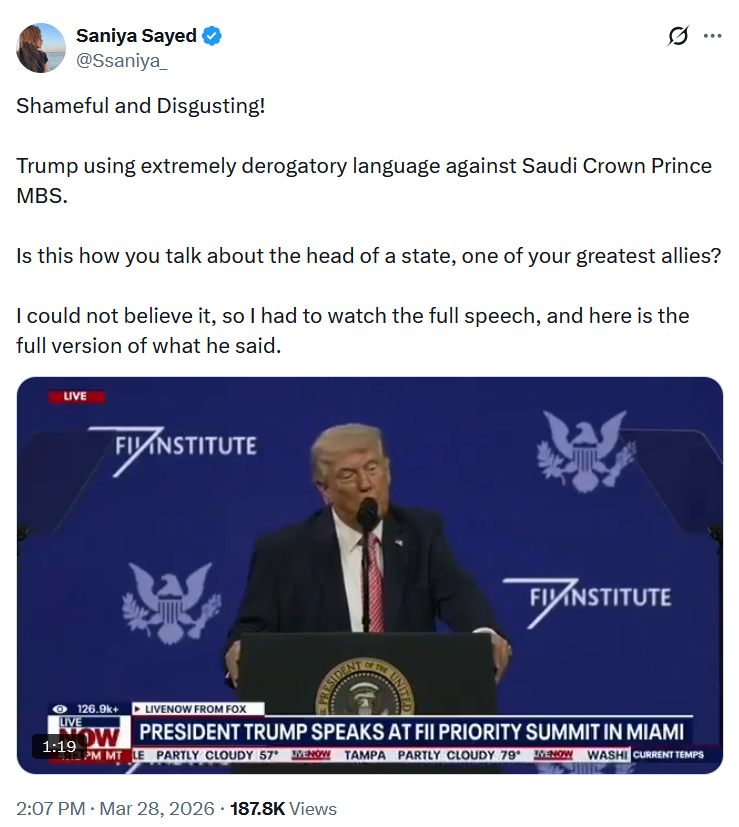
The outrage spread quickly beyond Naqvi’s circles. Saniya Sayed, another vocal user on X, expressed her disgust quite clearly. She wrote, “Shameful and Disgusting! Trump using extremely derogatory language against Saudi Crown Prince MBS. Is this how you talk about the head of a state, one of your greatest allies?” Her reaction mirrors a sentiment of deep-seated hurt, where an insult to a Saudi leader is viewed as a personal affront to Muslims everywhere.
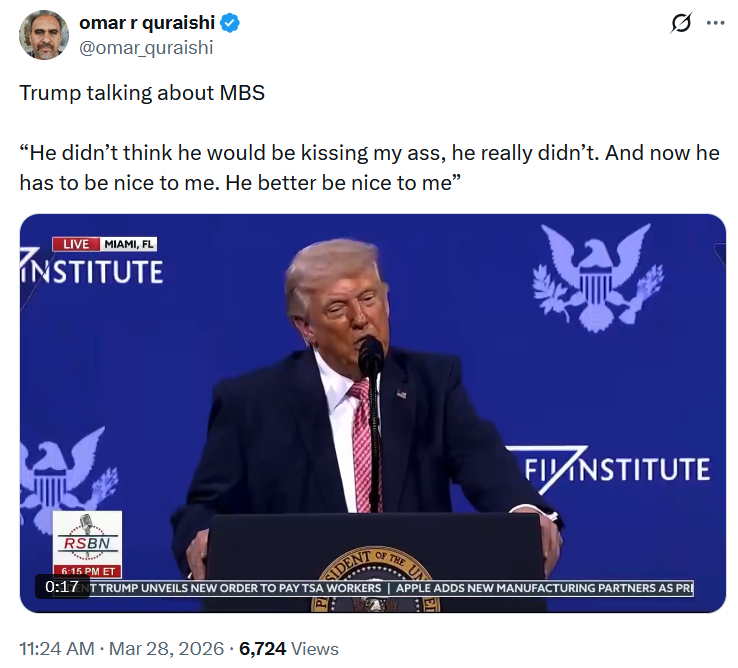
The sentiment was equally strong in Pakistan. A prominent Pakistani journalist shared the video of Trump’s comments, highlighting the specific part where Trump said, “He didn’t think he would be kissing my ass, he really didn’t. And now he has to be nice to me. He better be nice to me.” This sharing of the video wasn’t just for news; it was to highlight the perceived humiliation of a leader who represents the heart of the Islamic world.
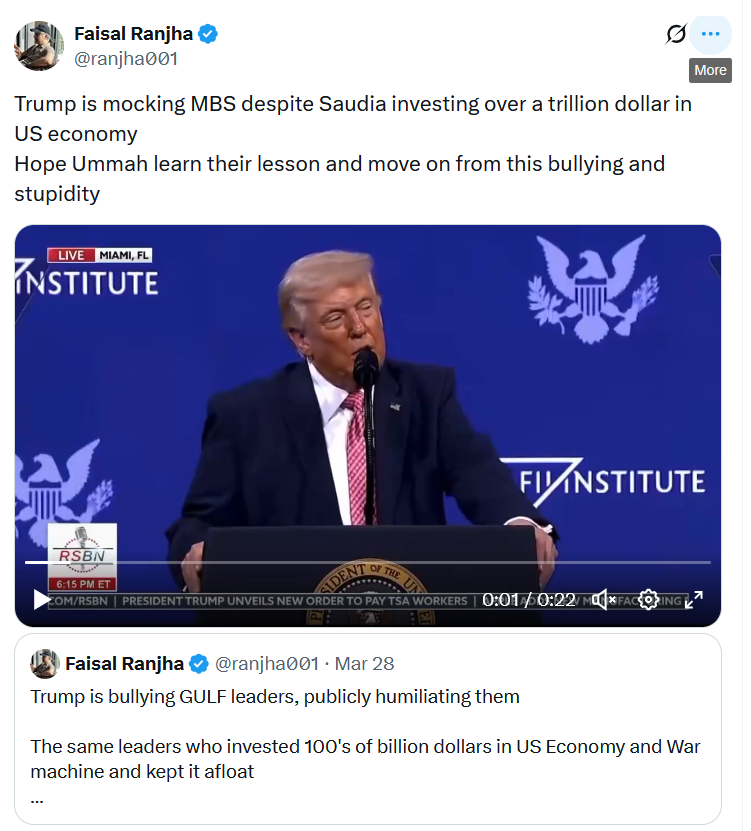
Another Pakistani voice, Faisal Ranjha, took a more direct stance by bringing up the economic angle. He noted that Trump was mocking MBS despite Saudi Arabia investing over a trillion dollars into the US economy. He wrote, “Hope Ummah learn their lesson and move on from this bullying and stupidity.” By using the word “Ummah” and suggesting they “learn their lesson,” Ranjha was effectively calling for a collective religious and economic pushback against what he perceives as American bullying. This reinforces the idea that for these individuals, the religious identity of the “Ummah” comes before any national or diplomatic pragmatism.
Crying for Khamenei: Loyalty beyond borders
This trend of showing extreme loyalty to global Islamic leaders, not national interests, can be seen in an even stronger form after the death of the Supreme Leader of Iran, Ayatollah Ali Khamenei. Khamenei was a figure who frequently criticised India, yet the news of his death saw massive outpourings of grief from Indian Shia Muslims. From Jammu and Kashmir to Uttar Pradesh, Mumbai, the roads saw people mourning the death, protesting against the killing of the Supreme Leader.
In Kashmir’s Lal Chowk, protesters described him as “a lion” and claimed many more like him would be born. Black flags were waved at imambaras, which is usually done only during the highest form of religious mourning, like the tragedy at Karbala.
Even in Aligarh Muslim University, students held funeral prayers in absentia. Activist SM Tahir Husain noted that for many, the Ayatollah was not just a leader for Shias but a symbol for all Muslims. This reaction highlights a significant trend: when a figure associated with the global “Ummah” is affected, the emotional and physical response from certain sections of the Indian Muslim community is overwhelming, often overshadowing domestic concerns.
Gold for Iran, silence for Pahalgam
The most striking evidence of this “Ummah-first” loyalty can be seen in the financial contributions made by Kashmiri Muslims toward Iran following the outbreak of the recent conflict. Reports have emerged of youth in the Kashmir valley going door-to-door to collect donations. People have been pledging gold, cash, and even livestock to support Iran. One woman reportedly donated gold she had kept for 30 years in memory of her late husband, while a young man in Ganderbal sold his Royal Enfield bike to contribute to the Iranian relief efforts.
“There is huge devastation caused by this illegal war imposed on Iran. The least the civilised world can do is send aid,” said one resident of Rainawari. While this humanitarian impulse is notable, it stands in stark contrast to the local response to domestic tragedies. For instance, when the Pahalgam terror attack occurred on 22nd April last year, where the victims were all Hindus, there was no such door-to-door collection, no selling of personal vehicles, and no mass outpouring of “hard-earned money” to support the victims’ families, not even the basic donations to the families of the victims.
A question of allegiance
The overall reaction to Trump’s comments on MBS, the mourning of Khamenei, and the large donations to Iran shows a common theme. For people such as Saba Naqvi and almost all Muslims, their true allegiance appears to be to their global Muslim community, or “Ummah,” rather than to their country of residence.
When a Saudi Arabian leader is disrespected, or an Iranian leader is assassinated, it elicits a personal, religious outrage. However, when their countrymen are murdered in a terror attack such as the one in Pahalgam, there is a deafening silence. This suggests a hierarchy of loyalty where religious identity and the concept of a borderless “Ummah” take precedence over national solidarity. By provoking MBS and the wider Muslim world over Trump’s remarks, these individuals are not just commenting on a news story; they are reinforcing a religious divide that places global sectarian ties above the unity of their own country.
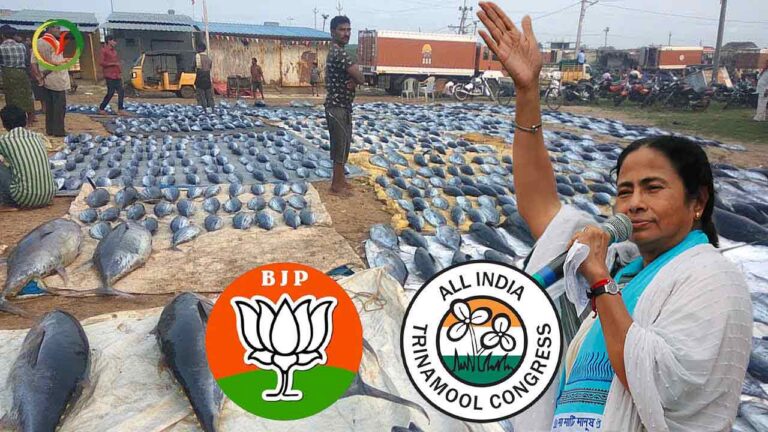
In a rally in Purulia on March 29, 2026, West Bengal Chief Minister Mamata Banerjee claimed that “fish is not eaten in BJP-ruled states” and warned that if the BJP comes to power in Bengal, people “won’t be able to eat meat or eggs,” saying that a BJP government in Bengal will ban non-vegetarian food.
The CM’s comments are part of a larger TMC campaign against the BJP, focusing on fish. Facing massive anti-incumbency after 15 years in power, the Trinamool Congress has been alleging in election rallies that the BJP is “anti-Bengali” and if it comes to power in the state, it will ban fish. TMC leaders have made it part of their election campaign, attempting to instil fear over the issue.
#WATCH | Purulia: West Bengal Chief Minister Mamata Banerjee says, "Fish is not eaten in BJP-ruled states. If BJP comes, you won't be able to eat meat or eggs. BJP is one-sided, they don't believe in any religion… These people incite riots. They come to power by inciting riots,… pic.twitter.com/f66hMHmXvV
Mamata Banerjee’s claim that “fish is not eaten in BJP-ruled states” is completely baseless and false. It is a clear distortion of facts and amounts to political fear-mongering designed to stoke anxiety over cultural and dietary habits in the poll-bound state.
Data from BJP-ruled states debunks the claim
India has 14 states currently under BJP governance or BJP-led alliances, including Arunachal Pradesh, Assam, Chhattisgarh, Goa, Gujarat, Madhya Pradesh, Maharashtra, Manipur, Odisha, Rajasthan, Tripura, Uttar Pradesh, and Uttarakhand. Fish consumption and non-vegetarian diets remain widespread and unaffected by the ruling party in these states.
BJP is in power in several states in the eastern parts of the country, where the majority of people consume meat and fish, and it has not changed after the BJP came to power in those states. In fact, in terms of the share of the non-vegetarian population, several BJP-ruled states rank among the highest in the country.
BJP-ruled Tripura tops the list with 99.35% of the population consuming fish, which is the highest proportion nationally. Manipur, Assam, and Arunachal Pradesh, three BJP-ruled states, also feature among the top fish-consuming states, with the northeastern and Eastern regions showing over 90% fish consumption in many areas. Daily fish consumption rates are notably high in states like Manipur and Assam. Every year during Bohag Bihu, Assam CM Himanta Biswa Sarma posts images of people gifting him fish as part of the tradition.
On the Western side, Goa, with a BJP government, has over 90% fish consumers, ranking second in daily fish intake nationally.
Even in states with relatively lower overall fish consumption due to cultural or geographical factors, like Rajasthan or parts of Gujarat and Madhya Pradesh, fish is freely available, consumed, and not banned. Gujarat, for instance, is a major exporter of Hilsa fish, a Bengali staple, supplying significant quantities to West Bengal and other markets. Maharashtra and Odisha, both BJP-led, are major fish-producing and consuming states with thriving seafood industries and no restrictions on consumption.
National surveys, including NFHS data, confirm that non-vegetarian consumption (including fish, chicken, and eggs) exceeds 50-70% in many BJP-ruled states like Madhya Pradesh and Uttar Pradesh, with no statewide bans on fish or everyday non-veg items. Temporary, location-specific restrictions on meat sales near sensitive areas during festivals have occurred in isolated cases, but there are no statewide bans on any non-vegetarian food in any state.
West Bengal BJP’s Clarification
The West Bengal unit of the BJP has repeatedly and categorically rejected any notion of a non-veg ban. State BJP president Samik Bhattacharya stated, “People in Bengal will eat whatever they want to eat. Bengal will have its fish and meat.” He emphasised that the party opposes only the open sale of beef in certain contexts but fully supports Bengali food culture.
He maintained that the BJP’s stand was limited to opposing the open sale of beef. “Only that stuff you sell in the open will not be allowed by the BJP,” he said.
'Fishy' affair! 🐟🐠
BJP candidate Dr Sharadwat Mukherjee went out campaigning with a fish in hand to counter TMC's charge that BJP will ban fish/non-veg if they came to power in Bengal pic.twitter.com/opgjEWT7JD
— Indrajit Kundu | ইন্দ্রজিৎ (@iindrojit) March 22, 2026
In a direct counter to TMC propaganda, BJP candidate Dr. Sharadwat Mukherjee from Bidhannagar campaigned door-to-door holding a large fish, declaring, “Lies are being spread against us. We will eat both fish and meat.” Senior leaders have publicly eaten fish in media appearances to underscore the point and to counter TMC’s baseless fearmongering.
Food habits are cultural – They do not change with ruling parties
The notion that if the BJP comes to power in a state, the state becomes vegetarian is completely baseless. Dietary preferences in India are deeply rooted in regional culture, availability of resources, and personal choices, they are not dictated by the party in power. West Bengal itself has seen multiple governments over decades, yet fish remains a daily staple for the vast majority, with over 98% of Bengalis identifying as non-vegetarian.
The same holds true across BJP-ruled states and states ruled by non-NDA parties. Northeastern BJP governments have not altered the fish-heavy diets of local communities, coastal states like Goa continue their seafood traditions, and other states similarly maintain their existing patterns. Claims that a change in ruling party would suddenly prohibit fish or eggs ignore decades of evidence and are designed purely for electoral polarisation.
TMC and Mamata Banerjee’s repeated assertions, linking BJP rule to a ban on fish, meat, and eggs, are therefore nothing but classic fear-mongering. With West Bengal heading into assembly elections, such rhetoric distracts from governance issues while attempting to portray the BJP as culturally alien.
The facts show otherwise, fish is very much eaten, and thriving, in BJP-ruled states, and West Bengal’s food habits will remain unchanged regardless of who forms the next government.
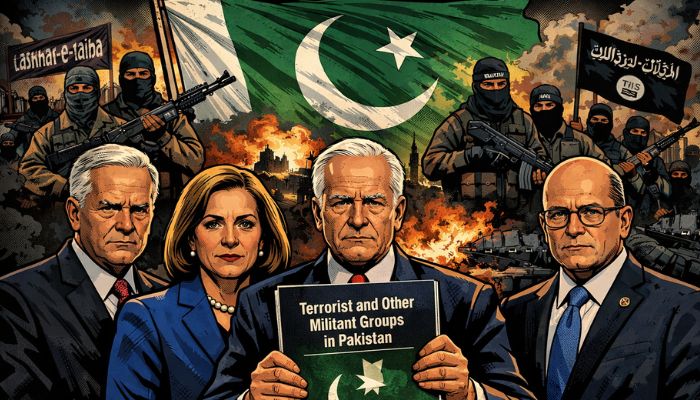
On 25th March (local time), a report was tabled by the United States Congress, which once again underlined Pakistan’s role as a hub of terrorist activity. The report identified multiple terrorist organisations operating from Pakistan’s soil that continued to target India and sought annexation of Jammu and Kashmir. The report, titled “Terrorist and other Militant Groups in Pakistan”, presented a structured assessment of terror ecosystems functioning within Pakistan and categorised them based on operational focus and ideological orientation.
The Congressional Research Service report stated that Pakistan was both a base and a target for numerous non-state militant groups, several of which had been active since the 1980s. It further noted that despite sustained military campaigns and counter-terror operations, these terror outfits continued to function with significant capability.
Five categories of terror groups operating from Pakistan
The report classified terror organisations linked to Pakistan into five broad categories, that are globally oriented groups, Afghanistan-oriented militants, India and Kashmir-focused organisations, domestically oriented groups, and sectarian outfits targeting Shia communities.
The report examined 15 groups, out of which 12 had been designated as Foreign Terrorist Organisations under US law. This classification showed the scale and diversity of terrorist organisations operating from Pakistan. The report also noted that Pakistan itself had suffered significantly from terrorism since 2003, with fatalities peaking in 2009. However, after a brief decline, terrorism-related deaths had risen again and reached 4,001 in 2025, the highest in over a decade.
Failure of military offensives to eliminate terror networks
One of the key observations made in the report was the limited effectiveness of Pakistan’s military operations against terrorist organisations. It claimed that major offensives, including airstrikes and large-scale intelligence-based operations, had failed to dismantle these networks.
The report further noted that hundreds of thousands of such operations had been conducted. However, US and UN-designated terrorist organisations continued to operate from Pakistani territory. This finding raised serious questions about both the intent and the effectiveness of counterterror measures undertaken by Islamabad.
Notably, in May 2025, when India destroyed numerous hubs of terrorist organisations in response to the Pahalgam terrorist attack as part of Operation Sindoor, the Pakistani military not only attempted to strike Indian cities but also participated in funeral processions of the terrorists killed in Indian operations.
Furthermore, reports suggested that Pakistan was supporting terror outfits to rebuild the destroyed infrastructure in Indian strikes. While the US Congress report did not explicitly detail Pakistan’s role in sponsoring terrorist organisations, what happened in the past year made it clearer than ever that Pakistani authorities were themselves responsible for the growing terrorist problem in the country.
India and Kashmir focused terror groups
The report placed significant emphasis on terrorist organisations targeting India. Among the most prominent groups named in the report were Lashkar-e-Taiba, Jaish-e-Mohammed, Hizbul Mujahideen, Harakat-ul-Mujahidin, and Harakat-ul Jihad Islami.
Lashkar-e-Taiba, led by Hafiz Saeed, was described as a large and well-structured organisation with several thousand terrorists. It was based in Pakistan’s Punjab province and Pakistan-occupied Jammu and Kashmir and had reportedly changed its name to Jamaat-ud-Dawa to evade sanctions. The report recalled its role in the 2008 Mumbai terror attacks, along with several other high-profile incidents.
Jaish-e-Mohammed, founded in 2000 by Masood Azhar, was identified as another key group seeking the annexation of Jammu and Kashmir into Pakistan. With approximately 500 armed terrorists, the group operated across India, Afghanistan, and Pakistan. It was also noted for its role in the 2001 attack on the Indian Parliament.
Harakat-ul-Mujahidin, which operated from Pakistan-occupied Jammu and Kashmir and urban centres in Pakistan, was linked to the 1999 hijacking of Indian Airlines flight IC 814. This incident ultimately led to the release of Masood Azhar, who later founded Jaish-e-Mohammed.
Hizbul Mujahideen was described as one of the oldest militant groups operating in Jammu and Kashmir, with a cadre strength of up to 1,500. The report claimed that its members were primarily “ethnic Kashmiris” seeking either independence or accession to Pakistan.
However, Indian security analysts had repeatedly contested such characterisations, noting that a significant number of terrorists neutralised in Jammu and Kashmir operations had origins in mainland Pakistan, particularly from Punjab.
Mischaracterisations and factual inconsistencies
While the report presented a detailed overview, certain descriptions raised questions regarding accuracy. For instance, Jaish-e-Mohammed founder Masood Azhar was described as a “Kashmiri militant leader”, whereas he was widely known to be of Punjabi origin from Pakistan.
Similarly, the depiction of Hizbul Mujahideen cadres as predominantly “ethnic Kashmiris” did not fully align with ground realities observed in counterterror operations in Kashmir. Such inconsistencies highlighted the limitations of external assessments that may rely on outdated or incomplete datasets.
Globally oriented terror groups and regional linkages
The report also examined globally oriented militant organisations operating from Pakistan, including Al Qaeda and its affiliates. Al Qaeda, founded in 1988, continued to maintain linkages with several Pakistan-based groups despite being significantly degraded over the years.
Its regional affiliate, Al Qaeda in the Indian Subcontinent, established in 2014, had been implicated in attacks within Pakistan and attempted operations against military assets.
Another major entity highlighted was the Islamic State Khorasan Province, which operated primarily in Afghanistan but maintained a presence in Pakistan through former members of Tehrik-i-Taliban Pakistan and other militant factions.
Afghanistan oriented networks and safe haven concerns
The report outlined the long-standing presence of Afghanistan-focused militant groups operating from Pakistani territory. The Afghan Taliban, which regained power in Afghanistan in 2021, was noted to have historically operated from cities such as Quetta, Karachi, and Peshawar.
The Haqqani Network, another key group, was described as having operational linkages near the Pakistan-Afghanistan border and was reportedly associated with Pakistan’s intelligence apparatus, a claim denied by Islamabad.
Domestic and sectarian terror ecosystem
The report also highlighted domestically oriented terrorist groups such as Tehrik-i-Taliban Pakistan, which was described as the deadliest militant organisation operating within Pakistan. With an estimated strength of 2,500 to 5,000 fighters, the group sought to overthrow the Pakistani state and impose Sharia law.
Additionally, ethnic separatist groups like the Balochistan Liberation Army and Jaysh al-Adl were identified, along with sectarian outfits such as Lashkar-e-Jhangvi and Sipah-e-Sahaba Pakistan, which had historically targeted Shia communities.
Continued global scrutiny and policy implications
The report noted that Pakistan remained under international scrutiny for its counter-terror record. It noted that the country was designated as a “Country of Particular Concern” under the International Religious Freedom Act in 2018 and had retained this designation annually since.
It also referenced findings from the US State Department’s Country Reports on Terrorism 2023, which stated that while Pakistan had taken some steps to curb terrorist activities, concerns remained regarding radicalisation through certain madrassas that promoted extremist ideologies.
Conclusion
The report tabled by the US Congress reinforced a long-standing global assessment that Pakistan hosted and enabled a wide range of terrorist organisations, many of which directly targeted India and sought territorial changes in Jammu and Kashmir.
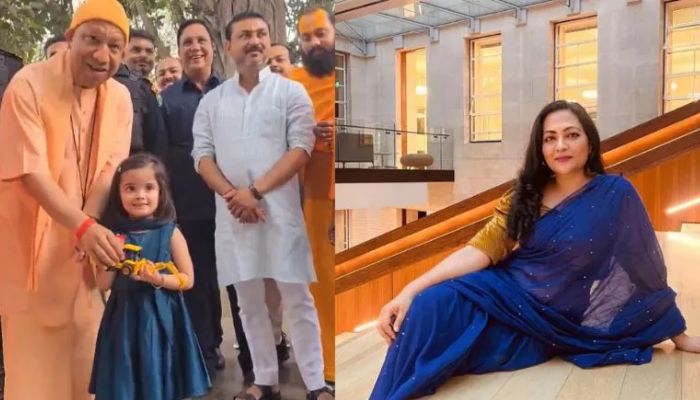
A heartwarming video from the Gorakhnath Temple in Gorakhpur has gone viral, showing an interaction between Uttar Pradesh Chief Minister Yogi Adityanath and a 5-year-old girl named Yashaswini from Kanpur. The young girl had come with her family to meet the Chief Minister and brought along a small toy bulldozer as a gift.
Beyond the Bulldozer: CM Yogi Encourages 5-Year-Old to Study Hard
In the video, CM Yogi is seen warmly greeting the child, offering her a chocolate, and accepting the toy with a smile. However, what stood out was his simple message to the girl. After holding the toy, he returned it to her and said, “Keep it with you, play with it, and study hard.”
The moment was widely shared online, with many people appreciating the Chief Minister’s calm and encouraging approach. His message was seen as clear and direct, while symbols like a bulldozer may have their own meaning in public life, a child’s focus should be on education and building a better future. Instead of encouraging anything else, he advised her to study and grow into a responsible citizen.
Arfa Khanum’s agenda: Seeing ‘Hindu Terrorism’ in a child’s toy
While many viewers saw the video as innocent and positive, journalist Arfa Khanum Sherwani reacted strongly to it.
This is how they are radicalizing a whole generation of Hindu kids. And that too innocent little girls. Heartbreaking and extremely dangerous. https://t.co/RUJwtcShLE
Sharing the clip on social media, she wrote, “This is how they are radicalising an entire generation of Hindu children. And that, too, innocent little girls. Heartbreaking and extremely dangerous.”
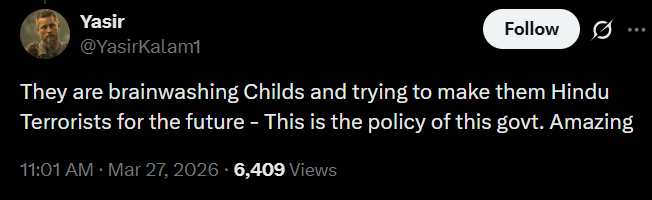
Her post quickly drew responses from others who shared similar concerns. A user named Yasir Kalam commented, “They are brainwashing children and trying to make them future Hindu terrorists; this is the policy of this government. Amazing.”
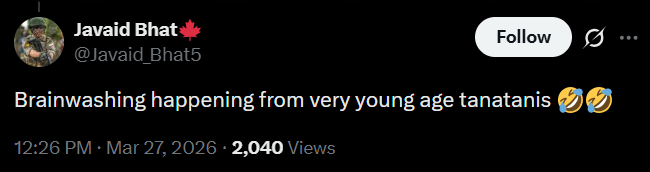
Another user, Javed Bhat, wrote sarcastically, “Sanatanists are being brainwashed from a very young age.”
Farhan Khan also joined in, criticizing the parents and saying, “What has happened to these children, the parents should be ashamed.”
These reactions turned what many saw as a simple and kind interaction into a larger debate on social media, with strong opinions from both sides.
Why Arfa ignores real radicalism while targeting a Child
At the same time, discussions also picked up around how different situations are viewed and highlighted.
A report by the Organiser has pointed out that in some places, children are exposed to ideas that divide people into “us versus them” and limit their exposure to modern education.
The report claims that when such thinking is introduced at a young age, it can shape how individuals see the world later in life. It also suggests that this kind of upbringing may lead to a mindset focused more on religious identity than on broader social responsibility.
According to the report, such trends have also contributed to unrest in countries like Spain, France, and Germany, where incidents of violence and clashes have been reported in recent years.
Fundamentalism vs. Innocence: The Poison of Double Standards
The debate further intensified as people pointed to other viral videos where young children were seen using aggressive or provocative language. In some clips circulating online, children were heard making threats, raising slogans like “Pakistan Zindabad,” or speaking about demolishing temples.
These incidents led to questions about how such views develop at a young age and whether similar reactions are seen across all such cases. Critics argued that while some situations are strongly condemned, others do not receive the same level of attention.
They also questioned whether there is consistency in calling out what is seen as harmful or divisive messaging among children, regardless of the context or community involved.
Bareilly Incident: Silence on desecrating Gandhi’s statue
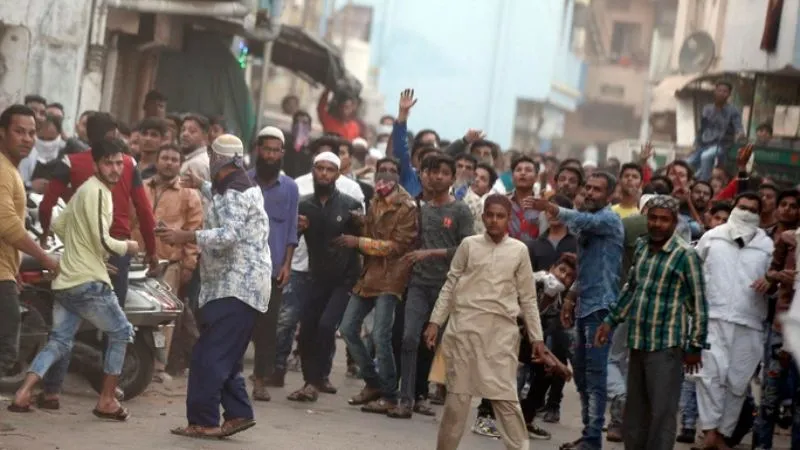
Another incident that was widely discussed took place during Eid celebrations in Bareilly. A video surfaced showing a group of youths and children behaving inappropriately with a statue of Mahatma Gandhi.
Brigadier Rudra Pratap Singh was visionary but still not visionary enough to imagine this
The visuals showed them touching and handling the statue in ways many people found disrespectful and offensive. The incident sparked anger online, with several users calling it an insult to a national figure.
Author Ratan Sharda also reacted, describing the act as a disturbing reflection of what some children are being exposed to. The incident added fuel to the ongoing debate about how different events are discussed and highlighted in public conversations.
Arfa Khanum, get your frustration treated
As the discussions continued, strong opinions emerged about the role of media voices and public commentary. Supporters of the Chief Minister argued that his message to the young girl was about education and growth, not anything negative.
They also claimed that focusing on a child’s toy while ignoring other serious issues reflects a one-sided narrative. According to them, encouraging children to study and build their future should be seen as a positive step.
On the other hand, critics maintained their concerns about symbolism and messaging, showing how divided opinions remain on such matters.
The incident, which began as a simple interaction between a leader and a child, has now turned into a larger conversation about perception, media narratives, and how society interprets such moments.
The 19th edition of the Indian Premier League began in Bengaluru on Saturday, 28th March, with the first match of the tournament taking place at the M. Chinnaswamy Stadium. The defending champions, Royal Challengers Bengaluru, are facing Sunrisers Hyderabad in what promises to be a thrilling start to the tournament that will go on for two months till the 31st of May.
The inaugural match of the Indian Premier League (IPL), 2026, commencing at Bengaluru’s M. Chinnaswamy Stadium on Saturday (March 28, 2026), is set to witness a high-octane contest between Royal Challengers Bengaluru (RCB) and Sunrisers Hyderabad (SRH).https://t.co/7DybJc38qu
RCB will begin their title defence with a new captain in Rajat Patidar, while Sunrisers Hyderabad will be led by stand-in skipper Ishan Kishan after Pat Cummins was ruled out of the tournament due to an injury. While the cricketing action is set to take centre stage again, this year’s opening carries a heavy emotional weight, as it marks the first match at the venue since last year’s tragic stampede that claimed 11 lives.
The Chinnaswamy stampede tragedy
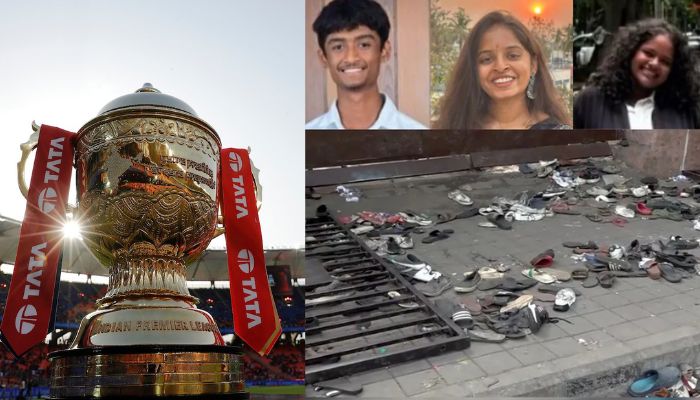
The excitement around RCB’s historic IPL win last year quickly turned into horror on 4th June, when a stampede broke out outside the Chinnaswamy Stadium while celebrating their victory. The franchise had just ended its 18-year-long wait for an IPL trophy, defeating Punjab Kings in a thrilling final.
A huge crowd had assembled to get a glimpse of the players during a victory parade and felicitation ceremony. However, there was a complete lack of proper planning and crowd management outside the stadium. In this tragic incident, at least 11 people lost their lives, including a child. More than 50 people got injured.
#BREAKING Video: Virat Kohli takes part in celebrations inside Chinnaswamy stadium. Earlier, 11 people lost their lives in a stampede outside the Bengaluru stadium.
The injured people were immediately shifted to hospitals such as Bowring Hospital and Lady Curzon Hospital. However, the event inside the stadium was not completely cancelled but was shortened, drawing criticism from many quarters.
Deputy Chief Minister D. K. Shivakumar had said, “There was no fault of the police, as the crowd was beyond anyone’s control.” However, the statement did little to calm the outrage.
Meanwhile, BCCI secretary Devajit Saikia admitted lapses, saying, “Organisers should have planned RCB’s IPL-winning celebrations better.”
No opening ceremony this year: BCCI
The Board of Control for Cricket in India has decided not to hold any opening ceremony for IPL 2026. This decision has been made as a tribute to the victims of last year’s tragedy.
Board of Control for Cricket in India (BCCI) secretary Devajit Saikia said, “Due to last year’s tragic incident on 4th June, there will be no formal function on the day of the start of IPL-2026.” “The BCCI is not organising any cultural or entertainment show… as a mark of respect to the departed souls,” he added.
At the same time, the Karnataka State Cricket Association (KSCA) has reserved 11 permanent seats inside the stadium in memory of those who lost their lives. RCB players are also expected to wear jerseys with the number 11 during practice sessions as a tribute.
Interestingly, while the opening ceremony has been cancelled, the IPL Governing Council is planning a grand closing ceremony on the day of the final, which may also be hosted in Bengaluru.
All the accused have been granted bail
Despite the serious findings, all the accused in the case have been granted bail on 12th June, 2025, by the Karnataka High Court. Those granted relief include RCB’s marketing head Nikhil Sosale and three senior officials from DNA Entertainment Networks, director and vice-president Sunil Mathew, manager Kiran Kumar and ticketing official Shamant Mavinakere and Kiran Kumar.
The interim relief was granted by the bench headed by Justice SR Krishnakumar. The court, while granting interim relief, directed the accused to surrender their passports. The petitions challenged the legality of their arrests, with the defence alleging procedural lapses.
During the hearing, Advocate General Shashi Kiran Shetty argued that RCB had played a key role in the incident. He told the court that the franchise’s social media posts had “invited the whole world” without providing clarity on entry or ticketing.
According to the state, lakhs of people gathered outside the stadium due to this confusion, leading to a situation that quickly went out of control.
CID probe points to major lapses
In November last year, the Criminal Investigation Department (CID) completed its probe and is preparing to file a massive chargesheet running over 2,200 pages. The investigation has placed direct responsibility on RCB, KSCA, and DNA Entertainment Networks.
According to media reports, the chargesheet includes CCTV footage, eyewitness testimonies, statements from injured victims, and accounts from police personnel present on duty. The findings highlight serious lapses in planning and coordination.
Investigators found that there was no proper crowd-management plan in place. There was also no clear security blueprint from the event organisers, and crucial decisions taken before the event were not communicated to the police.
One of the key triggers identified by the CID was confusion around ticketing. The probe suggests that unclear communication led to a massive crowd gathering outside the stadium, far beyond its capacity of around 35,000 people.
The report also points out that private security arrangements failed to handle the situation, leading to uncontrolled crowd pressure and eventually the stampede.
High court closes suo motu PIL
On 26th February this year, the Karnataka High Court closed the suo motu Public Interest Litigation (PIL) that it had initiated after the stampede.
The Division Bench of Chief Justice Vibhu Bakhru and Justice C M Poonacha also noted the state government’s submission that it has proposed the Karnataka Crowd Control (Managing Crowd At Events And Venues Of Mass Gathering) Bill, 2025, for effective management and control of crowds at sponsored events and venues of mass gathering, including political rallies, jatras, conferences, etc.
The government has also introduced a Standard Operating Procedure (SOP) for crowd management, which will be implemented until the proposed law is passed.
The court accepted these measures and disposed of the petition, effectively bringing an end to judicial monitoring of the case at this stage.
Justice still elusive for victims
As IPL returns to Chinnaswamy Stadium with packed stands and renewed excitement, the memories of last year’s tragedy remain fresh for many families. While theatrics like cancelling the opening ceremony and reserving seats have been made, questions around justice continue to linger.
The CID has pointed to clear lapses of the incident. The courts have granted bail to the accused. The PIL has been closed. The victims’ families are still waiting for justice.
In many ways, the story of the Chinnaswamy stampede is not just about a tragic incident, but also about what followed: delays, legal battles, and a lack of closure.
Wikipedia, notorious for letting anti-India and anti-Hindu editors use the platform for publicising biased information about individuals and entities, has sparked a fresh controversy rooted in the biasedness of its editors. Amidst an intense edit war on the Wikipedia page for the blockbuster film Dhurandhar and its even more successful 2026 sequel Dhurandhar: The Revenge, Wikipedia co-founder Jimmy Wales made a rare personal intervention on the article’s Talk page.
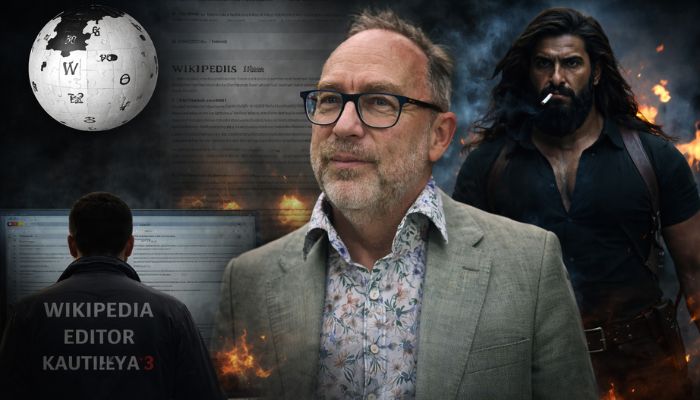
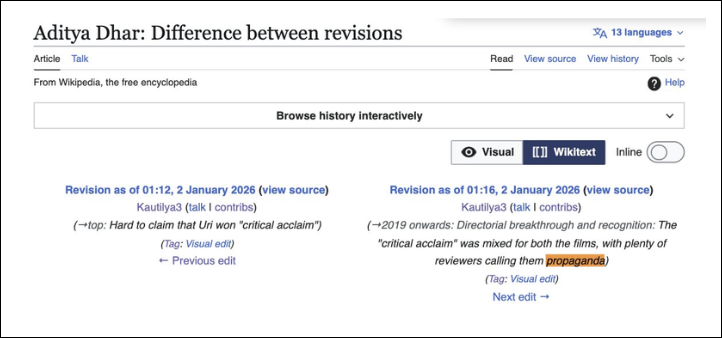
Wales explicitly rejected the attempts made by one of the editors, “Kautilya 3” to label the movie a “propaganda film” in the article’s opening sentence using the so-called encyclopedia’s ‘neutral’ “WikiVoice”.
Wales’s intervention was not about judging whether Aditya Dhar’s directorials are propaganda, but about protecting Wikipedia’s principle of Neutral Point of View (NPOV).
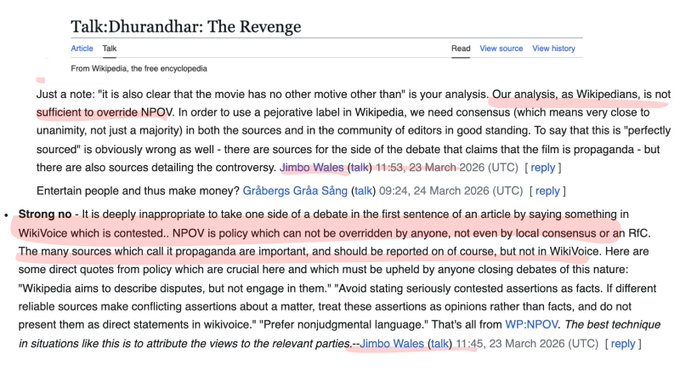
“…it is also clear that the movie has no other motive other than” is your analysis. Our analysis, as Wikipedians, is not sufficient to override NPOV. In order to use a pejorative label in Wikipedia, we need consensus (which means very close to unanimity, not just a majority) in both the sources and in the community of editors in good standing. To say that this is “perfectly sourced” is obviously wrong as well – there are sources for the side of the debate that claims that the film is propaganda – but there are also sources detailing the controversy,” the Wikipedia co-founder wrote.
Jimmy Wales stated that Wikipedia cannot pick sides, particularly on issues where reliable sources express strong disagreement.
“Strong no – It is deeply inappropriate to take one side of a debate in the first sentence of an article by saying something in WikiVoice which is contested.. NPOV is policy which can not be overridden by anyone, not even by local consensus or an RfC. The many sources which call it propaganda are important, and should be reported on of course, but not in WikiVoice. Here are some direct quotes from policy which are crucial here and which must be upheld by anyone closing debates of this nature: “Wikipedia aims to describe disputes, but not engage in them.” “Avoid stating seriously contested assertions as facts. If different reliable sources make conflicting assertions about a matter, treat these assertions as opinions rather than facts, and do not present them as direct statements in wikivoice.” “Prefer nonjudgmental language.” That’s all from WP:NPOV. The best technique in situations like this is to attribute the views to the relevant parties,” Jimmy Wales wrote.
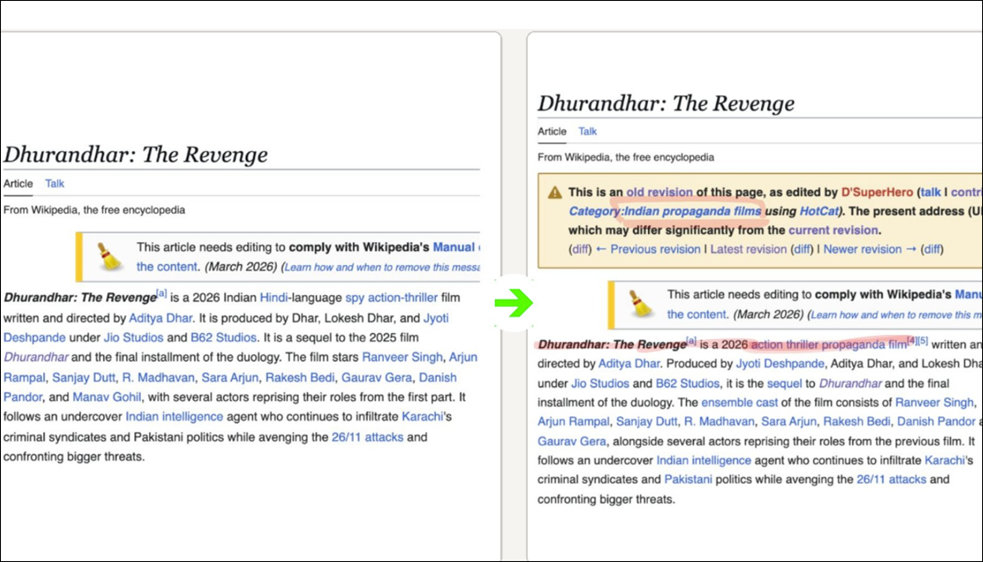
As Jimmy Wales’s intervention upheld Wikipedia’s core Neutral Point of View (NPOV) policy, the pages for Dhurandhar films were temporarily locked to experienced editors to stop the warring. Ultimately, the explicit “propaganda film” tag was removed from the lead.
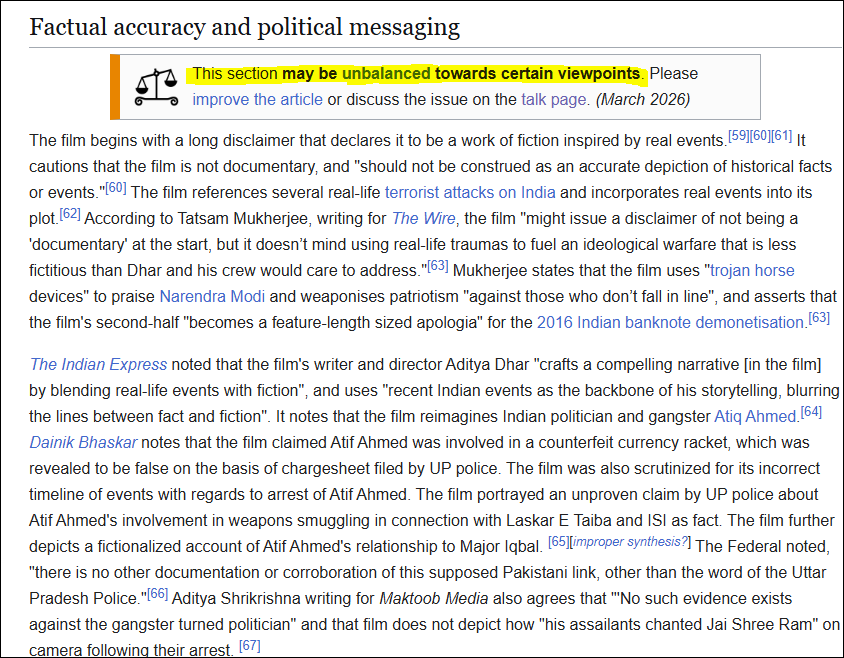
However, the so-called ‘critical’ opinions calling the two films propaganda remain in the reception and “Factual accuracy and political messaging” sections.
Anti-Hindu Wikipedia ‘Editor’ Kautilya 3 behind the push to label Dhurandhar as ‘propaganda’: Jimmy Wales’s intervention reinforces OpIndia investigation
Ever since the release of the film Dhurandhar in 2025, the Islamo-leftist coterie in India, and Pakistani Islamists alike, have been burning the midnight oil to push the ‘propaganda’ tag against Dhurandhar. Anti-Modi/BJP ‘Journalists’, YouTubers like Dhruv Rathee, and social media trolls have intensified their attacks further after the release of Dhurandhar: The Revenge earlier this month. There is a collective effort ongoing to portray the movie as pro-Modi government propaganda. This nefarious agenda found its soldier on Wikipedia in one of the editors, Kautilya 3.
Kautilya 3, is a UK-based Wikipedia editor, who was booked by Manipur police in 2024 for promoting enmity between communities in Manipur and propagating anti-Meitei hatred.
OpIndia reported recently how the discussions on the talk pages of Ranveer Singh starrer films reveal a pattern where certain editors have consistently attempted to insert politically loaded descriptions into the Wikipedia articles on the films, while others have pushed back, accusing them of selective sourcing, cherry-picking, and pushing a one-sided narrative.
Wikipedia editors openly pushed back against Kautilya 3’s attempt to label Dhurandhar films as a piece of propaganda. [Archive link 1] [Archive link 2]
One of the editors, “KabirDH”, explicitly flagged bias and bad-faith sourcing. He stated, “Whilst I agree that elements of the film are definitely aimed at promoting or showing a certain party in a good light, the sources being used to do this, as are the users, are completely bad faith.” He further questioned the credibility of the sources that were being relied upon. He added, “This is an obviously pro-Trinamool Congress (and therefore, anti-BJP) individual, who is using the Calcutta Telegraph to further propagate his views.”
Several editors flagged the violation of Wikipedia’s NPOV and other rules.
UnpetitproleX, one of the editors, rejected the claim that reliable sources had conclusively labelled the film as propaganda. “The fact remains that The Independent does not call the film a ‘propaganda film’ in its own voice.” Emphasising balance, he added, “But we also have a large number of sources that do not call the film propaganda… We cannot simply ignore these; we take into consideration all reliable sources when determining WP:DUE weight,” UnpetitproleX noted.
This blatant attempt at pushing a ‘propaganda’ tag against a film that does not toe the usual ‘Aman ki Asha’, Pakistan and Islamist-sympathising narratives was also seen when Dhurandhar 1 was released in December 2025.
The archived talk page of the first film, Dhurandhar, shows that the attempt to brand the film as propaganda began much earlier, and the controversial editor Kautilya3 played a crucial role in pushing this narrative. [Archive Link 1] [Archive Link 2]
On the talk page of the first film, Kautilya3 went beyond merely citing critics and instead advanced his own interpretation of the film’s messaging. In one of the most striking interventions, he wrote, “It is also demonstrated that it has propagandised the Modi government’s counterterrorism strategies.”
Uday Reddy elaborated his position, attempting to justify the use of the term “propaganda” by stating, “Propaganda means… ‘information, especially of a biased or misleading nature, used to promote a particular cause…’… In this case, there are [sources].”
In another comment, he doubled down, “My text… says that the film ‘propagandises’ Modi government’s policies. It is a fact that it does.”
Several editors, however, raised strong objections to Reddy using selective sources to push his ideological agenda against the film.
OpIndia dossier revealed anti-India and anti-Hindu shenanigans of Wikipedia and Kautilya 3
Back in 2024, OpIndia published a dossier detailing how Wikipedia is not a free, editorial-intervention-free encyclopaedia which relies on the voluntary work of thousands of unpaid, passionate volunteers across the globe, as claimed by the Wikimedia Foundation.
OpIndia concluded that Wikipedia’s “NPOV” (Neutral Point of View) guidelines do not mean that the entire spectrum of views would find equal representation in the article.
The outcome of NPOV is simply that whatever details are mentioned in the “reliable source” would be mentioned. The pool of “reliable sources” itself is tainted since the editors and administrators, who have disproportionate power in Wikipedia, ensure that “right-wing” (non-Left) sources are deprecated or blacklisted, essentially barring sources from being cited as reference material in any of the Wikipedia articles. The Dhurandhar-Wikipedia episode serves as a perfect example of this. Kautilya 3 cited the usual leftist sources like BBC and The Hindu, among others, to label the film as ‘propaganda’.
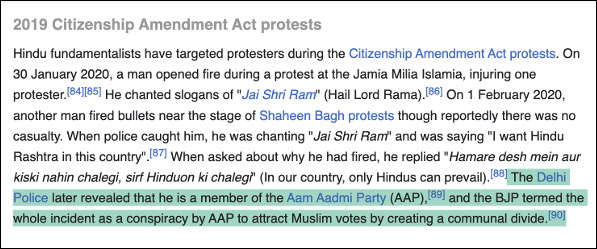
Kautilya 3 has consistently been pushing the Islamo-leftist agenda on Wikipedia. Earlier, a section on the 2020 anti-Hindu Delhi Riots was added to the Hindu terror Wikipedia article. In this section, Kautilya 3 added that a police investigation into the incident had revealed that the perpetrator belonged to AAP and therefore, it was a ‘conspiracy’ to create strife. Basically, the Wikipedia editor stated that the Delhi Police investigation should be removed since the Delhi police specifically is not a reliable source of information, while the left-leaning media is.
Kautilya3 is an Indian-origin UK-based doctor, Uday Reddy, who was booked in India for spreading disharmony between communities with his anti-India edits on Wikipedia. He works as a professor at a University in the United Kingdom. Reddy was booked by the Manipur Police over accusations of publishing inflammatory posts and statements on social media platforms. His X handle was withheld in India.
The complaint against him alleged that Reddy may have links with Khalistanis elements in Canada. The complaint stated that Uday Reddy has been working online to create tensions between Meitei and Kuki communities on religious grounds in Manipur. The FIR has been registered with a police station in Imphal East district under Sections 117 (abetment), 295-A (insulting religious sentiments), 153-A (promoting enmity between communities) and other relevant provisions of law.
“The accused person deliberately with malicious intention, insulted the Meitei’ religious beliefs and promoted enmity between the Meiteis and other communities on religious grounds,” the complaint stated.
Manipur Police had issued a statement wherein it said that Uday Reddy used to host spaces on social media platforms and allegedly directs people in Manipur on how to create unrest and trouble against law enforcement personnel.
Previously, Reddy was criticised for spreading propaganda about the Meitei community, particularly in the context of the Manipur crisis.
In one of the discussions, he was called out for his failure to accurately address Manipur’s history, specifically the Anglo-Kuki war.
Besides, Kautilya 3 also has a record of demonstrating his anti-Hindu bias. In April 2022, he accused Hindus of “weaponising” Ram Navami against Muslims. In a post on X, he wrote, “Hindutva nationalist organisations, spearheaded by RSS and BJP, have weaponised the festival to create Hindu Muslim frictions, causing riots and deaths, in which the Muslims have been the major sufferers.”
Contrary to Reddy’s claims, it was Muslims who attacked Hindus across India on Hindu festivals like Ram Navami and Hanuman Jayanti. In fact, processions related to festivals of Saraswati Puja and Ganesh Chaturthi too have been attacked, which are benign festivals related to the celebration of wisdom and knowledge.
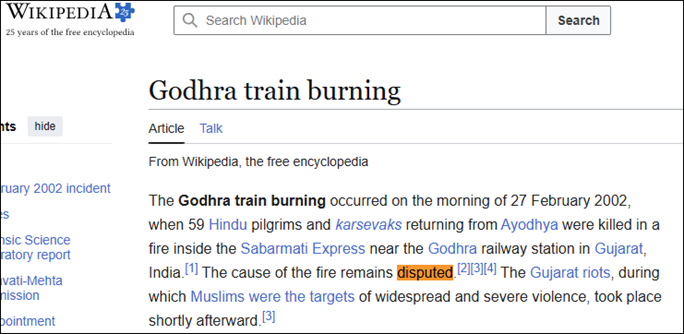
The anti-Hindu bias of Wikipedia editors is also evident from its page about the 2002 Godhra carnage, in which 59 Hindus were burnt alive in a bogey of the Sabarmati Express while returning from Ayodhya. The train bogey was set ablaze by a Muslim mob. However, if one searches for it, a Wikipedia page titled “Godhra Train Burning” shows up. Wikipedia calls it ‘train burning’ since they do not believe that the fire was indeed set by a Muslim mob, essentially to burn Hindus alive.
Wikipedia article’s first paragraph says that the cause of the fire that burnt 59 Hindu pilgrims to death “remains disputed” even though multiple people have been convicted for burning the Sabarmati Express train in Godhra. Even Indian leftists have almost stopped claiming that it was an accident, but the Wiki article in the first paragraph says that “The cause of the fire remains disputed”.
The truth, however, is “disputed” only in the imagination of Wikipedia editors and not in reality.
On 27th February 2002, the Sabarmati Express was scheduled to reach Godhra station at about 3:30 am. On that day, the train was running four hours late. As such, it arrived at Godhra by 7:40 am. 8 minutes later, a mob of 2000 Islamists set 59 Hindus, including 25 women and 15 children, on fire in the coach S6 of the train in Godhra’s predominantly Muslim area – Signal Falia.
31 Islamists were found guilty of the Godhra massacre on February 22, 2011, by the trial court (with only 11 receiving the death penalty and 20 receiving life in prison), and all 31 convictions were affirmed by the Gujarat High Court in October 2017, resulting in everyone receiving a life sentence.
Not only this, in February 2003, an accused person made a judicial confession in which he acknowledged that Godhra was a well-planned attack and that he had personally participated in it.
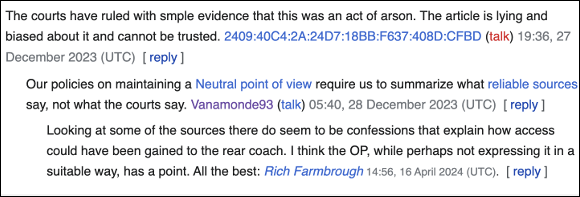
Forget intellectual integrity or unbiasedness; one of the Wikipedia editors demonstrated that this Jihadi-sympathizing lot has a dearth of common sense as well. When confronted that the article was biased and that the court of India, with ample evidence, had convicted people for act of arson, Vanamonda93, a Wikipedia editor, known for anti-Hindu bias, claimed that the Wikipedia policy required them to maintain “neutral point of view” – which means summarising information from “reliable sources” – and not what the courts say.
Basically, leftist media reports are more reliable for Wikipedia editors and court judgments.
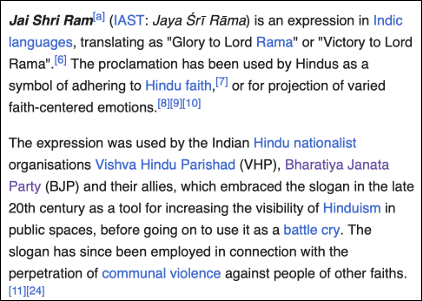
In addition, Wikipedia editors have also indulged in defamation of the sacred Hindu chant of Jai Shri Ram, relying on Islamo-leftist media reports. The opening paragraphs of the Wikipedia article itself disparage the religious chant, claiming it to be used as a war-cry to perpetrate communal violence against Hindus. The sources referenced to make this outlandish claim are mostly opinion pieces from Scroll, EPW, NYT and authors like Christophe Jaffrelot and Nandita Menon. The Wikipedia article essentially suggests that, contrary to its true meaning, Glory to Shri Ram, the chant Jai Shree Ram is a communal war cry, particularly invoked to target Muslims.
OpIndia dossier highlighted how Wikipedia picked up news reports from usual left-leaning sources, which framed non-communal cases of disputes between Hindus and Muslims, fake claims of ‘Jai Shri Ram-chanting mobs attacking Muslims, to vilify the sacred Hindu slogan.
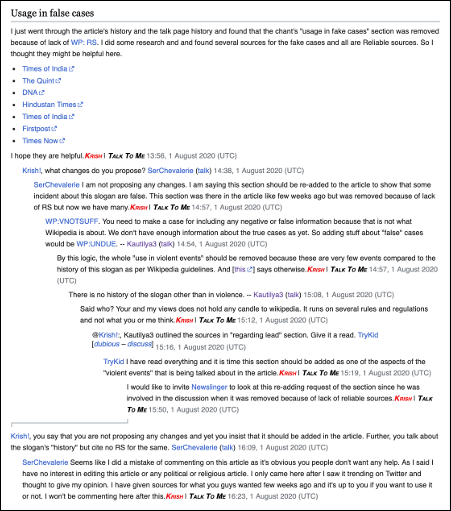
Wikipedia page on Jai Shri Ram has been deliberately kept one-sided. The ‘talk’ page reveals that there was a section someone had added which spoke about the usage is in such fake cases; however, it was removed – the move justified due to flimsy reasons by ‘Kautilya3’, the very editor booked in Manipur for creating strife.
In this section, a clearly fake account (Postaltoad) lists down why the source mentioned for the fake Jai Shri Ram crimes is not reliable. Further, the account claims that the instances where either Muslims or sympathetic media blatantly lied about the involvement of Jai Shri Ram. Ram in the crime are “minor incidents” and therefore must not be added, making a case for the removal of the section completely. Thereafter, Kautilya3, the very man booked in Manipur, says that even if the Logical Indian was a “reliable source”, the section on fake crimes attributed to Jai Shri Ram should not be added because it just makes a “BIG DEAL” out of minor instances.
In another conversation, Kautilya3 says that fake cases are of no interest to “US” because Wikipedia is not a fact-checking website. Newslinger goes further, claiming that the co-founder of Wikipedia is also not a reliable source.
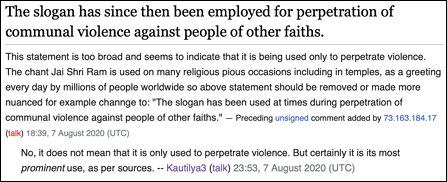
There was another conversation, a contributor says that the sentence in the introductory paragraph should be changed. His edit suggestion was rather reasonable, keeping intact that Left bias of the introduction as well; however, it was rejected by Kautilya3, saying that the most prominent use of Jai Shree Ram is to perpetrate violence against Muslims.
OpIndia analysis found that the page on Jai Shri Ram was created by an account which no longer exists. In his log, it is evident that he only made edits to some Bollywood pages and the only page of significance created was Jai Shri Ram. It is, therefore, entirely possible that this account was merely a pseudonym which was used to create the page and then deleted. Currently, the page is being manned by two main accounts – Kautilya3 and Newslinger.
Wikipedia also indulges in blacklisting sources, which reveals their inherent content bias. Most non-Left sources were banned for usage in Wikipedia. The list of deprecated sources and blacklisted sources indicate how the articles on Wikipedia are doomed to be biased because of the sources which are considered reliable and the ones which are not. The decision to deprecate sources itself stems from the Left bias that the editors seem to suffer from.
For Wikipedia, Qatar’s state-funded jihadi propaganda outlet Al Jazeera, which peddles fake news and has reporters with links to Islamic terrorist groups like Hamas, is a reliable source. The UK’s state-funded BBC is also a reliable source; however, the Indian state news channel Doordarshan does not feature in the list.
Right-wing media outlets like OpIndia and Swarajya are banned and blacklisted; however, Islamo-leftist rag TheWire, despite its several disinformation campaigns, Newslaundry, Scroll, Print, etc., are marked reliable.
When a retired naval officer publicly accused The Wire of misquoting him in an article that downplayed India’s naval achievements, his statement could not be added to The Wire’s Wikipedia page. His own clarification on Twitter was considered a “self-source”, and OpIndia, which reported his rebuttal, was blacklisted. As a result, The Wire’s misreport stood uncontested, a perfect illustration of how Wikipedia’s Neutral Point of View collapses when neutrality itself is defined by ideology.
In one case, the editors first agreed and then stonewalled the addition of a section about how TheWire fake news led to violence in the Northeast and other fake news that was spread by the publication. In the end, another editor said that the individual should go ahead and add the portion about TheWire causing violence with its fake news. However, when that information was added to the Wikipedia article, Kautilya3, who has been booked in Manipur for inciting hate, reverted that edit.
In another section, Kautilya3 and other editors ensure that an FIR against TheWire was not mentioned, claiming that FIRs are “very normal” according to TheWire and therefore, it should not be mentioned since they are very common.
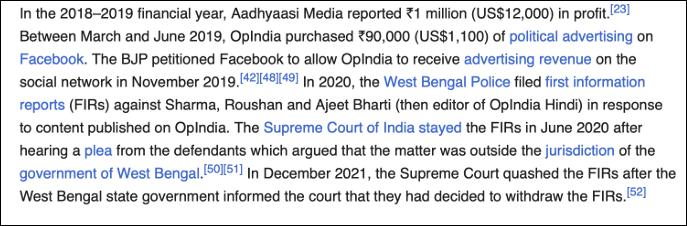
However, in the case of blacklisted sources like OpIndia, the FIRs against those publications are prominently mentioned.
These examples are just a drop in the ocean, OpIndia’ dossier contains numerous such cases, and detailed information on how Wikipedia and its several of its editors are pushing anti-India and anti-Hindu narratives and lies in the content they claim to be ‘neutral’.
Is Wikipedia an unbiased intermediary or a biased publisher? What OpIndia research found
OpIndia’s research paper revealed that the structure of Wikipedia itself gives unmitigated power to a handful of individuals who are called ‘administrators’. There are only 435 active administrators in the entire world who have the power to ban editors, blacklist sources, ban contributors and decide the edits that should be made or reverted on articles.
Soon after OpIndia released the dossier, Facebook, another Left-leaning platform that has been accused of election interference in the USA and many such instances of furthering the political interest of a certain ideology, banned the dossier to restrict its viewership.
Wikipedia claims to be an intermediary which depends on the wisdom of the crowd without content intervention and editorial line, based on ‘reliable sources’ and maintaining a neutral point of view. This, however, is far from the truth, as evidenced in OpIndia research. Wikipedia meets all the standards of publishers. They collate information on current events and historical events, they pay their editors and administrators, and they are easily accessible by the people at large on the internet.
Given that Wikipedia has an editorial stand based on the personal opinions and biases of its editors and administrators, the evidence cited in the OpIndia dossier suggests that they are no longer eligible to be considered an intermediary. OpIndia recommended that once declared a publisher, Wikimedia would have to have its offices in India, set up a grievance redressal system and submit to Indian laws about illegal content which undermines the sovereignty of India or creates disaffection.
The findings of the research paper prepared by OpIndia Editor-in-Chief Nupur J Sharma reveal that despite not having offices or presence in India, Wikipedia has been funding entities and individuals with anti-India ideology and even links to Islamists and Khalistanis, to further its own business and ideological interests in the country. Wikipedia not only collects funds from India in the form of donations but also spends millions of dollars in India and toes an absolutely biased and rigid editorial line, all while claiming to be an intermediary and not a publisher to escape any accountability before the Indian law.
Besides, declaring Wikipedia as a publisher, OpIndia also recommended that Wikipedia’s financial transactions be scrutinised. The OpIndia dossier titled Wikipedia’s War on India can be read here.
Wikipedia co-founder, Jimmy Wales, once said Wikipedia’s mission was to “make the sum of all human knowledge available to everyone.” Today, that mission appears conditional, as knowledge is welcome only if it conforms to one side of the political spectrum. The very guideline that demands “Neutral Point of View” has been hollowed out, because neutrality now depends entirely on which sources are allowed into the conversation.
As the OpIndia dossier concluded, “If the pool of reliable sources itself is tainted with ideological bias, the ‘Neutral Point of View’ merely remains a requirement where all versions of the Left are prominently added.”
In an interview published by Politics Home in October 2025, Wales unapologetically defended Wikipedia’s own internal censorship, that is, the blacklisting of sources he has personally deemed unreliable in the past. He insisted that “the idea that we should take sites that routinely publish crazy conspiracy theories and nonsense just doesn’t make any sense.”
Previously, Jimmy Wales himself admitted as well that he is the final arbitrator of content on Wikipedia. “Final policy decisions are up to me, as always,” he once said.
According to Wikipedia itself, “The contributors or editors of Wikipedia participate subject to many policies and guidelines governing behaviour and content. These rules are supervised by various authorities: Jimmy Wales, nominally in a position of ultimate authority, although he has deferred in most instances to the leadership of Wikipedia, the ~34 present Bureaucrats or Crats, the ~700 active Administrators or Admins, and another group called the Arbitration Committee or ArbCom with 15-18 members or Arbs, depending upon the rules adopted each year. In July 2012, there were 14 active arbitrators identified, all of whom were administrators, although this is not a set rule. The Wikimedia Foundation or its designated agents also have the authority to impose bans against IP addresses for pages, topics, or the entire site. The Arbitration Committee “has no jurisdiction over official actions of the Wikimedia Foundation or its staff”.
In fact, Larry Sanger, the co-founder of Wikipedia, has categorically stated as well that Wikipedia has a pronounced Left bias. In several interviews and talks, he has spoken extensively about how Wikipedia skews the scale of balance, leading to the information being an inaccurate representation of reality, ridden with Left bias.
Jimmy Wales created an Arbitration Committee, which is essentially Wikipedia’s Supreme Court. This Committee is an extension of the decision-making power he formerly held as CEO of Bomis Inc., to take over his role in resolving complex disputes between users. Bomis Inc was a for-profit private company which was co-founded in 1996 by Jimmy Wales for ventures like Nupedia and Wikipedia.
By 2007, the for-profit company was shut down, and all the Wikipedia-related sources were transferred to Wikimedia Foundation, a nonprofit charitable organisation, also founded by Jimmy Wales.
The content on Nupedia, the predecessor of Wikipedia, was less in comparison to Wikipedia. For example, in its first year, Nupedia had only 21 articles while Wikipedia had 200. However, Larry Sanger has criticised how Jimmy Wales sacrificed authenticity for volume while shifting from Nupedia to Wikipedia. The Wikimedia Foundation was established in 2003, 2 years after Wikipedia was started by Jimmy Wales. OpIndia dossier highlighted the relationship between Google and Wikipedia, and how the former granted millions of dollars as ‘gifts’ to Wikipedia over the years through Tides Foundation.
Tides Foundation is notorious for funding several anti-Hindu, anti-India organisations and elements. The Foundation gave grants to Hindus for Human Rights (HfHR), which has links to Islamists and Khalistanis, and was formed in 2019 by two Islamist advocacy groups, the Indian American Muslim Council (IAMC) and Organisation for Minorities of India (OFMI). Tides also funded AMAN Public Charitable Trust (AMAN). This trust is connected to the NewsClick-China funding scandal, where it is alleged that Chinese entities funded NewsClick, a Delhi-based pro-China propaganda outlet funded by CCP stooge Neville Roy Singham, to disrupt Indian sovereignty.
Conclusion
OpIndia has consistently been highlighting how Wikipedia is populated by several editors who are driven by anti-Hindu and anti-India ideological biases and are inserting these biases in the pages they edit, as exemplified in the case of Dhurandhar films. Jimmy Wales’s intervention and direct calling out of his platform’s editors indulging in mindless labelling of a film as ‘propaganda’ based on biased sources, reinforces OpIndia’s investigation into Wikipedia, Jimmy Wales, Kautilya 3 and the anti-Hindu and anti-India activities the so-called ‘free-for-all-to-edit encyclopaedia’ indulges in.
Gujarat’s Chief Minister Bhupendra Patel has said that the GIFT City has emerged as a “vibrant reality driving economic growth,” given the rapid growth in financial activity and international participation seen in the project. He said that the project has evolved from an initial concept into a fully operational international financial hub.
The CM underscored the transformative impact of GIFT City on the state’s economy, positioning it as a catalyst for job creation, infrastructure development, and global financial integration. A presentation on the GIFT city outlined the rapid maturation of India’s first fully integrated global financial and IT hub, making clear that GIFT City is no longer a vision but a functioning ecosystem already delivering substantial benefits to Gujarat through employment, investment inflows, and world-class infrastructure.
Located between Ahmedabad and Gandhinagar, GIFT City was envisioned by Prime Minister Narendra Modi as a world-class finance and IT zone that would serve not only India but the entire world. As the Chief Minister highlighted, the project is now operational and scaling rapidly, acting as India’s gateway to global capital, institutions, and financial systems. This progress directly supports Gujarat’s ambition to become a leading economic powerhouse.
Strong operational momentum
The latest figures demonstrate robust growth. More than 1,150 IFSCA-registered entities are now operational within GIFT City. The banking ecosystem has expanded to $106.7 billion, a near seven-fold increase in a short period, while the capital markets ecosystem has reached $80 billion. Monthly exchange turnover has surpassed $100 billion, with $101.8 billion in February 2026, reflecting high liquidity and active market participation. Additionally, 349 funds have been launched with a targeted corpus of $80 billion.
These metrics, the Chief Minister noted, establish GIFT City as an active financial system rather than a future pipeline, bringing tangible economic activity and revenue potential to Gujarat.
A major highlight for the state is the influx of high-quality employment opportunities. Several leading organisations have announced significant hiring plans by 2030, including ANSR (5,000+ jobs), Jaypee Capital (3,000+ jobs), Befree (1,500+ jobs), Hexaware (1,000+ jobs), Junomoneta (1,000+ jobs), Deloitte (1,000+ jobs), HCL Technologies (1,000+ jobs), PwC (600+ jobs), Wipro (500+ jobs), and KFintech (450+ jobs). This structured build-out spans consulting, technology, financial services, and backend operations, promising thousands of skilled positions for Gujarati youth and professionals migrating to the state.
Infrastructure projections reinforce this employment boom. Between FY2026 and FY2030, GIFT City plans substantial floor-area expansion across domestic tariff area (DTA) and special economic zone (SEZ) areas. The DTA will add 10.25 million square feet supporting approximately 52,300 employees, while the SEZ will contribute 12.26 million square feet supporting around 84,600 employees. In total, the incremental employment potential exceeds 136,000 jobs. Approximately 7,500 residential units are also planned by 2030, ensuring a tightly integrated live-work ecosystem.
Since December 2025, GIFT City has attracted a diverse range of participants, including financial services firms such as Jio BlackRock and IIFL, legal and advisory practices like Khaitan & Co and Trilegal, as well as insurance intermediaries and global/domestic financial service providers.
This broadening participation across capital markets, advisory, insurance, and investment services signals growing confidence and strengthens Gujarat’s position as a preferred destination for both domestic and international capital.
Regulatory framework
Over 30 regulations and multiple frameworks have been implemented as part of regulatory architecture, aligned with international best practices. These include unified licensing for TechFin and service providers, as well as local foreign-currency settlement mechanisms, which reduce operational friction for global players.
In 2025, TechFin regulations introduced a single registration covering more than 50 services, with 118 entities already registered. These measures enhance ease of doing business and support Gujarat’s goal of seamless integration with worldwide financial systems.
World-class infrastructure and smart-city features
GIFT City is being developed as India’s first truly engineered, self-sustaining smart city. Infrastructure priorities include pedestrian-friendly shaded walkways, intelligent traffic management, integrated mobility solutions, city-wide Wi-Fi, two additional metro stations, and enhanced connectivity to Ahmedabad and Gandhinagar.
An important feature is the fully integrated underground utility tunnel system, the first of its kind in India, spanning 16 km. 6 km has been completed and 5.7 km under construction. The tunnel carries pipelines for water, drainage, district cooling, waste, and storm water. Automated waste collection and centralised utility networks further distinguish the city.
Building development is advancing steadily: 29.47 million square feet have been allotted across 71 buildings, with 6.32 million square feet already completed across 29 buildings. Another 1.75 million square feet was finished in FY2025–26, while 19.50 million square feet (66 per cent of allotment) is under construction across 38 buildings. An additional 5.46 million square feet across 15 buildings is expected to be completed in FY2026–27.
Social infrastructure is keeping pace to create a “live, work, thrive” environment, with a destination mall, central park, international school (IB/Cambridge curriculum), sports arena, golf range, F&B zones, and weekly events programming.
Key institutional and innovation hubs
Notable developments include the Fintech Institute, housing GIFT IFI and IFIH, in partnership with IIT Gandhinagar, Ahmedabad University, UC San Diego, and Plug and Play for startup incubation. Plans for an international branch campus for foreign universities are also underway.
The GCC engagement pipeline is strong, with 23+ global clients engaged, four confirmed leads, and 11 qualified leads. The Fintech Innovation Hub, launched in January 2025, has already onboarded 37 startups, launched three certification programmes, and trained over 400 participants.
Mature financial, insurance, and leasing sectors
The capital markets ecosystem features 208 registered fund management entities, more than 200 bonds listed worth approximately $70.9 billion, and operational NSE IX–SGX Connect with average daily derivatives turnover of $4.8 billion.
Banking has grown from $14 billion in assets in 2020 to $106.7 billion in 2026, with 37 banks operational (20 foreign, 17 domestic), including global names such as DBS, Credit Agricole, Deutsche Bank, Citi, HSBC, JP Morgan, MUFG, Mizuho, Standard Chartered, and Qatar National Bank. A key innovation is the 2025 Foreign Currency Settlement System, enabling local FX settlement without routing through global intermediaries.
Insurance has attracted 65 registered entities, including global reinsurers such as Korean Re, Saudi Re, and Africa Re. Aircraft leasing involves 35 firms managing 372 aviation assets, while ship leasing has 36 entities and 34 ships leased. These high-value segments mark a strategic shift: India is moving from a consumer of global financial services to an owner and creator of financial value.
International universities already operational include Deakin University, University of Wollongong, and Queen’s University Belfast, with the University of Surrey in the pipeline.
Recent updates include Wipro’s AI-powered office expansion from 150 to 500 employees, the first IPO through GIFT IFSC, and a fintech accelerator for women.
Globally, GIFT City has conducted more than 40 interactions at the World Economic Forum in Davos, alongside engagements in Milan (dual listing and ESG), Zurich (diaspora investment), Hong Kong (fund structuring), and Germany & Austria (insurance, treasury, and fintech). Domestically, initiatives include banking forums with over 100 banks, Vibrant Gujarat participation, and a reinsurance summit drawing 400+ participants.
A fully operational global financial ecosystem
The Chief Minister emphasised that GIFT City is now a policy-driven, globally benchmarked financial ecosystem integrating capital markets, banking, technology, talent, and infrastructure. “GIFT City stands today as a powerful testament to India’s rising stature in the global financial ecosystem. What began as a bold and futuristic idea has now developed into a fully operational international financial hub, placing Gujarat and India firmly on the world map of finance and innovation,” he said.
By delivering high-skill jobs, cutting-edge infrastructure, and diversified financial services within Gujarat, the project is not only elevating India’s global standing but also generating sustained economic growth, urban development, and opportunities for the people of Gujarat.
The latest piece by BBC Hindi on India’s Strategic Petroleum Reserve is not journalism in any rigorous sense; it is narrative construction masquerading as concern. Published on March 28, 2026, it fear-mongers about India’s petroleum reserves, arguing that India has just 5 days of Strategic Petroleum Reserve.
Source: BBC Hindi
However, it didn’t take long for social media users to call out the BBC for indulging in alarmism and peddling fear about another country, an approach that risks triggering artificial scarcity, as misinformation spreads rapidly and convinces people that fuel is genuinely in short supply in India.
Sanjeev Sanyal took to X to condemn the BBC. He tweeted: “This is the state-owned media channel of one country trying to spread canards about oil supplies in another country.”
This is the state-owned media channel of one country trying to spread canards about oil supplies in another country pic.twitter.com/vCrygORwuw
“BBC News Hindi is spreading misinformation by claiming that India has only 5 days of petrol left. Such false reporting creates unnecessary panic and confusion among people. Strict action should be taken against the spread of misinformation @HMOIndia,” tweeted a social media user.
BBC News Hindi is spreading misinformation by claiming that India has only 5 days of petrol left.
Such false reporting creates unnecessary panic and confusion among people. Strict action should be taken against the spread of misinformation @HMOIndiahttps://t.co/Cgcw1qAof3
At a time when global anxieties around the Strait of Hormuz are already heightened, the article chooses not to inform but to inflame, not to contextualise but to selectively present fragments of truth in a way that manufactures panic.
The Five-Day Myth: A statistic without context
At the heart of BBC Hindi’s claim lies a clever but deeply misleading sleight of hand. The article asserts that India’s strategic reserves can barely meet five days of demand, a statistic presented as though it defines the country’s entire energy security architecture. What is conveniently downplayed, even though mentioned in passing, is that these strategic reserves are only one component of a much larger, layered system.
India’s total petroleum buffer, when operational stocks held by oil marketing companies, crude in transit, refinery inventories, and strategic reserves are taken together, stands at roughly 74 days. The average reader, however, is nudged toward the five-day figure, because that serves the intended narrative of vulnerability.
Government’s position: Ignored, not refuted
This is where the contrast with the government’s position becomes stark. Union Petroleum Minister Hardeep Singh Puri has categorically clarified that India’s crude supply position is secure, that volumes have already been procured in excess of what the Strait of Hormuz would have delivered, and that there is no shortage of petrol, diesel, or LPG anywhere in the country.
These are not rhetorical reassurances but grounded operational realities, further evidenced by the 28% surge in LPG production within days and the active diversification of sourcing from countries such as the United States, Russia, Norway, and Algeria. Yet, for BBC Hindi, these stabilising facts are not the story; they are inconvenient footnotes to be buried beneath alarmist framing.
A familiar template: Crisis optics over context
What emerges, then, is not an isolated editorial lapse but a pattern that has become all too familiar. Whether it was India’s handling of COVID-19, the constitutional abrogation of Article 370, or the construction of the Ram Mandir in Ayodhya, Western media outlets, and the BBC in particular, have repeatedly foregrounded crisis optics while backgrounding structural realities.
The technique is consistent: zoom into points of friction, strip away context, and present a distorted picture that aligns with a preconceived narrative about India’s governance under Narendra Modi.
Strategic reserves: Misunderstood by design
The irony is that even within its own reporting, BBC Hindi inadvertently undermines its alarmism. The article acknowledges that maintaining excessively large reserves during periods of high crude prices is economically inefficient, a point energy experts themselves concede.
Yet this nuance is quickly overshadowed by comparisons with countries like Japan or South Korea, whose storage capacities are cited without accounting for the fundamental differences in their energy models, economic structures, and strategic doctrines. Strategic petroleum reserves, by design, are emergency buffers, not primary supply channels.
India’s model, which blends strategic reserves with robust commercial and transit stocks, is tailored to its own consumption patterns and geopolitical realities. To judge it through a simplistic, one-size-fits-all metric is not analysis; it is intellectual laziness dressed up as critique.
The geopolitical reality: Risk managed, not ignored
The broader geopolitical backdrop, of course, is real. Tensions in West Asia, disruptions in LNG production, and threats to the Strait of Hormuz do pose risks to global energy flows.
But what BBC Hindi fails to acknowledge with any seriousness is India’s proactive response to precisely these risks. The government has not passively awaited disruption; it has actively diversified supply chains, secured alternative cargoes, explored non-Hormuz routes despite higher logistics costs, and ensured a steady inflow of energy resources.
This is what strategic foresight looks like. Yet, in the BBC’s telling, preparedness becomes invisibilized while hypothetical scarcity is amplified.
The subtext: Manufacturing doubt, not delivering insight
There is also an unmistakable political subtext to this framing. By amplifying fears of fuel shortages, the article does more than misinform; it feeds into opposition-driven narratives of crisis and incompetence, subtly eroding public confidence in state capacity.
It reinforces a long-standing Western media trope that views India not as a complex, adaptive system but as a perpetually fragile state waiting to falter. That this framing persists despite repeated evidence of resilience says less about India and more about the ideological priors shaping such coverage.
When narrative overrides nuance
In the end, the issue is not that BBC Hindi chose to examine India’s petroleum reserves. Scrutiny is both necessary and welcome. The problem lies in how that scrutiny is conducted, through selective statistics, incomplete context, and a predisposition toward pessimism.
In matters of energy security, where variables are interconnected and dynamic, isolating a single data point to construct a narrative of impending crisis is not just misleading; it is irresponsible.
Strip away the framing, and the reality is far less dramatic. India is not staring at a fuel collapse; it is navigating a volatile global environment with a calibrated mix of reserves, diversification, and policy intervention. The BBC article would have you believe otherwise, not because the facts demand it, but because the narrative does.