

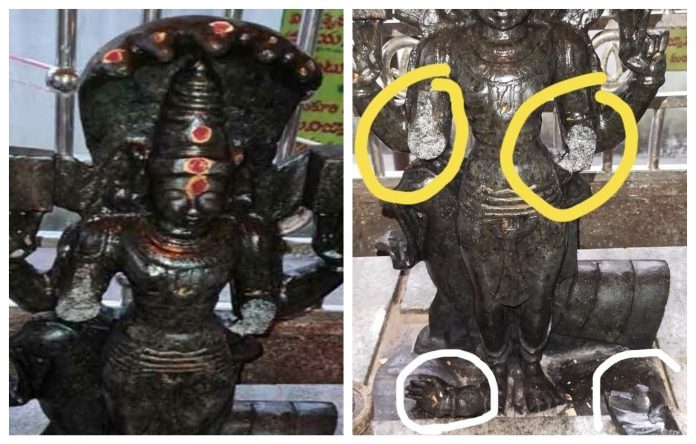
Attacks on Hindu temples seem to have become a routine affair in the state Andhra Pradesh. Hardly a few days after a murti of Lord Ram was vandalised by some unidentified miscreants at Ramatheertham in Vizianagaram district, a Lord Subrahmanya murti in Lord Vigneshwara temple was found desecrated yesterday in Rajahmundry district. Yesterday, the priest of the Vigneshwara temple found the murti of Lord Subrahmanya desecrated with two severed limbs of the murti lying on the ground.
Few days go, a 400-yer old murti of Lord Ram was found beheaded by the temple priest in the ancient Sita Lakshmana Kodandarama temple. When the priest entered the temple on Tuesday morning, he found the doors of the temple were broken and the murti placed inside was without its head. Police were called in immediately. Several parts of the desecrated murti have been recovered from a nearby pond. A case was registered and the search for the culprits is on.
Chandrababu Naidu blames state government’s indifference for the attacks
While Chief Minister Jagan Mohan Reddy has said that the state will take action against the perpetrators, the opposition parties are having none of it. After repeated attacks, opposition parties are now pointing fingers at the Reddy government and its indifference to Hindu places of worship being under siege in his state.
The recent incident was condemned by former CM Chandrababu Naidu. “Attacks on temples have become a daily occurrence, because of the government’s indifference. Neither the public nor the gods inside the temple are safe in the state. Matters would have come this far if stern action was taken in the first such case. The government has the responsibility to safeguard sentiments of all communities”, said Naidu.
The Yuvajana Sramika Rythu Congress Party (YSRCP) has, in turn, pointed finger at Naidu’s Telugu Desam Party (TDP) regarding the desecration of Lord Ram murti. The YSRCP General Secretary, V Vijaya Sai, alleged that the miscreants who vandalised the idol were TDP sympathisers.
Past incidents of attacks on Hindu temples in the state
Last year in February, a 50-feet tall ancient chariot of Prasanna Venkateswara Swamy temple at Bhogolu village of Bitragunta Mandal in Nellore district was set ablaze by some miscreants. A month earlier, in January, the idols of several Hindu gods and goddesses along with some flex banners in Pithapuram city in East Godavari district were vandalised. In a similar incident that happened a few months later in September, a six decades old, 40-feet high wooden ratham of Lord Narasimha was gutted in a fire.


