

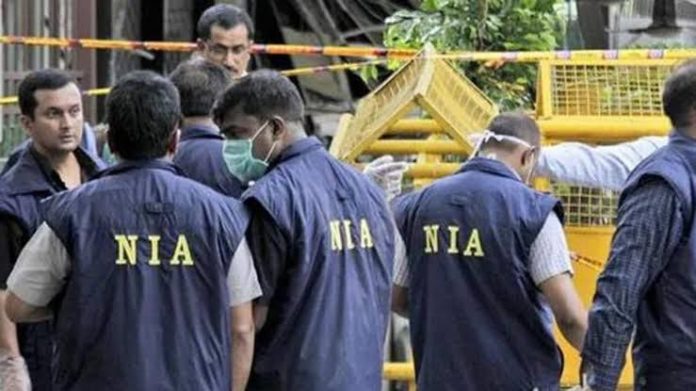
On Friday, June 30, the National Investigation Agency (NIA) filed its first supplementary charge sheet in the Islamic State (IS) conspiracy case in the Shivamogga district of Karnataka.
The accused, according to the NIA, carried out a trial IED blast in Shivamogga. Along with that, they conducted reconnaissance of multiple locations and arson of properties and vehicles to spread terror among people as part of “an ISIS conspiracy to carry out incidents of terror and violence and wage a war against India.”
According to the NIA, the accused were instructed by their ISIS handler based abroad to pursue robotics courses and gain skills to carry out future terrorist attacks in the direction of the Islamic State agenda for India.
The accused who have been charge-sheeted have been identified as Karnataka residents Mohamed Shariq (25), Maaz Muneer Ahmed (23), Syed Yasin (22), Reeshaan Thajuddin Sheikh (22), Huzair Farhan Baig (22), Mazin Abdul Rahman (22), Nadeem Ahmed K A (22), Zabiulla (32) and Nadeem Faizal N (27). The accused persons have been charged with violating the Unlawful Activities (Prevention) Act of 1967, the Karnataka State Prevention of Destruction and Loss of Property Act of 1981, and various sections of the Indian Penal Code.
Maaz and Yasin were charged in March of this year and have since been charged with additional offences.
Maaz, Yasin, Sheikh, Rahman, and Nadeem are among the nine accused who have studied mechanical and electrical engineering. According to the NIA, the accused was paid in cryptocurrency by their online handler. In March, OpIndia reported that Maaz received a Crypto equivalent of around Rs 1.5 lakhs from the online handler into the accounts of his friends, according to an NIA investigation. While Syed Yasin received Ps 62,000 in the account of a friend. The NIA said that accused Mohamed Shariq had intended to carry out an IED bombing at Kadri Temple in Mangaluru on November 19 of last year as part of a bigger ISIS plot.
The NIA investigations also revealed that Shariq, Maaz, and Yasin plotted a criminal conspiracy to promote terror and violence in the region with the help of IS operatives based abroad. According to the charge sheet, the trio actively radicalised and recruited the co-accused with the intent of undermining the country’s national security, unity, and sovereignty. On September 19, 2022, the Shivamogga rural police department filed the initial complaint. On November 15, 2022, the NIA took over the case and re-registered it.


