

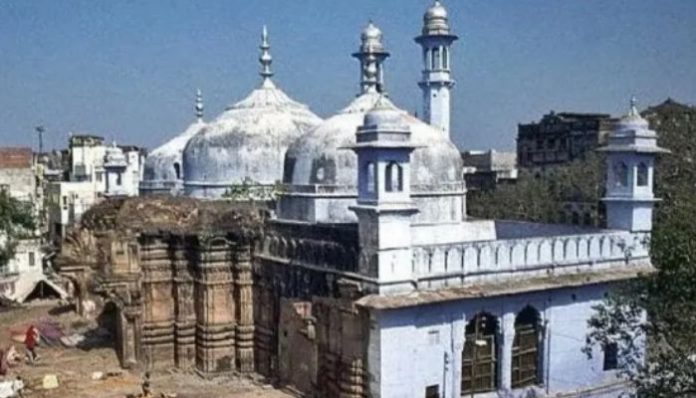
The court of the Additional District Judge-1 (ADJ-1) Anil Kumar will hear a plea seeking an ASI survey of the remaining closed cellars (Tehkhana) of the Gyanvapi complex on 15th February. The petition also includes a request to remove the blocked entrance and debris that hinder access to the areas. These areas could have not been surveyed so far by the ASI as they are blocked by stones and bricks.
The petition was moved on Monday by Rakhi Singh who is also one of the petitioners in the Maa Shringar Gauri case which led to the survey of the section of the Gyanvapi complex by the ASI. She is also a founding member of the Vishwa Vedic Sanatan Sangh.
During the hearing on the latest plea, the ADJ-1st court on Tuesday (6th February) heard arguments from both sides and set 15th February as the next date. Notably, the ADJ-1st Court, Varanasi, took up the plea after District Judge Dr AK Vishvesha retired on 31st January.
Advocate Saurabh Tiwari who is representing Hindu petitioner Rakhi Singh, said that after hearing both sides, the court fixed 15th February as the date for the next hearing.
According to the petitioner Rakhi Singh, there are “secret cellars” inside the basements which are necessary to be surveyed so that the entire truth of the Gyanvapi complex can be revealed. These cellars are adjacent to the Kashi Vishwanath temple. The Hindu side has maintained that the current structure was built over a pre-existing Hindu temple which was demolished during Aurangzeb’s time. This was also concluded by the recent ASI survey report on the Gyanvapi complex.
In her petition, Rakshi Singh contends that surveying the remaining cellars is imperative to determine the religious character of the property in question, the Gyanvapi premises. The application asserts that within the Gyanvapi premises, cellars numbered N1 to N5 in the north and S1 to S3 in the south exist, with cellars N1 and S1 inaccessible because their entrances are blocked.
However, the lawyers of Anjuman Intezamia Masjid (AIM) – the mosque management committee – opposed the plea seeking the ASI survey of the remaining closed cellars, N1 and S1. Their counsel objected to the demand for a survey stating that there is no basis to order a survey of the remaining basements.
It is pertinent to note that there are a total of eight cellars in North and South directions in the Gyanvapi complex. Six out of them have already been surveyed by the ASI whereas two cellars N1 and S1 are still closed.
As per the Hindu petitioner’s counsel, it’s been stated that the survey of the S-1 basement on the south side and the N-1 basement on the north side of the Gyanpavi complex couldn’t be conducted earlier due to the entry to those cellars being blocked with bricks and stones. The blocked doors don’t bear the load of the entire building. Hence, a scientific survey of all remaining basements could be carried out without causing any harm to the existing structure.
The petition has also included a map of the closed basements. Earlier, five women devotees had filed a petition in which the court had ordered the ASI to conduct a survey of the Gyanvapi complex. However, it excluded the wazukhana which had been used for ritual ablutions before namaz.
Opindia had extensively reported about the ASI Survey which concluded that there was a pre-existing Hindu temple beneath the current structure and it also recovered artifacts of idols of Hindu deities during this survey.
Last week, the court had allowed regular prayers in the southern cellar on a petition by Shailendra Kumar Pathak Vyas. He asserted that his maternal grandfather, priest Somnath Vyas, used to perform prayers there till December 1993.
As per his counsel, during Mulayam Singh Yadav’s tenure as Uttar Pradesh chief minister, he closed the access to the cellar for the priest. Then Chief Minister Yadav had locked and barricaded it with a steel grill.
Following the court’s order, the prayers at the Southern cellar are being performed by a priest nominated by the Kashi Vishwanath temple trust.


