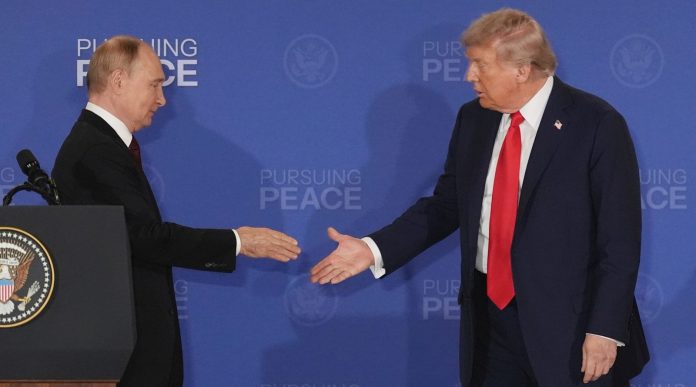
The Alaska summit between Russian President Vladimir Putin and US President Donald Trump was meant to be a diplomatic spectacle, an event where Trump could once again project himself as a dealmaker and visionary leader trying to end the Ukraine war. Instead, what emerged from the joint press conference was a revelation that shredded America’s carefully cultivated moral grandstanding.
Putin, through his translator, calmly revealed that US-Russia bilateral trade had expanded by over 20 per cent in the past few months, even Trump kept claiming the US has been pressuring Moscow to end its war in its Ukraine.
While Trump scolds the world about trading with Russia & funding its war in Ukraine, Putin says, “Since the US new administration came to power, US-Russia bilateral trade has grown by 20%.” pic.twitter.com/eb9GDyE5kN
— Shiv Aroor (@ShivAroor) August 16, 2025
The disclosure was nothing short of explosive. It exposed the duplicity of Washington’s Ukraine narrative, which has relentlessly pressured nations across the globe to wind down economic ties with Moscow in the name of “standing with Kyiv.” While the United States demands sacrifices from allies, it quietly deepens its own commercial engagement with the very country it brands as an international pariah. Notwithstanding the fact that the US quietly imports billions worth of Russian uranium and fertilizers to safeguard its own industries.
The tariff hammer falls on India
The timing of Putin’s disclosure could not have been more damning. Just days earlier, on August 6, Trump had imposed an additional 25 per cent tariff on Indian goods, raising the cumulative duty to 50 per cent. The move was explicitly framed as “punishment” for India’s refusal to halt imports of Russian oil. Trump did not mince his words.
“India has not been a good trading partner… we settled on 25 per cent… but I think I’m going to raise that substantially over the next 24 hours because they’re buying Russian oil,” he thundered while signing the executive order. The document spelt out his grievance with characteristic bluntness: “I find the Government of India is currently, directly or indirectly, importing Russian Federation oil… in my judgment I determine it necessary to impose an ad valorem duty on imports of articles from India…”
For New Delhi, the penalty was not merely an economic setback. It was a reminder of Washington’s overbearing expectations, its readiness to weaponise trade for geopolitical ends, and its disdain for the sovereign right of nations to pursue affordable energy security.
America’s Russian trade lifeline
Yet, while Trump was wielding tariffs like a cudgel against India, the United States was quietly securing its own energy and commodity needs from Moscow. Washington’s imports of uranium, essential for powering America’s nuclear energy sector, continue to run into billions of dollars annually. Likewise, Russian chemical fertilisers remain a staple for US agriculture, feeding the vast farm belt that forms Trump’s political base.
These are not minor transactions that slipped through the cracks. They are deliberate, calculated purchases that reflect America’s prioritisation of its own economic interests over the lofty rhetoric of isolating Russia. In other words, when it comes to the health of American industries and voters’ pocketbooks, the moral sermons about Ukraine suddenly fade into irrelevance.
This is the crux of the hypocrisy. The US government simultaneously demands that India abandon Russian oil, despite the obvious economic pain such a move entails, while ensuring that its own strategic sectors remain cushioned through steady imports from Moscow. Intriguingly, Trump has refrained from imposing tariffs on China, the largest importer of Russian oil, as well as European countries dependent on Russian energy.
Trump’s Nobel Prize obsession
Layered onto this economic duplicity is Trump’s personal obsession with legacy. Multiple reports and his own public statements point to his unhealthy fixation on being awarded a Nobel Peace Prize. He views the end of the Ukraine war not through the lens of global stability or humanitarian relief, but as a potential ticket to international recognition.
This explains his contradictory behaviour. On one hand, he has ramped up economic coercion against allies to create an illusion of toughness against Russia. On the other hand, he has allowed US-Russia trade to expand so that Washington retains leverage over Moscow and preserves a potential opening for negotiations. For Trump, the war is less about Ukraine’s sovereignty and more about scripting a personal triumph he can immortalise in history books, a dangerous narcissism masquerading as diplomacy.
The burden on India
India finds itself in the crosshairs of this American duplicity. As a nation of 1.4 billion people, with rising energy demands and developmental challenges, India cannot afford to turn its back on affordable Russian oil. Moscow offers competitive prices, reliable supply chains, and flexible payment mechanisms at a time when global energy markets remain volatile.
By penalising India for pursuing its national interest, Washington is not just alienating a vital partner but also undermining the very principle of a multipolar world order. Trump’s tariffs effectively amount to economic arm-twisting: fall in line with US diktats or pay the price. This is not the behaviour of an ally. It is the behaviour of a hegemon using trade as a weapon of control.
The façade of moral high ground
The larger problem lies in the narrative that the United States has sold to the world. Washington has consistently positioned itself as the moral leader of a coalition resisting Russian aggression in Ukraine. It has invoked the language of democracy, human rights, and the “rules-based international order.” Yet, its own conduct betrays these very principles.
If the war in Ukraine is truly an existential battle between freedom and tyranny, then why does the United States continue to import Russian commodities critical to its economy? Why is it acceptable for Washington to deepen its trade ties with Moscow while condemning others for doing the same? The answer is simple: because America’s foreign policy is not guided by moral consistency but by raw self-interest.
Lessons for the Global South
For India and much of the Global South, the Alaska summit should serve as a clarifying moment. It demonstrates that America’s call for unity against Russia is less about principles and more about maintaining US dominance. Allies are expected to bear the cost of sanctions, higher energy prices, and economic dislocation, while America quietly insulates itself from these very hardships.
This is why nations from Asia to Africa to Latin America have resisted Washington’s pressure campaigns. They see through the hypocrisy. They recognise that sovereignty means choosing partnerships based on national interest, not bending to the whims of a superpower obsessed with controlling global trade flows.
The naked truth
Putin’s revelation in Alaska was not just a diplomatic jab. It was an unmasking of America’s double game. Trump may continue to sermonise about principles, democracy, and peace prizes, but his actions reveal an administration willing to punish allies while privileging itself.
For India, the path forward lies in recognising that Washington’s friendship comes with strings attached, often economic, always self-serving. For the wider world, it is a reminder that American exceptionalism is built on selective morality, where rules apply only to others, never to itself.
The Ukraine war may eventually end. Whether Trump wins his coveted Nobel or not remains to be seen. But one truth has already been laid bare: America’s greatest export is not democracy or freedom. It is hypocrisy, packaged as high principle, enforced with economic might.
The Alaska summit may not have delivered the outcomes Washington hoped for, but it laid bare a stark truth: Ukraine’s sovereignty was never Trump’s real concern. For him, it is merely a bargaining chip to strong-arm other nations into submission. And when they refuse to submit to bend like India did, he has no other option but to “double” the tariffs.