


‘The Bengal Files’, a movie that vividly describes the horrors of the anti-Hindu pogroms of 1946 Direct Action Day and the Noakhali riots, has become the latest target of a defamatory campaign by Wikipedia.
Within 3 days of its release, the film has been labelled ‘propaganda’ on the so-called free encyclopedia through a coordinated effort by politically motivated editors.
Given that millions of people continue to hold the false impression that Wikipedia is a reliable source of information, their perception of ‘The Bengal Files’ is likely to be distorted through the featured page of the movie on the encyclopedia.
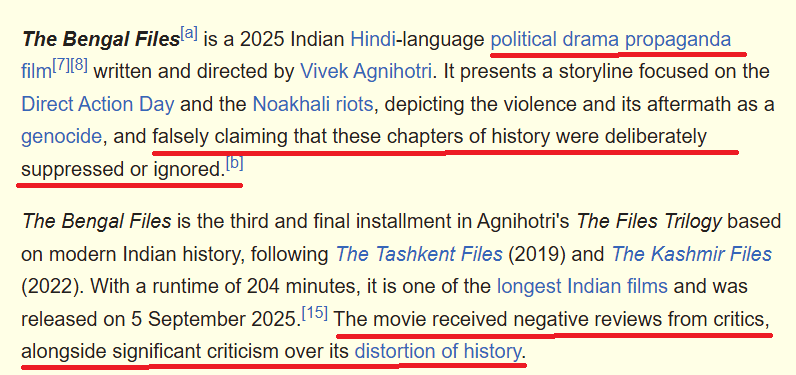
The introductory paragraphs (archive) on Wikipedia claim that ‘The Bengal Files’ is a ‘propaganda film’ and how it falsely claims that chapters of history on Direct Action Day and the Noakhali riots ‘were deliberately suppressed or ignored.’
“The movie received negative reviews from critics, alongside significant criticism over its distortion of history,” Wikipedia further claimed.
The negative portrayal of the movie continued throughout the article, particularly in the ‘Reception’ section. “The Bengal Files received predominantly negative reviews from critics,” the Wikipedia page of ‘The Bengal Files’ read.
Talk Page of the Wikipedia article gives insights into the malicious editing of ‘The Bengal Files’
OpIndia referred to the talk page (archive) of the Wikipedia article on the movie and found evidence of malicious editing by some politically motivated editors.
The deliberate distortion of ‘The Bengal Files’ on the Wikipedia is based on movie reviews (which are opinion pieces and not fact-based news articles) by what the free encyclopedia classifies as ‘reliable sources/perennial sources.’
For instance, The Hindu newspaper is considered a ‘reliable source’ by Wikipedia, although it has infamously cropped Ministry of Defence documents to pass off the Rafale Deal as a ‘scam.’
The characterisation of ‘The Bengal Files’ as a ‘propaganda film’ is based on an opinion piece/ movie review published in ‘The Hindu’ newspaper.
A Wikipedia Editor bearing the username ‘EarthDude’, who was involved in malicious editing of the article on the movie, kept on referring to the opinion piece published in ‘The Hindu’ and ‘The Indian Express‘ as the ‘gospel truth.’
When one Editor pointed out that ‘The Times of India’ (a reliable source/perennial source for Wikipedia) does not characterise ‘The Bengal Files’ as propaganda in its movie review, his argument was shot down.
Other Editors involved in malicious editing continuously removed neutral summaries to pass off their political agenda as reality. Another interesting discussion on the ‘talk page’ was the budget of the movie.
Despite a direct quote of ₹30 crores by the Director of the movie, Wikipedia Editors decided to cite speculative media reports about the budget of ‘The Bengal Files.’
Again, the notorious Editor ‘EarthDude’ insisted on referencing a report by ‘The Indian Express’ that claimed that the budget was ‘seemingly’ atleast ₹50 crores.
Despite the unreliable nature of the report, ‘EarthDude’ claimed, “Quotes do not matter. What reliable sources say do. Until and unless a reliable source states that the budget was ₹30 crores, we will state the ₹50 crores budget.”
When one Editor highlighted a report by Amar Ujala, independently claiming that the movie has a budget of ₹30 crores and that the newspaper is a ‘reliable source‘ on films and cinema, there was ‘no consensus.’
At the time of writing, the Wikipedia page of ‘The Bengal Files’ quotes the movie’s budget as ₹50 cr, which is 67% higher than the budget cited by director Vivek Agnihotri.
While analysing the ‘talk page’, OpIndia found out how some Wikipedia Editors conspired to rate the review of the movie as ‘predominantly negative.’ This was despite 4 overwhelmingly positive reviews and 7 neutral reviews.
Popular news website ‘Moneycontrol’ was dubbed ‘not reliable’ while leftist propaganda portal Scroll’s negative review of ‘The Bengal Files’ was included in the reception of the movie.
“So there is no justification for removing Moneycontrol review and having Scroll as far as I can see,” one sensible editor questioned.
Wikipedia Editors involved in malicious editing attempted to brand positive reviews by Amar Ujala and DNA India as ‘fringe sources.’ This is despite DNA India’s inclusion as a ‘reliable source’ on Wikipedia for Indian films and cinema.
Interestingly, notorious Editor ‘EarthDude’ had also objected to stating positive reviews at the start, followed by neutral and negative ones.
This is despite the convention laid down by Wikipedia in its ‘Featured articles’ and ‘Good article.’ At the time of writing, the negative reviews of ‘The Bengal Files’ feature at the top of the ‘Reception’ section.
OpIndia dossier exposes Wikipedia
In September 2024, OpIndia released its 186-page dossier on Wikipedia and made several revelations about the so-called free encyclopedia.
These include facts such as Wikipedia’s non-neutrality, tightly controlled ecosystem, ‘anonymised funding’, support for anti-India and anti-Hindu organisations, role as a publisher, and non-submission to Indian laws, among many other things.
In the context of Wikipedia’s distortion of ‘The Bengal Files’, we want to draw your specific attention to our findings about the encyclopedia’s so-called reliable sources.
Page 4 of the dossier makes it crystal clear –
“Wikipedia’s “NPOV” (Neutral Point of View) guidelines does not mean that the entire spectrum of views would find equal, or even fair, representation in a Wiki article. The result of NPOV is merely that whatever details are mentioned in the “reliable source” would be mentioned.
The pool of “Reliable source” itself is tainted since the editors and administrators, who have disproportionate power in Wikipedia, ensure that “right wing” (non-Left) sources are deprecated or blacklist – which bars those sources from being cited as reference material in any of the Wikipedia articles.“
During the course of our extensive research, we found that most non-Left sources were banned from use in Wikipedia.
“The list of deprecated sources and blacklisted sources indicate how the articles on Wikipedia are doomed to be biased because of the sources which are considered reliable and the ones which are not. The decision to deprecate sources itself stems from the Left bias that the editors seem to suffer from,” our research stated (Page 139).
Coincidentally, Qatar-funded Islamist propaganda portal Al Jazeera and habitual fake news peddler BBC are marked ‘reliable sources’ by Wikipedia.
Indian State broadcaster Doordarshan does not feature in the list of ‘reliable sources.’ Non-left news publications like OpIndia and Swarajya are banned and blocklisted. Coincidentally, Newslaundry is marked as ‘reliable.’
In our research we had highlighted how fake news peddled by ‘The Wire‘, which led to violence in India’s Northeast, was not added to its Wikipedia page by politically motivated editors.
“Any information on fake news being spread and the consequences of it by the Left media would be mostly covered in the non-Left media, which has in itself been blacklisted by Left editors of Wikipedia. The result of this well-crafted strategy is that the information is heavily biased, skewing towards the Left,” our dossier found (Page 144).
Note: The previous version of the article wrongly identified ‘Computeracct’ as the Editor involved in the malicious editing of the Wikipedia page of ‘The Bengal Files.’ The article has been updated now with the correct information. The inconvenience caused is highly regretted.


