

On 4th January, Marigold Marriage Palace in Amritsar became a crime scene when Aam Aadmi Party’s sarpanch Jarmal Singh was assassinated in broad daylight. A chilling CCTV footage of the incident showed two suited gunmen strolling into the wedding. They approached the 50-year-old village leader and fired a single point-blank shot to his head.
The scene turned into chaos as the guests dived for cover and the shooters conveniently slipped away unchallenged. Hours later, a social media post, allegedly by gangster Prabh, claimed responsibility for the murder. Punjab is not unfamiliar with violence. However, this execution-style murder of a ruling party local leader, that too in broad daylight, has sent shockwaves throughout Punjab.
In a statement on social media, Shiromani Akali Dal (SAD) president Sukhbir Singh Badal condemned the incident and accused the Chief Minister of Punjab, Bhagwant Mann, of policing failure in the state. Notably, CM Mann also holds the state’s Home Ministry.
Strongly condemn the cold-blooded murder of Sarpanch Jarmal Singh of Valtoha village (Tarn Taran), who was shot dead at a wedding function in Amritsar today.
— Sukhbir Singh Badal (@officeofssbadal) January 4, 2026
This follows an extremely worrisome pattern: yesterday, a young man was gunned down in Bhinder Kalan (Moga) and on Friday… pic.twitter.com/nt01hEeQAn
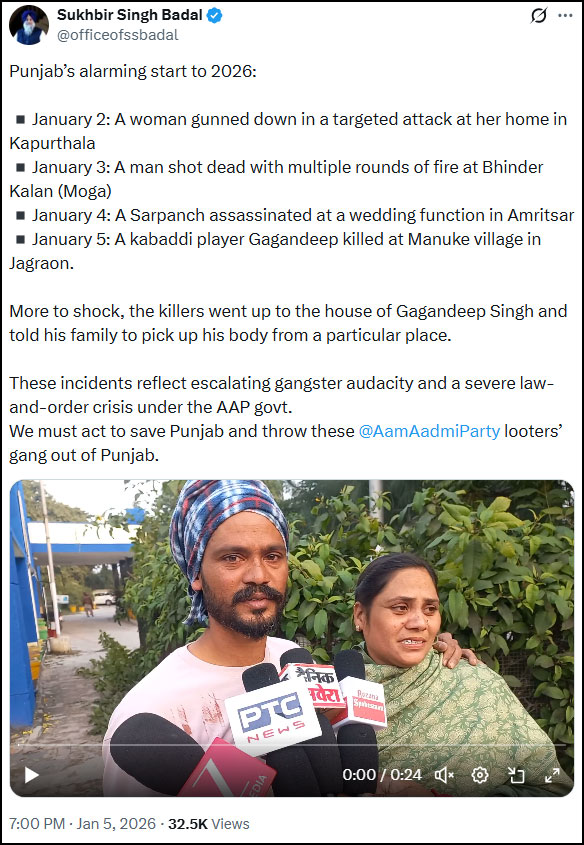
In another post on X, Badal listed four murders that have happened in Punjab in the first six days of 2026. In the post, he mentioned that a woman was murdered in Kapurthala on 2nd January, a man was shot dead in Bhinder Kalan of Moga, and a Kabaddi player, Gagandeep, was killed at Manuke village in Jagraon, apart from the sarpanch’s murder.
In a post on X, Bharatiya Janata Party (Punjab) said there is no “law and order” in the state. “It is a reign of Gundaraj”, the party said.
👉 ਵਿਆਹ ਸਮਾਗਮ ‘ਚ ਦਿਨ ਦਿਹਾੜੇ ਵਲਟੋਹਾ ਸੰਧੂਆਂ ਤੋਂ AAP ਸਰਪੰਚ ਜਰਮਲ ਸਿੰਘ ਨੂੰ ਗੋਲੀਆਂ ਨਾਲ ਮਾਰ ਦਿੱਤਾ ਗਿਆ- ਕੀ ਇਹੀ ਹੈ AAP ਦੇ ਰਾਜ ‘ਚ ਪੰਜਾਬ ਦੀ ਕਾਨੂੰਨ-ਵਿਵਸਥਾ !
— BJP PUNJAB (@BJP4Punjab) January 4, 2026
👉AAP ਪਾਰਟੀ ਜੋ ਪੰਜਾਬ ਨੂੰ ਸੁਰੱਖਿਅਤ ਰੱਖਣ ਦੇ ਝੂਠੇ ਦਾਅਵੇ ਕਰਦੀ ਹੈ, ਅੱਜ ਹਾਲਾਤ ਇਹ ਹਨ ਕੀ ਉਸਦੇ ਆਪਣੇ ਆਗੂ ਹੀ ਸੁਰੱਖਿਅਤ ਨਹੀਂ ਹਨ
👉 ਇਹ “ਬਦਲਾਅ”… pic.twitter.com/cXRR1Q6TFW
Political killings in broad daylight
The murder of the sarpanch was not an isolated incident. It is one of a series of political murders that have rocked Punjab in recent months. In fact, barely 48 hours before the murder of the sarpanch, Congress leader Umarsir Singh was riddled with bullets in Moga. The attackers were allegedly linked to a local rivalry involving an AAP functionary, which raised serious concerns.
These back-to-back political assassinations, one from the ruling party and one from the opposition, shed light on an uncomfortable reality – that no one, either from the ruling party or the opposition, is safe in the state.
Speaking on the matter, senior Congress MLA and former minister Pargat Singh pointed towards an “unchecked surge” in such cases of violence. He warned, “Punjab has never witnessed such lawlessness in recent years.” He and others in the opposition have demanded CM Mann’s resignation, calling the situation “completely out of the government’s hands”.
It has to be noted that these political murders were carried out in broad daylight, in public view. It was evident from the CCTV footage of the sarpanch’s murder that the murderers were scarcely concerned about police response. In the case of Umarsir as well, the gunmen escaped easily.
Congress MLA Gurjit Aujla slammed the AAP government for “failing to maintain law and order” and noted how even local disputes now routinely escalate into lethal violence.
This is not the first time Punjab has witnessed such high-profile bloodshed under AAP government. The assassination of internationally renowned yet controversial singer and Congress leader Sidhu Moose Wala in 2022 was an early warning of the state’s descent into gang-fuelled violence. Carried out in broad daylight with military-grade weapons, the murder was later linked to gang rivalries and exposed the dangerous nexus between organised crime and political circles. What followed was a series of violent episodes that only grew in frequency and boldness.
Extortion, gangs and sports turf wars
Beyond politics, organised crime networks have turned the state into their playground and battleground. Opposition leader Partap Singh Bajwa noted, “Getting extortion calls from gangsters has become the norm in the state.” He argued that the people of Punjab are not safe from this climate of fear.
He alleged that gang lords operate freely, and went on to claim that the administration has effectively ceded its authority in the hinterland. SAD chief Sukhbir Singh Badal likewise described a “prevailing jungle raj”, where “businessmen, doctors, artists, and athletes are facing grave threats from extortionists” and violent retribution is routine.
The collapse of law and order in the state is such that in July 2025, a prominent trader from Abohar in district Fazilka, Sanjay Verma, co-founder of famous Wear Well, was brutally gunned down outside his shop in broad daylight. Verma was fondly called the “Kurta Pyjama King”, as Wear Well is famous among politicians and celebrities alike. His murder prompted merchants’ strikes in protest.
The infamous gang wars of the state have also spilled into the sporting arena. Kabaddi, Punjab’s much-loved rural sport, has in recent years been stained with blood as criminal syndicates often try to influence its lucrative tournaments.
In December 2025, Kabaddi promoter Kanwar Digvijay alias Rana Balachauria was shot dead by imposters posing as fans in front of a packed stadium in Mohali. The murder epitomised the nexus of crime and sport. Kabaddi is a 100-crore industry which is now entangled with gambling, gang rivalries and score-settling.
In October 2025, 25-year-old player Tejpal Singh was shot during an on-field altercation in Jagraon. A month later, another player, Gurvinder Singh, was killed in Samrala. The Lawrence Bishnoi gang claimed responsibility for the murder on social media.
Even earlier, in 2022, international Kabaddi star Sandeep Nangal Ambian was gunned down at a tournament in Jalandhar. Later, the probe revealed the murder was the result of inter-gang rivalry among sport promoters. Each murder shifted the balance of underworld power in the profitable Kabaddi circuit, where syndicates attempt to control tournaments, run betting rackets and overshadow player contracts.
Speaking to Indian Express, an investigator claimed that the tentacles of gangs have reached so far into Kabaddi that players quietly talk about pressure to throw matches or face threats by bookies linked to gangs.
The gangsters in the state are pursuing their endeavours without much fear of the law. The Bhagwant Mann-led government is indeed working to curb gangland activities. The state government had set up an Anti-Gangster Task Force (AGTF) in 2022 and it has yielded some notable results on the ground. Media reports suggest that till November 2025, the task force arrested 2,209 gangsters, neutralised 21, dismantled 825 modules, and seized a large cache of weapons, vehicles, and drugs. While this is not a small number, there are allegations that gangs have flourished in the state in the past few years as a result of the government’s own lapses.
Pratap Bajwa has even accused the ruling AAP and some in the police of tacitly “using gangsters for furthering [their] political agenda” and claimed that victims who report extortion are advised to “settle the matter” with the criminals rather than see robust police action.
What Bajwa has claimed is damning, as it showcases public perception. It appears that the public now believes that the police are either unable or unwilling to take on the well-connected crime bosses. The term “gangland” was coined by Punjab Congress chief Amrinder Singh Raja Warring while lamenting that ordinary people now live in “fear and terror while the gangsters go scot-free” in the state.
Narco-terror state, drugs and terror attacks
On one hand, domestic crime is gripping the state and on the other hand, persistent drug menace has another tentacle that links to narco-terrorism. OpIndia has previously talked in detail about narco-terrorism in the context of Punjab which can be checked here.
According to the latest National Crime Records Bureau data, in 2023, Punjab saw 11,589 cases under the Narcotic Drug and Psychotropic Substances (NDPC) Act. It is the third highest in India after Kerala and Maharashtra. Notably, out of the 11,589 cases, 7,785 were related to drug trafficking and not personal consumption.
The data makes it clear that Punjab is not just a market for drugs but a major transit corridor for organised smuggling. Punjab shares a wide border with Pakistan which has made it a preferred route for contraband flooding in. Sophisticated cross-border networks use drones, tunnels and couriers to move narcotics as well as weapons into Punjab.
In a statement, Sukhbir Badal had blamed the AAP government’s “apathy” for “allowing narco-terrorism to raise its head again”. He linked the rocket-propelled grenade blasts in Tarn Taran that happened in December 2022 directly to the booming drug trade and porous border security. In a post on social media, Congress’s Raja Warring had called the situation “quite serious” and urged united action by the state and the Centre against the drug trade in Punjab.
Not to forget, there have been several such attacks in Punjab. The RPG attack on a police building in May 2022 and a blast in Ludhiana district court in 2021 showed that from time to time such attacks have shaken the state irrespective of which government was in power. In September 2024 as well, there was a blast in Sector 10 Chandigarh, the Union Territory that is shared as the capital by both Punjab and Haryana.
These audacious attacks have sent shockwaves not only across states but also have worried the central agencies. For ordinary residents of Punjab, these attacks are an eerie reminder of the bombings and shootouts that once haunted their daily lives during the insurgency between the 1980s and the 1990s.
Amid all the criminal activities, Khalistani separatist propaganda has grown more visible in the state. The most striking example was the rise of self-styled preacher Amritpal Singh. His hardline Khalistani campaign erupted into violence in early 2023 when in February, his followers, armed with swords, guns and the Sikh holy book as a shield, stormed the Ajnala police station near Amritsar to demand the release of an arrested aide.
The scenes of the attack on the police station were broadcast nationwide. Hundreds of men breached the barricades and besieged the station. Several police personnel were injured and it was a major humiliation for the state. The fact that the mob succeeded in freeing the detained aide of Amritpal Singh sent a very dangerous message that the radical separatists can defy the police with impunity.
For weeks, Amritpal Singh went on the run from authorities and evaded capture until a nationwide manhunt finally nabbed him. The Ajnala incident and subsequent pro-Khalistan events in the state exposed how the counter-terrorism infrastructure was weakened.
When Amritpal Singh-linked locations were raided, investigation officers revealed he was raising a militia. There were weapons, bulletproof jackets and other incriminating material that the police found at those locations. Amritpal was eventually nabbed and shifted to a jail in Assam. Amritpal, chief of the Waris Punjab De organisation, was booked under the National Security Act (NSA).
Surprisingly, despite being booked under serious charges, he was allowed to contest the 2024 Lok Sabha elections which he comfortably won. However, he remained in prison despite becoming an MP. He has not attended a single day of Parliament proceedings for obvious reasons.
Each drone shipment of weapons from Pakistan, each propaganda video by overseas Khalistani leaders, and each unexplained blast on Punjab’s soil chips away at the hard-won peace, at least on paper, of the past two decades.
State government under AAP
When Bhagwant Mann took charge of Punjab in 2022, his government promised a fresh start. There have been some decisions made to control gang related activities and the drug menace in the state, but the outcome seems limited. There have been reports of houses of drug mafia getting bulldozed, recoveries being made by special units of the Punjab Police against drugs, and recoveries of drug-carrying drones at borders by the Punjab Police in collaboration with the Border Security Force (BSF). In a press release, AAP claimed 283 drones carrying heroin, weapons and ammunition were seized in 2024. By August 2025, 137 drones were recovered. However, it has not been able to curb the drug problem completely in the state.
Similarly, the rise in murders, thefts, and other criminal activities has put the state government under strict scrutiny. Even judges got hit by theft. In March 2023, official residence of Additional Sessions Judge Ravdeep Hundal was broken into, and the thieves fled after stealing taps and a geyser from the house. In October 2024, a CCTV footage surfaced in which a woman in Punjab’s Amritsar bravely stopped three theives from entering her house. The incident took place in broad daylight.
Partap Bajwa, the Congress Leader of the Opposition, called for CM Mann’s resignation as he “failed to manage the Home Department and Punjab Police effectively”. Bajwa argued that if he had “an iota of self-respect, he would tender his resignation”.
In July last year, after the daylight murder of the Abohar businessman, Bajwa thundered in the Assembly that “no Punjabi is safe today” and that gangsters act without fear because the administration is asleep at the wheel.
Indeed, Punjab’s police have recovered caches of rifles, RDX explosives and heroin in recent months, highlighting just how heavily armed and funded the criminal-terror nexus is. But such successes are overshadowed by the brazenness of continued attacks. As BJP leader Sunil Jakhar put it, each “deafening silence of the AAP government after such killing only emboldens the gangsters”, and every week of delay in asserting control makes it “already too late”.
SAD veteran Daljit Cheema has similarly accused Mann of “failing to maintain law and order” and demanded he quit if he cannot stem the tide.
The statistics echo their concern. According to NCRB 2023 data, Punjab saw a slight rise in overall cognisable crimes (IPC+SLL) in the AAP era’s initial year before a dip in 2023. The state registered 69,944 total cases in 2023, combining 44,872 IPC offences and 25,072 special or local law cases.
While the total crime rate per capita in Punjab, around 228 per lakh people, remains lower than many large states, it is the nature of the crimes that alarms the public. Violent crimes have spiked in visibility, Punjab recorded 681 murder cases in 2023, about 2.2 murders per 100,000 people, only a marginal decline from the previous year’s 718.
In other words, an average of two people are still being killed every day in the state, many in feud-like shootings. Meanwhile, property crimes like theft and burglary form the bulk of Punjab’s IPC cases each year, the state logged tens of thousands of thefts, contributing to its around 146 per lakh property crime rate. And underpinning many of these statistics is the drug factor, NDPS cases in Punjab rose to 11,589, 37.6 per lakh, in 2023 as noted, with the state leading in narcotics seizures.
These figures, drawn from the NCRB’s latest report, paint a picture of a state where crime is both high in volume and increasingly chilling in character.
In sum, Punjab stands at a perilous crossroads. A state that shed rivers of blood to emerge from the nightmare of insurgency now stares at new demons in familiar garb. The onus is on its government to prove that it is not as inept as critics claim, that is, to show, in deed rather than word, that it can slay the hydra of crime and terror. Failing that, the judgement of the people will be harsh, and rightly so.


