

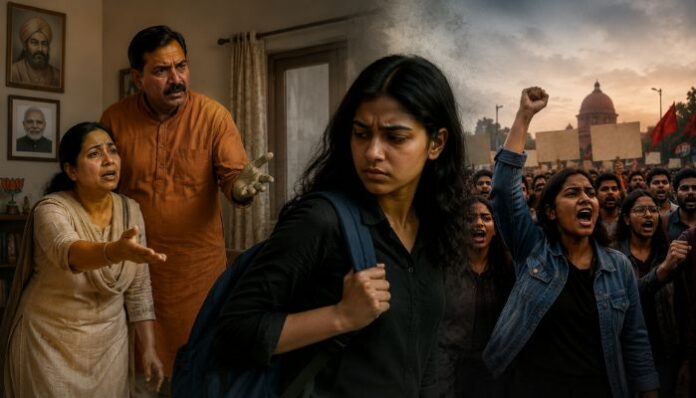
The recent wave of claimed student demonstrations sparked by the Cockroach Janata Party (CJP) at New Delhi’s Jantar Mantar exposed a deep, festering tear in the fabric of Indian households. Across cities and towns, political ideology is no longer just something discussed during election cycles; it has turned into a wall between parents and their children. The protests became a boiling point, showing how radicalisation, digital activism, and ideological clashes have created violent anger in young Gen Z minds, leaving many kids walking away from their homes and hating their parents over political views.
Take the case of 19-year-old Kunal Choudhary from Ludhiana. When he left home to join the protests, he knew he was burning his bridges behind him. Choudhary was raised in a hardcore Bharatiya Janata Party (BJP) and Rashtriya Swayamsevak Sangh (RSS) family, and was an active RSS worker himself. Yet, standing at Jantar Mantar, he severed all ties with his past.
His father, Jeevan Choudhary, a businessman who built his life around RSS values, watched his son broadcast a viral video criticising the ruling party. “They don’t teach you anything useful. They only tell you how to hate Muslims and Dalits,” Kunal openly said about his family’s ideological background.
The rift widened so much that even after the protests were called off on 25th July, Kunal refused to return home. Living in a local gurdwara, relying on communal kitchens, and working odd jobs, he admitted that the difference between his worldview and his family’s was simply too vast to bridge.
A similar story plays out with 24-year-old Priya Singh. Her father, a 55-year-old security firm employee, holds a firm loyalty to the BJP. When Priya made up her mind to join the Jantar Mantar demonstrations, her father warned her. Forced to hide her identity, Priya covered her face during the protests so her family wouldn’t spot her in news photos or online clips.
When she confronted her father over videos showing police action against violent protesters during the protests, he defended the police, claiming that they were right to act against the protesters to control the violence. The hostility at home had started earlier, when Priya secretly cleared the entrance exam for Jamia Millia Islamia without informing her family. Her father accused the institution of trying to convert her.
Today, Priya lives a double life, saying, “Now, when I come home, I don’t mention anything about my friends or classes to my family. I don’t even take calls from friends at home.
Flaunting conflict: The Gen Z trend of villainising parents
What makes this generational split unique today is how young left-liberal activists actively take pride in fighting with their elders. Confronting parents over their political views, recording these intense arguments, and broadcasting family clashes on social media has become a badge of honour among Gen Z youth.
Parents who support the BJP or Prime Minister Modi are routinely villainised online by their own children as “brainwashed” or “bigoted.” Instead of seeking common ground or keeping family bonds intact, youth activism encourages teenagers and young adults to publicly shame their parents’ conservative beliefs to prove their own ideological purity.
The CJP protests, heavily organised and steered by left-liberal student fronts, highlighted this reality. For hundreds of young demonstrators, travelling to Jantar Mantar was as much about rebelling against their conservative households as it was about demanding exam reforms. The protest grounds became a stage where young people flexed their rebellions on Instagram and X, posting stories about fighting with their parents, leaving home, or disobeying family orders just to stand on the front lines. The emotional fallout on families was brushed aside, framed instead as a victory for personal liberation and online engagement.
Glorifying disownment: The case of AISA’s Neha Bora
International media outlet Al Jazeera have played a key role in romanticising these family breaks, turning political hostility against one’s own parents into a heroic act. A primary example of this glorified hostility is Neha Bora, the 29-year-old national president of the All India Students’ Association (AISA).
During an interview with journalist Barkha Dutt, Bora spoke openly about her complete ideological detachment from her parents, a serving Army officer father and a homemaker mother, both of whom support the BJP. Media coverage frequently portrays her open defiance and contempt for her family’s background not as a tragedy of broken personal relationships, but as an inspirational act of political courage.
Bora, a doctoral student at Jawaharlal Nehru University (JNU), has become one of the most visible faces of left-wing student politics in India. As the national leader of AISA, she regularly uses student-centric issues, such as national exam leaks, as a doorway to push radical leftist agendas.
Under her leadership, AISA launched campaigns like “Cockroaches on the streets” and joined the CJP protests, where activists quickly shifted slogans from exam irregularities to demands for “Azadi” and political rhetoric. In public statements, Bora has actively whitewashed anti-terror charges against figures like Umar Khalid and Sharjeel Imam, calling them “ordinary students” subjected to political prosecution, while ignoring court observations regarding their roles in the 2020 anti-Hindu Delhi riots.
Beyond student rights, her digital footprint shows an explicit anti-Brahmin stance masked under the term ‘Brahmanvaad’, opposition to broad Hindu consolidation efforts claiming it frightens minorities, and active support for a free Palestine while downplaying domestic radicalisation threats.
The Leftist playbook: Destroying the family to rebuild the state
This growing drive among young activists to reject their parents is not an accidental byproduct of modern politics; it is a core structural strategy of classic communist and radical leftist theory. To bring about a total political and social revolution, radical ideologies have historically viewed the traditional nuclear family as an obstacle that must be dismantled. The family unit acts as a natural buffer, teaching children heritage, traditional values, authority, and unconditional personal loyalty.
By pushing young individuals to view their parents not as caretakers, but as symbols of “oppressive structures” or “reactionary politics,” far-left ideologies break these foundational emotional bonds. Once a young person is alienated from their home, the party or ideological collective steps in to replace the family, becoming their primary source of identity and belonging.
The recent wave of youth protests shows this playbook in action: kids are encouraged to sacrifice their education, leave their homes, cut off their parents, and find a new “family” among fellow communist and leftist activists on the streets. In the pursuit of ideological victories, the very foundation of the home is being systematically burned down.


