

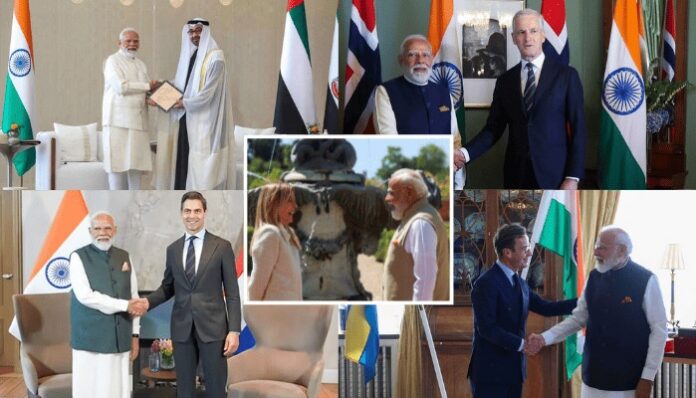
Prime Minister Narendra Modi returned to New Delhi on Thursday morning, 21st May, after concluding an extensive five-nation diplomatic tour that covered the United Arab Emirates, the Netherlands, Sweden, Norway and Italy. The 6-day tour has delivered a major investment push for India, with fresh business commitments and expansion plans worth an estimated ₹3.5 lakh crore (around USD 40 billion) emerging from meetings with global industry leaders and partner countries.
Delhi: Prime Minister Narendra Modi arrives in Delhi after concluding a five-nation visit pic.twitter.com/M3tkoyQqZ6
— IANS (@ians_india) May 21, 2026
The visit, which began on 15th May in the UAE and concluded in Italy on Wednesday, 20th May, focused on strengthening India’s strategic partnerships, boosting trade and investment, securing energy cooperation, and expanding collaboration in technology, defence, innovation, education and clean energy.
PM Modi began his tour with the UAE visit
PM Modi began his tour with an official visit to the UAE on 15th May, where he was welcomed by UAE President Sheikh Mohammed bin Zayed Al Nahyan with a ceremonial reception. During the visit, both leaders reviewed the growing India-UAE Comprehensive Strategic Partnership and discussed regional security, trade, energy and defence cooperation.
PM Modi also reiterated India’s support for safe and uninterrupted navigation through the Strait of Hormuz and strongly condemned attacks on the UAE.
List of outcomes (7 in total) : Official visit of PM @narendramodi to UAE ⬇️ pic.twitter.com/J1VqbjPZ8S
— Randhir Jaiswal (@MEAIndia) May 15, 2026
Major outcomes of the UAE visit included:
Massive $5 billion investment package: Emirati entities committed an immediate $5 billion into India’s growing financial and infrastructure ecosystems. This includes a major $3 billion investment by Emirates NBD in RBL Bank of India, $1 billion from the Abu Dhabi Investment Authority (ADIA) in the National Infrastructure & Investment Fund (NIIF) for high-priority projects, and another $1 billion from the International Holding Company in Sammaan Capital.
Petroleum and Gas reserve agreement: A major collaboration agreement was signed between Indian Strategic Petroleum Reserves Limited and the Abu Dhabi National Oil Company (ADNOC). This groundbreaking deal increases the UAE’s storage participation in India’s strategic oil reserves to 30 million barrels. It also sets up a shared framework to build dedicated strategic gas reserves right inside India.
Long-term LPG supply line: To guarantee steady household fuel supplies, a binding commercial agreement was locked in between Indian Oil Corporation Limited (IOCL) and ADNOC for predictable, long-term LPG shipments.
Framework for strategic defence partnership: Moving beyond simple defence sales, this newly signed framework shifts the relationship toward advanced defence industrial collaboration. It builds an active roadmap for joint training exercises, maritime security operations, shared cyber defence, secure communications, and advanced technology research.
Vadinar Ship Repair Cluster: Cochin Shipyard Limited joined forces with Drydocks World, Dubai, to sign an MoU establishing a specialised Ship Repair Cluster at Vadinar, India. Backed by India’s Maritime Development Fund Scheme, this project focuses heavily on advanced offshore fabrication.
Maritime skill development program: A tripartite MoU involving Cochin Shipyard Limited, Drydocks World, and the Centre of Excellence in Maritime & Shipbuilding (CEMS) was formalised. This agreement sets up an international training network to upskill Indian professionals, positioning India as a global hub for shipbuilding and repair talents.
Mega 8-exaflop supercomputer cluster: In a huge push for computing power, India’s CDAC partnered with the UAE’s tech giant G-42. They signed a formal term sheet to co-develop an 8-Exaflop supercomputing cluster, bringing massive data-processing capabilities to both countries.
Operationalising the MAITRI virtual trade corridor: The leaders officially launched the virtual trade corridor driven by MAITRI (Master Application for International Trade and Regulatory Interface). By digitally linking customs and port agencies on both sides, this system slashes shipping costs, removes paperwork delays, and speeds up the movement of goods.
Netherlands visit: Strategic partnership, semiconductors and return of historic Chola artefacts
PM Modi travelled to the Netherlands between 16th and 17th May at the invitation of Dutch Prime Minister Rob Jetten. The visit became one of the most significant stops of the tour as India and the Netherlands elevated ties to a full-fledged “Strategic Partnership”.
One of the most symbolic moments of the visit was the return of the historic 11th-century Chola-era Leiden Copper Plates to India after centuries.
Anaimangalam Copper Plates, 11th-century Chola dynasty artefacts.
— Sidhant Sibal (@sidhant) May 16, 2026
India getting them back from Netherlands https://t.co/GKvPFZaIP7 pic.twitter.com/JN9Xa3wJwy
The central achievement of this visit was the formal elevation of bilateral ties to a full-fledged “Strategic Partnership.” This upgrade was backed by the signing of 14 bilateral agreements that led to 17 major strategic outcomes across semiconductors, green energy, water engineering, and education.
The 17 Key Outcomes and deals signed with the Netherlands
1. Roadmap of India-Netherlands Strategic Partnership (2026-2030): This comprehensive document acts as the master blueprint for the newly upgraded relationship. It outlines clear, time-bound execution targets for defence manufacturing, semiconductor supply chains, cybersecurity frameworks, artificial intelligence research, and high-tech agriculture over the next four years.
2. Restitution of the Historical Chola Copper Plates: The return of the 11th-century Anaimangalam copper plates was a deeply symbolic moment. Weighing nearly 30 kilograms and held together by a large bronze ring with the royal seal of Rajendra Chola I, these 21 plates date back to the reigns of Emperor Rajaraja Chola I and his son. The inscriptions feature Sanskrit text tracing the divine lineage of the Chola kings, alongside Tamil text recording land grants made to a Buddhist monastery built by the Indonesian Srivijaya kingdom. This artefact provides rare, physical proof of India’s historical maritime trade networks and religious harmony.
3. Leiden University Libraries and ASI Heritage Pact: Directly linked to the restitution, an MoU was signed between Leiden University Libraries and the Archaeological Survey of India (ASI). This agreement sets up long-term academic access, shared restoration techniques, and digital research pipelines for ancient historical manuscripts.
4. Comprehensive MoU on Mobility and Migration: As thousands of Indian professionals, researchers, and students move to the Netherlands, both governments signed a protective migration treaty. This creates highly structured, legal, and safe pathways for skilled professionals. At the same time, it establishes strict institutional rules to stop human trafficking and irregular migration, fully protecting workers’ legal rights and keeping visa processes transparent.
5. The Tata Electronics and ASML Semiconductor deal: In a major technology win, Tata Electronics signed a highly anticipated MoU with the Dutch semiconductor giant ASML. ASML is the only company in the world capable of manufacturing the extreme ultraviolet (EUV) lithography machines required to print advanced microchips. ASML will provide state-of-the-art lithography equipment, direct engineer training, and supply chain support to scale Tata’s milestone 300mm wafer fabrication plant in Dholera, Gujarat.
#WATCH | PM @narendramodi witnesses the signing ceremony of the MoU between ASML and @TataCompanies.
— DD News (@DDNewslive) May 16, 2026
The agreement is expected to provide a significant boost to India’s semiconductor ambitions and strengthen its position in the global chip supply chain.@PMOIndia @MEAIndia… pic.twitter.com/XPyIlNUzbk
6. Strategic intergovernmental MoU on critical minerals: India and the Netherlands also signed a Memorandum of Understanding on cooperation in critical minerals. Signed between the Ministry of Mines of the Republic of India and the Ministry of Foreign Affairs of the Kingdom of the Netherlands, this MoU establishes an institutional framework for securing critical mineral value chains.
7. Letter of Intent for the Kalpasar Coastal Engineering Project: India’s Ministry of Jal Shakti joined hands with the Dutch Ministry of Infrastructure and Water Management. The Netherlands will bring its world-class hydraulic engineering and delta management experience to Gujarat’s massive Kalpasar Project, which focuses on building a giant fresh-water reservoir across the Gulf of Khambhat by damming tidal flows and controlling salinity.
BOOST FOR KALPSAR PROJECT IN GUJARAT: Accompanied by Netherlands PM Rob Jetten, Indian Prime Minister Narendra Modi visits the iconic Afsluitdijk Dam, a symbol of Dutch excellence in water management, flood protection and freshwater storage. The visit highlights the relevance of… https://t.co/9bJDfNXkL7 pic.twitter.com/zJ0N1Titpm
— DeshGujarat (@DeshGujarat) May 17, 2026
8. Launch of the Joint Green Hydrogen Roadmap: This energy blueprint combines India’s vast renewable power potential and low manufacturing costs with the Netherlands’ advanced infrastructure as Europe’s primary hydrogen entry point through the Port of Rotterdam. The roadmap sets out joint commercial rules, safety systems, and transport setups for clean energy.
9. Institutionalising the Joint Working Group on Renewable Energy: The leaders set up a permanent Joint Working Group (JWG) to move beyond basic discussions. This body will actively oversee cross-border investments, grid-scale battery storage installations, and smart solar-grid integration projects.
10. Renewal of the NITI Aayog-Netherlands Decarbonisation Accord: NITI Aayog and the Dutch government officially extended their Joint Statement of Intent. This extension focuses on sharing advanced data-modelling software and policy designs to transition traditional, heavy-emission industrial centres into modern net-zero networks.
11. Establishing the Indo-Dutch Centre of Excellence for Flowers: The two sides established the Indo-Dutch Centre of Excellence for Flowers in West Tripura. This will help farmers to adopt high-value floriculture.
India, Netherlands annouce establishment of joint centre of excellence for flowers in Tripura. This will help farmers to adopt high value floriculture.
— Sidhant Sibal (@sidhant) May 16, 2026
12. Opening the Indo-Dutch Centre of Excellence on Training in Dairy: The leaders further welcomed the signing of a Joint Declaration between the Ministry of Fisheries, Animal Husbandry and Dairying and the Ministry of Agriculture, Fisheries, Food Security and Nature of the Netherlands. The deal also included the establishment of an Indo-Dutch Centre of Excellence on Training in Dairy at the Centre of Excellence for Animal Husbandry (CEAH), Bengaluru.
13. Joint Declaration on Animal Husbandry and Food Processing: Both nations signed an expansive agricultural declaration to introduce automated Dutch processing technologies, cold-chain preservation systems, and livestock optimisation methods across India.
14. Public Health Research LoI between ICMR and RIVM: A Letter of Intent (LoI) was signed between the Indian Council of Medical Research (ICMR) and the Dutch National Institute for Public Health and the Environment (RIVM). The partnership focuses on tracking infectious diseases, building early warning systems for climate-driven health risks, and running joint biomedical programs.
15. Customs Mutual Administrative Assistance Agreement: India and the Netherlands also signed an Agreement on Mutual Administrative Assistance in Customs Matters to improve customs cooperation, information sharing and trade facilitation.
16. National MoU on Higher Education Expansion: India and the Netherlands also signed an MoU on Higher Education to encourage collaboration between universities, student exchanges and academic research. Expands opportunities for academic exchanges, joint programmes and research collaboration. It expands opportunities for academic exchanges, joint programmes and research collaboration.
India, Netherlands annouce cooperation between Leiden University, ASI to boost research on Chola history; cooperation between Nalanda University & Groningen University; cooperation in higher education with dual programs; Collaboration in health
— Sidhant Sibal (@sidhant) May 16, 2026
17. Landmark Nalanda University and University of Groningen Partnership: Stepping outside the general education framework, Nalanda University and the University of Groningen signed a direct academic cooperation treaty, building a dedicated research pipeline for historical studies and international relations.
Sweden visit: AI, innovation and technology partnership
PM Modi’s visit to Sweden on 17th May marked another major diplomatic milestone as India and Sweden officially upgraded their ties to a “Strategic Partnership”.
The focus of the visit remained strongly centred on innovation, advanced technology, artificial intelligence and sustainable industrial cooperation.
List of outcomes (6 in total) : PM @narendramodi’s visit to Sweden ⬇️
— Randhir Jaiswal (@MEAIndia) May 17, 2026
🇮🇳 🇸🇪 pic.twitter.com/a1Yed7Isky
Major outcomes of the Sweden visit included:
Launch of the Joint Innovation Partnership 2.0: This upgraded tech partnership focuses on joint research and development in cutting-edge areas, including 6G communication grids, quantum computing, artificial intelligence, space technologies, eco-friendly mining, and advanced life sciences.
Creation of the SITAC (India-Sweden Technology and AI Corridor): This digital corridor connects tech startups, venture capital networks, and premium labs in both countries. Designed to support India’s Viksit Bharat 2047 goals, SITAC simplifies cross-border tech testing and soft-landing pathways for emerging tech firms.
Establishing a virtual joint science and technology centre: To bridge the gap between research labs and real-world manufacturing, this virtual centre connects Indian and Swedish universities with industrial manufacturing partners to bring lab discoveries to market faster.
Bilateral trade doubling mandate: Both leaders committed to a firm economic goal: doubling total bilateral trade and investment over the next five years. The plan simplifies customs rules, ensures strong intellectual property protections, and clears regulatory hurdles for businesses.
Launch of the joint SME and startup platform: Recognising that smaller businesses drive innovation, this digital platform connects Indian and Swedish startups with global funding sources, mentorship networks, and international markets.
Introduction of the “Tagore-Sweden” lecture series: To deepen cultural and intellectual ties, both nations launched a permanent academic exchange series titled “Vikas Bhi Virasat Bhi” (Development along with Heritage), focusing on shared philosophical, historical, and social research.
Norway visit: Green partnership, maritime cooperation and digital development
PM Modi’s Norway visit marked the first visit by an Indian Prime Minister to the Nordic country in 43 years. Modi arrived in Oslo from Sweden and met King Harald V at the Royal Palace.
During the visit, King Harald V conferred Norway’s highest civilian honour, the Grand Cross of the Royal Norwegian Order of Merit, on PM Modi for strengthening India-Norway relations.
Honoured to receive the Grand Cross of the Royal Norwegian Order of Merit. This honour is dedicated to the people of India and is a tribute to the enduring friendship between India and Norway. It reflects our shared commitment to global progress. pic.twitter.com/bh7ucPamK4
— Narendra Modi (@narendramodi) May 18, 2026
PM Modi later wrote on X, “We had an excellent conversation on the India-Norway friendship and how our nations can keep working together across sectors for the benefit of our people.”
The visit focused heavily on climate cooperation, maritime partnerships, renewable energy and digital infrastructure.
List of outcomes (12 in total) : Official visit of PM @narendramodi to Norway ⬇️
— Randhir Jaiswal (@MEAIndia) May 18, 2026
🇮🇳 🇳🇴 pic.twitter.com/nMJwhV6oRe
Major outcomes of the Norway visit included:
1. Elevation to a green strategic partnership: The primary outcome of the trip was upgrading bilateral ties into an official Green Strategic Partnership. Backed by a comprehensive Joint Statement, this agreement blends Norway’s advanced green tech and environmental financing with India’s massive industrial scale and manufacturing capacity to speed up clean energy transitions.
2. Norway joins the Indo-Pacific Oceans Initiative: In a major geopolitical development, Norway officially joined India’s Indo-Pacific Oceans Initiative (IPOI).
3. Confirmed anchor at Nor Shipping 2027: India confirmed it will build a massive national pavilion at the upcoming Nor Shipping 2027 exhibition. This partnership focuses on co-developing green ships, modernising ports, and expanding blue economy frameworks.
4. Signing of the Inter-Agency Space Cooperation Agreement: Both countries signed a space treaty focused on the exploration and peaceful use of outer space. The deal simplifies joint satellite data sharing, climate observation from space, and commercial co-investments between space startups.
5. Launch of the Digital Development Partnership: This partnership creates a shared framework for building and scaling Digital Public Infrastructure (DPI) and open-source software tools. It supports the Digital India Mission while creating a pathway to share these digital tools with developing countries across the Global South.
6. Comprehensive Healthcare Cooperation Pact: This agreement establishes a permanent healthcare Joint Working Group. The group will coordinate research between medical institutes, share healthcare innovations, and run joint programs to study global health challenges.
7. Geotechnical Tunnel and Slope Stability Accord: India and Norway signed a specialised infrastructure agreement for technical consulting on mountain tunnels and highway slope stability.
8. Broad-Based Technology Cooperation Agreement: This overarching treaty sets up funding pools and fast-track visas for scientists and researchers working on shared projects in clean energy, marine biology, and climate science.
9. Direct CSIR and SINTEF Collaboration Agreement: India’s Council of Scientific and Industrial Research (CSIR) signed a partnership with Norway’s premier independent research organisation, SINTEF. They will focus on commercialising carbon-capture technologies, circular economy manufacturing, and eco-friendly bio-materials.
10. Ocean Energy Program Implementation Pact: This project-level agreement focuses on engineering offshore wind farms and deep-water wave energy devices. It combines Norway’s deep-water engineering experience with India’s long coastlines to build clean ocean energy networks.
11. Science and Innovation Agreement for the Green Shift: This academic mobility pact funds exchange programs for students, researchers, and university professors working on green technologies and environmental sustainability.
12. CSIR-NGRI and Emerald Geomodelling Geoscience Deal: India’s National Geophysical Research Institute (CSIR-NGRI) partnered with Norway’s Emerald Geomodelling AS. This commercial deal introduces advanced airborne subsurface mapping technologies to help plan and build large infrastructure projects safely.
PM’s five-nation visit concluded in Italy
PM Modi concluded his five-nation tour with an official visit to Italy on Wednesday, 20th May, where India and Italy elevated bilateral ties to a “Special Strategic Partnership”.
The Italy visit produced one of the broadest sets of agreements during the entire tour, covering defence, critical minerals, education, Ayurveda, agriculture, maritime infrastructure, climate science and healthcare mobility.
List of outcomes (15 in total) : PM @narendramodi’s visit to Italy ⬇️ pic.twitter.com/mxZfoZ3dDZ
— Randhir Jaiswal (@MEAIndia) May 20, 2026
Major outcomes of the Italy visit included:
Defence Industrial Roadmap: Shifting away from a simple buyer-seller dynamic, this roadmap focuses on co-developing and co-producing military hardware within India. It aims to integrate Italian component manufacturing into India’s domestic defence supply chains, focusing on advanced electronics, naval systems, and aviation parts.
Critical Minerals Cooperation MoU: Both countries signed a Memorandum of Understanding on cooperation in critical minerals, a sector increasingly viewed as strategically important for energy transition technologies and electronics manufacturing.
Anti-Financial Crime Pledges: To protect growing economic ties, India’s Directorate of Enforcement (ED) and Italy’s Guardia di Finanza signed a mutual assistance pact. The agreement focuses on sharing intelligence to trace tax evasion, crack down on cross-border terror financing, and cut off terror financing networks.
India and Italy set €20 billion trade target, Modi and Meloni agree to strengthen defence, trade and counter-terrorism cooperation.
— OpIndia.com (@OpIndia_com) May 21, 2026
Read details on the joint declaration and major outcomes during PM Modi’s landmark Rome visit.https://t.co/0nqFnF7KLK
Higher Education and Advanced Research Roadmap: This educational framework connects major research institutes in both countries. It focuses on setting up joint postgraduate degree programs, expanding credit transfers, and sharing academic best practices to improve student employability.
IITM Pune and Italy’s CMCC Climate Research MoU: India’s Indian Institute of Tropical Meteorology (IITM) in Pune joined forces with Italy’s Euro-Mediterranean Centre on Climate Change (CMCC). This scientific partnership focuses on advanced climate modelling, monsoon predictability research, and environmental risk tracking.
DST-Elettra synchrotron facility expansion: India’s Department of Science and Technology signed a deal with Italy’s Elettra Sincrotrone Trieste. Indian materials scientists gain direct access to Elettra’s advanced synchrotron radiation facility in Italy, opening up new opportunities for research in nanotechnology and life sciences.
Healthcare mobility pathway for Indian nurses: Addressing an immediate social need, Italy opened a legal migration pathway tailored specifically for certified Indian nurses. This agreement provides global career paths for Indian healthcare workers while helping Italy fill critical staffing shortages in its domestic healthcare system.
Bilateral MoU on Ayurveda cooperation: To bring traditional medicine to a global audience, both nations signed an Ayurveda cooperation pact. The agreement sets up research frameworks, university exchange programs, and safety testing guidelines to integrate Ayurvedic knowledge into Western health systems.
Maritime Infrastructure and Ports MoU: This shipping agreement aims to modernise port operations, increase cargo shipping volumes between the two countries, and create new jobs within the maritime logistics sector.
Lothal National Maritime Heritage Complex Collaboration: Italy signed an MoU to help build the National Maritime Heritage Complex in Lothal, Gujarat. Italian restoration experts and historians will share advanced museum technologies to showcase India’s ancient maritime history, aligning with the government’s “Vikas Bhi Virasat Bhi” vision.
Agricultural Technology and Sustainable Farming MoU: This agricultural agreement focuses on giving Indian farmers better access to precision farming machinery, automated irrigation systems, and water-saving agricultural techniques to improve crop yields.
MPEDA and ASSOITTICA ITALIA Seafood Pact: A commercial agreement was finalised between India’s Marine Products Export Development Authority (MPEDA) and the association of Italian seafood companies, ASSOITTICA ITALIA. The deal streamlines food safety inspections to boost exports of Indian seafood to Italian markets.
2027 Declared as the Year of Culture and Tourism: To bring the people of both nations closer together, the leaders announced that 2027 will be celebrated as the official India-Italy Year of Culture and Tourism. This initiative will feature major art exhibitions, music festivals, and travel promotions to boost tourism and create new service-sector jobs.
A tour focused on strategic technology, energy and global partnerships
PM Modi’s five-nation visit reflected India’s broader foreign policy focus on strengthening strategic partnerships with key countries across Europe and West Asia. From energy security agreements in the UAE to semiconductor cooperation with the Netherlands, AI partnerships with Sweden, green transition initiatives with Norway and defence-industrial collaboration with Italy, the tour covered almost every sector shaping the future global economy.
आज भाजपा मुख्यालय में आयोजित पत्रकार वार्ता को संबोधित करते हुए प्रधानमंत्री @NarendraModi जी की 5 देशों की ऐतिहासिक यात्रा के महत्वपूर्ण परिणामों और भारत की बढ़ती वैश्विक भूमिका पर अपने विचार साझा किए।
— Piyush Goyal (@PiyushGoyal) May 21, 2026
प्रधानमंत्री मोदी जी की यह यात्रा दुनिया को स्पष्ट संदेश देती है कि आज भारत… pic.twitter.com/F5bSpU0m6k
The visit also highlighted India’s growing importance in global supply chains, clean energy partnerships, technology ecosystems and geopolitical cooperation. The elevation of ties with multiple countries into strategic partnerships signalled India’s effort to build deeper and more institutionalised long-term relationships with trusted global partners.


