

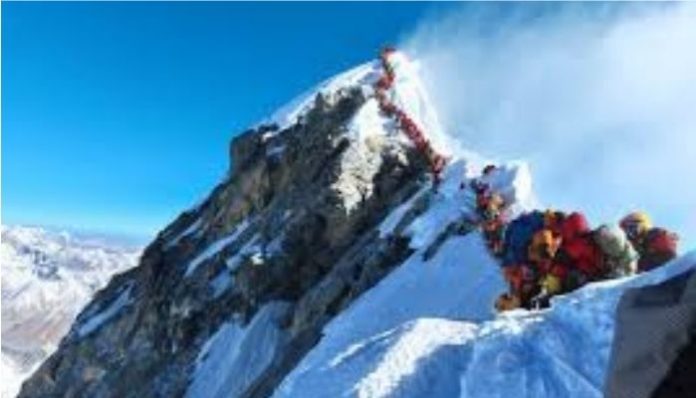
The Chinese government is mulling over a decision to set up a ‘line of separation’ on the peak of Mount Everest (also called Mount Qomolangma), reported China.org. The development comes days after Nepal confirmed that 17 mountaineers tested positive for the Coronavirus infection.
Mount Everest can be scaled from the northern side (via Tibet which is now occupied by China) or the Southern side (via Nepal). Reportedly, no case of Covid-19 has been reported from the northern side since the beginning of the climbing season in April this year. As per reports, the line of separation is a preventive measure to check the spread of Coronavirus infection from Nepal to China.
According to Nyima Tsering, Tibetan Sports Bureau head, China is set to take the step to prevent mountaineers from the Nepalese and the Chinese side from mixing once they reach the summit of Mount Everest. Such a ‘line of separation’ will be laid by guides, who scale the world’s highest mountain alongside the rope fixing teams.
17 mountaineers contract Coronavirus infection on the Nepalese side of Mount Everest
It will be placed at one of the camps at 8300 metres, which is the final camp before the climbers leave for the summit. Although China has stopped foreigners from scaling Everest from their side since 2020 due to the Covid pandemic, it has issued 21 expedition permits to Chinese nationals for the 2021 expedition. Earlier, reports emerged that several mountaineers, who were stationed at the Everest Base Camp in Nepal, had tested positive for the Wuhan Coronavirus.
They were taken to Kathmandu for testing and treatment of Coronavirus infection. While the Nepalese authorities have confirmed 17 cases of Coronavirus, other reports put the number of infected individuals to 30. Besides the line of separation, China Tibet Mountaineering Association will also put up a checkpoint at about 300 metres from the base camp. At the same time, daily disinfection is necessary at the canteens, washrooms, sleeping camps of climbers and protective gear such as gloves, masks and medical equipment.
Rising cases of Coronavirus in Nepal
A mountaineer, who develops coronavirus symptoms, will be taken to local media facilities for treatment. As of May 11, Nepal had reported 93,141 active cases and a total of 3859 fatalities. While speaking about the rising Coronavirus cases in the country, Meenakshi Ganguly cautioned, “Large volumes of oxygen equipment and other medical supplies are urgently needed to avert a Covid-19 catastrophe in the country.” She is the Director of Human Rights Watch in South Asia.


