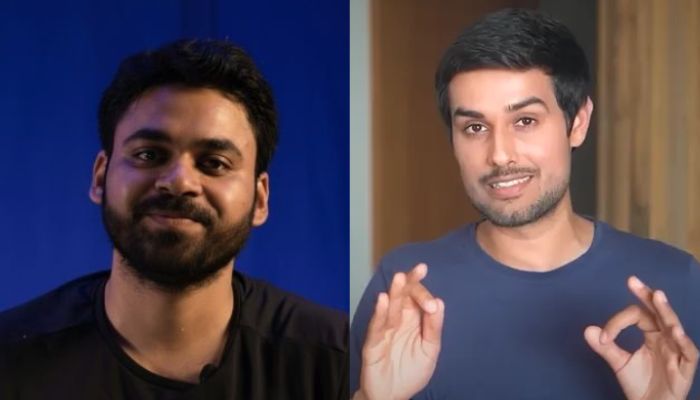
On 7th January, YouTuber Anubhav Gupta said in a social media post on X that he received a threat call asking him to remove his recent expose video targeting Dhruv Rathee and his AI based application, AI Fiesta. In his video, which was published on 22nd December, Gupta alleged that Rathee is involved in large scale data privacy violations, misleading marketing claims, and questionable business practices linked to the app. OpIndia spoke to Anubhav in detail about the threat call.
According to Gupta, the call came after the video began circulating widely on social media. He stated that the caller demanded that the video be taken down. Gupta cited the phone number from which he received the call, carrying a German country code, +49. While sharing the number on X, he asserted that the intent of the call was to intimidate him into removing the content, which he said is entirely based on publicly available policies and documents linked to the app.
In the post, he wrote, “Got a Threat Call to take down my video. Where, I explained how Dhruv Rathee is stealing your Data. I WONT TAKE IT DOWN GERMAN SHEPHERD.”
The statement was widely shared by his followers, with over 450 reposts and 2,000+ likes on X alone.
Speaking to OpIndia, Anubhav Gupta described the threat call in detail. He said the caller spoke in a Haryanvi accent and began the conversation by asking whether he wanted to “grow on YouTube”. When Gupta asked the caller to identify himself, the caller refused and instead issued threats.
Gupta said the caller warned that he had “people” who could physically assault him, record the act, and force him to upload the video on his own YouTube channel. According to Gupta, the caller also implied that since he already had Gupta’s phone number, obtaining his home address would not be difficult.
Gupta said the caller then referred specifically to his expose video, mentioning that it had received around 25,000 to 26,000 views. He alleged that the caller demanded the video be deleted immediately, warning that if it went viral, the consequences would escalate. Gupta said the call ended abruptly after the threat was delivered. He clarified that while the words he shared publicly were not a verbatim transcript, they accurately reflected the meaning of what was said, as he understands Haryanvi but does not speak it fluently.
When OpIndia asked Gupta whether the caller identified himself or indicated any affiliation, Gupta said the caller referred to Dhruv Rathee as “hamare Rathee bhai”, which he interpreted as a signal of alignment, though no formal identity was disclosed.
Gupta told OpIndia that while he does not have an audio recording of the call, he has preserved a screenshot of the call log showing the international number from which the call was received. He said he is willing to share this material to establish the timing and source of the call.
On the question of legal action, Gupta remarked that police action should ideally be taken against individuals who attempt to silence critics through intimidation. However, he said that after consulting a lawyer, he was advised that little could be done at this stage since the call originated from an international number.
Asked about his message to other creators and journalists who face similar pressure, Gupta said such threats should not be feared. He described those making such calls as online ‘gundas’ who rely on intimidation and are incapable of doing anything in real life.
Responding to a question on whether he had any message for Dhruv Rathee, Gupta said Rathee should clearly explain for what purpose AI Fiesta is storing public data, especially in light of the privacy concerns raised in the expose video.
What Anubhav Gupta has exposed about AI Fiesta
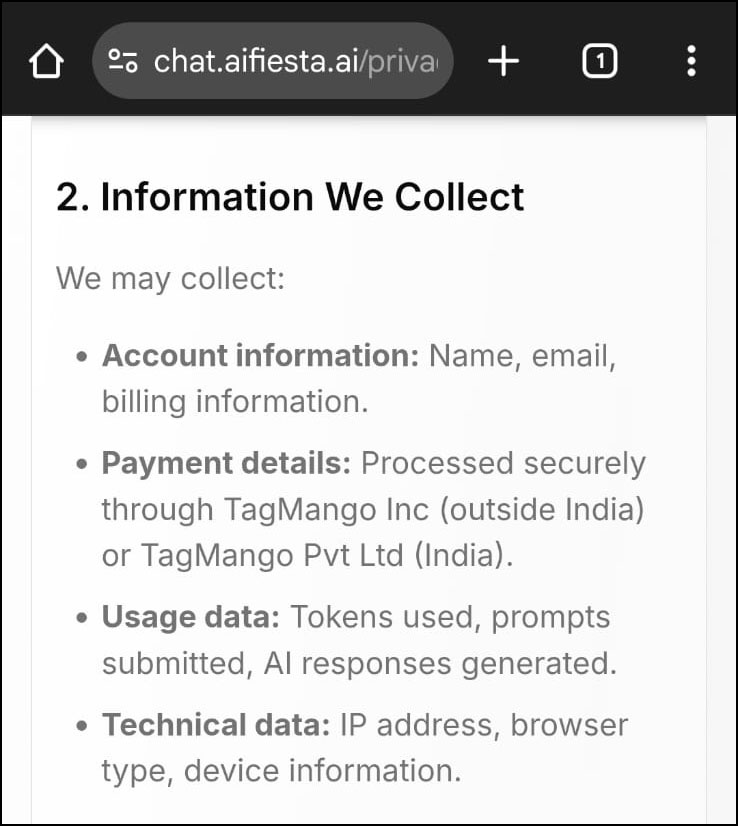
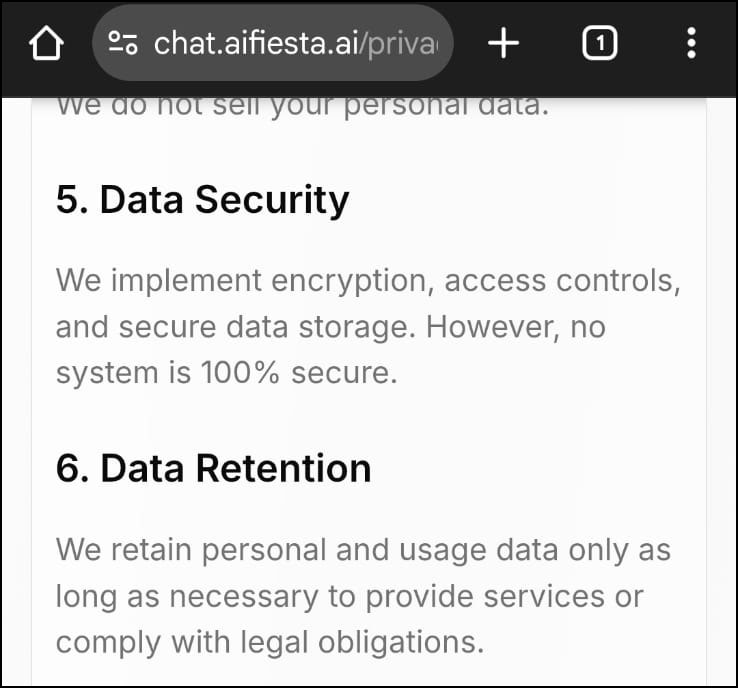
In his 22nd December video, Gupta said that AI Fiesta stores user prompts as well as AI generated responses. He stated that this practice could potentially include deeply personal, political, and sensitive information entered by the users. Notably, it is a general practice for users not to read the privacy policy, terms and conditions, and other documentation of the websites and apps they use. They usually agree to them and move on without realising the consequences.
Gupta said that this data retention is explicitly mentioned in the privacy policy statement of the app and raises serious questions about user safety and informed consent. OpIndia checked and confirmed that the AI Fiesta privacy policy says exactly what Gupta has alleged in his video.
Source: AI Fiesta
Gupta further stated that the app collects IP addresses and broadly worded “device information”, a term he argues is deliberately vague and capable of enabling extensive behavioural and geographical tracking of users. He pointed out that such data, if compromised, could expose users to phishing, profiling, or targeted manipulation.
Allegations of misleading hype and fake credibility
Another major allegation raised by Gupta in the video concerns AI Fiesta’s marketing claims. Gupta said that the app promoted a “3 million ARR in 36 hours” figure to manufacture hype and create the impression of massive commercial success. He argued that the claim is misleading and designed to attract paying users in a market where several AI tools are already available free of cost.
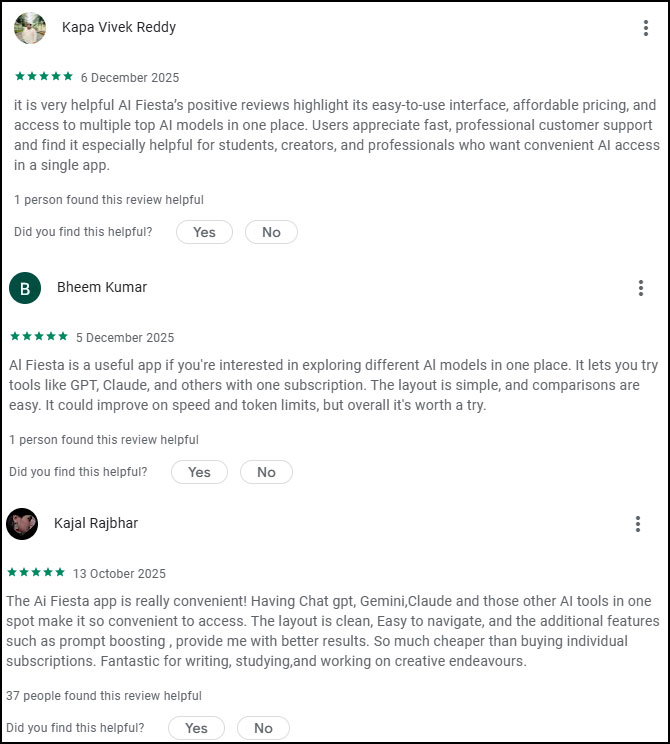
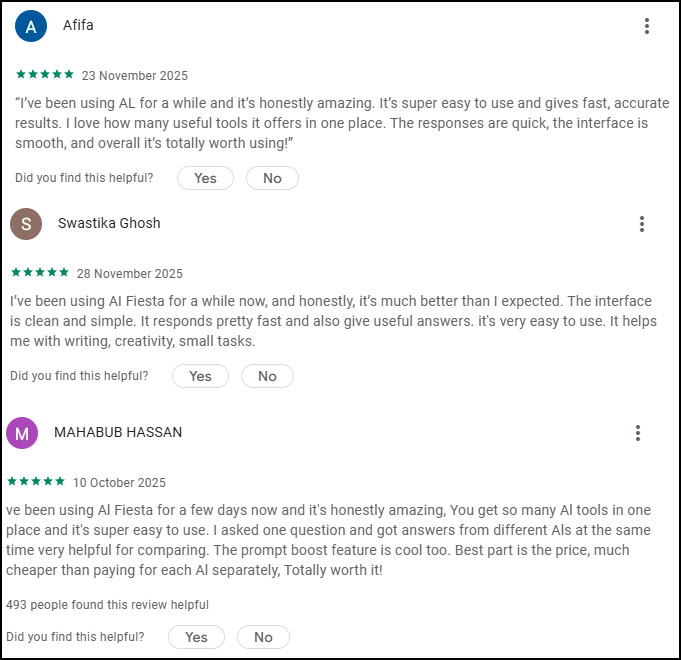
He also stated that AI Fiesta relied on bot generated or purchased reviews on the Google Play Store. He pointed to repeated phrases, identical sentence structures, and common keywords across multiple 5-star reviews as indicators of inauthentic feedback. He said such feedback is bought to mislead potential customers.
Source: Google Play Store
OpIndia crosschecked the claims laid by Gupta and found them to be true, as suggested in the screenshots added here. Both screenshot sets have three 5-star reviews with similar language used.
Source: Google Play Store
Privacy advocate versus data collector
At the centre of the expose was what Gupta described as the hypocrisy of Dhruv Rathee. Gupta pointed out that Rathee has built a public persona around warning people about data misuse, surveillance, and privacy violations. However, his app AI Fiesta’s own policies allow storage of user data, collection of IP addresses, and broad device level information.
Source: AI Fiesta
He further alleged that the app’s terms include disclaimers stating that no system is fully secure, which he argues effectively shields the company from responsibility in the case of a data breach.
Questions over accountability and jurisdiction
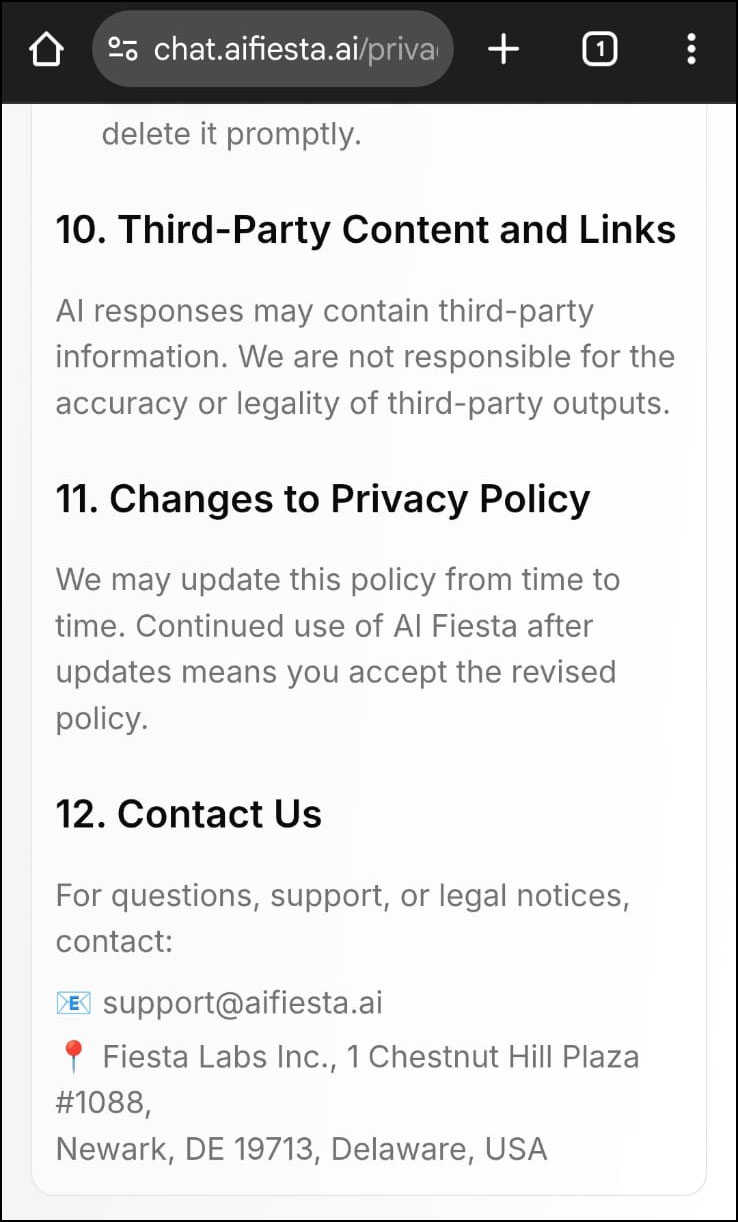
Gupta also raised concerns about the app’s corporate structure. He stated that AI Fiesta is registered in Delaware in the United States and argued that branding it as “the country’s biggest AI platform” is misleading when its registration, data infrastructure, and leadership are not based in India.
Source: Ai Fiesta
This is not the first time Dhruv Rathee has been accused of intimidating someone for exposing him. In September 2023, YouTuber Karolina Goswami and her husband had accused Rathee’s “supporters” of attacking them in Europe for fact-checking him.
Anubhav Gupta responded to our questions and this report has been updated accordingly.
In the United Kingdom, a massive row has erupted over the new Islamophobia definition that the Labour government is set to propose. The leaders of the British Hindu and Sikh communities have raised concerns that the new definition of what it calls “anti-Muslim hatred” will have a “significant chilling effect” on freedom of speech.
The proposed Islamophobia definition that has sparked debate in the UK
In December 2025, the BBC reported on the draft definition of anti-Muslim hatred or ‘Islamophobia’. The BBC reported that the Working Group on Anti-Muslim Hatred/Islamophobia has submitted its draft for adoption. While the draft excluded the term ‘Islamophobia’, the definition itself came under fire for leaving a window for its weaponisation.
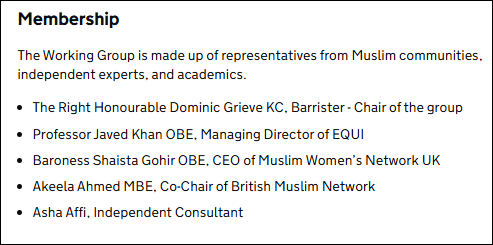
The Working Group formed in February 2025 submitted its draft in October. The Group is chaired by Dominic Grieve KC, Professor Javed Khan, Baroness Shaista Gohir, Akeela Ahmed, and Asha Affi.
In a statement issued on 15th December 2025, Shaista Gohir confirmed that the new Islamophobia definition BBC reported is the same as the one submitted by the Working Group to the government in October. Gohir also urged the Labour government to adopt the definition “if it cares about the safety of Muslims.”
My statement on the Islamophobia definition which is not called Islamophobia – I urge the govt to adopt it if it cares about the safety of Muslims. pic.twitter.com/0AeiWQjrun
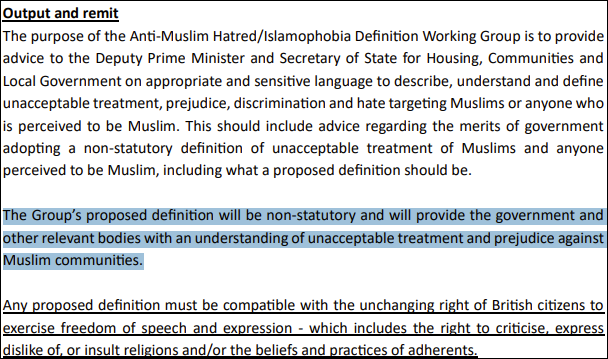
The Group states that the definition will be non-statutory, meaning that it will not be legally binding but will provide guidance to government and other bodies about what actions constitute Islamophobia or anti-Muslim hatred.
The draft definition reads, “Anti-Muslim hostility is engaging in or encouraging criminal acts, including acts of violence, vandalism of property, and harassment and intimidation, whether physical, verbal, written or electronically communicated, which is directed at Muslims or those perceived to be Muslims because of their religion, ethnicity or appearance.”
It adds, “It is also the prejudicial stereotyping and racialisation of Muslims, as part of a collective group with set characteristics, to stir up hatred against them, irrespective of their actual opinions, beliefs or actions as individuals.”
“It is engaging in prohibited discrimination where the relevant conduct – including the creation or use of practices and biases within institutions – is intended to disadvantage Muslims in public and economic life,” the definition further includes.
Hindu Council UK calls out the many problematic aspects of the new Islamophobia definition
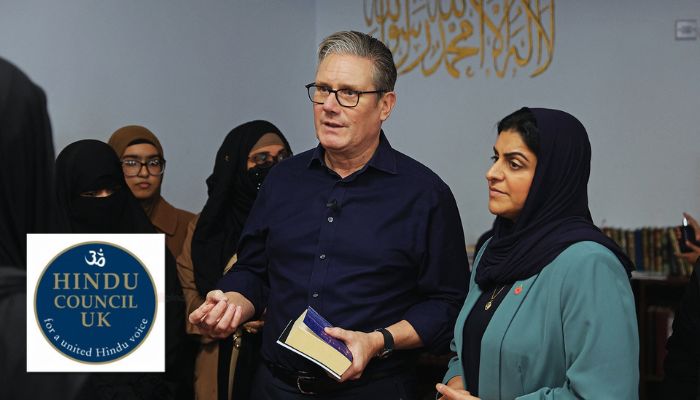
On 29th December, the Hindu Council UK wrote a letter to Communities Secretary Steve Reed, cautioning that the draft definition of Islamophobia is deeply flawed and will have serious consequences if it ends up being adopted officially.
In the letter signed by Dipen Rajyaguru, Director of Equality and Inclusion, the Hindu Council UK said, “…having carefully reviewed the proposed definition, and drawing on concerns raised by our community Hindu Council UK, other organisations and commentators as well as extensive criticism of the earlier APPG definition of Islamophobia we believe the current proposal is deeply flawed and risks serious unintended consequences.”
In a pointwise fashion, the Council detailed why it believes the draft Islamophobia definition is problematic. Under the first point, “Lack of Clarity and Overly Broad Language”, the Hindu Council said that the new definition introduces vague and undefined concepts like “prejudicial stereotyping”, racialisation of Muslims”, “collective group with set characteristics”, “stir up hatred”, “practices and biases within institutions”.
Asserting that these terms lack clear legal meaning, the Council said, “From a Hindu perspective, this ambiguity is dangerous. It leaves interpretation open to subjective perception rather than objective legal standards, making the definition vulnerable to inconsistent application and politicisation.”
Under the second point, “Conflation of People with Beliefs and Ideas,” the Hindu Council stresses a concern shared by not only Hindu but Sikh, Christian, secular, and free-speech organisations that the new definition “fails to clearly distinguish between hostility towards Muslims as people and criticism of Islam as a belief system.”
The Council pointed out that by referring to “racialisation” and “collective characteristics”, the definition “risks treating a religion and its associated ideas, doctrines, and practices as if they were immune from critique.”
The Council said that Hindu intellectuals often indulge in discussions of theological differences between dharmic traditions and Islam, historical events involving Islamic rule in South Asia, contemporary issues such as extremism, apostasy laws, or treatment of minorities and Women in Muslim-majority societies like Bangladesh.
However, the proposed definition, the Hindu Council asserted, risks such discussions getting characterised as “prejudicial stereotyping” or “stirring up hatred”, regardless of factual basis or intent.
Under the third point, the Council raised concern that the new Islamophobia definition could result in infringement of freedom of expression.
The Council expressed apprehension that, despite claiming that the definition targets hostility rather than debate, “its breadth creates a significant chilling effect on free speech.”
“For minority communities such as Hindus and other Dharmic Traditions, this presents a serious risk. Narratives about historical persecution under Islamic empires, or discussion of contemporary Islamist ideology, could be suppressed out of fear of breaching a poorly defined standard of “anti-Muslim hostility.”
Another important concern raised by the Hindu Council is the de facto reintroduction of blasphemy laws. The Council stated that the new definition risks “operating as a de facto blasphemy framework, even if this is not the Government’s intention.”
The Council said that the introduction of terms like “racialisation” and “collective stereotyping” in the new Islamophobia definition risks shielding Islamic beliefs and practices from scrutiny, “in practice, if not in law.”
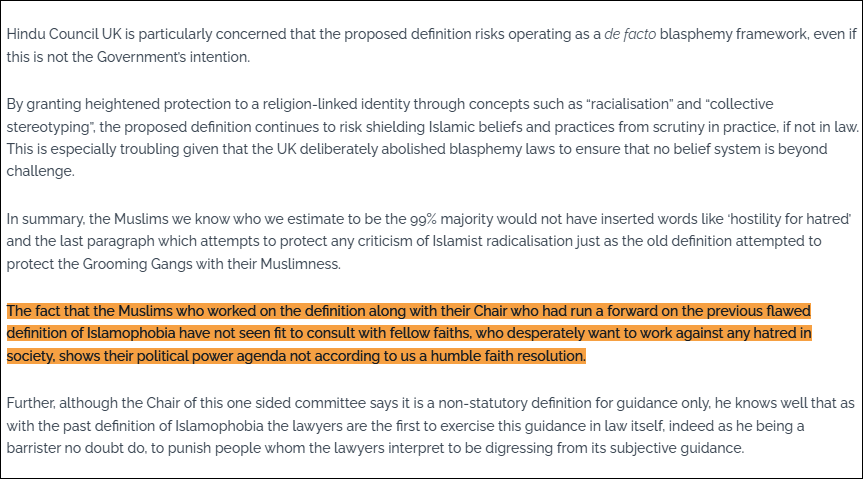
“In summary, the Muslims we know who we estimate to be the 99% majority would not have inserted words like ‘hostility for hatred’ and the last paragraph, which attempts to protect any criticism of Islamist radicalisation, just as the old definition attempted to protect the Grooming Gangs with their Muslimness,” the Hindu Council stated.
Furthermore, the Hindu Council UK stated the new definition could result in the weaponisation of complaints, institutional overreach, two-tier protection of religions, and the embedding of the initially “non-statutory” wording into public policies eventually.
Excerpt from the Hindu Council UK’s letter.
Labour Party’s adoption of an outrageously biased ‘Islamophobia’ definition
This is not the first time that the Labour Party has resorted to blatant Muslim appeasement. While the Keir Starmer-led Labour government is now proceeding towards adopting an anti-Muslim hatred definition, years back, the Labour Party adopted a document that ‘broadened’ the definition of Islamophobia.
In 2019, the Labour Party adopted the All-Party Parliamentary Group on British Muslims (APPG) definition of Islamophobia. Back in 2018, the All-Party Parliamentary Group on British Muslims proposed that there should be a ‘legally binding’ definition of Islamophobia. While there already are laws covering religion-based hate crimes and discrimination, the definition sought to expand the scope of what was deemed criminal under the existing legal framework, particularly in the context of criticism directed towards Muslims.
Excerpt from Labour Party’s Islamophobia policy (Source: labour.org.uk)
“Islamophobia is rooted in racism and is a type of racism that targets expressions of Muslimness or perceived Muslimness,” the definition proposed by the APPG on British Muslims, co-chaired by Anna Soubry and Wes Streeting, reads.
In their Foreword to the APPG report, Wes Streeting and Anna Soubry advocated for the definition of Islamophobia to be adopted by the government, statutory agencies, and civil society organisations. This would allow them to challenge Islamophobia through various channels such as politics, policymaking, media, society, and education.
The APPG’s reasoning behind expanding the scope of Islamophobia was highly outrageous and was steeped in pro-Muslim bias. The APPG asserted that criticising Islam amounts to anti-Muslim racism. It said that terms like ‘Asian grooming gangs’ or ‘Bin Laden’ (notice the inverted commas used by the APPG) are a modern-day iteration of “anti-Islam tropes”
Terms like “racialisation” found in the new draft definition of Islamophobia can be traced to the 2018 report of the APPG on Muslims.
“From the numerous victim forms we were able to collect, we found several themes that served to reinforce the evidence presented to us by academic experts and community activists. We found that the racialisation of Muslims has palpable consequences, with both Asian, Black and white convert Muslims being targeted for abuse on grounds of their Muslimness. We also found that age-old stereotypes and tropes about Islam, such as sexual profligacy and paedophilia or Islam and violence, and their modern-day iteration in the ‘Asian grooming gangs’ or ‘Bin Laden’ labels re-emerge in discourses and dispositions which heighten vulnerability of Muslims to hate crimes,” the propaganda report by APPG on British Muslims read.
The APPG, in its desperation to make Muslims and Islam sacrosanct to criticism of any form, deemed even accusing Muslims of exaggerating or inventing Islamophobia, genocide of Muslims, as an example of Islamophobia. In simple words, even Muslims play false victimhood, which they do in most cases, if not all, exaggerating isolated incidents of criticism or violence against a Muslim person or group as a targeted attack on the entire community. Others cannot call them out because if they do, they will be declared ‘Islamophobic’ and may face legal consequences.
.Interestingly, the APPG on British Muslims also asserted that “denying Muslim populations the right to self -determination e.g., by claiming that the existence of an independent Palestine or Kashmir is a terrorist endeavour,” would also be Islamophobic.
The APPG on Muslims did not attempt to accommodate Islamic sentiments or protect the community against unwarranted criticism; rather, the UK’s parliamentary body ceded freedom of expression and common sense to legalise the weaponisation of Islamophobia.
Since the Labour Party adopted this deeply flawed definition of Islamophobia, the Labour government later also attempted to formally adopt this definition. In August 2024, it was reported that the Labour government was considering adopting the APPG for British Muslims’ definition of Islamophobia.
The new draft Islamophobia definition proposed by the Working Group on Anti-Muslim Hatred/Islamophobia Definition is evidently the old APPG product in a new packaging.
This is alarming. It must not be forgotten how the Labour government tried to suppress criticism of Pakistani-Muslim grooming gangs. It was seen how the fears of appearing Islamophobic and racially insensitive prevented UK authorities from effectively acting against Pakistani Muslim groomers/rapists for years, and now the Labour Party, which has adopted the flawed Islamophobia definition, is dismissing those criticising Muslim grooming gangs as “far-right” in an apparent attempt to make the Muslim community sacrosanct to criticism.
Prime Minister Keir Starmer earlier rejected a national inquiry into the Pakistani-Muslim grooming gangs, apparently, inspired by the Islamophobia definition his party adopted, to avoid coming across as an Islamophobe.
OpIndia reported earlier how, in many cases involving Pakistani-Muslim grooming/rape gangs, instead of arresting the rapists, the police ended up arresting the victims and their families. This was commonly due to a failure to probe the grooming part, in most cases a deliberate cover-up to avoid appearing Islamophobic, culturally insensitive and racially prejudiced, with young victims being treated as offenders for small violations while still in contact with their abusers.
For years, the fear of being labelled Islamophobic or indulging in ‘racial profiling’ prevented the police from taking decisive action against Muslim rape gangs in the UK. The Labour Party’s political perversion further worsened the situation.
It must be recalled how Sarah Champion, a Labour Party MP, had to apologise for an article published in The Sun in 2017 wherein she wrote that “Britain has a problem with British Pakistani men raping and exploiting white girls”.
In 2012, Keith Vaz, a Labour Party leader and Chair of the Home Affairs Select Committee, downplayed the grooming jihad crimes, calling them not racially motivated and emphasising that the entire community should not be ‘stigmatised’. His overemphasis on not singling out the identity of the grooming gang members reflected the Labour Party’s appeasement politics and downplayed the crimes of the grooming gangs involving men of Pakistani origin.
In 2011, former Home Secretary Jack Straw attributed the cultural practices of Pakistani men to their crimes against white girls. He said that Pakistani men see white girls as “easy meat.”
A Nottingham Crown Court judge who convicted two Pakistani men who groomed and raped several minor white girls downplayed the identity of the perpetrators by asserting that the race of both the victims and the abusers was ‘coincidental’.
The collective failure of the British governments and law enforcement authorities in bringing Muslim grooming/rape gangs, which targeted thousands of non-Muslim minor and adult girls for over two decades, stems from the idea of avoiding being ‘Islamophobic’. It must also not be forgotten that even the British media, for a long period of time, refrained from calling the Muslim rape gangs what they are, but chose the broader and rather vague term, “South Asian grooming gangs.” Such terminology is fundamentally flawed and dishonest, as grooming Jihad or rape jihad is not a racial crime committed by South Asians against other races but an Islamist crime against non-Muslims.
Islamophobia is used as an excuse to suppress dissent, and legitimising it is suicidal
Islamist takeover of the UK is ongoing in full swing, through demographic shifts and other means. Yes, instead of cracking down on Islamists, Labour is coddling them and legitimising the ‘Islamophobia’ shield Islamists use to silence the victims of Islamic terrorism and extremism of other forms, gaslight critical voices, and weaponise it against other religious groups, allowing Islamists to assert religious dominance.
It must not be forgotten how the 2022 anti-Hindu Leicester violence carried out by Muslim mobs was dubbed a ‘Hindutva’ inspired riot. And, how deliberately floated and amplified rumours of Hindus attacking Muslims and doing blasphemy against Islam triggered Muslims to attack Hindus. The government adopting any definition of Islamophobia which enables Muslims to arbitrarily accuse members of other religious communities of Islamophobia, would expose the latter to threats, stigma and villainisation.
If a formal definition that essentially makes Muslims and Islam sacrosanct from criticism, and leaves a window for Muslims to bring up false Islamophobia complaints against non-Muslims, then, despite its non-binding nature, the definition will influence policies in such a manner that non-Muslim communities will be relegated to the status of second-class citizens in the UK.
The Jama Masjid of Bharuch city has once again landed in controversy. Two days ago, saints from the Akhil Bharatiya Sant Samiti staged a protest, alleging that despite the mosque being protected by the Archaeological Survey of India (ASI), illegal construction had been carried out there in violation of archaeological regulations. Eventually, the police administration intervened and sought two months, assuring action. Trusting the police, the saints called off their protest. The matter now rests with the police.
While more details about the protest and the saints’ demands are available separately, this episode has revived an old debate: was the Jama Masjid in Bharuch built after demolishing a temple? Did Hindu-Jain temples exist there in the past? What does history say, and what do contemporary records and books written at the time reveal?
One of the most recent references appears in the book “Hindu Temples: What Happened to Them,” authored by Sitaram Goel. Although the book primarily focuses on the Ram Janmabhoomi dispute, it also contains a separate section listing places across India where temples were demolished, and mosques or other religious structures were built in their place. These lists are organised state-wise and district-wise.
In the Gujarat section, when one looks at Bharuch, the very first entry is the Jama Masjid. It notes that the mosque was constructed in 1321 and that materials from Hindu-Jain temples were used in its construction.
The second volume of “Hindu Temples: What Happened to Them”, titled “The Islamic Evidence”, also mentions this mosque. Citing Mughal-era documents, it states that pillars from Hindu-Jain temples were used in the Jama Masjid of Bharuch.
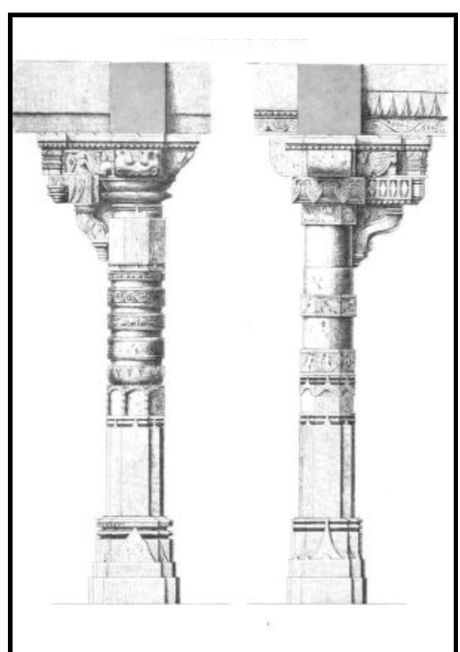
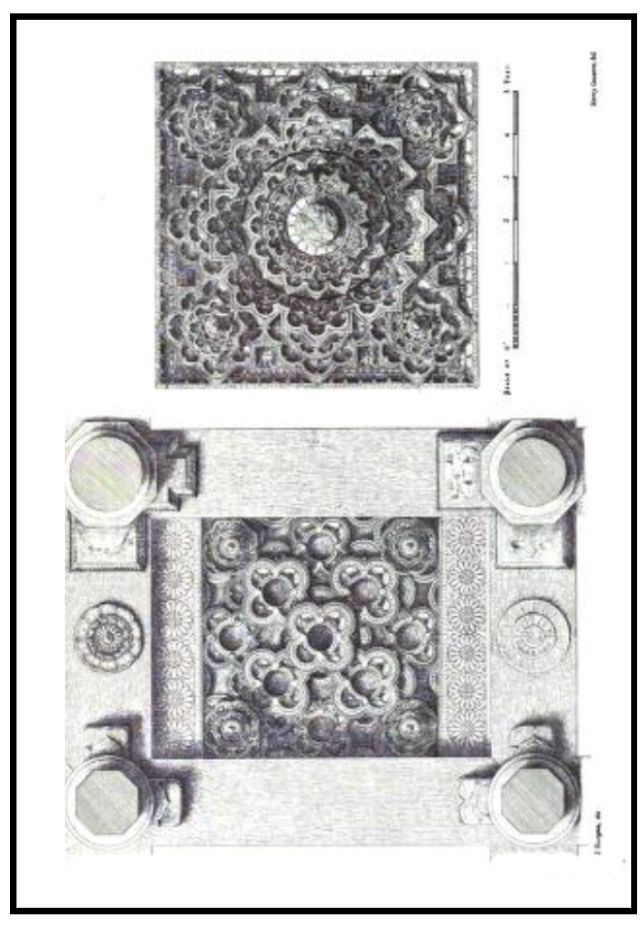
Courtesy: Burgess’ book
Several historical records agree that the Bharuch Jama Masjid was built during the reign of Alauddin Khilji. Khilji was an invader who attacked Hindu religious sites in India and destroyed numerous temples, including Somnath.
Amir Khusrau writes that around 1300, Khilji targeted temples in Gujarat and sent Ulugh Khan for this purpose. Ulugh Khan first reached Somnath, where the temple was demolished and plundered, and then proceeded towards Khambhat. From there, he looted and destroyed temples in several coastal cities, Bharuch being one of them.
British archaeologist James Burgess, born in the UK in 1832, conducted extensive archaeological work in India. He served as the Director General of the Archaeological Survey of India from 1886 to 1889 and earlier as Director of the Archaeological Survey, Western India. He documented what he observed during his travels across western India, later publishing several books.
In his work “On the Muhammadan Architecture of Bharoch (Bharuch), Cambay, Dholka, Champaner and Mahmudabad in Gujarat”, Burgess mentions the Bharuch Jama Masjid. While describing the site, he writes that invasions began in Bharuch around 1297 on Khilji’s orders. During these attacks, Hindu temples were targeted and demolished, and, as seen elsewhere, materials from destroyed Hindu and Jain temples were used to construct the Jama Masjid.
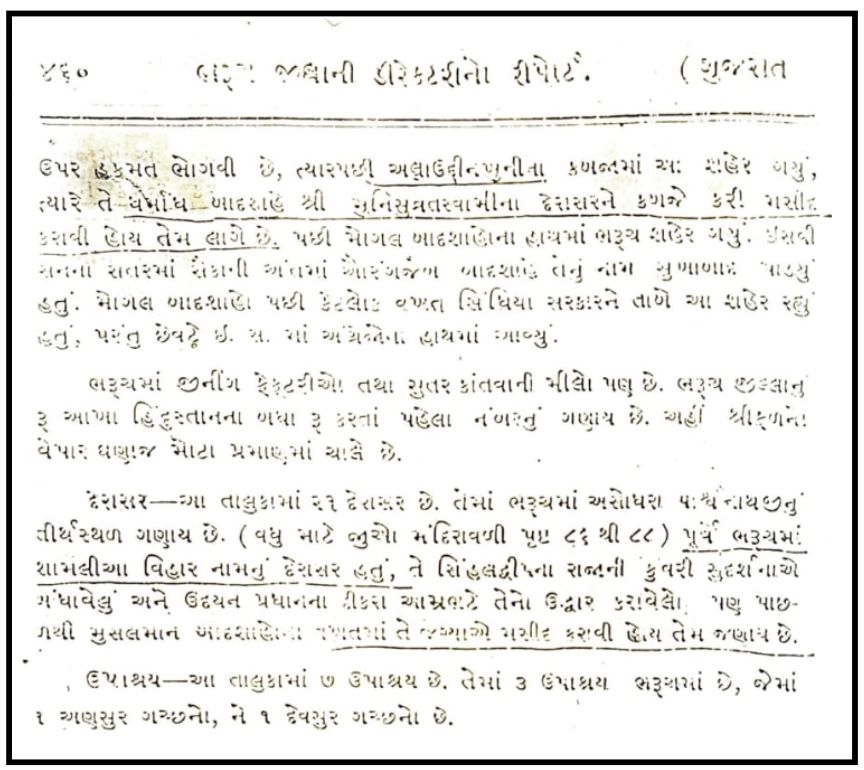
Courtesy: Burgess’ book
Burgess provides detailed plans and photographs of the mosque, offering further clarity. He notes that the spacing between the pillars is uneven, 8 feet in some places, 10 feet in others, and even 13 feet elsewhere, resulting in irregularities in the domes above. According to Burgess, this inconsistency exists because materials from Hindu temples were reused in construction. Parts of the roof were taken from smaller domes of older Jain and Hindu temples, and some pillars feature animal carvings, indicating their temple origin.
Burgess also points out that the mihrab (a semicircular niche in the wall) at the rear of the mosque is unlike typical mosques found in Gujarat, and its three mihrabs differ somewhat in architectural style. Regarding the courtyard, he writes that the marble gateway at its entrance is clearly from a Jain temple, with Jain figures still visible, though many have been defaced.
A document titled “Bharuch District Directory Report” records that the ancient city was attacked during the Khilji’s time, and a Jain derasara (temple) was seized and converted into a mosque. The same report mentions another Jain shrine called Shamaliya Vihar, which was also later demolished and turned into a mosque under Muslim rule.
The official website of the Bharuch District Collector likewise notes that the Jama Masjid was built using remnants of ancient Jain temples, largely from temple materials. It explicitly states that stones were taken from temples and that Hindu temple markers are visible in the mihrab.
Importantly, there are no contradictions across these documents; all accounts corroborate one another. Even official government records affirm these details.
References: – History of India as Told by Its Own Historians, H. M. Elliot – Hindu Temples: What Happened to Them, Volumes 1–2, Sitaram Goel – On the Muhammadan Architecture of Bharoch (Bharuch), Cambay, Dholka, Champaner and Mahmudabad in Gujarat, James Burgess
The United States of America, notorious for overthrowing governments, infringing upon the sovereignty of other nations and invading foreign lands to further national or strategic interests, commenced its journey by committing these very actions, as it eventually grew from 13 colonies to 50 states.
The Western power ruthlessly wielded its economic and military superiority in the name of “manifest destiny” to either push other countries into agreements or engage in warfare, while persistently expanding its landmass and global influence. Furthermore, this cold approach has been witnessed time and again, remarkably even to this day, from the Middle East to Venezuela and even Greenland.
The US buys Alaska for 2 cents per acre from Russia
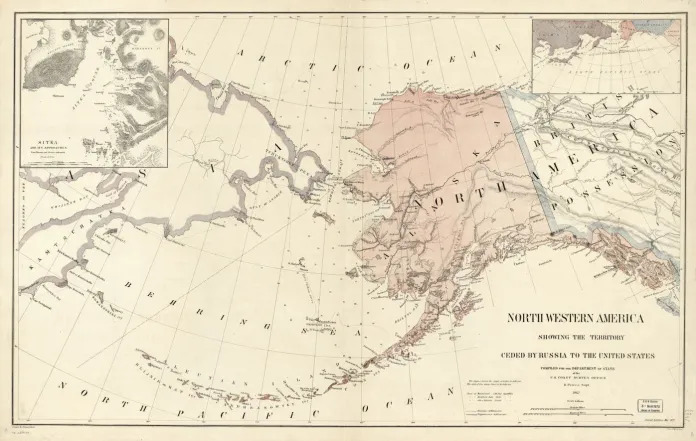
Alaska, with a GDP of more than $55 billion, is presently the 49th state in the United States. However, it was once part of the Russian Empire, which was handed over in a deal known as the “Cessation of Alaska” or the “Alaska Purchase,” to the US. On 30th March 1867, the latter agreed to pay just $7.2 million or nearly two cents per acre for the 1,518,800 square kilometres of territory.
A map showing the area that Russia gave up to the United States. (Source: File Photo)
Russian Tsar Alexander II wanted to sell Alaska because he believed that it would be difficult to protect the land in the case of a war with his country’s main adversary, the United Kingdom of Great Britain and Ireland. The Ottoman Empire’s setback served as the foundation for the decision. Russia chose to give up its area after losing over 12,000 soldiers and running out of resources.
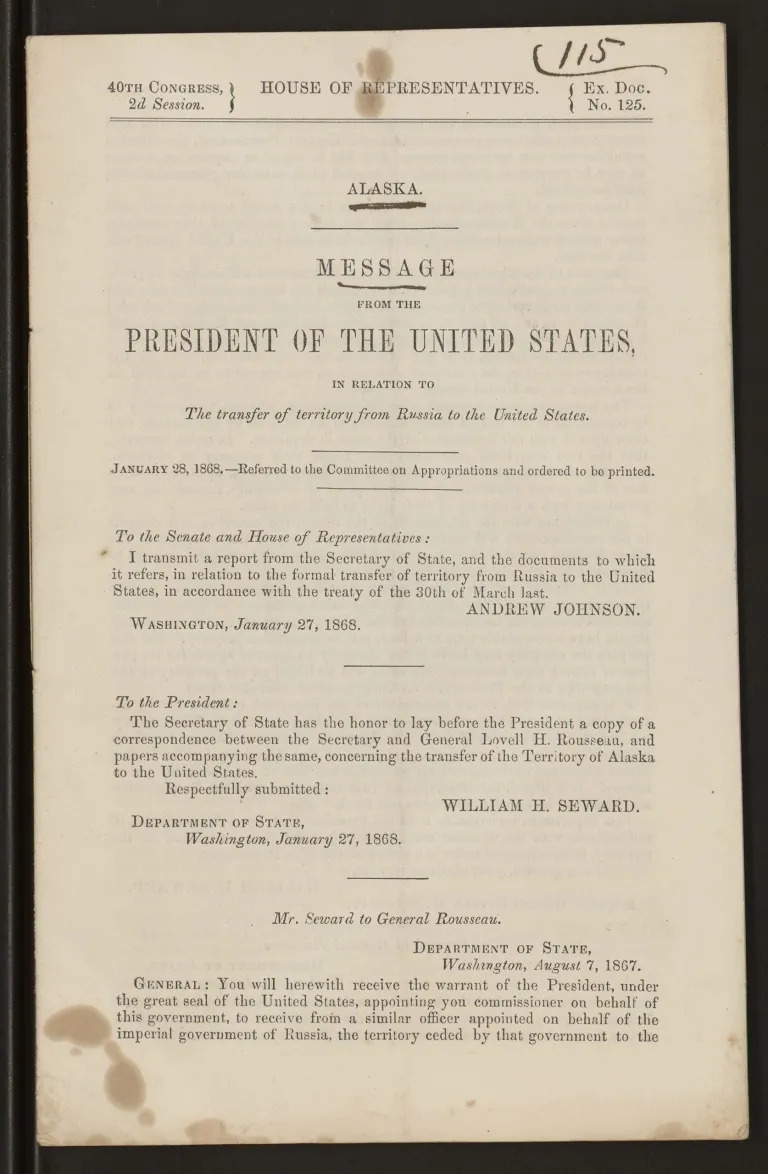
The presentation to the House of Representatives. (Source: File Photo)
Interestingly, Russia and the US were on the same side at the time due to their shared dislike of the British Empire. Therefore, the move was made in spite of advice not to proceed further. US Secretary of State William Seward and Russian Minister Eduard de Stoeckl discussed the deal following the conclusion of the American Civil War. Afterwards, the US Senate approved the treaty on 9th April, 1867, and President Andrew Johnson signed the same in May.
Louisiana joins the U.S
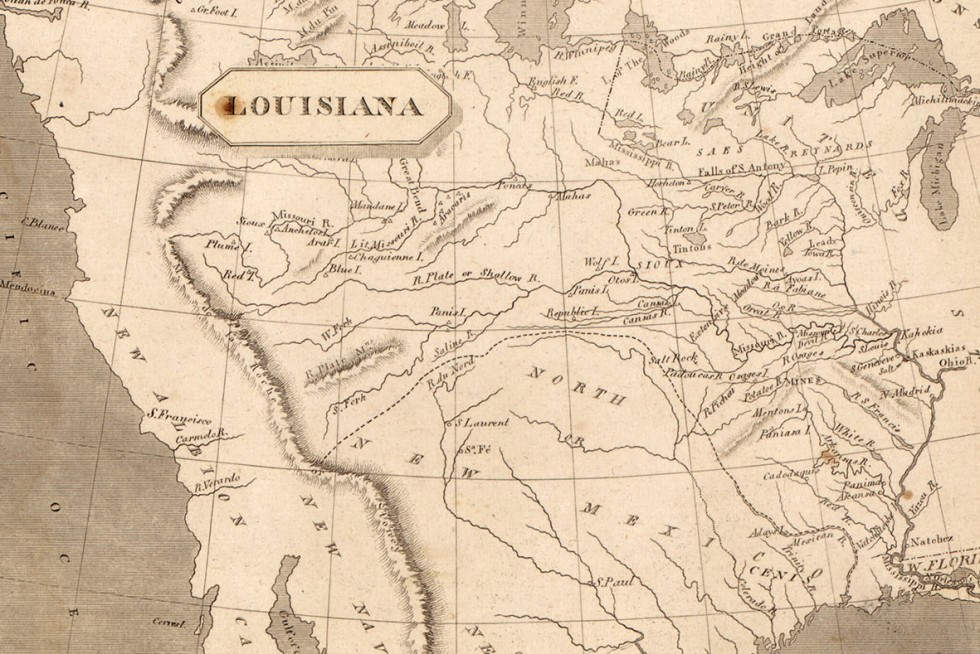
In 1803, the United States made a similar land agreement known as the “Louisiana Purchase,” in which $15 million was paid to France for around 827,000 square miles of territory west of the Mississippi River. The sale not only added extensively to the size of the young country but also set it on a path of westward expansion across the continent. It also prevented further occupation of North Americbyof Spain and France.
Louisiana’s map by Aaron Arrowsmith (Source: monticello.org)
The region close to New Orleans was already desired by the United States. The main goal was to protect its ability to sail ships through Spanish territory down the Mississippi River and unload cargo at New Orleans for transportation to Europe and the Atlantic coast. Additionally, Louisiana’s strategic location at the mouth of the pivotal river and the presence of a large number of American immigrants and traders there made the US interested in owning the entire state.
After learning that Louisiana had been transferred from Spain to France, the United States dispatched its diplomat Robert Livingston to France in 1801 in an attempt to acquire New Orleans. Afterwards, President Thomas Jefferson sent James Monroe, one of the founding fathers, to negotiate a contract when Napoleon Bonaparte first rejected the proposal.
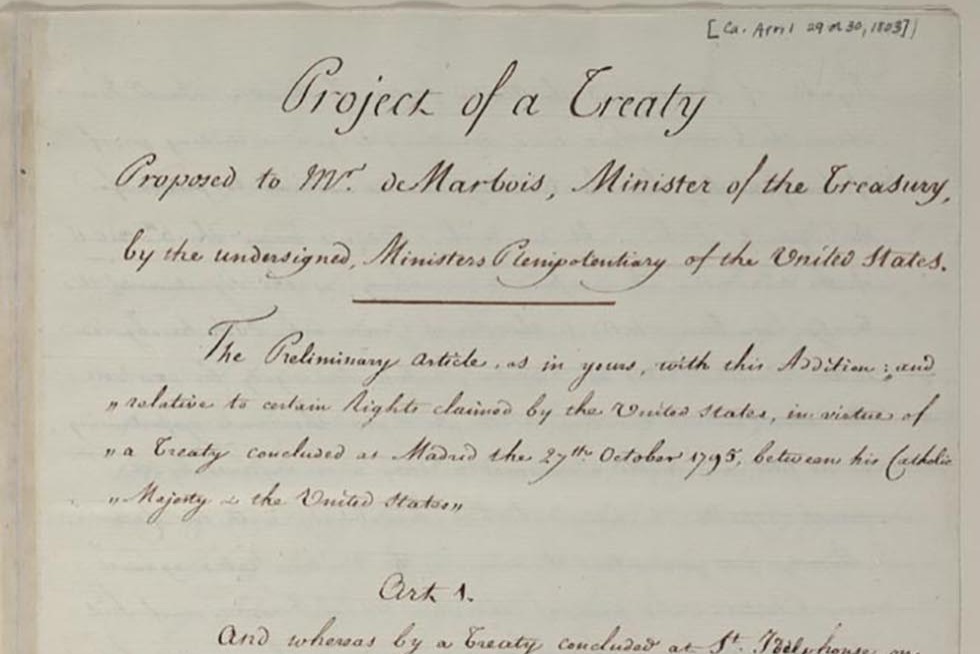
The Louisiana Purchase Treaty (Source: monticello.org)
However, he then offered not only New Orleans but all of Louisiana to the US in April 1803 in light of the financial problems and military setbacks. The change of heart happened a few days before Monroe was scheduled to arrive in Paris. The Marquis de Barbe-Marbois, minister of finance, mediated the conditions of the “Louisiana Purchase” with Livingston and Monroe. As a result, $11,250,000 was given by the US in exchnage Louisiana and $3,750,000 to settle claims of its own citizens against France.
Texas separates from Mexico and enters the US.
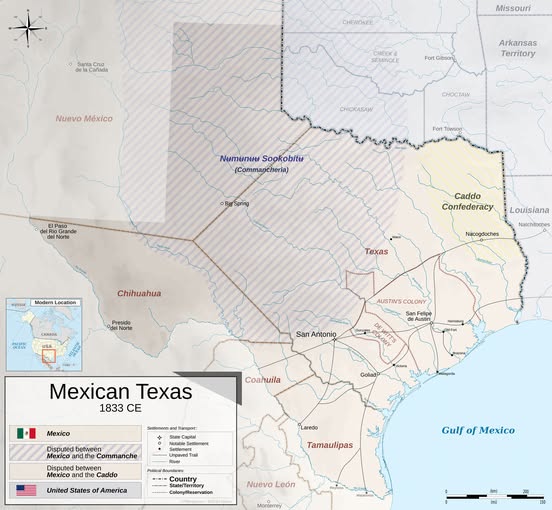
Texas was originally part of Mexico,o where a substantial population of Americans led by Stephen F. Austin moved close to the Brazos River. It was after Mexico invited foreigners to the barely inhabited area following its independence from Spain in the 1820s. However, the decision proved to be fatal, as it concluded in the separation of the entire region and its addition to the United States.
Image via Historical Maps/Facebook
The Mexican government’s attempts to govern over these semi-autonomous American enclaves by the 1830s sparked insurrection since the outsiders soon outnumbered the locals. As a result, Texas proclaimed its independence from Mexico in March 1836 during an armed confrontation with the government.
Sam Houston was elected president by the people of the Republic of Texas, who supported his region’s admission to the US for the sake of political and economic benefits. Therefore, it became the 28th state in the US on 28th December 1845. The action sparked the Mexican-American War and widened the irreconcilable divisions in the US on the subject of slavery. Texas had legalised slavery and broke away 15 years later to become the Confederate States of America before rejoining the union after civil war.
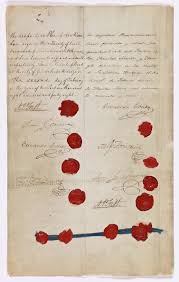
The Treaty of Guadalupe-Hidalgo
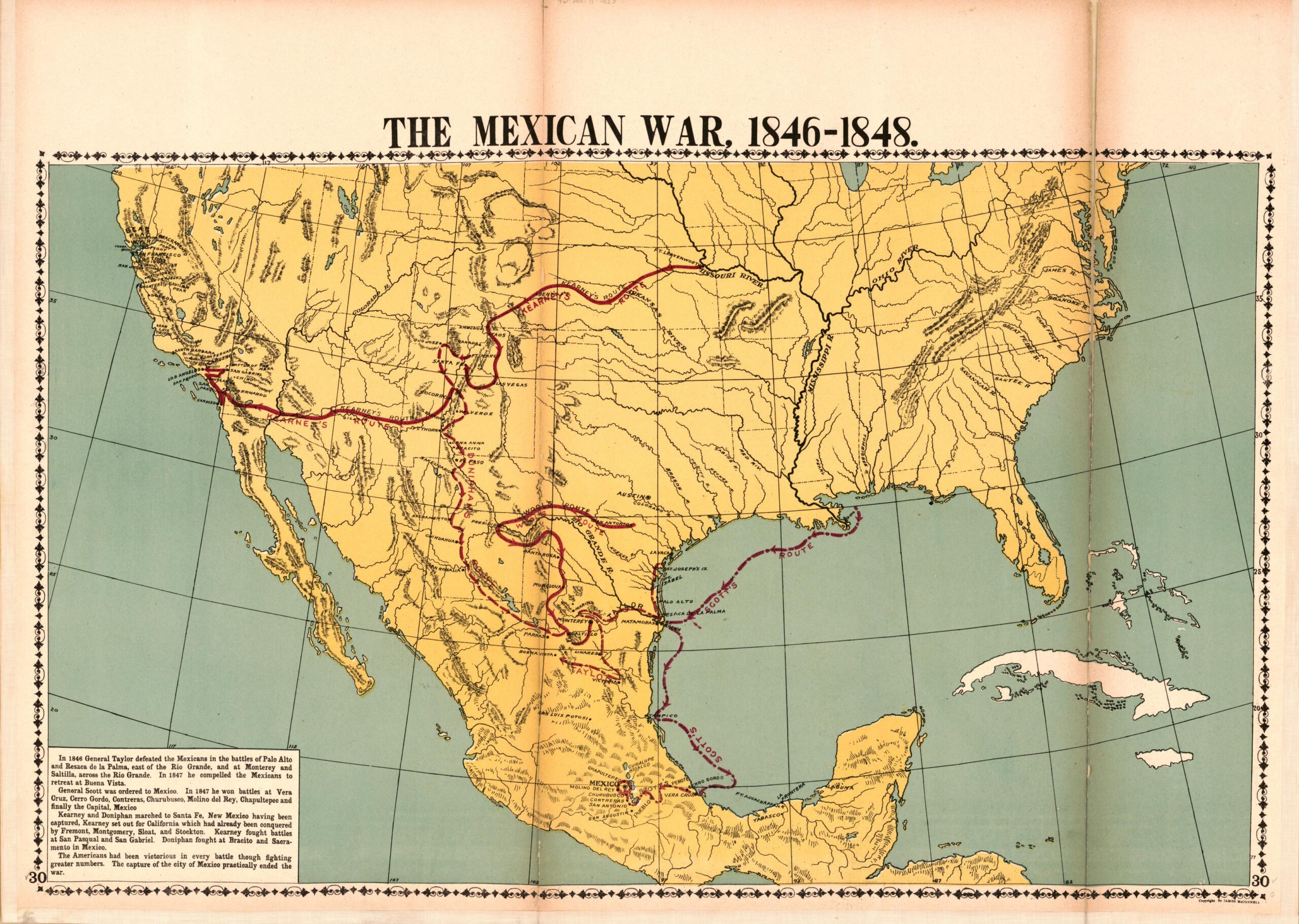
The Mexican W, ar which was fought between April 1846 and February 1848, contributed to the already broadening expanse of the US territory. The Army of the West entered New Mexico territory at the start of the War in 1846, taking control of Las Vegas on 15th August and Santa Fe three days later. The first American military fort in New Mexico, Fort Marcy, was built northeast of Santa Fe on 23rd August. Charles Bent was named governor, and a civil government was formed on 22nd September.
Image via Library of Congress
Afterwards, New Mexico, which included modern-day Arizona and other territories, was given to the United States by the Treaty of Guadalupe Hidalgo at the conclusion of the Mexican War in 1848. It received more than 525,000 square miles or 1,360,000 square kilometres of land, including Arizona, California, western Colorado, Nevada, New Mexico, Texas and Utah from Mexico for a payment of $15,000,000. The U, S in retu, rn agreed to settle the more than $3,000,000 in claims made by American citizens against Mexico.
The Treaty of Guadalupe-Hidalgo (Source: prologue.blogs.archives.gov)
The treaty also laid down the border between the Gila River and the Rio Grande. With this, the seizure of New Mexico and California, alongside the acknowledgement of the Rio Grande as the southern border of Texas, had been accomplished by the US. The Organic Act of the Territory of New Mexico, a part of the “Compromise of 1850,” defined New Mexico as a territory and assigned it a civil territorial administration. Over time, these annexed regions soon became part of the union in the coming years.
The annexation of Hawaii
On one hand, the United States persisted in expanding its territory by paying minimal amounts to exploit the vulnerability of some nations waging wars and shaping treaties, while on the other hand, it used its military strength to subjugate nations under its flag. A similar situation occurred in Hawaii, in the Pacific, where American and British missionaries arrived with the intention of converting the locals to Christianity in the 1820s.
Afterwards, the independent kingdom’s economy initially became reliant on the US, after which military action took place for its annexation. The region started to attract corporate investors who purchased vast areas of land and established a plantation economy centred on capitalism in place of traditional Hawaiian agricultural methods. In the meantime, discussions over Hawaii’s potential annexation to the US started in the 1850s as its sugar and whale industries grew more dependent on the country’s trade.
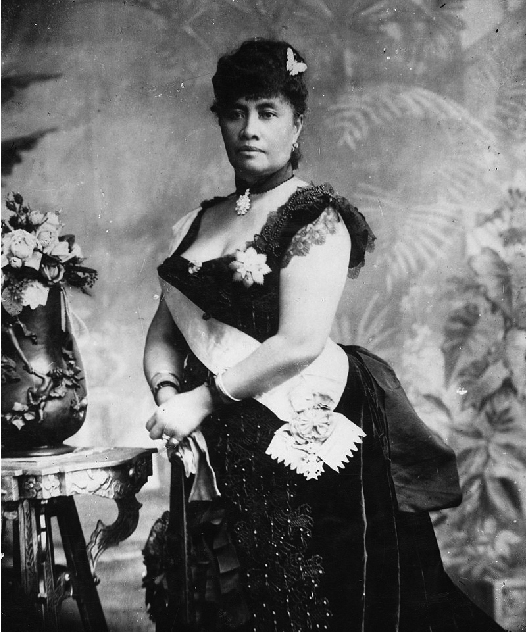
Queen (at the time of this photograph, Crown Princess) Liliuokalani of Hawaii was forced to surrender. (Source: billofrightsinstitute.org)
The wicked plan came to fruition when the executive monarch of the Hawaiian Kingdom was pressured to make a conditional surrender after US troops invaded the country without reason on 16th January 1893. “Committee of Safety,” led by Sanford B. Dole, overthrew the queen with the implicit assistance of the United States. On 1st February, Minister John Stevens declared Hawaii a US protectorate and acknowledged Dole’s new administration.
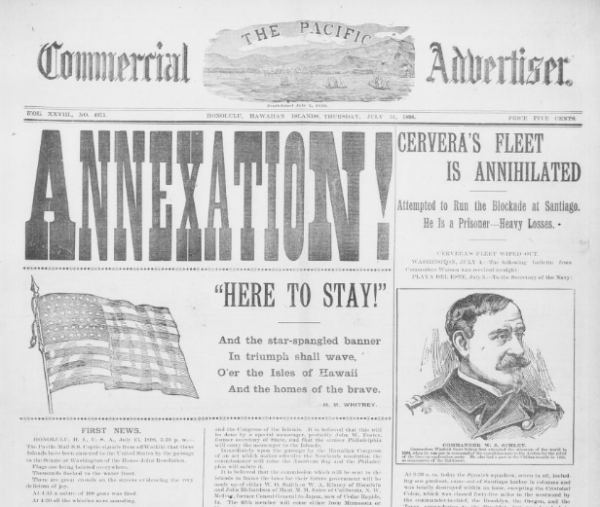
Image via inquirygroup.org
Dole presented the US Senate with an annexation treaty and declared independence when he was pressured to resign. President William McKinley formally supported Hawaiian annexation in his presidential platform when he assumed office in 1896. He also made a treaty with the Republic of Hawaii in 1897. Nevertheless, the independence was fleeting since Hawaii was designated a US territory and achieved statehood as the 50th state on 21st August 1959.
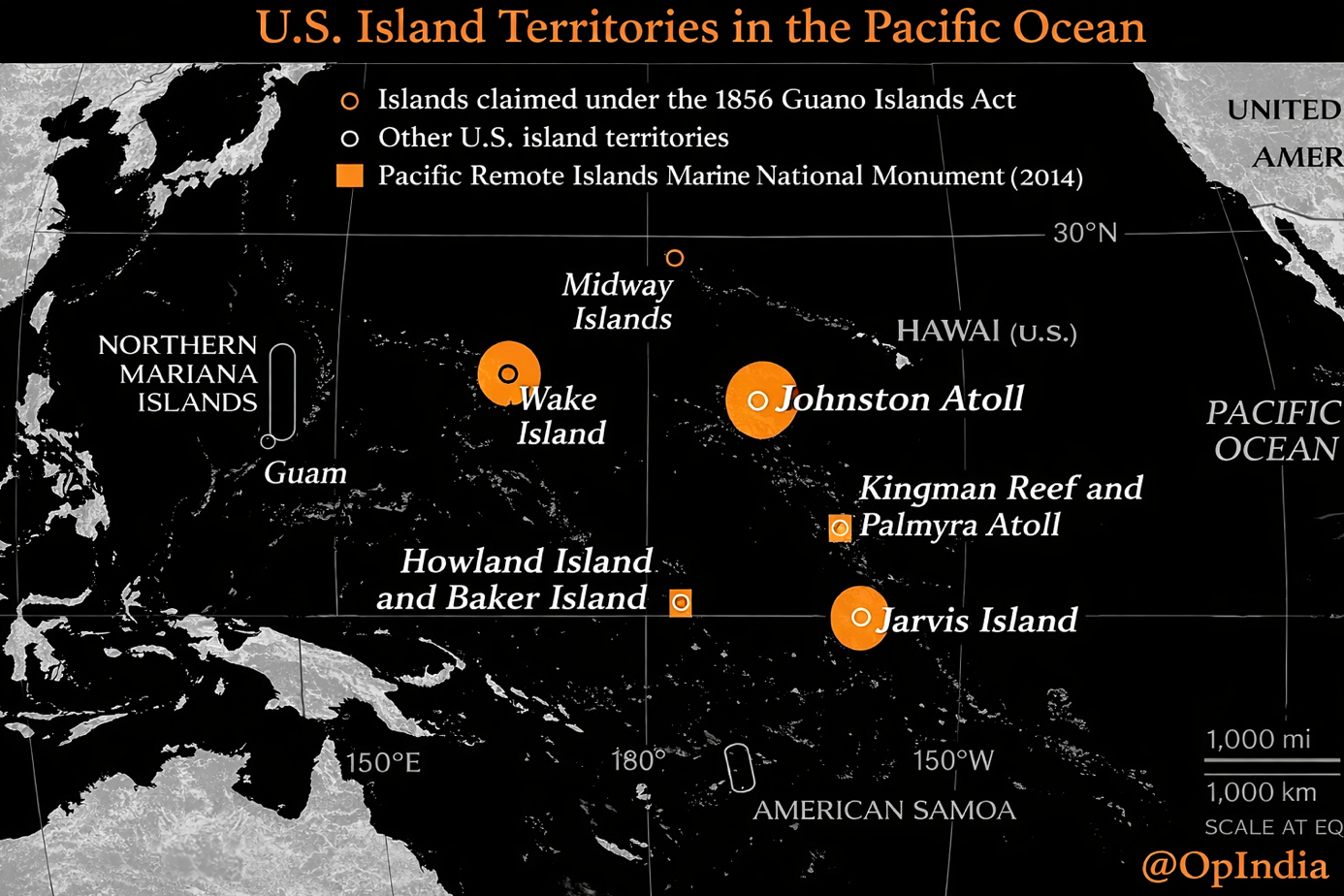
The Guano Islands Act
The United States even smelled the potential in bird excrement to enhance its resources and extend its territory. These feces known as Guano is an extraordinary fertiliser for farmlands. However, guano deposits were uncommon and geographically dispersed, consisting of small and isolated islands covered in layers of this waste that had accumulated over centuries or perhaps millennia.
Hence, the Guano Islands Act of 1856, which permitted any American citizen to claim a deserted island rich in guano on behalf of their nation, was passed by the US Congress out of a hunger for productivity and military advantage.
File Photo
Afterwards, Americans embarked on naval excursions to locate guano and declare it as their territory. The nation deployed a 22-gun warship to collect and assess guano in 1857 from the newly “owned” islands under this statute, as dozens of such places in the Pacific and Caribbean were grabbed.
Resources were taken from the islands as American flags were raised there. The United States claimed over a hundred islands under the act, but later vacated them after the guano ran out.
Expansionism and island hopping: US takes over Pacific islands
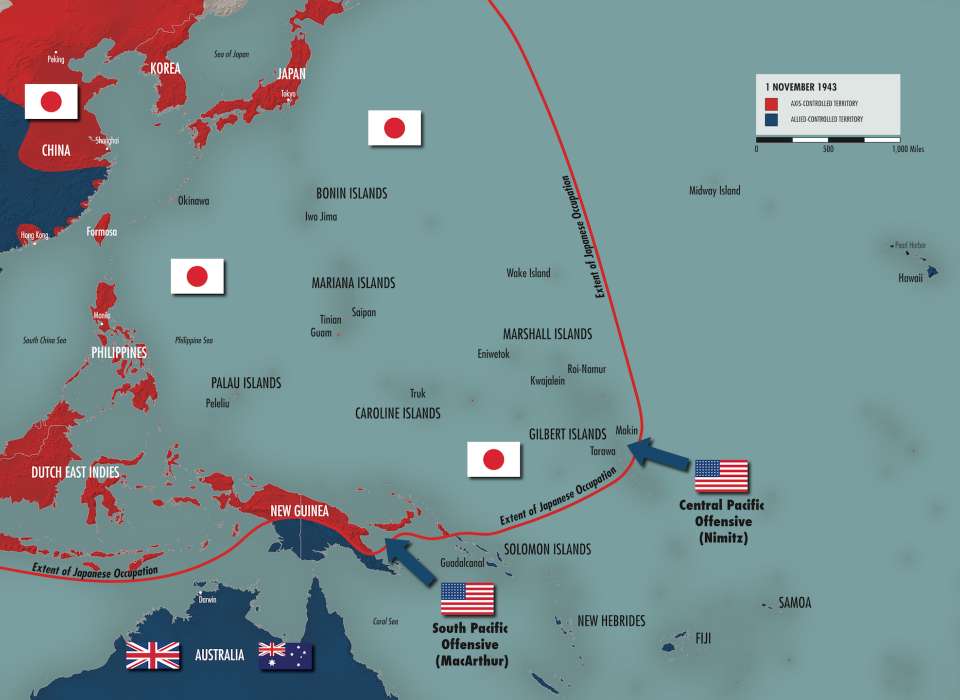
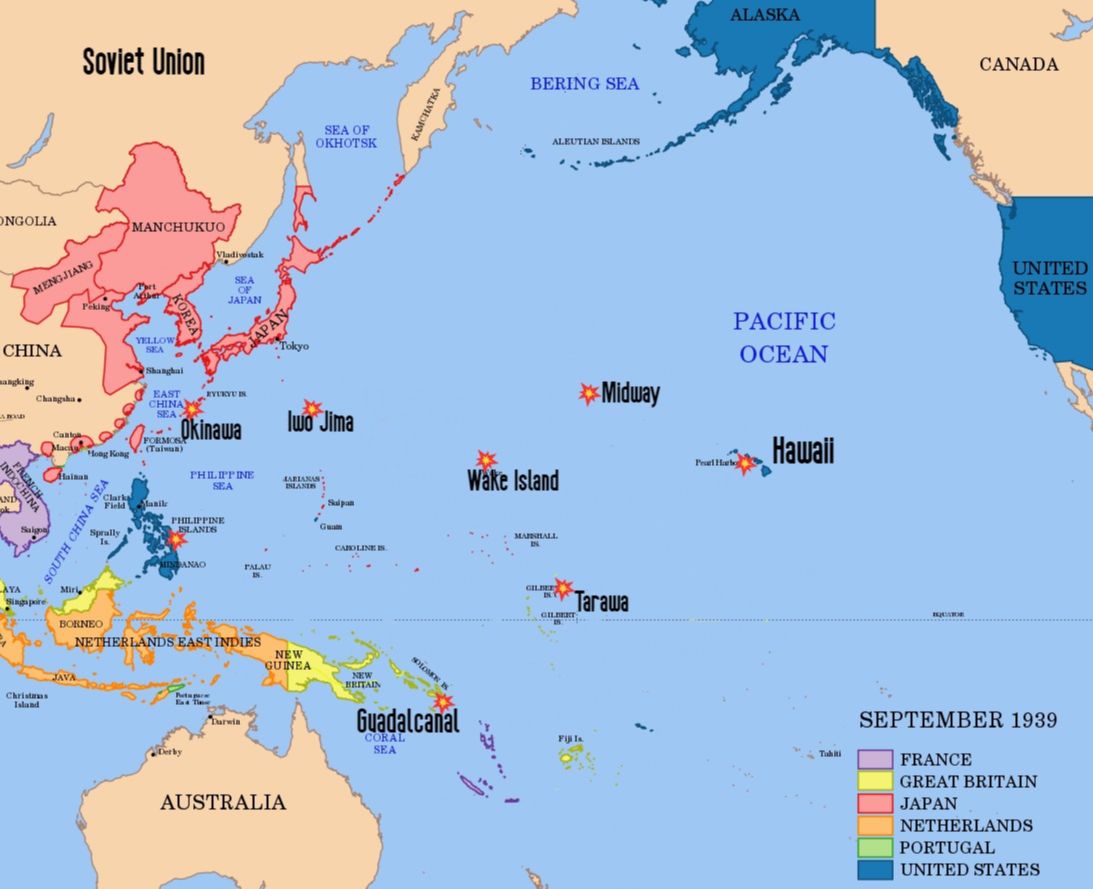
During the 19th century, the United States continued to press for a greater presence in and across the Pacific Ocean as part of its westward expansion, which extended beyond North America. Hence, it adopted a blend of 19th-century expansionism and the “island hopping” military tactic during World War II and gained control of Pacific islands.
US officials and individuals were initially encouraged to explore the Pacific region by the promise of gains from commerce with China. The United States swiftly broadened its footprint throughout the territory as a result of the China trade. They realised that travelling to the Asian land and developing a presence there entailed a network of ports spanning the Pacific Ocean.
Image via nationalww2museum.org
Moreover, the United States was engaged in combat on two fronts: the Pacific and Europe. Thus, the “island hopping” strategy was designed by Admiral Chester Nimitz and General Douglas MacArthur to travel across the ocean and get closer to Japan by winning wars on Pacific islands to confiscate military bases.
It involved avoiding well-fortified islands in favour of capturing weakly defended areas that can aid the following advance. Defenders were forced to suffer from malnutrition and illness when Japanese strongholds were cut off. The United States was able to leapfrog across the Pacific owing to this new scheme. Over the course of three years, this plan would bring American soldiers nearly all the way around the Pacific.
Image via studentsofhistory.com
Notably, the urge for an important centre of operations in the Pacific to aid American interests in China prompted the formation of the US base in Hawaii. The purchase of the Philippines from Spain in 1898 was the result of this maritime expansion as well, which transformed into a crucial goal for the US.
The country secured considerable commercial, political, and military interests as well as territorial possessions in the Pacific region by 1900, and turned into a prominent world power.
The foundation of US based on expansionism
The foundation of the United States is primarily based on brutal annexation and expansion, which has shaped its current shape and form, positioning it as the third-largest country worldwide. Each star on the “Old Glory” carries a distinct tale of how it came to be represented on the flag.
It is crucial to understand that the country has not only relied on this century-old strategy but has acted more aggressively and attacked different parts of the world for its interests, through direct invasions, regime changes and more.
The ouster of Prime Minister Sheikh Hasina in Bangladesh, the capture of Venezuelan President Nicolas Maduro and the current targeting of exceptionally resource-rich Greenland by President Donald Trump illustrate the same.
According to the White House, Trump views Greenland as a top national security concern for the United States, given the increasing activities of China and Russia in the Arctic. “Acquiring Greenland is important to deter our adversaries in the Arctic,” the statement added.
Greenland is part of the Kingdom of Denmark, a partner of the United States. Clearly, even allies are not immune to the schemes of Washington, which continuously adheres to the principle of “might is right” irrespective of who is seated in the Oval Office.
More importantly, as history indicates, the US never deviates from its imperialist ambitions without regard for the repercussions for others. Hence, what might deter them from pursuing a similar course in Greenland? International laws, diplomatic restrictions, the sanctity of sovereignty, or such ideals are pertinent to the country only for the purpose of imposing them on others and never for its own implementation.
In 2025, Pakistan exposed a deep internal divide, including rising militant violence, overworked security forces, and a government battling several conflicts at once. However, the same year was a unique opportunity for Balochistan. The balance on the ground subtly changed as Islamabad struggled to contain Islamist militancy in the north-west and separatist unrest in the south-west.
The Pakistani government’s focus was divided, and its counterinsurgency stretched thin. As a result of this pressure, Balochistan gained operational, symbolic, and political space. The Pakistani government was compelled to go on the defensive as a result of the resistance network’s ability to reorganise, increase visibility, and impose costs. From Balochistan’s point of view, what Pakistan called a deepening security crisis was, in fact, a moment of leverage. This contrast defines 2025 as a year of Baloch resistance momentum and attrition for Pakistan.
What mattered in 2025 was not one big attack or one dramatic incident. It was the constant pressure. Small and large actions continued to occur in Balochistan.
Why 2025 was different from previous years
What set 2025 apart was not just violence, but pattern and persistence.
The scale and frequency changed
In previous years, attacks came in waves, with incidents here and pauses there. But in 2025, that rhythm disappeared. Incidents occurred more frequently and relentlessly, leaving little time for recovery. The volume itself signalled that this was no longer a sporadic insurgency but an active, sustained challenge.
The geographic spread widened inside Balochistan.
Violence was no longer limited to a few known hotspots. Attacks and disruptions were reported across multiple districts, including strategic highways, towns, and areas close to major infrastructure projects. This spread diluted the effectiveness of Pakistan’s security grid and exposed control gaps.
The strain on infrastructure and security forces increased.
Pakistani forces were forced into a reactive posture by protecting convoys, guarding installations, securing transport routes, and responding to repeated incidents. Infrastructure linked to governance, mobility, and economic activity came under persistent stress, raising both financial and political costs for the state.
The key difference:
This was not episodic violence, driven by isolated events or temporary flare-ups. It was sustained resistance, maintained over time, across locations, and under pressure.
The numbers behind the shift
The argument that 2025 marks a structural shift is not a perception; it is grounded in data. The figures released by the Pakistan Institute for Conflict and Security Studies (PICSS) show that conflict-related deaths rose to 3413 in 2025. It was more than 74% compared to 2024. It was the deadliest year in over a decade.
Out of this, 667 were security personnel, a 26 per cent rise. It was the highest toll since 2011. Most importantly, there is a significant increase in the number of suicide bombings, 26 suicide attacks, marking a 53 per cent increase over the previous year, underscoring a return to high-impact, high-casualty tactics. Combined, these figures demonstrate that 2025 was not a one-off statistical spike driven by isolated incidents but a prolonged phase of escalation characterised by frequency, intensity, and sustained pressure on the Pakistani state.
Strategic gains on the ground
The significance of 2025 lies in outcomes, not tactics. Over the course of the year, Baloch resistance demonstrated an ability to operate across a broader operational landscape, moving beyond isolated pockets into multiple districts of Balochistan. This expansion complicated Pakistan’s security planning and reduced its ability to localise unrest. At the same time, persistent pressure on vital routes, convoys, and strategic assets resulted in ongoing costs for economic activity, transportation, and logistics, necessitating ongoing reinforcement and security measures. Pakistan’s security forces were forced into reactive deployment, reacting to events rather than setting the pace, as a result of the cumulative effect, which resulted in a distinct change in posture. Although no actual territory was transferred, something more significant took the initiative.
The symbolic shift: women enter the resistance
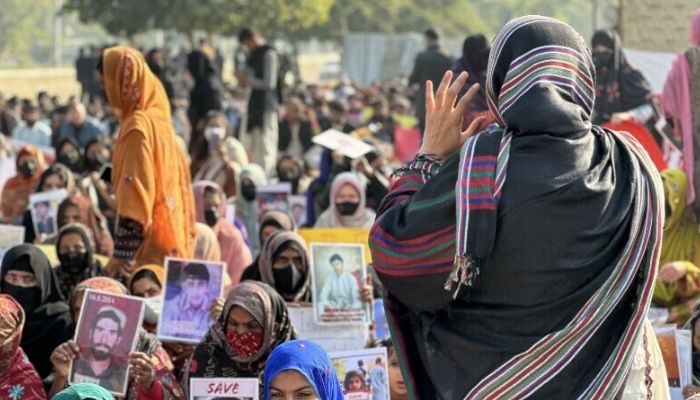
In 2025, one of the most significant shifts was social rather than military. The apparent involvement of Baloch women in resistance-related activities signals a shift in the perception of the conflict. For many years, the unrest in Balochistan was seen as an almost entirely male-led conflict. It was no longer the case. Women’s involvement demonstrated how deeply alienated Baloch society is. When women, who are frequently the most impacted by economic marginalisation, displacement, and disappearances, enter the conflict area, it indicates that grievances have moved beyond the margins and into the social core.
It also reflected a collapse of fear. It acts once restrained by social norms, and deterrence became possible, suggesting that coercion had lost much of its psychological hold. The generational hardening that this change exposed was as significant. A new generation with lower expectations from the state and less faith in redress through established institutions was inheriting and reshaping resentment. As seen by the entry of younger women into the resistance camp. This event altered the story of the conflict. It shifted the emphasis from “men with guns” to more profound concerns about permission, legitimacy, and the long-term viability of Pakistan’s control over Balochistan. In doing so, it created a conflict that no longer fits well within the security lens’s moral and social weight.
Attrition over time: Why momentum matters more than headlines
A big mistake in reading while understanding Balochistan is the search for a single defining event like a spectacular attack, a dramatic takeover or a declaration. None of these were offered in 2025. Instead, it delivered something far more consequential: attrition.
The resistance applied consistent pressure across the locations over time. Roads had to be guarded. Convoys had to be reinforced. The project slowed. Costs accumulated. The psychological impact compounded. Every incident, regardless of scale, forced Pakistan to respond, divert, secure and explain.
This form of conflict favours patience over spectacle. It exhausts institutions rather than shocking them. It erodes confidence rather than provoking panic. And most importantly, it reshapes expectations both within the government and among the population. By the end of 2025, the assumption that Pakistan could indefinitely suppress Balochistan at a manageable cost no longer held.
Conclusion: 2025 as the inflection point
From Islamabad’s perspective, 2025 was a year of crisis. From Balochistan’s perspective, it was a year of leverage.
The numbers matter. The spread matters. The persistence matters. But above all, the change in posture matters. Pakistan spent 2025 defending, reacting, and absorbing costs. Baloch resistance spent it reorganising, expanding presence, and normalising sustained pressure.
No territory changed hands. No formal victory was declared. And yet, the balance subtly moved.
As history shows, insurgencies rarely succeed in dramatic bursts. They succeed when the state loses confidence in its ability to control outcomes over time. In that sense, 2025 did not resolve the Baloch question, but it narrowed Pakistan’s options.
What burned Pakistan that year tells something entirely: that Balochistan did not disappear under pressure. It endured, adapted, and advanced.
That is why 2025 will be remembered. It should not be treated as the year of collapse but the year the momentum shifted.
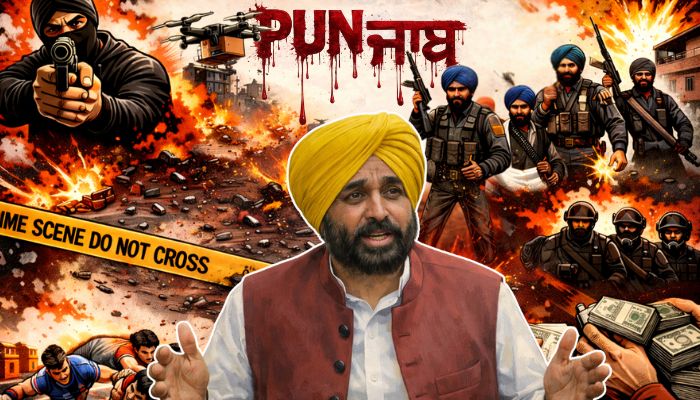
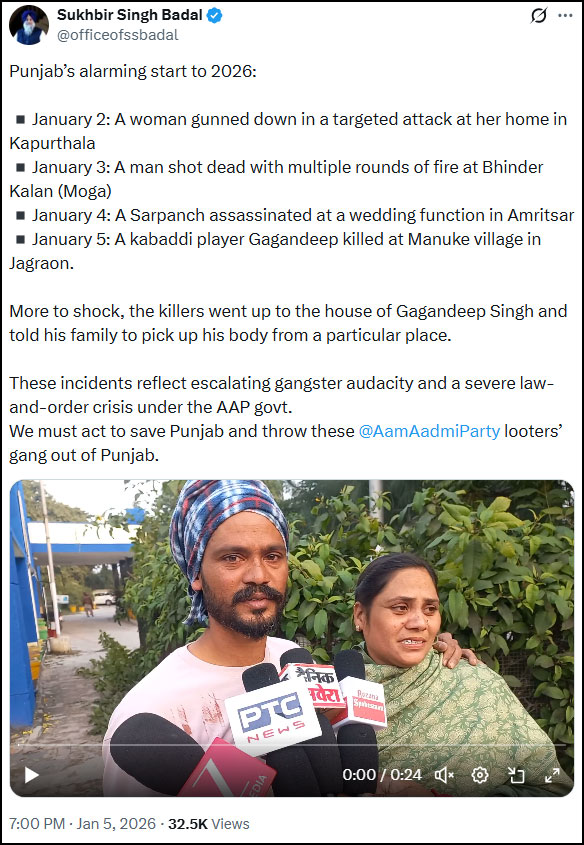
On 4th January, Marigold Marriage Palace in Amritsar became a crime scene when Aam Aadmi Party’s sarpanch Jarmal Singh was assassinated in broad daylight. A chilling CCTV footage of the incident showed two suited gunmen strolling into the wedding. They approached the 50-year-old village leader and fired a single point-blank shot to his head.
The scene turned into chaos as the guests dived for cover and the shooters conveniently slipped away unchallenged. Hours later, a social media post, allegedly by gangster Prabh, claimed responsibility for the murder. Punjab is not unfamiliar with violence. However, this execution-style murder of a ruling party local leader, that too in broad daylight, has sent shockwaves throughout Punjab.
In a statement on social media, Shiromani Akali Dal (SAD) president Sukhbir Singh Badal condemned the incident and accused the Chief Minister of Punjab, Bhagwant Mann, of policing failure in the state. Notably, CM Mann also holds the state’s Home Ministry.
Strongly condemn the cold-blooded murder of Sarpanch Jarmal Singh of Valtoha village (Tarn Taran), who was shot dead at a wedding function in Amritsar today.
This follows an extremely worrisome pattern: yesterday, a young man was gunned down in Bhinder Kalan (Moga) and on Friday… pic.twitter.com/nt01hEeQAn
In another post on X, Badal listed four murders that have happened in Punjab in the first six days of 2026. In the post, he mentioned that a woman was murdered in Kapurthala on 2nd January, a man was shot dead in Bhinder Kalan of Moga, and a Kabaddi player, Gagandeep, was killed at Manuke village in Jagraon, apart from the sarpanch’s murder.
Source: X
In a post on X, Bharatiya Janata Party (Punjab) said there is no “law and order” in the state. “It is a reign of Gundaraj”, the party said.
The murder of the sarpanch was not an isolated incident. It is one of a series of political murders that have rocked Punjab in recent months. In fact, barely 48 hours before the murder of the sarpanch, Congress leader Umarsir Singh was riddled with bullets in Moga. The attackers were allegedly linked to a local rivalry involving an AAP functionary, which raised serious concerns.
These back-to-back political assassinations, one from the ruling party and one from the opposition, shed light on an uncomfortable reality – that no one, either from the ruling party or the opposition, is safe in the state.
Speaking on the matter, senior Congress MLA and former minister Pargat Singh pointed towards an “unchecked surge” in such cases of violence. He warned, “Punjab has never witnessed such lawlessness in recent years.” He and others in the opposition have demanded CM Mann’s resignation, calling the situation “completely out of the government’s hands”.
It has to be noted that these political murders were carried out in broad daylight, in public view. It was evident from the CCTV footage of the sarpanch’s murder that the murderers were scarcely concerned about police response. In the case of Umarsir as well, the gunmen escaped easily.
Congress MLA Gurjit Aujla slammed the AAP government for “failing to maintain law and order” and noted how even local disputes now routinely escalate into lethal violence.
This is not the first time Punjab has witnessed such high-profile bloodshed under AAP government. The assassination of internationally renowned yet controversial singer and Congress leader Sidhu Moose Wala in 2022 was an early warning of the state’s descent into gang-fuelled violence. Carried out in broad daylight with military-grade weapons, the murder was later linked to gang rivalries and exposed the dangerous nexus between organised crime and political circles. What followed was a series of violent episodes that only grew in frequency and boldness.
Extortion, gangs and sports turf wars
Beyond politics, organised crime networks have turned the state into their playground and battleground. Opposition leader Partap Singh Bajwa noted, “Getting extortion calls from gangsters has become the norm in the state.” He argued that the people of Punjab are not safe from this climate of fear.
He alleged that gang lords operate freely, and went on to claim that the administration has effectively ceded its authority in the hinterland. SAD chief Sukhbir Singh Badal likewise described a “prevailing jungle raj”, where “businessmen, doctors, artists, and athletes are facing grave threats from extortionists” and violent retribution is routine.
The collapse of law and order in the state is such that in July 2025, a prominent trader from Abohar in district Fazilka, Sanjay Verma, co-founder of famous Wear Well, was brutally gunned down outside his shop in broad daylight. Verma was fondly called the “Kurta Pyjama King”, as Wear Well is famous among politicians and celebrities alike. His murder prompted merchants’ strikes in protest.
The infamous gang wars of the state have also spilled into the sporting arena. Kabaddi, Punjab’s much-loved rural sport, has in recent years been stained with blood as criminal syndicates often try to influence its lucrative tournaments.
In December 2025, Kabaddi promoter Kanwar Digvijay alias Rana Balachauria was shot dead by imposters posing as fans in front of a packed stadium in Mohali. The murder epitomised the nexus of crime and sport. Kabaddi is a 100-crore industry which is now entangled with gambling, gang rivalries and score-settling.
In October 2025, 25-year-old player Tejpal Singh was shot during an on-field altercation in Jagraon. A month later, another player, Gurvinder Singh, was killed in Samrala. The Lawrence Bishnoi gang claimed responsibility for the murder on social media.
Even earlier, in 2022, international Kabaddi star Sandeep Nangal Ambian was gunned down at a tournament in Jalandhar. Later, the probe revealed the murder was the result of inter-gang rivalry among sport promoters. Each murder shifted the balance of underworld power in the profitable Kabaddi circuit, where syndicates attempt to control tournaments, run betting rackets and overshadow player contracts.
Speaking to Indian Express, an investigator claimed that the tentacles of gangs have reached so far into Kabaddi that players quietly talk about pressure to throw matches or face threats by bookies linked to gangs.
The gangsters in the state are pursuing their endeavours without much fear of the law. The Bhagwant Mann-led government is indeed working to curb gangland activities. The state government had set up an Anti-Gangster Task Force (AGTF) in 2022 and it has yielded some notable results on the ground. Media reports suggest that till November 2025, the task force arrested 2,209 gangsters, neutralised 21, dismantled 825 modules, and seized a large cache of weapons, vehicles, and drugs. While this is not a small number, there are allegations that gangs have flourished in the state in the past few years as a result of the government’s own lapses.
Pratap Bajwa has even accused the ruling AAP and some in the police of tacitly “using gangsters for furthering [their] political agenda” and claimed that victims who report extortion are advised to “settle the matter” with the criminals rather than see robust police action.
What Bajwa has claimed is damning, as it showcases public perception. It appears that the public now believes that the police are either unable or unwilling to take on the well-connected crime bosses. The term “gangland” was coined by Punjab Congress chief Amrinder Singh Raja Warring while lamenting that ordinary people now live in “fear and terror while the gangsters go scot-free” in the state.
Narco-terror state, drugs and terror attacks
On one hand, domestic crime is gripping the state and on the other hand, persistent drug menace has another tentacle that links to narco-terrorism. OpIndia has previously talked in detail about narco-terrorism in the context of Punjab which can be checked here.
According to the latest National Crime Records Bureau data, in 2023, Punjab saw 11,589 cases under the Narcotic Drug and Psychotropic Substances (NDPC) Act. It is the third highest in India after Kerala and Maharashtra. Notably, out of the 11,589 cases, 7,785 were related to drug trafficking and not personal consumption.
The data makes it clear that Punjab is not just a market for drugs but a major transit corridor for organised smuggling. Punjab shares a wide border with Pakistan which has made it a preferred route for contraband flooding in. Sophisticated cross-border networks use drones, tunnels and couriers to move narcotics as well as weapons into Punjab.
In a statement, Sukhbir Badal had blamed the AAP government’s “apathy” for “allowing narco-terrorism to raise its head again”. He linked the rocket-propelled grenade blasts in Tarn Taran that happened in December 2022 directly to the booming drug trade and porous border security. In a post on social media, Congress’s Raja Warring had called the situation “quite serious” and urged united action by the state and the Centre against the drug trade in Punjab.
Not to forget, there have been several such attacks in Punjab. The RPG attack on a police building in May 2022 and a blast in Ludhiana district court in 2021 showed that from time to time such attacks have shaken the state irrespective of which government was in power. In September 2024 as well, there was a blast in Sector 10 Chandigarh, the Union Territory that is shared as the capital by both Punjab and Haryana.
These audacious attacks have sent shockwaves not only across states but also have worried the central agencies. For ordinary residents of Punjab, these attacks are an eerie reminder of the bombings and shootouts that once haunted their daily lives during the insurgency between the 1980s and the 1990s.
Amid all the criminal activities, Khalistani separatist propaganda has grown more visible in the state. The most striking example was the rise of self-styled preacher Amritpal Singh. His hardline Khalistani campaign erupted into violence in early 2023 when in February, his followers, armed with swords, guns and the Sikh holy book as a shield, stormed the Ajnala police station near Amritsar to demand the release of an arrested aide.
The scenes of the attack on the police station were broadcast nationwide. Hundreds of men breached the barricades and besieged the station. Several police personnel were injured and it was a major humiliation for the state. The fact that the mob succeeded in freeing the detained aide of Amritpal Singh sent a very dangerous message that the radical separatists can defy the police with impunity.
For weeks, Amritpal Singh went on the run from authorities and evaded capture until a nationwide manhunt finally nabbed him. The Ajnala incident and subsequent pro-Khalistan events in the state exposed how the counter-terrorism infrastructure was weakened.
When Amritpal Singh-linked locations were raided, investigation officers revealed he was raising a militia. There were weapons, bulletproof jackets and other incriminating material that the police found at those locations. Amritpal was eventually nabbed and shifted to a jail in Assam. Amritpal, chief of the Waris Punjab De organisation, was booked under the National Security Act (NSA).
Surprisingly, despite being booked under serious charges, he was allowed to contest the 2024 Lok Sabha elections which he comfortably won. However, he remained in prison despite becoming an MP. He has not attended a single day of Parliament proceedings for obvious reasons.
Each drone shipment of weapons from Pakistan, each propaganda video by overseas Khalistani leaders, and each unexplained blast on Punjab’s soil chips away at the hard-won peace, at least on paper, of the past two decades.
State government under AAP
When Bhagwant Mann took charge of Punjab in 2022, his government promised a fresh start. There have been some decisions made to control gang related activities and the drug menace in the state, but the outcome seems limited. There have been reports of houses of drug mafia getting bulldozed, recoveries being made by special units of the Punjab Police against drugs, and recoveries of drug-carrying drones at borders by the Punjab Police in collaboration with the Border Security Force (BSF). In a press release, AAP claimed 283 drones carrying heroin, weapons and ammunition were seized in 2024. By August 2025, 137 drones were recovered. However, it has not been able to curb the drug problem completely in the state.
Similarly, the rise in murders, thefts, and other criminal activities has put the state government under strict scrutiny. Even judges got hit by theft. In March 2023, official residence of Additional Sessions Judge Ravdeep Hundal was broken into, and the thieves fled after stealing taps and a geyser from the house. In October 2024, a CCTV footage surfaced in which a woman in Punjab’s Amritsar bravely stopped three theives from entering her house. The incident took place in broad daylight.
Partap Bajwa, the Congress Leader of the Opposition, called for CM Mann’s resignation as he “failed to manage the Home Department and Punjab Police effectively”. Bajwa argued that if he had “an iota of self-respect, he would tender his resignation”.
In July last year, after the daylight murder of the Abohar businessman, Bajwa thundered in the Assembly that “no Punjabi is safe today” and that gangsters act without fear because the administration is asleep at the wheel.
Indeed, Punjab’s police have recovered caches of rifles, RDX explosives and heroin in recent months, highlighting just how heavily armed and funded the criminal-terror nexus is. But such successes are overshadowed by the brazenness of continued attacks. As BJP leader Sunil Jakhar put it, each “deafening silence of the AAP government after such killing only emboldens the gangsters”, and every week of delay in asserting control makes it “already too late”.
SAD veteran Daljit Cheema has similarly accused Mann of “failing to maintain law and order” and demanded he quit if he cannot stem the tide.
The statistics echo their concern. According to NCRB 2023 data, Punjab saw a slight rise in overall cognisable crimes (IPC+SLL) in the AAP era’s initial year before a dip in 2023. The state registered 69,944 total cases in 2023, combining 44,872 IPC offences and 25,072 special or local law cases.
While the total crime rate per capita in Punjab, around 228 per lakh people, remains lower than many large states, it is the nature of the crimes that alarms the public. Violent crimes have spiked in visibility, Punjab recorded 681 murder cases in 2023, about 2.2 murders per 100,000 people, only a marginal decline from the previous year’s 718.
In other words, an average of two people are still being killed every day in the state, many in feud-like shootings. Meanwhile, property crimes like theft and burglary form the bulk of Punjab’s IPC cases each year, the state logged tens of thousands of thefts, contributing to its around 146 per lakh property crime rate. And underpinning many of these statistics is the drug factor, NDPS cases in Punjab rose to 11,589, 37.6 per lakh, in 2023 as noted, with the state leading in narcotics seizures.
These figures, drawn from the NCRB’s latest report, paint a picture of a state where crime is both high in volume and increasingly chilling in character.
In sum, Punjab stands at a perilous crossroads. A state that shed rivers of blood to emerge from the nightmare of insurgency now stares at new demons in familiar garb. The onus is on its government to prove that it is not as inept as critics claim, that is, to show, in deed rather than word, that it can slay the hydra of crime and terror. Failing that, the judgement of the people will be harsh, and rightly so.
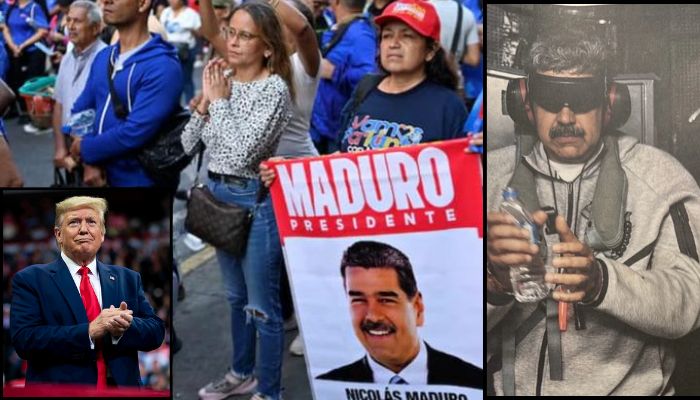
Following the dramatic capture of Venezuelan President Nicolás Maduro by United States forces, Venezuela slid into an anxious and fearful phase. As sections of the diaspora abroad celebrated the operation, inside the country, the mood has been quite different.
Streets in Caracas remain heavily guarded, public expressions are muted, and a sense of uncertainty hangs over daily life. What was described by Washington as a decisive strike against a “narco-terrorist regime” has instead deepened anxiety within Venezuela, raising serious questions about sovereignty, freedom of expression, and what comes next for the crisis-hit nation.
Journalists detained as information flow tightened
One of the clearest signs of the growing crackdown came on Monday, 5th January, when at least 14 journalists were detained across Caracas while covering the aftermath of Maduro’s capture by US Delta Force. According to the Venezuelan journalists’ union, almost all of those detained worked for foreign media organisations. Though most were released later the same day, one reporter was deported, and the incident sent a chilling message to the press.
The detentions took place near key political locations, including the National Assembly, surrounding neighbourhoods, and the opposition-leaning area of Altamira. Some journalists were seized by agents linked to Venezuela’s military counterintelligence, while others were held by the country’s intelligence service. Reporters said their equipment was searched, phones checked, and even private messages and social media activity scrutinised.
Two foreign journalists, one Colombian and one Spanish, were also detained at the border near Cúcuta. They were held incommunicado for several hours before being sent back to Colombia. Media unions called the incidents “alarming” and demanded the release of 23 journalists who remain detained across the country.
Foreign media have long faced restrictions in Venezuela, with visas rarely granted. But the post-Maduro atmosphere appears even more hostile. Several residents told international media that armed, hooded men were patrolling neighbourhoods, checking phones and WhatsApp statuses. In Petare, one of Caracas’s largest districts, a community leader described masked gunmen openly intimidating residents.
A 60-year-old Caracas resident said people were afraid to speak freely, pointing to the heavy presence of police, soldiers, and pro-government armed groups known as colectivos. Another woman said military personnel were stationed on nearly every corner, alongside armed civilians loyal to the government, creating an environment of fear rather than calm.
Delcy Rodríguez sworn in as the interim President, but questions loom
Amid this tense backdrop, Vice President Delcy Rodríguez was formally sworn in as Venezuela’s interim president on Monday, 5th January, just two days after US special forces captured Maduro and his wife, Cilia Flores, in a pre-dawn raid.
Rodríguez, 56, took the oath before the National Assembly in Caracas, with the ceremony presided over by her brother, Jorge Rodríguez, who heads the legislature.
Maduro’s VP SWORN IN as acting President
‘I swear by Bolivar, I swear by our liberatrors…in these terrible hours of threat’
Delcy Rodriguez says she’ll strive to provide ‘social happiness and political stability’ pic.twitter.com/nmy8ugZtJm
Lawmakers chanted slogans supporting Maduro during the ceremony, underlining that the transition was not the result of an internal political process but a response to extraordinary circumstances. In her address, Rodríguez said she assumed office “with pain,” referring to what she described as the “kidnapping” of Maduro and his wife, whom she called “heroes” now held hostage in the United States.
The Supreme Court ordered Rodríguez to take over in an acting capacity, a move that was later endorsed by the Venezuelan military. Initially, she strongly condemned the US operation as “barbaric” and a violation of national sovereignty. However, her tone shifted after warnings from the White House.
On Sunday, 4th January, Rodríguez signalled willingness to engage with Washington, inviting the US to cooperate on an agenda of shared development and peaceful coexistence.
US officials have reportedly described Rodríguez as a workable interim figure. A trained lawyer with experience in oil and finance, she is seen in Washington as someone who could manage a controlled transition. However, opposition leader and Nobel Peace Prize winner María Corina Machado has rejected Rodríguez’s appointment outright, calling instead for a full democratic transition led by elected representatives.
Maduro in a New York courtroom
While power shifted in Caracas, Nicolás Maduro appeared in a courtroom in New York on Monday, 5th January. Shackled and flanked by US marshals, Maduro pleaded not guilty to multiple charges, including narco-terrorism conspiracy, cocaine importation, and possession of machine guns and destructive devices.
.@AaronKatersky reports on the legal case against deposed Venezuelan President Nicolas Maduro as he and his wife plead not guilty in a New York courtroom to drug charges that could land them in prison for life. pic.twitter.com/FNhdapjPX2
“I am a decent man, the president of my country,” Maduro told the court, insisting he remained Venezuela’s legitimate leader. At one point, a member of the public shouted at him in Spanish, telling him he would “pay” for his actions. Maduro responded sharply, calling himself a “kidnapped president” and a “prisoner of war.”
Judge Alvin Hellerstein interrupted the exchange, reminding Maduro that there would be “a time and a place” to address his claims. The hearing lasted around 30 minutes, after which Maduro was escorted out through a back door with his wife. His next court appearance has been scheduled for 17th March.
At the United Nations, Venezuela’s ambassador, Samuel Moncada, denounced the operation as an “illegitimate armed attack” and a flagrant violation of the UN Charter. The US ambassador, Mike Waltz, defended the action, describing Maduro as an “illegitimate so-called president” and a fugitive from justice. He argued that the world’s largest energy reserves could not remain in the hands of such a leader.
The UN Security Council convened an emergency session to discuss the crisis, reflecting growing international unease over Washington’s actions.
“No Foreign agent is running Venezuela,” says Rodríguez
As speculation grew over US intentions, Delcy Rodríguez moved quickly to assert control. In a televised address on Tuesday, 6th January, she declared that Venezuela remained firmly in Venezuelan hands. “The government of Venezuela is in charge of our country, and no one else,” she said. “There is no foreign agent governing Venezuela.”
🚨Interim president of Venezuela fires back: Delcy Rodríguez dismisses Trump’s warning and says Venezuela governs itself.
"The government of Venezuela governs in our country, no one else… There is no external agent that governs Venezuela."pic.twitter.com/O3PU1YZNyY
Her remarks came a day after Maduro and Flores pleaded not guilty in New York. Venezuela’s prosecutor general demanded their immediate release, calling the US operation an illegal act of armed aggression. Rodríguez also announced a seven-day national mourning period after Venezuela released a list of 24 soldiers killed during the raid. Cuba, a close ally, said 32 of its military personnel had also died.
Despite Trump’s initial claim that the US would “run” Venezuela, American officials later walked back the statement. Secretary of State Marco Rubio said the US would instead guide the “direction” of governance using sanctions and pressure, particularly to gain greater access to Venezuela’s oil sector.
However, lawmakers in Washington expressed frustration over the lack of clarity. Senate Minority Leader Chuck Schumer described the administration’s plan as vague and troubling, warning that such interventions often end badly for both the US and the targeted country.
Are Venezuelans abroad celebrating?
Outside Venezuela, reactions have been markedly different. Since 2014, nearly 8 million Venezuelans have fled the country, creating one of the largest refugee crises in modern Latin American history. Many among the diaspora, particularly in the US and Europe, welcomed Maduro’s capture, seeing it as long-overdue accountability for alleged abuses.
Human rights groups such as Human Rights Watch and UN agencies have accused Maduro’s government of crimes against humanity, including torture, enforced disappearances, and extrajudicial killings. For those who lost family members, livelihoods, or futures, the images from New York felt like justice finally catching up.
Yet voices from within Venezuela tell a more complex story. A Caracas-based observer, Diego Sequera, questioned the US narrative, saying it was difficult to believe the drug trafficking accusations given the timing and intensity of recent pressure. “No one inside Venezuela wants what the US wants in the sense of regime change,” the person said. “No one wants internal conflict. No one is celebrating.”
The only Venezuelans who are happy with US strikes are the diaspora who have a lot of time. The overwhelming majority in #Venezuela do not approve that the resolution to our problems should be by #UnitedStates: Diego Sequera from #Caracas, tells me on #RaceToPowerpic.twitter.com/bmdtFcFjeo
According to this account, most of the visible celebration is coming from a relatively privileged section of the diaspora, with time and on their hands. Many others abroad are simply working to survive or are even returning to Venezuela as conditions slowly stabilise in some areas.
“There’s no party, no celebration here,” Diego said to WION. “And regardless of whether people support Maduro or not, the overwhelming majority do not approve of foreign action, especially by the United States, as the solution to our problems.”
Conclusion: Power vacuum may have been filled, but control is still questioned
For now, Venezuela appears to have filled the immediate power vacuum with the swearing-in of an interim president and the backing of key state institutions, including the military and the courts. On paper, governance continues, ministries function, and authority has a visible face. Yet beneath this surface stability, uncertainty remains deep and unresolved.
With former US President Donald Trump openly declaring that the United States will take Venezuela’s oil, serious doubts persist about how much real power Caracas actually holds over its own future. External pressure, economic leverage, and the shadow of foreign intervention continue to loom large. As a result, while the leadership gap may have been formally addressed, Venezuela’s sovereignty, decision-making authority, and control over its most critical resource remain in question.
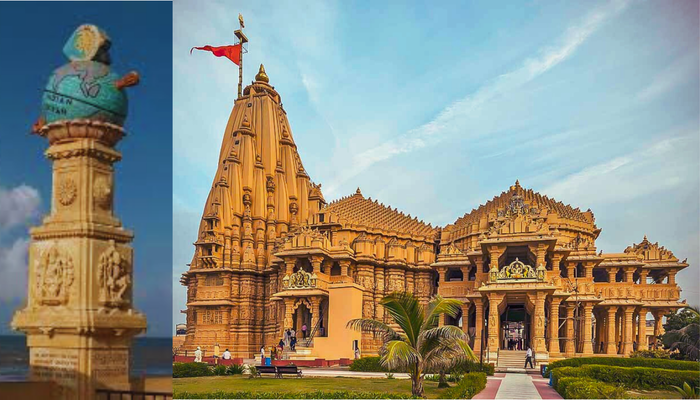
Adorning the Western coast of India, Somnath Temple stands as a testament to the resilience and grandeur of the ancient Hindu civilisation. One of the twelve Jyotirlingas dedicated to Lord Shiva, the temple accommodates a unique pillar known as the Baan Stambh. Located on the south side of the temple, facing the Arabian Sea, the pillar is decorated with intricate carvings. It remains a centre of curiosity for the visitors.
Baan Stambh is not just another ancient architectural spectacle; it symbolises a perfect amalgamation of spirituality and science, which existed in this ancient civilisation. The exact date of construction of the pillar is not known, but its history dates back to the 6th century CE. The pillar finds mention in some scriptures of that period.
Screengrab from the book “The Maritime Heritage of India”
Mystery and significance of Baan Stambh
At the top of the pillar is a globe through which an arrow is passing, which points southward. At the bottom of the pillar, a Sanskrit inscription is carved, which reads, “आसमुद्रान्त दक्षिण ध्रुव पर्यंत अबाधित ज्योतिर्मार्ग”. The Sanskrit inscription translates to ‘from this point of the sea to the South Pole (Antarctica), there is no mountain or landmass’. The inscription states a verified geographical fact. There is no intervening mountain or landmass from the point of the sea to Antarctica, around 10,000 km away.
The inscription is proof of the precise navigational skills of the ancient people, who lived at a time when no modern navigational tools existed. It highlights that the ancient people had a deep knowledge of the Earth’s geography and directions.
Somnath Swabhiman Parv
The Somnath Temple is located in Prabhas Patan of Veraval, in the Gujarati state of Saurashtra, along the coast. The temple is referred to in Chapter 14 of the Shiva Purana. It is known as Triveni Sangam because of the meeting of the Kapila, Hiran and Saraswati rivers. The temple is not only a revered ancient Hindu pilgrimage site but also a symbol of the indestructible spirit of the Sanatan civilisation. January 2026 marks the 1000 years since the first attack on the temple by Mahmud of Ghazni in 1026.
The temple subsequently endured multiple attacks and invasions by Islamic invaders and was reduced to ruins. But the temple kept rising from its ruins. The temple was restored to its present glory on May 11, 1951, with the efforts of visionary leaders like Sardar Vallabhbhai Patel, Dr Rajendra Prasad and KM Munshi.
Yesterday (5th January), Prime Minister Modi wrote an elaborate post, marking the Somnath Swabiman Parv, and highlighting the temple’s journey through these 1000 years.
In an extraordinary and largely forgotten episode of British parliamentary history, official records reveal that as many as 33 Members of Parliament once rallied in support of two men convicted of kidnapping and murdering an Indian diplomat on British soil. The campaign, formalised through a parliamentary motion titled the “Free Riaz and Qayyum Campaign,” sought the early release of Mohammed Riaz and Abdul Quayyam Raja, both convicted for their role in the abduction and killing of Ravindra Mhatre, an Indian official posted in the United Kingdom.
The episode exposes a troubling intersection of domestic British politics, diaspora activism, and international terrorism linked to the Kashmir conflict, raising uncomfortable questions about political sympathy for convicted militants and the selective framing of justice.
The abduction that shook diplomacy
The chain of events began on the evening of 3 February 1984 in Birmingham. Ravindra Mhatre, aged 48, served as an Assistant Commissioner at the Indian High Commission and was posted to the Indian Consulate in Birmingham. That evening, he was walking home from work carrying a birthday cake for his daughter when he was forcibly abducted outside his residence.
Soon after, a militant outfit calling itself the “Kashmir Liberation Army” claimed responsibility. The group was later identified as a front for the Jammu and Kashmir Liberation Front (JKLF), a separatist organisation advocating armed struggle against India. The kidnappers issued stark demands to the Indian government: a ransom of £1 million and the immediate release of Maqbool Bhat, the founder of the JKLF, who had been sentenced to death in India for terrorism-related offences, along with other imprisoned militants.
For India, the situation represented an unprecedented diplomatic crisis. It was the first time an Indian diplomat had been kidnapped on foreign soil. The Indian government, however, refused to negotiate with terrorists.
Murder and aftermath
The standoff ended in tragedy. On 6 February 1984, three days after the abduction, Ravindra Mhatre’s body was discovered at a side street in a rural area southeast of Birmingham. He had been shot twice. The murder sent shockwaves through diplomatic and political circles in both India and the United Kingdom.
In India, the killing hardened resolve. Just days later, on 11 February 1984, Maqbool Bhat was executed at Tihar Jail in New Delhi. The Indian government made it clear that hostage-taking and political murder would not influence its judicial or security decisions.
British authorities, meanwhile, launched an intensive investigation. The probe led to the arrest of Mohammed Riaz and Abdul Quayyam Raja, both Pakistan nationals of Pakistan-occupied Kashmir (PoK) origin. They were charged, tried, and convicted for their involvement in the kidnapping and murder. British courts sentenced both men to life imprisonment, recognising the gravity of the crime and its implications for diplomatic security.
A Parliamentary campaign for convicted killers
What followed a decade later remains startling even today. On 5 December 1994, Labour MP Max Madden tabled Early Day Motion (EDM) No. 12055 in the House of Commons. The motion was titled unequivocally: “FREE RIAZ AND QAYYUM CAMPAIGN.”
The EDM called for the early release of Riaz and Raja and framed their continued incarceration as a political injustice rather than the lawful punishment of convicted murderers. In total, 33 MPs signed the motion, overwhelmingly from the Labour Party. Among the signatories were prominent and controversial figures such as Jeremy Corbyn, George Galloway, Ken Livingstone, Dennis Skinner, and Tony Banks.
The language of the motion was striking. It argued that the two men were being “victimised for political reasons” and claimed that their treatment deviated from normal criminal justice standards. The signatories portrayed Riaz and Raja not as perpetrators of terrorism, but as casualties of geopolitical pressure and state overreach.
The Corbyn connection and Rahul Gandhi’s 2022 meeting in the UK
The controversy surrounding Jeremy Corbyn’s support for the “Free Riaz and Qayyum Campaign” acquires renewed significance in light of his meeting with Congress leader Rahul Gandhi in 2022. During a visit to the United Kingdom, Rahul Gandhi attended events at Cambridge University purportedly to discuss India’s future after 75 years of independence. However, the trip drew sharp criticism after Gandhi was photographed meeting Corbyn, the former Labour Party leader widely regarded in India as openly hostile to Indian interests.
Rahul Gandhi was accompanied by Indian Overseas Congress president Sam Pitroda during the meeting. The optics were particularly troubling given Corbyn’s well-documented history of supporting Kashmiri separatist narratives, echoing Pakistan’s position on Jammu and Kashmir, and endorsing calls for international intervention in India’s internal affairs. During Corbyn’s tenure as Labour leader, the party passed resolutions calling for a UN-led referendum in Kashmir, an explicit challenge to India’s sovereignty. Corbyn himself had earlier held meetings with Congress-linked representatives to discuss Kashmir, an episode that triggered backlash in India and forced the Congress party into damage control.
Beyond India-related issues, Corbyn’s political career has been marred by repeated allegations of sympathy for extremist and terrorist organisations. He has previously referred to Hamas and Hezbollah as his “friends,” refused to unequivocally condemn IRA violence, and was associated with platforms that justified terrorist attacks in the UK itself. Under his leadership, the Labour Party was found by a UK human rights watchdog to have engaged in unlawful antisemitic harassment, ultimately leading to Corbyn’s suspension from the party he once led.
Against this backdrop, Rahul Gandhi’s engagement with Corbyn was seen by critics not as an innocuous overseas interaction, but as a tacit legitimisation of a figure whose political history includes defending convicted terrorists, endorsing separatism, and undermining India’s territorial integrity. For many in India, the meeting reinforced concerns about the Congress leadership’s willingness to associate with foreign politicians whose records are fundamentally at odds with India’s national and diplomatic interests.
Challenging the Judiciary and the Home Office
Central to the MPs’ argument was a dispute over sentencing tariffs, the minimum period a life-sentenced prisoner must serve before being considered for parole. According to the motion, the trial judge had originally recommended a minimum term of 10 years for Riaz and 15 years for Raja.
The EDM cited remarks attributed to the judge, including that Riaz was “unlucky to have been involved at all” and that there was “no hard, clear evidence against Raja.” These assertions formed the moral backbone of the campaign, suggesting that the convictions or sentences were excessive.
However, the MPs expressed particular outrage at the role of the Home Secretary. In 1988, the then-Home Secretary reportedly increased the tariffs to 20 years for Riaz and 25 years for Raja, effectively doubling the minimum time they would spend in prison. The motion condemned this move, alleging that the decision was made “secretly” and without transparency.
For the MPs involved, this was portrayed as an unacceptable politicisation of justice. They argued that politicians should not have the authority to override judicial recommendations and implied that diplomatic pressure, particularly India’s reaction to the murder, had influenced the harsher sentencing.
Street protests and political solidarity
The parliamentary motion did not exist in isolation. It openly endorsed activism on the streets. The EDM applauded supporters in Bradford and other cities who were organising protests and planning to picket outside the High Court on 8 December 1994, coinciding with a judicial review related to the case.
By publicly aligning themselves with these demonstrations, the MPs moved beyond abstract concern and into active political advocacy for the release of convicted terrorists. The motion explicitly called for the “early release of Riaz and Qayyum,” placing its signatories in direct opposition to the British judicial system’s verdict and the Indian government’s position.
For India, the campaign was deeply offensive. Ravindra Mhatre was a serving diplomat murdered in cold blood as part of a transnational terror plot. The attempt to recast his killers as victims of injustice highlighted a profound disconnect between British domestic politics and the lived reality of terrorism faced by Indian officials and civilians
A disturbing intersection of politics and terror
The “Free Riaz and Qayyum Campaign” remains a potent case study in how ideological activism, diaspora politics, and geopolitical conflicts can distort moral clarity. That elected MPs in a Western democracy publicly campaigned for the release of men convicted of murdering a foreign diplomat underscores the selective empathy often extended in cases involving Islamist or separatist violence.
The episode also foreshadowed broader debates that would later emerge around political responses to terrorism, especially when perpetrators are framed through lenses of “resistance” or “political struggle.”
More than four decades after Ravindra Mhatre’s murder, the parliamentary motion stands as a stark reminder: while victims of terrorism are often quickly forgotten, efforts to sanitise or excuse their killers can find enduring platforms, even within the halls of democratic power.
In September 2024, Majid Freeman, the Muslim ‘activist’ who had spread lies and misinformation about the role of Hindus in the 2022 anti-Hindu Leicester violence, was jailed for 22 weeks for attempts to spark violence during the same unrest. Freeman offered no plea back then, knowing that he had no defence for his actions. However, CAGE International, a UK-based NGO dedicated to the cause of ensuring the release of jailed Islamists, is running a campaign whitewashing his anti-Hindu and criminal activities.
CAGE International, previously known as CagePrisoners Project, is mobilising support for Majid Freeman ahead of his retrial in the Leicester case on 9th January. In a flyer, CAGE International described Freeman as a ‘humanitarian’ and ‘anti-genocide activist’. It claimed that he was “convicted in a politicised trial for the crime of defending the Leicester community during Hindutva-inspired riots in 2022.”
“MOBILISE FOR MAJID FREEMAN. Humanitarian and Pro-Palestine activist Majid Freeman stood up for the Leicester community during the 2022 Hindutva-inspired riots after multiple failures from Leicestershire police. He was convicted last year in a politicised trial. Stand in solidarity with him at his retrial. Leicester Crown Court, 90 Wellington Street, LE1 6HG. Friday 9th Jan 2026. We stand with Majid!” CAGE International wrote on X.
INSIGHT UK, a Hindu rights advocacy group, has raised questions over CAGE International’s support for a convicted Islamist and accused the outfit of “victim-flipping” to downplay his anti-Hindu actions that fuelled the violence against Hindus in Leicester in 2022.
“Majid Freeman has been convicted for a racially aggravated public order offence linked to the Leicester riots, where a court found he used abusive words intending to provoke violence. Despite this, CAGE is ‘victim flipping’ and running a campaign that presents him as a persecuted community defender, downplaying his actions that fed anti‑Hindu sentiments in a city already on edge experiencing violence. Why is CAGE, a group with a long history of defending extremists now mobilising support for someone whose actions worsened hate and fear for Hindus in Leicester?” INSIGHT UK wrote.
Majid Freeman has been convicted for a racially aggravated public order offence linked to the Leicester riots, where a court found he used abusive words intending to provoke violence.
Despite this, CAGE is ‘victim flipping’ and running a campaign that presents him as a… pic.twitter.com/T1Bbyt1waB
On 9th September 2024, Majid Freeman, who had spread lies and misinformation about the role of Hindus in the 2022 anti-Hindu Leicester riots, was jailed for 22 weeks for attempts to spark violence during the same unrest. He was sentenced by District Judge Amar Mehta at Northampton Magistrates’ Court after being convicted of a section 4 public order offence.
The court had noted back then that Freeman intended “immediate unlawful violence” and used “abusive words with the intention that violence would be provoked.”
Notably, in July 2023, Freeman was charged with inciting terrorism and lending support to the proscribed terrorist organisation, Hamas. The prosecution had stated that Majid Novsarka, also known as Majid Freeman, who was arrested on July 9th 2023, on suspicion of counter-terrorism offences, including encouraging acts of terrorism, stated views or beliefs that were in favour of Hamas, a banned terrorist organisation, on several occasions between December 26 of last year and June 20.
Birgitte Hagem, for the prosecution, had informed the court at that time that Majid Freeman was encouraging individuals to carry out, plan, or incite acts of terrorism on social media on March 11, 2015, in reference to the 2015 murderous attack on the French satirical weekly Charlie Hebdo.
Majid Freeman incited anti-Hindu violence in Leicester
On 28th August 2022, unrest engulfed Leicester following a scuffle after India’s victory over Pakistan in a T20 match, during which the Indian flag was desecrated. Despite Hindus calming the situation and assisting the individual who desecrated the flag, Majid Freeman spread a false narrative against Hindus, further escalating the violence.
Amidst the peddling of disinformation by Muslim organisations, on 30th August 2022, Majid Freeman falsely claimed that Hindus in Leicester chanted “death to Muslims,” an allegation later debunked by the police. That same day, Freeman also spread a false rumour on X (formerly, Twitter), alleging that the Quran had been desecrated in Leicester and insinuating that Hindus were responsible. These claims were found absolutely false, however, the damage was done.
Furthermore, Freeman had sparked tensions by falsely accusing a group of Hindu men of chasing and assaulting a Muslim teenager. On 4th September 2022, while Muslim mobs were attacking Hindus in Leicester, Freeman further incited his local coreligionists against Hindus through social media.
Between 4th to 7th September, Hindus were attacked by Muslims. A local Ganesh Chaturthi celebration was disrupted by Muslim mobs, who threw eggs at Hindu sacred symbols. A Hindu man was attacked. In another incident, after Freeman falsely claimed that Hindu men had attempted to abduct a Muslim girl, a Hindu man was doxxed. The police later revealed that the whole story was fabricated.
On social media, Majid Freeman’s team, CAGE International and other Islamist outfits like the US-based Indian American Muslim Council (IAMC) have long been highlighting a story that somehow Freeman ‘saved’ a Hindu man during the Leicester violence and thus should be seen as a protector of locals against violence and not an instigator of the same. However, this reminds of the disgraceful ‘Muslims form human-chain to protect Hindu temples in Bangladesh’ narrative peddled by Islamo-leftists during violence after Sheikh Hasina’s ouster. Who were they (Muslims) protecting Hindus from? Majid Freeman essentially incited his co-religionists to attack Hindus, so how does allegedly ‘saving’ one Hindu from the same mob he incited absolve him from his role in inciting riots?
Established in 2003 as CagePrisoners Project, the outfit became CAGE International in 2013. As per its website, CAGE International is a source of “information on the status and whereabouts of prisoners seized under the war on terror, for their families, lawyers, as well as press and academics.”
The NGO has a record of defending Islamic extremists and even terrorists in some cases, in the name of opposing ‘misuse’ of counter-terrorism laws. Back in September 2022, CAGE International advocated for the release of Muhammad Rahim Al-Afghani, a close associate of slain Islamic terrorist Osama Bin Laden.
In addition, CAGE International has also advocated for the release of ‘Lady Al-Qaeda’ Aafia Siddiqui, who is serving an 86-year jail sentence after conviction in the case involving an attack on US officials in Afghanistan. OpIndia reported earlier that in 2008, the US Department of Justice had found a number of items in her possession, including handwritten notes that mentioned a mass-casualty attack.
Unsurprisingly, CAGE International is a supporter of the Palestinian Islamic terror group Hamas.
Coming back to Majid Freeman, CAGE International had organised a solidarity event for Freeman in July 2025. The Islamist NGO claimed that Freeman is “facing terrorism charges for sharing words of solidarity with Palestine.”
Right after Freeman’s conviction in the Leicester anti-Hindu violence case, CAGE International had claimed that Freeman was jailed in a ‘politicised Hindutva riots trial’. The Islamist outfit labelled Leicester Hindus as ‘Hindutva agitators’ and called them the perpetrators of the 2022 Islamist violence, even as Hindus were the victims of the Islamist-orchestrated attack, fuelled by disinformation peddled by Freeman.
“Since the 2022 Hindutva-inspired riots in Leicester, ongoing revelations have highlighted the failures of Leicestershire Police, particularly Chief Constable Rob Nixon, in managing the situation. The force allowed paramilitary-style marches by Hindutva agitators in Muslim neighbourhoods in Leicester, directly causing the community tensions,” CAGE International claimed.
While Majid Freeman, Mohammad Hijab (another radical Islamist and key instigator of Leicester violence), their Islamist supporters, and outfits like CAGE International have been trying to blame ‘Hindutva’ and Hindus for the 2022 anti-Hindu violence, the UK court debunked this propaganda earlier.
Ahead of the reported retrial of Majid Freeman on 9th January, CAGE International, operated mostly by British Muslims of Pakistani origins, is giving calls to Islamists to mobilise outside the Leicester Crown Court to show ‘solidarity’. However, concerns have been raised that, more than solidarity, this is a call for a show of ‘strength’.