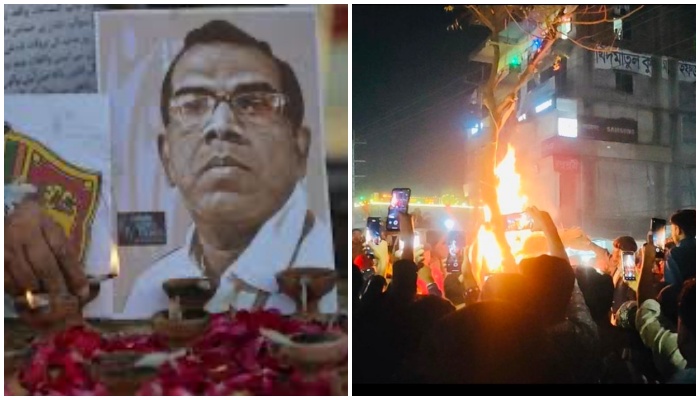
On December 18, in Bhaluka Upazila, Mymensingh district, Bangladesh, a young Hindu garment factory worker named Dipu Chandra Das was brutally lynched by a mob over unverified allegations of blasphemy. Dipu was no political activist or leader, he was a poor factory worker who lived in a rented room in the Dubalia Para area of Square Master Bari and went to work in a garment composite unit every day to earn wages.
The videos that have emerged on social media after Dipu’s lynching are gory, unwatchable. In the evening, an enraged, frenzied mob started beating Dipu. A mob of dozens of men is seen kicking, beating and jumping on every part of a defenceless Dipu’s body. After crushing every bone in his body and beating him to death, the mob was yet to be satisfied. They dragged the body to a public square, a busy thoroughfare that some are reporting as the Dhaka-Mymensingh highway. There, they tied the lifeless body and hung it up, to beat it further. The mob continued to beat the corpse of Dipu, and when even that wasn’t enough spectacle, they poured some inflammable liquid on it, and burned it, rejoicing with ‘Naara-e-Takbir, Allah Hu Akbar’ slogans.
Imagine this happened in India and the victim was Muslim. National and international media, Left and human rights organisations would be demanding justice nonstop.
But the victim is Dipu Chandra Das a Hindu minority in Bangladesh so there is silence.
From the beating, dragging and burning, there was no police personnel visible. Nobody seemed to have tried to stop the mob. The mob seemed completely carefree, fearless of any consequence. The security apparatus in Bangladesh has long surrendered before the Islamist mob, the mob has been destryoing monuments of national identity, desecrating the very foundation of the cultural and historical roots of the nation, and the ruling apparatus has been watching, the caretaker regime whitewashing their acts.
The images are confusing. The scene unfolding looks more like a medieval affair, a frenzied mob beating a man to death with wanton impunity. But there are mobile phones, vehicles, and signs of modern civilisation. This is what has happened to Bangladesh.
This is Bangladesh in December 2025, lost to Islamist fanaticism
Anyone who has been following the news, would know that the incident, however shocking and scary, was not unexpected in Bangladesh. Incidents like this have happened before, because whatever law and order was there in Bangladesh was shattered after the government of Sheikh Hasina fell in August 2024. The mob ruled the streets, the mob killed and chased and burned Hindus, and the mob was given cover fire, and ample whitewashing by the farce of a ‘caretaker government’ that was installed to fool the world. Hundreds of Hindus have been raped, killed, dragged from their homes, beaten, threatened to quit their jobs, and brutalised in Bangladesh in the past 18 months, just for being Hindus.
It is not that the persecution was not happening before. It did, but despite its flaws, Sheikh Hasina was a bulwark against the absolute Islamist frenzy that has engulfed the country now. Her government, albeit with mistakes, held the Islamist powers at bay. That bulwark is gone, and chaos rules now.
The visuals and circumstances of the brutal lynching of Dipu Das are almost a repeat of what happened with Sri Lankan national Priyantha Kumara in Sialkot, Pakistan in 2021.
The lynching of Priyantha Kumara in Sialkot, Pakistan in 2021
On December 3, 2021, in Sialkot, Punjab province, Pakistan, a mob of hundreds of locals, primarily factory workers and supporters of the hardline Islamist group Tehreek-e-Labbaik Pakistan (TLP), brutally lynched Priyantha Kumara Diyawadanage, a 49-year-old Sri Lankan factory manager at Rajco Industries.
Kumara, a Sinhalese Buddhist who had lived and worked in Pakistan for over 10 years, was preparing the factory for a visitor delegation. He asked workers to remove some posters from the walls and machinery to facilitate cleaning. Some of the posters had Islamic verses written on them and quotes from TLP leaders. When workers refused, he reportedly removed the posters himself and disposed of them. This simple act of ‘cleaning’ was seen as ‘blasphemy’.
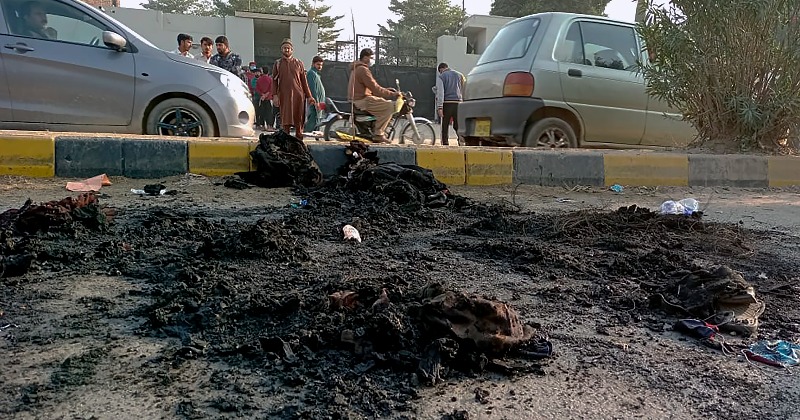
Priyantha Kumara was burned as a crowd of hundreds cheered in Sialkot, Pakistan in 2021
The mob first gathered, and chased Kumara to beat him. He fled to save his life as his pleadings to reason failed. The mob then dragged Kumara from the factory roof, where he had run to save his life, beat him severely with sticks and stones, broke all his bones, killed him, and then set his body on fire in the street. The ‘kafir’ was first beaten to death, then burned as a spectacle to entertain and satisfy the mob. Videos of the attack showed the crowd chanting slogans, the same slogans the killers of Dipu Das raised on December 18, 2025, raised by hundreds of people blinded by the same religious fury.
"Kaafir ke bacche ne Quran ki ayatein dustbin mein fainki hain (son of kaafir has thrown verses of Quran in dustbin)," a man is heard saying in the crowd that killed & burnt a Sri Lankan identified as Priyantha Kumara, in Pakistan's Sialkot. Priyantha was manager of RajCo factory pic.twitter.com/RRR3pGDaGz
The scenes were eerily similar in their horrific brutality, a chilling reminder of the depravity and hatred seemingly ‘normal’ people are capable of.
The unsettling similarity between Dipu and Priyantha is not limited to just how they were lynched and by whom, the allegations against them were similar too. Flimsy accusations of ‘blasphemy’, baseless rumours of ‘insult to Islam’ and ‘Insult to the Islamic prophet’.
Reports from Bangladesh say Dipu didn’t even commit any ‘insult’. He had apparently tried to argue that all religions are equal and all Gods are the same. December 18 was the ‘World Arabic Language Day’, and Dipu reportedly made some trivial remarks. Some coworkers took that as ‘offensive’, and that one spark, one accusation of ‘Insult to Islam’ was enough to gather a mob that wanted to spill his blood.
Incidents of violent mob lynching over flimsy accusations of blasphemy are nothing new in Pakistan. In the lawless Islamist hellhole, even a false rumour to settle personal grudges is enough to send a man to jail for ‘blasphemy’. The country punishes blasphemy by death, and rumours and verbal allegations are often enough for courts. The Islamist mob, however, is not satisfied with the prolonged process of what passes as law in those lands; they want the Kaafir killed then and there, in a violent manner where the mob cheers and enjoys the killing.
Bangladesh has come a full circle
Bangladesh sacrificed lakhs of lives and went through a lot of pain to free itself from the grip of Pakistan. Freedom fighters laid down their lives, a bloody war was fought, and an entire generation risked everything they had to gain that freedom and make the nation a democratic, secular country. However, demography writes a nation’s destiny, more than laws, constitution and governments.
Bangladesh has come a full circle, it has lost whatever it had gained. The economy is in shambles. The geography was never in their favour anyway, and the political powers that could have kept the religious fanatics at bay are gone. Bangabandhu Sheikh Mujibur Rahman is gone, his house, which stood as a symbol of the bloody struggle for freedom, is gutted. His daughter has been exiled.
Stripped of the hard-fought progress, the semblance of modernity and democratic governance, and the minority populations pushed to the brink of extinction, what is left now in Bangladesh is just chaos, anarchy and a lawless bloodlust of fanaticism that won’t stop till it engulfs the whole country.
Between 2025 and 1971, 54 years have passed. Bangladesh has become the very oppressor it fought to free itself from. Demography has changed its destiny and turned the country into Pakistan.
Bangladesh has outclassed its erstwhile oppressor, Pakistan, in being self-destructive. After derailing its economic progress and political stability in mid-2024, the country is witnessing a redux of Islamist mob violence, arson, vandalism and anti-India propaganda. The anti-India elements in Bangladesh have pinned the blame for the alleged “political assassination” of radical Islamist leader Sharif Osman Hadi on India.
Osman Hadi: The India-hating radical Islamist and his murder
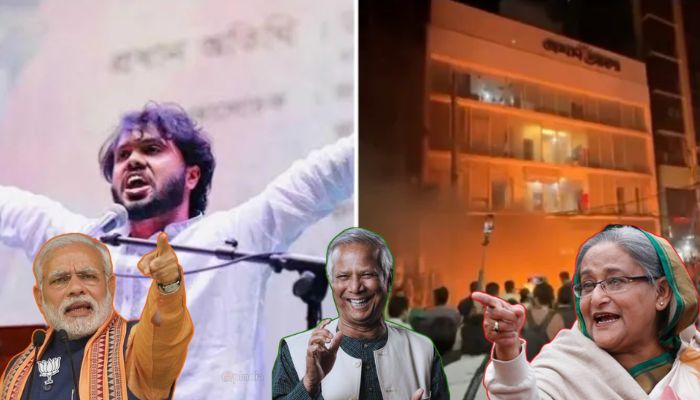
Osman Hadi rose to prominence in the turbulent political landscape of Bangladesh as a vocal leader of the radical student protest group, Inqilab Mancha. This group emerged during the anti-Sheikh Hasina ‘uprising’ in 2024. Hadi’s ascent to popularity was largely driven by his senseless but fiery anti-India rhetoric. In the name of championing Bangladeshi sovereignty, Osman Hadi perpetually peddled anti-India narratives rooted in falsehoods and exaggerations rather than reality.
More recently, Osman Hadi accused India of meddling in Bangladesh’s internal affairs and backing the ousted Sheikh Hasina government. Hadi stretched this hatred against India to the extent that he made statements about “capturing” the Seven Sisters northeast states of India. Hadi’s rhetoric framed India, the liberator of Bangladesh, as an ‘aggressor’ intent on ‘undermining’ Bangladesh’s sovereignty and independence.
The 32-year-old Inqilab Mancha leader had recently shared maps of ‘Greater Bangladesh’ depicting India’s Bengal, Bihar and the entire North Eastern states as Bangladesh territory, and the entire Jammu and Kashmir and Punjab as Pakistani territory. While campaigning for the proposed February elections, Osman Hadi was shot in the head by unidentified assailants on 12th December in Dhaka. A week later, Hadi died while undergoing treatment at a hospital in Singapore.
Hadi’s post with a distorted map of India
The timing of Hadi’s anti-India social media post and his assassination sparked speculations that somehow India was behind the radical Islamist’s killing; however, beyond the ‘timing’, there is no shred of evidence supporting this claim. It is suspected that Hadi was killed by local political rivals. However, Islamists and India detractors in Bangladesh do not need proofs; mere rumours and rhetoric are enough for them to hit the streets and wreak havoc in their own country.
Osman Hadi’s death triggers violence and anarchy in Bangladesh
Notably, Sharif Osman Bin Hadi was campaigning as an independent candidate ahead of the February 2026 elections. While the wounds of the August 2024 Islamist rampage are yet to heal, Hadi’s death has sparked a fresh wave of violence and anarchy across Bangladesh.
Calling Osman Hadi a ‘martyr’ of the July Uprising, his supporters across student groups and Islamist outfits have flooded the streets and carried out violence and arson in the garb of demanding justice for Hadi.
Hadi’s radical supporters, driven by mindless hatred against India, started attacking the offices of major newspapers, Prothom Alo and The Daily Star, accusing them of bias. On 18th December, the main office of Prothom Alo in Kawran Bazar in Dhaka was attacked by rioting mobs belonging to the Islamist outfit Inqilab Mancha. The mob, carrying sticks and rods, vandalised the office, breaking most of its window panes. Over 28 journalists and other staff members were trapped inside when the rioters set the Prothom Alo office building ablaze.
#WATCH | Bangladesh: Visuals of the aftermath from The Daily Star office in Dhaka, which was burned down by protesters.
After the death of Osman Hadi, a key leader in the protests against Sheikh Hasina, Bangladesh has erupted in unrest, and two newspaper offices have been set… pic.twitter.com/dpKn5h97fI
Similar events transpired at the nearby The Daily Star newspaper’s office, where around 25 journalists were rescued after being trapped in the office for over four hours. The anger of the radical mobs is such that even those attempting to calm them down peacefully are being attacked. Editors’ Council President and New Age Editor Nurul Kabir, along with photographer Shahidul Alam, came and attempted to calm the rioters down; they too were attacked and labelled by the mob as “Awami League agents”.
Editor of New Age Newspaper of Bangaldesh Nurul Kabir being attacked by mobsters. pic.twitter.com/gM0Bn7MJkz
Meanwhile, the ancestral residence of Bangladesh’s founding president, Sheikh Mujibur Rahman, in Dhanmondi, was vandalised by radical Islamist mobs again.
#BREAKING: Angry students set fire, vandalized Dhanmondi 32 in Dhaka. This is the ancestral place of Sheikh Mujibur Rehman. This location was attacked at least three times before and completely gutted and ransacked. Reports of attacks on Awami League offices across Bangladesh. pic.twitter.com/5uCxZcN02m
The radical Islamist mobs have also targeted India’s high commissions in Bangladesh. A group of anti-India protestors gathered outside the Indian Assistant High Commission in Bangladesh’s Chattogram after Osman Hadi’s death, to stage a sit-in protest. Earlier this week, anti-India protestors attempted to march towards Indian diplomatic missions in multiple cities to oppose the imaginary Indian ‘hegemony’.
Similar protests were staged in Dhaka, where a group under the “July Oikya” (July Unity) movement marched, demanding the extradition of deposed Prime Minister Sheikh Hasina, who fled to India in August 2024 following a mass ‘uprising’.
Disturbingly but unsurprisingly, Bangladeshi Hindus are also facing the brunt of Islamist ire. On 18th December, a Hindu youth, Dipu Chandra Das, was lynched by an Islamist mob over bogus allegations of blasphemy against Islam and Prophet Muhammad. After beating Das to death, the assailants tied his body to a tree and set it on fire, amidst slogans of “Nara-e-Takbir, Allahu Akbar”.
OpIndia has continuously reported on how Bangladesh has witnessed unprecedented violence against the marginalised Hindu community following Sheikh Hasina’s forced ouster from power and her country. The opprobrious trend of Islamists targeting Hindus in the face of crisis and instability continues under the Yunus regime unchecked.
Even on 19th December, anti-India protestors are carrying out a ‘long march to border’ with India in Benapole near the Indo-Bangladesh border. On the other side is Petrapole in India’s West Bengal.
Reports say that Islamist outfit Hefazat-e-Islam and some Islamist student groups, alongside Inqilab Mancha, are behind the anti-India protests. OpIndia has reported earlier that Hefazat-e-Islam is a platform of mainly teachers and students of non-government or “kawmi” madarsas or religious seminaries in Bangladesh, and it is considered an influential pressure group. The radical Islamist outfit has been demanding the strict implementation of Islamic laws in Bangladesh. This outfit was also involved in Islamist violence during PM Modi’s two-day Bangladesh visit in 2021.
Did India orchestrate Osman Hadi’s killing, or is the Yunus regime exploiting the radical Islamist’s murder for its own ambitions?
The Yunus-led interim government and its Islamist supporters have consistently and mindlessly blamed India for a wide array of Bangladesh’s self-inflicted woes. Osman Hadi’s killing is no different. While the Yunus regime has expressed solidarity with Hadi’s family and assured justice after a thorough investigation, its Islamist supporters have already declared India the culprit.
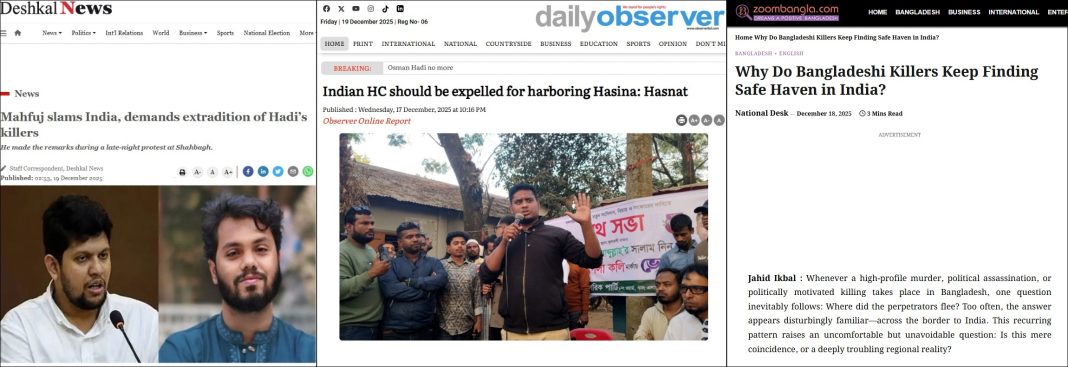
On 14th December, the Yunus administration claimed that Osman Hadi’s killers had crossed into India. The Bangladeshi interim government even summoned the Indian ambassador, asking India to arrest and hand over Hadi’s killers. This fuelled the already simmering suspicion that India, or somehow those linked with India, were behind Hadi’s assassination.
However, the Yunus regime made a villain out of India by peddling lies even as the Dhaka Metropolitan Police stated that there is no evidence that Hadi’s killers had crossed into India.
“There is no verified evidence that the attackers… have crossed into India”, Dhaka-based TV channel Jagonews24 quoted the DMP as saying.
Deputy Commissioner of the DMP Muhammad Talebur Rahman said that the police have no confirmed information that any of the suspected killers have left Bangladesh.
It must be noted that local Islamist activists, along with anti-India propaganda portals, have been making unfounded claims that Osman Hadi’s attackers, including one from the banned Awami League’s student wing Chhatra Shibir, crossed into India and are staying in Assam’s Guwahati.
First, the Yunus regime involved India’s name in Osman Hadi’s killing, summoned the Indian Ambassador to send out a message to his Islamist and anti-India support base that the unelected regime was taking a strong stand against India, when India responded strictly through diplomatic channels, Yunus delivered a message to his nation seeking time to complete the investigation.
Yunus regime has a set pattern: Blame India for everything
This, however, has been Muhammad Yunus’s pattern: Point fingers at India, accuse India of attempting destabilisation of Bangladesh, and cry hoarse when called out. Yunus’ regime is doing what Pakistani governments have been doing for decades: blame India for their own failures, deflect attention from domestic issues by painting India as a bigger threat, gain public support by posing as defenders of the nation against the ‘India threat’, and continue to rule the ruins.
By villainising India, the Yunus regime wants to consolidate power and rally nationalist sentiments. It is a clear indication that Muhammad Yunus wants to either delay elections by stirring prolonged unrest or wants to ensure that whenever elections are held, Islamist political outfits come to power.
Dissecting Muhammad Yunus’s sinister modus operandi, a Bangladeshi professor, Rezwana Snigdha, told BBC Bangla in an interview that the Yunus regime conveniently points fingers at India for every unpleasant incident in Bangladesh to hide its own failures, including the attack on Osman Hadi.
Interestingly, several Bangladeshi political analysts and minority rights activists have repeatedly been insisting that Muhammad Yunus wants the elections not to happen or at least wants them to be delayed. Earlier this month, OpIndia spoke to Dipan Mitra, the President of the Bureau of Human Rights and Justice (BHRJ), who said that Yunus is “totally aligned with Islamist groups to target Hindus. I don’t think he will even let the elections take place next year. Even if he does, he would make sure the Jamaat-e-Islami and its allies come to power. He wants to make Bangladesh an Islamic country.”
He added that after banning Sheikh Hasina’s Awami League from partaking in the coming elections next year, the interim government’s advisor is also trying to eliminate the Bangladesh Nationalist Party (BNP) from the race for power.
Not to forget, under Yunus’s watch, the outlawed anti-India and hardcore Islamist outfit Jamaat-e-Islami was unbanned, Islamist leaders were released from jail, while the crackdown on Awami League leaders intensified.
Ever since Muhammad Yunus assumed office as the Chief Advisor to the interim government in Bangladesh, he has consistently and in the most senseless fashion been blaming India for every unpleasant incident unfolding in the country. First, Yunus dismissed the anti-Hindu pogrom orchestrated by Islamists as political retribution and not religiously-motivated attacks and accused the Indian media of doing propaganda. Then, Muhammad Yunus villainised Prime Minister Narendra Modi and the Indian government for deteriorating India-Bangladesh ties over the latter’s decision to grant refuge to Sheikh Hasina.
Further, without taking India’s name, Yunus claimed that ‘big countries’ are not liking Bangladesh’s post-Hasina ‘freedom’, in the presence of leaders of different political parties, including Jamaat-e-Islami, the BNP (Bangladesh Nationalist Party) headed by former prime minister Khaleda Zia, and left-leaning outfits.
In May this year, Muhammad Yunus reportedly threw tantrums, saying that he would resign. He whipped up anti-India sentiments in the country to distract the public from his incompetence and failure to restore democracy and electoral reforms in Bangladesh. Through one of his stooges, Mahmudur Rahman Manna (Nagorik Oikya party President), Yunus sent out a message that Bangladesh was faced with a ‘major crisis due to Indian hegemony’. It is seen how the current anti-India protestors are claiming to put up resistance to ‘Indian hegemony’.
OpIndia reported earlier how Yunus first attempted to ban the export of Hilsa fish to India but it was in vain. He then strategically downplayed the crucial role played by India in the 1971 Bangladesh Liberation War by distorting textbooks. With the tacit support of the Yunus regime, Islamist political and student leaders have continuously been spewing anti-India vitriol and threatening to severe India’s Seven Sister states and merge them into Bangladesh.
Sarjis Alam, a so-called ‘student activist’, issued veiled threats to Indian Prime Minister Modi. And yet again, Yunus maintained strategic silence. His own ‘adviser’, Mahfuz Alam, threatened to annex parts of India.
Former Director General of the Border Guard Bangladesh (BGB), A.L.M. Fazlur Rahman, had also threatened to occupy the 7 States of North-East India in case of war with Pakistan. He is a close aide of Muhammad Yunus.
Border Guard Bangladesh (BGB) commander Lt. Col Golam Kibria also issued threats to India’s Border Security Force (BSF). The interim government maintained stoic silence yet again.
Yunus went on a trip to China and urged the expansionist nation to use the 7 sisters of India as an extension of its economy.
Earlier this year, it was reported that during the floods and economic downturns, the Yunus regime accused India of water aggression through upstream dams, even as meteorological evidence pointed to natural causes. Even the incidents of Bangladeshi youth expressing discontent over delayed reforms by the Yunus regime were dismissed as India’s attempt to destabilise the interim government.
While Muhammad Yunus makes it seem that he is not power hungry or interested in delaying elections, his “Shuru majboori mein kiye they, ab maza aa raha hai (started out of necessity, but now enjoying it) mindset is reflected in his attempts at sidelining Bangladeshi President Mohammed Shahabuddin. Earlier in December 2025, Shahbuddin revealed how the interim administration, headed by Muhammad Yunus, degraded him. Shahabuddin mentioned that Yunus had not seen him in almost seven months. Moreover, his photos were pulled out of Bangladeshi embassies all around the world in September, and his press department was also shut down.
Yunus’s modus operandi is quite clear: tighten grip over power, legitimise and empower anti-India and Islamist elements and villainise India on hand, and stir chaos, blame it on India and posit own regime as a force resisting Indian ‘hegemony’. Apparently, for Muhammad Yunus, a known deep-state asset, chaos is a ladder, and he wants to use this ladder to further postpone elections. The Hadi assassination episode can be used by the Yunus regime as a justification to cause further delays in conducting elections, arguing that stability must precede elections to ensure their credibility.
Mohibul Hasan Chowdhary, a former Education Minister in the Hasina Government, has also asserted that Muhammad Yunus is deliberately inciting violence to postpone elections indefinitely. Speaking with ANI, Hasan stated that the attack on the residence ofthe Indian Deputy High Commissioner was “pre-planned” and “state-sponsored” to incite India.
He said that Muhammad Yunus plans to use Hadi’s political assassination to mobilise Islamic extremist elements and sympathetic political groups to engineer nationwide unrest in Bangladesh.
“Sharif Osman Hadi was a firebrand fanatic who openly called for blood. According to information available in the media, he was gunned down by someone close to him, a member of his own armed group,” Chowdhury said.
“The primary objective is to delay the elections they themselves keep talking about. The second objective is to eliminate grassroots political workers who are still active inside the country,” the former minister added.
Regarding why out of nowhere Indian High Commissions were targeted, Hasan said that the idea behind invoking India’s name was to internationalise the crisis. He added that this entire agitation is manufactured by ministers in the Yunus regime, saying that everyone was silent until Yunus’s ministers began calling for blood.
OpIndia earlier analysed Muhammad Yunus’s meticulous attempts at delaying elections. In July 2024, Muhammad Yunus wanted a ‘fresh election’ when Sheikh Hasina was in power. In October, months after Hasina was forcibly removed from power, Yunus refused to put a ‘time frame’ on conducting elections. By December 2024, as Yunus faced public pressure to announce election dates, he vowed to hold elections in late 2025 or early 2026.
In March 2025, as pressure mounted, Yunus pushed the election process to next year. In May 2025, Yunus delayed the election until June 2026; however, he later said that elections would be held in February 2026. This came amidst rising frustration among the Bangladeshi populace and politicians. However, as the election time is nearing, Muhammad Yunus is quite shrewdly stirring nationwide unrest. The timing and the tactic can’t be more telling.
Going by the pattern of persistent provocation by the Yunus regime, it seems that Muhammad Yunus wants to flare things up to a point where India has to resort to a kinetic response to Bangladesh’s anti-India activities, which can then be used as a vindication of the Yunus regime’s months-long peddle-hate-against-India project, and justification to postpone elections. The question lingers: Is Muhammad Yunus trying to become South Asia’s Zelenskyy?
India responding militarily to the Yunus regime’s political game to cling to power will be a historic blunder. India has been Bangladesh’s liberator against the Pakistani oppressive forces, while Bangladesh under Yunus is becoming everything its Islamist oppressor was. India will not and should not become what it defeated in 1971. However, Yunus’s audacious attempt at using India as a scapegoat for his political ambitions cannot go unanswered.
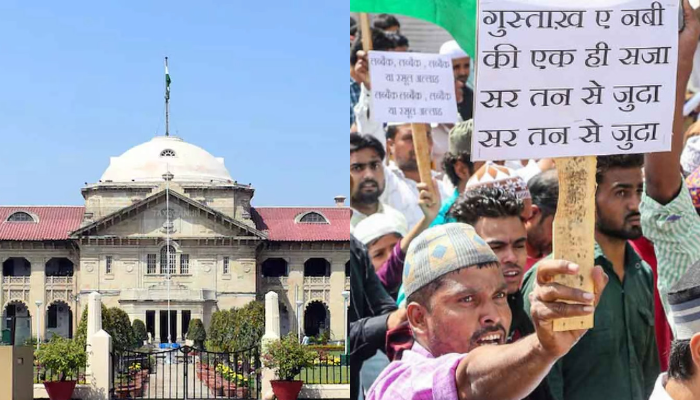
On 17th December (Wednesday) the Allahabad High Court pronounced a landmark judgement regarding the slogan “gustakh-e-nabi ki ek saja, sar tan se juda, sar tan se juda (the only punishment for insult to prophet is beheading),” during the bail hearing of Bareilly violence accused named Rihan. The case pertains to the violence amid “I love Muhammad” row.
Justice Arun Kumar Singh Deshwal stated that the slogan undermines India’s sovereignty, integrity and legal authority. The plea for bail was also rejected. OpIndia has a copy of the order.
Rihan had been booked under sections 109(1), 109(2), 118(2), 121(1), 189(5), 191(2), 191(3), 195(1), 196(1), 196(2), 223, 310(2), 324(5), 324(6), 61(2), 62 BNS, 7 Criminal Law Amendment Act and Section 3/4 Prevention of Damage of Public Property Act.
The applicant’s lawyer alleged that he “has been falsely implicated and he was arrested from his home, but the police falsely claimed his arrest from the spot.” He added, “Rihan has no criminal history and there is no incriminating material against him. Therefore, he is entitled to be released on bail during the investigation/trial.”
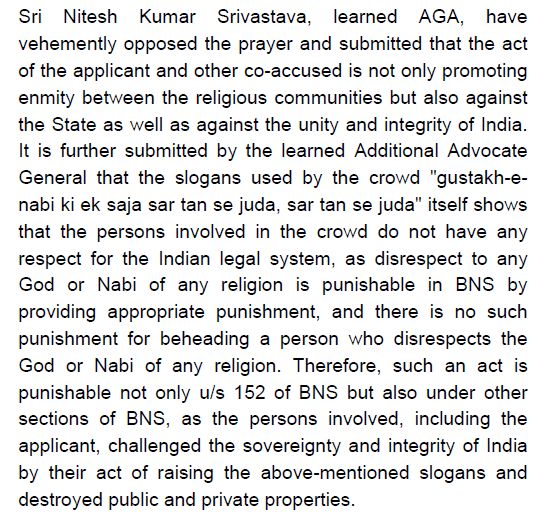
However, the prosecution led by Additional Advocate General for the State of Uttar Pradesh, Anoop Trivedi fiercely objected to the prayer and maintained that the actions of Rihan and the other co-accused were against the state, the unity and integrity of India and religious communities.
It was argued that the use of the slogans “gustakh-e-nabi ki ek saja sar tan se juda, sar tan se juda” demonstrated their disdain for the Indian legal system, since insult to any God or prominent figures of any religion is criminalised in Bharatiya Nyaya Sanhita (BNS) through appropriate punishment. “There is no such punishment for beheading a person who disrespects the God or Nabi of any religion,” the prosecution added.
As a result, such a conduct carries penalties not only under section 152 of the BNS, but also under other sections of the BNS. The prosecution mentioned that the individuals involved, including the applicant, threatened India’s sovereignty and integrity by shouting the aforementioned slogans and destroying public and private property.
Allahabad High Court’s decision
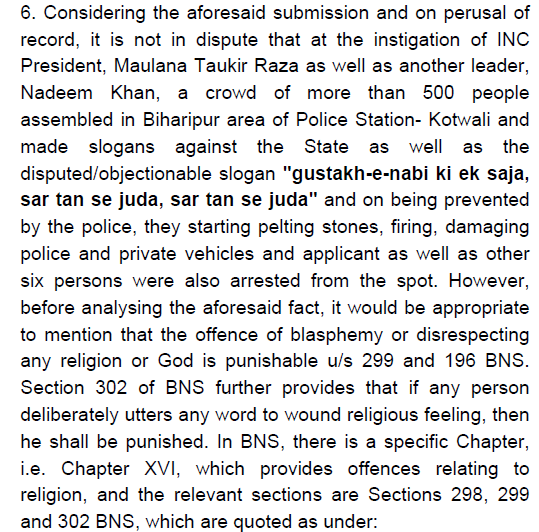
The high court noted that the role of Maulana Taukir Raza, Nadeem Khan and the 500 people who assembled in Biharipur area and raised slogans against the state alongside the controversial “gustakh-e-nabi ki ek saja, sar tan se juda, sar tan se juda” was “not in dispute.” It also acknowledged that violence was carried out due to the inflammatory remarks of Maulana Taukir Raza.
According to BNS 299 and 196, blasphemy and disparaging any faith or God are crimes. Additionally, section 302 of the BNS stipulates that anyone who intentionally uses a word to offend someone’s religious feelings would be punished. Sections 298, 299 and 302 BNS are the pertinent sections of Chapter XVI of the BNS, which contains violations pertaining to religion.
The court specifically emphasised the particular provisions and the penalties imposed on the convicts of such actions. It observed, “From the perusal of the above section, it is clear that BNS has taken care of all such situations where any person disrespects any religion or its God, Prophet, Guru or attempts to promote enmity between the religious groups by chanting any slogan or visible representation, then appropriate punishment has also been provided.”
The court held that using the slogan is tantamount to subverting India’s integrity and sovereignty as well as the country’s legal system, which is founded on serious constitutional goals and democratic ideals.
The genocidal slogan is a challenge to Constitution and legal system
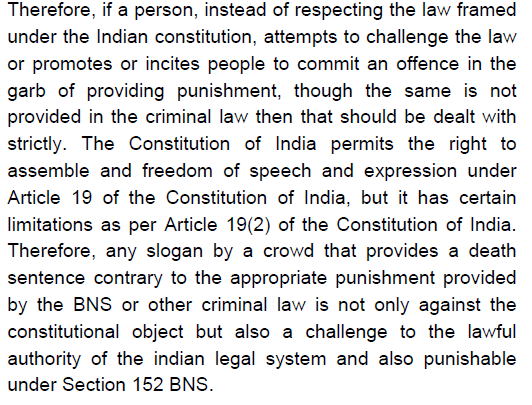
“The Constitution of India provides freedom of speech and expression as well as other liberties to all Indian citizens irrespective of their caste, creed or religion. Therefore, if a person, instead of respecting the law framed under the Indian constitution, attempts to challenge the law or promotes or incites people to commit an offence in the garb of providing punishment, though the same is not provided in the criminal law then that should be dealt with strictly,” the order read.
The court outlined that Article 19 of the Indian Constitution guarantees the freedom of speech and expression as well as the right to assemble. However, Article 19(2) of the Indian Constitution places restrictions on these rights. Thus, any slogan that calls for murder in contrast to the proper punishment stipulated by the BNS or other criminal laws is not only contrary to the constitutional intent but also contests the legitimacy of the Indian legal system and is punishable under section 152 BNS.
The judge highlighted slogans from various faiths, such as “Jai Shree Ram,” “Har Har Mahadev,” “Jo bole so nihaal, Sat Sri Akal,” and even “Nara-e-Takbir Allahu Akbar,” to show that these calls to devotion or proclamation uttered by an individual or a group of people are not illegal unless they are employed vilely to intimidate adherent of a different religion.
He stated that the phrase “gustakh-e-nabi ki ek saja sar tan se juda, sar tan se juda” does not appear in the Quran or any other Muslim holy scripture, but is often used by the community who is unaware of its true meaning and consequences.
Origin of “gustakh-e-nabi ki ek saja”
The Allahabad High Court pointed out that the blasphemy law was established by the British in 1927 in response to the communal strife between Hindus and Muslims. It conveyed how the blasphemy laws in Pakistan were turned harsher after the partition and recounted the accusations against Christian woman Asia Bibi, which received international attention.
The court mentioned that the Governor of Punjab, late Salman Taseer’s support to her sparked unrest in the nation and led to the emergence of the notorious slogan. Taseer was killed by his bodyguard while extremists took to the streets under the guidance of Islamist Tehreek-e-Labbaik Pakistan‘s (TLP) late supremo Khadim Hussain Rizvi.
The order revealed that the Pakistani hardliner Rizvi was the one to use the slogan for the first time “and thereafter this slogan also spread to other countries including India and has been widely misused by certain Muslims just to intimidate the people of other religions and also to challenge the authority of the state.” The court reiterated that the slogan widely heard in the streets of India “is nothing but used to challenge the authority of law and sovereignty of India and also to incite people for armed rebellion.”
The court referenced the life of Prophet Muhammad to illustrate instances of kindness that the prophet reportedly showed towards his neighbours and repeated that it was evident that the slogan “gustakh-e-nabi ki ek saja, sar tan se juda, sar tan se juda” raised by an individual or by a crowd questions the authority of the law as well as the sovereignty and integrity of India because it encourages armed rebellion. Hence, this act would be penalised under section 152 BNS.
Judge rejects the bail application
The court confirmed that “it is not in dispute that such a disputed or objectionable slogan was used by the crowd of thousands of people assembled at the instigation of Maulana Taukir Raza.” It also affirmed the criminal conduct of Maulana Taukir Raza and the Islamist throng despite the police’s objections along with the violence directed at cops which prompted the arrests of several perpetrators including Rihan.
The judge emphasised, “There is sufficient material in the case diary showing that the applicant was part of an unlawful assembly which not only raised objectionable slogans challenging the authority of the Indian legal system but also caused injuries to police personnel and damaged public as well as private property, which is nothing but an offence against the state and he was arrested from the spot. Therefore, this court does not find any ground to release the applicant on bail.”
He further concluded, “Accordingly, the bail application of the applicant is rejected.”
Background of the case
The prosecution informed that on 26th May, a formal complaint was lodged charging that Maulana Taukir Raza Khan, President of the Ittefaq Minnat Council, had called on the Muslim community to gather at Islamia Inter College in order to protest the state’s atrocities and alleged false charges against Muslim youth. On 25th September, police were informed that Raza and Nadeem Khan, one of the INC’s leaders, had encouraged members of the Muslim community to gather on Islamia Inter College grounds following the conclusion of namaz on 26th September.
Police asked the crowd not to proceed. Furthermore, section 163 Bharatiya Nagarik Suraksha Sanhita (BNSS), which forbids any gathering of more than five people was also implemented in the district. Afterward, the first informant, who was stationed close to Nadeem Khan’s home in Biharipur, discovered that he had encouraged people to gather and head for Islamia Inter College. A mob emerged from Nadeem Khan’s home as well.
He also exited the place to provoke people elsewhere. It was then discovered that 500 people gathered in Biharipur and began shouting slogans against the government and “gustakh-e-nabi ki ek saja sar tan se juda, sar tan se juda.” Police attempted to stop them, but they started snatching their canes and ripping off their uniforms.
When the cops objected, the mob hurled petrol bombs, fired shots and threw stones which injured many personnel and damaged several police personnel along with private vehicles. Seven people, including Rihan, were immediately taken into custody. The names of other people, consisting of the primary suspects, Maulana Taukir Raza and Nadeem Khan, emerged based on their accounts.
An FIR (First Information Report) was filed against 25 named and 1700 unknown individuals in line with the statements of these detainees and the identification of other co-accused. Police then captured other named suspects and identified anonymous persons according to evidence gathered from the held individuals, independent witnesses and CCTV footage.
The real-life effects of the radical slogan
Multiple occurrences, such as the shocking beheading of Kanhaiya Lal and the murder of Kamlesh Tiwari, whose throat was slit by two Islamist fanatics, highlight the fact that “gustakh-e-nabi ki ek saja, sar tan se juda, sar tan se juda” constitutes a real threat to the lives of non-Muslims, especially Hindus. Multiple Hindu leaders, including former Bharatiya Janata Party leader Nupur Sharma and Yati Narsighanand Saraswati of the Dasna Devi Temple, have faced similar threats over accusations of showing ‘disrespect’ towards the Prophet of Islam.
Essentially, a target is placed on the back of anyone regarded as a blasphemer, regardless of the truth. This slogan not only stir up violence directly but, as the order rightly indicated, is a serious threat to India’s Constitution and legal system. It also exemplifies how Muslims in Pakistan target their shrinking minorities, particularly Hindus, while similar actions are being attempted in India by Muslim fundamentalists.
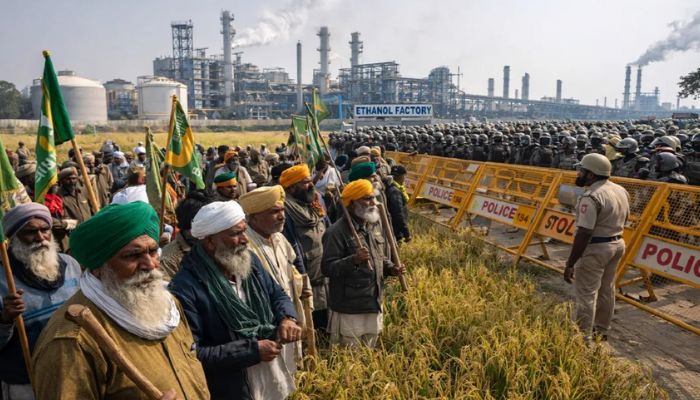
Massive protests were witnessed in the Hanumangarh district of the Rajasthan state on Wednesday, 17th December, where a large gathering of farmers was witnessed during the mahapanchayat that has been organised against the biggest ethanol production facility in Asia. The protest that took place at the Junction Dhan Mandi has caused quite a stir in the region, where the farmers have raised vocal slogans such as “Factory band karo,Kisan Bachao.”
Although the meeting was relatively peaceful, there was a sense of tension present. The government, in anticipation of violence, continued with strict measures on the fourth day running, including the ban on the internet, imposition of Section 144, and a strong police presence in the district.
At the root of this protest is the deep-seated fear of the farmers about this ethanol unit damaging their land and depleting their water resources and the future of the coming generations. At the same time, questions are being raised over whether the agitation is purely a local farmers’ issue or if political interests and external groups are fuelling the unrest, especially with the visible presence of farmer unions from neighbouring Punjab.
Ethanol plant at the centre of the storm
Tibbi, a part of the Hanumangarh area, has been renowned for its fertile land and an agriculture-based economy. The farmers of this area have been utilising the groundwater resources and canals for irrigation purposes and have been facing challenges associated with electricity shortages and decreasing levels of water. The issue started getting raised in the year 2023 when the then Congress party of the state chose a proposed ethanol plant project of the Punjab-based firm Dune Ethanol Private Limited for funding to the tune of ₹450 crores.
The proposed plant was expected to manufacture ethanol using rice husks. This was supposed to create jobs, offer the farmer a fair price for farm waste, as well as conserve the environment through the promotion of ethanol as a cleaner fuel alternative to petrol.
However, farmers did not believe these assurances. As per their claims, Hanumangarh is already experiencing drought-like conditions, as water levels in groundwaters have gone below 100 feet. They feel that this unit is also going to utilise water to the extent of 50 to 60 lakh liters every day.
Besides water, pollution is another big issue here. According to farmers, harmful gases like methanol and carbon dioxide are also produced by emissions from the factory, which can cause respiratory and cancer-related problems. Even as environmental clearance has been given by the Pollution Control Board, natives argue that the EIA study has been done on paper, without taking into account realities on the ground.
How the protests turned violent earlier this month
This unrest has not broken out in a single day. On 10th December, a mahapanchayat was held at Tibbi, where farmers marched towards the plant site in anger. This time, the situation got heated with machines vandalised, vehicles set on fire. The police unleashed a lathi charge on the protesters, resulting in at least 16 farmers being injured, while 40 protesters were arrested. This incident has led to tension among the farm community.
Following this, there were negotiations between the government and farm union representatives on 12th December. A deal was struck regarding the formation of a committee to look into their grievances, and, subsequently, a pause in the construction activities at the spot. However, farm unions, particularly the Samyukt Kisan Morcha, labelled this attempt as an “eyewash” and said that only a complete withdrawal of their project would assuage their anger.
However, this unsettled anger ultimately resulted in the huge mahapanchayat on Wednesday, 17th December.
Mahapanchayat Day: Calm on the surface, tension beneath
The mahapanchayat started around 12 pm on Wednesday, 17th December at Junction Dhan Mandi. From early morning, long lines of tractors could be seen entering the town, though authorities imposed restrictions on tractor movement to maintain order.
Security was tight. Internet services remained suspended, drones hovered over the area, Section 144 was in force, and senior officials, including District Collector Khushal Yadav, were present on the ground. Despite the heavy security presence, farmers maintained discipline, and no violent incidents were reported.
Addressing the crowd, former MLA Balwan Poonia of the Communist Party accused the government of signing an MoU with the company without consulting farmers. “We will not step back until the MoU is cancelled,” he declared.
Farmer leaders from Punjab also took the stage, warning that if the factory is allowed to operate, protests would spread beyond Rajasthan. “This is not just Rajasthan’s issue, it is a national’ issue,” one Punjab-based leader said, drawing parallels with the 2020–21 farmers’ agitation.
However, some local farmers expressed discomfort with the growing involvement of outsiders, saying they only wanted to protect their land and livelihoods, not turn the issue into a national political movement.
Farmers place three clear demands before the administration
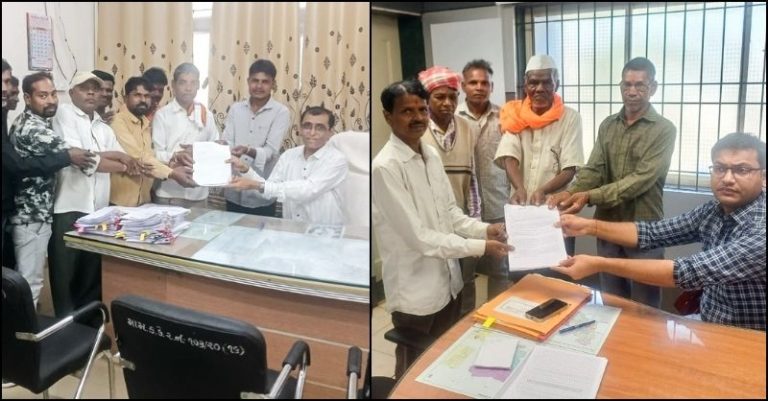
During the mahapanchayat, officials held discussions with farmer representatives. The protesters placed three key demands before the administration: immediate cancellation of the MoU signed with the ethanol company, withdrawal of all cases filed against farmers during the protests, and the formation of a genuinely impartial investigation committee.
The administration assured farmers that their demands would be conveyed to the state government. Farmers, however, gave a clear deadline of 20 days and announced another mahapanchayat on 7th January in Sangaria if their demands remain unmet.
“We will continue our protest peacefully, but we will not surrender,” said a farmer. “The government must understand that farmers are not weak.”
Political blame game comes to the fore
Politics has become deeply intertwined with the movement. Critics point out that it was the Congress government that approved the ethanol project in 2023, yet now Congress leaders are among the loudest voices opposing it. Congress MLA from Sangaria, Abhimanyu Poonia, accused the BJP-led state government of favouring corporates over farmers. “Lathi charges and arrests show the government’s true face,” he said at a press conference.
Interestingly, FIRs related to the 10th December violence also name Congress MPs and MLAs. Balwan Poonia dismissed the allegations, calling the violence a “government conspiracy” to defame the movement. The BJP, on the other hand, accuses the Congress of hypocrisy and instigating unrest for political mileage.
Punjab’s role raised eyebrows, old memories return
The involvement of farmer groups from Punjab has added another layer of complexity. Leaders from the Bharatiya Kisan Union and the Samyukt Kisan Morcha arrived in large numbers, reviving slogans and rhetoric from the 2020-21 farmers’ protest.
“If farmers lose in Rajasthan, Punjab will also rise,” warned a Punjab-based leader. Others spoke of cross-border solidarity among farmers. However, many locals remain sceptical. “These people look like professional protesters,” said an elderly farmer. “They come, ignite the fire, and leave. We are the ones who suffer.”
Administration sets up committee, situation temporarily calms
In response to mounting pressure, the administration formed a five-member committee led by the divisional commissioner, with the district collector and subject experts as members. The committee will examine issues related to groundwater depletion, pollution, and water availability. Construction work at the factory site will remain halted until the committee submits its report.
Still, farmer leaders remain cautious. “A committee is fine, but unless the MoU is cancelled, we will not stop,” said one leader, adding that preparations for the 7th January mahapanchayat are already underway.
2025 is nearing its conclusion and we will enter the new year in a few days. The current year has been marked by many success stories for India. The country has made substantial progress in various sectors, including economy, infrastructure, defence and digitisation, among others. Likewise, India has excelled in the field of science, space and technology. The Indian Space Research Organisation (ISRO) has established itself as a powerhouse, achieving significant accomplishments in 2025, just as it has done consistently over the years, bringing pride not only to its fellow citizens but to the entire scientific community around the world.
On 17th December (Wednesday), the Department of Space (DoS) presented a comprehensive overview of the key milestones reached by the nation in 2025, which have added more feathers to the golden cap of its glorious feats in this domain.
SpaDeX Mission demonstrated docking, undocking, power transfer technology and circumnavigation experiment
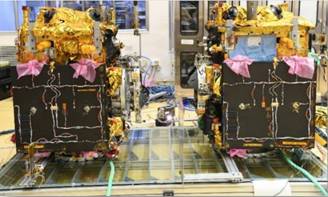
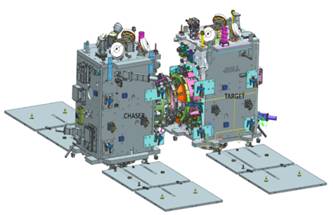
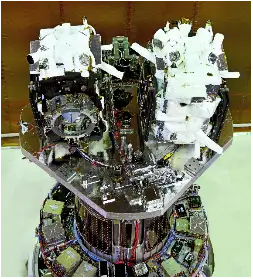
On 30th December of last year, PSLV-C60 successfully sent the SPADEX (Space Docking Experiment) satellites into a targeted 474-kilometre circular orbit. On 16th January, the two spacecraft successfully docked in orbit.
Spadex Satellites (Source: PIB)
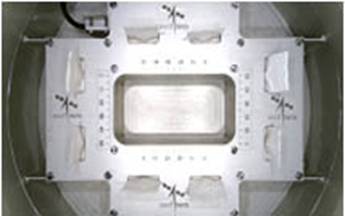
The country’s crucial indigenous technologies for its Space Vision 2047 were showcased by this pivotal mission. It comprised of sensors, control algorithms, docking and undocking, power transfer between satellites, circumnavigation alongside exclusive mission planning and operations, all of which were tested in orbit.
Docking mechanism (Source: PIB)
The SPADEX platform and spaceship docked once more on 20th April following ground simulations and in-space evaluations based on the initial docking, undocking and circumnavigation. The next day, the spacecraft transitioned to joint control mode and power transfer between them was successfully tested.
CROPS breakthrough in biological research in space
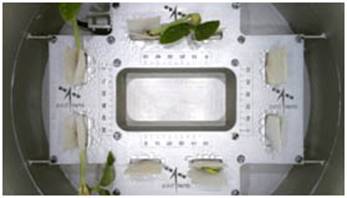
Compact Research Module for Orbital Plant Studies, also known as CROPS is an unmanned experimental module that aids ISRO to cultivate and care for plants in space. The goal of the first mission, CROPS-1, was to demonstrate plant growth and seed germination in orbit up to the two-leaf stage.
CROPS image from orbit on 30th December 2024 (Source: PIB)
During the PSLV-C60 mission, CROPS-1 travelled as a payload on the POEM-4 platform to evaluate plant survivability and seed germination for five to seven days. After ground tests on a variety of seeds, cowpea (Vigna unguiculata) was chosen owing to its rapid germination time.
The CROPS-1 payload was activated after the POEM platform descended to a 350 kilometre orbit post the main satellite’s launch and separation. The temperature was properly regulated between 20 and 30 degrees Celsius and all systems performed as intended. Ground controllers added water to the soil by opening an electronic valve approximately ninety minutes later.
CROPS image from orbit on 6th January 2025 (Source: PIB)
Seed germination was detected by elevated carbon dioxide levels in data from later orbits. Seeds started to emerge from their encased tissue strips on the fourth day. The sprouts had two leaves on the fifth day, meeting the mission objectives.
National conference on the release of Aditya L1 data and evaluation of payload performance
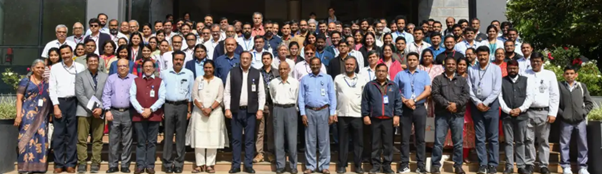
The first set of scientific data from India’s groundbreaking solar observatory, Aditya-L1, was made available to scientists worldwide on 6th January at ISRO Headquarters in Bengaluru. Aditya-L1 entered its halo orbit around the first Lagrange point (L1) of the Sun-Earth system one year ago on this date. Forty scientists, academics and students from fifteen Indian institutions and research facilities attended the national gathering.
National Meet on Aditya L1 Data Release (Source: PIB)
All seven of the mission’s on-site and remote-sensing investigations were included in the preliminary datasets. The performance of the spacecraft’s instruments was reviewed after the event. On 14th February, a second set of data was made available by ISRO. Together with direct observations of particles and magnetic fields at L1, these datasets offered substantial understanding into the Sun’s surface (photosphere), lower atmosphere (chromosphere) and outer atmosphere (corona).
Third Launch Pad approved by Modi government
The Third Launch Pad (TLP) at ISRO’s Satish Dhawan Space Centre in Andhra Pradesh’s Sriharikota had been approved by the central government. The project aims to build the launch infrastructure for ISRO’s Next Generation Launch Vehicles there as well as serve as a backup launchpad for the Second Launch Pad. Moreover, this is going to boost the launch capacity for upcoming human spaceflight missions from India.
ISRO’s 100th launch from India’s spaceport
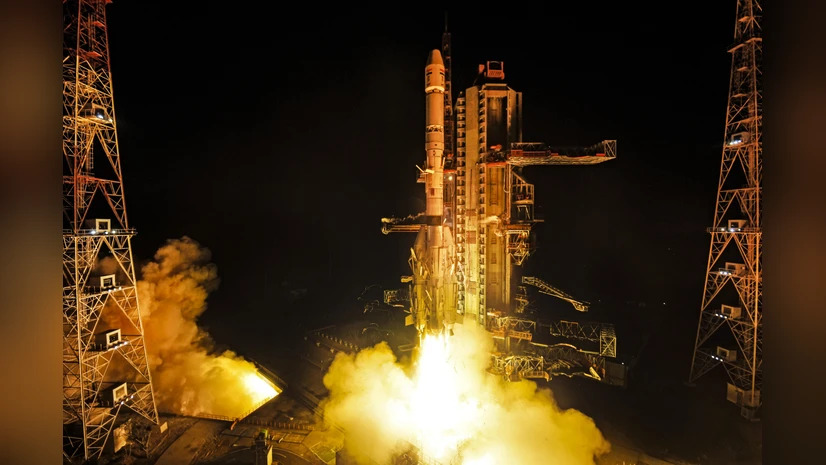
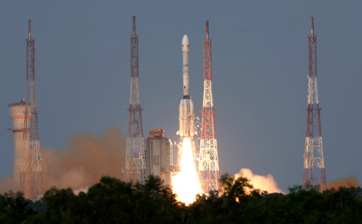
The 17th GSLV rocket mission from the Sriharikota spaceport on 29th January witnessed ISRO’s 100th launch. The NVS-02 navigation satellite went into the intended Geosynchronous Transfer Orbit by the mission. The orbit was attained with great accuracy and every stage of the rocket operated flawlessly.
Image via PTI
However, the valves for supplying oxidiser to the thrusters did not open, making it impossible to raise the orbit and transport the satellite to its ultimate position. The satellite has since settled in an elliptical orbit and its systems are in good condition.
PSLV Orbital Experimental Module completed 1000 orbits
The PSLV Orbital Experimental Module (POEM-4), the fourth stage of the PSLV, carried 24 payloads: 10 from non-governmental organisations and 14 from ISRO. Every payload effectively completed the intended experiments in orbit. On 4th March, POEM-4 completed 1,000 orbits.
Image via PIB
Space robotics experiments, bacterial growth and seed germination in microgravity, green propulsion, laser activation of thrusters, amateur radio signals, and sophisticated sensors were all tried out.
An AI (Artificial Intelligence) model was uploaded and executed by a space startup as part of an in-orbit AI lab. POEM-4 surpassed the previous three POEM flights to hold the record for the most payloads of any mission to date and yet again displayed its worth as an affordable, adaptable platform for an array of experiments.
First 32-bit microprocessors made in India for space applications
The Semiconductor Laboratory (SCL) in Chandigarh hosted an event in New Delhi on 5th March, where S. Krishnan, Secretary of MeitY, presented the first batches of two 32-bit microprocessors for space use, VIKRAM3201 and KALPANA3201, to Dr. V. Narayanan, Secretary of DOS and Chairman of ISRO.
ISRO’s Vikram Sarabhai Space Centre collaborated with SCL to design and manufacture these microprocessors.
Image via PIB
The IEEE 1754 Instruction Set Architecture serves as the foundation for the 32-bit SPARC V8 RISC CPU KALPANA3201. It has been tested using actual flying software and supports both custom simulators and development environments in addition to open-source software tools.
Centre of Excellence at IIT Madras
On 17th March, the “Centre of Excellence (CoE) for Research in Fluid and Thermal Sciences” was opened at the Indian Institute of Technology (IIT)-Madras by the Chairman of ISRO and the Secretary of DoS. The institution is called the S Ramakrishnan Institution of Excellence in commemoration of the prominent space scientist and former director of ISRO’s LPSC and VSSC. He graduated from the institution as well.
On 11th November 2024, ISRO and IIT Madras signed a Memorandum of Understanding (MoU) to create the facility. It would be used to address thermal and fluid-related issues pertaining to the design, analysis and testing of different fluid-thermal components of ISRO’s launch vehicles and spacecraft.
Firing life test of Stationary Plasma Thruster (SPT) for 1000 hours
ISRO successfully finished the 1000-hour life test of the 300mN Stationary Plasma Thruster, which is designed to be integrated into satellite electric propulsion systems, on 27th March. Future ISRO satellites are expected to replace their chemical propulsion systems with electric propulsion systems. It is set to open the door for communication satellites that only rely on electric propulsion mechanisms for station maintenance and orbit acceleration.
This initiative would lead to major mass savings, which would allow the transponder capacity of communication satellites to be raised. These thrusters are propelled by xenon. An essential performance metric for a space propulsion system is the Specific Impulse of the Electric Propulsion System, which is at least six times greater than that of the Conventional Propulsion System.
The erosion of electrode liners was routinely seen during the life test, which was conducted at a full power level of 5.4 kilowatts in a room that mimics the vacuum conditions of space.
ISRO takes charge of “International Charter Space and Major Disasters” for 6 months
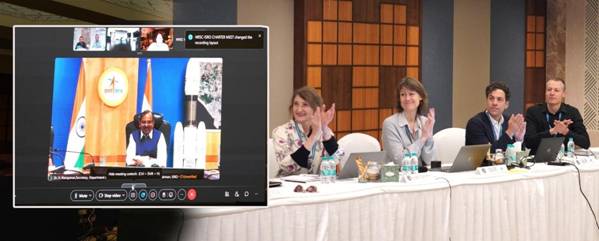
India assumed the six-month lead role in the “International Charter Space and Major Disasters” through ISRO. The development which happened in April illustrated strong leadership in space-based catastrophe management. Major international space organisations and 22 foreign delegates attended the 53rd meeting of the Charter, which was held in Hyderabad from 14th to 17th April, at ISRO’s National Remote Sensing Centre (NRSC).
Image via PIB
India is not only a signatory but also a founder member of the Charter, which celebrated its 25th anniversary this year. It is a framework for collaboration between 17 organisations that exchange Earth observation data and practical goods for use in catastrophe management across the globe.
NRSC/ISRO had to employ space tools to spearhead the Charter’s worldwide emergency responses during the next six months. This include managing activation requests, promptly disseminating products, directing strategy and assisting with outreach, training and capacity-building initiatives.
ISRO satellites predict the yield of wheat
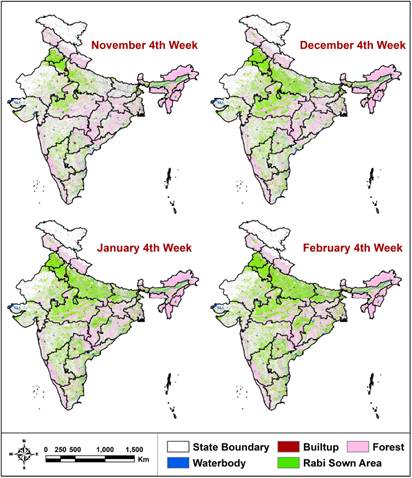
According to a study conducted by ISRO utilising remote sensing satellites, as of 31st March, the combined wheat production from India’s eight major wheat-growing states would be 122.724 million tonnes. NRSC/ISRO created a semi-automated and scalable system called Agricultural (Comprehensive Remote Sensing Observation on Agricultural Progress). It allows for the live tracking of sowing and harvesting throughout India in the Rabi season.
This method used Optical and Synthetic Aperture Radar (SAR) remote sensing datasets from EOS-04 (RISAT-1A), EOS-06 (Oceansat-3) and Resourcesat-2A for the Rabi season, 2024–2025. It methodically assessed the progress of wheat-sown stretches and the general crop condition across the country’s regions.
Image via PIB
The satellite data disclosed that 330.8 lakh hectares of wheat had been sown by 31st March, near to the figures, 324.38 lakh hectares, produced by the Ministry of Agriculture and Farmers Welfare as of 4th February. A process-based crop growth simulation model with a 5-kilometre by 5-kilometre spatial resolution incorporates satellite-derived characteristics, involving crop area, sowing date information and in-season crop condition, to conduct an experimental evaluation of wheat output at the national level.
NE-SPARKS: Program for Northeast students
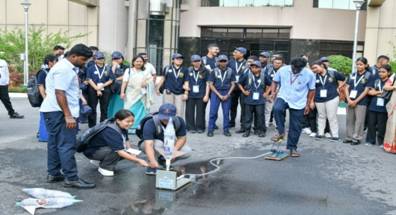
The North East Students Programme for Awareness, Reach, and Knowledge on Space (NE-SPARKS) is a ground-breaking program designed to stimulate students from India’s North Eastern Region (NER) with an interest in space science and technology. Through trips to ISRO Centres in Bengaluru, this program aspires to address geographical and informational barriers by offering students a comprehensive knowledge of India’s breakthroughs in space research and exploration.
Image via PIB
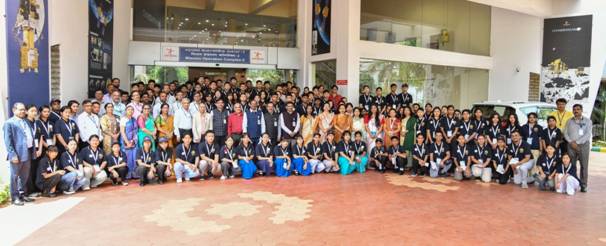
From April to December, the program would be conducted in eight batches at least one month apart. Approximately 700 students in seven batches have so far had the chance of experiencing state-of-the-art technology and engage with renowned scientists and engineers via a meticulously organised guided tour. Students are able to envision a career in STEM (science, technology, engineering, and mathematics) after learning about ISRO’s mission to explore the unknown.
Image via PIB
Students had the opportunity to visit the Satellite Control Centre (SCC), Mission Operations Complex (MOX), and the Indian Deep Space Network (IDSN) at Byalalu, gaining first-hand insight into satellite operations and deep space communications. They also visited UR Rao Satellite Centre (URSC), exploring spacecraft integration facilities and the URSC exhibition area. They had also visited the Jawaharlal Nehru Planetarium with a fascinating lecture and planetarium show on Gaganyaan.
GLEX 2025 comes to India: Developing global routes in space exploration
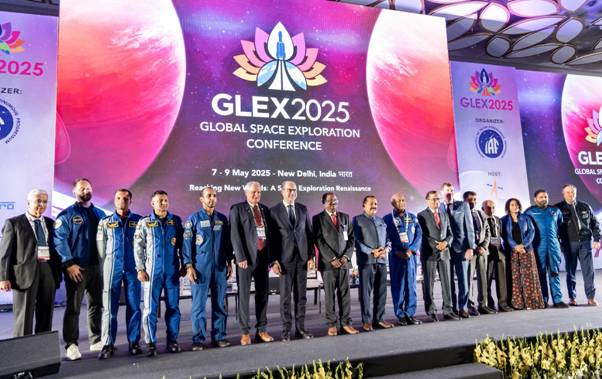
An important turning point in international cooperation was reached during the Global Space Exploration Conference (GLEX) 2025, which took place in New Delhi from 7th to 9th May. ISRO and the International Astronautical Federation’s (IAF) Astronautical Society of India (ASI) co-hosted the program.
Image via PIB
Leaders, astronauts and scientists from more than 35 nations attended the prestigious conference with the theme “Reaching New Worlds: A Space Exploration Renaissance,” underlining India’s fundamental role in global space diplomacy and innovation. GLEX 2025 presented international progress in space exploration with over 240 interactive presentations spread throughout 10 technical sessions and 15 subject sections.
PSLV-C61/EOS-09 Mission
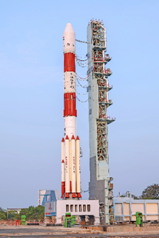
The PSLV-C61 mission, ISRO’s 101st launch effort, planned to deploy the 1,696-kilogram EOS-09 Earth Observation Satellite into a 505-kilometre Sun-Synchronous Polar Orbit. It improved India’s all-weather radar imagery for agriculture, disaster management and surveillance. PSLV-C61 was the Polar Satellite Launch Vehicle’s 63rd mission and the 27th to execute the PSLV-XL variant.
Image via PIB
Launch was attempted on 18th May, and PSLV-C61 performance was standard until the second stage. The mission could not be concluded because of an observation made in the third stage.
Third hot test of Semi-Cryogenic Engine Power Head Test Article completed successfully
ISRO started a series of performance evaluation examinations for the Power Head Test Article (PHTA) of the Semicryogenic combustion engine in March 2025, which includes all engine systems except the thrust chamber. The purpose was to check the design of the propellant feed system, which comprises a pre-burner, start system, control components, low-pressure and high-pressure turbo-pumps.
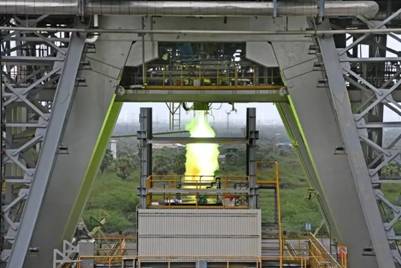
The Power Head Test Article (PHTA) underwent a third hot test on 28th May at the ISRO Propulsion Complex (IPRC) in Mahendragiri. The goal was to confirm the engine’s ignition and start-up sequence and identify the optimal sequence for the integrated engine.
Image via PIB
The engine successfully ignited and ran at 60% of its rated power output during the test, exhibiting steady and regulated performance. Two hot tests have already been conducted on the PHTA. The first test, which took place on 28th March, showed that the bootstrap and ignition processes ran smoothly for about 2.5 seconds.
In the second hot test, conducted on 24th April, a 3.5-second hot-firing was used to test the start-up procedure and exhibit the start transient build-up. The third test was carried out on 17th December and lasted for three seconds in order to further refine and complete the start-up routine.
The present liquid core stage (L110) of the LVM3 launch vehicle shall be replaced with the Semi-Cryogenic Propulsion Stage (SC120), which is powered by the 2000 kN (kilonewton)-class SE2000 engine, with the intention to expand its payload capability.
ISRO Academia Connect Workshop at Bhopal’s MANIT
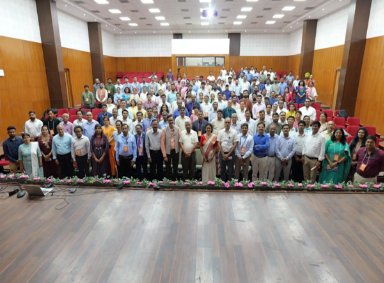
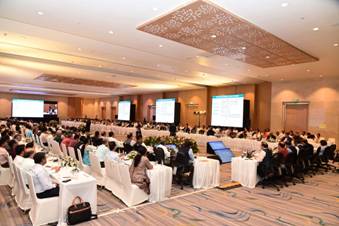
On 22nd May, ISRO hosted a one-day Academia Connect workshop at Maulana Azad National Institute of Technology (MANIT), Bhopal, for the central parts of the country, such as Madhya Pradesh, Uttar Pradesh and Chhattisgarh. Dr. K. K. Shukla, Director of MANIT Bhopal and M. Ganesh Pillai, Scientific Secretary of ISRO, also attended when Dr V. Narayanan inaugurated the workshop.
Image via PIB
Senior scientists from ISRO and DoS Centres delivered presentations on an assortment of prospective space science and technology research areas where ISRO and academia might work together. More than 200 academics and researchers from 70 engineering colleges and universities from the three states joined the event.
First Indian to ISS: Shubhanshu Shukla’s Axiom-04 Mission
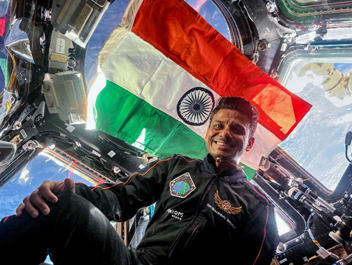
Shubhanshu Shukla, an ISRO astronaut, successfully completed the Axiom-04 mission and returned to Earth. This was a momentous occasion for the space agency and India. He spent 18 days aboard the International Space Station (ISS). The European Space Agency (ESA), National Aeronautics and Space Administration (NASA), Axiom Space and other international organisations collaborated to perform the mission on a SpaceX Dragon spacecraft on 25th June.
Image via PIB
Shukla did an outstanding job of adjusting to the microgravity environment during his time on the International Space Station. He remained in excellent health during the journey despite the psychological and physical demands of spaceflight. He documented life and work in orbit with multiple images and videos.
He accomplished a series of seven microgravity experiments created by Indian scientific institutes under the supervision of the Human Space Flight Centre (HSFC). With the goal of improving knowledge of human spaceflight and microgravity science, these trials investigated muscle regeneration, algal development, crop viability, microbial survivability, cognitive performance in space and cyanobacteria behaviour.
Image via PIB
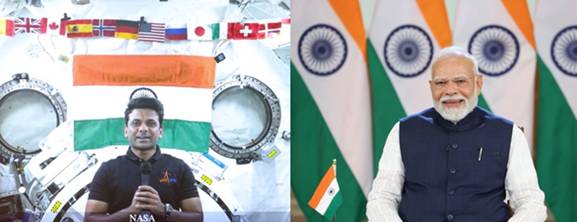
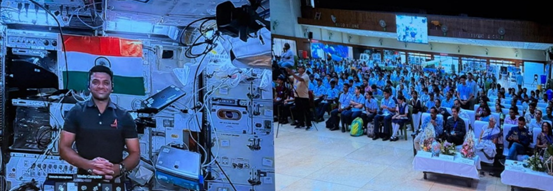
Strong public outreach was part of the objective to inform India’s citizens and young people about its space achievements, outlining patriotism and inspiring the following generation. Shukla also spoke with Prime Minister Narendra Modi via live video conversation from the International Space Station on 28th June.
The latter conveyed the happiness of the country at seeing the Indian flag in orbit and commended his part in the country’s space journey. Millions of Indians watched the event, which turned into an important turning point for India’s space alliances.
Image via PIB
Shukla also engaged with schoolchildren in Trivandrum and Lucknow on 3rd July. He answered multiple questions about life on the International Space Station and how to become an astronaut.
ISRO-STC Confluence 2025 at IIT Kharagpur
On 1st and 2nd July, the Indian Space Research Organisation and IIT-Kharagpur hosted the second ISRO-STC (Space Technology Cell) Confluence. Dr. V Narayanan inaugurated the event and issued the ISRO-STC Confluence Proceedings in the presence of ISRO’s Scientific Secretary and Director of IIT-Kharagpur.
Image via PIB
It is an extensive compilation of certain research projects from the nine Space Technology Cells (STCs) that ISRO established in the nation’s top universities. These initiatives have proved considerable technological value and have directly impacted numerous ISRO missions in areas including as spacecraft systems, propulsion, sensors, materials and AI applications.
Department of Space hosts Chintan Shivir for Space Vision 2047 and beyond
The Department of Space (DoS) arranged a three-day workshop, “Chintan Shivir 2025,” from 16th to 18th July, in accordance with the directive of PM Modi. The aim was to push the strategies, action plans, milestones and more, for achieving the goals laid out in Space Vision 2047 alongside evolving space vision beyond that year. The theme, “Implementing Space Vision 2047 and Looking Beyond,” was in line with that objective.
Image via PIB
Experts from ISRO, NewSpace India Limited (NSIL), Indian National Space Promotion and Authorisation Centre (IN-SPACe), DoS and other independent DoS institutes came together for the workshop and sketch out a comprehensive roadmap for DoS. Eleven key domains, space transportation, space infrastructure, space applications, human space exploration, supporting Indian space industries and space business were the focus of the deliberations.
NISAR Mission: Historic growth in Indo-US space partnership
On 30th July, ISRO’s GSLV-F16 launched NASA-ISRO Synthetic Aperture Radar (NISAR), the first joint satellite of ISRO and NASA, from Satish Dhawan Space Centre (SDSC SHAR) in Sriharikota. Weighing 2392 kilograms, NISAR is a special earth observation satellite that was the first to use a dual frequency Synthetic Aperture Radar (NASA’s L-band and ISRO’s S-band) to study the planet.
NASA’s 12 metre unfurlable mesh reflector antenna was fitted onto ISRO’s modified I-3K satellite bus or the INSAT 3000. For the first time, NISAR deployed SweepSAR (Swept Synthetic Aperture Radar) technology to observe Earth with a 242-kilometre swath and high spatial resolution.
Image via PIB
The launch was the culmination of over a decade of close technical partnership between ISRO and NASA/JPL (Jet Propulsion Laboratory) technical teams.
The satellite allows for a multitude of uses by scanning the entire planet and providing all-weather, day and night data at 12-day intervals. Even minute alterations in the Earth’s surface, consisting of vegetation dynamics, ice sheet movement and ground deformation, can be detected by NISAR.
Image via PIB
Sea ice classification, ship detection, coastline monitoring, storm characterisation, changes in soil moisture, surface water resource mapping and monitoring, as well as disaster response are its additional applications.
ISRO’s Space Analogue Mission in Ladakh
The goal of the Indian Human Spaceflight Programme, a national initiative headed by ISRO, is to increase human presence across the solar system by accomplishing an Indian Crewed Lunar Landing by 2040 and commencing with human spaceflight flights to Low Earth Orbit (LEO).
This necessitates conducting systematic studies to collect the essential Indian subject data for tackling the many physiological, psychological and operational issues associated with human space flight missions. Hence, ground-based analogue missions in environments that mimic some characteristics of a normal human space mission offer a chance to comprehend the hazards to human performance and health.
This project is headed by ISRO’s Human Space Flight Centre (HSFC) for the organisation’s future human space missions. The HSFC team led the Ladakh Human Analogue Mission (LHAM) in November 2024. It worked on the recently completed ten-day Isolation Study “Anugami” with ISRO’s Gaganyatri in July. The Himalayan Outpost for Planetary Exploration (HOPE) analogue mission setup in Tso Kar Valley of Ladakh was officially opened on 31st July by Dr. V Narayanan, in line with this effort.
Image via PIB
HOPE is a specially constructed 8-meter-diameter habitat module for crew housing and a 5-meter-diameter utility module for operations and support systems, both of which are coupled for smooth operation. The Tso Kar Valley was chosen especially for this analogue expedition because of its extraordinary environmental similarities to early Mars, including saline permafrost, intense UV flux, low air pressure and extreme cold.
An industrial partner arranged the 10-day analogue mission featuring the selected experiments from collaborating national institutions, including the Institute for Aerospace Medicine in Bangalore, Indian Institute of Space Science and Technology (IIST) and Rajiv Gandhi Centre for Biotechnology (RGCB) in Trivandrum, IIT Hyderabad and IIT Bombay.
These researchers investigated the epigenetic, genomic, physiological and psychological reactions of two analogue mission crew members. They also evaluated health-monitoring protocols, improved planetary surface operations, and refined sample collection and microbiological analysis methodologies.
The extensive data acquired would serve as the foundation for the creation of protocols and infrastructure for future Indian Human Exploration Missions. It would also offer critical insights into technology performance, crew procedures and environmental adaptation.
Successful static test of KALAM 1200
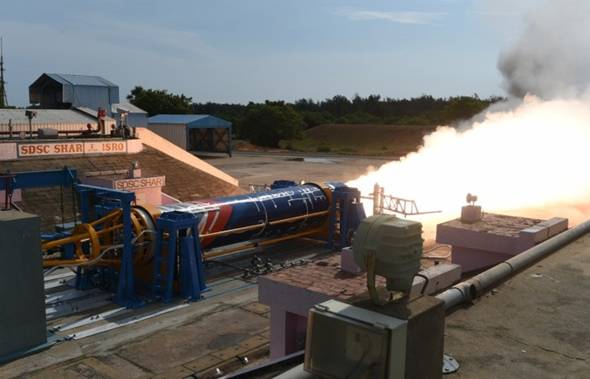
On 8th August, SDSC SHAR of ISRO successfully completed the first static test of the KALAM 1200 Motor, the first stage of the Vikram-1 Launch Vehicle of M/s Skyroot Aerospace Private Limited (SAPL). This is an important moment in the setup and implementation of the systems for the Vikram 1 Launch Vehicle.
Image via PIB
The motor has a propellant mass of 30t and is a monolithic composite motor measuring 11 metres in length and 1.7 metres in diameter. This longest monolithic motor is made at the Solid Propellant Plant in Sriharikota in response to design feedback. The design for the Test Stand, which is utilised for the motor’s static test, was also supplied by the ISRO team.
This is consistent with the Government of India’s Space Policy 2023 program, which seeks to present private sector participants with the technical infrastructure and managerial direction needed to support the expansion of the space economy. As anticipated, the test bed and related systems are operating normally.
Bharat Mandapam organises National Meet and National Space Day
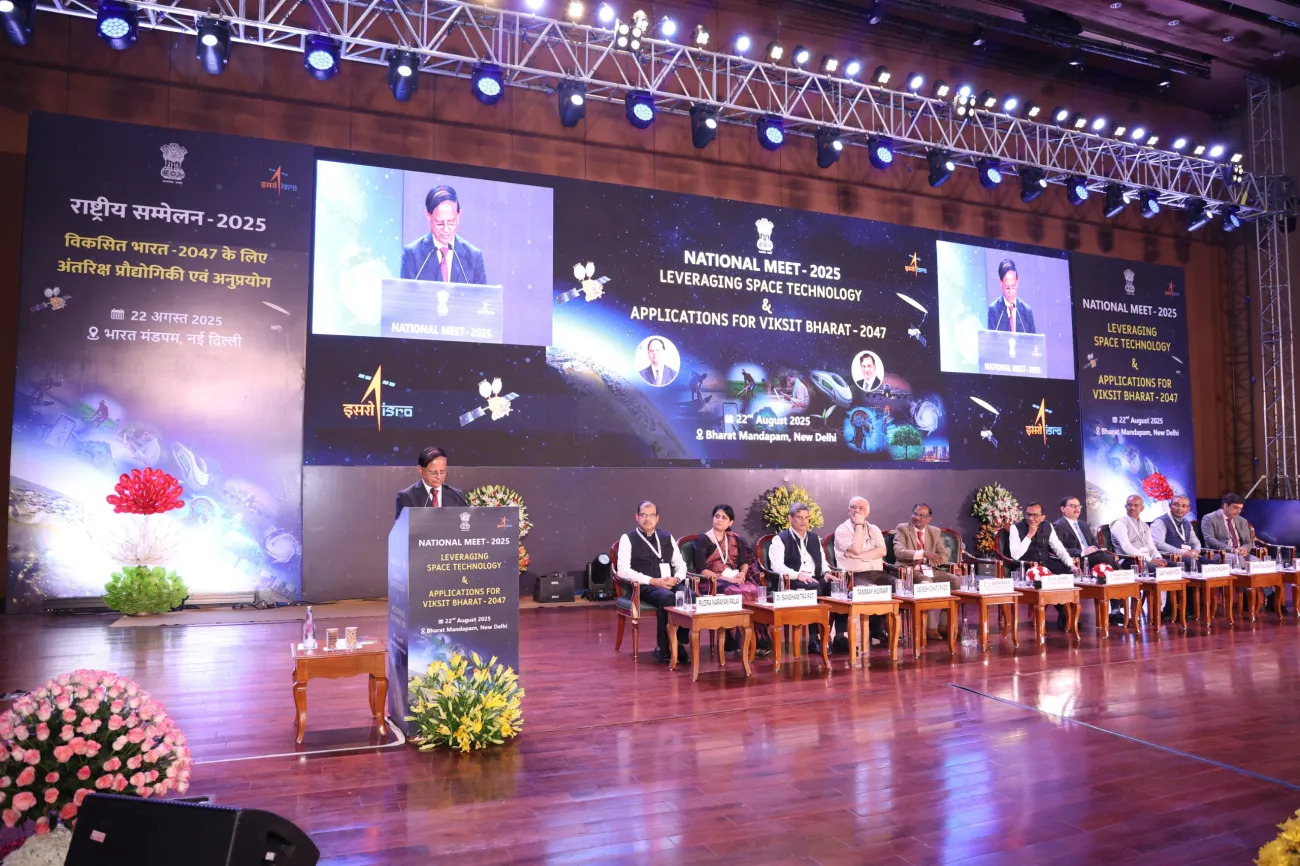
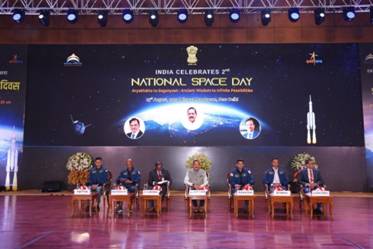
ISRO held the National Meet (NM) 2.0 at the Bharat Mandapam in New Delhi on 22nd August, which coincided with the Second National Space Day celebrations. “Leveraging Space Technology and Applications for Viksit Bharat 2047,” served as the theme and provided an essential forum for bringing together many stakeholders, including ministries, state governments, businesses, startups, academia and space enthusiasts.
Image via iist.ac.in
The unveiling of an exhibition that represented ideas from startups, academic institutions and business followed the NM 2.0, which emphasised the role of space in national growth.
Image via PIB
“Aryabhatta to Gaganyaan: Ancient Wisdom to Infinite Possibilities” was the subject of the magnificent and proud celebration of the second National Space Day 2025 at Bharat Mandapam in New Delhi on 23rd August.
Foundation stone for Launch Pad at SSLV Launch Complex
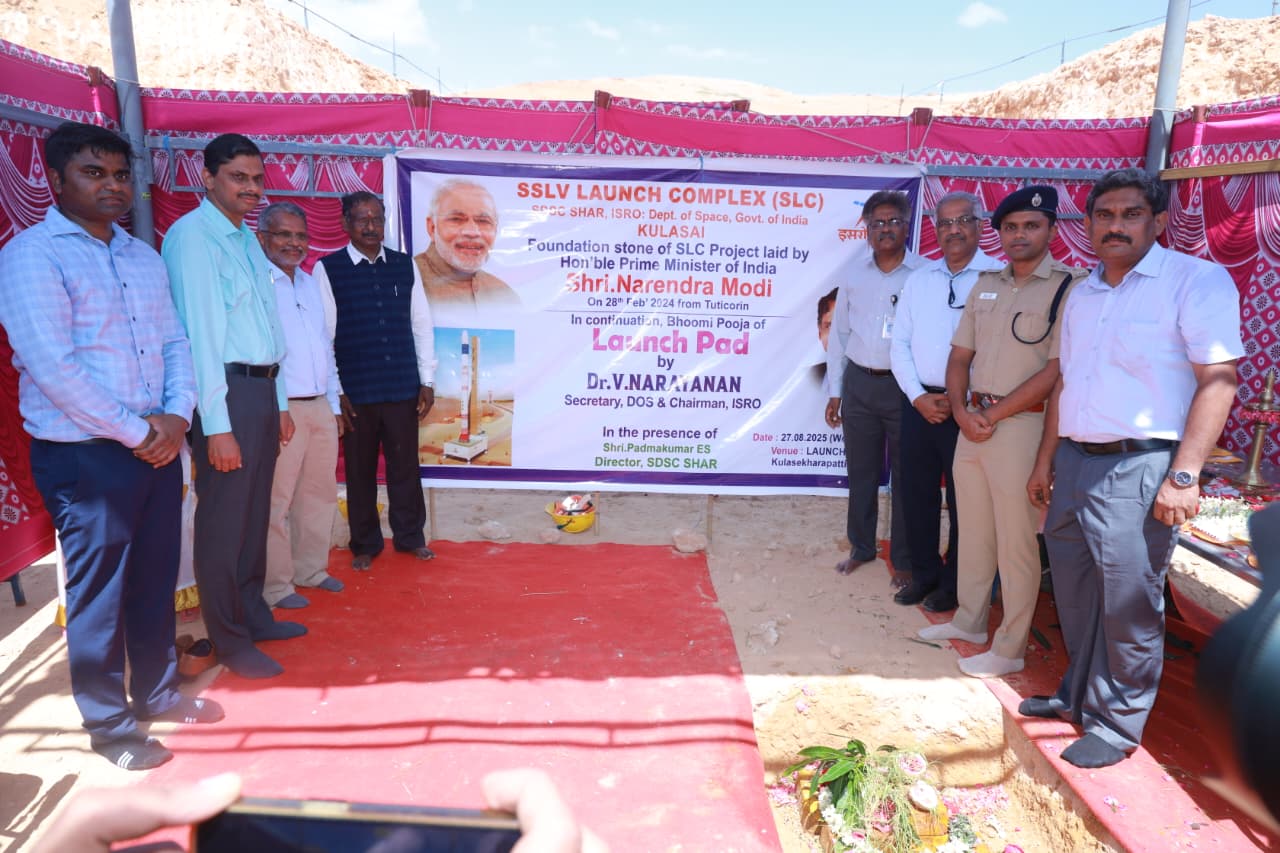
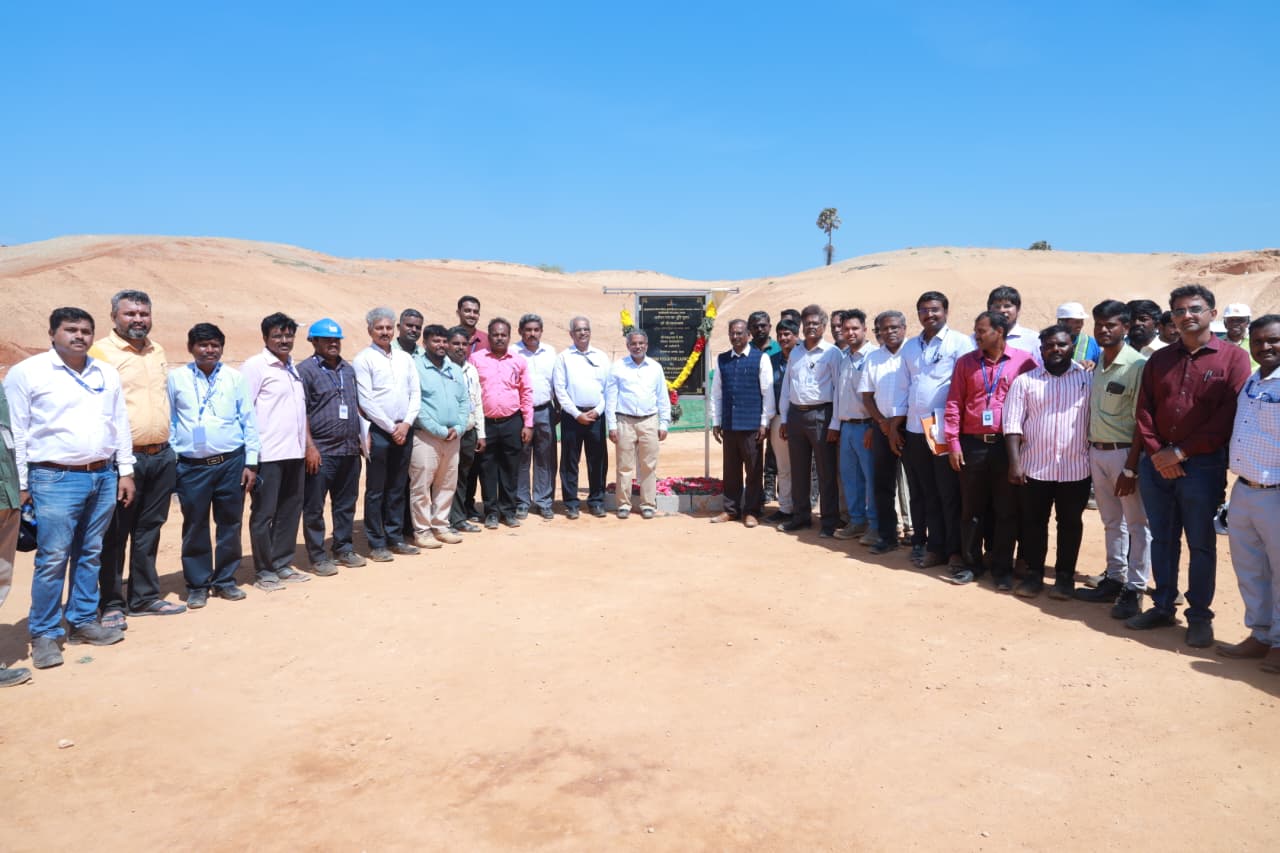
The SSLV Launch Complex is under construction as a specialised launch facility in Kulasekarapattinam, Tuticorin or Thoothukudi district in Tamil Nadu, to accommodate the nation’s escalating launch requirements, mainly for SSLV launches and Non-Governmental Enterprises (NGEs). The foundation stone was placed by PM Modi on 28th February 2024 from Tuticorin. Afterward, 32 of the 33 main facilities are being built. Dr. V. Narayanan did the groundbreaking ceremony for the Launch Pad at the SSLV Launch Complex (SLC) on 27th August.
Image via ISRO
SLC has launch pad and rail track systems, range systems, checkout systems, telemetry and tele-command systems, safety and firefighting facilities, stage preparation and vehicle integration buildings and basic civic amenities.
Image via ISRO
The Mobile Launch Structure (MLS), bogies, platforms, doors, Jet Deflection Duct, and vibration isolation systems are among the major systems that have been internally created. Large-scale systems like telemetry, telecommand and radars are being developed in the nation and put into service through industry cooperation.
MPTTF and ITPF facility openings at LPSC/ISRO
On 3rd September Liquid Propulsion Systems Centre (LPSC)/ISRO opened the Integrated Titanium Alloy Propellant Tank Production Facility (ITPF) and Monopropellant Thruster Test Facility (MPTTF) at Tumakuru, Karnataka. The purpose of MPTTF is to qualify, accept, and assess the performance of monopropellant hydrazine thrusters, which are crucial for maintaining orbit and controlling attitude in satellites, spacecraft and launch vehicles.
ITPF is a cutting-edge facility that specialises in producing lightweight titanium alloy propellant tanks, including propellant management devices for microgravity operations, for spacecraft and PSLV’s PS4 stage. The facility offers advanced techniques such as electron beam welding, precision machining, non-destructive testing, and cleanroom assembly to cater to the greater need for ISRO missions.
Small Satellite Launch Vehicle (SSLV) Technology Transfer Agreement
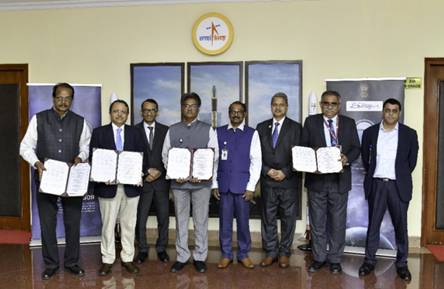
On 10th September, NewSpace India Limited, ISRO, IN-SPACe and Hindustan Aeronautics Limited (HAL) inked a technology transfer agreement to transfer the Small Satellite Launch Vehicle (SSLV) technology at Bengaluru’s ISRO Headquarters.
Satellites up to 500 kilograms in weight can be launched into Lower Earth Orbit (LEO) using the SSLV, a three-stage all-solid vehicle. ISRO created SSLV as a fast turnaround, on-demand launch vehicle that can be produced industrially and is intended to serve the worldwide market for small satellite launch vehicles. For inclined launches, it can be launched from Sriharikota or from the upcoming new launch site at Kulasekarapattinam for polar launches.
Image via PIB
The Modi government’s recommended space-sector reforms have made it possible for the SSLV Technology Transfer Agreement. It is anticipated that the successful commercialisation of SSLV would contribute to the Indian space ecosystem and satisfy the need for small satellite launch services both domestically and internationally.
India presents space accomplishments at Sydney’s IAC 2025
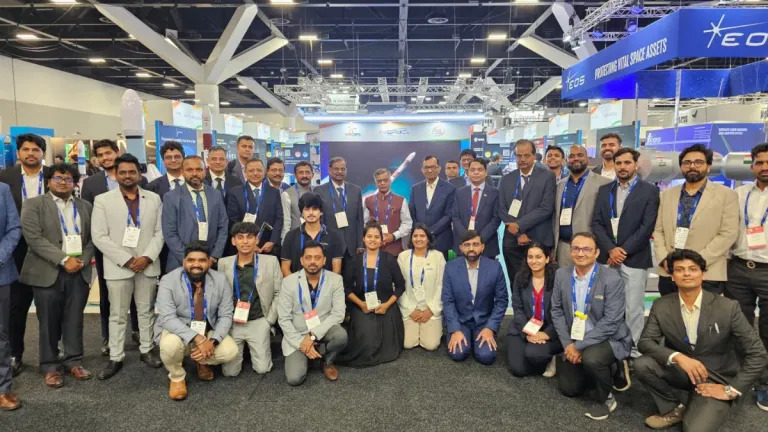
India’s contribution to international space pursuits was emphasised at the 76th International Astronautical Congress (IAC 2025), which was held in Sydney from 29th September to 3rd October. The India Space Pavilion, created by ISRO and IN-SPACe, showcased 60 years of the nation’s space journey, from groundbreaking missions like Chandrayaan and Aditya L1 to ambitious future initiatives like Gaganyaan and the projected Bharatiya Antariksh Station.
Image via Hindu Post
These displays reflected India’s ongoing quest for space technology innovation and excellence. 18 Indian space enterprises and showed off their products and accomplishments as part of the Indian Space Pavilion. As part of IAC-2025, 5 Indian startups and space businesses set up standalone promotional pavilions.
CMS-03 communication satellite successfully launched by LVM3 launch vehicle
On 2nd November, the CMS-03 communication satellite was successfully launched by the LVM3 launch vehicle in its fifth operational flight (LVM3-M5). A broad oceanic region, including the Indian mainland, is covered by the multi-band communication satellite. It weighs around 4400 kilogram and is the heaviest communication satellite to ever take off from Indian land into Geosynchronous Transfer Orbit (GTO).
C25 Cryogenic Stage demonstration restart in LVM3-M5 Mission
Powered by the CE-20 engine, the LVM3-M5 mission accomplished the first-ever in-space restart of its locally sourced C25 cryogenic upper stage. Future LVM3 missions are going to be able to deploy satellites into different orbits in a single mission because of to this vital feature which enhances mission flexibility. The primary satellite, CMS-03 was successfully launched into its assigned orbit prior to the restart.
PRL/ISRO finds a new exoplanet
A new exoplanet, TOI-6038A b, a dense sub-Saturn with a mass of 78.5 Earth masses and a radius of 6.41 Earth radii in a broad binary system, hab been found by researchers at the Physical Research Laboratory (PRL), Ahmedabad. The planet revolves around a brilliant and metal-rich F-type star in a circle every 5.83 days.
The TOI-6038A b offers a rare opportunity to research planetary creation and evolution. It is not present in our solar system and is located in the Sub-Saturn category between Neptune-like and gas giant exoplanets.
Image via PIB
This is the second finding of an exoplanet. The cutting-edge PARAS-2 spectrograph, mounted on a 2.5-meter telescope at PRL’s Mount Abu Observatory in Gurushikhar made the discovery. Moreover, it is the fifth exoplanet to be identified by the joint use of the PARAS-1 and PARAS-2 spectrographs. The PARAS-2 spectrograph, the highest-resolution stabilised radial velocity (RV) spectrograph in Asia, points to India’s expanding proficiency in cutting-edge astronomical instrumentation.
Memorandum of Understanding for space medicine collaboration
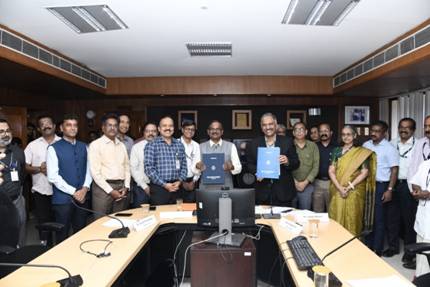
The Framework Memorandum of Understanding on Cooperation in Space Medicine was signed by the Indian Space Research Organisation (ISRO), Department of Space (DoS) and Sree Chitra Tirunal Institute for Medical Sciences & Technology (SCTIMST), Department of Science & Technology (DST). This represents a landmark event in the development of space medicine and its uses in the nation.
The Indian Human Space Program, Gaganyaan, is a national initiative of ISRO that provides a special opportunity in the areas of human health research, microgravity research, space medicine and space biology to many national agencies, academia and business. The national human space program would gain from cooperation in the specialised field of space medicine as a result of this framework Memorandum of Understanding between ISRO and SCTIMST.
Image via PIB
Human physiological studies, behavioural health studies, biomedical support systems, radiation biology and medicine, countermeasures for enhancing human health and performance in space environments, telemedicine and communication protocols and crew medical kits for space missions would reap the rewards of these innovations and breakthroughs. The opportunities for research and experimentation would be made possible by the project, particularly in the area of space medicine.
Conclusion
The growth of the Indian space program, which has successfully positioned India’s flag on the southern side of the moon and aims to send humans to Earth’s natural satellite, is indeed a heartwarming story of dedication and commitment. The diverse achievements in multiple areas, including wheat production and space biological experiment, further illustrated the profound and evolving technological competence and ability of India and its space agency.
ISRO has come a very long way from its days of carrying rockets on bicycles. This year has also seen multiple significant achievements along with several crucial firsts and with the current momentum, the next year is likely to be even more eventful for India and its ambitious space ventures.
The campaign launched by the Yogi Adityanath government to uproot the illicit drug trade in Uttar Pradesh not only transcends state borders but is also proving to be a milestone in dismantling the empire of the drug mafia at the international level. While Phensedyl, a common cough syrup made from codeine, is used to treat coughs, it is being misused as a cheaper narcotic to spread addiction through illicit trafficking.
In Uttar Pradesh, a racket involved in the illegal sale of this drug was exposed, which was responsible for the illicit sale of the drug not only within the country but also abroad. In 2024, the Yogi Adityanath government ordered a joint operation to investigate the matter. The Food Safety and Drug Administration (FSDA) and the state’s Special Task Force (STF) received orders to investigate the illegal storage and smuggling of codeine-based drugs and syrups.
The investigation began in 2024, and a vast network was uncovered by 2025, leading to the filing of 128 FIRs, the cancellation of 280 drug licenses, the seizure of over 3.5 lakh vials, and the arrest of 32 key accused. This illegal empire, estimated to be worth over ₹425 crore, stretched from 28 districts of Uttar Pradesh to Nepal, Bangladesh, Dubai, and Pakistan.
From super-stockist firms to shell companies, political connections, and even a terror funding angle have been exposed during the investigation. The suspected links of some Samajwadi Party leaders, including those close to Samajwadi Party chief and former Uttar Pradesh CM Akhilesh Yadav, with the drug trade have stirred political turmoil. Pursuant to the instructions of Chief Minister Yogi Adityanath, a joint operation by the STF, FSDA, and the Enforcement Directorate (ED) dismantled a ‘halal’ drug syndicate, which has been ruining youth and endangering national security. The SIT and ED are now conducting an investigation into the drug syndicate, which could uncover money laundering and terror funding worth thousands of crores.
What is codeine and its syrup?
Codeine is a derivative of opium. It is commonly used in cough syrups and can cause mind-numbing effects if taken in excessive amounts. Long-term use of codeine has the potential to cause addiction, similar to heroin or opium. In recent years, its use as a soft drug has increased. Using 10 ml of codeine in 100 ml of syrup can cause addiction.
How did the first case come to light?
In February 2024, a raid was conducted in the Sushant Golf City area of Lucknow. The UP Special Task Force (STF) had received information that a large quantity of Phensedyl, a codeine-based syrup, was being illegally stored there. The raid revealed fraudulent documentation, and the syrup’s supply chain raised suspicions.
An FIR was registered at the Sushant Golf City police station under various sections of the Narcotic Drugs and Psychotropic Substances Act, 1985 (NDPS) and the Indian Penal Code. The action was taken based on inputs received over several months. Following this raid, all aspects of the case were investigated for more than a year.
Uttar Pradesh Chief Minister Yogi Adityanath issued a direct order that no leniency should be shown in dealing with the drug syndicate. The investigative agencies of Uttar Pradesh followed the CM’s direction. Over the course of about a year, the STF and the FSDA conducted a thorough investigation, scrutinised all the details of the case to ensure that no culprits escaped their sight and the entire racket behind it was exposed.
Super stockist and drug mafia nexus
During the investigation of the case by the STF, it was revealed that some firms were super-stockists, licensed to stock large quantities of medicines. The investigation revealed that legitimate purchases of large quantities of codeine-containing cough syrup were first made in the name of these super-stockist companies. Thereafter, fake firms were set up to sell the cough syrup illegally.
By forging records, the syrup was sold on the black market as a narcotic syrup instead of a medicine. This drug was then supplied to Nepal and Bangladesh via the nearby states of Uttar Pradesh, Bihar, Jharkhand, and Bengal. The illegal drug trade spanned 28 districts in Uttar Pradesh, including Lucknow, Lakhimpur Kheri, Bahraich, Varanasi, Jaunpur, and Saharanpur, and several other states.
Several scandals, ranging from political connections to the international drug mafia, surfaced. The biggest challenge for the state government and administration was to arrest the kingpin and expose the syndicate.
How was the syndicate exposed?
After nearly a year of investigation, a truck was seized in Sonbhadra district of Uttar Pradesh on October 18, 2025. Inside the truck were found a large number of cartons of chips (snacks). But when these cartons were opened, a huge cache of drugs was found inside. The cartons contained bottles of cough syrup containing codeine. To the shock of the administration, the value of these drugs was estimated to be around Rs 3 crore. Three smugglers from Madhya Pradesh, Hemant Pal, Brijmohan Shivhare, and Ramgopal Dhakad, were arrested.
Since February last year, the STF had been connecting links of the drug syndicate to similar smuggling operations. When this information came from Sonbhadra, the dots began to connect. Initial investigations revealed that the consignment was headed to Pakistan via Nepal. Within fifteen to twenty days, large consignments of drugs were also seized from Jharkhand and Ranchi.
A thorough investigation into the case revealed a name: Shubham Jaiswal. The agencies arrived at Shubham’s name after screening over 300 firms. Out of these firms, 133 were shortlisted as being either directly involved in the drug trade or facilitating diversion. A few months before the truck was seized in Sonbhadra, agencies had started conducting similar raids to reach the roots of the entire drug nexus.
Banaras to Dubai connection and drug syndicate
As the STF swiftly pursued the investigation, the layers of the drug syndicate began to come off. Shubham Jaiswal, originally from Varanasi, currently lives in Dubai. On November 27th, the STF arrested Amit Kumar Singh, alias Amit Tata, near Gauri Square in Lucknow’s Vibhutikhand area. During interrogation, it was revealed that he was a key link in this drug trade and operated the entire network from Dubai at Shubham Jaiswal’s behest.
The digital devices recovered from Amit Tata revealed the supply route, transaction routes, and the syndicate’s entire network map. Shubham’s father, Bhola Prasad, was also involved in his drug dealings. He was arrested at Kolkata airport while trying to flee to Thailand, fearing action by the Uttar Pradesh Special Task Force (STF).
The Chief Minister ordered the Special Task Force (STF) and the Uttar Pradesh Drugs Department to crack down on the entire network. As the investigation intensified, agencies discovered that the drug syndicate used supply chains belonging to major pharmaceutical companies, including Laborate, 3B Healthcare, and Abbott.
#WATCH | Lucknow, UP: CM Yogi Adityanath briefs media on Cough Syrup case, says, "… Action was taken following complaints of poisonous cough syrups being sold at various locations. There were also reports of illegal smuggling of syrups in Uttar Pradesh, and the case was pursued… pic.twitter.com/6SFDpnlu2f
The name of Alok Kumar Singh, a dismissed Uttar Pradesh police constable, also surfaced. His 7000 sq. ft. mansion stunned the ED officials. Subsequently, a photo of SP chief Akhilesh Yadav with Alok Kumar Singh surfaced. Names of several influential politicians also emerged, although the agencies have not yet released any names. Photos and videos of these politicians with Shubham Jaiswal and Amit Tata are going viral on the internet. Furthermore, with such a vast business spanning across borders, there are suspicions that some high-profile individuals may be involved. This is the reason that CM Yogi Adityanath has ordered strict and swift action under a zero-tolerance policy of the government.
What action has been taken so far?
Following these arrests and the discovery of the syndicate’s kingpin, the investigative agencies focused on dismantling the entire network. On 8th December, Principal Secretary of the Home Department Sanjay Prasad, Director General of Police (DGP) Rajiv Kumar Krishna, and FSDA Commissioner Roshan Jacob held a joint press conference in Lucknow, detailing the actions taken so far.
It was reported that 128 FIRs have been registered so far, 280 drug licenses have been cancelled, and 3.5 lakh vials have been seized. Thirty-two people involved in this smuggling network have been arrested till now. The prominent names identified in these arrests are Vibhor Rana, Vishal Rana, Saurabh Tyagi, Bhola Prasad Jaiswal, Alok Pratap Singh, Abhishek Sharma, Akash Pathak, and Amit Singh alias Amit Tata.
During the investigation into this entire racket, the UP Special Task Force (STF) discovered that the illegal drug trade could amount to thousands of crores. A rough estimate of approximately ₹425 crore has been made. A Special Investigation Team (SIT) has been formed to thoroughly investigate every detail related to the case. On 3rd December, the ED filed an Enforcement Case Information Report (ECIR) against 67 accused. The ED conducted simultaneous searches at 25 locations, including Lucknow, Saharanpur, Varanasi, and Ghaziabad in Uttar Pradesh, and the capital cities of Jharkhand and Gujarat.
During the search, it was discovered that 700 fake firms were registered in the names of 220 individuals, which were created directly for money laundering. The ED estimated that the total amount involved could exceed thousands of crores and is therefore preparing to take action in this case under the Prevention of Money Laundering Act,2002 (PMLA).
Recently, in a press conference held in Lucknow on 8th December, UP Police DGP Rajiv Krishna stated that a total of 11 cases have been registered in the Lucknow zone, 4 cases in the Bareilly zone, 10 cases in the Gorakhpur zone, and 2 cases in the Varanasi zone. Through these cases, preparations are underway to dismantle the entire network through which the illegal drug trade was being conducted.
Halal intoxication is cough syrup, and the angle of terror funding is also coming to the fore.
There have been reports of BSF operations on the India-Bangladesh border on several occasions, including intercepting and confiscating cough syrups. During the ED investigation in the current case, it was revealed that the proceeds from the drug smuggling were used to fund terror.
Names of two smugglers, Asif and Wasim, from the Meerut district in Uttar Pradesh have also surfaced in the case. It is reported that Asif smuggled money to other Gulf countries via Bangladesh. The hawala network used to launder money is suspected of benefiting terrorists.
Furthermore, it is said that since alcohol is prohibited in Islam, the use of such cough syrups for intoxication has increased rapidly. Cough syrups are promoted as ‘halal’ intoxicants. Reports suggest that the consumption of cough syrups is higher in areas with a majority Muslim population.
Here is a list of 12 names who are the main accused in the Codeine Cough Syrup case:
Shubham Jaiswal: A resident of Varanasi, he currently lives in Dubai. He is the mastermind behind the entire racket.
Bhola Prasad Jaiswal: A resident of Varanasi, he is the father of Shubham Jaiswal. He owns Sally Traders, which has a turnover of 100 crore rupees.
Manohar Jaiswal: A member of Shubham Jaiswal’s family. He played a key role in establishing shell companies.
Vibhor Rana: A resident of Saharanpur, he is the main superstockist and supplies the syrup through GR Trading Company.
Saurabh Tyagi: A resident of Ghaziabad, he was found in possession of 1.57 lakh bottles. He was the one who provided Shubham Jaiswal’s name to the agencies.
Vishal Rana: A resident of Saharanpur, brother of Vibhor Rana, who orchestrated the network of fake billing and shell firms.
Pappan Yadav: He is a resident of Lakhimpur Kheri/Bahraich. He worked in transport and oversaw the Nepal supply route.
Shadab: A resident of Varanasi/Jaunpur. He is accused of stocking locally using a fake license.
Abhishek Sharma: A resident of Lucknow, he is accused of possessing a fake drug license. 8 million bottles were seized from his possession.
Vishal Upadhyay: A resident of Lucknow, he handled bogus billing and paperwork.
Akash Pathak: He is a resident of Varanasi and used to handle the business at the local level.
Vinod Agarwal: A resident of Lucknow/Varanasi, he is a CA by profession and used to manage the money trail through shell companies.
The drug syndicate’s connection to Samajwadi Party leaders came to light
Among the many names circulating on social media in connection with the drug syndicate, one name is Rahul Yadav. He is a close associate of Lucky Yadav, a Samajwadi Party MLA from the Malhani seat in Jaunpur district. In a viral photo, Rahul Yadav can be seen shaking hands with Akhilesh Yadav.
Photos of dismissed UP Police constable Alok Singh with Akhilesh Yadav are also circulating on social media. As per the information mentioned in 128 FIRs registered across 28 districts, many of the accused received drug licenses during Akhilesh Yadav’s tenure. The accused are said to have played a key role in spreading the illegal trade. Currently, they are working as retailers at the local level.
Samajwadi Party is upset with the action of the Yogi Adityanath government
The Samajwadi Party’s frustration is growing at the same pace with which Uttar Pradesh agencies are apprehending codeine offenders. As the entire network of major drug mafias is being dismantled with the precise planning of Uttar Pradesh agencies, which have been given free rein by the government, the Samajwadi Party’s annoyance is clearly visible.
The photo of dismissed UP Police constable Alok Singh’s meeting with SP chief Akhilesh Yadav hints at a political connection. As the investigation advances, the Samajwadi Party’s troubles are likely to increase.
Codeine has become a poison that has devastated a large population. Those who profit from its trade are considered close to the Samajwadi Party. Many more names and their connections to the Samajwadi Party are yet to be revealed. The names of those mafias who have long had good relations with Akhilesh Yadav’s father, Mulayam Singh Yadav, have also surfaced.
The Yogi government has made it clear through its sustained action over the past several months that no one linked to the drug syndicate will be spared. The ED has expanded its investigation to terror funding. The government and the administration have made clear their intention to destroy this drug trade.
In several villages of Dharampur and Kaprada talukas in Valsad district, which locals allege are increasingly becoming hubs of illegal religious conversion and proselytising activities, applications have been submitted to the Mamlatdar’s office over the past few days. Hindu residents of these villages have demanded that permission to celebrate the Christmas festival on December 25 be granted only to those who are officially recorded as Christians in government records. Hindu organisations have raised this demand, citing apprehensions that such events could accelerate illegal religious conversions.
Over the last few days, Hindu leaders from more than ten villages in the Dharampur and Kaprada talukas have submitted memoranda to the Mamlatdar’s office through various organisations such as Dev Birsa Sena and Adivasi Sanskriti Bachao Sena.
The applications state that for the past several years, people belonging to the Christian faith have been organising large gatherings, peace festivals, seminars and similar events in different villages of tribal areas with the intention of carrying out religious conversions. Missionaries and pastors reportedly arrive during the month of December and organise Christmas programmes in various villages.
The memoranda further claim that through these Christmas events, a conspiracy is underway to detach tribals from their original culture and traditions and to ultimately erase their indigenous identity, which the organisations describe as a serious matter. The organisations have clarified that they do not discriminate against any religion and respect all faiths and sects. However, they insist that only those individuals who are legally recorded as Christians in official government records should be granted permission to organise Christmas programmes.
They have demanded that anyone seeking permission to organise Christmas events must first be asked to produce certificates proving that they are legally registered as Christians, and that permission should be granted only after proper verification.
What are local Hindus saying?
When OpIndia visited some villages in Dharampur to gather further details, several striking observations emerged. One notable point is that as one moves away from Dharampur town into more remote areas, the number of churches visibly increases. Churches have been constructed in many villages. It is also worth noting that in the past, several cases have come to light in these very areas where illegal churches were built on government land without any permission.
A church located in a remote area of Dharampur
Hindu leaders from Gadina village, located barely two kilometres from the Maharashtra border, have also applied to the Dharampur Mamlatdar’s office. Speaking to OpIndia, village leaders said that Gadina has a population of around 1,400, but not a single person is officially recorded as a Christian in government records. Despite this, a church has been built in the village, where programmes are frequently organised, and Hindu villagers are also made to participate.
Local Hindus allege that initially, innocent tribal Hindus are included in such programmes. Later, missionaries and pastors offer inducements, claim to cure illnesses through miracles, promise money, and propagate the Christian faith, encouraging participants to bring others into the fold as well.
Speaking to OpIndia, Gadina’s local leader, Pilubhai Chaudhary, said, “Most churches have been built illegally, without obtaining any permission. These churches then become centres for conversion activities. Once local Hindu tribals start going there, they are gradually persuaded not to worship Hindu deities, not to visit temples or traditional places of worship, and eventually, the individual becomes completely disconnected from their religion and culture.”
OpIndia spoke to locals about the menace of conversion rackets operated by Christian groups
Pilubhai further stated that if there is not a single person officially registered as a Christian in government records in a village, there is no justification for organising such programmes there. Even if permission is granted, authorities should clearly disclose how many Christians reside in that village.
Village leaders also pointed out that in many villages, people are converted through inducements, but they continue to be recorded as Hindus in government records and keep availing government benefits. This, they say, explains why despite the mushrooming of large churches in many villages, the officially recorded Christian population remains negligible.
Local Hindus fear that Christmas programmes could once again intensify proselytising activities. Therefore, they are demanding that permission be granted only to registered Christians.
Not just Dharampur-Kaprada, the entire eastern belt of South Gujarat is affected
This issue is not limited to a few villages in Dharampur or Kaprada. Over the past few years, rapid demographic changes have been observed across the eastern belt of South Gujarat—from Dharampur and Kaprada to Dang, Tapi, and even the northernmost areas of Surat district, such as Umarpada and Dediapada. Since converts often do not undergo legal religious conversion, they continue to be recorded as Hindus in government records, but the Hindu religion and culture gradually disappear from their lives.
Recently, OpIndia published a special report on the construction of an illegal church in Umarpada, indicating that this problem is slowly spreading from South Gujarat towards Central Gujarat.
Demographic changes have led to several other issues. In many villages of Dang and Tapi, followers of Hinduism have reportedly become a minority. Temples are disappearing from villages, and tribal sacred sites are either being destroyed or altered. For instance, in 2022, a case came to light in a village in Songadh where an ancient tribal sacred site was demolished and replaced with a shrine dedicated to Mother Mary.
For all these reasons, local Hindus say they have become alert ahead of Christmas this time and are raising their demands before the administration. What decision the administration and the government take on this matter remains to be seen.
OpIndia attempted to contact the Dharampur Mamlatdar for his response on the issue, but could not establish contact. The report will be updated once a response is received.
The SHANTI Bill, 2025, which permits private participation in India’s nuclear energy sector, is historic in more ways than one. It marks a fundamental shift in the country’s nuclear architecture and is poised to deliver benefits far beyond electricity generation, spanning healthcare, agriculture, food processing, industry, and climate action. By opening the sector to responsible private and joint-venture participation, the Bill also removes long-standing legal and investment bottlenecks that have deterred both domestic and global investors for decades.
A structural reform in a sensitive sector
Nuclear energy has traditionally remained under complete government control due to its strategic and sensitive nature. While that core principle remains intact, the SHANTI Bill introduces a calibrated reform. It allows private players to participate alongside public sector entities, while making it explicitly clear that highly sensitive materials and strategic controls will continue to remain exclusively with the government.
Radioactive materials, nuclear fuel, and heavy water will remain under strict state oversight. Safety norms, licensing, and operational clearances will be determined by the government and enforced by an empowered regulator. In essence, the reform expands capacity and investment without compromising national security.
What exactly is the SHANTI Bill?
The Sustainable Harnessing and Advancement of Nuclear Energy for Transforming India (SHANTI) Bill, 2025replaces two key legislations:
The Atomic Energy Act of 1962, and
The Civil Liability for Nuclear Damage Act, 2010.
A major institutional reform under the Bill is granting statutory status to the Atomic Energy Regulatory Board (AERB). This move significantly strengthens regulatory oversight and ensures independent, transparent, and robust supervision of radiation safety and nuclear operations, something India’s nuclear ecosystem has long required.
Clearing the investment logjam
Despite economic liberalisation, nuclear energy remained an exception due to rigid liability provisions, particularly supplier liability under the 2010 law. Global nuclear companies were reluctant to invest in India due to legal uncertainty and disproportionate exposure to risk.
The SHANTI Bill addresses this directly by clearly defining liability structures, thereby providing legal certainty to operators and suppliers. This reform is critical if India is to attract cutting-edge nuclear technology, global partnerships, and long-term capital.
Compensation, liability, and safety: addressing the criticism
The opposition has alleged that the Bill dilutes compensation provisions and weakens supplier accountability while opening the door for corporate interests in a sensitive sector. These claims were categorically rejected by Union Minister Dr Jitendra Singh.
The government has clarified that:
Victim compensation has not been reduced.
Operator liability is now linked to reactor capacity to encourage new technologies such as Small Modular Reactors (SMRs).
Liability limits range from ₹100 crore to ₹3,000 crore, depending on reactor size.
In addition, compensation will be ensured through:
Operator liability,
The government-backed Nuclear Liability Fund, and
India’s participation in international nuclear compensation conventions.
Crucially, the “no-fault liability” principle continues, meaning victims do not need to prove negligence. Operators are also mandated to maintain insurance equal to their liability exposure. If compensation exceeds an operator’s capacity, the Central Government will step in to cover the remainder.
Penalties under the Bill range from ₹5 lakh for minor violations to ₹1 crore for serious offences, and criminal liability for negligence remains intact.
Independent dispute resolution and licensing
The Bill also proposes the creation of a Nuclear Energy Dispute Resolution Advisory Council to handle operational and liability-related disputes. All operators, public or private, must obtain government licences and AERB safety clearances before commencing operations.
The legislation also provides for compensation in case a nuclear incident in India causes damage beyond national borders, subject to specified conditions—aligning India with international nuclear law norms.
Is the public sector being weakened?
The opposition has argued that encouraging private participation undermines public sector undertakings. This narrative does not withstand scrutiny.
Over the past decade, the government has increased the Department of Atomic Energy’s budget by nearly 170%. India’s nuclear power contribution to the energy mix remains modest compared to peer economies. With rising demand from data centres, healthcare, manufacturing, and digital infrastructure, nuclear energy is indispensable alongside coal, hydro, wind, and solar.
According to the government, the SHANTI Bill enables responsible private and joint-venture participation without compromising public sector strength, national security, or public interest. Its objective is to reduce project delays, overcome resource constraints, and achieve 100 GW of nuclear capacity by 2047, up from the current ~8.2 GW, while supporting India’s net-zero target by 2070.
Climate action and clean energy transition
For the first time, the definition of nuclear damage under Indian law explicitly includes environmental and economic harm. Nuclear energy is a low-carbon, non-intermittent power source that operates round-the-clock, unlike solar or wind.
While uranium mining, fuel processing, and plant construction are energy-intensive, lifecycle emissions from nuclear power remain among the lowest of all energy sources. Unlike coal-based plants, nuclear reactors produce no air pollution or CO₂ during operation, helping industries avoid carbon taxes and emissions penalties.
By promoting advanced technologies such as Small Modular Reactors, the Bill supports India’s transition away from coal while ensuring energy security.
Managing radioactive waste
Radioactive waste remains a legitimate concern. However, its handling, covering storage, transportation, processing, and disposal, remains strictly controlled by the government.
Waste is categorised into low-level and high-level waste, each with established and internationally accepted disposal protocols. In volume terms, nuclear waste is far smaller than waste generated by fossil fuel-based energy. This is precisely why developed economies continue to expand their reliance on nuclear power.
Agriculture and food processing: a silent revolution
Nuclear technology is already transforming Indian agriculture. Radiation-based techniques have helped develop 72 new crop varieties, including mustard, soybean, sunflower, pulses, rice, jute, and banana.
Food irradiation extends shelf life, reduces dependence on expensive cold storage, eliminates pests, and enhances food safety. These applications strengthen food security, reduce post-harvest losses, improve farmer incomes, and boost India’s competitiveness in global agricultural trade.
Healthcare and public welfare gains
The Bill must also be viewed through the lens of public health. Radiation plays a critical role in cancer diagnosis and treatment, medical imaging, and biomedical research. Expanded nuclear infrastructure will accelerate innovation, research, and access to advanced healthcare technologies.
Institutions like Bhabha Atomic Research Centre (BARC) have already deployed nuclear-based water purification technologies in flood-prone areas, significantly reducing disease outbreaks. Nuclear desalination projects are operational in states such as Gujarat, Rajasthan, and Maharashtra, addressing both water scarcity and salinity.
Private capital, global partnerships, and national ambition
To fully harness nuclear energy’s potential, India requires private capital, advanced technology, and global collaboration. Indian conglomerates such as Reliance, Tata Power, and Adani Power have shown interest, while foreign companies are also exploring opportunities under the new framework.
To achieve the vision of Viksit Bharat, India must scale up nuclear energy, not merely as a power source, but as an enabler of healthcare, agriculture, exports, industry, and technological self-reliance.
The SHANTI Bill, 2025, is therefore not just an energy reform; it is a strategic, economic, and developmental milestone. By balancing safety, sovereignty, sustainability, and growth, it lays the foundation for a cleaner, stronger, and more self-reliant India.
In a major boost for the ‘Make in India’ initiative, Apple Inc. is exploring a massive expansion of its supply chain in India by holding discussions with Indian semiconductor firms to assemble and package certain iPhone components domestically. With this decision, Apple has again defied Trump’s threat to stop manufacturing in India.
Reports say the talks between Indian semiconductor companies and Apple particularly centre on outsourced semiconductor assembly and test (OAST) processes, the backend steps of assembling dies into finished chips and packaging them, rather than full chip fabrication.
The CG Semi, a unit of the Murugappa Group, is the primary partner in the exploratory talks. CG Semi is building a major OSAT facility in Gujarat’s Sanand.
The initial focus could be on display driver integrated circuits (DDICs) used in OLED panels of the iPhone. Currently, South Korea, Taiwan and China provide chip fabrication and packaging facilities to Apple.
Notably, Apple sources its iPhone display panels from the world’s top OLED manufacturers: Samsung Display, LG Display, and BOE. The DDICs used with these panels are supplied by Samsung, Novatek, Himax, and LX Semicon.
While the discussions remain in the initial stage, Apple’s reported move builds on the US-based tech giant’s rapid scaling of iPhone production in India. It was reported earlier that iPhone assembly in India reached $22 billion in value by March 2025, marking a 60 per cent year-on-year increase. Tata Electronics, Foxconn, and Pegatron handle iPhone’s full device assembly in India.
India is becoming Apple’s ‘apple of the eye’ as diversification away from China becomes a necessity
Apple has consistently been expanding its manufacturing footprint in India as the company is intensifying diversification away from China. What drives this strategy is India’s vast potential, US-China trade risks and ever-looming threat of more and more Trump tariffs. Apple is aiming to produce most iPhones sold in the US at Indian factories by the end of the year 2026.
Interestingly, Apple’s reported plans of shifting assembly and packaging to India reflect a step up the value chain from just device assembly. Even though advanced processors like A-series and M-series chips continue to be fabricated by Taiwan’s TSMC, localising backend processes shortens supply chains, slashes transportation costs and import duties while also improving resilience against disruptions. Besides, Apple will also benefit from India’s skilled labour pool and rapidly growing precision engineering ecosystem.
Regarding this, Prabhu Ram, vice president, industry research group, CyberMedia Research, told TOI, “As India evolves into a crucial component of the global electronics supply chain, Apple could gain from increased stability and variety by potentially collaborating with an Indian chip manufacturer.”
If everything goes right, this development could give a massive impetus to India’s nascent but emerging semiconductor industry, especially in the OSAT segment, which, although is less capital-intensive than front-end fabrication, is significant for scaling production.
The CG Semi facility alone will create high-skilled jobs, in testing, assembly and packaging, if the Apple-CG Semi talks materialise. In addition, with a broader ecosystem growth, thousands of jobs in ancillary roles.
Besides, local packaging in India would curb reliance on East Asian hubs and attract suppliers for material and equipment, etc, creating a thriving ecosystem akin to those in Vietnam or Taiwan. This would encourage other global players to invest in India and expand partnerships. Needless to say that Apple’s investment in India’s capabilities will signal confidence and serve as a catalyst for other global tech giants to pour investment into the sector.
Not to forget, Intel has partnered up with India’s Tata Electronics recently for “collaboration focused on consumer and enterprise hardware enablement, and semiconductor and systems manufacturing.” With this, Tata Electronics’ upcoming Fab in Assam and OSAT facility in Assam will manufacture and package Intel products for local markets, in addition to advanced packaging.
India’s domestic firms and startups in semiconductor could also benefit from a partnership with Apple, as such collaborations involve knowledge sharing in quality standards, processes and testing.
As the Indian government is offering subsidies for OSAT facilities, Apple’s plans to shift assembly and packaging to India could elevate the country from low-value assembly to higher-value semiconductor backend work and open doors for further progress, aligning with India’s Semiconductor Mission.
Notably, the Modi government provides a financial support of 30% of the Capital Expenditure to the eligible applicants for setting up of Compound Semiconductors / Silicon Photonics (SiPh) / Sensors (including MEMS) Fab and Semiconductor ATMP / OSAT facilities in India.
In addition, the government also provides financial incentives, designs infrastructure support across various stages of development and deployment of semiconductor design for Integrated Circuits (ICs), Chipsets, System on Chips (SoCs), Systems & IP Cores and semiconductor-linked design.
The government scheme also offers “Product Design Linked Incentive” of up to 50% of the eligible expenditure, subject to a ceiling of ₹15 Crore per application, and “Deployment Linked Incentive” of 6% to 4% of net sales turnover over 5 years, subject to a ceiling of ₹30 Crore per application.
The success of Apple’s partnership with Indian semiconductor companies could also accelerate progress towards much-needed self-reliance in the electronics sector.
Moreover, this partnership could reinforce appeal as a reliable and efficient alternative to China. The Modi government’s Production Linked Incentives (PLI) schemes are already luring foreign companies to expand investment in India.
For Apple, diversifying chip packaging away to India curbs vulnerability to Taiwan Strait tensions, which are on the rise currently, and other disruptions in the region. For India, this partnership could create massive job opportunities, enhance the semiconductor industry and contribute significantly to economic growth. Although the road is not without challenges, however, this could pave the way for more sophisticated components or even front-end fabs; however, it is a long game.
It must be recalled that in September this year, despite repeated threats from U.S. President Donald Trump to stop manufacturing in India, Apple Inc. announced plans not only for expanding iPhone assembly lines in India, but also increasing the localisation of the production of specialised machinery critical to the process.
It was reported that Apple Inc. is pivoting beyond component sourcing to manufacture the very capital equipment and tools used in iPhone production.
The most recent reports on Gaza’s post-war peace plan follow a well-known pattern, Israel establishes the red lines, the United States builds the architecture, and an army with a majority of Muslims is supposed to provide the troops and withstand the criticism. Reuters has once again highlighted Pakistan in the past 24 hours as a nation that Washington is pressuring to provide troops to a proposed International Stabilisation Force (ISF) for Gaza. The broader plan is specifically focused on reconstruction and ‘demilitarisation,’ a euphemism for dismantling armed groups and permanently decommissioning weapons.
At the same time, today’s reports highlight how fragile the ceasefire is and how the next phase, containing an international force and Hamas disarmament, is slipping. According to the Associated Press, the second phase of the ceasefire is meant to involve international peacekeepers and stabilisation, the establishment of new governance mechanisms, disarming Hamas, and additional Israeli troop withdrawals; however, the process is hindered by violence, allegations of violations, and political impasse. The what’s next dilemma is similarly framed by Reuters. Disarmament and international force are essential to the Trump plan, but they are still unresolved, with Hamas opposing disarmament in the absence of political guarantees.
Pakistan’s potential involvement in that situation is more important as a geopolitical tool than as a peacekeeping contribution. The nuanced reality is that Pakistan runs the possibility of becoming both (1) the front line enforcer for tasks few Arab states want tied to their own flags and (2) the Muslim legitimacy shield for a coercive security design if it is drawn into Gaza under a framework supported by the United States. In contemporary conflict management, being used takes the form of responsibility flowing downward and control flowing upward.
The headlines are about ‘stabilisation’, but the paperwork is about force
The idea of ISF is marketed as a stabilising mechanism. However, Reuters’ coverage of the plan’s UN track is direct on the legal framework. According to a draft language that Reuters saw, an ISF would be permitted to employ all necessary measures a basic diplomatic code that permits force to fulfill its mandate. Demilitarisation is a primary goal, according to Reuters’ December planning report, but it acknowledges that the difficult question is how Hamas would be disarmed.
This is the first method that powerful governments use on others. While the main architects attempt to keep their own soldiers out of the bomb radius, the mission is publicly presented as humanitarian stabilisation, but the legal and operational architecture keeps the possibility of violence at the center.
Additionally, according to an Axios article that Reuters quoted, the Trump administration intended to name a two-star general from the United States to lead the ISF. If the reporting is correct, it shows the hierarchy, outsourced boots, but centralised command influence a setup that lets Washington shape results while allowing other nations to bear the political fallout on the ground.
akistan is attractive as a tool, not as a peacemaker
Pakistan is being discussed because it satisfies three criteria that mission designers frequently look for.
First, the demand for optics: in a region with a majority of Muslims, Muslim troops can be promoted as culturally acceptable, which lessens the perception of Western occupation.
Second, the need for capacity: Pakistan’s army is sizable and well-versed in institutional logistics and deployments.
Third, the need for political management: Pakistan’s military establishment, which is largely responsible for making security-related decisions, has the authority to make important foreign decisions, even if they are contentious.
The final point that Washington may negotiate with a small command circle rather than a wide democratic consensus is reflected in Reuters’ portrayal of Pakistan’s army leader as being under pressure. Given that Gaza is politically poisonous, high-risk, and time-sensitive, this is helpful to the plan’s designers.
However, this is precisely where use becomes apparent. Israel offers the security doctrine and veto power; Washington offers structure and international cover, Pakistan offers Muslim legitimacy and manpower, and the troop contributor becomes the face of any coercion.
Everyone wants Hamas disarmed, but nobody wants to be the one doing it
According to Reuters’ December reporting, international troops could be deployed as early as January as part of a UN-authorised mission, but the disarmament issue remains unresolved. From the perspective of the ceasefire, AP reporting makes the same point, although disarming Hamas and sending in foreign peacekeepers are part of the second phase, the truce is crumbling, and both sides accuse one another of violating it.
Assigning the most difficult work to someone else creates a foreseeable temptation. In this case, Pakistan serves as a Muslim enforcer in two ways. The designers of the plan can assert that this isn’t Israel occupying Gaza, it’s an international Muslim backed force ensuring security, if Pakistani forces take on Hamas or demand disarmament. The same architects can back out if things don’t work out and can state we urged peace, local dynamics turned violent.
Strategic insulation is what that is. Pakistan may be positioned as a moral shield even while being pushed into coercive duties, which is why it is being floated despite its public pro-Palestinian stance.
Pakistan’s own public stance already exposes the trap
Ishaq Dar, Pakistan’s deputy prime minister and foreign minister, stated that his country was prepared to provide troops to a peace force in Gaza, but he specifically stated that disarming Hamas was not his country’s job and distinguished between peacekeeping and peace enforcement.
This is important because a mission cannot be both a force that openly opposes demilitarisation and a force that ensures demilitarisation.
Therefore, when the plan stalls, either the mandate will be modified in practice (making the mission symbolic) or Pakistan will face pressure to do more, first in private and then publicly. Pakistan becomes useful at the pressure point when it is requested to sign up for a benign label and then progressively given coercive duties after it is inside the apparatus.
Historical precedent: Pakistan in the theatre, Palestinians paying the price
When people bring up Pakistan in the Arab-Israeli conflict, they frequently mention Pakistani pilots who served as advisers/volunteers with Arab air forces. When Palestinian armed movements and Arab regimes clashed, stability took precedence, and the Palestinian presence was seen as the issue.
Black September in Jordan (1970), not the 1967 war, is the most obvious and well-documented instance of widespread Palestinian murder by Arab forces, in which military officers with ties to Pakistan are reportedly involved as trainers or advisers. Zia ul Haq is specifically mentioned in a CIA historical assessment that indicates Jordan’s army benefited from Pakistani expertise, which helped reorganise training and prepare for conflict. The number of casualties for Black September varies greatly between sources. Encyclopaedia Britannica describes the event as ‘brief but bloody,’ with estimates ranging from roughly 1,000 to 2,000 in some discussions, while other accounts claim much higher figures; the variation itself is part of the political history.
The same CIA study also documents covert communications between King Hussein and Israeli officials after 1967, including a description of Hussein’s intention to visit Israeli Prime Minister Golda Meir, demonstrating the coexistence of private backchannels and public posture in the same setting. Therefore, the historical warning is this: Muslim regimes have frequently turned their guns inward on Palestinians when stability becomes the top objective, and military networks connected to Pakistan have been implicated in enhancing such regimes’ capability for coercion. The demilitarisation phase in Gaza runs the risk of repeating this cycle.
There are two under-the-radar consequences of that history for the present: When forces presumably supporting the Palestinian cause fight Palestinians, external troop engagement in the name of security can quickly morph into internal repression. The Pakistani establishment has a history of being present in these kinds of situations as advisors and trainers close enough to be relevant but far enough to disavow primary responsibility.
Even though the language used on social media is historically unclear, regional power arrangements have frequently resulted in incidents where Palestinians were slain by Arab forces, sometimes with military involvement connected to Pakistan. Gaza’s demilitarisation phase runs the risk of recreating that dynamic.
Behind the curtain, Israel-Pakistan contacts: denials, loopholes, and selective engagement
According to Dawn, which refuted reports that the clause was eliminated, Pakistan does not formally recognise Israel and even keeps the passport phrase ‘valid for all countries except Israel.’ However, no recognition has never meant no contact.
Documented public contact: The foreign ministers of Israel and Pakistan met in Istanbul in 2005, a historic event that was simultaneously reported by several media outlets and recognised by Israel’s foreign ministry. Dawn has also reexamined this incident, stating that it resulted in more extensive diplomatic interactions during that time.
Claims of covert channels: According to certain investigations, there have traditionally been covert intelligence exchanges between Israeli and Pakistani services, particularly in the context of Cold War-era regional dynamics. These should be regarded as claims rather than gospel since they are disputed and difficult to establish conclusively in public sources.
Current rumors and denials: Pakistan’s information ministry has openly refuted any talks or understandings between the CIA, Mossad, and Pakistan regarding deployments to Gaza, declaring them false, in response to claims made by Indian media and online narratives.
More recently, after a picture went viral, Dawn reported that Pakistan’s Foreign Office claimed to have no information of a Pakistani official interacting with an Israeli tourist ministry official in London. Such a reaction is a classic indication of bureaucratic distance. It is neither an investigation nor a confirmation, but rather just enough ambiguity to limit domestic fallout.
What can we legitimately say about the behind-the-curtain reality?
Although Pakistan’s stated stance is maximalist (no Israel), it has made high-level contacts when beneficial (2005).
When allegations of covert coordination jeopardise internal legitimacy, particularly with regard to Palestine, Pakistan responds violently.
Even if it were done indirectly through intermediaries, a Gaza force would need operational coordination with Israel (movement, airspace, information deconfliction), which would almost certainly lead to hypocrisy.
This is interpreted in India as typical Pakistani establishment behaviour to maintain a pro-Palestine public narrative, maintain pragmatic operational channels, and strategically exploit the divide between the two.
How the US and Israel use Pakistan in the Gaza plan predictably
Step 1: Create a UN wrapper that permits the use of force.
The U.S. draft resolution’s all necessary measures phrasing, as reported by Reuters, demonstrates how the plan seeks legal justification for coercion without referring to it as an occupation.
Step 2: Retain American influence while keeping American soldiers out
Washington avoids direct troop participation while maintaining enormous operational leverage, as demonstrated by the Reuters-cited Axios claim about a U.S. general possibly commanding the ISF.
Step 3: Call for demilitarisation, but leave the physical risk to others.
Demilitarisation is crucial, according to Reuters, which also notes that few nations enjoy sending soldiers to disarm Hamas.
Step 4: Find a Muslim face to both absorb and lessen criticism
Pakistan’s ability to present itself as a Muslim contributor and its internal power structure’s ability to make choices fast make it appealing. Another indication that Washington views Pakistan as a lever rather than a partner with equal agency is the way Reuters presents Pakistan’s predicament in terms of internal backlash vs U.S. pressure.
Step 5: The troop contributor is held accountable if the strategy fails.
The narrative shifts to Hamas refused, the stabilisation force failed, and local actors escalated if disarmament leads to conflict. The enforcer becomes the headline, but the architect stays architect.
By positioning them in the area between ideology and enforcement, where reputations perish, powerful regimes use mid-tier forces in this way.
India’s perspective
India maintains ties throughout the area and has consistently emphasised humanitarian aid, stability, and measured diplomacy in West Asia. However, India has also experienced firsthand the consequences of internationalising and legitimising Pakistan’s security system without holding it accountable.
Expanding its influence networks in West Asia, rebranding Pakistan’s military as a peace provider, and giving it a moral shield (we were there for Palestine), even if its operational engagement turns into coercion against Palestinians, are all possible outcomes of a Pakistan-led role in Gaza.
There is more to India’s deeper interest than just Gaza. It sets the pattern for Pakistan’s army to be acknowledged as a Muslim security contractor, obtaining new sources of financing, prestige, and strategic cover while its Indian subcontinent posture remains unchanged.
Conclusion: the quiet lesson of this entire episode
Pakistan may yet attempt to portray any involvement in Gaza as peacekeeping or moral solidarity. However, the present reporting already depicts a distinct reality, a demilitarised force with Israeli security expectations and a command structured by the United States, looking on Muslim troops to bear the visible load.
Pakistan won’t be in charge of the strategy if it takes on that role. In addition to being required to perform the most difficult tasks that the architects themselves are afraid to perform in public, it will be renting out its uniform to a structure over which it has little influence. History also indicates what happens when an external force imposes stability on Palestinian politics. Palestinians are frequently damaged by forces claiming to be assisting them, while the true creators of the structure remain at a remove.