Home Blog Page 153

Caribbean boat strikes trigger war crime controversy, US lawmakers seek audio and video records: Read how Trump and Defence Secretary Hegseth are facing heat

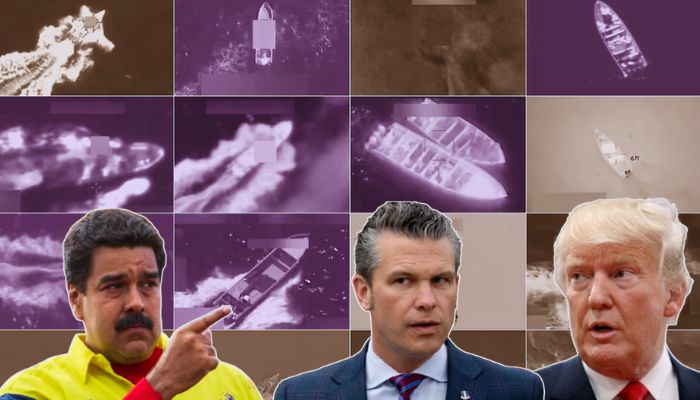
In an ironic turn of events, US President Donald Trump, who has been claiming to have stopped around eight wars and seeking the Nobel Peace Prize, is now facing heat for his administration’s commission of a war crime in the Caribbean. A row has erupted in the US as Defence Secretary Pete Hegseth is likely to face criminal liability for giving a “kill everybody” order, which led to a second airstrike on a boat and the killing of the survivors of the first strike on 2nd September.

The US airstrikes on a suspected ‘drugs-smuggling’ boat and the Trump administration’s alleged war crime

The strikes carried out by the US forces on the order of Defence Secretary Pete Hegseth on a vessel in international waters off Venezuela’s coast were claimed to be a part of the Trump administration’s campaign against “narcoterrorists”. The US authorities claimed that the attacked boat was suspected of ferrying drugs on behalf of the Tren de Aragua (TDA) gang, a designated Foreign Terrorist Organisation (FTO).

However, the Venezuelan foreign minister lodged a complaint days after the strike, alleging that the American authorities are “seeking an incident that would justify a military escalation in the Caribbean”. Foreign Minister Yván Gil cited an incident of US forces occupying a Venezuelan fishing boat for eight hours.

The initial strike on 2nd September 2025 had severely wrecked the boat, leaving many survivors clinging to its debris in the water. However, only minutes later, a second strike followed and targeted the boat’s wreckage. The second strike killed all the survivors on board. It is estimated that around 8 to 12 people were killed.

Reportedly, drone footage and radio communications captured the moments of the final blow, with survivors visible and wounded.

Trump pardoned convicted drug facilitator but accuses Biden of going soft on Drug cartels

The Democrat and Republican leaders are indulging in a war of words, with the former accusing the latter of committing ‘war crimes’ in the name of aggressive policy against drug smugglers. Trump administration officials, including Pete Hegseth, are claiming that while the previous Biden administration “coddled terrorists, “we kill them.”

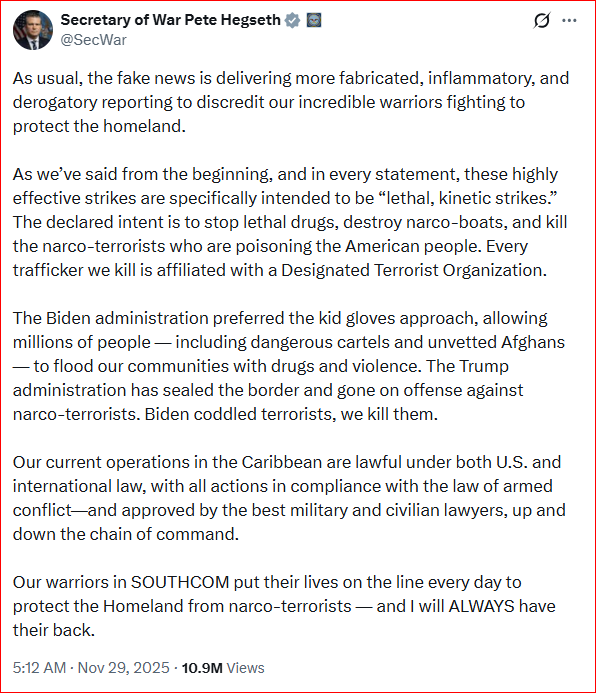
In an X post published on 29th November, Pete Hegseth dismissed the media report, particularly the Washington Post report, which claimed that Hegseth gave “kill everybody” orders to Admiral Frank M. Bradley, commander of U.S. Special Operations Command.

“…As we’ve said from the beginning, and in every statement, these highly effective strikes are specifically intended to be “lethal, kinetic strikes.” The declared intent is to stop lethal drugs, destroy narco-boats, and kill the narco-terrorists who are poisoning the American people. Every trafficker we kill is affiliated with a Designated Terrorist Organization. The Biden administration preferred the kid gloves approach, allowing millions of people — including dangerous cartels and unvetted Afghans — to flood our communities with drugs and violence. The Trump administration has sealed the border and gone on offense against narco-terrorists. Biden coddled terrorists, we kill them…” Hegseth wrote.
President Donald Trump had also expressed confidence in Hegseth, saying that he believed the Defence Secretary “100%”.

Interestingly, while Pete Hegseth accused the Biden administration of coddling terrorists, be it narcoterrorists in the Caribbean and East Pacific or Afghans, and claimed that the Trump administration kills terrorists. The reality is quite different.

It is arguably true that the Biden administration was comparatively soft on drug cartels smuggling narcotics into the US. The Trump administration has also been mollycoddling terrorists and their enablers.

In May 2025, Trump held a meeting with Ahmed Hussain al-Sharaa, the interim president of Syria, who just months back had a $10 million bounty on his head by the US government. Trump heaped praises on the former terrorist, who once admitted to having celebrated the 9/11 Islamic terror attack that killed thousands. Trump called Sharaa a “Young, attractive guy. Tough guy. Strong past. Very strong past. Fighter.”

In Afghanistan, former US President Joe Biden received all the global condemnation and domestic backlash for withdrawing US forces in 2021. However, it was Trump’s 2020 Doha Agreement that laid the ground for the eventual historic visuals of the US literally fleeing Afghanistan and leaving it in the hands of Taliban terrorists.

After elevating a former ISIS terrorist to power in Syria and leaving Afghanistan to the Taliban, Trump has declared ‘friendship’ with the Pakistan Army, the biggest Islamic terrorist group in the region. It is not a secret that Pakistan Army funds, fosters and shields Islamic terrorists and uses them as its proxies to carry out attacks against India.

In fact, the Trump administration is also going soft on convicted drug trafficking facilitators. While US forces acting on Defence Secretary Pete Hegseth’s orders are regularly striking vessels in the Caribbean over suspicion of drug smuggling, President Trump, on 29th November, pardoned former Honduran President Juan Orlando Hernández, who is convicted of facilitating huge drug trafficking, including cocaine smuggling into the US.

Hernández was sentenced to a 45-year jail term in July 2024. He was convicted of colluding with drug traffickers for over a decade to smuggle cocaine into the US.

Trump not only granted clemency to Hernández but also justified it by saying that the people of Honduras “basically said he was a drug dealer because he was the president of the country. And they said it was a Biden administration setup. And I looked at the facts and I agreed with them.”

Calling out Trump’s hypocrisy, Democrat leader Chuck Schumer dubbed the American President’s decision to pardon Hernandez as “egregious, dangerous and shameful.”

Press Secretary Karoline Leavitt’s admission and justification of the second strike that allegedly amounts to a war crime

The controversy over the September 2 airstrike began after a Washington Post report said that the verbal order was to kill “everybody” on the boat. “In an effort to comply with that order, the commanding officer of the operation directed a second strike targeting two survivors of an initial attack, who were “clinging to the smouldering wreck,” according to the Post.

Admiral Frank M. Bradley, commander of U.S. Special Operations Command, had directed a second strike on the boat’s survivors to comply with Pete Hegseth’s verbal order to “kill everybody”.

On Monday, US Press Secretary Karoline Leavitt justified the second strike that killed survivors on the boat. Leavitt defended Admiral Frank M. Bradley, commander of U.S. Special Operations Command, saying that he had acted “within his authority and the law” when he ordered a second strike after the first strike left survivors.

“Secretary Hegseth authorized Admiral Bradley to conduct these kinetic strikes. Admiral Bradley worked well within his authority and the law, directing the engagement to ensure the boat was totally destroyed and the threat to the United States of America was eliminated,” Leavitt said.

US lawmakers raise concerns over the rules of engagement of the airstrikes on the suspected drug-carrying boat

The operation carried out on 2nd September was a part of the Trump administration’s aggressive policy to interdict drug boats without prior warning. Over 83 people have been killed in 21 such operations by the US forces since September. After a series of attacks near the Venezuelan coast, the US forces have carried out multiple airstrikes along the Pacific coasts of Colombia, Ecuador, and Peru.

The rules of engagement (ROE) of the 2nd September airstrikes have been questioned by US lawmakers. The admission by Karoline Leavitt has further added fuel to the fire as many legal experts opine that Admiral Bradley’s action amounted to a war crime and murder, and thus, Defence Secretary Pete Hegseth, who ordered the strike, could be held legally culpable.

While the Trump administration faced criticism within the US for its harsh measures against alleged Venezuelan drug cartels, after Karoline Leavitt’s statement defending the second strike, US lawmakers have intensified attacks on Pete Hegseth.

Democratic Senator Tim Kaine said, “This rises to the level of a war crime if it’s true.”

Republican lawmaker Mike Turner said, “Obviously if that occurred, that would be very serious, and I agree that that would be an illegal act.”

These remarks came after the Republican-led Senate Armed Services Committee announced that it will conduct a “vigorous oversight” on the strikes.

“The Committee is aware of recent news reports – and the Department of Defence’s initial response – regarding alleged follow-on strikes on suspected narcotics vessels in the SOUTHCOM area of responsibility,” the committee’s Republican chair, Senator Roger Wicker, and his Democratic counterpart, Senator Jack Reed, said.

In a joint statement Republican-led House Armed Services Committee also called for an investigation into the follow-on strike that allegedly amounted to a war crime.

“We take seriously the reports of follow-on strikes on boats alleged to be ferrying narcotics in the SOUTHCOM region and are taking bipartisan action to gather a full accounting of the operation in question,” Republican leaders Mike Rogers, and Adam Smith wrote.

Senator Roger Wicker of Mississippi said that he expects the Committee to have full access to the audio and video of the strikes. Over 80 people have been killed in these strikes since September.

Appearing on CNN, Sen. Mark Kelly, D-Arizona, said that if the reports about the second strike are true, then “it seems to” constitute a war crime.

“If what has been reported is accurate, I’ve got serious concerns about anybody in that, you know, chain of command stepping over a line that they should never step over. We are not Russia. We’re not Iraq. We hold ourselves to a very high standard of professionalism,” Kelly said.

Former Defence Secretary Leon Panetta, who served in the Obama administration, appeared on a CBS show and deemed the second airstrike in question a violation of the rules of war and a criminal act.

“The basic rules of war that are involved here make very clear that you do not strike wounded people in the water in order to kill them. You basically then are responsible to try to make sure you do everything to try protect their lives at that point. And that the concern right now whether or not this really violated the rules of war and constituted a criminal act,” Panetta said.

Meanwhile, the Former JAGs Working Group, a group of ex-military lawyers, have released a memo assessing the second strike and argued that it amounts to a violation of both American and international laws.

“…not only does international law prohibit targeting these survivors, but it also requires the attacking force to protect, rescue, and, if applicable, treat them as prisoners of war. Violations of these obligations are war crimes, murder, or both. There are no other options,” the memo reads.
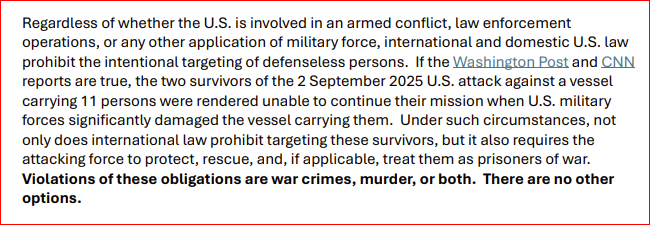
Excerpt taken from the document released by the Former JAGs Working Group

Trump administration trying to throw Admiral Bradley under the bus?

While Pete Hegseth claims to be backing Admiral Bradley, a decorated SEAL commander who oversaw the operation on 2nd September, it seems that, amidst backlash and the possibility of legal trouble, the Trump administration is scapegoating Admiral Bradley.

These speculations are fuelled by Karoline Leavitt’s remarks that Frank Bradley “directed the engagement” and that he acted “within his authority and the law”. On one hand, Leavitt justified the alleged war crime as a ‘lawful action’, on the other, she absolved Hegseth of any role in the carrying out of the second strike.

It seems that singling out Admiral Bradley by the White House was a shrewd blame-shifting strategy. Democrat leaders like Jason Crow are alleging that the Trump administration has a history of getting reckless things done by others and then throwing them under the bus to shift blame.

The family of a Colombian fisherman killed in one of the airstrikes carried out by US forces files a complaint

The controversy around the Trump administration’s aggressive and allegedly in violation of international laws actions shows no signs of fading. Amidst pressure to provide full transparency and accountability over civilian deaths in the Caribbean caused due to US strikes, the family of a Colombian fisherman named Alejandro Carranza Medina, killed in a US airstrike carried out on 15th September, has filed a formal complaint with the Inter-American Commission on Human Rights.

The complainants alleged that the deceased man was denied his rights to due process and a fair trial. The family directly accused Pete Hegseth of ordering extra-judicial killings in the name of fighting against drug smugglers.

“From numerous news reports, we know that Pete Hegseth, US Secretary of Defense, was responsible for ordering the bombing of boats like those of Alejandro Carranza Medina and the murder of all those on such boats, Secretary Hegseth has admitted that he gave such orders despite the fact that he did not know the identity of those being targeted for these bombings and extra-judicial killings,” the complainant family said in its statement.

Venezuela’s political instability, oil reserves and Trump’s reassertion of the ‘Monroe Doctrine’

For many months, Venezuelan President Nicolás Maduro has been alleging that Trump is attempting to orchestrate regime change in Venezuela. While the drug menace stemming from Venezuela is real and massive, it is being said that the anti-drugs smuggling crackdown is a part of Trump’s wider strategy to gain control over politically unstable but oil-rich Venezuela.

It is notable that Venezuela has the largest proven oil reserves, more than five times that of the United States; however, political instability and numerous sanctions prevent the Latin American nation from fully unlocking its oil potential. What further concerns the US is Venezuela’s strengthening ties with Russia and China, both of which are seen by Washington as its rivals. Having a country tilted towards Russia and China in the neighbourhood is not something America would like or allow.

There is a history of America deploying its infamous ‘plane of democracy’ to countries rich in natural resources for its own benefits, either by stirring political instability or by taking advantage of a prevailing disturbance.

The Trump administration has been using the Venezuelan opposition’s “criminal regime” description of the Maduro government as an excuse to not only meddle in the Latin American country’s internal affairs but also to justify the intensified military actions.

While a direct invasion is unlikely, given how such an adventure played out against the US in Iraq, the crackdown against drug cartels in the Caribbean seems to be a pressure and intimidation tactic to either compel Maduro into resigning and fleeing or becoming subservient to Trump, while CIA covert action is also said to be on the cards.

Apparently, Trump’s hawkish approach to the drug menace originating from the Caribbean stems from his desperation to seize direct or indirect control over the Venezuelan oil reserves, ensure strategic security, and lucrative markets. It remains to be seen how successful the Trump administration’s revitalisation of the 19th-century Monroe Doctrine would be, in a world rapidly moving towards multipolarity.
Kerala HC quashes rape charges against man, cites 3-year-long relationship to question ‘educated’ woman’s allegations: How courts are dealing with misuse of rape laws

The Kerala High Court on Monday (1st December) quashed criminal proceedings against a man, rejecting the rape accusations brought against him by a woman. A single bench of Justice G Girish examined the submissions of both sides and found several contradictions in the woman’s claims, after which he passed the decision.

The petitioner had approached the High Court seeking the quashing of the criminal proceedings, which were initiated after an FIR was filed against him on July 23, 2018, by the Erattupetta Police under Section 376(f)(n) of the IPC and Section 66E of the Information Technology Act. The complainant (woman) alleged that the petitioner committed rape on her during the period between 2011 and 2014, and subjected her to mental torture by threatening to publish her objectionable photos and disclose their affair.

HC cited loopholes in the victim’s claims

However, the High Court found the complainant’s account replete with dichotomies, which supported the man’s claim that he was falsely implicated in the case after he sued the complainant for failing to repay money she had borrowed from him and for committing insurance fraud with him.

“Having regard to the financial and property transactions between the petitioner and the de facto complainant from 2010 onwards as revealed from the case records, it is too hard to believe the version of the de facto complainant that the petitioner had been subjecting her to sexual abuse for a period of more than three years, and that she did not disclose the above crime due to shame,” the High Court noted in the judgment accessed by OpIndia.

The High Court pointed out that in 2017, the complainant had testified for the petitioner before a court in a case of cheque dishonour, in which she described him as “a close family friend”. “The allegation of the de facto complainant that on several occasions, the petitioner compelled her to come to her residence at Thrissur and also to his residence at Poonjar, and that she had to surrender herself to the petitioner, cannot be reconciled with the sworn statement which the de facto complainant gave on 26.07.2017 before the Judicial First Class Magistrate Court to the effect that the petitioner is a close family friend of her,” the Court pointed out.

Expressing disbelief in the complainant’s claims, Justice Girish said that it could not be expected of an “educated and employed lady like the petitioner would have fallen prey to the coercion and criminal intimidation of the petitioner for a period of about three years, and subjected herself to the sexual abuse of the petitioner.” After analysing the sequence of events, from the institution of a suit by the petitioner against the complaint followed by the filing of an FIR by the complainant against the petitioner, the High Court concluded that there was “substance in the allegation of the petitioner that a false complaint has been lodged against him as a counterblast to the legal action initiated by him against the de facto complainant”.

A consensual relationship turning sour cannot be a ground for invoking rape allegations: SC

The case is the latest example of how laws relating to sexual offences against women are being misused by several women in India, which results in the harassment of innocent men, undermining the cases of actual victims and the abuse of the process of law. Indian courts have repeatedly clarified that that consensual relationships turning sour or not resulting in marriages do not constitute the offence of rape.

In May 2025, the Supreme Court held that initiating criminal proceedings in cases involving consensual relationships deteriorating over time adds to the burden on the judiciary and damages the reputation of innocent persons. The observation was made by the Apex Court in a case in which fake rape allegations were levelled by a married mother of one against a 23-year-old man after their relationship turned sour.

“A consensual relationship turning sour or partners becoming distant cannot be a ground for invoking the criminal machinery of the State. Such conduct not only burdens the Courts, but also blots the identity of an individual accused of such a heinous offence. This Court has time and again warned against the misuse of the provisions, and has termed it a folly to treat each breach of promise to marry as a false promise and prosecute a person for an offence under section 376 IPC,” the top court noted, dismissing the criminal proceedings.

High Courts adopt a strict approach in dealing with false rape cases

With the rampant rise in the number of false rape cases, India Courts are exercising caution while trying rape cases. In some recent cases, various High Courts quashed criminal proceedings where the rape cases were found to be false. In August 2025, the Uttarakhand High Court dismissed rape proceedings against a minor boy after finding that the complainant and the accused had a consensual relationship. In a similar case, a Lucknow court sentenced a woman to 7.5 years in jail after she implicated two men in a rape case and offences under the SC/ST Act. Last year in August, the Bombay High Court quashed an FIR filed against a 73-year-old man, who was accused of raping a woman on a false promise of marriage. The High Court noted the fact that the complainant had been in a sexual relationship for 31 years and the complainant had never before spoken about her opposition to the relationship.

Legal remedies for men falsely accused of sexual offences

The increasing trend of rape laws being invoked by women after emotional fallout in consensual relationships is alarming and needs to be addressed by the judiciary to prevent the laws from being weaponised by vindictive individuals. There are several legal provisions which can be invoked by men facing false rape cases. Such men can seek the quashing of FIR under Section 482 CrPC (now Section 528 BNSS) in the respective High Court. They can invoke Sections 182 (false information to a public servant, Section 217 BNS) and 211 (false charge to injure, Section 248 BNS) of the IPC against women who falsely accuse them of sexual offences, after they have been acquitted or the charges have been proved to be fabricated. Apart from this, a Magistrate can invoke Section 273 of the BNSS and order the complainant to give compensation to the accused after acquittal if he finds that there was no reasonable ground for the accusation.

However, cases pertaining to sensitive relationships often have a wider social impact. Media headlines tend to sensationalise cases where the legal nuances are ignored, and controversial aspects are hyped. Intimate relationships are complicated and sometimes, due to the diverse socio-economic power dynamics, prolonged relationships can still be abusive and ‘coerced’, even though they appear to be consensual on the surface. Sweeping statements against women, and even men, tend to spread confusion among the masses. Hence, it is prudent for the judiciary and the media both to approach social issues with care.

India and natural farming…the way ahead!

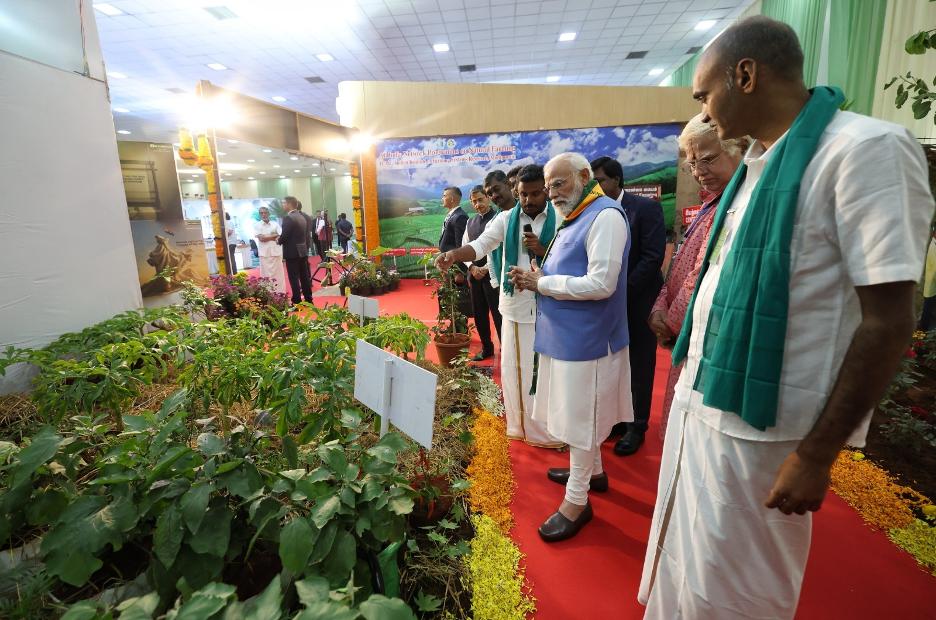
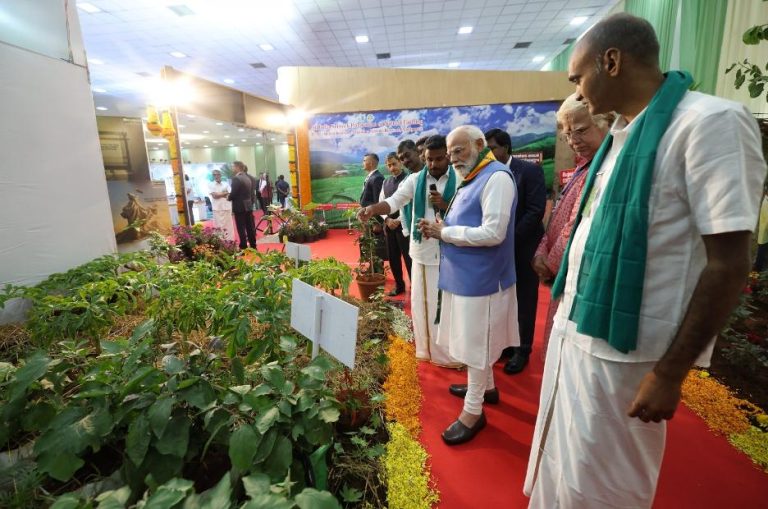
In August this year, a group of farmers from Tamil Nadu met me and talked about how they were practising new agricultural techniques to boost sustainability and productivity. They invited me to a Summit on natural farming to be held in Coimbatore. I accepted their invite and promised them that I would be among them during the programme. Thus, a few weeks ago, on 19th November, I was in the lovely city of Coimbatore, attending the South India Natural Farming Summit 2025. A city known as an MSME backbone was hosting a big event on natural farming.

Natural farming, as we all know, draws from India’s traditional knowledge systems and modern ecological principles to cultivate crops without synthetic chemicals. It promotes diversified fields where plants, trees and livestock coexist to support natural biodiversity. The approach relies on recycling farm residues and enhancing soil health through mulching and aeration, rather than external inputs.

This Summit in Coimbatore will forever remain a part of my memory! It indicated a shift in mindset, imagination and confidence with which India’s farmers and agri-entrepreneurs are shaping the future of agriculture.

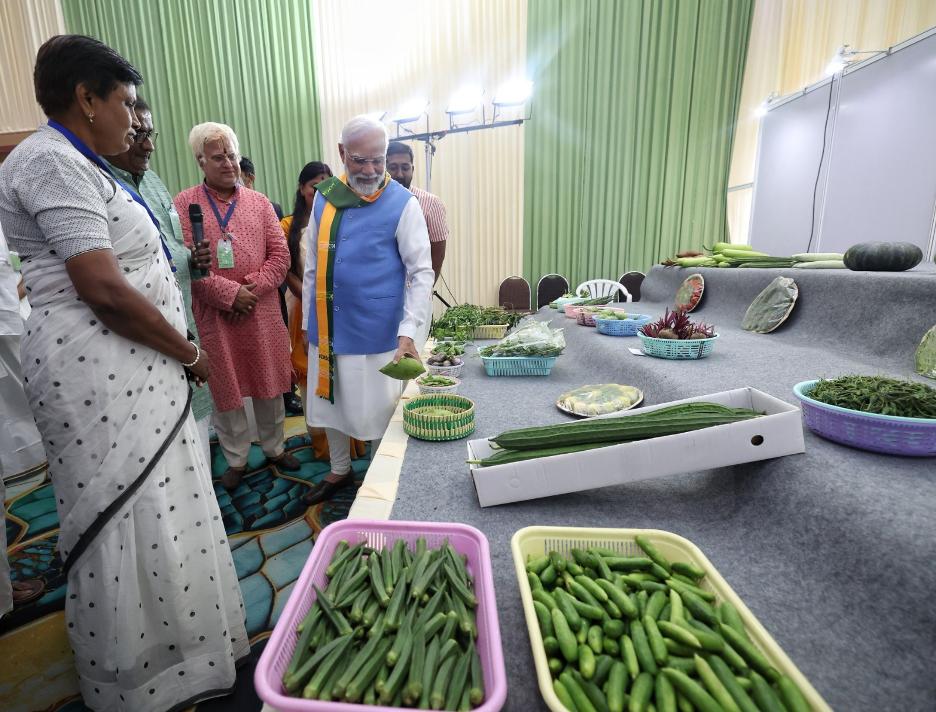
The programme included an interaction with farmers from Tamil Nadu, in which they showcased their efforts in natural farming and I was amazed!

I was struck by the fact that people from diverse backgrounds, including scientists, FPO leaders, first-generation graduates, traditional cultivators and notably people who had left high-paying corporate careers, decided to return to their roots and pursue natural farming.

I met people whose life journeys and commitment to doing something new were noteworthy.

There was a farmer who managed nearly 10 acres of multi-layered agriculture with bananas, coconuts, papaya, pepper and turmeric. He maintains 60 desi cows, 400 goats and local poultry.

Another farmer has dedicated himself to preserving native rice varieties like Mapillai Samba and Karuppu Kavuni. He focuses on value-added products, creating health mixes, puffed rice, chocolates and protein bars.

There was a first-generation graduate who runs a 15-acre natural farm and has trained over 3,000 farmers, supplying nearly 30 tonnes of vegetables every month.

Some people who were running their own FPOs supported tapioca farmers and promoted tapioca-based products as a sustainable raw material for bioethanol and Compressed Biogas.

One of the agri-innovators was a biotechnology professional who built a seaweed-based biofertilizer enterprise employing 600 fishermen across coastal districts; another developed nutrient-enriched bioactive biochar that boosts soil health. They both showed how science and sustainability can blend seamlessly.

The people I met there belonged to different backgrounds, but there was one thing in common: a complete commitment to soil health, sustainability, community upliftment and a deep sense of enterprise.

At a larger level, India has made commendable progress in the field. Last year, the Government of India launched the National Mission on Natural Farming, which has already connected lakhs of farmers with sustainable practices. Across the nation, thousands of hectares are under natural farming. Efforts by the Government such as encouraging exports, institutional credit being expanded significantly through the Kisan Credit Card (including for livestock and fisheries) and PM-Kisan, have also helped farmers pursuing natural farming.

Natural farming is also closely linked to our efforts to promote Shree Anna or millets. What is also gladdening is the fact that women farmers are taking to natural farming in a big way.

Over the past few decades, the rising dependence on chemical fertilisers and pesticides has affected soil fertility, moisture and long-term sustainability. At the same time, farming costs have steadily increased. Natural farming directly addresses these challenges. The use of Panchagavya, Jeevamrit, Beejamrit, and mulching protects soil health, reduces chemical exposure, and lowers input costs while building strength against climate change and erratic weather patterns.

I encouraged farmers to begin with ‘one acre, one season.’ The outcomes from even a small plot can build confidence and inspire larger adoption. When traditional wisdom, scientific validation and institutional support come together, natural farming can become feasible and transformative.

I call upon all of you to think of pursuing natural farming. You can do this by being associated with FPOs, which are becoming strong platforms for collective empowerment. You can explore a StartUp relating to this area.

Seeing the convergence between farmers, science, entrepreneurship and collective action in Coimbatore was truly inspiring. And, I am sure we will together continue making our agriculture and allied sectors productive and sustainable. If you know of teams working on natural farming, do let me know too!

This article was written by Prime Minister Narendra Modi on LinkedIn and has been republished here with due credit. The original article can be read here.

Envoys of UK, France and Germany play EU politics on Indian soil, joint anti-Putin article called ‘unacceptable and unusual’ by MEA

India has taken a strong stance regarding a joint article authored by envoys of the United Kingdom, France and Germany for “The Times of India.” The piece which was published on 1st December accused Russia for Ukraine conflict and President Vladimir Putin of “total disregard for human life.”

The development occurred against the backdrop of Putin’s first state visit to India since the onset of the war in Ukraine in February 2022. His previously landed in the country in December 2021 and now is set to arrive in Delhi for the 23rd annual summit between the two nations on 4th to 5th December.

The article was criticised by senior official from Ministry of External Affairs (MEA) who stated, “We see this as very unusual. It is not an acceptable diplomatic practice to advise India’s foreign relations with a third country. We have taken note of it.”

Former Foreign Secretary Kanwal Sibal also described the joint article as “vicious” as it “breaches diplomatic norms” and “is a diplomatic insult to India.” He added, “It is interference in our internal affairs as the purpose is to fuel anti-Russian sentiments in pro-European circles in India and question the morality of our ties with Russia.”

“The envoys of these three countries are free to make their views known to the MEA in an official demarche but are not supposed to engage in public grandstanding with an overt propagandist intent,” Sibal outlined and even denounced the English daily for providing space to it and “doing disservice to diplomacy and national interest.”

Diplomats attack President Putin, hold Russia responsible for the “illegal war”

The controversial article titled, “World wants the Ukraine war to end, but Russia doesn’t seem serious about peace,” have been written by Philipp Ackermann (German Ambassador to India), Thierry Mathou (French ambassador to India) and Lindy Cameron (British High Commissioner to India). It lauded the “courage and fierce determination” of Ukrainians “against Russia’s unprovoked war of aggression on their home,” without referencing the billions of dollars in resources and weaponry funnelled into Ukraine.

The article further claimed that Russia has initiated illegal attacks on innocent people and civilian infrastructure. “This last week alone, Russia has launched over 1,200 drones and over 60 cruise and ballistic missiles at Ukraine. These are not the actions of someone that is serious about peace. Neither are these indiscriminate attacks mere accidents, they are a systematic choice by Russia to wage its war of aggression with absolute ruthlessness. And it must end,” it added.

The article subsequently charged Moscow with disrespecting Ukraine’s national sovereignty, fundamental principles of the international order, independence and territorial integrity alongside breaching the treaties it has ratified concerning the Ukrainian border.

“Russia’s malign global activity, including through cyber-attacks and disinformation, shows us that the Russian leadership’s appetite for territorial expansion and global destabilisation goes well beyond Ukraine. President Putin is the one leader who could end the war any time he so wishes,” the piece asserted, insinuating his alleged aversion to peace.

Notably, the West, which claims to be the protector of global peace and order, has played a significant role in conspiring to incite bloodshed, instability and even the destruction of countries in order to install governments that align with its interests. Interestingly, Ukraine has also been a target of a similar regime change operation by the United States. The only principle or order these countries follow is one that serves their own agenda while sermoning or demonising others.

The article then delves into further condemnation of Russia, alleging that the nation has stationed troops within Ukraine and is refusing “to engage in meaningful negotiations or even a ceasefire that everyone else is calling for.” It asserted that thousands of children have been displaced as “Russia’s illegal invasion has inflicted a severe human toll on both sides.”

The envoys then added that “Putin’s illegal war, and his total disregard for human life, have taken a huge toll on his own people.”

Deliberate effort to influence India-Russia diplomatic ties

After a scathing attack on Putin ahead of his trip to India, in an attempt to overshadow this crucial occasion, the piece then dragged India and quoted PM Modi, who earlier conveyed, “A solution cannot be found on the battlefield.” However, the move has only resulted in a firm objection from New Delhi.

Furthermore, it has even reminded of a famous quote by External Affairs Minister S Jaishankar, who aptly articulated this hypocrisy when he expressed, “Somewhere Europe has to grow out of the mindset that Europe’s problems are the world’s problems but the world’s problems are not Europe’s problems. That if it is you, it’s yours, if it is me it is ours. I see reflections of that,” in 2022.

“When we look out at the world, we look for partners. We don’t look for preachers, particularly preachers who don’t practice at home what they preach abroad and I think some of Europe is still struggling with that problem,” he reiterated in May of this year.

This double-standard of Western nations resulted in 50% tariffs (including 25% for buying Russian oil) by the US on India. These countries are reluctant to support India in its fight against Pakistani terrorism, which poses a real threat to the world, or against China’s imperialistic ambitions. However, they consistently find ways to directly or indirectly ask the Modi government to take a stance against India’s close partner and ally, Russia.

The article also highlighted the contentious meeting between President Donald Trump and President Volodymyr Zelenskyy where the later was not only openly chastised but even had to apologise as “efforts to secure a just and lasting peace and end the killingm.” It declared that the “governments of France, Germany and the United Kingdom, will continue to give Ukraine our ironclad support. Today and every day,” along with additional denunciation of Russia.

These diplomats want to reduce the crucial meeting between the two world leaders as a platform for their politics of global influence via Ukraine and grab eyeballs. However, India wants no part of it.

President Putin’s India visit

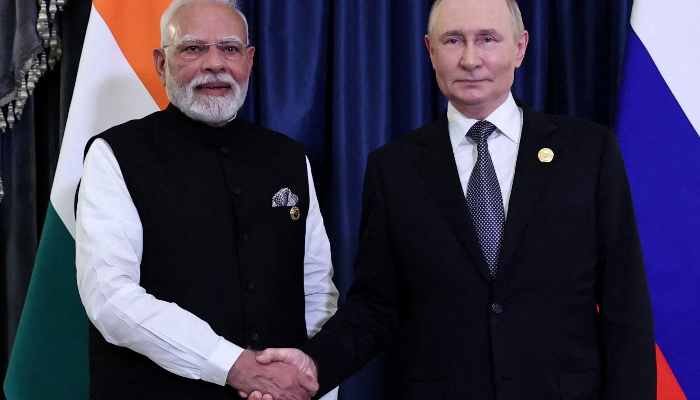
India and Russia are preparing to sign many important agreements during this summit which would also feature a vital private dinner between Putin and Prime Minister Narendra Modi. Moscow and New Delhi are anticipated to concentrate on defence cooperation including the S-400 missile system and energy trading.

On 2nd December, Putin announced, “We aim to elevate cooperation with the People’s Republic of China and the Republic of India to a qualitatively new level by strengthening its technological component. This is the objective of numerous joint projects in energy, industry, space, agriculture, and other sectors.” in Moscow, providing a glimpse into the objective of the summit in Delhi.

The two nations have maintained close ties throughout the nearly four-year dispute while the European Union alongside North Atlantic Treaty Organisation (NATO) has provided Ukraine with weapons and assistance. However, New Delhi has repeatedly advocated for a peaceful resolution to the matter.

The subject can transpire during the upcoming summit and the officials restated India’s long-held position that the issue cannot be decided on the battlefield as discussion alongside diplomacy are the only viable options. India has unequivocally demonstrated its commitment for peace while not siding with any nation and remaining neutral, owing to its sovereign foreign policy. This has clearly vexed Europe and its other Western allies who want Modi government to support Ukraine.

Therefore, they seize every opportunity to pressure India or impact its relationship with Russia. The recent article published by these diplomats is yet another extension of this detrimental effort and the timing of the article has likewise sparked suspicion concerning the intentions.

It has evidently turned into a tough fact for the European Union and the West that they are unable to control India’s foreign relations with any country, let alone Russia.

Lawrence Bishnoi gang claims responsibility for own associate Parry’s murder: “Your countdown has begun”, Goldy Brar warns in fresh threat

On Monday (1st December), Inderpreet Singh alias Parry, an associate of the Lawrence Bishnoi gang, was shot dead by unknown attackers near Timber Market in Chandigarh’s Sector 26. The 36-year-old man was rushed to a hospital, where he succumbed to his injuries.

Right after Parry’s killing, a Facebook post by gangster Aarzoo Bishnoi, who claimed responsibility for the murder, went viral.

Notably, Inderpreet Singh alias Parry had multiple criminal cases registered against him.

Speaking about the incident, IG Chandigarh Police Pushpendra Kumar said, “We received a call about a firing incident near Timber Market at around 6 pm. The police team reached the spot and found the victim in the car. He was taken to PGIMER, but he could not survive”.

Around 9-10 rounds of bullets were fired by the attackers. Two of the bullets hit the windshield of the Kia Seltos car Inderpreet Singh, aka Parry, was inside. The assailants, who arrived in a compact SUV, Creta, escaped the crime scene after shooting Parry. Some reports say that the co-passenger in Inderpreet Singh’s car also fired at him before escaping; however, this claim remains a subject of investigation.

According to the preliminary investigation, the assailants were known to the deceased, Lawrence Bishnoi gang associate. A case has been registered, and the police are investigating the matter.

The criminal background of Inderpreet Singh alias Parry and the Lawrence Bishnoi connection

Notably, Inderpreet Singh was a former Students’ Organisation of Panjab University (SOPU) leader and was jailed with gangster Lawrence Bishnoi 14 years ago. Parry had been involved in numerous extortion, arms recovery, and assault cases. He was also facing trial ia n a 14-year-old case in Chandigarh wherein he, along with other accused persons, barged into a house in Sector 40 and attacked a man named Harpreet Singh Grewal. In this case, Lawrence Bishnoi is also named as an accused.

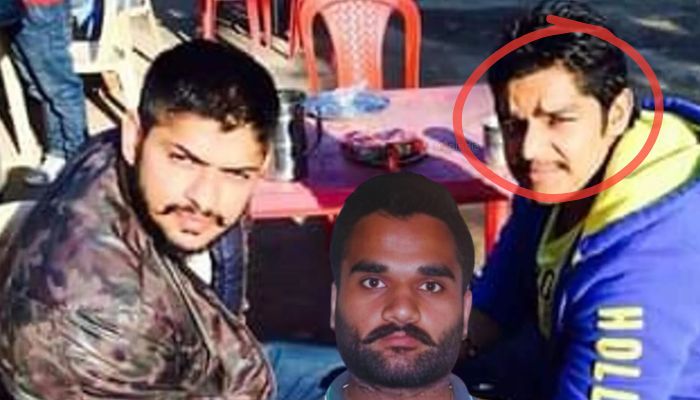
Lawrence Bishnoi and Inderpreet Singh Parry were classmates at the DAV College. Parry entered the crime world during his graduation days. Bishnoi, Parry and gangster Goldy Brar used to be an inseparable trio before the eventual fallout.

Source: India TV

In another case, the Punjab Police arrested Parry from a hotel in Himachal Pradesh’s Sundernagar. In March 2022, Inderpreet Singh alias Parry was arrested by the Chandigarh Police over accusations of making extortion calls to businessmen and owners of clubs and hotels in Chandigarh, Panchkula and Mohali.

In 2022, when the law enforcement agencies were cracking down on the Lawrence Bishnoi gang’s organised crime syndicate, Parry was arrested at his residence in Sector 33. During the arrest, the police confiscated a pistol and 10 live cartridges from his possession. Following his interrogation, the authorities further recovered a Glock pistol with 10 cartridges and a US-made rifle, also carrying 10 cartridges. Months later, Inderpreet Singh was released on bail.

Back in 2017, Inderpreet Singh or Parry, was arrested alongside gangster Bharat Bhushan aka Bhola Shooter in the murder case of Lavi Deora of the Vicky Gounder gang.

Allegations of betrayal within the Lawrence Bishnoi gang and Goldy Brar’s emotional message after the killing of Inderpreet Singh Parry

It appears that once friends and partners in crime, Lawrence Bishnoi and Inderpreet Singh Parry were at odds. Earlier this year, Goldy Brar announced a dissociation with the Lawrence Bishnoi gang. Brar was upset with the Bishnoi gang’s dissatisfaction over how Brar handled matters about his brother Anmol in the United States.

The Brar vs Bishnoi rivalry further escalated with Brar’s associate Rohit Godara claiming responsibility for the murder of Bishnoi’s ally Sippa in Dubai.

In a social media message, gangsters Aarzoo Bishnoi, Hari Boxer and others accused Inderpreet Singh Parry of “betraying” them as the deceased criminal allegedly supported the Goldy Brar gang, extorted money for Brar and was even planning attacks on Bishnoi gang members. Aarzoo Bishnoi and others also threatened that anyone siding with Brar will be killed. While the threat message has gone viral online, the police are investigating its veracity.

Meanwhile, Goldy Brar, the Canada-based gangster, purportedly issued an emotional message expressing grief and condolences for Parry’s family. “Parry had done nothing to deserve such a death,” Brar reportedly said.

“Sat Sri Akal to all my brothers. I am Goldy Brar. I am sending this voice message to say that our brother Inderpreet Parry, who was murdered by the Lawrence Bishnoi gang, was targeted deliberately. They may now claim he extorted money or worked for others, but the truth is that Lawrence himself had called Parry after his wedding to congratulate him and discuss personal matters unsafe to talk about on the phone. He asked Parry to meet a contact at a specific location and speak from that person’s phone.”

“Lawrence called his own friend out and had him killed. This is a new low in friendship. Parry never intended any harm toward Bishnoi. Lawrence can never prove Parry harmed him in any way,” he added.

In addition to criticising Lawrence Bishnoi and accusing him of getting his own aide murdered, Goldy Brar also defended and tried to distance himself from Parry’s killing.

“We have only ever taken action against those guilty of wrongdoing. When Sippa, whom many thought was a don, was killed in Dubai, it was because he was a police informant, making money in the name of extortion and loyal to no one. At that time, Parry was busy with his wedding functions,” Brar said, adding that Inderpreet Singh Parry made his “biggest mistake” by considering Lawrence Bishnoi his friend. Goldy said in his audio message that Lawrence’s countdown has now begun.

How Goldy Brar eventually parted ways with Lawrence Bishnoi

In the Punjab and Haryana underworld, Lawrence Bishnoi once commanded a tightly controlled network where Goldy Brar, Rohit Godara, Shehzad Bhatti and others operated as trusted allies. For years, Goldy was seen as Lawrence’s “right hand”, executing major operations and helping expand the gang’s reach. Their bond, rooted in college and strengthened during their time in jail, drove several high-profile crimes, including the killings of Sidhu Moosewala and Baba Sidhique and the firing outside Salman Khan’s home.

However, the partnership began to fracture in 2024 after Anmol Bishnoi’s arrest in the United States. According to media reports, the Bishnoi camp believed Goldy had not provided sufficient legal support to Anmol. This disagreement escalated, and by early 2025 both factions had formally split. Once the separation became public, several prominent gangsters shifted sides, intensifying tensions and triggering a gang war between the two groups.

Who was Saksham Gautam Tate, the Dalit Buddhist youth killed by OBC girl’s family and what led to the tragic crime: Here is what we know so far

0

A 20 year old man, Saksham Gautam Tate, was killed in Nanded district on 27 November, days before his 21st birthday. The man was killed by the father and brothers of his girlfriend, Aanchal Mamilwad. The attack has been described by the police as an honour driven attack linked to an inter-community relationship.

According to media reports, the events escalated on Thursday when Aanchal’s younger brother attempted to take her to the Itwara Police Station to lodge what she alleges was a false complaint against Saksham. When she protested, she claimed that two policemen, identified as Dheeraj Komalwar and Maheet Asarwar, encouraged the family to “kill him before coming back” instead of filing fabricated cases.

In the evening on the same day, Saksham was intercepted in Minidnagar, Junaganj, by Aanchal’s father, Gajanan Mamilwad, and her brothers, Himesh and Sahil. According to a police statement, Saksham was shot and then his head was smashed with a stone to ensure he died on the spot. Police detained eight accused within hours of the incident, including a minor and a woman. The minor has been sent to a juvenile home and the woman has been placed in judicial custody. Four key accused were sent to police custody.

The police have registered the case under Sections 103, 61(2), 189, 190(1), 191(2) and 191(3) of the Bharatiya Nyaya Sanhita (BNS) 2023, Sections 3(2)(v) and 3(2)(va) of the Scheduled Caste and Scheduled Tribe (Prevention of Atrocities) Act, and Section 3/25 of the Indian Arms Act.

Both the accused and the victim had prior criminal records, and some of them faced charges under MCOCA as well. Assistant Commissioner of Police, Prashant Shinde, is leading the probe in the matter. Allegations of police complicity raised by Aanchal are being probed separately.

According to a Dainik Bhaskar report, while Aanchal’s father was opposing the marriage, his own was a love marriage. Aanchal’s mother, Jaishree, is a Rajput. Reportedly, when Jaishree came in contact with Gajanan, she was already married and had a son.

There is a video of Gajanan dancing with Saksham. Saksham was frequently at Aanchal’s house, which led to a relationship between them. When Gajanan came to know about it, he became furious and threatened Saksham to stay away from Aanchal several times.

OpIndia tried contacting police to learn more about the matter, however they refused to comment as the matter is under investigation.

A symbolic marriage and a grieving family

In a dramatic and emotional gesture, the day after the murder, when the body was about to be taken for cremation following post mortem, Aanchal visited Saksham’s house and applied haldi and sindoor to his body, symbolically marrying him. In a statement, she said they had planned to elope after his 21st birthday. Saksham, according to Aanchal, hoped to convince her family for an approved marriage.

Aanchal, who is a first year BSc student, claimed that Saksham supported her studies and wanted her to join civil services. She further added that Saksham himself wanted to join civil services. However, investigation into Saksham’s past revealed he was involved in several criminal activities making it impossible for him join any government service, let alone civil services. Aanchal has demanded capital punishment for his family members who killed Saksham.

The surge of anti-Brahmin propaganda online

As news of the killing spread, a parallel narrative quickly took shape on social media, with several accounts attempting to frame the incident as yet another instance of so called Brahmanical oppression. This was despite the girl’s own clarification that Saksham was Buddhist, and her family belonged to the OBC community. The rush to impose an anti-Brahmin angle, detached from the facts of the case, became a major driver of online outrage.

Speaking to the media, Aanchal said, “We were in a relationship for three years. My family got to know about it. Because he was ‘Jai Bhim’ (Buddhist), my family did not agree to our marriage. My family had told him that if he wanted to marry me, he would have to convert to Hinduism. He was ready to do this also.” However, a campaign is being run on social media making it a case where an upper caste family killed a Dalit boy.

Anchal belongs to Mamilwad caste which, according to police recruitment document, comes under Special Backward Class (SBC) in Maharashtra.

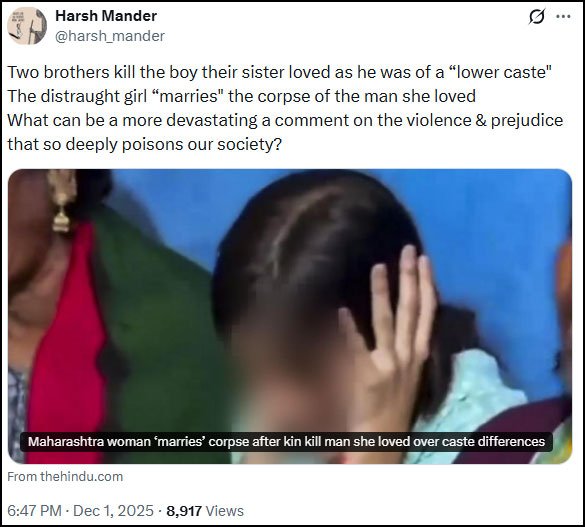
In post on X, propagandist Harsh Mander wrote, “Two brothers kill the boy their sister loved as he was of a “lower caste”. The distraught girl “marries” the corpse of the man she loved. What can be a more devastating a comment on the violence & prejudice that so deeply poisons our society?”

Source: X

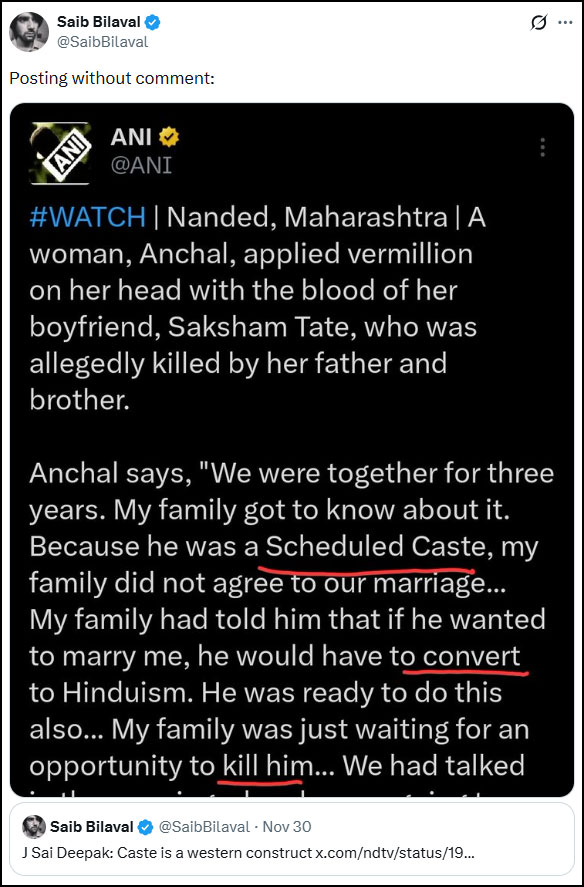
In a post, Saib Bilawal, though did not comment openly, but highlighted “caste” being the reason behind the murder.

Source: X

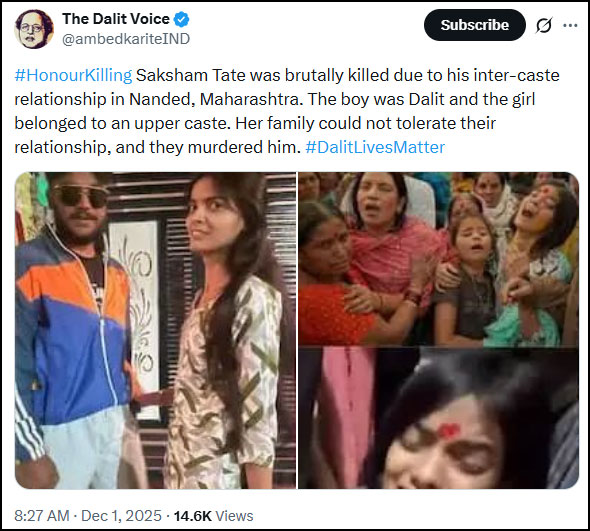
Propaganda handle ‘The Dalit Voice’ wrote, “Honour Killing. Saksham Tate was brutally killed due to his inter-caste relationship in Nanded, Maharashtra. The boy was Dalit and the girl belonged to an upper caste. Her family could not tolerate their relationship, and they murdered him.”

Source: X

Saksham’s criminal past

During the course of examining official records related to the case, OpIndia accessed a court document that lists multiple offences previously registered against Saksham Tate. According to the document, he had been named in at least eight criminal cases over the past few years. These entries, now part of the investigation’s wider context, shed light on his history with local police and the circumstances surrounding his activities before the incident.

Interestingly, in December 2024, Aanchal filed a complaint against Saksham at Itwara Police Station claiming he molested her. At that time, Aanchal was under 18 years old, so Sections 8 and 12 of the POCSO Act were invoked along with Sections 74 and 78 of the Bharatiya Nyaya Sanhita (BNS). In her complaint, Aanchal claimed that on 22 November 2024, Saksham stalked her and took her to a room against her wish. He took objectionable photographs and thereby outraged her modesty. Aanchal was just three days away from turning 18 at that time.

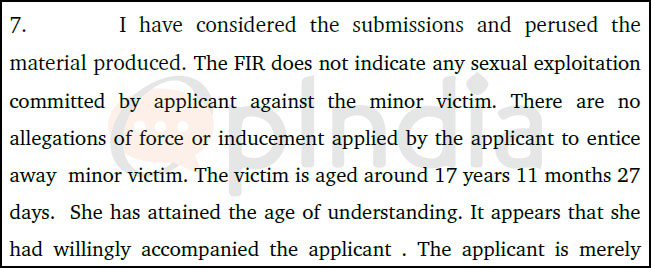
However, during the bail hearing, Saksham’s advocate told the court that Saksham did not force her and she went with him herself. Further, he did nothing against her will. Aanchal did not appear in court to contest the bail plea.

The court noted that the FIR did not indicate any sexual exploitation committed by Saksham against the victim. Considering her age, the court noted that she had attained the age of understanding and it appeared she had willingly accompanied Saksham. He was released on bail with conditions including co operation in the investigation. This particular case was still ongoing in the Nanded court.

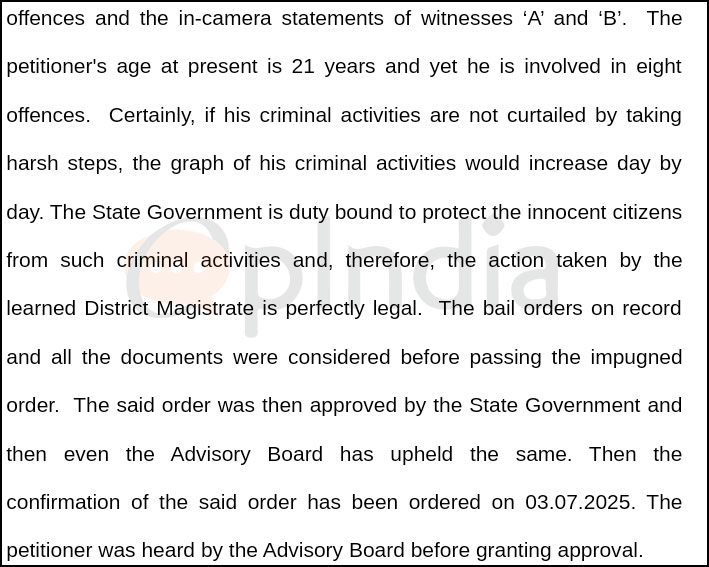
According to a judgment that impugned a detention order against him on 8 September 2025, it was noted that he was involved in eight criminal cases in different police stations in Nanded. A robbery case in Shivaji Nagar Police Station, another robbery case in Bhokar Police Station and one in Umri Police Station were mentioned. However, other cases were not mentioned in the judgment.

Source: Bombay High Court

According to court documents, he was taken into preventive detention under the Maharashtra Prevention of Dangerous Activities Act on 15 May 2025. The state called him a “dangerous person” under defined under Maharashtra Prevention of Dangerous Activities of Slumlords, Bootleggers, Drug-Offenders, Dangerous Persons and Video Pirates Act, 1981 or MPDA Act. While arguing the case, the state added, “Due to the terror created by the petitioner, people are not coming forward to lodge report against him and, therefore, it affects the public order.”

He filed an appeal against the detention order. The cases he was involved in were mentioned by the police while opposing the quashing of the detention order.

The High Court quashed Saksham Tate’s preventive detention under the MPDA Act after finding that the order was passed with clear non application of mind and without meeting the legal threshold of a public order threat. The judges noted that although eight offences were registered against him, the District Magistrate relied only on two cases, ignored the fact that Saksham had already secured bail and anticipatory bail, and based the detention on weak material such as in-camera statements and FIRs involving unknown assailants. The court held that these incidents, at most, created a law and order situation, not a disturbance to public order, and therefore there was no justification to categorise him as a “dangerous person” under a harsh preventive detention law.

The unfolding facts show that the case is far more layered than the simplified caste narrative being pushed online. From the family’s opposition, allegations of police misconduct and Aanchal’s symbolic marriage to the uncovering of Saksham’s extensive criminal history and a quashed preventive detention order, each element adds complexity to an already volatile situation. As the investigation continues, it remains essential to separate emotion from evidence and acknowledge that this tragedy involves multiple intersecting realities rather than a single convenient storyline.

Fresh FIR against Gandhi family in National Herald case: Read how Sardar Patel repeatedly warned Nehru about the newspaper’s financial impropriety decades ago

The National Herald issue has resurfaced after the Economic Offences Wing of the Delhi Police filed a fresh First Information Report (FIR) against Congress leaders Sonia Gandhi and Rahul Gandhi alongside other accused individuals in response to an Enforcement Directorate (ED) complaint. The agency has charged that the party’s top leadership utilised their political position for personal gain.

Sam Pitroda, Suman Dubey, Sunil Bhandari and an unknown individual, along with three organisations, Associated Journals Limited (AJL), Young Indian and Dotex Merchandise Private Limited are featured in the official complaint which was submitted on 3rd October. It pointed out a criminal conspiracy to “fraudulently take over the Associated Journals Limited (AJL),” which is the parent business of the newspaper.

According to the case, the Gandhi family possess a 38 per cent share each in a company named Young India which received Rs 1 crore from Dotex Merchandise, a shell firm situated in Kolkata. For a minimal price of Rs 50 lakh, it then took over the debt of Associated Journals Limited, the publisher of the now-defunct National Herald daily. This enabled Young Indian to take control of AJL’s real estate assets across the country worth over Rs 2,000 crore.

The issue has its roots in 2008, when the National Herald, which was founded by Pandit Jawaharlal Nehru and other freedom fighters, suspended its publication, due to financial constraints and resulted in a debt of nearly Rs 90 crore. The case began in 2012 when Bharatiya Janata Party leader Subramanian Swamy filed a lawsuit in a Delhi trial court. He accused Congress leaders of being complicit in cheating and violation of trust in the takeover of the AJL.

Massive developments have transpired in the last 17 years. Sonia Gandhi, Rahul Gandhi and other perpetrators have been summoned in the case as Income Tax Department and the ED launched separate probes. The Income Tax Department’s findings and Swamy’s complaint served as the foundation for the ED’s formal Prevention of Money Laundering Act (PMLA) case.

Rahul Gandhi has been questioned and AJL property valued at Rs 750 crore were attached. Sonia and Rahul Gandhi had been identified as the principal accused in the ED’s PMLA chargesheet that was presented to the Special MP/MLA court in Delhi.

Blast from the past

As this matter has come back into focus, it is vital to point out that Sardar Vallabhbhai Patel has similarly questioned Nehru about the National Herald and its dubious functions. He expressed worries about the newspaper’s financial operations and warned about possible abuse of political power in fundraising along with crony capitalism. His cautionary remarks, however, were met with denial and ambiguous reassurances.

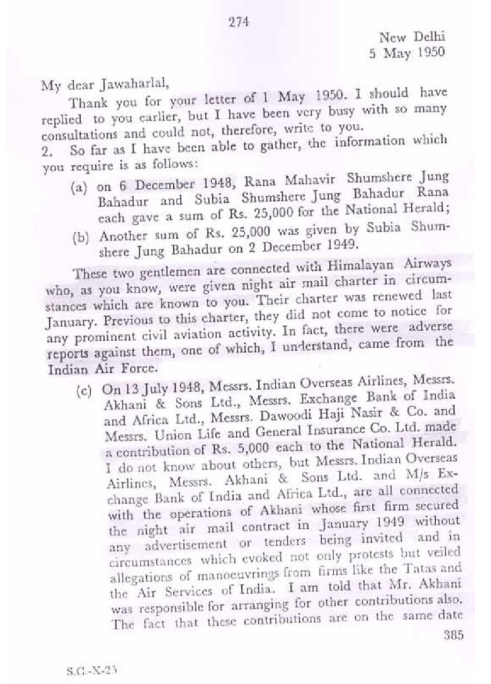
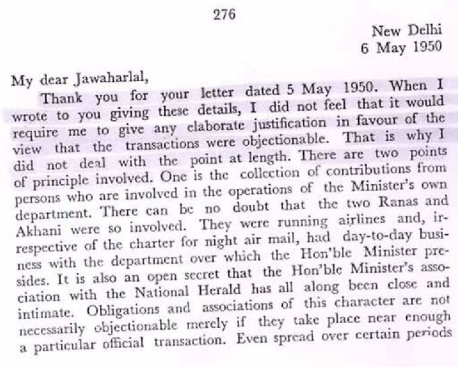
According to the book “Sardar Patel’s Correspondence,” Patel and Nehru corresponded about the matter in a number of letters in May 1950. On 5th May, Patel wrote to Nehru and outlined that National Herald collected money from two shady persons affiliated to Himalayan Airways which fraudulently won contract for night air mail service from government.

He outlined, “Bahadur and Subia Shumshere Jung Bahadur Rana each gave a sum of Rs. 25,000 for the National Herald. Another sum of Rs. 25,000 was given by Subia Shumshere Jung Bahadur on 2nd December 1949. These two gentlemen are connected with Himalayan Airways who, as you know, were given night air mail charter in circumstances which are known to you. Their charter was renewed last January. Previous to this charter, they did not come to notice for any prominent civil aviation activity. In fact, there were adverse reports against them, one of which, I understand, came from the Indian Air Force.”

Image via pgurus.com

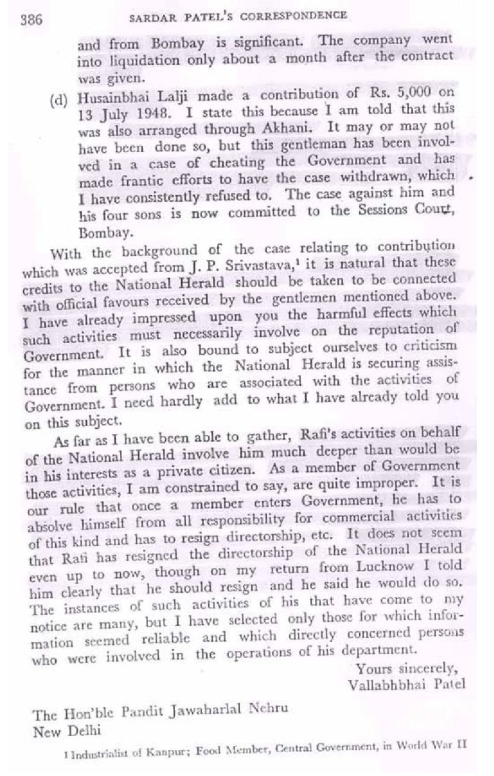
Patel also emphasised that another such individual named Akhani not only donated to the National Herald but also facilitated funding from various sources. He mentioned that “Akhani first firm secured the night air mail contract in January 1949 without any advertisement or tenders being invited and in circumstances which evoked not only protests but veiled allegations of manoeuvrings from firms like the Tatas and the Air Services of India. I am told that Akhani was responsible for arranging for other contributions also. The fact that these contributions are on the same date and from Bombay is significant. The company went into liquidation only about a month after the contract was given.”

He also highlighted Rs 5,000 provided by Husainbhai Lalji who “has been involved in a case of cheating the Government and has made frantic efforts to have the case withdrawn, which I have consistently refused to. The case against him and his four sons is now committed to the Sessions Court, Bombay.”

Patel remarked that “these credits to the National Herald should be taken to be connected with official favours received by the gentlemen mentioned above.” He added, “It is also bound to subject ourselves to criticism for the manner in which the National Herald is securing assistance from persons who are associated with the activities of Government. I need hardly add to what I have already told you on this subject.”

Image via pgurus.com

Additionally, he raised concerns about then Union Minister Rafi Ahmed Kidwai, who was seeking money from suspicious businessmen, including Lucknow’s JP Srivastava.

Nehru attempts to placate Patel who sent a second letter to address the fundamental issue

Patel repeatedly focused on the issue and was unreserved in his language, but his direct and honest questions received vague and dismissive answers from Nehru. He distanced himself from the financial affairs of the National Herald. Nehru also claimed that he had asked his son-in-law, Feroze Gandhi, to address the issue. The latter was serving as the General Manager of the newspaper, at the time.

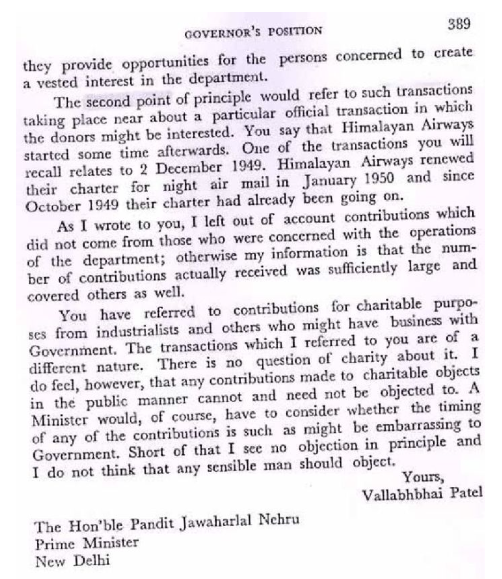
On 6th May, Patel sent another letter conveying that the donations lacked any element of charity and were founded in private interests. He mentioned that both Ranas and Akhani not only contributed to National Herald but also maintained a close relationship with the ministry led by Kidwai.

“It is also an open secret that the minister’s association with the National Herald has all along been close and intimate. Obligations and associations of this character are not necessarily objectionable merely if they take place near enough a particular official transaction. Even spread over certain periods they provide opportunities for the persons concerned to create a vested interest in the department,” he observed.

Image via pgurus.com

Patel also challenged the flimsy justifications given by Nehru with concrete facts. He stated, “You say that Himalayan Airways started some time afterwards. One of the transactions you will recall relates to 2 December 1949. Himalayan Airways renewed their charter for night air mail in January 1950 and since October 1949 their charter had already been going on.”

“You have referred to contributions for charitable purposes from industrialists and others who might have business with Government. The transactions which I referred to you are of a different nature. There is no question of charity about it,” Patel further stressed. “A minister would, of course, have to consider whether the timing of any of the contributions is such as might be embarrassing to Government,” he added.

Image via pgurus.com

Nehru reiterated that he had not been engaged with the paper’s finances for a period of three years and alleged that he had entrusted the responsibility to a person named Mridula. He acknowledged that “some mistakes may have occurred,” but he dismissed Patel’s reservations by arguing that it was a question of “profit and loss” rather than morality.

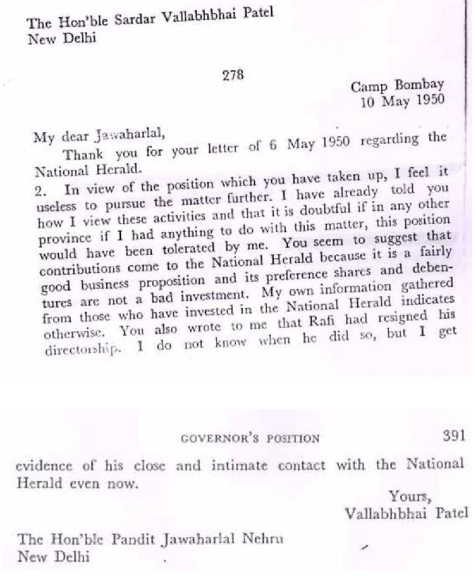
Nehru’s indifference and failure to accept accountability marked the breaking point for Patel, who, in a final letter dated 10th May, expressed, “I feel it useless to pursue the matter further. I have already told you how I view these activities and that it is doubtful if in any other province if I had anything to do with this matter, this position would have been tolerated by me.”

Image via pgurus.com

“You seem to suggest that contributions come to the National Herald because it is a fairly good business proposition and its preference shares and debentures are not a bad investment. My own information gathered from those who have invested in the National Herald indicates otherwise,” he reaffirmed. Patel even voiced skepticism regarding Nahru’s assertions that Kidwai had stepped down from his position as director.

Conclusion

The National Herald has always been permeated by these unsavoury operations and the Nehru-Gandhi family has perpetually been under a cloud of suspicion, not only due to their inability to accept the questionable activities of the company even 75 years ago but also for deliberately ignoring the serious issues associated with it.

Kashi-Tamil Sangamam reborn: How the Modi government is revitalising ancient civilisational ties to strengthen national unity

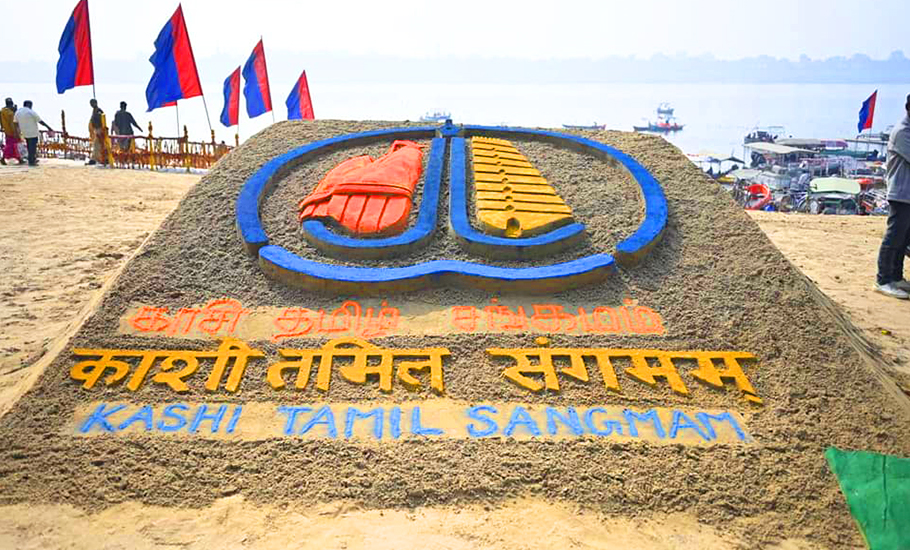
Varanasi, the spiritual capital of India that is Bharat, is all set to host the fourth edition of the Kashi-Tamil Sangamam, a confluence of the world’s oldest city and one of the oldest languages, Tamil.

The Kashi-Tamil Sangamam is a flagship cultural and educational initiative launched by the Central government under the Ministry of Education. The initiative is aimed at rediscovering and celebrating the ancient civilizational bond shared by Kashi, Bharat’s spiritual heart and Tamil Nadu, the epicentre of the country’s antiquity and unmatched glory.

Conceived as a part of the Modi government’s “Ek Bharat Shreshtha Bharat” vision, the Kashi-Tamil Sangamam is a new platform to bolster unity through shared Dharmic and cultural heritage. The event is organised in collaboration with Banaras Hindu University (BHU), IIT Madras, and the Uttar Pradesh government. The Sangamam brings delegates from Tamil Nadu for immersive experiences, including exhibitions, seminars, temple visits, cultural performances, handicraft exhibitions, spiritual discourse, and interactions with local crafts and cuisine.

The fourth edition of Kashi-Tamil Sangamam is set to commence on 2nd December 2025, in Varanasi at the Namo Ghat and BHU. The event will run for around two weeks and conclude on 15th December.

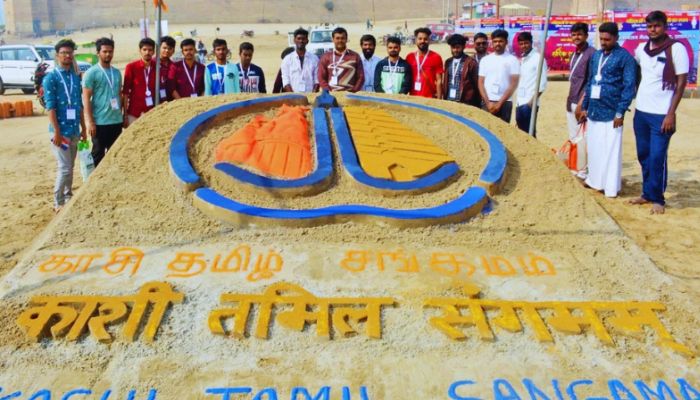
Kashi Tamil Sangamam
Kashi Tamil Sangamam preparations ongoing in Varanasi (Image via ANI)

This year, the Sangamam’s theme is “Learn Tamil – Tamil Karakalam”, focusing on promoting the Tamil language nationally. The event will involve campaigns like “Karpom Tamil” to teach Tamil to children in Uttar Pradesh. The Kashi-Tamil Sangamam aims to highlight Tamil inscriptions in Kashi, the glorious contributions of Tamil saints to the Bhakti Movement, as well as historical Tamil trading guilds along the Ganga.

The Sangamam will include an eight-day experiential tour visiting Kashi’s iconic sites like the Kashi Vishwanath Temple and the Mata Annapoorna Temple, Prayagraj, and Ayodhya.

During his Mann Ki Baat programme, Prime Minister Narendra Modi urged widespread participation in the Kashi-Tamil Sangamam and called the event a “wonderful confluence of language and culture” that reinforces national unity.

Notably, the Kashi Tamil Sangamam was first launched in 2022. Around 10,000 Tamil delegates arrived in Kashi at that time. PM Modi formally inaugurated it on 19th November 2022. The second Sangamam event was organised in 2023 at the Namo Ghat in Varanasi. Back then, the Varanasi Tamil Sangamam train was flagged off and multilingual, and Braille translations of Thirukkural, Manimekalai, and other classic Tamil literature were launched.

The third Kashi-Tamil Sangamam was held in February 2025, providing an opportunity for scholars, students, philosophers, merchants, artisans, and artists from Kashi and Tamil Nadu to come together and share their experiences.

The Dharmic and cultural connection of Kashi and Tamil Nadu

The deep reverence for Kashi and Baba Vishwanath can be traced in Tamil literature. In fact, the ties between Tamil Nadu and Kashi are millennia-old, woven by the shared intellectual, spiritual and economic threads of Hindu civilisation. Being the spiritual capital of India, Kashi has long been a Teerth/pilgrimage hub for Tamil devotees, including kings, fostering a profound dharmic bond between Lord Shiv and his Shaivs (followers of Shiv).

Tamil Nadu houses more than 450 temples dedicated to Kashi Vishwanath, including the 15th-century Kasi Viswanathar Temple in Tenkasi (also spelt Thenkasi). This temple is counted among the Pancha Kasi or five Kashis alongside Sivakasi, Uttarkasi, Varanasi and Guptkasi.

The Tenkasi Shiv temple was built by Pthe andyas as a surrogate for those Tamil Shivbhakts unable to travel north to Varanasi.

Interestingly, it is a legend that King Harikesari Parakkirama Pandian (also spelt, Parakrama Pandyan) journeyed to Kashi to fetch a Shiv Lingam for a temple he wished to construct; however, when the Shiv Lingam could not be moved from a rest spot, the King understood the “divine will” and installed the Lingam in what became Sivakasi.

Rishi Agastya is credited with having played a major role in bridging the north and the south. He migrated from Kashi to the Thamizhagam or simply the Tamil region to transmit Vedic knowledge, Ayurveda and Siddha medicine. An ardent Shivbhakt himself, Rishi Agastya forged a deep bond between Sanskrit and Tamil and compiled early Tamil grammar. This shared bond is evident in Tamil literature’s echoes of Sanskritic themes and shared Bhakti traditions, like the Alvars and Nayannars drawing inspiration from Kashi’s Shaiv and Vaishnav ethos.

Even 2300 years ago, the streets of Tamil Nadu’s towns and villages echoed with songs praising the ‘Nagari of Mahadev’.

It is said that the first Tamil Sangam was held in Madurai, the capital of the Pandya kings, and scholars such as Agastya, Shiva, and Murugavel participated in it. The second Sangam, which followed, was centred in Kapatapuram. According to Dr Vishudhanand Pathak, a former professor of Indian Oriental History at Banaras Hindu University, the Kapatapuram Sangam was the largest in history, bringing together scholars from both the north and south.

The Tamil language is so rich that there is mention of a grammar book named ‘Agatitayam Agastyam’ in this language; the period of its composition is before Christ.

The exchanges between Kashi and Thamizhagam extended beyond Dharma to encompass cultural influences and economic activities. Tamil scholars like Subramania Bharati studied in Kashi, while Tamil trading guilds flourished on the banks of the Ganga River. It is also said that around 40,000 Tamil people have settled in Kashi, and the holy city is home to various Tamil-style mutts and Shivalayas within Tamil homes.

Kashi is truly the spiritual centre of gravity for Sanatan Hindu Dharma, and the Kashi-Tamil Sangamam sends out a message to those dreaming of stirring linguistic and regional divisions to eradicate Sanatan Dharma, that in Dharma, Karma, and Moksha, language or regionality are no barriers for Hindus.

In a country like Bharat with a tapestry of over 1,600 languages and myriad regional customs, keeping the country united against divisive forces within and outside the nation is a Herculean task; however, the Hindu culture and civilisation serve as an invisible glue, embodying the idea of unity in diversity in its truest and practical sense. Vedas, Upanishads, Ramayan and Mahabharat or the Tamil Vedas, including the Nalaiyira Divyaprabandham (Vaishnav collection of hymns) and the Tevaram (Shaiv collection of hymns), transcend linguistic barriers and continue to intrigue and inspire Hindus.

Bharatnatyam in the south and Kathak in the north, the river Kaveri, which is also revered as the Ganga in the south and the Ganga River in the north, from dance, literature, to even rivers, Hindu civilisation truly unites the nation.

The Kashi-Tamil Sangamam serves as a great initiative to strengthen national unity and bridge gaps between the south and north, through Dharma, education and culture to make a truly “Shreshtha Bharat”.

RSF targets OpIndia: Their dubious Press Freedom Index and the global regime change orgs – How Western-funded fiction factories are targeting nationalist voices in India


The Reporters Without Borders (RSF) debate took a sudden turn in late 2025, when RSF included India’s Hindu nationalist news outlet OpIndia on its annual “Press Freedom Predators” list, alongside global corporate magnates such as Elon Musk and the Adani Group. Widespread discussion about RSF’s neutrality and political agendas was spurred by this controversial group. Many have seen the inclusion of OpIndia, a strong supporter of nationalist and sovereign narratives, as part of RSF’s larger plan to discredit Indian nationalist voices that oppose Western geopolitical objectives. This listing was the result of past RSF reports that portrayed nationalist elements as dangers to press freedom and critiqued India’s media environment under the current government.

The UK’s Telegraph newspaper noted how RSF’s story influenced how the world saw India’s democratic climate and press landscape, highlighting the strange coalition of different Indian media and corporate figures with worldwide criticism. This short research critically investigates the origins of this dispute by tracking RSF’s financing sources, which are mostly from Western government organisations and foundations connected to regime change, such as the US Congress-funded National Endowment for Democracy (NED), as well as its opaque methods. It also examines RSF’s connections to investigative organisations such as Bellingcat, which has been exposed as a CIA front, demonstrating a coordinated information ecosystem that pushes Western goals under the guise of press freedom advocacy. The study shows that RSF is not an unbiased custodian of free journalism, but rather a contentious actor in the worldwide ideological fight over India’s sovereignty and democratic narrative. 

RSF: Image Vs ecosystem

The World Press Freedom Index (WPFI), which is frequently cited by Western governments, multilateral organizations, and legacy media, is published by RSF, which positions itself as an international NGO that defends press freedom worldwide. However, the Index relies on opaque, perception-based surveys with undisclosed respondents and undisclosed category-wise scoring, posing significant concerns regarding reproducibility and openness, as even India’s official policy think tank NITI Aayog has pointed out. Such an index, according to critics in India and elsewhere, runs the risk of turning into a geopolitical instrument rather than a neutral assessment when it is based on subjective expert questionnaires dominated by a limited ecosystem that faces the West.

In reality, RSF’s country narratives frequently reflect the talking points of Western human rights organisations and affiliated media, particularly when it comes to nations like India, Hungary, and others that are seen as “illiberal” or “nationalist.” While characterising Western structural problems like corporate consolidation, intelligence leaks, and surveillance scandals as minor anomalies in generally “free” contexts, RSF’s India country note consistently presents Hindu nationalism as the primary threat to journalism.

Funding: Western governments, NED and Regime change philanthropy

RSF receives substantial backing from Western governments and quasi-governmental democracy promotion organisations, according to its public statements and independent investigations. Research referenced in the OpIndia-CSDS document states that RSF has received funding from:

  1. French government agencies, including the French Development Agency (AFD), the foreign ministry, the defense ministry, the interior ministry, the culture ministry, and the city of Bayeux. 
  2. The European Instrument for Democracy and Human Rights (EIDHR) of the European Commission. 
  3. Similar European aid organizations, such as the Swedish International Development Agency (SIDA). 
  4. The National Endowment for Democracy (NED), which is funded by the US Congress, clearly identifies itself as an organization that promotes democracy and is primarily supported by the US government.

Large US foundations like the Ford Foundation, which has a lengthy and contentious history of supporting political action and lobbying in India, including organisations later charged with financial irregularities and anti-India campaigns, are also connected to RSF. According to investigative reporting cited in the OpIndia paper, RSF has consistently adopted tough positions against governments targeted by US-EU regime change initiatives, such as Venezuela, while showing support for US funded organisations and oligarch-owned opposition media in those nations.

This donor profile clearly places RSF within the well-known “democracy promotion” network. NGOs, media initiatives, indices, and lobbying campaigns that selectively highlight “authoritarianism” in regimes at odds with Western geopolitical preferences of which India is increasingly one are funded by Western governments and affiliated institutions.

Methodology and bias of the World Press Freedom Index

Three main problems with RSF’s Index opacity, subjectivity, and selective emphasis are the focus of several Indian and international criticisms.

Opacity: It is hard to audit how specific scores were created for India or compare them with similarly situated countries because RSF does not reveal question wise scores or the identities and institutional locations of its respondents.

Subjectivity: The Index is based on perception. ‘Experts’ complete surveys on subjects including “ownership pressure,” “hate campaigns,” and “self-censorship.” If this group of experts is overwhelmingly drawn from liberal-progressive, Western facing circles, their ideological preconceptions will inevitably influence the results, especially in opposition to conservative or nationalist regimes.

Selective Emphasis: Critics point out that while nations like India are severely penalized due to narrative-heavy accounts of “Hindu nationalist pressure” and social media trolling, Western democracies with severe structural issues concentrated media ownership, aggressive use of security laws, and intelligence collusion remain relatively high.

RSF’s methodology is inadequate as a policy benchmark due to “lack of a consensual definition of press freedom,” “very low sample size,” and “non-transparent weighting of parameters,” according to an Indian government discussion paper. As a result, OpIndia has referred to the Index as a “biased tool tailor-made to peddle the global Left’s narrative,” pointing out that while RSF’s own historical data indicates that India’s media environment declined throughout the Congress years, the discourse disproportionately attacks the Modi period.

RSF and India: Narrative Construction against nationalist politics

A predetermined template is frequently highlighted in RSF’s India fact sheets and press releases. “Hindu nationalist mobs,” “Modi supporters,” “Bhakts,” and the “right-wing ecosystem” are highlighted as the main dangers facing journalists. Violence against journalists from vernacular or nationalist backgrounds is mostly ignored in favour of occurrences and narratives that are reinforced by a particular clique of English-language liberal sites, many of whom are connected to Western foundations. Despite being irreconcilable with the image of nearly “captured media,” there is little recognition of structural variety in India’s media, thousands of journalists, hundreds of channels, and fiercely critical coverage of the Modi government on several major platforms.

The CSDS-Lokniti report on “Indian Media, Trends and Patterns,” which is featured in the OpIndia research, starts off by referencing RSF’s pessimistic depiction of Indian media freedom. It then uses this as a starting point to make the claim that the majority of journalists believe that media outlets support the ruling BJP. However, the survey’s findings, such as “85% of women journalists suffered mental health issues,” were drawn from a small sample of 206 journalists out of a nation of 1.4 billion. According to OpIndia’s critique, the global index denounces India, a domestic foreign funded think tank mentions the index, and the media then cites both as proof of democratic regression. This feedback loop is caused by the subjective narrative of RSF and the scant data of CSDS. 

RSF describes OpIndia as a “Hindu nationalist website” that “smears journalists” critical of the government, portraying any objection to its technique or ideological leaning as part of an anti-press freedom effort. This is a classic rhetorical strategy in which those who challenge the index or its supporters are characterized as enemies of journalism, effectively closing the door on genuine methodological debate.

Bellingcat: OSINT, NED money and the intelligence shadow

Bellingcat, a Netherlands-based “open source investigations” collective lauded by Western media for its work on Russia, Syria, and other conflict theaters, is a crucial component of the network highlighted in the OpIndia-CSDS study. 

According to public records, Bellingcat has received donations from the National Endowment for Democracy (NED), a US-Congress-funded organization specifically established to assist organizations that promote US interests overseas. Additionally, it gets funding from various Western government-affiliated institutions and benefactors, notably European and British sources. Even sympathetic sources acknowledge that such funding is frequently intended to promote studies that are in line with Western foreign policy interests, such as tracking army movements in Russia or charges of chemical weapons in Syria, which easily fit NATO narratives.

Therefore, critical observers characterize NED as a “front” for US foreign policy, established to do overtly what the CIA once did covertly, and Bellingcat as a component of this ecosystem, an NGO layer that amplifies and launders information flows favorable to Western strategic messaging rather than formal intelligence officers. Bellingcat has been directly accused by the Russian government and others of being a Western intelligence cutout, citing instances in which its “open source” conclusions coincidentally matched classified disclosures and biased attributions of culpability in disputed occurrences. 

The Global Investigative Journalism Network (GIJN), OCCRP, Forbidden Stories, Internews, ICIJ, DRFLab, Freedom House, NED, and other organizations that receive funding from Western governments, Soros’s Open Society Foundations, Omidyar networks, Ford Foundation, and similar actors are all included in the OpIndia–CSDS paper. Foreign funded narratives can then be repackaged domestically under the guise of “independent investigative journalism” because many of them collaborate with Indian media outlets and activists who are steadfastly opposed to the Modi administration and Hindutva.

In this way, Bellingcat serves as a model for the larger ecosystem that RSF operates in. It is an officially recognized non-governmental organization, it is substantively in line with Western security and foreign policy agendas, and it is frequently referenced as an impartial source of information by the same Western media outlets who fund it.

RSF, Syrian media projects and narrative warfare

The Syria case study in the OpIndia report demonstrates how RSF type organisations work closely with Western states in active conflict areas. According to documentation, Canal France International (CFI), a French media-support organisation backed by the French foreign ministry, provides funding for Radio Rozana, a Syrian channel that RSF hailed as “independent.” The governments of Denmark, Sweden, and Norway provide funding for international media support. RSF itself funds alongside other Western donors.

Simultaneously, Radio Rozana collaborated with the “Syriaza” narrative project of Ara Pacis Initiative, which was specifically funded by the Italian foreign ministry and operated under the strong support of the Italian government and presidency. Building “narratives” and “storytelling” to influence public opinion in and about Syria is mentioned in the project’s own materials.

When taken as a whole, this demonstrates a model. Western governments finance media outlets via middlemen like RSF and CFI, then sponsor content and “capacity building” for journalists whose work supports a specific interpretation of the conflict, typically one in which the targeted government is an inhumane authoritarian and Western-backed opposition forces are democrats. When the same RSF then declares “press freedom” in those countries, it is basically evaluating an information battlefield that its own donors contributed to.

The India-focused network: CSDS, KAS, RSF, GIJN and beyond

The OpIndia research places RSF in the context of a dense network of India facing institutions that share funding, partners, and ideological lines.

  1. The paper states that CSDS and its Lokniti program, a Delhi think tank, systematically amplify narratives of “Hindu majoritarianism,” Dalit-Muslim hyphenation, and caste divisions, frequently in collaboration with Western organizations and donors connected to the government.
  2. Konrad Adenauer Stiftung (KAS) is a German foundation that is “politically affiliated” with the CDU. It is almost exclusively sponsored by German public funds and has contributed over ₹2.6 crore to CSDS since 2016. It also operates a special “Media Programme Asia” that focuses on youth and investigative journalism.
  3. Important sponsors of the “Uncovering Asia” investigative journalism conference were GIJN, OCCRP, Ford Foundation, Open Society Foundations, Oak Foundation, and others. Among the Indian attendees were individuals and media outlets who have constantly criticized the Modi government and Hindutva. 

According to the study, RSF is a good fit for this web. International investigative networks cross-promote each other’s work while utilizing the same pool of international donors, CSDS references RSF on the fall of Indian media, and RSF depends on narratives from Western-funded Indian outlets. This creates a closed epistemic circuit wherein Western-funded organizations create the questionnaire, provide the tales, analyze the data, and then give each other rankings and rewards that are used as weapons in both domestic political discussions and international diplomacy.

Narrative impact: Delegitimising nationalist India

The issue is not that RSF criticises India, rather, it actively undermines a democratically elected government by reducing intricate media ecosystems to a morality play between “brave liberal journalists” and “authoritarian Hindu nationalists.” 

It ignores or minimizes threats and acts of violence against journalists who are thought to be nationalist, pro-Hindutva, or critical of global liberal narratives.

Also is reinforced by the same Western media that promote unfavorable coverage of India on topics such as farm laws, CAA, Kashmir, and alleged “minority persecution,” frequently citing RSF, Freedom House, and comparable indices as objective indicators of “democratic backsliding.”

This is not merely a discussion, as the OpIndia–CSDS report highlights. When indices show India slipping into authoritarianism, it becomes simpler to justify:

  1. Increased foreign funding for activist networks and non-governmental organizations (NGOs) opposing Indian laws and policies. 
  2. In international forums, diplomatic pressure and “naming and shaming”. 
  3. Deliberate attempts to undermine India’s international image, particularly when New Delhi challenges Western stances on Russia, China, the climate, or trade or claims strategic autonomy in relation to the US EU alliance. 

To put it another way, RSF’s coverage of India is de facto a geopolitical tool in the larger struggle over how India’s rise is portrayed as either an illiberal, majoritarian state in constant need of Western guidance and “civil society correction” or as a pluralist, civilizational democracy finding its own path. 

Conclusion

When the strands are combined, a distinct pattern appears. Western state institutions and US-style democracy-promoting organizations like NED and sizable foundations connected to regime change provide the majority of RSF’s funding. Despite being advertised as an impartial worldwide standard, its flagship World Press Freedom Index is perception-based, opaque, and fundamentally susceptible to ideological prejudice. RSF largely relies on Western funded, left liberal media ecosystems to propagate a biased narrative in India that highlights Hindu nationalism as the main threat. The OpIndia–CSDS study places RSF in a broader network that encompasses CSDS, KAS, IDRC, Soros affiliated foundations, and Indian activist or journalist circles. All of these organizations are working toward the same goal, which is the consistent production of unfavorable narratives regarding Hindu identity, Indian democracy, and nationalist politics. 

Therefore, from a nationalist Indian perspective, RSF is less of an unbiased guardian of press freedom and more of a crucial component of a transnational narrative apparatus whose resources, partnerships, and products continually work against India’s elected government and civilizational self-assertion. When India is ritualistically devalued in indices defined in far-off Western capitals, a truly sovereign response necessitates rigorous examination of who pays the scoreboard, who crafts the questions, and whose strategic interests are ultimately served.  

Smartphone makers directed to pre-install Sanchar Saathi: Here’s why the government wants it to be a must-have app on every phone

In a move that could reshape India’s mobile security landscape, the Ministry of Communications has directed major smartphone manufacturers, including Apple, Samsung, Xiaomi, Vivo and Oppo, to pre-install the government-owned cybersecurity app Sanchar Saathi on all new devices sold in the country.

According to a Reuters report, companies have been given 90 days to comply with the directive. The order, which was sent privately to phone makers rather than issued publicly, also requires manufacturers to roll out software updates to install the app on devices already in the supply chain.

The directive has sparked immediate concern within the industry, particularly from Apple, which traditionally resists pre-installation of non-Apple apps and has previously clashed with Indian regulators over similar demands. Shortly after reports claimed that smartphone manufactures were directed to have the app installed on every device without providing users with an option to disable it, the Indian government issued a clarification.

Union Minister for Communications Jyotiraditya Scindia said the app is optional and one can delete it if they don’t want it on their mobile phones. “… If you don’t want Sanchar Sathi, you can delete it. It is optional… It is our duty to introduce this app to everyone. Keeping it in their devices or not, is upto the user…,” Scindia said.

While the decision is expected to trigger debates around privacy, compliance and user rights, the government argues that the decision is necessary to counter rising cyber threats, mobile fraud and misuse of telecom infrastructure. To understand the significance of this move, it is essential to examine what Sanchar Saathi does, how it works and why India considers it a core component of its telecom security strategy.

What is Sanchar Saathi?

Sanchar Saathi began as a web portal launched by the Department of Telecommunications (DoT) in May 2023. In January 2024, the government expanded its reach by introducing the Sanchar Saathi mobile app for Android and iOS, transforming it into a comprehensive public tool against mobile-related crimes. At its heart, the app is designed to help users protect themselves from mobile theft, fraud and identity misuse.

Screenshot of Santhar Saathi app

One of the app’s primary capabilities is enabling users to block lost or stolen mobile phones. When a device is reported through Sanchar Saathi, telecom operators across India are instructed to block its IMEI number, which disables the phone on all networks. If someone attempts to use the blocked phone anywhere in the country, law enforcement agencies can trace its location. This mechanism severely restricts the resale of stolen devices and helps police crack theft networks.

Sanchar Saathi also includes a fraud-reporting feature called Chakshu. This facility allows users to report suspicious calls, phishing SMS, scam WhatsApp messages and fraudulent links. The reports help authorities identify high-risk numbers and patterns of criminal activity, enabling proactive blocking or investigation by telecom and law enforcement agencies.

Another valuable function of the app is the ability to verify all mobile numbers registered under an individual’s identity. Many users remain unaware of how many SIM cards have been issued in their name, often leading to cases of impersonation, SIM misuse or financial fraud. Sanchar Saathi displays these linked numbers and allows users to raise complaints against those they do not recognise, helping prevent identity theft or illicit use of their documents.

The app also assists users in verifying the authenticity of their mobile devices through the Know Your Mobile (KYM) feature. KYM enables users to check whether their handset’s IMEI is genuine, whether the device was reported stolen earlier or if it might be a counterfeit or cloned phone. This protects consumers from unknowingly purchasing blacklisted or illegally altered devices, especially from the grey market.

Why the government wants Sanchar Saathi pre-installed

The government’s mandate for pre-installing Sanchar Saathi stems from concerns over the growing threat posed by duplicate and spoofed IMEI numbers. The confidential order describes this as a “serious endangerment” to telecom cybersecurity. Criminal networks often clone or spoof IMEIs to evade tracking, commit fraud or resell stolen phones. This manipulation of a device’s identity undermines law enforcement efforts and enables large-scale telecom scams.

By ensuring Sanchar Saathi is present on every smartphone and cannot be disabled, the government aims to create a universal detection layer against IMEI tampering. A non-removable app guarantees that the system’s fraud-reporting and verification features remain active across all devices, strengthening India’s ability to monitor misuse and intervene quickly when needed.

The government’s confidence in mandating the app also stems from its track record. Since its launch, Sanchar Saathi has helped block more than 3.7 million stolen or lost phones and recover over 700,000 devices. October alone accounted for 50,000 recoveries. Additionally, the app has led to the termination of more than 30 million fraudulent mobile connections, demonstrating its impact on curbing widespread telecom misuse. With more than 5 million downloads already, the app has proven effective as a public-security tool in a country with over 1.2 billion mobile subscribers.

The push for pre-installation is also driven by the need to bolster national security and counter cybercrime. India has witnessed a sharp increase in online financial fraud, SIM-based scams, WhatsApp impersonation cases and international criminal syndicates operating via Indian telecom infrastructure. By integrating IMEI blocking, fraud reporting, number verification and device authenticity checks into a single ecosystem, the government hopes to create a centralised cyber-security grid capable of detecting suspicious patterns across networks in real time.

Another advantage of universal installation is improved coordination among telecom companies, law enforcement agencies and cybercrime units. Sanchar Saathi allows immediate sharing of device and fraud-related information, enabling faster investigation and quicker recovery of stolen phones. With the app present on all devices, authorities expect a more seamless and standardised reporting process.

Why smartphone companies are concerned

Despite its security potential, the directive has raised industry concerns. Apple, in particular, faces a direct policy conflict. The company’s global rules prohibit pre-installing third-party or government apps before sale, setting the stage for a possible standoff similar to its earlier clash with Indian regulators over the TRAI anti-spam app.

Privacy advocates have also flagged potential issues, arguing that a mandatory government app could raise fears of excessive data access, surveillance or overreach. Although the government asserts that Sanchar Saathi only collects essential information related to device identity, fraud reporting and IMEI verification, the challenge will be to maintain transparency and reassure users about data protection.

Sanchar Saathi represents one of India’s most ambitious efforts to secure its sprawling telecom ecosystem. Its success in reducing fraud and phone theft has convinced the government that universal deployment is necessary.

How smartphone companies respond in the coming months, and how the government balances security with user autonomy, will determine whether Sanchar Saathi becomes a widely accepted safeguard or a point of contention in India’s evolving digital landscape.

Note: The report was updated on 2 December 2026 with Union Minister Jyotiraditya Scindia’s statement.