Home Blog Page 154

From JeM posters in Kashmir to 2900 kg of explosives and a massive blast: The timeline of a conspiracy and terror module of doctors

The probe into the fatal blast near Delhi’s Red Fort on 10 November has now unraveled one of the most disturbing terror networks unearthed in recent years. What initially appeared to be an isolated car explosion killing at least 15 people and injuring about 2 dozen others has now unfolded into a detailed, multi-state terror plot linked to Jaish-e-Mohammad (JeM).

As investigators dug deeper, the trail led back to mid-October, weeks before the attack, when posters praising JeM surfaced in a Srinagar neighbourhood. Those posters, which many then dismissed as routine propaganda, became the first big clue that helped piece together the chain of events behind the blast.

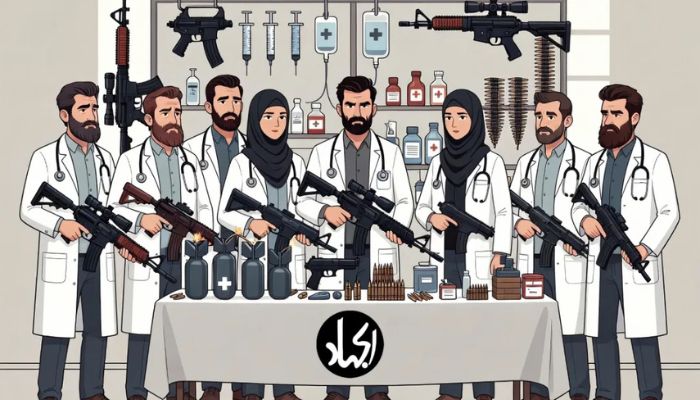
The bomber was later identified as Dr Umar Un Nabi, 36-year-old doctor-turned-terrorist from Pulwama who was employed with Al-Falah University in Faridabad. His role of a suicide bomber shocked the investigators, particularly when they found that at least three other members of the module were also doctors or medical interns at the same university.

Over the next few weeks, arrests, raids and forensic tests revealed how young, educated professionals had been radicalised and turned into a tightly coordinated terror cell that operated between Kashmir, Haryana and Delhi, and maintained links with foreign handlers in Afghanistan and Pakistan-occupied Kashmir.

Prelude: Posters that sparked the investigation

October 18: The first indications of what would later become the Red Fort blast investigation cropped up in mid-October. On the night of 18th October, Jammu and Kashmir Police received information about posters pasted on the walls of houses in Nowgam, a middle-class neighbourhood on the outskirts of Srinagar. These posters were in Urdu and carried threats of imminent “spectacular attacks” on security forces and “outsiders” (non-locals) in Kashmir.

October 19: The next morning, the police came across the same posters again in the Bunpora Nowgam area. These posters openly praised the Jaish-e-Mohammad (JeM) terror group and carried warnings that anyone “sheltering Indian predators” would face strict action. They were signed by a man identifying himself as Commander Hanzala Bhai, dated 17th October.

The posters might have been dismissed as another attempt at fearmongering, but their content and timing raised suspicion. The police filed an FIR under the Unlawful Activities Prevention) Act (UAPA) and started an investigation in detail. CCTV footage was scanned and three young men were picked up. Upon interrogation, they confessed to having put up the posters on the directions of a local cleric from Srinagar’s Chanpora area, Moulvi Irfan.

This interrogation marked the beginning of the unraveling of the larger network behind the Delhi blast.

Confronted with evidence, cleric Moulvi Irfan identified one of the main brains behind the poster campaign as Dr Adeel Ahmed Rather, a doctor from the south Kashmir district of Kulgam. A resident doctor at GMC Anantnag before shifting to Al-Falah Medical College in Faridabad, Rather was arrested in October.

October 30: Adeel disclosed during interrogation the name of another doctor in the network: Dr Muzammil Shakeel Ganai, a GMC Srinagar resident doctor who subsequently shifted to Al-Falah University. Muzammil was arrested on 30th October.

Muzammil’s confession proved to be a turning point. He led the police to another young doctor at Al-Falah University, namely Dr Umar Un Nabi-who would eventually prove to be the suicide bomber. Muzammil also confessed to keeping an illegal AK-47 rifle, which he claimed was kept in the car of his colleague, another doctor at Al-Falah University, Dr Shaheen Shahid.

Several leads that pointed to Faridabad resulted in coordination between the Jammu and Kashmir Police and Haryana Police in conducting a series of crucial raids in November.

Chain of events: From posters to blast

November 8: Based on the interrogation of Muzammil, the Jammu and Kashmir Police informed Haryana Police that weapons and explosives might be hidden in Faridabad. A search operation was launched inside the Al-Falah University campus and nearby areas like Dhauj and Khandawali.

The police recovered an AK-47 rifle, a pistol, 83 rounds, three rifle magazines, two pistol magazines, and seven live cartridges from a Swift car on campus. The vehicle was seized, and 12 crime branch teams were assigned to sweep the surrounding areas.

November 9: The breakthrough got bigger the next day when police recovered 358 kg of ready-to-use explosives stored in 12 suitcases inside a room in a building in Dhauj village. Timers, cutters, batteries, detonators, face masks, disguises and IED-making material were also recovered. A bomb squad collected the material and handed it over to the J&K Police.

Indeed, this confirmed that the group had been stockpiling explosives on a large scale and was preparing multiple attacks.

November 10: On the morning of 10th November, searches continued and led to the seizure of 2,553 kg of ammonium nitrate from the home of a man named Imam Ishtiyaq in Fatehpur Taga, Haryana. This chemical is widely used in IEDs.

Investigators noted that the material found in Dhauj was only “one step away” from becoming a complete bomb.

At 6:52 pm, the terror plot turned deadly.

A car exploded near Red Fort in Delhi’s Chandni Chowk area, killing at least 15 people. CCTV footage later showed that the bomber, Dr Umar Un Nabi, had travelled through multiple parts of Delhi earlier that day. He was last seen entering the Red Fort area moments before the explosion.

Initially, his body was too badly damaged to be identified. Only a DNA match from samples collected from his family in Pulwama confirmed that Umar was the suicide bomber.

Authorities also discovered that the blast car, a Hyundai i20, had been sold by a man named Sonu from Royal Car Dealers who was arrested on 12th November.

November 12: Intelligence reports suggested that a red Ford EcoSport carrying explosives might travel from Faridabad’s Khandawali village. Although the car was intercepted, no explosives were found initially. Forensic tests were ordered to detect residue.

Meanwhile, during interrogation, Dr Shaheen Shahid confessed that she and the other doctors had been collecting explosives for nearly two years and were planning attacks across India.

CCTV footage showed the i20 visiting multiple parts of Delhi, including Connaught Place, before heading to the Red Fort.

November 13: The Ford EcoSport was seized, and a man named Wasib from Dhauj was arrested. Wasib, who worked as a computer operator at Al-Falah University, had parked the EcoSport and was in touch with Umar before the attack.

A Brezza SUV belonging to Dr Shaheen was also seized. The National Security Guard (NSG) reached the campus for forensic testing, although no suspicious items were found in the Brezza.

DNA tests by this date had fully confirmed Umar’s identity as the suicide bomber.

November 14: Another suspect named Mustaqil, an MBBS graduate from China and an intern at Al-Falah University, was detained from Rajasthan’s Mewat. He was reportedly in touch with Umar.

On the same day, Umar’s house in Pulwama was demolished in a controlled explosion using an IED. This was done as part of the crackdown on the module.

Investigators also traced the purchase of explosives to Basai Meo village in Nuh and surrounding regions, confirming that the entire blast was planned and executed using locally procured material.

November 15: The National Medical Commission cancelled the medical licences of four doctors linked to the terror plot, Dr Muzaffar Ahmad, Dr Adeel Rather, Dr Muzammil Shakeel and Dr Shaheen Saeed. Their names were removed from the national medical registers.

November 16: Dr Priyanka Sharma, a woman doctor from Haryana, was detained at GMC Anantnag for questioning as she was suspected to be connected with the “white-collar” terror network. Later that night, she was released after questioning. Her family confirms that she has returned home safely.

November 17: The National Investigation Agency (NIA) has arrested a Kashmiri assistant of Red fort bomber Dr Umar Un Nabi in its first arrest in the Delhi bomb investigation. According to the agency, Amir Rashid Ali was the registered owner of the Hyundai i20 that was used in the assault. 

Investigations also reached Mhow in Madhya Pradesh, where Hamood Siddiqui, the younger brother of the Al-Falah University Chancellor, was arrested from Hyderabad.

November 18: Forensic reports revealed that Umar hid the bomb trigger in his shoe, making him a “shoe bomber.” Metal fragments from the shoe and traces of TATP (a high-power explosive) were recovered.

That same day, Jasir Bilal Wani, a technical aide to the terror module, was sent to judicial custody.

November 19: The Enforcement Directorate arrested Jawad Ahmed Siddiqui, the founder of the Al-Falah Group, for money laundering. His arrest came after searches at 25 locations.

Investigators also found over 70 radicalisation videos, including 12 recorded by Umar himself, which he had been sending to young recruits. Some targets were from Kashmir, while others were from Uttar Pradesh, Kerala and Karnataka.

November 20: The investigative agencies had identified three foreign handlers, Faisal Ishfaq Bhat, Hashim, and Dr Ukasha, operating from Afghanistan and Pakistan-occupied Kashmir. Bank accounts with more than ₹2 lakh were frozen, and financial trails were examined.

November 23: Investigators discovered that Muzammil had purchased a Russian rifle worth ₹5 lakh through a contact linked to Dr Shaheen. The rifle was later found in a locker belonging to Dr Adeel.

November 26: The NIA arrested Soyab, a resident of Dhauj, for sheltering Umar shortly before the blast and providing logistical support.

November 29: Delhi Police issued notices to all private hospitals seeking details of doctors who completed their MBBS in Pakistan, Bangladesh, UAE and China. This was done to prevent similar terror networks from forming within medical institutions.

December 1: The National Investigation Agency (NIA) conducted raids at several places in the districts of Pulwama, Shopian and Kulgam of Kashmir in relation to the Jaish-e-Mohammed (JeM) terror module responsible for the car explosion near Delhi’s Red Fort.

A terror network hiding in plain sight

The Red Fort blast exposed something more than a terror strike; it revealed how a clutch of highly educated people, many working as doctors, established a deeply entrenched network across Kashmir, Haryana and Delhi. The poster incident in mid-October turned out to be the thread that guided investigators through weapons caches, massive explosive stockpiles, foreign handlers, financial trails and ideological radicalisation.

The NIA has so far arrested 7 terror suspects in connection with the Red Fort blast, namely Dr Muzammil Shakeel Ganai of Pulwama, Dr Adeel Ahmed Rather of Anantnag, Mufti Irfan Ahmad Wagay of Shopian, all residents of Jammu and Kashmir, and Dr Shaheen Saeed of Lucknow in UP, Amir Rashid Ali, in whose name the car used in the blast was registered, Jasir Bilal Wani alias Danish, who had provided technical assistance to the terrorist involved in the attack, Soyab of Dhauj who provided shelter to terrorist Umar Un Nabi shortly before the November 10th blast near Red Fort in Delhi. Out of all the terror suspects arrested in connection with the case, three are doctors.
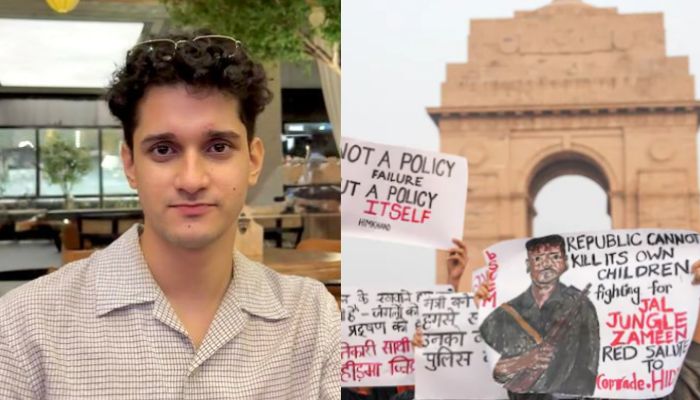
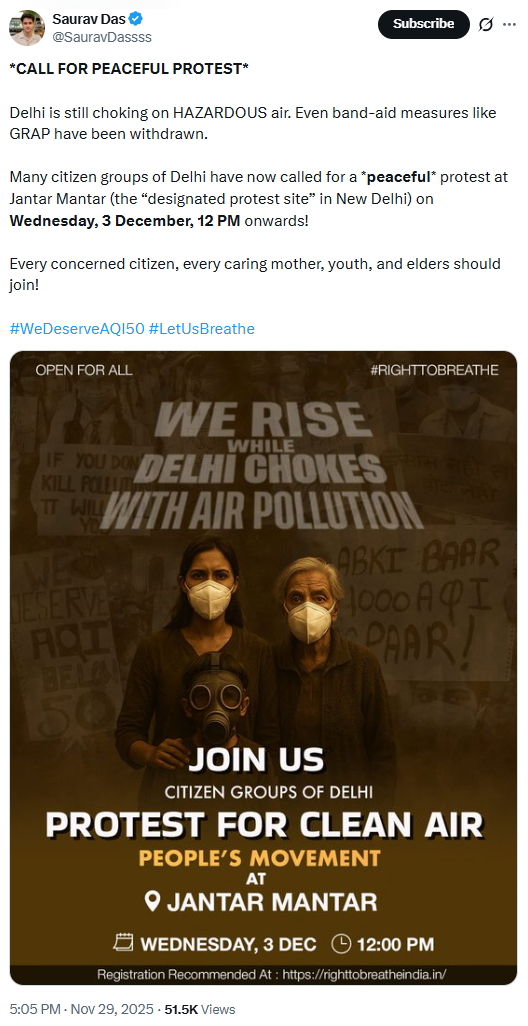
Delhi pro-Naxal protests: Who is ‘independent journalist’ Saurav Das who backed Urban Naxals who raised pro-Maoist slogans during anti-pollution protests

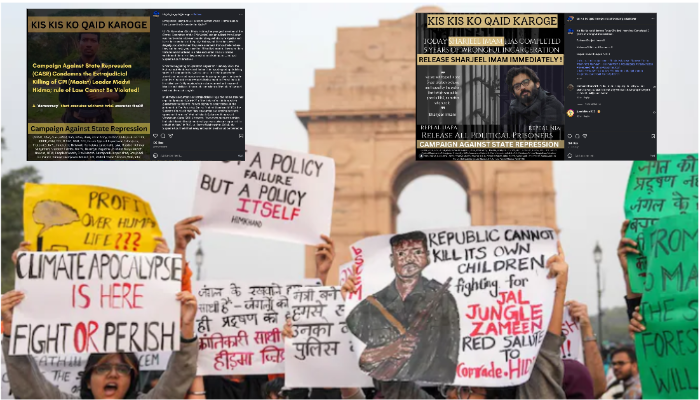
Not too long ago, a group of Urban Naxals staged ‘anti-pollution’ protests in New Delhi wherein they raised banners and slogans in support of slain Naxal terrorist Madvi Hidma. These pro-Naxal protests were spearheaded by left-leaning student organisations Bhagat Singh Chhatra Ekta Manch (bsCEM) and The Himkhand.

OpIndia reported earlier that bsCEM is one of the 40+ organisations that formed a collective called “Campaign Against State Repression” or CASR. Among those who participated in or supported the pro-Naxal protests was Saurav Das, a self-declared ‘investigative journalist’.

Saurav Das, who often writes propaganda pieces on notorious leftist media outlets like The Caravan, Article 14, The Wire, and The Hindu’s Frontline, among others.

On 25th November, Saurav Das published an X post supporting ‘kids’ who raised ‘Tum Kitne Hidma Maaroge, Har Ghar Se Hidma Niklega’ slogans similar to those raised by the infamous ‘Azadi’ gang for terrorist Afzal Guru, as “kids”. He also criticised the police for the national security charges against Urban Naxals for using pollution protests as a ruse to stage pro-Naxal agitation.

“High-handed action. Can nation’s security be threatened by a couple of kids sloganeering? Must give it to Indian police for frivolizing such serious provisions,” he wrote.

Das is also supporting another Congress’s student wing, NSUI-backed anti-pollution protest scheduled to be held on 3rd December. It remains to be seen if this protest will be a genuine anti-pollution demonstration or yet another pro-Naxal gimmick.

Source: X

Saurav Das wrote a hit piece against former CJI DY Chandrachud

Left liberals have a knack for lionising anyone who slanders the Modi government or whoever they deem ideological detractors, before turning on them for perceived ‘deviations’. Former Chief Justice of India (CJI) DY Chandrachud, whose perception arc went from being a blue-eyed liberal hero to a sophisticated subscriber of ‘Hindu right-wing ideology’. When Chandrachud retired, the same liberal lobby that once hailed him a hero came out to slander him.

Last year, Saurav Das also jumped on the bandwagon and wrote a hit job against the former CJI in the leftist propaganda outlet, The Caravan. The article titled “Performative Justice: The equivocations of DY Chandrachud”, relied primarily on anonymous sources to reach the same conclusion. To lend credence to the elaborate ‘character sketch’ of the outgoing CJI, 2 alleged Supreme Court judges and their supposed comments were also incorporated.

In an attempt to draw a ‘character sketch’ of ex-CJI Chandrachud, Saurav Das ended up writing a long rant, rather, a complaint letter. As Chandrachud attended Prime Minister Narendra Modi’s Ganesh Chaturthi pooja last year, Saurav Das framed it as a ‘betrayal’ of constitutional ethos and evidence of India’s slide towards ‘Hindu Rashtra’.

Das further lamented how the left-liberal ecosystem expected former CJIs and outgoing DY Chandrachud to toe their line but was let down by their verdict. The Caravan columnist alluded that DY Chandrachud facilitated judgments in favour of the Centre by handling cases to ‘pro-Modi’ Judges. He further suggested that the outgoing CJI got an easy entry to the Supreme Court owing to nepotism and engaged in ‘bench-fixing’ by handling important cases to judges not aligned with its ideology.

In his article, Saurav Das also cried hoarse over the Ram Janmabhoomi verdict of 2019 and the decision to kick open the Gyanvapi mosque to the Archaeological Survey of India and the 2020 anti-Hindu Delhi Riots accused mastermind Umar Khalid’s prolonged incarceration.

Saurav Das’s earlier hit job on Justice Bela Trivedi

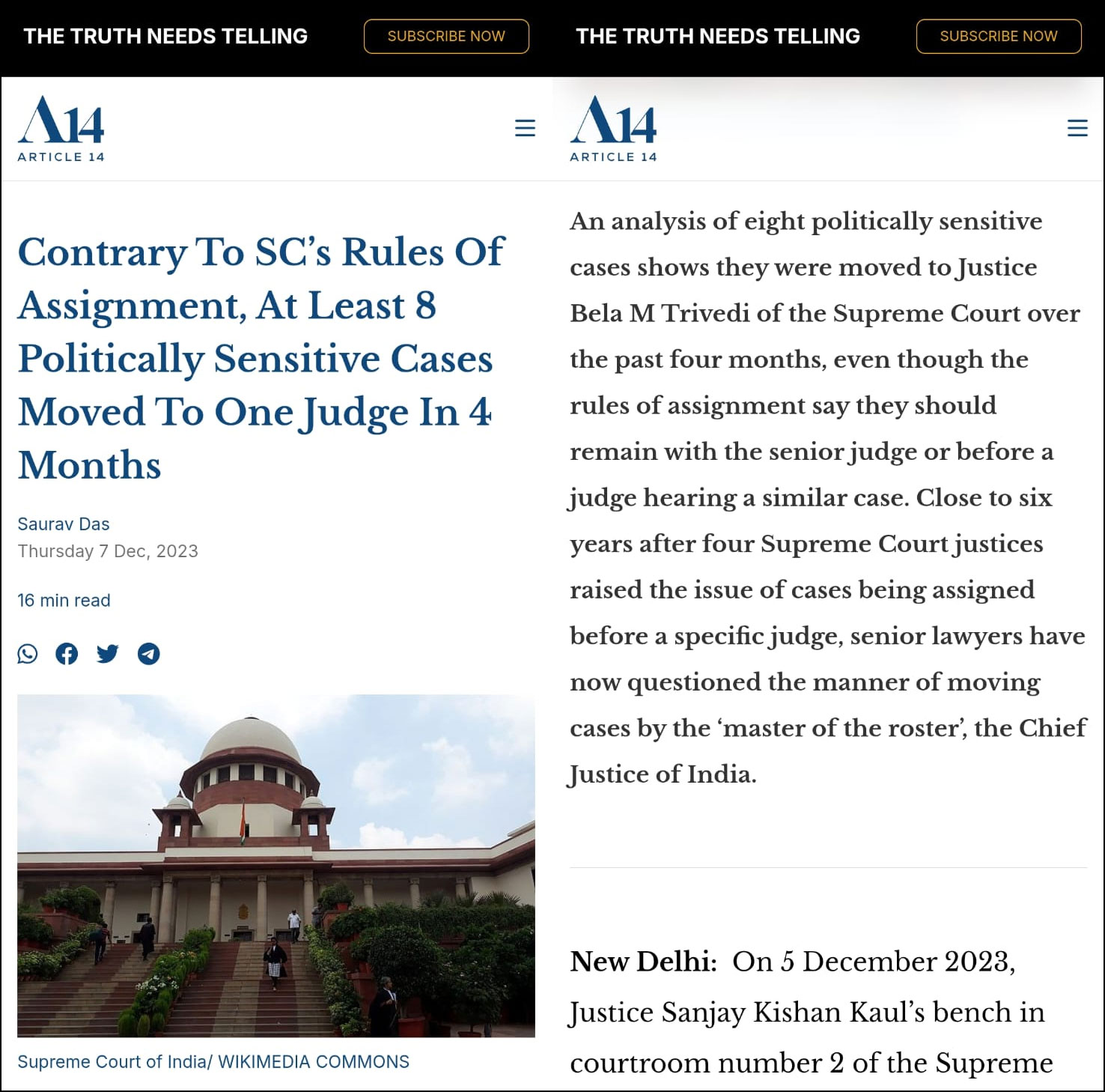
Before Saurav Das launched his hit job on former CJI DY Chandrachud, he had already test-fired the formula on Justice Bela M Trivedi through a December 2023 piece on the propaganda website Article 14. The piece was dressed up as a “roster investigation” in which he claimed that eight politically sensitive cases, including Umar Khalid’s bail, UAPA challenges, DK Shivakumar’s disproportionate assets case, Chandrababu Naidu’s skill-development matter and others, were “moved” to Justice Trivedi in violation of Supreme Court convention.

Source: Article 14

Routine administrative listing under the CJI’s roster powers was projected as a conspiracy, aided by insinuations about her past service in the Gujarat government to suggest she was somehow aligned with the ruling establishment. Das relied on selective quotes from the usual left-liberal voices to manufacture concern, weaponised technical rules like “first coram” and “similar matters” while conveniently ignoring that these rules operate under the CJI’s overriding administrative authority and framed normal case-tagging as a crisis of judicial independence.

His intention was clear. Saurav Das wanted to delegitimise the judge in advance so that any adverse order against the Islamo-leftist ecosystem could be dismissed as compromised. This hit job on Justice Trivedi set the narrative template that Das later recycled, with even greater hostility, against former CJI Chandrachud.

‘Independent journalist’ Saurav Das received dubious funding from the Thakur Family Foundation

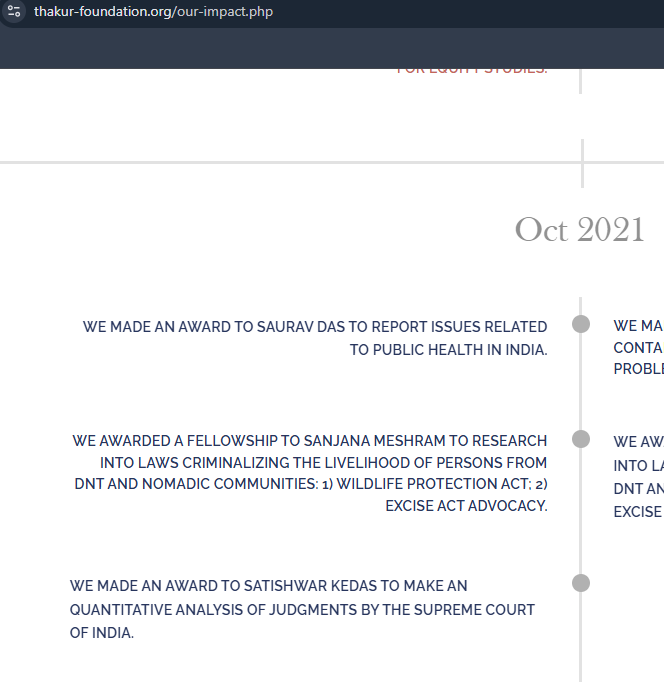
Unsurprisingly, Saurav Das is not an ‘independent’ journalist as he claimed to be. Das received grants from the controversial Thakur Family Foundation in 2021. As per the information published on the Foundation’s website, Das received a grant “to report issues related to public health in India.”

However, despite receiving funding for reporting on issues related to public healthcare, Das wrote articles targeting the BJP government in Uttar Pradesh and peddled propaganda on the Pegasus spyware.

The TFF’s website included links to two of Das’ works, one of which is apparently removed, and the other is an article published in Article 14, about the Pegasus spyware controversy.

Not to forget, the opposition parties and their supportive ecosystem had made a huge hue and cry over the Israeli spyware allegedly being used by the Modi government to snoop on opposition leaders; however, the Supreme Court-appointed committee concluded that the Israeli spyware was not found in the 29 mobile phones it examined.

Source: Thakur Foundation

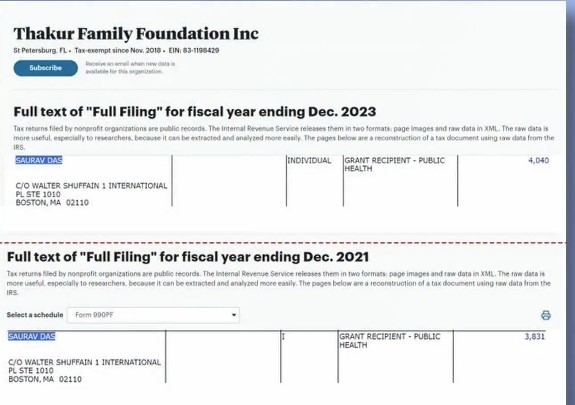
Saurav Das also received another grant under the ‘public health’ category from the Thakur Family Foundation in 2023.

Source: Thakur Foundation

Notably, the Thakur Family Foundation Inc. is a United States 501 (c)(3) organisation founded by Dinesh Thakur. It claims to work in the areas of public health and civil liberties. Based in St. Petersburg, Florida, the Foundation invests in capacity building for an empowered society through participative, socially-just governance. The so-called public health activist, Dinesh Thakur, has been allegedly targeting the Indian pharmaceutical sector for years, spreading and amplifying negative news about the industry.

Interestingly, the Thakur Family Foundation also funds the Association for Democratic Reforms (ADR), a so-called electoral reform NGO that also received funding from known Modi detractor and regime change specialist George Soros. The Thakur Family Foundation also funds The Wire, the propaganda portal that has been forced to remove fake stories against the BJP and the Modi government after they were exposed. It also backs The Caravan, the ultra-left portal Saurav Das often writes propaganda pieces for. The Foundation further funds several journalists who have written multiple negative stories on India, particularly on the handling of COVID-19.

Saurav Das supported Pakistan-linked anti-Hindu X handle ‘Hindutva Watch’

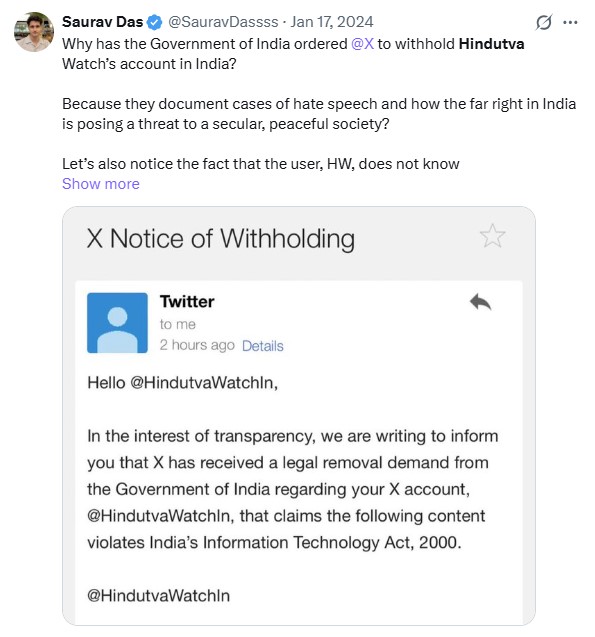
Saurav Das’s outrageous activities are not confined to peddling anti-India propaganda and supporting Naxals but extend to backing Pakistan-linked anti-Hindu propagandists. In 2024, when the Indian government banned the X handle ‘Hindutva Watch’, Saurav Das came out in its support, and asked if the X handle was targeted because “they document cases of hate speech and how the far right in India is posing a threat to a secular, peaceful society?”

Source: X

However, Saurav Das did not mention that the Hindutva Watch handle was operated by a man named Raqib Hameed Naik and had direct links with Pakistan’s ruling party, Pakistan Muslim League-Nawaz (PML-N). Naik was reportedly found to have links with one Sardar Adil Kayani, the same man who ran PML-N’s propaganda in Pakistan.

The account was withheld in India after gaining notoriety for its lopsided coverage of events in India, including its practice of distorting facts and maligning Hindu leaders who unabashedly wear their Hindu identity on their sleeves, most notably leaders such as T Raja Singh, Kajal Hindustani, and several others who have been championing the cause of Hindus.

In 2023, the Maharashtra Police filed an FIR against ‘Hindutva Watch’ for spreading fake news and attempting to incite riots during the violence that erupted in Kolhapur city over controversial social media stories hailing Islamic tyrants like Aurangzeb and Tipu Sultan when the state celebrated the 350th Rajyabhishek Day of Chhatrapati Shivaji Maharaj.

The account often used ambiguous expressions such as “extreme hate speech” without bothering to explain how spitting facts is the dissemination of hatred, was routinely quoted by usual suspects, including ‘fact-checker’ Mohammed Zubair and members of the leftwing ecosystem, for whom projecting India in a bad light has been a constant exercise ever since PM Modi came to power in 2014 general elections.

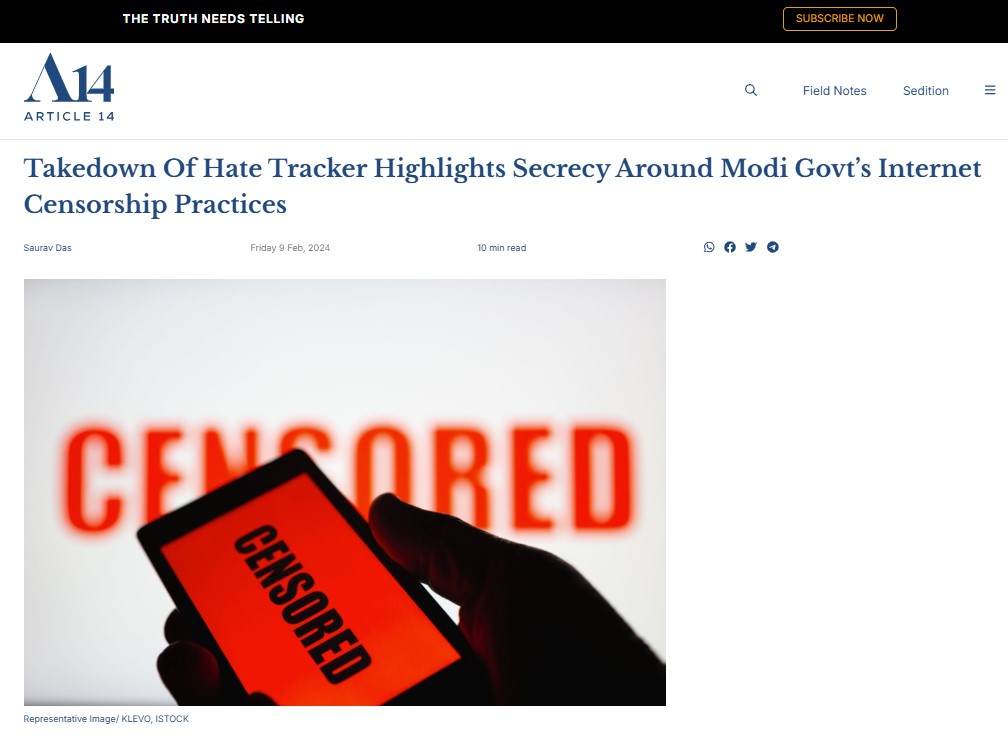
Das also wrote an article for Article 14, another Thakur Family Foundation-funded propaganda outlet, accusing the Modi government of censoring critical voices, including journalists, foreign news reports, media websites and investigative documentaries like BBC’s anti-Modi documentary and ‘hate trackers’ like Hindutva Watch.

Source: Article 14

Saurav Das labelled the 2020 anti-Hindu Delhi Riots as ‘Hindutva game plan’

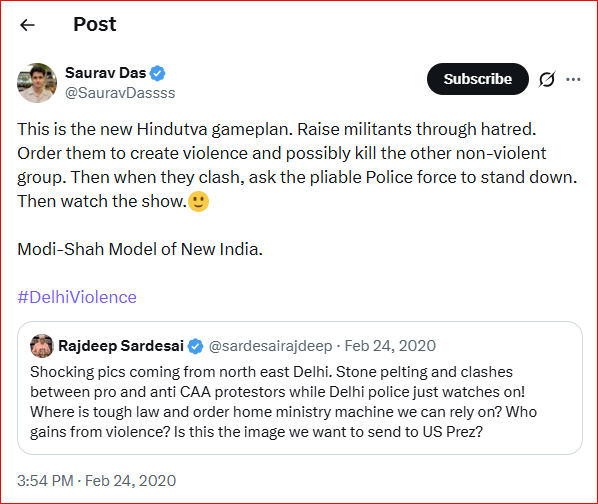
In February 2020, when Islamists and their leftist cheerleaders staged massive protests in Delhi against the Citizenship Amendment Act (CAA) and unleashed riots, Saurav Das dubbed the Islamist-orchestrated violence as ‘Hindutva game plan’.

“This is the new Hindutva gameplan. Raise militants through hatred. Order them to create violence and possibly kill the other non-violent group. Then when they clash, ask the pliable Police force to stand down. Then watch the show. Modi-Shah Model of New India,” he wrote.

Source: X

Saurav Das’s heart bleeds for Umar Khalid

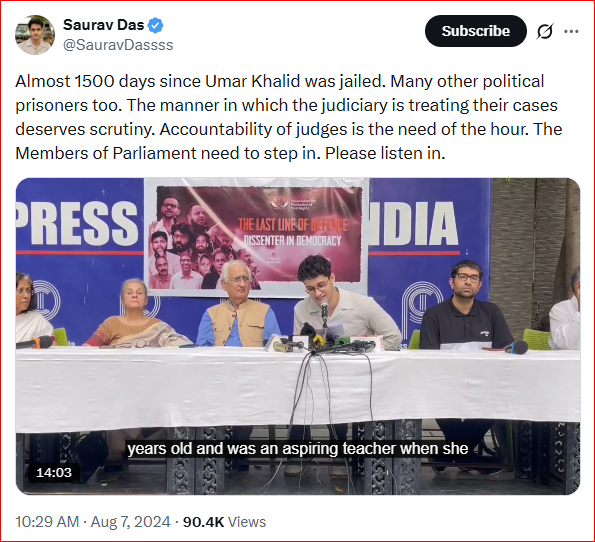
No wonder, Saurav Das, who called the Islamist-orchestrated 2020 anti-Hindu Delhi Riots a ‘Hindutva gameplan’, has consistently been supporting the accused mastermind of the riots, Umar Khalid.

In one of the many X posts supporting Umar Khalid, Das wrote, “Almost 1500 days since Umar Khalid was jailed. Many other political prisoners, too. The manner in which the judiciary is treating their cases deserves scrutiny. Accountability of judges is the need of the hour. The Members of Parliament need to step in.”

Source: X

Notably, Islamo-leftists have long been peddling propaganda that Umar Khalid is ‘a political prisoner’ who has been ‘unfairly incarcerated’ for the last five years, for voicing dissent and somehow for religious identity. However, contrary to the false narrative peddled by Islamo-leftists to garner support and sympathy for Umar Khalid, OpIndia has reported earlier that out of the 14 adjournments in 2023 and 2024, 7 delays and adjournments were sought by Umar Khalid himself.

It therefore becomes evident that the withdrawal was certainly not because of the famed “delay” in hearing. While the Islamo-leftist ecosystem continues to cry ‘injustice’, it is the alleged failed forum shopping attempts of the accused’s lawyer that have Khalid rotting in jail for so long.

In fact, former Chief Justice of India, DY Chandrachud, had also said earlier this year that the real problem lies in the mindset of some lawyers and political groups who want their cases heard only by certain judges. Highlighting what OpIndia has reported multiple times, the former CJI said that court records showed that Khalid’s legal team, led by Sibal, had sought at least seven adjournments before finally withdrawing the bail plea in February 2024, citing “a change in circumstances.”

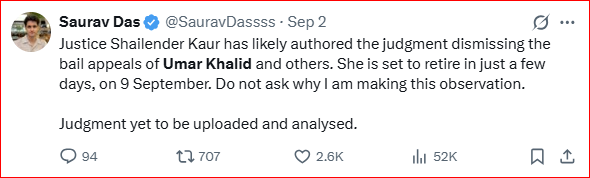
Das has also been downplaying Umar Khalid’s role in planning and inciting the anti-Hindu riots in 2020, often by throwing shade on judges involved in hearing his case.

Source:X

Saurav Das backed Gulfisha Fatima

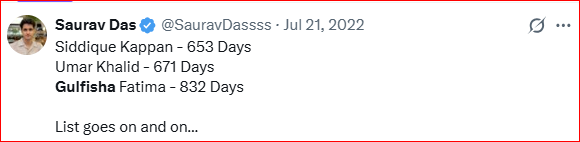
In addition to supporting Umar Khalid, Saurav Das has also backed Gulfisha Fatima, another accused in the Delhi Riots case. In one of the social media posts, Das highlighted the number of days she has been incarcerated.

While the Islamo-leftists often call Gulfisha Fatima a ‘political prisoner’ and hail her a hero, Fatima is no political prisoner but is accused of gathering around 300 women at Seelampur, Jafrabad and mobilising them to block the road at Jafrabad Metro Station during the Delhi riots in 2020. She is accused of inciting them to attack the police using chilli powder, stones, sticks and other dangerous articles, which were allegedly provided by Fatima and the co-accused persons.

Source: X

On directions of Umar Khalid, Gulfisha Fatima stockpiled red chilli powder, acid, bottles, and sticks, which were to be used when the planned riots began. The prosecution also alleged that Fatima, along with co-accused persons, organised violent protests against the CAA/NRC and, on 22nd February 2020, blocked the road under the Jafrabad Metro Station after instigating women to attack the Police. She was arrested by the Jafrabad Police in this case. She is also accused of involvement in receiving funds from the co-accused AAP councillor at that time, Tahir Hussain, for utilising them in the riots. The defence, however, contended that the allegations of Tahir Hussain giving money to Fatima for illegal purposes are “uncorroborated”.

Saurav Das’s meltdown over Ayodhya Ram Mandir

January 2024 came as a month marked by a huge civilisational and Dharmic victory for the Hindus as a 500-year-long battle of resistance and reclamation of the birthplace of Lord Ram in Ayodhya came to its end. While the Hindus rejoiced, Islamists and their docile leftist supporters cried ‘India’s social fabric ripped apart’, ‘collapse of democracy’, ‘not the India I grew up in’ and whatnot.

Saurav Das also expressed his thoughts. He asked Hindus not to look for “new temples” under every other mosque and advised against asking Muslims to “repay” for something that happened in the past, before chanting Jai Shri Ram. Das asked Hindus not to use history to destroy today’s social fabric; however, he did not advise Muslims, who are essentially the descendants of Hindus, who were forcibly converted to Islam, not to glorify Islamic tyrants and identify them as their ancestors.

Also, Hindus have not been on the quest of finding “new temples” underneath mosques. Be it the Ram Mandir, the Krishan Janmabhoomi in Mathura, Gyanvapi-Kashi Vishwanath in Varanasi or Harihar Mandir in Sambha, Hindus are seeking legal remedy only to reclaim temples which were destroyed and/or encroached upon by Islamic tyrants and later on, by Muslims.

Saurav Das against the prosecution of ‘finest intellectual’ Arundhati Roy

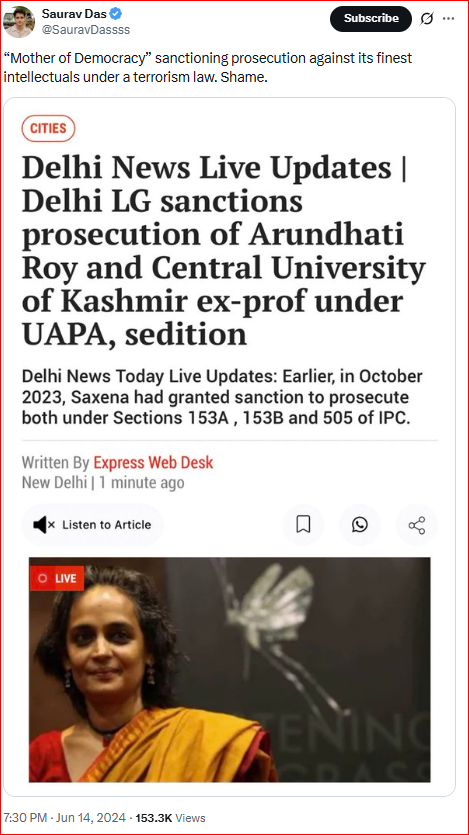
Islamo-leftists support and glorify even anti-national voices, as long as they subscribe to their core ideological principles. In June 2024, when the Delhi Lieutenant Governor Vinai Kumar Saxena granted permission to prosecute author Arundhati Roy under the stringent Unlawful Activities Prevention Act (UAPA) for her provocative speech at a 2010 event, Saurav Das opposed it and said, ““Mother of Democracy” sanctioning prosecution against its finest intellectuals under a terrorism law. Shame.”

Source: X

Notably, in the 2010 event, alongside Arundhati Roy, Sheikh Showkat Hussain and late Hurriyat leader Syed Ali Shah Geelani, SAR Geelani (the anchor of the conference and a prime accused in the Parliament attack case), and Varavara Rao were also present.

It was alleged that Geelani and Arundhati Roy strongly asserted that Kashmir was never part of India, was forcibly occupied by the Indian Armed Forces, and that every effort should be made for the independence of Jammu and Kashmir from India.

Clearly, Saurav Das supports ‘finest intellectuals’ who seek to separate Kashmir from India.

Saurav Das hailed Naxal ideologue GN Saibaba a ‘hero’

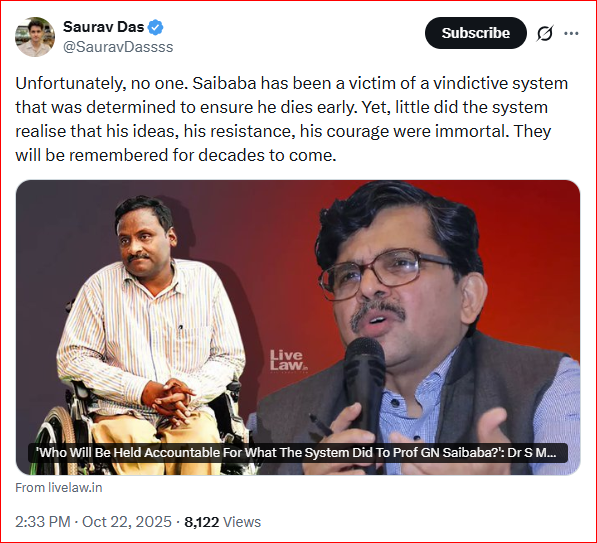
In the past, Saurav Das has also extended support to GN Saibaba, a convicted Naxal ideologue. In one such post supporting Saibaba last year, Das wrote, “Unfortunately, no one. Saibaba has been a victim of a vindictive system that was determined to ensure he dies early. Yet, little did the system realise that his ideas, his resistance, his courage were immortal. They will be remembered for decades to come.”

Source: X

Notably, GN Saibaba, a professor of English in Ram Lal Anand College of the Delhi University, was sentenced to life imprisonment by a Gadhchiroli sessions court in 2017 for waging war against India for his Maoist links and involvement in anti-national activities. He was convicted under sections 13, 18, 20, 38 and 39 of the UAPA.

G N Saibaba was first arrested in May 2014 on charges of being a member of the banned CPI-Maoists plus providing logistics and carrying out recruitment for them. He was then provided bail for three months on 30th June 2015 in view of his worsening health. He was given bail again in August 2016, this time by the Supreme Court against the wishes of the Maharashtra Government, which thought freeing Saibaba would render him free to propagate his views and brainwash students.

Conclusion

Saurav Das is neither independent nor a journalist. He is simply a leftist propagandist pushing the Islamo-leftist agenda and backing anti-India elements in the name of fighting for the constitution, democracy, the social fabric of India, and whatnot.

Hailing Naxalities to defending anti-Hindu Delhi riots accused: A brief history of Urban Naxal CASR’s devious actions

The recent “anti-pollution” protests in Delhi have highlighted how the Urban Naxals have resorted to the exploitation of significant climate issues to advance their sinister agenda. Notably, Bhagat Singh Chhatra Ekta Manch (bsCEM) and The Himkhand were behind the demonstration, which not only showcased the glorification of the red terror, including the lionisation of commander Madvi Hidma, but also involved a grave assault on the police personnel.

Notably, bsCEM alongside over 40 similar outfits form “Campaign Against State Repression” (CASR), which is focused on venerating left-wing terrorism, while continually denouncing the Indian state and security agencies for their remarkable initiative to achieve a Naxal-free country by 31st March 2026.

The collective has consistently advocated for the release of the overground workers of the Maoists, the “protesters” who assaulted police officers in the national capital using chili spray, Khurram Parvej and Irfan Mehraj, who faced charges of financing terrorism in Kashmir, and Anuradha Bhasin, the managing editor of Kashmir Times. Notably, 14 AK-47 cartridges, several pistol rounds, and three grenade safety levers were uncovered in the office of the newspaper.

These individuals have been charged with serious offenses due to their heinous actions, however, CASR portrayed these cases as a “conspiracy” as it fundamentally supports every anti-India element under the guise of activism, human rights, and other dubious justifications.

Exalting Hidma and anti-India propaganda

As expected, the radical group also mourned the neutralisation of the dreaded Communist Party of India (Maoist) commander Hidma, referring to it as an “extra-judicial killing.” It also criticised “Operation Kagaar” as a tool of the “Brahmanical Hindutva Fascist Indian state,” and described Naxalism as “armed and unarmed mass movements resisting the corporate exploitation of natural resources and displacement in Central India.”

In addition to the misleading claims and the use of such blase terminology, CASR invoked law and order, ironically for the outlawed CPI(M), which neither acknowledges the Indian constitution nor its democracy and has taken up arms against the country. Moreover, the manner in which the violent “people’s governments” of the Maoists wield the power of the gun to oppress the locals and tribals, not only keeping them underdeveloped but also forcing them to live in fear, is well documented.

However, the shackles have at last been broken due to the efforts of the government and security forces. These areas and their residents are now being assimilated into the mainstream as the violent movement counts its last days, with several surrenders and the elimination of its fragile leadership. This significant development has profoundly disturbed these urban naxals, resulting in outrage.

Facilitating Islamists, unrelenting hostility towards India

Rejaz M Sheeba Sydeek, who not only condemned “Operation Sindoor” and actions against Naxalities but also shared visuals of himself with a firearm on social media, received support from CASR, which demanded an end to his incarceration. Similar sentiments were conveyed regarding Delhi University Professor Hany Babu (son of Kunhu Mohammad), who has been implicated in the Bheema Koregaon violence.

Support was also extended to the infamous “Nazariya: A Queer Feminist Resource Group,” which advertised a vulgar colouring book to students that featured images of naked women wearing dildos and engaged in extremely inappropriate sexual imagery.

When CASR is not shedding tears over the Unlawful Activities Prevention Act (UAPA) or the National Investigation Agency (NIA) and advocating for every entity engaged in actions or plots against the nation, it arranges programs for the same and offers platforms to Islamists such as Sharjeel Usmani and others under the pretext of “World Press Freedom Day.”

Another event was conducted to declare that universities were also under siege, with similar propaganda being disseminated to attack the government and promote leftist agendas.

CASR also persistently urged the center to retract “Operation Kagaar” and foster an environment suitable for peace negotiations with the banned CPI(M). Interestingly, it attempted to establish a false equivalence between a legitimate government and an illegal gun-toting group that has been responsible for multiple attacks on security forces, politicians, and civilians.

The cabal even sought to instruct the government to terminate all action and meet the demands of Naxals, accountable for immeasurable death and devastation, who have only been brought to submission due to the assertive policies.

Support for devious minds behind anti-Hindu Delhi riots and SDPI and more

Gulfisha Fatima, who has been consistently denied bail owing to her serious participation in the anti-Hindu Delhi riots, has also found an ally in CASR. She had received female demonstrators in Seelampur and Jafrabad and joined WhatsApp groups that planned how the riot plot would be implemented.

Gulfisha also started two of these groups to organise Muslim women and their kids for rallies that were intended to turn violent. Mehmood Paracha, Umar Khalid and Apoorvanand were among those who joined the agitations planned by Gulfisha close to Nadima Masjid and incited people with provocative statements.

CASR also supprted Moideen Kutty K, also known as MK Faizy, president of Social Democratic Party of India (SDPI), which is the political wing of the banned Popular Front of India’s (PFI). He was booked under the provisions of the Prevention of Money Laundering Act (PMLA).

“Investigation revealed that the office bearers, members and cadres of PFI, were conspiring and raising/collecting funds from within India and abroad through banking channels, Hawala, donations for committing and financing terrorist acts across India,” the Enforcement Directorate (ED) had disclosed.

The group also made a post regarding Khalid Saifi, another individual accused in the Delhi violence, who operated the “Shaheen Bagh control room” to instigate, organise and perpetuate the unrest. He even participated in the Shahen Bagh protests and coordinated meetings between Umar Khalid and Tahir Hussain, who is reportedly responsible for the murder of Intelligence Bureau (IB) officer Ankit Sharma.

bsCEM vandalised Delhi University’s walls with graffiti urging people not to cast ballots prior to last year’s general elections. They wrote, “Ek hi raasta Naxalbari” (the only way is Naxalbari), “Boycott elections, join new democracy,” and other slogans on the walls of Delhi University after which police took action against the offenders which was predictably denounced by CASR.

The outfit also demanded an end to the imprisonment of Sharjeel Imam, a significant conspirator in the Delhi riots, who sought to sever the Siliguri Corridor “chicken’s neck” from India, which would effectively balkanise the country.

CASR hosted another event to assist the Urban Naxals apprehended by the authorities for their involvement in anti-India activities and invited Safoora Zargar to speak at the event. She was charged under the UAPA for her part in the plot that resulted in the riots in Delhi.

Safoora was involved in a scheme to “destroy, destabilise and disintegrate the Government of India to compel it to withdraw the Citizenship Amendment Act (CAA) and the alleged National Register of Citizens,” according to the Delhi Police. She was granted bail by the Delhi High Court on humanitarian grounds in the June 2020 Delhi Riots case.

CASR also held a memorial gathering in honor of GN Saibaba. He was a professor of English at the University of Delhi, and was given a life sentence due to his ties to Maoists. He was later found not guilty and the Bombay High Court judge who delivered the ruling, Rohit B. Deo, left his position in 2023 for personal reasons.

A mass email drive regarding the key conspirator of the anti-Hindu Delhi riots of 2020, Umar Khalid, and other so-called “political prisoners” was also started by the organisation. His speeches, along with the meticulous pre-planning to execute the violence, have been the reason behind his constant incarceration.

It is important to note that the turmoil in Delhi was not just a premeditated conspiracy, but in fact, a regime change operation, as demonstrated by the prosecution in the Supreme Court, which even presented videos of Sharjeel as evidence.

Conclusion

This is just a small insight into the infamous activities of CASR. The group, which consists of Urban Naxals and various anti-Hindu factions, has extended support to every individual from Kashmir to Kerala who has been accused of serious crimes against the Republic of India.

Likewise, its previous account also provided a glimpse into the dubious propaganda, showcasing foreign individuals attempting to interfere in India’s internal matters and even peddling false narratives concerning Kashmir.

Hence, it is not surprising that bsCEM took to the streets to “protest” the rising pollution in the national capital but soon began to commend Hidma and the oppressive Naxal authority in the red corridor regions. Their goal is to impose their warped ideology while trying to present it as a viable alternative to democracy.

CASR’s campaign to represent the accused, who are confronted with serious charges, as victims of a ruthless state and conceal their dreadful offences to generate sympathy in the public’s perception, while also appealing to international audiences.

CASR essentially cries victimhood in the name of journalists, social activists, and others who, in fact, attempt to undermine the Constitution, laws and democratic institutions of the country, support Maoist movements and jihadis. It desires India to submit to every extremist movement, otherwise, it will be branded as “fascist”.

India’s new seismic map puts entire Himalayan region in high-risk zone: Read what it means and how it is more about building design and city planning than panic

Media and social media are abuzz with alarmist headlines, claiming that a major part of India is now a great risk of massive earthquakes and that crores of people might die. Some videos and social media posts are making it sound as if the Himalayas are suddenly going to blow up beneath our feet and over our heads, swallowing the north and north-eastern India and killing the majority of the Indian population that lives in the foothills of the mountain range and the plains of the rivers that originate from it.

The reality, however, is slightly less dramatic.

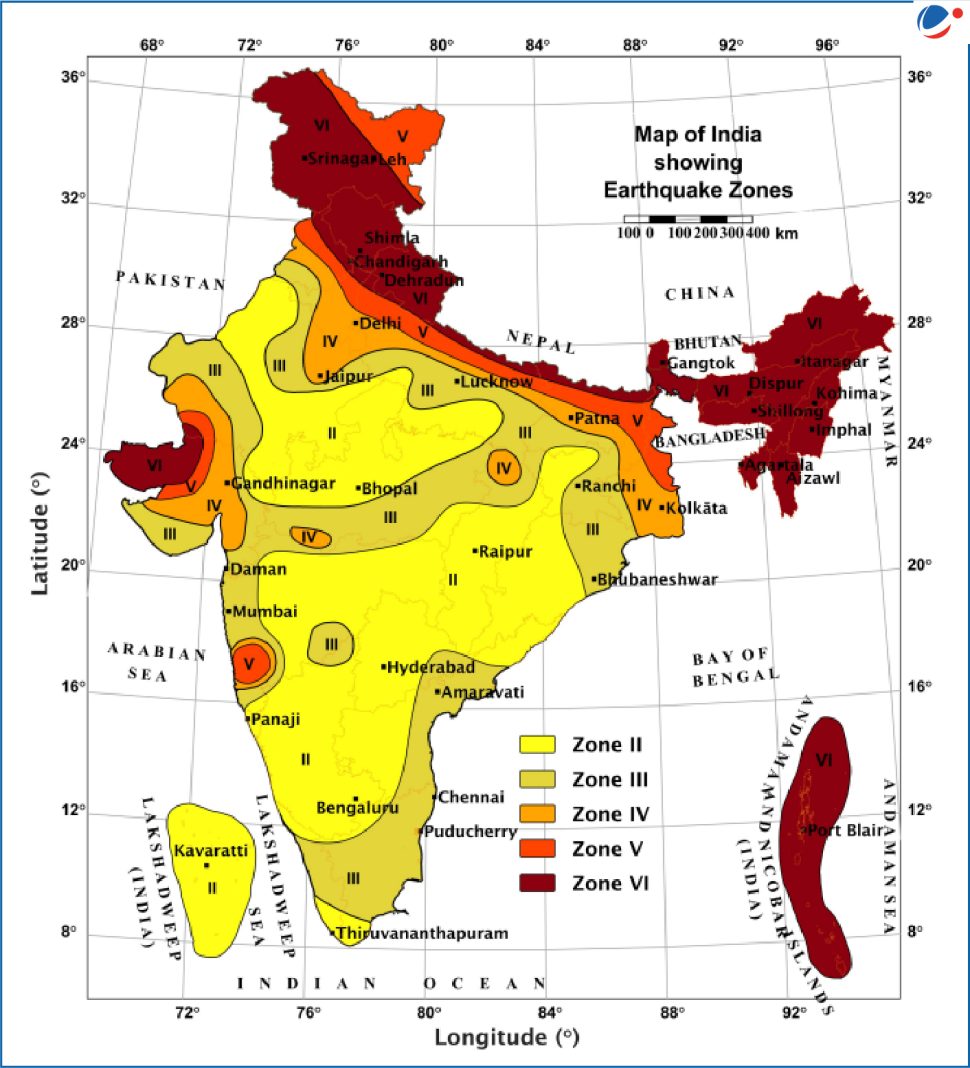
On November 28, India released an updated, new seismic zonation map, as part of the revised Earthquake Design Code, by the Bureau of Indian Standards (BIS). The new map places the entire Himalayan region under Zone VI, the highest risk zone, for the first time. This also means that around 75% of the Indian population now lives in seismically active zones, and 61% of India’s landmass is now under seismic risk.

But even that is not as alarming as it sounds. Because, for Indonesia, almost the whole nation, 100% of their landmass is ‘seismically active’. They are literally sitting above the Ring of Fire. They had 2212 earthquakes in 2023 and 1872 in 2024. Every week, some volcano starts hissing and puffing, throwing lava around. They have around 130 active volcanoes and are happily living with them. The same is the case with Japan, and even China has 65% of its landmass that comes under the ‘seismically active’ classification.

However, the devil is in the details. The tectonic realities of the Indian subcontinent have been the same for millions of years. The news is that we are now changing how we classify our landmass as per seismic activity, using the latest scientific data and ensuring the best possible preparedness.

India’s seismic map was first drawn in 1962. 

The new map marks a radical shift in India’s seismic hazard assessment because, now 61% of the nation comes under the moderate to high hazard zones. The new Zone VI now spans from Jammu & Kashmir in the west to Arunachal Pradesh in the east. Though it was well known that the Himalayan region is a generally seismically active zone, the previous classification divided this region into a mix of Zone IV and Zone V. 

What is the classification, and what does Zone VI (highest risk) mean?

In the seismic zoning system, zones indicate the expected intensity of ground shaking during an earthquake, based on factors like peak ground acceleration (PGA). Higher risk zones demand stricter safety measures and design rules to minimise property damage and loss of life. Basically, this means more steel, and deeper foundations, apart from stricter planning standards in a larger area of the country.

The updated map takes into account major earthquakes that have occured in the larger region, like Nepal in 2015, and the Turkey-Syria earthquake in 2023. The updated design rules factor in geological aspects, like the Himalayan Frontal Thrust (HFT), locked fault segments accumulating stress for 200+ years, especially in the central Himalayas, and seismic gaps and the possibilities of ruptures spreading from central to outer regions.

The new map also automatically classifies boundary towns between seismic zones into a higher risk zone, contrary to the earlier system that depended on administrative borders.


The zone classification is as follows:

Seismic ZoneHazard LevelMeaningRegions (Typical Examples)
Zone IILowLight shaking expectedCentral India, parts of South India, MP, Rajasthan
Zone IIIModerateNoticeable shakingMumbai, parts of north Odisha and Jharkhand
Zone IVHighStrong shaking possibleDelhi NCR, Kolkata, Patna, Gandhinagar
Zone VVery HighVery strong shakingEastern Ladakh, Himalayan foothills
Zone VI (new introduction)ExtremeGreat earthquakes (M8+) possibleEntire Himalayan arc: Kashmir–Himachal–Uttarakhand–Nepal border region–Sikkim–Arunachal


The new Zone VI classification means that the entire Himalayan region is capable of major earthquakes, with the magnitude of 8 and above on the Richter scale. The possibility of magnitude 9 events are also not ruled out in this zone. 

The new seismic map zones, image via Vision IAS

New Earthquake Design Standard: What does it mean?

The Zone VI classification means new building and planning standards will have to be followed in these regions, confirming with the highest earthquake-resistance requirements in India’s building code (updated IS 1893). 

  • 1. All new constructions (houses, bridges, hospitals, schools) in Zone VI now must use enhanced designs, including higher ductility, better energy dissipation, and limits on structural displacement.
  • 2. Stricter land-use rules in urban planning, like halting development on soft soils or near fault areas, and factoring in population density and earthquake vulnerability before executing constriction projects.
  • 3. Disaster preparedness drills, audits and early warning systems will now be mandatory in states like Haryana, Punjab, Delhi-NCR, Uttarakhand, Himachal Pradesh, J&K, Sikkim, and parts of the Northeast, Bihar, Uttar Pradesh
  • 4. Cost of building is going to increase as public infra like schools, bridges, dams, highways and airports will now need better designs and reinforcements that need costlier building materials and engineering oversight. 
  • 5. Critical infrastructure like schools and hospitals will now need to be made as per the strictest criteria of earthquake resistance, so that they remain safe and functional during earthquakes for better disaster management

Why is the Himalayan region seismically active? 

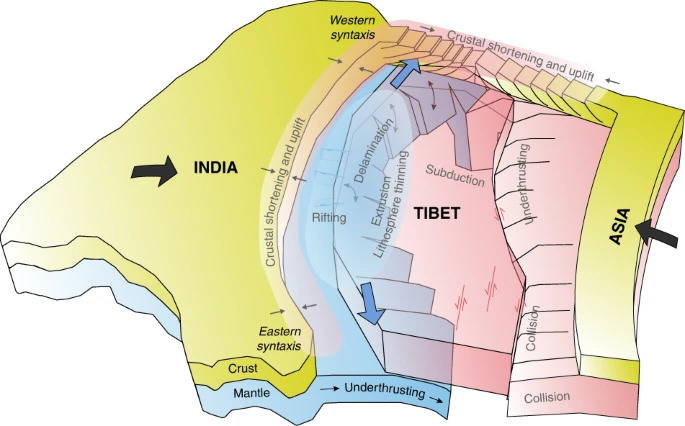
The Himalayas are, geologically speaking, still forming. The Himalayas are one of the world’s most seismically active zones due to the ongoing tectonic collision forming the mountain range. The Himalayas are the result of the Indian Plate breaking off from the Supercontinent Gondwana and colliding with the Eurasian Plate, and that process is still happening for millions of years. The Indian Plate thrusts upwards to the Eurasian Plate and moves at a speed of around 5 cm/year.

Image via Nature.com

The contact zone between the two plates is a gigantic thrust fault system called the Main Himalayan Thrust (MHT). All that violence and turbulence is dissipated along a series of faults, spanning from Delhi to Tibet. 

The problem is, most parts of the Himalayas have not ruptured in a major earthquake for 200–700 years, hence, scientists think that we better be prepared. 

Why is this not a panic announcement, but rather a practical, scientific approach to earthquake preparedness

The words like ‘highest risk’, ‘crores of people under earthquake threat’, ‘entire Himalayan region under major earthquake risk’ etc circulating in the media may be nice clickbait headlines, but they are misleading. The new zone classifications are not a panic announcement, but it is the most honest, and updated reflection of risk India has ever published.

Himalaya have been our guardian for millennia. It is the reason for Monsoons, the ground of our civilisational foundation and the creator of our rivers, forests and plains. No matter what the media headlines scream, the mountain range is not going anywhere, and neither are the crores of people in India and Nepal that call the region their home. Earthquakes are a reality of the Earth because beneath the superficial tranquillity of the ground we walk on, the tectonic plates are moving over a lava-filled core, the instruments of the planet’s engine. 

The updated map is a testimony of human preparedness, because better equipment, better monitoring and twenty-first-century knowledge has made us more capable of handling disasters. 

Bhopal man Shubham Goswami’s Muslim girlfriend’s family forced him to covert, renamed him Aman Khan, and fed him beef, case filed after 3 years of ordeal: Exclusive details

0

A disturbing case of coercive conversion has surfaced in Bhopal, Madhya Pradesh. A Hindu youth, identified as Shubham Goswami, was compelled to convert to Islam and adopt a Muslim identity as “Aman Khan” after he fell in love with a Muslim girl in 2022. Shubham has now stated that he wants to return to Hinduism and for that he has approached minister Vishwas Kailash Sarang during a public grievance event.

Shubham narrated the harrowing experience of coercion, religious pressure and intimidation by the family of the Muslim girl with whom he had once been in a relationship. Speaking to the media, Sarang said that it was heartbreaking to listen to Shubham’s account. He assured that the state government would ensure that Shubham is allowed to reclaim his identity through a proper ghar wapsi. The minister said the case highlighted why it was important for the state to enact a law against forced religious conversions.

Shubham had not merely been pressured to convert but had been pushed to a point where his identity, social standing and mental well-being were systematically undermined. The family that targeted Shubham allegedly filed false cases against him, forced him to convert to Islam and even controlled how he presented himself in society.

OpIndia accessed related FIR and court documents in the case.

Forced to convert to Islam, sent to Jamaat and fed cow meat

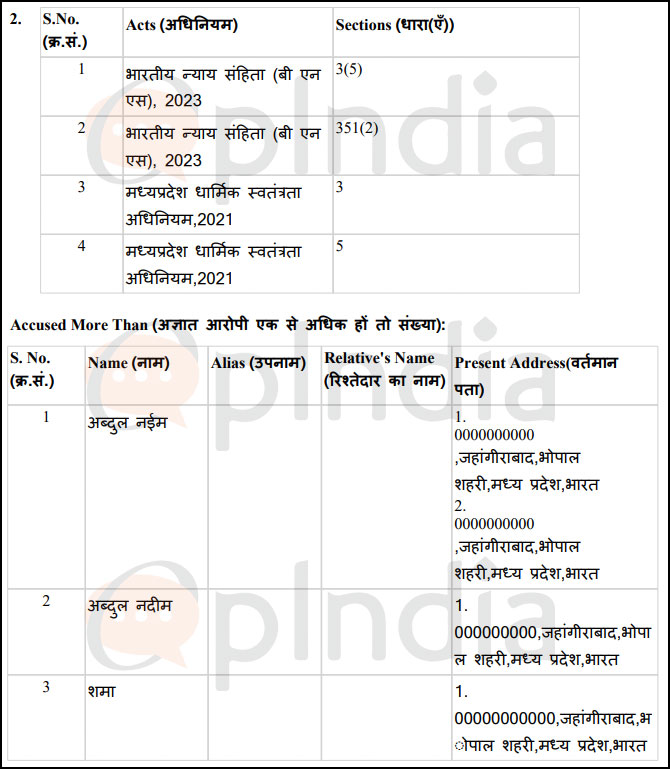
On 20th November, Shubham reached Jahangirabad Police Station with two friends and submitted a complaint against Abdul Naim, his son Abdul Nadeem, and his wife Shama. Based on his complaint, an FIR has been registered under Sections 3(5) and 251(2) of the Bharatiya Nyaya Sanhita (BNS) and Sections 3 and 5 of the Madhya Pradesh Freedom of Religion Act, 2021.

Source: Madhya Pradesh Police

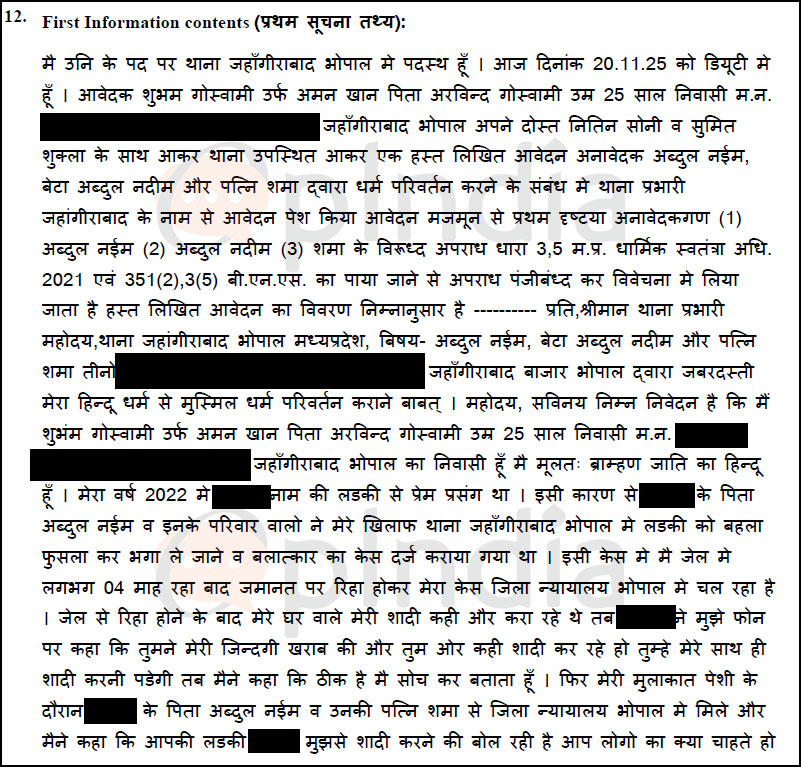
In his complaint, Shubham said that he is a Hindu Brahmin and that he got into a relationship with a Muslim girl in late 2022. He said the relationship led to severe backlash from the girl’s family and they filed a case against him under charges of abduction and rape, including provisions of the POCSO Act.

As the case was registered under serious sections, he was arrested and remained behind bars for around four months. He was eventually released on bail but the criminal proceedings in the matter have continued and the next hearing in the matter is scheduled on 22nd December in Bhopal District Court.

He emphasised that even after he converted to Islam under their pressure and agreed to marry the girl, the POCSO case was never withdrawn and is still ongoing before the court in Bhopal.

How Shubham was coerced to convert to Islam

In the FIR, Shubham recounted that after his release from jail, his family wanted to marry him to a Hindu girl and preparations for the same began. However, Ilma contacted him and said he had ruined her life and must marry her. During one of his court appearances, he met her parents, Abdul Naim and Shama, who told him that the rape case would be withdrawn only if he permanently abandoned Hinduism and converted to Islam.

Source: Madhya Pradesh Police

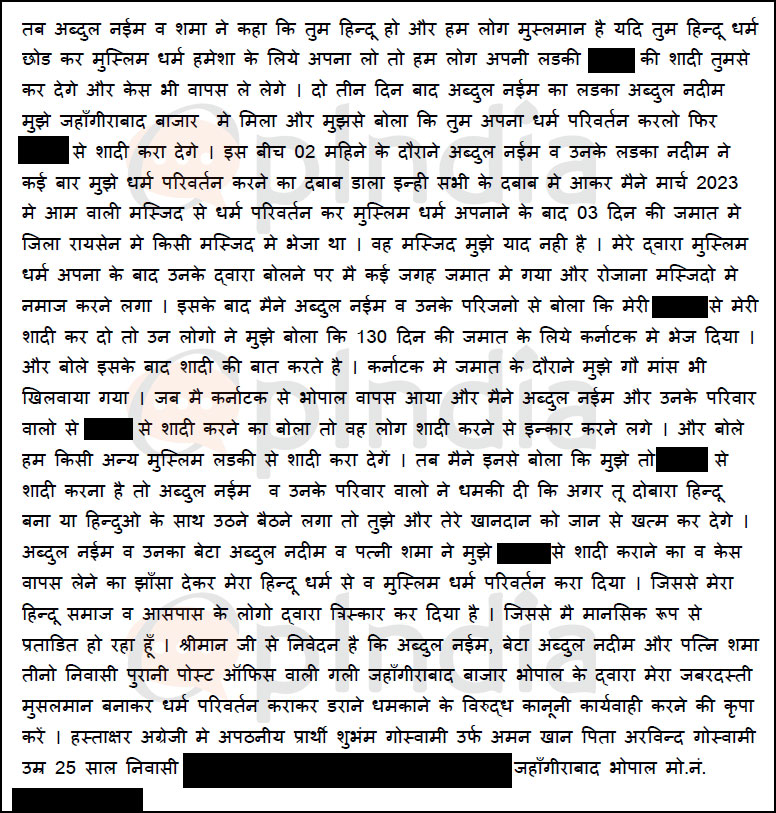
Shubham resisted in the beginning but for the next two months, Naim and his son, Abdul Nadeem, repeatedly pressured him to convert. He eventually broke down and converted to Islam at Aam Wali Masjid in March 2023.

Following the conversion, he was immediately sent to a three-day jamaat in Raisen. After that, he was regularly instructed to attend prayers at the mosque and continue engaging in Islamic religious activities. When he asked the girl’s parents that now he should be allowed to get married to the girl, he was sent on a 130-day jamaat to Karnataka. Shubham was forced to eat cow meat during that period.

He stated that he spent almost three years living away from his family, in a Muslim locality, under the identity of Aman Khan. The emotional, social and economic distress he endured during this period left him mentally exhausted.

Accused refused to arrange marriage even after conversion, issued threats if he attempted to return to Hindu identity

Shubham stated that after he converted to Islam, he repeatedly requested the girl’s family to fulfil their promise of allowing him to marry her. Instead, they deferred the matter repeatedly and later told him that they would get him married to another Muslim woman. When he insisted that he would marry only the girl he was in a relationship with, the family began threatening him. He said they warned him that if he attempted to return to Hinduism or resumed contact with members of his community, they would kill him and his relatives.

Source: Madhya Pradesh Police

The pending case against Shubham was consistently used to pressure him, ensuring that he remained under their influence.

Court deny bail to accused family members of the girl

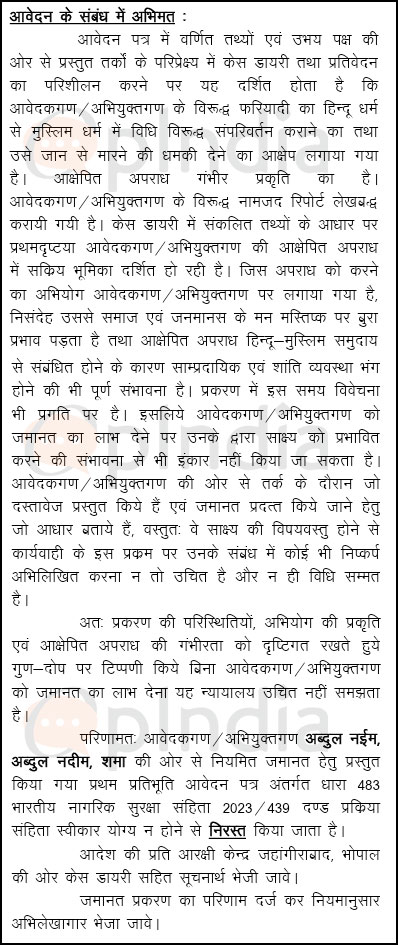
Following the FIR lodged against Naim, Nadeem and Shama, the trio were arrested and presented in the court. They were sent to judicial custody. A bail plea was submitted in Bhoppal District Court on their behalf which was rejected by Justice Pankaj Kumar Jain on 24th November 2025.

In its order, the court noted that the allegations against the accused were grave in nature. The material collected during the preliminary stage of investigation indicated a prima facie role of the accused in forcing Shubham to convert to Islam.

Source: Bhopal District Court

The court observed the case involved acts that, by their very nature, could impact social harmony, as the allegations related directly to religious coercion and threats issued to prevent Shubham from embracing Hinduism again. The judge held that the accusations, which included threats to kill Shubham and his family if he re-embraced Hinduism or interacted with members of his community, raised serious concerns that could not be lightly dismissed at the initial stage of the proceedings.

The judge observed that given the communal sensitivities involved, the case had the potential to disturb peace and social stability. It was further noted that the investigation was still underway and releasing the accused at this stage might lead to interference with witnesses or tampering with evidence. On these grounds, the court held that it was not appropriate to grant bail.

The exhausting three years

During the three-year period where Shubham lived as “Aman Khan”, he was stripped of his identity, community and stability. He lost his job, was left by his family and lived under constant fear that the case against him could be used again to target him. Shubham described living in a Muslim neighbourhood, attending mosques daily and being required to follow practices that he had not willingly chosen. With state machinery on his side, Shubham will soon re-embrace Hinduism and his true identity.

Aapada mein avsar: Read how India is finding new export markets in Europe and Asia to counter the effects of US tariffs

The steep 50% tariffs imposed by the United States from 27th August have forced India to find ‘Aapada mein avsar‘ (opportunity in crisis).

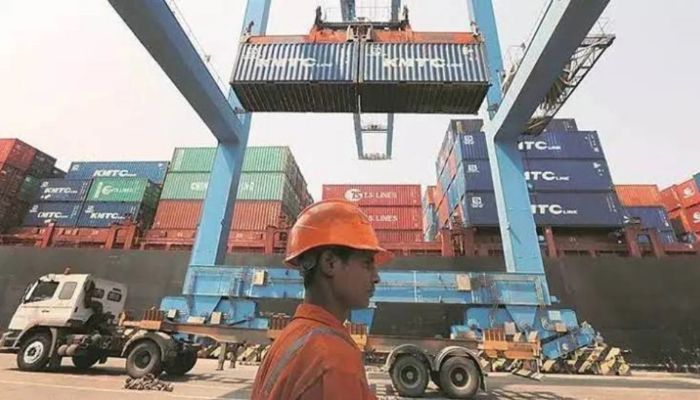
Several sectors that earlier depended heavily on the American market are now quickly redirecting their products to other regions. Items like shrimps, gems and jewellery, auto components, and electrical machinery have found many buyers in Asian and European countries.

A recent report from the Commerce and Industry Ministry shows that while exports to the US have fallen sharply across some categories, overall numbers have not collapsed because exporters are tapping new destinations.

Gems, Jewellery and Auto components find new buyers

One of the clearest examples of this shift can be seen in the gems and jewellery sector. Exports of these items to the US fell by a massive 76% in September compared to last year. Yet, overall gems and jewellery exports dropped only 1.5%. This was possible because shipments to the UAE increased 79%, to Hong Kong by 11%, and to Belgium by 8%.

A similar trend was visible in auto components. Exports to the US dipped 12% in September, but total auto component exports actually grew 8%. Germany, the UAE and Thailand picked up a large part of the redirected shipments, showing how Indian exporters are turning to multiple markets at once.

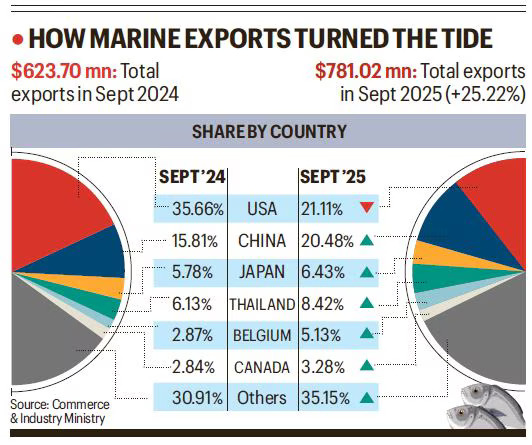
Marine products are seeing the strongest growth among all categories. Exports rose 25% in September and 11% in October. China, Japan, Thailand and the European Union accounted for most of this rise. Exporters say demand from these countries has helped them deal with the sudden slowdown from the US.

These trends strengthen the idea that India’s strong trade links with countries across Asia and Europe can reduce the immediate shock of losing access to the American market. However, this may not be true for all sectors.

Marine sector expands EU approvals

The government has been pushing for diversification, especially for products like marine items that already have good demand in many regions. Since the US tariffs were imposed, the number of Indian seafood units approved by the European Union has gone up by 25%. At least 102 additional units have now been allowed to supply to the EU, which is India’s second-largest seafood export market.

Image via The Indian Express

Before this, 502 Indian units were listed as eligible exporters to the EU. Many of the latest approvals had been pending for more than five years. Exporters say these new permissions will help increase shipments significantly.

Exporters asked not to slash prices

The government has also asked exporters to explore new markets like Russia. A senior official said around 25 fishery units in India may soon get approval to export to Russia as well. Authorities believe these diversification efforts are useful.

The Commerce Department has advised exporters not to reduce prices too sharply in the search for new buyers. Officials say that slashing prices may harm India’s long-term position in those markets.

Some US shipments are still taking place because buyers need temporary replacement stocks. But these orders are slowly being taken over by countries in East Asia and Central America. Indonesia and Ecuador, where US tariffs are lower at around 19% and 15%, have emerged as major gainers. Interestingly, both these countries have increased their prices too, which still keeps Indian goods competitive in some segments.

Tariffs in the EU may also come down from the current level of around 12% once the India–EU Free Trade Agreement (FTA) is finalised. This could boost India’s fishery exports to Europe by 20–25%. EU approval is considered an important quality benchmark, and once exporters crack that market, it often becomes easier to enter other regions too.

To support exporters, the government has announced assistance worth Rs 45,060 crore, including Rs 20,000 crore in credit guarantees for bank loans. A special support scheme announced in the Union Budget has also been put into operation.

Data shows diversification is helping

A recent report by SBI’s Ecowrap said India’s export diversification strategy is showing early signs of success. Between April and September this year, India’s total merchandise exports grew by 2.9%. Surprisingly, exports to the US also grew 13% during this period, although this may be because exporters rushed to ship goods before the tariffs took effect.

But by September, US-bound exports fell 12% year-on-year. At the same time, India’s exports to countries like the UAE, China, Vietnam, Japan, Hong Kong, Bangladesh, Sri Lanka and Nigeria increased sharply. This suggests that many goods that once went to the US are now being routed elsewhere.

The report pointed out that the US is now importing many items from Indonesia, Thailand and Vietnam, where shipments have risen as exports from India and China have dropped. Container shipments from India to the US fell 18.4% in October 2025 compared to the previous year, while China’s shipments declined 16.3%. Meanwhile, Indonesia’s shipments grew 10.1%, and Thailand and Vietnam grew around 3.6%.

Overall, India has managed to soften the blow of US tariffs by actively shipping goods to other countries. Many sectors, especially those with strong demand in Asia and Europe, have adjusted quickly.

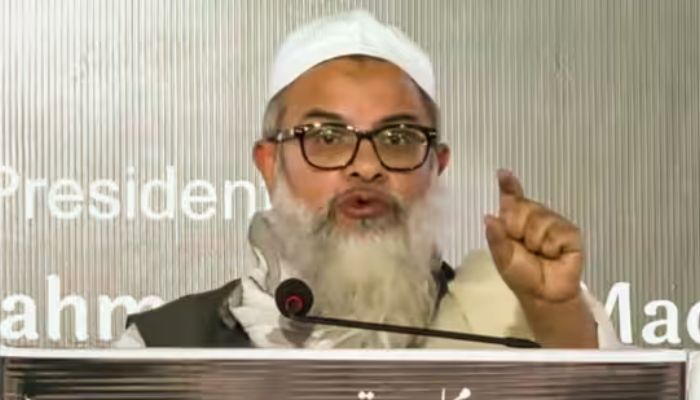
Maulana Mahmood Madani threatens Hindus with ‘jihad against oppression’ remark, attacks judiciary: Read about the radical Islamic scholar who heads Jamiat Ulama-i-Hind

Jamiat Ulema-e-Hind President Maulana Mahmood Madani triggered a national controversy on Saturday (29th November) after asserting that “if there is oppression, there will be jihad,” a statement he made while sharply criticising the judiciary and accusing it of failing to protect the constitutional rights of minorities. 

Speaking at the Jamiat Ulama-i-Hind’s national governing body meeting held at Barkatullah Education Campus in Bhopal, Madhya Pradesh, Madani suggested that several recent court verdicts, including the Babri Masjid decision and the judgment that criminalised instant triple talaq, reflected a judiciary working “under government pressure.” His comments have set off a storm of political reactions, especially from the Bharatiya Janata Party (BJP), which accused him of inciting Muslims, spreading misinformation, and challenging constitutional institutions.

Madani, who leads one of India’s oldest Islamic organisations, founded in 1919, positioned his comments as a defence of minority rights. However, the phrase “if there is oppression, there will be jihad” became the centre of the controversy, as critics argued that it could be interpreted as a call for confrontation. Madani maintained that the word “jihad” was being misrepresented in public discourse, and insisted that he was referring to it in a spiritual and ethical sense rather than violence. But the backlash was swift and intense.

Madani’s critique of the Judiciary and the Constitution

During his speech, Madani argued that a series of recent judgments had weakened constitutional protections for minorities. He highlighted cases being heard in courts despite the Places of Worship Act, 1991, which mandates maintaining the religious character of places of worship as it existed in 1947. Citing this, he said, “The Supreme Court is entitled to be called ‘Supreme’ only as long as the Constitution is protected there. If this does not happen, then it does not deserve to be called supreme even in a non-remnant.”

The remark was interpreted by many as a direct challenge to the country’s highest court. Madani further said that the judiciary’s recent decisions “openly violated the rights of minorities guaranteed in the Constitution,” and said that these verdicts indicated constitutional deviations driven by political influence.

He also offered an assessment of the public mood, claiming that “10% of people are supportive of Muslims, 30% are against them, and 60% are silent.” Urging the Muslim community to engage with this silent majority, he warned that if these neutral individuals “turn against Muslims, then there will be a big danger in the country.”

‘Jihad was and will always remain holy’: Madani 

A major part of Madani’s speech focused on the interpretation of jihad, a term he claimed had been repeatedly distorted by the government, media, and certain political groups. 

Madani said, “By using phrases like ‘love jihad’, ‘land jihad’, ‘education jihad’, ‘spit jihad’, etc, the freedom of Muslims and their religion is being insulted… This is an old pattern: whenever any terrorist act occurs anywhere, it is labelled jihad, and Islam and Muslims are subjected to taunts, accusations and baseless allegations. It must be clarified that in Islam, jihad is a sacred religious obligation.”

He said that the “word jihad is used in the Quran in many meanings, but in whichever meaning it is used, it is for the welfare of the individual, society and humanity, for their elevation and for upholding their honour and dignity”.

“Wherever it is used in the sense of war and fighting, that too is for ending oppression and corruption and for the survival of humanity. Therefore, wherever there is oppression, there will be jihad. I repeat: wherever there is oppression, there will be jihad,” Madani said.

He further said, “In a democratic and secular country like India, where the concept of an Islamic state does not exist, any talk in the name of jihad is not even a subject of discussion.”

“Muslims are bound by constitutional loyalty, and the government is also responsible for protecting the rights of citizens. If the government fails in this, it will be the government’s responsibility, not ours,” he said.

Madani’s remarks on Vande Mataram trigger another debate

In the same address, Madani also commented on the ongoing debate surrounding the recitation of ‘Vande Mataram.’ His remark, “A dead community surrenders”,sparked fresh criticism, as he suggested that any community that unquestioningly complies with demands to recite the song is “a dead community.”

Madani said that if Muslims are pressured to recite Vande Mataram, they should not accept it passively. “If they say ‘say Vande Mataram,’ they will start reading it. This will be the identity of a dead community. If we are a living community, we will have to face the situation,” he said.

The comment was viewed as provocative at a time when debates around national symbols and religious freedom had already become politically charged.

He also spoke about halal, alleging that “the purely religious concept of halal is being systematically defamed”.

“Halal does not mean only ritual slaughter; it is the pure way of life of an entire Muslim life. Halal includes the basic principles of lawful earnings, honesty in employment and trade, and the correct use of wealth,” he said.

BJP reacts sharply, calls Madani’s remarks incendiary

Madani’s statements invited an immediate and fierce backlash from the BJP, which accused him of deliberately provoking the Muslim community and attacking constitutional institutions.

Responding to Madani’s comments, BJP leader Narottam Mishra said, “…India will no longer tolerate such a mindset. They are questioning the courts; they are questioning Vande Mataram. What kind of mindset is this?”

BJP MLA Rameshwar Sharma led the charge, saying, “new Jinnahs are emerging in India who are trying to provoke the country’s Muslims.” He demanded that the Supreme Court take suo motu cognisance of Madani’s remarks and initiate action against him.

Sharma accused Madani of “violating the Constitution” and “challenging the Supreme Court,” warning him to “stay within limits.” His response escalated sharply as he claimed that individuals like Madani “produce terrorists, jihadists, rapists” and support movements such as “love jihad, land jihad, and thook jihad.” Sharma also questioned the morality of expecting the Supreme Court to “serve them biryani” after promoting activities he associated with terrorism.

Taking a hard line, Sharma said: “Will you spread terrorism, kill innocents in India, and expect the Supreme Court to reward you? The Supreme Court will hang you.” He added that the government “will not feed sweets to terrorists” and that Madani should “keep his misbehaviour in check.”

Sharma argued that anyone who “violates the Constitution or questions the judiciary” should face strict action, even under sedition-like laws. He warned that India is not a country that would tolerate anti-national activities. “If your children become doctors, the country will salute you,” he said. “But if they become doctors who throw bombs, they will also be blown up by bombs.”

The heated exchange further deepened existing tensions between the Jamiat Ulema-e-Hind and the BJP leadership, with both sides accusing the other of undermining national unity and constitutional principles.

Madani was selected as the ‘Person of the Year – 2023’

Maulana Mahmood Madani, the President of Jamiat Ulama-e-Hind (M), has been selected as the ‘person of the year – 2023’ by the Royal Islamic Strategic Studies Centre.

The independent research entity recently published the 14th annual issue [pdf] of ‘The Muslim 500: The World’s 500 Most Influential Muslims’ wherein Maulana Mahmood Madani is listed as the ‘Person of the Year- 2023.’

Madani’s latest remarks are part of a recurring pattern in which he has taken strong and often contentious positions on national issues. Over the past few years, he has been at the forefront of debates on the Uniform Civil Code, alleged Islamophobia, religious freedom, and the rights of Islamic institutions. 

Opposition to Uttarakhand’s Uniform Civil Code

In January this year, when Uttarakhand became the first state in independent India to implement a Uniform Civil Code, Madani strongly opposed the law. Calling it a violation of the constitutional right to religious freedom, he compared it to an “assault on democracy.”

Madani argued that the law ignored the objections raised by Muslim minorities and failed to consider the guidance provided by the Law Commission of India, which had previously stated that a Uniform Civil Code was neither necessary nor desirable. According to him, the government imposed the UCC in a “dictatorial manner,” disregarding democratic processes and public consultation.

He insisted that Muslims would continue to adhere to their personal laws and Sharia, and that they would resist any attempt to dilute religious practices, though only “within the bounds of the law and Constitution.” Madani’s remarks sparked significant political debate, with critics accusing him of resisting reforms aimed at ensuring gender justice.

Call for legislation against ‘Islamophobia’ 

In June 2024, Madani and the Jamiat Ulama-e-Hind demanded comprehensive legislation to address what they called rising Islamophobia in India. However, this appeal triggered controversy due to the organisation’s track record of legally defending individuals accused of terrorism.

OpIndia earlier published a report in 2022, which explain that since 2007, the Jamiat’s legal cell has provided legal support to nearly 700 terror-accused individuals, resulting in over 190 acquittals, many due to procedural lapses rather than confirmation of innocence. The organisation’s involvement in high-profile cases, such as the 7/11 Mumbai train blasts, the 2006 Malegaon blasts, and the 26/11 Mumbai attacks, raised questions about its intentions in proposing such a law. 

Madani’s statement also accused the government and child rights bodies of targeting madrasas under the guise of regulation. He said that directives such as mandatory Surya Namaskar, Saraswati Puja, or recitation of Hindu prayers were unconstitutional and infringed upon Muslim religious freedom. Critics dismissed these allegations as exaggerated and argued that such claims were intended to create a false narrative of victimisation.

Jamiat also voiced objections to the UCC, demanded protection for Islamic institutions, and even raised questions on reservation policies, further intensifying debates around identity politics and religious autonomy.

Threat-like statements during UCC debate 

Madani’s contentious statements on the UCC date back to May 2022, when the Jamiat Ulama-e-Hind passed a resolution against the proposed national Uniform Civil Code during a two-day convention attended by thousands of Muslim organisations.

The resolution warned that Muslims would “take all measures” against the UCC, though it insisted that these measures would remain “within constitutional limits.” The phrasing led to criticism that the organisation was indirectly issuing threats.

Madani added another layer of controversy by saying, “We had a chance to go to Pakistan, but we did not go. Those who harp on about Pakistan should go there themselves.” He said that Muslims had become “strangers in their own country,” adding that they would compromise on everything except their faith.

During the same event, a Jamiat official, Maulana Niaz Ahmed Farooqui, warned that disputes like the Gyanvapi mosque issue could lead to “the creation of another Pakistan.” The statement was widely condemned for invoking a divisive and sensitive historical reference.

Demand for a new blasphemy law 

Another controversy arose in August 2022, when Madani demanded exemplary punishment for former BJP MLA T Raja Singh over alleged derogatory comments about the Prophet Muhammad. He described the party’s internal action against Singh as inadequate and called for a new law to protect the dignity of religious figures.

Critics argued that creating such a law would endanger freedom of expression and could be misused. The demand also triggered concerns about the rise of blasphemy-related restrictions at a time when many countries were moving away from such legislation.

Support for the Waqf Act and opposition to reforms 

In September 2022, Madani and the Jamiat Ulama-e-Hind opposed a petition challenging the Waqf Act’s sweeping provisions. The organisation moved the Delhi High Court, defending the existing structure of Waqf administration and suggesting that any attempt to amend the law was part of a campaign to target Muslim community practices.

Maulana Mahmood Madani’s recent remarks on “jihad,” judicial decisions, and Vande Mataram have reignited long-standing debates around religious identity, constitutional rights, and political polarisation in India. While he insists that his comments stem from concern for minority rights and constitutional protections.

The intense reactions to his latest statements are not occurring in isolation. Over the past several years, Madani has repeatedly taken strong and controversial positions on issues ranging from the Uniform Civil Code to alleged Islamophobia, blasphemy laws, and Waqf regulations. Each of these episodes has contributed to wider political and societal divisions.

Modi govt denies visa to Christian evangelist Franklin Graham: Read about his father’s conversion mission and connection to Nehru- Gandhi family

0

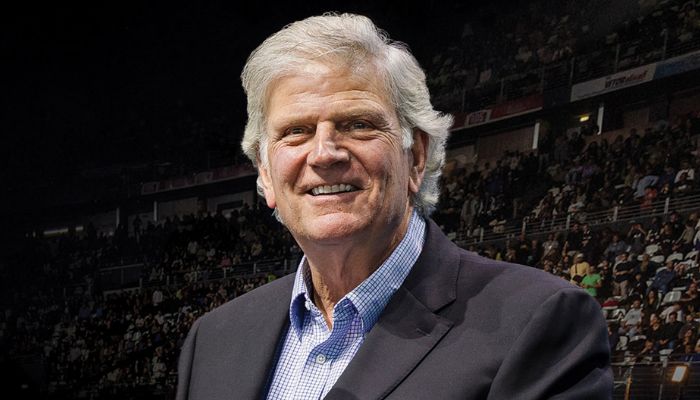
The Ministry of Home Affairs recently denied visa to Christian evangelist Franklin Graham from the United States, who was scheduled to visit Kohima in Nagaland on 30th November for a Christian event. While his visit has been cancelled, the event would continue as stated by the organisation behind it. The Centre has not publicly stated the reason behind rejecting visa to Franklin, however, his long-standing activities in India, including conversion-linked outreach through his organisation Samaritan’s Purse, might be at the core of the decision.

Franklin Graham’s long history in India

Over the past few decades, Franklin has visited India multiple times. His organisation, Samaritan’s Purse, has been involved in conversion-oriented activities in the country, using aid, food distribution, and other material assistance as a tool for evangelism. In the 1980s, the organisation had announced plans to establish one thousand churches in India and has worked towards that goal through various mission programmes.

His father, the late Billy Graham, first visited India in the 1950s and had met then Prime Minister Jawaharlal Nehru. He also had links to the Gandhi family. These historical associations must be recalled as the Nagaland Pradesh Congress Committee has openly criticised the central government for denying visa to him.

Organisations criticised Government for denying visa

The Nagaland Joint Christian Forum (NJCF), National People’s Party (NPP), Chakhesang Public Organisation (CPO), Nagaland Pradesh Congress Committee (NPCC) and others have expressed disappointment over the cancellation of Graham’s visit due to visa restrictions.

NJCF is the organisation that had arranged the event which Franklin was scheduled to attend. Despite the setback, NJCF said the scheduled programme, organised with the Kohima Baptist Pastors’ Fellowship, would proceed as planned. The event took place on 30th November at the Indira Gandhi Stadium. NJCF called the event an opportunity for unity and worship.

On the other hand, NPP said it was disappointed and troubled by the Centre’s decision. The party noted that local churches had prepared extensively and that thousands of Christians were anticipating Graham’s visit.

NPP argued that Christianity in Nagaland is not a ceremonial identity but the moral and social backbone of the State. It said the cancellation had hurt sentiments and raised concerns about how the Christian minority is being treated. While acknowledging India’s sovereign authority in visa matters, NPP warned that repeated restrictions could erode minority confidence in democratic institutions.

The CPO issued a statement calling the visa denial a “direct affront” to the Christian community of Nagaland. CPO leaders Veuzhu Keyho and Chepetso Koza said the decision hurt the sentiments of people who had been preparing in prayer for months.

The group described the event as an anticipated moment of renewal and revival. It linked the decision to what it termed a historical pattern of “stepmotherly treatment” by the Centre, recalling even the 1929 Naga Club memorandum to the Simon Commission. CPO said the refusal widened the existing trust deficit and reopened old wounds, asserting that the Nagas’ right to self-determine their future must be respected. It urged the Centre to act with transparency and sensitivity in matters concerning the State’s distinct identity.

The NPCC condemned the visa denial and called it discriminatory and an “insult” to the Christian community. Congress claimed the decision reflects what it described as the BJP-RSS establishment’s intolerance towards religious minorities. It criticised the Naga People’s Front (NPF), a partner in the ruling alliance, accusing it of remaining silent and failing to defend the concerns of its own people.

Franklin Graham mocked Hinduism

In 2010, during an interview with USA Today, Franklin Graham had mocked Hinduism for its many manifestations of God and said “No elephant with 100 arms can do anything for me. None of their 9,000 gods is going to lead me to salvation.”

“We are fooling ourselves if we think we can have some big kumbaya service and all hold hands and it’s all going to get better in this world. It’s not going to get better,” Graham added.

His remarks were a direct dismissal of Hindu beliefs. He reduced the rich and ancient Hindu tradition to caricatures. By saying “No elephant with 100 arms can do anything for me” and referring to “9,000 gods”, he was not merely expressing theological disagreement, he was ridiculing Hindu Gods and asserting that they hold no value or power.

His argument rested on an exclusivist evangelical claim that salvation is possible only through Christianity, rejecting the legitimacy of all other religious paths. When he criticised the idea of a “big kumbaya service”, he mocked the very concept of interfaith harmony, implying that coexistence or mutual respect between religions is meaningless.

His mocking of Hinduism reflected the same missionary mindset that has historically targeted India, dismissing its civilisational heritage while aggressively promoting conversion under the guise of spiritual concern.

Mission to build 1,000 churches in India

In 1984, Franklin came to India to lay the foundation stone of a church. In a report from January 2020 on Samaritan’s Purse’s website, the organisation flaunted the fact that over the years, it has established 1,012 churches and 12 Bible schools across India.

The organisation used the standard modus operandi to attract Hindus towards Christianity, by providing basic amenities, education and health care. The report noted that most of the churches established by the organisation included a well where Hindus could come and get clean water.

“This gave Christians the opportunity to share the same Good News that Jesus once revealed to a Samaritan woman drawing water: “Everyone who drinks of this water will be thirsty again, but whoever drinks of the water that I will give him will never be thirsty again. The water that I will give him will become in him a spring of water welling up to eternal life” (John 4:13-14, ESV),” the report noted.

Using COVID pandemic as tool to convert people

As most of the evangelists do, Franklin also used the pandemic to claim that only “Christian God” can save people from the disease. In May 2020, targeting India, Billy Graham Evangelistic Association published a video from 2010 when Franklin was in India to attend a conversion event. In the post, the organisation wrote, “As COVID claims thousands of lives in India, join us in praying the people of India come to know the living Saviour. This clip is from Franklin Graham’s 2010 visit to the country.”

In April 2021, when the second wave of COVID-19 hit India, Franklin’s organisation Samaritan’s Purse claimed that it distributed food to 1,000 families, helped a local clinic for COVID-19 care and more. It is, though, unclear which channel the organisation used to provide relief material during the pandemic in India.

Billy Graham’s visit to India and his links to Congress

In early 2025, after US President Donald Trump decided to shut down USAID, several organisations that were running conversion rackets in India were hit. OpIndia, at that time, had published an investigation into World Vision International, one of the top recipients of USAID funds. The organisation sent hundreds of crores every year to its Indian chapter pretending it was for humanitarian work.

In reality, World Vision is a Christian fundamentalist organisation that allies with other Christian fundamentalists to convert unsuspecting Hindus, especially children and women. World Vision has been indulging in conversion activity in India for many years. It was first established in India in 1951. For over 70 years, World Vision received crores to convert Hindus and subvert Hinduism. It was only in 2024 that the Modi government revoked its FCRA licence, denting its conversion activity in India.

World Vision was founded by Bob Pierce. In the early 1950s, the organisation started operations in India and by 1960, the organisation had started six childcare projects. In the background, it was establishing its foot in the country to run conversion rackets. In this letter by Bob Pierce in February 1953, he talked about how he was in Calcutta and was converting Hindus and Sikhs. In 1956-1957 too, Pierce travelled to India to preach to Indian students, again children.

Another crucial point came in 1956-57 when Pierce had an interesting meeting with then Prime Minister Jawaharlal Nehru. Here is a picture of him meeting Nehru. In the picture, Billy Graham, father of Franklin Graham, was also there.

To understand the implications of this picture, we must, along with Billy Graham, also understand who evangelist Billy Graham was.

William Franklin Graham Jr (Billy Graham) was an American evangelist and ordained Southern Baptist minister. In his years of preaching the gospel and converting people, Graham met several state heads and personalities. He was extremely close to several US Presidents. He famously said, “Everywhere I go I find that people … both leaders and individuals … are asking one basic question,” Billy Graham has said. “‘Is there any hope for the future?’ My answer is the same, ‘Yes, through Jesus Christ.’”

According to the Billy Graham website, After being encouraged by a key figure in the Evangelical Alliance in London, Rev. Graham scheduled Crusades in Bombay (now Mumbai), Madras (Chennai), Kottayam, Palamcottah, New Delhi and Calcutta (Kolkata).

His first visit to India has been documented on the website as 1956. “His 1956 visit was timely, as India was beginning to strengthen its ties with the Communist bloc, raising questions about the role of Western influence and faith in the area. Billy Graham, however, was well prepared, taking the initiative to meet with the current secretary of state for a briefing on relations between the U.S. and India”.

This trip appears to be a significant one not just from the point of view of Christian conversions, but also geo-politically. It was in this period that Graham and Bob Pierce met Jawaharlal Nehru as well.

In the book, “Billy Graham – His Life and Influence” written by David Aikman (former TIME magazine senior correspondent), there are details of the meeting which prove that Graham was furthering USA’ foreign policy goals.

The book states clearly that the US Government was using Billy Graham’s Christian crusades to further foreign policy goals and the first time they tried this was when Graham was visiting India.

President Dwight D. Eisenhower sent greetings to Graham before his trip to India and Secretary of State Dulles met Graham to impress upon him that he must not make any political mistakes during his trip to India and focus on furthering American interests.

The book says, “This was but the first of many occasions US administrations found it useful to capitalize or piggyback on Graham’s evangelistic activities and indeed his prominence as a worldwide evangelist. In decades to come, not only did his crusades have the indirect effect of helping to bring down totalitarian regimes, but, on occasion, Graham served as an unofficial emissary for American presidents to world leaders with whom the US government was unable otherwise to have direct contact”.

The book reveals that the US Ambassador to India John Sherman Cooper had “strongly” pushed Nehru to meet Graham. When they met, Nehru looked bored until Graham started talking about Christianity.

In the meeting, it is said that when Billy Graham was talking to Nehru about how much he liked India, he displayed boredom and fiddled with a paper opener.

However, the situation evolved when Graham changed his strategy. Realising that Nehru was not particularly interested in talking about how much Billy Graham had learnt about India on his trip, he switched the conversation to Christianity.

“Nehru immediately became alert and, according to Graham, began to ask questions”, the book says. The book further makes a shocking revelation. Jawaharlal Nehru told Billy Graham that he had nothing against Christian missionaries so long as they avoided politics.

It is pertinent to note here that the image of Nehru, Billy Graham and Bob Pierce was ‘created on’ the George Fox University website in 1957. But, according to the records we can find, the actual meeting possibly took place in 1956. The account of the meeting finds its place in several books – one of them being the Autobiography of Billy Graham called “Just As I Am”. The book by Billy Graham does not mention Bob Pierce being present during this meeting, however, the book makes it amply clear that Graham and Pierce knew each other very well.

Interestingly, in the biographical book on Bob Pierce, “This One Thing I Do”, the introduction was written by Billy Graham. In that book, with a foreword by the Chaplain of the United States Senate, there is a picture of the same meeting with Jawaharlal Nehru.

India revisited – Indira Gandhi continues the legacy of Jawaharlal Nehru

In 1972, Billy Graham returned to India. The Hindu on 24th November 1972 published a report that read as follows:

The noted American evangelist, Dr. Billy Graham, to-night expressed the hope that his visit to this country would help improve relations between India and the United States. Dr. Graham, who was talking to newsmen at the airport here on his arrival from Kohima, was asked if he was carrying any message from President Nixon for Mrs. Indira Gandhi. “I am sorry, I can’t answer that,” he replied. Dr. Graham, a close friend of Mr. Nixon, is scheduled to meet Mrs. Gandhi on Monday. Dr Graham said the Indian Government had gone out of the way in permitting him to visit Nagaland. “I am grateful for this,” he added. During his stay in the capital, he will also call on the President, Mr. V.V. Giri. Earlier, talking to newsmen at Calcutta airport, Dr Graham said he had talks with Mr Nixon twice before he left for India. “I love India and I want the United States and India to become very close friends. This is necessary because we need each other for our mutual interests,” he said.

There were certain operative parts of this short report that we must bear in mind:

  1. He said he could not tell the press the message he was carrying for Indira Gandhi from President Nixon.
  2. The Indian govt had gone “out of its way” to permit him to visit Nagaland.
  3. He wants a great relationship between the US and India.

The report by The Hindu would make it appear as though Graham was merely a Christian pastor, close to the President of the US, who was in India to improve ties and visit Nagaland. However, there was far more to the story – which The Hindu, of course, didn’t report.

Billy Graham details his 1972 trip to India and his meeting with Indira Gandhi during that trip in his autobiography.

About his mandate to meet Indira Gandhi, Graham writes:

President Nixon, at the request of the American consul in New Delhi, had personally asked me to seek an interview with Prime Minister Indira Gandhi, in part to find out from her what kind of ambassador she wanted from America. He asked me to notice every single thing about her—the movement of her hands, the expression on her face, how her eyes looked. “When you’ve finished the interview,” he said to me, “go to the American embassy and dictate your report to me.” And so, when I visited with Mrs. Gandhi in the Indian capital, I put the question to her. She told me she wanted someone who understood economics, who had the ear of the President, and who had influence in Congress. This I reported to the President. He later appointed Daniel Patrick Moynihan. Whether my report influenced the President’s decision, I never learned.

According to what Billy Graham wrote in his autobiography, it is evident that while Billy Graham was in India for a completely different reason, his mandate from the US government was to meet Indira Gandhi, observe her mannerisms and report back to the US. It is also evident that Billy Graham was close enough to the US dispensation to affect their decisions.

However, this mandate by the US government was essentially a pile-on. It was what the government wanted Graham to do, while he was visiting India for his real motive.

In his book, Graham makes it clear that he was visiting Nagaland for the purpose of evangelism.

Our purpose in going to India was to preach in Nagaland, an isolated area tucked in the mountainous, jungle-covered northeast corner of India near the Burmese border. The area was home to a dozen separate tribes, each with its own dialect and often with a history of headhunting“, Graham writes.

Graham writes that in late November 1972, it was almost miraculous that the Indira Gandhi government granted him a permit to visit Nagaland, since at that time, due to instability, foreigners were not getting the permission to visit the Indian state.

What becomes interesting is how Graham got the permit. He writes (emphases added):

This permission was in response to an appeal from a delegation headed by the Reverend Longri Ao and other church leaders from Nagaland. (Assisting them was a gifted young Indian clergyman named Robert Cunville, who was head of the North East India Christian Council and had been invited to be director of youth evangelism for the World Council of Churches; he later joined our Team as an evangelist and has had a wide ministry not only in India but in many other parts of the world as well.)

It becomes important here to remember what “World Council of Churches” is. In our previous report where we wrote about the USAID-funded World Vision, we investigated how World Council of Churches was a trusted partner of World Vision – the evangelical organisation which was founded by Bob Pierce.

In their own words, “The World Council of Churches is a fellowship of churches which confess the Lord Jesus Christ as God and Saviour according to the scriptures, and therefore seek to fulfil together their common calling to the glory of the one God, Father, Son and Holy Spirit. It is a community of churches on the way to visible unity in one faith and one eucharistic fellowship, expressed in worship and in common life in Christ. It seeks to advance towards this unity, as Jesus prayed for his followers, “so that the world may believe.” (John 17:21). The World Council of Churches (WCC) is the broadest and most inclusive among the many organized expressions of the modern ecumenical movement, a movement whose goal is Christian unity”.

World Council of Churches is funded by several governments across the world and also gets substantial funding from a German NGO called “Bread For The World”. Bread For The World funds and has connection to several anti-India NGO, Urban Naxals, Jihadis and nefarious elements like Harsh Mandar.

A full report on this can be read here.

Coming back to Billy Graham’s Nagaland trip, Graham writes that when he landed in Nagaland, he was received by American consul who was a good friend of Mother Teresa.

Interestingly, in another book about Bob Pierce – the founder of World Vision – the NGO was also paying money to Mother Teresa.

Billy Graham in his book writes that when he reached Nagaland, he started shaking hands with people when the police pulled him and made him sit in the car because they felt he was in danger. He says that he then arrived at the place to deliver the sermon to over 90,000 people. Thereafter, he was taken to the government house to stay.

“After that, we were taken to a government house to spend the night. The chief minister of the cabinet of Nagaland had arranged a dinner for us. At that dinner, the schedule for the next day was discussed”, Graham writes.

The website of Billy Graham says, “500,000 people attended Billy Graham’s Crusade from November 20-22, 1972. The crowd included many different tribes, each having their own interpreter. Mr. Graham took note of the attendees’ tribal dress, painted faces, and spears in hand as he preached from the platform, declaring God’s love for them”.

Other than the fact that the Indira Gandhi government had provided him police protection, a stay in the government house and his evangelism was entertained by the CM of Nagaland, Indira Gandhi had also arranged for helicopters for Graham and said that she would be following his trip with great interest.

“Mrs. Gandhi had told me that she would be following the trip with great personal interest and warned me of some particular dangers. She ordered two helicopters to pick us up at the conclusion of our meetings”, Graham writes.

This portion of Billy Graham’s writing reveals a few things:

  1. Indira Gandhi was keenly following Billy Graham’s tour of Nagaland.
  2. She gave him a permit to visit Nagaland when foreigners were not being granted permit due to the instability.
  3. She gave him the permission to visit Nagaland on the insistence of a priest associated with World Council of Churches.
  4. She gave Billy Graham police protection, government accommodation and private helicopters to travel.
  5. She went out of her way to ensure the evangelist Billy Graham – who was converting hundreds of thousands of non-Christians (predominantly Hindus) could visit Nagaland during instability to convert people.
  6. Billy Graham was extremely close to the US government and was carrying out their foreign policy goals when he met heads of state like Indira Gandhi – and reporting back to the US Government.

As it is established that Billy Graham played a significant role in shaping Nagaland into a Christian-majority state, Franklin’s visit would have further enabled the ongoing conversion networks in the Northeast, particularly targeting tribal communities already vulnerable to such influence.

After 120+ deaths in Sri Lanka, ‘Ditwaha’ moves towards India, red alert issued: Indian government launches ‘Operation Sagar Bandhu’ to help Sri Lanka: Read how the cyclone poses a threat

Ditwah, a powerful cyclonic storm that formed in the Bay of Bengal, struck neighbouring Sri Lanka, causing unprecedented devastation. More than 120 people died in the country due to the cyclone, which caused extensive damage. The cyclone is now reportedly moving toward India’s coastal areas, including Tamil Nadu, Puducherry, and southern Andhra Pradesh. The Indian Meteorological Department (IMD) has issued a red alert for heavy rain and gusty winds in these states, and residents have been advised to stay indoors.

What is a cyclone and how is it formed?

A cyclone is a large and powerful storm that forms over an ocean, caused by a strong low-pressure centre and inward-spiralling winds. It is like a wind machine, bringing with it strong winds, torrential rain, and high waves. These storms typically form over warm waters like the Indian Ocean and cause massive destruction upon reaching land.

Here is how a cyclone typically forms over an ocean. For a cyclone to form, the ocean surface water must be very warm (about 26.5°C or higher). This heat is what powers the storm. When the water has reached the ideal temperature, the air above it also heats up, becomes lighter, and begins to rise rapidly. The rising air creates a void near the ocean’s surface, reducing the pressure in this area. This is the “centre” where a storm brews up.

To fill this void created near an ocean’s surface, cold air from the surrounding area rushes in at a fast rate. Gushing winds approach this ‘centre’, and the Coriolis force (resulting from the Earth’s rotation) causes them to spin in a circular motion. This swirling air continues to rise, transforming into steam and forming large clouds. When the speed of these winds exceeds 119 kilometres per hour, it becomes a full-blown cyclone. Cyclone Ditawah formed similarly over the Bay of Bengal, which first hit Sri Lanka and is now approaching the coast of India.

Why are cyclones so dangerous?

A cyclone isn’t just wind and rain; it is a formidable combination of wind and rain moving at reckless speed. The winds in a cyclone are so powerful that they can uproot trees, destroy houses and buildings. They can even topple electricity poles, plunging cities into darkness.

Cyclones bring heavy rainfall, so much so that flooding occurs within hours. Floodwaters inundate homes and farmland, causing significant damage. Strong winds raise ocean waters to great heights, and these high waves (like a moving wall) rapidly approach land. This can submerge coastal areas in an instant, causing significant loss of life and property. Cyclones can wreak havoc on agriculture, livestock, and the entire region’s economy. Therefore, as soon as the weather department issues a “red alert,” people in affected areas should immediately move to safety.

Cyclone Ditawah has a devastating impact on Sri Lanka

Cyclone Ditawah struck Sri Lanka, causing a major disaster. The government described it as “destruction like never before.” More than 120 people have died, and 130 are still missing. Heavy rainfall caused flooding in many areas and landslides in hilly areas and mudslides.

The situation was so alarming that the government had to evacuate around 44,000 people from their homes and send them into camps set up in schools and other safe places. Water level rose significantly in Sri Lanka’s capital, Colombo, and surrounding areas, prompting immediate evacuation there as well. Schools were closed, trains were halted, and even the stock market was forced to close early due to the storm.

‘Operation Sagar Bandhu’ linked to PM Modi’s vision ‘SAGAR’

At a time when Sri Lanka is dealing with such a massive disaster, India launched “Operation Sagar Bandhu” to assist in relief and rescue work. The operation demonstrates how India is a trustworthy friend to its neighbours. With Operation Sagar Bandhu, India has proved that it is always willing and prepared to help its neighbours during difficult times.

India’s benevolent gesture has further strengthened its relationship with Sri Lanka. This demonstrates India’s strong capabilities in providing Humanitarian Assistance and Disaster Relief (HADR). In this relief operation, India deployed its large and modern warships, such as INS Vikrant, showcasing India’s maritime prowess and alertness.

Whenever a neighbouring country faces a crisis, China also attempts to utilise the opportunity to establish its influence there. However, China’s expansionist ambitions were foiled by India’s swift action of sending aid to Sri Lanka in time. Operation Sagar Bandhu is linked to Prime Minister Modi’s larger vision of “SAGAR” (Security and Growth for All in the Region). The vision signifies that India is always ready to ensure the security and progress of the entire Indian Ocean region.

What will be the impact of Cyclone ‘Ditwah’ on India?

After wreaking havoc in Sri Lanka, Cyclone Ditvaah is now moving toward India. The Indian Meteorological Department (IMD) predicts it could reach coastal areas in northern Tamil Nadu, Puducherry, and southern Andhra Pradesh by the morning of November 30, 2025. The Meteorological Department has issued a red alert in several Tamil Nadu districts, including Cuddalore. Heavy downpour is expected in these regions, which could cause flooding and submerge low-lying areas over the next couple of days. Wind speeds could reach 70 to 90 kilometres per hour, which could cause downed trees, power poles, and damage to homes.

Additionally, Chennai and the surrounding districts will experience heavy rains, disrupting flight services and daily activities. An orange alert has been issued, and the local administration has geared up to deal with this threat. In Cuddalore district alone, 233 relief camps have been set up to accommodate 150,000 people. Motors and teams are also ready to pump out water, and doctors are working 24 hours a day in all government hospitals.

People have been advised to remain indoors for the next few days. Fishermen who venture out into the sea have been strictly advised to avoid going near the sea til December 1, 2025. Flights between Chennai and Sri Lanka have also been affected. Anyone experiencing any concerns can call the government helpline number 1077.

(This is a translation of the original article published on OpIndia Hindi.)

PM Modi unveils 77-ft Lord Rama statue at Partagali Math in Goa: How the 550-year-old institution protected Hindus for centuries and now powers India’s cultural renaissance

Prime Minister Narendra Modi unveiled the tallest bronze statue of Lord Rama on Friday, 28th November. This 77-foot-tall statue stands at Shree Sansthan Gokarna Partgali Jivottam Math in Partgali village, Canacona, South Goa. The statue was crafted by the famous sculptor Ram Sutar, who also created the Statue of Unity in Gujarat. Lord Rama is depicted holding a bow and arrow to show his divine and gentle nature.

Goa Governor Ashok Gajapathi Raju, Chief Minister Pramod Sawant, Union Minister Shripad Naik, and other ministers attended. PM Modi first prayed at an ancient temple inside the monastery complex.

PM Modi’s words on the Math and Statue

Addressing the gathering, PM Modi highlighted the rich 550-year history of the monastery. He said, “Shri Sansthan Gokarna Partgali Jivottam Math has endured the test of time for over five centuries. Despite all changes and challenges faced by society and the country, this monastery has remained a guiding light for the people.”

He praised India’s cultural revival, mentioning the restoration of the Ram Temple in Ayodhya, the grand restoration at Kashi Vishwanath Dham, and the expansion of Mahakal Mahalok in Ujjain. These developments, he said, show how India is waking up to its spiritual heritage with renewed energy and confidence.

Referring to Goa’s past hardships, PM Modi said the state’s temples and traditions once faced challenges, and language and culture were under pressure. However, these difficulties only made the cultural spirit stronger. Goa’s uniqueness lies in how its culture stayed true and even revived over time, with institutions like the Partgali Monastery playing a vital role.

Highlighting current developments, PM Modi spoke about the newly unveiled Lord Rama statue and a Ramayana theme park inaugurated alongside it. He said these additions will be permanent centres for meditation, inspiration, and spiritual learning for generations. The monastery is also developing a museum and a 3D theatre with modern technology to connect youth to their traditions.

During the event, PM Modi urged the people to commit to nine important resolutions, including conserving water, planting trees, helping the poor, adopting Swadeshi, promoting natural farming, leading a healthy lifestyle, practising yoga regularly, preserving ancient manuscripts, and visiting heritage sites across India.

Shree Sansthan Gokarna Partgali Jivottam Math

The Shri Samsthan Gokarna Partgali Jivottam Math is the oldest Vaishnava monastery of the Gaud Saraswat Brahmin community. It was founded in the 13th century by Jagadguru Madhvacharya, following the Dvaita Vedanta tradition. The monastery’s headquarters are in Partgali, a peaceful town on the banks of the Kushavati River in South Goa, where the current complex was built around 370 years ago.

This math is one of India’s oldest spiritual institutions, known not only for its religious importance but also for promoting social and cultural values.

The monastery historically provided strength and hope to Hindu families during difficult periods like the Portuguese colonial era, when Hindu temples were often under threat. It became a symbol of unity and resilience for the community, rallying Saraswats and preserving their identity.

Math actively supports education, too. It runs schools and a Vedic pathshala, a traditional learning centre, drawing students from all over India to study Sanskrit and old religious texts. This keeps Hindu educational traditions alive.

Over centuries, it expanded its reach with centres across India, including Varanasi, Mangalore, and Belgaum, and supported education, Sanskrit studies, and Vedic traditions.

Recent developments and celebrations

To mark its 550th anniversary, the monastery is creating a Ramayana theme park and a Ram museum, designed to bring devotees closer to Lord Rama’s story and encourage cultural tourism. The anniversary celebrations from 27th November to 7th December are drawing thousands daily, with 7,000 to 10,000 visitors attending bhajans, spiritual talks, and cultural programs that showcase the rich heritage of the math.

The Goa Public Works Department recently renovated the complex, adding modern amenities to serve visitors better. Goa Minister Digambar Kamat remarked, “This centuries-old spiritual centre has now received a modern facelift that will carry its legacy forward to the new generation.”

How the Math had powered India’s cultural renaissance

At a time when India is reclaiming its civilizational confidence, the Partagali Math stands as a living example of how ancient institutions can drive a modern cultural renaissance. The Math is not merely preserving heritage; it is actively revitalizing it. By installing a monumental 77-foot bronze statue of Lord Rama, launching a Ramayana theme park, and building a state-of-the-art museum and 3D theatre, the Math is ensuring that timeless dharmic values are communicated through contemporary forms. This blend of tradition and technology reflects the very ethos of New India, where cultural identity is not a relic of the past but a foundation for the future.

The Math’s cultural impact also lies in its centuries-long commitment to education, Sanskrit learning, and Vedic scholarship. In an age where rootlessness and civilizational amnesia pose real challenges, institutions like Partagali Math offer continuity, clarity, and grounding.

Its Vedic pathshalas, heritage programmes, and spiritual camps ensure that the younger generation reconnects with their linguistic, philosophical and spiritual inheritance. By nurturing both knowledge and character, the Math helps cultivate the very consciousness that fuels India’s ongoing cultural resurgence, from Ayodhya to Kashi to Ujjain.

Above all, the Partagali Math embodies the civilizational resilience that PM Modi often highlights. For centuries it protected Hindu faith in Goa during adversity, kept traditions alive through colonial suppression, and provided refuge, unity, and leadership.

Today, that same spirit of service is being channelled into building a culturally confident India, a Bharat that is modern yet rooted, progressive yet anchored in dharma. As India experiences a nationwide spiritual revival, the Math stands as both a symbol and a catalyst, proving that when ancient institutions rise with renewed purpose, an entire civilization rises with them.