Home Blog Page 19

14 decisions Suvendu Adhikari took within 48 hours of becoming CM of Bengal: From no namaz in public, reopening 2021 post-poll violence cases and more

Suvendu Adhikari is the man of the moment. The heavyweight politician defeated the supreme leader of Trinamool Congress, Mamata Banerjee, not once but twice in her bastion. He led the BJP to victory in one of its last remaining frontiers and was rightfully crowned the Chief Minister of West Bengal on 9th May this year.

Suvendu Adhikari did not waste time and began fulfilling the promises he made to people during the elections. Within 48 hours of assuming office, he took more than a dozen decisions to undo the damage inflicted by the Trinamool Congress (TMC) regime in the State for the past 15 years.

Decision 1: Ban on street Namaz, restrictions on the use of loudspeakers and action against stone pelting

One of the first decisions taken by the Suvendu Adhikari government was to restrict namaz on the roadside and on the streets of Bengal. While speaking about the matter, BJP leader Arjun Singh informed, “The CM has given many orders during the Cabinet meeting. Namaz will not be allowed in the streets. Let them pray at mosques, but on the streets, it won’t be tolerated.”

He further pointed out that public Namaz in the Red Road area of Kolkata will no longer be allowed by the administration. “Such a thing won’t be seen. These are court orders,” Singh pointed out. During Mamata’s reign, Muslims would offer public prayers on Red Road, which is owned by the Ministry of Defence, causing the Army to delay its training schedule.

At the same time, the administration has restricted the use of loudspeakers. A government officer informed The Telegraph, “Use of loudspeakers must remain restricted within designated religious premises and comply with legal and court-mandated noise regulations.”

Besides, the new government has directed strong action against stone pelters. “Stone pelting won’t be allowed,” BJP leader Arjun Singh remarked.

Decision 2: Reopening of post-poll violence cases from the 2021 and 2023 elections

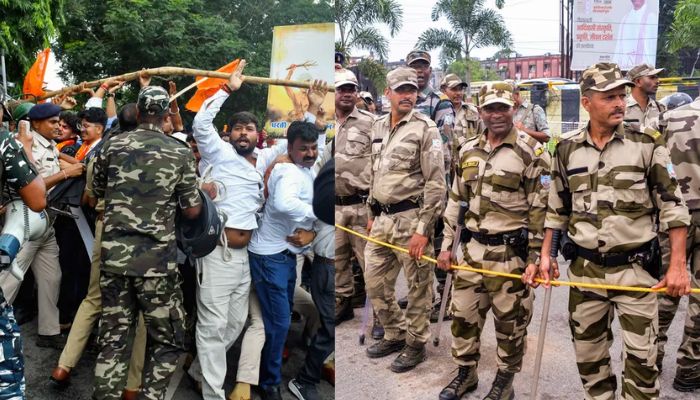
On Monday (11th May), West Bengal Chief Minister Suvendu Adhikari directed senior police officers to reopen cases of post-poll violence from the 2021 Vidhan Sabha election and the 2023 Panchayat election. The cases were previously closed by Mamata’s regime.

A police officer informed The Telegraph, “We were told to reopen all cases of violence reported after the elections of 2021 and 2023, which had been closed without any logical conclusion.”

The decision was taken during a meeting between the West Bengal Chief Minister and senior police officers, including the DIG, Additional Directors-General, Zonal Inspectors-General, Range Deputy Inspectors-General, Superintendents of Police, and others.

Decision 3: Ensuring justice for BJP workers killed by TMC goons

The new government is taking steps to fulfil the commitment it made to the families of 321 BJP workers, who were killed by Trinamool Congress (TMC) goons over the last 15 years.

While speaking about the matter, Suvendu Adhikari said, “Regarding the 321 individuals who lost their lives during our struggle: if their families desire, the government will initiate an investigation.”

Decision 4: Non-bailable cases against those involved in communal violence, police given free hand

According to journalist Kamalika Sengupta, Suvendu Adhikari has instructed the police to book criminals responsible for triggering communal violence in West Bengal under non-bailable offences.

Besides, the new Chief Minister has directed the police to function without fear and lodge cases against those involved in illegal activities. An official informed The Telegraph, “Political affiliations should not be considered. Assurance was given that this government would not be vindictive like the previous regime.”

Decision 5: Crackdown on cattle smuggling

The new BJP government in Bengal is taking steps to curb illegal cattle smuggling in the State, which has been a long-standing poll issue.

“Please ensure that there is no illegal transportation of cattle in the state. Proper checking should be done, and legal action should be initiated. Only legal and licensed cattle haats/markets will function. All illegal cattle haats be closed in your respective jurisdictions,” read a directive by Chief Secretary Dushyant Nariala.

Besides, the new government also directed action against illegal cattle markets that are operating in Dinajpur, Malda, Murshidabad, and North 24 Parganas districts.

Previously, Amit Shah had said that cattle smuggling would become impossible in India. On 8th May, he stated, “With the BJP governments in power in Assam, Tripura, and now in West Bengal, the borders will be secured, and cattle smuggling and infiltration would be impossible now in West Bengal.”

Decision 6: Crackdown on syndicates and illegal mining

The BJP government in Bengal has announced plans to curb ‘Syndicate Raj’ and illegal mining in the State. It was a pre-poll promise of the party.

According to reports, directives have been given to officials to destroy syndicate networks currently running at district and block levels by the TMC regime.

Undoubtedly, the Mamata regime allowed syndicates to thrive in multiple sectors. Many TMC leaders controlled the supply & distribution of materials.

Decision 7: BSF to get land for border fencing in 45 days

On Monday (11th May), Suvendu Adhikari announced that the government will hand over land to the Border Security Force (BSF) for fencing within 45 days. This marks a key step in preventing illegal immigration from Bangladesh and stopping further demographic change in Bengal.

Adhikari pointed out that the BSF would be given complete control of the land, which is required to fence the India-Bangladesh border.

“In our very first Cabinet meeting today, we have taken the decision to transfer the land to the BSF. The process begins today and will be completed within the next 45 days. Once this is accomplished, the BSF will complete the border fencing, and the issue of illegal infiltration will be resolved within a short period,” he told the media.

Decision 8: Removal of security cover of criminals

In a major development, the BJP government in Bengal directed the withdrawal of security cover of individuals with criminal antecedents. The inflated security cover of TMC leader Abhishek Banerjee will be reviewed after threat perception and his official position.

Decision 9: Rollout of central schemes

On Monday (11th May), Suvendu Adhikari informed that the central schemes, which the previous Mamata regime refused to implement in West Bengal, would officially be enforced now.

He announced the rollout of the Ayushman Bharat scheme and directed the Health Secretary and advisers to the CMO to complete the necessary agreement with the Union Health Ministry as soon as possible.

Other central schemes such as Beti Bachao Beti Padhao, Pradhan Mantri Jan Arogya Yojana, Pradhan Mantri Krishak Bima Yojana, PM SHRI, Vishwakarma Scheme, and Ujjwala Yojana will also be rolled out at the earliest. All DMs have been directed to expedite the implementation process.

Decision 10: BNS to be implemented

Suvendu Adhikari also announced the implementation of the Bharatiya Nyaya Sanhita (BNS), the new criminal code of India that replaced the colonial-era Indian Penal Code (IPC), in West Bengal.

It must be mentioned that Mamata’s regime delayed the adoption of the BNS by almost 2 years despite constitutional obligations.

Decision 11: TMC-appointed members removed from govt bodies

On Monday (11th May), the new BJP government in Bengal instructed all Departments to immediately end the services of TMC-appointed nominated members, directors, and Chairpersons of PSUs, Boards, organisations and non-statutory Boards under its control.

“The government has issued an order to take necessary action to immediately terminate the tenures of the nominated members, directors, or chairpersons of different boards, organisations, non-statutory bodies and public sector undertakings of the state government,” a senior official informed.

At the same time, the new government directed Departments to prevent re-employment and terminate the extension of tenures of officials beyond the age of 60 years.

Decision 12: IAS, IPS officers cleared for central training

Besides, Suvendu Adhikari also announced reforms in the State administrative services. IAS officers in West Bengal will henceforth participate in Central government training programmes, as is the case with other States.

“West Bengal government officials will participate in training programmes conducted by the Central government. The previous government had not allowed officials to participate in the scheme,” he emphasised.

Decision 13: Increasing the age limit for govt jobs

In a major relief to government job aspirants, the BJP government in West Bengal increased the upper age limit for applicants by 5 years (from 40 to 45). The move is expected to increase employment opportunities for the youth.

While speaking about the matter, Suvendu Adhikari said, “This five-year relaxation is our guarantee to those who were deprived of opportunities. Employment and transparent recruitment are our top priorities.”

He further added, “During the campaign, Union Home Minister Amit Shah had promised that the BJP would resolve the deadlock and provide opportunities to deprived candidates. Today, we have fulfilled that guarantee in our first hour.”

Decision 14: Carrying out the census

On Monday (11th May), Suvendu Adhikari informed that the Mamata regime failed to implement the census process, as directed by the Union Home Ministry in his directive dated 16th June 2025.

The new BJP government has enforced the administrative circular, which was deliberately kept pending for close to a year.

“A letter was sent by the ministry of home affairs on June 16, 2025, for carrying out the census as per the Government of India directive. The previous government kept sitting on the file; we are starting the census in West Bengal. This government does not function on ego; it functions on principles,” Suvendu Adhikari highlighted.

Conclusion

As the old proverb says, “Morning shows the day”, Suvendu Adhikari has clearly shown the people of Bengal that his intent is in the right place. Within just 2 days of assuming Office, he has announced 14 key decisions which will change the course of the State. The BJP leader has been elected for a period of 5 years by the people with a thumping majority. It is crystal clear that in the coming days, the new West Bengal CM will usher the State into an era of development and prosperity.

The Kolkata Trials: What Nuremberg-like trial against TMC and its masters would look like, the legal framework and the moral requirement

The night Kali danced

At midnight, she arrived. Thousands of people watched in quiet, broken only by tears, as she danced in the streets outside RG Kar Medical College in Kolkata while dressed in the resemblance of Maa Kali, the goddess of time, destruction, and righteous rage. The month was of August 2024. A few weeks prior, during a 36-hour shift, a 31-year-old doctor was raped and killed inside that hospital. She had gone to sleep in a room that was supposed to be safe. She never stepped out. That night, the woman who danced wasn’t giving a performance. She was delivering a verdict.

Witch you’ll be reduced to ashes. Your reign will end.

Through the streets, those words echoed. They were intended against a system that had determined, quietly and then openly, fifteen years ago, that certain lives in Bengal, specifically Hindu lives in Bengal, did not matter. That powerful men could exploit women as they pleased. That particular communities could be terrorised during election season while the police looked the other way because the police reported to the party, which had decided these people were not its people. Maa Kali performed a dance. Something, somehow, started to end.

What the Nuremberg Trials taught the world

The successful Allied powers accomplished something the world had never witnessed in October 1945 in the ruined city of Nuremberg. A government was placed on trial. Not only particular criminals. Not merely troops with triggers. The administrators who established the system, the ministers who signed the directives, and the bureaucrats who observed what was going on and decided to take part rather than decline all, were all put on trial.

Like all abusers of power, the Third Reich’s architects had thought that the truth would eventually be buried if they moved quickly enough, suppressed enough witnesses, and controlled enough institutions. Nuremberg proved otherwise. 

The Nuremberg Trials established a fundamental principle that should, ideally, never need to be reiterated, but it must be reiterated in every generation; that power does not equate to immunity, and accountability never ends. The portfolio of a minister does not shield you. The position of chief minister does not shield you. An election victory will not safeguard you. And an election loss does not absolve you. If you exploited the state’s apparatus to persecute, terrorise, rape, murder, or silence others, you will be held accountable. That answer may take years to come. But it arrives nonetheless.

Anywhere in the world, systematic, identity-based persecution takes place under the cover of a government which controls the police, the tribunals, and the narrative. Nuremberg’s lesson is applicable anywhere victims are intimidated and threatened, as the Hindu women of Sandeshkhali were, to keep quiet, to say that nothing happened, and attempts are made to systematically prove that they are lying. 

In the 2026 West Bengal Assembly election, Bengal witnessed the BJP secure an overwhelming majority with more than 200 seats, while the TMC, after fifteen years in power, was confined to about 80 seats. A democratic decision has been made. The balance of power has shifted. However, history reminds us that a democratic mandate does not deliver justice on its own. Power is transferred through elections, but it does not completely rejuvenate the dignity of victims who suffered because of it. Something more challenging is needed for that. 

For the first time, we are calling it ‘The Kolkata Trials.’ Not a catchphrase for politics. Not a call to action. Bengal owes its people a framework that is systematic, evidence-based, and ethical. Tailored for Bengal’s reality, based on the spirit of Nuremberg and posing the same queries as Nuremberg – Who issued the direction? The criminal was facilitated by whom? The witness was suppressed by whom? The state was weaponised by whom?

Fifteen years of the broken shield and a chronology of documented failure

In order to put an end to the bloodshed of Left Front government, the Trinamool Congress (TMC) was elected in 2011. Every billboard featured the term ‘paribortan,’ which means change. But nothing changed. The victims and targets of the violence were reorganised as a result. Partisan pamphlets were not used to compile the timeline that follows. It is derived from Supreme Court suo motu hearings, CBI charge sheets, NCRB reports, National Commission for Women findings, Calcutta High Court orders, and published news coverage from media sources, local and national. 

This, of course, is merely an indicative list. The atrocities are overwhelming. For example, during the 2021 post-poll violence itself, there are scores of cases that deserve individual attention, and there are several other instances of violence that haven’t been listed here for the sake of brevity. For example, the 2010 Deganga riots. It was a time when TMC was not in power in the state, but it won the seat in question. Its goons went on a rampage against the Hindus of the area and terrorised them for weeks. At the heart of the violence was a Hindu place of worship. What makes the case far more insidious is that the TMC leader, Haji Nurul Islam, who masterminded the violence against Hindus, was fielded again in 2024 by TMC. Given how TMC ruled on the basis of unbridled violence against Hindus and those who did not ideologically agree with them, it would not be a stretch to say that Nurul Islam had been rewarded for persecuting Hindus and the shocking violence his goons had unleashed. 

While we will be documenting the string of violence perpetrated by TMC over the years, the following list is merely a hint of the carnage unleashed by the criminal regime. 

Canning riots, 2013

In Canning, South 24 Parganas, violence between communities breaks out. Mobs target and destroy hundreds of Hindu owned businesses. Three years later, the cycle would repeat itself. Police complaints are made by families who had lost their means of living. The grievances were unanswered. The cycle of impunity, silence, and violence has already been formed.

Baduria-Basirhat riots, 2017

The location is North 24 Parganas, and families wake up to discover their homes on fire. Temples are vandalised. Under the TMC government, the 2017 violence in Baduria and Basirhat represented a significant communal flashpoint. The inability or unwillingness of the state machinery to defend its own inhabitants ultimately prompted the central government to deploy paramilitary forces. Hindu families had to flee their ancestral villages. They are informed, both informally and openly, that they are responsible for their situation.

Post poll massacre, 2021

This chapter is the darkest, most well-documented and irrefutable. Violence erupted around the state following the announcement of the 2021 West Bengal Legislative Assembly election results. According to the BJP, attacks by members of the ruling Trinamool Congress resulted in the deaths of at least six of its workers. TMC workers are accused of raping numerous women, including a little girl, because their families voted against them. The Supreme Court heard the story of a 60-year-old widow who was reportedly raped and her daughter-in-law physically assaulted by TMC workers.

Lynchings, crude bombings, and forced conversions were among the incidents that occurred between May and July of 2021. Families fled to Assam, homes were set on fire, and women were beaten. Victims claimed police had threatened them and refused to register complaints. In one known instance, Joy Prakash Yadav, a 28 year old BJP worker, was killed in a crude bombing in Bhatpara. One of the perpetrators was heard stating, ‘Forget police,’ prior to his murder. ‘You’re doing too much BJP.’ Forget the police. Just two words. Two phrases summed up the entire impunity architecture. Because they had spent years witnessing the authorities ignore them, these men had learned that they had nothing to fear from the law.

On July 2, 2021, TMC workers killed BJP worker Chandana Haldar in South 24 Parganas by beating her to death. According to her husband Gautam Haldar, they went to support a cousin who was being attacked. Together, they were attacked. His spouse passed away. 52 incidents of murder or unnatural death and 39 cases of rape and molestation were investigated by the CBI, which eventually filed 10 charge sheets for these crimes. At least 303 BJP workers who had left Bengal in 2021 had not yet returned home as of April 2022. 

Ram Navami clashes, 2023

Stone throwing and vandalism targeted Hindu religious processions in Howrah, Hooghly, and North Dinajpur. The trend of Hindu public religious expression being confronted with coordinated violence repeats again during the TMC years, which critics claimed demonstrated planned administrative indulgence rather than spontaneous communal violence.  

Sandeshkhali, 2024

Approximately 100 kilometres from Kolkata, Sandeshkhali is one of the Sundarbans’ thousand islands. It’s the type of village that doesn’t make headlines until something unusual occurs. An astonishing event took place. Officers from the Enforcement Directorate went to Sandeshkhali on January 5, 2024, to question Sheikh Shahjahan, the local TMC leader, about corruption. Three people were hurt when his followers attacked the ED officers. After that, Shahjahan ran away and was at large for 55 days.

The Sandeshkhali women started speaking throughout those fifty-five days. Their words were heartbreaking. Atrocities such as property confiscation, arbitrary imprisonment of male family members, and threats of future violence against women who dared to speak were documented by the National Commission for Women. On that tiny island, sexual assault, land grabs, and terror had become so prevalent that you had to live under them. State police stopped and returned opposition politicians who were trying to visit Sandeshkhali to meet victims. The case was brought before the Calcutta High Court. At first, the state government responded with denial, saying nothing took place, they’re lying, and the BJP is using them. The Sandeshkhali women were familiar with those words. They refused to back down.    

The RG Kar rape and murder, 2024

A 31-year-old postgraduate doctor working a 36-hour shift at RG Kar Medical College Hospital in Kolkata was brutally raped and murdered inside the hospital’s seminar room on August 9, 2024. She had endured all that the Indian medical system requires of its doctors, including years of laborious study, the rigorous nature of entrance exams, the hierarchy of hospitals, and the exhausting residency. She had decided to dedicate her life to curing people. She rested in a room that, in principle, was part of an institution that had pledged to protect her in its charter. She had been brutally raped before her murder, according to an autopsy. Additionally, it implied that she might have resisted the perpetrator and endured torture before being killed.

Unsatisfied with how the police handled the inquiry, the Calcutta High Court transferred the matter to the CBI on August 13, 2024. Additionally, they pointed out that if the state police carried out the inquiry, evidence might be destroyed. The matter was taken up suo motu by the Supreme Court on August 18. The three-judge panel slammed the college administration, the state government, and the Kolkata police for mishandling the case. The college principal, who had administrative protection and political connections, was fired. Then, to the surprise of even seasoned observers, he was temporarily reappointed to another esteemed institution. Outrage from the public compelled another change. The CBI later arrested him for financial irregularities and evidence tampering. 

Thousands of women from West Bengal marched on the streets at midnight on September 4th as part of the ‘Reclaim the Night‘ movement. In a nation where women are advised against leaving the house at night, it was a demonstration of rage and trauma, to reclaim spaces and streets that have been made unsafe for women for no fault of them.

The architecture of impunity

The Nuremberg prosecutors’ understanding that individual acts, no matter how horrible, remain individual crimes is what makes their work everlasting. The system that permits individual crimes is what turns them into crimes against humanity.

The system reveals the story itself.

This was how the system operated in Bengal. A man with ties to the TMC commits violent crimes against a woman, a political opponent and/or a Hindu family. The complaint is not registered by the state police, which answers to a home ministry under the control of the ruling party. If it registers it and moves at snail’s pace, or lodges a counter complaint against the victim after registering it. The accused man is still free, visible, and sometimes captured on camera at social gatherings. The victim receives the message, through the grinding silence of institutions that should have protected her, that ‘you do not matter enough for us to protect you.’

There is no guesswork here. It is the recorded ruling of multiple courts. It was said by the Calcutta High Court. It was said by the Supreme Court. Every time the CBI had to grab control of a case from state police, it was made clear by their investigation.

The extent and gravity of the incidents that occurred after 2021 prompted the Calcutta High Court to intervene and order investigations into several cases, raising serious questions about the state machinery’s capacity and willingness to guarantee citizens’ fair and equal protection. This statement, expressed in a court order, bears the significance of the entirety.  A court never uses words carelessly. When it refers to willingness, it means that this was a decision.

Impunity is a decision. Someone picked it somewhere. 

The legal architecture of The Kolkata Trials and can it be done?

A critic’s first query is always procedural: is it really possible to set up such a tribunal? If the Kolkata Trials are to have any significance, they cannot be a metaphor; hence, it is a reasonable question that requires a thoughtful response. There must be a way for them. This idea is not ruled out by the Indian Constitution’s framework. 

The Constitution’s Article 323-B specifically provides Parliament the authority to create tribunals to decide complaints and disputes pertaining to certain issues, amending that article and adding a further sub clause to include heinous crimes is what Parliament needs to do. 

Furthermore, the Supreme Court’s governing Articles (124 to 147) provide it an authority that most people never fully understand – the ability to form special benches, take suo motu cognisance of matters of serious public importance, and, most importantly, direct the establishment of investigative and quasi judicial structures when regular institutional mechanisms have clearly failed. This position of power has previously been exercised by the Supreme Court. The Special Investigation Team for the 2002 Gujarat riot cases was appointed using it. The anti-Sikh genocide investigations in 1984 made use of it. There is already a legal framework in place. 

Additionally, Parliament has an alternate path. In order to properly administer the legislation it has passed, Parliament may create more courts under Article 247. A Bengal Atrocities Tribunal with a defined jurisdiction could be established by a specific legislative act passed by a government with the mandate currently held nationally by the BJP. This tribunal would have the authority to look into, record, and prosecute acts of rape, violence, displacement, and institutional cover-up that occurred in West Bengal between 2011 and 2026. From the National Green Tribunal to the several commissions established under the Commissions of Inquiry Act of 1952, Indian legal history has established a pattern for time-bound, cause-specific tribunals.

Such a tribunal’s composition is just as important as its structure. It cannot be a political tool dressed in judicial garb, as it would make it identical to the exact system it aims to replace. A retired Supreme Court judge should serve as the tribunal’s presiding officer, with two retired High Court judges from states other than West Bengal on either side. This is a crucial safeguard because the Bengal judiciary has occasionally been seen as functioning under Nabanna’s long shadow. The women of Sandeshkhali and the families of the 2021 post-poll violence victims have already shown, at great personal cost, what happens when the state that is meant to protect witnesses is the same state that produced the accused. Therefore, it should include an independent prosecutor appointed through a transparent approach and a witness protection mechanism with real teeth.

Critics from any and all political camps have observed an increasingly frustrating pattern in Indian judicial activism; the court roars during public outcry and fades by the time the cameras leave. They need a tribunal with a defined mandate, a defined time frame, and the absolute support of both the executive and a Supreme Court order, a system that is immune to the whims of political weather and news cycles. Without that protection, the Kolkata Trials run the risk of turning into what far too many Indian commissions of inquiry have become: eloquently phrased written documents that collect dust in the hallways of establishments too complacent to take action on their contents.

It is worthwhile to draw one more parallel, which is the most structurally significant. Robert H. Jackson, an Associate Justice of the United States Supreme Court who left the bench to act as Chief Prosecutor, was the one who started the Nuremberg Trials, not a politician, a soldier, or a diplomat. Jackson felt that the finest practitioners of the law had an obligation to pursue justice in the arena, even in uncomfortable situations, rather than just interpreting it from a safe distance. He thought that in order to create a procedure that would withstand historical scrutiny, a judge who was knowledgeable about the fundamentals of the law was more qualified than a politician. 

What the Kolkata Trials must be

The term we’ve coined needs to be defined precisely because words overused become the very wrong they claim to resist.

The Kolkata trials are not revenge: The satisfaction of the wronged is what revenge is all about. Justice is about safeguarding the future. Even in their retrospective view, the Kolkata Trials must be forward-looking. Their goal is not to punish for the sake of punishing, but to prove, permanently and transparently, what happened and what accountability looks like when a state fails its people.

The Kolkata trials are not political persecution: Due process, legal counsel, and a case of innocence must be available to all accused individuals. It is imperative that the same institutions that were used as weapons during TMC administration not be used again under a different political banner. If that occurs, the Kolkata Trials should be criticised as just another chapter of impunity.

Who issued the directive prohibiting state police from assisting CBI investigations? Who made the decision to let a TMC leader who was charged with sexual assault be on the run for 55 days without an actual manhunt? When a college principal was being investigated for tampering with evidence in a rape murder case, who gave the go ahead for his administrative reappointment? These are the issues that extend beyond individual crime to what history refers to as complicity and what the law refers to as criminal conspiracy.

The Kolkata trials must begin with survivors: Not with the intentions of politicians and particularly with lawyers. It should start with Sandeshkhali’s women, the relatives of the 2021 deceased, and the parents of the RG Kar doctor. Their story is not evidence that can be manipulated. It serves as the cornerstone for any serious reckoning.

The democratic mandate and the moral mandate

In a state that had eluded it for decades, the Bharatiya Janata Party (BJP) won a majority on the day of the 2026 West Bengal Assembly Elections. After winning the elections in 2021, the TMC was reduced to about 80. A democratic decision of remarkable force resulted from fifteen years of dictatorship and fifteen years of the accumulated grievances detailed in this piece.

A political majority is not synonymous with justice. Power is transferred through elections. They do not, however, restore the dignity of people who suffered as a result of the transferred power. Something else is needed for it.

There will be a lot of pressure on Bengal’s new government to go forward and concentrate on infrastructure, development, the economy, and the future. These items are important. However, they cannot be constructed upon an unexamined past. A house that is constructed on unresolved grief will eventually crumble. Without a reckoning, the patterns that led to Sandeshkhali, RG Kar, and the 2021 post election violence will just wait for the next political storm to blow. This is why Bengal’s new chapter needs to start. Perhaps, it is this realisation that led to the newly sworn-in Chief Minister, Suvendu Adhikari, to order the re-opening of the 2021 post poll violence cases. While it is a welcome step, what is needed is a systematic approach to try TMC and its administrative system, including Mamata Banerjee and Abhishek Banerjee, for crimes against humanity itself. 

Vengeance is not the goal of the Kolkata Trials. They serve as a model for the only future worth constructing, one in which Bengali women know deep down that the state will be held accountable for its abandonment of them. One where a young, aspiring doctor can safely rest her head after a 36-hour shift and awaken to the profession she has chosen.

The goddess does not forget

She is not a soft deity, Maa Kali. She is shown wielding a sword and holding a decapitated head. On her husband’s, Lord Shiva’s, chest, she dances. She represents the end of things that have to end, the devastation that comes before creation, and the fire that needs to go out so the field may be replenished. She is the one who birthed Bengal. It is Bengal that reposed its faith in her, as their mother. That decision was wise.

The women who dressed like her outside RG Kar in August 2024 realised that time is on the side of the oppressed, something that the powerful inevitably forget. that each recorded act of violence adds to an existing debt. That the goddess, in which we include the essence, the past, and the combined voice of every woman who refused to remain silent, never forgets. She has patience, and she shows up eventually.

The Kolkata Trials will be an indication of her coming.  

Somnath was never just a temple: Meet the Acharyas and Kings who kept Shaivite civilisation alive after every invasion

Some places in India are far more than just religious sites. They become symbols of the country’s civilizational journey, cultural identity and spiritual continuity. The ancient Somnath temple at Prabhas Patan in Gujarat is one such place. For centuries, Somnath has stood not merely as a temple dedicated to Lord Shiva, but as a living symbol of faith, resistance, knowledge, devotion and cultural revival.

Recently, during the celebrations of the Somnath Pranpratishtha Amrit Mahotsav marking 75 years of the reconstruction of the temple in independent India, Prime Minister Narendra Modi spoke about the long and uninterrupted history of Somnath. He highlighted how saints, kings, scholars, warriors and devotees across different centuries protected and revived the temple whenever it faced destruction. His speech presented Somnath not only as a temple rebuilt many times, but as a continuing civilizational tradition that survived every challenge.

Somnath more than a temple

The story of Somnath is not limited to medieval invasions or political conflicts. Its roots go back to ancient India, when Prabhas emerged as an important centre of Shaivite philosophy and spiritual learning. Long before the attacks that later became famous in history books, Somnath had already developed into one of western India’s major centres of worship, penance and philosophical discussions.

Ancient sages and Acharyas transformed the region into a major centre of Shivaism. Over time, Somnath became connected with the Pashupata tradition, one of the oldest Shaivite sects in India. The temple complex was not just a place where devotees offered prayers. It also became a place where scholars debated philosophy, yogis practised penance, and spiritual teachers guided disciples.

This intellectual and spiritual atmosphere helped Somnath gain importance across India. Pilgrims, saints, traders and seekers travelled to Prabhas from different regions, turning it into a major cultural and spiritual hub.

Soma Sharma and the rise of Prabhas

Among the earliest names associated with the spiritual history of Somnath is Soma Sharma. According to Shaivite traditions, he is regarded as the 27th incarnation of Rudra and is remembered as one of the sages who laid the foundation of the Pashupata tradition at Prabhas.

Traditional narratives also mention that Soma Sharma established the earliest golden temple dedicated to Lord Shiva at Somnath. However, his importance goes far beyond temple construction. He played a major role in shaping the spiritual identity of Prabhas during a period when many religious traditions and schools of thought were developing in the Indian subcontinent.

The Shaivite philosophy, linked with Soma Sharma, later influenced western India deeply. Traditions connected to him also mention the “Som Siddhant,” which gave philosophical direction to Shaivite practices and spiritual discipline. Because of this, Prabhas gradually became known not just as a pilgrimage site but also as a centre of learning and meditation.

Lakulish and the Pashupata tradition

After Soma Sharma, one of the most important figures in the Shaivite history of western India was Lakulish. Born in Kayavarohan in present-day Gujarat, Lakulish is considered the 28th incarnation of Rudra and is regarded as the great teacher who gave organized form to the Pashupata sect.

The name Lakulish comes from the word “lakut,” meaning staff or rod. In sculptures and depictions, he is often shown seated in a yogic posture while holding a staff, symbolising penance, discipline and spiritual power.

According to tradition, Lakulish was born to Vishwaroop and Sudarshana. Several stories connected to his childhood and spiritual journey remain popular in Gujarat. Places like Kayavarohan, Devkhat Lake and Brahmashwar Shiva Temple continue to hold importance in his tradition.

Historians also find references to Lakulish through inscriptions. A Mathura inscription from around 380-381 AD mentions the tenth generation of his disciple Kusika. This has led many scholars to believe that Lakulish may have lived during the second century AD.

Lakulish’s teachings spread through his four major disciples: Kusika, Garga, Mitra and Kaurusha. Their followers carried the Pashupata tradition to different parts of western India. The Kausika branch became influential in Mewar, the Gargya branch in Gujarat, the Maitraka branch in Saurashtra and the Kaurusha branch in nearby regions.

Because of this expansion, places like Prabhas and Kayavarohan became major centres of Shaivite learning and worship.

Acharyas who kept the tradition alive

The growth of Somnath was not possible through royal support alone. Spiritual teachers and Pashupata Acharyas continuously strengthened the intellectual and religious traditions connected with the temple.

One such important figure mentioned by Prime Minister Modi was Bhava Brihaspati. Though not widely known among the general public today, he played a key role in establishing Somnath as both a centre of worship and a centre of knowledge.

In ancient India, temples often functioned like universities. Scholars discussed philosophy, grammar, scriptures, yoga and spiritual practices inside temple complexes. Somnath also followed this tradition. Teachers like Bhava Brihaspati ensured that the temple remained connected with learning and spiritual debate.

The Pashupata Acharyas were not just priests. They were philosophers, yogis, teachers and guides. Their presence ensured that Somnath remained spiritually alive even during politically difficult periods.

Royal patronage and ancient reconstruction

The continuity of Somnath was also protected by many rulers who supported the temple over centuries. One of the earliest rulers linked with its reconstruction was Chakravarti Maharaja Dharsen of the Maitraka dynasty.

His contribution is important because it shows that the history of Somnath is much older than medieval conflicts. During the Maitraka period, Valabhi became an important centre of education and culture in western India. Shaivite traditions also received royal support during this era.

Dharsen’s reconstruction helped restore the religious and cultural importance of Prabhas. In ancient India, temples were not only spiritual centres. They also supported trade, travel, education and social activities. Since Prabhas Patan was located close to important sea trade routes, Somnath gained influence far beyond Gujarat.

Mahmud Ghazni’s attack and the revival

One of the most discussed chapters in Somnath’s history is the attack by Mahmud of Ghazni in the 11th century. However, equally important is the story of how the temple and its traditions were revived afterwards.

After the destruction caused during Ghazni’s invasion, Gujarat faced a difficult political and religious situation. At that time, Solanki ruler Bhimdev I emerged as an important figure connected with the rebuilding and revival of Somnath.

Bhimdev I, was not only a political ruler but also someone who worked to preserve Gujarat’s cultural identity. Historical accounts mention that he supported reconstruction efforts and helped restore religious traditions linked to the temple.

The Solanki period later became one of Gujarat’s greatest cultural eras. Temple architecture, trade, water systems, sculpture and literature flourished during this time. Bhimdev’s role in reviving Somnath became part of that larger cultural renaissance.

The wider struggle against invasions

The history of Somnath is also connected with the larger resistance against invasions in northwestern India. Hindu Shahi rulers Jayapal and Anandpal are remembered for fighting Turkish and Ghaznavid forces for years.

Though they were not directly linked to the administration of Somnath, their battles represented a broader struggle to defend Indian kingdoms and traditions. Jayapal fought against Sabuktigin and later against Mahmud Ghazni. His son Anandpal continued that resistance.

Their inclusion in the larger narrative of Somnath shows that the temple’s story was not limited to Gujarat alone. Different rulers across the Indian subcontinent were fighting to protect political independence and cultural identity during that period.

Maharaja Bhoj and cultural pride

Another major ruler associated with Somnath’s revival is Maharaja Bhoj of Malwa. He is remembered not only as a powerful king but also as a scholar, poet, architect and patron of culture.

Historical traditions credit Bhoj with contributing to the rebuilding of Somnath. For rulers like him, temples represented much more than religious places. They symbolised the spiritual and cultural strength of a kingdom.

Bhoj’s support reflected the idea that preserving temples also meant preserving India’s knowledge traditions, arts and civilizational memory.

Solanki kings and Gujarat’s golden age

The Solanki dynasty played one of the biggest roles in keeping Somnath alive after repeated attacks and political turmoil.

Karnadev Solanki strengthened Gujarat politically and culturally during a time when the region was emerging as a major power in western India. Temple construction, urban development, water management and trade grew rapidly under the Solanki rule.

The Solankis saw temples as symbols of prosperity and pride. Their support helped restore Somnath’s position as a sacred and respected pilgrimage centre.

Later rulers like Siddharaj Jaisingh further expanded Gujarat’s cultural influence. Under him, educational institutions, lakes, temples and cities flourished. His reign is often described as one of Gujarat’s golden periods.

Siddharaj not only strengthened the kingdom militarily but also supported religious institutions that shaped Gujarat’s cultural identity. Somnath remained one of the most important symbols of that identity.

Kumarpal Solanki continued this tradition. Though often remembered for his association with Jain Acharya Hemchandra, Kumarpal also supported Shaivite traditions. During his period, temples, pilgrimage centres, and centres of learning received strong royal support.

Bhava Brihaspati is often mentioned alongside Kumarpal because of their shared role in strengthening Somnath’s religious and intellectual traditions.

Vaghela rulers and spiritual guardians

After the Solankis, the Vaghela dynasty emerged in Gujarat. Though the political situation became more difficult during this period, efforts to preserve Somnath’s traditions continued.

Visaldev Vaghela is remembered as one of the rulers who tried to protect Gujarat’s cultural and religious institutions. Prime Minister Modi also referred to Tripurantak, who is seen in Shaivite traditions as a protector of spiritual knowledge.

Their importance lies in the fact that Somnath survived not only because of military resistance, but also because people preserved its traditions, teachings and memories across generations.

Revival after Islamic invasions

Repeated invasions left Somnath damaged several times. There were periods when local devotees became afraid to openly visit the temple. Yet the tradition never completely disappeared.

The Chudasama rulers of Junagadh played a major role in reviving worship at Somnath during difficult times. Mahipal Chudasama and Ra’ Khengar are remembered for restoring religious practices and supporting temple traditions after destruction.

For these rulers, Somnath represented the pride and identity of Saurashtra. Even when political conditions were unstable, they ensured that worship and pilgrimage continued.

Ahilyabai Holkar’s contribution

Centuries later, Queen Ahilyabai Holkar emerged as one of the greatest patrons of Indian pilgrimage sites. Her name is associated with the restoration and revival of several major temples across India, including Kashi Vishwanath and Somnath.

At a time when many ancient pilgrimage centres were struggling because of political and economic instability, Ahilyabai worked to keep religious traditions alive. Her efforts helped ensure that Somnath remained connected with worship and devotion even during difficult periods.

The Gaekwads and Pilgrim Protection

The Gaekwad rulers of Baroda also contributed to protecting Somnath and supporting pilgrims. Though their role is not discussed as frequently, they helped preserve the pilgrimage tradition during a time when British influence was expanding in western India.

Maintaining old temple traditions during colonial rule was not always easy. Yet rulers like the Gaekwads helped ensure that Somnath continued to remain spiritually active.

Forgotten heroes of Somnath

The history of Somnath is not only about kings and saints. It is also about ordinary warriors and local heroes who sacrificed their lives for the temple.

Among the most remembered names in Saurashtra’s folk memory are Hamirji Gohil and Vegdaji Bhil. Stories about Hamirji are still sung in folk songs across the region. He is remembered as a young warrior who gave his life while defending Somnath.

Vegdaji Bhil is similarly remembered as a symbol of sacrifice and resistance. Their stories reflect how deeply Somnath was connected with the emotions and identity of local communities.

The modern reconstruction of Somnath

The modern chapter of Somnath began after India’s independence. Following the integration of Junagadh into India, Sardar Vallabhbhai Patel visited Prabhas Patan and declared that Somnath would be rebuilt.

This decision was seen not only as the reconstruction of a temple, but also as a symbol of cultural confidence in newly independent India.

K. M. Munshi played a major role in turning this vision into reality. Jam Saheb Digvijaysinhji of Nawanagar and many others also supported the reconstruction effort.

Finally, in 1951, the reconstructed temple was inaugurated in the presence of India’s first President, Rajendra Prasad. Despite opposition from Jawaharlal Nehru regarding the President’s participation, Rajendra Prasad attended the ceremony and described Somnath as a symbol of India’s cultural revival.

An unbroken civilizational journey

The story of Somnath stretches across centuries and connects sages, saints, rulers, warriors and ordinary devotees. From Soma Sharma and Lakulish to Bhava Brihaspati, from Bhimdev and Bhoj to Ahilyabai Holkar, from Hamirji Gohil to Sardar Patel, every generation added a chapter to the temple’s survival.

Somnath was attacked many times, but its traditions never disappeared. That continuity is what makes Somnath unique. The temple survived because it lived not only in stone structures, but also in the cultural memory of people.

Even today, Somnath stands as more than a pilgrimage site. It represents continuity, resilience and the civilizational confidence of India.

As West Bengal CM Suvendu Adhikari approves land handover to BSF for fencing along India-Bangladesh border, read how Mamata Banerjee had stonewalled the project under TMC regime

In the run-up to the West Bengal state assembly election, the Bhartiya Janata Party (BJP) repeatedly said that it is a civilisation battle for the party, particularly in the wake of the ongoing deliberate demographic shift. Just two days after being sworn in as West Bengal Chief Minister, Suvendu Adhikari chaired his first cabinet meeting and approved the transfer of land to the Border Security Force (BSF) for completing fencing along the India-Bangladesh border.

CM Adhikari announced on 11th May 2026, that the process of handing over the required land to BSF, with over 90% already identified, would be completed within 45 days. The BJP government in West Bengal aims to enable the BSF to erect fencing and secure vulnerable stretches presently exploited by Bangladeshi Muslim infiltrators.

The West Bengal Chief Minister said that border fencing is his government’s priority for national security to curb the illegal influx of Bangladeshis.

“In our very first Cabinet meeting today, we have taken the decision to transfer the land to the BSF. The process of transferring this land commences today. It will be transferred to the MHA within the next 45 days. Once this is accomplished, the BSF will complete the border fencing, and the ongoing issue of illegal infiltration will be resolved within a short period,” CM Adhikari said.

Bangladeshi infiltration, demographic challenge and the TMC regime’s deliberate obstacles in the completion of the India-Bangladesh border fencing project

The India-Bangladesh border, stretching over 2,200 km in West Bengal, is one of India’s most porous international boundaries. In total, Bangladesh shares 4096 kilometres of border with the Indian states of Assam, Meghalaya, Tripura, Mizoram and West Bengal.

Over the years, the Modi government has pushed for blanket barbed-wire fencing, floodlights, and BSF Border Outposts (BOPs) to tackle illegal infiltration, cattle smuggling, narcotics trafficking, fake currency, and other criminal activities.

For such projects, state governments are required to hand over the demanded land area while the Centre bears the cost. In West Bengal’s case, the Central government has already acquired or paid compensation for large tracts of land in around nine border districts. However, the erstwhile Mamata Banerjee-led regime caused frustrating delays in the handover of physical possession of the acquired land to the BSF, thus slowing down the border fencing project chronically over the years.

Consequently, massive stretches of land along the India-Bangladesh border remain unfenced despite budgetary allocations and the Centre’s appeals.

Over the decades, India has followed established protocols to deport Bangladeshi infiltrators and Rohingyas to their home country. The process, however, has been slow, often due to legal hurdles put up by Indian Islamo-leftists who approach courts to prevent deportation of illegal Muslim infiltrators, cumbersome due to the Bangladesh government and the Bangladesh Border Guard’s dishonest refusal to acknowledge their own citizens. As per a 2016 report, there are more than 2 crore Bangladeshis living illegally in India. The actual numbers are now estimated to be significantly higher than 2 crores.

In addition to Bangladesh’s refusal to accept its own citizens back, some state governments, particularly the TMC regime in West Bengal, have been non-cooperative in providing land for border fencing, despite its crucial role in deterring illegal entries.  This treacherous non-cooperation stemmed from the TMC government’s lethargic attitude in land acquisition to avoid displeasing the Muslim community, since the majority of the illegal immigrants are Muslims. OpIndia has documented numerous instances wherein Mamata Banerjee, who often boasted that she is not a Kafir, made policy decisions and gave speeches that indicated her pro-Muslim bias and anti-Hindu politics.

Last year, then Leader of Opposition (LoP), Suvendu Adhikari, had raised the issue of the ruling CM Mamata Banerjee-led TMC government’s reluctance to provide land for fencing 600 kilometres of area, which allowed several illegal immigrants to enter India. Adhikari said this while highlighting the case of 3 Rohingya women who were arrested at Sealdah railway station in Kolkata.

The Mamata Government continuously faced accusations of not cooperating with the Border Security Force (BSF) in curbing infiltration and transboundary crimes. In fact, the no-so-Kafir Mamata Banerjee’s obsessive electoral communal-political dynamics, and consequent delays in land acquisition, prevented completion of the border-fencing project.

It has been alleged that 569.254 km of the international border in West Bengal remains unsecured due to Mamata Banerjee’s intransigence, leaving the portion vulnerable to illegal infiltration and smuggling. It is due to the delays in acquiring the Centre-approved land areas by the TMC government that the BSF could not build essential border infrastructure like outposts and fences in over 17 critical locations. The West Bengal Police, under ex-CM Mamata Banerjee, also faced allegations of deliberate non-cooperation in the fight against transborder crimes and infiltration of Bangladeshi illegals.

Notably, there are three categories of land required for border fencing. First category: land areas acquired and compensation received by the state government from the central government, but only a partial portion of which is handed over to the BSF. The second category is wherein land acquisition proceedings started under the direct purchase policy but could not be finalised; thus, there is a status quo. Third is where the land acquisition process is yet to commence.

Besides causing delays in land handover, the Mamata Banerjee government also had a problem with the expansion of the BSF’s jurisdiction from 15 to 50 Kilometres.

While Mamata Banerjee kept denying the allegations of deliberate delays on her government’s part in the completion of the India-Bangladesh border fencing project, the Calcutta High Court rebuked the TMC regime over the same in April.

A bench comprising Chief Justice Sujoy Paul and Justice Partha Sarathi Sen reprimanded the Mamata government for failing to hand over land stretches across nine border districts on time to the BSF. The court also imposed a Rs 25,000 fine on the state government officer.

Alarmingly, the court found that out of 127.327 km of “lands already acquired” for which “compensation” had been “received by the state government from the central government”, only 8 km of land was handed over since 27 January.

“What is surprising and shocking is that in a matter of national importance, the respondent state has not thought it proper to file their report” on the compliance of its direction “on affidavit” but had instead filed a “sketchy and evasive report which does not disclose date and place-wise as to what action has been taken for handing over the land after passing the order of this court…” the court said.

The court further noted that out of 198.252 km of land stretches acquired for fencing, in the districts of 24 Parganas (N), Nadia, Murshidabad, Malda, Dakshin Dinajpur, Uttar Dinajpur, Darjeeling, Jalpaiguri, and Cooch Behar, only 70.925 km was handed over to the BSF.

The court’s observations came during the hearing of a PIL filed by former Deputy Chief of Army Staff Subrata Saha.

The delay in land handover was conspicuously deliberate, since Mamata Banerjee did not want to upset her Muslim votebank by expediting the process of border fencing that would obstruct the influx of Bangladeshi Muslims into West Bengal. The mutual admiration between Mamata Banerjee and Bangladeshi Muslims can also be understood from the fact that after TMC’s defeat, several Bangladeshi Islamists issued statements in support of Banerjee, with some, like Nurul Huda, even going to the extent of encouraging her to declare war on Delhi and join Bengal with Bangladesh. Apparently, the worst of the Bangladeshi Islamists admire and support Mamata Banerjee since she obstructed border fencing and allowed a political shield to Muslim infiltrators for electoral gains.

No wonder, Mamata Banerjee and Trinamool Congress vehemently opposed the Special Intensive Revision, alleging Muslim disenfranchisement and continue to blame it for their humiliating defeat against the BJP in state elections.

Somnath at 75: The temple that powered India’s maritime economy and global trade, defied invaders, and rebuilt Hindu civilisation

On 11 May 1951, independent India witnessed an event that went far beyond the reconstruction of a temple. What happened at Somnath Temple was the civilisational resurrection of a people who had endured centuries of invasions, iconoclasm and humiliation, yet refused to surrender their faith, memory or sacred geography.

That day, India’s first President, Shri Rajendra Prasad, stood before the rebuilt Somnath Temple and performed the Pran Pratishtha ceremony of the Jyotirlinga despite strong objections from the then Prime Minister Shri Jawaharlal Nehru.

Somnath was much more than just a temple. It was one of the most important civilisational and economic centres of medieval India. In fact, ancient India understood what modern geopolitical theorists would describe centuries later: control over coastal networks shaped the destiny of entire civilisations. And nowhere was that understanding more visible than at Somnath.

Located strategically at Prabhas Patan on the Saurashtra coast, Somnath stood at the intersection of spirituality, trade, finance and maritime connectivity. It was not simply a shrine visited by pilgrims. It was one of the gateways to India’s medieval maritime world.

When Mahmud of Ghazni invaded Somnath in 1026, the attack was not just an act of religious fanaticism; it was a strategic strike against one of the economic nerve centres of Hindu civilisation. As the western coast increasingly came under foreign domination, India’s maritime confidence weakened. Over time, oceanic travel itself began to be socially discouraged in some sections of society as ‘Kala Pani.’ What began as a strategic defeat slowly transformed into a psychological and social retreat from maritime life. By the time Vasco da Gama arrived in India in 1498, Indian maritime dominance had already weakened significantly. European powers entered not merely to trade but to dominate the seas.

What Ghazni began symbolically, colonial powers later completed economically. But when India became independent in 1947, there was hope, and the nation was watching. Would India reclaim its historical memory after centuries of invasions and colonialism? Or would it continue viewing Hindu heritage through the lens of secular discomfort?

While Sardar Vallabhbhai Patel resolved to rebuild Somnath, and Shri K. M. Munshi saw it as a civilisational recovery and a matter of national self-respect, Shri Jawaharlal Nehru viewed the reconstruction with disdain, terming it Hindu Revivalism. Despite the dichotomy of Nehru’s ‘secularism’, which viewed minority assertion as pluralism and Hindu civilisational recovery as ‘revivalism’, President Shri Rajendra Prasad did attend the consecration ceremony – one that had profound ramifications.

The reconstruction of Somnath sowed the seeds of India’s cultural renaissance after centuries of suppression. Today, that same spirit can be seen in the rejuvenation of Kashi Vishwanath Temple, the Mahakal corridor in Ujjain, the revival of Kedarnath, and the construction of the Ram Mandir in Ayodhya.

India is no longer treating its civilisation as something to apologise for. It is reclaiming it with dignity and confidence.

But this resurgence is not limited to temples alone.

Under PM Shri Narendra Modi’s vision of “Vikas Bhi, Virasat Bhi”, India’s recent Free Trade Agreements with developed economies are carrying Indian civilisational knowledge systems to the world in unprecedented ways.

The recently concluded FTA with New Zealand is not merely a trade agreement in the conventional sense. It creates opportunities for Ayush practitioners, Yoga instructors and Indian traditional knowledge professionals to work in New Zealand for extended durations, while formally creating an enabling environment for Ayurveda, Yoga and holistic healthcare rooted in India’s ancient traditions.

Similarly, trade agreements with the UK, the European Union and Australia are integrating India’s civilisational knowledge systems into global economic frameworks. Under the EU trade agreement, Ayush practitioners will be able to provide services using qualifications earned in India, while also facilitating the establishment of Ayurveda wellness centres and clinics across Europe.

This is a remarkable historical reversal.

For centuries, India’s sacred institutions and philosophical traditions were attacked, ridiculed or dismissed under colonial and foreign frameworks. Today, those very traditions are becoming instruments of India’s soft power, economic expansion and global influence.

Yoga has become a worldwide wellness movement. Ayurveda is emerging as a globally relevant healthcare system. Indian spiritual traditions are generating employment opportunities, trade partnerships and institutional collaborations across continents.

Today, 75 years after reconstruction, Somnath symbolises not merely remembrance, but revival.

Modern India’s growing focus on the Indo-Pacific, maritime infrastructure and naval power represents the return of an old civilisational instinct. India’s Indo-Pacific vision is not something entirely new. It is the continuation of a journey interrupted centuries ago.

The same Gujarat that once hosted Somnath’s maritime ecosystem now anchors India’s economic rise through ports like Mundra and Kandla.

India’s naval expansion, maritime corridors and strategic presence in the Indian Ocean reflect the revival of a civilisational memory that had weakened after centuries of invasions and colonialism.

Ports, logistics corridors, fisheries, marine industries and coastal infrastructure are once again becoming the engines of Gujarat’s economic rise.

In many ways, Gujarat is reconnecting with the same maritime instinct that once made Somnath flourish.

The Vibrant Gujarat Regional Conference held in Rajkot earlier this year focused heavily on the maritime economy, blue economy investments and sea-led growth. The conference saw MoUs worth nearly Rs 5.78 lakh crore across 5,492 projects.

The Kutch region alone attracted investment commitments worth Rs 1.25 lakh crore.

Major investments are flowing into ports, logistics, renewable energy, fisheries and maritime infrastructure.

The same Saurashtra-Kutch belt that once powered India’s maritime civilisation around Somnath is once again becoming the centre of India’s sea-led economic rise.

This is not accidental. Civilisations prosper when they reconnect with their foundational strengths.

Yet the lessons of Somnath are not confined to medieval invasions alone.

Even today, India remains the target of forces that seek to destabilise its cultural harmony and civilisational confidence through terrorism, infiltration and radicalism.

The methods may have changed, but the intent remains familiar.

The New India under PM Modi has increasingly signalled that such threats will no longer go unanswered. With Operation Sindoor, India delivered a strong response to terrorists and their sponsors across the border, reinforcing the message that repeated attacks on India’s sovereignty and civilisation would not be tolerated.

Significantly, the anniversaries of Operation Sindoor and the reconstruction of Somnath fall only days apart.

The parallel is difficult to ignore.

Both represent India’s refusal to surrender. Both represent resilience after an attack. Both represent a civilisation that absorbs blows, regroups and rises stronger.

Ahead of his visit to Somnath on the occasion of the 75th anniversary of the temple’s reconstruction, PM Modi captured this civilisational spirit perfectly when he wrote:

“Somnath gives us a civilisational message. The vast sea before it evokes timelessness. The waves tell us…that no matter how fierce the storms are or how turbulent the tides are, one can always rise again with dignity and strength. The waves return to the shore, as though reminding every generation that the spirit of the people can never be subdued for long.”

That is the true story of Somnath. Not merely that it was attacked numerous times by invaders. But that Hindu civilisation rebuilt it every single time.

Empires and invaders came believing they had buried Hindu civilisation forever. Yet today, those empires and invaders survive only in history books, albeit written by Marxist historians, while Somnath once again stands proudly on the coast of Saurashtra.

The temple still stands in all its glory. The traditions are still followed. The bells still ring. The saffron flag still flies over the Arabian Sea.

And just like the waves PM Modi described, Hindu civilisation too returned to the shore, again and again, undefeated.

This article was written by Union Minister Piyush Goyal on LinkedIn and has been republished here with due credit. The original article can be read here.

Inside The Timothy Initiative: Tracing the breadcrumbs of founder David Nelms’ visits to India and Christian conversion activities

On 18th and 19th April, the Enforcement Directorate (ED) conducted raids at several locations linked to the Christian missionary organisation named The Timothy Initiative (TTI). According to the investigation agency, in just six months, TTI used foreign bank debit cards across different states to withdraw Rs 95 crore. It included Rs 6.5 crore withdrawn in Naxal affected regions of Chhattisgarh. While doing so, TTI bypassed FCRA regulations. Notably, the organisation is not registered under FCRA, which means it cannot legally receive foreign funding.

Intially known as “Project India” as it started in India, the organisation has been active in India since 2007. But its history in the country dates back to 1992, when its founder, David Nelms, came to India with his associate and decided to plant churches in every village of the country. OpIndia is doing a series of reports on how TTI functions.

Source: TTI

During our research, we found that TTI not only has its own network in India and other countries, but also collaborates with other churches to push its agenda. In our previous report, we described how TTI’s manual guides church planters to enter Hindu dominated villages, approach Hindus, avoid suspicion and use caste leaders to push evangelism in the country.

In this report, we will trace the history of TTI’s origin and how it functions alongside other churches. The aim of TTI is to convert Hindus and members of other communities to Christianity and have at least one church in every village in the country. Following ED’s action, a lot of content has either been blocked in India or removed from social media platforms. However, there are still a lot of breadcrumbs that need to be followed and documented.

Documented earliest visit of David Nelms to India

In January 2023, a person named Dan Burrell, who himself is an evangelist, shared a post on social media platform Facebook about his visit to India in 1992 with David Nelms, founder of TTI.

Source: Facebook

In his post, he wrote that the 1992 trip to India and Thailand was a life changing mission trip. He clearly noted that for over 30 years, he and David have been in the business of religious conversions. There is a possibility that this was the visit mentioned on TTI’s website, where Nelms appeared to be “heartbroken” because there were only temples and mosques in India, and not churches. According to the website, that particular visit gave birth to the idea of TTI.

Source: TTI Global

This post is the oldest proof of David’s visit to India and his indulgence in conversion activities. The post contained a blurred image of both Dan and David, which we have enhanced using AI.

Person on the left is David Nelms, founder of TTI. Source: Facebook/Dan Burrell

Following the breadcrumbs left by TTI

As the documented history of the organisation on its website, which is blocked in India, suggests, it was founded in 2007. In 2009, a person named Tony Armour shared a video on Facebook where he had tagged David Nelms, and the location was set as Bengaluru, Karnataka. The video was titled “India 2009”. The first image that appeared in the video was of possible Indian church planters sitting happily with David Nelms for a group photograph.

Source: Screenshot from video shared by Evangelist Tony Armour who visited India with Nelms in 2009. (Image had been enhanced using AI)

In the video, Nelms and other foreigners were seen roaming around a suburban location, meeting vulnerable families and spending a lot of time with children. It appears that they used children to get comfortable with the families to push the conversion agenda.

Notably, towards the end, Tony Armour was seen with UB Bhat, an entrepreneur from Karnataka who was one of the victims of the IC814 Indian Airlines hijack. In one of the books, TTI asked church planters to use caste leaders to build a rapport with the locals so that they could be converted. It seems that they not only used caste leaders, but also prominent personalities, whether they were involved in conversions or not, to establish TTI’s reputation among Indians.

In 2013, David Nelms posted on Facebook that he would be in India from 11th to 18th September and invited people to come and see the work TTI had carried out in India, Nepal, and Pakistan.

Source: Facebook/David Nelms

In July 2016, David posted on Facebook that he was headed towards India.

Source: Facebook/David Nelms

In January 2017, David posted a photograph on Facebook with the caption, “Having fun with my Punjabi peeps!” Notably, Punjab is among the states most affected by Christian missionary activity. Lakhs of Hindus and Sikhs have converted to Christianity over the years in Punjab.

Source: Facebook/David Nelms

In February 2017, David Nelms posted on Facebook that he had returned to the US, adding that “India/Nepal were both a blast”, indicating that he had visited both India and Nepal.

Source: Facebook/David Nelms

David’s son, Jared Nelms, is currently serving as president of TTI. In the same year, TTI posted about him on LinkedIn. The post mentioned that Jared and his wife, Amber, served as missionaries in India for almost five years. Notably, the post suggested that Jared possibly lived in India for five years to push the church planting agenda. It is unclear whether the stay was continuous, or whether he and his family came to India multiple times during that period.

Source: TTI’s LinkedIn Profile

What David Nelms has left in the public domain about his visits to India is actually very limited. What remains today is mostly a few Facebook posts, an old tagged video, and references that can be pieced together only after careful tracking. This is especially important because much of TTI’s online material has either been blocked in India or removed from public platforms. So while the available record is small, it is still enough to establish that India was not a one off stop for Nelms, but a repeated and important part of TTI’s activity.

Even from these scattered details, one thing becomes clear. David Nelms visited India multiple times over the years, and his son Jared Nelms appears to have had an even deeper presence here. TTI itself said that Jared and his wife Amber served as missionaries in India for almost five years. Whether that stay was continuous or spread across multiple visits is not fully clear, but it strongly suggests that the Nelms family was not engaging with India through brief tours alone, but through longer stays linked to missionary work.

This becomes even more serious when seen alongside TTI’s own claims. In its “Kingdom Impact” material, it says it has planted over 2,68,750 churches across 50 countries since 2007, including India, and converted 23,92,427 people to Christianity, including 2,01,954 widows and orphans. In the next report, we will trace how churches have collaborated with TTI over the years in India, or in efforts directed at India.

PM Modi asks Indians not to buy gold for a year: Read how gold imports burden economy, cause massive Forex outflow and widen trade deficit

On 10th April (Sunday), Prime Minister Narendra Modi urged for the conservation of foreign exchange reserves amid the crisis in West Asia. He asked people to promote domestic travel rather than unnecessary international travel, foreign weddings and vacations. He also requested Indians to refrain from buying non-essential gold for a year to lessen the strain on foreign exchange outflows.

“Gold purchases are another area where foreign exchange is used extensively. In the national interest, we must resolve not to purchase gold for a year,” PM Modi conveyed while addressing a Bharatiya Janata Party (BJP) rally in Hyderabad.

Gold is usually considered as a “safe haven” asset amid geopolitical turmoils. Hence, investors flock to acquire it in times of dispute or unpredictability. However, rising crude oil prices are also fuelling concerns about protracted inflation and soaring interest rates across the globe. Hence, the matter has turned out to be more complicated.

How West Asia war impacted the economy and Gold investment

Oil prices have jumped again as worries about disruptions in the Strait of Hormuz intensified following President Donald Trump’s rejection of Iran’s recent peace proposal. Global inflation risks are boosted by rising oil costs, which led central banks such as the US Federal Reserve to maintain higher interest rates for longer. This consequently has an adverse effect on gold since it doesn’t provide yield or interest. Investors frequently favour interest-bearing assets, including bonds and fixed-income instruments over bullion when interest rates remain substantial.

On the other hand, India is one of the biggest importers of gold in the world and procurement increases dramatically during holidays and the marriage season. The country pays for the majority of its gold imports using foreign currency, because domestic gold production is minimal and the growing global gold prices put an additional financial strain on its coffers. An uptick during a time of excessive crude prices exacerbates the trade gap and imposes greater pressure on the rupee and foreign exchange stock. The higher consumption causes a dollar drain and expands the nation’s import bill.

Moreover, global gold prices have been volatile due to the consistent fight between Iran and the United States, with bullion markets responding dramatically to each provocation and setback in the ceasefire. Therefore, the appeal made by PM Modi is a proactive move to strengthen the finances by shaping the spending habits of people.

This is important since India’s enormous yearly demand for gold is largely met by supplies from abroad. The action is linked to the mounting economic difficulties triggered by the elevated cost of energy and tensions in the Middle East.

The accelerating impact on vulnerable foreign reserves

India’s foreign exchange reserves are squeezed by its hefty gold shipments which account for about 9% of its entire import bill and are second only to crude oil. The projected value of these imports in FY26 was $72 billion. The matter has been made worse by the ongoing strife which has pushed up costs of fundamental goods like fertiliser and oil.

The current account deficit swelled as a consequence of these pressures, reaching $13.17 billion in Q4 2025. Thus, India’s foreign currency reserves slipped from a peak of $728.49 billion in February 2026 to roughly $690.69 billion by early May 2026. According to International Monetary Fund (IMF) projections, the country’s current account deficit could touch $84.5 billion in 2026 or around 2% of GDP.

It is continually widening, which shows that more money is leaving India than entering it. Meanwhile, India imported over $72 billion worth of gold in FY26, a 24% boost over the earlier year.

Representational Graph via AI

The four items (crude oil, gold, vegetable oils and fertilisers) depicted in the graph account for 31.1% of all imports into India. Gold alone contributes to over 10% of the entire import budget. Hence, the prime minister’s suggestion to cut back on gold purchases is a direct means of reducing foreign exchange expenditures and safeguarding these key reserves.

The interest of Indians in gold investments poses a serious challenge during critical times

The fact that gold has transformed into more than just a cultural commodity associated with festivals and weddings in India further emphasises the prime minister’s statement. For the first time in history, Indians are obtaining more gold for investments than jewellery in 2026. Gold is rapidly being employed as a financial hedge against uncertainties.

The World Gold Council (WGC) released data last month that revealed a major shift in the gold market in India. In the March quarter, investment demand for gold increased 54% year over year to 82 tonnes, surpassing demand for jewellery, which decreased by almost 20% to 66 tonnes. Despite record-high prices, the overall demand for gold climbed by 10%.

Representational Graph via AI

Inflows into gold exchange-traded funds rose by 186% during the March quarter as shares reached all-time highs. In India’s contemporary gold market, transactions of bars and coins almost equalled the demand for jewellery. This pattern presents a massive challenge during critical periods which already witness astronomical oil prices.

The large volume of gold imports necessary to meet domestic local demand becomes especially troublesome as it widens the trade deficit and weakens the currency. Thus, the timing of PM Modi’s remark is vital. The West Asia conflict is already hurting global supply chains and energy imports are going to be more and more expensive.

The nation is specifically susceptible to shocks from the outside because it imports around 90% of its crude oil needs. Foreign exchange reserves find themselves under double constraint when heavy gold imports are introduced in this scenario. Crude oil, gas, edible oil and fertilisers are all ‘necessary’ commodities, but gold is not. Its value lies in socio-cultural and aesthetic needs, not ‘necessity’.

Strong demand, negligible production and a recent downturn

India absorbs 700-800 tonnes of gold annually due to its profound cultural traditions, celebrations, nuptials and application as a store of value. The nation’s meagre domestic production, roughly 1-2 tonnes per year, is far less than this requirement. India is the largest importer of the precious metal, second only to China since it imports more than 90% of its gold needs.

Image via World Gold Council/Voronoi

New Delhi bought $51.8 billion worth of gold in 2024, making it the fifth-largest importer in the world by value. During the previous fiscal year, India imported almost 60 tonnes of gold per month with a monthly average of about $6 billion. However, imports plummeted from around 100 tonnes in January to roughly 65-66 tonnes in February, then to 20-22 tonnes in March.

According to reports, imports were only 15 tonnes roughly $1.3 billion in April, offering further short-term respite for policymakers trying to mitigate stress from the external sector. It is among the lowest monthly levels recorded in decades outside of the Covid pandemic.

PM Modi’s plea alongside notable administrative and tax issues are considered responsible for this precipitous decline. Major banks have also halted shipments owing to multiple factors. The India International Bullion Exchange (IIBX) continues to receive some gold, but it takes longer and costs more money. India’s gold prices are higher than those throughout the world due to this shortage.

The influence on gold prices subsequent to PM Modi’s appeal

Stock prices for prominent jewellers fell dramatically following PM Modi’s recommendation. The price of 24 carat gold has come down by ₹603.0 to ₹15192.0 per gram. The value of 22 carat gold has sunk by ₹552.35 to ₹13915.872 per gram, while the price of 24 carat gold has moved by -1.84% over the last week and by 0.13% over the past month. Nevertheless, it is not feasible to predict how long this trend will hold in the future.

It is noteworthy that India has made multiple attempts in the past to reduce gold imports through increased import taxes, limitations and gold monetisation programs. However, demand has stayed robust because gold is not considered as a luxury product and serves as a blend of financial insurance, security and savings. Consequently, the World Gold Council has forecasted that investment demand will persist to be sturdy in the upcoming quarters.

The analysts expressed that it is unclear how successful PM Modi’s request will be in the long run even though the temporary import ban would improve India’s trade balance. The government’s actions have demonstrated a constant focus on managing import costs and safeguarding foreign exchange reserves. However, the situation is probably going to remain dynamic as government attempt to strike a balance between gold consumption and economic stability.

India’s first mini-micro LED display unit to be set up in Gujarat’s Dholera: Read about this advanced technology and ways it can make Bharat ‘Atmanirbhar’

As the global race for advanced technology accelerates, India has been trying to strengthen its position on the global map of advanced technology, not just as a manufacturing hub, for the last few years. From semiconductors to artificial intelligence (AI) and electronics manufacturing, India is now also moving ahead rapidly in the technological competition going on around the world, and Gujarat is now emerging as an important centre in this journey. In a major development, India’s first mini/micro LED display fabrication unit will now be set up in Dholera, Ahmedabad, after receiving approval from the Central government under the India Semiconductor Mission.

The project will be developed by Crystal Matrix Limited with an investment of nearly ₹3,068 crore. The Company will set up a Gallium Nitride (GaN) based mini/micro-LED display fabrication facility in Dholera. Until now, India has not manufactured such advanced display technologies domestically and has mostly depended on imports from countries like China, South Korea and Taiwan. Now, for the first time, India is moving towards developing such technology domestically. 

What is mini-micro LED technology?

Display technology has become extremely important in today’s world of smartphones, smartwatches, premium televisions, EVs and AR/VR devices. The brighter, more energy-efficient and thinner the screen, the better the user experience is considered. Mini and Micro LED technology is seen as the next generation of display technology. 

Currently, most devices around the world use LCD or OLED screens, but mini/micro LED displays offer higher brightness, greater contrast, lower power consumption, and longer life-cycle. Micro-LED technology in particular is considered extremely important for future devices, as it is ideal for foldable displays, automotive dashboards, augmented reality glasses, and ultra-premium televisions.

In simple terms, till now, India has been a country that mostly buys such screens. Now, this facility to be set up in Dholera can become a major link that takes India from a ‘consumer’ to a ‘producer’.

What is gallium nitride (GaN) and why is it becoming increasingly important?

A key part of this entire project is gallium nitride (GaN) technology. While silicon-based technology is typically used in semiconductor manufacturing, GaN is seen as a next-generation high-performance semiconductor material.

GaN allows faster power transfer, generates less heat and is far more energy-efficient than traditional silicon-based systems. Because of these advantages, its use is rapidly increasing not only in display technology but also in electric vehicles, defence electronics, 5G infrastructure and advanced communication systems.

This means the Dholera project is not just about manufacturing screens. It is also being viewed as India’s entry into the larger compound semiconductor ecosystem, which is expected to play a major role in future global technologies.

According to PIB, the facility will not only manufacture mini and micro LED display modules but will also provide GaN foundry services. Advanced processes like epitaxy on 6-inch wafers will also be carried out at the plant.

A major step towards reducing dependence on China-Taiwan

The world has seen the importance of the semiconductor supply chain closely over the past few years. The Covid-19 pandemic, the US-China trade tensions and rising geopolitical concerns surrounding Taiwan exposed the risks of depending too heavily on a few countries for semiconductors and advanced electronics.

For India, this became an important strategic issue. From smartphones and automobiles to defence systems and communication networks, semiconductors are now essential for almost every major industry.

The mini/micro LED fab unit to be set up in Dholera is being considered as part of the same larger strategy. It simply means that India no longer wants to be just an electronics assembly country, but is also moving towards manufacturing the basic components of future technologies within the country.

What does it have to do with the life of a common man?

Terms like semiconductor or display fabrication often sound highly technical to the average reader, but in reality, this technology is directly related to everyday life. The advanced displays that will be seen in smartphones, smart TVs, electric vehicles, wearable devices and AR/VR products in the coming times are now being prepared to be made in India.

According to the details released by the government, this facility in Dholera will be able to produce 72,000 square meters of mini/micro LED display panels and 24,000 sets of RGB wafers per year. So this is not just a factory, but an industrial capacity that can give India a stronger position in the consumer electronics economy of the next decade. Along with this, thousands of high-tech jobs will be created, and local youth will get new opportunities in the manufacturing sector.

Acceleration for ‘Self-reliant India’

In recent years, slogans like “Make in India” and “Atmanirbhar Bharat” have been repeatedly promoted by the government. But this project in Dholera shows that this vision is now visible on the ground too. Because self-reliance does not come from just assembling imported products, it comes when a country builds its own manufacturing capacity in core technologies.

The Mini/Micro LED Fab Unit at Dholera is an important step in the same direction. This project can give India a new identity in the field of future display technology, compound semiconductors and advanced electronics manufacturing.

For a long time, such advanced technologies were largely associated with countries like the United States, Taiwan, South Korea and China. India is now trying to enter that same global race, and the Dholera project may become one of the clearest symbols of that technological shift.

(This article is a translation of the original article published at OpIndia Gujarati.)

From restoring schools to reopening temples and shops: How the BJP is reclaiming Bengal from TMC’s ‘Jungle Raj’ after its landslide victory in the state 

In a historic political shift in West Bengal, BJP leader Suvendu Adhikari took oath as the ninth Chief Minister of the state on Saturday, 9th May, becoming the first Chief Minister from the Bharatiya Janata Party in Bengal’s history. The grand oath-taking ceremony was held at Brigade Parade Ground and witnessed massive crowds, political leaders and supporters gathering to mark the beginning of a new political chapter in the state after more than 15 years of Trinamool Congress rule.

The BJP had secured a massive and historic victory in the Assembly elections on 4th May. Out of 293 constituencies, the BJP won 206 seats, while the All India Trinamool Congress (AITC) was reduced to just 81 seats. One of the biggest political shocks came from Bhabanipur, where former Chief Minister Mamata Banerjee lost her seat. Just a decade ago, such a political outcome would have seemed impossible in Bengal.

The BJP’s rise in Bengal has been long and gradual. From having zero seats in 2011 to now forming the government in 2026, the party spent years building its organisation at the grassroots level. BJP leaders and workers repeatedly claimed that the people of Bengal were frustrated with the “jungle raj” of the TMC government. 

Now, just days after coming to power, the BJP has begun the process of reclaiming Bengal, from reopening schools and temples to restoring shops and livelihoods taken over by the TMC govt led by Mamata Banerjee.

Reopening of schools in remote villages

The first signs of this reclamation emerged from the remote villages of the state. One of the first such developments after the change in government came from Jharkhali in South 24 Parganas district, where the Aranyaj School, under illegal occupation of local TMC leaders for nearly two years, was finally reopened. Videos from the village showed children and residents unlocking the gates of the school and celebrating its reopening.

The school had originally been started in 2023 by social worker Amrita Bose Gupta as a free English-medium school for poor children. It also worked on women’s empowerment projects. However, according to the school administration, local TMC-linked groups took over the property in July 2024. Since then, the school building reportedly remained shut, depriving children in the area of education.

According to the FIR filed by Amrita Bose Gupta, the attack on the school in 2024 was brutal. She said that TMC goons led by Bishnupur TMC MLA, Dilip Mondal,  entered the campus early in the morning, cut electricity and CCTV wires, dragged people out of their rooms and assaulted women and elderly family members. She also claimed that her young son was attacked and her mother was beaten unconscious while trying to save him.

While talking to OpIndia, the school administration said that books, computers, solar panels, furniture, hostel items and even women’s sanitary napkin production machines were looted. Cash, food grains, uniforms and other materials were also stolen. Despite FIRs and chargesheets, locals claimed that no strong action was taken during the TMC government because the accused enjoyed political protection.

The atmosphere changed after the BJP’s victory. Videos now show villagers cleaning the school premises, hoisting the national flag and preparing to restart classes. Speaking about the reopening, Amrita Bose Gupta said that for the past month she and her team had been receiving death threats but continued campaigning for political change. She said the BJP victory gave them courage to finally reopen the school.

Another similar incident emerged from the Majhipara locality of North 24 Parganas district. Viral videos showed BJP workers breaking the locks of a school building which locals confirmed that it had been converted into a TMC party office and a centre for illegal activities. BJP workers were seen asking children to return to school and assuring villagers that they no longer needed to fear “TMC goons”.

For many BJP supporters, these reopenings are being projected not just as administrative action, but as a symbolic reclaiming of education spaces that they had become victims of political control.

Restoration of puja at temples

The BJP’s reclamation efforts have also extended to the religious and cultural heart of Bengal. In a viral incident from Rampurhat in Birbhum district, BJP leaders reopened the Bhog room of the Sri Sri Radha Govinda Temple, which locals said had been occupied for years and converted into a TMC party office.

Video shared by Banglar Barta Digital News showed BJP workers breaking open locks and removing chairs and banners linked to TMC activities from the temple premises. According to locals, the Bhog room, where prasad for Lord Jagannath used to be prepared, had stopped functioning as a religious space years ago.

Another major moment came from Asansol, where a Durga temple that had remained closed for years reopened soon after the BJP’s victory became clear. BJP MLA Krishnendu Mukherjee had promised before the elections that if elected, he would ensure the reopening of the temple.

On 4th May, after the BJP secured its landslide victory, Mukherjee personally visited the temple, unlocked the gates and performed puja. The temple, maintained by the Sri Sri Durga Mata Charitable Trust, had reportedly remained closed for years due to disputes and administrative restrictions, except during Durga Puja and Lakshmi Puja.

As soon as the gates reopened, large crowds gathered at the temple. BJP supporters celebrated the moment as a sign of political and cultural change in Bengal. For many locals, the reopening was not just about a temple, but about restoring religious spaces that they felt had been neglected or politically controlled during the TMC government.

Social Justice: Returning livelihoods and dignity 

The TMC’s ‘Jungle Raj’ was not limited to the possession of public buildings; it even struck at the very survival of the common man. Across Bengal, stories are emerging of shops and small businesses that were forcibly snatched from those who refused to toe the party line. The BJP has now begun a process of “Social Justice” by returning these livelihoods to the public. 

One such case came from Purba Bardhaman district, where BJP workers helped reopen the shop of former BJP mandal president Binod Patel. According to local reports, the shop had been shut down by former TMC MLA Khokan Das after Patel refused to join the TMC following the 2021 elections.

After reopening the shop, Patel said that the BJP government would ensure that no one in Bengal suffers such political harassment again. Videos from the area showed BJP supporters celebrating the reopening as a moment of justice.

Another emotional case came from Koyra Kadamgachi station area in North 24 Parganas district. According to viral videos circulating online, a BJP worker’s shop had been forcibly taken over by TMC-linked miscreants during the lockdown period and converted into a liquor shop. The BJP worker later passed away, but after the BJP came to power, party workers returned the shop to his family.

In the video, the late worker’s wife, Rina Barui, explained how local TMC workers occupied the shop and kept delaying its return. She said her family repeatedly requested the return of the property, but were told to first support and vote for the TMC. Even after elections, the shop was not returned.

Rina Barui said, “Once the business started doing well, they set their sights on it.” She thanked BJP leader Sajal Ghosh and party workers for finally restoring the shop to her family. The video has now become symbolic for BJP supporters, who say it reflects the suffering faced by many party workers during the previous government.

These incidents are only the beginning of a larger process of reclaiming Bengal from years of fear, political violence and illegal occupation. The new administration faces a mountain of challenges, from recovering stolen school equipment to ensuring that the culprits who enjoyed political protection for fifteen years are finally brought to book. 

From daily riots under SP rule to zero kidnapping-for-ransom cases: How Yogi govt transformed UP’s law and order landscape

Over the past nine years, the law and order situation in Uttar Pradesh has seen a major transformation. The Yogi Adityanath government’s zero-tolerance policy has made the state riot-free, completely curbing incidents like kidnapping for ransom. The state, which was known as the “riot state” before 2017, has now become an example of peace and security.

On average, 19 riots and 33 kidnappings took place every day under the SP government.

During the SP government, between 2012 and 2017, questions were raised about law and order in the state. According to the NCRB report, on average, approximately 19 riots and 33 kidnappings occurred daily. During this period, more than 25,000 riots occurred, severely damaging the state’s image. Both businessmen and ordinary citizens lived under the threat of extortion.

Yogi government adopted a zero-tolerance policy

After coming to power in 2017, Chief Minister Yogi Adityanath announced a strict “zero tolerance” approach towards crime and criminals. Under its zero-tolerance policy, measures such as proactive policing, the use of the Gangster Act, and the confiscation of mafia properties were implemented. As a result, Uttar Pradesh has not seen a single riot in the last nine years. Certain anti-social elements attempted to incite riots, but the government thwarted those plans by taking timely, strict action.

Before minor incidents escalated into violence, reports were filed under anti-riot laws and unruly elements were put behind bars. Chief Minister Yogi Adityanath has clearly stated on public platforms, “No curfew, no danga, UP mein sab changa.” This policy has established an atmosphere of peace throughout the state.

NCRB report confirms the claims

The NCRB’s 2024 report confirms this change in the state. According to the report, Uttar Pradesh recorded a zero crime rate for kidnapping for ransom. This rate remained zero in 2023 as well. Compared to other states in the country, Uttar Pradesh is in the best position in this regard. As per the data, states like Nagaland recorded a kidnapping-for-ransom crime rate of 0.7, Manipur 0.6, Arunachal Pradesh 0.3 and Meghalaya 0.2, while Uttar Pradesh remained at zero.

There has been no kidnapping for ransom in the state for two years (2023-2024). While businessmen were often abducted and ransomed, such incidents have now completely ceased. The NCRB report clearly states that during the Samajwadi Party (SP) regime, 33 kidnappings were reported daily, but under the Yogi government, this figure has reached zero.

The Yogi government’s record on the crime rate of riots is also noteworthy. According to NCRB data, Uttar Pradesh recorded a riot crime rate of 1.1 in 2024, which is lower than the national average of 2.2. The report mentions that the 1.1 figure in Uttar Pradesh mainly includes cases where attempts to incite violence were quickly controlled, and legal action was taken before situations worsened. This rate was 8.4 in Manipur, 6.4 in Maharashtra, 5.4 in Karnataka, 5.3 in Haryana and 4.7 in Himachal Pradesh.

Yogi government changed the picture of UP

This positive change is the result of the Yogi government’s zero-tolerance policy against crime and criminals, proactive policing, and consistent action against organised crime. By enforcing the Gangster Act, the police have broken the financial backbone of the mafia and seized their assets. The impact of these steps is clearly visible on the ground.

Uttar Pradesh is now not only riot-free but also outperforms the national average in other crime categories. Compared to the time of the Samajwadi Party government, Uttar Pradesh’s image has completely changed. Where riots and kidnappings were common, today a story of peace and development is being written.

The government believes that strict law and order are the foundation of development. These measures, taken under Yogi Adityanath’s leadership, have not only deterred criminals but also increased the sense of security among ordinary citizens. The latest NCRB report bears testimony to this truth.

In this way, the Yogi government has proven that a zero-tolerance policy, combined with the right balance of strictness and sensitivity, can pave the way for a crime-free society. Uttar Pradesh has now become an example for the entire country.

(This article is a translation of the original article published at OpIndia Hindi.)