The Pakistani Higher Education Commission rescinded its divisive ruling on Thursday, June 22, one day after it forbade Holi festivities in all educational institutions nationwide. On Wednesday, the HEC prohibited Holi celebrations at all colleges and universities in Pakistan, asserting that the celebration was responsible for the “erosion of the nation’s Islamic identity.”
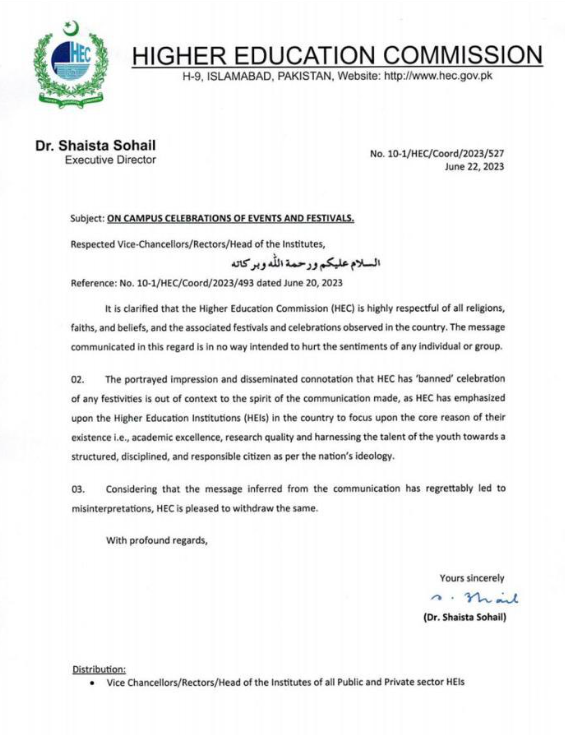
“It is clarified that the Higher Education Commission (HEC) is highly respectful of all religions, faiths, and beliefs, and the associated festivals and celebrations observed in the country. The message communicated in this regard is in no way intended to hurt the sentiments of any individual or group,” the HEC said today in the clarification notice.
Withdrawal notice by HEC Pakistan
“The portrayed impression and disseminated connotation that HEC has ‘banned’ celebration of any festivities is out of context to the spirit of the communication made, as HEC has emphasised upon the Higher Education Institutions (HEls) in the country to focus upon the core reason of their existence i.e., academic excellence, research quality and harnessing the talent of the youth towards a structured, disciplined, and responsible citizen as per the nation’s ideology,” the statement added.
In a statement, the HEC further said that its prior notice prohibiting Holi festivities in universities had been “taken out of context” and that it was “pleased to withdraw” the notification because it had unintentionally led to misinterpretation of its intended message.
The HEC had issued the notice after students of Quaid-i-Azam University were seen celebrating Holi on the campus, and videos of the event had gone viral. According to the reports, the event was held by the Mehran Students’ Council, a non-political cultural organisation of the university.
The HEC on Wednesday issued a notice stating that activities such as the celebration of Holi portray a complete disconnect from Pakistan’s sociocultural values. It is further claimed that the “fervour” displayed in the Holi celebrations at a university (in an apparent reference to the Holi celebrations at Quad-i-Azam University) has ‘affected’ the image of Pakistan.
“Unfortunately, it is sad to witness activities that portray a complete disconnect from our sociocultural values and an erosion of the country’s Islamic identity. One such instance that has caused concern was the fervour exhibited in marking the Hindu festival of Holi. This widely reported/publicized event from the platform of a university has caused concern and has disadvantageously affected the country’s image,” the notice stated.
Earlier on March 6 this year, exhibiting their hatred for Hindus, the Islamists of Islami Jamiat Tulba (IJT) had also attacked Hindu students celebrating Holi inside Punjab University in Lahore. The said attack had left 15 Hindu students injured.
In a major announcement coinciding with Prime Minister Narendra Modi’s visit to the United States, GE Aerospace on Thursday announced that it has signed a Memorandum of Understanding (MoU) with Hindustan Aeronautics Limited (HAL) to produce fighter jet engines for the Indian Air Force.
The agreement includes the potential joint production of GE Aerospace’s F414 engines in India. GE Aerospace said in a release that it continues to work with the US government to receive the necessary export authorization for this. The effort is part of the Indian Air Force’s Light Combat Aircraft Mk2 programme.
The US company said that the MoU with HAL to produce fighter jet engines for IAF is a major milestone amidst PM Modi’s official state visit to the United States and a key element in strengthening defence cooperation between the two countries.
The announcement about the MoU came ahead of PM Mod’s bilateral talks with US President Joe Biden on Thursday.
“This is a historic agreement made possible by our longstanding partnership with India and HAL,” said H Lawrence Culp, Jr., Chairman, and Chief Executive Officer of GE and CEO of GE Aerospace.
“We are proud to play a role in advancing President Biden and Prime Minister Modi’s vision of closer coordination between the two nations. Our F414 engines are unmatched and will offer important economic and national security benefits for both countries as we help our customers produce the highest quality engines to meet the needs of their military fleet.”
GE Aerospace announced today that it has signed a Memorandum of Understanding (MOU) with Hindustan Aeronautics Limited (HAL) to produce fighter jet engines for the Indian Air Force, a major milestone amidst Indian Prime Minister Narendra Modi’s official state visit to the United… pic.twitter.com/ChOX14Ipao
GE Aerospace said more than 1,600 F414 engines have been delivered globally.
The release said GE Aerospace has operated in India for more than four decades with wide engagement in the industry including engines, avionics, services, engineering, manufacturing, and local sourcing. In addition to potential new work in India, a number of US facilities that currently support work on the F414 engine will see additional volume as a result of the announcement, it said.
In 1986, GE began working with the Aeronautical Development Agency and HAL to support the development of India’s Light Combat Aircraft (LCA) with F404 engines.
Subsequently, GE Aerospace’s F404 and F414 have been part of the development and production programs of LCA Mk1 and LCA Mk2 programs.
In total, 75 F404 engines have been delivered and another 99 are on order for LCA Mk1A. Eight F414 engines have been delivered as part of an ongoing development program for LCA Mk2, the release said.
“Today’s agreement will advance GE Aerospace’s earlier commitment to build 99 engines for the Indian Air Force as part of the LCA Mk2 program. It puts the company in a strong position to create a family of products in India, including the F404 engine that currently powers the LCA Mk1 and LCA Mk1A aircraft and GE Aerospace’s selection for the prototype development, testing and certification of the AMCA program with our F414-INS6 engine.
“In addition, GE will continue to collaborate with Indian government on the AMCA Mk2 engine programme,” it said.
The release said GE’s presence in India includes its research and technology centre, the John F Welch Technology Centre at Bengaluru, which opened in 2000 and its Multi-modal Factory at Pune, which opened in 2015.
It said GE Aerospace and its joint ventures have an installed base of more than 40,000 commercial and 26,000 military aircraft engines, and the business is playing a vital role in shaping the future of flight.
(This news report is published from a syndicated feed. Except for the headline, the content has not been written or edited by OpIndia staff)
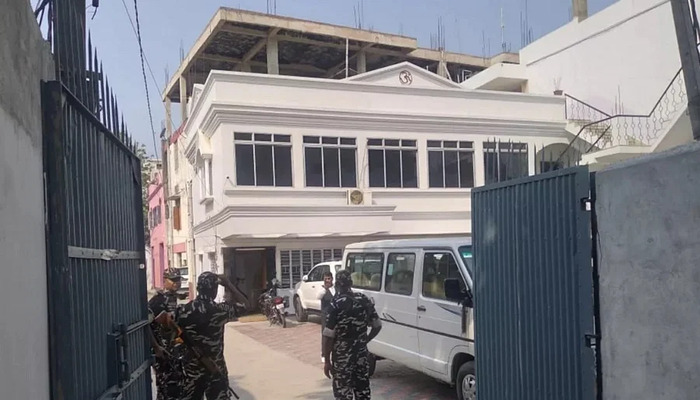
On Thursday, June 22, teams of the Enforcement Directorate (ED) and Income Tax Department raided the Begusarai residence of builder Ajay Kumar Singh, who is the brother-in-law of Bihar Finance Minister and Janata Dal (United) leader Vjiay Kumar Choudhary.
Ajay Singh, also known as Karu Yadav, is connected to JD(U) state president Lalan Singh. Singh reportedly runs an iron bar-making factory. The raid took place at Ajay Singh’s residence in Begusarai district’s Sri Krishna area in Nagar police station precinct.
Income Tax Department and ED officials launched raids on the builder’s home at 6:00 a.m. The exact specifics of the raid are undisclosed. The Begusarai authorities sent a significant number of police officers to avert any unfortunate incidents.
Reportedly, the officials arrived at Karu Singh’s residence in six vehicles during the early hours of Thursday. Bihar Finance Minister Vijay Kumar Choudhary is yet to react to the raids conducted at his relative’s residence.
ED raids at 24 locations connected with JDU and RJD leaders
Earlier this month, Ed conducted raids at 24 locations in Bihar and Jharkhand in connection with a case pertaining to the sand trade. ED raided locations reportedly connected with JDU MLC Radha Charan Sah also known as Seth Ji, RJD’s Jagnarayan, Satish Kumar, Ashok Kumar, Sanjay Singh and Subhash Yadav. The raiding teams searched the premises in Patna, Danapur, Aurangabad, Bhojpur, Ranchi, Dhanbad, and Hazaribagh among others. The aforementioned people were reported to have a connection with Broadson and Aditya Multicom, which undertakes the government’s work related to sand. It was reported that the ED seized several crucial documents.
I-T raids at JDU MLC Radha Charan Sah’s premises
In February this year, the income tax officials raided multiple locations in the Arrah district of Bihar connected with the JDU MLC Radha Charan Sah. The raids were conducted in an alleged multiple crore tax evasion case pertaining to irregularities in the sand trade.
On Tuesday, June 20, 2023, Shaktisinh Gohil assumed office as the president of the Gujarat Pradesh Congress Committee. With the Congress party facing a rapid decline in popularity, both nationally and specifically in Gujarat, it has become crucial for them to maintain a presence in the media.
The party sought to generate media attention by orchestrating an event on June 21st, involving their own workers being welcomed into the Congress party, which sparked controversy and garnered significant attention.
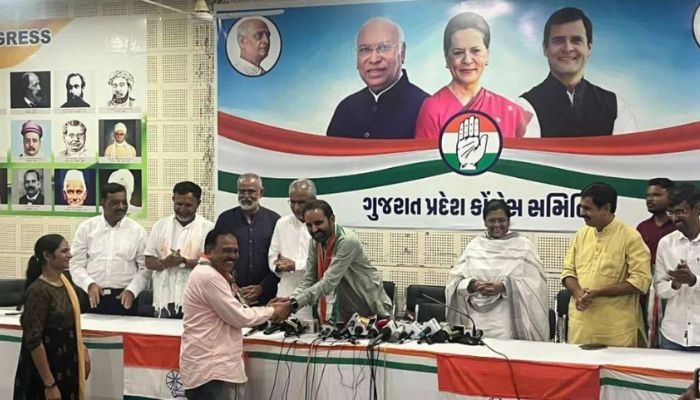
According to reports, Aam Aadmi Party state vice-president Vashram Sagathia, along with a group of approximately 20-30 supporters, joined the Congress at the party’s office on Wednesday, June 21. It is worth mentioning that Sagathia had previously left Congress and switched to the Aam Aadmi Party (AAP).
on June 20th, the Aam Aadmi Party made an official announcement regarding the removal of Vashram Sagathia from the party. However, Sagathia countered by disclosing that he had actually resigned from his position and membership in the Aam Aadmi Party on June 18. He further substantiated his claim by sharing a screenshot of his resignation message. Since then, the speculation surrounding Vashram Sagathia’s joining of the Congress has intensified.
While 30 new members joined the Congress, the media took the number to 100
With an Aam Aadmi Party leader making the move to join the Congress, the grand old party has made a significant announcement, revealing that over 100 AAP workers have also joined their ranks. In response to this development, the newly-elected state president, Shaktisinh Gohil, expressed his enthusiasm, stating, “The additional over 100 AAP workers will undoubtedly enhance the strength of the Congress.”
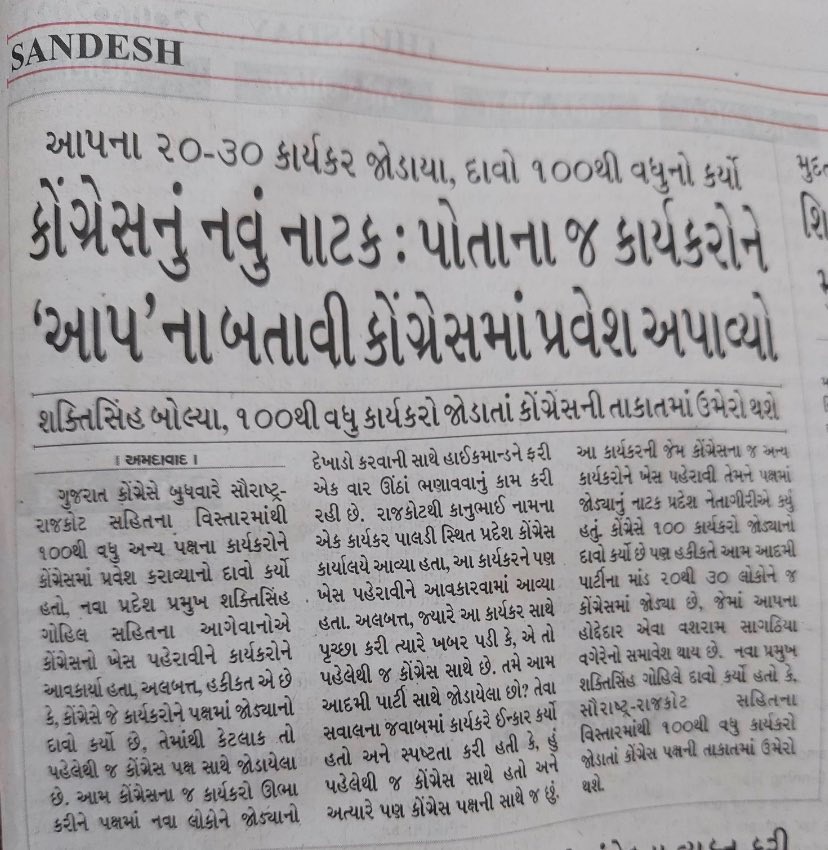
According to a report in ‘Sandesh’, following the media announcement, Shaktisinh Gohil personally approached each worker to formally welcome them into the Congress by presenting them with party robes. The Gujarat Congress made a concerted effort to ensure that not only the media but also the party’s high command received substantial visibility regarding the significant number of AAP workers who had joined the Congress.
During this period, the media interviewed an individual who was personally welcomed into the Congress by Shaktisinh Gohil, adorned with a shawl. The person introduced himself as Kanubhai, hailing from Rajkot. When asked about his transition from AAP to Congress, Kanubhai claimed that he was already a dedicated Congress worker. However, upon further investigation, the media discovered that out of the claimed 100 AAP workers, only around 20-30 individuals, including Vashram Sagathia, had actually joined the Congress. The remaining individuals who received the ceremonial induction with Congress robes were already affiliated with the Congress party.
Whether it is the results of the recent assembly elections or the grassroots landscape, both the AAP and the Congress have failed to pose a significant challenge to the Bharatiya Janata Party (BJP) in Gujarat. The people of Gujarat have unequivocally rejected their ideologies. Consequently, the people of Gujarat are expressing criticism towards Congress for resorting to such stunts merely to maintain a media presence.
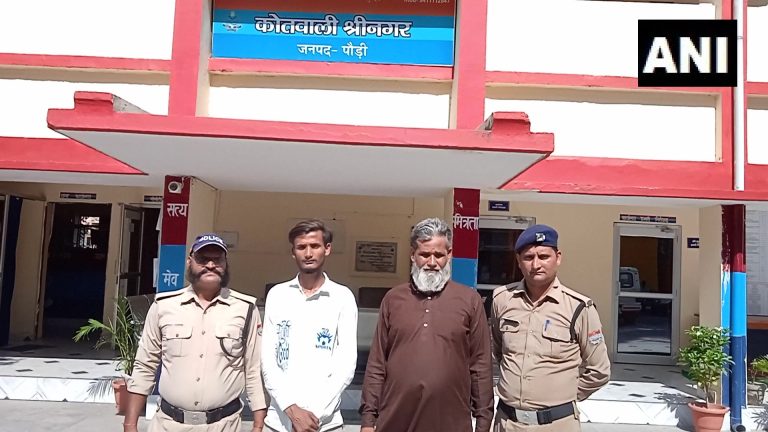
As the controversy around forced conversions and love jihad continue to grip Uttarakhand, another case of religious conversion has come to the fore from Srinagar, Pauri Garhwal. A father-son duo has been arrested by the police for forcing a girl to convert to Islam.
An FIR was filed by the father of the victim alleging that his daughter’s friend, and the friend’s brother belonging to a specific religion (Islam) attempted to convert her. She was also forced to wear a hijab, offer namaz, and marry the boy. The father of the boy was also allegedly involved in the crime.
A man gave a complaint that his daughter is being forced by a man to convert to Islam, wear Hijab & offer namaz. He allegedly also forced her to get married to him. We registered a case & arrested the man and his father. Further investigation is underway: Shyam Dutt Notiyal, DSP pic.twitter.com/TrY5mVraDm
Mujeeb Khan (22) and Babu Khan (45) were on the run but were nabbed by the police from Rishikesh railway station. A case has been registered against both of them under sections 354 and 3/5 of the Uttarakhand Religious Freedom Act 2018. An additional section has been invoked on the son for molestation.
Both accused have been sent to the district jail Khandusain on the orders of the court
Social activists including Srinagar Vyapar Sabha have also demanded action against the accused alleging that he planned to run away along with the victim.
Cases of conversion and love jihad growing in Uttarakhand
There have been growing concerns over the cases of conversion and love jihad in Devbhoomi Uttarakhand.
15 June 2023: Teen’s body found hanging in Dehradun
A 17-year-old Hindu girl’s dead body was discovered hanging at her residence in Laxman Chowk of Dehradun, Uttarakhand. “I am leaving your life, both of you be happy,” was also found written in blood on a wall of the room. The police took the dead body in their possession and transported it to a hospital for postmortem.
Reportedly, she was in love with a Muslim individual named Shadab, and the victim’s family accused him of leading the girl to kill herself.
15 June 2023: The Ghajwa-e-Hind threat
Devbhoomi Raksha Abhiyan Sangathan founder, Swami Darshan Bharti, received a letter in which Islamists issued death threats to the Hindu saint for protesting against Love Jihad cases.
Swami Bharti has been at the forefront of protests against the rampant Love Jihad incidents that are taking place in the Purola area of Uttarkashi, Uttarakhand.
14 June 2023: Muslim girl traps Hindu girl, and forces her to convert
A Hindu girl was forced to convert and marry by a Muslim man who was the brother of the victim’s friend. The individuals accused in the case are Armaan Ansari and his sister Tamanna.
31 May 2023: Hindu minor girl abducted by Uved Khan
A Hindu minor girl was abducted by two youths, one of whom is from the Muslim community, in Purola region of Uttarkashi. The two accused have been identified as Uved Khan and Jitendra Saini.
Massive protests were launched by locals who demanded a shutdown of shops owned by non-locals, the majority of whom are from the minority community.
13 June 2023: Muslim man caught taking intimate images of a Hindu student
A Muslim man was caught by a local Hindu organization while he was taking intimate photographs of a Hindu medical student. The man also blackmailed the female student using the photographs and forced her to change her religion to Islam.
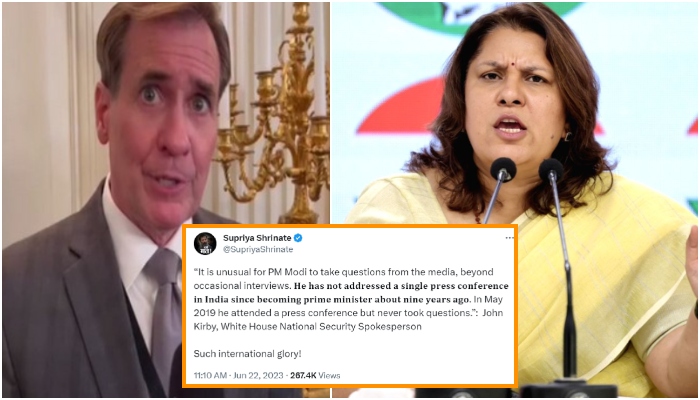
On Thursday, Congress spokesperson Supriya Shrinate tried to spread fake news amid PM Narendra Modi’s visit to the United States. In an attempt to criticize PM Modi, Shrinate who has also worked as a journalist misquoted John Kirby, White House National Security Spokesperson. She indicatively claimed that Kirby had criticized PM Modi for not taking any press conferences in the last 9 years.
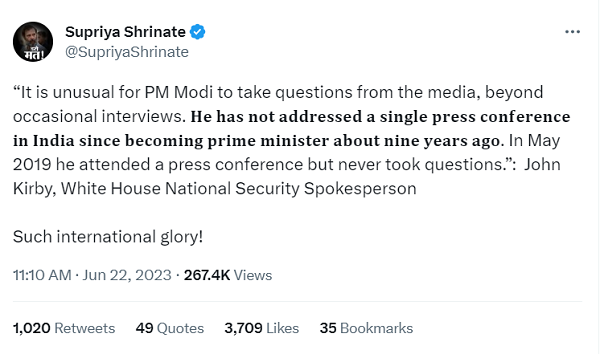
““It is unusual for PM Modi to take questions from the media, beyond occasional interviews. ?? ??? ??? ????????? ? ?????? ????? ?????????? ?? ????? ????? ???????? ????? ???????? ????? ???? ????? ???. In May 2019 he attended a press conference but never took questions.”: John Kirby, White House National Security Spokesperson,” her tweet read.
Interestingly, the words diligently quoted by Shrinate have never been said by John Kirby. Shrinate happened to pick the quoted statement from a recently published Reuters report and falsely claimed that Kirby had stated those.
Netizens mocked Shrinate for spreading fake news by putting wrong quotes in the name of Kirby. They highlighted that the quotes used by Shrinate was actually not a quote but a paragraph from a Reuters report. They also said that if Kirby had said those words, Reuters would have published the same as his quote.
— Shashank Shekhar Jha (@shashank_ssj) June 22, 2023
Reuters on June 22, published a report saying that US President Joe Biden and PM Modi would address and take questions from journalists today amid the Indian leader’s state visit. The report also stated that one of the senior White House officials had called it a ‘big deal’.
Furthering the report, Reuters wrote, “It is unusual for Modi to take questions from the media, beyond occasional interviews. He has not addressed a single press conference in India since becoming prime minister about nine years ago. In May 2019 he attended a press conference but never took questions.” These exact words were used by Shrinate to claim that John Kirby, White House National Security Spokesperson said so.
However, as per the Reuters report, Kirby called the event a ‘big deal’ and said, “We are just grateful that Prime Minister Modi is participating in a press event at the end of the visit. We think that’s important and we’re glad he thinks that’s important too.”
Reportedly, Kirby yesterday in an exclusive interview to ANI said that he was looking forward to deepening relations with India. “India is a world player and a net exporter of security and stability. India is already exporting security in the Indo-Pacific region and beyond, and they are contributing to the Indo-Pacific Quad. We are participating with India in the I2U2,” he said.
PM Modi will attend the state dinner hosted in his honor by US President and the first lady. The PM will also address a joint sitting of the US Congress today.
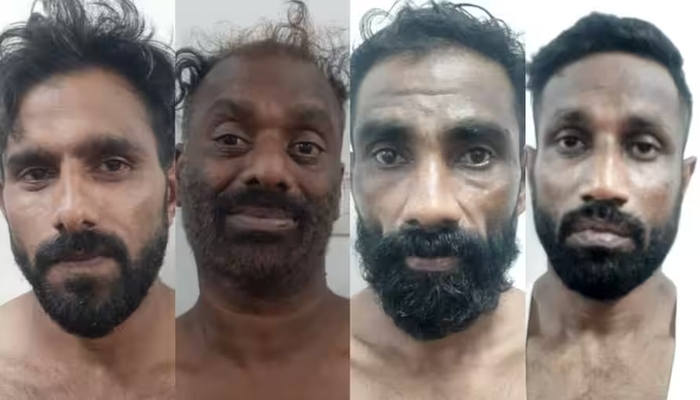
On Thursday, Kozhikode Police arrested four history sheeters, identified as Nainook, Nishad Ali, Sajar, and Jasim for sexually assaulting a 16-year-old minor boy. The alleged incident took place on Wednesday morning at Kozhikode Beach when the four gang members assaulted the minor. They also tried to drown the victim’s friends in the sea.
The town police station Inspector Baiju K Jose identified the accused as Nainook (40), a resident of Panniyankara, and his accomplices as Nishad Ali (35), Sajar (35), and Jasim (35).
Local police managed to arrest them from their hideout in the city. In the operation, two policemen also suffered injuries.
The police stated that the incident transpired on Wednesday morning when the victim along with other children was playing on the Kozhikode beach. When the victim’s friends objected to the accused persons sexually assaulting the victim, two of the accused Nainook and Nishad tried to drown them in the sea.
The police had to conduct an operation in Panniyankara to nab the accused persons. During the operation, the accused tampered with a gas cylinder endangering everyone’s lives. However, the police forcibly entered the premise and arrested them.
The accused also vandalised a police vehicle. Notably, two of the accused Sajar and Jasim have been arrested for assaulting the police officials. The police also found Cannabis plants at the 40-year-old Nainook’s residence.
The gang is known for committing several crimes in the city. They will be produced before the magistrate after a routine medical exam where police will seek their custody.
On June 20, Calcutta High Court ordered the formation of a Special Investigation Team (SIT) to investigate the tension at the Matua temple of Binapani Devi, aka Bora Ma, at Thakurnagar of district Bangaon, West Bengal. The order was passed by a single-judge bench of Justice Rajasekhar Mantha after hearing a petition filed by Bharatiya Janata Party (BJP) MP of Bongaon Shantanu Thakur. In his plea, Thakur accused Trinamool Congress (TMC) National General Secretary Abhishek Banerjee and his associates of creating tension during his visit on June 11.
Union Minister of State for Ports, Shipping and Waterways Shantanu Thakur said in his plea that the district police did not take any action against the offenders. On the other hand, the police filed a police complaint against the devotees of the temple, who TMC supporters heckled. The petition was filed in the High Court on Monday and came for a hearing on Tuesday.
In his order, Justice Mantha directed that the SIT should be headed by an IPS officer in the rank of Additional General of Police (ADGP). He also directed the police to take CCTV footage from the temple for investigation immediately. Furthermore, Justice Mantha ordered the immediate release of the Matua devotees that were arrested by the police in the matter. The next date of hearing has been set for July 18.
Devotees hackled by TMC supporters at Matua Temple
On June 11, TMC leader Abhishek Banerjee was allegedly denied entry into the sacred Harichand-Guruchand temple of the Matua community in Thakurnagar in North 24 Parganas district of West Bengal. As per reports, he was stopped by a Matua community section and greeted with black flags and ‘go back’ slogans. Abhishek Banerjee, however, alleged that it was the handiwork of BJP MP Shantanu Thakur and his followers.
He accused them and CISF personnel, accompanying the BJP MP, of forcibly closing the gates of the main temple and preventing him from offering prayers. The TMC leader also claimed that the central forces assaulted women devotees who came to pray at the Matua temple.
Meanwhile, the BJP has rubbished the allegations levelled by Abhishek Banerjee. While speaking to the media, BJP MP Shantanu Thakur said, “Abhishek Banerjee had brought in goons to foment trouble, but members of the Matua community thwarted him.”
He further added, “TMC general secretary was not allowed to use the Matua community for political gains.” Thakur informed that BJP workers and MLA Ashoke Kirtaniya sustained injuries after TMC goons attacked them before Abhishek Banerjee arrived at the Harichand-Guruchand temple.
He said that the local police and TMC workers manhandled him when he went to meet the injured party workers at the Chandpara Hospital. Thakur also told Times Now that TMC leaders such as Jyotipriyo Mallick, Bratya Basu and Sujit Bose and their supporters assaulted the temple priest.
“They threw the purohit (temple priest) out and prevented the devotees from visiting the main temple…When I was informed about the matter, I reached the temple premises. TMC goons pushed me and abused me verbally,” he narrated.
Shantanu Thakur emphasised, “I am a member of the Matua family. I belong to the 6th generation of Sri Sri Harichand Thakur ji. It is my duty to protect the temple at all costs. And TMC goons were trying to stop me from entering the temple.”
Abhishek Banerjee had claimed that he could have forcibly entered the Harichand-Guruchand temple with his supporters but supposedly chose not to do so to avoid a clash at the holy site.
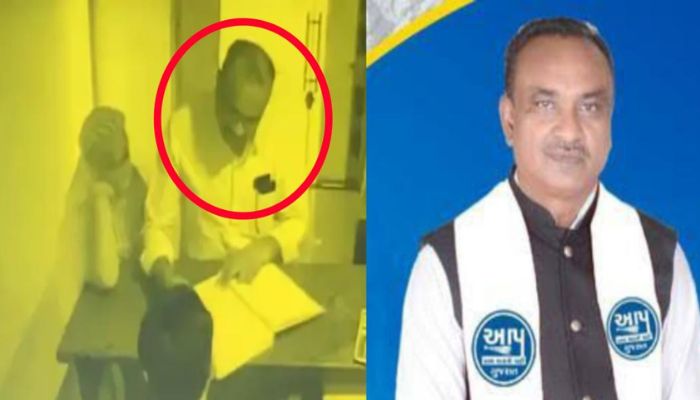
A controversy erupted on Wednesday, 21st June 2023, as reports claimed that Bhupat Bhayani, an MLA from the Aam Aadmi Party (AAP) representing Visavadar, was caught in a hotel room with a married woman. The incident took place at the Suraj Hotel in Surat’s Kadodara area. Additionally, a CCTV video allegedly showed the MLA and the woman checking in at the hotel reception.
According to a report by Divya Bhaskar, the incident unfolded when the AAP MLA accompanied the woman to a hotel in Kadodara, near the city of Surat. The report identified the person captured in the viral CCTV video as Aam Aadmi Party MLA Bhupat Bhayani. It was alleged that Bhayani was seen entering a room with the married woman, suggesting a close relationship between them.
The Visavadar MLA fled covering his face as the woman’s husband arrived
The report claimed that Visavadar’s AAP MLA Bhupat Bhayani was discovered in a hotel room with the married woman. Upon learning about the situation, the woman’s husband promptly arrived at the hotel. Caught off guard by the unexpected presence of the husband, the MLA from Visavadar swiftly covered his face with a handkerchief, expressing shock.
Another report stated that Bhupat Bhayani had allegedly rented the room for Rs 800. As per the report, the AAP MLA spent approximately 50 minutes in the hotel room with this married woman. However, when the woman’s husband arrived at the hotel and began recording a video on his mobile phone, Bhayani was forced to hastily flee with a handkerchief concealing his face.
As per the allegations, the woman’s husband refrained from filing a police complaint in an attempt to salvage his marital life. Furthermore, it is reported that he has not yet made the recorded video public. The woman’s husband, according to the report, asserts that if a police investigation is conducted, it will uncover Bhupat Bhayani’s alleged involvement in intimate relationships with other women as well.
When Divya Bhaskar’s journalist Deven Chitte contacted the Aam Aadmi Party MLA and asked him about this incident, he said, “I’m at home right now, please, I can’t give you any kind of comment or reaction right now, I’ll meet my legal team and react later.”
On 17th June, Free Press Journal published an explosive report claiming that Rs 500 banknotes worth as much as ₹88,032.50 crore were missing. Based on RTI replies on data submitted by banknote printing presses on notes sent and RBI data on notes received, it claimed that there was a huge mismatch of 1760.65 million pieces of the ₹500 notes for the year 2016-17. The claim was subsequently published by almost all other media houses citing the FPJ report and the RTI queries.
The Reserve Bank of India has already dismissed the claim. Now, based on the relevant documents based on which the claim was made by the RTI activist and FPJ, OpIndia can confirm that there are no missing ₹500 notes. Several crucial details, some of which are mentioned in the documents obtained by the RTI queries and cited in the report itself, were ignored, which led to the wrong calculation of data, leading to the assumption that notes were missing.
In the clarification issued late on the night on the same day when the FPJ report was published, RBI affirmed that all banknotes supplied from the printing presses are accounted for, and the report was based on an erroneous interpretation of information obtained under RTI. The central bank added that robust systems are in place for the reconciliation of banknotes printed at the presses and supplied to RBI which include protocols to monitor the production, storage and distribution of banknotes.
What the report claimed
The report is based on the RBI annual report, and the number of notes sent by three currency printing presses to the RBI, which are Bharatiya Reserve Bank Note Mudran (P) Ltd (BRBNML), Bank Note Press in Dewas (BNP), and Currency Note Press in Nashik (CNP). The latter were obtained through RTI, while RBI’s annual report is available on its website.
According to the report, in the year 2016-17, the number of notes sent by these three presses was 5,195.65 million pieces from BRBNML, 1,953.000 million pieces from BNP Dewas, and 1,662 million pieces from CNP Nashik, totalling 8,810.65 million pieces of “new ₹500 notes”. According to the report, in the same year, RBI received only 7,260 million pieces of ₹500 notes, and therefore there is a mismatch of 1550.65 million pieces.
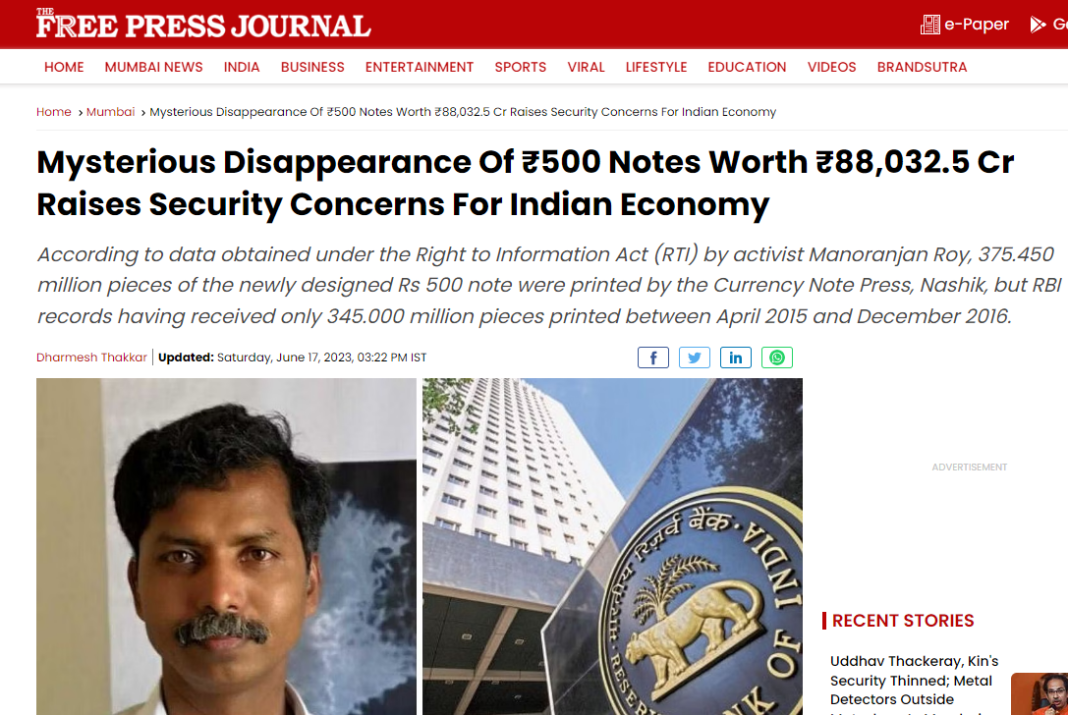
It further claims that 375.45 million pieces of the newly designed ₹500 note were printed by the CNP, Nashik between April 2015 and December 2016, but RBI records show it received only 345. It adds that 210 million pieces of ₹500 notes, printed between April 2015 and March 2016 at CNP Nashik, were sent to the RBI, but it is not mentioned in the RBI report, and therefore these notes are also missing.
Screenshot of the FPJ report
Adding the “missing” 1,550.65 million pieces for 2016-17 and 210 million pieces for 2015-16 from CNP Nashik, the report concluded that 1,760.65 million banknotes of ₹500 denomination are “missing”, amounting to ₹88,032.50 crore.
While the RBI clarified that the numbers were wrongly interpreted, the brief clarification didn’t include an explanation of how the numbers were misinterpreted. To understand what exactly happened and how Free Press Journal arrived at the conclusion, OpIndia contacted the writer of the story, Dharmesh Kakkar, to learn about the documents relied upon.
When we received the documents, which are annual reports on notes printed by various security printing presses and RBI report on notes received, we analysed them minutely. It was found while examining the documents that the number of notes sent by the presses actually matches the number of notes received by RBI for the year 2016-17, and there is no difference as claimed in the report. RBI was correct in saying that numbers were interpreted wrongly.
Crunching the numbers
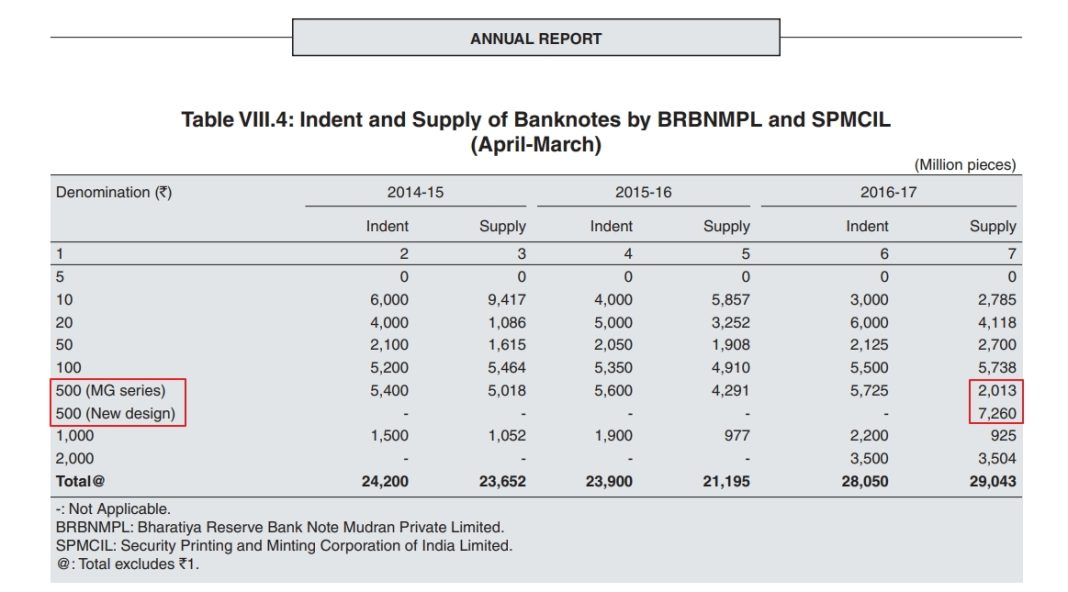
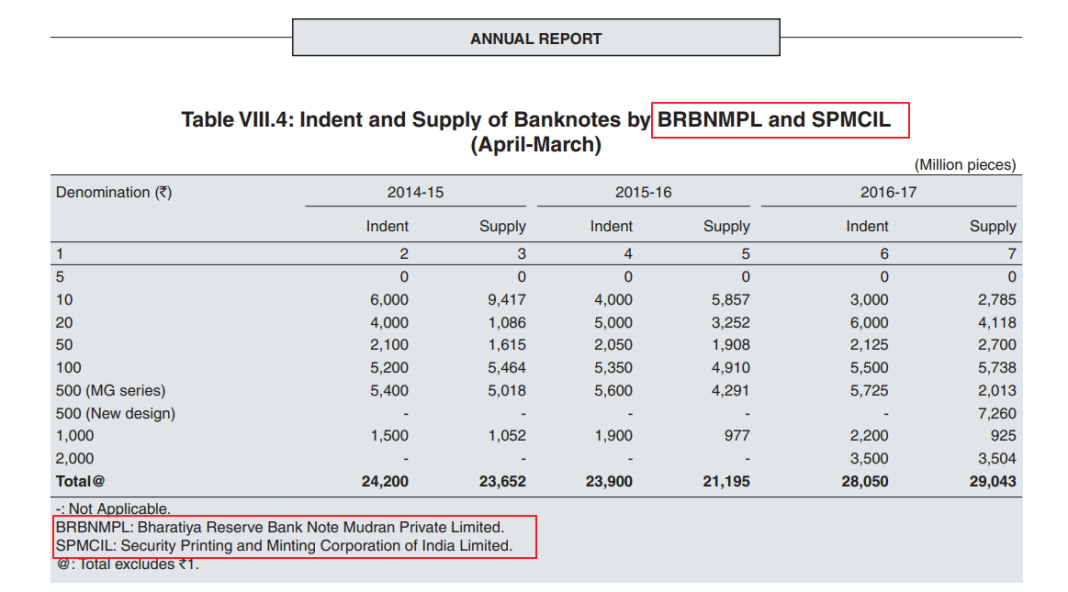
Citing the Currency Management chapter in the annual report of the RBI for 2016-17, the report claims that RBI received 7,260 million pieces of ₹500 notes from the presses. The report is available on public domain, and when we checked, we made a stunning discovery. The report actually has two numbers for ₹500 notes for the year 2016-17, MG series and New design.
The RBI report states that in 2016-17, it received 2,013 million pieces of old ₹500 notes, apart from 7,260 million pieces of new notes. Therefore, RBI received 9,273 million pieces of ₹500 notes, including both demonetised and new versions.
From RBI annual report for 2016-17
RBI received two versions of ₹500 notes in 2016-17 because the demonetisation of old ₹500 notes and ₹1000 notes took place in that year, in November 2016. It has been reported that the decision of demonetisation was kept a top secret, and the printing presses were printing old ₹500 notes till days before that.
It was earlier reported based on an RTI query that the last batch of old ₹500 was printed on 27 October 2016 at Bharatiya Reserve Bank Note Mudran (P) Ltd, just days before demonetisation was announced on 8 November 2016. Moreover, the printing of new notes at BRBNMPL began on November 23, as per another RTI response. A Times of India report from 13 November 2016 states that the printing of new ₹500 notes started at CNP Nashik two weeks ago, which means the last days of October or the start of November.
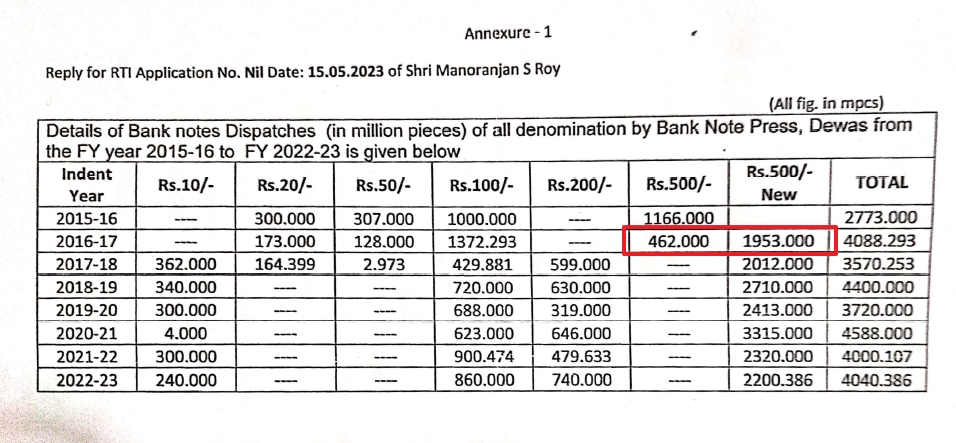
Now, if we analyse the numbers obtained from the three presses, we can find that Bank Note Press in Dewas has given two numbers. In 2016-17, this press supplied 462 million pieces of old ₹500 notes, and 1,953 million pieces of new ₹500 notes. Therefore, a total of 2,415 million pieces of ₹500 notes, including both versions, were supplied to RBI by BNP Dewas.
RTI response from Bank Note Press in Dewas
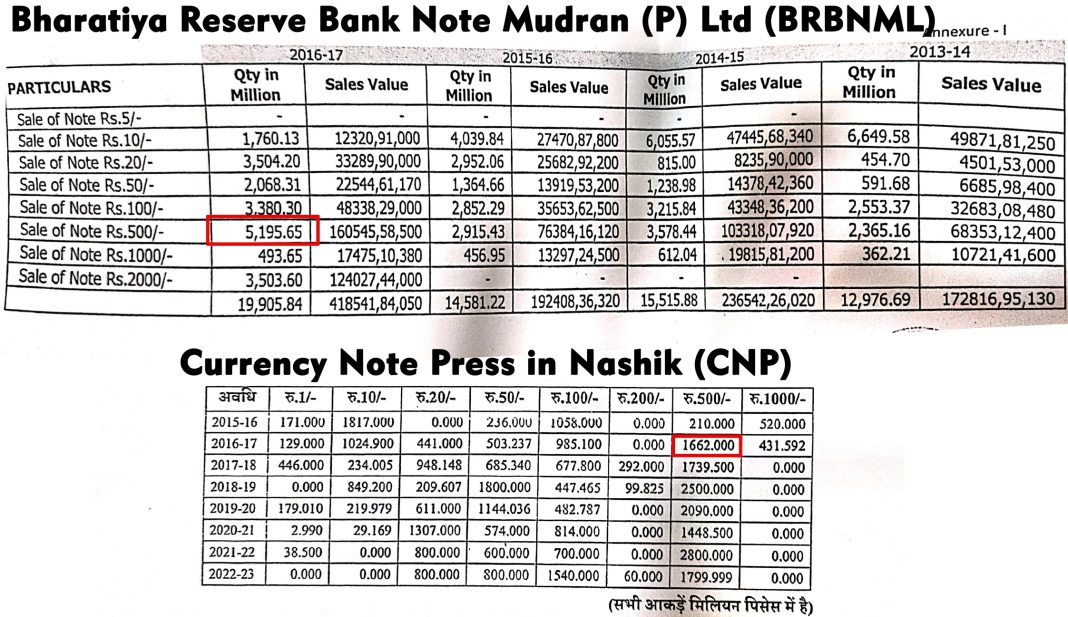
But in the documents supplied as RTI response by Bharatiya Reserve Bank Note Mudran (P) Ltd (BRBNML) and Currency Note Press in Nashik (CNP), there is no separate mention of old and new ₹500 notes. They just mention single numbers, 5,195.65 million and 1,662 million respectively. And, the Free Press Journal assumed these two are the numbers of new ₹500 notes printed by BRBNML and CNP Nashik in 2016-17.
RTI Responses from BRBNMPL and CNP, Nashik
That is a completely wrong assumption because it is already known that the presses were printing old design MG series ₹500 notes till October 2016, and printing of new notes started only after that. This means, the numbers for 2016-17 given by BRBNML and CNP Nashik include both old and new numbers.
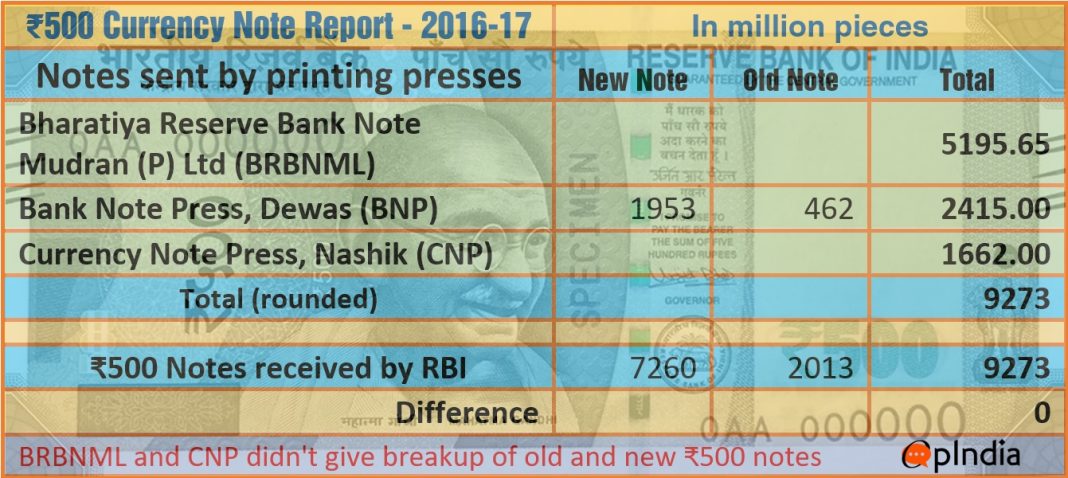
If we add these two numbers with the number of old and new ₹500 notes from BNP Dewas, we find that it matches exactly with the total of old and new notes given in the RBI annual report. The total comes to be 9,272.65 million, while the total of both the ₹500 notes in RBI report for 2016-17 is 9,273 million. It can be seen RBI rounded the number after the decimal, and 9,272.65 million became 9,273 million, which is an exact match.
This means, there is no mismatch of ₹500 notes sent by the presses and received by RBI in 2016-17. As two of the three presses have not provided separate numbers for old and new ₹500 notes, it is not possible to compare the new notes only based on the available data. The comparison has to be done on the total number of notes, both old and new. And when the comparison is done on the total numbers, they match exactly.
As the report took the number of only new notes from the RBI report and then took the total number of old and new notes from BRBNMPL and CNP, it was a wrong comparison. That is why the number of notes supplied by the 3 printing presses is showing more than the number of notes received by RBI.
The report also claimed that the numbers for 2015-16 also do not match, as it claimed that the 210 million notes sent by CNP Nashik is not seen in the RBI report. It is not known how the report arrived at this conclusion, because RBI report does not contain press-wise detail of notes received, it only gives the total numbers.
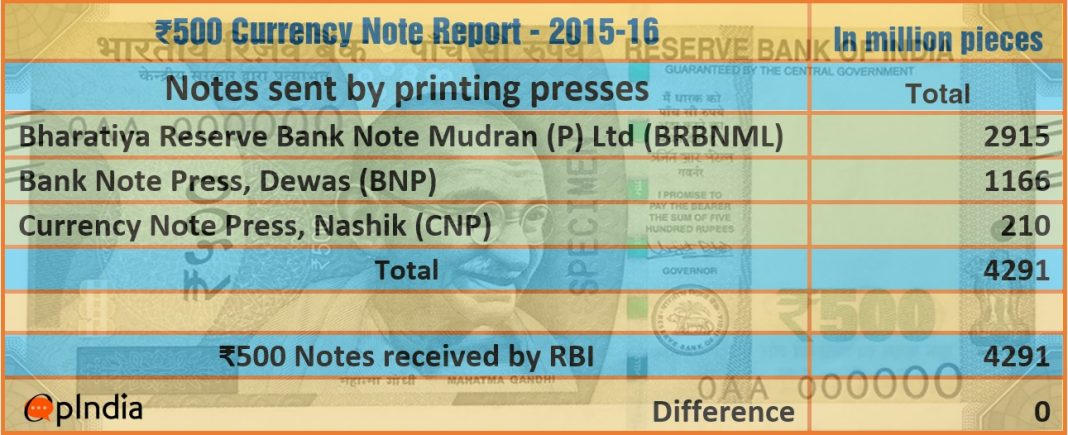
In the year 2015-16, only old MG series notes were printed by the security printing presses and sent to RBI, as the demonetisation took place over eight months after the end of the year. In that year, BRBNML sent 2,915 million pieces, BNP sent 1,166 million, and CNP sent 210 million pieces, based on the reports provided by the three presses in response to the RTI query.
These numbers can be seen in the RBI report and the RTI responses of the three presses given above. If we add the number of ₹500 notes sent by the three presses, the result is 4,291 million. This result matches exactly with the RBI’s number for the year, 4,291 million pieces. Therefore, there is no mismatch for the year 2015-16 too as claimed by Free Press Journal. It can be seen that 210 million pieces of ₹500 notes sent by CNP Nashik is included in the RBI report for that year.
Wrong claim that RBI does not mention a printing press
The report also made a claim that the RBI report does not mention receiving any new ₹500 notes from Currency Note Press, Nashik. In fact, it claimed that 210 million pieces of ₹500 notes were missing because it is the number of notes sent by CNP, as the report claims that the RBI report does not include this number.
This is clearly the result of the wrong interpretation of the report. The RBI annual report mentions banknotes received from BRBNMPL and SPMCIL. Here BRBNMPL is Bharatiya Reserve Bank Note Mudran (P) Ltd, for which we already have data. But SPMCIL is Security Printing and Minting Corporation of India Limited, and the FPJ report somehow assumed that it means Bank Note Press in Dewas, and therefore it claimed that CNP is not mentioned.
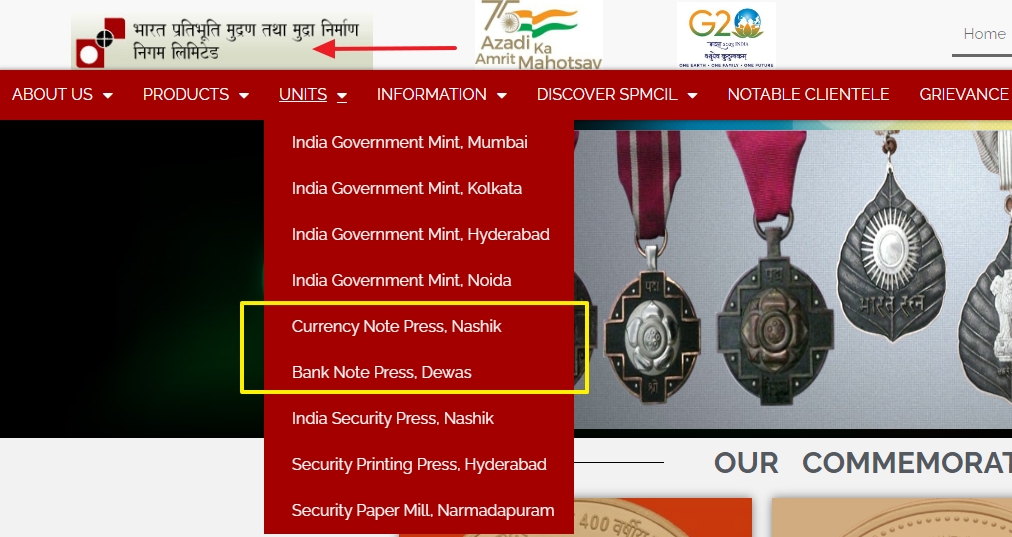
But actually, the Security Printing and Minting Corporation of India Limited (SPMCIL) is a company under the Department of Economic Affairs of the Union Finance Ministry. And the two note printing presses from whom RTI responses were obtained, Currency Note Press in Nashik (CNP) and Bank Note Press in Dewas (BNP), come under SPMCIL. Therefore, the number mentioned in the RBI report includes numbers from both BNP and CNP, as it clearly marked as SPMCIL, and does not mention BNP or CNP.
It is notable that these two presses were earlier independent units, but the SPMCIL was set up in 2016, and several mints, security paper printing presses under the finance ministry, along with these two note printing presses were brought under it. On the other hand, BRBMNPL is a division of RBI. Therefore, the RBI report gives data from BRBMNPL and SPMCIL, not individual presses under SPMCIL.
Screenshot from SPMCIL website
The above screenshot of the website of SPMCIL shows various mints and printing presses under it. As the FPJ report assumed that SPMCIL means BNP, it assumed that the numbers for CNP are missing in the RBI data. But, had they simply added the numbers for all three presses for 2015-16, they would have found that it matches with the RBI data for that financial year.
Blatant misrepresentation
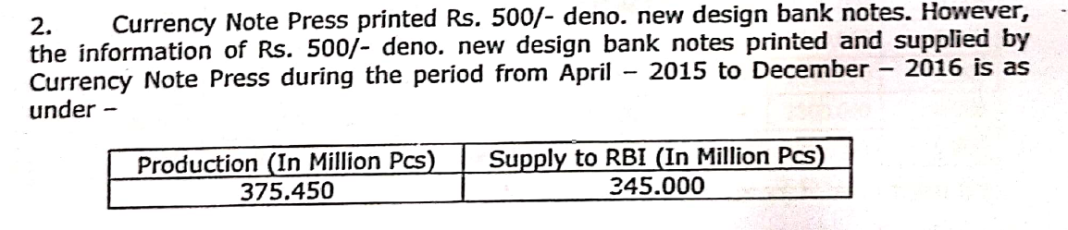
Apart from clearly wrong calculations and assumptions, the report also has one blatant misrepresentation of fact. It mentions that between April 2015 and December 2016, 375.45 million pieces of new ₹500 notes were printed by CNP Nashik, but RBI received only 345 million pieces.
Interestingly while in one place it claimed RBI does not include numbers from CNP Nashik, it also the report also claimed RBI report mentions 345 million pieces received from it. Both are wrong claims.
RBI annual report does not have a break up of notes received from BNP and CNP, and the number 345 million notes is not mentioned in the report. Surprisingly, the numbers are from the same source, the document supplied by CNP Nashik. It states that from April 2015 to December 2016, 375.45 million pieces of new ₹500 notes were printed, and 345 million of the same were supplied to RBI.
Therefore, both the numbers are from the press, one is production and the second is shipment to RBI. The second number is not from RBI as claimed by the report. It is obvious that the balance quantity, 30.45 million, was in stock at the end of the period at the press. But the report somehow assumed that it is a mismatch between notes sent by CNP and received by RBI.
Notably, although the report of the CNP states that 375.45 million pieces of new design ₹500 notes were printed from April 2015 to December 2016 by CNP, as the RTI query must have mentioned this period of 21 months, the actual printing must have taken place in the last two months of this period, November and December 2016.
Because, as mentioned above, demonetisation took place in November 2016, and up to October 2016, all ₹500 notes printed were old Mahatma Gandhi series notes which were demonetised. No new notes were printed in 2015-16, and from April 2016 to October 2016. Therefore, it can be seen that Currency Note Press in Nashik sent 345 million pieces of new ₹500 notes to RBI in 2016-17.
BNP Dewas sent 1,953 million pieces of new notes, CNP Nashik sent 345 million, therefore the balance of the 7,260 million received by RBI must have been sent by BRBNMPL, which would be 4,962 million pieces.
In conclusion, it is clear that Free Press Journal arrived at the wrong conclusion of missing new ₹500 notes because it compared data for only new ₹500 notes from RBI with the combination of both old and new ₹500 notes from two of the three printing presses. Along with that, it wrongly concluded that data for one press is not included in RBI data because it missed the fact that the concerned press is part of a company and the RBI has taken the total number for the company, and didn’t use separate numbers for individual presses.
OpIndia contacted Dharmesh Kakkar, the author of the Free Press Journal report, to ask if he has any comments to make on our conclusions. He said that he has no comments to offer, and their report was published based on claims made by RTI activist Manoranjan Santosh Roy, who obtained the reports from printing presses under RTI, and made the assumption that ₹500 notes were missing. However, as FPJ was given the documents by the RTI activist, it is clear that the portal didn’t examine the documents, and published Roy’s claims without any verification.