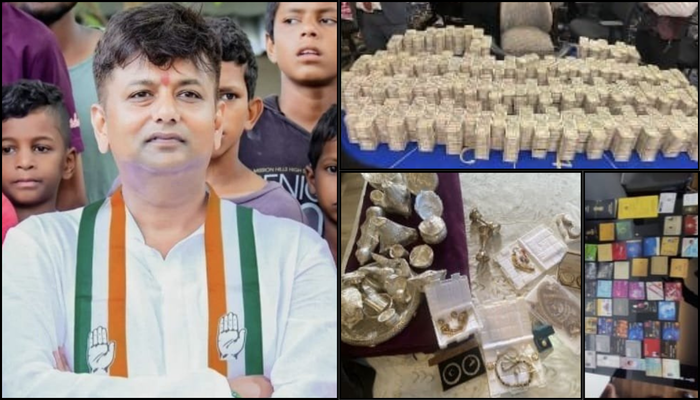
The Enforcement Directorate (ED) arrested Karnataka Congress MLA KC Veerendra on Saturday (23rd August) in connection with an illegal betting case. The MLA, who is also known as ‘puppy’, was arrested in Gangtok, Sikkim. Puppy’s arrest comes a day after the ED raided multiple locations linked to him. A transit remand has reportedly been obtained by the officials for bringing him to Bengaluru for further investigation.
On Friday (22nd August), the ED conducted searches at several locations in different parts of the country, including Gangtok, Chitradurga District, Bangalore City, Hubballi, Jodhpur and Mumbai under the provisions of the Prevention of Money Laundering Act (PMLA). The probe agency reportedly seized ₹12 crore in cash, including ₹1 crore in foreign currency comprising bundles of 100 US dollars, 10 and 20 British pounds, 500 dirhams and 100 and 50 euro currency notes.
ED arrested KC Veerendra, Karnataka's MLA from Chitradurga constituency, from Gangktok in connection with illegal online and offline betting case and recovered amount of approximately Rs 12 crore in cash, including approximately Rs 1 crore in foreign currency, gold jewellery… pic.twitter.com/BlHzQdStkd
In addition to that, the agency also recovered gold jewellery worth ₹6 crore, silver articles worth 10 kgs, international casino membership/reward cards – MGM casino, Metropolitan Casino, Bellagio casino, Marina casino, Casino Jewel. Multiple credit and debit cards of various banks, luxury hospitality membership cards of Taj, Hyatt and the Leela, and 4 cars. The ED blocked 17 bank accounts and two bank lockers belonging to the MLA.
As per reports, ED also seized several property-related documents from the premises of the MLA’s brother, KC Nagaraj and his son Pruthvi N Raj. Veerendra’s another brother, KC Thippeswamy, and Pruthvi N Raj allegedly handled his operations of online gaming from Dubai. “Many property related documents were also seized from the premises of Veerendra’s brother K C Nagaraj and his son Pruthvi N Raj. His other associates like another brother K C Thippeswamy are handling operations of online gaming from Dubai,” the probe agency reportedly said.
The agency also reportedly conducted searches at the Congress MLA’s properties in Goa, including Puppy’s Casino Gold, Ocean Rivers Casino, Puppy’s Casino Pride, Ocean 7 Casino and Big Daddy Casino. An ED statement said that the Congress MLA has been running several online betting apps. “Search has revealed that the accused is running several online betting sites in the name of King567, Raja567, etc. Further, the brother, KC Thippeswamy, of the accused is operating three business entities from Dubai, viz, Diamond Softech, TRS Technologies, and Prime9Technologies, related to the call centre services and gaming business of KC Veerendra Puppy,” the ED statement said.
The name of the 50-year-old MLA from Chitradurga emerged in an illegal online and offline betting case. According to ED, he had gone to Sikkim to lease a casino.
“পথাৰ! তোমাৰো স্বীকৃতি আছে, তুমি কোনোবা আদিতম মানুহৰ সংগ্ৰামৰ ইতিহাস আৰু সভ্যতাৰ স্তৰে স্তৰে একোটা নিৰ্ণয়-সূত্ৰ।”
The above lines from a poem by famed Assamese author Ram Gogoi means – “Oh, field! You too have recognition, you symbolize history of struggle of ancient man and you are a determinant to every step of civilizational progress.” Indeed, ever since the arrival of Ahoms in 1228 AD to this land of Brahmaputra and Barak, of enchanting hills and lush greens, Assam has grown culturally, economically, and socially. Ancient Sanskrit literature mentions the names ‘Pragjyotisha’ (meaning City of Eastern Astrology) and ‘Kamrupa’ (where Kamdev regained his Rupa or form) – both of which signify the rich cultural and religious heritage of Assam.
Assam has seen its share of turmoil over last few decades. Right from the Assam Movement (1979-1985) that saw protests against illegal immigrants, to the Assam Accord being signed on 15th August 1985, the State has gone through a roller coaster journey. Today, the State has 33 districts, and is the most populous State in N-E India.
Assam a cornerstone to ‘Act East Policy’
Ever since BJP assumed the mantle of governance at the Center in 2014, the erstwhile ‘Look East Policy’, that was enunciated in 1991 by PM Narasimha Rao’s government, was made more action-oriented and outcome-based through ‘Act East Policy’. A more proactive role in East Asia as envisaged under the policy required NE India to play a pivotal part in this. A sustained focus that ensued by Central Gov on NE India led to a gradual turnaround of this territory, with Assam benefiting a great deal too. The 2021 Assembly elections saw BJP securing 60 out of 126 seats, with a vote shareof 33.6%. NDA at 75 seats comfortably won.
Last decade has seen the ‘double engine government’ of NDA, at the State and Centre, lead to an unprecedented development for the region. From economy to empowerment of women, social security to secular fabric, the State has witnessed holistic growth. In the first of a three-part series, I will focus on how the State has made a turnaround to its economy, courtesy the dual prowess of BJP at Center and State.
Economic indicators have improved over last decade
Assam’s economy is currently ranked as 3rd fastest growing economy in the country. The State’s GSDP has grown 113% from 2020-21 to 2024-25, reaching ₹7.25 Lakh Crore. From 2012-13 to 2021-22, the State’s real GSDP has grown at an average rate of 6.3%, which is higher than the national average of 5.6 %.
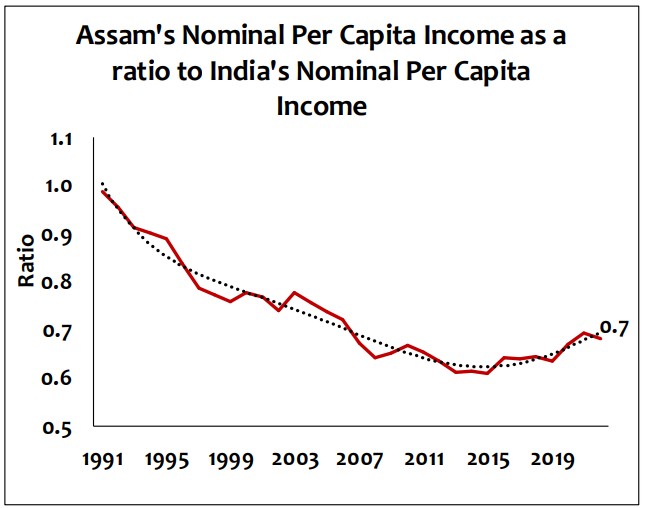
Capital expenditure has more than doubled, from ₹12,000 Cr in 2020-21 to ₹26,000 Cr in 2024-25. It is interesting to note that the State’s nominal per capita income as a ratio of India’s nominal per capita income had declined steadily over the years, until 2014 – post which the ratio has increased slowly.
(Source: The Ministry of Statistics and Programme Implementation (MoSPI), August 2023. Back series with 2011-12 base has been taken from Economic and Political Weekly Research Foundation (EPWRF).)
It is noteworthy that prior to 2014, Assam received only ₹1.27 Lakh Crore as devolution grants and grant-in-aid, that has now increased to ₹4.49 Lakh Crore. This goes to show the focus present day Central Gov has on Assam and N-E in general. To promote greater investments, the State has adopted the North East Industrial Investment Promotion Policy and Industrial Policy of Assam to facilitate business through fiscal incentives and multi-year concessions to investors.
Assam Industrial Development Corporation (AIDC) has implemented an Export Promotion Industrial Park (EPIP) at Amingaon, near Guwahati in the district of Kamrup, at an estimated cost of US$ 3 million. Also, Industrial growth centres with supporting infrastructure have been set up at Balipara in the Sonitpur district and Matia in Goalpara, at an estimated cost of US$ 4.5 million and US$ 5.3 million respectively.
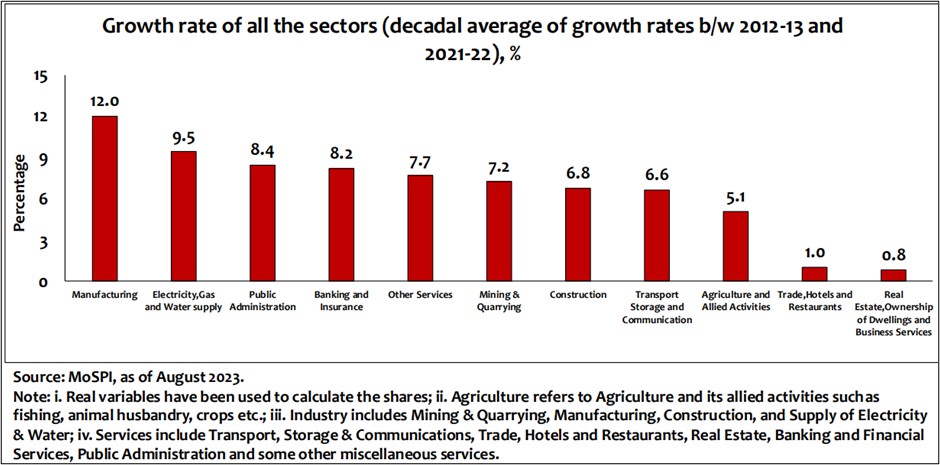
The tenets of ‘Sabka Sath, Sabka Vikas’, that drive GoI’s actions, entails a focus on development of all sectors. No better example of same than Assam, where sectors spanning from Agriculture and Manufacturing, to Real estate and Banking, have shown impressive growth over last decade.
One key enabler to investments has been investor summits like Advantage Assam Summit, that had its first edition in 2018. From then on, till Summit 2.0 that was held in February 2025, the State’s economy has grown from ₹2.75 Lakh Crore to ₹6 Lakh Crore, being fueled by growth across sectors.
Key sectors have flourished Setting up of Industrial parks has aided growth too, notable ones being as below:
Name of the park
Destination (District)
Departments
Project cost
Plastic Park
Tinsukia
Deptt. of Chemicals & Petrochemicals, Ministry of Chemicals & Fertilizers, Govt. of India
₹93.65 million (US$1.12 million) ;
Means of Finance:
Department of Chemical & Petrochemicals, Govt. of India: ₹40 million (US$480,000)
and
Industries & Commerce Department, Govt. of Assam: ₹53.65 million (US$640,000)
Mega Food Park
Nalbari
Ministry of Food Processing Industry
₹75.98 million (US$910,167.72)
Bamboo Technology Park
Kamrup
Ministry of Commerce & Industry
₹62.28 million
(US$746,141.09)
Jute Park
Nagaon
Ministry of Textile
₹49.57 million
(US$594,636.12)
Tea Park
Kamrup(R)
State Government
₹35.32 million (US$423,494.64)
Crude Oil and Natural Gas
Assam accounts for 14.3% of India’s total crude oil production. For the period 2019-20 to 2022-23, royalty contributions from crude oil production amounted to ₹19, 291.17 Crore, while that from Natural gas totalled ₹1,851.12 Crore.
Several development initiatives have been announced aimed at enhancing Assam’s position in the energy sector. These initiatives include the Numaligarh Refinery Expansion Project, the North East Gas Grid, the Paradip-Numaligarh Crude Pipeline, the establishment of Ethanol Plants including the launch of NRL’s Plant to produce ethanol from bamboo.
In 2023, Vedanta Ltd’s Cairn Oil & Gas, India’s largest private oil and gas exploration and production company, started test production from its Hazarigaon field in Assam, becoming the first company in the country’s northeast to commence gas flow from a Discovered Small Field (DSF) block.
Renewable Energy
Assam has made significant strides in green energy objectives, and several solar power projects have been launched across the state. With a target of producing 1,000 MW of electricity over the next three years, Assam aims to emerge as a hub for renewable energy.
Aligning with Sustainable Development Goals, Assam’s solar policy, formulated in 2017, encourages the deployment of grid-connected solar power plants on the rooftops of various establishments, promoting eco-friendly electricity generation and reducing dependence on fossil fuels.
Emerging Semiconductor Hub
The Assam Electronics (Semiconductor, etc.) Policy, 2023, has outlined guidelines around investments in Compound semiconductors, Silicon Photonics Sensors Fab, and Semiconductor Assembly, Testing, Marking, and Packaging facilities. Aside of attractive incentives, an additional 40% of Capex assistance will be provided by State Gov.
In March 2024, PM laid the foundation of Tata Group’s ₹27,000 Cr indigenous ‘Semiconductor Assembly and Test Facility’ in Jagiroad. The facility is expected to commence partial operations by 2025 and will be capable of producing 48 million chips daily.
Investor-friendly policies of Assam
The policy environment has been conducive post 2014 as well. One example being the Cess Utilisation Policy for small tea growers declared on 30th May, 2015, that has enabled small and marginal tea growers, as also facilitated welfare of tea laborers. The Industrial and Investment Policy of Assam, 2014 has laid down fiscal incentives for investors in Assam, that includes pointers like:
Tax Exemption – Includes Value Added Tax exemption, Entry Tax exemption, Luxury and Tax Exemption
Subsidy on quality Certification/Technical know how
20% State Capital Subsidy on cost of PV Modules upto 20 KW
Assam key to Viksit Bharat
As the State targets USD 143 billion of economy by 2030, it also holds the added responsibility of being the largest State in NE India. Through the 2023 modification of the Industrial and Investment Policy (IIPA) 2019, Assam has secured investments of ₹133.64 billion (US$1.6 billion) and 17,800 jobs in the last 14 months. The Assam cabinet has accepted 21 applications under the Industrial and Investment Policy of Assam (IIPA), 2019, and 14 MoUs have already been inked with companies such as PepsiCo India, Star Cement, Jericho Chemicals, and others. All of this at a breakneck pace!
As 2026 dawns near, and Assam gets ready to elect 126 members of its Legislative Assembly yet again, it remains to be seen if the Gateway to North-East continues its economic growth trajectory with the kind of astute governance witnessed over past decade, or the State dials back down to the erstwhile era of Naxalism, insurgency, and instability.
2026 will decide if ‘A’ for Assam can still hold the key to Viksit Bharat 2047!
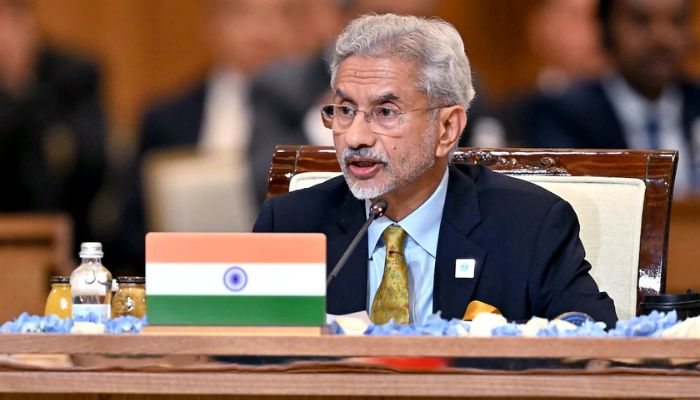
External Affairs Minister S. Jaishankar has once again underlined that India will take decisions only in its national interest, even if they don’t align with the expectations of other countries. He said that if USA and European countries don’t like Russian oil, they should not buy petrochemical products from India which are derived by refining Russian crude oil.
Speaking at the Economic Times World Leadership Forum, he defended India’s continued imports of Russian crude oil while also admitting that trade talks with the United States remain stuck on key issues. Jaishankar made it clear that India’s decision to buy oil from Russia is both in its own interest and in the global interest. “At the end of it all, we make decisions that are in national interest,” he said, adding that energy security is non-negotiable for a growing economy like India.
Taking on criticism from Western countries, Jaishankar said India’s oil trade should not be singled out. “It is presented as an oil issue, but it’s still not applied to the largest importer, China. Arguments used to target India have not been applied to China,” he pointed out.
He also issued a blunt response to those questioning India’s stance. “If you don’t like it, don’t buy it. But Europe buys, America buys. If you don’t like it, don’t buy from us,” he remarked.
#WATCH | Delhi: At The Economic Times World Leaders Forum 2025, EAM Dr S Jaishankar says, "It's funny to have people who work for a pro-business American administration accusing other people of doing business. If you have a problem buying oil or refined products from India, don't… pic.twitter.com/rXW9kCcVuv
Jaishankar reminded the audience that when global oil prices were shooting up in 2022, many nations had no problem with India purchasing Russian oil because it helped keep prices in check. “That time, people said if India wants to buy Russian oil, let them, because it would stabilise prices,” he recalled.
Responding to American allegation of India making profits by selling petrochemical products refined from Russian oil, he said that it was funny that a pro-business administration is accusing India of doing business.
Why India buys Russian oil
Explaining India’s position further, Jaishankar said that crude oil purchases from Russia not only support India’s domestic needs but also help keep international prices stable. “Yes, it is in our national interest, but it is also in global interest,” he said.
He recently visited Russia for annual bilateral talks, where discussions included expanding trade. Meanwhile, Jaishankar reaffirmed that India’s stand on the Russian-Ukrainian conflict is clear-cut. “We desire an early cessation of hostilities,” he mentioned, reiterating that India desires peace while managing its economic interests.
In addition to the oil issue, Jaishankar also addressed the issue of trade relations with the United States, which has hit a roadblock after Trump administration’s demand for more concessions from India. He admitted that the negotiations are not making progress but asserted that talks for a trade deal are ongoing.
“Right now, there are issues; it is pretty open, but it’s not like we never had issues before. Other parts of the relationship are strong,” Jaishankar said.
The Trump administration has imposed a 25% tariff on Indian goods exported to the US, effective from 7th August. Another 25% tariff on India’s crude oil trade with Russia is expected to take effect from 27th August.
Jaishankar said that while India is willing to talk, it has ‘red lines’ in negotiations. “We are committed to protecting the interests of farmers and small businesses,” he explained.
India–US relations beyond trade
Despite the differences, Jaishankar described India–US ties as broadly positive. “We are two big countries; we need to have conversations, and we will see how it goes,” he said.
#WATCH | Delhi: At The Economic Times World Leaders Forum 2025, EAM Dr S Jaishankar says, "Negotiations (India-US trade negotiations) are still going on. But the bottom line is we have some red lines. Negotiations are still going on in the sense that nobody said the negotiations… pic.twitter.com/deCHoeDSrx
He noted that every American administration has had its own approach. “President Trump’s style is unconventional. Earlier, under President Obama, there was even a proposal for a ‘G2’ arrangement with China,” he said, highlighting that ups and downs in diplomacy are natural.
Despite tensions on tariffs and oil imports, Jaishankar assured that India and the US are still engaged. “Communication channels are open,” he added, stating that coordination remains in other fields despite differences on trade and energy policies.
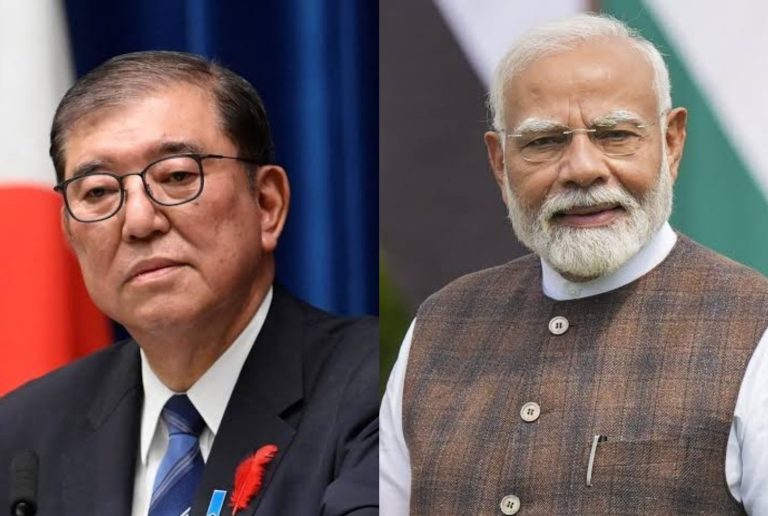
When Prime Minister Narendra Modi arrives in Japan on 29th August this year, it will be more than just another bilateral visit. Tokyo plans to invest about ¥10 trillion (approximately $68 billion) in India over the next decade, exceeding its previous commitment of ¥5 trillion for five years in 2022.
The visit is more than just a bilateral ritual. India has emerged as an indispensable partner for Japan, which shares concerns about China’s growing aggression, in the midst of a shifting global order.
The United States, Japan’s other strong ally, is also embroiled in a tariff war at the same time. After months of negotiating, Washington has lowered the baseline tariffs on Japanese exports from the original threatened 25% to 15%.
The agreement was more of a new tariff “floor” than a compromise. This implies reduced profit margins and a reevaluation of their international strategy for Japanese businesses. It means an opportunity for India.
Why India gains from US-Japan trade friction
Japan and the United States are considered to be the closest of allies. However, Washington’s economic nationalism has solidified into tariffs, even against allies.
All nations now face the default threat of a 15–20% “world tariff” unless they reach special agreements with the United States.
To prevent worse, Japan has to accept a 15% tariff agreement. The US and the EU struck a similar agreement a few days later.
The lesson is clear for Japan. There is a risk to its overdependence on US markets. Profits must be safeguarded elsewhere if tariffs are to remain in place. India is becoming more and more like “elsewhere.”
Japan requires scale, India provides it. With American tariffs eroding profitability, Japanese companies must find a base with reduced prices and high consumption. India’s 1.4 billion population, rapidly increasing middle class, and predicted 6.4% GDP growth by 2025 (IMF) make it the sole viable alternative to both China and the tariff-heavy US market.
Strategic autonomy pays dividends. India has steadfastly opposed joining blocs, whether they be Western sanctions regimes or the RCEP in East Asia. As Japan seeks diversification without relying on China, New Delhi is the ideal hedging partner due to its balanced autonomy.
The macro landscape is evolving. Japan’s inflation is hovering above the BoJ’s target, and markets are pricing in future rate hikes, indicating that the historic era of ultra-cheap yen finance is coming to an end, even if the yen remains weak in the short term. This encourages Japanese capital to seek higher returns elsewhere, just where India can position itself.
Beyond Japan, there is pressure, recent rounds of US-Indian negotiations have been called off, and India itself faces the threat of additional US tariffs in the absence of a bilateral agreement. Washington has threatened more duties if oil geopolitics and other irritants continue, and a planned round of negotiations in late August was cancelled. The need for India to (i) derisk export mixtures and (ii) strengthen third-country partnerships that reduce market risk is heightened by this.
India-Japan partnership is mutually beneficial
As the United States strengthens its tariff wall against friends like as Japan and the EU, India is emerging as the greatest tariff-free partner of choice.
The India-EFTA FTA will take effect on October 1, 2025, while the UK FTA has already been negotiated. This means that Japanese investments in India will immediately get access to Europe. PM Modi may position this as a geopolitical arbitrage that India offers.
Semiconductors and advanced electronics: Make India a “plus-one” to Japan’s semiconductor renaissance. Japan’s Rapidus project intends to achieve 2-nm production by 2027, with strong METI support and global partners. Tokyo has also established a Japan-India Semiconductor Supply Chain Partnership and hosts a formal Japan-India Semiconductor Policy Dialogue. India should propose a Rapidus-India “design, packaging, and talent” corridor headquartered on Bengaluru/Hyderabad and Gujarat’s Dholera, in line with India’s PLI and OSAT initiatives.
Infrastructure and Connectivity: From the Mumbai-Ahmedabad bullet train to the North-East road corridors, Japanese ODA has previously supported India’s most ambitious connectivity initiatives. The Japan International Cooperation Agency (JICA) has funded the development of almost 750 kilometres of new roads, improving connectivity throughout the North-East region. Aside from physical connectivity initiatives, Japan has been actively involved in regional water supply and sanitation projects. In Guwahati, for example, JICA has funded and supported measures to upgrade water delivery infrastructure.
The Mumbai-Ahmedabad High-Speed Rail (MAHSR) project is the main symbol of India-Japan economic cooperation. It marks not only India’s first high-speed rail line, but also Japan’s desire to export cutting-edge infrastructure know-how. It was largely funded by highly concessional Japanese ODA loans and built with Shinkansen technology.
The Gujarat segment is scheduled to be completed by December 2027, with full commissioning in December 2029. The Indian government is pushing for additional Japanese engagement in India’s national high-speed railway project, and Japan is expected to submit proposals for routes other than the one currently under development in western India, which will use Shinkansen bullet train technology.
Security and partnerships: India and Japan’s security collaboration has evolved into a multifaceted strategic alliance founded on mutual interest and trust. Their 2008 Joint Declaration on Security Cooperation established a comprehensive framework for partnership, ranging from intelligence sharing and maritime coordination to counterterrorism and peacekeeping.
This foundation was strengthened by subsequent agreements, including the 2014 Memorandum on Defence Exchanges, the 2015 pacts on Defence Equipment & Technology Cooperation and Military Information Protection, and the 2020 Reciprocal Provision of Supplies and Services (RPSS) arrangement, which allows for logistical support. In 2024, a Memorandum of Intent was signed to co-develop the UNICORN mast for Indian naval vessels, marking a significant step forward in defense technology collaboration.
The significance of PM Modi’s visit to Japan
Realpolitik is another factor in this visit. PM Modi wants to demonstrate that India not only endures but also benefits from world unrest. India transforms the trade conflict into supply chains, capital flows, and geopolitical leverage while others respond to it.
As part of their efforts to expand the India-Japan partnership, leaders from both countries will look into areas such as intelligence-sharing mechanisms, semiconductor supply chains, rare earth elements that are essential for electric vehicles, and more general economic-security cooperation, including coordination through the Quad framework.
China’s aggression is changing the Indo-Pacific, which means that both democracies have less options and more necessities.
Japan’s move toward India, as seen by expanding defense equipment and technical cooperation, nuclear exemption, cooperative exercises such as Malabar, Maritime Partnership Exercises, and rising technology collaborations, is a planned hedge against regional instability.
Both states avoid ideological alliances and instead create a flexible, interest-driven security architecture through the Quad, SCRI, and bilateral ties. This improves deterrence without formal entanglements.
Prime Minister Modi’s trip to Tokyo will be more than simply another bilateral meeting; it will be an opportunity to showcase India’s progress to the globe. India under Modi stands out as a reliable and potent ally at a time when China is attempting to exert dominance through threats and the US is applying tariff pressure to partners.
India is now viewed as a key player in Asia’s future, as evidenced by the bullet train, new chip projects, defense ties, and Japan’s enormous investment plan.
This visit demonstrates that India is becoming a nation that shapes global trends rather than merely responding to them. India is emerging under Modi’s leadership as self-assured, dependable, and prepared to take the lead globally.
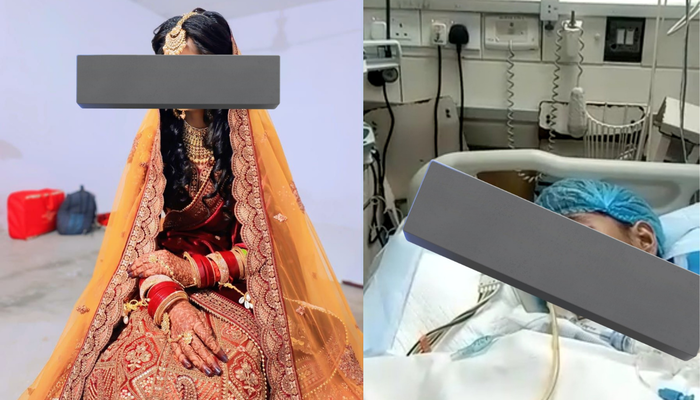
A disturbing case of dowry-related harassment of a newly-married woman has come to light from Gwalior in Madhya Pradesh. The 26-year-old victim, named Sonali Sharma, is fighting for her life in the Ganga Ram Hospital in Delhi. Sonali was admitted to the hospital on July 26, 2025, after her mother-in-law allegedly fed her a soft drink laced with a toxic substance.
Her brother, Mayank Sharma, shared the details of abuse endured by his sister and her current health condition on X. According to Mayank, Sonali has been receiving critical care in the ICU at the hospital for about a month, but her condition has not improved.
Now, her in-laws have fled, leaving her in critical condition. She is currently in ICU since last one month getting her treatment in Sir GangaRam Hospital Delhi. Her condition is very critical and there is no positive growth in her health
Mayank said that Sonali’s in-laws did not even give her proper food for days before she was admitted to the hospital. He added that Sonali’s husband and in-laws have been torturing her for dowry. She had been facing mental and physical harassment by her in-laws for the past year, since she got married.
Accusing the police and local administration of apathy and lack of support, Mayank said, “The police haven’t taken any strict actions against her in-laws, and are taking the case very lightly. We are getting no support from the system and the police are not showing any interest in helping us”.
The police haven't taken any strict actions against her inlaws, and are taking the case very lightly. We are getting no support from the system and the police are not showing any interest in helping us. https://t.co/EwS4e305u0
FIR says Sonali’s in-laws burnt her with hot iron tongs, fed toxin-laced drink
An FIR was filed by the victim’s father, Satish Sharma, at the Maharajpura Police Station in the Gwalior district under Sections 85, 123, 115(2) and 3(5) of the BNS and Sections 3 and 4 of the Dowry Prohibition Act, 1961 on July 25, 2025.
According to the FIR accessed by OpIndia, Sonali Sharma, originally from Bhind, Madhya Pradesh, got married to Aditya Sharma on February 18, 2024. The victim’s family had given cash worth ₹14 lakh 50 thousand to her in-laws at the time of marriage. However, a few months after the marriage, the victim told her family that her in-laws, including her husband, Aditya Sharma, father-in-law, Rajesh Sharma, mother-in-law, Anita Sharma, and sister-in-law, Sapna Sharma, have been pressuring her to ask her family to gift them a Bullet motorcycle. When she refused to accept their demand, they physically assaulted her.
The father of the victim said that around 15 days before the filing of the FIR, Sonali’s in-laws burnt her hands with heated iron tongs. The FIR states that the victim called her mother on July 19, 2025, around 11:30 pm, and told her that her mother-in-law had given her a soft drink laced with some toxic substance, after consuming which she fell sick. She added that she had been vomiting repeatedly, but her in-laws did not take her to a doctor. Her father immediately informed their relative, Akash Sharma, who lived close to her in-laws’ house and requested him to take her to a doctor.
Akash Sharma went to her in-laws’ house and urged them to take her for medical treatment. Subsequently, her husband, Aditya Sharma, accompanied by Akash Sharma, got her admitted to Birla Hospital for treatment. From there, she was referred to Ganga Ram Hospital, where she is undergoing treatment currently.
No arrests have been made so far by the police in the case as the in-laws are absconding.
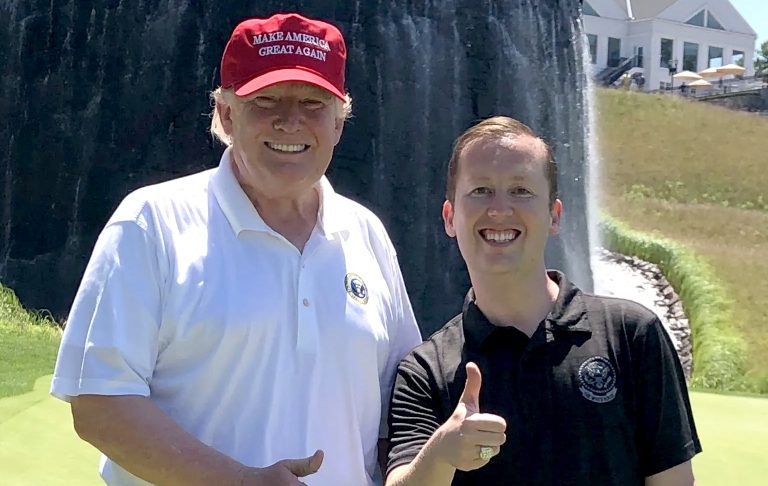
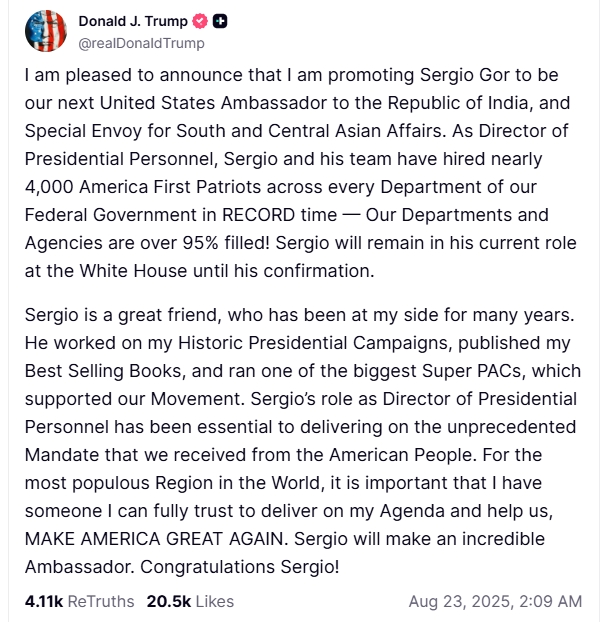
US President Donald Trump on Friday nominated Sergio Gor as the next US ambassador to India. Gor has also been appointed as the Special Envoy for South and Central Asian Affairs, giving him a dual role. This endorsement comes at a critical juncture in U.S.-India relations, which have deteriorated under Trump’s second term due to aggressive trade policies, including a 50% tariff on India’s export to US aimed at pressuring New Delhi over its continued imports of Russian oil amid the ongoing Ukraine conflict.
Sergio Gor, a 38-year-old White House personnel director and longtime Trump loyalist, will replace Eric Garcetti, the previous ambassador appointed by President Joe Biden in 2023. Garcetti, a former mayor of Los Angeles with experience in diplomacy and urban affairs, focused on strengthening economic ties and countering China’s influence in the region during his tenure.
However, Sergio Gor has no diplomatic or foreign policy experience, and he has been appointed as ambassador to India along with the Special Envoy for South and Central Asian Affairs. Trump’s decision to nominate Gor appears driven by a desire to install a trusted insider who can enforce his “America First” agenda, including trade pressures, while maintaining a direct line to the White House.
Announcing the decision on Truth Social, Trump said, “Sergio is a great friend, who has been at my side for many years.” On his appointment as ambassador to India, he said, “For the most populous Region in the World, it is important that I have someone I can fully trust to deliver on my Agenda and help us, MAKE AMERICA GREAT AGAIN. Sergio will make an incredible Ambassador. Congratulations Sergio!”
Sergio Gor, born Sergey Gorokhovsky in 1986 in Tashkent, Uzbekistan (then part of the Soviet Union), emigrated to the U.S. in 1999. A graduate of George Washington University, he began his career as a Republican activist, supporting John McCain’s 2008 presidential bid, and later served as an aide to Senator Rand Paul and in various roles with the Republican National Committee.
By 2020, Gor had entered Trump’s inner circle, serving as chief of staff for the Trump Victory Finance Committee and as a senior advisor to MAGA Inc., before becoming director of presidential personnel in the current administration.
In this role, he has vetted over 4,000 hires, emphasizing “America First” loyalty. Described by the Trump administration as “most loyal, fearless, and hardworking,” Gor is a seasoned political operative focused on domestic politics, fundraising, and internal vetting.
However, he possesses no prior diplomatic experience or foreign service background, with his exposure to international affairs limited to peripheral involvement in Trump’s campaigns. This lack of expertise has raised eyebrows, particularly given India’s complex geopolitical landscape, including India’s continued close ties with Russia and improving relations with China.
Apart from lack of diplomatic experience, Gor also faced controversies in the past, including being labelled a “snake” by Elon Musk over internal disputes.
Gor’s nomination arrives amid heightened U.S.-India tensions under Trump’s renewed presidency. Trump has imposed a 50% tariff hike on Indian exports, citing India’s refusal to curtail Russian oil purchases as a betrayal amid the Ukraine war. The Trump administration has called it ‘sanctions’.
He has further escalated rhetoric by labelling India a “dead economy” and claiming unsubstantiated credit for averting India-Pakistan conflict, assertions dismissed by Indian government.
These actions have stalled trade negotiations and reversed bipartisan progress in U.S.-India ties, with critics calling it Trump’s “biggest foreign policy mistake.”
Appointing Gor, a career politician with no diplomatic credentials, signals Trump’s strategy to leverage the ambassadorship as an extension of his hostile policies toward India, prioritizing enforcement of tariffs and loyalty to his agenda over traditional relationship-building. Trump surely has no plan to improve ties with India, he wants to continue increasing pressure on Indian government to stop buying from Russia.
Gor’s nomination as the Special Envoy for South and Central Asian Affairs underscores the administration’s intent to centralize control over regional policy. This dual role means he will have a much wider wider mandate for the entire region, not just India. This may include India’s relationships with other countries in the region, including Pakistan.
This can be called Trump’s attempt to ‘hyphenate’ India and Pakistan again, which India has been preventing with lots of efforts. The dual appointment means Trump does not think that India is important enough to require a full time ambassador, and the country is just one of several South and Central Asian countries as a bloc.
While Gor’s direct access to Trump might offer India a backchannel for dialogue, his inexperience risks mishandling sensitive issues like technology transfers, defence cooperation, and Indo-Pacific security. If confirmed by the Senate, a process that could face scrutiny over his past feuds and lack of qualifications, Gor’s tenure may push India further from U.S. orbit.
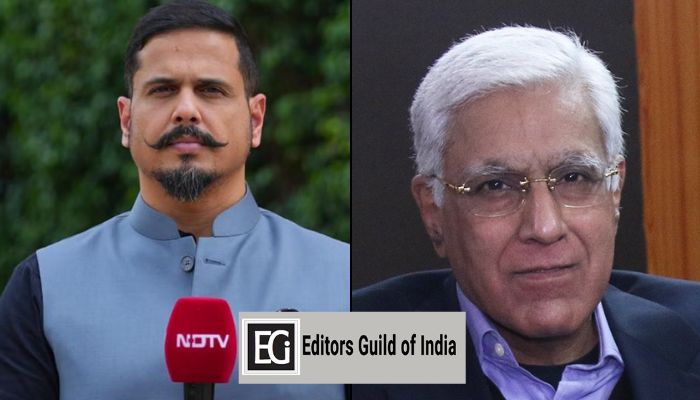
The Editors Guild of India (EGI) has yet again exhibited its double speak when it came to the subject of ‘press freedom.’ Infamous for its selective activism, EGI has recently advocated for Karan Thapar but has maintained stoic silence over the hounding of journalist Shiv Aroor.
For the unversed, a criminal complaint was filed by the Congress party against Aroor for debunking the ‘vote chori’ conspiracy theory of its leader Rahul Gandhi.
In the program titled “From ‘Chori’ To ‘Sorry’: Vote The Fake Narrative?” aired on 19th August, Shiv Aroor had cited the apology issued by Sanjay Kumar of CSDS for publishing wrong data.
Kumar had alleged massive discrepancies in the Maharashtra voter list. Rahul Gandhi and the Congress party had used this false data posted on X to attack the Election Commission and allege ‘vote theft’.
Shiv Aroor pointed out how most of Rahul Gandhi’s allegations against ECI were baseless. He also said that Rahul Gandhi had made it a prestige issue by not stating the allegations in an affidavit as demanded by the Election Commission.
Three days later on Friday (22nd August), Congress spokesperson Pawan Khera posted a tweet, confirming the hounding of the NDTV journalist. He declared that a criminal complaint has been filed against Shiv Aroor.
Shiv Aroor’s (@ShivAroor) malicious attempt to defame the Indian National Congress & the Leader of Opposition Shri @RahulGandhi on “India Matters” aired on 19.08.2025, on @ndtv, will not go unanswered. A criminal complaint has been filed, and our lawyer (@EeshaBakshi) will pursue…
“Shiv Aroor’s (@ShivAroor) malicious attempt to defame the Indian National Congress & the Leader of Opposition Shri @RahulGandhi on “India Matters” aired on 19.08.2025, on @ndtv , will not go unanswered. A criminal complaint has been filed, and our lawyer (@EeshaBakshi) will pursue every remedy to the fullest extent of law,” Khera tweeted.
At the time of writing this article, it had been 19 hours since the tweet by the Congress spokesperson. But the Editors Guild of India did not squeak a word in support of Shiv Aroor.
It has maintained strategic silence as usual, showcasing how press freedom and freedom of speech apply only to their ecosystem of lef-liberal ‘journalists’ and ‘activists.’
How Editors Guild rushed to defend Karan Thapar and Siddharth Vardarajan
On Tuesday (19th August), the Editors Guild of India rushed to defend propagandists such as Karan Thapar and Siddharth Vardarajan after being summoned by the Assam police for undermining the sovereignty of India.
“The Editors Guild of India is deeply concerned by media reports that the Assam Police have summoned two senior journalists Mr. Siddharth Varadarajan, Founding Editor of The Wire, and Mr. Karan Thapar, Consulting Editor of The Wire to Guwahati,” it said in a statement.
The NGO founded in 1978 continued, “The Guild is extremely disturbed by this continuing trend of law enforcement agencies across states registering FIRs against journalists by invoking multiple provisions of the criminal code. This practice effectively muzzles independent journalism, as the very process of responding to notices, summons, and prolonged judicial proceedings becomes a form of punishment.”
EGI Statement on FIRs and Summons Issued to Siddharth Varadarajan and Karan Thapar pic.twitter.com/tWNDhzM0R5
“The invocation of Section 152 of the BNS is particularly troubling, since it is widely regarded as a repackaged version of the draconian sedition law (Section 124A of the IPC), which the Supreme Court ordered to be kept in abeyance in May 2022 in response to petitions filed by the Guild and others challenging its constitutionality,” it alleged.
“The Guild had written to the Home Ministry in July 2024 highlighting these concerns, specifically regarding Section 152 and other provisions that pose a serious risk of misuse against free speech,” the NGO housing left-liberal activists brazened out.
“The Editors Guild urges the Assam Police to refrain from actions that could cast even the slightest doubt on their true intent. The Guild also takes the opportunity to remind fellow journalists about the importance of pursuing their profession without fear or favour. Honest journalism can never be a crime,” it continued its activism.
While the Editors Guild was prompt in the case of Karan Thapar, the NGO remained missing in action in the case of Shiv Aroor.
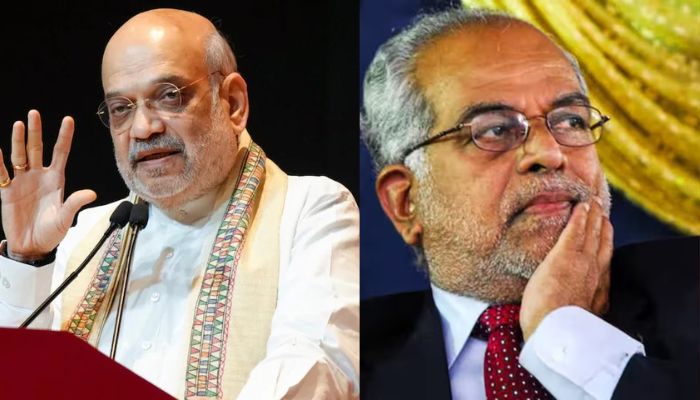
Union Home Minister Amit Shah on Friday, 22nd August, launched a sharp attack on the opposition’s Vice President candidate, Justice B. Sudershan Reddy, accusing him of supporting left-wing extremism through his past judgments.
Speaking at a conclave organised by Malayalam news outlet Manorama in Kochi, Shah said the Congress party had fielded Reddy under pressure from its Left allies.
“The opposition (Congress) vice presidential candidate Sudarshan Reddy is the same person who gave the Salwa Judum judgment in support of leftist extremism and Naxalism. If this had not been done, extremism would have been eradicated by 2020. Kerala has suffered the sting of Naxalism and endured extremism as well. The people of Kerala will surely see how, under pressure from the leftists, Congress has chosen such a candidate who used a platform like the Supreme Court to support leftist extremism and Naxalism,” Shah said, suggesting that the move exposed the opposition’s political priorities.
BJP leader Vijay Sharma also criticised the opposition’s VP candidate
Chhattisgarh Deputy Chief Minister and BJP leader Vijay Sharma has also criticised the opposition’s Vice President candidate, Justice B. Sudershan Reddy, claiming that one of his judgments in 2011 led to a surge in Naxal violence in the state.
Speaking at a lecture in Pune on the topic “Tackling the Naxal Challenge in Chhattisgarh,” Sharma claimed that the judgment had created fear and panic in Bastar, leading to a wave of killings and brutal attacks by Naxal groups.
“After the judgment of 2011, Bastar was gripped by terror. Thousands became victims of Naxal violence. Many were shot dead, others crippled, and some even strangled. People have not forgotten that horror,” Sharma said.
He further said that people of Bastar still asked him whether the same judge who gave that verdict was now the opposition’s Vice President candidate. “They remember his name. They ask how such a person can be accepted for the country’s second-highest constitutional office,” he said.
Sharma explained that the Salwa Judum movement had started as a people’s response to the atrocities committed by Naxals in Bastar. Villagers, he said, had set up their own camps to protect themselves, without any initial involvement of the government. Later, the state extended limited support and some of the members were recruited as Special Police Officers (SPOs). The movement, he said, was essentially about “restoring peace,” since the word Judum meant peace.
He argued that the judgment declaring Salwa Judum unconstitutional was not based on ground realities but on “academic reasoning.” According to him, the Supreme Court never heard the voices of Bastar’s people before pronouncing the verdict. Instead, the court only considered arguments made in Delhi by petitioners and police officials, leaving those who were directly affected unheard.
The Chhattisgarh leader said the BJP government in the state, in line with Amit Shah’s announcement, had resolved to wipe out armed Naxalism from Bastar by March 2026. “We are determined to take the Indian Constitution to every corner of Bastar. Naxals are not fighting for anyone’s rights; they only believe in Maoist ideology, which says power flows from the barrel of a gun. With this ideology, they are trying to create fear among local people,” Sharma said. He added that the government was also working to bring those involved in the Maoist movement back into the mainstream.
What the Supreme Court judgement said
In a judgement in 2011, a two-judge bench of the Supreme Court, Justices Sudershan Reddy and SS Nijjar disbanded Salwa Judum, an outfit in which tribal youth were appointed by the Chhattisgarh government as Special Police Officers (SPOs) to counter the Maoist insurgency.
The verdict was in reaction to a petition presented by social anthropologist Nandini Sundar and others, who had objected to the Chhattisgarh government’s move to arm tribal youths and use them as SPOs to counter Maoists.
In a strong indictment of the state’s policy, the court ruled that appointing poorly educated tribal youth, some with only a fifth standard education, as armed security forces violated constitutional principles.
The bench said the Chhattisgarh government must immediately recall all firearms issued to SPOs, including rifles and other weapons. It directed the state to stop using SPOs in any form of counter-insurgency operations and asked both the Centre and the state government to ensure their safety against possible Maoist attacks.
The judgment also ordered the state to investigate all allegations of human rights violations and criminal acts committed by Salwa Judum members or those known as Koya Commandos. The bench made it clear that no group could be allowed to take the law into its own hands or act outside the Constitution.
“The effectiveness of the force cannot be the sole criterion to judge whether it is constitutionally permissible,” the bench observed. It added that even if SPOs were somewhat effective in fighting Maoists, the “dubious gains” came at the cost of massive constitutional violations and damage to social order.
Justice Reddy, writing the order, stressed that every organ of the state had to work within the “four corners of constitutional responsibility.” While acknowledging that Chhattisgarh faced a serious security threat from Maoist violence, the court said that condoning extra-constitutional methods was not acceptable. “The state has the obligation, both moral and constitutional, to combat extremism while ensuring security for citizens,” the bench said.
The ruling was a setback to both the Centre and the Chhattisgarh government, which had defended Salwa Judum as a necessary measure against Maoists. But the court concluded that the militia-style outfit was illegal and unconstitutional, effectively shutting it down.
The upcoming vice presidential election
These remarks against Justice Reddy come just weeks before the Vice Presidential election, where he is set to face off against the NDA’s nominee, C.P. Radhakrishnan. The INDIA bloc has extended its support to Justice Reddy, making the contest a direct fight between the two.
Polling for the Vice President’s post is scheduled for 9th September, with counting to be completed the same day. Filing of nominations was to be done by 21st August, while withdrawal of candidates can be done till 25th August.
The Vice Presidential post fell vacant after Jagdeep Dhankhar resigned on the first day of the Monsoon Session of Parliament on 21st July, citing health reasons.
The VP is elected by an electoral college, which consists of MPs from both houses of Parliament. The elections of the Vice President are governed by the provisions under Articles 64 and 68 of the Constitution. The Election Commission notifies the VP polls by the Presidential and Vice-Presidential Elections Act, 1952.
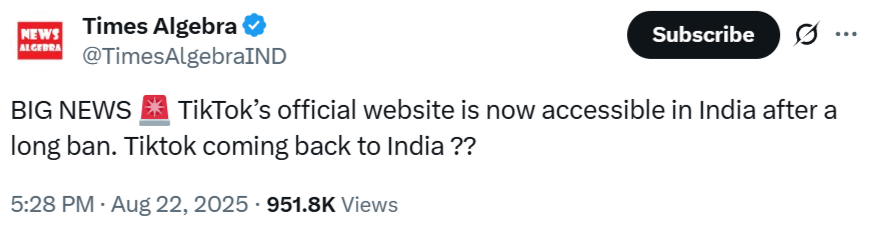
Rumours ran rife on social media yesterday (22nd August) that the ban on the Chinese app TikTok has been lifted by the Indian government. Several social media accounts, as well as some media outlets, widely posted about the supposed lifting of the ban on the Chinese app.
Screenshot via X
The rumours started after the TikTok website became partially accessible to some users in India, causing excitement among its fans. The TikTok app, however, remained unavailable on the Google Play Store and the App Store.
Screenshot via X
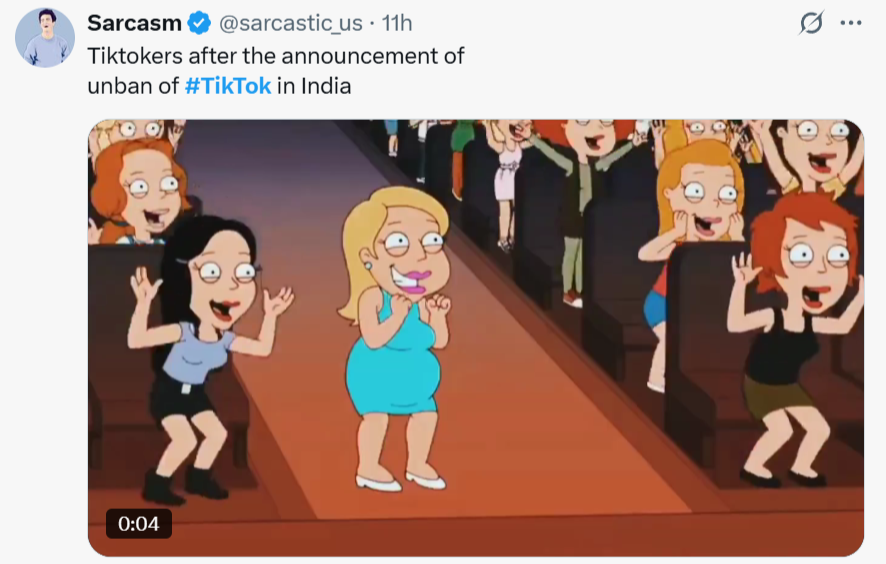
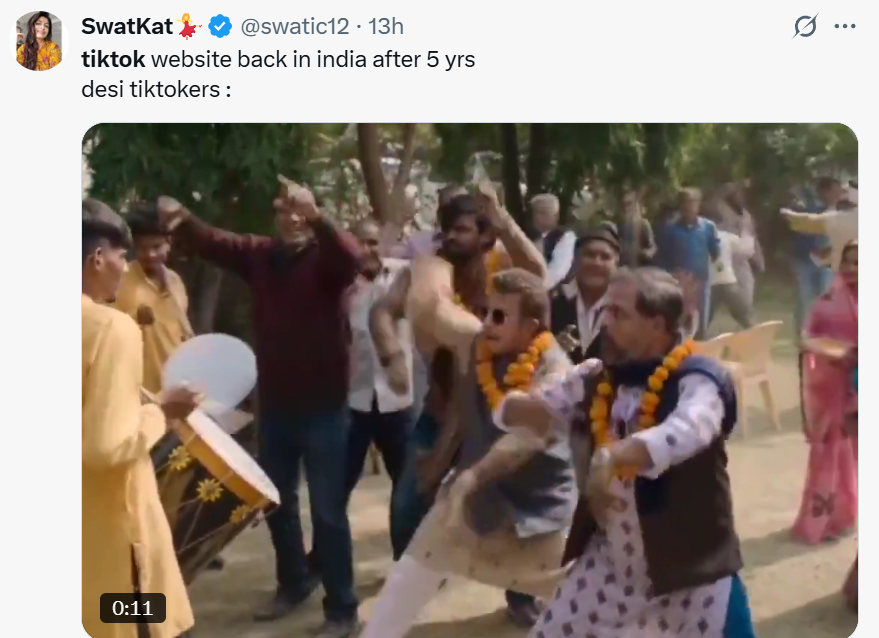
Several accounts on X expressed excitement by posting popular memes over the rumoured comeback of the app in India.
Screenshot via X
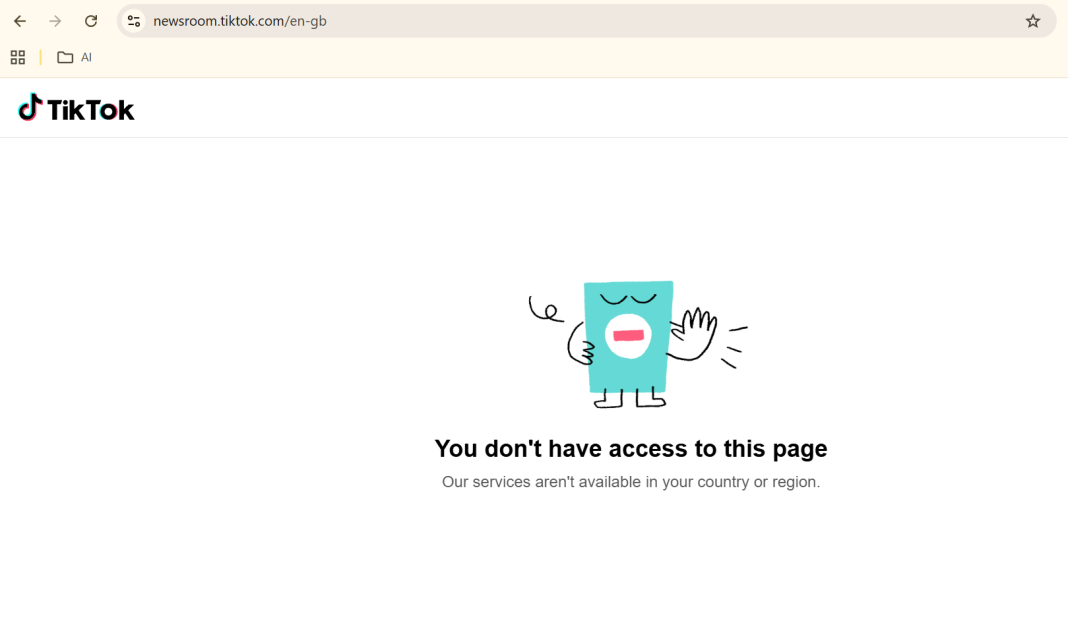
The homepage of the TikTok website is visible to some users in India, but no further access is available. When the ‘Newsroom’ link on the website is clicked, a message appears, which reads, “You don’t have access to this page” and “Our services are not available in your country or region”.
Screenshot via TikTok Website
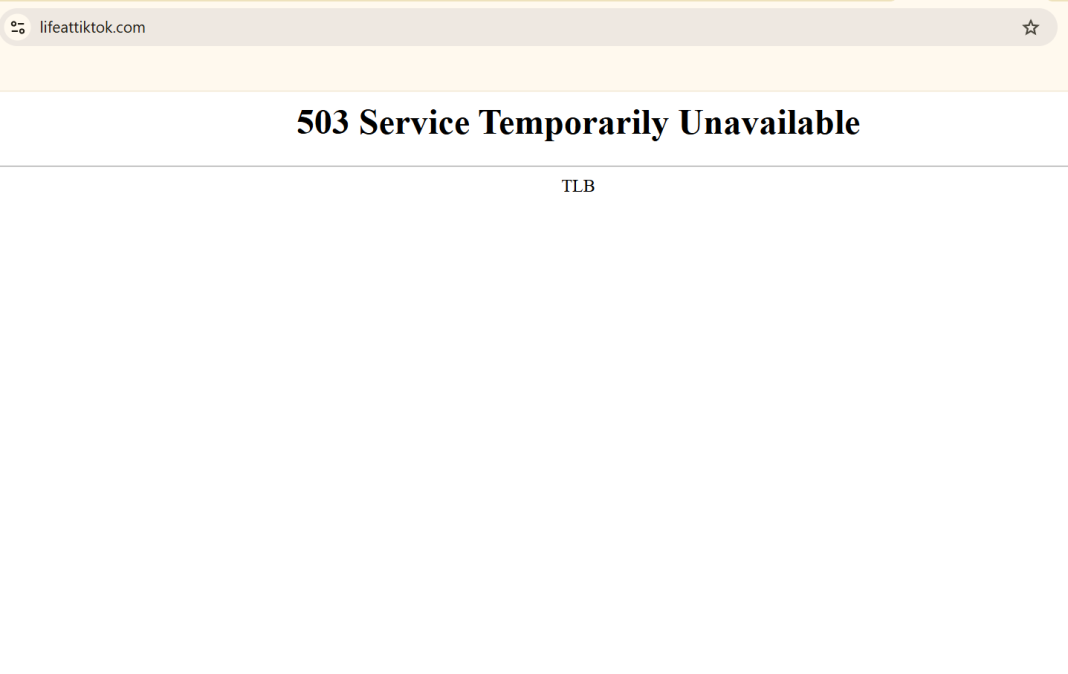
Similarly, when the ‘careers’ link on the website is clicked, it flashes a message saying “503 Service Temporarily Unavailable”.
Screenshot via TikTok Website
When one visits the TikTok website, its about page opens. However, there are no options to log in or sign in, which means it can’t be used in India. Similarly, as the app is still not available, it can’t be used from mobile devices. It is not confirmed whether one page of the website became accessible in India due to some technical glitch.
The only webpage of TikTok accessible from India
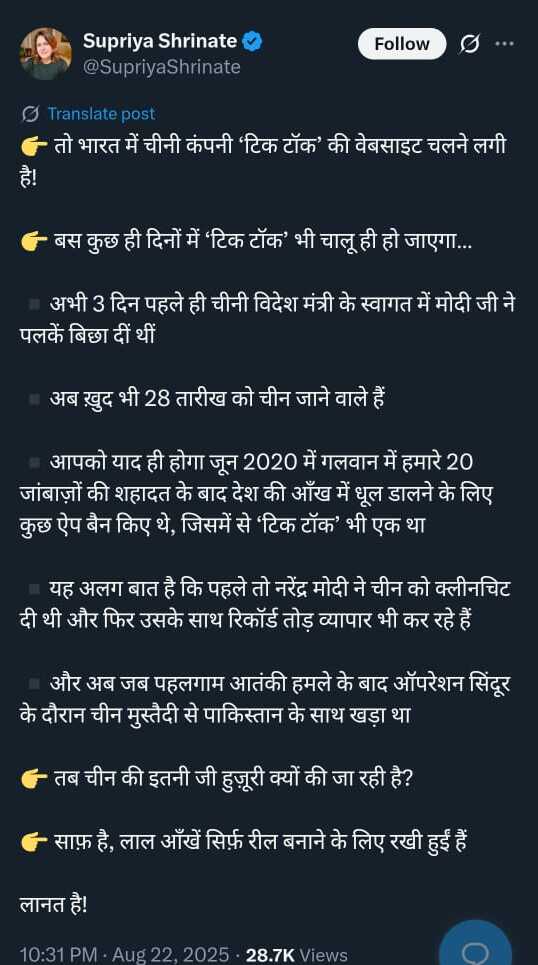
The Congress Party grabbed the opportunity to slam the Modi government. Former journalist and Congress leader, Supriya Shrinate, lashed out at the Modi government, claiming that the government deceived people by banning the Chinese app after the Galwan Valley clash. She added that soon the app will be running in India.
Screenshot via X
Putting all the rumours and allegations to rest, the government clarified that TikTok remains banned in India. The government did not issue any order for lifting the ban on the Chinese app.
The Government of India has not issued any unblocking order for TikTok. Any such statement/news is false and misleading: Govt Sources pic.twitter.com/1BxK5jE4xG
In June 2020, the Ministry of Information Technology banned 59 apps, including TikTok, over security and privacy concerns. The Ministry of Information Technology, invoking its power under section 69A of Information Technology Act, with the relevant provisions of the Information Technology (Procedure and Safeguards for Blocking of Access of Information by Public) Rules 2009 has ordered a block on the use of 59 apps saying that these apps are “engaged in activities which are prejudicial to sovereignty and integrity of India, defence of India, the security of the state and public order”.
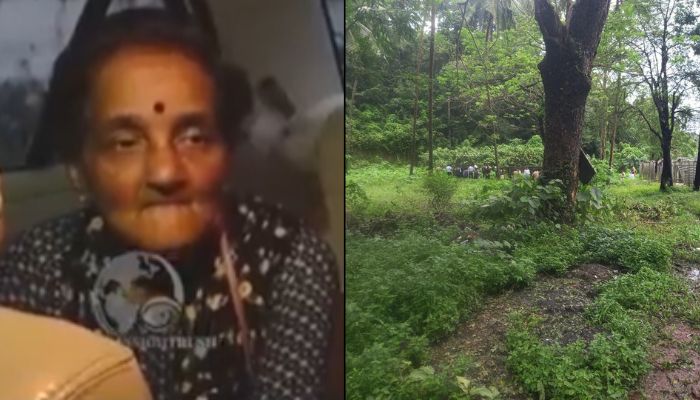
On Friday (22nd August), an elderly woman named Sujatha Bhat conceded that her testimony of a missing daughter in Dharmasthala, which fuelled allegations of mass burial and sexual assault, was fabricated.
While speaking to a YouTube channel, Bhat informed that she was brainwashed into lying by activists Girish Mattannavar and T Jayanti. The duo had been campaigning to defame the temple town of Dharmasthala.
Sujatha Bhat had previously claimed that her ‘daughter’, Ananya Bhat, went missing in Dharmashtala in May 2003. She had alleged that the non-existent Ananya was an 18-year-old medical student who disappeared from the temple area.
Bhat also claimed that she was kidnapped, tied up and threatened not to return to Dharmasthala. She was allegedly told not to speak about her ‘ordeal’ publicly. She also claimed to be assaulted, treated at a private hospital in Bengaluru and remained in a state of coma.
“It is not true. There was never any daughter named Ananya Bhat,” the woman acknowledged. She further added that the picture presented as evidence of Ananya’s existence was also completely fake.
It has now come to light that Sujatha Bhat, who had earlier claimed to be the mother of a fictitious person named Ananya Bhat and alleged that her daughter was subjected to abuse and murder in Dharmasthala, has admitted that her statements were false. She revealed that she was… pic.twitter.com/YyeKu3KCaJ
Sujatha Bhat conceded, “Some people told me to say it. I was asked to do it because of the property issue. That’s the only reason.”
Reportedly, she joined the defamatory campaign targeting the temple town due to a dispute over a parcel of land between the Dharmasthala temple administration and her grandfather.
Sujatha Bhat claimed that she never received or paid money in connection with her fake testimony. “Nobody demanded money from me,” she was heard saying.
She further apologised to the people of Karnataka for hurting their religious sentiments. “Yes, for the people of Karnataka, for the devotees of Dharmasthala…I ask the people of this state, and the whole country, to forgive me…” Bhat added.
In the meantime, the Special Investigation Team on Friday (22nd August) directed Sujatha Bhat to appear before its office in Belthangady.
17 sites searched, no skeletons of any woman yet
In the ongoing investigation into the sensational case, no human remains of any females (allegedly buried at the sites pointed out by a whistleblower) have been exhumed by the Special Investigation Team (SIT).
The SIT started the process of digging at the sites pointed out by the sanitation worker on 29th July. Five sites, out of the total 13 sites identified by the sanitation worker, were dug up by the SIT by 30th July, but no human remains were discovered.
On 31st July, SIT exhumed some human remains at the sixth site. However, an official confirmed that they belonged to a human male.
The police reportedly found around 15 bones at the site, some of which were broken, but no skull was found.
In addition to that, the SIT discovered a debit card belonging to a woman and a PAN card belonging to a man. When the investigation team tracked down the owner of the PAN Card, they reached his family.
The PAN Card reportedly belonged to a man named Suresh, from Nelamangala taluk in Bengaluru Rural district. His father told the team that Suresh was an alcoholic and died of jaundice in March 2025.
The Background of the controversy
The case started after the unknown man claimed that he was former sanitation worker employed by the Lord Manjunatha shrine in Dharmasthala, and that he was forced to bury dead bodies of women and minor girls in Dharmasthala.
He lodged a complaint with the police on 3rd June with some ‘evidence’, and a week later, he appeared before a court covered head to toe to conceal his identity, to testify to the allegations made in his complaint. He submitted some skeletal remains he claimed to have exhumed from one of the burial sites.
The ’masked man’ had alleged that he was forced to burry a large number of young women and minor girls after they were allegedly killed at Dharmasthala between 1995 and 2014. Following this, another complaint was filed by a woman whose daughter had gone missing while on a trip to the pilgrimage town of Dharmasthala.
Given the seriousness of the allegations, the Karnataka government ordered the formation of an SIT to probe the case on 19 July. The ‘masked man’ gave the SIT the locations of 13 ‘burial sites’, and the SIT started excavating at those places.
And as the SIT excavated one after another site, the entire case started to fall apart, as nothing was found at those places. The skull that the man had submitted at the court turned up to belong to a man. The skull was examined at two hospitals, and both tests confirmed that it belonged to a man who died 30 years ago.
The ‘masked man’ claimed that 60-100 bodies were buried at site number 13 at the depth of 16 feet. The SIT used Ground Penetrating Radar, which detected nothing. When the site was excavated, nothing was found.