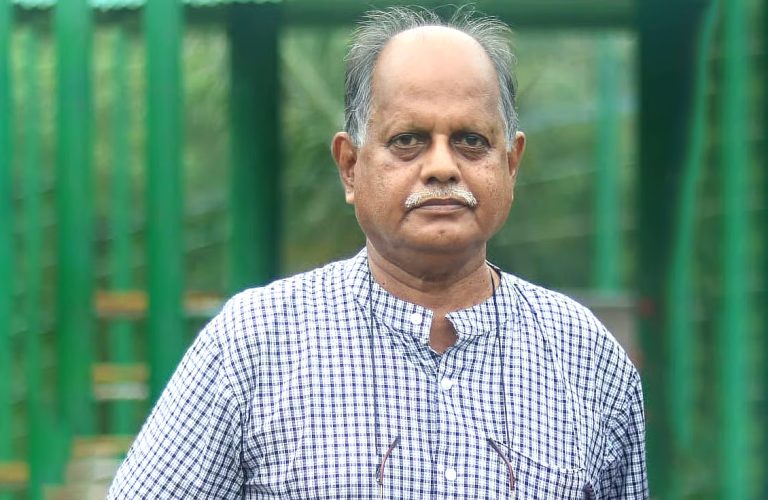
Veteran Bangldaeshi journalist-columnist Bibhuranjan Sarkar, who went missing a day ago, was found dead on Friday. Police recovered the body of 71-year-old Sarkar from Meghna River in Munshiganj.
He had been reported missing since Thursday morning. Police said that the body was found floating in the river near Kalagachhia. They matched it with the photograph of the missing journalist submitted by Ramna police, and informed the station immediately.
Bibhuranjan Sarkar worked as Senior Assistant Editor at Ajker Patrika and contributed regular columns to various media outlets. Before leaving home on Thursday, he sent his ‘last article’ to bdnews24.com, adding in a footnote, “This may be published as my final piece.”
Sarkar was missing after he left his residence on Friday morning saying that he was going to Ajker Patrika office. He had left his phone behind. When he didn’t return by evening, his family called the newspaper office, and were told that he didn’t went to the office that day.
After searching in various places and finding nothing, Bibhuranjan’s son Rit Sarkar filed a report at Ramna Police Station at night.
His final article, titled “Khola Chithi”, or Open Letter, was published in the opinion section of bdnews24.com on Friday. In the open letter, he wrote how he was labelled pro-Awami League despite receiving no benefit from the Sheikh Hasina government.
He wrote about his regrets, highlighting the financial uncertainty he faced during his long journalism career, his and his son’s illnesses, and the lack of proper appreciation for his doctor daughter and engineer son.
He wrote, “I have no success stories in my life. Even as a journalist, I have not been able to grasp any solid ground by trying to do so. I have a big deficiency somewhere or the other. I have not been able to overcome this deficiency.”
Given the circumstances, it has been speculated that the journalist died by suicide.
Born in 1954, Bibhuranjan Sarkar studied in the Bengali department of Dhaka University. He was a student union leader and was also involved in the leftist movement.
The Government of India has sanctioned 23 chip-design projects under the Design Linked Incentive (DLI) Scheme as part of its effort to boost the country’s semiconductor design capabilities, the Ministry of Electronics & IT said in a statement. These projects, led by domestic startups and MSMEs, are receiving support to develop indigenous chips and System-on-chip (SOC) solutions for areas such as surveillance cameras, energy meters, microprocessor IPs, and networking applications. 72 companies have gained access to the industry-standard Electronic Design Automation (EDA) tools for their chip design projects.
Amongst these- Vervesemi Microelectronics, a fabless semiconductor company, today announced its upcoming portfolio of advanced integrated circuits (ICs) designed to accelerate India’s semiconductor self-reliance and drive global innovation.
Founded in 2017, Vervesemi is among the first Indian companies to export semiconductor intellectual property (IPs) globally, with its proprietary machine learning-powered analog chain IPs embedded in products of leading international manufacturers. With a portfolio of 110+ IPs, 25 IC SKUs, 10 patents, and 5 trade secrets, the company is powering applications across space, defense, industrial, and smart energy, with multiple ICs currently under evaluation by customers worldwide.
Amongst the first cohort of the companies approved under the Government of India’s DLI Scheme and also approved under Chips to Startup (C2S) program, Vervesemi is committed to developing designed-in-India chips that strengthen self-sustenance and foster innovation.
Vervesemi’s roadmap includes several notable ICs designed to address critical applications. BLDC controller Application Specific Integrated Chip (ASIC) is being designed by Vervesemi under the MeitY-supported C2S Programme, aimed at small motor applications such as fans and appliances, further reducing import dependence with samples expected in 2026.
ASIC for Precision motor-control solutions, approved as a DLI-recognized project, is focused on silicon for EVs, drones, and industrial automation, also targeted for sampling in 2026.
Other significant products roadmap includes the following –
ASIC for multifunction data acquisition system for space and avionics, powered by advanced machine learning and designed for mission-critical aerospace applications, with engineering samples available in 2026.
ASIC for weighing scale and bridge sensor applications is enabling next-generation weighing systems and Force Touch devices with very high precision and reliability. This IC is being sampled with key partners across Asia, with engineering samples available at end of 2025.
ASIC for smart energy metering applications is being designed in India to deliver ultra-accurate, high-speed energy measurement and predictive maintenance capabilities. Featuring multi-channel sensing compliant with Class 0.2S precision standards, this IC ensures robust and reliable performance for next-generation smart energy systems with samples available at end of 2025.
Vervesemi’s ICs are powered by embedded machine learning, enabling self-healing systems, fail-safe reliability, and improved fabrication yields. This breakthrough extends performance, power efficiency, and precision beyond traditional boundaries; making Vervesemi chips smarter, safer, and more efficient.
“These innovations mark a turning point for India’s semiconductor ecosystem,” said Rakesh Malik, Founder & CEO of Vervesemi. “By building high-performance, Made-in-India ICs for strategic and consumer markets, we are not only driving import substitution but also showcasing India’s capability to lead on the global semiconductor stage.”
At Vervesemi, we integrate advanced signal-chain design with machine learning to deliver fault tolerance, adaptive calibration, and predictive diagnostics. Our multi-channel data acquisition and industrial application ICs set new benchmarks in precision, efficiency, and reliability across aerospace, industrial, and consumer markets,” said Pratap Narayan Singh, Founder & CTO, Vervesemi Microelectronics.
“India’s ambition to become a world leader in semiconductor design, envisioning a future where every device in the world has designed-in-India chip” said Smt. Sunita Verma, Group Coordinator(R&D), MeitY
Vervesemi Microelectronics is a fabless semiconductor company specializing in high-performance analog IPs and ASICs. With innovations spanning five foundries and over 20 technology nodes, Vervesemi delivers up to 10x improvements in performance, power, and area. Trusted by global manufacturers in 5G, Wi-Fi 6/7, energy, motor control, and aerospace, Vervesemi continues to pioneer designed-in-India semiconductor solutions for worldwide impact.
While US president Donald Trump keeps attacking India for buying Russian oil and have imposed 50% tariff with threats of more, he is now angry at Ukraine for disrupting supply of Russian oil to Europe. Trump said that he was ‘very angry’ at Ukraine for bombing a pipeline that carries Russian oil to central Europe.
Trump’s comments came in response to a note by his friend Viktor Orbán, the Prime Minister of Hungary, calling the move unfriendly. He was referring of bombing of the Druzhba pipeline in Russia, which supplies Russian oil to Hungary, Slovakia and other countries in Central Europe. The pipeline goes through Ukraine.
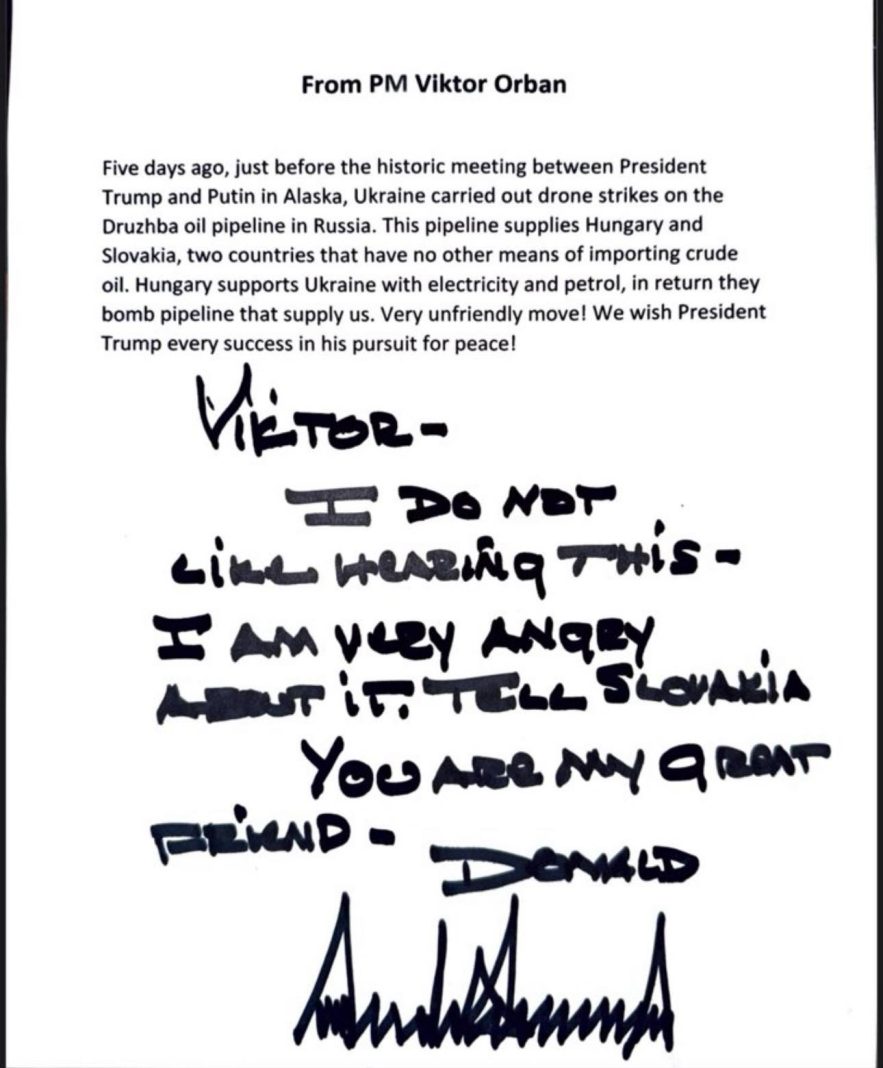
Viktor Orbán wrote, “Five days ago, just before the historic meeting between President Trump and Putin in Alaska, Ukraine carried out drone strikes on the Druzhba oil pipeline in Russia. This pipeline supplies Hungary and Slovakia, two countries that have no other means of importing crude oil. Hungary supports Ukraine with electricity and petrol, in return they bomb pipeline that supply us. Very unfriendly move! We wish President Trump every success in his pursuit for peace!”
Trump wrote a handwritten note below Viktor’s comments, saying, “Viktor – I do not like hearing this. I am very angry about it. Tell Slovakia. You are my great friend.”
The note was posted by Orbán’s ruling Fidesz party on Facebook.
Notably, the recent attack on the Druzhba pipeline was the third attack on it by Ukraine in this week. The pipeline was restored on 19 August, but it was again hit two days later, when the Unecha oil pumping station in Russia was hit on Thursday night. This has completely halted Russian oil deliveries to Hungary and Slovakia, which are still importing large amounts of Russian oil.
After the third hit, Hungary and Slovakia have written to European Commission seeking EU action to stop Ukraine from attacking the Druzhba pipeline. “Given that in the past years, the EU and its Member States have provided hundreds of billions of Euros’ worth of support to Ukraine, we find Ukraine’s actions, which severely threaten the energy security of Hungary and Slovakia, completely irresponsible,” read the letter signed by Hungary’s Foreign Minister Péter Szijjártó and Slovakia’s Foreign Minister Juraj Blanár.
Péter Szijjártó posted on X saying, “The Druzhba pipeline is indispensable for our energy supply. Without it, providing oil to our countries is physically impossible. Such attacks are a direct and unacceptable assault on our energy security.” He alleged that with these attacks, Ukraine hurting Hungary and Slovakia, not Russia.
Together with Slovak FM Juraj Blanár, we sent a letter to HRVP @kajakallas and Energy Commissioner @DanJoergensen demanding that the @EU_Commission finally act against Ukraine’s repeated attacks on the Druzhba oil pipeline.
He further added, “Brussels must understand: they are the EUROPEAN Commission, not the Ukrainian Commission!”
In another tweet, the Hungarian foreign minister alleged that the attack on the pipeline was a clear attack on their energy security and another attempt to drag Hungary into the war. “It will not succeed! We stand for peace & our national interests,” he added.
???? UKRAINE STRIKES DRUZHBA PIPELINE AGAIN
The Armed Forces of Ukraine released new footage showing another strike on Russia’s Unecha Oil Pumping Station in Bryansk Oblast.
Reportedly, the attacks on the pipeline have been conducted by the Unmanned Systems Forces of Ukraine. While Ukraine has not officially acknowledged the attacks, a video of the strike was posted on Telegram by Robert Brovdi, the head of Unmanned Systems Forces.
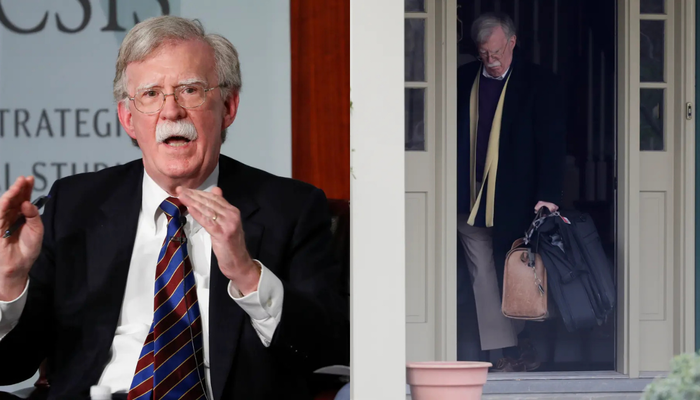
A team of the Federal Bureau of Investigation (FBI) on Friday morning raided the house of John Bolton, who was the National Security Advisor to the Trump administration during his first term. According to the New York Post, the raids were conducted by the FBI agents at Bolton’s house in Bethesda, Maryland, as part of an investigation ordered by FBI Chief Kash Patel.
Shortly after the raids, the FBI Chief Kash Patel posted a cryptic message on x, which said, “NO ONE is above the law…@FBI agents on mission”.
— FBI Director Kash Patel (@FBIDirectorKash) August 22, 2025
The investigation, which was launched years ago, reportedly involves classified documents. It was shut down by the previous Biden administration. Bolton has been at loggerheads with Trump since he was accused of disclosing classified information in his book titled “The Room Where it Happened” in 2020.
Trump unsuccessfully tried to stop the publication of the book, citing the inclusion of ‘national secrets’. He said that Bolton breached a non-disclosure agreement, which was signed by him as a condition of his employment in the first Trump administration. Subsequently, an inquiry was opened into the book in September 2020 by the Justice Department. However, the case was closed by the Biden administration.
A day before the raid, Kash Patel accused former FBI Director James Comey of authorising leaks of classified documents and “misleading Congress” before the 2016 elections.
The raid comes amid the vocal criticism by Bolton of the Trump administration’s national security and foreign policies. He has been appearing on TV channels criticising Trump over his policies, and has supported India’s stand on the tariff and Russian oil issue.
A day before the highly anticipated meeting between Russia and the US, Bolton described Trump’s decision to selectively impose tariffs on India for buying Russian oil and to exempt China, which also buys Russian oil, as a “lack of focus’ and “unforced error” by the Trump administration.
When Trump slapped tariffs on India for buying Russian oil, but not China which also purchases Russia oil, it may have pushed India further into the Beijing-Moscow axis. This lack of focus by the Trump Admin is an unforced error. pic.twitter.com/7lXNpyMg79
“Leaving India hanging out to dry as the only country to which punitive action has been taken obviously leads a lot of people to conclude that the United States has given up on India. I do worry that India is being driven closer to Russia and China,” Bolton said. He added that the US sanctions on Russia do not technically prohibit India from buying the Russian oil or even reselling it in the international market.
According to Bolton, Trump’s “lack of strategic thinking and priorities” has pushed India closer to Russia, which is against the interests of the US.
India has reacted very strongly against Trump's decision to impose tariffs for purchasing Russian oil and gas, potentially driving India closer to Russia, contrary to US national interests. This unforced US error shows the Administration's lack of strategic thinking and…
Bolton predicted that after the imposition of Trump’s tariffs on India, both China and Russia would try to draw India closer, which, according to Bolton, would have negative consequences for the US.
Notably, PM Modi had a telephone conversation with Putin last week, in which he invited the Russian President to India for the India-Russia Annual Summit, later this year. Besides, after a gap of seven years, PM Modi is expected to visit China later this month for the Shanghai Cooperation Organisation (SCO) Summit in Tianjin.
India targeted numerous terrorist hideouts in Pakistan during “Operation Sindoor” including Muhammad Masood Azhar Alvi alias Masood Azhar, Jaish-e-Mohammed (Jaish or JeM). He has now formulated a plan to re-establish terrorist facilities in collaboration with Inter-Services Intelligence (ISI) and 3.9 billion (390 crores) Pakistani rupees are to be used for this.
They have devised an ingenious method to raise funds to prevent suspicion from international agencies. The terrorists are now acquiring money through digital wallets instead of bank accounts.
Jaish’s strategy to evade organizations such as FATF
Pakistan is notorious for its support of terrorism. Consequently, it remained on the Financial Action Task Force (FATF) grey list for an extended period. Hence, the Islamic Republic proposed a plan that included measures against Jaish-e-Mohammed to address this issue. The former insisted that it does not financially support terrorists and mentioned its intention to monitor the bank accounts of Masood Azhar, his brother Rauf Asghar and his youngest brother Talha al Saif.
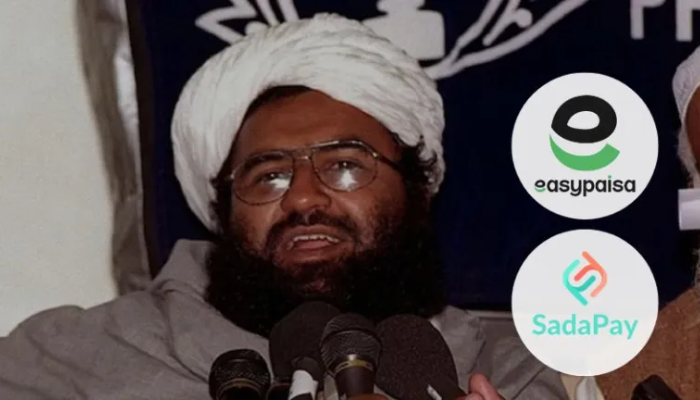
As a result of these actions, the terror state successfully exited the FATF grey list in 2022, however, its deceptive tricks did not go unnoticed by India. Outfits such as Jaish-e-Mohammed continued to thrive within Pakistan and their operations remained unabated. Terrorists required funds to sustain their activities and the scrutiny of Pakistan’s bank accounts made this increasingly challenging. Hence, Pakistani digital wallets like EasyPaisa and SadaPay have now been utilized, to circumvent this barrier.
Jaish to build 313 terrorist camps
ISI and Jaish are currently attempting to amass 3.9 billion Pakistani Rupees under the pretext of constructing mosques and markaz. These places have previously been utilized by the terrorist group Lashkar-e-Taiba (LeT). Indian intelligence agencies suspect that a significant portion of this amount is allocated to support terrorism and procure weapons for terrorist activities.
Jaish aims to set up 313 new camps with this financial resource. The apprehension regarding India also contributes to the formation of these structures. The terror group is doing it to mislead India, in response to the destruction of its hideouts during the military action. The headquarters of Jaish, Markaz Subhanallah, was demolished in Pakistan and Pakistan Occupied Kashmir (PoK) following the Pahalgam terrorist attack.
Additionally, four other Jaish training camps, namely Markaz Syedna Bilal, Markaz Abbas, Mahmona Zoya and Markaz Sarjal were also obliterated. Over 100 terrorists were eliminated including Masood Azhar’s family members.
5 digital wallets of Jaish discovered
Money had been gathered through digital wallets registered under the names of family members of Masood Azhar. If there had been no bank transactions, Islamabad could have claimed that the funds received by Jaish had decreased while in truth, a significant sum is being funneled to the terrorists.
According to reports, five such wallets have been identified all of which are directly linked to Jaish. A SadaPay account was registered under the name of Masood Azhar’s brother, Talha Al Saif (Talha Gulzar) which was associated with the Pakistani mobile number +92 3025xxxx56, reported Aaj Tak.
This number was registered in the name of Aftab Ahmed, the commander of Jaish in the Haripur district. Additionally, an EasyPaisa wallet was connected to the mobile number of Masood Azhar’s son, Abdullah Azhar which is +92 33xxxx4937. Furthermore, there a wallet set up to provide assistance in Gaza. It was managed from the number +92xxxx195206 and was registered under the name of Khalid Ahmed. However, it was actually operated by Masood Azhar’s son, Hammad Azhar.
Donation campaign in mosques
JeM terrorists are also gathering donations from mosques during Friday prayers in addition to soliciting funds online. They present this money as assistance for Gaza, but in reality it is being utilized to support terrorist activities. A video featuring Jaish commander Wasim Chauhan (also known as Wasim Khan) emerged, showing him counting the amount after a Friday prayer.
A trust named “Al-Rehmat” managed by Masood Azhar and his close associates has also become a crucial part in this scheme. This trust has been taking funds through an account (account number 105XX9) at the National Bank of Pakistan which is operated under the name of Ghulam Murtaza. Annually, this trust contributes approximately 100 crore Pakistani rupees to JeM’s financial resources.
Social media to foreign countries: Jaish demands funds
Jaish has fully mobilized its active operatives and proxy network with plans to generate funds through platforms such as Facebook and WhatsApp, according to recent intelligence reports. Information suggests that posters, provocative videos and letters authored by Masood Azhar are being consistently disseminated on these platforms from proxy accounts associated with Jaish as well as those directly managed by its commanders.
These posts assert that the terror group is in the process of developing 313 Markaz and each facility requires 12.5 million Pakistani rupees. This effort is not confined to Pakistan alone as Jaish also sought contributions from Pakistani citizens residing abroad. It is evident that these funds will be utilized for training terrorists, securing weapons and expanding the terror network.
Jaish exploits the network of digital wallets
According to a report by the Economic Times, the digital wallets utilized by Jaish such as EasyPaisa and SadaPay, offer the facility for wallet-to-wallet and wallet-to-cash transfers which is not available in traditional banking. This feature complicates monitoring efforts for international bodies like FATF.
The report indicated that Masood Azhar’s family manages between 7 to 8 wallets simultaneously and replace them every 4 months. When a significant sum accumulates in a wallet, it is segmented into smaller amounts for cash withdrawal. It is disclosed that approximately 30 new wallets are created each month.
Cybersecurity expert Amit Dubey stated that these digital wallets function similarly to “digital hawala,” enabling monetary transactions without relying on a banking network. This is why this network of Jaish manages to evade the clutches of investigative agencies and international monitoring organizations.
Jaish’s financial transactions reportedly occur through these wallets, amounting to around 80-90 crore Pakistani rupees at present. This money is utilized for purchasing weapons, operating training camps, supporting Azhar Masood’s family and acquiring luxury vehicles. A large part of this amount comes from the Gulf.
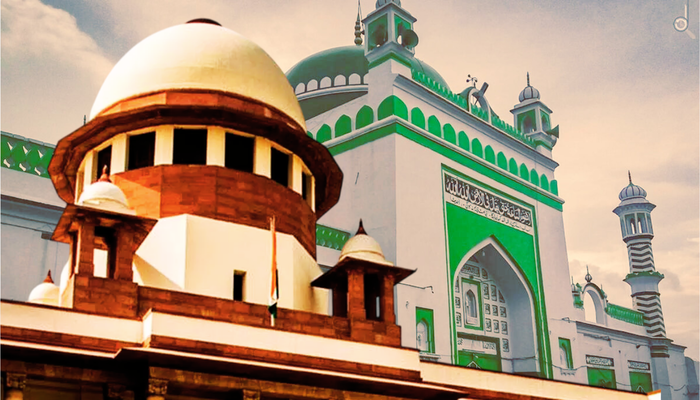
The Supreme Court on Friday (22nd August) ordered a status quo effective till Monday (25th August) in the Sambhal mosque case, during the hearing of a Special Leave Petition (SLP) filed by the Sambhal Mosque Committee. With the status quo order, any further developments in the case have been stayed till further hearing.
The plea filed by the Sambhal Mosque Committee challenged an order passed by the Allahabad High Court on May 19, 2025, upholding a decision of the civil court, which held that the suit with respect to the Sambhal mosque was not barred by the Places of Worship Act. The civil court also allowed the survey of the court and appointed a commissioner for that.
A bench of Justices P.S. Narasimha and A.S. Chandurkar passed an interim order of status quo and issued notice to the Hindu petitioners in the matter. Senior Advocate Huzefa Ahmadi, appearing for the mosque committee, contended before the Apex Court that the High Court was not right in holding that the suit was not barred by the Places of Worship Act.
Advocate Vishnu Shankar Jain, appearing for the Hindu side, submitted before the court that the issue relating to the said did not arise in the case as the Sambhal mosque, being an Archaeological Survey of India (ASI)-protected monument, was not subject to the Act. He said that the plaintiffs (Hindu side) were only seeking access to the monument.
In support of his submission, Jain cited an order passed by another bench of the Supreme Court earlier in the day, wherein it was held that an ASI-protected monument is not covered by the Places of Worship Act. The Court asked Jain to produce the said order and ordered the status quo. “We will see that order. We do not want to pass inconsistent orders,” Justice Narasimha said.
Background of the case
The civil suit in relation to the Sambhal mosque was filed by eight Hindu plaintiffs, including Mahant Rishiraj Giri. The plaintiffs claimed that the mosque was built in 1526 after partially demolishing an ancient Hindu temple dedicated to Kalki, Lord Vishu’s avatar. The plaintiffs sought the right to access and worship the sacred site.
The civil court allowed the suit, holding that it was not barred by the Places of Worship Act. Besides, it ordered a court-monitored survey of the site on November 19, 2024 and appointed an Advocate Commissioner for that. However, during the second round of the court-monitored survey on November 24, 2024, Islamist mobsters, who had gathered outside the mosque, engaged in violence and created communal disturbance. The Sambhal Mosque Committee moved the Allahabad High Court, claiming that the second survey was illegal as the court did not order it. The High Court upheld the decision of the civil court regarding the maintainability of the suit and the order of the survey.
After the violence by Islamists, the Supreme Court stayed the proceedings in the civil court pending the decision of the High Court on the Committee’s plea. In May 2025, I rejected the committee’s claims and upheld the civil court’s decision.
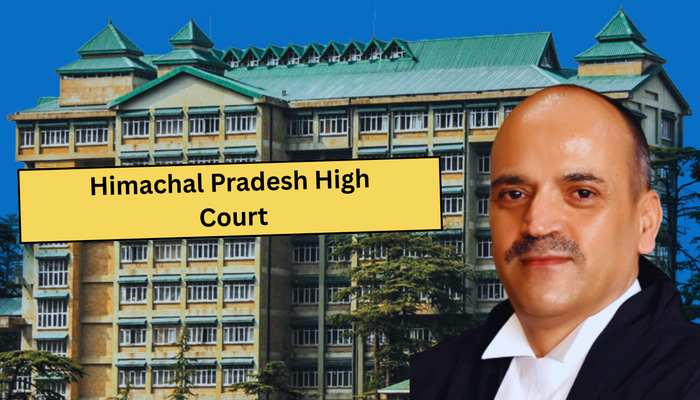
The Himachal Pradesh High Court said in a bail order passed on 19th August, that raising pro-Pakistan slogans does not amount to sedition. The observation was made by a single bench of Justice Rakesh Kainthla while allowing the bail plea of an accused named Suleman.
The accused moved the court seeking bail after he was booked under Section 152 of the BNS by Paonta Sahib police in the Sirmour district of Himachal Pradesh in May this year. Suleman was accused of sharing an AI-generated image of PM Modi with a slogan of ‘Pakistan Zindabad’ written on it. The counsel for the state submitted before the court that the image was shared by the accused at a time when the relations between India and Pakistan were strained.
‘Hailing a country without denouncing one’s own country is not sedition’, says HC
The High Court observed that the act of the accused did not amount to sedition, as praising a country without denouncing one’s own country did not constitute the offence. “Hailing a country without denouncing the motherland does not constitute an offence of sedition because it does not incite armed rebellion, subversive activities, or encourage feelings of separatist activities. Therefore, prima facie, there is insufficient material to connect the petitioner with the commission of a crime,” the High Court stated in its order granting the accused a conditional bail.
“There is no averment in the complaint that hatred or discontent was brought towards the government established by law in India. The averments show that the words ‘Pakistan Zindabad’ were mentioned in the post,” the court added. The High Court said that the custodial interrogation of the accused was not necessary, and therefore, he should be released after submitting a sum of ₹50,000.
Suleman surrendered to the police on July 8, 2025. A chargesheet was filed by the police before the court on August 6, 2025.
Israel’s Defense Minister Israel Katz on Friday warned Hamas that the “gates of hell” will open for the terror group if they don’t release all the hostages and agree to the Israel’s terms of ceasefire. The comment comes after the Israel government approved military plans to intensify operations in Gaza.
The statement, posted on X (formerly Twitter), signals a potential major escalation in the nearly two-year war, with plans focusing on taking control of Gaza City through heavy firepower, civilian evacuations, and ground maneuvers. In his post in Hebrew, Katz wrote: “We approved yesterday the IDF’s plans to defeat Hamas in Gaza – with intense fire, evacuation of residents, and maneuver. Soon the gates of hell will open on the heads of the murderers and rapists of Hamas in Gaza – until they agree to Israel’s conditions for ending the war, primarily the release of all hostages and disarmament. If they do not agree – Gaza, the capital of Hamas, will become like Rafah and Beit Hanoun. Exactly as I promised – so it will be.”
אישרנו אתמול את תוכניות צה"ל להכרעת החמאס בעזה – באש עצימה, בפינוי תושבים ובתמרון. בקרוב ייפתחו שערי הגיהנום על ראשם של מרצחי ואנסי החמאס בעזה – עד שיסכימו לתנאי ישראל לסיום המלחמה ובראשם שחרור כל החטופים והתפרקות מנשקם. אם לא יסכימו – עזה בירת החמאס תהפוך לרפיח ובית חאנון. בדיוק…
This rhetoric echoes the Israeli cabinet’s approval to take control of Gaza City despite Hamas threat to execute the remaining hostages. The approved plan involves mobilizing up to 60,000 reservists for a phased offensive aimed at conquering Gaza City, Hamas’s stronghold, while expanding humanitarian aid distribution in southern Gaza.
The Israel government has vowed to eradicate Hamas following the group’s October 7, 2023, attack on Israel, which killed approximately 1,200 people and resulted in over 250 hostages being taken.
Israeli forces already control about 75% of the Gaza Strip, according to military statements, with the operation targeting remaining urban areas, including tunnel networks and refugee camps.
Officials have outlined five key principles for ending the war: disarming Hamas, returning all hostages, demilitarizing Gaza, establishing Israeli security control, and creating an alternative civilian administration excluding both Hamas and the Palestinian Authority.
Hamas has responded by denouncing the plan as a “new war crime,” alleging it to be Israel’s blatant disregard for negotiations. The terror group has vowed fierce resistance while holding Israel responsible for endangering remaining hostages.
Prime Minister Netanyahu has emphasized that Israel does not intend permanent governance of Gaza, proposing a handover to unspecified “Arab forces” post-demilitarization.
On 22nd August, the Supreme Court of India delivered a balanced but decisive interim judgment in the stray dog menace case. A clear first victory for OpIndia’s campaign against the menace, the apex court drew a clear line between citizen safety and dog-lobby narrative. The Court made it explicit that the right to life of Indians cannot be compromised to accommodate rabid and aggressive dogs.
The judgment has been passed by a three-judge Bench, headed by Justice Vikram Nath and comprising Justice Sandeep Mehta and NV Anjaria. The Bench modified the earlier 11th August judgment in the suo motu case passed by a two-judge Bench comprising Justice JB Pardiwala and R Mahadevan, which directed the Delhi-NCR authorities to round up all dogs from the streets in a phased manner.
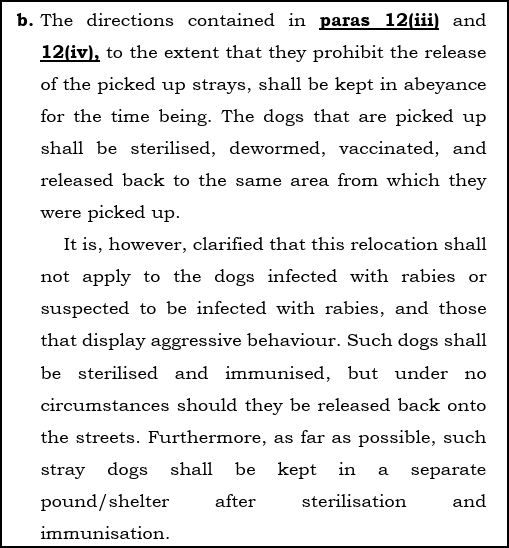
While continuing sterilisation, deworming, and vaccination, the Court categorically prohibited the release of rabid or aggressive dogs back on the street. Just as importantly, it struck a major blow to dog-feeding lobbies by banning feeding on roads and public spaces. Instead, municipal bodies must create designated feeding zones within every ward.
What the Supreme Court ordered
The Court has clarified certain points as follows:
Stray dogs must be picked up, sterilised, dewormed, and vaccinated.
These dogs are to be returned to the same area only if they are healthy and non-aggressive.
Dogs infected with rabies, suspected to be rabid, or showing aggression cannot be released back under any circumstances. They must be kept in separate shelters.
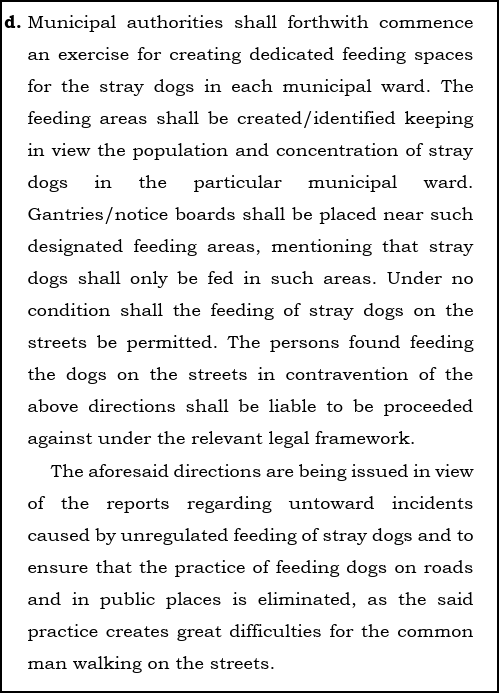
Feeding of stray dogs on public roads is now banned. Feeding areas must be designated by municipal authorities, and violators can be prosecuted. This means dog feeders in gated societies cannot feed dogs anywhere they wish within the premises. Feeding will be permitted only at the officially designated areas.
A helpline must be created in every municipality to allow citizens to report illegal feeding.
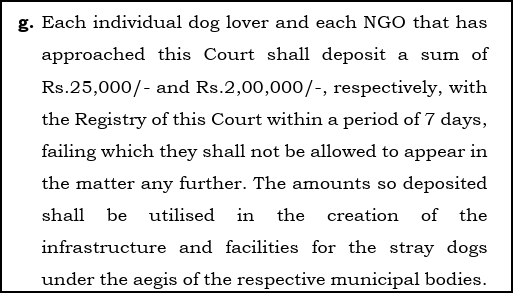
Individuals and NGOs who approached the Court on behalf of dogs must deposit ₹25,000 and ₹2 lakh respectively within 7 days. The money will fund municipal dog infrastructure.
No adopted dog can be sent back to the streets. Once adopted, it is the adopter’s responsibility to keep the dog off public spaces.
This order, while softer than the 11th August direction that required all picked-up dogs to be permanently impounded, nonetheless sets aside key provisions of the Animal Birth Control (Dogs) Rules, 2023. In particular, Rule 16 (allowing feeding of community dogs in public) and Rule 20 (requiring release of sterilised dogs back to the same area) have been diluted to the extent that they no longer shield rabid, aggressive, or dangerous dogs on the streets.
Ban on feeding in public spaces
One of the most significant elements of the ruling is the blanket ban on public feeding. The Court has made it illegal to feed dogs on streets, roads, and public places. Instead, each municipal authority has been directed to create dedicated feeding spaces, marked with boards and gantries, where feeding can take place.
Source: Supreme Court of India
This step directly addresses one of the biggest enablers of dog attacks, that is roadside feeding. When stray dogs are fed on streets, it brings packs together, increases aggression, and makes entire neighbourhoods unsafe. The Court noted how unregulated feeding has led to untoward incidents across the country. From citizens being chased and bitten while on morning walks to children mauled near feeding spots, the dangers have been well documented. OpIndia, as part of its campaign, is regularly documenting these cases.
For years, self-styled dog lovers have claimed that feeding is an act of compassion. But as the Court has now recognised, compassion cannot come at the cost of citizen safety. If feeding is to happen, it must happen in controlled spaces and not in the middle of roads where people live, work, or walk.
Penalties imposed on dog lovers and NGOs
Another striking feature of the order is the financial penalty imposed on those who have tried to stall dog-removal efforts through litigation. The Court directed each individual dog-lover petitioner to deposit Rs 25,000, and each NGO to deposit Rs 2 lakh within a week. If they fail to comply, they will not be permitted to appear in the matter further.
Source: Supreme Court of India
The Court has also directed that this money will not sit idle. It must be used to build infrastructure for municipal dog shelters, veterinary care, and dedicated feeding zones. This is a powerful message to animal-rights groups that litigation cannot be a playground for obstruction while citizens continue to bleed.
However, in a statement, Maneka Gandhi said that the Government of India has allocated Rs 2,500 crores for ABC programmes. This is indeed a massive amount, and the onus should not be on the general public but on those who continue to favour stray dogs.
For years, NGOs shielded under the ABC Rules have pushed for unconditional release of stray dogs back onto the streets. With this ruling, the Court has not only curbed their influence but also made them pay up for the mess created under the ABC regime.
Sterilisation and vaccination are not enough
The Court has clarified that sterilisation and vaccination programmes will continue. However, it does not mean these are the ultimate solution. Sterilisation may prevent breeding, and vaccination may prevent rabies spread, but neither addresses the fundamental menace of dog attacks.
It has to be firmly printed in every mind that sterilised dogs still bite. Vaccinated dogs still chase and create havoc. In fact, authorities will only know whether a dog is “aggressive” after it has already bitten someone. That is the unfortunate reality of how this order is structured. To “identify” an aggressive dog, someone has to first become a victim.
Furthermore, this is going to be used as a loophole in the judgment by the self-styled dog lovers. As Maneka Gandhi said in a recent statement, there is no “definition” of an aggressive dog. Gandhi, who is behind the ABC Rules, hinted at the loophole present in the judgment almost immediately after the order came through.
#WATCH | Delhi | SC rules stray dogs in Delhi-NCR not to be rounded up permanently, animal rights activist & BJP leader Maneka Gandhi says," I am very happy with this scientific judgement. Relocation and fear are the only reasons for dogs biting. There is no question of releasing… pic.twitter.com/lfsS7t15v1
This is why relying on sterilisation as a long-term solution is flawed. Citizens’ right to life cannot depend on whether or not sterilisation has been successful in reducing population after decades. With more than 37 lakh dog bites reported in 2024 alone, the Supreme Court must go beyond sterilisation and mandate permanent removal of all biting dogs.
A victory, but also a warning
Make no mistake, this judgment is a turning point. For the first time, the Supreme Court has recognised that public feeding is unacceptable and that aggressive or diseased dogs cannot be re-released. This is the first crack in the dog-lobby fortress that has hidden behind ABC Rules for decades.
Source: Supreme Court of India
However, this order is also a warning. It shows that unless strong monitoring and immediate compliance are enforced, authorities will hide behind loopholes. Citizens should not have to wait for “more bite cases” to prove that a dog is aggressive. The Court must set strict timelines for states to file affidavits, demonstrate their facilities, and prove they are acting. Otherwise, as always, files will move slowly while more lives are lost.
Also, it has to be noted that the first order came on 11th August and the dog-lobby is so strong that they not only got a new Bench but also got an early hearing in the apex court. The judgment came just a week after it was reserved. If the dog menace is to be controlled, more sane voices need to become a party in the case. Thankfully, the Government of India has made it clear in the Court that the menace must be controlled and the ABC Rules are not enough to do so.
No obstruction will be tolerated
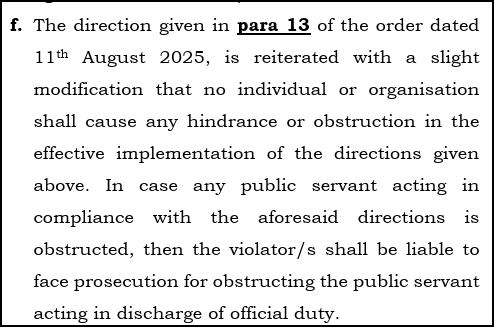
The Supreme Court has made it clear in para 16(f) of its 22nd August order that no individual or organisation can obstruct municipal authorities from implementing its directions. This reiterates para 13 of the 11th August order, leaving no ambiguity on the point. Any obstruction to public servants carrying out their duty will invite prosecution. This comes at a time when, on 18th August, MCD officials were attacked by self-styled dog lovers in Delhi’s Rohini during a stray dog removal drive. The Court’s warning leaves no doubt that such behaviour will now face the full force of the law.
Case expands nationwide
Until now, the stray dog litigation was largely confined to Delhi-NCR. However, the new ruling has expanded its scope across the entire country. All States and Union Territories have been impleaded through their Animal Husbandry and Municipal Departments.
The Registry has been asked to collect details of every stray-dog-related writ pending before various High Courts and transfer them to the Supreme Court. This means that instead of fragmented judgments from different states, there will now be one unified direction for the whole country. This is another major blow to the dog-lobby, which often managed to get favourable judgments from different High Courts.
This nationwide expansion is a historic moment. For decades, states have been shifting blame, pointing to the ABC Rules as a shield. Now, they will have to answer directly to the Supreme Court about what facilities they have, how many shelters exist, how many veterinarians are available, and whether citizens’ complaints are being addressed.
Impact on ABC Rules
Though no one will openly accept it, the 2023 ABC Rules, which were a modified version of the ABC Rules 2001, were designed as a charter for dog lovers. There were provisions like Rule 16 that allow feeding of “community dogs” in public places and Rule 20 which mandates the release of sterilised dogs back to their original spots, even if they had bitten someone.
Today’s ruling cuts straight into these provisions. Public feeding is now expressly banned, and aggressive or rabid dogs can no longer be released. In simple terms, Rules 16 and 20 have been rendered toothless, the same way the ABC Rules have been rendering state laws on controlling the dog menace toothless for decades. This is perhaps the most important outcome of the order as, for the first time, the Court has recognised that citizen safety cannot be sacrificed to dog-feeding activism.
The ruling also closes the door on a favourite argument of the animal-rights groups that sterilisation is enough. By carving out a category of dogs that must never return to streets, the Court has acknowledged the failure of “catch-neuter-release” to guarantee safety.
Balanced but historic
It must be noted that the judgment is still cautious. While banning feeding and disallowing aggressive dogs back on streets, it has kept sterilisation-based release in place for healthy dogs. The result is a compromise, that is, one step towards public safety, one step still bound to ABC philosophy.
For us at OpIndia, this is nonetheless a first victory. The Court has broken the monopoly of dog-lobby narratives. It has ordered financial accountability of NGOs and self-styled dog lovers. It has banned public feeding and prioritised human safety. And it has opened the door for nationwide scrutiny.
But we must also urge the Court not to wait for fresh victims to “prove” aggression. The burden of proof should not fall on children mauled or elderly citizens chased to their deaths. The Supreme Court should require proactive identification of dangerous dogs and insist on permanent removal as a rule, not an exception.
Our call to action
This order is a welcome start, but it cannot be the end. Sterilisation will not stop bites. Vaccination will not stop mauling of children, the elderly, the disabled, and the vulnerable ones. And no family should have to pay the price before a dog is labelled “aggressive.”
The Supreme Court must enforce strict deadlines for states and municipalities. It must demand statistics, compliance affidavits, and concrete action, not vague promises. It must ensure that shelters are built, helplines are active, and violators of the feeding ban are prosecuted.
Most importantly, it must never forget the core principle that India’s streets belong to its citizens, not to packs of feral animals. Today’s order is a first victory. The final victory will come when not a single child has to die to prove that dogs on streets are a menace.
In the end, it is also important to note that dog lovers and activists are already spreading the false claim that the 11th August order has been “stayed.” The truth is that it has only been modified, not struck down. By twisting facts to suit their agenda, these groups are once again attempting to mislead the public and downplay the Supreme Court’s clear stand against the stray dog menace.
OpIndia is doing a series on stray dog menace that can be checked here.
A young man breached security on 22nd August morning and climed the Parliament complex’s wall to enter the highly secured area of the national capital without permission. He made it close to the Garuda Dwar, one of the six gates to Parliament’s main building before being swiftly apprehended by Central Industrial Security Force (CISF).
He scaled the wall from the Rail Bhavan side. The accussed has been identified as 19-year-old Ram Kumar Bind from Bhadohi district in Uttar Pradesh. He works in a factory in Gujarat’s Surat and is reportedly “mentally incoherent.” Further probe is underway.
“Today at about 5: 50 am, one unidentified person approached the Parliament House complex and tried to scale the perimeter wall with an intention to jump inside. However, due to the alertness of the CISF and Delhi Police staff, he was timely intercepted by the security staff and apprehended and handed over to local police for further enquiry,” read the statement of Delhi Police.
The sources said that the man jumped the wall between TKR 2 – North Utility of Parliament gate and got into the Parliament Complex. CISF security personnel at Parliament caught the intruder immediately. The sources said that the man reached the Garuda gate of the new Parliament building by jumping over the wall from the Rail Bhawan side.
The intruder told authorities during interrogation that he intended to return home and had even visited the train station but was unable to board a train. Instead, he proceeded to Parliament. Media reports alerted the local police to the occurrence. According to officials, once Parliament Security has finished questioning him, they will turn him over to the local police for further investigation.
Bind is currently being questioned by the CISF, IB, Parliament Security Wing and other central agencies. The security lapse unfolded just one day after the Parliament’s monsoon session was adjourned sine die, therefore no MP was present. “He wasn’t carrying any bag with him,” reported ThePrint quoting sources.
On 13th December 2001, there was an attack on the old building of the Parliament by terrorists belonging to Pakistan-based terrorist organisations Lashkar-e-Taiba (LeT) and Jaish-e-Mohammed (JeM). Fourteen people, including five terrorists, were killed in the attack. In December 2023, coinciding with the 22nd anniversary of the 2001 Parliament terror attack, two individuals jumped into the Lok Sabha chamber from the visitors’ gallery during Zero Hour and released yellow gas from canisters.
They were heard shouting anti-government slogans. Simultaneously, outside the Parliament complex, two people were seen using similar canisters to release coloured smoke while chanting slogans. Six people were arrested in connection with the incident.