Home Blog Page 243

Rajdeep Sardesai lies about Chhatrapati Shivaji Maharaj to whitewash Mughal atrocities: When false moral equivalence becomes historical slander

In an alarming demonstration of distorting history, India Today journalist Rajdeep Sardesai has once again stirred controversy—this time by misrepresenting the legacy of one of India’s most revered historical icons, Chhatrapati Shivaji Maharaj. During a recent episode of ‘Democratic Newsroom’ on India Today, Sardesai appeared so rattled over the latest NCERT textbook revisions initiated by the central government that he didn’t mind employing lies to achieve false moral equivalence between Mughal tyrants and Chhatrapati Shivaji Maharaj.

While the changes in textbooks, among other things, aim to bring more balance and historical accuracy by highlighting the brutalities of Mughal invaders, facts long suppressed or sanitised in earlier educational narratives, it has also veritably triggered a meltdown among leftwing ‘intellectuals’, with Rajdeep’s angry rant perfectly embodying the complete disregard of historical facts concerning Hindu cultural and historical icons among the left echo chamber.

In his attempt to defend the discredited, Mughal-centric version of Indian history, Sardesai launched into a bizarre tirade, drawing false equivalences between the reign of Shivaji Maharaj and that of the Mughals. Sardesai argued that all medieval rulers, including Shivaji, were driven by political compulsions of the times, an oversimplification that serves only one purpose: to blur the civilizational distinction between native guardians of dharma like Shivaji and foreign invaders like Mughals.

But in doing so, Rajdeep went a step too far. He alleged that Chhatrapati Shivaji Maharaj was a dacoit and his army had wreaked havoc during raids on Bengal. This is not just factually incorrect; it is a blatant lie.

The truth: Shivaji never invaded Bengal

Historical records, including those by both Indian and foreign chroniclers, unanimously state that Chhatrapati Shivaji Maharaj never invaded Bengal, nor did his army conduct raids in that region. Shivaji’s military campaigns were primarily focused on liberating large parts of the Deccan and western India from Mughal and Sultanate control. His resistance was largely confined to the oppressive regimes of Bijapur, Golconda, and especially the Mughals under Aurangzeb.

If there is no credible record of Maratha activity in Bengal during Shivaji’s time, what then was the basis of Rajdeep Sardesai’s claim? None. It appears to be a calculated fabrication aimed at manufacturing moral equivalence between Hindu warrior kings and Islamic invaders whose campaigns were drenched in blood, temple destruction, and forced conversions.

A false equivalence meant to whitewash Mughal crimes

By drawing such false comparisons, Rajdeep is not merely misinforming the public; he is engaged in a subtle but dangerous propaganda effort to trivialise the genocidal violence committed by the Mughals against Hindus and other non-Muslims. Unlike Shivaji, whose campaigns were focused on defensive warfare, protection of the native population, and establishing Hindavi Swarajya (self-rule), the Mughals, especially Aurangzeb, were driven by an explicitly Islamic supremacist fantasy of turning India into an Islamic nation. Temples were occupied, razed, women were abducted and put into harems, and Hindus were taxed, converted, or killed.

There is no recorded instance where Chhatrapati Shivaji Maharaj’s forces indulged in mass rape, temple desecration, or religious persecution. In fact, he was known for his chivalry, especially toward women, and often went out of his way to protect the honour of those captured during warfare, a code of ethics absent from the Mughal playbook.

Political bias masquerading as journalism

This episode raises uncomfortable questions about the ideological lens through which certain sections of Indian media view history. Rajdeep Sardesai’s remarks were not rooted in ignorance, but were entrenched in clear intent to undermine nationalist historical consciousness, which is gaining ground through textbook corrections and contemporary public discourse where questions are raised over celebrations of Mughal tyrants and maintaining tombs commemorating them.

However, Rajdeep’s statements on Chhatrapati Shivaji Maharaj is symbolic of a larger pattern: an entrenched elite class that views native Indian rulers with contempt while romanticising Muslim invaders, rationalising their atrocities as the “order of the day”, and drawing false moral equivalences and lies to buttress their contentions. This intellectual dishonesty is not only disrespectful to historical truth but also an affront to national sentiment.

History must be respected, not manipulated

As India reclaims its civilisational narrative and corrects decades of systematic historical distortion perpetrated by Nehruvian Marxists, public intellectuals and journalists must act responsibly. Criticism of government policies is welcome in a democracy, but spreading outright lies about national heroes like Chhatrapati Shivaji Maharaj crosses all lines of journalistic ethics, which some ‘journalists’ seem to have abandoned, especially after Modi came to power for the third term in 2024.

Rajdeep Sardesai owes an apology, not just to the people of Maharashtra, but to all Indians who take pride in their history and heroes. Chhatrapati Shivaji Maharaj was not just a king; he was a symbol of resistance against tyranny, a guardian of dharma, and a beacon of just rule. Any attempt to stain his legacy with falsehoods and slanderous allegations must be exposed, condemned, and corrected.

Bihar ADG Kundan Krishnan issues apology for claiming that farmers become contract killers when they have no work, says ‘didn’t mean to hurt anyone’

0

Bihar’s Additional Director General (ADG) of Police, Kundan Krishnan, issued a public apology on Saturday after his earlier remarks linking the rise in murders to the lack of farm work before the monsoon.

In a fresh statement, Krishnan clarified that his comments were misinterpreted and not aimed at disrespecting farmers. The controversy erupted following his recent press briefing in which he claimed that the surge in murders in Bihar could be attributed to idleness caused by the gap in agricultural work before the monsoon.

Addressing the issue, Krishnan said, “In the earlier press conference…a part of the speech given by me was presented in detail. There has been a controversy over this.”

“The speech given by me did not mean that the farmers of our country, our forefathers, had anything to do with any criminal incidents. In fact, they have always been and will always be worthy of our respect,” he added.

Krishnan also shared his personal connection to farming, saying, “My forefathers were also farmers, and I have a deep connection with my village and the agricultural society. Behind every criminal incident, there are only criminals and they have no caste or religion.”

He later added, “I have a lot of respect for the farmers, but still, if my speech has hurt anyone, then I am sorry for that and I apologise for that.”

Earlier in the day, lashing out at ADG’s statement, Union Minister Chirag Paswan said that the statement was “pointless”, further stating that speaking this way about the providers of food was wrong.

Speaking to ANI, Paswan stated that instead of blaming farmers, the administration must take responsibility and fulfil its duties rather than washing its hands clean.

“Such statements are pointless. This kind of comment seems like an attempt to sweep things under the rug. Speaking in this manner about the providers of food (farmers) is incorrect. The administration must take responsibility and fulfil its duties. You can’t wash your hands clean by simply saying, Farmers are committing crimes, If crime is happening, that’s worrying. It demands your attention and accountability,” Paswan told ANI.

Paswan said that even if a single incident of crime happens, it was the responsibility of the state government.


(This news report is published from a syndicated feed. Except for the headline, the content has not been written or edited by OpIndia staff)

ISIS-style conversion racket busted: UP Police exposes pan-India Islamic radicalization syndicate; 10 accused linked to PFI, SDPI arrested

In a major nationwide crackdown under the Yogi Adityanath-led Mission Asmita initiative, the Uttar Pradesh Anti-Terror Squad (ATS) has busted a large-scale Islamic religious conversion and radicalisation syndicate that operated with tactics mirroring those of the ISIS. The racket, which spanned across six Indian states, involved terror funding through the dark web and targeted vulnerable Hindu women and minors through coercion, deception, and ‘love jihad’.

The operation led to the arrest of ten individuals from Delhi, Goa, West Bengal, Rajasthan, Uttarakhand, and Uttar Pradesh.

The arrests come close on the heels of another major bust in Balrampur earlier this month, where Jalaluddin alias Chhangur Baba was nabbed for spearheading a foreign-funded conversion racket involving over ₹100 crore in remittances and incentives for mass conversions.

AK-47, Love Jihad, and ISIS-style tactics

The current investigation began in Agra in March after two sisters, aged 33 and 18, went missing. The case soon snowballed into the exposure of a pan-India jihadi network. According to Agra Police Commissioner Deepak Kumar, one of the sisters had even uploaded a social media profile photo of a girl holding an AK-47, signalling links to terror ideologies. The police suspect that she was radicalised online and recruited into an ISIS-inspired module targeting minor girls.

The network is believed to have channeled funds through illegal routes including the dark web, with financial trails traced to Canada, the United States, London, and Dubai.

“Their methods — coercion, grooming, love jihad, and brainwashing — bear the unmistakable signature of ISIS,” said Uttar Pradesh DGP Rajeev Krishna, adding that several of the accused were linked to banned Islamist outfits such as the Popular Front of India (PFI) and the Social Democratic Party of India (SDPI).

Accused operated in multiple states

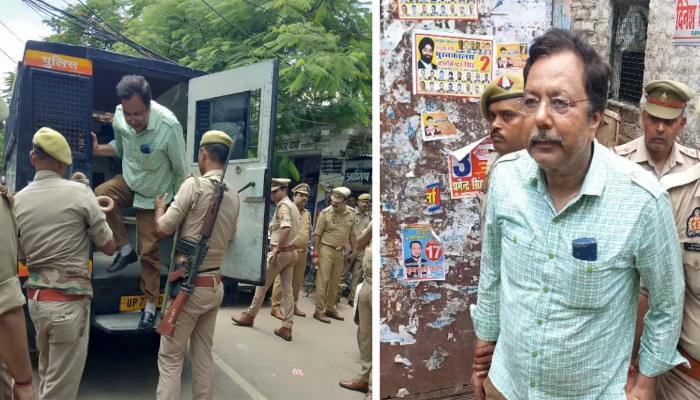
The 10 accused arrested by the Agra Police from Delhi, Goa, West Bengal, Uttarakhand, Rajasthan, and Uttar Pradesh, have been identified as Aisha alias S.B. Krishna (Kolkata, West Bengal), Osama (Kolkata, West Bengal), Rehman Qureshi (Agra, UP), Abbu Tariq (Muzaffarnagar, UP), Abdur Rehman (Dehradun, Uttarakhand), Mohammad Ali (Jaipur, Rajasthan), Junaid Qureshi (Jaipur Rajasthan), Mustafa alias Manoj (Delhi), and Mohammad Ali (Jaipur, Rajasthan).

Accused arrested in Islamic conversion racket

They face charges under the Bharatiya Nyaya Sanhita (Sections 87, 111(3), and 111(4)) and the UP Prohibition of Unlawful Conversion of Religion Act, 2021.

Accused arrested in Islamic conversion racket

Foreign funding, ISI, and Christian Missionary links

Earlier this month, in a separate yet connected case, Jalaluddin alias Chhangur Baba was arrested in Balrampur for running an elaborate conversion racket funded by over ₹100 crore from Gulf countries. His network provided caste-based incentives to Muslim men who managed to convert Hindu women. Investigations also revealed his links to Pakistan’s ISI and local Christian missionary groups operating in Uttar Pradesh.

Mission Asmita: Coordinated crackdown on conversion syndicates

The entire operation is part of Mission Asmita, a state-wide campaign initiated by the UP Government to eliminate threats to national security stemming from foreign-funded religious conversions, radicalisation, and communal subversion.

As DGP Krishna confirmed, coordination with national agencies is ongoing, and custodial remand for the accused will be sought to unravel the full scope of the conspiracy. Specialised agencies including the ATS and STF have been roped in due to the terror-linked nature of the case.

Trump admin escalates tensions with Brazil, revokes visa of Supreme Court Judge for ordering ankle monitor, house arrest & other restrictions on ex-president Bolsonaro

0

The U.S. on Friday revoked the visa of Brazilian Supreme Court Justice Alexandre de Moraes, overseeing the case against former president Jair Bolsonaro, in a sharp escalation of tensions between the two nations, The Washington Post reported.

The move follows Moraes’s order restricting Bolsonaro–mandating an ankle monitor, barring foreign contacts, and house arrest outside daylight hours–after accusations of seeking U.S. support to destabilize Brazil, The Washington Post said. Justice Moraes also barred Bolsonaro from contacting foreign governments and individuals under investigation, intensifying the scrutiny around Brazil’s judicial handling of his case.

U.S. Secretary of State and current President Trump asserted that the visa revocation was a response to what he described as a “political witch hunt” against Bolsonaro, alleging it violated basic rights and overreached beyond Brazil’s borders, according to The Washington Post. The sanctions reportedly also extend to Moraes’s allies and their immediate families.

The unprecedented diplomatic spat comes amid a wider rift involving trade tensions. On July 9, President Trump imposed a 50 percent tariff on Brazilian imports, citing concerns over free speech suppression under Moraes’s leadership, The Washington Post highlighted.

Moraes’s campaign against online misinformation–including the takedown of over a hundred social media accounts–has sparked criticism from Bolsonaro supporters who claim the judge wields the Supreme Court as a tool for political persecution, The Washington Post added. The judge accuses Bolsonaro and his son, Congressman Eduardo, of conspiring with foreign powers to intimidate Brazil’s judiciary, a charge Eduardo described as a continuation of a pattern of authoritarian behavior.

Legal analysts expressed skepticism about the U.S. invoking the Magnitsky Act–a sanction tool targeting human rights abuses–in this context, calling its use against Moraes questionable, The Washington Post reported. Despite the brewing confrontation, it remains unclear how many foreign nations Moraes visits or whether the visa revocation will significantly impact him personally.

Tensions continue as both countries dig in. Bolsonaro and his supporters have amplified their efforts to seek further U.S. intervention, including sanctions under the Magnitsky framework. Meanwhile, Brazilian President Luiz Inacio Lula da Silva has condemned Bolsonaro’s allies domestically, calling them traitors to national interests.

The dispute underscores deepening discord between Brazil and its longstanding ally, the U.S., with political, trade and judicial disagreements showing little sign of resolution.


(This news report is published from a syndicated feed. Except for the headline, the content has not been written or edited by OpIndia staff)

First Balasore self-immolation, now Greater Noida suicide: Why do we need such tragedies to wake us up to the problem of harassment of students

Jyoti Sharma, a second-year student from Sharda University in Greater Noida, pursuing BDS, died by suicide in her hostel room. She passed away on July 18, Friday, reportedly after writing a suicide note. The note accuses two professors and the university administration of mental harassment. The two staff members, Mahinder and Shairy, have been arrested so far.

In the suicide letter, she wrote that she had been mentally harassed and humiliated for a long time, which caused her significant distress. She expressed her desire for the accused to face legal action. She held the teachers of PCP and Dental Materials responsible for her death.

The note reads, “They mentally harassed me. They humiliated me. I have been under stress because of them for a long time. I want them to face the same thing. I am sorry. I can’t live like this anymore. I can’t…”

Shortly after the incident came to light, students gathered and protested against the university administration, alleging negligence. They claimed Jyoti had been under immense stress due to accusations of forging signatures. A minor scuffle broke out between the protesters and the police, while the family of the deceased was seen manhandling the head of the dentistry department.

The incident occurred on Friday night, and a case has been filed at the Knowledge Park Police Station in Gautam Buddha Nagar. “The woman’s body has been sent for post-mortem, and two staff members of the university have been arrested on the basis of a complaint filed by the victim’s family,” said Additional DCP of Greater Noida, Sudhir Kumar.

He added that tension had escalated due to the anger among the deceased’s family and university students towards the administration. The anger and scuffle were defused by the police through dialogue, and peace was restored at the scene. Further legal proceedings are underway.

Dr. Ajit Kumar, the university’s Public Relations Officer, confirmed that two faculty members have been suspended. For now, two teachers have been suspended. A committee has also been formed to investigate the matter. Action will be taken against those found guilty based on the committee’s report,” he stated.

This is not an isolated case of a student taking her life due to harassment. A similar incident took place in Odisha’s Balasore shocking self-immolation case on July 12. A 20-year-old girl set herself on fire, allegedly after enduring sexual harassment by the head of her college department. She suffered 90 percent burns and later succumbed to her injuries at AIIMS Bhubaneswar on July 14.

These brutal incidents show no discrimination based on gender or age. This was evident in the tragic case of a teenager from The Global Public School in Kerala who ended his life after reportedly being bullied, assaulted, and harassed by his schoolmates.

According to the teenager’s mother, on January 15, he was forcibly taken to the toilet and made to lick the seat; his head was then pushed into the toilet while it was flushed. He was also bullied for his skin tone. The relentless harassment severely affected his mental health, ultimately driving him to end his life by jumping from the 26th floor of their apartment building.

On April 30, 2023, a 16-year-old boy died by suicide after allegedly being mentally abused by his principal and faculty members. He purportedly left a suicide note in which he apologized to his parents and elder brothers and urged serious action against those who had harassed him. The boy allegedly died by suicide in Telangana, with his family accusing the college management and certain members of the teaching staff of harassment and holding them responsible for his death, police reported. The student, in his first year of intermediate studies at a private college in Narsingi, Telangana, was found hanging in a classroom by his friends on Tuesday night, April 30.

All these incidents reflect one painful similarity: before taking their own lives, the victims tried to express what they were going through and, in the end, wrote in their suicide notes.  Instead of receiving empathy and support from those around them when they spoke up about harassment in educational institutions, their voices were often ignored. Their stories must be heard, and their grievances must be addressed before blaming the victim. Continued ignorance will only lead to more such tragedies unless educational institutions actively work towards providing safe, empathetic, and responsive environments for students.

Assam govt cracks down on illegal encroachment, ‘rattled’ Mamata Banerjee claims persecution of Bengalis, Himanta Biswa Sarma slams appeasement politics of TMC supremo

On Saturday (19th June), a war of words ensued between West Bengal Chief Minister Mamata Banerjee and Assam Chief Minister Himanta Biswa Sarma over the latter’s crackdown on illegal encroachment in his State.

For the unversed, the Himanta government is actively carrying out anti-encroachment drives in Assam to remove squatters from government-owned land.

This includes freeing large forests and village grazing areas, which have been illegally occupied by encroachers (many of whom are illegal immigrants from Bangladesh).

In a tweet on Saturday (19th June), West Bengal Chief Minister Mamata Banerjee falsely claimed that the anti-encroachment drive was aimed at Bengali population.

“The second most spoken language in the country, Bangla, is also the second most spoken language of Assam. To threaten citizens, who want to coexist peacefully respecting all languages and religions, with persecution for upholding their own mother tongue is discriminatory and unconstitutional,” she claimed.

“This divisive agenda of the BJP in Assam has crossed all limits and people of Assam will fight back. I stand with every fearless citizen who is fighting for the dignity of their language and identity, and their democratic rights,” Mamata Banerjee further added.

Ahead of the 2026 West Bengal Vidhan Sabha elections, Mamata Banerjee is eyeing to consolidate the Bengali Hindu vote bank in the State by presenting the TMC government as the ‘messiah’ of Bengalis living across the country.

Assam Chief Minister Himanta Biswa Sarma lashed out at Mamata Banerjee for misleading people and conflating action against illegal encroachment as action against Bengalis.

“Didi, let me remind you— In Assam, we are not fighting our own people. We are fearlessly resisting the ongoing, unchecked Muslim infiltration from across the border, which has already caused an alarming demographic shift,” he highlighted the menace of illegal immigration.

“And yet, when we rise to defend our land, culture, and identity, you choose to politicise it. We do not divide people by language or religion. Assamese, Bangla, Bodo, Hindi—all languages and communities have coexisted here. But no civilisation can survive if it refuses to protect its borders and its cultural foundation,” he added.

“While we are acting decisively to preserve Assam’s identity, you, Didi, have compromised Bengal’s future—encouraging illegal encroachment by a particular community ,appeasing one religious community for vote banks, and remaining silent as border infiltration eats away at national integrity—all just to stay in power. Assam will continue to fight to preserve its heritage, its dignity, and its people—with courage and constitutional clarity,” Himanta Biswa Sarma emphasised.

UP Islamic conversion racket: Jalaluddin posed as RSS member, used PM Modi’s photo on letterhead to lure and convert minor Hindu girls to Islam

Jalaluddin Shah, the main accused in the Balrampur Islamic conversion racket, busted in Uttar Pradesh, also known as Chhangur Baba, used clever tricks to hide his real identity. According to investigators, he pretended to be a senior leader of an RSS-affiliated group and even used Prime Minister Narendra Modi’s photo on the group’s letterhead to make it look official.

He was made the general secretary (Awadh region) of a group called Bharat Pratikarth Seva Sangh. This group was run by another accused of the racket named Eidul Islam. Investigators believe the group’s name was purposely chosen to make it sound like it was linked to the RSS. Islam even set up a fake office in Nagpur, the headquarters of the RSS, to make the organisation appear more genuine.

During meetings with government officials and political leaders, Jalaluddin and Islam also used the names of well-known RSS leaders to gain trust and support. Jalaluddin, a spiritual leader from Balrampur, was arrested earlier this month for running a large-scale Islamic conversion network. He mainly targeted minor girls from poor families.

The Uttar Pradesh Anti-Terrorist Squad (ATS) has also filed an FIR against him. They claim he was planning to set up a terrorist training centre using foreign funds. Reports say he received over ₹500 crore from foreign countries, including Gulf nations and possibly Pakistan.

The Enforcement Directorate (ED) is looking into the financial angle. Jalaluddin is said to own property worth over ₹100 crore in UP and Maharashtra, much of it on encroached land. 

So far, the ED has found ₹60 crore involved in money laundering, linked to 22 bank accounts. They also found documents showing he bought a property called Ranwal Greens in Mumbai and has links to a Panama-based company called Logos Marine.

European Union’s hypocrisy marches unchecked: EU won’t stop using Russian gas but wants India to jeopardise energy security of 140 crore Indians

On 18th July 2025, the European Union imposed its 18th round of sanctions on Russia. One of the major announcements was a sanction on India’s Vadinar oil refinery in Gujarat owned by Nayara Energy, a firm in which Russia’s Rosneft has 49% stake. They also designated Indian flag register, which means ships bearing Indian flags can be targeted if suspected of transporting Russian oil.

EU also lowered the cap on Russian oil prices to 15% below market prices, to hit the oil revenue earned by Russia. However, the union has not banned buying Russian Oil. It only said that Russian Oil must be bought at lower prices, and has announced sanctions on third parties processing and transporting Russian oil.

EU’s clearly said here, we won’t stop buying oil from Russia, but if India refines it or helps in shipping, we’ll impose restrictions. Europe itself, however, hasn’t forbidden all Russian oil or gas. It has merely imposed a price cap 15% below the market rate, which is still enough for Russia to make a profit. 

So Indian refiners are sanctioned while Europe continues to import the same oil, sometimes after processing it in India. Is this not hypocrisy?

Ever since the Russia-Ukraine war started in 2022, India has always been under Western pressure to cut down on its trade with Russia, particularly when it involves purchasing oil from it. The European Union (EU) and the United States have demanded that India sever its relationship with Moscow and join the bandwagon of sanctions. But there is a catch here: while they urge India to desist, they have not completely stopped importing energy from Russia.

Western sanctions and double standards

Following Russia’s invasion of Ukraine, Western nations quickly imposed sanctions on  Russia. They imposed restrictions on banks, energy exports, and key industries. The motive  was to isolate Russia and harm its economy. The application of these sanctions has, however, been inconsistent.

India began to purchase more crude oil from Russia once the war had started. Now, it’s purchasing over 1 million barrels a day, much of this discounted. These imports allow India to keep its energy costs low for 140 crores of people. This has drawn concern in the West, though. Critics say that India is supporting Russia’s war efforts financially.

What people tend to overlook is that the EU itself keeps on purchasing huge quantities of Russian energy, particularly liquefied natural gas (LNG). Spain and Belgium rank among the largest purchasers. Germany, which ceased receiving gas via pipelines, is currently purchasing LNG from Russia at its ports. Italy is also receiving Russian oil products via third countries.

Even the United States, while spearheading the sanctions campaign, continues to import certain essential commodities from Russia, such as uranium for its nuclear reactors. So, while they sermonise India, they go quietly on importing from Moscow.

MEA and Indian leaders push back

India has not taken these lessons lightly. “Securing the energy needs of our people is understandably an overriding priority for us. In this endeavour, we are guided by what is there on offer in the markets, as also by the prevailing global circumstances,” MEA spokesperson Randhir Jaiswal said.

Recently, the Ministry of External Affairs released a stern warning against double standards and said India is keeping a close eye on the U.S. plan to tax nations that continue to purchase Russian oil with a 500% tariff.  

Union Petroleum Minister Hardeep Puri also stated that India would deal with sanctions, when they are passed, pointing out that India has diversified its supply sources, buying oil from about 40 countries now, as opposed to 27 in the past.

EU purchases more but holds India responsible

Despite all these facts, the figures tell the story. The EU in 2022 paid over $120 billion to Russia for fossil fuels. India’s total payment in the same period was around $50 billion. And yet, India is the one being attacked with sanctions and criticism.

And to add to it, it’s reported that Indian oil refineries, which process Russian crude and export the refined oil to Europe, are under Western agencies’ surveillance. Ironically, it’s Europe that is purchasing these same fuels but continues to blame India for purchasing the crude.

So, what’s the question here: Are these sanctions all about punishing Russia or merely all about Western control of global trade and politics?

Defence deals and strategic independence

India’s defence ties with Russia are another aspect that is in the spotlight. Close to 60–70% of India’s defence arms are of Russian origin. India claims it cannot abruptly turn around and compromise national security.

But even here, the West’s double standards are evident. Turkey, a member of NATO, acquired Russian S-400 missile systems in 2019 and was subjected to some sanctions by the U.S. But it is still a member of NATO and even does business with Russia in other areas. No one is threatening Turkey as they are India.

U.S. threatens more sanctions

An American bill in Congress is calling for a 500% tariff on nations that purchase Russian energy. India isn’t mentioned by name, but it’s clear who they mean. The U.S. legislators have even threatened 100% secondary tariffs unless nations comply. Even NATO Secretary General Mark Rutte spoke out, saying that nations such as India and China need to pressure Russia to stop the war or risk tariffs.

India has pushed back hard. When visiting Washington recently, Jaishankar informed U.S. officials that the energy security of India cannot be sacrificed. The country’s concerns have been expressed forcefully to those initiating the sanctions, he said.

India is not purchasing oil to finance a war

This is where the question truly lies. If the U.S. and EU are still purchasing oil from Russia, then why should India? If Spain, Belgium, Germany, and Italy are importing Russian LNG and oil, why is it a problem if India imports the same?

India is not purchasing oil to finance a war. It’s purchasing because it has 140 crore citizens who needs affordable fuel. Europe may be waging a war, but India isn’t. We cannot neglect the requirements of our population due to the fact that someone else is waging a war elsewhere.

We must consider our development, our own economy, and our own citizens. And if it means purchasing energy from wherever it can be had at a reasonable price, so be it.

India always stands for peace. It has reached out to Ukraine with humanitarian assistance. It has talked to both President Zelensky and President Putin for a diplomatic resolution. But India will not be cornered or guilt-tripped to prioritise its people over everything else.

This is not an oil issue. It’s an issue of global fairness. If the West is going to be the leader, it is going to have to lead with character. It can’t establish principles that others have to abide by, but which it violates in secret.

Mangal Pandey turned ‘greased cartridge’ into a weapon of 1857 revolt; scared British hanged the revolutionary 10 days early: The spark from Barrackpore shook the Empire, ending the Company Raj

On the occasion of the birth anniversary of Mangal Pandey, the hero of India’s first war of independence, Prime Minister Narendra Modi paid a heartfelt tribute to him. PM Modi wrote on X, “Heartfelt tributes to the great freedom fighter Mangal Pandey on his birth anniversary. He was a pioneering warrior of the country who challenged British rule. His story of courage and valour will continue to be a source of inspiration for the people of the nation.”

In his message, the Prime Minister not only commemorated Mangal Pandey’s bravery, but also called upon the countrymen to take inspiration from his sacrifice. Mangal Pandey’s sacrifice sparked the first major rebellion against the British in 1857, which we today refer to as ‘India’s First War of Independence’. Let’s find out in this special report, the story of Mangal Pandey’s life, his rebellion, how the British caught him, why he was hanged 10 days early and what the British were afraid of.

Mangal Pandey: From an ordinary soldier to a revolutionary

Mangal Pandey was born on 19 July 1827 in a simple Brahmin family in Nagwa village of Ballia district of Uttar Pradesh. Some historians say that he was born in Sururpur village near Ayodhya, but his family was from Ballia. His father’s name was Diwakar Pandey. The financial condition of the family was not very good. Yet Mangal was a passionate patriot since childhood and wanted to fight against injustice.

In the year 1849, at a young age of 18, Mangal became a soldier in the 34th Bengal Native Infantry of the East India Company. At that time, the number of Indian soldiers in the British army was significantly high, but they were undervalued. The soldiers were angry with low salaries, discrimination and the arbitrary attitude of the British. Mangal Pandey also shared this anger, which later became the reason for their rebellion.

First War of Independence of 1857 and the role of Mangal Pandey

The revolt of 1857, which is called the First War of Independence of India, was not a one-day event. It was an explosion of anger that had accumulated over the years. The British had taken away the kingdoms of Indian kings, imposed heavy taxes on farmers and mistreated Indian soldiers. But the final spark behind the revolt was the cartridges of the new Enfield rifle.

In the 1850s, the British gave this rifle to Indian soldiers, but a rumour spread that its cartridges were laced with cow and pig fat. These cartridges had to be bitten with the mouth and loaded into the rifle, which would hurt the religious sentiments of Hindu as well as Muslim soldiers. This news spread like wildfire and created uneasiness among the soldiers.

Mangal Pandey lent a voice to this disquiet. On 29 March 1857, while he was posted at the Barrackpore Cantonment in West Bengal, he sounded the bugle of revolt. Mangal Pandey refused to use the cartridges and asked his fellow soldiers to stand up against the British. He shouted a slogan, “Maro Firangi ko!” (Kill the British) and attacked two British officers, Lieutenant Baugh and Sergeant-Major Hugheson.

Mangal injured Baugh and killed Hugheson. This incident marked the beginning of the revolution across the country. His unwavering courage incited anger against the British among the soldiers and the common people. Historians believe that this step of Mangal Pandey was the first big leap towards the war of 1857, which frightened the British.

How the British caught Mangal Pandey

Mangal Pandey’s rebellion caused a stir in the Barrackpur cantonment. Some of the soldiers showed solidarity with him, but the whole regiment lacked unity. Mangal tried to shoot himself to avoid falling into the hands of the British. He placed the barrel of his gun on his chest and pressed the trigger with his foot, but the bullet could only injure him. Subsequently, British General John Hersey took charge of the situation.

Hersey threatened the soldiers that anyone who did not stop Mangal would be shot. Finally, a soldier caught Mangal Pandey. He was arrested and court-martial proceedings were initiated against him. Mangal confessed that he rebelled against the British. The court sentenced him to death and set the date for his execution on 18 April 1857.

Why he was hanged 10 days earlier

The British secretly hanged Mangal Pandey in Barrackpore on 8 April 1857, 10 days before the scheduled date. The reason behind this was the fear of the British. The news of Mangal Pandey’s bravery was spreading rapidly. Not only among the soldiers of Barrackpore, but the murmur of rebellion had spread in the surrounding cantonments as well. The British were afraid that if Mangal was kept alive or the hanging was delayed, his spark would set the whole country on fire. Therefore, they hastily hanged him on 8 April so that the rebellion could be crushed. But this proved to be a mistake. Contrary to what the British had imagined, Mangal Pandey’s sacrifice further fueled the rebellion.

What the British feared

The biggest fear of the British was that Mangal Pandey’s rebellion would transform into a huge freedom movement. At that time, there were lakhs of Indian soldiers in the army of the East India Company, and if they had united, the British rule could have ended. Following Mangal’s revolt, the spark of rebellion spread in cities like Meerut, Delhi, Kanpur, and Lucknow. On April 20, 1857, some soldiers set a police post on fire in Kasauli, Himachal Pradesh. On May 10, 1857, some soldiers killed some British officers in Meerut and marched towards Delhi.

After reaching Delhi, they declared Mughal emperor Bahadur Shah Zafar as their leader. On May 30, farmers, labourers and soldiers took up arms against the British in Chinhat and Ismailganj in Lucknow. Nana Saheb in Kanpur, Rani Lakshmibai in Jhansi and Begum Hazrat Mahal in Lucknow held the reins of the rebellion. The British feared that if Mangal Pandey was not killed soon, this rebellion would put the whole of India on the path of independence.

The legacy of Mangal Pandey

Mangal Pandey’s sacrifice breathed new life into the First War of Independence of 1857. Even though the British were able to suppress this rebellion, it exposed their weakness. In 1858, the rule of the East India Company ended, and the British Crown started direct rule over India. Mangal Pandey’s martyrdom awakened the desire for independence among Indians, which was fulfilled in 1947. In 1984, the government of India issued a postal stamp in memory of Mangal Pandey. In 2005, a film named ‘Mangal Pandey: The Rising’ was also made on his life, in which Aamir Khan played his role.

Mangal Pandey was not just a soldier but the first spark of India’s independence. We all salute him on his birth anniversary. Jai Hind!

(The Hindi version of the article can be read on the OpIndia Hindi website)

Gopalganj horror: How the Bangladesh Army perpetrated atrocities against unarmed civilians at the behest of Muhammad Yunus

16th July 2025 must be forever marked as a ‘Black Day’ in the history of Bangladesh. On that day, the Bangladesh Army – an institution that once held global respect for its role in UN peacekeeping missions – committed crimes against humanity in the Gopalganj district.

Under the pretext of “maintaining law and order,” the military gunned down unarmed civilians and unleashed unspeakable brutality in the heart of Sheikh Hasina’s hometown.

According to multiple reports, including alarming disclosures submitted to the United Nations by the International Crimes Research Foundation (ICRF), the atrocities carried out in Gopalganj may amount to genocide.

The ICRF, in a formal letter to the UN Ethics Office, highlighted not just the Gopalganj bloodbath but a disturbing pattern of political violence, heritage destruction, and gross human rights violations engulfing Bangladesh.

Dubious claims made by the Bangladesh Army vs ground reality

In a desperate attempt at damage control, the Bangladesh Army issued a statement alleging it was forced to use lethal weapons “in self-defense”.

However, this narrative is being artificially amplified through state-controlled media and propaganda loyalists of the Yunus regime, many of whom are embedded in foreign media circles due to past affiliations with outlets like AFP.

On the ground, however, the truth is far darker. Social media is flooded with testimonies and footage showing no resistance from the civilians. Instead, reports suggest nighttime raids are continuing, with families – men, women, and even children – being abducted under the cover of darkness.

The most chilling detail? None of the victims received an autopsy. The four confirmed dead – Dipto Saha (30), Ramzan Kazi (17), Sohel Rana (35), and Imon Talukder – were either cremated or buried hastily, within hours, without inquest or forensic examination. This was not just a cover-up; it was a state-sponsored execution meant to erase evidence.

The Islamist regime of Muhammad Yunus

This atrocity was not an isolated event. It is part of a larger, calculated strategy orchestrated by radical Islamists and jihadists who seized power through what many now call the Jihadist Coup of 2024, orchestrated with the direct patronage of Nobel laureate-turned-Islamist-political-aspirant Muhammad Yunus.

Under this new regime, attacks against Bangladesh’s Hindu community have sharply intensified. Temples are being torched, houses razed, and even the names of districts with Hindu heritage are being targeted for erasure. The Gopalganj district – home to a large Hindu population – has long been in the crosshairs of Islamists.

In 2014, Khaleda Zia, chairperson of the Bangladesh Nationalist Party (BNP), called for changing its name and made offensive remarks against its residents, labeling them “Gopali” – a derogatory slur.

Today, that same hatred has morphed into violence. Islamist mobs now brazenly wave the flags of Al Qaeda, ISIS, Hamas, and the Taliban, chanting militant slogans in broad daylight. One extremist leader, Mufti Faizul Karim of Islami Shashontontro Andolan, openly vowed to turn Bangladesh into the “next Afghanistan”.

Bangladesh is becoming a new staging ground for international jihadists. According to an article published in the Gatestone Institute website, since the coup, senior leaders from Hamas, Al-Qaeda, and the Taliban have visited Bangladesh. Among them: Sheikh Khaled Quddumi and Khaled Mishal of Hamas, and Pakistani Islamists like Mufti Taqi Usmani and Maulana Fazlur Rahman.

Intelligence sources suggest these visits aimed to forge operational links with Rohingya refugees and “Stranded Pakistanis” (Biharis) – marginalized groups now being radicalized and recruited for terrorist activities targeting Israel, India, the US, and even Gulf nations like Saudi Arabia and Bahrain.

Erasing the pluralistic identity of Bangladesh, one act at a time

The Islamists’ mission goes beyond physical violence – they seek to obliterate Bangladesh’s secular and pluralistic identity. Calls have intensified to remove Bangladesh’s national anthem written by Rabindranath Tagore, branding it a “Hindu song”. There is also growing pressure to rename Gopalganj, as Islamists argue its Hindu-rooted name “offends Muslim sentiment”.

Such demands are not based on faith – they are born of fascist ideology. The historical truth is that Gopalganj was developed by Hindu zamindars and carries the legacy of Rani Rasmoni, a revered Bengali icon. The area has long stood as a symbol of communal harmony and inclusive identity.

But the current regime wants to destroy that. In a blatant act of cultural cleansing, the ancestral home of Satyajit Ray – a global icon of Bengali art and cinema – was demolished in Mymensingh district. Authorities dismissed the home’s connection to Ray’s family despite decades of history and public sentiment. This was not an accident; it was a calculated erasure of Bengali and Hindu legacy.

Other revered landmarks, including those linked to Sheikh Mujibur Rahman and Rabindranath Tagore, have also been targeted. And while the physical destruction is horrifying, the psychological warfare being waged is even more insidious.

The Gopalganj massacre is not merely a tragedy – it is a harbinger. The bloodshed claimed at least five lives, denied even the dignity of proper autopsies, and was followed by a military lockdown and media blackouts.

Conclusion

Historically, Gopalganj stood as a bastion of communal peace – even Jamaat-e-Islami and BNP held peaceful rallies there. But under the guise of a National Citizen Party (NCP) rally, violence was engineered. The army did not maintain peace – they incited bloodshed. The curfew that followed wasn’t about safety – it was about sealing off truth, isolating the district, and silencing its people.

By turning a rally into a battlefield, the Yunus regime has made it clear: no place is safe for Bangladesh’s minorities.

The ongoing attacks on cinema halls, Sufi shrines, Hindu temples, and cultural institutions signal a regime hell-bent on rewriting the country’s very DNA. This is not mere negligence – it is a systemic and orchestrated assault on Bangladesh’s soul.

Where once stood a secular nation, inspired by the dreams of its founder Sheikh Mujibur Rahman, now stands a fractured state gripped by fanaticism, manipulated by extremists, and betrayed by its own institutions.

The July 16 massacre in Gopalganj is a war crime. It is a gruesome symbol of a broader genocidal campaign unfolding in Bangladesh under the guise of “restoring order”. The international community must not remain silent. As the UN and Western powers turn a blind eye – complicit in the very coup that empowered these jihadist elements – the people of Bangladesh face annihilation of their culture, heritage, and very existence. If Gopalganj is allowed to be forgotten, tomorrow it will be Faridpur, Narayanganj, Brahmanbaria and beyond. The world must speak up. Not later – now. For every minute of silence, another life is lost, another truth is buried, and another piece of Bangladesh dies.