Home Blog Page 2882

China blocks India-backed US proposal to designate Mumbai 26/11 attacks LeT handler Sajid Mir as a global terrorist by the UN

0

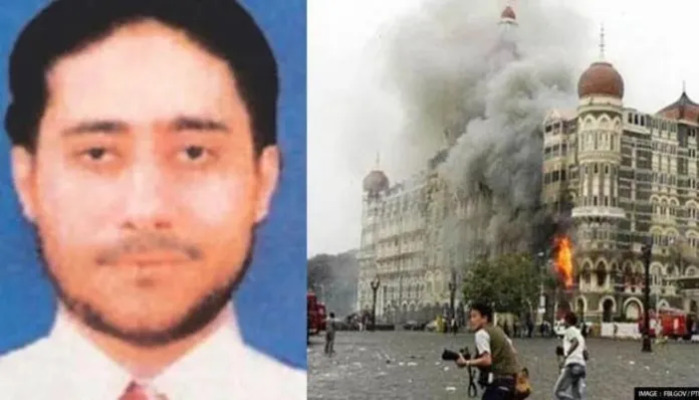
China has consistently defended Pakistani terrorists in the United Nations. On Friday, China vetoed India and the United States’ bid to designate Pakistani terrorist Sajid Mir as the most wanted terrorist. Terrorist Sajid Mir is the dreaded terrorist of Lashkar-e-Taiba (LeT), whom the US requested the United Nations to designate a global terrorist organization. This proposal was backed by India.

Sajid Mir, India’s most wanted terrorist, was a participant in the 2008 Mumbai attacks. The resolution was proposed by the United States and co-designated by India to blacklist Sajid Mir as a global terrorist under the United Nations Security Council’s 1267 Al-Qaeda Sanctions Committee.

In recent months, China has shielded Lashkar-e-Taiba and Jamaat-ud-Dawa (JuD) chief Abdul Rehman Makki, as well as Jaish-e-Mohammed (JeM) chief’s brother, Abdul Rauf Azhar. In June 2022, China blocked a joint proposal by India and the US to list Pakistan-based terrorist Abdul Rehman Makki as a global terrorist under the Al-Qaeda Sanctions Committee of the Security Council. Abdul Rehman Makki is the brother-in-law of Lashkar-e-Taiba founder Hafiz Saeed and the deputy commander of Lashkar-e-Taiba. The Jamaat-ud-Dawa, the political wing of Lashkar-e-Taiba, has also been designated as a terrorist front group by the UN committee.

Beijing has also been a staunch supporter of Jaish-e-Mohammed chief Masood Azhar and has come to the rescue of the terrorist several times over India-US proposals to designate him as a global terrorist. vetoing Indian proposals to designate him as a global terrorist.

Let us inform you that UN Security Council Resolution 1267 sanctions individuals and entities that assist or finance the acts or operations of ISIL, al-Qaeda, and related individuals, groups, undertakings, and institutions.

Who is terorrist Sajid Mir?

Terrorist Sajid Mir is the chief commander of Lashkar-e-Taiba (LeT) and is in charge of the group’s “India establishment.” He was a key figure in the Mumbai terror attack that took place on 26 November 2008, when 10 armed Pakistani terrorists created mayhem in the country’s financial capital, killing hundreds of civilians and leaving scores of others injured.

Mir reportedly recruited Dawood Gilani, alias David Coleman Headley, a Pakistani-American and FBI/DEA informant, and planned the Mumbai attacks with the assistance of Pakistani military officers. He was the mastermind behind the largest-ever overseas Lashkar-e-Taiba terrorist attack, which killed nationals from numerous nations, including India and Western countries. 175 people were murdered (18 police officers, 122 civilians, 26 foreigners, and 9 terrorists) and 291 were injured during the incident (25 police personnel, 243 people, 22 foreigners, and one terrorist Ajmal Kasab). Sajid Mir was the Lashkar-e-Taiba project manager for the November 2008 Mumbai terror strikes. He, via satellite phones, had commanded the terrorists involved in the operation to execute the hostages.

Two Interpol notices RCN A-6269/10-2010 and A-2032/2-2019 have been issued against him. India has marked him as a terrorist under the Unlawful Activities (Prevention) Act [UA(P)A], 1967, as amended in 2019 in October 2020.

Pakistan detained Sajid Mir this year and sentenced him to 15 years in prison in May 2022 for providing terror financing to Lashkar founder Hafiz Muhammad Saeed’s charitable organization and his role in other terror attacks. Sajid Mir was charged with conspiracy to destroy the property of a foreign government in the US District Court for the Northern District of Illinois on April 21, 2011. Allegations include providing logistic aid to terrorists, killing a civilian outside of the United States, assisting and abetting terrorists, and bombing public places.

On April 22, 2011, an arrest warrant was issued against Sajid Mir. In August 2012, Mir was labelled as a Specially Designated Global Terrorist (SDGT). In November 2018, the US State Department issued a USD 5 million reward for information leading to Mir’s capture and conviction. Mir was placed on the Federal Bureau of Investigation’s Most Wanted Terrorist list in March 2019.
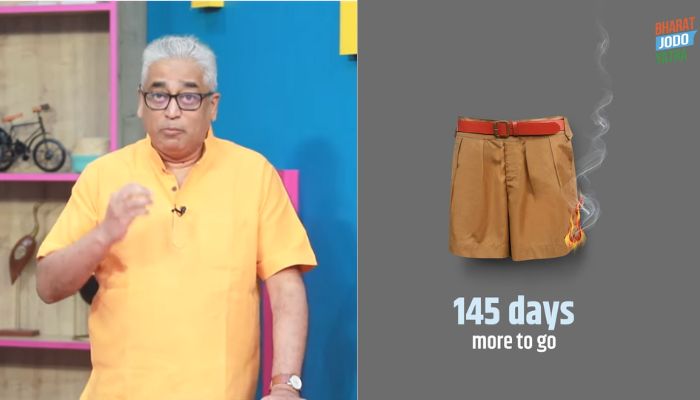
Rajdeep Sardesai tries to save Congress leaders after the ‘burn RSS’ campaign, dresses up the controversy as old vs new guard

0

Days after the Congress party floated its ‘burn RSS’ campaign, ‘journalist’ Rajdeep Sardesai came to the defence of the Congress party. During an episode of Netanagri, aired on Lallantop’s Youtube channel on Saturday (September 17), Rajdeep Sardesai blamed the vicious campaign on the generational gap between the Congress old guard and the young social media team of the party.

At about 29 minutes into the programme, he said, “There has been a lot of talk around the burn RSS campaign. I was told today that veteran Congress leaders such as Digvijay Singh were strongly against it. The campaign was proposed by the social media team, comprising of young people.”

“The Congress old guard opposed it tooth and nail. One veteran leader even proposed that the party members must meet the family of at least one RSS worker, killed by CPI (M) in Kerala, as part of the Bharat Jodo Yatra,” Rajdeep Sardesai claimed.

This is despite the fact that Congress scion Rahul Gandhi has not left any stone unturned to defame the Rashtriya Swayamsevak Sangh (RSS). “Several leaders including Sudheendra Kulkarni suggested that the Congress cannot fight the RSS on an everyday basis,” he said.

Rajdeep Sardesai claimed that the Congress old guard has now directed the social media team to include them in the review process, prior to publishing contentious material on other political parties.

The ‘journalist’ insinuated that the ‘burn RSS’ campaign was in fact the outcome of a generational and communication gap between the old and new factions of the Congress party.

The Background of the controversy

Ahead of the Lok Sabha polls in 2024, the Congress party is fighting for its survival. Having steadily lost relevance among the electorates under the leadership of the Gandhi family, the grand old party is making a last-ditch effort to turn its political fortunes.

Dubbed as ‘Bharat Jodo Yatra’, Congress kickstarted its 3,570-km march from Kanniyakumari in Tamil Nadu on September 7. The march will last over 5 months and will cover 12 States before terminating at Srinagar.

On September 12, the grand old party launched its ‘burn RSS’ campaign wherein khaki shorts (worn by RSS cadets) were set on fire. The contentious poster was accompanied by the caption, “To free the country from shackles of hate and undo the damage done by BJP-RSS. Step by step, we will reach our goal.”

The Congress party had even set a goal of 145 days to realise their objective. To put things in perspective, Congress leaders and their supporters have often dehumanised RSS Swayamsevaks and celebrated the deaths of those associated with opposing ideologies.

In fact, their supporters have often justified Nazi-like camps for ‘Sanghis’ once Congress is back to power. ‘Liberals’ have normalised hatred against ‘Sanghis’ to such an extent that people in their ranks feel entirely comfortable with demonizing them and wishing violence upon them. 

So when ‘Congress’ don’t even consider ‘Sanghis’ human enough to be one of their own, it really should not come as a surprise that they wish them dead. Their concept of a nation does not include the ‘Sanghis’ or those who identify themselves as Hindus (because if you do, you would be shamed as a Sanghi).

That Congress now wants to get ‘rid of Sanghis’, one wonders if this above message put out by the party which talks about ‘inclusivity’ harbours genocidal thoughts and intentions for ‘Sanghis’.

Amanatullah Khan arrested: All you need to know about the Delhi Waqf Board corruption case against the AAP MLA

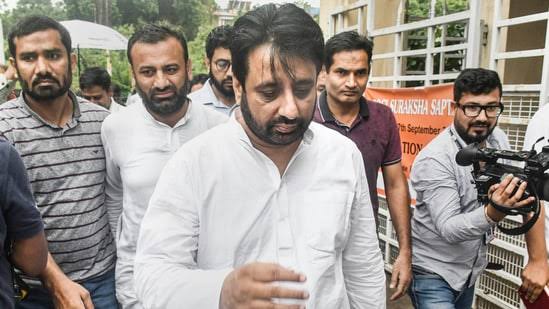
The Delhi Anti-Corruption Branch (ACB) on Friday arrested AAP MLA Amanatullah Khan in connection with irregularities observed in the Delhi Waqf Board case. 

An FIR in the case was registered two years ago and since then investigation has been underway. As a part of the investigation, Khan was called to the office of the ACB on Friday for questioning in relation to the case. Based on his questioning, the agency said, search operations were conducted at four locations allegedly linked to Khan.

On Friday, Anti-Corruption Branch raided multiple locations, including the home of Aam Aadmi Party (AAP) MLA Amanatullah Khan. The agency said that it recovered incriminating material and evidence against the AAP leader during the raids conducted earlier yesterday.

During the raid by the ACB, an unlicensed Beretta pistol was recovered from Hamid Ali Khan, the alleged close aide of Khan. During the raids, officials also recovered Rs 24 lakhs.

In a statement released after the raids, the ACB said, “From these locations, around Rs 24 lakh in cash has been recovered and two illegal and unlicenced weapons and cartridges and ammunition was also recovered. Also, at one of the locations i.e. outside the residence of Mr Amanatullah Khan, the search team consisting of an ACP was attacked by the relatives and other known persons of Mr Amanatullah Khan and they also caused obstruction in the discharge of government duty.”

Subsequently, the ACB filed two more cases against him, the first one pertaining to the recovery of illegal weapons, and the second for the alleged attack on the officers.

What is the case against Amanatullah Khan? 

Even so, the raids on Khan are related to an unauthorised appointment to the Waqf Board. In 2016, a case was lodged against Khan following a complaint from the sub-divisional magistrate (headquarters), revenue department, alleging that appointments to various “existing and non-existing posts” in the Waqf Board were “arbitrary and illegal”. 

The complainant, Hafiz Irshad Qureshi alleged that 33 people were recruited to the Board on a contractual basis in flagrant violation of established rules or regulations. He further alleged that some of those appointed to the board were related to Khan and most of them belonged to his constituency, Okhla. 

Four years later, in 2020, the ACB registered an FIR against him under Section 7 (public servant taking gratification) of the Prevention of Corruption Act, and Section 120-B (criminal conspiracy) of the IPC.

The CBI had also booked AAP MLA from Okhla under the prevention of corruption act and other relevant sections of the IPC after a complaint was filed against him in 2016. Khan was also accused of corrupt actions and criminal offences including deliberate and criminal violation of rules, regulations, and misuse of position. 

Reportedly, CBI had probed the matter and found substantial evidence against the AAP MLA, following which the CBI sought permission from LG to proceed against him in July 2022. 

Apart from Amanatullah Khan, Mehboob Alam, then CEO of Waqf Board was also charged by the premier agency with criminal violation of rules, misusing of position, and causing loss to the public exchequer and other relevant sections. 

According to the complaint, the CEO of the new waqf board and over 30 staff members were appointed and employed in contravention of Section 24 of the Waqf Act, 1955 and Delhi Waqf Rules, 1977. The FIR by CBI stated that irregular and illegal appointment of officials had led to the loss of revenue of the Delhi Waqf Board, and the appointments were done by misusing their official positions as public servants. It was alleged that waqf board properties were leased to the tenants and the encroachers were allowed to possess the properties in contravention of lease rules leading to the loss of revenue/assets for the board.

Jamia Millia Islamia bans Delhi riots accused Safoora Zargar from entering campus: Instigating students, protesting with outside students and more

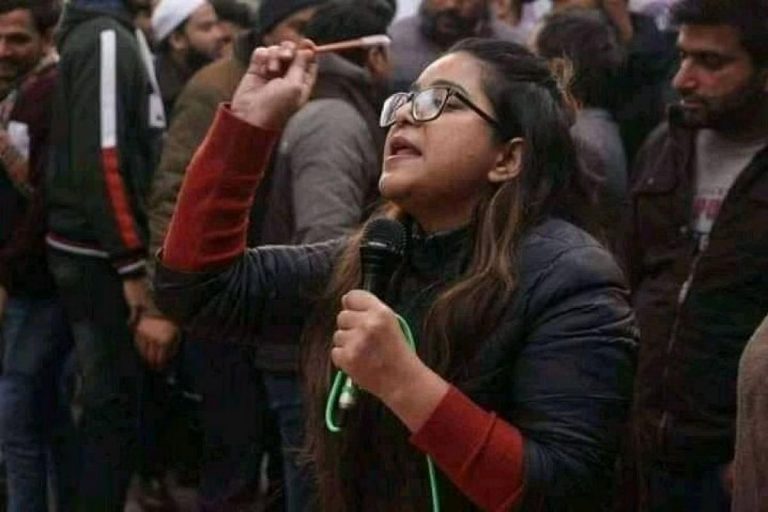
Jamia Millia Islamia University has banned the entry of anti-Hindu Delhi riots accused Safoora Zargar on its campus. This decision has been taken after Safoora Zargar and other students created a ruckus on the university campus earlier this month over the cancellation of Zargar’s admission. Several provocative slogans like ‘RSS Ki Kabr Khudegi, Jamia Ki Dharti Par’ and ‘ABVP Ki Kabr Khudegi Jamia Ki Dharti Par’ were raised during these protests in Zargar’s support.

Announcing the decision, the office of the Chief Proctor at Jamia Millia said, “It has been observed that Ms. Safoora Zargar (ex-student) has been involved in organizing agitations, protests, and marches on the campus against the irrelevant and objectionable issues to disturb the peaceful academic environment with few students who are mostly outsiders. She is instigating innocent students of the University and trying to use the University platform for her malafide political agenda along with some other students. Further, she is hampering the normal functioning of the institution.”

The notice further added, “In view of the above, the Competent Authority, for maintaining a peaceful academic environment across the Campus, has approved Campus Ban on ex-student Ms. Safoora Zargar with immediate effect.”

Earlier, the sociology department at Jamia Millia Islamia cancelled the admission of Delhi riots accused Safoora Zargar. Zargar was in the Department of Sociology’s interdisciplinary MPhil/PhD program. Jamia Millia Islamia in a statement said, “Her progress report by the supervisor was unsatisfactory. The scholar did not apply for an extension as a woman scholar before the expiry of the stipulated maximum period.”

“The scholar did not submit her M.Phil dissertation within the maximum stipulated time of 5 semesters plus one additional semester of COVID extension (6th Semester) that was also given to her, which ended on 6th February 2022,” the statement further added.

Safoora Zargar was booked under UAPA following the anti-Hindu Delhi riots

Safoora Zargar was booked under the Unlawful Activities (Prevention) Act for her alleged role in the conspiracy that led to the Delhi Riots in February 2020. She was arrested in April 2020. The Delhi Police had claimed that she was part of the conspiracy to “destroy, destabilize and disintegrate the Government of India in order to compel to withdraw the Citizenship Amendment Act (CAA) and the alleged National Register of Citizens.”

The Delhi High Court granted bail to Safoora Zargar in the Delhi Riots case in June 2020 on humanitarian grounds. After the Central Government said that it had no objections to her release, bail was granted. A regular bail was granted to Safoora Zargar after furnishing a bond of Rs. 10,000 on the condition that she will not leave the territory of Delhi without the permission of the Court and will not hamper the investigation.

Democratic party unit in New Jersey displays open Hinduphobia, seeks FBI and CIA probe against Hindu organisations calling them “hate groups”

0

In another instant of rising Hinduphobia in the United States, a unit of the ruling Democratic party has passed a resolution labelling a number of Hindu organisations as “foreign hate groups”.

The Teaneck Democratic Municipal Committee (TDMC) in New Jersey named the Hindu American Foundation (HAF), the Vishwa Hindu Parishad of America (VHPA), SEWA International, Infinity Foundation, Ekal Vidyalaya Foundation, as “foreign hate groups”, and said that they have direct and indirect ties to RSS. Calling them Hindu Supremacists, the unit of president Joe Biden’s party has demanded that the Federal Bureau of Investigation (FBI) and the Central Intelligence Agency (CIA) should step up research on “foreign hate groups that have domestic branches with tax-exempt status”.

The resolution passed by TDMC says, “Hindu nationalist organisations have infiltrated all levels of politics and were highly effective in blocking US House Resolution 417 which was a congressional attempt to warn against the Hindu nationalist movement.”

House Resolution 417 was a controversial resolution brought in 2013 in the Congress that sought to continue denying a US visa to Narendra Modi, which was sponsored by both Republican and Democratic lawmakers. The resolution had also called on India to protect the rights and freedoms of religious minorities and asked the US government to include the matter as part of bilateral the Strategic Dialogue. However, the House resolution lost traction after several sponsors withdrew from it after growing criticism of the move.

TDMC alleges that “most local American elected officials remain unaware and unprepared to deal with the Hindu extremists”. The resolution says, “A bulldozer which has been weaponized against minorities was part of the New Jersey India Independence Day parade with giant pictures of Yogi Adityanath as ‘Daddy Bulldozer’, responsible for demolishing homes of peaceful protestors”. TDMC also states that “controversial BJP spokesman Sambit Patra served as Grand Marshall”.

The resolution also claims that, “one million emails, death threats and rape threats were sent by Hindu extremists to US Academic scholars” like Hinduphobic Rutgers professor Audrey Truschke and their families when 50 universities supported the anti-Hindu online conference ‘Dismantling Hindutva’. They also claimed that Drew University received 30,000 emails in few minutes causing server to crash.

Teaneck Democratic Municipal Committee claims that the Hindu organisations can be declared as terror groups under US Code Title 22 Chapter 38, section 2656f(d), which defines terrorism as, “premeditated, politically motivated violence perpetrated against noncombatant targets by subnational groups or clandestine agents, usually intended to influence an audience”

They say that only condemning hate incidents is insufficient as “hate groups” are increasingly more organized, cause fear and harm to people, and need to be identified and monitored now for safety and security.

The TDMC urged New Jersey Senators Bob Menendez and Cory Booker, Governor Phil Murphy and Congressman Josh Gottheimer to ask the FBI and CIA to probe these groups. They also urged the representatives to revise the Visa waiver program Improvement and Terrorist stave Prevention Act of 2015 “to address foreign violent extremists”. They further asked them to pass the US House Resolution 1196, “condemning human rights violations and violations of international religious freedom in India”. This resolution urges the US Department of State to designate India as a Country of Particular Concern.

The TDMC press release informing about the resolution was published by Indian American Muslim Council among others. Despite not being a media organisation, IAMC published it on their website, indicating their support for demanding action against Hindu groups in the USA.

The resolution by the Democratic party unit underlines the increasing anti-Hindu trend among American liberals, particularly in the Democratic party.

Amit Shah security lapse: TRS leader parks his car blocking Shah’s convoy in Hyderabad, breaches HM’s security

0

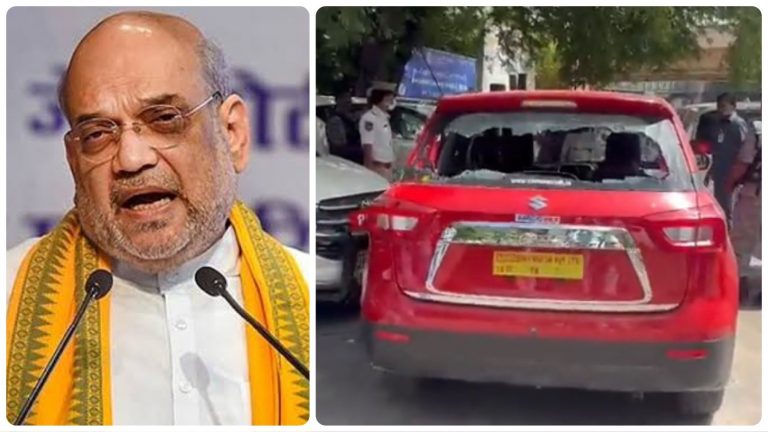
In a major security breach of Union Home Minister Amit Shah’s cavalcade during his visit to Hyderabad, TRS leader Gosula Srinivas parked his car in front of Shah’s motorcade, following which the Union Minister’s security detail damaged the car.

As per reports, Gosula Srinivas parked his car in front of Home Minister Amit Shah’s cavalcade in Hyderabad. Following this, the Home Minister’s security guard immediately told him to move the car from the place. After Srinivas did not move the car as instructed, the guards damaged his vehicle.

However, in his defence Srinivas alleged that his car suddenly stopped and by the time he could remove the car the police had vandalised it.

“The car stopped just like that. I was in tension. I will speak to them (Police officers). They vandalised the car. I will go, it’s unnecessary tension,” Srinivas said. 

In the visuals that have gone viral on the internet, Srinivas is seen driving a red car whose rear glass had been completely damaged, presumably after he parked the car in front of Amit Shah’s motorcade. 

Shah is in Hyderabad to celebrate the day when Hyderabad was liberated from the oppressive Nizam rule. TRS, the party that is in power in Telangana, is celebrating a 3-day long Telangana National Integration Day.

Meanwhile, Amit Shah during his speech for Hyderbad Liberation Day had applauded the role of Sardar Vallabhai Patel in ‘liberating Hyderabad’ from ‘Razakars’ of Nizams. KTR, on the other hand, hit back at Shah saying that the Union Home Minister has come to Telangana to divide and bully the people of the state and its government.

Patra Chawl Scam Case: ED opposes Sanjay Raut’s bail plea, says Sanjay Raut played a crucial role ‘behind curtains’

0

On Friday, September 16, the Enforcement Directorate (ED) opposed the bail plea of Shiv Sena MP Sanjay Raut saying that Raut played a crucial role ‘behind the curtains’ in the Patra Chawl redevelopment-related money-laundering case. 

In July, the Rajya Sabha member from Shiv Sena was detained in the case and is currently in judicial custody. He has appealed for bail in a special court for Prevention of Money Laundering Act (PMLA) cases.

In its reply, the ED refuted Sanjay Raut’s allegations that the action against him was taken out of political vendetta or any sort of malice. 

“Accused played a significant role in the offense through his proxy and confidant Pravin Raut (a co-accused), to avoid the money trail (Sanjay Raut) has been acting behind curtains,” the ED said.

“Sanjay Raut is a “highly prominent and powerful individual” who, if freed on bail, may tamper with evidence and has previously threatened witnesses,” the Enforcement Directorate added. On September 19, special judge M G Deshpande will hear the arguments from both sides again during the next hearing of the case.

Sanjay Raut’s role in the Patra Chawl Land Scam

The Patra Chawl Land Scam can be traced back to 2007. Patra Chawl, also known as Siddharth Nagar, is a 47-acre area in the North Mumbai district of Goregaon. The Maharashtra Housing and Area Development Authority (MHADA) and Guru Ashish Construction Pvt Ltd (GACPL) signed an agreement in 2007 to build new residences for the chawl’s 672 tenants. Furthermore, GACPL has agreed to build 3,000 units for MHADA. The remaining chawl space was designated for sale to private developers. The original residents of the chawl are yet to receive the flats.

The investigating agency ED claimed that Pravin Raut, a close aide to Sanjay Raut, and other GACPL directors failed to meet the agreed-upon terms. 

The Enforcement Directorate has filed a case against GACPL, alleging that the company’s unlawful operations total Rs 1,039.79 crores. The investigation revealed that Pravin Raut had received Rs 100 crores from HDIL. ED also stated that the funds were moved to various accounts held by his family members, business entities, and close associates. Some of the funds were also transferred to accounts related to Shiv Sena politician Sanjay Raut.

Moreover, the agency stated that Varsha Raut, Sanjay Raut’s wife, received Rs 83 lakhs directly or indirectly from Madhuri Raut, Pravin Raut’s wife, which equates to criminal gains. Varsha Raut allegedly used the money to purchase a Dadar apartment.

ED attached properties associated with Raut in Alibaug and Dadar during the probe. The agency asked Raut to answer questions about his relationship with Pravin Raut. Details concerning his wife’s business dealings were also included in the questioning. The ED apprehended Pravin Raut, one of the suspects in the case, in February 2022. He is also currently held in judicial custody.

How Western Media like Reuters, WaPo and Guardian ignored facts to peddle the ‘caste hierarchy’ narrative while covering Lakhimpur Kheri case

The recent gangrape and murder of two minor Dalit sisters in the Uttar Pradesh district of Lakhimpur Kheri by six men including Junaid, Sohail, Arif, Hafiz, and two others has shocked the entire nation, but the utterly distorted and exclusive coverage of the incident by Western media exposes the intent of these outlets and their tenacity to push their agenda in a subtle manner.

It is pertinent to mention that out of the 6 accused persons, 5 belonged to the Muslim community. The 1 who was Hindu, Chottu (Gautam) had introduced the sisters to the other accused. The rape and murder were done by the other accused, who were introduced to the sisters by Chottu, who was a neighbour of the girls. Some reports also indicate that Chottu himself belonged to the Dalit caste.

The BBC, The Guardian, The Washington Post, and Reuters have all reported on the case exclusively, making explicit reference to the “hierarchical and discriminatory Hindu caste system” and specifically omitting the names of the accused men, which were openly announced by authorities after they were promptly arrested within hours of the crime being reported. Here is how all of them reported the incident with their prejudiced opinions subtly injected in between the lines.

Report by Reuters mentions ‘ancient caste system’

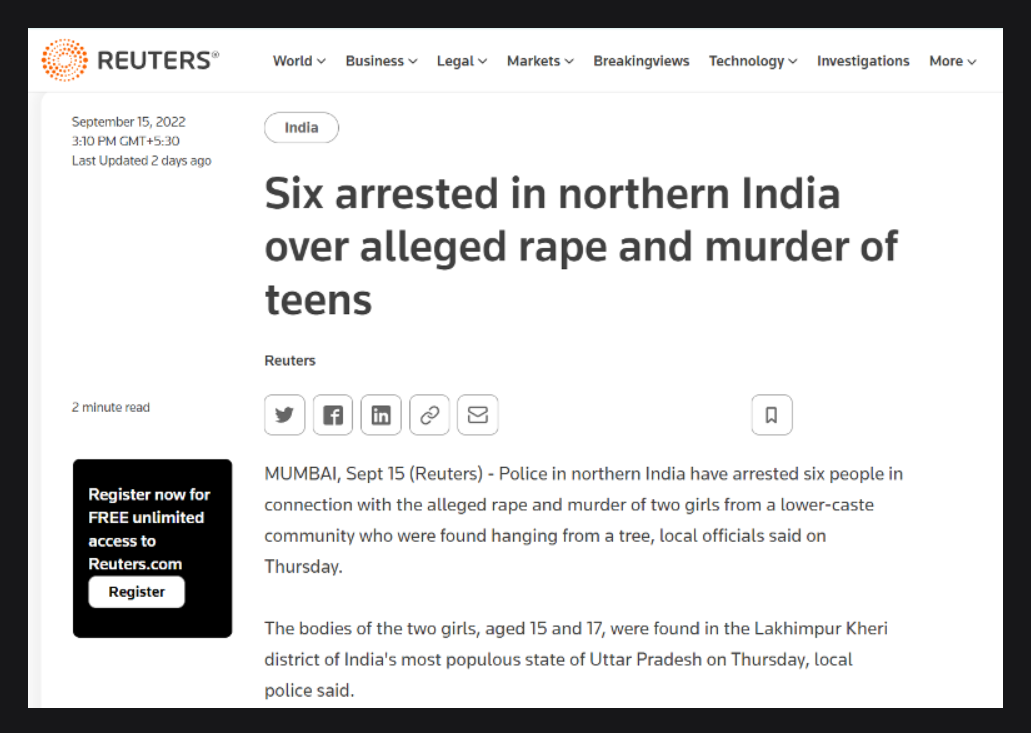
Reuters reported the incident on September 15, stating the police arrested six persons “in connection with the alleged rape and murder of two girls from a lower-caste community.” It is pertinent to note here that the whole report makes no mention of the names of the accused which were made public by the police within hours after their prompt arrest following the incident.

Arrests were already made, according to the Reuters report. The UP Police had notified the public about the arrests during a news conference, and the identities of the accused were also revealed during that press conference. Therefore, Reuters was aware of the identities of the arrested accused, but they deliberately opted to exclude the names of the arrested accused in their article.

Report by Reuters.

The report also tries to push the propaganda of India as a deeply divided society based on classes and hierarchy. In the later parts of the report, it is mentioned that people and families in India “follow an ancient caste system.” The intent of Reuters for using such a prejudiced connotation for India can be contested by their resolve is fairly clear i.e., to defame India and capitalize on India’s perceived schisms.

Washington Post report mentions ‘India’s rigid caste hierarchy’

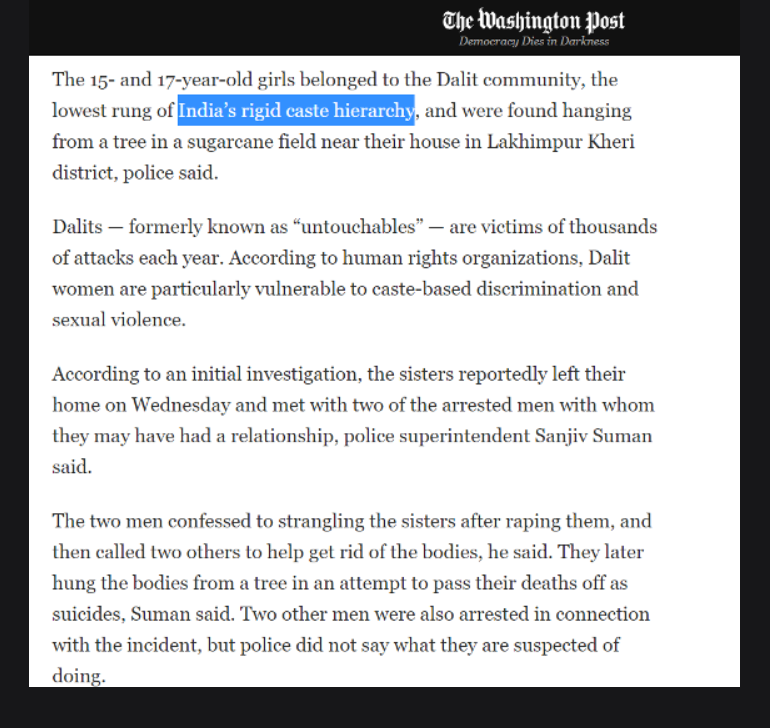
The Washington Post also mentioned that six people were arrested by the police but deliberately missed their names. The Uttar Pradesh Police arrested six persons named Junaid, Sohail, Arif, Hafiz, Karimuddin and Chhotu alias Gautam for sexually assaulting the girls and brutally murdering them.

WaPo further mentioned that the girl belonged to the Dalit community, “the lowest rung of India’s rigid caste hierarchy.” WaPo deliberately made a reference to untouchability, malpractice that persisted in India under colonial rule much before the independence.

Report by WaPo.

The Washington Post also made a reference to the social media outrage that followed after the incident regarding the punishment of the accused and instead portrayed it as an outrage against the state government, which has acted more than promptly and assured that the family of the victims face no single challenge in the future and justice is delivered to them on time. The state government has provided ex gratia financial assistance to the family through the district administration and has assured that the family is taken care of in future.

The Guardian report refers UP CM Yogi as a ‘hardline Hindu nationalist monk’ failing to protect women

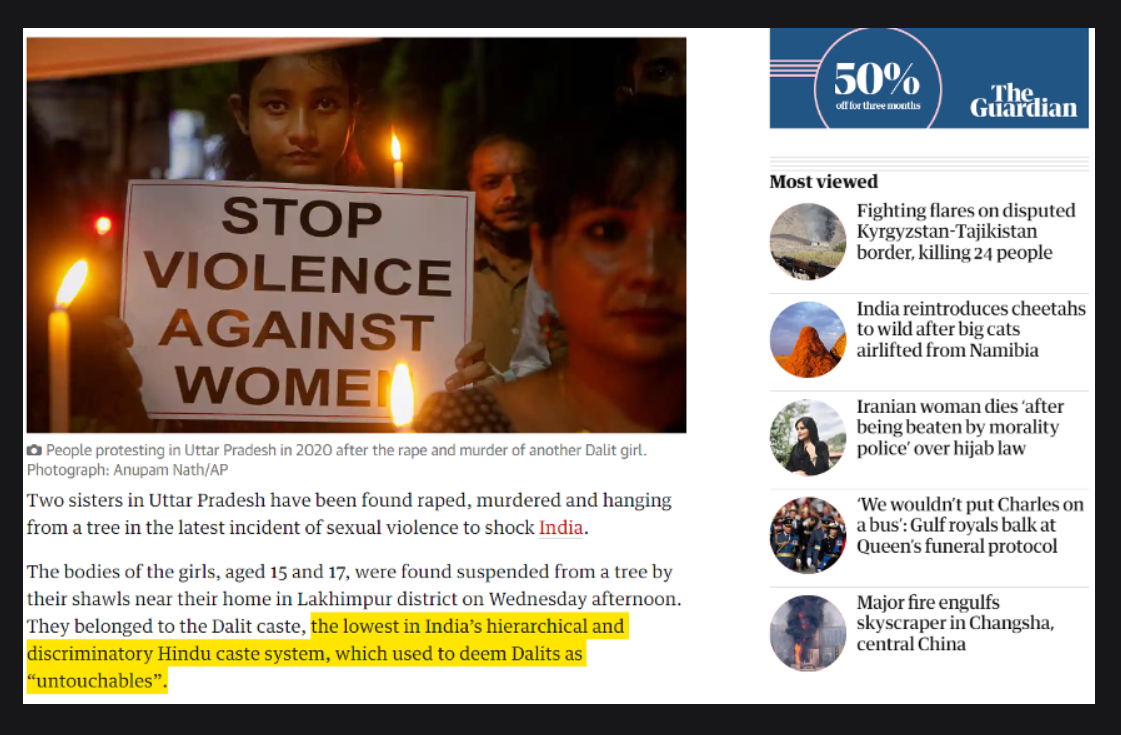
The United Kingdom-based The Guardian has gone a step ahead in portraying India in a bad light. In addition to intentionally omitting the names of the accused, The Guardian referred to the girls as Dalits, “the lowest in India’s hierarchical and discriminatory Hindu caste system,” and labels them as “untouchables.”

Report by The Guardian.

Again, labelling the social media outrage against the culprits as against the government, The Guardian stated that the incident triggered protests and criticism of the ruling government of Uttar Pradesh, led by the “hardline Hindu nationalist monk Yogi Adityanath, who has been accused of not doing enough to protect women from rape and sexual violence, particularly those from poor and lower-caste backgrounds.”

This mention of Uttar Pradesh Chief Minister Yogi Adityanath, who is well known for his policy of zero tolerance against any type of crime and special attention to incidents involving women as victims, exposes the prejudiced notion of India and the hatred for the Hindus and nationalist personalities.

BBC report blames ‘Hindu hierarchy’ for the rape and murder of two girls

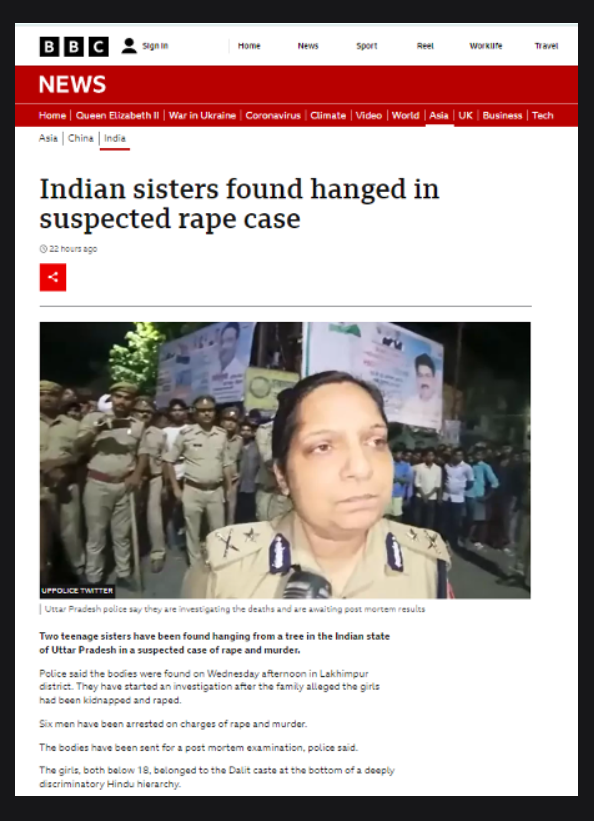
As reported earlier by OpIndia, a BBC report stated that the girls were targeted as they were Dalits, “the bottom of a deeply discriminatory Hindu hierarchy.”

The BBC story has factual inaccuracies about the incident. The first is that the identities of the accused were not published by them, despite the fact that the names were openly revealed by the police in a news conference.

According to the BBC, “The girls, both below 18, belonged to the Dalit caste, at the bottom of a deeply discriminatory Hindu hierarchy.” By portraying Hindus as “highly discriminatory,” the BBC attempted to indicate that the incident occurred because of the prevalence of a “Hindu hierarchy,” rather than because of a crime committed by individuals who had already been apprehended by police.

The BBC report.

The BBC also sought to cast doubt on the rapid response taken by Uttar Pradesh police. The official British broadcaster mentioned the UP Police encounter in quotations, judging its credibility. Furthermore, the article states, “There is a deep suspicion of the police within the Dalit community,” insinuating that the police, who apprehended the perpetrators within hours of the incident, were not trustworthy.

OpIndia had already reported on the bias of foreign media and addressed many issues in detail. The conclusion was that these agencies bet on India’s perceived schisms, hunting for disagreements and politically charged features. Furthermore, this not only causes social unrest in the country but also tarnishes India’s worldwide image, compromising India’s diplomatic connections and business interests. The full report can be read here.

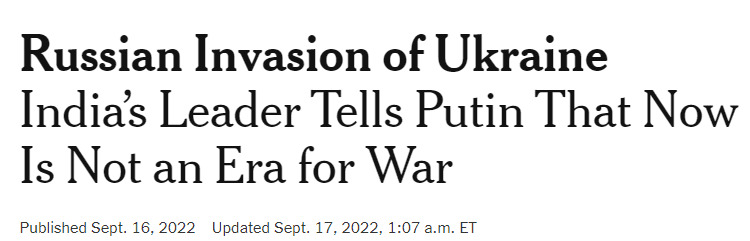
‘Era not of war’, said Modi, ‘I know your position on Ukraine conflict’, said Putin: Exchange between PM Modi and Russian President Putin during SCO

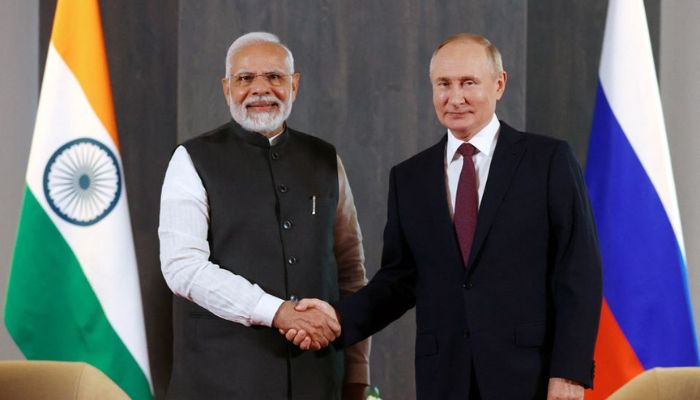
On Friday (September 16), Prime Minister Narendra Modi told Russian President Vladimir Putin about the need to establish global peace and end the conflict in Ukraine. He made the remarks during a bilateral meeting with Putin on the sidelines of the Shanghai Cooperation Summit (SCO) in Samarkand in Uzbekistan.

“Today’s era is not of war and I have spoken to you about it on the call. Today we will get the opportunity to talk about how we can progress on the path of peace. India and Russia have stayed together with each other for several decades,” the Indian Prime Minister told the Russian President.

PM Modi also thanked Putin and Ukrainian President Volodymyr Zelenskyy for facilitating the evacuation of Indian students from the war-torn areas. He added, “We spoke several times on the phone about India-Russia bilateral relations and various issues. We should find ways to address the problems of food, fuel security and fertilizers.”

Russian President Vladimir Putin acknowledged the concerns raised by the Indian Prime Minister. “I know about your position on the Ukraine conflict. I know about your concerns. We want all of this to end as soon as possible. But the other party, the leadership of Ukraine has claimed… that they refuse to engage in the negotiation process.”

“They said they want to achieve their objectives, as they say, on the battlefield militarily. We will keep you abreast of everything that is happening over there. We are actively engaging on international platforms. We are in discussion on international issues. Sometimes these issues are something that is not very good news…,” Putin emphasised.

He further emphasised that the trade between India and Russia is growing and that the supply of Russian fertilisers to India has grown more than 8 times. “I am hopeful that this is going to be of huge help of the agricultural sector of India,” he remarked.

The two-day summit was attended by Prime Minister Narendra Modi, Russian President Vladimir Putin and Chinese President Xi Jinping along with other leaders from a total of fifteen heads of state and the heads of ten international organizations. 

US Media heaps praise on PM Modi for ‘rebuking’ Putin

On Friday, the US media heaped praise on the Indian Prime Minister for ‘bluntly and publicly’ challenging Putin to stop the war in Ukraine.

The Washington Post wrote, “The rare reproach showed the 69-year-old Russian strongman coming under extraordinary pressure from all sides. Internationally, he is facing calls to end the war not only from his traditional critics in the West but also from Asian partners whom he cannot paint as beholden to the U.S.”

It further added, “Russia and India for years have enjoyed close bilateral cooperation, but, as with China, Putin’s decision to invade Ukraine has tested the relationship.”

Screengrab of the news report by The Washington Post

Similarly, The New York Times lauded the Indian government for looking Putin in the eye. It wrote, “Mr Modi’s comments came a day after President Xi Jinping of China — in his first face-to-face meeting with Mr Putin since the invasion began — struck a far more subdued tone than the Russian president, and steered clear in his public comments of any mention of Ukraine.”

“All along, India has called for dialogue while avoiding challenging Russia as an aggressor, with its officials quietly insisting that their country is an intermediate power and needs to maintain ties and credibility with both Russia and the West in order to help make peace,” it concluded.

Screengrab of the news report by The New York Times

This is the first in-person SCO Summit since the Covid epidemic. The most recent SCO Heads of State Summit took place in Bishkek in June 2019.

The SCO currently has eight member countries (China, India, Kazakhstan, Kyrgyzstan, Russia, Pakistan, Tajikistan, and Uzbekistan), four observer states interested in acceding to full membership (Afghanistan, Belarus, Iran, and Mongolia), and six “Dialogue Partners” (Armenia, Azerbaijan, Cambodia, Nepal, Sri Lanka and Turkey).

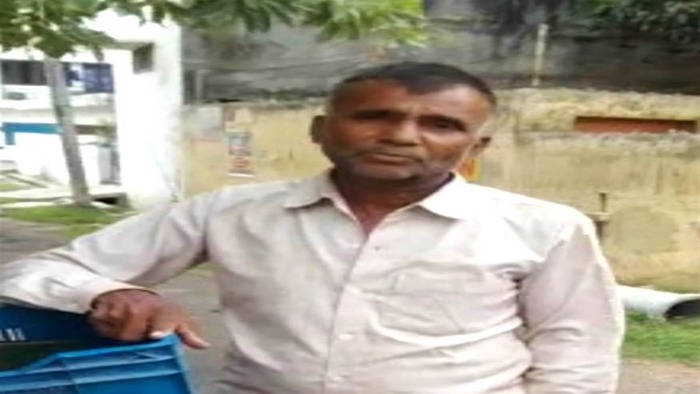
Bareilly: Vegetable vendor Sharif caught on video urinating on vegetables and selling them in Hindu majority localities, arrested

In the Bareilly district of Uttar Pradesh, Sharif, a vegetable vendor was beaten up by locals and handed over to the police after he was caught urinating on vegetables he was planning to sell in a Hindu majority area. Bareilly Police has registered a case against the accused. The video of the accused is going viral on social media.

The case is of the Izzatnagar area of Bareilly. A local, Durgesh Gupta, who lives in the city, was going out for some work in his car. Meanwhile, he noticed a 55-year-old elderly man pulling a vegetable cart on the colony’s roadside and urinating on the vegetables kept under the handcart. Durgesh recorded the vegetable seller as proof before confronting him, so he couldn’t deny it later.

Durgesh Gupta showed the video of Sharif urinating on the vegetables to the local people, who then thrashed Sharif black and blue. Harsh Bhardwaj, District President of Hindu Jagran Manch said, “This person has been selling veggies here for numerous years. Given Sharif’s age and hard labour, the majority of the people in the neighbourhood used to buy vegetables from him. However, people’s trust has been shattered as a result of this deed.”

According to Bareilly SSP Styarth Anirudh Pankaj, the accused vegetable vendor is still being questioned. He will be brought before the court. He is seen in the video urinating on the vegetables kept at the bottom of the handcart. During interrogation, it was learned that the individual’s name is Sharif and that he is a resident of Partapur Chaudhary police station, Izzatnagar. The accused Sharif has been arrested after a case was filed against him for disturbing the communal atmosphere, hurting religious sentiments, and spreading infection.